DOI 10.1007/s10152-002-0130-2
Abstract Macrofauna samples were taken in May 1996–1998 at 28 stations on the Dogger Bank (central North Sea) to describe species composition, spatial distri-bution and trophic structure of the macrofaunal commu-nities. In general, five communities could be distin-guished depending on the influence of different water masses, depth, type of sediment and food availability. Ex-cept for those species which feed in the sediment, macro-fauna communities did not show any correlation to the measured sediment variables. In fact, macrofauna com-munities of the Dogger Bank were mainly structured by lateral food supply via frontal systems. This was indicat-ed by the dominance of interface feindicat-eders foraging in the benthic boundary layer, which are able to switch from surface deposit to suspension feeding depending on flow conditions. The importance of sandlickers in the shallow-est parts of the Dogger Bank hints at an important contri-bution of benthic primary production to the nutritional and energetic needs of the benthic community.
Keywords Macrofauna communities · Benthos · Trophic structure · Total organic carbon (TOC) · North Sea · Dogger Bank
Introduction
The North Sea is one of the most intensely studied marine environments of the world, but ecological aspects and in-terrelationships are still poorly understood. Little is known about the offshore areas of the central and northern North Sea, whereas coastal areas have been investigated very thoroughly. In May 1986 the macrofauna communities of
the whole North Sea were studied synoptically by the IC-ES Benthos Ecology Working Group (Heip et al. 1992; Künitzer et al. 1992). According to the results of this North Sea Benthos Survey, the factors structuring species distributions and assemblages seemed to be temperature, the influence of different water masses (e.g. Atlantic water inflow), the type of sediment and the food supply to the benthos (Künitzer et al. 1992). The Dogger Bank proved to be a special region which separates the species and communities of the northern and southern North Sea.
Due to its importance for fisheries in former years, the Dogger Bank has been the subject of intensive inves-tigations since the beginning of the twentieth century. First investigations were carried out by Davis (1923, 1925) in 1921–1924. In 1950–1954 the echinoderm, polychaete and bivalve fauna of the Dogger Bank area were investigated by Ursin (1960), Kirkegaard (1969), and Petersen and Høpner (1977). At approximately the same time, Birkett sampled the western part of the Dogger Bank (cited in Kröncke 1991). The investiga-tions from the first half of the twentieth century concen-trated especially on zoogeography and gave only limited information on ecological aspects of the communities as well as on the distribution of other taxonomic groups, e.g. amphipods, due to rather coarse sieves.
During April/May 1985–1987, Ursin’s stations were partly revisited by Kröncke (1990, 1991, 1992). The long-term comparison of the macrofauna communities on the Dogger Bank revealed an increase in opportunis-tic species and an eightfold increase in biomass. The ex-tensive Spisula and Mactra patches described by Davis (1923, 1925), and to a lesser extend by Petersen and Høpner (1977) and Birkett (cited in Kröncke 1991), had disappeared. The observed changes were suggested to be the result of an increasing eutrophication and pollution of the central North Sea.
Within the framework of a renewed long-term com-parison, the stations sampled in the 1980s (Kröncke 1992) were revisited in May 1996–1998. The aim of this paper is to describe the spatial distribution, species composition and trophic structure of macrofaunal com-Communicated by E. Rachor
G. Wieking · I. Kröncke (
✉
) Department of Marine Research,Senckenberg Institute, Schleusenstrasse 39a, 26382 Wilhelmshaven, Germany
e-mail: [email protected] Tel.: +49-4421-947532, Fax: +49-4421-947550
O R I G I N A L A R T I C L E
Gunther Wieking · Ingrid Kröncke
Macrofauna communities of the Dogger Bank (central North Sea)
in the late 1990s: spatial distribution, species composition
and trophic structure
munities of the Dogger Bank in the late 1990s for the better understanding of the long-term changes found by Wieking and Kröncke (2001).
Methods
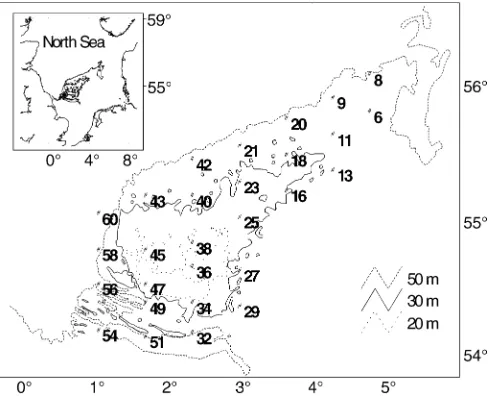
Sampling designTwenty-eight stations were selected on the Dogger Bank. The wa-ter depth ranged from 18 m at the shallow stations on top of the bank to 68 m in the deeper southern part and 47 m in the northern part (Fig. 1, Table 1). Macrofauna samples were taken in May 1996, 1997 and 1998 with RV “Senckenberg”. Two samples were taken at each station with a 0.2 m2 van Veen grab, weighing
150 kg. Macrofauna grab samples were washed over 1 mm mesh size. The retained material was preserved in 4% buffered formalin. For analysis of the fine fraction (<63 µm), organic carbon and nitrogen contents of sediments, samples were taken from an addi-tional grab and frozen at −20°C.
Sample treatment Macrofauna
In the laboratory, macrofauna samples were stained with Bengal Rose prior to sorting. The organisms were sorted, identified to the lowest possible taxon and counted. Species abundance data are standardized to a total per square metre at each site. The species number is given as total number for both samples (0.4 m2).
Species composition, total abundance and species numbers of the different communities are given as mean numbers for May 1996–1998, as the ordination by multidimensional scaling (MDS) performed for the three years showed that communities remained similar throughout the years 1996–1998.
Statistical tests comparing the fauna and sediment parameters were performed with the data from May 1996 and, accordingly, sediment and trophic structure data are given as examples for this year. As recent investigations showed that sediment parameters did not show significant differences throughout the years, these are suggested to be representative.
The general trophic structure of the communities was assigned by classification into feeding types using information from the lit-erature (e.g. Fauchald and Jumars 1979; Lincoln 1979; Hayward Fig. 1 Map of the area of investigation in the central North Sea with sampling stations
Table 1 Location and depth of the sampling stations as well as dates of sampling
Station N E Depth (m) May
96 97 98
6 55° 48′ 04° 51′ 34 x x
8 56° 04′ 04° 51′ 43 x x x
9 55° 54′ 04° 20′ 43 x x x
11 55° 38′ 04° 20′ 32 x x x
13 55° 22′ 04° 20′ 42 x x x
16 55° 13′ 03° 40′ 32 x x x
18 55° 29′ 03° 40′ 31 x x x
20 55° 45′ 03° 40′ 47 x x x
21 55° 33′ 03° 00′ 40 x x x
23 55° 17′ 03° 00′ 29 x x x
25 55° 01′ 03° 00′ 23 x x x
27 54° 37′ 03° 00′ 33 x x x
29 54° 21′ 03° 00′ 39 x x x
32 54° 09′ 02° 20′ 51 x x x
34 54° 23′ 02° 20′ 27 x x x
36 54° 39′ 02° 20′ 18 x x x
38 54° 50′ 02° 20′ 27 x x
40 55° 11′ 02° 20′ 32 x
42 55° 27′ 02° 20′ 44 x x x
43 55° 11′ 01° 40′ 36 x x x
45 54° 47′ 01° 40′ 23 x x x
47 54° 31′ 01° 40′ 18 x x x
49 54° 23′ 01° 40′ 48 x x x
51 54° 07′ 01° 40′ 68 x x
54 54° 10′ 01° 00′ 45 x x x
56 54° 31′ 01° 00′ 55 x x
58 54° 47′ 01° 00′ 50 x x x
and Ryland 1990 and references therein; Künitzer et al. 1992; Hartmann-Schröder 1996; Dauwe et al. 1998).
Generally, interface-feeders are capable of alternative suspen-sion and surface-deposit feeding dependent on flow conditions. Symbiotic deposit feeders are those species which utilize symbiotic (e.g. sulphate-reducing) bacteria in their nutrition (e.g. lucinid clams). In addition to the classical classification, we distinguished two additional feeding types: species that clean their food off sand grains were separated from subsurface deposit feeders and classi-fied as sandlickers (Remane 1940). Since Anthozoa and Corymor-pha nutans are known to feed mainly on pelagic copepods and har-pacticoids swimming in the water column at night (Eleftheriou and Basford 1983; Holohan et al. 1998), these species were separated from suspension feeders and predators as hyperbenthos predators.
Sediments
Fine fraction (<63 µm) content. The fine fraction (<63 µm) content at each station was analysed using the “Analysette 22 Economy” laser particle sizer (Fritsch, Germany). Frozen sediment was freeze-dried. Samples were sieved with a 1,000 µm sieve to remove shell particles and macroalgae. An aliquot of each sample was placed in the laser particle sizer and automatically homogenized with a stirrer and by ultrasonication. Although this method pro-vides the percentage of different grain size fractions, we only used the grain size fraction <63 µm (mud) for further statistical analysis. Organic carbon and nitrogen contents and C/N ratio. According to Wirth and Wiesner (1988), higher total organic carbon (TOC) of the total sediment (TOCtot) is primarily related to the higher ratio of clay/silt to sand and, thus, to the hydrodynamic regime. In con-trast, the increase in TOC content of the fine fraction (TOC<63µm) arises from a local admixing of varying amounts of small sized or-ganic-rich particles to an otherwise low and constant TOC back-ground, probably as a response to direct planktonic inputs or tem-porary deposition of suspended matter. Therefore, TOC, total ni-trogen (TN) and C/N ratio were analysed for the total sediment (TOCtot, TNtotand C/Ntot) as well as for the fine fraction <63 µm (TOC<63µm, TN<63µm and C/N<63µm). The fraction <63 µm was sep-arated by wet sieving over 63 µm mesh size to determine variables related to the fine fraction. Analyses of total sediment organic car-bon and nitrogen were performed on freeze-dried samples that were powdered and homogenized.
For all sediment fractions an aliquot of 10–30 mg was com-busted at 1,010°C in a Heraeus C/N analyser following acidificat-ion of the samples with concentrated HCl in a desiccator to re-move inorganic carbonates.
Statistics
The PRIMER 5 (Plymouth routines in multivariate ecological re-search) software package was used for statistical analyses of faunal data. MDS analyses (Kruskal and Wish 1978) were performed. The data were transformed using double square roots. Similarities were calculated using the Bray–Curtis coefficient. Characteristic species which contribute most to the similarity of the station groups were identified using the SimPer (similarity percentage) tool.
The environmental data were analysed for subsets of abiotic variables whose multidimensional patterns corresponded best with those of the species data using the Bio-Env tool.
Canonical correspondence analysis (CCA) was performed with Canoco software (Microcomputer Power, Ithaca, N.Y.). CCA was applied to evaluate correlations between environmental variables, species and variance in site patterns. The Monte Carlo permutation test was used to check the statistical validity of these associations.
The Kolmogorov–Smirnov test was applied to test which data were normally distributed. In the case of normal distribution we applied Pearson’s product moment correlation to calculate the cor-relation between two variables. Otherwise, Spearman rank correla-tion was applied.
The spatial patterns were interpolated using the inverse dis-tance weighted interpolator.
Fig. 2 Spatial distribution of A the sediment fine fraction (<63 µm) content (%), B total organic carbon (TOC) content of the total sediment (TOCtot) (%) and C TOC of the fine fraction (<63 µm) (TOC<63µm) (%) in May 1996
Results
Sediment
Fine fraction content
shallow and the eastern parts of the Dogger Bank showed the lowest values (station 38: 0.34%, station 45: 0.38%), and the mud content increased towards the er south-western sites. Fine fraction contents of the deep-er southdeep-ern stations wdeep-ere highdeep-er (station 32: 6.07%, sta-tion 51: 11.07% in the Outer Silver Pit) than those of the deeper northern stations (station 42: 1.97%).
TOC, TN and C/N of the total sediment
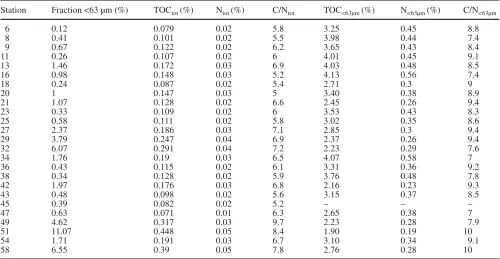
TOCtot, TNtotand C/Ntotshowed nearly the same spatial pattern as the fine fraction content, as they correlated pos-itively with the fine fraction content (Table 2). Values were lowest in the shallow and in the eastern parts of the Dogger Bank, and increased towards the deeper south-western part (Fig. 2B). TNtot values were very low and varied little, ranging between 0.02% and 0.04% (Table 2).
TOC, TN and C/N of the fine fraction
The values measured for the fine fraction showed a much more variable spatial pattern. In general, highest TOC<63µmand TN<63µmcontents were found in the east-ern part of the Dogger Bank (Fig. 2C, Table 2), but the values decreased towards the deeper southern parts char-acterized by muddy fine sands, and towards the deeper central northern stations (42 and 21). Locally higher TOC<63µmcontents were measured on top of the Dogger Bank (stations 34 and 38) and on station 54 in the west-ern part.
C/N<63µmratio increased with depth ranging between 7 in the shallow and 10 in the deeper parts (Table 2). However, there were some deviations from this pattern, such as station 36 on top of the Bank (C/N 9.2), and sta-tion 32 in the Outer Silver Pit (C/N 7.6).
Overall, two types of sediment could be distinguished for the Dogger Bank (Fig. 3). Sediments of the Outer Silver Pit and the Oyster Ground (the southern stations) covered quite a narrow range of TOC<63µm(1.9–2.5%) of the entire fine fraction content between 2% and 13%. The sediments of the Dogger Bank and towards the cen-tral North Sea displayed higher TOC<63µm values (2.16–4.12%) at comparable fine fraction contents. Table 2 C/N ratios, total organic carbon (TOC) and nitrogen contents in total surface sediments (tot) as well as in the fine fraction (<63 µm) contents in May 1996. C/N ratios are raw data, TOC and TN contents (%) are rounded, – no sample
Station Fraction <63 µm (%) TOCtot (%) Ntot (%) C/Ntot TOC<63µm (%) N<63µm (%) C/N<63µm
6 0.12 0.079 0.02 5.8 3.25 0.45 8.8
8 0.41 0.101 0.02 5.5 3.98 0.44 7.4
9 0.67 0.122 0.02 6.2 3.65 0.43 8.4
11 0.26 0.107 0.02 6 4.01 0.45 9.1
13 1.46 0.172 0.03 6.9 4.03 0.48 8.5
16 0.98 0.148 0.03 5.2 4.13 0.56 7.4
18 0.24 0.087 0.02 5.4 2.71 0.3 9
20 1 0.147 0.03 5 3.40 0.38 8.9
21 1.07 0.128 0.02 6.6 2.45 0.26 9.4
23 0.33 0.109 0.02 6 3.53 0.43 8.3
25 0.58 0.111 0.02 5.8 3.02 0.35 8.6
27 2.37 0.186 0.03 7.1 2.85 0.3 9.4
29 3.79 0.247 0.04 6.9 2.37 0.26 9.4
32 6.07 0.291 0.04 7.2 2.23 0.29 7.6
34 1.76 0.19 0.03 6.5 4.07 0.58 7
36 0.43 0.115 0.02 6.1 3.31 0.36 9.2
38 0.34 0.128 0.02 5.9 3.76 0.48 7.8
42 1.97 0.176 0.03 6.8 2.16 0.23 9.3
43 0.48 0.098 0.02 5.6 3.15 0.37 8.5
45 0.39 0.082 0.02 5.2 – – –
47 0.63 0.071 0.01 6.3 2.65 0.38 7
49 4.62 0.317 0.03 9.7 2.23 0.28 7.9
51 11.07 0.448 0.05 8.4 1.90 0.19 10
54 1.71 0.191 0.03 6.7 3.10 0.34 9.1
58 6.55 0.39 0.05 7.8 2.76 0.28 10
Macrofauna
Note that in the figures some data are given exemplarily for May 1996 only, whereas the other data are given as means for the whole study period 1996–1998. MDS or-dination plots for the different communities in May 1996–1998 are presented in Wieking and Kröncke (2001).
Species number and macrofauna abundance
A total of 269 taxa was identified for the three cruises in May 1996–1998.
Mean species number per year and station was 47 species/0.4 m2 (Table 3). The maximum value (65
species/0.4 m2) was reached at stations 40, 49 and 60 in
May 1997. Generally, higher species numbers (more than 50 species/0.4 m2) were found along the northern
slope of the Dogger Bank (>30 m depth) and in the deep-er south-westdeep-ern part. Species numbdeep-er was lowdeep-er at the shallow stations on top of the Bank, and dropped to 17 species/0.4 m2 at the shallowest station 47 on the
South-West Patch. No correlation was found between species number and measured environmental variables.
Mean abundance per year and station was 1,225 ind/m2(Table 3). Maximum abundance was found at
sta-tion 6 (2,947 ind/m2). Mean abundance was lower at the
northern slope of the Dogger Bank, but minimum abun-dance was found again at station 47 (349 ind/m2). For
the rest of the investigated area, mean abundance ranged between 878 ind/m2 and 2,370 ind/m2 without obvious
spatial trends. Generally, the lowest abundances were re-corded in May 1996, which has already been discussed by Wieking and Kröncke (2001) in relation to the ex-traordinary cold winter of 1995/1996. Total abundance was correlated positively to TOC<63µm.
Macrofauna communities
In the area of investigation we separated five groups of stations by means of non-metric MDS and CCA (Figs. 4, 5). In general, the macrobenthic fauna on top of the Dog-ger Bank (Bank community, South-West Patch commu-nity) was different from the fauna of the surrounding deeper areas (Southern and Western Amphiura commu-nities, North-eastern community) (Fig. 5, Table 4). Ac-cording to the Bio-Env procedure, a combination of depth, TOCtot, TNtot (ρ=0.636) and depth, fine fraction (<63 µm), TNtot(ρ=0.633) best matches the ordination of the macrofaunal abundance data, which is also reflected in the CCA triplot. The addition of further factors does not increase the fit of the multivariate data. In the fol-Table 3 Macrofaunal species number per 0.4 m2and macrofaunal
abundance per m2in May 1996–1998. SD standard deviation, Com
Communities: B Bank, NE North-eastern, SA SouthernAmphiura,
SW South-West Patch, WA Western Amphiura, WT Western transi-tional, – no sample
Station Com Species number Abundance
no
1996 1997 1998 Mean SD 1996 1997 1998 Mean SD
6 B 45 – 41 43 3 763 – 5,130 2,947 3,088
8 NE 28 56 57 47 16 435 1,335 1,583 1,118 604
9 NE 51 56 44 50 6 1,103 1,168 573 948 326
11 B 46 64 44 51 11 1,155 1,405 1,188 1,249 136
13 SA 42 50 52 48 5 1,595 1,448 2,608 1,884 632
16 B 39 40 33 37 4 1,438 1,098 2,305 1,614 622
18 B 48 49 49 49 1 948 1,090 1,348 1,129 203
20 NE 47 59 57 54 6 575 630 420 542 109
21 NE 58 53 48 53 5 723 903 798 808 90
23 B 54 55 48 52 4 1,035 1,428 1,198 1,220 197
25 B 51 60 45 52 8 1,040 1,553 1,253 1,282 258
27 B 48 46 43 46 3 1,080 1,043 1,128 1,084 43
29 SA 42 42 57 47 9 675 1,515 2,328 1,506 827
32 SA 32 38 42 37 5 953 1,415 1,325 1,231 245
34 B 48 49 47 48 1 1,035 2,258 1,525 1,606 616
36 B 46 43 54 48 6 1,053 2,003 1,210 1,422 509
38 B 42 44 – 43 1 1,238 1,215 – 1,227 16
40 B – 65 – 65 – – 1,543 – 1,543 –
42 NE 46 59 60 55 8 580 1,160 665 802 313
43 NE 47 41 37 42 5 788 930 275 664 345
45 SW 35 20 28 28 8 623 935 833 797 159
47 SW 10 19 22 17 6 223 – 475 349 178
49 SA 54 65 53 57 7 1,363 4,158 1,588 2,370 1,553
51 WA 45 – 54 50 6 693 – 1,063 878 262
54 WT 44 64 59 56 10 840 1,255 1,518 1,204 342
56 WT – 53 47 50 4 – 1,080 510 795 403
58 WA 45 46 36 42 6 1,023 1,438 753 1,071 345
Table 4 Abundance and feeding types of characteristic species (ind/m2) for the different communities found on the Dogger Bank
in May 1996–1998. Species are ordered in decreasing contribution to similarity, as indicated by SimPer for the √√transformed
abun-dance data; HP hyperbenthos predator, IF interface feeder, P pred-ator, SD surface deposit feeder, SL sandlicker, SSD subsurface de-posit feeder, SyD symbiotic dede-posit feeder, U unknown
Bank community South-West Patch community North-eastern community
Spiophanes bombyx IF 514 Bathyporeia elegans SL 192 Spiophanes bombyx IF 125 Magelona johnstonii IF 74 Nephtys cirrosa P 60 Bathyporeia elegans SL 114 Amphiura brachiata IF 83 Bathyporeia guilli. SL 75 Scoloplos armiger SSD 59 Bathyporeia elegans SL 158 Donax vittatus SF 44 Polinices pulchellus P 15 Fabulina fabula IF 85 Polinices pulchellus P 21 Perioculodes longimanus U 17 Bathyporeia guilli. SL 83 Pontocrates arenarius U 15 Chaetozone sp. F group SD 12 Polinices pulchellus P 39 Perioculodes longimanus U 9 Edwardsiidae spp. HP 24 Magelona filiformis IF 30 Spiophanes bombyx IF 125 Dosinia lupinus SF 12 Perioculodes longimanus U 22 Goniada maculata P 4 Nephtys assimilis P 10 Phoronis mülleri SF 11 Magelona johnstonii IF 4 Cerianthus lloydii HP 62
Owenia fusiformis IF 13 Gari fervensis SF 11
Nephtys assimilis P 7 Ophelia borealis SSD 10
Bathyporeia tenuipes SL 27 Abra prismatica SD 26
Spio cf. decorata IF 24 Magelona johnstonii IF 14
Chaetozone sp. F group SD 11 Amphiura filiformis IF 14
Iphinoe trispinosa SL 10 Echinocyamus pusillus SL 20
Urothoe poseidonis SL 12 Goniada maculata P 7
Nephtys cirrosa P 13 Phoronis mülleri SF 30
Edwardsiidae spp. HP 8 Hippomedon denticulatus U 5
Goniada maculata P 7 Magelona filiformis IF 15
Mean total abundance 1,184 573 813
per m2
Mean species number 49 23 50
per 0.4 m2
Southern Amphiura community Western Amphiura community
Amphiura Transitional
Amphiura filiformis IF 640 Amphiura filiformis IF 376 Amphiura filiformis IF 103 Mysella bidentata SF 127 Pholoe baltica P 33 Spiophanes bombyx IF 182 Spiophanes bombyx IF 300 Spiophanes bombyx IF 109 Scoloplos armiger SSD 44 Pholoe baltica P 66 Diplocirrus glaucus SD 23 Bathyporeia elegans SL 85 Magelona filiformis IF 23 Mysella bidentata SF 36 Goniada maculata P 11 Polinices pulchellus P 13 Phoronis mülleri SF 16 Echinocyamus pusillus SL 199 Nemertini spp. P 13 Nemertini spp. P 14 Polinices pulchellus P 13 Nucula nitidosa SSD 61 Cylichna cylindracea P 16 Ophelia borealis SSD 58 Echinocardium cordatum SD 10 Phaxas pellucidus SF 10 Phaxas pellucidus SF 14 Phaxas pellucidus SF 11 Lucinoma borealis SyD 8 Phoronis mülleri SF 8 Bathyporeia tenuipes SL 10 Nucula nitidosa SD 22 Cochlodesma pratenue SF 6 Harpinia antennaria U 7 Harpinia antennaria U 13 Owenia fusiformis IF 7 Tellimya ferruginosa SF 7 Scoloplos armiger SSD 13 Sthenelais limicola P 7 Cylichna cylindracea P 12 Edwardsiidae spp. HP 7 Edwardsiidae spp. HP 10 Thyasira flexuosa SyD 16 Echinocardium cordatum SD 4 Nephtys assimilis P 4 Nephtys hombergii P 10 Thyasira flexuosa SyD 5 Echinocardium cordatum SD 3 Diplocirrus glaucus SD 29 Nephtys hombergii P 8 Bathyporeia guilliamsoniana SL 4 Phoronis mülleri SF 11 Nuculoma tenuis SSD 21 Amphiura brachiata IF 15 Scoloplos armiger SSD 37 Eudorellopsis deformis SL 13 Abra prismatica SD 12
Abra alba SD 20 Goniada maculata P 5 Nemertini spp. P 6
Mean total abundance 1,748 992 1,000
per m2
Mean species number 47 50 53
per 0.4m2
lowing sections, the five communities are characterized in detail.
Bank community. Especially at the shallow stations (<25 m) the Bank community was dominated by the amphipods Bathyporeia elegans (158 ind/m2) and B.
gu-illiamsoniana (83 ind/m2). At deeper stations (>25 m)
the abundances of the tellinid bivalve Fabulina fabula (85 ind/m2), the ophiurid Amphiura brachiata
(83 ind/m2) and the polychaetes Spiophanes bombyx
(514 ind/m2), Magelona johnstoni (74 ind/m2), M.
filifor-mis (30 ind/m2), Spio cf. decorata (24 ind/m2) and
Owenia fusiformis (13 ind/m2) were higher (Table 4).
domi-South-West Patch community. Stations at the domi-South-West Patch (stations 45 and 47) formed a subgroup of the Bank community. The South-West Patch fauna was char-acterized by an impoverished Bank fauna with low cies and individual numbers (Tables 3, 4). Dominant spe-cies were Bathyporeia elegans (192 ind/m2) and B.
guil-liamsoniana, with lower abundances than at the other stations on top of the bank (75 ind/m2), but Donax
vitta-tus (44 ind/m2) and Nephtys cirrosa (60 ind/m2) showed
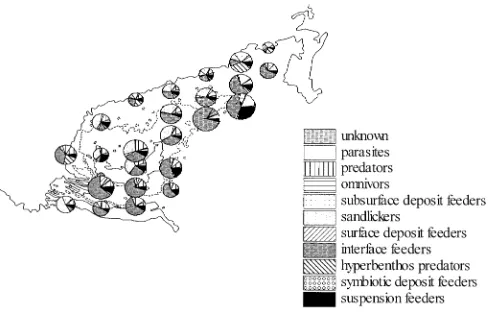
their highest abundances at these stations (Table 4). Con-cerning the trophic structure, in particular the numbers and abundances of interface-feeding polychaetes were lower in the South-West Patch community compared to the Bank community (Fig. 6). In contrast, sandlickers dominated the community throughout the three years. The comparatively high contribution of predators was due to the occurrence of the small predatory polychaete, N. cirrosa.
North-eastern community. Along the northern slope and towards the north-eastern part of the Dogger Bank, sta-tions were inhabited by a transitional community and the fauna also changed with depth (Figs. 4, 5). The fauna of shallower stations close to the bank (mainly stations 21 and 43) was still rather similar to the Bank fauna [Spiophanes bombyx (125 ind/m2), Bathyporeia elegans
(114 ind/m2) and Polinices pulchellus (15 ind/m2)], but
in addition Cerianthus lloydii (62 ind/m2) and
Echino-cyamus pusillus (20 ind/m2) occurred at high abundances
(Table 4). The deepest northern stations (mainly stations 8, 9, 20, 42) were characterized by higher abundances of Amphiura filiformis (14 ind/m2), Abra prismatica (26
ind/m2) and Scoloplos armiger (59 ind/m2). Generally,
hardly any dominance of species was found in the north-eastern part, but many species contributed similarly to the total abundance. Among these were several rare spe-cies known from the northern North Sea such as Aric-idea cerrutii and A. simonae, as well as species prefer-ring coarser sediments, such as Ophiura affinis and Pisi-one remota.
The latter findings were also reflected in a compara-tively high structural and functional diversity (Fig. 6). Nonetheless, some feeding types, such as hyperbenthos predators (Cerianthus lloydii, C. nutans) and sandlickers (Echinocyamus pusillus), showed locally high abun-dances.
Southern Amphiura filiformis community. Towards the southern stations in water depths >35 m, the Bank com-munity changed and was finally dominated by Amphiura filiformis (640 ind/m2). These changes were correlated to
an increase in the fine fraction (<63 µm) content. Pholoe baltica (66 ind/m2), Mysella bidentata (127 ind/m2) and
Nucula nitidosa (61 ind/m2) were also important parts of
the fauna present in this area (Table 4).
Despite the significant change in faunal composition, this community was also dominated by interface-feeding species [Amphiura filiformis and, locally, Spiophanes bombyx (300 ind/m2)]. Subsurface deposit feeders (e.g.
nated by interface-feeding species, such as the polychae-tes and A. brachiata, contributing up to 60% to the total abundance (Fig. 6). The second most important group comprised sandlicking amphipods and cumaceans. The most important predator of the Bank community was the naticid gastropod, Polinices pulchellus (39 ind/m2).
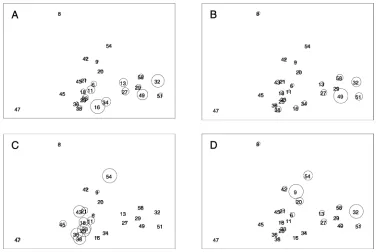
Fig. 4 MDS ordination of the √√ transformed abundance data
from May 1996 only. Relative depth is superimposed by the size of
the circles (Stress 0.11). Numbers are station numbers
Fig. 5 Spatial distribution of macrofauna communities in the study area in May 1996–1998
Amphictene auricoma, Lagis koreni, Nucula nitidosa), the second most important feeding type, as well as sur-face deposit feeders (Diplocirrus glaucus, Abra alba) appeared in highest abundances in this community (Fig. 7B, D). Suspension feeders were mainly represent-ed by the bivalve Mysella bidentata, a commensal of Amphiura filiformis.
Western Amphiura filiformis community.Although simi-lar in abundance of the dominant species Amphiura filiformis (376 ind/m2), Pholoe baltica (33 ind/m2),
Spiophanes bombyx (109 ind/m2) and Mysella bidentata
(36 ind/m2), the remaining associated fauna of the
Amphiura community changed in the Outer Silver Pit and towards the deeper western parts (Table 4). In this area the number of species typical for the northern North Sea [e.g. Nuculoma tenuis (21 ind/m2), Lucinoma
bore-alis (8 ind/m2), Amparete falcata (33 ind/m2)] was
high-er than in the southhigh-ern part of the Amphiura community. Especially at station 51, up to ten individuals of different large and long-lived species were found in both grabs (e.g. Acanthocardia echinata, Priapulus caudatum, Bris-sopsis lyrifera, Pectinaria belgica, Leptosynapta inhaer-ens and Glycera spp.).
Due to the occurrence of spatial and temporal variable sand banks and ripples (the Hills) the morphological het-erogeneity was high in this area (Fig. 1). Therefore, spa-tial variability can hardly be separated from temporal variability throughout the period of investigation. Gener-ally, the fauna of the deep stations with lower mud con-tents (Western transitional, mainly stations 54 and 56) differed from those with higher mud contents (Western Amphiura community, mainly stations 51, 58, 60). West-ern transitional stations showed a somewhat different fa-unal composition similar to the North-eastern
communi-ty with Amphiura filiformis (102 ind/m2) and
Bathypor-eia elegans (85 ind/m2) as well as locally high
abun-dances of Ophelia borealis (58 ind/m2) and
Echinocya-mus pusillus (199 ind/m2).
The trophic structure was as variable as the faunal composition. Due to the occurrence of Amphiura filifor-mis and Spiophanes bombyx, most stations were dominat-ed by interface-fedominat-eding species. Sandlickers, representdominat-ed by Bathyporeia elegans and Echinocyamus pusillus, were the dominant feeding types at the stations inhabited by the transitional community. Hyperbenthos predators such as Corymorpha nutans and Cerianthus lloydii occurred in varying numbers at both types of station.
Correlations between feeding types and environmental variables
Due to the high species numbers, and since the correla-tion of single species to the measured environmental variables was weak (Fig. 8), we correlated functional groups with environmental variables. Among the differ-ent feeding types only those species that forage in the sediment (sandlickers and subsurface deposit feeders) showed significant correlations with the measured envi-ronmental variables (Table 5). The abundance of sand-lickers was negatively correlated with the fine fraction (<63 µm), TOCtot, and C/Ntot, whereas their species num-ber was correlated negatively with TOCtot,and positively with TOC<63µm.
Species numbers of subsurface deposit feeders were positively correlated with water depth and C/N<63µm of the fine fraction, and negatively with TOC<63µm and N<63µm. The abundance of subsurface deposit feeders was only correlated to water depth (positively).
Discussion
The shallow parts (Bank community and South-West Patch)
The stations on top of the Dogger Bank were inhabited by a Bathyporeia–Fabulina community. Towards the southern slope, the abundance of Fabulina fabula, Amphiura brachiata and tube-building polychaetes such as Spiophanes bombyx and Owenia fusiformis increased.
The dominance of eurytherm cosmopolitan and tem-perate species such as Spiophanes bombyx and Bathy-poreia elegans reflects the comparatively large seasonal variations in temperature in a shallow area such as the Dogger Bank (Künitzer 1990). However, high summer temperatures in connection with moderate winter tem-peratures (Otto et al. 1990) support the presence of southern species from warm temperate areas reaching the Dogger Bank via the English Channel (e.g.
Megalur-opus agilis, Amphiura brachiata, Donax vittatus, Sync-helidium maculatum). Several species of this zoogeo-graphical group actually increased in abundance and spread across the Dogger Bank as a result of temperature increase since the late 1980s (Wieking and Kröncke 2001).
The shallow part of the Dogger Bank is a highly dy-namic area where periods of tidal resuspension and sedi-mentation alternate, but no net deposition occurs (von Haugwitz and Wong 1988; Puls 1987). As a result there is only minor accumulation of organic matter in the sedi-ment (low TOCtot) and even in the surface layer, as mea-sured by Stoeck and Kröncke (2001). There is no de-tailed information on sedimentation and resuspension on the Dogger Bank, but investigations on a sandy site in the southern North Sea inhabited by similar communities revealed that tidal resuspension potential is governed by the supply of benthic fluff (Jago and Jones 1998). Supply of fluff was greatest in May after phytoplankton blooms, but was still significant in January. The occurrence of thermal fronts might additionally support locally higher food supply to the benthos in the benthic boundary layer in several areas of the shallow part of the bank (Fig. 9) in Table 5 Correlations between sediment and macrofauna; SL sandlickers, SSD subsurface deposit feeders; *P<0.05, **P<0.01
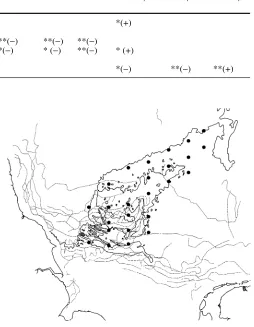
Depth Fraction TOC tot Ntot C/Ntot TOC<63µm N<63µm C/N<63µm <63 µm
Total macrofauna abundance *(+)
Species number
Abundance SL **(−) **(−) **(−) **(−) **(−)
Species number SL **(−) **(−) *(−) * (−) **(−) * (+)
Abundance SSD **(+)
Species number SSD **(+) *(−) **(−) **(+)
Fig. 8 Triplot of the CCA ordination of the species data from May 1996 only. Open circles represent the station positions within the ordination space, black dots represent the positions of individual taxa contributing significantly to the biological variance. The
vec-tor lines represent the relationship of significant environmental
variables to the ordination axes, and their length is proportional to their relative significance
Fig. 9 Position of the Flamborough/Frisian frontal system (grey
lines) from satellite infrared images in 1978–1980 (see Otto et al.
polychaetes at the deeper sites of the Bank community. Similar observations were made by Oliver et al. (1980) at a shallow sublittoral area at the Pacific coast off Cali-fornia. An additional hint for higher sediment mobility is the dominance of Amphiura brachiata in the Bank com-munity. This buries deeper in the sediment than Amph-iura filiformis, which is the dominant species of the deeper regions where sediment disturbance is less effec-tive.
Even greater effects of hydrodynamic stress can be found at the South-West Patch sites. This shallow area on top of the Dogger Bank is strongly influenced by bot-tom stress and sediment disturbance during storm events (von Haugwitz and Wong 1988). The authors showed that during a north-westerly storm at a station on the South-West Patch, horizontal current speeds at 10 m depth exceeded 45 cm/s for almost a day. Even the nor-mal periodic tidal current became unidirectional. Fre-quent resuspension of bed sediment will erode organ-isms, inhibit larval settlement and damage the appendag-es of speciappendag-es feeding at the sediment–water interface (Dauwe et al. 1998). This strong environmental stress re-sults in low abundance and a macrofauna community with low diversity, consisting of an adapted fauna such as the mobile amphipod Bathyporeia and the filter-feed-ing bivalve Donax vittatus, which is highly adapted to sediment mobility (Dörjes 1979; Ansell 1983).
North-eastern transitional community
The community in the northern and north-eastern part of the Dogger Bank (north-eastern community) was a tran-sitional community similar to the Bathyporeia–Fabulina association on top of the Bank as well as to the Amph-iura association described for the central North Sea by Duineveld et al. (1987) and Künitzer (1990). Amphiura filiformis appeared only at the deepest northern stations. In this community we found the highest species num-bers, lowest total abundances and, consequently, highest diversity. On the other hand, it was characterized by higher numbers of rather rare northern species and spe-cies preferring coarser sediments (Wieking and Kröncke 2001). The occurrence of northern species reflects the in-fluence of northern water masses and lower bottom tem-peratures on the species composition of this area.
The presence of species preferring coarser sediment indicates differences in the hydrodynamic conditions, and consequently in the food supply to the benthos, since sediment composition reflects the hydrodynamic regime in the benthic boundary layer. Moreover, passive pene-tration of organic matter into the sediment and, thus, food supply is strongly influenced by sediment composi-tion (Huettel and Rusch 2000). For the north-eastern part of the Dogger Bank, only little and highly variable local sedimentation of refractory fine material of mainly bio-logical origin occurred, reflected by the low TOCtot con-tent (generally below 0.1%) and the high TOC<63µm con-tent (up to 3.5%) and C/N<63µmratio (7.5–9). At the cen-addition to winter primary production. This is confirmed
by the locally higher TOC<63µmcontent of the fine frac-tion as well as the low C/N ratios of TOC, indicating high quality of organic matter in the sediment. This input of little, but fresh, organic material in the shallow parts of the bank was also shown by Stoeck and Kröncke (2001) and Wieking (2002), using phytopigments as a marker for fresh organic material. This situation favours those species which feed in the benthic boundary layer, and especially those which are able to switch from sur-face deposit to suspension feeding. Indeed, intersur-face feeding was the most important feeding type in the Bank community. The high quality of organic mater on top of the Dogger Bank was also reflected in the high quality of food in the gut of the surface-deposit-feeding sea urchin Echinocardium cordatum (Wieking and Kröncke 2002).
Sandlickers (such as Bathyporeia spp) were the sec-ond most important feeding type of the communities on top of the bank and even dominated the South-West Patch community (stations 45 and 47). The importance of species relying on the sediment as a food resource seems to contradict the finding of low amounts of food (as indicated by the low TOCtot) in the sediments of the bank. But as already emphasized by Cammen (1982), “it would be difficult, if not useless, to attempt to assess nu-tritional quality of the sediment with bulk sediment ana-lyses” for organisms that feed selectively on sediment and ingest only a limited range of particle sizes. Sand-licking species are highly selective deposit feeders. Bathyporeia spp. and cumaceans such as Iphinoe trispi-nosa are described as cleaning their food of sand grains. Sundbäck and Persson (1981) and Herman et al. (2000) showed that Bathyporeia pilosa, from coastal waters, feeds mainly on benthic diatoms. Taking the high abun-dances of amphipods into consideration, benthic primary production of small diatoms growing on sand grains seems to be an important food source in a shallow area with considerable light penetration, such as the Dogger Bank, as described for other shallow areas (Nelson et al. 1999; Cahoon et al. 1993).
At the exposed South-West Patch, the availability of rare and mainly small prey organisms is reflected in the presence of the small predatory polychaete Nephtys cir-rosa, which replaces the bigger Nephtys hombergii and N. assimilis living in the other areas of the Dogger Bank. Gut contents of N. cirrosa from the South-West Patch stations consisted of up to 50% of juvenile N. cirrosa as well as small spionids, nematodes and harpacticoids (personal observations). This cannibalistic behaviour hints at a strong food limitation for this predatory poly-chaete, as well as the total community.
tral northern stations 21 and 42, both TOC parameters showed low values.
Macrofauna trophic structure indicated that the North-eastern community along the northern slope was influ-enced by low food quantities and quality (especially in the deeper parts) in the sediment as well as in the benthic boundary layer. Predators, hyperbenthos predators and symbiotic deposit feeders contributed to a high function-al diversity function-along the northern slope, which is character-istic for communities in more refractory environments (Rosenberg et al. 1996; Dauwe et al. 1998). Subsurface deposit feeders (e.g. Pectinaria spp., Ampharete falcata, Paraonidae) and sandlickers such as Echinocyamus pus-illus are highly selective, reflecting the low amount of food in the sediment (Taghon 1981, 1982). Low abun-dances of interface-feeding species indicate lower food quantity in the benthic boundary layer (Dauwe et al. 1998). Predatory behaviour is a possible mechanism to satisfy nutritional needs in refractory sediments (Dauwe et al. 1998). Consequently, the importance of hyperben-thos predators which fulfil their nutritional needs by pdation in the water column or in the sediment might re-flect nitrogen deficiencies in the pelagic–benthic cou-pling. Macrofauna abundances in the North-eastern com-munity decreased towards the deeper northern stations and were correlated with TOC<63µm, which may indicate increasing food limitation of the macrobenthic communi-ty down the northern slope of the Dogger Bank.
Feeding modes, as well as sediment structure, reflect that the North-eastern community is heavily influenced by hydrodynamics. It is located in an area between the well-mixed water masses on top of the bank and the sea-sonally stratified water masses north of the bank. Where stratification occurs, the vertical exchange across the thermocline is considerably reduced (Otto et al. 1990), and consequently food quality can change substantially with developing stratification.
However, our data do not indicate any influence of subsurface phytoplankton production (up to 700 mg C/m2
per day) as measured by Nielsen et al. (1993), which should result in additional food supply for the benthos. Stoeck and Kröncke (2001) have already suggested that microbial benthic communities do not benefit from the high primary production of the frontal system along the northern slope of the Dogger Bank (Bo Pedersen 1994; Riegmann et al. 1990; Nielsen et al. 1993; Richardson et al. 1998) due to strong hydrodynamic conditions. High cur-rent velocities in the north-eastern part of the Dogger Bank (Siegismund and Schrum 2001), in addition to a seasonal jet (Brown et al. 1999), limit the accumulation of particulate organic material in the sediment. In addi-tion, Klein et al. (1999) showed that during storms fine sediment is mobilized up to 60 m depth at the northern slope of the Dogger Bank.
A model by Bo Pedersen (1994) described the north-ward transport of nutrient-rich deep water in the thermo-cline, which means that organic matter originating from the subsurface phytoplankton bloom might also be trans-ported towards the central North Sea. Finally, the
ob-served differences in the pelagic food web structure of the frontal system north of the Dogger Bank, compared with the surrounding waters (Richardson et al. 1998), showed that a significant part of the additional primary production is consumed in the pelagic system. As a con-sequence, the benthic system receives mainly refractory material, e.g. faecal pellets.
The deeper parts (Southern and Western Amphiura communities)
The southern and western Amphiura communities were similar as to the dominant species, but differed in the oc-currence of species from the northern North Sea.
Species typical of cold temperate and Arctic boreal areas occurred mainly in the deeper part southwest of the Dogger Bank, reflecting the inflow of water masses from the north. A few species from warm temperate areas (Lumbrineris spp.) also occurred in these areas, possibly as a result of constant rather than high temperatures.
High fine fraction (<63 µm) (up to 13%) and TOCtot (up to 0.45%) contents reflected sedimentation and accu-mulation of organic matter (Wirth and Wiesner 1988) in the south-western part of the Dogger Bank, but TOC<63µmcontents were low (1.9–2.8%) and C/N ratios high, indicating higher amounts of refractory organic matter.
The communities in the deeper south-western part of the Dogger Bank were (similarly to the Bank communi-ty) dominated by interface-feeding species foraging in the benthic boundary layer. The dominant species in the south-western part was Amphiura filiformis, an interface feeder ingesting both deposited and suspended food items, especially macro-flocs (Loo et al. 1996). The highest abundances of this species were also found in frontal areas such as the Skagerrak (Rosenberg 1995) and south of the Dogger Bank (Duineveld et al. 1987).
References
Ansell AD (1983) The biology of the genus Donax. In: McLachlan A, Erasmus T (eds) Sandy beaches as ecosystems. Dev Hydro-biol 19:607–635
Bo Pedersen F (1994) The oceanographic and biological tidal cy-cle succession in shallow sea fronts in the North Sea and the English Channel. Estuar Coast Shelf Sci 38:249–269
Boon AR, Duineveld GCA (1996) Phytopigments and fatty acids as molecular markers for the quality of near-bottom particulate organic matter in the North Sea. J Sea Res 35:279–291 Boon AR, Duineveld GCA (1998) Chlorophyll a as a marker for
bioturbation and carbon flux in southern and central North Sea sediments. Mar Ecol Prog Ser 162:33–43
Brown J, Hill AE, Fernand L, Horsburgh KJ (1999) Observations of a seasonal jet-like circulation at the Central North Sea cold pool margin. Estuar Coast Shelf Sci 48:343–355
Cahoon LB, Beretich GR Jr, Thomas CJ, McDonald AM (1993) Benthic microalgal production at Stellwagen Bank, Massachu-setts Bay, USA. Mar Ecol Prog Ser 102:179–185
Cammen LM (1982) Effect of particle size on organic content and microbial abundance within four marine sediments. Mar Ecol Prog Ser 9:273–280
Dauwe B, Herman PMJ, Heip CHR (1998) Community structure and bioturbation potential of macrofauna at four North Sea stations with contrasting food supply. Mar Ecol Prog Ser 173: 67–83
Davis FM (1923) Quantitative studies on the fauna of the sea bot-tom. 1. Fish Invest Ser II 6(2):1–54
Davis FM (1925) Quantitative studies on the fauna of the sea bot-tom. 2. Fish Invest Ser II 8(4):1–50
Dörjes J (1979) Zur Populationsdynamik des Sägezähnchens, Donax vittatus. Nat Mus 109:305–311
Duineveld GCA, Künitzer A, Heyman RP (1987) Amphiura fili-formis (Ophiuroidea: Echinodermata) in the North Sea: distri-bution, present and former abundance and size composition. Neth J Sea Res 21:317–329
Eleftheriou A, Basford DJ (1983) The general behaviour and feed-ing of Cerianthus lloydi (Anthozoa, Coelenterata). Cah Biol Mar 24:147–158
Fauchald K, Jumars PA (1979) The diet of worms: a study of poly-chaete feeding guilds. Oceanogr Mar Biol Annu Rev 17:193–284 Hall SI (1994) Physical disturbance and marine benthic communi-ties: life in unconsolidated sediment. Oceanogr Marine Biolo-gy Annu Rev 34:179–239
Hartmann-Schröder G (1996) Annelida, Borstenwürmer, Polycha-eta. In: Dahl F (ed) Die Tierwelt Deutschlands und der angren-zenden Meeresteile. Fischer, Jena, Germany
Haugwitz W von, Wong HK (1988) The Dogger Bank: seismic stratigraphy and holocene sedimentation. In: Kempe S, Liebezeit G, Dethlefsen V, Harms U (eds) Biogeochemistry and distribution of suspended matter in the North Sea and im-plications to fisheries biology. (SCOPE/UNEP Sonderband 65) Geologisch-Paläeontologisches Institüt, Hamburg, pp 381–407 Hayward PJ, Ryland JS (1990) The marine fauna of the British
Isles and North-West Europe. Clarendon, Oxford
Heip C, Basford D, Craeymeersch JA, Dewarumez JM, Dörjes J, Wilde P de, Duineveld G, Eleftheriou A, Herman PMJ, Niermann U, Kingston P, Künitzer A, Rachor E, Rumohr H, Soetaert K, Soltwedel T (1992) Trends in biomass, density and diversity of North Sea macrofauna. ICES J Mar Sci 49:13–22 Herman PMJ, Middelburg JJ, Widdows J, Lucas CH, Heip CHR
(2000) Stable isotopes as trophic tracers: combining field sam-pling and manipulative labelling of food resources for macro-benthos. Mar Ecol Prog Ser 204:79–92
Hill AE, James ID, Linden PF, Matthews JP, Prandle D, Simpson JH, Gmitrowicz EM, Smeed DA, Lwiza KMM, Durazo R, Fox AD, Bowers DG (1994) Dynamics of tidal mixing fronts in the North Sea. In: Charnock H, Dyer KR, Huthnance JM, Liss PS, Simpson JH, Tett PB (eds) Understanding the North Sea system. The Royal Society/Chapman and Hall, London, pp 53–68
Conclusions
According to the multivariate analysis, depth and sedi-ment variables can explain part of the variability in spe-cies composition of the different macrofauna communi-ties of the Dogger Bank, whereas sediment variables alone correlated only with a limited number of feeding types. Our detailed analysis of the different communities revealed that none of the measured variables per se is re-sponsible for the observed differences among the macro-fauna communities.
In the North Sea macrofauna, distribution and species composition often coincide with specific depth contours, indicating differences in temperature and temperature variability (Künitzer et al. 1992). However, although northern species occurred preferentially in the North-eastern community, all communities on the Dogger Bank were dominated by eurytherm temperate and cosmopoli-tan species. Consequently, differences in temperature were not the main factor causing the occurrence of dif-ferent macrobenthic communities on the Dogger Bank. Moreover, lower temperatures at the northern slope are the effect of thermal stratification during summer, which in turn strongly influences the quality and quantity of food supply to the benthos.
Sediment variables only reflect the hydrodynamic conditions and thus, to some extent, food availability (Snelgrove and Butman 1994). During our large-scale in-vestigations, food supply was only measured by means of TOC and TN, which are poor indicators for bioavail-able organic matter and organic matter quality (Boon and Duineveld 1996, 1998; Dauwe et al. 1998). Bulk mea-surements of TOC and TN in sediments more often re-flect refractory material which may be of little value for macrofauna (Rice 1982; Josefson and Conley 1997). Sediment bulk measures do not indicate differences in food availability for those species feeding selectively on a limited range of particles (Cammen 1982).
However, significant differences in the trophic struc-ture of the communities suggest that the main factors causing the differences among the communities of the Dogger Bank were the availability, quantity and quality of food in the benthic boundary layer which, in turn, are partly dependent of frontal systems such as the Flambor-ough/Frisian frontal system. The importance of sandlick-ers in the shallowest parts of the Dogger Bank hints at a considerable contribution of benthic primary production to the nutritional and energetic needs of the benthic com-munity on top of the bank.
Our results show that macrofaunal community struc-ture and function are able to document and reflect pel-ago-benthic coupling in relation to hydrodynamics, since macrofauna integrates environmental conditions over longer time periods.
Puls W (1987) Simulation of suspended sediment dispersion in the North Sea. ICES/CM, C37
Remane A (1940) Einführung in die zoologische Ökologie der Nord- und Ostsee. In: Grimpe G von, Wagler E (eds) Die Tier-welt der Nord- und Ostsee, vol I, part Ia. Akademische Ver-lagsgesellschaft, Leipzig, pp 1–238
Rice DL (1982) The detritus nitrogen problem: new observations and perspectives from organic geochemistry. Mar Ecol Prog Ser 9:153–162
Richardson K, Nielsen TG, Bo Pedersen F, Heilmann JP, Lokkegaard B, Kaas H (1998) Spatial heterogeneity in the structure of the planktonic food web in the North Sea. Mar Ecol Prog Ser 168:197–211
Riegman R, Malschaert H, Colijn F (1990) Primary production of phytoplankton at a frontal zone located at the northern slope of the Dogger Bank (North Sea). Mar Biol 105:329–336
Rosenberg R (1995) Benthic marine fauna structured by hydrody-namic processes and food availability. Neth J Sea Res 34: 303–317
Rosenberg R, Hellman B, Lundberg A (1996) Benthic macrofau-nal community structure in the Norwegian trench, deep Skag-errak. J Sea Res 35:181–188
Siegismund F, Schrum C (2001) Decadal changes in wind forcing over the North Sea. Climate Res 18:39–45
Snelgrove PVR, Butman CA (1994) Animal-sediment relation-ships revisited: cause versus effect. Oceanogr Mar Biol Annu Rev 32:111–177
Stoeck T, Kröncke I (2001) Influence of particle mixing on verti-cal profiles of chlorophyll a and bacterial biomass in sedi-ments of the German Bight, Oyster Ground and Dogger Bank (North Sea). Estuar Coast Shelf Sci 52:783–795
Sundbäck K, Persson L-E (1981) The effect of microbenthic graz-ing by an amphipod, Bathyporeia pilosa, Lindström. Kieler Meeresforsch 5:573–575
Taghon GL (1981) Beyond selection: optimal ingestion rate as a function of food value. Am Nat 118:202–214
Taghon GL (1982) Optimal foraging by deposit feeding inverte-brates: roles of particle size and organic coating. Oecologia 52:295–304
Ursin E (1960) A quantitative investigation of the echinoderm fau-na of the central North Sea. Medd Dan Fisk Havunders NS2 24:1–204
Wieking G (2002) The macrofauna at the Dogger Bank: food supply in relation to hydroclimate. PhD thesis. University of Oldenburg, Germany
Wieking G, Kröncke I (2001): Decadal changes in macrofaunal communities on the Dogger Bank caused by large-scale cli-mate variability. In: Kröncke I, Türkay M, Sündermann J (eds) Burning issues of North Sea ecology: proceedings of the 14th international Senckenberg conference ‘North Sea 2000’. Senckenbergiana marit 31:125–141
Wieking G, Kröncke I (2002) Abundance and growth of the sea urchin Echinocardium cordatum in the central North Sea in the late 80s and 90s. Senckenbergiana marit 32
Wirth H, Wiesner MG (1988) Sedimentary facies in the North Sea. In: Kempe S, Liebezeit G, Dethlefsen V, Harms U (eds) Biogeochemistry and distribution of suspended matter in the North Sea and implications to fisheries biology. (SCOPE/UNEP Sonderband 65) Geologisch-Paläeontologis-ches Institüt, Hamburg, pp 289–311
Witbaard R, Duineveld GCA, Bergman M (2001) Food supply to the benthos: do qualitative characters determine growth? In: Kröncke I, Türkay M, Sündermann J (eds) Burning issues of North Sea ecology: proceedings of the 14th international Senckenberg conference ‘North Sea 2000’. Senckenbergiana marit 31:225–234
Holohan BA, Klos EG, Oviatt CA (1998) Population density, prey selection, and predator avoidance of the burrowing anemone (Ceriantheopsis americanus) in Narragansett Bay, Rhode Is-land. Estuaries 21:466–469
Huettel M, Rusch A (2000) Transport and degradation of plankton in permeable sediment. Limnol Oceanogr 45:534–549 Jago CF, Jones SE (1998) Observation and modelling of the
dy-namics of benthic fluff resuspended from a sandy bed in the southern North Sea. Cont Shelf Res 18:1255–1282
Jones SE, Jago CF, Bale AJ, Chapman D, Howland RJM, Jackson J (1998) Aggregation and resuspension of suspended particu-late matter at a seasonally stratified site in the southern North Sea: physical and biological controls. Cont Shelf Res 18: 1283–1309
Josefson AB, Conley DJ (1997) Benthic response to a pelagic front. Mar Ecol Prog Ser 147:49–62
Kirkegaard JB (1969) A quantitative investigation of the central North Sea polychaeta. Spolia 29:1–285
Klein H, König P, Frohse A (1999) Currents and near-bottom sus-pended matter dynamics in the central North Sea during stormy weather: results of the PIPE ’98 field experiment. Dtsch Hydrogr Z 51:1
Kröncke I (1990) Macrofauna standing stock of the Dogger Bank: a comparison. II. 1951–52 versus 1985–87: are changes in the community of the north-eastern part of the Dogger Bank due to environmental changes? Neth J Sea Res 25:189–198 Kröncke I (1991) The macrofauna distribution on the Dogger
Bank in April/May 1985–87. Ber Biol Anst Helgol 8:1–137 Kröncke I (1992) Macrofauna standing stock of the Dogger Bank:
a comparison. III. 1950–54 versus 1985–87: a final summary. Helgol Meeresunters 46:137–169
Kruskal JB, Wish M (1978) Multidimensional scaling. Sage, Bev-erly Hills, Calif.
Künitzer A (1990) A comparison of the Amphiura filiformis asso-ciations north-east of the Dogger Bank and of the German Bight. Neth J Sea Res 25:199–208
Künitzer A, Basford D, Craeymeersch IA, Dewarumez IM, Dörjes J, Duineveld GCA, Eleftheriou A, Heip C, Herman P, Kingston P, Niermann U, Rachor E, Rumohr H, Wilde PAI de (1992) The benthic fauna of the North Sea: species distribu-tion and assemblages. ICES J Mar Sci 49:127–143
Lincoln RJ (1979) British marine Amphipoda: Gammaridea. Natu-ral HIstory Museum, London
Loo L-O, Jonsson PR, Sköld M, Karlsson Ö (1996) Passive suspen-sion feeding in Amphiura filiformis (Echinodermata: Ophiur-oidea): feeding behaviour in flume flow and potential feeding rate of field populations. Mar Ecol Prog Ser 139:143–155 Nelson JR, Eckman JE, Robertson CY, Marinelli RL, Jahnke RA
(1999) Benthic microalgal biomass and irradiance at the sea floor on the continental shelf of the South Atlantic Bight: spa-tial and temporal variability and storm effects. Cont Shelf Res 19:477–505
Nielsen TG, Lokkegard B, Richardson K, Bo Pedersen F, Hansen L (1993) Structure of plankton communities in the Dogger Bank area (North Sea) during a stratified situation. Mar Ecol Prog Ser 95:115–131
Oliver JS, Slattery PN, Hurlberg LW, Nybakken JW (1980) Rela-tionships between wave disturbance and zonation of benthic invertebrate communities along a subtidal high-energy beach in Monterey Bay, California. Fish Bull USA 78:37–454 Otto L, Zimmermann ITF, Furnes GK, Mork M, Saetre R, Becker
G (1990) Review of the physical oceanography of the North Sea. Neth J Sea Res 25:161–238