S H O R T R E P O R T
Open Access
Detection of putative new mutacins by
bioinformatic analysis using available web tools
Guillaume G Nicolas
Correspondence: guillaume. [email protected] Département de Biochimie Microbiologie et Bioinformatique, Faculté des Sciences et Génie, Université Laval, Québec (Québec), G1K7P4, Canada
Abstract
In order to characterise new bacteriocins produced byStreptococcus mutanswe perform a complete bioinformatic analyses by scanning the genome sequence of strains UA159 and NN2025. By searching in the adjacent genomic context of the two-component signal transduction system we predicted the existence of many putative new bacteriocins’maturation pathways and some of them were only exclusive to a group ofStreptococcus. Computational genomic and proteomic analysis combined to predictive functionnal analysis represent an alternative way for rapid identification of new putative bacteriocins as well as new potential
antimicrobial drugs compared to the more traditional methods of drugs discovery using antagonism tests.
Findings
The increasing resistance of bacteria to antibiotics motives researches for new antimi-crobial compounds [1]. In this way bacteriocins which are small antibacterial riboso-mally synthetized peptides produced by bacteria represent promising candidates [2,3]. Bacteriocins acted on sensitive cells by punching pores in their membrane. To date, the bacteriocins produced by Gram positive bacteria are grouped in two major classes [4] but four classes are also proposed [5]. Lantibiotic_class I and non-lantibiotic_class II bacteriocins display great diversity with regard to their structures, modes of action, and genetic determinants [4,6]. Typical bacteriocin biosynthesis operons are usually organised as a cluster of genes comprising the prepropeptide coding gene associated with genes for exportation and maturation (ATP-binding cassette (ABC) transporter and sometimes combined to a specific protease), genes conferring immunity to the inhibitory activity to prevent self-killing and occasionally genes involved in regulation of the production of the bacteriocin [6,3]. The expression of the bacteriocin gene clus-ter is under the control of a two-component signal transduction system (TCS) com-posed of an histidine kinase (HK) and its associated response regulator (RR) that are usually part of the cluster. The inducer can be either the bacteriocin itself or a bacter-iocin-like peptide [7].
Discovery of new bacteriocins traditionally rest upon functionnal assays based on the inhibition of specific target bacteria. Such method is limited and time-consuming regarding the culture condition for bacteriocin production with the indicator strains used. The growing of genomic data makes the detection of new bacteriocin peptides possible by using anin silico screening strategy and precise computational analyses.
Recently many research teams have bring to light existence of new type of bacteriocins using this strategy [8-11]. Furthermore, a very powerful tool for direct discovery of bacteriocins inside genomic data have been recently develop [12]. However, such tool build on well-known bacteriocins characteristics may overlook detection of new type of bacteriocins as bacteriocins detect by Haft methodoly are not found using BAGEL2 [8,9]. Open reading frame detection and identification coding for short peptides includ-ing bacteriocin precursors inside genomes is generally recognised as difficult to per-form [13].
Our research group is interested in the discovery of new antibacterial compounds produced by Streptococcus mutansand named mutacins [14]. Based on the conserved organisation of bacteriocin biosynthesis operon, we screened the genomic context of the HK/RR genes found in theS. mutansUA159 genome to detect new putative bac-teriocin-encoding genes (GenBank: AE014133) [15]. Following a profound inspection by bioinformatic analysis using available web tools we were able to identify new puta-tive bacteriocin maturation patchways in theS. mutansgenome.
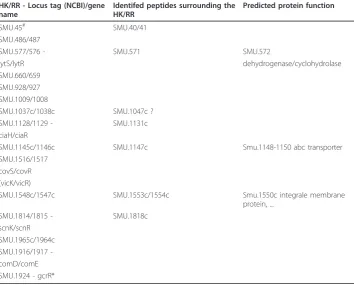
The Microbial Signal Transduction database (MiST, http://mistdb.com) [16] was used to locate the HK/RR genes inside the S. mutansgenome (Table 1). A set of small ORF encoding small peptides were identified around each TCS. By browsing the geno-mic context using the Entrez Gene tool from the NCBI http://www.ncbi.nlm.nih.gov/ gene we identified a complete set of bare genes able to produce bacteriocins in the vicinity of the SMU.1548c/1547c locus tag (Figure 1a).
Table 1 Two Components Systems found in theS. mutansUA159 genome.
HK/RR - Locus tag (NCBI)/gene name
Identifed peptides surrounding the HK/RR
Predicted protein function
SMU.45# SMU.40/41
SMU.486/487
SMU.577/576 - SMU.571 SMU.572
lytS/lytR dehydrogenase/cyclohydrolase
SMU.660/659 SMU.928/927 SMU.1009/1008
SMU.1037c/1038c SMU.1047c ? SMU.1128/1129 - SMU.1131c ciaH/ciaR
SMU.1145c/1146c SMU.1147c Smu.1148-1150 abc transporter SMU.1516/1517
covS/covR (vicK/vicR)
SMU.1548c/1547c SMU.1553c/1554c Smu.1550c integrale membrane protein, ...
SMU.1814/1815 - SMU.1818c scnK/scnR
SMU.1965c/1964c SMU.1916/1917 -comD/comE SMU.1924 - gcrR*
#
HK uncoupled to a RR * RR uncoupled to an HK
NicolasBioData Mining2011,4:22
http://www.biodatamining.org/content/4/1/22
The cluster of genes (location: 1475357-1478860) presents the same genomic organi-sation than conventional bacteriocin biosynthesis operon with the genes encoding two small peptides (SMU.1554c and SMU.1553c), the ABC transporter genes (SMU.1552c/ SMU.1551c), a gene encoding an integrale membrane protein possibly involved in the immunity function (SMU.1550c), and the TCS genes, HK gene (SMU.1548c) and RR gene (SMU.1547c), probably implicated in the regulation of the biosynthesis of the bac-teriocin. Furthermore additionnal untypical genes were identified: a methionine amino-peptidase (ampM/SMU.1556c) and a putative acetyltransferase (SMU.1558c) with related function to proteases and scaffoldingproteins.
Putative precursor peptides were analysed for the presence of a signal peptide using Signal-3L http://www.csbio.sjtu.edu.cn/bioinf/Signal-3L/[17] and PrediSi http://www. predisi.de/[18] algorithms.
The potential of antimicrobial activity of the putative mature peptides was evaluated using freely web available programs such as APD2 http://aps.unmc.edu/AP/main.php [19] and the AntiBP2 server http://www.imtech.res.in/raghava/antibp/[20]. Similarity with known antimicrobial peptides was retrieved for the query input peptide sequences. SMU.1553c presents similarity with the carnocyclin A peptide [21].
A BlastP analysis [22] of the precursor peptides reveals the strict conservation of these peptides with their genomic context to theStreptococcus salivariusgroup species (Figure 1b).
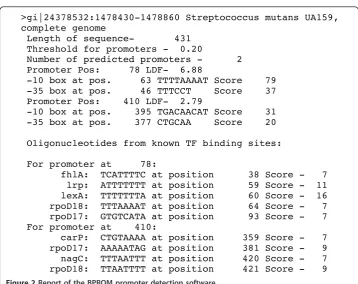
Upstream genomic coding sequence was analyse to detect putative promoter regions and transcription factor binding sites using the bacterial promoter recognition program BPROM (Softberry inc.) (Figure 2).
Many putative mutacin-encoding genes have been previously predicted using bioin-formatic analyses and some of them were functionnally verified using mutational ana-lyses for S. mutans UA159 [23]. Inactivation of all putative mutacin genes did not abrogate complete antibacterial activity of the strain, let suggest the existence of an
Figure 1a) Predicted bacteriocin maturation patchway.GenBank locus tag are given with the propeptide genes (blue), the ABC transporter genes (green), the immunity gene (majenta), the
other type of inhibitory substance produced which confort the reliability of our hypothesis and findings hither [23].
The group of genes detect by our method predicted the existence of a putative bac-teriocin maturation pathway in an exclusive group of Streptococcus and reveals its potential to encode for a new type of bacteriocin. It also provides mature hypothesis that may be test by a focused wet lab experiment. Since inactivation of small genes remains difficult to perform, our method study provides a computational evidence for identification of a new putative bacteriocin production. This method can be applied to a large set of short coding sequence with unknown function yet found in the strepto-coccal genomes [13].
Abbreviations
ABC: ATP-binding cassette; BlastP: Basic Local Alignment Search Tool for protein; ORF: Open Reading frame; TCS: Two-component signal transduction system; HK: Histidine Kinase; RR: response regulator.
Acknowledgements
This work was supported by the Natural Sciences and Engineering Research Council of Canada (NSERC). Guillaume Nicolas is supported by a University-Industry Ph.D. Scholarship from the NSERC and Microbio LCA Inc.
Authors’contributions
GGN performed the bioinformatic analyses, interpreted the results, and wrote the manuscript.
Competing interests
The author declares that they have no competing interests.
Received: 7 October 2010 Accepted: 14 July 2011 Published: 14 July 2011
References
1. Andersson DI, Hughes D:Antibiotic resistance and its cost: is it possible to reverse resistance?Nat Rev Microbiol
2010,8:260-271.
>gi|24378532:1478430-1478860 Streptococcus mutans UA159, complete genome
Length of sequence- 431 Threshold for promoters - 0.20
Number of predicted promoters - 2 Promoter Pos: 78 LDF- 6.88
-10 box at pos. 63 TTTTAAAAT Score 79 -35 box at pos. 46 TTTCCT Score 37 Promoter Pos: 410 LDF- 2.79
-10 box at pos. 395 TGACAACAT Score 31 -35 box at pos. 377 CTGCAA Score 20
Oligonucleotides from known TF binding sites:
For promoter at 78:
fhlA: TCATTTTC at position 38 Score - 7 lrp: ATTTTTTT at position 59 Score - 11 lexA: TTTTTTTA at position 60 Score - 16 rpoD18: TTTAAAAT at position 64 Score - 7 rpoD17: GTGTCATA at position 93 Score - 7 For promoter at 410:
carP: CTGTAAAA at position 359 Score - 7 rpoD17: AAAAATAG at position 381 Score - 9 nagC: TTTAATTT at position 420 Score - 7 rpoD18: TTAATTTT at position 421 Score - 9
Figure 2Report of the BPROM promoter detection software.
NicolasBioData Mining2011,4:22
http://www.biodatamining.org/content/4/1/22
2. Smith L, Hillman J:Therapeutic potential of type A(I) lantibiotics, a group of cationic peptide antibiotics.Curr Opin Microbiol2008,11:401-408.
3. Riley MA, Wertz JE:Bacteriocins: evolution, ecology, and application.Annu Rev Microbiol2002,56:117-137. 4. Nes IF, Diep DB, Holo H:Bacteriocins diversity inStreptococcusandEnterococcus.J Bacteriol2008,189:1189-1198. 5. Wescombe PA, Heng NC, Burton JP, Chilcott CN, Tagg JR:Streptococcal bacteriocins and the case forStreptococcus
salivariusas model oral probiotics.Future Microbiol2009,4:819-835.
6. Dufour A, Hindré T, Haras D, le Pennec JP:The biology of lantibiotics from the lacticin 481 group is coming of age.
FEMS Microbiol Rev2006,31:134-167.
7. Kleerebezem M, Quadri LE, Kuipers OP, de Vos WM:Quorum sensing by peptide pheromones and two-component signal-transduction systems in Gram-positive bacteria.Mol Microbiol1997,24:895-904.
8. Haft DH:A strain-variable bacteriocin inBacillus anthracisandBacillus cereuswith repeated Cys-Xaa-Xaa motifs.Biol Direct2009,4:15.
9. Haft DH, Basu MK, Mitchell DA:Expansion of ribosomally produced natural products: a nitrile hydratase- and Nif11-related precursor family.BMC Biology2010,8:70.
10. Begley M, Cotter PD, Hill C, Ross RP:Identification of a novel two-peptide lantibiotic, lichenicidin, following rational genome mining for LanM proteins.Appl Environ Microbiol2009,75:5451-5460.
11. Lee SW, Mitchell DA, Markley AL, Hensler ME, Gonzalez D, Wohlrab A, Dorrestein PC, Nizet V, Dixon JE:Discovery of a widely distributed toxin biosynthetic gene cluster.Proc Natl Acad Sci USA2008,105:5879-5884.
12. de Jong A, van Heel AJ, Kok J, Kuipers OP:BAGEL2: mining for bacteriocins in genomic data.Nucleic Acids Res2010,
Web Server.
13. Ibrahim M, Nicolas P, Bessières P, Bolotin A, Monnet V, Gardan R:A genome-wide survey of short coding sequences in streptococci.Microbiology2007,153:3631-3644.
14. Nicolas GG, Lavoie MC, LaPointe G:Molecular genetics, genomics and biochemistry of mutacins.Genes, Genomes and Genomics2007,1:193-208.
15. AjdićD, McShan WM, McLaughlin RE, SavićG, Chang J, Carson MB, Primeaux C, Tian R, Kenton S, Jia H, Lin S, Qian Y, Li S, Zhu H, Najar F, Lai H, White J, Roe BA, Ferretti JJ:Genome sequence ofStreptococcus mutansUA159, a cariogenic dental pathogen.Proc Natl Acad Sci USA2002,99:14434-14439.
16. Galperin MY:Diversity of structure and function of response regulator output domains.Curr Opin Microbiol2010,
13:150-159.
17. Shen HB, Chou KC:Signal-3L: A 3-layer approach for predicting signal peptides.Biochem Biophys Res Commun2007,
363:297-303.
18. Hiller K, Grote A, Scheer M, Münch R, Jahn D:PrediSi: prediction of signal peptides and their cleavage positions.
Nucleic Acids Res2004, ,32 Web Server:W375-9.
19. Wang G, Li X, Wang Z:APD2: the updated antimicrobial peptide database and its application in peptide design.
Nucleic Acids Res2009, ,37 Database:D933-937.
20. Lata S, Mishra NK, Raghava GP:AntiBP2: improved version of antibacterial peptide prediction.BMC Bioinformatics
2010,11(Suppl 1):S19.
21. Martin-Visscher LA, van Belkum MJ, Garneau-Tsodikova S, Whittal RM, Zheng J, McMullen LM, Vederas JC:Isolation and characterization of carnocyclin a, a novel circular bacteriocin produced byCarnobacterium maltaromaticum UAL307.Appl Environ Microbiol2008,74:4756-4763.
22. Altschul SF, Madden TL, Schäffer AA, Zhang J, Zhang Z, Miller W, Lipman DJ:Gapped BLAST and PSI-BLAST: a new generation of protein database search programs.Nucleic Acids Res1997,25:3389-3402.
23. Hale JD, Ting YT, Jack RW, Tagg JR, Heng NC:Bacteriocin (mutacin) production byStreptococcus mutansgenome sequence reference strain UA159: elucidation of the antimicrobial repertoire by genetic dissection.Appl Environ Microbiol2005,71:7613-7617.
doi:10.1186/1756-0381-4-22
Cite this article as:Nicolas:Detection of putative new mutacins by bioinformatic analysis using available web tools.BioData Mining20114:22.
Submit your next manuscript to BioMed Central and take full advantage of:
• Convenient online submission
• Thorough peer review
• No space constraints or color figure charges
• Immediate publication on acceptance
• Inclusion in PubMed, CAS, Scopus and Google Scholar
• Research which is freely available for redistribution