Abstract The fauna associated with hard bottom mussel beds along the exposed Pacific coast of Chile was exam-ined. The abundance of adult (>10 mm body length) pur-ple mussels Perumytilus purpuratus varied between 32 and 75 individuals per 50 cm2, and their biomass between 4.8 and 8.6 g AFDW per 50 cm2at eight sampling sites between Arica (18°S) and Chiloé (42°S). At all sampling sites, the associated fauna was dominated by suspension-feeding organisms (cirripeds, spionid and sabellid poly-chaetes, a small bivalve) followed by grazing peracarids and gastropods. Predators and scavengers also reached high abundances while deposit- and detritus-feeding organisms were of minor importance. The majority of organisms associated with these hard bottom mussel beds feed on resources obtained from the water column or growing on the mussels rather than on materials deposit-ed by the mussels. This is in contrast to the fauna associ-ated with mussel beds on soft bottoms, which comprises many species feeding on material accumulated by mus-sels (faeces and pseudofaeces) and deposited within the mussel bed. Many of the organisms dwelling between mussels both on hard bottoms and on soft bottoms have direct development, but organisms with pelagic develop-ment also occur abundantly within mussel beds. We pro-pose that species with direct development are dispropor-tionately favoured by the structurally complex habitat with diverse interstitial spaces between the mussels, which provides ample shelter for small organisms. We conclude that mussels on hard-bottoms primarily provide substratum for associated fauna while mussels on soft bottoms provide both substratum and food resources.
Keywords Infauna · Hard bottom · Soft bottom · Exposed shore · Trophic groups
Introduction
Mussels of the family Mytilidae form beds or patches on substrata ranging from muddy soft bottoms to exposed hard bottoms. These mussel beds provide a favourable habitat for a wide range of associated organisms that find shelter and food between the mussels (Asmus 1987; Commito and Boncavage 1989; Dittmann 1990; Seed and Suchanek 1992). Thus, many associated species are more abundant in mussel beds than in surrounding habi-tats such as sand or mud bottoms or bare rock surfaces. However, other organisms decrease in abundance or are completely absent in mussel beds (Commito 1987; Dittmann 1990; Tokeshi and Romero 1995). Species richness and diversity of the associated fauna increase with age and size of mussel patches (Tsuchiya and Nishihira 1985, 1986), and decrease with increasing tidal elevation (Seed 1996; Seed and Suchanek 1992; Hertlein 1997). Lintas and Seed (1994) found that most taxa of associated fauna specialise on specific layers within the mussel assemblage from the sediment at the base to the surface of the mussel matrix. In mussel beds covered by algae, barnacles (Balanidae), periwinkles (Littorina littorea) and crabs (especially Carcinus maenas) may be less abundant compared with uncovered mussel beds (Albrecht and Reise 1994; Bertness 1999). The biomass of the associated fauna generally contributes relatively little to the total biomass within mussel beds (<10% of the total biomass – Asmus 1987).
Several studies have indicated that distinct groups of organisms are favoured in mussel beds. For example Tokeshi and Romero (1995) have shown that polychaetes are much more abundant in mussel beds than on sur-rounding mussel-free rock surfaces. In particular, mobile species such as syllid and nereid polychaetes that require shelter on exposed rocky shores may be favoured by structurally complex substrata with many interstitial Communicated by H. Asmus and R. Asmus
M. Thiel (
✉
)Facultad Ciencias del Mar, Universidad Católica del Norte, Larrondo 1281, Coquimbo, Chile
e-mail: [email protected]
N. Ullrich
Universität Kiel, Zoologisches Institut,
Arbeitsgruppe Marine Ökologie und Systematik, Olshausenstrasse 40-60, 24118 Kiel, Germany DOI 10.1007/s10152-001-0098-3
O R I G I N A L A R T I C L E
Martin Thiel · Niklas Ullrich
Hard rock versus soft bottom: the fauna associated
with intertidal mussel beds on hard bottoms along the coast of Chile,
and considerations on the functional role of mussel beds
spaces provided by mussels on hard bottoms. Commito and Boncavage (1989), based on their finding of high numbers of oligochaetes in mussel beds, suggested that species with direct development or asexual reproduction may be favoured in dense reefs of suspension-feeders. Dittmann (1990) revealed that deposit-feeding annelids were abundant in mussel beds but suspension-feeding organisms were excluded by the mussels. In general, this short comparison suggests that organisms with distinct trophic and reproductive characteristics are favoured within mussel beds.
Mussels establish dense beds on soft-bottom as well as on hard-bottom habitats. In both environments, mus-sels provide a highly structured habitat with many inter-stitial spaces, which differs substantially from the sur-rounding environments (Seed and Suchanek 1992; Jones et al. 1994). While bare soft bottoms provide a habitat for a rich infauna, the colonisation of bare rock surfaces is restricted to specialists that live on the substratum sur-face. In soft-bottom environments, the shells of mussels provide the only hard substrate available for some algal and faunal species to attach to (Buschbaum 2001), while mussel beds in hard-bottom environments provide exten-sive interstitial spaces that can be inhabited by species that otherwise could not gain a hold on wave-exposed rock surfaces (Tokeshi and Romero 1995). Mytilid mus-sels, through their tendency to form dense assemblages, create a three-dimensional habitat (Alvaredo and Castilla 1996; Guiñez and Castilla 1999) of high spatial com-plexity (Snover and Commito 1998), thereby rendering it suitable for a wide range of marine invertebrates.
Both on soft bottoms and on hard bottoms, once established, mussel beds persist for long time periods, i.e. many years or decades (e.g. Suchanek 1986; Nehls and Thiel 1993). Individual mussel patches remain in place for sufficiently long time to allow associated fauna to grow and reproduce within the dense interwoven net-work of byssal threads and mussels. Thus, in both types of environments (hard and soft bottoms) mussel beds increase the diversity of habitat characteristics available
to other organisms. The distinct differences between hard-bottom and soft-bottom environments suggest that the functional role of mussel beds in these habitats may differ with respect to the associated fauna.
The main objective of the present study was to describe the fauna associated with hard-bottom mussel beds along the Pacific coast of Chile. The data obtained herein provided the principal information for a compar-ison of the functional role of mussel beds in hard-bottom and soft-hard-bottom environments reported in the literature.
Materials and methods
The purple mussel (Perumytilus purpuratus Lamarck, 1819) is a common inhabitant of intertidal hard bottoms along the coast of Chile. At wave-exposed sites, mussels may form patches from <1 m2 to >100 m2. Often, only one layer of mussels covers the rocks, but with increasing size of the mussels multi-layered patch-es develop (Alvaredo and Castilla 1996; Guiñez and Castilla 1999), creating cavities that allow even large organisms to find shelter under the cover of the mussels (Navarrete and Castilla 1990).
Samples of P. purpuratus and the associated fauna were col-lected during the austral autumn (April–June 2000) at eight differ-ent sites along the Pacific coast of Chile (Fig. 1). At each site, six replicate samples were taken. All mussels from a circle corre-sponding to the opening of the sampling jar (50 cm2) were careful-ly scraped from the rock and immediatecareful-ly transferred into the sampling jar together with the entire associated fauna. Results from previous studies on the fauna associated with mussel beds on hard bottoms have indicated that sample sizes between 50 cm2and 200 cm2provide relatively good estimates for species and individ-ual numbers (Tsuchiya and Nishihira 1985; Peake and Quinn 1993). Six replicate samples of 50 cm2surface area thus provide a relatively reliable estimate for the composition of associated fau-na. During the sampling process, particular care was taken that all mobile fauna were collected. Samples were preserved in 5% for-malin for storage. In the laboratory, the samples were washed over a 500-µm sieve. The entire material retained on the sieve was sorted for small mussels and associated fauna under a dissecting microscope.
Following species identification and counting, biomass was determined for purple mussels and the major taxa of the associated fauna. Specimens were sorted, dry weight was determined
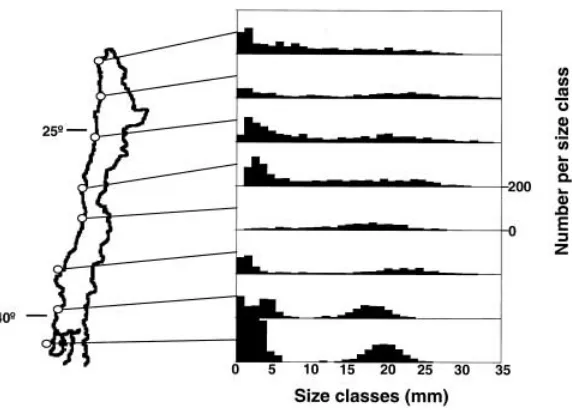
follow-Fig. 1 Size frequency
distribu-tion of purple mussels,
Peru-mytilus purpuratus, at the eight
sampling sites along the Pacific coast of Chile; at each site six replicate samples (each of 50 cm2) were taken, all mussels
ing drying at 70°C for 24 h, and ash weight was measured follow-ing combustion at 500°C for 6 h. Based on a sample of 492 purple mussels >10 mm body length (BL) a length–weight relation was determined and used to calculate the individual biomass of all oth-er purple mussels >10 mm BL. For the associated fauna an indi-vidual-based average biomass was determined and used to calcu-late the biomass of the respective species in each sample.
An ANOVA was employed to examine for statistical differ-ences between sampling sites. Since in most cases the variances were not homogeneous, a non-parametric ANOVA (Kruskal-Wallis) was used. The Tukey post-hoc test was employed after rank-transformation of the original data (Zar 1984). Rarefaction curves were produced using the program BioDiversity-Pro freely available from The Scottish Association for Marine Science.
Published data sets on the associated fauna from soft-bottom and hard-bottom mussel beds were examined for information on the abundance of associated fauna. Only studies in which samples had a minimum surface area of 50 cm2were considered for inclu-sion in this comparison. The abundance values reported for indi-vidual taxa were averaged and transferred to a value of indiindi-viduals per 100 cm2in order to allow for direct comparison between dif-ferent studies. The studies on the fauna associated with hard-bottom mussel beds considered in all cases the entire fauna down to the bare rock surface. Samples from soft-bottom mussel beds usually considered the entire fauna down to uninhabited sediment layers.
Results
The abundance of purple mussels >10 mm ranged between 32.2±6.5 (mean ± SD) (Concepción) and 74.5±11.5 (Chiloé) individuals per 50 cm2, and their bio-mass ranged between 4.8±1.1 (Valparaíso) and 8.6±0.9 (Taltal) g AFDW per 50 cm2at the eight sampling sites. The mussel size ranged from 0.5 to 34.5 mm BL. With the exception of one sampling site (Valparaíso) where small mussels were lacking, small (<5 mm BL) and intermediate-sized mussels (15–24 mm BL) dominated in the samples (Fig. 1)
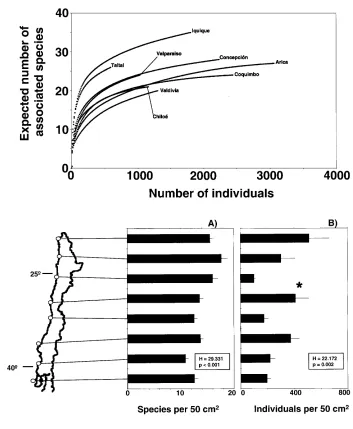
At most sampling sites, the rarefaction curves had sim-ilar shapes, reaching the asymptote (Fig. 2). This indicates that the fauna associated with P. purpuratus had been rep-resentatively sampled at most sampling sites – an increase in sampling effort would not have revealed many more additional species. The mean number of associated species varied between 10.8 and 17.7 species per 50 cm2and the mean number of total individuals between 99 and 511 in-dividuals per 50 cm2at the eight sampling sites (Fig. 3).
Fig. 2 Rarefaction curves
(individual numbers vs species numbers) for the eight sam-pling sites along the Pacific coast of Chile; at each site six replicate samples (each of 50 cm2) were taken
Fig. 3 Average number ±SE of A species, and B of individuals
of associated fauna in dense beds of purple mussels
Peru-mytilus purpuratus at eight
sampling sites along the Pacific coast of Chile; at each site six replicate samples (each of 50 cm2) were taken; stars
Table 1 Species associated with purple mussels, Perumytilus purpuratus, along the coast of Chile, and sampling sites at which they
were recorded. Sites: 1 Arica, 2 Iquique, 3 Taltal, 4 Coquimbo, 5 Valparaiso, 6 Concepción, 7 Valdivia, 8 Chiloé
Taxa Sites Taxa Sites
Amphipoda
Hyale hirtipalma 5
Hyale grandicornis 1–8
Orchestia sp. A 6, 7
Amphipoda undet. 2
Tanaidacea
Tanais cf. marmoratus 3
Tanaid sp. C 4
Isopoda
Pseudosphaeroma lundae 6–8
Ischyromene tuberculata 5
Paradella bakeri 1–3
Vermectias sp. A 5
Decapoda
Acanthocyclus gayi 4–8
Cyclograpsus cinereus 2–4,6
Cirripedia
Jehlius cirratus 1–8
Notochtamalus scabrosus 7
Verruca laevigata 2
Polychaeta
Sabellid sp. A 1, 2, 5
Typosyllis magdalena 1–8
Typosyllis sp. A 1–5
Syllid sp. A 5–8
Syllid sp. B 1–3,6
Syllid sp. C 3
Perinereis longidonta 6, 8
Perinereis falklandica 8
Perinereis nuntia 6, 7
Pseudonereis variegata 2–6
Boccardia polybranchia 1–8
Mediomastus branchiferus 5
Capitellid sp. A 3, 4
Terebellid sp. A 2
Eulalia sp. A 1–3
Oligochaeta
Oligochaeta nondet. 1–8
Polyplacophora
Chiton granosus 1, 3, 4
Gastropoda
Fissurella maxima 2, 5
Scurria bohmita 1–5
Scurria plana 1–5
Scurria sp. A 2–4, 6, 7
Scurria zebrina 3, 8
Scurria scurra 3, 8
Scurria silvana 5–8
Scurria variabilis 7, 8
Scurria ceciliana 8
Scurria sp. B 1, 2, 4
Scurria orbignyi 2
Lepetia coppingeri 2
Marinula cf. nigra 1, 4, 6
Nodilittorina araucana 1, 6, 7 Nodilittorina peruviana 1, 2
Caecum chilense 1, 2, 6, 7
Onchidella marginata 6
Bivalvia
Lasaea sp. A 1–7
Nemertinea
Nemertopsis bivittata 1, 2, 4–7 Emplectonema friederichi 1, 4, 7
Amphiporus nelsoni 1, 3, 4, 6
Lineus sp. A 1–4, 6
Nemertinea sp. A 8
Anthozoa
Phymactis clematis 1–4
Bunodactis hermaphroditica 6–8
Hydrozoa
Hydrozoa nondet. 2, 5–8
Echinodermata
Heliaster helianthus 2
Plathelminthes
Planaria sp. A 1–4, 6, 8
Others
Insecta nondet. 1–8
Aranea sp. A 7
Acari nondet 2, 5, 6
The major taxa were represented at all sampling sites, but some taxa only occurred at some sites (Fig. 4, Table 1). Polychaetes and bivalves (other than P. purpu-ratus) reached the highest abundances of the taxa associ-ated with P. purpuratus (Fig. 4). Nemerteans and turbell-arians (macrofauna species) reached high abundances at the four northernmost sites but were absent or only occurred in low numbers at the four southernmost sites. Insect larvae showed a reverse trend, with highest abun-dances at the four southernmost sites. Some taxa, such as echinoderms and sipunculids, only occurred as single individuals at some sites but were completely absent at most sites (others in Fig. 4).
Fig. 4 Average numbers of
faunal taxa associated with purple mussels P. purpuratus at eight sampling sites; at each site six replicate samples (each of 50 cm2) were taken
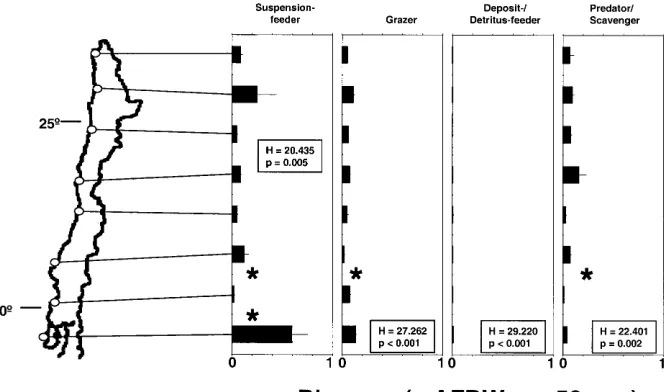
Fig. 5 Average numbers ± SE
of trophic groups of fauna asso-ciated with purple mussels
P. purpuratus at eight sampling
sites; at each site six replicate samples (each of 50 cm2) were
taken; stars indicate significant differences between immedi-ately neighbouring sites (P<0.05); Kruskal-Wallis followed by non-parametric Tukey (after rank-transforma-tion)
Table 2 Abundance (±SE) and
reproductive traits of major macrofauna species associated with purple mussels,
Peru-mytilus purpuratus, along the
coast of Chile. Larval stage:
p pelagic, b benthic, b/p both
reported, ? unknown
Species Taxa Larval stage Individuals per 50 cm2
Lasaea sp. A Bivalvia b 84.3±29.6
Scurria bohmita Gastropoda p? 3.9±1.6
Onchidella marginata Gastropoda p? 3.0±3.0
Pseudosphaeroma lundae Isopoda b 8.1±7.7
Hyale grandicornis Amphipoda b 5.5±3.1
Hyale hirtipalma Amphipoda b 6.3±6.3
Jehlius cirratus Cirripedia p 26.9±14.4
Verruca laevigata Cirripedia p 4.2±4.2
Oligochaeta nondet. Oligochaeta b 30.3±13.0
Boccardia polybranchia Polychaeta b 48.4±22.8
Typosyllis magdalena Polychaeta b 2.8±1.2
Typosyllis sp. A Polychaeta b 3.4±2.4
Sabellid sp. A Polychaeta b 2.6±2.4
Nemertopsis bivittata Nemertinea p? 15.2±6.7
Lineus sp. A Nemertinea p? 4.2±1.7
Turbellaria nondet. Plathelminthes b/p 3.6±1.7
Phymactis clematis Anthozoa p 3.1±1.6
high densities at some sites (Fig. 5), but their biomass was of minor importance (Fig. 6). Thus, also with re-spect to biomass, most sites are dominated by suspension feeders, followed by grazers and predator/scavengers.
Many of the most abundant species found in mussel beds along the coast of Chile have benthic larval stages (Table 2). Taxa such as amphipods, isopods, syllid poly-chaetes, oligochaetes and the small bivalve Lasaea sp. release advanced larval stages or small juveniles directly into the adult habitat. Thus, offspring of these taxa may establish within the parental habitat. However, species with pelagic larval stages such as cirripeds, gastropods, nereid polychaetes and probably most of the nemertean species also occurred in high numbers between purple mussels (Table 2).
Discussion
Mussel beds of P. purpuratus harboured an abundant and diverse fauna of associated species. While the abundance and biomass of different taxa associated with mussels was variable among different sites along the Pacific coast of Chile, two consistent patterns emerged: the as-sociated fauna was dominated by suspension-feeding species, and species with direct development were abun-dant in the mussel beds. These results suggest that mus-sel beds of P. purpuratus serve a specific functional role on hard bottoms. In the following discussion it will be examined whether these findings can be generalised for mussel beds on hard bottoms and how this compares to the functional role of mussel beds on soft bottoms.
Functional role of mussel beds on hard bottoms and soft bottoms
Several previous studies have documented the high abundance of polychaetes, peracarid crustaceans and
small bivalves in both hard- and soft-bottom mussel beds (Tsuchiya and Nishihira 1985, 1986; Jacobi 1987; Tsuchiya and Retière 1992; Topaloglu and Kihara 1993; Lintas and Seed 1994; Tokeshi 1995; Tokeshi and Romero 1995). These small organisms find shelter from predators and wave-exposure between the mussels on hard bottoms that otherwise offer little structural support. Associated species comprise highly mobile (nereid and syllid polychaetes, isopod and amphipod peracarids) as well as more sedentary organisms (sabellid and spionid polychaetes, tanaid and some amphipod peracarids). Mobile species roam in the complex matrix of the mus-sels searching for prey or detritus retained in interstitial spaces. Sedentary species attach self-constructed tubes between the mussels feeding primarily on allochthonous material that is continuously imported into the mussel bed. Nemerteans are also abundant in these biogenic habitats of high structural complexity (Thiel and Kruse 2001) where they probably feed on their preferred prey items, namely polychaetes and amphipods (McDermott and Roe 1985). The high densities of these predators found in the present study indicate strong interspecific interactions among the fauna associated with mussel beds on hard bottoms as had also been shown by Navarrete and Castilla (1990). Few of the organisms found in hard-bottom mussel beds feed on material pro-vided directly by the mussels (faeces and pseudofaeces). Thus, mussels on hard bottoms primarily provide struc-tural protection for the associated fauna, similar to other habitat-forming organisms such as corals, ascidians, sponges and sabellariid polychaetes (see e.g. Nelson and Demetriades 1992).
A comparison between the fauna found in mussel beds on hard bottoms and on soft bottoms reported in the literature shows that crustaceans and polychaetes reach high abundances in mussel beds in both environments (Table 3). Non-mytilid bivalves were much more abun-dant in mussel beds on hard bottoms than on soft bot-toms while the reverse pattern was true for oligochaetes.
Fig. 6 Average biomass ± SE
of trophic groups of fauna asso-ciated with purple mussels
P. purpuratus at eight sampling
sites; at each site six replicate samples (each of 50 cm2) were
T
able
3
A
verage density (Individuals per 100
cm
2) of taxa associated with mussel beds
on hard-bottom (
hb
) and on soft-bottom (
sb
) environments;
gr
ey shading
indicates the
three sites in an inter
-site comparison at which the respective taxa were most abundant –
on this scale, each study could only score once (for example: the polychaete abundance in study E was only scored once despite the fact that the two values obtained from this study represent the maximum densities for polychaetes),* indicates artificial substrate, y. -young,
m . medium-aged; o . old, e. edge, c. centre, u.s
. upper shore,
l.s
. lower shore,
w .f. with Fucus , n.f . no Fucus , M.e. Mytilus edulis , M.g. Mytilus gallopr ovincialis , S.a. Semimytilus algosus , P .p. Perumytilus purpuratus , C.c. Chor omytilus chorus Study a A1 A2 A2 A2 A2 B B C D E E F G H H I1 I1 I2 I2 J1 J2 K L Substrate hb * hb * hb * hb * hb * hb hb hb hb hb hb hb sb sb sb sb sb sb sb sb sb sb sb Site characteristics y. m.e. m.c. o. u.s l.s. l.s u.s. u.s. e. c. w .f. n.f. w .f n.f. Mytilid species M.e. M.e. M.e. M.e. M.e. M.g. M.g. M.e. M.e. S.a. P .p. P .p. M.e. M.e. M.e. M.e. M.e. M.e. M.e. M.e. M.e. M.e. C.c.
Sieve size (mm)
1 0.25 0.25 0.5 0.5 0.5 0.5 0.5 0.5 0.5 0.5 0.5 0.5 0.5 0.5 Amphipoda 1.7 82.6 8.8 10.6 9.4 128.0 187.8 21.6 20.4 25.0 1 1.2 4.2 7.2 0.4 13.4 33.7 45 12 T anaidacea 0.0 0.7 15.6 0.4 0.3 Isopoda 0.7 2.6 1.4 0.2 0.6 1.7 3.3 20.6 8.4 19.3 1.2 0.7 1.1 0.0 15.8 46.0 20 Decapoda 0.3 0.4 1.4 4.6 2.4 0.1 0.9 2.0 1.6 1.3 2.5 4.3 3.9 7.2 2.3 1.1 Cirripedia 0.0 0 0 0 6 0.3 2.5 142.0 130 62.2 0.0 0.7 8.6 19.0 1.4 0.2 Crustacea 2.7 85.6 1 1.6 15.4 18.4 130.8 210.0 186.1 160 108.0 2.5 5 15.0 9.9 20.8 26.6 32.8 80.9 Polychaeta 34.9 26.2 27.8 29.8 71.4 2.9 1.1 3.1 16 250.0 250.0 124.8 0.6 80 20 4.1 3.9 7.5 10.3 13.9 8.7 Oligochaeta 0.0 22.7 34.6 0.2 60.6 144 70 80 1 1 1.2 21 1.7 11 0 110 Annelida 34.9 25.6 35.7 3.4 250.0 250.0 185.4 144.5 150 100 4.1 3.9 7.5 10.3 125.0 220.3 Polyplacophora 1.0 0.6 2.6 2.2 2.6 0.9 0.5 0.1 0.5 0.0 0.1 0.1 0.1 0.0 0.0 Gastropoda 9.1 6 4.8 6.6 10 1 1.7 4.2 5.0 14.4 32.0 2.5 3.7 10.4 22.4 4.1 16.8 Bivalvia 33.7 0.4 0.8 1.6 4.6 12.7 6.1 1228.9 88.8 168.7 2.2 0.2 0.4 0.2 0.3 1.2 2.0 Mollusca 43.9 7 8.2 10.4 17.2 25.3 10.8 1233.9 103 200.7 18 15 2.8 4.2 10.7 22.7 5.3 18.8 Nemertinea 2.0 0.2 1.4 1.4 1.4 0.9 0.8 0.4 160 39.5 0.1 0.5 0.2 0.7 0.6 Anthozoa 0.0 0 0.2 0.4 0 0.8 0.7 0.4 1.2 6.5 0.0 0.0 0.0 0.0 Hydrozoa 0.0 0.4 0.6 Insecta 0.0 0.5 0.0 48.7 12.8 19.1 Plathelminths 5.7 0 0.4 0.2 0 0.6 0.3 7.3 Others 0.0 0 0.4 0.8 1 0.3 0.2 0.1 0.4 1.5 0.0 0.0 0.0 0.0 0.2 0.1
A1 Japan; T
suchiya and Nishihira 1985 (only samples >50
cm
2were considered)
A2 Japan; T
suchiya and Nishihira 1986
B France (Mediterranean); T
suchiya and Bellan-Santini 1989
C France (Atlantic); T
suchiya and Retière 1992 (only samples >50
cm
2were considered)
D England; Lintas and Seed 1994 E Peru; T
okeshi 1995
F Chile; this study G Maine, USA; Commito 1987
H Germany
, W
adden Sea; Dittmann 1990 (data taken from figures)
I Germany
, W
adden Sea; Albrecht and Reise 1994 (I1 – site Möwenber
gwatt; I2 – site
Oddewatt J Denmark, Baltic Sea; Svane and Setyobudiandi 1996 (J1 – site Kerteminde; J2 – site Norsminde) K Scotland; Ragnarsson and Raf
faelli 1999 (data taken from figures)
These strong differences in the taxonomic composition of the fauna in mussel beds also indicate differences in the functional role of mussel beds on hard bottoms com-pared with those on soft bottoms. Mussel beds on hard bottoms often establish on sites that are exposed to strong wave action, and material discarded by the mus-sels (faeces and pseudofaeces) is immediately washed away by wave action. In contrast, mussel beds on soft bottoms usually establish in sheltered areas, because on exposed tidal flats they cannot withstand strong storms (Nehls and Thiel 1993). Thus, mussel beds on soft bot-toms often develop and persist in areas of limited wave-action and consequently a large proportion of the faeces and pseudofaeces from the mussels are deposited direct-ly within the mussel beds (Hild and Günther1999). The mussels themselves can survive in this depositional envi-ronment by changing their location in the mussel matrix (Okun 1999), but if sediment deposition is too strong even mussels die under the mud deposits (Albrecht and Reise 1994). Probably this depositional environment in soft-bottom mussel beds does not permit the persistence of non-mytilid bivalves (and other suspension feeders) that abound in hard-bottom mussel beds. However, de-posit-feeding annelids, in particular oligochaetes, appear to benefit from the mud deposits that accumulate in soft-bottom mussel beds as shown by their high densities in this habitat (Commito 1987; Commito and Boncavage 1989; Dittmann 1990; Kröncke 1996; Quijón et al. 1996; Villbrandt et al. 1999). The high organic content of de-posited sediments can be exploited by these deposit-feeding annelids (Mayer et al. 1997) which may directly
invert assimilated energy into new offspring. Svane and Setyobudiandi (1996) suggested a direct relationship be-tween the degree of organic enrichment and the number of deposit-feeding annelids in mussel beds, as was also found by Norkko and Bonsdorff (1996) and Thiel and Watling (1998) under algal mats.
Mussel beds both on hard bottoms and on soft bot-toms support a wide diversity of different trophic groups that are favoured by the structural protection within the mussel matrix. In addition to this protective function, mussels living on soft bottoms also provide food re-sources in the form of faeces and pseudofaeces for asso-ciated fauna, which appear to be of little importance in hard-bottom mussel beds.
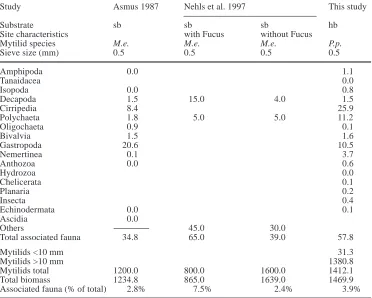
The habitat-forming mussels themselves reach very high biomass both on soft bottoms and on hard bottoms (Table 4; Reise et al. 1994). The associated fauna usually constitutes only about 2–8% of the total biomass within mussel beds, and values found in the present study are similar to those reported from soft bottoms (but see Buschbaum 2000). The biomass of associated fauna within mussel beds often does not exceed that of fauna in surrounding habitats (Asmus 1987; Nehls et al. 1997), but the species composition within mussel beds often is substantially different from that outside mussel beds (soft bottoms – see e.g. Dittmann 1990; hard bottoms – see e.g. Tokeshi and Romero 1995). Thus, mussel beds do not necessarily enhance biomass (or production) of associated fauna but they provide a habitat for particular species that otherwise could not exist in the respective hard-bottom or soft-bottom environments.
Table 4 Average biomass
(g AFDW m–2) of taxa associ-ated with mussel beds on hard-bottom (hb) and on soft-hard-bottom (sb) environments.
M.e. Mytilus edulis, P.p. Perumytilus purpuratus
Study Asmus 1987 Nehls et al. 1997 This study
Substrate sb sb sb hb
Site characteristics with Fucus without Fucus
Mytilid species M.e. M.e. M.e. P.p.
Sieve size (mm) 0.5 0.5 0.5 0.5
Amphipoda 0.0 1.1
Tanaidacea 0.0
Isopoda 0.0 0.8
Decapoda 1.5 15.0 4.0 1.5
Cirripedia 8.4 25.9
Polychaeta 1.8 5.0 5.0 11.2
Oligochaeta 0.9 0.1
Bivalvia 1.5 1.6
Gastropoda 20.6 10.5
Nemertinea 0.1 3.7
Anthozoa 0.0 0.6
Hydrozoa 0.0
Chelicerata 0.1
Planaria 0.2
Insecta 0.4
Echinodermata 0.0 0.1
Ascidia 0.0
Others 45.0 30.0
Total associated fauna 34.8 65.0 39.0 57.8
Mytilids <10 mm 31.3
Mytilids >10 mm 1380.8
Mytilids total 1200.0 800.0 1600.0 1412.1
Total biomass 1234.8 865.0 1639.0 1469.9
Reproductive traits of associated fauna
Previous studies have remarked that organisms that occur in high densities in soft-bottom mussel beds are characterised by direct development or benthic larval stages (Commito 1987; Commito and Boncavage 1989; Dittmann 1990). The present study also revealed high abundances of species with direct development in hard-bottom mussel beds. Similarly, many taxa commonly found in hard-bottom mussel beds such as peracarid crustaceans, syllid and sabellid polychaetes, and small bivalves Lasaea spp. (Tsuchiya and Bellan-Santini 1989; Ong Che and Morton 1992; Tsuchiya and Retière 1992; Lintas and Seed 1994; Tokeshi and Romero 1995) release fully developed juveniles or advanced larval stages into the parental environment. The hypothesis has been put forth that these organisms with direct develop-ment are resistant to active ingestion by suspension-feeding mussels or to the sedimentary environment pro-duced by mussel faeces and pseudofaeces (Commito 1987; Dittmann 1990). Species with direct development are not exposed to the negative effects of adult–larval interactions, thereby partly explaining their high densi-ties in mussel beds. However, it should at this point be noted that organisms with pelagic development such as barnacles, some polychaete species and juvenile mus-sels themselves also establish continuously and often in large numbers in mussel beds [see e.g. high biomass of cirripeds in Asmus (1987) and Buschbaum (2000); large numbers of juvenile mytilids in McGrorty and Goss-Custard (1991)]. In the present study, large numbers of recently settled cirripeds and mytilids were found at some sites, supporting the notion that these species with pelagic larval stages can successfully settle in dense mussel beds. Thus, exclusion of arriving larvae by the habitat-forming mussels does not appear to be the only factor favouring the relatively high abundance of organ-isms with direct development. These latter organorgan-isms may particularly benefit from the structurally complex and protected microhabitat that mussel beds constitute. The interstitial space between the mussels may provide ideal shelter both for parents and offspring of the spe-cies with direct development, most of which are meum-sized macrofauna (1–10 mm BL). Species with di-rect development may rapidly build large populations in mussel beds, because they release their offspring di-rectly within the mussel beds (and other biogenic habi-tats) that usually develop in areas with high food supply (see also Crooks and Khim 1999; Thiel and Vásquez 2000). Females that incubate embryos or larvae within or on their bodies may find optimal conditions for suc-cessful reproduction in mussel beds. Their offspring, upon being released, may remain in the parental habitat. This “neighbourhood recruitment” may thus primarily be responsible for the high abundance of species with direct development compared to that of species with pe-lagic larval stages that have to take a long detour via the water column.
Acknowledgements We are most grateful to Prof. N. Rozbaczylo
for help with identification of the polychaetes. As always, D. Lancellotti helped in many respects – we are very thankful for his cheerful support. We also thank two anonymous reviewers and C. Buschbaum for comments on the final manuscript. Finan-cial support for this study was received in form of FONDECYT 3980002.
References
Albrecht A, Reise K (1994) Effects of Fucus vesiculosus covering intertidal mussel beds in the Wadden Sea. Helgol Meeres-unters 48:243–256
Alvaredo JL, Castilla JC (1996) Tridimensional matrices of mus-sels Perumytilus purpuratus on intertidal platforms with vary-ing wave forces in central Chile. Mar Ecol Prog Ser 133:135–141
Asmus H (1987) Secondary production of an intertidal mussel bed community related to its storage and turnover compartments. Mar Ecol Prog Ser 39:251–266
Bertness MD (1999) The ecology of Atlantic shorelines. Sinauer, Sunderland, Mass.
Buschbaum C (2000) Direct and indirect effects of Littorina littorea (L.) on barnacles growing on mussel beds in the Wadden Sea. Hydrobiologia 440:119–128
Buschbaum C (2001) Siedlungsmuster und Wechselbeziehungen von Seepocken (Cirripedia) auf Muschelbänken (Mytilus edulis L.) im Wattenmeer. PhD thesis, University of Hamburg, Germany
Commito JA (1987) Adult–larval interactions: predictions, mus-sels and cocoons. Estuar Coast Shelf Sci 25:599–606
Commito JA, Boncavage EM (1989) Suspension-feeders and coexisting infauna: an enhancement counterexample. J Exp Mar Biol Ecol 125:33–42
Crooks JA, Khim HS (1999) Architectural vs. biological effects of a habitat-altering exotic mussel, Musculista senhousia. J Exp Mar Biol Ecol 240:53–75
Dittmann S (1990) Mussel beds – amensalism or amelioration for intertidal fauna? Helgol Meeresunters 44:335–252
Guiñez R, Castilla JC (1999) A tridimensional self-thinning model for multilayered intertidal mussels. Am Nat 154:341– 357
Hertlein A (1997) Assoziierte Epifauna der Miesmuschelbänke (Mytilus edulis L.) im Sylter Wattenmeer. Diploma thesis, University of Bonn, Germany
Hild A, Günther CP (1999) Ecosystem engineers: Mytilus edulis and Lanice conchilega. In: Dittmann S (ed) The Wadden Sea ecosystem: stability properties and mechanisms. Springer, Berlin Heidelberg NewYork, pp 43–49
Jacobi CM (1987) Spatial and temporal distribution of Amphipoda associated with mussel beds from the Bay of Santos (Brazil). Mar Ecol Prog Ser 35:51–58
Jones CG, Lawton JH, Shachak M (1994) Organisms as ecosystem engineers. Oikos 69:373–386
Kröncke I (1996) Impact of biodeposition on macrofaunal com-munities in intertidal sand flats. In: Dworschak PC, Stachowitsch M, Ott JA (eds) Influences of organisms on their environment: the role of episodic events. Proceedings of the 29th European marine biology symposium 1994, Vienna. (Pubblicazioni della Stazione Zoologica di Napoli: Marine Ecology 17) Blackwell, Vienna, pp 159–174
Lintas C, Seed R (1994) Spatial variation in the fauna associated with Mytilus edulis on a wave-exposed rocky shore. J Mollusc Stud 60:165–174
Mayer LM, Schick LL, Self RFL, Jumars PA, Findlay RH, Chen Z, Sampson S (1997) Digestive environments of benthic macroinvertebrate guts: enzymes, surfactants and dissolved organic matter. J Mar Res 55:785–812
McGrorty S, Goss-Custard JD (1991) Population dynamics of the mussel Mytilus edulis: spatial variations in age-class densities of an intertidal estuarine population along environmental gra-dient. Mar Ecol Prog Ser 73:191–202
Navarrete SA, Castilla JC (1990) Resource partitioning between intertidal predatory crabs: interference and refuge utilization. J Exp Mar Biol Ecol 143:101–129
Nehls G, Thiel M (1993) Large-scale distribution patterns of the mussel Mytilus edulis in the Wadden Sea of Schleswig-Holstein: do storms structure the ecosystem? Neth J Sea Res 31:181–187
Nehls G, Hertzler I, Scheiffarth G (1997) Stable mussel Mytilus edulis beds in the Wadden Sea – they’re just for the birds. Helgol Meeresunters 51:361–372
Nelson WG, Demetriades L (1992) Peracarids associated with sabellariid worm rock (Phragmatopoma lapidosa Kinberg) at Sebastian Inlet, Florida, USA. J Crustac Biol 12:647–654 Norkko A, Bonsdorff E (1996) Population responses of coastal
zoobenthos to accumulations of drifting algal mats. Mar Ecol Prog Ser 131:143–157
Okun N (1999) Einfluss der Sedimentation auf die Miesmuschel (Mytilus edulis L.) Diploma thesis, University of Hamburg, Germany
Ong Che RG, Morton B (1992) Structure and seasonal variations in abundance of the macro-invertebrate community associated with Septifer virgatus (Bivalvia: Mytilidae) at Cape d’Aguilar, Hong Kong. Asian Mar Biol 9:217–233
Peake AJ, Quinn GP (1993) Temporal variation in species-area curves for invertebrates in clumps of an intertidal mussel. Eco-graphy 16:269–277
Quijón P, Jaramillo E, Pino M (1996) Macrofaunal assemblages associated with mussel and clam beds in an estuary of Southern Chile. Estuaries 19:62–74
Ragnarsson SÁ, Raffaelli D (1999) Effects of the mussel Mytilus edulis L. on the invertebrate fauna of sediments. J Exp Mar Biol Ecol 241:31–43
Reise K, Herre E, Sturm M (1994) Biomass and abundance of macrofauna in intertidal sediments of Königshafen in the northern Wadden Sea. Helgol Meeresunters 48:201–215 Seed R (1996) Patterns of biodiversity in the macro-invertebrate
fauna associated with mussel patches on rocky shores. J Mar Biol Assoc UK 76:203–210
Seed R, Suchanek TH (1992) Population and community ecology of Mytilus. In: Gosling EM (ed) The mussel Mytilus: ecology, physiology, genetics and culture. (Developments in aquacul-ture and fisheries science 25) Elsevier, Amsterdam, pp 87–169 Snover ML, Commito JA (1998) The fractal geometry of Mytilus edulis L. spatial distribution in a soft-bottom system. J Exp Mar Biol Ecol 223:53–64
Suchanek TH (1986) Mussels and their rôle in structuring rocky shore communities. In: Moore PG, Seed R (eds) The ecology of rocky coasts. Columbia University Press, New York, pp 70– 96
Svane I, Setyobudiandi I (1996) Diversity of associated fauna in beds of the blue mussel Mytilus edulis L.: effects of location, patch size, and position within the patch. Ophelia 45:39–54 Thiel M, Kruse I (2001) Status of the Nemertea as predators in
marine ecosystems. Hydrobiologia 456:21–32
Thiel M, Vásquez JA (2000) Are kelp holdfasts islands on the ocean floor? – Indication for temporarily closed aggregations of peracarid crustaceans. Hydrobiologia 440:45–54
Thiel M, Watling L (1998) Effects of green algal mats on infaunal colonization of a New England mud flat – long-lasting effects, but highly localized. Hydrobiologia 375/376:177–189 Tokeshi M (1995) Polychaete abundance and dispersion patterns
in mussel beds: a non-trivial infaunal assemblage on a Pacific South American rocky shore. Mar Ecol Prog Ser 125:137– 147
Tokeshi M, Romero L (1995) Filling a gap: dynamics of space occupancy on a mussel-dominated subtropical rocky shore. Mar Ecol Prog Ser 119:167–176
Topaloglu B, Kihara K (1993) Community of Mediterranean mus-sel Mytilus galloprovincialis Lamarck, 1819 in the Bosphorus strait. J Tokyo Univ Fish 80:113–120
Tsuchiya M, Bellan-Santini D (1989) Vertical distribution of shal-low rocky shore organisms and community structure of mussel beds (Mytilus galloprovincialis) along the coast of Marseille, France. Mésogée 49:91–110
Tsuchiya M, Nishihira M (1985) Islands of Mytilus edulis as a habitat for small intertidal animals: effect of island size on community structure. Mar Ecol Prog Ser 25:71–81
Tsuchiya M, Nishihira M (1986) Islands of Mytilus edulis as a habitat for small intertidal animals: effect of Mytilus age structure on the species composition of the associated fauna and community organization. Mar Ecol Prog Ser 31:171– 178
Tsuchiya M, Retière C (1992) Zonation of intertidal organisms and community structure of small animals associated with patches of the mussel Mytilus edulis L. along the rocky coast of Dinard, Brittany, France. Bull Coll Sci Univ Ryukyus 54:47–81
Villbrandt M, Hild A, Dittmann S (1999) Biogeochemical process-es in tidal flat sediments and mutual interactions with macro-benthos. In: Dittmann S (ed) The Wadden Sea ecosystem: sta-bility properties and mechanisms. Springer, Berlin Heidelberg NewYork, pp 95–132