R E S E A R C H A R T I C L E
Open Access
How do medical students differ in their
interpersonal needs?
Yera Hur
1, A Ra Cho
2, Sun Huh
3and Sun Kim
2*Abstract
Background:Knowing one’s interpersonal relationship preferences can be tremendously helpful for medical students’ lives. The purpose of this study was to examine the interpersonal needs in medical students.
Methods:Between 2010 and 2015, a total of 877 students from four Korean medical schools took the Korean version of the Fundamental Interpersonal Relations Orientation–Behaviour (FIRO-B) scale. The FIRO-B results were analyzed by descriptive statistics, frequency, independentt-test, and one-way ANOVA.
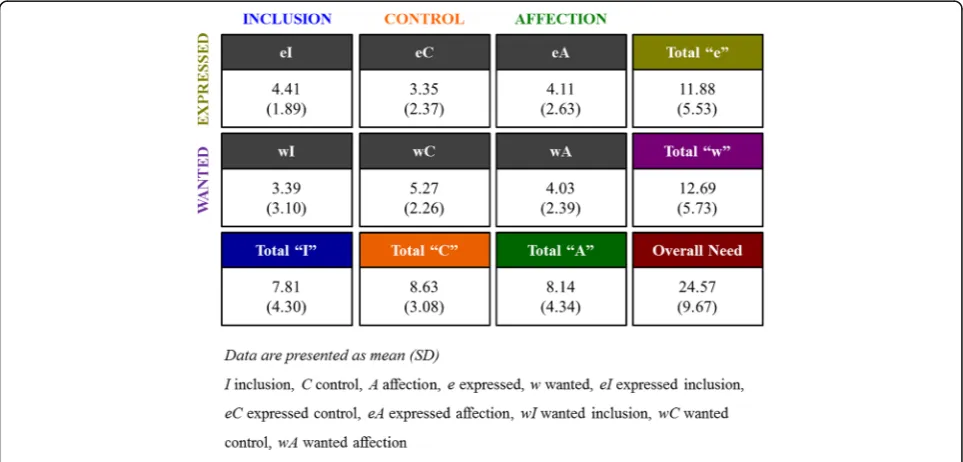
Results:The medical students’scores for interpersonal needs were moderate overall, with the highest scores for control (M = 8.63, SD = 3.08), followed by affection (M = 8.14, SD = 4.34), and inclusion (M = 7.81, SD = 4.30). Gender differences showed in three areas: expressed control (male > female, t = 4.137,p< 0.001), wanted affection (male < female, t =−3.148,p= 0.002), and control needs (male > female, t = 2.761,p= 0.006). By school type, differences were shown in expressed control (t = 3.581,p< 0.001), wanted inclusion (t = 2.625,p= 0.009), Inclusion (t = 1.966,p= 0.050), and expressed (t = 2.077,p= 0.038); undergraduate medical college (MC) students’needs were greater than the needs of graduate medical school (MS) students, but for wanted control, the MS students showed greater needs (t =−2.122,p= 0.034).
Conclusions:There were differences in all categories except for expressed inclusion, wanted control, and control. The FIRO-B is a useful tool for giving insight into students regarding their interpersonal orientations, which will help them to adjust to medical school life. In addition, the FIRO-B can be useful when mentoring and coaching students.
Keywords:Personal characteristics/attitudes, Physician/patient relationship, Interpersonal education
Background
We all know that a good patient-doctor relationship is essential to modern health care. There are many approaches to building good patient-doctor relationships, and many medical school curricula provide communication skills courses to excel such competencies [1–3]. We approached the subject in a different way. We evaluated medical students’ interpersonal relationship orientations using the Fundamental Interpersonal Relations Orientation-Behavior (FIRO-B) inventory by Schutz (1958, as cited in Young [4]).
The first step in building good patient-doctor relation-ships is to help medical students to be aware of who they are and what kinds of interpersonal orientations
they have. It is important for medical students to know and understand the differences in human behavior in interpersonal relationships both because they will work with diverse patients in the future and this knowledge will also help them to work well with their colleagues. Moreover, as Reis et al. [5] observed, knowing one’s interpersonal relationship type is essential because it is the foundation of human life.
The tool we used in this study, the FIRO-B, is widely used for interpersonal relationships [4], but not in medical education. Using the keyword “FIRO-B” in all fields in PubMed Central revealed only two results related to Shutz’s assessment tool for interpersonal rela-tionships [6], and these papers did not address medical education or medical students. Two previous studies that used the instrument in medical education can be found in theJournal of Korean Medical Education[7, 8], but these studies focused on comparing the FIRO-B
* Correspondence:[email protected]
2Department of Medical Education, College of Medicine, The Catholic University of Korea, Seoul, Republic of Korea
Full list of author information is available at the end of the article
with other personality inventories or finding correla-tions between the FIRO-B and stress or depression. These few attempts had some significance, but very little.
This study has its originality in that it intended to focus solely on the interpersonal orientations of medical stu-dents and to properly introduce the special features of a simple instrument, the FIRO-B. The following are the three overarching topics this study examined: 1) What are the medical students' fundamental interpersonal relation-ship behaviors? 2) Are there differences in interpersonal needs between genders? 3) Are there differences in inter-personal needs by school system? and 4) Are there differ-ences in interpersonal needs by academic level?
Methods
Participants
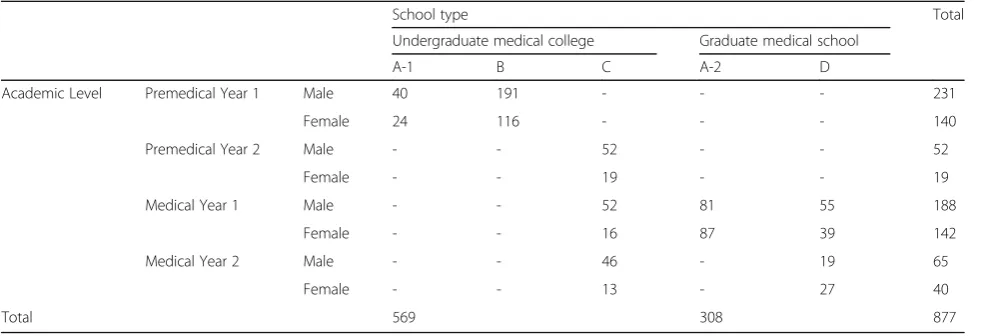
Four medical schools in Korea participated from 2010 to 2015. One of the participating schools had both an undergraduate medical college and a graduate medical school. In Korea, undergraduate medical college (MC) takes six years and graduate medical school (MS) takes four years. Nine hundred twenty-one medical students took the FIRO-B, 44 surveys were excluded for missing data, so a total of 877 results were used (Premedical year 1: male = 231, female = 140, Premedical year 2: male = 52, female = 19, Medical year 1: male = 188, female = 142, Medical year 2: male = 65, female = 40). Five hundred sixty-nine students were from of the MC and 308 were from the MS (Table 1).
Material
The FIRO-B was first introduced by Schutz in 1958 [4], and the Korean version consists of 54 items. The reli-ability of the instrument using coefficient reproducibility ranged from 0.88 to 0.96 for the six individual needs cat-egories: expressed-inclusion (eI) = 0.90, wanted-inclusion
(wI) = 0.96, expressed-control (eC) = 0.93, wanted-control (wC), wanted-affection (wA) = 0.95, and expressed-affection (eA) = 0.88. Interpersonal needs consists of three areas, in-clusion, control, and affection, and behavior is measured in two aspects, expressed and wanted. These measurements are combined to form the six individual needs above: eI, eC, eA, wI, wC, and wA. The items are ranked from 1 (never) to 6 points (always), so that the overall needs score ranges from 0 to 54 points maximum. The three needs di-mensions, inclusion, control, affection, are scored between 0 and 18, and the scores of the two behavior aspects, expressed and wanted, are scored between 0 and 9 [4]. Table 2 shows the specific score ranges and briefly describes each need and behavior.
Statistical analysis
The medical students’interpersonal needs score and distri-bution were analysed with descriptive statistics for mean scores and frequency. Difference by gender and school system were analysed with independent t-test. One-way ANOVA of parametric statistical tests was used to identify the significant differences between academic years. All tests were two tailed, and p-value of <0.05 was considered significant. Statistical analysis was done using SPSS version 21.0 (IBM Corp., Armonk, USA).
Results
Level of interpersonal needs
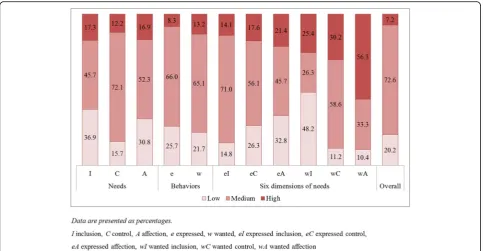
The medical students' FIRO-B results are shown in Figs. 1 and 2. The medical students’interpersonal needs scores as moderate overall; specifically, control’ needs were the highest (8.63 ± 3.08) followed by affection (8.14 ± 4.34) and inclusion (7.81 ± 4.30). Expressed and wanted behavior levels were also moderate (e 11.88 ± 5.53, w 12.69 ± 5.73). By needs level, many of the medical students had high wA scores (56.3%), and 48.2% of students showed low wI scores.
Table 1Number of students by school type and academic level
School type Total
Undergraduate medical college Graduate medical school
A-1 B C A-2 D
Academic Level Premedical Year 1 Male 40 191 - - - 231
Female 24 116 - - - 140
Premedical Year 2 Male - - 52 - - 52
Female - - 19 - - 19
Medical Year 1 Male - - 52 81 55 188
Female - - 16 87 39 142
Medical Year 2 Male - - 46 - 19 65
Female - - 13 - 27 40
Total 569 308 877
Differences by gender
Gender differences were analyzed, and the results showed statistically significant differences in three areas. From the six dimensions of needs, males showed higher expressed control needs than did females (Male 3.61 ± 2.45 > Female 2.95 ± 2.19; t = 4.137,p< 0.001), and female showed higher wanted affection than did male (Female 4.34 ± 2.47 > Male 3.82 ± 2.32; t =−3.148, p= 0.002). The only difference in the needs category was found for control; specifically, males had greater control needs than did females (Male 8.85 ± 3.23 > Female 8.28 ± 2.78; t = 2.761,p= 0.006).
Differences by school type
Korea has a four-year MS and a six-year MC system that includes two years of premedical courses. Comparing
these two school systems, in which MS students are much older than MC students, differences were found in eC (MC 3.56 ± 2.31 > MS 2.97 ± 2.45; t = 3.581,p< 0.001), wI (MC 3.59 ± 3.15 > MS 3.03 ± 2.97; t = 2.625, p= 0.009), I (MC 8.01 ± 4.41 > MS 7.43 ± 4.08; t = 1.966, p= 0.050), and e (MC 12.16 ± 5.48 > MS 11.35 ± 5.59; t = 2.077, p= 0.038); specifically, the MC students’ needs were greater than those of the MS students’. For wanted control, however, MS students showed greater needs (MS 5.49 ± 2.20 > MC 5.15 ± 2.29; t =−2.122,p= 0.034).
Differences by academic level
Some differences were found between the school sys-tems: MC students showed greater interpersonal needs than did the MS students (Table 3). Given that the MC students were generally younger, we wanted to confirm the result by analyzing the needs by academic level. The Levene’s test results showed homoscedasticity, allowing for using one-way ANOVA, which found differences in all categories except eI, wC, and C.
Discussion
There are many ways to promote and develop good rela-tionships with patients, and one is to be aware of one’s interpersonal skills. Dyche observed that it is important for medical educators to focus at least somewhat on the verbal aspects of their relationship skills [9]. This study aimed to determine whether different approaches are needed for different students regarding their interper-sonal needs. Because no studies to date have explored medical students’ interpersonal skills using the FIRO-B, it is difficult to compare this study’s results with those Table 2FIRO-B score range
Score range Low Medium High
Needs 0–5 6–12 13–18
♦Inclusion: Being part of a group, recognition
♦Control: Influencing situations, leading, responsibility
♦Affection: Being close with individuals, building rapport Behaviors 0–7 8–19 20–27
♦Expressed: What you tend to do; how much you initiate this behavior with others; observable action
♦Wanted: How much you tend to want others to initiate this behavior with you; how much you prefer to be the recipient
Six dimensions of needs
0–2 3–6 7–9
Overall 0–15 (Low) 16–26 (High) 27–38
39–54
from previous studies. But FIRO-B can be a useful tool to assist and to enhance the students’interpersonal and communication skills in medical education by acknow-ledging their behaviors in the context of dealing with people. This study’s results revealed moderate needs among the medical students for control, affection, and inclusion. It is interesting to see many students had high wA scores (56.3%) which means that they preferred not to show their affection but rather want others to show
affection for them. Nearly as much students showing low wI scores (48.2%), meaning they would like to be asked to join groups or activities rather than initiating membership themselves, reveals that at leat half of the medical students prefer to be the recipients in the area of needs [10]. Expressed and wanted behaviors also showed moderate scores, indicating that the students had varying levels of control in interpersonal relations [10]. Of the six need dimensions on the FIRO-B, two
Fig. 2Distribution Scores for Interpersonal Relationship Needs
Table 3FIRO-B need scores by academic level
Academic level F p
Premedical year 1 Premedical year 2 Medical year 1 Medical year 2
Needs I 8.56 7.77 7.21 7.05 7.205 <0.001
C 8.87 8.76 8.41 8.38 1.581 0.192
A 8.79 8.41 7.62 7.25 5.994 <0.001
Behaviors e 12.75 12.32 11.03 11.16 6.499 <0.001
w 13.47 12.62 12.21 11.51 4.625 0.003
Six dimensions of needs eI 4.58 4.42 4.29 4.19 2.005 0.112
eC 3.74 3.49 2.95 3.18 6.776 <0.001
eA 4.43 4.41 3.79 3.79 4.266 0.005
wI 3.98 3.35 2.92 2.86 8.257 <0.001
wC 5.13 5.27 5.46 5.2 1.251 0.290
wA 4.36 4.00 3.83 3.46 5.249 0.001
Overall 26.22 24.94 23.24 22.68 7.209 <0.001
Data are presented as means p-value by one-way ANOVA
showed differences by gender. Male students wanted more expressed control than did females, and females showed more wanted affection than did males. By specific need, inclusion, control, and affection, males showed higher control needs in their interpersonal re-lationships. This could be attributable to cultural dif-ferences that make males traditionally more dominant in the household in Korea [11], but it could also relate to how in junior high school, males and high academic achievers tend to lead their classes as representatives; however, this matter needs to be studied further. The male students’greater desire for control in their inter-personal relationships reflects their increased desire to influence people, preference for situations with clear responsibility, desire for power, and desire to make de-cisions [10]. It may be necessary to acknowledge this fact with male medical students to ensure that they do not attempt to overly control their relationships with their patients and to remind them of the importance of patient-centered care. In contrast, females showed higher wanted affection, meaning they preferred intimate, warm, one-to-one relationships, to be supportive and open, to be considerate and caring, and to show sympathy. The female students also preferred that others express these behaviors toward them. This is an acceptable result because we generally consider females to be more affec-tionate than males.
A number of differences were found in the FIRO-B di-mensions by school type and academic level, with the most significant differences being in expressed control and wanted inclusion; specifically, the needs in these areas were greater among the lower academic year stu-dents. Significant statistical differences were clearly seen between undergraduate freshmen and second-year graduate students. One previous study showed that participants who had high wanted control were less ad-justed to work [12]. In Sharma’s study [13], expressed control had the highest correlation with one of five fac-tors, conscientiousness, which relates to self-discipline and influences how we control our impulses. The level of conscientiousness increased among young adults and decreased with age [14]. These results are we would expect undergraduate freshmen to be very motivated to adjust to school, get involved in clubs and activities, and gain a sense of inclusion, whereas entering graduate students already have this experience and would thus be more comfortable when they enter their programs. However, further research is needed because these re-sults do not exactly match the subject and the instru-ment of our study. It would be interesting to determine whether there exist any adjustment and self-confidence differences between undergraduate and graduate students, particularly looking at the correlations with the FIRO-B. Furthermore, tracking medical students’satisfaction with
their interpersonal relationships over the courses of their education would be valuable for mentoring and coaching them. Indeed, we were presented to the medical students by individual report. Especially Konyang University College of Medicine (KYUCOM) had a team projects during communication skills course or one as FIRO-B workshops. The students in KYUCOM enjoyed the FIRO-B sessions and workshop giving feedbacks such as they had valuable time to acknowledge their type of behaviors in communication and also the behaviors of others. Therefore we recommend to provide a 2 or 3 h educa-tion as a form of active class or as a workshop dealing with FIRO-B in other medical schools.
But in order to make the full use of FIRO-B instruments there needs to be some preparations. One of them is the training of some devoted faculty staff who can be trained to understand the instrument and then by faculty workshops within the institution, the advantages of FIRO-B can be widely spread. We also need give some brief orientation to the medical students the purpose and the benefit of FIRO-B. And when FIRO-B is used in actual scene, forming the students in small groups with similar types may help to share and understand the common characteristics. Thus small group tables with movable seating environment may help.
This study has limitations in generalizing its results because the subjects were limited to four medical schools in Korea. Therefore, more diverse study sub-jects and regions, including overseas, could give more interesting results. The study used the FIRO-B, and despite the originality of a study using that tool, future studies could expand to use other interpersonal rela-tionship instruments, including comparing the results with those from the FIRO-B as in Dancer and Woods [15], Mahoney [16], and Sharma [13]. This has been attempted, but it is necessary to determine whether the FIRO-B could replace other instruments that are already widely used in medical schools.
Conclusions
Abbreviations
A:Affection; C: Control; e: Expressed; eA: expressed Affection; eC: expressed Control; eI: expressed Inclusion; FIRO-B: Fundamental interpersonal relations orientation–behaviour scale; I: Inclusion; MC: Undergraduate medical college; MS: Graduate medical school; W: Wanted; wA: wanted Affection; wC: wanted Control; wI: wanted Inclusion
Acknowledgements
The authors wish to thank Sang Hee Yeo of the Kyungpook National University performed data collection.
Funding
None.
Availability of data and materials
The data contained in this study were collected from files used for the development of education programs. Therefore, for ethical reasons, the students’identification data was omitted, in order to preserve the confidentiality of the students enrolled in IRB of Songeui Medical Campus, The Catholic University of Korea. Data will not be made available due to ethical restrictions.
Authors’contributions
SK had full access to all data in the study and was responsible for the overall supervision of the study, and incorporated all authors’comments into the final version. YH and ARC made substantial contributions to the conception and design of this study, and to data analyses and interpretation, and drafted the manuscript. SH contributed to the data collection and the revised it critically for important intellectual content. All authors contributed to the revision of the paper and approved the final manuscript for publication.
Competing interests
The authors declare that they have no competing interests.
Consent for publication
Not applicable.
Ethics approval and consent to participate
This study was approved by IRB of Songeui Medical Campus, The Catholic University of Korea (MC16QIMI0024). Participation in this study was voluntary and informed consent was obtained.
Author details
1Department of Medical Education, Konyang University College of Medicine, Daejeon, Republic of Korea.2Department of Medical Education, College of Medicine, The Catholic University of Korea, Seoul, Republic of Korea. 3
Department of Parasitology and Institute of Medical Education, College of Medicine, Hallym University, Chuncheon, Republic of Korea.
Received: 22 August 2016 Accepted: 25 January 2017
References
1. Choudhary A, Gupta V. Teaching communications skills to medical students: Introducing the fine art of medical practice. Int J Appl Basic Med Res. 2015;5 Suppl 1:S41–S4.
2. Smith S, Hanson JL, Christy C, Talib NJ, Harris MA, Beck GL, et al. Teaching patient communication skills to medical students: a review of randomized controlled trials. Eval Health Prof. 2007;30(1):3–21.
3. Lee Y-M, Lee YH. Evaluating the short-term effects of a communication skills program for preclinical medical students. Korean J Med Educ. 2014; 26(3):179–87.
4. Youngs D. A social withdrawal component in Schutz’s FIRO model of interpersonal personality: Social engagement, control and social withdrawal. Interpersona. 2013;7(1):1–11.
5. Reis HT, Collins WA, Berscheid E. The relationship context of human behavior and development. Psychol Bull. 2000;126(6):844–72. 6. Hojat M, Gonnella JS. Eleven Years of Data on the Jefferson Scale of
Empathy-Medical Student Version (JSE-S): Proxy Norm Data and Tentative Cutoff Scores. Med Princ Pract. 2015;24(4):344–50.
7. Hur Y, Cho AR, Kim S. The characteristics of medical students’personality types and interpersonal needs. Korean J Med Educ. 2013;25(4):309–16. 8. Hur Y, Cho AR, Kim S. Operation of a school adaptation program considering
the interpersonal needs of medical freshmen. Korean J Med Educ. 2014;26(4):283–9.
9. Dyche L. Interpersonal skill in medicine: the essential partner of verbal communication. J Gen Intern Med. 2007;22(7):1035–9.
10. Kim MJ, Lee JS. FIRO-B user's manual. Seoul: ASSESTA; 2011.
11. Retherford RD, Westley SB, Choe MK, Brown T, Mason A, Mishra V. The future of population in Asia. Honolulu: East–west Center; 2002. p. 29.
12. Ditchburn G, Brook ER. Cross-cultural adjustment and fundamental interpersonal relations orientation behaviour (FIRO-B). J Glob Mobility Home Expatriate Management Research. 2013;3(4):336–49.
13. Sharma E. Personality mapping wand to organizational performance. J Bus Theory Pract. 2014;2(1):13–27.
14. Donnellan MB, Lucas RE. Age differences in the big five across the life span: evidence from two national samples. Psychol Aging. 2008;23(3):558–66. 15. Dancer LJ, Woods SA. Higher-order factor structures and intercorrelations of
the 16PF5 and FIRO-B. Int J Sel Assess. 2006;14(4):385–91.
16. Mahoney JM, Stasson MF. Interpersonal and personality dimensions of behavior: FIRO-B and the Big Five. North Am J Psychol. 2005;7(2):205–15.
• We accept pre-submission inquiries
• Our selector tool helps you to find the most relevant journal
• We provide round the clock customer support
• Convenient online submission
• Thorough peer review
• Inclusion in PubMed and all major indexing services
• Maximum visibility for your research
Submit your manuscript at www.biomedcentral.com/submit