www.nonlin-processes-geophys.net/17/123/2010/ © Author(s) 2010. This work is distributed under the Creative Commons Attribution 3.0 License.
Nonlinear Processes
in Geophysics
A delay differential model of ENSO variability – Part 2:
Phase locking, multiple solutions and dynamics of extrema
I. Zaliapin1and M. Ghil2,3
1Department of Mathematics and Statistics, University of Nevada, Reno, Nevada, USA
2Geosciences Department and Laboratoire de M´et´eorologie Dynamique (CNRS and IPSL), Ecole Normale Sup´erieure,
Paris, France
3Department of Atmospheric & Oceanic Sciences and Institute of Geophysics & Planetary Physics, University of California,
Los Angeles, California, USA
Received: 3 October 2009 – Revised: 12 January 2010 – Accepted: 18 January 2010 – Published: 22 March 2010
Abstract. We consider a highly idealized model for El Ni˜no/Southern Oscillation (ENSO) variability, as introduced in an earlier paper. The model is governed by a delay differ-ential equation for sea-surface temperatureT in the Tropical Pacific, and it combines two key mechanisms that participate in ENSO dynamics: delayed negative feedback and seasonal forcing. We perform a theoretical and numerical study of the model in the three-dimensional space of its physically relevant parameters: propagation periodτ of oceanic waves across the Tropical Pacific, atmosphere-ocean coupling κ, and strength of seasonal forcingb. Phase locking of model solutions to the periodic forcing is prevalent: the local max-ima and minmax-ima of the solutions tend to occur at the same po-sition within the seasonal cycle. Such phase locking is a key feature of the observed El Ni˜no (warm) and La Ni˜na (cold) events. The phasing of the extrema within the seasonal cy-cle depends sensitively on model parameters when forcing is weak. We also study co-existence of multiple solutions for fixed model parameters and describe the basins of attraction of the stable solutions in a one-dimensional space of constant initial model histories.
Correspondence to: I. Zaliapin
1 Introduction and motivation
1.1 Key ingredients of ENSO theory
The El-Ni˜no/Southern-Oscillation (ENSO) phenomenon is the most prominent signal of seasonal-to-interannual climate variability. Its crucial role in climate dynamics and its socio-economic importance were summarized in the first part of this study (Ghil et al., 2008b), hereafter Part 1; see also Philander (1990); Glantz et al. (1991); Diaz and Markgraf (1992) and Cane (2005), among others.
An international ten-year (1985–1994) Tropical-Ocean-Global-Atmosphere (TOGA) Program greatly improved the observation (McPhaden et al., 1998), theoretical mod-elling (Neelin et al., 1994, 1998), and prediction (Latif et al., 1994) of exceptionally strong El Ni˜no events. It has been confirmed, in particular, that ENSO’s significance extends far beyond the Tropical Pacific, where its causes lie.
1900 1910 1920 1930 1940 1950 1960 1970 1980 1990 2000 −3
−2 −1 0 1 2 3 4
Time, years
NINO3.4 index
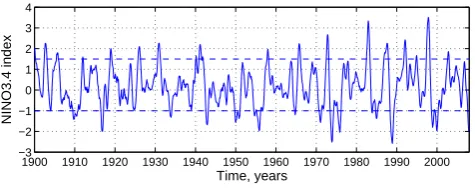
Fig. 1. Temporal evolution of the NINO3.4 index that
summa-rizes sea-surface temperature (SST) anomalies in the region be-tween 170◦,W–120◦W and 5◦S–5◦N. The time series is centred and normalized, but the horizontal lines do not represent the stan-dard deviations: instead, they have ordinates 1.5 and−1; see also Fig. 3.
A typical version of the SST index is the so-called Ni˜no-3.4 index, which summarizes the mean “anomalies” – i.e., the monthly mean deviations from the climatological “nor-mal” – of the spatially averaged SSTs over the region (170◦W–120◦W, 5◦S–5◦N) (Hurrell and Trenberth, 1999; Reynolds and Smith, 1994; Trenberth, 1997).
The evolution of this index, since 1900, is shown in Fig. 1: it clearly exhibits some degree of regularity, on the one hand, as well as numerous features characteristic of a determinis-tically chaotic system, on the other. The regularity mani-fests itself as the rough superposition of two dominant oscil-lations – quasi-biennial and quasi-quadrennial (Jiang et al., 1995; Ghil et al., 2002) – accompanied by a near-symmetry of the local maxima and minima (i.e., of the positive and neg-ative peaks). The lack of regularity has been associated with the presence of a “Devil’s staircase” (Jin et al., 1994, 1996; Tziperman et al., 1994, 1995) and does not preclude the su-perposition of stochastic effects as well (Ghil et al., 2008c).
While this study mainly focuses on local extrema (maxima and minima) in our ENSO model, one must recall that the major El Ni˜nos of 1982–1983 and 1997–1998 (see Fig. 1) are, in fact, genuine extremes, i.e. rare events of unusually large magnitude. These climatic extremes and the related hydroclimatological impacts are part of the motivation for studying ENSO in general and for this study in particular. At the moment, the observational record contains too few of these truly extreme events to allow studying them by the methods of classical, i.e. statistical extreme value theory. Therefore, we hope that the modelling approach developed in this study might prove useful in obtaining relevant statisti-cal data to better understand ENSO-related extreme events.
To simulate, understand and predict such complex phe-nomena, one needs a full hierarchy of models, from “toy” via intermediate to fully coupled general circulation mod-els (GCMs) (Neelin et al., 1998; Ghil and Robertson, 2000; Dijkstra and Ghil, 2005). We focus here on a “toy” model, which captures a qualitative, conceptual picture of ENSO dy-namics that includes a surprisingly broad range of features. This approach allows one to gain a rather comprehensive un-derstanding of the model’s, and maybe the phenomenon’s, underlying mechanisms and their interplay, at the cost of not capturing a full spatiotemporal picture of ENSO evolution.
We consider the following conceptual ingredients that play a determining role in the dynamics of the ENSO phe-nomenon: (i) the Bjerknes hypothesis, which suggests a pos-itive feedback as a mechanism for the growth of an inter-nal instability that could produce large positive anomalies of SSTs in the eastern Tropical Pacific (Bjerkness, 1969); (ii) delayed oceanic wave adjustments, realized in the form of eastward Kelvin and westward Rossby waves, that compen-sate for Bjerknes’s positive feedback (Suarez and Schopf, 1998); and (iii) seasonal forcing (Battisti, 1988; Chang et al., 1994, 1995; Jin et al., 1994, 1996; Tziperman et al., 1994, 1995; Ghil and Robertson, 2000). A more detailed discus-sion of these ingredients is given by Ghil et al. (2008b) and references therein.
Fig. 2. Maximum and period maps for a warm initial history,φ (t )≡1. (a) Maximum map,M=M(κ, τ )atb=1; (b) maximum map, M=M(b, τ )atκ=10; (c) period map,P=P (κ, τ )atb=1; (d) period map,P=P (b, τ )atκ=10. Reproduced from Ghil et al. (2008b), with kind permission of Copernicus Publications on behalf of the European Geosciences Union (EGU).
1.2 Part 1 results and their physical interpretation
Ghil et al. (2008b) took several steps toward a comprehen-sive analysis, numerical as well as theoretical, of a DDE model relevant for ENSO phenomenology. In doing so, they also illustrated the complexity of the structures that arise in its phase-and-parameter space for even such a simple model of climate dynamics. Specifically, the authors formulated a highly idealized DDE model for ENSO variability and fo-cused on the analysis of model solutions in a broad three-dimensional (3-D) domain of its physically relevant para-meters. They showed that this model can reproduce many scenarios relevant to ENSO phenomenology, including pro-totypes of El Ni˜no and La Ni˜na events; spontaneous inter-decadal oscillations and intraseasonal activity reminiscent of Madden-Julian oscillations or westerly wind bursts (Delcroix et al., 1993; Gebbie et al., 2007; Harrison and Giese, 1988; Verbickas, 1998).
This model was also able to provide a good justification for the observed quasi-biennial oscillation in Tropical Pacific SSTs and trade winds (Philander, 1990; Diaz and Markgraf, 1992; Jiang et al., 1995; Ghil et al., 2002), with the 2–3-year
period arising naturally as the correct multiple of the sum of the basin transit times of Kelvin and Rossby waves. An important finding of Ghil et al. (2008b) was the existence of regions of stable and unstable solution behaviour in the model’s parameter space; these regions have a complex and possibly fractal distribution of solution properties.
This sensitivity is an important qualitative conclusion since, in reality, the propagation times of Rossby and Kelvin waves are affected by numerous phenomena that are not re-lated directly to ENSO dynamics. Moreover - as soon as the atmosphere-ocean couplingκvanishes or the delayτ de-creases below a critical value - the instabilities disappear and the dynamics of the system becomes purely periodic, with period one year; see Fig. 2a, b. Finally, the boundary be-tween the domains of stable and unstable model behaviour is clearly visible in Fig. 2, in the lower-right part of panels (b) and (d).
The region below and to the right of this boundary con-tains simple period-one solutions that change smoothly with the values of model parameters. The region above and to the left is characterised by sensitive dependence on parame-ters. The range of parameters that corresponds to present-day ENSO dynamics lies on the border between the model’s stable and unstable regions. Hence, if the dynamical phe-nomena found in the model have any relation to reality, Tropical Pacific SSTs and other fields that are highly corre-lated with them, inside and outside the Tropics, can be ex-pected to behave in an intrinsically unstable manner; they could, in particular, change quite drastically with global warming.
There are basically two approaches to ENSO dynamics (Neelin et al., 1994, 1998), both of which may be useful in extending the results of Part 1 above. The model consid-ered here and in Ghil et al. (2008b) explains the complexities of ENSO dynamics by the interplay of two oscillators: an internal, highly nonlinear one, due to a delayed feedback, and a forced, seasonal one. Our model, thus, falls within the strongly nonlinear, deterministic approach.
An alternative approach attempts to explain several fea-tures of ENSO dynamics by the action of fast, “weather” noise on a linear or very weakly nonlinear “slow” sys-tem, composed mainly in the upper ocean near the equa-tor. Boulanger et al. (2004) and Lengaigne et al. (2004), among others, provide a comprehensive discussion on how weather noise could be responsible for the complex dynam-ics of ENSO, and, in particular, whether wind bursts trigger El Ni˜no events. Saynisch et al. (2006) explore this possibil-ity in a conceptual toy model. Ghil and Robertson (2000) al-ready discussed the arguments about a “stochastic paradigm” for ENSO, with linear or only mildly nonlinear dynamics be-ing affected decisively by weather noise, vs. a “deterministi-cally chaotic paradigm”, with decisively nonlinear dynamics.
Ghil et al. (2008c) have recently illustrated a way of combin-ing these two paradigms to obtain richer and more complete insight into climate dynamics in general.
The present paper continues the study initiated in Part 1 and focuses on (i) the multiplicity of model solutions for the same parameter values, and on (ii) the behaviour of lo-cal extrema in these solutions. In particular, we investigate the distribution in time of the model solutions’ maxima and minima; these extrema are directly connected to the strength and timing of the corresponding El Ni˜no (warm) or La Ni˜na (cold) events. The current analytic theory of DDEs does not allow one to easily answer many practically relevant ques-tions about the behaviour of even such apparently simple equations as our Eq. (1) below. The present study, there-fore, combines general theoretical results about the existence and continuous dependence of solutions on parameters with extensive numerical investigations.
The rest of the paper is organized as follows. In Sect. 2, we summarize the model formulation from Part 1, recall ba-sic theoretical results concerning this model’s solutions and briefly review details of the numerical integration method. Section 3 reports on the phase locking of solutions to the periodic forcing, namely on the tendency for the solutions’ maxima and minima to each occur within a fixed, small in-terval of the seasonal cycle. Existence of multiple solutions and the attractor basins of the stable solutions are studied in Sect. 4. In Sect. 5 we investigate the behaviour of the model’s local extrema, considered as a discrete dynamical system. A discussion of these results in Sect. 6 concludes the paper.
2 Model and numerical integration method
2.1 Model formulation and parameters
Following Part 1, we consider a nonlinear DDE with additive, periodic forcing,
very rich behaviour that includes several important features of more detailed models and of observational datasets.
The function h(t ) in Eq. (1) represents the thermocline depth deviations from the annual mean in the eastern Trop-ical Pacific; accordingly, it can also be interpreted roughly as the regional SST, since a deeper thermocline corresponds to less upwelling of cold waters and, hence higher SST, and vice versa. The thermocline depth is affected by the wind-forced, eastward Kelvin and westward Rossby oceanic waves. The waves’ delayed effects are modelled by the func-tion tanh[κ h(t−τ )]; the delayτ is due to the finite velocity of these waves and it corresponds roughly to their combined basin-transit time.
The particular form of the delayed nonlinearity plays an important role in the behaviour of a DDE model. Munnich et al. (1991) provided a physical justification for the mono-tone, sigmoid nonlinearity we adopt here. The parameterκ, which is the linear slope of tanh(κ z) at the origin, reflects the strength of the atmosphere-ocean coupling. The forcing term represents the seasonal cycle in the trade winds, with the strongest winds occurring in boreal fall.
The DDE model (1) is fully determined by its five parame-ters: feedback delayτ, atmosphere-ocean coupling strength κ, feedback amplitude a, forcing frequencyω, and forcing amplitudeb. By an appropriate rescaling of timet and de-pendent variableh, we letω=1 anda=1. The remaining three parameters –τ,κandb– may vary, reflecting different physical conditions of ENSO evolution. We consider here the same parameter ranges as in Part 1 of this study: 0≤τ≤2 yr, 0< κ <∞, 0≤b <∞.
To completely specify model (1), we need to prescribe some initial “history”, i.e. the behaviour ofh(t )on the inter-val[−τ,0), cf. Hale (1977). In the numerical experiments of Sect. 3 below, we assume, as in Part 1, that h(t )≡1, −τ ≤t <0, i.e. we start with a warm year. But in Sect. 4 we turn to a systematic exploration of the effect of the initial histories on the number and stability of solutions.
2.2 Main theoretical result
Consider the Banach spaceX=C ([−τ,0),R)of continuous functionsh: [−τ,0)→Rand define the norm forh∈Xas
khk=sup{|h(t )|, t∈ [−τ,0)},
where| · |denotes the absolute value inR(Hale, 1977; Nuss-baum, 1998). For convenience, we reformulate the DDE
initial-value problem (IVP) in its rescaled form:
h0(t )= −tanh[κ h(t−τ )]+bcos(2π t ), t≥0, (2) h(t )=φ (t ) for t∈ [−τ,0), φ (t )∈X. (3) Ghil et al. (2008b) proved the following result, which fol-lows from Hale and Verduyn Lunel (1993) and references therein.
Proposition 1 (Existence, uniqueness, continuous dependence)
For any fixed positive triplet(τ, κ, b), the IVP (2)–(3) has a unique solutionh(t )on[0,∞). This solution depends con-tinuously on the initial dataφ (t ), delayτ and the right-hand side of (2), considered as a continuous mapf : [0,T )×X→ R, for any finiteT.
From Proposition 1 it follows, in particular, that the sys-tem (2)–(3) has a unique solution for all time, which depends continuously on the model parameters(τ, κ, b)for any finite time. This result implies that any discontinuity in the solution profile, as a function of the model parameters, indicates the existence of an unstable solution that separates the attractor basins of two stable solutions. Our numerical experiments suggest, furthermore, that all stable solutions of (2)–(3) are bound and have an infinite number of zeros.
2.3 Numerical integration
The results in this Part 2 of our study are based on numeri-cal integration of the DDE (2)–(3). We emphasize that there are important differences between the numerical integration of DDEs and ODEs, and that these differences require devel-oping special software; often the problem-specific modifica-tion of such software also becomes necessary. We used here the Fortran 90/95 DDE solver dde solverof Shampine and Thompson (2006), available at http://www.radford.edu/
∼thompson/ffddes/. Technical details ofdde solver, as
well as a brief overview of other available DDE solvers, are given in Appendix C of Part 1.
3 Seasonal phase locking of extrema
J F M A M J J A S O N D 0
1 2 3 4 5
Month
No. of local maxima
(a)
J F M A M J J A S O N D
0 1 2 3 4 5 6
Month
No. of local minima
(b)
Fig. 3. Histogram of temporal location of (a) warm and (b) cold
events for the Ni˜no–3.4 index. The event thresholds are shown by the dashed horizontal lines in Fig. 1. Notice the preferential occur-rence of both warm and cold events during the boreal winter.
which shows the histograms of the monthly positions of un-usually warm and unun-usually cold events, based on the Ni˜no-3.4 index of Fig. 1. In our classification, El Ni˜nos (see panel a) are those for which NINO3.4>1.5, while La Ni˜nas (see panel b) have NINO3.4<−1. This asymmetry in the classification is due to the fact that extreme warm events are more intense but fewer in number than the extreme cold events (Hoerling et al., 1997; Burgers and Stephenson, 1999; Sardeshmukh et al., 2000; Kondrashov et al., 2005). Clearly, the extreme events, both warm and cold, tend to occur during boreal winter.
In discussing extrema, we distinguish between local and global ones. Recall that for a functionh(t )specified on the interval [t1,t2], its global maximum (minimum) is defined as
the pointt so thath(t )is above (below) all the other values on that interval:h(t )≥h(s), respectivelyh(t )≤h(s), for all s∈[t1,t2]. A local maximum (minimum) is a pointtso that
the corresponding valueh(t )is above (below) all the values in a vicinity oft; for a sufficiently smooth function, the latter definitions are equivalent to
(i) h0(t )=0; and (ii) h00(t ) <0 or h00(t ) >0, whereh00=(h0)0is the second derivative ofh(t ).
In this paper, we work with numerical solutions of the DDE problem (2)-(3) that are available only on a finite time
interval[0,tf]; in addition, we eliminate the initial transient
interval[0,t0). Thus, we consider the global and local
ex-trema of our solutions only on the interval[t0,tf]. The global
extrema so defined might differ in certain cases from their counterparts on the interval [0,∞), for which our DDE is formally defined. The difference will only be noticeable for very long-periodic, highly fluctuating solutions that are rela-tively rare in our model. Hence, the reduced definitions of the global and local extrema do not affect the main conclusions of our analysis.
In this section, we study the phaseϕ of the local maxima and minima of the model solutions that obey (2)–(3). The main result, as we shall see, is that the model’s extrema occur exclusively within a particular season.
We start with several examples that illustrate the analysis in the rest of the section. Figure 4a shows a piece of model solutionh(t ) for τ=0.5, κ=11 andb=2. This solution has periodP=1, as illustrated in panel (b), which shows the scatterplot of the pairs(h(ti),h(ti+1)) for i=0,1,... and
ti+1=ti+1. Given the 1-periodic character of the solution,
all the points(h(ti),h(ti+1)) coincide. The choice of the
starting pointt0will only affect the position of a single point
in the panel (not shown).
For each time epocht we define its positionϕwithin the seasonal cycle as ϕ=t (mod 1); the origin of the seasonal cycle in the forcing is taken in October, when the trade winds are strongest. Panel (c) shows the values of the local maxima (filled circles) and minima (squares) of h(t ) as a function of their positionϕ within the seasonal cycle. The six other panels in Fig. 4 show the results of a similar analysis for a solution with periodP =7 (panels d–f) and an aperiodic one (panels g–i).
In all the examples of Fig. 4, most of the local maxima are located within the first half of the annual cycle, i.e. in boreal winter, while the local minima lie within the second half, i.e. in boreal summer. Moreover, the global maximum, as well as local maxima with large amplitudes, are always located within the ϕ-interval (0.15, 0.4), while the global minimum, as well as large-amplitude local minima, are al-ways located within the interval (0.7, 0.95). We found this characteristic property of the model holding for most of its solutions.
0 1 2 3 4 5 6 7 −0.2
0 0.2
Time, t
h(t)
(a)
−1 −0.5 0 0.5 1 −1
−0.5 0 0.5 1
h(t)
h(t+1)
(b)
0 0.2 0.4 0.6 0.8 1 −1
−0.5 0 0.5 1
Position within the seasonal cycle
Minimum and maximum
(c)
0 5 10 15 20
−1 0 1
Time, t
h(t)
(d)
−1 −0.5 0 0.5 1
−1 −0.5 0 0.5 1
h(t)
h(t+1)
(e)
0 0.25 0.5 0.75 1
−1 −0.5 0 0.5 1
Position within the seasonal cycle
Local extrema
(f)
0 10 20 30 40 50 60 70
−1 0 1
Time, t
h(t)
(g)
−1 −0.5 0 0.5 1
−1 −0.5 0 0.5 1
h(t)
h(t+1)
(h)
0 0.5 1
−1 −0.5 0 0.5 1
Position within the seasonal cycle
Local extrema
(i)
Fig. 4. Seasonal phase locking of local extrema for model trajectories: (a–c) with periodP=1; (d–f) with periodP=7; and (g–i) aperiodic. The model solutions in panels (a, d, g) are shown in the stationary regime, after a sufficiently long transient, and the time axis is shifted so as to start fromt=0. The parameter values for these solutions are (a)τ=0.5,κ=11,b=2; (d)τ=0.56,κ=11,b=1.4; and (g) τ=0.47,κ=10,b=1.0. The scatterplots of the points(h(ti),h(ti+1))in panels (b, e, h) use the valuesi=0,1,...,500, which correspond
tot0=2500 and the parameter settings in panels (a, d, g), respectively. The phase locking is illustrated in panels (c, f, i), which give the h-value of the local extrema – maxima shown as red filled circles and minima as blue squares – as a function of their position within the seasonal cycle,ϕ=t (mod 1).
summarized in Figs. 5 and 6, where we used 10 000 individ-ual solutions for each value ofκ. Figure 5 shows histograms of positions of the local extrema within the seasonal cycle, while Fig. 6 plots the position of the global maximum as a function of the model parametersτ andb.
The phase locking of the extrema to the seasonal cycle is present for most combinations of the physically relevant model parameters. Moreover, the local maxima tend to oc-cur, depending on the value ofτ, at eitherϕ=0.23 orϕ= 0.27, while the local minima occur atϕ=0.73 orϕ=0.77. We notice that the cosine-shaped seasonal forcing vanishes atϕ=0.25 andϕ=0.75; hence, the local maxima occur in the vicinity of zero forcing when the latter decreases, and the local mimina occur in the vicinity of zero forcing when the latter increases. The offset in the position of the extrema
from the point where the external forcing vanishes seems to be independent of the model parameters.
0 0.2 0.4 0.6 0.8 1 0
500 1000 1500 2000 2500
Position within the seasonal cycle
No. of trajectories
Local maxima Local minima
0 0.2 0.4 0.6 0.8 1
0 500 1000 1500 2000 2500
Position within the seasonal cycle
No. of trajectories
Local maxima Local minima
Fig. 5. Seasonal phase locking of local extrema: cumulative results.
Histogram of the phaseϕof the local maxima (red bars) and minima (blue bars) of model solutions withκ=2.0 (top panel) andκ=11.0 (bottom panel). Each panel uses 10 000 individual solutions with parameters 0< τ≤2 and 0< b≤10; see also Fig. 6.
4 Multiple solutions, stable and unstable
The analysis in the previous section was carried out, as in Part 1, for the model (2)–(3) with a fixed initial history, φ (t )≡1. In this section, we study the model’s solutions for distinct, yet still constant historiesφ (t )≡φ0.
Naturally, different initial history valuesφ0may result in
different model solutions. This is illustrated in Fig. 8 for the parameter valuesτ=0.5,κ=10 andb=1. To produce this fi-gure, we used 20 distinct initial histories with constant values that are uniformly distributed betweenφ0=−2 and φ0=2;
hence, at timet=0 there exists 20 distinct solutions. As time passes, those solutions are attracted by a smaller number of stable solutions so that, byt=15, there are only four distinct solutions left, all of which have periodP=2. Furthermore, we notice that two of the remaining four solutions can be obtained by shifting the other two by one unit of time.
In general, it is readily seen that – if the system (2)–(3) has solutionx(t )– thenx(t+k)with any integerkis also a solution. Hence, ifx(t )is a solution with integer periodP= k, then there arek−1 other solutions obtained fromx(t )by an integer time shift. We will focus on solutions that cannot be obtained from each other by such a shift. Thus, we call two solutionsx(t )andy(t )distinct ifx(t )6≡y(t+k)for any positive integerk6=P.
1 2 3 4 5 6 7 8 9 10
0.2 0.4 0.6 0.8 1 1.2 1.4 1.6 1.8 2
Forcing amplitude, b
Delay,
τ
Phase
0.05 0.1 0.15 0.2 0.25 0.3 0.35 0.4 0.45 0.5
1 2 3 4 5 6 7 8 9 10
0.2 0.4 0.6 0.8 1 1.2 1.4 1.6 1.8 2
Forcing amplitude, b
Delay,
τ
Phase
0 0.1 0.2 0.3 0.4 0.5 0.6 0.7 0.8 0.9
Fig. 6. Seasonal phase locking of global extrema: parameter
de-pendence. The plots show the phase ϕof the global maxima of solutions of Eq. (2) forκ=2.0 (top panel) andκ=11.0 (bottom panel); same number of solutions and parameter range as in Fig. 5. The rectangle in the bottom panel highlights the region blown up in Fig. 7.
Next, we concentrate on the attractor basins of the model’s stable solutions. Figure 9 shows the model’s solution pro-files, after a suitable transient, for −10≤φ0≤10, at two
Forcing amplitude, b
Delay,
τ
Phase
0 0.2 0.4 0.6 0.8 1 1.2 1.4 1.6 1.8 2
0.6 0.65 0.7 0.75 0.8 0.85 0.9 0.95 1
0 0.1 0.2 0.3 0.4 0.5 0.6 0.7 0.8 0.9
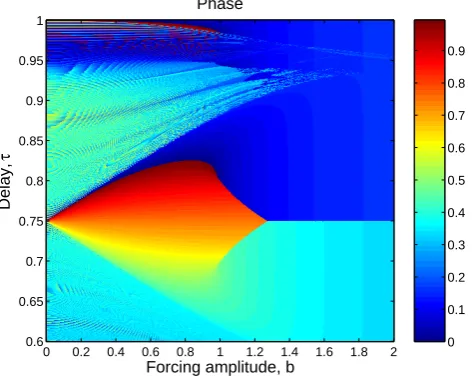
Fig. 7. Reversal in the phase locking of the maxima. The plot
shows the seasonal cycle positionϕ of the global maximum for 250 000 solutions of Eq. (2), forκ=11.0; it represents a blow-up of the region marked by a rectangle in the lower panel of Fig. 6.
The model has two distinct stable solutions at point B: the boundary between their attractor basins, as plotted on the real line of initial-history valuesφ0, corresponds to points of
dis-continuity in the solution profiles. These points line up into straight horizontal lines in Fig. 9: one can see 8 horizontal lines of discontinuity in the solution profiles and, thus, there would appear to be 9 attractor basins. These basins corre-spond, however, as shown in Fig. 8, to only two stable solu-tions that are distinct from each other.
Recall from Sect. 2.2 that our solutions lie in the infinite-dimensional Banach spaceX=C ([−τ,0),R), and that the solutions with constant initial histories do not span this space. By using such a particularly simple type of initial histories, we are merely exploring a 1-D manifold of solu-tions, parametrized by the scalar φ0, in the full space X.
The intersection of the boundary between the attractor basins of the two stable solutions with this 1-D manifold gives the 8 lines of discontinuity seen in the bottom panel of Fig. 9.
Proposition 1 also implies that a discontinuity in the solu-tion profile atφ0 suggests that there exists an unstable
so-lution starting from φ (t )≡φ0. Hence, the boundary that
separates the two attractor basins from each other is formed by unstable model solutions. This boundary is a mani-fold of codimension one in X, and Fig. 9 merely reveals the intersection of this manifold with the 1-D manifold of solutions that have constant initial histories. The presence of 8 such intersections suggests, in turn, that the boundary
be-0 1 2 3 4 5 6 7 8 9 10 11 12 13 14 15
−2 −1 0 1 2
Time, t
h(t)
Fig. 8. Multiple stable solutions. Twenty trajectories that
corre-spond to different initial historiesφ (t )≡φ0collapse, after a tran-sient, onto four stable solutions. Two of these solutions are distinct and the other two can be obtained from the latter by a time shift. Model parameters areτ=0.5,κ=10 andb=1; see also Fig. 9.
Fig. 9. Solution profiles for multiple constant historiesφ (t )=φ0. The top panel corresponds to point A=(τ=0.4,κ=11,b=2)in parameter space, where there exists a unique stable solution. The bottom panel corresponds to B=(τ=0.5,κ=10,b=1), the same point as in Fig. 8; here there exist two stable solutions and their attractor basins are bound by horizontal discontinuity lines in the solution profile. The solutions are shown after a sufficiently long transient, and the origin of the time is shifted to start from zero; colour bars indicate solution values, here as well as in Fig. 10.
tween the two attractor basins is a highly curved, but still smooth manifold. It is known for finite-dimensional prob-lems that such boundaries can become quite complex and possibly fractal (Grebogi et al., 1987).
Time, t
History,
φ0
(a)
0 2 4 6 8 10
−5
0
5
−3 −2 −1 0 1 2 3
−0.4 −0.2 0 0.2 0.4
Time, t
h(t−t
max
)
(b)
−0.2 −0.1 0 0.1 0.2
Time, t
History,
φ0
(c)
0 1 2 3 4 5 6 7
−5
0
5
−5 −4 −3 −2 −1 0 1 2 3 4 5
−2 −1 0 1 2
Time, t
h(t−t
max
)
(d)
−1.5 −1 −0.5 0 0.5 1 1.5
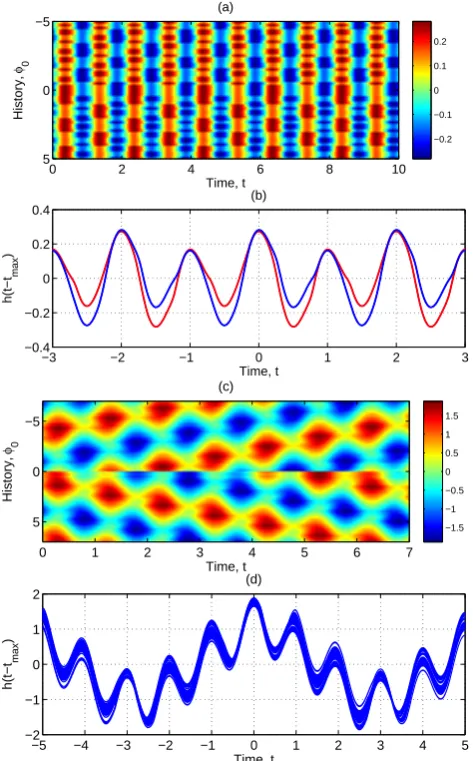
Fig. 10. Multiple stable solutions. Solution profile for (a, c)
dif-ferent initial historiesφ (t )≡φ0, and (b, d) the corresponding dis-tinct solutions. For visual convenience, the trajectories are shifted to have their global maxima att=0. Panels (a, b): model be-haviour at point C=(τ=0.5,κ=11,b=1.7842), where there exist 2 distinct solutions; and panels (c, d): model behaviour at point D=(τ=1.4579,κ=11,b=4), where there exist 61 distinct solu-tions.
solutions, having allP =10 (panels c, d). For visual conve-nience, we shift all the solutions so that their global maxima occur att=0.
5 Dynamics of local extrema
Here, we focus on the dynamics of the local extrema in the model solutions. For each solutionh(t ), we consider the se-quence of its local extrema{ei} := {h(ti),i=1,2,...}, where
Fig. 11. Local maxima (red) and minima (blue) of model solutions
as a function of delayτ; the other parameter values are fixed at κ=11 andb=2. Notice the aperiodic regimes between periodic windows of gradually increasing period.
h0(ti)=0. The local maxima {Mi,i=1,2,...}are
charac-terised by the additional condition thath00(ti) <0, while at
the local minima{mi,i=1,2,...}one hash00(ti) >0.
Figure 11 shows the position of the local extrema as a function of delay 0< τ <2 for fixedκ=11 andb=2. The figure illustrates convincingly the increase in complexity of model solutions as the delayτ increases. For small delay values, 0< τ <0.5, each solution is a periodic sine-like wave with periodP =1, which contains a single maximum and a single mimimum within each cycle.
Within the interval 0.6< τ <0.8, the solutions become more complex: the solution period here isP =3, and each cycle has three local maxima and three local minima. In gen-eral, the time elapsed between a local maximum and the next is an integer number; this effect is caused by the seasonal forcing, and the same is true for local minima. Often, the recurrence interval for extrema of the same kind is just unity and the number of local maxima (or minima) coincides with the periodP of a given solution.
Figure 12 zooms in on the distribution of local maxima within the first aperiodic region of Fig. 11, namely 0.51< τ <0.59. In this region, the τ-intervals of aperiodic be-haviour alternate with shorter periodic windows: in the for-mer the local maxima are distributed continuously within an interval, while in the latter several distinct local maxima oc-cur within a comparable range of values. This distribution of the maxima resembles the behaviour of chaotic dynamical systems in discrete time – e.g., period doubling for smooth maps (Feigenbaum, 1978; Kadanoff, 1983) – and suggests that the model’s aperiodic dynamics are, in fact, chaotic. An even richer behaviour – with multiple, overlapping cascades – seems to emerge for 0.545< τ.
6 Concluding remarks
In the present paper, we continued our study of a periodically forced delay differential equation (DDE) introduced by Ghil et al. (2008b); the DDE (1) serves as a toy model for ENSO variability. We studied the model solutions numerically in a broad 3-D domain of physically relevant parameters: oceanic wave delay τ, ocean-atmosphere coupling strength κ, and seasonal forcing amplitudeb. In Part 2 of our investigation, we focussed on multiple model solutions as a function of ini-tial histories, and on the dynamics of local extrema.
We found that the system is characterised by phase locking of the solutions’ local extrema to the seasonal cycle (Figs. 4 and 5): solution maxima – i.e., warm events (El Ni˜nos) – tend to occur in boreal winter, while local minima – i.e., cold events (La Ni˜nas) – tend to occur in boreal summer. The former model feature is realistic, since observed warm events do occur by-and-large in boreal winter; in fact, this property is one of the main features of the observed El Ni˜no events, this given rise to the name of the phenomenon (Philander, 1990; Glantz et al., 1991; Diaz and Markgraf, 1992).
The phase locking of cold events in the model to boreal summer is not realistic, since La Ni˜nas also tend to occur in boreal winter, rather than in phase opposition to the warm ones; see again Fig. 3. It is not clear at this point which one of the lacking features of our DDE model gives rise to this unrealistic phase opposition; it might be the lack of a positive feedback mechanism, present with a separate, distinct delay in the Tziperman et al. (1994) model. On the other hand, even GCMs, with many more detailed features, may have their warm events in entirely the wrong season; see Ghil and Robertson (2000) for a review.
Fig. 12. Distribution of local maxima as a function of delayτwithin the interval 0.5< τ <0.59; the other parameters are as in Fig. 11.
At the same time, for small-to-intermediate seasonal forc-ingb, the position of the global maxima and minima depends sensitively on other parameter values: it may exhibit signif-icant jumps in response to vanishingly small changes in the parameter values (Fig. 6). In particular, an interesting phe-nomenon of “phase reversal” of the global extrema may oc-cur, cf. Fig. 7.
We explored a 1-D manifold of solutions for a set of given, prescribed pointsP=(τ,κ,b)in the model’s param-eter space. Such a manifold was generated, for eachP, by solutions with constant initial historiesφ (t )≡φ0.
We found multiple solutions coexisting for physically rel-evant values of the model parameters; see Figs. 8–10. Some of these solutions are generated by shifting a single solution in time, using integer multiples of the period of the forcing, taken here to be unity. We have often found a set ofk solu-tions so obtained from a single solution of periodP=k.
Typically, each stable solution has a bounded, but infinite-dimensional attractor basin in the solution spaceXdescribed in Sect. 2.2. This attractor basin is separated from that of another stable solution by a manifold of codimension one, which is generated by unstable solutions (see Proposition 1 and the following remarks). The intersections of such a man-ifold with the 1-D manman-ifold of solutions, explored herein, appear as the straight horizontal lines in the solution-profile panels of Figs. 9 and 10.
P of model solutions increases in discrete jumps, like {P=2k+1,k=0,1,2,...}, separated by narrow, apparently chaotic “windows” in τ. This increase in P is associated with the increase of the number of distinct local extrema, all of which tend to occur at the same position within the seasonal cycle. The distribution of the maxima in Fig. 12 resembles, in fact, the behaviour of chaotic dynamical systems in discrete time (Feigenbaum, 1978; Kadanoff, 1983) and suggests that the model’s aperiodic dynamics is, in fact, chaotic.
It is quite interesting that, for plausible values of the de-layτ, the periods lie roughly between 2 and 7 years, a range that is commonly associated with the recurrence of relatively strong warm events (Philander, 1990; Glantz et al., 1991; Diaz and Markgraf, 1992; Neelin et al., 1998). The sensitive dependence of the period on the model’s external parameters (τ,κ,b)is consistent with the irregularity of occurrence of strong El Ni˜nos, and can help explain the difficulty in pre-dicting them (Latif et al., 1994; Ghil and Jiang, 1998).
Acknowledgements. We are grateful to our colleagues
M. D. Chekroun, J. C. McWilliams, J. D. Neelin and E. Si-monnet for many useful discussions; MDC in particular suggested the search for multiple solutions, and JDN provided information on the seasonal cycle in the surface winds. This study was supported by DOE Grants DE-FG02-07ER64439 and DE-FG02-07ER64440 from the Climate Change Prediction Program, and by the European Commission’s No. 12975 (NEST) project “Extreme Events: Causes and Consequences (E2-C2)”.
Edited by: J. Davidsen
Reviewed by: P. Ditlevsen and another anonymous referee
References
Battisti, D. S.: The dynamics and thermodynamics of a warming event in a coupled tropical atmosphere/ocean model, J. Atmos. Sci., 45, 2889–2919, 1988.
Battisti, D. S. and Hirst, A. C.: Interannual variability in the tropical atmosphere-ocean system: Influence of the basic state and ocean geometry, J. Atmos. Sci., 46, 1687–1712, 1989.
Bjerknes, J.: Atmospheric teleconnections from the equatorial Pa-cific, Mon. Weather Rev., 97, 163–172, 1969.
Boulanger, J. P., Menkes, C., and Lengaigne, M.: Role of high- and low-frequency winds and wave reflection in the onset, growth and termination of the 1997–1998 El Nino, Clim. Dynam., 22(2– 3), 267–280, 2004.
Burgers, G. and Stephenson, D. B.: The “normality” of El Ni˜no, Geophys. Res. Lett., 26, 1027–1030, 1999.
Cane, M.: The evolution of El Ni˜no, past and future, Earth Planet. Sc. Lett., 230(3–4), 227–240, 2005.
Cane, M., Munnich, M., and Zebiak, S. E.: A study of self-excited oscillations of the tropical ocean-atmosphere system. Part I: Lin-ear analysis, J. Atmos. Sci., 47(13), 1562–1577, 1990.
Chang, P., Wang, B., Li, T., and Ji, L.: Interactions between the seasonal cycle and the Southern Oscillation: Frequency en-trainment and chaos in intermediate coupled ocean-atmosphere model, Geophys. Res. Lett., 21, 2817–2820, 1994.
Chang, P., Ji, L., Wang, B., and Li, T.: Interactions between the seasonal cycle and El Ni˜no – Southern Oscillation in an inter-mediate coupled ocean-atmosphere model, J. Atmos. Sci., 52, 2353–2372, 1995.
Diaz, H. F. and Markgraf, V. (Eds.): El Ni˜no: Historical and Pale-oclimatic Aspects of the Southern Oscillation, Cambridge Univ. Press, New York, 1993.
Delcroix, T., Eldin, G., McPhaden, M., and Morli`ere, A.: Effects of westerly wind bursts upon the western equatorial Pacific Ocean, February–April 1991, J. Geophys. Res., 98(C9), 16379–16385, 1993.
Dijkstra, H. A.: Nonlinear Physical Oceanography: A Dynamical Systems Approach to the Large Scale Ocean Circulation and El Ni˜no, 2nd edn., Springer-Verlag, 2005.
Dijkstra, H. A. and Ghil, M.: Low-frequency variability of the ocean circulation: a dynamical systems approach, Rev. Geo-phys., 43, RG3002, doi:10.1029/2002RG000122, 2005. Feigenbaum, M. J.: Quantitative universality for a class of
non-linear transformations, J. Stat. Phys., 19, 25–52, 1978.
Gebbie, G., Eisenman, I., Wittenberg, A., and Tziperman, E.: Mod-ulation of westerly wind bursts by sea surface temperature: A semistochastic feedback for ENSO, J. Atmos. Sci., 64, 3281– 3295, 2007.
Ghil, M. and Jiang, N.: Recent forecast skill for the El Ni˜no/Southern Oscillation, Geophys. Res. Lett., 25, 171–174, 1998.
Ghil+02 Ghil, M., Allen, M. R., Dettinger, M. D., Ide, K., Kon-drashov, D., Mann, M. E., Robertson, A. W., Saunders, A., Tian, Y., Varadi, F., and Yiou, P: Advanced spectral meth-ods for climatic time series, Rev. Geophys., 40(1), 1003, doi:10.1029/2000RG000092, 2002.
Ghil, M. and Robertson, A. W.: Solving problems with GCMs: General circulation models and their role in the climate mod-elling hierarchy, in: General Circulation Model Development: Past, Present and Future, edited by: Randall, D., Academic Press, San Diego, 285–325, 2000.
Ghil, M., Zaliapin, I., and Coluzzi, B.: Boolean delay equations: A simple way of looking at complex systems, Physica D, 237, 2967–2986, doi: 10.1016/j.physd.2008.07.006, 2008a.
of extremes, Nonlin. Processes Geophys., 15, 417–433, 2008b, http://www.nonlin-processes-geophys.net/15/417/2008/. Ghil, M., Chekroun, M. D., and Simonnet, E.: Climate dynamics
and fluid mechanics: Natural variability and related uncertain-ties, Physica D, 237, 2111–2126, 2008c.
Glantz, M. H., Katz, R. W., and Nicholls, N. (Eds.): Teleconnec-tions Linking Worldwide Climate Anomalies, Cambridge Univ. Press, New York, 545 pp., 1991.
Grebogi, C., Ott, E., and Yorke, J. A.: Chaos, strange attractors, and fractal basin boundaries in nonlinear dynamics, Science, 238(4827), 632–638, 1987.
Hale, J. K.: Theory of Functional Differential Equations, Springer-Verlag, New-York, 1977.
Hale, J. K. and Verduyn Lunel, S.: Introduction to Functional Dif-ferential Equations, Springer-Verlag, New York, 1993.
Harrison, D. E. and Giese, B.: Remote westerly wind forcing of the eastern equatorial Pacific; some model results, Geophys. Res. Lett., 15, 804–807, 1988.
Hoerling, M. P., Kumar, A., and Zhong, M.: El Ni˜no, La Ni˜na, and the nonlinearity of their teleconnections, J. Climate, 10, 1769– 1786, 1997.
Hurrell, J. W. and K. E. Trenberth: Global sea surface temperature analyses: Multiple problems and their implications for climate analysis, modelling, and reanalysis, B. Am. Meteorol. Soc., 80, 2661–2678, 1999.
Jiang, N., Neelin, J. D., and Ghil, M.: Quasi-quadrennial and quasi-biennial variability in the equatorial Pacific, Clim. Dynam., 12, 101–112, 1995.
Jin, F.-F., Neelin, J. D., and Ghil, M.: El Ni˜no on the Devil’s Stair-case: Annual subharmonic steps to chaos, Science, 264, 70–72, 1994.
Jin, F.-F., Neelin, J. D., and Ghil, M.: El Ni˜no/Southern Oscilla-tion and the annual cycle: Subharmonic frequency locking and aperiodicity, Physica D, 98, 442–465, 1996.
Kadanoff, L. P.: Roads to chaos, Phys. Today, 12, 46–53, 1983. Kondrashov, D., Kravtsov, S., Robertson, A. W., and Ghil, M.: A
hi-erarchy of data-based ENSO models, J. Climate, 18, 4425–4444, 2005.
Latif, M., Barnett, T. P., Fl¨ugel, M., Graham, N. E., Xu, J.-S., and Zebiak, S. E.: A review of ENSO prediction studies, Clim. Dy-nam., 9, 167–179, 1994.
Lengaigne, M., Guilyardi, E., Boulanger, J. P., et al.: Triggering of El Nino by westerly wind events in a coupled general circulation model, Clim. Dynam., 23(6), 601–620, 2004.
Madden, R. A. and Julian, P. R.: Description of a 40–50 day oscil-lation in the zonal wind in the tropical Pacific, J. Atmos. Sci., 28, 702–708, 1971.
Madden, R. A. and Julian, P. R.: Description of global-scale circu-lation cells in the tropics with a 40–50 day period, J. Atmos. Sci., 29, 1109-,1123, 1972.
Madden, R. A. and Julian, P. R.: Observations of the 40–50-day tropical oscillation – A review, Mon. Weather Rev., 122(5), 814– 37, 1994.
McPhaden, M. J., Busalacchi, A. J ., Cheney, R., Donguy, J. R., Gage, K. S., Halpern, D., Ji, M., Julian, P., Meyers, G., Mitchum, G. T., Niiler, P. P., Picaut, J., Reynolds, R. W., Smith, N., and Takeuchi, K.: The Tropical Ocean-Global Atmosphere observ-ing system: A decade of progress, J. Geophys. Res., 103(C7), 14169–14240, 1998.
Munnich, M., Cane, M., and Zebiak, S. E.: A study of self-excited oscillations of the tropical ocean-atmosphere system. Part II: Nonlinear cases, J. Atmos. Sci., 48(10), 1238–1248, 1991. Neelin, J. D., Latif, M., and Jin, F.-F.: Dynamics of coupled
ocean-atmosphere models: the tropical problem, Annu. Rev. Fluid Mech., 26, 617–659, 1994.
Neelin, J. D., Battisti, D. S., Hirst, A. C., Jin, F.-F., Wakata, Y., Yamagata, T., and Zebiak, S.: ENSO Theory, J. Geophys. Res., 103(C7), 14261–14290, 1998.
Nussbaum, R. D.: Functional Differential Equations, available at: http://citeseer.ist.psu.edu/437755.html, 1998.
Philander, S. G. H.: El Ni˜no, La Ni˜na, and the Southern Oscillation, Academic Press, San Diego, 1990.
Reynolds, R. W. and Smith, T. M.: Improved global sea surface temperature analyses using optimum interpolation, J. Climate, 7, 929–948, 1994.
Sardeshmukh, P. D., Compo, G. P., and Penland, C.: Changes of probability associated with El Ni˜no, J. Climate, 13, 4268–4286, 2000.
Saunders, A. and Ghil, M.: A Boolean delay equation model of ENSO variability, Physica D, 160, 54–78, 2001.
Saynisch, J., Kurths, J., and Maraun, D.: A conceptual ENSO model under realistic noise forcing, Nonlin. Processes Geophys., 13, 275–285, 2006,
http://www.nonlin-processes-geophys.net/13/275/2006/. Shampine, L. F. and Thompson, S.: A friendly Fortran 90 DDE
solver, Appl. Numer. Math., 56(2–3), 503–516, 2006.
Suarez, M. J. and Schopf, P. S.: A delayed action oscillator for ENSO, J. Atmos. Sci, 45, 3283–3287, 1988.
Trenberth, K. E.: The definition of El Ni˜no, B. Am. Meteorol. Soc., 78, 2771–2777, 1997.
Tziperman, E., Stone, L., Cane, M., and Jarosh, H.: El Ni˜no chaos: Overlapping of resonances between the seasonal cycle and the Pacific ocean-atmosphere oscillator, Science, 264, 72–74, 1994. Tziperman, E., Cane, M. A., and Zebiak, S. E.: Irregularity and
locking to the seasonal cycle in an ENSO prediction model as explained by the quasi-periodicity route to chaos, J. Atmos. Sci., 50, 293–306, 1995.