EVALUATION OF RESEARCH-DEVELOPMENT-INNOVATION IN THE CONTEXT OF STRATEGIC MANAGEMENT
Margareta Stela Florescu 1, Alina Valentina Din2 1
The Bucharest University of Economic Studies, Romania 2
SC ALBIS SRL, Romania
Abstract
The more and more accelerated scientific and technological progress in advanced economies and the increase in complexity of the uncertainty and non-repetitiveness characteristics of the RDI activities call more and more for the diversification, perfection and refinement of the evaluation methods for the efficiency and effectiveness of the RDI activity, in the short, medium and long run, under the new conditions of globalization and assertion of knowledge-based society.
The notion of “research evaluation” is approached in the broader context of strategic management, where the process of financing and evaluating costs and RDI results are primary elements. The strategic dimension of research management consists in a series of priorities within various time horizons. Strategic research management interferes with the other components of the national economic and social development programs, with the opportunities offered by the European Research Area and other bilateral and multilateral forms of collaboration with other non-member countries.
Key words: evaluation, research-development-innovation, evaluation methods, strategic management
1. INTRODUCTION
The evaluation can contribute the most as far as policies regarding research, development and innovation are concerned, since success is not guaranteed and the implementation does not occur without obstacles in this field. There must be a balance between demand and offer for research evaluation, hence the necessity of efficient management and adequate planning.
When applied adequately, evaluation helps clarify some inherent uncertainties of complex situations. Social-economic development is not an exact science; it is a complex process, with numerous uncertainties. Selecting the goals and measures, designing the programs, implementing and ensuring their dynamic development require analysis, power of anticipation, feedback systems and support from various institutions, agencies and groups through scientists and researchers.
Bryde (2003) proposed a model of project management performance evaluation whereby a project can have the best performance possible, with certain variations depending on the organization (PMPA model).
Romania, a developing country, needs new synchronized approaches of the developed world in order to improve its efficiency, reliability and success, which are mandatory for the business world. The success factors of projects evolve in a new dimension in line with the changes and according to the „survival of the fittest” principle. The principle of the competitive business environment is characteristic today. The project can be defined as „a transitional society” created to exclusively generate a result or a service Barad et al. (2000). The transition refers to the fact that the project has an end date. This means that the exclusiveness of the project’s final results is different from the results of the organization’s other functions. Dean &Bowen (1994) use case studies to suggest that the only way organizations can accomplish important goals is through projects.
Project management is a vital and imperative task to evaluate project management performance. In this case, it is important to make the distinction between project performance and project management performance. Both are interconnected, but they are completely different from each other, so these terms are not to be confused (Bryde, 2003). Although project management (PM) may seem “poor”, the
actual project can be “prosperous”, just as a project can be useless despite great project management (DeWitt 1988).
As an essential instrument for the proper management of the RDI patrimony and activity, evaluation is good for measuring a research program/project while contributing to strengthening and/or substantiating managerial decisions, in order to accomplish the strategic goals.
Strategic management in the research field is “the way organizations formulate and implement their strategies concerning the research activities, helping managers accomplish their goals regarding innovation and development” (Cassiman & Gambardella, 2009).
The concept of strategic RDI management offers better analytical and synthetic support for more rigorous knowledge of the criteria, functions, levels and types of evaluation.
The purpose of the evaluation is to determine the efficiency of achieving objectives of a project or program, and the effectiveness of evaluation is measured through the impact and sustainability of scientific results.
Evaluation has been defined as a systematic and objective appreciation of a project, program or policy, currently carried out or finished, both conceptually and as far as results are concerned. We use the concept of evaluation to assess results of programs, and in this regard, the program is the activity plan which establishes (in the order of their accomplishment) the stages proposed for a given period, the set of principles, purposes and tasks regarding the activity of an organization (dexonline.ro). This assessment is understood to be a complex, detailed and extremely important process for the future actions of an organization(Thompson 1991).
In the paper, a distinction is made between evaluation, audit and monitoring, highlighting the specific of each of the three notions in terms of objectives, the scope, the “actors” involved, the methods, the analysis instruments and the system of indicators used.
Performance management is a strategic and integrated approach to long-term success for organizations, by improving the performance of the organization, teams and individuals (Bolboacă et al. 2011).
Strategic character comes from emphasis on the general problems the organization encounters, in order to function efficiently and effectively, in its external environment and regarding the general direction it plans to adopt to accomplish its medium and long-term goals. In fact, the mission, vision, goals and strategies of the organization, defined in the strategic planning stages, are the starting point for any strategic management program. At this point, the performance evaluation and measurement processes are developed (Florescu 2012).
2. EXPERIMENTAL PART
In this study makes a synthesis on how to approach the literature, providing a series of propositions for a better comprehension of the evaluation process in the broader context of strategic management, which includes specific objectives within various time horizons. In this context, a new model of evaluating RDI project/program management performancesis proposed. This model consists in compatibilizing set objectives through bottom-up and top-down processes, which provide the opportunity to plan a clear framework to acknowledge and solve the threats throughout the entire RDI activity of a project and/or a program, the interdependence between the purposes and objectives of the project/program, implementing the scientific results in the short, medium and long run, as well as the optimal evaluation methodologies.
The new conceptual model proposed has the advantage of efficient evaluation by identifying and analyzing the relation between a set of short-term and medium-term performance factors and the impact on RDI projects through quantitative and qualitative evaluation methods that allow a correlation between the contributions of the predictive factors to the explained variables, whereby the contributions of the qualitative factors can be quantitatively extracted.
Research evaluation gains a wider scope, connected to various financing methods, as well as to various types of research activities (fundamental, applicative, etc.) (Mishra 2009a).
Evaluation practices also vary in terms of the involved actors and the types of problems related to research evaluation, implemented in each country, attempting to separate pecularities and similarities of approach, but especially best practices to be adapted, implemented and improved in our country. Evaluations in Europe, in the context of a coordinated RDI policy, include various levels, namely: a strategic level for design, implementation management, intermediary evaluation, transfer of results and the target group. Evaluation is only a stage in the process of the policy.
Designing evaluation methodologies based on economic theoretical bases allows a link between measuring the results and the marginal impact of the policies on the economic welfare
The evaluation system based on RDI indicators was analyzed in the paper from the perspective of financing programs, taking into account four essential criteria that allow us to identify the performances and the difficulties generated by the projects/programs, namely:
a) the resources attracted;
b) the relevance and visibility of the results;
c) the impact and sustainability of the results;
d) the performance achieved by implementing the projects.
In this context, the paper proposes a new conceptual intermediary evaluation model, taking into account “predecessors” of the “identifiable” result indicators. These “identifiable” predecessor-indicators of scientific results should be characterized through:
1. Simplicity and easy understanding; 2. Consistency and direct relevance; 3. Objectivity;
4. The calculation possibility; 5. Stability;
6. Comparability at an international level.
The management of the RDI performance is based on a strategic and integrated approach to ensuring long-term success, by improving performance in the organization, the research teams and the individuals. The strategic character resides in the concern for the general problems of the efficient and effective functioning of the organization in the external environment, permanently trying to accomplish the medium-term and long-term objectives. We stress that any successful strategic management program starts with missions, visions, objectives and strategies defined as clearly as possible, in the stages of a consistent, well correlated and dynamic process of strategic planning. Only under these circumstances can performance measurement and evaluation processes take place later, in an ex-ante and ex-post evaluation.
There are no unanimously accepted definitions or interpretations for performance, as a key-term, frequently used in project management. We stress the co-existence of various different points of view regarding the scope, structures, criteria and matrix of the project management performance(Mishra 2009a).
One of the basic attributes of the conceptual project management performance evaluation model consists in identifying and analyzing the relation between the set of short-term and medium-term performance and the impact on RDI projects, based on the use of the canonical correlation analysis. This interaction model allows us to identify the contributions of the influence factors on the predicted dependent variable. The canonical correlation analysis allows us to also estimate, in quantitative terms,
the contribution of the qualitative factors, the qualitative-quantitative ratio, involving new techniques and determination complexes.
The originality of the model proposed consists in estimating the external qualitative criterion (the dependent variables) based on information regarding the qualitative attributes for every subject (independent variables). The performance factors of this model consist in the conceived and identified impact inputs and outputs, in order to ensure their interdependence and the items attributed for every factor, in order to obtain the real values of the research evaluation. The input and output factors are the project management performances, for each type of research organization, interpreted in the short and medium run, while the impact factor is the international and national performance, interpreted as long-term performance.
In most studies, the performances were measured according to Likert ordinal scale, but they were treated solely as continuous variables. More important information may fade when a category such as Likert scale is treated as a continuous variable. In this paper, the answers from the questionnaire were measured according to Likert scale as ordinal categorical variables, and the application method is the statistical canonical correlation method meant to identify the link between the four items of the impact of the project: scientific, social, economic and technological (dependent variables) as a function of performances of management, resources and results of the project (independent variables).
To each independent variable were attributed 4 qualitative binomial variables, for:
• The resources factor (identification of the financing sources, the evolution of the fund absorption, the development of the capacity of human resources, the development of the research infrastructure)
• The management factor (the PM policies and strategies, PM leadership, the staff from the project team, the PM key indicators)
• The results factor (types of results, result indicators, identification of other results, PM key indicators)
In the feed-back questionnaire carried out on an online platform, for every qualitative binomial variable, a question with four possible answers was asked, in order to analyze the relation between the long-term impact and the short-term and medium-term performances of the four different categories of public research institutions (Public authorities and institutions, Research-development institutes, Private organizations, Universities) with a main or secondary RDI activity, and have received national and/or European financing.
The originality of the evaluation model proposed consists in using group and risk analysis for the RDI institutions identified in the study, through highly significant feedback on the innovative performances in RDI financing through projects of these types of institutions.
2.1 The research methodology/ The purpose of the research study
• The research methodologies used in this study were: investigations, interviews and questionnaires, as well as canonical correlation analysis. In order to identify the relation between the four items of the project’s impact (dependent variables) as a function of the project’s performances, management and results (independent variables), canonical correlation analysis was used.
• This multivariate analysis technique was used in order to investigate two sets of variables (dependent and independent). This statistical method reduces type I errors(Mishra 2009b).
• The canonical correlation analysis was performed using the Statistica program (StatSoft Inc., v. 8.0), with a significance threshold of 5%, so probabilities smaller than 0.05 were considered statistically significant (Jäntschi & Bolboacă 2010).
2.2 The investigation methods (e-mail, interviews and phone calls)
For the research, at first, 143 experts with 10-35 years of experience in evaluations of national and European projects were chosen to participate in a survey,to collect data and information, in order to establish a conceptual model of project management performance evaluation in the organizations that benefited from national and/or European financing. Due to the time deficit, we originally used the e-mail survey for anthology data. Through this method, we collected answers to a series of key questions regarding the national and European evaluation system, good and bad practices. However, there were also certain problems that reduced the answer efficiency rates. For instance, certain experts took a lot of time before sending the e-mails, so data elaboration was delayed.
In order to deal with this challenge, phone interviews were used as well: representatives of institutions in charge of monitoring and evaluation in Romania, managers of institutions that have and are carrying out nationally and internationally financed projects, project managers, directors of research and development departments from these institutions. As a result, the response rate was better, of a higher quality and quicker. The answers were collected from 69 institutions. This method was relatively more productive, allowing us to collect more answers. The descriptive investigations were made in order to establish an image of the current problems and the relational investigations were developed for an empiric analysis.
2.3 The questionnaire method
This research was based on conventional sampling (which was not based on probability), used as a modus operandi to make the research process quicker, in order to obtain more respondents (162) and so that the questionnaire would be filled in quickly and economically both on the online platform and on the e-mail of this questionnaire’s author. The institutions selected to fill in the questionnaire were:
Public institutions and authorities (11), Research-development institutes (27), Private organizations (15), Universities (16) whose main or secondary activity is research-development.
THE EXPERIENCES AND WORKPLACES OF THE RESPONDENTS
Institutions No. of
institutions
No. of respondents from the institutions
Experience in the field (years)
Public institutions and authorities
11 29 5-15
Research-development institutes
27 62 10-35
Private organizations 15 15 5-10
Universities 16 56 5-25
TOTAL 69 162 Average: 16
The purpose of this study is to find the “relation and impact between the financing resources, PM leadership, the PM staff, the PM policy, the PM strategy, the resources used, the life cycle of PM and the project management performance”, impact and sustainability of the results of scientific research projects.
The system of indicators was defined based on the structure of four fundamental components in performance evaluation, taking into account the approach of the performance in terms of efficiency/effectiveness.
These components are:
I. Resources attracted in the project
Resources (S) are characterized by 4 binomial qualitative variables (S1, S2, S4, S4)
• S1: identifying the financing sources
• S2: evolution of the absorption of funds
• S3: developing the capacity of human resources
• S4: developing the research infrastructure
II. Project performance management in the organization
Management (M) is characterized by 4 binomial qualitative variables (M1, M2, M3, M4)
• M1: PM policies and strategies • M2: PM leadership
• M3: the project team staff • M4: the PM key indicators
III. The relevance and visibility of the results of scientific research projects Results (R) are characterized by 4 binomial qualitative variables (R1, R2, R3, R4)
• R1: types of results
• R2: result indicators
• R3: identifying other results
• R4: the volume of scientific production
IV. The impact and sustainability of the results of scientific research projects Impact (I) is characterized by 4 binomial qualitative variables (I1, I2, I3, I4)
• I1: scientific impact
• I2: social impact
• I3: economic impact
• I4: technological impact
The criteria according to which the performances of the indicators identified in each of these four groups are evaluated, through this system, are:
• the international relevance of the performances;
• the national relevance of the performances;
• management performance.
In the study, the following factors associated with R&D performance were conceived: the financing resources, management, results, as well as their impact factor.
We adopted the four factors and measurement variables based on two aspects. Firstly, we regrouped the input and output indicators into a set of short and medium-term performances, to discover their relation to the impact factor. In various studies we have taken part in, we classified the R&D fund for performance according to three aspects: input, output and the impact factor. Nevertheless, although the input and output indicators directly indicate the level of accomplishment of a R&D project and the impact factor presents the indirect accomplishments and its long-term effects, we will try to combine the input and output indicators into a set of short and medium-term performances. Additionally, in this
particular study, the inputs and outputs are the performances of project managers from institutions and the impact represents the national/European performance.
For this purpose, we will analyze the relation between a series of short and medium-term performance factors and the impact factor. The second aspect refers to the fact that we will use quantification methods to identify the non-linear model between the two groups of performance factors, because the contribution of the qualitative factors can be extracted through canonical correlation analysis.
2.4 Description of the tools
The feedback questionnaire contains 16 questions (a question for every binomial variable). The answers to the questions were “YES”/”NO”. The binary code was: “YES” = 1; “NO” = 0 (see http://en.wikipedia.org/wiki/Truth_value 'Classical logic').
2.4.1 Mathematical model
If S.1.1, S.1.2, S.1.3 and S.1.4 are Bernoulli (0/1) variables, then S1 = S.1.1 + S.1.2 + S.1.3 + S.1.4 is a binomial variable (0, 1, 2, 3, 4).
Resources (S) are characterized by 4 binomial qualitative variables (S1, S2, S4, S4) Management (M) is characterized by 4 binomial qualitative variables (M1, M2, M3, M4) Results (R) are characterized by 4 binomial qualitative variables (R1, R2, R3, R4) Impact (I) is characterized by 4 binomial qualitative variables (I1, I2, I3, I4)
The interaction model can be seen as [7]: Resources (S1,S2,S3,S4) * Management (M1,M2,M3,M4) * Results (R1,R2,R3,R4) = Impact (I1,I2,I3,I4), therefore identifying the contributions of the predictive factors on the predicted variable is possible.
Through canonical correlation analysis [8, 9], the contributions of qualitative factors can be quantitatively extracted.
2.4.2 Statistical analysis
The variables were summarized as absolute frequencies and percentages. The associated 95% confidence intervals were calculated for the percentages, under the assumption of the binomial distribution [10]. The association in the 2x2 contingency table between pairs of items was analyzed through Cochran test. Null statistical hypothesis: the answer to an item is independent from the answer to the second item. A p value associated to Cochran statistic, smaller than the applied significance threshold (5% in this case, so p < 0.05), indicates a statistical significant dependence as far as the answer to the two investigated items is concerned. The canonical correlation analysis was made through the program Statistica, v. 8, with a significance threshold of 5%.
3. RESULTS
3.1 Evaluation of project performance
Table 1
SUMMARIZATION OF THE POSITIVE ANSWERS (“YES”): ABSOLUTE FREQUENCY (PERCENTAGE [A CONFIDENCE INTERVAL OF 95%])
1
n (% [IC95%])
2
n (% [IC95%])
3
n (% [IC95%])
4
n (% [IC95%])
S.1 160 (98.77 [95.68; 99.99])
124 (76.54 [69.14; 82.71])
96 (59.26 [51.24; 66.66])
98 (60.49 [52.47; 67.90])
S.2 124 (76.54 [69.14; 82.71])
68 (41.98 [33.95; 49.99])
102 (62.96 [54.94; 70.37])
20 (12.35 [7.41; 18.52])
S.3. 92 (56.79 [48.77; 64.81])
104 (64.20 [56.18; 71.60])
52 (32.10 [24.70; 40.12])
108 (66.67 [58.65; 74.07])
S.4. 134 (82.72 [75.93; 88.27])
118 (72.84 [65.44; 79.63])
106 (65.43 [57.41; 72.84])
72 (44.44 [36.42; 52.47])
n = absolute frequency; % = percentage; IC95% = confidence interval of 95%
Table 2
SUMMARIZATION PER GOAL: WHERE S.1, S.2, S.3, S.4, M.1, M.2, M.3, M.4, R.1, R.2, R.3, R.4, I.1, I.2, I.3, I.4 = COUNTIF(ARRAY, “YES”)
Factor Variable Abb.
Frequency of the variable
0 1 2 3 4
Project performance
Do you think the project tool helped attract financing funds? S.1 0 6 44 64 48
Which of the financing funds between 2007 and 2013 generated an increasing absorption through the project tool in your organization?
S.2 9 44 62 42 5
Your projects contributed to the development of human
resources’ capacity through… ? S.3 9 40 49 38 26
Did your projects aim to develop the research infrastructure
through the following actions? S.4 8 15 45 51 43
Project management
Name the project management (PM) policies and strategies
in your organization. M.1 12 19 36 63 32
PM leadership described in your organization.
M.2 3 8 30 48 73
Was/is the staff in the project team in the following
situations: …? M.3 4 25 45 41 47
Did the following key indicators (K1-K4) of project
management exist? M.4 5 11 9 25 112
Table 3
SUMMARIZATION PER GOAL: WHERE S.1, S.2, S.3, S.4, M.1, M.2, M.3, M.4, R.1, R.2, R.3, R.4, I.1, I.2, I.3, I.4 = COUNTIF(ARRAY, “YES”)
Factor Variable Abb.
Frequency of the variable
0 1 2 3 4
Results of the projects
The project mainly focused on developing… ? R.1 6 53 57 39 7
Were the following result indicators planned/achieved in your
projects? R.2 12 30 49 48 23
Do you agree with the following statements? R.3 8 37 80 31 6
Evaluate whether the volume of scientific production expressed through the number of articles/books you published had a significant increase.
R.4 16 14 24 34 74
Impact of the projects
To what extent do you agree with the following statements? I.1. 4 9 23 43 83
Which of these statements do you agree with? I.2 7 23 25 51 56 To what extent do you agree with the following statements? I.3 4 24 28 48 58
Do you think the projects from your organization generated
impact factors in the field? I.4 8 12 30 24 88
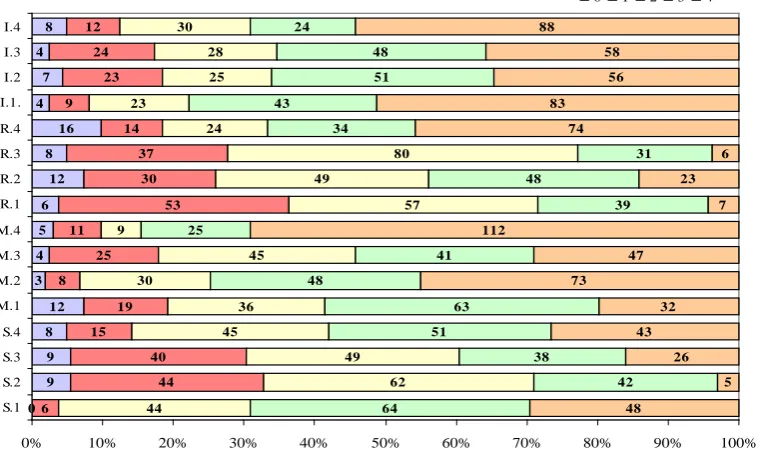
Fig. 1. The values of the response functions for Impact (I1-I4), Results (R1-R4), Management (M1-M4) and Resources (S1-S4)
0 9 9 8 12 3 4 5 6 12 8 16 4 7 4 8 6 44 40 15 19 8 25 11 53 30 37 14 9 23 24 12 44 62 49 45 36 30 45 9 57 49 80 24 23 25 28 30 64 42 38 51 63 48 41 25 39 48 31 34 43 51 48 24 48 5 26 43 32 73 47 112 7 23 6 74 83 56 58 88
0% 10% 20% 30% 40% 50% 60% 70% 80% 90% 100%
S.1 S.2 S.3 S.4 M.1 M.2 M.3 M.4 R.1 R.2 R.3 R.4 I.1. I.2 I.3 I.4
0 1 2 3 4
Table 4
THE RESULTS OF THE CANONICAL CORRELATION ANALYSIS: “LEFT SET” (RESOURCES, MANAGEMENT, RESULTS) VS. “RIGHT SET” (IMPACT)
No variables Variance extracted (%) Total redundancy (%)
Left set 12 43.2950 11.5744
Right set 4 100 25.9167
Canonical R: 0.63075; Chi²(48)=144.53 p = 1.42·10-11
Conclusion: the association is distinctly significantly statistical.
Table 5
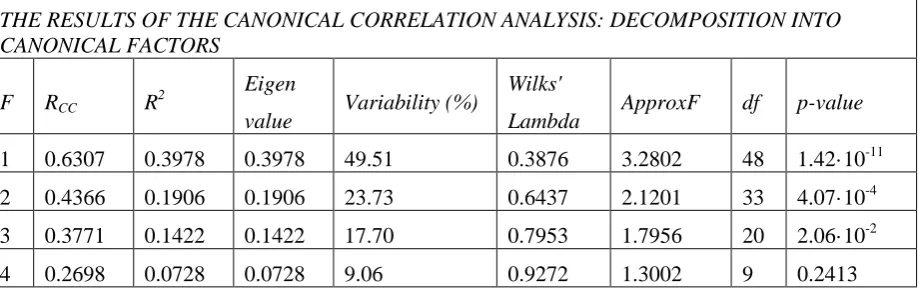
THE RESULTS OF THE CANONICAL CORRELATION ANALYSIS: DECOMPOSITION INTO CANONICAL FACTORS
F RCC R
2 Eigen
value Variability (%)
Wilks'
Lambda ApproxF df p-value
1 0.6307 0.3978 0.3978 49.51 0.3876 3.2802 48 1.42·10-11
2 0.4366 0.1906 0.1906 23.73 0.6437 2.1201 33 4.07·10-4 3 0.3771 0.1422 0.1422 17.70 0.7953 1.7956 20 2.06·10-2
4 0.2698 0.0728 0.0728 9.06 0.9272 1.3002 9 0.2413
RCC = the canonical correlation coefficient; R2 = the square canonical correlation coefficient
4. DISCUSSIONS
Canonical factor no.1 is an ascending factor for all the observed qualitative variables and variables R1 and M2 are associated with the main canonical factor (F1), which suggests that they are the most important for it.
Additionally, in relation to canonical factor no.2, response variable I is separated in I1 (a negative projection in relation with F2 factor) and I2, I3 and I4 (positive projections in relation with F2 factor). Therefore, if F1 factor is a measure of the central tendency in practically all the measured variables (both in the impact measurable and predicting variables), factor F2 is a measure of variability in accomplishing the impact goals.
Factor 2 also contains the management observables almost all the time (except for M2 in F1-F2 projection), so it expresses the “Management” factor to a great extent.
Canonical factor no.1 is an ascending factor for all the observed qualitative variables and variables R1 and M2 are associated with the main canonical factor (F1), which suggests that they are the most important for it.
Additionally, in relation to canonical factor no.2, response variable I is separated in I1 (a negative projection in relation with F2 factor) and I2, I3 and I4 (positive projections in relation with F2 factor). Therefore, if factor F1 is a measure of the central tendency in practically all the measured variables (both in the impact measurable and predicting variables), F2 factor is a measure of variability in accomplishing the impact goals. Factor 2 also contains the management observables almost all the time (except for M2 in F1-F2 projection), so it expresses the “Management” factor to a great extent. This study was carried out on a basic level, since there was no data available prior to this research.
5. CONCLUSIONS
Evaluation is an essential tool for good management of practices. It is a tool that not only helps measure the success of a program/project, but also contributes to its success. Research evaluation currently requires trans-disciplinary expertise and a new set of tools. In this thesis, the term “research evaluation” is approached as a wide concept, connected to the research financing process and the evaluation of the research process, as well as the result. Evaluation practices also vary according to the actors involved in the process and the method of evaluating RDI and the types of problems of research evaluation practiced in every country.
- The results show that using an evaluation model concept (identifying the goals/choosing the methodology of optimizing it in the implementation; identifying the factors/measurables and following the feedback of the evaluation) has a significantly positive impact on project management. The results obtained through the analysis show that every criterion has a significant association with PM, which proves the main hypothesis.
- Secondly, the key performance indicators (KPI) have the biggest impact on PM, followed by PM leadership in accomplishing the results planned in the project. All these results support the main hypothesis.
- This study also stressed that in relation to canonical factor no.2, response variable I is separated in I1 (a negative projection in relation with F2 factor) and I2, I3 and I4 (positive projections in relation with F2 factor). Therefore, if F1 factor is a measure of the central tendency in practically all the measured variables (both in the impact measurable and predicting variables), F2 factor is a measure of variability in accomplishing the impact goals.
- Factor 2 also contains the management observables almost all the time (except for M2 in F1-F2 projection), so it expresses the “Management” factor to a great extent.
- The study also reveals that making performance evaluation efficient is also necessary. Through this study, the performance of the R&D financing programs was analyzed, using statistical methods, such as the canonical correlation method, which was used to analyze the relation between a series of short and medium-term performance factors and the impact on R&D projects.
- Unlike previous studies, this study dealt with the categorical Likert-scale answers using the canonical correlation method to identify the relation between the four items of the project’s impact (dependent variables) as a function of the project’s performances, management and results (independent variables).
- This multivariate analysis technique was used in order to investigate two sets of variables (dependent and independent). This statistical method reduces type I errors. [6].
- By grouping the types of institutions that received the questionnaire with the performance results of the four other factors, we discovered which group (type of organization) had poor or strong results. Out of the four categories, three groups (Public institutions and authorities, Research-development institutes, Universities), except for the Private organizations group have good performances for all the four factors. Throughout the analysis of the groups, we suggested that the companies within the “Private organizations” group, which generally report poor performances for the four performance factors, should make efforts to achieve progress as far as every performance-related aspect is concerned. Moreover, this group should be offered adequate guidance or performance monitoring in project management.
- According to the risk analysis applied to this type of institution, institutions that own a research department have been proven to be more efficient. Based on the results of the risk analysis, we suggest that the institutions that participate in financing competitions through projects must pay more attention to the dimension of project management in order to increase the performance of the institutions in obtaining national and/or European funds.
However, this studies does have certain limits. The small dimension of the set of data, formed of 162 respondents, along with the number of institutions that filled out the questionnaire (69), caused fewer
values and made the task of carrying out an applicable conceptual evaluation model with national performances more difficult. Nevertheless, it can be a longitudinal evaluation model; researching the model is extremely useful for project managers, program managers, strategies and policies when elaborating the RDI policies because it identifies and consolidates good practices for efficiency in project management.
REFERENCES
Barad, M & Raz, T 2000, “Contribution of quality management tools and practices to project management performance”, International Journal of Quality & Reliability Management, vol 17, no 4/5, pp. 571-583.
Bolboacă, SD, Jäntschi, L, Sestraş, AF, Sestraş, RE, Pamfil, DC 2011, “Pearson-Fisher Chi-Square Statistic Revisited”, Information, vol. 2, no 3, pp 528-545.
Bryde, JD 2003, “Project management concepts, methods and application”, International Journal of Operations & Production Management, vol. 23, no 7, pp. 775-793.
Bryde, JD, 2003, “Modelling project management performance”, International Journal of Quality & Reliability Management, vol 20, no 2, pp 225-229.
Cassiman, B & Gambardella, A 2009, “Strategic organization of R&D”,in Nickerson, J, Silverman B (eds.), Economic Institutions of Strategy, Emerald Press, London, pp.39-64.
Dean, JW & Bowen DE 1994, “Management theory and total quality: improving research and practice through theory development”, The Academy of Management Review, vol. 19, no 3, Special Issue: "Total Quality", pp. 392-418.
DeWit, A 1988, Measurement of project management Success, International Journal of Project Management, vol. 6, no 3, pp. 164- 170.
Florescu, MS, 2012, Management of Publicly Financed Projects-A Practical Approach, Editura Economica, Bucuresti.
Jäntschi, L & Bolboacă, SD 2010, “Exact Probabilities and Confidence Limits for Binomial Samples: Applied to the Difference between Two Proportions”, The Scientific World Journal, vol. 10, pp. 865-878.
Mishra, SK 2009a, “A note on the ordinal canonical correlation analysis of two sets of ranking scores”, Journal of Quantitative Economics, vol 7, no 2, pp. 173-199.
Mishra, SK 2009b, “Representation-constrained canonical correlation analysis: a hybridization of canonical correlation and principal component analyses”, Journal of applied economic sciences, vol 4, no 1, pp. 115-124.
Thompson, B 1991, “A primer on the logic and use of canonical correlation analysis”, Measurement and Evaluation in Counseling and Development, vol. 24, pp. 80–95.
![Table 1 SUMMARIZATION OF THE POSITIVE ANSWERS (“YES”): ABSOLUTE FREQUENCY (PERCENTAGE [A CONFIDENCE INTERVAL OF 95%])](https://thumb-us.123doks.com/thumbv2/123dok_us/103988.1510715/8.595.74.528.363.693/summarization-positive-answers-absolute-frequency-percentage-confidence-interval.webp)