THE STUDENTS' ATTITUDE TOWARDS SCIENCE SUBJECTS STUDIED IN SCHOOL Yordanka P. Stefanova
Plovdiv University “Paisii Hilendarski”, Bulgaria
Abstract
Our time is characterized by increasingly significance of science in daily needs of people and the necessity of sufficient knowledge to understand the processes and phenomena in the surrounding reality. At the same time people express their proven opinion, that the interest of young people in science tuition decrease.
This article presents the results of a survey of students attitude towards science classes at school. Research in several areas: a) interest in learning science; b) knowledge of the character of natural knowledge; c) the applicability of natural knowledge; d) understanding of the cognitive processes inherent in natural scientific knowledge; e) the ratio of students to scientists engaged in science. For all who work in the field of natural scientific education in Bulgaria, but also for those who have interest in education in our country, it would be useful to know the students view on science classes at school. We regard that this would help compilers of school programs and teachers to develop educational strategies aimed to increase the student’s interests in sciences. Anonymous survey reveals that students believe their education in school doesn’t contribute significantly to acquaintance them with the character of natural knowledge. Curriculum content in these disciplines do not assist them in making decisions about current life problems.
Key words: science education, scientific literacy, attitude
1. INTRODUCTION
To act adequately in nowadays world young people graduating school must be able to understand scientific information, to apply scientific knowledge, to explain the phenomena of the surrounding reality (Osborn, 2007). For the future life of adolescent their scientific education will allow them to live and work useful in a society influenced by the ideas and values of science. In a time of more and more increasingly importance of science knowledge in the daily needs of people and the need for sufficient knowledge to understand the processes and phenomena in the surrounding reality, we settle that the interest of young people to the study of natural sciences decrease. In the search for the causes of the reduced interest for scientific knowledge there is a complex of factors, but two factors have a direct relation to that state of scientific education at home and globally (Moore&Foy, 1997; Osborn & Dilon 2008). The first factor is the development of high technology, their entry into the daily lives of people quick and easy access to a lot of and diverse information, active participation in the virtual society. It enriches them with many and varied information.This engage their attention and as a result, students spend less time to study. The second factor is the educational content in the natural sciences, the organization of the school process and requirements for the performance of students who have preserved character of the middle of last century, featuring extrinsic to the age of the students academic classes. This makes it less interesting, and often inaccessible to students. These are the two counterpoint that cause difficulties in the work of teachers and reduce students' interest in this type of knowledge.
Contemporary views on science education put to the fore the need for such knowledge, skills and abilities that allow graduates to deal successfully with the dynamics of life's problems, to prepare for lifelong learning. Therefore, in the 90s of the 20th century rises the idea of objective science education in school is building a scientifically literate individuals. Scientific literacy is associated with understanding the nature ,the scientific knowledge and its application in specific life situations, knowledge of the processes inherent, scientific knowledge, awareness of the relation between science and technology (OECD 2003a, 2004b, 2006c, SESA, 1996, Minevska,&Stefanova, 2007; Raykova 2008, Tafrova-Grigorova, 2011, 2013). The need to build scientific literacy is associated with an
influence on the economic and spiritual development of the nation. Because "only societies whose citizens are scientifically literate, can" grow "scientists, researchers, engineers and technicians. This thesis is directly related to the increase of the outflow of young people in science - "there is no way to attract science, if you do not know what he's doing and how to do it» (Tafrova-Grigorova, 2013, р. 137).
Conducted studies for settling the science knowledge of Bulgarian students in 2006, 2009, 2012 are scantily compared to other European countries. In the presented results for 2012, a PISA study indicate the presence of correlation between student performance in solving test in the field of natural sciences and skills to solve problems. Students who achieve high scores in mathematics, reading and science, deal successfully with test problem solving. These young people who are well prepared to use their knowledge and skills in reading, mathematics and science are also better equipped to solve problems in real-life situations. Bulgaria is among the countries where the students' results of the test problem solving are poor compared to students from other countries with similar Bulgarian result in reading, mathematics and science (Petrova, 2010, 2013). These results allow us to raise the question: Why Bulgarian students show unsatisfied results in these international studies? What are the strengths and weaknesses in their preparation in science? Is it due to shortcomings in the education at science? These are just some of the issues ,which researchers face in the field of education.
To achieve scientific literacy of students require time and changes in the theory and practice of teaching. In publications concerning science education and the requirements of modern, reasonably draw conclusions about the purposes and content of science education in Bulgarian schools (Minevska, & Stefanova 2007; Stefanova & Minevskа, 2009, Boiadjieva, 2011, Hollenbeck, Kirova, 2009). They generally boil down to the conclusion that the educational content in science is information overload with facts, theories, laws, patterns, examples of which are outside the perimeter of the world in which they live 13-17 year olds. Large number of scientific facts, abstract theoretical knowledge concerning micro and macro, on the one hand and the relatively limited training time and time to prepare lessons difficult and burdensome students and lead to loss of interest.
Studies show that students in Bulgarian schools willing to participate in the planning and management of teaching and be trained so that they benefit from learning (Hollenbeck, Kirova, 2009). For teachers and those who prepare them, it would be useful to know the attitude of students towards science taught in school. We believe that this would help compilers of curriculum and teachers, as if students in school studying facts and events that have practical applications and would benefit them to act appropriately in solving life's problems, then their interest in the natural sciences would increase . This article presents the results of a survey of the attitudes of students towards science. Research in several areas: a) interest in learning science; b) knowledge of the character of science problems; c) the applicability of scientific knowledge; d) understanding of the cognitive processes inherent in scientific knowledge; e) treatment of students to scientists engaged in science.
2. METHODOLOGY AND TOOLS OF THE STUDY
The study of the perceptions of students about science is done in accordance with guidelines set out by Marshall and Rossman for conducting qualitative research (Marshall & Rossman, 1998). With this aim we make an inquiry, which is anonymous and does not contain identifying information. Survey questions are presented in Appendix 1. Main parameters of the study for students are: the delivery period: 2012-2013 and 2013-2014 school years; Target group: students of IX, X, XI class; sample size of 500 students from schools in Plovdiv; research methods: survey; tools: a survey.
The basis of our research we put ideas Millar and Osborne on the main elements of the Natural school education, namely knowledge of the Scientific methods; The Creative nature of scientific work; historical development of Scientific Knowledge; Science and Questioning; Diversity of scientific thinking; Analysis and Interpretation of data; Science & Certainty; Hypothesis and Prediction; Cooperation and Collaboration (Millar & Osborne, 1998, p. 179).
We believe that the study of natural sciences in the secondary school is required to connect with the idea that students have to "see" in the natural sciences not only facts, abstract theoretical knowledge of laws, regularities, theories concerning micro and macro, but opportunities for their application to explain the phenomena of the world where 13-17 years old people live. This understanding can build upon: understanding the nature of science knowledge, their application in specific life situations to understand the problems which are discussed daily in the media - television, radio, newspapers, making reasoned decisions on personal issues health, diet, use of energy sources, etc.; understanding of the cognitive processes inherent in scientific knowledge; create a basis for continuing education in a related or different scientific field to be successful in the labor market.
The study involved 500 students from different schools in Plovdiv. From the survey of 300 randomly selected the questionnaires so that all classes - 9, 10, 11, are equally represented. The questions in the survey can be conditionally divided into five groups:
The first group of questions - They aim to obtain information about the views of pupils studied natural sciences. Their perception of science by exploring allegations of interest which exert students in different classes.
The second group of questions relate to understanding the nature of science knowledge. Knowing the nature of science knowledge not only about knowledge of specific facts, concepts, laws, theories, names and terms, but also knowledge of their characteristics: evidence provided for, orderliness, openness to criticism and inspections, subject definitions, scientific language, borders applicability. The third group of questions concerns the applicability of science knowledge taught in school in the lives of adolescents. They aim to establish whether studied science helps teenagers motivated to take personal decisions on issues related to life and health; to learning about issues that are discussed daily in the media.
The fourth group of questions relate to understanding the cognitive processes inherent in their scientific knowledge. They aim to establish whether students know and appreciate the importance of the processes inherent in the different levels of scientific knowledge - observation, experiment, description, explanation, prediction of facts and phenomena, understanding and interpretation of evidence or statements.
The fifth group of questions concerns the attitude of students to scientists engaged in science. They aim to establish whether through science instruction creating a base for continuing education in a related scientific field.
The attitude of respondents to the natural sciences are reported by the opinion of students about 31 statements on five-point scales ranged, not necessarily their grading.
Table 1. Rank the results of a study of the attitudes of students towards science
Index
Values from the scale
low middle high
Interest in science classes 1 - 2 3 4 - 5
Recognizing the character of the science knowledge 1- 2 3 4 - 5 Applicability of the science knowledge obtained at school 1 - 2 3 4 - 5 Understandind of the cognition of the scientific knowledge 1 - 2 3 4 - 5 Attitude to people ,who are concerned with science 1 - 2 3 4 - 5
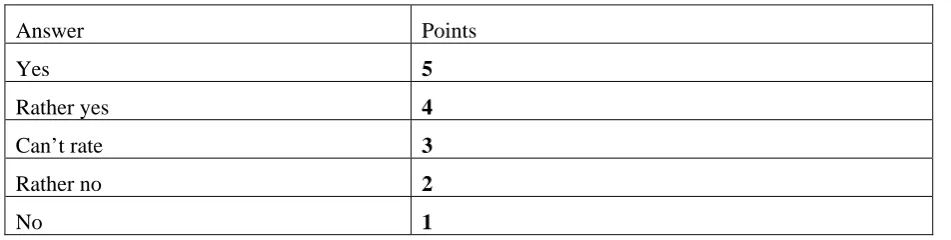
Represented in the survey claims are assessed in the manner provided in Table 2. Missed and invalid responses were evaluated by 3.
Table 2. Points relevant statements
3. RESULTS AND ANALYSIS
The sample of 300 students divided into subgroups formed on the ground: class, age. Once processed the data analyzed them and compared to investigate the influence of each of these signs on the opinion of students taught at school science. The analysis results are presented below.
3.1. Results of the study criterion interest in science
Age of the students, respectively, and their class could affect their interest in studying science in school. You should also consider the fact that different classes taught different learning content. For example, in the subject of Chemistry and Environmental study - Inorganic Chemistry Class 9, Organic Chemistry - Class 10, Physical Chemistry - Class 11. Table 4 presents the frequencies through a scale of answers given by the students for their interest in studying science in school. A comparison of the responses of students from different classes is done on indicators presented in Table 1. Practical skills of students in classes coincide. The data in Table 4 show that 92% of students identify science as difficult, and 24%, define them as difficult and boring. Most of the values that indicate the students surveyed 9, 10, 11 class for your interest in the natural sciences are 4 and 5. According to the scale in Table 1 for ranking the answers these values correspond to a high level, 43% of respondents consider that the hours science at school (1 or 2 hours a week mandatory training) are sufficient and should be increased.
Answer Points
Yes 5
Rather yes 4
Can’t rate 3
Rather no 2
No 1
Table 3. Distribution of frequencies in the responses of students about their interest in studying science
Interest in science classes
Frequency
9 class 10 class 11 class
Values Values Values
1 - 2 3 4 -5 1 - 2 3 4 - 5 1-2 3 4 - 5
Statement 2 11 - 99 - 7 93 6 10 84
Statement 3 100 100 3 3 94
Statement 7 49 7 44 60 18 22 66 10 24
Statement 11 56 7 37 21 14 35 60 18 22
Statement 14 56 14 30 70 21 9 57 9 34
3.2. Results of the study by criterion recognizing the character of science knowledge
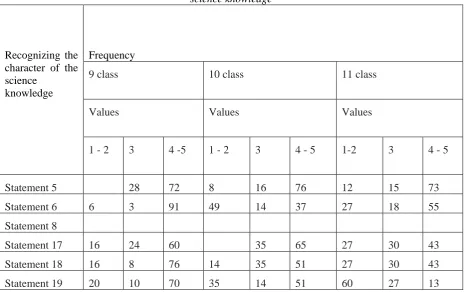
Natural knowledge of a complex evolving system with different levels of organization. The system of scientific knowledge for each science is heterogeneous. It brings together different forms of knowledge: empirical facts, laws, principles, hypotheses, theories. They all belong to two main levels of organization - theoretical and empirical. Natural knowledge possess the essential characteristics: evidence provided for, orderliness, openness to criticism and checks subject definiteness, scientific language limits of applicability, regardless of the form and level of organization (Ruzavin, 2012). The statements presented in the survey, this criterion are related to the understanding of the character of Science Knowledge: nature and role of laws and theories in science (claim 5, 8); subject determination (claim 6); openness to criticism and review (statement 17, 18, 19). Table 5 presents the data obtained from respondents' answers on knowledge criteria nature of scientific knowledge. The data obtained from respondents' answers show that: (a) the majority of the students surveyed - 56 percent believe that the laws and theories taught in science are always true and can not be changed; (b) a small portion of the students surveyed 14% believe that the laws and theories develop and change over time. When comparing the responses of students from different classes this criterion, there was no significant difference of opinion. This allows us to say that science education does not contribute significantly to familiarizing students with the nature of science knowledge - their variability and development. This may be due to the fact that the curriculum content in science is overload and doesn’t leave enough time for discussion of alternative and sometimes conflicting perspectives in the study of facts and events, which will allow for the detection of some important characteristics of their scientific knowledge - evidence provided for, variability and development.
Table 4. Distribution of frequencies in student responses by criterion recognizing the character of science knowledge
Recognizing the character of the science
knowledge
Frequency
9 class 10 class 11 class
Values Values Values
1 - 2 3 4 -5 1 - 2 3 4 - 5 1-2 3 4 - 5
Statement 5 28 72 8 16 76 12 15 73
Statement 6 6 3 91 49 14 37 27 18 55
Statement 8
Statement 17 16 24 60 35 65 27 30 43
Statement 18 16 8 76 14 35 51 27 30 43
Statement 19 20 10 70 35 14 51 60 27 13
3.3. Results of a study by criteria of applicability of the science knowledge obtained at school Through science education creates a foundation for improving public understanding of the importance of their scientific knowledge as part of our culture and have a tremendous impact on our way of thinking "(Tafrova-Grigorova, 2013). A prerequisite for this is the application of knowledge, skills and competences acquired in real-life situations to solve problems of the world around us and to acquire new knowledge.
The statements presented in the survey, this criterion are related to study pupils' opinions about the role of science knowledge in real life. They make it possible to obtain information on their perception of their applicability in solving everyday life problems related with the health (claim 16); diets (claim 9); how the material studied helps them to understand the information from the media (claim 22). Table 6 presents the data obtained from respondents' answers, the applicability criterion of science knowledge in real life situations. The data obtained from respondents' answers show that: a) 10% of students believe that learning science is useful in their daily lives to solve daily and health problems; b) 27% of them think that leaning sciences helps them to understand the information discussed in the media. When we compare the responses of students from different classes by this criterion, there was no significant difference of opinion. One possible reason for these results is that, in our traditional textbook information on the meaning and application of the studied materials and processes are presented at the end of lessons, usually without being associated and based on the properties of substances where they are considered . The result is that students either do not know anything about the use and importance of practice important substances and processes that apply daily or learn mechanically the information.
Table 5. Distribution of frequencies in student responses by criterion- applicability of science knowledge
Applicability of the science knowledge
obtained at school
Frequency
9 class 10 сlass 11 class
Values Values Values
1 - 2 3 4 -5 1 - 2 3 4 - 5 1-2 3 4 - 5
Statement 4 84 16 84 8 8 93 6 1
Statement 9 84 8 8 71 21 8 76 14 10
Statement 10 84 16 93 7 84 5 11
Statement 16 57 22 21 46 53 1 53 15 32
Statement 22 49 30 21 46 23 31 44 26 30
Statement 23 86 14 62 23 15 52 41 7
3.4. Results of the study by criterion - understanding of cognitive processes inherent in natural scientific knowledge
Cognitive processes are seen as those mental or practical actions that are applied to the understanding, acquisition, interpretation and use of evidence or evidence of accumulation of knowledge or understanding them (OECD). Cognitive processes involved in the development and application of scientific knowledge that can be formed by science education, are related to research practice - planning, experimentation, measurement using appropriate tools, description, explanation, prediction, processing and analysis of experimental data. Natural sciences are experimental sciences and laboratory experiments is therefore an integral part of training. In making him follow the path of scientific knowledge - planning the study, experimentation, targeted surveillance, fixing results, drawing conclusions, explanation.
The statements presented in the survey, this criterion are related to the understanding of cognitive processes inherent in natural scientific knowledge: an explanation of the facts and phenomena (statement 13, 20); role of experiment (statement 28), observation and description (statement 25, 29) for the natural sciences. Table 7 presents the data obtained from respondents' answers, criterion understanding of cognitive processes inherent in natural knowledge. The data obtained from respondents' answers show that: (a) the majority of the students surveyed - 63% do not understand the role of experiment, observation and description of the natural sciences; (b) 48% of the students surveyed did not understand the role of explanation as cognitive procedure of the natural sciences. When comparing the responses of students from different classes this criterion, there was no significant difference of opinion. This allows us to say that science education does not contribute significantly to the understanding of students cognitive processes inherent in scientific knowledge. These poll results confirm the fact that in recent years in science education more frequently present laboratory experiments. As a result, students do not know the different stages of the research and their importance.
Table 6. Distribution of frequencies in student responses criterion understanding of cognitive processes inherent in scientific knowledge
Understanding of the cognition of the scientific knowledge
Frequency
9 class 10 class 11 class
Values Values Values
1 - 2 3 4 -5 1 - 2 3 4 - 5 1-2 3 4 - 5
Statement 13 12 85 3 16 71 13 4 64 32
Statement 20 9 89 3 12 77 11 7 82 11
Statement 25 42 51 7 17 51 32 23 58 19
Statement 28 42 51 7 17 31 52 5 44 51
Statement 29 33 19 48 37 44 22 5 35 60
3.5. Results of the study by criterion of scientists engaged in science
The relation between science knowledge and the development of society consists in the realization of the fact that the welfare of society depends on their development. In this sense science literate people are able to value the benefits and harms of one or another scientific achievement (Tafrova, 2013, p. 130). School education should provide the basis for improving the understanding of science and their achievement of the overall population. Creating a basis for continuing education in a related field of science through science education is a prerequisite for this.
With the allegations presented in the survey, this criterion aims to establish whether through science instruction there is a created base for continuing education in a related scientific field. Table 8 presents the results of the answers of the respondents by criteria to attitude to scientists engaged in science. The data obtained from the responses of the students indicate that: (a) the majority of the students - 69 percent believe scientists are interesting people, but 32% of them don’t want to study science in the future. This allows us to say that science education does not contribute significantly to the creation of a basis for continuing education in a related scientific field. These results are related in our opinion with the results of the criteria by recognizing the character of science knowledge; understanding of the cognitive processes inherent in natural scientific knowledge; applicability of knowledge in specific situations.
Table 7. Distribution of frequencies in student responses by the criterion of scientists engaged in science
Attitude to people, who are concerned with science
Frequency
9 class 10 class 11 class
Values Values Values
1 - 2 3 4 -5 1 - 2 3 4 - 5 1-2 3 4 - 5
Statement 21 9 14 77 23 7 70 7 33 60
Statement 24 29 71 7 23 70 12 12 76
Statement 26 16 42 42 30 28 42 25 21 56
Statement 27 42 28 30 28 7 56 21 10 59
Statement 30 58 21 21 70 16 14 58 15 27
Statement 31 16 21 63 15 85 6 12 32
4. CONCLUSION
The conducted survey of students from 9, 10, 11 class about their attitude to science, studied in the Bulgarian school shows that for students:
• its difficult to study science, and some of the science subjects are boring. One of the reasons for this is that , the academic performance ot the science material in these disciplines in textbooks and educational literature has preserved itself in time;
• science education does not contribute significantly to introduce the character of science knowledge to the students - their variability and progress and the understanding of the processes inherent in natural scientific knowledge.
• significant part of the students knowledge remain "passive", this means that students can not apply them in solving concrete life problems related to lifestyle, health and diet, and also to understand the current issues discussed in the media. Diversity of needs of students, their personal experiences, as well as the environment in which they live and learn insist on giving the students the opportunity to study properly and relating the science study with daily life situations
• we believe that the received data could be useful for compilers of curricula, because they give information about some characteristics of the curricula in science, mainly its information is overload and present insufficient practical application of the learned knowledge.
• solutions to problems relating to the reduction or lack of interest in science at school, should be sought in the interaction capabilities of these two factors-globality and the wealth of very interesting scientific information provided by high-tech in daily life and synchronization, and rethinking the content and organization of natural scientific education with a view to decrease its content and academic workload.
References
Abell, S. K. & Lederman, N.C., Handbook of research on science education. New York: Lawrence Erlbaum.
Boiadjieva, E., Kirova, M., Tafrova-Grigorova, A., Hollenbeck, J.E. (2011) Science Learning Environment in the Bulgarian School: Students' Beliefs. Chemistry 20(1), 43 - 56, [In Bulgarian]. Hollenbeck, J. E., Kirova, M., Boiadjieva, Tafrova-Grigorova,A. (2009) Astudy on students` and teachers` perceptions and expectations of their learning in secondary science classrooms. Chemistry 18(5), 349 – 368, [In Bulgarian].
Jonathan O. (2007) Science Education for theTwenty First Century. Eurasia Journal of Mathematics, Science & Technology Education, 3 (3), p. 173-184
Marshall & Rossman. (1998) Designing Qualitative Research. Sage, Thousands Oaks
Millar, R., & Osborne, J. F. (Eds.). (1998). Beyond 2000: Science Education for the Future. London: King's College London
Minevska, M. & Stefanova, Y. (2007) Strategy "Skills for Life" and Program for International Student Assessment (PISA).. Chemistry, (2), с.99-107, [In Bulgarian].
Moore, R. & Foy. R (1997) The Scientific Attitude Inventory: A Revision (SAI II). Journal of research in science teaching 34( 4) , pp. 327–336
National Committee on Science Education Standards and Assessment. National Research Council, 1996 Available from: http://www.nap.edu/openbook.php?record_id=4962
OECD (2003a). The PISA 2003 Assessment Framework Mathematics, Reading, Science and Problem Solving knowledge and skills. Published by: OECD Publishing, Paris, p.228.
OECD (2004b). Learning for Tomorrow’s World – First Results from PISA 2003. OECD, Paris, p. 471.
OECD (2006c) Assessing Scientific, Reading and Mathematical Literacy; A Framework for PISA
2006. OECD, Paris, p.187. Available from:
http://www.oecd.org/pisa/pisaproducts/pisa2006/37464175.pdf
Osborn, J. & Dilon J., (2008) Science education in Europe: Critical Reflection. The Nuffield Foundation: Kings College London, Nuffield Foundation.
Petrova, S.& Vasileva, N. (2013) Assessment of competence to solve problems in PISA 2012, Sofia: ЦКОКО. Available from: http://www.ckoko.bg/upload/docs/2014-04/PS_Chapter_BGR.pdfJo
Petrova, S. (2010) Science, school and the world of tomorrow. Results of Bulgaria's participation in the Programme for International Student Assessment - PISA 2006. Sofia, ЦКОКО Available from http://www.ckoko.bg/upload/docs/2012-12/nd_pisa06_web.pdf:
Stefanova Y. & Minevskа. M. (2009) Some social aspects of students` results in chemistry. The 5th international Balkan education and science congress, Octоber 01-03, Edirne-Turkey. Congress full text book. Vol. 2, 608 – 612.
Raykova Zh.( 2008) Development procedural skills in science education – constructivist approach, Plovdiv Univesrsity press
Ruzavin, G. (2012) Methodology of scientific knowledge. Moscow, UNITY. [In Russian]
Tafrova-Grigorova, A. (2013) Ccontemporary trends in pupils’ science education. Bulgarian Journal of Science and Education Policy (BJSEP), 7 (1).
Tafrova-Grigorova, A. (2011) Scientific literacy: a key goal of science education in schools Chemistry, 20( 6), [In Bulgarian].
The researches were conducted with the financial support of the Fund "Research and mobile projects", Unit Research & development, Plovdiv University " Paisii Hilednarski " project NI 13 HF 006
Appendix 1 Inquiry
This inquiry contains statements related to science subjects, which are studied at school. Through answers you should express your personal opinion on the claims made. In this inquiry there are no correct and incorrect answers.
For all statements tick the right, according to you, answer. Example: If you agree with the statement tick Yes. If you change your mind, enclose the previous answer with a circle and cross the true. If you have crossed two or more answers, they will be canceled and we will recognize the statement - I can’t rate
Class... Age...Sex...
1. Should we explain the phenomena surrounding us?
Yes Rather, yes I can’t rate Rather, no no
2. Its hard to study science at school.
Yes Rather, yes I can’t rate Rather, no no
3. Watching popular
science programs on TV about
how science facts and
phenomena are discovered and proved is interesting..
Yes Rather, yes I can’t rate Rather, no no
4. Learning science
subjects helps us make the right decisions for the diets we follow.
Yes Rather, yes I can’t rate Rather, no no
5. Through laws and
theories of science we can explain the facts and phenomena of the surrounding reality.
Yes Rather, yes I can’t rate Rather, no no
6. . All of the phenomena surrounding us can be explained by science.
Yes Rather, yes I can’t rate Rather, no no
7. Science classes at school should be more..
Yes Rather, yes I can’t rate Rather, no no
8. Observations of different objects and experiments are important because they are the basis of scientific explanations.
Yes Rather, yes I can’t rate Rather, no no
9. Science classes are useful because we learn how to use substances in the household..
Yes Rather, yes I can’t rate Rather, no no
10. in Science classes we learn how to plan and conduct an experiment.
Yes Rather, yes I can’t rate Rather, no no
11. The natural sciences are only interesting for scientists who deal with them.
Yes Rather, yes I can’t rate Rather, no no
12. To make experiments with different substances in
Yes Rather, yes I can’t rate Rather, no no
science classes is fun and interesting..
13. To explain changes that occur with substance in experiments conducted in science classes is important.
Yes Rather, yes I can’t rate Rather, no no
14. Science classes are boring and difficult..
Yes Rather, yes I can’t rate Rather, no no
15. Experimentation is more interesting than to learn everything about the nature from the teacher.
Yes Rather, yes I can’t rate Rather, no no
16. What you learn in
science helps you to make the right decisions for your health.
Yes Rather, yes I can’t rate Rather, no no
17. Laws and theories that we study at science classes are always true and can not be changed.
Yes Rather, yes I can’t rate Rather, no no
18. Laws and theories that we study at science classes are relatively accurate and may be changed..
Yes Rather, yes I can’t rate Rather, no no
19. An explanation of a phenomenon can not be changed over time.
Yes Rather, yes I can’t rate Rather, no no
20. Explanations of
phenomena which surround us are an important result of the sciences progress
Yes Rather, yes I can’t rate Rather, no no
21. Scientists are interesting people because they know a lot about nature.
Yes Rather, yes I can’t rate Rather, no no
22. What you learn in
science helps you to understand better the information from the press and the Internet.
Yes Rather, yes I can’t rate Rather, no no
23. What we learn in science helps us to prognosticate the properties and phenomena.
Yes Rather, yes I can’t rate Rather, no no
24. Studying biography of scientists and discovers is useful and interesting.
Yes Rather, yes I can’t rate Rather, no no
25. To explain a
phenomenon we should apply knowledge of laws and theories..
Yes Rather, yes I can’t rate Rather, no no
26. When I finish school I Yes Rather, yes I can’t rate Rather, no no
would like to continue studying humanities.
27. When I finish school I would like to continue studying science.
Yes Rather, yes I can’t rate Rather, no no
28. Experimentation is
important because we collect experimental data.
Yes Rather, yes I can’t rate Rather, no no
29. Observing and describing changes that occur with substances is important because they are the basis of explanations…
Yes Rather, yes I can’t rate Rather, no no
30. The work of scientists who study science is boring because you have to read a lot of books.
Yes Rather, yes I can’t rate Rather, no no
31. To work in a science laboratory is interesting because you make a lot of experiments.
Yes Rather, yes I can’t rate Rather, no no
Thank you for your participation!