2019, Vol. 7, No. 2 10.15678/EBER.2019.070206
Knowledge-Intensive Services Development
in the EU: Forecasts for Selected Countries
and Implications for Poland
Bianka Godlewska-Dzioboń, Piotr Klimczyk, Agnieszka Witoń
A B S T R A C T
Objective: The first purpose of the article and the underlying research is to identify trends in the development of the knowledge-intensive services (KIS) sector in se-lected EU countries and to create forecasts of its further growth. The second purpose is to recognize factors that may help or inhibit Poland from drawing upon the experi-ences of the analysed countries.
Research Design & Methods: We use time-series trend forecasting. Forecasts of the development of the KIS sector in the EU are constructed basing on available time series (2008 - 2017) using the least square method (LSM).
Findings: Knowledge-intensive services are developing with various speed in the EU countries, but an existence of a ‘glass ceiling’ in the context of a possible level of devel-opment can be noted. This ‘glass ceiling’ is situated on different levels for different groups of countries (higher for the most innovative ones, lower for others). While Po-land is on the path of convergence with highly-developed EU countries in respect to the growth of knowledge-intensive services sector, several country-specific factors hinder its ability to enter the path of convergence with the innovation-leaders, thus most prob-ably preventing it from ever reaching the highest ‘glass ceiling.’
Implications & Recommendations: The innovation policy should not only be oriented to support R&D activities but also support the development of KIS.
Contribution & Value Added: The added value of the article lies in filling the gap in the literature concerning the analysed issue. The findings may serve as suggestions for creating innovation policy.
Article type: research article
Keywords: convergence; innovative services; knowledge-intensive services; Eu-ropean Union; Polish economy
JEL codes: O33, O38
Received: 30 August 2018 Revised: 6 March 2019 Accepted: 7 March 2019
Suggested citation:
INTRODUCTION
Modern economies are based on knowledge and information. Knowledge and information are recognized as the driver of productivity and economic growth. The term ‘knowledge-based economy’ stems from this fuller recognition of the place of knowledge and infor-mation in modern economies.
One of the elements of knowledge-based economy is a dynamic development of knowledge-intensive services (KIS) (Wyszkowska-Kuna, 2016). The areas of KIS are char-acterised by large involvement in research and development1 (Doloreux, Shearmur, & Rodriguez, 2015) and employment of highly educated workforce. The knowledge re-source held by the service provider and innovation are necessary conditions for the ac-tivity to be included in KIS category. These services may be provided as part of business activity or obtained from specialised third-party companies. KIS is, therefore, capital and knowledge-intensive. These services are a vital source of innovation for businesses and entire economy. Knowledge-intensive services contribute not only through the diffusion of knowledge and innovation to the creation and transfer of modern technology but also to an increase in productivity (Musolesi, & Huiban, 2009, p. 63) and thus to acceleration of economic growth (Klaesson, & Norman, 2015, p. 158).
An increase in the number and influence of knowledge-intensive business services (KIBS) in the EU can be attributed to several factors. First, there is an increasing need for knowledge within the economy. Increasing research and development is seen as a sig-nificant venue towards the attainment of this objective. Second, the strategies put in place by most governments in the region offer a conducive environment for the increase in KIBS (Pauceanu, 2015, p. 12). In Poland and other CEE countries, a rapid growth of KIS can be seen after 1989 (Baláž, 2004, p. 1).
The purpose of the article is to show trends in the development of the knowledge-intensive services (KIS) sector in selected EU countries and to create projections of its further growth. The second purpose is to identify factors that may help or inhibit Poland from drawing upon the experiences of the analysed countries. To fulfill those aims, we verify the main hypothesis, which is as follows: the process of development of knowledge-intensive services has a certain limit that cannot be overcome, which can be called a ‘glass ceiling’. Furthermore, three additional hypotheses were developed: (1) The level of the proposed ‘glass ceiling’ of knowledge-intensive services development varies in particular economies; (2) The knowledge-intensive services sector is character-ised by decreasing marginal productivity; (3) Knowledge-intensive services sector in Po-land is on the path of convergence with highly-developed EU countries.
To verify these hypotheses we use time series trend forecasting of the development of the KIS sector in the EU countries.
1 A study carried out by Masso and Vather (2012) concludes that, although knowledge-intensive services (KIS)
LITERATURE REVIEW
In the literature of the subject, two concepts are often used interchangeably: knowledge-intensive services (KIS) and knowledge-knowledge-intensive business services (KIBS). The difference be-tween them is that knowledge-intensive business services (KIBS) are the sub-group of KIS. In the literature, KIBS are defined as firms that provide knowledge-intensive goods and services for other business firms (Schricke, Zenker, & Stahlecker 2012, p. 6). Thus, KIBS include all KIS, except for education, health and social work, recreational, cultural, and sporting activities, which are services destined for consumers (Wyszkowska-Kuna, 2016).
The origins of the research on KIS dates back to the 1990s of the last century (Miles et al., 1995). According to this author, ‘Knowledge-Intensive Business Services involve eco-nomic activities which are intended to result in the creation, accumulation, or dissemina-tion of knowledge’ (Miles et al., 1995, p. 18). They act as transmitters of knowledge, con-tributing in different ways to the innovation processes of related firms (Miles et al., 1995, pp. 41-42). Currently, applicable definitions of KIS and KIBS have some common features, focusing on the high involvement of excellent work (requiring a high level of knowledge), a diffusion process and a significant impact on innovative activities within the enterprise and the economy (Gallego & Maroto, 2015; Dubosson & Fragniere, 2008). Concluding, knowledge-intensive business services (KIBS) are:
− performed by private companies and organisations,
− relying on professional knowledge, related to a specific (technical) discipline or (tech-nical) functional domain,
− supplying intermediate products and services that are knowledge-based (Bilderbeek et al., 1998).
KIS are key players in innovation systems, particularly in advanced regions where man-ufacturing competitiveness depends on knowledge contents provided by highly special-ised suppliers (Braga, Marques, & Serrasqueiro, 2018 p. 360).
Among the determinants of the development of the KIS sector one can mention (Miles et al., 2018):
− growing demand from organisations that focus on ‘core competences’, outsourcing non-core activities to specialised suppliers,
− increasing requirements for external knowledge,
− changing environments and technologies which require knowledge to fully utilise them, − growing complexity of economies and the technologies which are deployed in them.
Nowadays, many authors develop the concept of knowledge-intensive services. Full review of authors, publications, topics, and the number of citations is included in a study by Figueiredo et al. (2017). The three most-quoted authors are: Miles, Hertog and Muller, and the four most frequently quoted articles are by Muller and Zenker (2001), Hertog (2000), Miles (2005) and Bettencourt et al. (2002).
of the EU. As a continuation of our research on the service sector (Godlewska-Dzioboń, Klimczyk, & Witoń, 2018), in this article we follow the above mentioned research and also focus on the KIS topic from the point of view of the service structure. We want to present the current KIS situation and its share in the EU countries, but our added value is forecasting changes of KIS and their implications for the Polish economic policy.
According to Rodriguez (2014), studies of KIS can be classified into three groups de-pending on their main objective. The first group contains works that link regional inno-vation efficiency and KIBS (i.e. Brenner et al., 2018; Gallego & Maroto, 2015). The second group of authors and we focus on the location of KIS (Pauceanu, 2015; Ženka et al., 2017). The third group of publications addresses how regional features affect the for-mation of KIS (Dolores & Shearmur, 2012).
There seems to be an agreement in literature that knowledge intensive (business) ser-vices can contribute to economic growth, either regional or national (Brenner et al., 2018; Desmarchelier, Djellal, & Gallouj, 2013). Knowledge intensive business services provide ad-vanced technological knowledge directly to other industrial sectors, and indirectly to the whole economy (Castellacci, 2008; Radovanović, Dmitrović, & Žarkić Joksimović, 2017). The economy can benefit collectively from the knowledge produced by KIBS (Brenner et al., 2018). The contribution of KIBS to the productivity of the other industrial sectors may well exceed the productivity gains as measured within the KIBS sector itself (Castaldi, 2009).
However, the relationship between KIS/KIBS and economic growth is two-way. There is a strong demand-pull mechanism in place. Growth in the rest of the economy causes KIBS to grow in the next or later years (Brenner et al., 2018). Therefore, the de-velopment of the KIS/KIBS sector in the most developed EU economies is limited due to the slowdown in economic growth. Additionally, according to Baumol (2002) and Wolff (2002), intellectual work is stagnant – the rise in costs is nowhere near being balanced by the improvement in the ‘act of thinking’. This causes productivity decreases in knowledge-intensive sectors. What is more, some KIS/KIBS firms follow their clients overseas, and/or seek new markets in (especially) emerging economies. A possible trend is likely to be the emergence of KIBS firms within emerging economies – catering to local and/or world markets (Miles, 2018). Having considered this, we proposed the main hy-pothesis of the study, which posits that the process of development of knowledge-in-tensive services has a certain limit that cannot be overcome, which can be called a ‘glass ceiling’. The exact level of that limit should be analysed in further studies.
MATERIAL AND METHODS
Sector development of knowledge-intensive services is measured as employment in KIS in relation to all employment in the economy. The data was obtained from the Eurostat’s data-base. The data source is the European Labour Force Survey (LFS). The definition of knowledge-intensive services used by Eurostat is based on a selection of relevant items of NACE Rev. 2 on a 2-digit level and is oriented to the ratio of highly qualified workers in these areas.
1. The level of the proposed ‘glass ceiling’ of knowledge-intensive services development varies in particular economies;
2. The knowledge-intensive services sector is characterised by decreasing marginal productivity;
3. The knowledge-intensive services sector in Poland is on the path of convergence with highly-developed EU countries.
The available data include the years 2008-2017 and that period was used to build predictions about the development of the KIS sector in the European Union. The length of the available time-series must be considered a limitation of the study, and it needs to be taken into account when perusing the results. Additionally, this method does not identify factors causing the ‘glass ceiling’ in KIS. This issue should be addressed in further studies. Forecasts were constructed using the method of least squares. The method of least squares is a standard approach in regression analysis to approximate the solution of overdetermined systems. The principle of least squares regression states that the best choice of this linear relationship is the one that minimises the square in the vertical dis-tance from the y values in the data and the y values on the regression line (Watkins, 2016, p. 37). This leads to a minimisation problem for:
, = ∑ = ∑ − + (1)
This approach – with the use of econometric models to forecast socio-economic – is known as a classical statistical approach (Wilks, 2006, p. 217). It is used in cases in which the course of the testing phenomenon is regular over time, and the observed trend is per-manent and can be described with a smooth mathematical function. It is assumed that the regularity governing the testing phenomenon will not change significantly during the pe-riod for which the forecast is based. The predictions reach the year 2025, but their accu-racy decreases as the time horizon progresses.
It was initially assumed that the time series equations would be evaluated in the form of second-degree polynomials:
̂ = + ∗ + ∗ (2)
where:
̂ - ind involvement of employment in the KIS sector in the country in the year ; - time variable;
- constant;
, - structural parameters.
In some cases, for a better fit of the model, statistically insignificant at least at the level α=0.1 independent variables appearing in the estimation process were aban-doned (time variable or its square) and eventually, linear time series were obtained. The estimated equations for all EU countries are included in Table 1.
=∑!"!
∑!"! (3)
where:
- are the theoretical values of the dependent variable (calculated with the model);
- are empirical values of the dependent variable.
The coefficient of determination R2 was 0.990 in the case of Sweden, 0.978 in the case of Portugal, 0.964 in the case of Finland, and 0.968 in the case of Bulgaria. On the other hand, in the case of Germany R2 was only 0.342, and in the case of Lithuania – 0.391, which proves a weak model match for these countries. A complete exception was the Nether-lands, for which the created model has no prognostic value (R2=0.047).
Calculated residual variability coefficient (indicating how much of the average value of the explanatory variable is the deviation of the residual component) was for below 3% all the countries, which suggests that the development of KIS in the selected coun-tries is very slightly affected by random factors.
The usability of the forecasts constructed by the estimated trends is determined by their accuracy, measured with an ex-ante forecast error. It was calculated as a quotient of the forecasted value and its standard error. The obtained results allow to determine most focasts as accurate (relative error ex-ante < 5%), however, in some cases it is necessary to re-ject forecasts for further years. Too high (>5%) relative errors of the forecast were observed: for Bulgaria from the year 2024, Denmark from the year 2022, for Estonia from the year 2019, for Greece from the year 2021, for Spain from the year 2021, for Ireland from the year 2021, for Luxembourg throughout the analysed period, for Poland from the year 2024, for Portugal from the year 2022, for Romania in the year 2025, for Slovenia from the year 2022, for Hungary from the year 2022, and for Italy from the year 2023.
To verify the second hypothesis, in the further part of the study the productivity in the KIS sector was analysed in individual years. In this case, due to the limited availability of the data, the testing period is restricted to 2008-2014. The productivity of the sector was measured as the production value for every euro of personnel costs. In this section, the analysis was carried out only for the knowledge-intensive high-technology services.
The last part of the study draws conclusions for the Polish KIS sector and assesses the opportunities and threats it faces.
RESULTS AND DISCUSSION
by 3.43 percentage points from 38.9% in 2008 to 42.33% in 2017. The most dynamic de-velopment of the KIS sector has been observed in Moderate Innovators (Czech Republic, Portugal, Malta, Spain, Estonia, Cyprus, Italy, Lithuania, Hungary, Greece, Slovakia, Latvia, Poland, and Croatia): by 4.42 percentage points from 31.54% to 35.96%. In turn, in the group of Modest Innovators (Bulgaria, and Romania) the average share of employment in the KIS sector increased by 3.1 percentage points from 23.1% to 26.2%. In the case of Po-land, an increase in the share of the KIS sector in total employment amounted to three percentage points from 28.3% in 2008 to 31.3% in 2017. Special cases were Luxembourg and the Netherlands, countries characterised by a high level of development of the KIS sector (the share in employment in 2017 48.5% and 45%, respectively). where, in the an-alysed period, there was a decrease in the employment share in this sector, 5.7 percentage points and 1.9 percentage points, respectively. In particular, in the case of Luxembourg, this decrease can be explained by a change in factors directly related to the definition of knowledge-intensive services. In the years 2015-2017, when the share of KIS in total em-ployment began to decline in Luxembourg, a decrease in the share of the population with higher education and a simultaneous increase in employment was also seen. Employment in other sectors was characterised by higher dynamics than employment in the KIS.
As mentioned, in almost all the EU countries (and the European Union as a whole) knowledge-intensive services are developing, which is illustrated by the increasing share of this sector in total employment. However, the analysis of the constructed forecasts shows that the achieved increments are getting smaller. The determined trend lines (Table 1) indicate that some of the analysed countries have already reached the maximum level of the share of em-ployment, corresponding to the conditions characterising the country. The other surveyed countries will soon reach this level, after which employment in KIS may start to decline.
Table 1. Functions of employment trends in KIS in the European Union countries (as % of total employment)
Country Trend function
Coefficient of
determina-tion R2
Residual variability factor (in %) Belgium z$%&= 45.12 + 0.343636 ∗ t 0.894673 0.805
Bulgaria z$0&= 25.93 − 0.075 ∗ t + 1.20682 ∗ t 0.967816 0.899
Czech Republic z45&= 30.2067 + 0.313333 ∗ t 0.801868 1.566
Denmark z67&= 45.2717 − 0.133712 ∗ t + 1.52114 ∗ t 0.777567 1.295
Germany z6%&= 39.3333 + 0.108485 ∗ t 0.341760 1.211
Estonia z%%&= 31.4583 − 0.082197 ∗ t + 1.21386 ∗ t 0.665089 2.599
Ireland z8%&= 39.2067 − 0.159091 ∗ t + 2.03788 ∗ t 0.887204 1.368
Greece z09&= 30.63 − 0.0886364 ∗ t + 1.435 ∗ t 0.905916 1.613
Spain z%:&= 29.8667 − 0.131818 ∗ t + 1.86879 ∗ t 0.924267 1.500
France z;9&= 42.6867 + 0.375152 ∗ t 0.945131 0.649
Croatia z<9&= 27.02 + 0.809091 ∗ t 0.935005 2.177
Italy z8=&= 33.54 + 0.118182 ∗ t 0.922556 0.322
Cyprus z4>&= 33.4933 + 0.641212 ∗ t 0.823784 2.573
Latvia z?@&= 33.4267 + 0.37697 ∗ t 0.681614 2.331
Lithuania z?=&= 32.0667 + 0.23697 ∗ t 0.390587 2.848
Luxembourg z?A&= 51.2833 − 0.285606 ∗ t + 2.59682 ∗ t 0.814755 2.715
Country Trend function
Coefficient of
determina-tion R2
Residual variability factor (in %) Malta zB=&= 38.8 + 0.832727 ∗ t 0.900125 2.053
Netherlands zC?&= 46.2267 − 0.0484848 ∗ t 0.047488 1.517
Austria zD=&= 35.4 + 0.338182 ∗ t 0.824473 1.345
Poland zE?&= 27.6883 − 0.0541667 ∗ t + 0.881288 ∗ t 0.937294 0.923
Portugal zE=&= 26.47 − 0.0643939 ∗ t + 1.6053 ∗ t 0.978161 1.425
Romania z9F&= 19.4683 + 0.0288759 ∗ t 0.813273 2.437
Slovenia z:8&= 30.36 − 0.0681818 ∗ t + 1.17727 ∗ t 0.911859 1.438
Slovakia z:7&= 30.0733 + 0.453939 ∗ t 0.854230 1.849
Finland z;8&= 40.765 − 0.0443182 ∗ t + 0.918409 ∗ t 0.963867 0.671
Sweden z:%&= 49.34 + 0.427273 ∗ t 0.990293 0.263
United Kingdom z0$&= 46.3967 − 0.044697 ∗ t + 0.693485 ∗ t 0.693220 1.090
Source: own calculations based on Eurostat’s database, https://ec.europa.eu/eurostat/data/database, Re-trieved on September 11, 2018.
Due to the volume restrictions, the article will not present forecasts for all EU countries. It was decided to present only selected countries – Innovation Leaders (Denmark, Finland, Sweden, and the United Kingdom), Modest Innovators (Romania, and Bulgaria), and the neighboring countries of Poland in the Innovation Scoreboard ranking (Croatia, and Latvia).
Figure 1. The participation of the KIS sector in employment in Denmark (data for 2008-2017 and the forecast for 2018-2025)
Source: own calculations based on Eurostat’s database, https://ec.europa.eu/eurostat/data/database, Retrieved on September 11, 2018.
Starting with the best-performing countries in creating and implementing innova-tion, it can be seen that (excluding Sweden) the forecast foresees that the share of the KIS sector in total employment will decrease. The ‘glass ceiling’ for Denmark has been the level of 50% share of KIS in total employment, for Finland – 46%, for the United Kingdom – also 50% (Figures 1-4).
Figure 2. The participation of the KIS sector in employment in Finland (data for 2008-2017 and the forecast for 2018-2025)
Source: own calculations based on Eurostat’s database, https://ec.europa.eu/eurostat/data/database, Retrieved on September 11, 2018.
Figure 3. The participation of the KIS sector in employment in Sweden (data for 2008-2017 and the forecast for 2018-2025)
Source: own calculations based on Eurostat’s database, https://ec.europa.eu/eurostat/data/database, Retrieved on September 11, 2018.
Figure 4. The participation of the KIS sector in employment in the United Kingdom (data for 2008-2017 and the forecast for 2018-2025)
Figure 5. The participation of the KIS sector in employment in Bulgaria (data for 2008-2017 and the forecast for 2018-2025)
Source: own calculations based on Eurostat’s database, https://ec.europa.eu/eurostat/data/database, Retrieved on September 11, 2018.
Figure 6. The participation of the KIS sector in employment in Romania (data for 2008-2017 and the forecast for 2018-2025)
Source: own calculations based on Eurostat’s database, https://ec.europa.eu/eurostat/data/database, Retrieved on September 11, 2018.
Poland and countries similar to Poland in terms of ranking on the Innovation Score-board 2018 are characterised by diversified trends in KIS development. Poland most likely (as previously described Bulgaria) will not exceed the level of 32% of the KIS sector in total employment. The observed development of knowledge-intensive services in recent years has slowed down, and, according to the constructed forecast, reached its maximum. In turn, Croatia and Latvia are characterised by a growing trend line of the share of KIS in total employment. In the years 2008-2017 these countries were characterised by a rapid growth of this sector (an increase in the share of KIS in total employment by 7.4 and 5.1 percentage points, respectively), which allows to determine that achieving the 40% share of KIS in total employment by the year 2025 is possible (Figures 7-9).
Figure 7. The participation of the KIS sector in employment in Croatia (data for 2008-2017 and the forecast for 2018-2025)
Source: own calculations based on Eurostat’s database, https://ec.europa.eu/eurostat/data/database, Retrieved on September 11, 2018.
Figure 8. The participation of the KIS sector in employment in Latvia (data for 2008-2017 and the forecast for 2018-2025)
Source: own calculations based on Eurostat’s database, https://ec.europa.eu/eurostat/data/database, Retrieved on September 11, 2018.
Figure 9. The participation of the KIS sector in employment in Poland (data for 2008-2017 and the forecast for 2018-2025)
These are Bulgaria, the Czech Republic, and Poland, moderate or modest innovators. The second group brings together countries where the share of the KIS sector in employment does not exceed 35-37%: Estonia, Greece, Spain, Croatia, Italy, Latvia, Lithuania, Hungary, Portugal, Slovenia, and Slovakia. Almost all countries in this group (except for Slovenia) are moderate innovators. Another ‘glass ceiling’ is observed at the level of 40%. This level is approached, but not significantly exceeded, by Germany, Cyprus, Austria, as well as the EU as a whole, and also the Eurozone. The sector's share in employment for the fourth group is 45-47%. This includes Ireland, France, Malta, the Netherlands, and Finland – strong innovators and innovation leaders. The level of 50% share of the KIS sector in total employment is the ‘glass ceiling’ for Belgium, Denmark, and the United Kingdom, also strong innovators and innovation leaders. This level is exceeded only in Sweden and Lux-embourg. In the analysed years, Luxembourg was characterised by an extremely high share of KIS in total employment, reaching up to 58% in the year 2014. In recent years, however, a significant reduction in employment in the KIS sector could be observed (to 48.5% in 2017). It can be predicted that in the future a similar fate will be shared by Swe-den, which, for the time being, continuously develops its KIS sector. Given the parabolic shape of many constructed trend lines and the results of the constructed forecasts, it can be said that some of the analysed countries have already reached their maximum level of development of KIS, and some will reach it in the coming years. However, constant progress of knowledge-intensive services should not be expected.
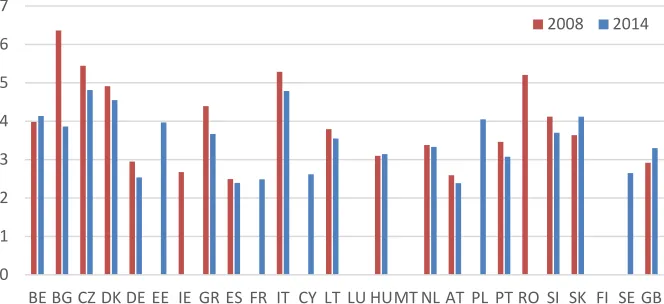
Similar conclusions can be drawn by analysing productivity in knowledge-intensive services. In the years 2008-2014, the vast majority of the EU countries experienced a de-crease in productivity defined as production of the sector per one-euro of personnel costs (Figure 10). During that period only in Belgium, Sweden, Finland, and the United Kingdom productivity increased (by 11%, 4%, 3%, 2%, respectively). Such results are not surprising. Tassey (2004) pointed out that knowledge-based services are at risk of a decrease in productivity. This is due to the fact that they typically represent the final stage in a system of products related to consumption (e.g., communication, marketing, or trade).
Figure 10. Productivity in knowledge-intensive high-technology services in the EU countries in 2008-2014
Source: own calculations based on Eurostat’s database, https://ec.europa.eu/eurostat/data/database, Retrieved on September 11, 2018.
0 1 2 3 4 5 6 7
BE BG CZ DK DE EE IE GR ES FR IT CY LT LU HUMT NL AT PL PT RO SI SK FI SE GB
What needs to be acknowledged is the fact that not all jobs in the knowledge intensive services sector are innovative, or actually knowledge intensive. To demonstrate this we compared some aspects of working conditions in two sectors: Financial (and other ser-vices) and Commerce and Hospitality (Figure 11). It can be observed that, depending on the aspect, only 50-80% of the jobs in Financial Services demand some form of knowledge processing. On the other hand, those figures are significantly lower for Commerce and Hospitality sector, so while it can be said that the KIS sector is not fully knowledge-inten-sive, it is still much more knowledge-intensive than other services.
Figure 11. Percentage of respondents agreeing with knowledge-related statements concerning their workplace in 2015 (average for the EU countries, Albania, the former Yugoslav Republic
of Macedonia, Montenegro, Serbia, Turkey, Norway, and Switzerland)
Source: own calculations based on the European Working Conditions Survey (EWCS), https://www.euro-found.europa.eu/surveys/european-working-conditions-surveys, Retrieved on December 17, 2018.
Focusing on Poland, it should be emphasized once again that although in the years 2008-2017 the share of the KIS sector in total employment increased by three percentage points, the pace of these changes slows down, and currently the forecasts do not give it a chance to catch up to the countries – innovation leaders in this area. The declining efficiency is not conducive to the development of the KIS sector in Poland (-14% in the years 2008-2014), but this trend is observed in most EU countries, and the efficiency in Poland remains higher than the EU average (5.20-euro of production for 1 euro of personnel cost to 3.73 euro in EU).
CONCLUSIONS
The study examined the design of knowledge-based business services in selected Euro-pean countries. The EU-15 countries were characterised by a higher level of use of KIS and innovation than the EU-12 countries. In most EU countries, efficiencies in the KIS sector may fall; this is due to decreasing performance in Europe and the growing competition of non-EU outsourcing companies (e.g. in India), where costs are low.
In the case of Poland, the development of KIS also depends on the demand for in-novative services, even the ‘innovation climate.’ In Poland, low spending on research
83,4 64,0
74,3 50,0
62,4
80,8 47,8
63,3 26,9
53,7
0 20 40 60 80 100
Work involves solving unforeseen problems on their own Work involves complex tasks Work involves learning new things
Work involves working with computers, laptops, smartphones etc.
One is able to apply their own ideas in their work
and development continues, despite the extensive participation of people with higher education in the labour market, resulting in a significant mismatch between the skills of workforce and business needs.
However, weak signals suggesting a break in the trends presented can be seen. In Eu-rope, this signal is the economic growth that eventually appears after the financial and debt crisis. With a demand-side mechanism, economic growth can revive the KIS sector. In partic-ular, in Poland a significant influx of immigrant workers from non-EU countries (mainly Ukraine) can reduce staff costs in the KIS sector. Migrant workers tend to concentrate in larger cities, and many of them are attending local schools for higher education. This skilled workforce finds employment in outsourcing companies located in Poland, as opposed to pre-vious years, when outsourcing companies moved to non-EU countries seeking lower costs. The test carried out was not free from research limitations. It should be noted that the time series used to construct the projections were limited due to the availability of data con-cerning the EU's knowledge-intensive sectors; this can affect the accuracy of the results.
It can be concluded that the future standard of living for citizens in the EU will de-pend heavily on the KIS sector and the services sector. Based on the findings, it can be considered that it is essential that policymakers and governments put more emphasis on the development of the sector, notably by offering financial support, incentives and building a favourable political and economic environment for the functioning of KIS and knowledge transfer process. Besides, the development of a knowledge-based economy should also intensify the development of the information and communication sector (ICT). The results of the study can be a signal for innovation policy that it should not only target R&D activities, but also support the development of KIS and innovation systems. It should also be noted that the current technological advances not only allow but also determine the implementation of activities related to the use of artificial intelligence and robotics in organisations. This will be a competitive advantage by reducing the cost of doing business, while at the same time increasing the efficiency of investment. How-ever, it should be remembered that while the introduction of artificial intelligence un-doubtedly contributes to the growth of GDP, it is not possible to downplay ethical issues or the consequences of the social introduction of new technologies.
Concluding, it should be stressed that the providers of business services have a rel-atively high potential to create innovative solutions in their activities. They are quite well prepared for both the infrastructure and the personnel side. There are no signifi-cant financial constraints in this respect, and innovation is regarded as important sup-port for the processes of market competition.
Unexpectedly, however, the market can also hinder innovation development in KIS. Many companies using these services are more valued for their proven, less risk-based solutions. Inherent barriers in customer awareness seem to be the most difficult to over-come, and their recognition requires to conduct research among managers of companies using knowledge-intensive services.
We hope that our article will be an inspiration for further scientific research in the topic of KIS. Due to research limitations we focused only on the main components of the KIS development in the EU countries. The most important questions that should be ad-dressed in the future concern the following issues:
− Could the decreases in KIS employment in innovation leader countries be due to automation and AI development?
− What are the possible factors that could help a country to break the forecasted trend?
REFERENCES
Baláž, V. (2004). Knowledge-intensive business services in transition economies. The Service Indus-tries Journal, 24(4), 83-100, https://doi.org/10.1080/0264206042000275208
Baumol, W.J. (2002). Services as leaders and the leader of the services. In J. Gadrey & F. Gallouj (Eds.), Productivity, Innovation and Knowledge in Services: New Economic & Socio-Economic Ap-proaches (pp. 147-163), Cheltenham, UK, Northampton, MA, USA: Edward Elgar Publishing.. Bettencourt, L.A., Ostrom, A.L., Brown, S.W., & Roundtree, R.I. (2002). Client co-production in
knowledge-intensive business services. California Management Review, 44(4), 100-128. Bilderbeek, R., den Hertog, P., Marklund, G. & Miles, I. (1998). Services in Innovation Knowledge
Intensive Business Services (KIBS) as Co-producers of Innovation, Synthesis Paper SI4S-S3/ 1998. Oslo: Studies in Technology, Innovation and Economic Policy Group, 1-59.
Braga, A., Marques, C.S., & Serrasqueiro, Z. (2017). Internationalisation Strategy of Knowledge-In-tensive Business Services. Journal of the Knowledge Economy, Springer; Portland International Center for Management of Engineering and Technology (PICMET), 9(2), June, 359-377. https://doi.org/10.1007/s13132-017-0461-5
Brenner, T., Capasso, M., Duschl, M., Frenken, K., & Treibich, T. (2018). Causal relations between knowledge-intensive business services and regional employment growth. Regional Studies, 52(2), 172-183, https://doi.org/10.1080/00343404.2016.1265104
Castaldi, C. (2009). The relative weight of manufacturing and services in Europe: An innovation per-spective. Technological Forecasting and Social Change, 76(6), 709-722. https://doi.org/10.1016/j.techfore.2008.08.001
Castellacci, F. (2008). Technological paradigms, regimes and trajectories: Manufacturing and service industries in a new taxonomy of sectoral patterns of innovation. Research Policy, 37(6), 978-994. https://doi.org/10.1016/j.respol.2008.03.011
Desmarchelier, B., Djellal, F., & Gallouj, F. (2013). Knowledge intensive business services and long term growth. Structural Change and Economic Dynamics, 25, 188-205.
Doloreux, D., Shearmur, R., & Rodriguez, M. (2015). Determinants of R&D in knowledge-intensive business services firms, Economics of Innovation and New Technology, 391-404. https://doi.org/10.1080/10438599.2015.1067001
Doloreux, D., & Shearmur, R. (2012). Collaboration, information and the geography of innovation in knowledge intensive business services, Journal of Economic Geography, 12(1), 79-105, https://doi.org/10.1093/jeg/lbr003
Dubosson, M., & Fragniere, E. (2009). The Consequences of Information Overload in Knowledge Based Service Economies: An Empirical Research Conducted in Geneva. Service Science 1(1), 56-62. https://doi.org/10.1287/serv.1.1.56
Gallego, J., & Maroto, A. (2015). The Specialization in Knowledge-Intensive Business Services (KIBS) across Europe: Permanent Co-Localization to Debate. Regional Studies, 49(4), 644-664. https://doi.org/10.1080/00343404.2013.799762
(pp. 519-534). Nowy Sącz; Nowy Targ: Wyższa Szkoła Biznesu – National-Louis University; Foun-dation for the Dissemination of Knowledge and Science ‘Cognitione’.
Hertog, P. (2000). Knowledge intensive business services as co-producers of innovation. Interna-tional Journal of Innovation Management, 4(4), 491-528.
J-Figueiredo, R., Vieira Neto, J., Gonçalves Quelhas, O.L., & de Matos Ferreira, J.J. (2017). Knowledge Intensive Business Services (KIBS): Bibliometric Analysis And Their Different Behaviors In The Scientific Literature. INMR – Innovation & Management Review, 14(3), 216-225. Retrieved from http://www.revistas.usp.br/rai/article/view/134958 on March 10, 2018.
Klaesson, J., & Norman, T. (2015). Market potential and the employment growth of knowledge-in-tensive services: comparing different geographical resolutions. The Annals of Regional Science, 55(1), October, 157-185. https://doi.org/10.1007/s00168-015-0701-1
Masso, J., & Vahter, P. (2012). The link between innovation and productivity in Estonia´s services sector. Service Industries Journal, 32(16), 2527-2541. https://doi.org/10.1080/02642069. 2011.600444 Miles, I. (2005). Knowledge intensive business services: Prospects and policies. Foresight, 7(6),
39-63, https://doi.org/10.1108/14636680510630939
Miles, I.D., Belousova, V., & Chichkanov, N. (2018). Knowledge intensive business services: ambigui-ties and continuiambigui-ties. Foresight, 20(1), 1-26.
Miles, I., Kastrinos, N., Bilderbeek, R., den Hertog, P.,Flanagan, K., Huntink, W., & Bouman, M. (1995). Knowledge-Intensive Business Services: Users, Carriers and Sources of Innovation. European Inno-vation Monitoring System (EIMS) Publication, 15. European Commission, Brussels, 1-105. Muller, E., & Zenker, A. (2001). Business services as actors of knowledge transformation: The role of
KIBS in regional and national innovation systems. Research Policy, 30(9), 1501-1516.
Musolesi, A., & Huiban, J.P. (2010). Innovation and productivity in knowledge intensive business ser-vices. Journal of Productivity Analysis, 34, 63-81. https://doi.org/10.1007/s11123-009-0163-5 Pauceanu, A.M. (2015). Impact of knowledge intensive businesses services on the economic
perfor-mance of sectors and regions in the UE. Africa Development and Resources Research Institute Journal, Ghana, West Africa, 8(2), 2343-6891.
Radovanović, N., Dmitrović, V., & Žarkić Joksimović, N. (2017). From Knowledge to Innovation and Back: Empirical Testing of Knowledge-Intensive Industries in Serbia. Entrepreneurial Business and Economics Review, 5(3), 119-131. https://doi.org/10.15678/EBER.2017.050306
Rodriguez, M. (2014). Innovation, Knowledge Spillovers and High-Tech Services in European Re-gions. Inzinerine Ekonomika-Engineering Economics, 25(1), 31-39. https://doi.org/10.5755/j01.ee. 25.1.3207
Schricke, E., Zenker, A., & Stahlecker, T. (2012). Knowledge-intensive (business) services in Europe, Euro-pean Commission, EUR 25189 EN, Brussel, Retrieved from ec.europa.eu/research/innovation-un-ion/pdf/knowledge_intensive_business_services_in_europe_2011. pdf on September 25, 2018. Tassey, G. (2004). Policy Issues for R&D investment in a knowledge-based economy. Journal of
Tech-nology Transfer, 29(2), 153-185.
Wilks, D.S. (2006). Statistical Methods in the Atmospheric Sciences. Burlington, MA: Academic Press, 1-630, Retrieved from http://danida.vnu.edu.vn/cpis/files/Books /Statistical%20methods %20in%20the%20atmospheric%20sciences,%20D.%20Wilks%20(2ed.,%20I GS%2091,%20Elsev ier,%202006)(ISBN%200127519661)(649s).pdf on September 25, 2018.
Wolff, E. (2002). How stagnant are services? In J. Gadrey & F. Gallouj (Eds.), Productivity, innovation and knowledge in services: new economic and socio-economic approaches. (pp. 3-25), Chelten-ham, UK, Northampton, MA, USA: Edward Elgar Publishing..
Wyszkowska-Kuna, J. (2016). Competitiveness of the New European Union Member States in Inter-national Trade in Knowledge-intensive Business Services. Comparative Economic Research, 19(3), 5-26. https://doi.org/10.1515/cer-2016-0018
Ženka, J., Novotný, J., Slach, O., & Ivan, I. (2017). Spatial Distribution of Knowledge-Intensive Busi-ness Services in a Small Post-Communist Economy. Journal of the Knowledge Economy, Springer; Portland International Center for Management of Engineering and Technology (PIC-MET), 8(2), June, 385-406. https://doi.org/10.1007/s13132-015-0260-9
The copyediting and proofreading of articles in English is financed in the framework of contract No. 913/P-DUN/2019 by the Ministry of Science and Higher Education of the Republic of Poland committed to activities aimed at science promotion.
Authors
The contribution share of authors is equal and amounted to 33% each of them.
Bianka Godlewska-Dzioboń
Master in Economics (Faculty of Economics, specialisation: Accountancy, Cracow University of Economics); PhD in Economics (Cracow University of Economics). Research interests include in-ternational trade, labour market and the structure of economy.
Correspondence to: Bianka Godlewska-Dzioboń PhD, Cracow University of Economics, ul. Rako-wicka 27, 31-510 Kraków, Poland, e-mail: [email protected]
ORCID http://orcid.org/0000-0001-9668-458X
Piotr Klimczyk
Master in Economics (Faculty of Economics, specialisation: Foreign Trade, Cracow University of Economics); PhD in Economics (Cracow University of Economics). Research interests include in-ternational trade, labour market and the structure of economy.
Correspondence to: Piotr Klimczyk, PhD, Cracow University of Economics, Theory of Economics Department, ul. Rakowicka 27, 31-510 Kraków, Poland, e-mail: [email protected] ORCID http://orcid.org/0000-0001-9238-2744
Agnieszka Witoń
Master in Economics (specialisation: International Economics, Jagiellonian University in Cracow); PhD in Economics (Cracow University of Economics). Research interests include economic growth, socio-economic development, and knowledge-based economy.
Correspondence to: Agnieszka Witoń, PhD, Cracow University of Economics, Theory of Economics Department, ul. Rakowicka 27, 31-510 Kraków, Poland, e-mail: [email protected]
ORCID http://orcid.org/0000-0002-4024-2851
Acknowledgements and Financial Disclosure
The authors would like to thank the anonymous reviewers and the Thematic Editor of EBER for their useful comments, which allowed to increase the quality of this article. The research has been co-financed from funds allocated to the Faculty of Economics and International Relations of the Cracow University of Economics, as part of subsidies for maintaining research potential.
This article has been presented as the academic paper at the scientific conference GLOB2018: “Globalization and Regionalization in the Contemporary World: Competitiveness, Development, Sustainability” organized in Kraków on 21-22 September 2019.
Copyright and License
This article is published under the terms of the Creative Commons Attribution – NoDerivs (CC BY-ND 4.0) License
http://creativecommons.org/licenses/by-nd/4.0/