THE DISTRIBUTION OF NORMAL AND TOXIC AMOUNTSOFBORONINGROUNDNUT
N.H. GoPAL'
Department
of
Botany, S. V. University, TirupatiReceived on May 5, 1969
SuMMARY
Leaves on the middle part of the stem of groundnut (TMV-2) plants showed severe interveinal chlorosis with 10 mgjl boron after 12 days in soil culture. Yellowing of basal leaves and a slight pale yellow colour in apical leaves also developed by that time. The distribution of boron in various parts was uneven in control as well as boron-treated plants after 12 days. In treated plants the accumu-lation of boron was the highest in middle leaves, less in roots, stem, petioles, apical leaves, flowers and also slightly less in basal leaves, although it was higher than in control plants. In control plants also leaves had more boron than other parts.
INTRODUCTION
With the adoption of relay-cropping pattern in agriculture, it has become customary to increase the fertility of cultivable soils by applying heavy doses of inorganic fertilizer with heavy irrigation. Although inevitable, these methods have focussed an increasing attention on several complicated problems on plant mineral nutrition, particularly those of deficiency and toxicity of trace elements. Amongst these, the problem of boron toxicity, particularly in arid and semi-arid areas, has received considerable attention due to its presence in several mineral fertilizers and high solubility in water.
The visual examination method to identify the element that produces toxicity is not dependable. For example, marginal chlo-rosis and necchlo-rosis in the leaves of groundnut plants are caused
by the toxicities of zinc (Millikan, 1947), manganese (Morris and Pierre, 1949) as well as boron (Harigopal and Rao, 1964). Further, the leaf symptoms produced by boron toxicity in different
plants differ considerably (Oertli and Kohl, 1961). The
analysis of leaves or of all plant parts for these trace elements, therefore, is the only dependable method for the identification of toxic effects. According to Allison ( 1964) "foliar analysis of leaf tissue is preferred over leaf symptoms as a basis for diagnosing boron injury, and often it provides a more reliable basis for diagnosis than the analysis of soil or water". A detailed investigation on the distribution of boron in various parts of groundnut (TMV-2, bunch type) plants grown with 10 mg/1 boron as soil culture was, therefore, undertaken and the results are presented in this paper.
MATERIALS AND METHODS
Soil culture technique.-Earthen-ware pots (30 X 30cm) with a hole at the bottom of each for drainage, were filled each with 8 kg of air-dry soil and compost (3 : I) mixed with 0 · 25
mg/1 boron. Groundnut (Arachis hypogaea L.) seeds obtained
from the Regional Oilseeds Research Station, Kadiri were sown in soil previously watered approximately upto field capacity (20 per cent on oven-dry soil). When the plants were 15-day old, they were thinned to three uniform plants per pot and watered once a day using tap water with 0·19-0·21 mg/1 boron through-out the experimental period.
Boron treatment.-When the plants were 28-day old, these were divided into two groups. To group I, 10 mg/1 boron was added as boric acid and group 2 served as untreated control. To obtain 10 mg/1 boron concentration, the required quantity of boric acid was dissolved in a measured volume of tap water, sufficient to raise the soil-moisture-content to its field capacity, and this solution was added to the soil uniformly all over the surface in pots. Leaching was prevented by watering the pots upto field capacity throughout the experimental period.
94 N. H. GOPAL
root and lateral roots. The shoot portion was divided into basal, middle and apical parts-the stem, petioles and leaves of these parts were sampled separately. Root and shoot samples were dried to constant dry weight, powdered and analyzed for
boron content by curcumin procedure of Dible et al. ( 1954).
Later at two different growth stages i.e. 60 and 90 days after sowing respectively, pegs were collected from the plants in three pots at each time from both the groups; were
washed, dried, powdered and also analyzed for boron
content.
Soil sampling.-Soil samples were collected at different growth periods of the plants from both the groups and air dried. Water-soluble boron in these soil samples was estimated as a measure of its availability.
RESULTS
Toxicity .rymptoms.-Slight chlorosis appeared on the tips and margins of mature middle leaves 5 days after boron treatment, which later progressed towards the base. Severe interveinal chlorosis resulted in all the mature middle leaves by 12 days. Yellowing of the basal and to a slight extent of apical leaves occurred by this time.
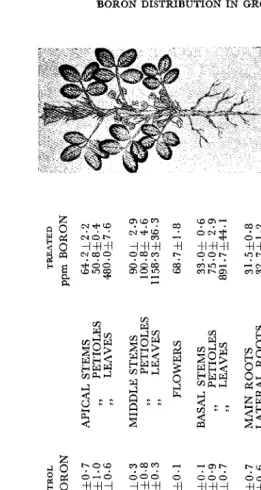
Boron distribution.-Boron distribution in various parts of the control and boron-treated plants is shown diagrammatically in
Fig. I. Boron content was markedly higher in main as
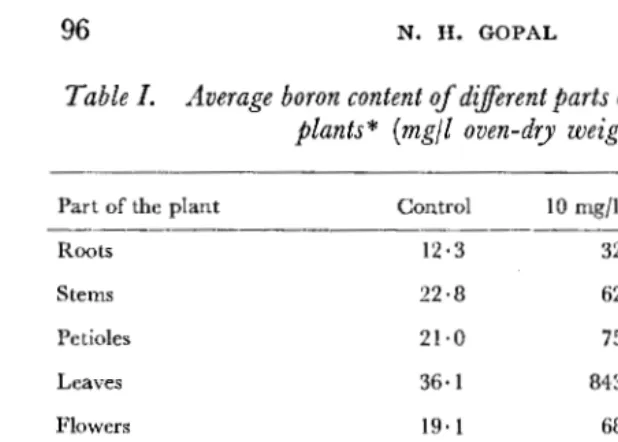
com-pared to lateral roots in control plants, but did not differ in boron-treated ones. In both the control and boron-treated plants roots contained much less boron than other organs. On an average '(Table I) boron content was the same in stem and petioles of control plants; but in boron-treated ones, petioles contained slightly more boron than the stem.
Control Plant ~ -~-.--__ ...___
___
_
CONTROL TREATED ppm BORON ppm BORON 23-2±0·7 APICAL STEMS 64.2±2·2 18.8±1-0 " PETIOLES 50.8±0-4 33.0±0-6 " LEAVES 480.0±7-6 28.0±0-3 MIDDLE STEMS 90-0± 2-9 24-5±0-8 " PETIOLES 100.8± 4.6 36-0±0-3 " LEAVES 1158·3±36.3 19.1±0-1 FLOWERS 68.7±1-8 16.2±0·1 BASAL STEMS 33-0± 0·6 19.8±0·9 " PETIOLES 75-0± 2-9 39.2±0· 7 " LEAVES 891. 7±44.1 17.8±0-7 MAIN ROOTS 31.5±0-8 6-8±0-6 LATERAL ROOTS 32. 7±1-2j ·l
96 N. H. GOPAL
Table I. Average boron content of different parts
of
groundnut ( T MV-2) plants* (mgfl oven-dry weight)Part of the plant Control 10 mg/1 boron % over Control
Roots 12·3 32·1 261
Stems 22·8 62·4 274
Petioles 21·0 75·5 360
Leaves 36·1 843·3 2336
Flowers 19·1 68·7 360
-*12 days after boron treatment.
The boron content of flowers as well as of pegs of treated plants was significantly higher than that of control plants
(Table II).
Table II. Boron content of pegs of groundnut ( TMV-2) plants (mgfl oven-dry weight). Each figure is a mean
of
3 replicatesPart of the plant
Pegs•
Pegs•
Average
Control
20·3±0·6
25·0± 1·2
22·7
•'Above soil' stage (60 days after sowing). •'Entered soil' stage (90 days after sowing).
10 mg/1 boron
42·7±2·4
50·0±1·2
46·4
%over Control
210
200
204
Table III. Water-soluble boron (mgfl) in soil
of
the pot cultures with groundnut ( TMV-2) plants (on air-dry soil basis). Each figure isa mean of duplicate samples
Particulars Days after sowing
Before sowing the seeds
On the day before boron
treatment (28)
12 days after boron treatment (40)
Control pots
0·25
0·25
0·25
10 mg/1 boron treated pots
0·25
0·24
Soil boron.-The water-soluble boron content of the soil collected from the control and boron-treated pots at various growth stages is presented in Table III. The content of boron in the soil of control pots did not change but that of 10 mg/1
boron-treated ones increased. .
DISCUSSION
A supply of 10 mg/1 boron to the soil was toxic and injured groundnut (TMV-2) plants. The toxicity symptoms were mani-fested in leaves, but not in petioles or stems. The matt\rC middle leaves showed severe chlorosis after 20 days.
The distribution of boron in various plant parts was not uniform (Fig. 1). Roots did not accumulate boron as most of it was carried passively to the upper parts of the plant due to its solubility in water and accumulated in leaves (Eaton, 1944; Kohl and Oertli, 1961; Gopal and Rao, 1969). In both control and boron-treated plants, the roots, stem, petioles and flowers accumulated much less boron than the leaves.
Boron content of leaves was significantly higher with toxic levels (10 mg/1) as compared with the control but it increased slightly in other organs. Thus, in the control set the leaves, stem and roots contained 36, 23 and 12 mg/1 boron as compared to 843, 62 and 32 mgjl in boron-treated ones, respectively. These results are thus, in conformity with those ofEaton(1944) who also showed that the boron content of roots and stem under both control and toxic levels, varied to some extent but was much higher in leaves.
Bobko and Priadilshchikova (1945) reported higher boron content in flowers than in leaves of buckwheat. Many other investigators also reported higher boron content of flowers than that of other parts (See Gauch and Dugger, 1954), but the results presented here indicate that the boron content of flowers does not differ significantly from that of the stem either of control or boron-treated groundnut plants.
Boron was also translocated into pegs (Table II) and after they entered into the soil, they might have absorbed some boron directly from the soil with the help of root hair-like structures that are reported to occur on the pegs (Seshadri, 1962).
98 N. H. GOPAL
accumulation have been established for many plant species by Eaton ( 1944). It is further supported by the distribution pattern of boron that was observed in the present study in various parts of the groundnut plant.
AcKNOWLEDGEMENTs
The author is grateful to Prof. I. M. Rao, Head of the
Department of Botany, for his valuable guidance and providing
facilities for this work. He is also thankful to Prof. W.
J.
Mcilrath, Dean, Graduate School, Northern Illinois University, DeKalb, Illinois, for the gift of curcumin (Eastman Kodak No. 1179).
REFERENCES
Allison, L. E. (1964). Salinity in relation to irrigation. Advan. A.gron., 16: 139-80.
Berger, K. C. and Truog, E. (1945). Boron availability in relation to soil reaction
and organic matter content. Soil. Sci. Soc. Amer. Proc., 10: 113-16.
Bernstein, L. and Hayward, H. E. (1958). Physiology of salt tolerance. Ann. Rev.
Plant Physiol., 9: 25--46.
Bobko, E. and Priadilshchikova, T. D. (1945). On the solubility of boron
com-pounds in the plant (In English). Compt. Rend (Dokaldy) Acad. Sci. USSR.,
11-12: 18-20.
Dible, Vv. T., Truog, E., and Berger, K. C. (1954). Boron determination in soils
and plants. Anal. Chern., 26: 418-21.
Eaton, F. M. (1944). Deficiency, toxicity and accumulation of boron in plants.
Jour. Agr. Res., 69: 237-77.
Gauch, H. G. and Dugger, Jr. W. M. (1954). The physiological action of boron in
higher plants: a review and interpretation. Bull. Univ. Ma~yland Agric.
Exp. Sta. No. A--80 (Technical).
Gopal, N.H. and Rao, I. M. (1969). Effect of excess boron supply on germination
and seedling growth of groundnut (Arachis h]•pogaea Linn.). Plant and
Soil., 30(3): (in press).
Harigopal, N. and Rao, I. M. (1964). Physiological studies on boron toxicity in
groundnut (Arachis hypogaea). Andhra Agric. ]., 11: 144-52.
Kohl, Jr. H. C. and Oertli, J. J. (1961). Distribution of boron in leaves. Plant
Physiol., 36: 420-24.
Lal, K. N. and Subba Rao, M. S. (1954). Micro-element nutrition of plants.
Banaras Hindu University Press.
l\fillikan, C. R. (1947). Zinc toxicity in flax, grown in a wire netting bird cage. ].
Aust. Agric. Sci., 13: 64-67.
l\lPrris, H. D. and Pierre, W. H. (1949). Minimum concentrations of manganese
necessary for injury to various legumes in culture solutions. Agron. ].,
41: 107-12.
Oertli, J. J. and Kohl, H. C. (1961). Some considerations about the tolerance of
various plant species to excessive supplies of boron. Soil Sci., 92: 243--4 7.
Seshadri, C. R. (1962). Groundnut. Rrv. Theodore A. Pereira, Examiners Press,
Fort, Bombay.