R E S E A R C H A R T I C L E
Open Access
The NASSS framework for ex post
theorisation of technology-supported
change in healthcare: worked example of
the TORPEDO programme
Seye Abimbola
1,2†, Bindu Patel
2†, David Peiris
2, Anushka Patel
2, Mark Harris
3, Tim Usherwood
4and
Trisha Greenhalgh
2,5*Abstract
Background:Evaluation of health technology programmes should be theoretically informed, interdisciplinary, and generate in-depth explanations. The NASSS (non-adoption, abandonment, scale-up, spread, sustainability)
framework was developed to study unfolding technology programmes in real time—and in particular to identify and manage their emergent uncertainties and interdependencies. In this paper, we offer a worked example of how NASSS can also inform ex post (i.e. retrospective) evaluation.
Methods:We studied the TORPEDO (Treatment of Cardiovascular Risk in Primary Care using Electronic Decision Support) research programme, a multi-faceted computerised quality improvement intervention for cardiovascular disease prevention in Australian general practice. The technology (HealthTracker) had shown promise in a cluster randomised controlled trial (RCT), but its uptake and sustainability in a real-world implementation phase was patchy. To explain this variation, we used NASSS to undertake secondary analysis of the multi-modal TORPEDO dataset (results and process evaluation of the RCT, survey responses, in-depth professional interviews, videotaped consultations) as well as a sample of new, in-depth narrative interviews with TORPEDO researchers.
Results:Ex post analysis revealed multiple areas of complexity whose influence and interdependencies helped explain the wide variation in uptake and sustained use of theHealthTrackertechnology: the nature of cardiovascular risk in different populations, the material properties and functionality of the technology, how value (financial and non-financial) was distributed across stakeholders in the system, clinicians’experiences and concerns, organisational preconditions and challenges, extra-organisational influences (e.g. policy incentives), and how interactions between all these influences unfolded over time.
Conclusion:The NASSS framework can be applied retrospectively to generate a rich, contextualised narrative of technology-supported change efforts and the numerous interacting influences that help explain its successes, failures, and unexpected events. A NASSS-informed ex post analysis can supplement earlier, contemporaneous evaluations to uncover factors that were not apparent or predictable at the time but dynamic and emergent.
Keywords:Ex post evaluation, Theory-driven evaluation, Diffusion of innovation, Scale-up, Programme sustainability, Implementation, Complexity of innovations, NASSS framework, Non-adoption, abandonment, scale-up, spread, sustainability framework, Innovation adoption
© The Author(s). 2019Open AccessThis article is distributed under the terms of the Creative Commons Attribution 4.0 International License (http://creativecommons.org/licenses/by/4.0/), which permits unrestricted use, distribution, and reproduction in any medium, provided you give appropriate credit to the original author(s) and the source, provide a link to the Creative Commons license, and indicate if changes were made. The Creative Commons Public Domain Dedication waiver (http://creativecommons.org/publicdomain/zero/1.0/) applies to the data made available in this article, unless otherwise stated.
* Correspondence:[email protected]
†Seye Abimbola and Bindu Patel are the joint first authors.
2
Centre for Health Systems Science, The George Institute for Global Health, University of New South Wales, Level 5/1 King St, Newtown, NSW 2042, Australia
5Nuffield Department of Primary Care Health Sciences, University of Oxford,
Background
The NASSS framework
The fortunes of technology programmes in healthcare are notoriously stormy [1–4]. Effective evaluation of such pro-grammes requires in-depth, theoretically informed and mixed-method analysis that address potential challenges to adoption and scale-up [5–9]. Yet published evaluations are sometimes disappointingly theory-light, empirically superficial, and deterministic [5].
TG’s group undertook a narrative review of
theory-informed frameworks for analysing and evalu-ating technology programmes in health and social care [10]. Previous research was synthesised and ex-tended to develop a new evidence-based framework (abbreviated NASSS) for studying the adoption, non-adoption, and abandonment of technologies by indi-viduals and the challenges to scale-up, spread, and sustainability of such technologies in healthcare or-ganisations and systems [10].
The NASSS framework is shown in Fig.1. It consists of seven domains, each of which may be simple (few compo-nents, predictable), complicated (many components but still largely predictable), or complex (many components interacting in a dynamic and unpredictable way). The dif-ferent sub-domains (right-hand panel in Fig.1) can be ap-plied eclectically to generate a nuanced narrative that
surfaces different kinds of complexity in the unfolding programme.
Domain 1 is the illness or condition. Complexity oc-curs when the condition is metabolically volatile (e.g. diabetes in pregnancy), inherently unstable (e.g. drug de-pendency), poorly described or understood (e.g. a newly discovered syndrome), associated with co-morbidities (most commonly in elders), or strongly influenced by socio-cultural factors (e.g. poverty, social exclusion) [11]. Domain 2 is the technology. Complexity may relate to its material properties (e.g. functionality, dependability, speed), knowledge needed to use it, knowledge it brings into play (all technologies foreground some kinds of knowledge at the expense of others [12]), supply model (e.g. is it substitutable?), and intellectual property (how easy is it to say who“owns”this?) [13].
Domain 3 is the value proposition—both supply-side (value to the developer) and demand-side (value to the pa-tient, healthcare system, and taxpayer or insurer). Complexity in this domain relates to difficulties in formulating a credible business plan (e.g. when efficacy or cost-effectiveness studies are unavailable or contested) [14,15].
Domain 4 is the adopter system: the staff, patients, and carers who will be expected to use the technology (but who may refuse to use it or find they are unable to use it). Complexity may arise, for example, when the
roles and practices assumed by the technology threaten professional traditions and codes of conduct [16].
Domain 5 is the organisation(s). Complexity in this domain may relate to the organisation’s general cap-acity to innovate (such things as leadership, resources, and clinician-managerial relationships) [17], its readiness for this particular technology (tension for change, balance of supporters and opponents) [17], the nature of the adoption and funding decision (more complex if it depends on inter-organisational agreements and speculative cross-system savings), potential disruption to existing routines [18], and extent of work needed to implement the changes (including gaining buy-in, delivering the change, and evaluating the change) [7].
Domain 6 is the wider system, including the policy context, support from regulatory or professional bod-ies, and public perceptions [5]. This domain also in-cludes inter-organisational networking (for example, via quality improvement collaboratives), which can be a powerful way of spreading organisational-level inno-vations [17].
Domain 7 is embedding and adapting over time. Com-plexity may arise from the technology’s“brittleness” (inabil-ity to adapt to changing context) or from the organisation’s lack of resilience (inability to withstand shocks and setbacks through learning and adaptation) [19].
The NASSS framework is a sensitising device that incorporates and combines a range of existing theor-etical perspectives on illness and disease, technology adoption, organisational change, and system change [10]. Empirical studies by TG’s team [20, 21] and others [22, 23] have demonstrated how NASSS can help construct a rich narrative of an unfolding tech-nology programme and identify the various uncertain-ties and interdependencies that need to be contained and managed if the programme is to succeed. To date, the NASSS framework has not been used retro-spectively for secondary analysis of a historical data-set. In the remainder of this paper, we first offer a theoretical justification for using NASSS for ex post analysis of case study data. We then describe the
TORPEDO research programme (an initiative to
introduce a new technology, HealthTracker, into Aus-tralian primary care) and the large empirical dataset it generated. We describe how we applied the NASSS framework to the TORPEDO secondary dataset and
to a new sample of primary interviews with
programme staff. In the “Results” section, we present our ex post analysis and highlight how this approach allowed us to draw together and extend previous ana-lyses of different parts of the dataset. In the “ Discus-sion” section, we offer reflections (theoretical and methodological) on our findings.
Ex post theorisation of complex case studies in healthcare
In 2011, in the introduction to “Explaining Michigan” (a retrospective analysis of the somewhat unexpected success of a state-wide quality improvement programme), Dixon-Woods et al. observed:“Understanding how and why pro-grammes work—not simply whether they work—is cru-cial. Good theory is indispensable to advancing the science of improvement.”(page 167) [24].
The Michigan Keystone Project achieved a dramatic reduction in central venous catheter bloodstream infec-tions in more than 100 participating intensive care units across the state [25]. It was widely hailed as a model of good practice (for example, by the World Health Organization, who sought to roll it out internationally) [25]. But initial accounts of the programme were sim-plistic and superficial, and helped perpetuate the myth that success was attributable to a “simple checklist” ra-ther than to a highly complex and context-specific social intervention [24].
Dixon-Woods et al. argued that because programmes al-most never proceed as planned, we rarely discover why a programme succeeded (or failed) by studying the initial study protocol (which can tell us only how its architects
assumedit would work) [24]. The“why”question must be addressed through a combination of re-analysis of primary data and additional interviews with programme staff and evaluators, who are asked to reflectretrospectivelyon what happened [24]. Such an analysis tracked the Keystone Pro-gramme’s success to a combination of six powerful and synergistic social influences: isomorphic pressures to join the programme and conform to its requirements, a profes-sional community of practice maintained via weekly tele-conferences, attention to the social and behavioural aspects of the intended change, nurturing a culture of commitment to quality improvement, harnessing data on infection rates as a disciplinary force, and judicious use of hard-edged formal accountability. This rich and innovative theorisation was later applied prospectively to explain why the same checklist-based intervention was much less suc-cessful in achieving its quality improvement goals in a UK setting [26].
politics are usually stripped away in the final report in the misguided pursuit of spurious scientific ideals (par-simony, objectivity, generalisability). Yet it is these messy, local narratives that could reveal why the programme worked in some settings some of the time but not in other settings or at other times.
Methods Overview
We studied the TORPEDO (Treatment of Cardiovascu-lar Risk in Primary Care using Electronic Decision Sup-port) research programme, a multi-faceted computerised quality improvement intervention for cardiovascular dis-ease prevention in Australian general practice, using a technology by the name HealthTracker (Fig. 2). This study was conducted using primary (i.e. ex post inter-views of TORPEDO researchers) and secondary (i.e. datasets and publications to date from the TORPEDO project) datasets. Based in Australia, TORPEDO extends back more than a decade. Against a context of high rates of cardiovascular disease in certain groups (notably, the indigenous Aboriginal population), researchers at the George Institute for Global Health in Sydney began an initiative to improve opportunistic risk factor assessment
and guideline-recommended primary and secondary pre-vention for individuals at high risk of cardiovascular disease.
TheHealthTrackertechnology
HealthTracker is a third-party add-on software tool which incorporates ten different clinical practice guide-lines into a single on-screen algorithm. It sits on the cli-nician’s desktop and draws data from the patient’s electronic medical record to populate a quantitative risk estimate (represented visually) for future cardiovascular disease. In patients who are at high risk of cardiovascular disease, it may recommend further testing, medication (statins, antihypertensive drugs, and antiplatelets), and lifestyle changes. The point-of-care decision support is aided by a “traffic light” (red, amber, and green) visual alert to flag missing information or suboptimal treat-ment and prompt conversations with patients. An audit tool (designed for use by both clinical and non-clinical managers) allows aggregation of performance data across the practice and access to a web portal for comparison with other de-identified sites.
The idea for the study emerged from a workshop on the NASSS framework at the George Institute in Sydney
in 2018, in which TG invited participants to share exam-ples of health technology projects that had met with im-plementation challenges. AP (a cardiologist and chief investigator of the TORPEDO programme), DP (a GP and research lead on TORPEDO), SA (a health systems researcher), and BP (at the time, a completing PhD stu-dent who had been project manager on TORPEDO) all contributed to that workshop.
It was evident that the application of NASSS to the ex-tensive TORPEDO dataset had the potential to synthe-sise and extend insights from previous evaluations about whether and to what extent HealthTracker had suc-ceeded. Accordingly, we agreed to revisit the original dataset and undertake some additional interviews to cap-ture retrospective reflections of the study team. The principles and methodology of Dixon-Woods et al.’s ex post theorisation required little adaptation when we sought to apply them to theHealthTrackerprogramme.
Primary dataset: ex post interviews
SA and TG (who were not involved in the original em-pirical work) read the published papers on TORPEDO and drafted an initial set of questions based on the NASSS domains. They then consulted BP, who had been involved in TORPEDO from the outset and whose doc-toral work had been an evaluation of the TORPEDO programme. With her input, SA and TG refined the draft questions to construct the specific “ex post” ques-tions below:
What was the nature of the conditions for which
HealthTrackerwas developed? What disease-related
uncertainties, co-morbidities, and cultural influences did the programme grapple with?
How didHealthTracker’s material features (e.g. functionality, dependability, interoperability, and customisability) and its supply model influence its uptake and use in different settings?
What value didHealthTrackergenerate (for developers, patients, providers, and the healthcare system more widely)? Were there weak links in the value chain—and if so, why?
What explained situations in which an individual resisted adoptingHealthTrackeror abandoned it after a short trial period?
To what extent could variation in adoption and mainstreaming ofHealthTrackerbe explained by organisational antecedents, organisational readiness, nature of funding decision, degree of disruption to organisational routines, or the organisational work needed to normalise and evaluate the technology? To what extent could variation in uptake and use of
HealthTrackerbe explained by an adverse (or
supportive) external context—in particular in the
policy, regulatory, professional, or public realm? How strong were inter-organisational networks and to what extent did they enable participating organi-sations to deliver change?
What changed over time (in individuals, in
organisations, in the wider system)? To what extent could the technology, the service model, and the organisation adapt—and why?
We collected a primary dataset of five interviews with the programme evaluation team, comprising the princi-pal investigator of TORPEDO (AP), three chief investi-gators (DP, TU, and MH; the last two were GPs with an interest in decision-support software development), and one project manager and PhD student (BP). The ex post research questions listed above were used as prompts in a conversational interview in which the participant was invited to tell the story of the TORPEDO programme in their own words and reflect on the multiple interacting influences on it. Interviews were audiotaped with con-sent and professionally transcribed.
Secondary dataset: the TORPEDO research programme
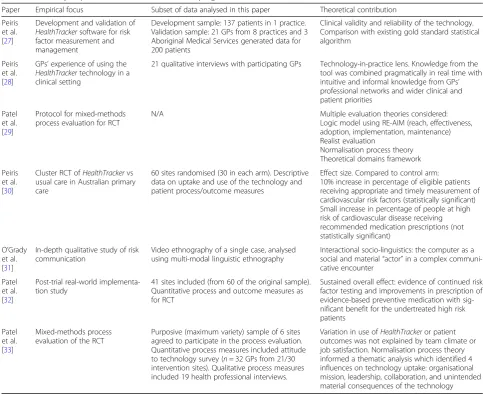
Publications from TORPEDO are summarised in Table1, which shows their empirical focus, dataset, and theoret-ical contribution. Each was produced for a different audience and had a different focus; together, they pro-vide a rich and multi-faceted picture of the programme’s origins, rationale, and unfolding fortunes over a 10-year period. Along with relevant primary source material from those original studies (in particular, a re-analysis of 19 transcripts of interviews with health professionals and managers using the NASSS framework), these consti-tuted the secondary dataset for our ex post analysis. In the following paragraphs, we provide brief descriptions of the publications reporting the original studies.
The development, core functions, and early usage sta-tistics of HealthTracker were described in a technology journal in 2009 [27]. A qualitative pilot study of this tool, based on ethnography and interviews and analysed using a technology-in-practice lens, was published in a sociological journal in 2011 [28]. This study highlighted the gap between the abstract evidence inscribed in the technology and the realities of real clinical cases (which were often unique, messy, and complex).
Based on this pilot work, a protocol was developed for a randomised controlled trial (RCT) of HealthTracker with mixed-method process evaluation [29]. The trial (Austra-lian Clinical Trials Registry 12611000478910), which rando-mised 60 sites (general practices or Aboriginal Community-Controlled Health Services) to intervention (installation of
measured and receive evidence-based preventive care than those in control practices. Absolute differences between intervention and control arms were small, but differences in the primary endpoint for appropriate screening of car-diovascular risk factors were statistically significant. High-risk patients in the intervention group whose care had been suboptimal prior to the study showed clinical benefit.
Some risk assessment consultations using Health-Tracker were video-recorded and analysed using multi-modal conversation analysis, producing, for example, a book chapter on the nuanced challenges of using tech-nology to help communicate risk in patients with vari-able health literacy and (sometimes) a very different world view from the doctor [31].
A post-trial follow-up study of 41 of the original 60 sites (from both arms of the trial) assessed the use of the
HealthTracker technology under real-world conditions. The initial paper from that follow-up study reported mainly quantitative data (e.g. proportion of doctors
using the tool; proportion of patients being treated ac-cording to guidelines) [32]. But this on-average finding obscured the fact that in the implementation phase, use of HealthTracker to support proactive preventive care varied widely between individual clinicians and practices. A mixed-method study, based on surveys and semi-structured interviews, explored reasons for this variation [33]. This paper concluded that four spheres of influence (discussed further below) appeared to account for the fortunes of the HealthTrackertechnology in a practice: organisational mission and history, leadership, team en-vironment, and material properties of the technology.
Ex post analysis
Using the NASSS domains as a sensitising framework, we undertook a thematic analysis of the previous TOR-PEDO publications along with the new primary inter-views. As we amassed material under each domain, we drew on various theoretical lenses (some identified in a
Table 1Summary of publications from the TORPEDO programme
Paper Empirical focus Subset of data analysed in this paper Theoretical contribution
Peiris et al. [27]
Development and validation of
HealthTrackersoftware for risk factor measurement and management
Development sample: 137 patients in 1 practice. Validation sample: 21 GPs from 8 practices and 3 Aboriginal Medical Services generated data for 200 patients
Clinical validity and reliability of the technology. Comparison with existing gold standard statistical algorithm
Peiris et al. [28]
GPs’experience of using the
HealthTrackertechnology in a clinical setting
21 qualitative interviews with participating GPs Technology-in-practice lens. Knowledge from the tool was combined pragmatically in real time with intuitive and informal knowledge from GPs’ professional networks and wider clinical and patient priorities
Patel et al. [29]
Protocol for mixed-methods process evaluation for RCT
N/A Multiple evaluation theories considered:
Logic model using RE-AIM (reach, effectiveness, adoption, implementation, maintenance) Realist evaluation
Normalisation process theory Theoretical domains framework
Peiris et al. [30]
Cluster RCT ofHealthTrackervs usual care in Australian primary care
60 sites randomised (30 in each arm). Descriptive data on uptake and use of the technology and patient process/outcome measures
Effect size. Compared to control arm: 10% increase in percentage of eligible patients receiving appropriate and timely measurement of cardiovascular risk factors (statistically significant) Small increase in percentage of people at high risk of cardiovascular disease receiving recommended medication prescriptions (not statistically significant)
O’Grady et al. [31]
In-depth qualitative study of risk communication
Video ethnography of a single case, analysed using multi-modal linguistic ethnography
Interactional socio-linguistics: the computer as a social and material“actor”in a complex communi-cative encounter
Patel et al. [32]
Post-trial real-world implementa-tion study
41 sites included (from 60 of the original sample). Quantitative process and outcome measures as for RCT
Sustained overall effect: evidence of continued risk factor testing and improvements in prescription of evidence-based preventive medication with sig-nificant benefit for the undertreated high risk patients
Patel et al. [33]
Mixed-methods process evaluation of the RCT
Purposive (maximum variety) sample of 6 sites agreed to participate in the process evaluation. Quantitative process measures included attitude to technology survey (n= 32 GPs from 21/30 intervention sites). Qualitative process measures included 19 health professional interviews.
previous systematic review of technology evaluation frameworks [10] and others known to the research team), which are highlighted in the next section where we present our analysis, along with our key findings, in-cluding particular theories mobilised to explain specific findings. Each of the questions and discussion points during the ex post interviews requires the application of theory, and different theories were appropriate for ex-ploring the domain of the NASSS framework.
The re-analysis of primary interviews included a search for disconfirming data (i.e. searching the dataset material, both quantitative and qualitative, that might challenge our emerging interpretation of what hap-pened) to ensure that we were not simply cherry-picking quotes that supported our interpretation. We included ten quotes from the original dataset, all selected by BP, and checked by SA and TG using the principle of“apt il-lustration”. Whilst we did not undertake further quanti-tative analysis for this study, the original quantiquanti-tative findings from TORPEDO—and in particular, differences that were and were not statistically significant in the ran-domised trial [30]—were a major focus of discussion in the ex post interviews.
A provisional summary of findings, produced by SA, BP, and TG, was discussed and factual errors corrected. Differences of interpretation were resolved by discus-sions among the research team and by triangulating the findings with historical qualitative and quantitative data from the primary TORPEDO studies. For example, when one of the ex post interviewees mentioned that negative media reports about statins may explain a drop in pre-scriptions during the follow-up study, we checked if this explanation was supported by the quantitative trend data from the follow-up study and from GP interview tran-scripts from the original studies, both suggesting that GPs were influenced by the media reports (see “The intended adopters”under the“Results”section).
Results
The analysis identified interacting complexities in the TORPEDO programme which played out differently in different sites and settings. These are presented under the NASSS domains below. Direct quotes from the new primary dataset of ex post interviews are labelled “ex post interview [number]”; quotes from the original TOR-PEDO dataset are labelled with the original coding nota-tion (e.g. 2282-005, with the first four digits indicating the original study site number and the last three digits indicating the participant number).
The condition
HealthTrackerwas designed for use in two kinds of pa-tient: those who already had cardiovascular disease and those (usually asymptomatic) who were potentially at
high risk of developing it. Established cardiovascular dis-ease is well characterised, and guidelines for its manage-ment are relatively uncontested and widely accepted. The evidence base on managing cardiovascular risk is more complex. It is skewed towards a white European and North American population (especially the US Fra-mingham study, on which the HealthTrackeralgorithm was partially based). Furthermore, since cardiovascular risk is a continuous variable influenced by multiple risk factors such as blood pressure and cholesterol levels,
HealthTracker could not offer an unambiguous binary categorisation of patients into“high risk”or“low risk”.
In Australia (as elsewhere), cardiovascular disease is strongly patterned by socio-demographic factors: it is commoner in those who are poor, those with low health literacy, and in Aboriginal people. Such individuals are more likely to have comorbidities such as diabetes or mental health conditions (“High risk is a sort of multi-farious set of component conditions”—ex post interview 2). They may also have cultural beliefs and practices that affect their ability and willingness to understand the risk communication and comply with preventive treatment.
The risk communication tool inHealthTrackerworked well for many patients (“I found the patient education information just great, it was just wonderful.”—Nurse in TORPEDO study, 2368-005). But it assumed that pa-tients would be able to understand a visual representa-tion of quantitative risk and make a rarepresenta-tional decision to alter their lifestyle based on it. This was not always the case, partly because of numeracy (“I find that they’re [ab-solute risk percentage] harder to explain to the patient with a number. So we need to go back and look at how to translate into the number needed to treat. But that’s very hard concept for the patient to understand at the moment too.”—GP in TORPEDO study, 2290-001), and partly because of competing priorities in complex lives (“[HealthTracker] works for people that have structured lives… but some patients are much less organised, and they have social and other medical problems … which interfere with their ability … to accept and to seek out systematic care”—ex post interview 4).
The TORPEDO findings confirmed that cultural habits die hard and familiar folk models of illness and risk may over-ride less familiar epidemiological ones [34]. A 66-year-old patient with a family history of cardiovascular disease and adverse clinical and lifestyle factors commented:
... it’s no good saying we’ll change your lifestyle. I’m 66 years old. I have a lifestyle, you know. I’m not an alcoholic. I don’t over-drink. I don’t you know I don’t overeat. I’m just, just a big bloke. Look, I didn’t walk out of there thinking, oh, I’m only going to eat salad and, you know, drink water for the rest of my life.
The “no symptoms, no problem” mindset helps ex-plain why patients with established cardiovascular dis-ease appeared to engage better than those flagged for primary prevention (“I have this difficulty convincing pa-tients that they should be on medication when the indi-cation is only based on high risk … ‘Doctor, but I haven’t got the problem now so why do you want to give me the medication’ and, of course, medications are not cheap”—GP in TORPEDO study, 2308-001).
The technology
HealthTracker had many attractive design features (“[GPs] loved it,…loved the traffic light [which] was sim-ple, [and] loved seeing the graphs, looking at the heart age over time”—ex post interview 1). Many valued the way it structured care (“HealthTracker reminds me what needs to be followed, to be checked and followed. So it wasn’t so much telling me what the guidelines are, it was telling me what I needed to do to ensure that their health, every-thing’s been covered”—GP in TORPEDO study, 2303-001). But GPs described technical glitches (such as when data on the patient’s record did not appear in the Health-Tracker viewer) that were frustrating and interfered with their use of the technology in real time. Many found themselves regularly on the phone to the helpdesk. A major concern was that “apps that would just chew up memory, make the EMR [electronic medical record] run slowly; people said, ‘I don’t want to have anything to do with this thing, because it’s making my existing work flow worse’”(ex post interview 2).
Despite its visual appeal, “the user design wasn’t very good” (ex post interview 3), and in retrospect, findings suggest that it was not fit for purpose. It was not easy to integrate HealthTracker into existing workflows and practices for quantifying risk, advising patients, and pre-scribing medication. HealthTracker appeared in a side bar on the GP’s screen with pop-up prompts, “and sometimes prompts would go up, [or] wouldn’t; some of them wouldn’t see it because they would [mistakenly] shut it off, [and]…would say, oh, it’s gone, I don’t know where it is.”(ex post interview 1). Because of these tech-nical imperfections, GPs participating in the TORPEDO study soon divided into highly motivated and/or technic-ally adept ones, who persisted with the technology, and the rest, who gave up on it (“We tried to fix it and it didn’t work, then I just stopped doing it, yeah. We never knew why, I don’t know if it is the software because we tried many times … It’s never worked.”—part-time GP in TORPEDO study, 2290-003).
HealthTracker’s inbuilt algorithms foregrounded“hard” risk data (biometrics, family history) at the expense of
“softer” data (e.g. on personal and cultural context) that could have informed a more individualised approach to care [27]. This was a conscious design feature, but it helps
explain why, glitches aside, different GPs had very differ-ent levels of use of the tool (see domain 4).
The TORPEDO project team sought to facilitate adop-tion by ensuring from the outset thatHealthTrackerwas able to integrate with more than one electronic record system. Whilst it covered only two such systems, they amounted to 80% of the Australian market. But the inte-gration was only one way: “nothing fromHealthTracker
populated into the EMR; [only] the reverse occurred”(ex post interview 3). This meant that the risk score and management plan did not automatically populate the pa-tient’s record—a feature that contributed to clinicians’ experience of“clunkiness”.
The value proposition
HealthTracker was developed in a university setting by publicly funded research. There were two implicit poten-tial models for introducing it into Australian primary care. The technology could be sold directly to GP prac-tices or paid for by or through government entities, e.g. Primary Health Networks (PHNs), which are the organi-sations responsible for planning and commissioning pri-mary care services, one for each of 31 geographically defined locations across Australia; and Medicare, which is the publicly funded universal healthcare system in Australia. The value proposition varied accordingly. The Australian government is prioritising digital health ini-tiatives (see“The wider system”section). To government as a third-party payer, the potential value of Health-Tracker would be“quality of care, [a] better performing health system, reduced inefficiency, better use of medi-cines, … reduction of morbidity and mortality, and no unintended safety consequences” (ex post interview 2). In addition, there was hope among the TORPEDO team that HealthTracker would support a shift towards a more prevention-oriented healthcare system. One re-searcher commented that the Australian primary health-care system is designed to be“…reactive, not proactive, and what we’re trying to do [by introducing Health-Tracker] is to graft on some extra things that make it more proactive”(ex post interview 4).
decisions for commissioning similar interventions based on cost-effectiveness analyses are scant.
The heavy burden of preventable and costly cardio-vascular disease, particularly in Aboriginal communi-ties, made the value proposition particularly compelling for community leaders. One researcher recalled, when
recruiting the Aboriginal Community-Controlled
Health Services to the TORPEDO trial, “it was just so pressing how – every one of the [community] board members, either themselves or relatives, knows some-one who’s died of heart disease, or stroke, or diabetes, or kidney diseases; it’s just absolutely everywhere” (ex post interview 2).
Some individual GPs shared this perspective, viewing
HealthTrackerin positive value terms as supporting bet-ter (more proactive) care and making it easier and quicker to follow evidence-based guidelines and monitor their own performance. They felt it could potentially save them time “because it got all sorts of information out of the medical record and told you what otherwise you have to go hunting for” (ex post interview 5). Be-cause HealthTrackersynthesised several guidelines so as to streamline decision-making in patients with multi-morbidity, it saved considerable time sourcing individual guidelines.
But this would generate value only for GPs who were committed for professional reasons to delivering guideline-informed care, since HealthTracker increased overall con-sultation length [33]. The conversation triggered by the risk visualisation tool could sometimes be lengthy (“the thing is, it’s not time to run the programme, it’s time to actually chat to the patient. So if you’re going to go through all this, you’ve got to be prepared to have a good 10 minute chat with the patient because you actually want to engage them and help them understand where they’re at and make a dif-ference and that’s the time.”—GP in TORPEDO study, 2282-005). Since the Australian payment system predomin-antly rewards GPs on a fee-for-service basis rather than (say) incorporating a pay-for-performance scheme (as in the UK Quality and Outcomes Framework [35]), the tech-nology could be viewed as having negative financial value for GPs, especially given the many technical“bugs”, which could be time-consuming to resolve.
The value of HealthTracker to patients was complex and varied for different individuals and communities. For example, only a minority of patients valued the focus on prevention and future health gain: “patients who are not at high risk, who are motivated and got high health literacy, are the minority, [while] the major-ity of patients at high risk have got multiple problems and need much more hands-on working”(ex post inter-view 4). And some GPs had commented that using
HealthTracker would increase their professional status in the eyes of current or potential patients—“that you’re
a 21st century doctor and you’re doing the right thing” (ex post interview 4).
However, patients’ main priority when choosing a GP was not always quality of care delivered. For example, in ethnically diverse areas of Sydney, “[a large proportion] of the GPs consult in a language other than English, people find the same language, same culture GPs, … that’s what people are looking for, they’re not necessarily looking for them following guidelines”(ex post interview 4). Some patients were driven predominantly by material needs. The Australian copayment system meant that out-of-pocket payments for a GP consultation could be $30–$50, which might place negative financial value on additional medication and GP appointments triggered by aHealthTrackerfocused consultation.
The intended adopters
In the TORPEDO study, at least 1 GP responded to a sur-vey in 21 of the 30 intervention sites; of these, fewer than one third said they usedHealthTrackerfor more than half of eligible patients, even though most expressed positive attitudes to the technology (e.g. they considered it easy to use, valued the data it generated, and felt it helped im-prove the quality of care) [32].
Their reasons for limited adoption were complex; they in-cluded technical issues described in domain 2. Those aside,
HealthTracker’s potential to prompt the screening of asymptomatic patients for cardiovascular disease risk was
“a low hanging fruit that most GPs were happy to engage with and could see that was an important thing to do”(ex post interview 2). This partly explains why the intervention arm of the TORPEDO RCT showed significant improve-ment in process measures (measuring and docuimprove-menting risk factors). But despite this, there was no significant im-provement in prescribing preventive drugs in the TOR-PEDO trial. At the level of individual consultations, GPs may have been taking account of the (often complex) socio-cultural factors described in domain 1 when judging whether to use HealthTracker at all and (if they did) whether to follow the algorithm’s recommendations.
that whilst statin prescription increased among those with a diagnosis of cardiovascular disease, it fell for those without such a diagnosis:“I think there was a huge drop in the prescription for statin …Lipitor came into the news around that time.…And I quickly had a look and realised that yes, I did reduce the prescription of the statin … [and] the prescription for high blood pressure group may have dropped at the same time, not just the statin.”(GP in TORPEDO study, 2290-001).
HealthTracker also appeared to exert what one re-searcher called “psychic costs” in the form of anxiety induced by a red light which alerted GPs to recom-mendations they did not follow [38]. GPs felt they were being marked down and expressed along the fol-lowing lines: “don’t tell me to do something when I’ve made an active decision in discussion with my patient to not do it, don’t keep giving me a red traffic light” (ex post interview 3). In contrast, a GP re-searcher who was part of the TORPEDO team said: “I found it very useful, every time I saw a patient, I’d open the HealthTracker and have a quick squizz, and make sure that there were no red indicators any-where” (ex post interview 5).
The organisation(s)
Not all practices invited to participate in the TORPEDO study chose to do so. And among the studies that partic-ipated in the trial, 15 declined to participate in the post-trial study because of the following: the service was clos-ing or movclos-ing (4 practices), concerns thatHealthTracker
would slow down their computer system (3), limited re-sources (3), changing to an incompatible electronic rec-ord system (3), already using another cardiovascular risk tool (1), and lack of interest (1) [32]. In other words, the practices which declined to participate may have had significant organisational-level issues to report, and find-ings from the practices which did participate may not reflect all those issues.
There was wide variation in participating practices’ underlying capacity to innovate. Technical infrastructure was sometimes poor, increasing the likelihood of technical crashes (“some practices don’t tend to change their hard-ware very often, or let it upgrade very often, so you’re
try-ing to run sophisticated new software on older
machines”—ex post interview 5). Some larger GP practices and Aboriginal Community-Controlled Health Services (ACCHSs) had “been engaged in quality improvement work very strategically for about 15 years [and] already had an operational structure that they could weave [HealthTracker] into”(ex post interview 2). In some, there was a dedicated individual focused on audit and quality improvement (“we can report to them that, you know, for example only 30% of the high-risk patients are being pre-scribed with triple therapy and they go, whoa.”—Health
information officer (ACCHS) in TORPEDO study, 2282-001). Notably, some of the more confident larger practices sought a high degree of autonomy over how and when
HealthTrackerwas used.
Larger practices sometimes also had an on-site IT sup-port person or technically adept practice manager who could troubleshoot problems and coordinate remotely with the developers. At the other end of the spectrum were small, poorly resourced practices, who“had less ex-perience doing this sort of thing, [and] probably needed a bit of arm twisting to sign up”(ex post interview 2). In ex-treme cases, the practice was not even able to install the software. More commonly, a“series of cascading negative things [could] then lead to complete abandonment”.
Whilst practice size was to some extent a proxy for capacity to innovate, the latter was also influenced by the practice’s governance structure [39, 40]. In small one- or two-doctor practices, decision-making was gen-erally very streamlined. In a typical GP practice, quality improvement is commissioned by Primary Health Net-works (PHNs) and practices are facilitated to conduct audits of their electronic medical records and provide de-identified data to the PHN. Each PHN is governed by a board, but there are hundreds of GP practices within a PHN region. Thus, the owner of a small practice was a GP who was essentially the CEO and the provider, such that “once you’ve engaged the principal or principals, and if they’re taken with the idea, then they’ll just do it” (ex post interview 4). This also explained why small practices could sometimes (albeit relatively rarely) over-come capacity disadvantages (“I’m probably taking about 90% of the data cleaning here, in this surgery.”—GP in TORPEDO study, 2290-001).
In larger organisations, several levels of governance were involved. In ACCHSs, for example, there were three tiers of decision-makers: “[The first tier is] com-munity elected broad members,…the next tier is about senior management support for it, that’s the CEO and their senior level staff, and then the next tier is the pro-viders or clinicians. …. We wouldn’t be able to work with any service without having all three of those pro-cesses in place” (ex post interview 2). Whilst strategic-level actors tended to make decisions on the basis of population disease burden and likely long-term benefit, operational-level actors appeared to be more concerned about short-term costs and workload implications and the factors discussed in domain 4.
practice manager), who made the decision to sign up for the trial and embraced the technology with enthusiasm, and other staff (fellow GPs and most practice managers) whose engagement was often much lower. As the TOR-PEDO researchers discovered, “when you sign on a [large] GP practice…usually agreed by the lead GP who may be enthusiastic about intervention,…it really needs all the GPs to be committed and want to use it”(ex post interview 3).
Larger practices had a more diverse and distributed workforce. Potentially, this could reduce the cost of adoption of HealthTracker, for example, if nurses rather than doctors undertook the risk assessment (as happens routinely in the UK [41]). But large practices typically have a clear division of labour (with formal job descrip-tions, for example), so optimal embedding of new tech-nologies may require revision of roles and routines and regular retraining. In some cases, HealthTracker work could not be sustained if a key member of administrative staff was absent. Given the high staff turnover in larger practices, community health workers (e.g. Aboriginal health workers, who already undertook some screening and health education tasks) could potentially “spend more time explaining to [patients] what it [the Health-Tracker data] was all about, talking to them about life-style changes, their medication, why they need to be on them, how they could continue taking them and sup-porting them to do that” (ex post interview 4). Unfortu-nately, use of HealthTracker could not be easily incorporated into community health workers’ role in some ACCHSs for several reasons including lack of ac-cess privileges, low health worker confidence in use of computers, perceived time constraints, low GP confi-dence in health workers, and governance issues (“they weren’t given the green light by the head of the board”— ex post interview 1).
Variation in capacity to innovate (a phenomenon we have documented previously in GP practices involved in complex intervention trials [42]) raised the question of whether and how much to support each GP practice to implement HealthTracker during the TORPEDO trial and subsequent real-world implementation. This was partly for cost reasons (“it would have taken an extra couple of years [of planning] and another million dollars or something; it’s not cheap to do this kind of stuff”—ex post interview 4) and partly because of concerns that too much external support would limit the external validity of the findings. For these reasons, TORPEDO re-searchers decided to implement the intervention in a more or less standardised way.
Some of these findings, based on the NASSS frame-work, are resonant with those of an earlier theorisation using normalisation process theory, which identified four key influences on the routinisation of HealthTracker in
participating practices: organisational mission and his-tory (e.g. strategic investment to promote a culture of quality improvement), organisational leadership (e.g. ability to energise staff), team environment (e.g. extent to which team members with different skill sets worked in complementary ways), and technical features of the tool (covered in domain 2) [33].
The wider system
HealthTracker was not classed as a medical device so did not require regulatory approval. Technology vendors saw regulation as a two-edged sword. On the one hand, lack of regulatory hurdles meant that it was easier to get them to market. On the other hand, achieving regulatory approval, had it been required, would have given the vendor an advantage over competitors.
The TORPEDO team was keen to create an institu-tional environment that would promote the use of
HealthTrackerby GP practices. They sought to position
HealthTracker nationally so that it could generate rev-enue for GPs and GP practices in the future.
For example, they sought to maximise the chance that professional bodies supported and endorsed its use:“We made a decision very early on that that we would just use [existing] guidelines, whether or not we agreed with the guidelines” (ex post interview 3). This strategy was based on the assumption that if the guidelines emanated from professional societies, most physicians would accept them as reasonable. They had anticipated a po-tential scale-up platform through the Royal Australian College of General Practitioners (RACGP) and had se-lected the technology developer because of its existing relationship with RACGP (“we were somewhat lured into the attraction of working with them [the devel-opers], because they’d signed this partnership with the College of GPs …to make this software available to all 20,000 members of the College of GPs”—ex post inter-view 2). However, RACGP subsequently discontinued this partnership because of negative feedback from its members, especially in relation to the tool slowing down practice systems. Even though RACGP had a long his-tory of endorsing clinical practice guidelines, they did not endorse HealthTracker to their members. This was partly because “when it comes to endorsing software, that’s a relatively new space for them; [they] approached it like a guideline, …and missed the point that we wer-en’t trying to create a new guideline; we were trying to implement existing guidelines”(ex post interview 2).
Benefits Schedule (MBS), the government-subsidised health services, given Australia’s fee-for-service remu-neration model for GPs. But this approach stalled ini-tially:“we put in a submission to the federal government only to be told eventually that from a legislative view-point, MBS items can’t be attached to software” (ex post interview 3).
PHNs have the mandate to facilitate quality im-provement programmes as part of their work, with dedicated staff to support that work, though such programmes do not tend to be focused on particular technologies. The TORPEDO researchers hoped to use the results of the trial “to drive the decision-making process a little bit more rationally” (ex post interview 2). This was particularly important at the time, given the absence in Australia of other quality incentives to promote proactive care for people at risk of cardiovascular disease. Without such incentive programmes, or the ability to bill patients or insurers for using HealthTracker and similar software, the chances of widespread adoption and scale-up of
HealthTracker are probably limited.
The TORPEDO researchers built inter-organisational communication and networking into the study design. It is well established that complex innovation in healthcare is facilitated when different organisations communicate with one another, share experiences, and resources, and progress a shared vision of what they are collectively try-ing to achieve—perhaps using the quality improvement collaborative model [17]. As Dixon-Woods et al. found, inter-organisational communication and collaboration conveys strong normative pressure to engage with the programme and improve performance to match that of others [24].
The Australian Primary Care Collaborative (APCC) had been established in 2005; it involved over 4000 health professionals from over 2000 services across the country, with a principal goal of improving access and chronic disease care [43]. This initiative was running in parallel with the TORPEDO study and achieved some improvements in quality of care and clinical outcomes
[43]. The TORPEDO team worked with the APCC
group, using the APCC web platform for reporting peer-ranked data, and running joint workshops and webinars aimed at GP practices and ACCHSs. But the uptake of these efforts was variable and restricted to GP practices that were already experienced in the qual-ity improvement collaborative approach [33]. Those practices aside, inter-organisational communication and networking was limited. Some of the TORPEDO team reflected on the tension between the RCT design (assumed to be a controlled experiment of a fixed inter-vention) and the more iterative approach encouraged in quality improvement:
there’s always the challenges of the RCT design, the side of you that you sort of test fixed ingredients or pills, and you don’t change things, adapt things over time. So I think if we had a different kind of design in evaluating this, it would have been more of that kind of cyclical adaptation over time, constantly reiterating, modifying our intervention, potentially taking it into different areas as we started to build a sort of community of practice, and I think all of those things are as important—ex post interview 2
Adaptation over time
The TORPEDO study began in 2008, so this analysis allowed us to assess howHealthTracker, and the organi-sations seeking to support its use, had evolved and adapted over time. As noted in the previous section, a desire to keep the intervention fixed to meet the stan-dards of the RCT design existed in tension with the need to make local adaptations to improve its embedding.
One challenge for practices was maintaining staff skills in the face of high turnover or flagging commitment. GPs who used HealthTracker only sporadically tended to forget the content of the training. Some practices found that it was necessary to retain “someone on the ground who is familiar with the tool inside out and with the IT infrastructure, who can coordinate with the devel-opers” (ex post interview 1). Such support implies a re-current cost, to be borne by Primary Health Networks or GP practices (or, within the context of the study, by the TORPEDO research group). Another factor that re-duced sustainability of HealthTracker was the limited ability of the software vendor to respond technical diffi-culties by adapting the technology. It took around 2 years after the TORPEDO implementation study ended for them to release the next generation of the software (which GPs claimed still had“bugs”). This lack of agility had a negative impact on adoption. The TORPEDO team subsequently moved the development of Health-Trackerin-house to a technology spinoff of their host re-search institute.
crowded real estate on the GP’s screen”(ex post interview 2). To address this challenge, researchers suggested expand-ing the number of conditions for which HealthTracker
could be used: “ifHealthTracker is …for just one condi-tion, you might get a few people to use for a little while, but
…if it could be developed for a whole range of interven-tions that might be sustainable … [for example if it had] multiple uses … like a Swiss Army Knife, … so that it looked the same and did similar things”(ex post interview 4). The counter-argument is that additional functionality would increase both technical and operational complexity and likely generate new problems elsewhere in the system.
An opportunity recently emerged to adjust financial incentives. In 2018, the entire Medicare Benefits System programme was undergoing a review (commenced in 2015), and an application for listing (not specific to
HealthTracker) was made to create item numbers around performing risk assessment and management. A similar submission was recently also made to the Med-ical Services Advisory Committee, which advises the Australian government on which new medical services should receive public funding. As of April 2019, interim MBS items (to be reviewed over the next 2 years) have been introduced to allow GPs and non-specialist physi-cians to conduct a heart health check that lasts at least 20 min. This recent development has potential to shift the value proposition (see domain 4) for HealthTracker
to make GPs’use of the technology worthwhile.
Whist TORPEDO researchers were upbeat about the potential for increasing uptake ofHealthTrackervia such national-level levers, they acknowledged that “ … regu-lating clinical practice is difficult…ultimately, it’s always going to be optional, [as] the doctor can always say, I didn’t have time, I wasn’t interested, it didn’t seem like the right patient”(ex post interview 5). They also recog-nised that technologies generally do not have universal appeal:“Some people would [be interested], some people might not, it’s the same as almost any other thing, some practices have a spirometer and some don’t” (ex post interview 5). And that if the choice on whether to adopt
HealthTracker(or not) was left to individual GPs or GP practices, uptake would likely be slow, because GPs may only realise that the technology was helpful after they had started using it. Purchase by GP practices or Pri-mary Health Networks in such a scenario would depend on price and competing third-party software.
Two changing features of the governance structure of Australian general practice may influence adoption of
HealthTrackerin the future. First, it is possible that Pri-mary Health Networks will start to provide significant direct support to GP practices to implement quality im-provement initiatives, thoughHealthTrackermay or may not be prioritised in this move. Second, with the growth of corporatised GP practice chains, more practices will
have key staff such as a practice manager, IT lead, and quality improvement lead. But as the TORPEDO team found in their experience with larger GP practices, buy-in from the CEO of such corporatised practices does not guarantee that front-line clinicians will use the tool.
Another potentially positive development on the hori-zon is policy support for new digital health initiatives. Whilst Australia has included digital health in strategic documents since around 2005, in 2017, the first National Digital Health Strategy was released. It named several relevant goals to be achieved by 2022: (1) digitally en-abled care models to improve accessibility, quality, safety, and efficiency of care; (2) workforce confidently using digital health technologies; and (3) high-quality data with a common understood meaning that can be used with confidence [44]. However, there is still per-ceived to be a mismatch of investment decisions and ac-tivities needed at the organisational and adopter levels to address identified gaps in healthcare delivery and their links to improved population outcomes.
In sum, whilst there are some positive trends, there re-mains a high degree of uncertainty about how the for-tunes ofHealthTracker, both locally and nationally, will unfold in the future.
Discussion
Summary of empirical findings: what explains TORPEDO?
This ex post evaluation has identified a number of inter-acting explanations for HealthTracker’s varied and par-tial uptake. Before listing these, it is worth noting that whilst there were undoubtedly some weaknesses in the original TORPEDO studies, it is striking how many strengths were built into the design and implementation. The technology was developed through extensive co-design; the programme had strong leadership and clear goals; much effort was made to recruit practices working in areas where unmet need was high, and considerable support was provided to practices to set up the technol-ogy, train staff in its use, and support a collaborative ap-proach to quality improvement. Despite these strengths, TORPEDO has, to date, had only a limited impact on patient outcomes. Below, we summarise our findings.
Cardiovascular risk is strongly influenced by social de-terminants and often coexists with comorbidities and entrenched lifestyle patterns; a technology designed to support rational decision-making based on epidemio-logical risk models may not appeal to many patients.
incentives for preventive care, there were costs associ-ated with usingHealthTrackerfor GP practices—for ex-ample, it required more time than was funded through Medicare standard consultations. Some GPs resisted usingHealthTracker because its guideline-based recom-mendations conflicted with informally shared assump-tions (mindlines) about best practice, and in such circumstances, design features (e.g. red lights) generated psychic costs [38].
Limited capacity to innovate (e.g. lack of infrastruc-ture, skills, and support staff), mismatch of commitment between those signing the organisation up to the study and those who would be responsible for delivering on it, mismatch between implementation strategy (which was standardised) and widely varying capacity and govern-ance structure of GP practices, and underestimating the work of implementation helped explain why some orga-nisations were unable to fully integrate HealthTracker
into business as usual. The wider institutional environ-ment (professional, financial and regulatory), whilst not entirely adverse, was not sufficiently aligned and did not provide specific incentives, and inter-organisational net-working occurred only to a limited extent. Most of these influences appear set to continue to pose challenges in the future, though recent realignments of financial in-centives may positively influence the value proposition for GP practices.
Summary of theoretical findings: how did the NASSS framework add value?
This study has also shown that the NASSS framework can be applied retrospectively to produce a new theor-isation of a historical dataset which extends rather than replaces research and evaluations undertaken at the time. In particular, NASSS was built on the assumption that implementation of technologies in healthcare tends to follow the logic of complex systems [10, 20]. The seven NASSS domains are interdependent and interact in non-linear and unpredictable ways. Technologies de-signed to improve quality of care, even when pro-grammed with the latest evidence-based guidelines, are not simple conduits for those guidelines, nor will their introduction determine particular behaviours or out-comes. Rather, technologies exert their influence (if at all) by becoming part of a dynamic network of people and other technologies which generatesparticular activ-ities in particular contexts. Only when—and to the ex-tent that—the “ensemble” of technologies-plus-people-in-wider-context comes together optimally will target patient groups actually receive better care and expect better outcomes [8,45].
The “complex systems” analytic lens of the NASSS framework has also surfaced the tendency of technolo-gies to “configure the user”. HealthTracker was
designed by enthusiasts for evidence-based preventive care. Implicit in the software were assumptions— per-haps unintended and also unjustified—about the clin-ician (assumed to be a GP committed to following guidelines) and the patient (assumed to be a rational chooser with at least a moderate level of health literacy and numeracy). This systems lens also revealed that once a technology is installed in an organisation, there exists a greater or lesser potential to adapt and accom-modate it.HealthTracker, for example, might have been better accommodated in Aboriginal Community Con-trolled Health Centres by creatively extending its use to community health workers who had ongoing relation-ships with patients and understood their cultural con-texts (as opposed to restricting its use to temporary GPs who did not). This phenomenon (known as inter-pretive flexibility [45]) is critical to the successful em-bedding of technologies in organisational workflows and processes. The limited capacity to influence the in-stitutional environment [46] and for organisational rou-tines to adapt in the HealthTracker example suggests that the software and the organisations into which it was being introduced may have been too “brittle” to survive in the complex system of Australian general practice.
Comparison with other literature
No previous studies have applied NASSS in an ex post analysis. The findings from this study resonate closely with our own and others’ application of NASSS in the empirical evaluation of health technology projects in the UK [20–23].
Dixon-Woods et al. applied a different theoretical lens to explain the success of the US Keystone Project [24] and the failed attempt to replicate this success in the UK [26]; they placed less emphasis on the technology and more on the various social practices and processes volved in the change effort. The six synergistic social in-fluences that helped explain both the US success and UK failure of Keystone had some parallels in NASSS. For example, isomorphic pressures from other provider organisations would have been captured in domain 6 of the NASSS framework (extra-organisational influences). These pressures were weak in the TORPEDO study be-cause most practices were not familiar with, or partici-pating in, collaborative quality improvement approaches, and because of the Royal Australasian College of GPs’ ambivalence towards the technology.
way of behavioural intervention because the research team were cautious about providing too much support since the resource implications would then make the intervention unscalable. Another finding from Dixon-Wood et al.’s ana-lysis of Keystone was the importance of nurturing a culture of commitment to quality improvement. This was captured in domain 5 of the NASSS framework as part of the work to support change; in TORPEDO, maintaining such a cul-ture was something of an uphill struggle in the absence of specific financial incentives.
Finally, Dixon-Woods’ finding that harnessing per-formance data as a “disciplinary force” and the use of
“hard-edged formal accountability” are reflected in do-main 6 of the NASSS framework as external (regulatory) influences on the system. In TORPEDO, a major motiv-ator for many GPs was the peer-ranked performance portal described above, but the accountability was not
“hard-edged”, since TORPEDO was run as a research study on collegiate lines, not as a policy must-do. The comparison with the Keystone Project highlights the tricky trade-offs that must be made in RCTs of complex interventions between undertaking a theoretically “ ro-bust” RCT and taking steps to maximise real-world success.
Strengths and limitations of the NASSS framework for ex post evaluation
The NASSS framework has proved useful in under-standing how and why a technology-enabled quality improvement intervention generated mixed outcomes. Earlier evaluations of the programme, including a ran-domised controlled trial [30], process evaluation [29], qualitative explorations of patients’ and clinicians’ ex-periences [27, 31], real-world implementation study of sustainability post-trial [32], organisational-level theor-isation using normaltheor-isation process theory [33], and an economic evaluation (Patel et al., submitted), all contributed valuable insights. Re-theorising these vari-ous findings through the NASSS framework added in-sights at the overall health system level, illustrating the interplay between the various contributory factors at different levels and the specific local environments in which they played out.
The limitations of using the NASSS framework as an ex post analytic tool are similar to using any retrospect-ive approach to undertake research. Apart from the nar-ratives of long-standing research staff (which may be affected by recall bias), the dataset already exists and cannot be extended with new, real-time data. In a large, longitudinal study such as TORPEDO, material that could have enhanced a system-wider analysis might have been inadvertently discarded at the time by researchers operating a more deterministic paradigm.
Conclusion
The NASSS framework, originally developed to explain the fortunes of health technology projects in real time, can be applied retrospectively to generate a rich, contextualised narrative of a technology-supported change effort and the numerous interacting influences on its successes, failures, and unexpected events. A NASSS-informed ex post ana-lysis, drawing on the principles of complex systems, can supplement earlier contemporaneous evaluations to un-cover emergent interactions and interdependencies that were not fully knowable or predictable at the time.
Whilst it is widely recognised that technology imple-mentation in healthcare requires a judicious mix of“ top-down” [47], “bottom-up” [48], and “middle-out” ap-proaches [49], the literature still lacks rich exemplar case studies of how such approaches may dovetail (or not) in practice. Whilst not the only way to approach complexity in technology implementation, NASSS can be used to generate multi-level accounts that incorporate the target health condition(s), the technology, the adopter system (patients, providers, managers), the organisational ele-ments, and the broader system enablers (policy, financing, etc.). Explaining in rich detail why past programmes suc-ceeded or failed potentially allows us to learn from history and improve the design of future programmes.
We are currently extending the NASSS framework alongside a complexity assessment tool (CAT) for use as an ex ante tool for planning, managing, and evaluating complex technology projects in health and social care. Further details of the NASSS-CAT tool are available from the corresponding author.
Acknowledgements
The original TORPEDO study would not have been possible without the active participation of health professionals and support staff who were committed to improving quality of care. We also acknowledge the patients who gave up their time to participate in research interviews. This paper was improved as a result of helpful feedback from two peer reviewers.
Authors’contributions
TG and DP conceptualised this secondary analysis study. AP was the principal investigator, DP was a chief investigator and the lead researcher, MH and TU were chief investigators, and BP was a project manager, on the original TORPEDO study, and PhD student. SA worked with TG to plan the study based on the NASSS domains, undertook the new interviews, and prepared an initial version of the findings section based on those. TG analysed the previous publications along with SA’s outline and prepared a first draft of this paper. BP checked TG’s and SA’s interpretations and extracted additional quotes from the secondary dataset. TG, BP, and SA prepared a near-final version of the paper which was checked and approved by all authors before submission.
Funding