OF YIELD
VI. Analysis of the Effect of Water Stress on Grain Development in Wheat*
By R. D. AsANA AND R.N. BAsu**
Division of Botany, Indian Agricultural Research Institute, New Delhi-12
Ir was observed by Asana and Saini (1962) that during the period of about a fortnight following anthesis there occurred little loss of sugars from the stem and the grain weight was similar both under adequate water-supply (W) and intermittent drought (D). No adequate explana-tion was then given for the absence of the effect of water stress in the early stages of grain development. Subsequently the shoot yellowed and the stem sugars decreased more rapidly and the final grain weight was less under intermittent drought. The rates of decrease in the stem sugars during the later period were occasionally found to vary directly with the rates of increase in the dry matter as" ell as the starch content of the grain, thereby suggesting utilization of stem sugars in starch formation in the grain. It was however not clear whether the ultimate smaller grain weight under D was solely due to limitation of the supply of sugars from the stem. As the ear yellowed more rapidly under D during this stage it was possible that the resultant depression in photo-synthetic activity alone accounted for the lo'.1er grain yield.
In order to clarify this situation the shoot was subjected to water stress over short intervals during early and late stages of the develop-ment of the grain. During the first fortnight after anthesis the shoot increases in dry weight and the leaves alone yellow to some extent. It is therefore convenient to compare the increase in grain weight with the net assimilatory activity of the shoot as estimated by the increase in the dry matter of the shoot. It \'las difficult to make an estimate of the net assimilatory activity of the shoot in the later stage due to decrease in stem weight. It was therefore undertaken to study the increase in grain weight when the shoot was kept in the dark. If any increase in grain weight occurred in the dark it could only be due to utilization of sugars from the stem and the effect of drought on photosynthetic acti-vity could thus be dissociated. The results of these experiments are
reported in this paper. i
I ' ' 1'
*
The data incorporated in this article formed a partr<if tte thesis apprm ed in partial fulfilment of the requirements for tr.e Ph.D. degree of I.A.R.I., New Delhi.**
Present address: Dep~rtment of Agriculture, University of C~lcutta.Calcutta.
EXPERIMENTAL PROCEDURE
Plants of variety PbC 281 were raised in pot culture according to the technique described earlier by Asana and Saini (1962). For water stress, intermittent drought was given at appropriate stages after anthesis as described later. The droughted pots were watered when the leaves did not recover from wilting in the early morning. Observa-tions were made on mother shoots only (roots excluded). Six mother shoots per pot constituted one replicate and five such replicates were taken per treatment on every sampling occasion. The day by which 50% of the mother shoots of all the pots came to anthesis was taken as the mean data of anthesis. The pots were so distributed among different treatments and samples as to ensure that the different sets (of 5 replicates each) had approximately the same mean date of anthesis. The other particulars about the sampling procedure were the same as described earlier by A sana and Saini (I 962).
The mean dates of sowing and anthesis in the different experiments are given in Table I.
Experiments A (i), (ii) and (iii) were concerned with the ~:arly stage of grain development and f xperim ent B with the later stage when the leaves and leaf-sheaths were yellow and the ear was partially green.
Shades.-Ho!low cylinders of cartridge paper, black inside and
white outside, were used for shading the plants. A number of holes, about 5 em. in diameter, in each shade provided for circulation of air. The light intensity around the plants, when shaded, was of the order of
5 F.C.
~ Estimation of sugars in stem and grain.-The same technique for
extraction of sugars as employed by A sana and Saini ( 1962) was followed. The sugars were estimated by Somogyi's method ( 1945).
Estimation of starch.-Starch was estimated in the powdered grain
of starch given in the figures and tables include sugars which were deter-mined separately.
Estimation of dry weight.-The samples were dried in an oven at
100° C. to constant weight. The residual dry weight of grain was calculated as the difference between dry weight and starch content and that of stem as the difference between dry weight and sugar content. The analysis of variance was employed in the statistical estimation of treatment effects.
EXPERIMENTAL RESULTS
Experiment A (i).-Five samples were collected in this experiment
beginning from anthesis. Samples 2, 3, 4 and 5 were collected on the day 15th, 18th, 20th and 22nd respectively after anthesis. Due to a rainy spell during the first two weeks after anthesis, the pots under (D) received only a very mild water stress up to the second sample. 1he second sample was collected two days after watering the pots under the treatments W and D. The third sample was taken when the leaves under D wilted permanently. The pots were subsequently watered again and the fourth sample was collected two days later. The fifth sample was collected when the leaves under D again wilted permanently.
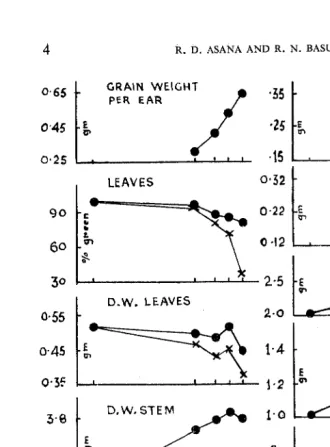
It was observed that (1) that the dry matter of the shoot increased up to twenty days; (2) D had little adverse effect on the dry matter of the shoot between fifteen and twenty-two days; (3) the total sugar level in the stem remained constant under both W and D between fifteen and twenty-two days; (4) the leaves yellowed more rapidly particularly between 18 and 22 days and there was a slightly greater decrease in the dry matter of the leaves under D (see Fig. 1, in which the mean values of W and D are presented wherever there was no effect of D).
Since D did not affect increase in dry matter of the shoot or grain, it may be surmised that the .photosynthetic activity was also not depressed by D. This suggestion may appear to conflict with the more rapid yellowing of leaves under D, but it must be noted that the flag leaf remained green and functional and it is this leaf which contributes to grain filling (cf. Archbold and Mukherji, 1942; Archbold, !942).
Experiment A (ii).-ln this experiment intermittent drought \\as
0·65 0'45 0·25 90
60
30
0·55 0·45 0·3~ ~-e 3·4 3•0 6·05·0
4·0GRAIN W E I G H /
PER EAR
£ II' LEAVES 1:
"
•
L In~ 0
D.W. LEAVES
D.W.STEM
E
Q'J
I
'
o.w.
SHOOT~
~
..---·l5
f
·25
-~
·15
0·32
0·22 ~
2·5 2.·0
1·4
1·2So
4514
Eio lT"
6
0 IS 18 20 22 0
R. D. OF
/
GRAINS
STARCH IN
GRAINS
SUGARS IN
STEM
GRAIN NUMBER PER
EAR ~
1000-GRAIN
WEIGHT
IS' l8 ZO :12
DAYS AFTER ANTHESIS
FIG. I. Increase in dry weight (DW) of different organs, etc. in experi• ment A (i). R. D = Residual dry weight. • - • indicates W and x - x, D in the case of leaves. • - • represents mean values of W and D for other characters.
1·0
0·8
0·6
0·5
0·6
4
3
6
5
E 0">
O~AFF D.W.
~
GRAIN D.W.
'
LEAVES D.W.STEM D.w.
o.w.
E
~
I001
en
0 14
0·4
0·3
o·2
0·1
2.·7
2.·5
1·4
I· 2
1·0
100
80
E
.,..
RESIDUAL fJ.W. GRAIN
t
STARCH IN GRAIN
E ~
(1">
RESIDUAL D.W.
STEM
~~
GREEN LEAVES
60
~40
DAYS AFTER ANTHESIS
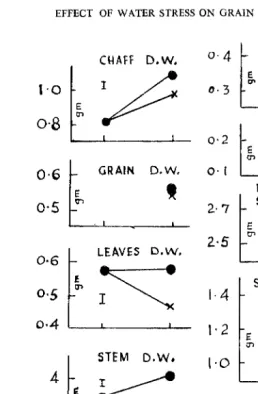
FIG. 2. Increase in dry weight (DW) of different organs, etc.. in experi-ment A (ii). • - • represents W and x - x, D. I represents significant difference at 5%P.
Experiment A (iii).-Three samples were collected in this
0·9
cy
0·52 RE!:.IDUAL o.w.o.w I GRAIN
0·'1
e
0·52 EGl 0'1
0·5 0·12
STARC\-1 IN
0·60 0·25
~GRAIN
I
0'40 0·05
2·4 RESIDUAL O.W.
0·20
~·rr
LEAVES O.W. 2·2
0·60
~~I
2·0 I0·55
1
1·05 0·50
s/-(
j
0·95
3·5 o.w. E ~
o·85
STEM SUCAR~ 3·0 E . en
0·75
2·5
GREEN LEAVES6·0 SHOOT
D.w.
IOO~~
]5·0 E
60
q")
4·0 20
0 8 15 0 8 15
DAYS
AFTER ANI~ESISFIG. 3. Increase in dry weight (DW) of different organs, etc., in experiment
A (iii). • - • = W; x - x = D. I represents significant difference at 5% P between values on the 8th and 15th day.
Experiment B.-The effect of inhibition of photosynthesis, by shading, on grain development was investigated at two stages: (1) between eight and fifteen days after anthesis and (2) between twenty-seven and thirty-four days later when the leaves and the stem (plus sheaths) were yellow and the ear was partially green. There were four treatment combinations: (1) normal water-supply and exposure to full sunlight (WL), (2) intermittent drought and exposure to full sunlight (DL), (3) normal water-supply and shoot in dark (WS) and (4) drought and shoot in dark (DS).
Grain developUlent during the first stage: The mean effects of treatments D and S and of the interaction between the two on the various characters are presented in Table IT. Tt may be concluded
TABLE II
Experiment B. Mean effects of water stress (D) and shade (S) and their inter-action (D x S) on grain development, etc., on the fifteenth day after an thesis
~~---~ · ;
-Days after anthesis ; 8 1 15
r<wL)
1-
w
__
D ____L __
s ____
D;s-'
Dry weight per shoot in 4·93 5·05 5·01 5·36 gm.
Dry weight per stem in 3 · 31 3 · I 7 3 · 07 3 · 24 gm.
Dry weight ofleaves in 0·58 0·50 0·47 0·54 gm.
Dry weight of chaff in 0·81 0·82 0·84 0·89 gm.
Total sugars per stem in 0·99 0·94 0·82* 1·01 gm.
Residual dry weight of 2 · 32 2 · 22 2 · 25 2 · 23 stem in gm.
Grain weight per ear in 0·22 0·56 0·62* 0·68 gm.
1000 grain weight per ear 3 · 77 9 ·18 10 · 90* I I· 62 in gm.
Starch(+sugar)ingrains 0·09 0·23 0·24 0·29 per ear in gm.
Residual dry matter in 0· I3 0·33 0·38* 0·39 grains per ear in gm.
_ ~--~ * indicates significant difference at 5% P.
t Reduction in leaf weight due to D jn full sunlight only.
4·70 Notsignificant
2·99* Do.
0 · 43 * Significantt
0·76* Not significant
0·75* Do.
2·40 Do.
0· 50* Do.
8·96* Do.
0·18* Do.
that although the increase in total dry matter of the shoot was not affected due to D, the increase in grain weight was slightly more. This effect is attributed to transfer of sugars from the stem-the sugar con-tent of the stem was not affected under W whereas it decreased slightly under D. The leaf weight decreased due to D only in the shoot exposed to light. The increase in grain weight was less under S at both levels of water-supply.
Evidently the increase in grain weight that occurred in the dark was due to transfer of sugars from the stem.
Grain development during the second stage: The mean effects of the treatments D and S and of their interaction are presented in Table Ill.
TABLE Ill
Experiment B. Mean effects of water stress (D) and shade (S) and their interaction (D x S) on grain weight, etc., on the 34th day after anthesis
Days after anthesis 27 34
~----~---: (WL) i W D L
s
(DxS)'
I !
Grain weight per ear I 2·01 1 2·55 2·39* 2·62 2·32* Not significant
in gm.
1 000-grain weight per ear [33·00 !42·30 40·60* 43·60 39· 20* Do. in gm.
Starch (
+
sugar) in grains 1·30 1· 79 I· 67 ]· 88 1· 58* Do. per ear in gm.0·71 • 0·76 0·71 0·74
Residual weight of grains 0·74 Do.
-in gm. !
Dry weight per shoot 6·63 I 6· 35 6·26 6·51 6·1 J
*
Do.in gm.
3·06 2·36
Dry weight per stem 2·41 2·40 2·37 Do.
in gm. i
Dry weight of leaves 0· 53 : 0·47 0·46 0·48 0·46 Do. in gm.
1·03 0·96 1·00
Dry weight of chaff 1·00 0·96 Do.
in gm.
0·65 I o·18 0·25* Sugar content of stem
! 0·22 0·23 Do.
in gm.
I 2·19 2·16
Residual dry matter of 2·41
I 2·20 2·14 Do.
stem in gm.
The results indicate that the increase in the dry weight (and the starch content) of the grain was reduced by D and S, the effect of the latter being much larger than that of the former. The decrease in stem
~ug~rs yaried in the order control= shading (S) >drought (D), thereby Ind1catmg that the transport of stem sugars to the ear was impeded under D. The decrease in stem sugars was also less under D, by 96 mg., when the shoot was shaded and the corresponding increase in the starch content of the grain was less by 106 mg., thus indicating that the decreased transport of stem sugars limited the increase in grain weight.
. It w~s seen that although assimilatory ~ctivity, as estimated by mcrease Ill the dry matter of the shoot, declined and sugars did not accumulate in the stem due to water stress during the first fortnight after anthesis, the increase in grain weight was not affected adversely. Evidently the synthetic activities in the grain were not affected by the degree of water stress that led to permanent wilting of leaves.
The absence of the effect of water stress on assimilatory activity and on accumulation of sugars in stem in experiment A (i) is note-worthy in view of the fact that the flag leaf did wilt permanently even at the relatively low temperature. Asana and Saini (1962) also observed that water stress at a relatively low temperature did not reduce grain weight.
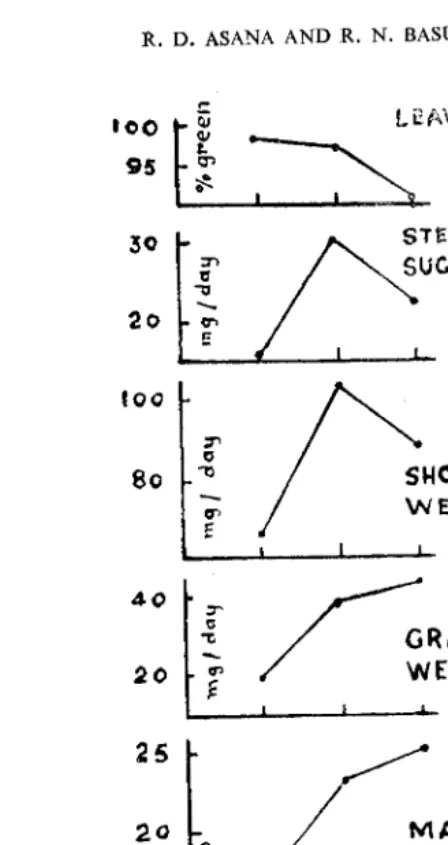
It is interesting to compare the assimilatory activity with the rate of grain development in non-stressed plants at different temperatures. The data in Fig. 4 show that there was no consistent direct relation between the rate of increase in the dry matter of the shoot and day temperature (maximum) as was the case with the rate of grain develop-ment. It also appears that the rate of increase in stem sugars was dependent upon the rate of increase in the weight of shoot (i.e., assimi-latory activity).
...
too
[!
LEtWES
95
~
~
30
...
r~·M
:n UCARS
u
"
20
--
C7'>E
IOO
:1'
0
So "l)
0H00T
fT> WEIGHT
E
I
4()
:r
a
~
~~AIN
20 <r> WEIGHT
~
25
20 f..
~AX.
oc EMP.
15
10
~lN·
oc
IEMP. 5
:
t~
EVAP.~
Ai
Aii
A iii
FIG. 4. Effect of temperature on rate of increase in dry matter of shoot and grain and of stem sugars.
TABLE IV
Experiment B. Effect of shading on grain development and stem sugars
-~-~~--- ----· - - - ---·
-Rate of
Period Rate of increase Rate of
after Treat- increase in in starch change in anthesis ment grain weight content stem sugars
in days in mg./day of grain in mg./day
in mg./day
8-15
ws
35 11 -328-15 WL 60 27 +17
15-27 WL I 14 85 -39
27-34 WL 101 91 -68
27-34
ws
53 47 -67shaded plants (WS) was higher between 27-34 days than between 8-15 days after anthesis.
With water stress and shading, the decrease in stem sugars was relatively less than with shading alone, thereby indicating that transport of sugars to the ear was inhibited. Since the decrease in stem sugars was also less and the ear yellowed more rapidly in water-stressed plants exposed to full light, it appears likely that the decrease in grain weight was due to decrease in photosynthetic activity of the ear and in trans-port of stem sugars to the ear. It may be recalled that water stress had little effect on transport of stem sugars during the first fortnight after anthesis. The observations of Zohlkevich, Prusakova and Lizandr (1958) are pertinent in this connexion. According to them, during less intense drought (soil moisture 35% of total moisture capacity) during the period of grain formation, a rather considerable increase in the rate of translocation of assimilate into the spike was noted. Later, during grain maturation, the increase gave way to a decrease; during a more intense soil drought (25-30% of total moisture capacity), however, the translocation of assimilate decreased at both stages of grain development. Konovalov (1959) attributed reduction in grain-weight, due to drought, to decrease in photosynthetic activity, but his conclusion was based on indirect evidence from separate experiments with water and shade treatments.
sene-scence of the ear and/or by transport of stem sugars? Which of these two factors is relatively more important? It is also possible that the synthetic activity per se of the grain of a variety may be more potent than the limitation imposed by senescence and sugar transport under the influence of water stress. Experiments to dissociate the effects of these factors are under way.
ACKNOWLEDGEMENT
Our thanks are due to Dr. M. S. Swaminath~n, Head of the Division of Botany, for providing facilities and encouragement in the prosecution of these investigations.
SUMMARY
The effect of water stress on the development of the grain of wheat, variety PbC 281, was analysed by subjecting the plant to intermittent drought during (I) the first fortnight after anthesis and (2) between 27 and 34 days later when the leaves and stems were yellow and the ear was partly green. During the early stage, although water stress reduced the increase in the dry weight of the shoot (photosynthetic activity) and inhibited accumulation of sugars in the stem, the increase in grain weight was not affected. Apparently the surplus of assimilate produced without water stress accumulated in the stem and the degree of water stress causing permanent wilting of leaves did not affect synthetic pro-cesses in the grain. During the later stage grain weight was reduced due to water stress and this effect was attributed to (1) reduced photo-synthetic activity resulting from rapid yellowing of the ear and (ii) depression in the rate of transfer of stem sugars to the ear as indi-catd by their subsequent higher level in the stem. The significance of the second factor was vindicated by the observation that when photo-synthesis was prevented by shading the shoots, increase in grain weight and decrease in stem sugars were less with water stress than without it. The significance of ear senescence and stem sugars in determination of the yield potential of a variety under water stress is briefly discussed.
REFERENCES
ARCHBOLD, H. K. AND MUKHERJEE, B. N. (1942). Physiological studies in plant nutrition. XII. Carbohydrate changes in the several organs of the barley plant during growth with special reference to the development and ripening of the ear. Ann. Bot. N.S., 6, 1-41.
ARCHBOLD, H. K. (1942). Physiological studies in plant nutrition. XIII. Experi-ments with barley in defoliation and shading of the ear in relation to sugar metabolism. Ibid., 6, 487-531.
ASANA, R. D. AND SAINI, A. D. (1962). Studies in physiological analysis of yield. V. G_rain dev~lopment in wheat in relation to temper~ture, soil moisture and changes with age m the sugar content of the stem and m the photosynthetic surface.
Indian J. Plant Physiol., 5, 128-71.
KoNOVALOV, Y. B. (1959). Effect of soil moisture deficiency on grain ripening in spring wheat. Trans!. Pl. Physiol. (Fiziol. Rast.), 6, 189-95.
NIELSEN, J. P. AND GLEASON, P. C. (1945). Rapid determination of starch. Factors for starches and comparison with acid and enzyme hydrolysis methods. Ind. and Eng. Chem., Anal. Ed., 17, 131.
SoMOGYI, M. (1945). A new reagent for the determination of sugars. J. Bioi. Chem., 160, 61.
ZHOLKEVICH, V. N., PRUSAKOVA, L. D. AND LIZANDR, A. A. (1958). Translocation of assimilants and respiration of conducting pathways in relation to soil moisture.