FROM THE ALTAR WEST OF THE PAINTED STOA
(PLATE 20)
IN THE FOLLOWING INVESTIGATIONS conventional comparative methods were
used to identify birds and animals, and morphometric analyses were applied to sheep and goat astragali to distinguish between the two species, to determine the sex of the animals, and to estimate their age at the time of sacrifice. Since mean foaling time for ovicaprids is known in Greece, the month of sacrifice could be estimated. A comparison of the conclusions drawn from these studies to existing information from literary sources on Athenian sacri- fices during Classical times permitted testing of the hypothesis that the altar west of the Painted Stoa was dedicated to Aphrodite Ourania.
MATERIALS AND METHODS
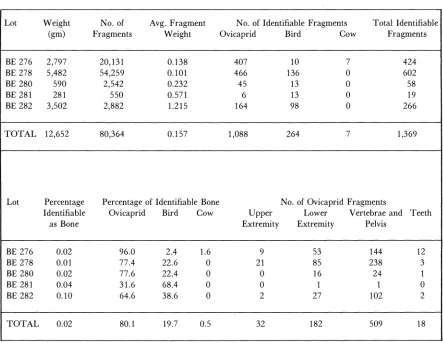
Characteristics of the bone assemblage. The bone fragments had been collected by sifting soil found in and adjacent to the altar (Lots BE 276, 278, and 280-282). The entire assem- blage consisted of 80,364 pieces and weighed 12.6 kg. (Table 1). The average weight of a fragment was therefore only 157 mg. More than 98% of the fragments were estimated to be less than 1 cm. in diameter and more than 80% were less than 0.5 cm. After washing, at least 80% grossly appeared to have been burnt or at least heavily impregnated with ash.
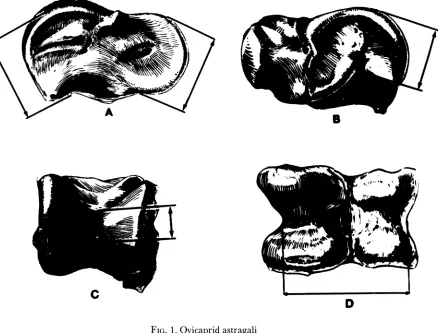
Investigations carried out on ovicaprid astragali. Morphometric analytical techniques previously developed by using bones of modern unhybridized animals from Cyprus to dis- tinguish sheep from goat and male from female2 were applied to 15 ovicaprid astragali found in association with the altar. All measurements were made, as illustrated in Figure 1, with a Fowler Ultra-Cal digital caliper. Values of quotients of 1.10 or greater, when the larger dimension in Fig. 1 :A was divided by the smaller, indicated sheep, and values of 1.09 or less indicated goat with an accuracy of 94%. The sex of the animal could likewise be determined from two measurements of the astragalus if the species was known. For this
I For literary and sculptural evidence for this identification see articles by T. Leslie Shear, Jr. (pp. 1-57,
esp. 37-40) and Charles M. Edwards (pp. 59-72) in this issue.
2 A full description of the method used will be published elsewhere in connection with an analysis of the
skeletal remains of the ovicaprid excavated in the Archaic precinct of the Sanctuary of Apollo Hylates at Kourion, Cyprus, under the direction of Dr. Diana Buitron. Sixty-one astragali from animals of known species, sex, age, and weight have been studied using the descriptive criteria of J. Boessneck ("Osteological Differences between Sheep and Goat," Science in Archaeology, D. Brothwell and E. S. Higgs, edd., New York 1970). Animals were selected from indigenous Cypriot breeds that were uncontaminated by out-breeding with recently imported hybridized stock. Measurements were made and tested for accuracy and precision. From these the proportional values described in Figure 1 :A, B, and C were demonstrated to be the most powerful discriminators of species and sex. The accuracy was also determined and tested against other modern-day breeds and found to be 94% and 68-72% for species and sex identification respectively, irrespective of breed. Knowing the inherent accuracies of the methods, realistic estimates could be made of the numbers of sheep and goat and their sex using partial discriminant analysis.
American School of Classical Studies at Athens is collaborating with JSTOR to digitize, preserve, and extend access to
Hesperia
74 GIRAUD V. FOSTER
TABLE 1: Summary of Composition of Bone Assemblage
Lot Weight No. of Avg. Fragment No. of Identifiable Fragments Total Identifiable'
(gm) Fragments Weight Ovicaprid Bird Cow Fragments
BE 276 2,797 20,131 0.138 407 10 7 424
BE 278 5,482 54,259 0.101 466 136 0 602
BE 280 590 2,542 0.232 45 13 0 58
BE 281 281 550 0.571 6 13 0 19
BE 282 3,502 2,882 1.215 164 98 0 266
TOTAL 12,652 80,364 0.157 1,088 264 7 1,369
Lot Percentage Percentage of Identifiable Bone No. of Ovicaprid Fragments
Identifiable Ovicaprid Bird Cow Upper Lower Vertebrae and Teeth
as Bone Extremity Extremity Pelvis
BE 276 0.02 96.0 2.4 1.6 9 53 144 12
BE 278 0.01 77.4 22.6 0 21 85 238 3
BE 280 0.02 77.6 22.4 0 0 16 24 1
BE 281 0.04 31.6 68.4 0 0 1 1 0
BE 282 0.10 64.6 38.6 0 2 27 102 2
TOTAL 0.02 80.1 19.7 0.5 32 182 509 18
In addition to the above, 37 bones or fragments of bones of mice were found. They are not tabulated with the assemblage of sacrificial osseous material since presumably they are intrusive. Their distribution was as follows: 2 in BE 276, 7 in BE 278, 2 in BE 281, and 28 in BE 282.
purpose the distance illustrated in Figure 1:B was divided by that shown in Figure 1:C. Calculated values of 1.83 or less in sheep or 1.92 or less in goats recognized females with 68% accuracy, while quotients of 1.83 or greater in sheep and 1.93 in goat predicted male with an accuracy of 72%.
To estimate age of animals the circumferences of the astragali were measured in their long axis (Fig. 1:D) and compared with circumferences of animals of known age and weight.3 This measurement was facilitated by wrapping dental floss around the bone,
3The argument can be advanced that if sheep and goat were of a different size in antiquity, spurious
-~~~~~~~~~~~~~~~~~~~~~~~A
D
FIG. 1. Ovicaprid astragali
marking it with a fine-tipped pen, and measuring the distance demarked against a straight- edged scale.
All specimens were examined under an Olympus SX 111-TR zoom microscope with direct lighting to observe for butchery marks and evidence of bone having been burnt.4
his height to be 5'6". Third, even if ovicaprids were 25% smaller in Ancient Greece than animals today, since the rate of the animal's growth is exponential during the first three months of its life, it is unlikely that this would introduce an error of more than one month in the estimate of the animals' ages if bones of animals less than 60 days of age were being studied.
4 Bone found in association with ash frequently is discolored and may present a problem in the deter-
mination of whether or not it has been burnt. Drying, particularly of the articular surfaces of bones of young animals, may give the appearance of having been burnt if the surface appears lightly fissured. The presence of deep fissures, however, is almost always evidence of exposure to heat above 2500C. Ideally, the bones should have been studied using scanning electron-microscopy. Scanning electron-microscopy, using magnifications up to 10,000-fold, by permitting recognition of characteristic changes in bone minerals as fusion occurs, can not only verify that bone has been burnt but also the temperature to within 1000 C (P. Shipman, G. V. Foster, and M. Schoeninger, "Burnt Bones and Teeth: Experimental Study of Color, Morphology, Crystal Structure,
76 GIRAUD V. FOSTER
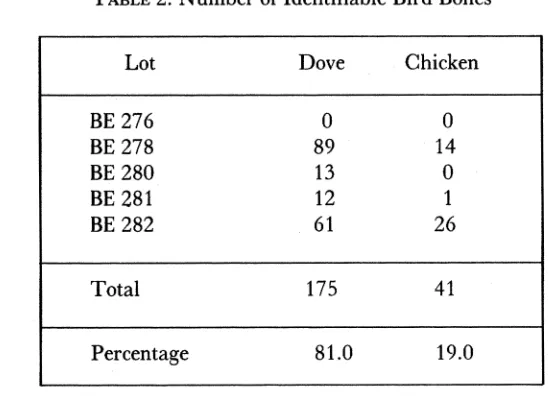
TABLE 2: Number of Identifiable Bird Bones
Lot Dove Chicken
BE 276 0 0
BE 278 89 14
BE 280 13 0
BE 281 12 1
BE 282 61 26
Total 175 41
Percentage 81.0 19.0
RESULTS AND DiSCUSSION
Species identification. In view of the size of most of the fragments, it is not surprising that less than 0.2% could be identified (Table 1). Of the fragments, 80.1% were ovicaprid, 19.7% bird, and less than 1% cow (7 fragments). The majority that could not be identified were spheroid particles of trabecular bone (P1. 20:a). Comparison of the trabeculations under magnification with those of ovicaprid membranous bone (vertebrae, pelvis, etc.) and epiphyses of birds (distal ends of the long bones) led to the conclusion that many of the fragments were from birds. This view was supported by the observation that as much as five percent of the fragments had thin-shell cortical bone.
Avies. While most of the bird bone was burnt to a degree that made further identi- fication impossible, some specimens were remarkably well preserved (Table 2; P1. 20Qb, c).5 The latter were not burnt but had probably dried sufficiently that destruction by bacterial action was prevented. Of the 264 bones that could be reasonably identified, 81.0% were compatible with dove and 19.0% compatible with chicken. Very small bones initially thought possibly to be sparrow proved to be mouse bones (P1. 20:d) and undoubtedly are intrusive.6
I The femora in Plate 20:b and c measured 65.1 and 40.2 mm. respectively and were the only identifiable
long bones which were sufficiently intact that such measurements could be made. The femor in Plate 20:g was compatible with a 3 lb. chicken and that in Plate 20:c with a 12 oz. dove or pigeon. Reference bones of modern chickens studied had femora measuring 64 mm. (3.1 lbs.), 77 mm. (5.2 lbs.), and 80 mm. (5.5 lbs.). The femor of one Cypriot ground dove (Columbigallina Passerina) weighing 12 oz. was 40.0 mm. For comparative purposes the length of femora of pigeons vary between 37 and 40 mm., turkey 112-146 mm., grouse 55-66 mm., duck 47-55 mm., and quail 40-43 mm. See B. M. Gilbert, L. D. Martin, and H. G. Savage, Avian Osteology, Laramie, Wyoming 1981. The identification of dove and chicken was made on the basis of com- parison of the morphology with reference bones and not solely on length.
A review of literary and epigraphic references to sacrifices of birds in Greece identified only five deities to whom such offerings were made (Table 3): Aphrodite, Ares, Artemis, Dionysos, and Herakles. Of these, doves were properly offered only to Aphrodite. The conclusion that the bird offerings at the altar west of the Painted Stoa were to Aphrodite is further supported by the fact that the only birds offered the other four deities were cocks (Ares, Dionysos, and Herakles) and jays (Dionysos). Caution, however, must be exercised in acceptance of any deduction made solely on the basis of avian offerings, since bird offer- ings may well have been made by the poor to any deity.
TABLE 3: Literary and Epigraphic References to Sacrifices of Birds in Greece
Deity Bird Place Date Reference
Aphrodite Cock Cos 3rd century B.C. Ziehen, LGS II, 138 (Decree)
Dove Athens Ca. 287/6 B.C. IG 112, 659, line 24
Goose Greece Before A.D. 560 loannes Lydus, de mens. Iv.64, p. 117, 19ff. Partridge Greece Before A.D. 560 loannes Lydus, de mens. iv.64, p. 117, 19ff.
Thrush Lesbos 600 B.c. Plato Comicus, Phaon; Non Choral
Any bird Lesbos 2nd century B.C. Ziehen, LGS II, 119, line 8 (Decree)
Ares Cock Sparta Before A.D. 120 Plutarch, Inst. Lacon. 238F
Artemis Cock Epidauros 400 B.C. Syll.3, 998; SIG3, 998, lines 5, 23
Dionysos Jay Greece Before A.D. 70 Cornutus, 30
Herakles Cock Athens 1st century IG 112, 1367: Calendar, lines 5, 25
after Christ
---,
TABLE 4: Measurable Parameters of Ovicaprid Astragali
Registration Species Index Species Sex Index Sex Diameter Sidedness Number Burnt Comments
Number Value Value (Long Axis) of Cuts
mm.
1 - - - - 6.2 Left 0 Probably Sides and anterior
surface polished
2 1.07 Goat 1.94 F 5.3 Left 18 Probably
3 - - - - 7.2 Right 3 Yes
4 1.00 Goat 1.40 M 5.5 Left 0 Yes
5 1.08 Goat 1.40 M 6.4 Right 0 No
6 1.14 Sheep - - 5.1 Right 14 No
7 - - - - 6.1 Right 0 Probably Drilled through 0
shortest axis
8 1.06 Goat 1.87 F 6.0 Left 2 Yes
9 1.02 Goat 1.41 M 6.3 Right 1 Yes
10 1.07 Goat 1.85 F 6.3 Right 5 Probably
11 1.03 Goat 1.89 F 5.5 Left 8 Probably
12 - Goat* - - 5.4 Left 1 Yes
13 - - - - 4.9 Left 11 Yes
14 - - - - 5.9 Left 0 Yes Both sides polished
and carved on lateral side
15 1.04 Goat 1.83 F 6.6 Right 0 Probably
Species index values of 1.09 or less indicate goat; sex index values of 1.83 or greater indicate female. Where bones were too fragmentary to permit accurate measurement of these indices a blank has been left. The one animal marked with an asterisk (*) was damaged in its mid- medial aspect and was identified as goat by the equality in size of its superior and inferior medial trochlear projections and absence of ovid
horncores, and two whole teeth were identified. Since phalanges and teeth, together with astragali, are among the commonest dentoskeletal elements found when complete animals exist in archaeological context,7 most likely only decapitated animals, whose extremities were dressed, were burnt on the altar.
Species and sex studies on ovicaprid astragali. Fifteen astragali were found (Table 4). Ten were in sufficiently good condition to permit morphometric studies, 9 of which were identified as goat and 1 as sheep. Since our method is only 94% accurate, the results are most consistent with the conclusion that all the bones were goat and that one astragalus had diagnostic indices compatible with sheep as might be anticipated in an assemblage of nor- mal bones from this species.
Of 8 astragali that were complete enough to allow sex-ratio values to be calculated, 5 were compatible with female and 3 with male. Since our method of determining sex is 72% accurate in the goat, the data best fit the conclusion that all animals were female and that, of these bones from female animals, 3 had male characteristics.
Greek literary and epigraphic evidence indicates that goats were offered to Aphrodite, Apollo, Ares, Artemis, Athena, Dionysos, Hera, Hermes, and Zeus. Of these only Aphro- dite and Artemis are reported to have received female animals as sacrifices.8 This finding is consistent with the generally accepted view that female animals are offered to female deities and male animals to male deities.9
Surface findings of astragali. Most of the astragali appeared to have been burnt (P1. 20:e),10 and three had been worked by hand (Table 4). Of the latter, one had its lateral and medial sides and superior surface (anterior in the goat)'1 polished. The second had been drilled through its shortest axis (superio-inferior or in goat anterio-posterior) and most likely had originally been weighted with a metal plug (P1. 20:e). The third had its lateral and medial sides polished and an epsilon carved on its lateral side (P1. 20:f). While these workings altered the bones to the extent that species and sex ratios could not be calculated, the bones were all from animals similar in age to those whose bones had been burnt. These astragali obviously represent special offerings and presumably were gaming pieces.
7 To assess the incidence of specific bones that survive burning, preliminary studies have been carried out in which carcasses of ovicaprids of eight days, one month and six months of age have been burnt over olive and carob-wood fires (estimated maximum temperature 8000 C). Irrespective of age, the commonest bones to sur- vive were rib fragments, phalanges, teeth, astragali, femoral caps and distal ends of the tibiae and humerii in that order.
The assemblage of bones from the altar west of the Painted Stoa was unique in its paucity of rib frag- ments, suggesting that the rib cage was not part of the burnt offering. The presence of two horncores is not evidence that the entire animal was placed on the altar since neither horncore appeared burnt.
8 The following references are to the specific practice of sacrificing female goats: Lucian, Dual. Court, 7. I
(Aphrodite); Xenophon, Hell. IV.2.20, Xenophon, Anab. III.2, I I-I2, and Aelian, Var. Hist., 2.25 (Artemis).
9 E. Kadletz, Animal Sacrifice in Greek and Roman Religion, diss. University of Washington, 1976.
10 See footnote 4 above.
80 GIRAUD V. FOSTER
Finally, butchery markings were found on 9 of the 15 astragali. These consisted of 1 to 18 small cuts (P1. 20:g) on the superior surface (anterior surface in the goat). The marks are similar to those found on astragali of modern animals butchered in many Mediterranean countries. During removal of the hide, the hind foot is struck several times with a sharp instrument to cut the skin. Once cut, a tube is inserted subcutaneously, and either air is blown in by mouth and the "bubble" beaten with a stick or air is blown in under force with bellows. In this way the skin is dissected free of the underlying tissues. This practice is still carried out in Greece, Cyprus, and the Middle East to remove the hide intact. The method may be relevant since in antiquity the hide was in some instances given to the priest as his fee for officiating in the sacrifice.
Age of ovicaprids. Studies were carried out on astragali to estimate the age of the an- imals at time of sacrifice. The mean circumference (Fig. 1 :D) was 6.1 ?0.3 cm. (Table 4). When this value is compared to values obtained from modern nonhybridized Cypriot goats, it would appear the mean age of the animals was two months old if female and six weeks old
E 90
<
,'0
60i .X o? mal oat -
0 30
u 0 2 4 6 8 0 12 14 16 18
5_ AGE (months)
FIG. 2. Age of ovicaprids as indicated by astragali
if male (Fig. 2). Since the mean foaling time for goats in the Mediterranean is mid-January, presumably these animals could have been sacrificed in mid-March. This estimated date, however, can only be accepted with the condition that goats in 5th-century Athens were similar in size to modern Cypriot animals12 and that no shrinkage due to burning had taken place.
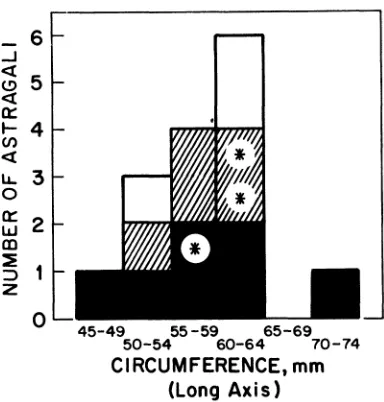
Despite the fact that the population of bones studied was small, a plot of the circum- ference values demonstrates a near normal distribution with only slight skewing in the di- rection of larger sized astragali (Fig. 3). The range of values exceeds that expected had all the animals been sacrificed annually on the same day, assuming a foaling season of about 2?/ months long and a relatively inbred stock of animals. This somewhat wider than normal
O-__
(5
4 Cl)
L3 /
o 2
m*
z
45-49 55-59 65-69 50-54 60-64 70-74 CIRCUMFERENCE, mm
(Long Axis)
FIG. 3. Circumference values of astragali
spread, however, can be anticipated since festivals were not celebrated on the same day each year, because the Greeks began their calendar year with the new moon after the summer solstice, and the relation of the lunar cycle to the summer solstice varies by as much as three or four weeks from year to year. 13
Effect of burning on bone. Bone is composed not only of bone mineral in the form of hydroxyappatite, but also of inorganic bone matrix consisting principally of collagen and mucopolysaccharides.14 Both organic and inorganic phases, and particularly the latter, are associated with water of hydration, such that when bone is burnt, shrinkage occurs. Since the articular surfaces of bones, especially the trochlear projections of astragali of young animals, are rich in collagen, they are likely to shrink more than most other bones if they are subjected to high temperatures. For this reason measurements were made of the long cir- cumference of the astragali in the mid-line (Fig. 1:D), rather than of their length from trochlear tip to trochlear tip, to minimize these changes.
The microscopic appearance of bone from the altar was typical of bone that had been burnt (P1. 20:h). The changes were especially evident on the articular surfaces of the fe- moral caps, that is, that portion of the femur that articulates with the pelvis. Since electron- microscopy studies15 were not carried out on the bone fragments, it was not possible to determine the temperature to which they had been subjected. By assuming, however, that the temperature of an altar fire was in the range of 400-800?C, is was estimated that
13 The Athenians of the 5th century did not use any regular system of intercalation to adjust their lunar
calendar annually to a solar calendar. Later months were added as needed, sometimes irregularly. Likewise in some years only days were added or even deleted. See E. J. Bickerman, Chronology of the Ancient World, 2nd ed., Ithaca, New York 1980, pp. 35ff., for specific examples.
14 See T. H. Hsu and G. V. Foster, "Disorders of Calcium and Metabolic Bone Diseases," Principles and Practice of Medicine, A. McG. Harvey, ed., 1980, pp. 845-868.
82 GIRAUD V. FOSTER
shrinkage was probably in the order of 5%. 16 Correcting for this shrinkage, the mean cir- cumference of the astragali before burning was more likely to have been of the order of 6.4?0.3 cm. By inspection of Figure 2, if the assumption that all the bones were from female goats is correct, the animals' age should have been three months and not two months old and they should have been sacrificed in mid-April rather than mid-March.
Festivals. Burnt bones of female goat and of dove are strong diagnostic indicators of the worship of Aphrodite. Since they are not recorded as offerings to any other deity, they give additional credence to the view that the altar west of the Painted Stoa was dedicated to that goddess as already noted (p. 77 above). Furthermore, the conclusion that the sacrifices took place in April is consistent with the worship of Aphrodite, that month being sacred to the goddess. 1 7
SUMMARY
Conventional comparative studies of osseous material and morphometric analysis per- mitted the identification of the bones found in association with the altar west of the Painted Stoa as those belonging to female goat, with a mean age of three months, and bird, inclusive of dove and chicken. From this data and relevant literary references the following conclu- sions are drawn:
1. The deity honored was female and most likely Aphrodite, she being the only goddess known to receive sacrifices of both dove and female goat.
2. The sacrifices were made in the spring, most likely April.
GIRAUD V. FOSTER
JOHNS HOPKINS UNIVERSITY Baltimore, MD 21218
16 Under controlled laboratory conditions ovicaprid astragali have been burnt for a four-hour period over a
range of temperatures. From 200? to 600?, shrinkage of the circumference (Fig. 1:D) averages 2%, increases to about 7% at 800?, and rises to 15% at 10000. See Shipman, Foster, and Schoeninger, op. cit. (footnote 4 above).
a. Representative assemblage of unidentifiable partic- b. Femur and radius identified as chicken ulate metaphyseal bone. (Marker, 1 mm.)
c. Femur and radius identified as dove or pigeon d. Mandible identified as mouse. (Marker, 1 mm.)
e. Drilled astragalus f. Astragalus with carved epsilon
g. Multiple butchery marks on superior aspect of ?!4 ~~~~(
c. Feur h. Bradu dntifiemu cap oeo ien d adil os. (Marker, 1 mm.) dniida