400
DISCRIMINANTS OF SEAFARERS’ STANDARDS OF TRAINING,
CERTIFICATION, AND WATCHKEEPING COMPETENCE: AN
EXPLORATORY DATA ANALYTICS
Richard R. Cabaron
Faculty/Research Chairperson Jose Rizal Memorial State University
Abstract
Standards Training, Certification, and Watchkeeping (STCW) convention provides the minimum standards of competence which have to be integrated among other criteria to produce competent and knowledgeable seafarers who can interact with other stakeholders of the industry. The study aimed to determine how the navigational watch, and leadership and teamwork skills as the independent variables discriminate the STCW competence for seafarers. The study utilized the descriptive type research method. Frequency count, percentage, and discriminant analysis used as a statistical tool. The discriminant analysis used to discard variable which little related to group distinctions. The study revealed that 40% of seafarers were deck ratings with no licensed and received a salary below USD 2,000.00. It means that there were many deck ratings employed aboard. Out of 10 variables on navigational watch, only three variables were qualified in the discriminant analysis specifically on maintenance and repair of electrical and electronic equipment, use the International Maritime Organization (IMO) Standard Marine Communication Phrase, and use English in written and oral form. On the other hand, for leadership and teamwork skills, only one variable was qualified in the discriminant analysis, particularly on keeping calm in a difficult situation. Aside from that, the discriminant function model constructed.
401
Introduction:
The global maritime economy and the maritime community have significantly impacted by the implementation of Standards of Training, Certification, and Watchkeeping (STCW) 2010 convention Manila Amendments that went into force on January 1, 2012. Although it has been 18 years from the previous revision of the Convention and Code in 1995 and thirty-five years since they adopted in 1978, the maritime industry was not fully prepared for the far-reaching changes and implications to operations, training, and technology. These amendments were promulgated to improve the global standards of mariners’ competence (Muccin, 2013).
The STCW convention provides a minimum standard of competency, which has to be integrated among other criteria to produce the likely competent and knowledgeable seafarer, who can interact with other stakeholders of the industry. Enriching the knowledge of seafarer to the level of higher education will benefit the maritime sector. Most of today, seafarers are likely to hold different positions in the industry in the future (Etman; El Ashmawy, 2012).
The International Maritime Organization in its Standards of Training, Certification, and Watchkeeping (Mercado, Mogol, Sarmiento, & Jalbuena, 2018) has mandated that Officers wishing to re-validate their STCW Certificate of Competency (COC) after January 1, 2017, need documentary evidence of completing the above STCW short courses within the previous years. Without these in-date certificates, Officers will not be able to update their COC (www.marineskillsacademy.com). The new updating training course requirements undertook every five years such as updated proficiency namely: personal survival techniques; fire prevention and firefighting; advanced firefighting; survival craft and rescue boats; and fast rescue boats.
Based on the IMO model course guidelines, competence (Trenker, 2005) defines the application of knowledge, understanding, proficiency, skills, and experience for an individual to perform a task, duty or responsibility on board in a safe, efficient and timely manner. The International Shipping Federation, (2011) cited in Chae (2011), and Wanga (2015), seafarers competence are one of the most critical factors in the human aspects to ensure safe and efficient ship operations. It is directly related to the safety of life at sea and the protection of the marine environment as well. The STCW Convention constitutes a comprehensive set of regulations intended to maintain the highest standards of competence globally.
Material and methods
This study utilized the descriptive survey as its research design through the aid of a modified questionnaire. The convenience sampling method used, considering that the respondents were currently signed off from their shipping contract - the survey used for investigating the Standards of Training and Watch-keeping (STCW) competence for seafarers.
402
Frequency counts, percentage, and weighted mean computation were used to analyze the data obtained from the respondents' profile. The discriminant analysis used to discard variables which little related to group distinctions with the help of SPSS version 16.
The reliability statistics provides the actual value for Cronbach "s alpha for 20 items devised in the questionnaire. The Cronbach" s alpha of 0.948 indicated overall reliability of internal consistency of the research instrument (Table 1).
Table 1
Reliability Statistics
3.
Results and discussion
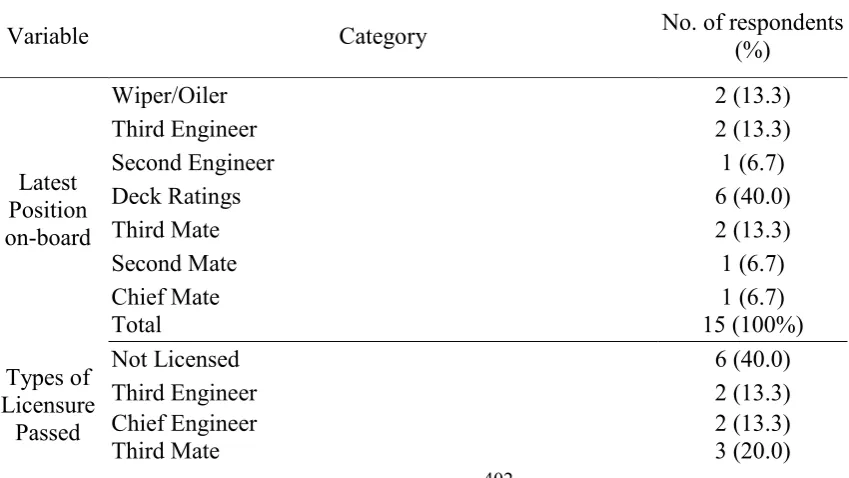
Table 2 presents the profile of the respondents. Most of seafarers latest position on board was deck ratings (40%) with no licensed yet (40%) received a salary below USD 2,000.00.
The findings of the study support the conclusions of TESDA (2017), states that the global supply of seafarers has increased over the past five years, with both qualified officers and ratings being made available to the international trading world. In the year 2015, out of 1,647,500 seafarers, 53% were ratings, and 47% were the officers. It means that there is a higher number of deck ratings on board compared to some officers. On the other hand, concerning salary, the master mariners receive about the US $8,000 –US $12,000 or PHP 200, 000-500,000 a month, while the lowest ranks receive about PHP 42,000 to P50, 000 a month. Seafarers serve as the cornerstone of the industry that moves 90 % of the world trade.
Table 2
Distribution of Respondent by Demographic Profile
Cronbach's Alpha
Cronbach's Alpha Based on Standardized
Items
No of Items
0.948 0.951 20
Variable Category No. of respondents
(%)
Latest Position on-board
Wiper/Oiler 2 (13.3)
Third Engineer 2 (13.3)
Second Engineer 1 (6.7)
Deck Ratings 6 (40.0)
Third Mate 2 (13.3)
Second Mate 1 (6.7)
Chief Mate Total
1 (6.7) 15 (100%)
Types of Licensure
Passed
Not Licensed 6 (40.0)
Third Engineer 2 (13.3)
Chief Engineer 2 (13.3)
403
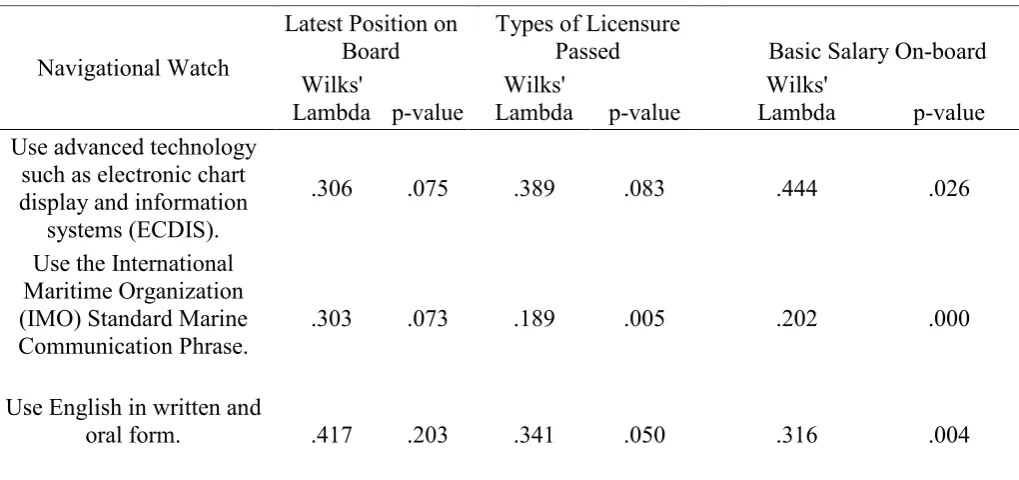
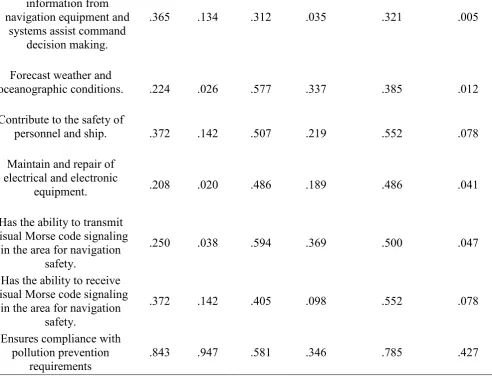
Table 3 presents the tests of equality of group means on STCW competence of seafarers in terms of the navigational watch when grouped according to their profile. The tests provide strong statistical evidence of a significant difference between means of STCW competence when arranged according to seafarer’s profile. When the analysis grouped according to latest position on-board, the resulting values < 0.05. Since the p-values are <0.05, the null hypothesis rejected. Thus, there is a significant difference in the navigational watch, particularly on forecast weather and oceanographic conditions (p=.026), and maintain and repair of electrical and electronic equipment (p=.020).
Likewise, when grouped by types of licensure passed, and basic salary on-board, the resulting p-values are lesser than 0.05. Since the p-value, 0.05, the null hypothesis is then rejected. Thus, there is significant difference on navigational watch particularly on the usage of the International Maritime Organization (IMO) Standard Marine communication phrase (p=.005 / p=.000), the use of English in written and oral form (p=.050 / p=.004). Maintaining safe navigation through the use of information from navigation equipment and systems assist command decision making (p=.035 / p=.005), forecast weather and oceanographic conditions (p=.012), maintain and repair of electrical and electronic equipment (p=.041), and has the ability to transmit visual Morse code signalling in the area for navigation safety (p=.047).
Table 3
Test of Equality of Group Means of Navigational Watch Competence When Grouped by Seafarer’s Profile
Chief Mate 1 (6.7)
Master Total
1 (6.7) 15 (100%)
Basic Salary
On-Board
Below USD 2,000 9 (60.0)
USD 2,001 - USD 4,000 2 (13.3)
USD 4,001 - USD 6,000 3 (20.0)
USD 6,001 - USD 8,000 1 (6.7)
Navigational Watch
Latest Position on Board
Types of Licensure
Passed Basic Salary On-board Wilks'
Lambda p-value
Wilks'
Lambda p-value
Wilks'
Lambda p-value
Use advanced technology such as electronic chart display and information
systems (ECDIS).
.306 .075 .389 .083 .444 .026
Use the International Maritime Organization (IMO) Standard Marine Communication Phrase.
.303 .073 .189 .005 .202 .000
Use English in written and
404
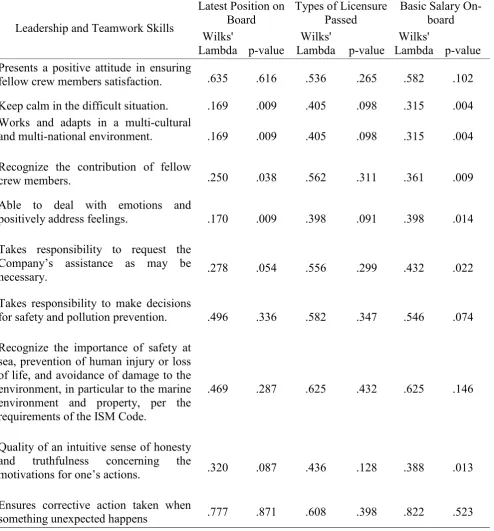
Table 4 presents the tests of equality of group means on STCW competence in terms of leadership and teamwork skills when grouped by seafarer’s profile. The analyses provide strong statistical evidence of a significant difference between means of STCW
competence when grouped according to seafarer’s profile.
When the test grouped by latest position on-board, the resulting p-values < 0.05. Since the p-values are <0.05, the hypothesis rejected. Thus, there was a significant difference on leadership and teamwork skills particularly on keeping calm in the problematic situation (p=0.009), working and adapting in a cultural and multi-national environment (p=0.009), dealing with emotions and positively address feelings (p=0.009), and recognizing the contribution of fellow crew members (p=0.038).
However, the resulting p-values across all leadership and teamwork skills, when grouped by types of licensure passed, were not significant since the p-values are too high for the hypothesis to be rejected. It leads to the idea that the hypothesis is then not-rejected. Thus, there is no significant difference in leadership and teamwork skills of the respondents when grouped according to types of licensure passed.
Likewise, when the test grouped between leadership and teamwork skills, and basic salary on-board, the resulting p-values are lesser than 0.05. Since the p-value, 0.05, the hypothesis is then rejected. Thus, there is no significant difference in leadership and teamwork skills, mainly to keep calm in the problematic situation (p=.004), works, and Maintain safe navigation
through the use of information from navigation equipment and
systems assist command decision making.
.365 .134 .312 .035 .321 .005
Forecast weather and
oceanographic conditions. .224 .026 .577 .337 .385 .012
Contribute to the safety of
personnel and ship. .372 .142 .507 .219 .552 .078
Maintain and repair of electrical and electronic
equipment. .208 .020 .486 .189 .486 .041
Has the ability to transmit visual Morse code signaling
in the area for navigation safety.
.250 .038 .594 .369 .500 .047
Has the ability to receive visual Morse code signaling
in the area for navigation safety.
.372 .142 .405 .098 .552 .078
Ensures compliance with pollution prevention
requirements
405
adapts in a multi-cultural and multi-national environment (p=.004). Further, recognize the contribution of fellow crew members (p=.009), able to deal with emotions and positively address feelings (p=.014), and takes responsibility to request the Company’s assistance as may be necessary (p=.022), and quality of an intuitive sense of honesty and truthfulness concerning the motivations for one’s actions (p=.013).
Table 4
Test of Equality of Group Means of Leadership and Teamwork Skills Competence When Grouped by Seafarer’s Profile
Leadership and Teamwork Skills
Latest Position on Board
Types of Licensure Passed
Basic Salary On-board Wilks'
Lambda p-value
Wilks'
Lambda p-value
Wilks'
Lambda p-value Presents a positive attitude in ensuring
fellow crew members satisfaction. .635 .616 .536 .265 .582 .102
Keep calm in the difficult situation. .169 .009 .405 .098 .315 .004 Works and adapts in a multi-cultural
and multi-national environment. .169 .009 .405 .098 .315 .004
Recognize the contribution of fellow
crew members. .250 .038 .562 .311 .361 .009
Able to deal with emotions and
positively address feelings. .170 .009 .398 .091 .398 .014
Takes responsibility to request the Company’s assistance as may be
necessary. .278 .054 .556 .299 .432 .022
Takes responsibility to make decisions
for safety and pollution prevention. .496 .336 .582 .347 .546 .074
Recognize the importance of safety at sea, prevention of human injury or loss of life, and avoidance of damage to the environment, in particular to the marine environment and property, per the requirements of the ISM Code.
.469 .287 .625 .432 .625 .146
Quality of an intuitive sense of honesty and truthfulness concerning the
motivations for one’s actions. .320 .087 .436 .128 .388 .013
Ensures corrective action taken when
406
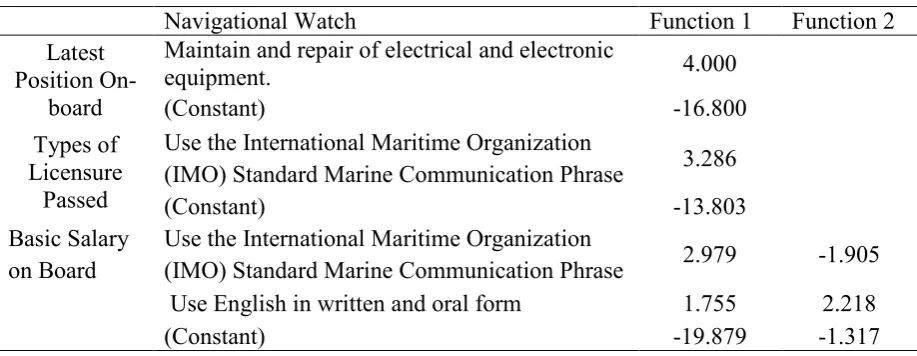
Table 5 presents the canonical discriminant function coefficients on navigational watch competence. Based on the canonical coefficient table above the discriminant function, the mathematical form of the Discriminant analysis model is Z = a + b1x1 + b2x2 + b3x3 + b4x4. The unstandardized canonical coefficient indicates the unstandardized scores of the independent variable. Therefore it was used to construct the Discriminant function on Navigational Watch, wherein:
Latest position on board
Z= -16.80 + 4.0 (maintain and repair of electrical and electronic equipment)
Types of Licensure Passed
Z= -13.803 + 3.286 (Use the International Maritime Organization (IMO) Standard Marine Communication Phrase)
Basic Salary On-board
Z1= -19.879 + 2.979 (Use the International Maritime Organization (IMO) Standard Marine Communication Phrase) + 1.755 (Use English in written and oral form).
Z2= -1.317 -1.905 (Use the International Maritime Organization (IMO) Standard Marine Communication Phrase) + 2.218 (Use English in written and oral form).
IMO's Standard Marine Communication Phrases (SMCP) includes phrases for use in routine situations such as berthing as well as standard expressions and responses for use in emergency situations under the International Convention on Standards of Training, Certification and Watchkeeping for Seafarers (STCW), 1978, as amended (Albayrak, & Sağ, 2011). Thus, the maritime industry demands seafarers on STCW competency to avoid catastrophic losses and damage, not only at the financial level but also at the human level.
The STCW Code requires adequate knowledge of the English language to enable the officer to use charts and other nautical publications, to understand meteorological information and messages concerning ships safety and operation. Also, to communicate with other ships and coast stations and to perform the officer s duties even with a multilingual crew, including the ability to use and understand the Standard Marine Navigational Vocabulary as replaced by the IMO Standard Marine Communication Phrases (Borodina, 2017).
Table 5
Canonical Discriminant Function Coefficients on Navigational Watch
Navigational Watch Function 1 Function 2
Latest Position
On-board
Maintain and repair of electrical and electronic
equipment. 4.000
(Constant) -16.800
Types of Licensure
Passed
Use the International Maritime Organization
(IMO) Standard Marine Communication Phrase 3.286
(Constant) -13.803
Basic Salary on Board
Use the International Maritime Organization
(IMO) Standard Marine Communication Phrase 2.979 -1.905 Use English in written and oral form 1.755 2.218
407
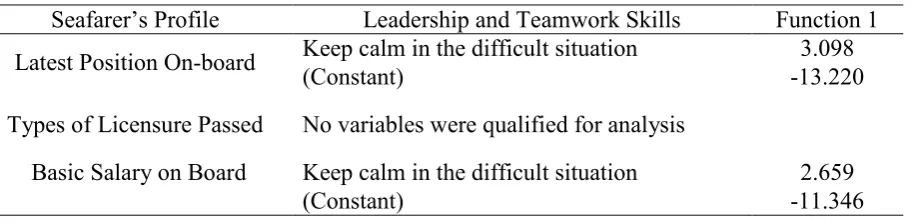
Table 6 shows the canonical discriminant function coefficients on leadership and teamwork skills competence. Results revealed that seafarers are needed to be trained about leadership and teamwork skills, specifically on keeping on calm in a difficult situation with the canonical coefficient value of 3.098 and 2.659. Teamwork and leadership contribute to the global understanding of the ship safety concept. These are the components of human resource management and contribute to the worldwide knowledge of the ship safety concept. Thus, leadership and teamwork skills required at all ship bridge activities of seafarers, especially on how they lead to a tough situation. In a working environment like ships or vessels, teamwork can be the way for safe movement. When more than one person covers an operation, the safety level has increased through a second or more people involvement (Hanzu-Pazara, Popescu, & Varsami, 2012).
According to the International Chamber of Shipping & International Shipping Federation, (2011) cited by Wanga (2015), the competence of seafarers is the most critical factor in the safe and efficient operation of ships and has a direct impact on the safety of life at sea and the protection of the marine environment.
Based on the canonical coefficient table below, the discriminant function, and then obtained a discriminant function model:
Latest position on board
Z= -13.220 + 3.098 (Keep calm in the difficult situation)
Basic Salary On-board
Z= -11.346 + 2.659 (Keep calm in the difficult situation)
Table 6
Canonical Discriminant Function Coefficients on Leadership and Teamwork Skills
Seafarer’s Profile Leadership and Teamwork Skills Function 1
Latest Position On-board Keep calm in the difficult situation 3.098
(Constant) -13.220
Types of Licensure Passed No variables were qualified for analysis
Basic Salary on Board Keep calm in the difficult situation 2.659
(Constant) -11.346
Conclusions
408
was constructed. Hence, the researcher hereby recommended that the concerned maritime sectors may continue to require all seafarers to undergo the training on STCW for the continuous safety on ship sailing and seafarers on board. It is also recommended that the future researcher/s respondents will conduct a study to the superiors of seafarers during on board or will conduct a study to the personnel in charge in manning agency.
Acknowledgments
The researcher wishes to express his deep gratitude and appreciation to the Key Officials of Jose Rizal Memorial State University for their financial support and for the motivation to conduct this study. He wishes also to extend her profound gratitude to seafarers who served as the subjects of this study.
References
Albayrak, T., & Sağ, O. K. (2011). Maritime English in view of STCW 2010. In International Maritime English Conference (IMEC)
23,“Proceedings of International Maritime English Conference (IMEC) (Vol. 23, pp. 17-24).
Borodina, N. (2017). Use of authentic materials in Maritime English classroom. Proceedings of the
International Maritime English Conference – IMEC 29. Busan, Republic of Korea: Korea Institute of Maritime and Fisheries Technology.
Chae, C. J. (2011). The STCW Manila amendments: its challenges to the Far East. Etman, E. The impact of STCW implementation on Maritime Administrations, MET
Institutions and Shipping Companies.
Retrieved on August 2, 2018
Lewin, P. M. E. (2015). Training effectiveness in maritime transport (Master's thesis, Høgskolen i Buskerud og Vestfold).
Mercado, F. M., Mogol, C. R., Sarmiento, J. L., & Jalbuena, M. C. M. (2018). The Philippine Context of the Teaching and Learning of
Maritime English. The Normal Lights, 12(1).
Muccin, E (2013). Economic Impacts of STCW 2010. Retrieved from www.marinelink.com. Retrieved on March 9, 2017
Wanga, Michelle Hellena, "Effects of the standards of training, certification and Watchkeeping for Seafarers
(STCW) 78 convention, as amended, on Kenya's maritime education and training (MET)" (2015).World Maritime University Dissertations. Paper 500.
TESDA (2017). The Philippine Maritime Industry Through the Years. Labor Market Intelligence Report. Retrieved on October 24,
2018.
Trenkner, P. (2005, October). The IMO Standard Marine Communication Phrases– Refreshing memories to refresh motivation.