Research Article
Mutagenic effect of sodium azide (NaN
3
)
on M
2
generation of Brassica napus L.
(variety Dunkled)
Saddam Hussain
1, Wisal Muhammad Khan
1*, Muhammad Saleem
Khan
1, Naveed Akhtar
1, Nosheen Umar
2, Sajjad Ali
3, Sajjad Ahmed
1and Syed Sadaqat Shah
11. Department of Botany, Islamia College Peshawar-Pakistan 2. Department of Botany, University of Peshawar-Pakistan
3. Department of Botany, Bacha Khan University, Charsadda-Pakistan
*Corresponding author’s email: [email protected]
Citation
Saddam Hussain, Wisal Muhammad Khan, Muhammad Saleem Khan, Naveed Akhtar, Nosheen Umar, Sajjad Ali, Sajjad Ahmed and Syed Sadaqat Shah. Mutagenic effect of sodium azide (NaN
3) on M2 generation of Brassica
napus L. (variety Dunkled). Pure and Applied Biology. Vol. 6, Issue 1, pp226-236.
http://dx.doi.org/10.19045/bspab.2017.60018
Received: 10/11/2016 Revised: 25/01/2017 Accepted: 08/02/2017 Online First: 11/02/2017
Abstract
The present study was aimed to investigate the effect of different doses (0.2%, 0.4%, 0.6% and 0.8%) of sodium azide (SA) on M2 generation of Brassica napus (variety Dunkled) on some qualitative, quantitative and biochemical parameters. The result showed that days to germination, days to flowering and days to siliqua maturation were delayed (9.4, 98 and 153 days respectively) in higher treatment as compared to control (5.4, 96 and 147 days respectively). Higher concentration of SA (0.8%) decreased germination percentage (88.56%), plant height (97.95 cm), stem diameter (3.49 cm), number of branches/plant (3.49), number of leaves/plant (10), number of siliqua/plant (64.68), number of seed/siliqua (20.09) and 1000 seeds weight (3.91g) as compared to control. An increase was noticed for siliqua length (5.42 cm) in higher concentration of SA (0.8%) as compared to control (5.24 cm). Proximate analysis showed a significant decrease in oil, oleic acid and glucosinolates contents percentage (42.6%, 54.9%, and 58.5 μmol/g respectively) in higher concentration of SA (0.8%) as compared to control (44.7%, 58.1% and 71.3 μmol/g respectively) while a significant increase was noticed in proteins, moisture, linoleic acid and erucic acid percentage (28.4%, 5.9%, 9% and 37.3% respectively) in higher concentration of SA (0.8%) as compared to control (26.8%, 5.5%, 8.4% and 35.2% respectively.
Keywords: Sodium Azide (SA); Brassica napus; morphological and biochemical parameters Introduction
Rapeseed (Brassica napus) is also known as rape and Rapa. It is a bright yellow flowering annual herb of family Brassicaceae/ Cruciferae. The family
Hussain et al.
227 Europe [2]. Rapeseed cultivars show significantly different responses depending on weather conditions to different irrigation levels [3].The increase of temperature has a negative effect on seed yield of spring oil rape seed, nitrogen show significant effect on seed yield and flowering, phosphorous concentration is not important while potassium concentration effect on the contrary [4]. Rapeseed and mustard is the important crop of Brassica group grown as oilseed crop in Pakistan. Oilseeds are rich in proteins (36-40 %) and in addition they contain a high level of fat contents (40-45%) [5, 6]. Rapeseed (Brassica napus L.) is now the third most important source of edible oil in the world after soybean and palm oil [7]. In Pakistan, after cotton it is the second most important source of oil. It contributes about 17% to the domestic production of edible oil [8]. In Pakistan during the year 2010-11 total cultivated area under rapeseed was 439 thousand acres producing 157 thousand tons of seed, which yielded 50 thousand tons of oil while in 2011-12¸ the total cultivated area under rapeseed cultivation was 575 thousand acres, producing 203 thousand tons of seed, which yielded 61 thousand tons of oil [9]. Brassica vegetables have been related to the prevention of cancer and degenerative diseases, owing to their glucosinolates and phenolic contents [10]. Combination of physical and chemical mutagen show enhancing effect on different parameter of Brassica napus [11]. One hundred and sixty three cultivars of annual oil seed crops developed using induced mutations. The maximum number of cultivars have been released in soybean (58), followed by groundnut (44), sesame (16), linseed (15), rapeseed (14), Indian mustard (8), Caster bean (4), white mustard (3) and sunflower (1) [12]. During the past seventy years, worldwide more than 2250 varieties have been released that have been derived either as direct mutants or from their
progeny [13] and according to FAO/IAEA mutant varieties database there are 2541 mutant cultivars, 30 of which are of Brassica. Among the different breeding method induced mutation has been extensively and successfully used for genetic improvement of any yield attributes either qualitative or quantitative in nature [14]. Chemical mutagenesis is considered as an effective mean in improving the yield and quality trait of crop plants [15]. Sodium azide (NaN3) is one of the most powerful chemical mutagens used to induce mutation in crop plants [16]. The present study was carried out to investigate the effect of sodium azide induced mutation on the qualitative and quantitative characters of Brassica napus L.
Materials and methods
The seeds of M2 generation of Brassica
napus variety Dunkled were obtained from the Institute of Biotechnology and Genetic Engineering (IBGE), The University of Agriculture, Peshawar. They were presoaked in distilled water for 4 to 6 hours at temperature 250C. Sodium azide solutions of four different concentrations were prepared i.e. 0.2%, 0.4%, 0.6%, and 0.8%. Seeds were soaked in all these different concentration of solution for 5 hours. The control seeds were soaked in distilled water for 5 hours.
Sowing
Seeds of M2 generation of Brassica napus
(variety Dunkled) were sown in the green house of botanical garden, Islamia College, Peshawar on 24th November 2014. The treated seeds of each dose were sown in 5 pots while seeds of control were sown in separate 5 pots. The seedling survival, growth, morphological changes and seeds setting were carefully observed.
Morphological parameter
Days to germination, germination percentage, days to flowering, plant height, number of branches /plant, number of siliqua/plant, number of seeds/siliqua, number of leaves/plant, siliqua length, days to siliqua maturation and 1000 seeds weight Biochemical parameter
Oil contents, protein contents, moisture contents, glucosinolates, oleic acid, linoleic acid and erucic acid
Statistical analysis
Experiment was set up in randomize complete block design with five replica per treatment. Data were statistically analyzed to find out coefficient of variation for each parameter. Two tests were performed i.e. analysis of variation (ANOVA) and least significant difference (LSD) at α = 0.05 using Statistics 10.0 software.
Proximate analysis
Proximate analysis of seeds was carried out at national institute of food and agriculture (NIFA), Peshawar, Pakistan.
Results and discussion
Mutation is a change in a genetic sequence at small level like substitution of a single DNA building block or nucleotide base with
another nucleotide base. Meanwhile larger mutations can affect many genes on a chromosome along with substitutions; mutation can also be caused by insertions, deletion or duplications of DNA sequences. In the current study, results of the parameters studied are given below.
Germination
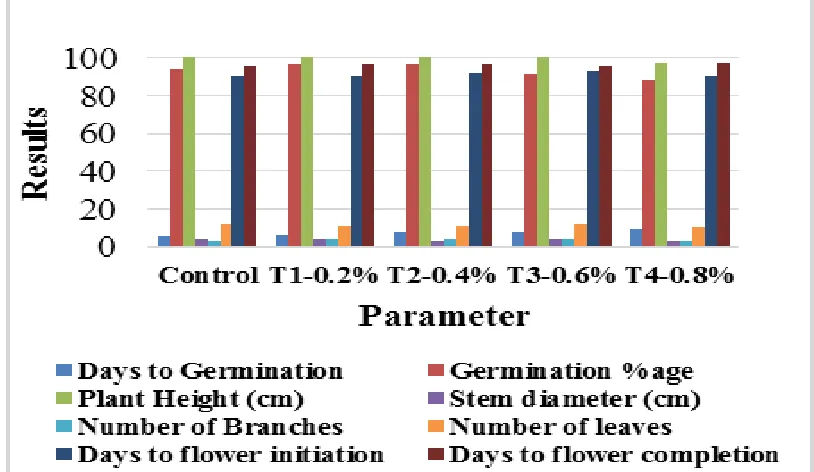
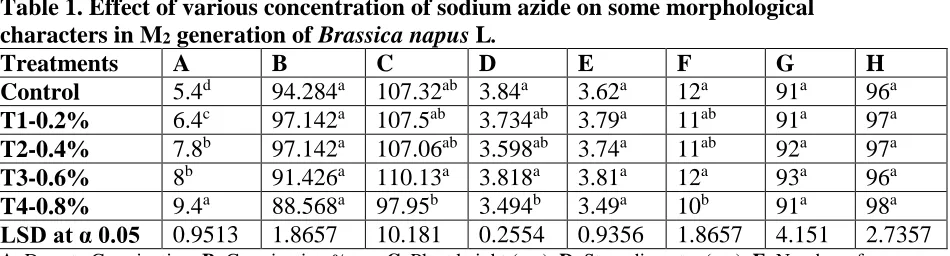
The result of table 1 and figure 1 show the effect of various concentration of sodium azide on days to germination in M2 generation of Brassica napus L. The mean value showed that higher concentration of sodium azide may delay the germination. Days to germination increased slightly at 0.2%, 0.4%. 0.6% and 0.8% are (6.4, 7.8, 8 and 9.4 days respectively) as compared to control (5.4). The reduction in seed germination in mutagenic treatment had been explained due to delayed or inhibition of physiological and biological processes for seed germination including enzyme activity and inhibition of mitotic process [17, 18]. These results are also in the agreement with the finding of [19] on Lycopersicun esculentum and [20] on Arachis hypogaea.
Figure 1. Showing the effect of various concentration of sodium azide on days to
Hussain et al.
Table 1. Effect of various concentration of sodium azide on some morphological characters in M2 generation of Brassica napus L.
Treatments A B C D E F G H
Control 5.4d 94.284a 107.32ab 3.84a 3.62a 12a 91a 96a
T1-0.2% 6.4c 97.142a 107.5ab 3.734ab 3.79a 11ab 91a 97a
T2-0.4% 7.8b 97.142a 107.06ab 3.598ab 3.74a 11ab 92a 97a
T3-0.6% 8b 91.426a 110.13a 3.818a 3.81a 12a 93a 96a
T4-0.8% 9.4a 88.568a 97.95b 3.494b 3.49a 10b 91a 98a
LSD at α 0.05 0.9513 1.8657 10.181 0.2554 0.9356 1.8657 4.151 2.7357
A. Days to Germination, B. Germination %age, C. Plant height (cm), D. Stem diameter (cm), E. Number of branches, F. Number of leaves, G. Days to flower initiation, H. Days to flower completion
Germination percentage
The results showed that there is no significant effect of various concentration of sodium azide on germination percentage. The lowest mean value for germination percentage were recorded at 0.6%, 0.8% (91.42% and 88.56 respectively) while the highest mean value were recorded at 0.2% and 0.4% (97.142% each) as compared to control (94.28%). This study also confirms the finding of [18], [21-27] who reported that germination percentage, shoot height, root depth, leaflet areas, chl a, chl b and the initial level of fluorescence (F0) decreased with NaN3 treatment in pea. The present result is also in agreement with the finding of [28] who observed almost adverse effect of higher concentration of sodium azide on germination percentage (Table 1 and Figure 1).
Plant height
The data in table 1 and figure 1 show that mean value of plant height was increased (107.5 cm and 110.3 cm) at 0.2% and 0.6% respectively and decreased (107.06 cm and 97.95 cm) at 0.4% and 0.8% respectively as compared to control (107.32). Sodium azide i.e. 0.8% has adversely affected the plant height (97.95 cm). The work of [17] also showed almost the same results on stem height which was reduced by higher
concentration of sodium azide. Similar results were also obtained by [22],[29-33].
Stem diameter
Table 1 and figure 1 represent the effect of various concentration of sodium azide on M2 generation on stem diameter. Control showed the highest value for the mean of stem diameter (3.84 cm), and decreased (3.81 cm, 3.73 cm, 3.59 cm and 3.49 cm) at 0.6%, 0.2%, 0.4% and 0.8% respectively. Result showed that various concentrations of sodium azide adversely affected the stem diameter. These results are in agreement with the finding of [34, 35] on Phyllanthus odontadenius[33] on Browallia speciosa. Number of branches
Number of leaves/ stem
Data presented in Table illustrate the effect of various concentration of sodium azide on number of leaves/stem in M2 generation of
Brassica napus L. Control and 0.6% showed the highest value for the mean number of leaves/stem (12 leaves/stem). While other treatments showed a decreasing tendency in the mean values of number of leaves/stem were recorded i.e. 0.2%, 0.4% and 0.8% are (11, 11 and 10 leaves/stem respectively). The stimulative effect of sodium azide might be attributed to cell division rates as well as activation of growth hormone e.g. auxin as reported by [37]. These results are in agreement with the findings of [30] on Helianthus annuus and [20] on Arachis hypogaea and Browallia speciosa [33] Flowering initiation and completion Table 1 represents the effect of various concentration of sodium azide on flowering initiation in M2 generation of Brassica
napus L. The result showed that there is no significant value on days to flowering initiation while flower completion was slightly affected. The lowest mean value was observed at 0.8%SA (98 days) while the highest meant value was recorded in control (96 days). Higher concentration of sodium azide delayed flowering. These results are parallel with the results of [25, 38, 30].
Siliqua maturation
Data in Table 2 illustrate the effect of various concentration of sodium azide on siliqua maturation in M2 generation of
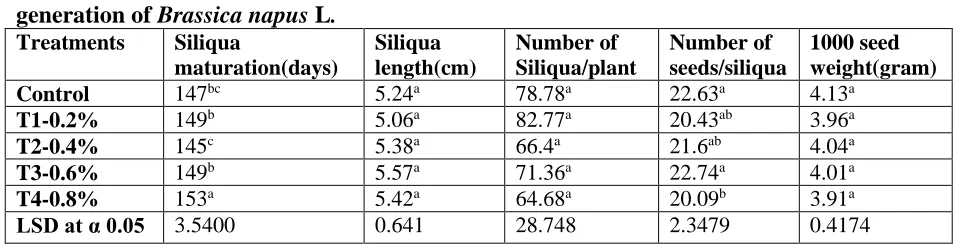
Brassica napus L. there is significant effect of various treatments on siliqua maturation. Higher concentration of sodium azide may delay the siliqua maturation as compared to control. The highest mean value were found in 0.8% (153 days), while the lowest mean value were found in 0.4% (145 days) as compared to control (147 days) and other treatments.
Table 2. Effect of various concentration of sodium azide on yield production in M2
generation of Brassica napus L.
Treatments Siliqua
maturation(days)
Siliqua length(cm)
Number of Siliqua/plant
Number of seeds/siliqua
1000 seed weight(gram)
Control 147bc 5.24a 78.78a 22.63a 4.13a
T1-0.2% 149b 5.06a 82.77a 20.43ab 3.96a
T2-0.4% 145c 5.38a 66.4a 21.6ab 4.04a
T3-0.6% 149b 5.57a 71.36a 22.74a 4.01a
T4-0.8% 153a 5.42a 64.68a 20.09b 3.91a
LSD at α 0.05 3.5400 0.641 28.748 2.3479 0.4174
Length of siliqua
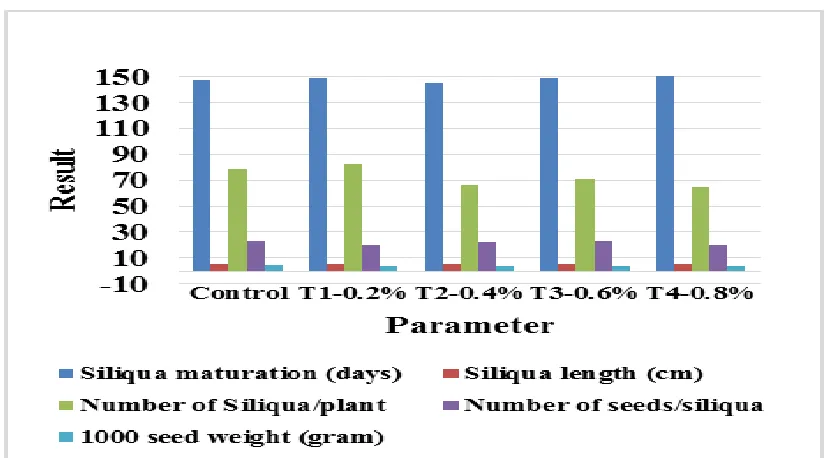
Data presented in figure 2 illustrates the effect of various concentration of sodium azide on siliqua length in M2 generation of
Brassica napus L. The mean values show that there is no significant effect of Sodium azide on siliqua length. It shows that spike
Hussain et al.
231
Figure 2. Illustrates the effect of various concentration of sodium azide on siliqua length
Number of siliqua/plant
Table 2 show average number of siliqua/plant at various concentration of sodium azide on M2 generation of Brassica
napus L. In control number of siliqua/plant was 78.78, and increase was noticed at 0.2% (82.77 siliqua/plant). Then decrease in the mean values for number of siliqua/plant in 0.6% (71.36%) and 0.8% (64.68 siliqua/plant) as compared to control. A decrease of siliqua was noticed in 0.4% (66.40 siliqua/plant) as compared to control and other doses. In 0.4% treatment a bifurcated siliqua was also obtained. [11] showed that siliqua/plant was enhanced by gamma rays and EMS (Ethyl methane sulphonate). This was also confirmed by [32]. Higher concentration of sodium azide reduced siliqua/plant. Similar finding were obtained by [26, 40]. However, present study disagrees with the finding of [41] who noticed increase in number of pods/plant with higher concentration of sodium azide. Number of seed/siliqua
The data of table 2 and figure 2 represent the effect of various concentration of sodium azide on number of seed/siliqua in M2 generation of Brassica napus L. Number of
seed/siliqua was significantly affected by chemical treatment. The highest mean value for number of seed/siliqua was recorded at 0.6% (22.74 seed/siliqua) and the lowest mean value for number of seed/siliqua was recorded at 0.8% (20.09) as compared to control (22.63). Number of seed/siliqua at 0.2%, 0.4% is 20.43 seed/siliqua and 21.60 seed /siliqua respectively. The result revealed that the number of seed/siliqua was not improved by chemical treatment in M2 generation of Brassica napus L. Similar results was obtained by [42] on Sesame indicum and [27] on Arachis hypogaea L. Increased number of seeds at 0.7% was also recorded by [32].
1000 seeds weight
Table 2 and figure 2 show the effect of various concentration of sodium azide on 1000 seed weight in M2 generation of
adversely effected 1000 seed weight. Present study is dispute with the finding of [20] who observed an increase in 1000 grain weight at different concentrations. [32] also recorded an increase in 1000 grain weight at higher treatment. Present study also contradict finding of [43, 44].
Chemical analysis of seeds
The qualitative analysis of seeds was carried out using NIRS (Near Infra-Red Reflectance Spectroscopy) which works on the principle of measuring the absorption of light energy or wavelengths of each component at its
characteristic frequency in the near IR region.
Oil percentage
Table 3 and figure 3 show the effect of various concentration of sodium azide on oil percentage in M2 generation of Brassica
napus L. The data obtained revealed that the oil content decreased significantly with high concentration of sodium azide. The lowest oil contents were recorded at 0.6%SA and 0.8% SA (43.9% and 42.6% respectively) as compared to control (44.7%) and other treatments. Our results also confirmed the findings of [11].
Table 3. Effect of various concentration of sodium azide on some bio chemical parameters in M2 generation of Brassica napus L.
Treatments Oil
percentage
Protein percentage
Glucosinolates
μmol/g Moisture percentage
Oleic acid (18:1) percentage
Linoleic acid(18:03) percentage
Erucic acid(22:01) percentage
Control 44.7bc 26.8a 71.3a 5.5a 58.1a 8.4a 35.2b
T1-0.2% 45ab 27.8a 61.9bc 6.2a 56.2b 8.7a 37.8ab
T2-0.4% 47.2a 26.1a 64.9b 5.6a 56.4b 7.8a 40a
T3-0.6% 43.9bc 27a 71.5a 5a 58.2a 8.7a 27.5c
T4-0.8% 42.6c 28.4a 58.5c 5.9a 54.9c 9a 37.3ab
LSD at α 0.05
2.2851 3.0659 3.6154 1.3259 1.4926 1.6583 2.9322
Hussain et al.
233
Proteins percentage
Table 3 show the effect of various concentration of sodium azide on Protein percentage in M2 generation of Brassica
napus L. The treated seed were analyzed for protein contents and the result showed that with high concentration of sodium azide increased the protein content i.e. 0.2% SA (27.8%), 0.6% SA (27.0.%), 0.8% SA (28.5%) except 0.4% SA which show a deviation and decrease protein content (26.1%) is noted as compared to control (26.8%). Similar results were reported by [45, 46].
Glucosinolates (GSL) content
The data of table 3 and figure 3 illustrate that when treated seed were analyzed for GSL content and the result revealed that increasing concentration of sodium azide significantly decreased the GSL content except at 0.6% SA which show a deviation and increase in GSL content is noted.
Moisture content (MC)
The result of table 3 and figure 3 revealed that high concentration of sodium azide increased the moisture content i.e. 0.2% SA (6.2%MC), 0.4% SA (5.6%MC), 0.8% SA (5.9%MC), except 0.6% SA (5.0%MC) as compared to control (5.5%MC).
Oleic acid (18:1) content
The data of table 3 and figure 3 represent the effect of various concentration of Sodium azide on Oleic acid content in M2 generation of Brassica napus L. The analysis of seed revealed that high concentration of sodium azide decreased oil content i.e. 0.2% SA (56.2%), 0.4% SA (56.4%), 0.8% SA (54.9%) except at 0.6% SA (58.2%) as compared to control (58.1%).
Linolenic acid (18:3) content
Table 3 and figure 3 shows that linolenic acid content is increased with high concentration of sodium azide. 0.8% SA showed the highest mean value (9.0%) while 0.4% SA gave the lowest mean value (7.8%) as compared to Control (8.4%) and other
doses i.e. 0.2% SA and 0.6% SA (8.7% and 8.7% respectively). Similar results were also observed by[47].
Erucic acid (22:1) content
The data of table 3 and figure 3 show the effect of various concentration of sodium azide on erucic acid in M2 generation of
Brassica napus L. The data revealed that result changed variously compared to control. 0.4% SA gave the highest mean value (40%) while 0.6% SA showed the lowest mean value (27.5%) as compared to control (35.2%) and other doses.
Recommendation
It is recommended that if 0.4% treatment of sodium azide is given to Brassica napus and worked on its different stages and environmental factor, so it is likely to obtain bifurcated siliqua which will increase the crop productivity and oil production. Authors’ contributions
Conceived and designed the experiment: WM Khan, Performed the experiment: S Ahmed, S Hussain & SS Shah, Analyzed the data: WM Khan, N Umar & S Ali, Contributed reagents/ materials/ analysis tools: MS Khan & N Akhtar, Wrote the paper: S Ahmed & WM Khan.
References
1. Beilstein MA, AL-Shehbaz IA, Mathews S & Kellogg EA (2008). Brassicaceae phylogeny inferred from phytochrome A and NADH sequence data: tribe and trichome revisited. Am J Bot 95(10): 1307-1327.
2. Saeidnia S & Ghoari AR (2012). Importance of Brassica napus as a medicinal food plant. Med Plants Res 6(14): 2700-2703.
3. Rad AHS, Abbasian A & Aminpanah H (2014). Seed and oil yields of rapseed (Brassica napus L.) cultivars under irrigated and non-irrigated condition. The J. Animal Plant Sci 24(1): 204-210. 4. Sidlauskas S & Bernotos S (2003). Some
seed rape (Brassica napus L.). Agron Res 1(2): 229-243.
5. Amin R & Khalil SK (2005). Effect of pre and post-emergence herbicides and row spacing on canola. Sarhad. J Agric 21: 165-170.
6. Sarwar MF, Sarwar MH, Sarwar M, Qadri NA & Mogal S (2013). The role of oil seeds nutritionin human health: A Critical Review. J Cereals Oilseeds 4(8): 97-100. 7. EL-Beltag HES & Mohamed AA (2010).
Variations in fatty acid composition, glucosinolates profile and some phytochemical contents in selected oil seed rape (Brassica napus L.) cultivars. Grasas. Y. Aceites. 61(2): 143-150. 8. Abbas SJ, Ullah F, Marwat KB & Munir
I (2008). Molecular and biochemical assessment of Brassica napus and indigenous campestris species. Pak J Bot 40(6): 2461-2469.
9. Anonymous (2011-12). The agriculture sector economic survey. Pakistan oilseed development board. Pakistan. p. 24. 10.Velasco P, Francisco M, Moreno DA,
Ferrares F, Viguera CG & Cartea ME (2011). Phytochemical finger printing of vegetable Brassica oleracea and Brassica napus by simultaneous identification of glucosinolates and phenolics. Phytochem Anal 22: 144-15.
11.Siddiqui MA, Khan IA & Khatri A (2009). Induced quantitative variability by gamma rays and ethyl methane sulphonate alone and in combination in rapeseed (Brassica napus L.). Pak J Bot 41(3): 1189-1195.
12.Bhatia CR, Nichterlein K & Maluszynski M (1999). Oilseed cultivars developed from induced mutations and mutation altering fatty acid compostion. M. Bred Rev 11: 1-36.
13.Ahloowalia BS, Maluszunski M & Nichterlein K (2004). Global impact of mutation-derived varieties. Euphytica 135: 187-204.
14.Mudibu J, Nkongola KKC, Mbuyi AK & Kizungu RV (2012). Effect of gamma irradiation on morpho-agronomic characteristics of soybeans (Glycine max L). Am J Plant Sci 3: 331-337.
15.Srivastava P, Marker S, Pandey P & Tiwari ZDK (2011). Mutagenic effects of sodium azide on the growth and yield characteristics in wheat (Triticum aestivum L.em. Thell). Asian. J. Plant Sci 10(3): 190-201.
16.Elfeky S, Abu-Hamad S & Saad-Allah KM (2014). Physiological impact of sodium azide on Helianthus annus seedlings. Int J Agron Agric Res 4(5): 102-109.
17.Mostafa GG (2015). Effect of some chemical mutagens on the growth, phytochemical position and induction of mutation in Khaya senegalensis. Int. J.Plant Bred Genetic 9(2): 57-67.
18.Khan S & AL-Qurainy VF (2009). Mutagenic effect of sodium azide on seed germination of Eruca sativa (L.). Australian J Basic Appl Sci 3(4): 3081-3087.
19.Adebola MO (2013). Mutagenic effect of sodium azide (NaN3) on morphological characteristics of tomato (Lycopersicum esculentum). Res J Sc and IT Magt 2(4): 1-5.
20.Animasaun DA, Oyedeji S, Azeez MA & Onasanya AD (2014). Evaluation of the vegetative and yield Performances of groundnut (Arachis hypogaea) varieties Samnut 10 and Samnut 20 treated with sodium azide. Int J Sci and Res Pub 4(3): 1-10.
21.Turkan AD, Khawar KM, Ciftct CY & Ozca S (2006). Effect of mutagenic sodium azide (NaN3) in vitro development of four pea (Pisum sativum L.) cultivars. Int J Agric Biol 8 (3): 349-351.
Hussain et al.
235 aberration, induced by diethyl sulphate (DES) and sodium azide (SA) in Vicia faba L. (Fabaceae). Pakistan J Biol Sci 10(5): 783-787.
23.Roychowdhury R & Tah J (2011). Assessment of chemical mutagenic effects in mutation breeding program for M1 generation of carnation (Dianthus
caryophyllus). Res plant biol 1(4): 23-32. 24.Roychowdhury R, Alam MJF, Bishnu S,
Dalal T & Tah J (2012). Comparative study the effects of chemical mutagenesis on seed germination, surviviability and pollen sterility in M1 and M2 generation of Dianthus. Plant Bred and Seed Sci 65: 29-38.
25.Ali A, Yubey K, Deka UK & Tomur SMS (2014). Effect of sodium azide on seed germination and related Agro-metricat traits in M1 lentil (Len sculinaris
medik) generation. W J Agric Sci 10(3): 95-102.
26.Saad-Allah KM, Hammouda M & Kasim WA (2014). Effect of sodium azide on growth criteria, some metabolites, meitotic index and chromosomal abnormalities in Pisum sativum. Int J Agron Agric Res 4(4): 129-147.
27.Ikhajiagbe B & Shittu HO (2015). Effect of different concentration and exposure time of sodium azide on the growth and yield of glycine max sown in an oil-polluted soil. UNIBEN J Sci Tech 3(1): 112-126.
28.Emrani SN, Arzani A & Saeidi G (2011). Seed viability, germination and seedling growth of canola (Brassica napus L.) as influenced by chemical mutagen. African J Biotech 10(59): 12602-12613.
29.Alliyu H & Adamu AK (2007). The effect of diethylsulphate on some quantitative trait of tomato (Lycopersicon esculentum Mill). Sci World J 2(4): 1-4.
30.Mostafa GG (2011). Effect of sodium azide on growth and variability induction in Helianthus annuus L. Int J Plant Bred Genetic 5 (1): 76-85.
31.Khan S, Al-Qurainy F & Anwar F (2009). Sodium azide: a chemical mutagen for enhancement of agronomic traits of crop plants. Environ We Int J Sci Tech 4: 1-21.
32.Kumar G & Dwivedi K (2013). Sodium azide induced complementary effect of chromosomal stickiness in Brassica compestris L. Jordan. J Biol Sci 6(2): 85-90.
33.Hatlaa M, Hazar Y & Manyman MO (2014). Stimulation of mutation in (Browallia speciosa) using sodium azide and classification of the genetic variation by peroxidase enzyme. Int J Hortic Floric 2(3): 061-065.
34.Ukwubile CA & Nathanie MS (2014). Effect of sodium azide (NaN3) on seed germination plantlets growth and in vitro antimalarial activities of Phyllanthus odontadeniuns Mull Arg. Asian. J Res Chem Pharma Sci 2(1): 15-26.
35.Nakweti RK, Franche C & Ndjku SL (2015). Effect of sodium azide (NaN3) on seed germination, plantlets growth and in vitro antimalarial activities of Phyllanthus odontadenius Mull. Arg Asian J Res Chem.Pharma. Sci 5(3): 226-238.
36.Rajani P, Vineeta D & Chaudhary BR (2011). Sodium azide- induced mutagenesis in fenugreek (Trigonella- foenum gracium Linn). Legume Res 33(4): 235-241.
37.Joshi N, Ravindran A & Mahajan V (2011). Investigation on chemical mutagen sensitivity in onion (Allium cepa L.). Int J Bot 7(3): 243-248.
caudatus L. and A. hypochondriacus, floriculture, Faculty of Agriculture, Alexandria university.
39.Nasim A, Ullah F, Iqbal S, Shah S & Azam SM (2013). Genetic variability and correlation, studies for morphophysiological trait in Brassica napus L. Pak J Bot 45(4): 1229-1234. 40.Menash JK & Obadani B (2007). Effect
of sodium azide on yield parameters of groundnut (Arachis hypogaea L.). African J Biotech 6(6): 668-671.
41.Animasaun DA, Oyedeji S, Azeez MA & Onasanya AD (2014). Alkylating efficiency of sodium azide on pod Yield nut size and nutrition composition of samnut 10 and samnut 20 varieties of groundnut (Arachis hypogaea L.). African J Food Agri Nutr Development 14(7): 9497-9510.
42.Menash JK, Obadoni B, Akomeah PA, Ikhajiagbe B & Janet A (2007). The effect of sodium azide and colchicine treatments on morphological and yield traits of sesame seed (Sesame indicum L.). African J Biotech 6(5): 534-538.
43.Scossirol RE, Palenzonaans DL & Pallengrins SI (1966). Studies on the induction of new genetic variability for quantitative traits by seed irradiation and its use for wheat improvement. Int Energy Agency Vienna 197-229.
44.Irfaq M & Nawab K (2001). Effect of gamma irradiation on some morphological characteristics of three wheat cultivars. J Biol Sci 1: 935-937. 45.Rehman SM, Takagi Y, Kubota K,
Miyamoto K & Kawakita T (1994). High oleic acid mutant in soyabean induced by x-ray irradiation. Bio Sci Bio Tech Bio Chem 58: 1070-1071.
46.Hajduch M, Debre F, Bohmova B, Dolesova P & Pretova A (2000). Two soybean mutants with increased total and sulphur amino acid content induced by sodium azide. J Gent Breed 54: 83-87. 47.Begum T & Dasgupta J (2011). Effect of