Vikram CH, et al. J Sci Res Pharm, 2018;7(2):13-17
World Inventia Publishers
J
ournal of
S
cientific
R
esearch in
P
harmacy
http://www.jsrponline.com/
Vol. 7, Issue 2, 2018 ISSN: 2277-9469
USA CODEN: JSRPCJResearch Article
DEVELOPMENT AND EVALUATION OF ANTI- INFLAMMATORY HERBAL FORMULATION
Vikram Choudhary 1 *, Kishan lal Seervi 2, Mahesh D. Kamalja 3 * 1 Shrinathji Institute of Pharmacy, Nathdwara Dist- Rajsamand (Rajasthan) – 313301, INDIA.
2 Shrinathji Institute of Pharmacy, Nathdwara, Rajasthan, INDIA.
3 R. C. Patel Institute of Pharmaceutical Education & Research Shirpur, Rajasthan, INDIA.
Received on: 02-02-2018; Revised and Accepted on: 14-02-2018
ABSTRACT
H
erbal remedies are more acceptable in the view that they are safe with fewer side effects than the synthetic ones. Herbal formulations have more demanded in the market. Inflammatory diseases including different types of rheumatic diseases are major cause of morbidity of the working force throughout the world. This has been called the ‘King of human miseries’. The present work deals with the Development and Evaluation of Poly-Herbal Anti-inflammatory Formulation containing alcoholic extract of Vitex negundo leaves, Boswellia serrata, Berberis aristata & wintergreen oil. The gel was prepared using polymer carbopol 940 (1% w/v), propylene glycol 400, triethanolamine, propyl paraben, methyl paraben and required amount of distilled water. Various conc. of extract were taken for formulations (F1 to F3). Prepared formulations (F1 to F3) were evaluated for various parameters like colour, appearance, consistency, viscocity, pH, spreadability, stability along with anti-inflammatory activity by using model carageenan induce paw edema in rats. F3 formulation was found optimum for all the parameter.KEYWORDS: Vitex Negundo, Boswellia Serrata, Spreadability, pH, Carbopol.
INTRODUCTION
I
nflammation and rheumatism remain serious problems inthe present era. Inflammation is a complex immune response to vascular tissues injury or infection caused by pathogens, clinically characterized by signs of swelling, redness, pain, warmth and loss of function [1].
Inflammation is an important feature of great number of diseases. It is a response of the tissue to an injury, infection, irritation or foreign substance. It is a part of host defence, but when the response becomes too great it may be far worse than the disease itself and in extreme conditions, it may be fatal. Anti- inflammatory drugs are considered important because of their wide therapeutic potential and their utility in a number of diseases such as arthritis, lupus erythematosus, pemphigus and rheumatic fever and in a number of other disorders associated with pain, pyrexia and inflammation.
Many anti-inflammatory drugs (both NSAIDs and corticosteroids) have been developed but their safety profile studies have shown that none of them is clearly safe. They show wide ranges of adverse effects. Due to adverse reactions of synthetic and chemical medicines being observed round the globe, herbal medicines have made a comeback to improve our basic health needs. Many plants and herbs such as ginger, turmeric, olive oil, have been shown to exhibit potent anti-inflammatory effect [2].
Vitex nigundo linn: Vitex negundo L. commonly known as Nirgundi
*Corresponding author:
Vikram ChoudharyShrinathji Institute of Pharmacy, Nathdwara Dist- Rajsamand, Rajasthan – 313301, INDIA.
* E-Mail: [email protected]
DOI: https://doi.org/10.5281/zenodo.1182717
belongs to family Verbenaceae. Vitex negundo Linn. use for cure various
types diseases. Traditionally the leaves of are documented to possess antibacterial, antitumor, astringent, febrifuge, sedative, tonic and vermifuge. This species is globally distributed in Indo-Malesia, cultivated in America, Europe, Asia and West Indies. Within India, it is
found throughout the Maharashtra [3]. Vitex contains the flavonoids,
casticin, chryso-splenol and vitexin. Vitex contains Chrysophenol D. which is a substance with anti-histamine properties and muscle relaxant. Leaves contains two alkaloids nishindine and hydrocotylene. The main compounds are viridiflorol (19.55%), beta-caryophyllene
(16.59%), sabinene (12.07%)[5].
Boswellia serrata: Boswellia serrata Roxb. is one of the medicinal
plants of Burseraceae family. This herb is mentioned in traditional Unani
texts as an effective remedy for bronchitis, asthma, cough, cardiovascular diseases, diarrhea, dysentery, ringworm, boils, fevers (antipyretic), skin and blood diseases, mouth sores, vaginal discharges, etc. It chiefly possesses arthritic, inflammatory, anti-hyperlipidemic, anti-cancer, hypoglycemic, anti-asthmatic, analgesic, hepato-protective etc [4].
Alcoholic extract of salai guggal was reported to posses anti-inflammatory and anti- arthritic activities in animals which were due to boswellic acids, which are pentacyclic triterpenes. Boswellic acids selectively inhibit leucotriene synthesis by inhibiting 5-LOX in an
enzyme directed, non-redox, and non-competitive mechanism [5].
Berberis aristata: The Plant Berberis aristata DC. belongs to family
Berberidaceae, known as Indian barberry in English and Daruhaldi in Hindi. Berberine has demonstrated wide range of pharmacological activities including; antihypertensive, anti-inflammatory, antioxidant,
antidepressant, anticancer, anti-diarrhoeal, cholagouge,
The aim of current research trend is to discover newer drugs from plant kingdom which may provide therapeutic cure and which also should be cost effective, thus would be widely accepted developing nation like India.
MATERIAL AND METHODS
C
arbopol 940, Propylene glycol 400 (LOBA CHEMIEPVT.LTD, Mumbai); Propyl paraben, Methyl Paraben, EDTA (Research- Lab Fine Chem Industries, Mumbai); Triethanolamine (SAMAR CHEMICALS, Nagpur) All other chemicals used were of analytical grade.
Plant material collection and authentification:
The leaves of Vitex negundo collected from local area of
Amravati and the leaves of Boswellia serrata collected from local area of
Wari (Maharashtra) in August 2015. The gum resin of plant Boswellia
serrata and the roots of plant Berberis aristata were purchased from Barsaiya Ayurvedic Shop, Amrawati. The above herbs were authentified by Dr. S. N. Malode, head of botany department, Govt. Vidarbha Institute of Science and Humanities, Amravati, Voucher specimens and sample material was deposited in the Pharmacognosy & Phytochemistry Laboratory, Govt. College of Pharmacy, Amravati.
Extract preparation:
The collected materials were washed thoroughly in water, chopped, air dried for a week at 35-40°C and pulverized in electric grinder and exhaustively extracted successively in soxhlet apparatus, using petroleum ether, ethanol respectively. Boswellia serrata extracted by maceration process in which gum resins were soaked in petrolium ether upto 2 days and then marc again extracted by using solvent
ethanol, macerate upto 2 days[7,8]. The extracts were concentrated under
reduced pressure.
Formulation of Gel:
Carbopol 940 (1 % w/w) and purified water were taken in a beaker and allowed to soak for 24 hr. Stirred by mechanical stirrer at
400 to 650 rpm. Add ethanolic extract Vitex negundo, Boswellia serrata
and Berberis aristata of were dispersed in alcohol in separate container then add this in carbopol 940. Then neutralized with sufficient quantity of Triethanolamine. Propylene glycols 400 as penetration enhancer, methyl paraben and Propyl paraben as preservatives were added slowly with continuous gently stirring until the homogenous gel was formed. The formulation of developed gel formula given in table no. 1.
Table No. 1: Formulation table showing composition of F1, F2 and F3 gel formulation
Ingredient F1 F2 F3
Ethanolic extract of Vitex negundo 100mg 150mg 200mg
Ethanolic extract of Boswellia serrata 100mg 150mg 200mg
Ethanolic extract of Berberis aristata 50mg 50mg 50mg
Carbopol 940 1gm 1gm 1gm
Alcohol 2ml 2ml 2ml
Methyl paraben 0.2gm 0.2gm 0.2gm
Propyl paraben 0.02gm 0.02gm 0.02gm
EDTA 0.01gm 0.01gm 0.01gm
Propylene glycol 400 4ml 4ml 4ml
Wintergreen oil 2ml 2ml 2ml
Triethanolamine (To maintain pH7) Q.S. Q.S. Q.S.
Water 100 ml 100 ml 100 ml
Evaluation of Developed Gel Formulation: [9]
Following are the parameters for the evaluation of gel as per standard guidelines.
1.Physicochemical parameters: All the formulated herbal gels for
inflammation were tested for the physiochemical parameters like appearance, colour, odour, homogenicity by visual inspection and the result are shown in Table no. 2.
2.pH: Weighed 20gm of each gel formulation were transferred in 10ml
of beaker and measured it by using digital pH meter i.e. Equip-Tronics. Formulation was carried out in triplicate and the average
values are represented [10]. pH of the topical gel formulation should be
between 3-9 to treat the skin infection. The results are shown in Table no. 3.
3.Spreadability: Spreadability was determined by the apparatus which
consists of a wooden block, which was provided by a pulley at one end. By this method spreadability was measured on the basis of slip and drag characteristics of gels. An excess of gel (about 2.5 g) under study was placed on the ground slide. The gel was then sandwiched between this slide and another glass slide having the dimension of fixed ground slide and provided with a hook. A 1 kg weight was placed at the top of the two slides for 5 minutes to expel air and to provide a uniform film of the gel between the slides. Excess of the gel was scrapped off from the edges. The top plate was then subjected to pull of 50 g with the help of string attached to the hook and the time (in seconds) required by the top slide to cover a distance of 5 cm was
noted [11]. A shorter interval indicated better spreadability.
Spreadability was calculated using the following formula:
Where,
S= spreadability, L= length of glass slide,
M= weight tied to upper slide and T=time
4.Viscosity: Viscosity of herbal gel was determined by using Brookfield
rotational viscometer. The correct spindle was selected (spindle No. 4) for the given product then the operating condition was setup. Then the viscosity was measured directly at 6-rpm speed by keeping the torque constant. The mean was obtained. The viscosities of all formulations have been found to be in the centipoises at room temperature, and the results are shown in Table no. 3.
The viscosity of gelling agents in the gelling layer be within range of about 1000 cps to about 100,000cps. The viscosity is determined by following formula:
Viscosity (centipoises) = Dial Reading × Factor
Factor: For model LV- 4(spindle) at 6 RPM is 1M (M=1000)
5.Extrudability: The gel formulations were filled in standard capped
collapsible aluminum tubes and sealed by crimping to the end. The weights of the tubes were recorded. The tubes were placed between two glass slides and were clamped. 500 gm was placed over the slides and then the cap was removed. The amount of the extruded gel was collected and weighed. The percent of the extruded gel was calculated (>90% extrudability: excellent, >80% extrudability: good, >70% extrudability: fair).
6.Drug Content (Content of Uniformity): The drug content was
by withdrawing 1ml from above solution and further diluted to 10 ml
with phosphate buffer 7.4, Vitex negundo, Boswellia serrata and
Berberis aristata was determined at 250 nm, 260 nm and 348nm respectively by using UV-Vis spectrophotometer. The absorbance of other solutions also taken against blank solution by using respective
λmax (Shimadzu UV/VIS spectrophotometer-1700). The % Drug content in all formulations was in the range of 40-85% indicating uniform distribution of drug. It was calculated by using the equation, which was obtained by linear regression analysis of calibration curve
[13]. Drug content of three gel formulation given in table no. 3
Table No. 2: Physicochemical Parameters
Formulations Appearance Colour Odour Homogeneity
I Smooth Pale yellow Characteristic Homogenous
II Smooth Dull Green Characteristic Homogenous
III Smooth Yellowish green Characteristic Homogenous
Table No. 3: Results of evaluation parameters of various gel formulations
Formulation pH Spreadability
g.cm/sec viscosity at 6rpm (centipois) % Extrudation %Drug content
I 5.75 27.77 58666.6 70.04 82.6%
II 5.75 21.13 33000 71.81 92.1%
III 6.05 22.06 32666.6 76.89 92.8%
7. In-vitro drug release study: The in-vitro diffusion studies were
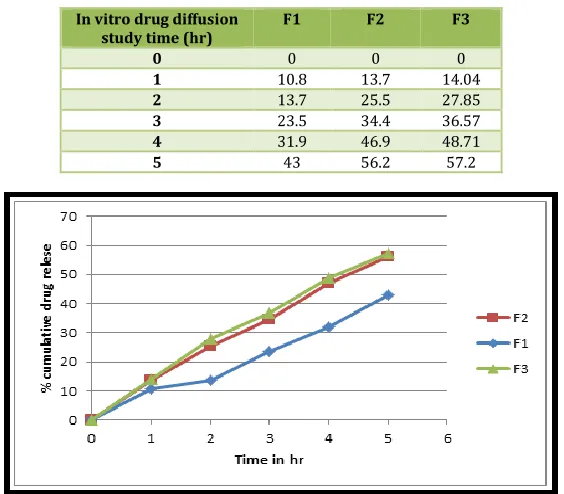
carried out using Franz diffusion cell apparatus and semi-permeable cellophane membrane. Cellophane membrane (egg membrane & rat skin), previously soaked overnight in phosphate buffer 7.4 was mounted by tied and sandwiching between the donor and receiver compartment. Franz diffusion cell with a diameter 3.7 cm was used in in-vitro release studies. A glass tube with both end open, 10 cm height and 3.7 cm outer diameter was used as a permeation cell. A one gram sample was accurately weighed and placed on a semipermeable cellophane membrane to occupy a circle of 3.7 cm diameter. The loaded membrane was stretched over the lower open end of a glass tube of 3.7 cm diameter and made water tight by rubber band. The tube (donor compartment) was immersed in a beaker containing 100 ml of phosphate buffer pH 7.4 (receptor compartment). The cell was immersed to a depth of 1 cm below the surface of buffer. The system temperature was maintained at 37°±1° and speed was maintained at 30 rpm throughout the experiment by magnetic stirrer (Fig.2.2). Samples 5 ml were withdrawn at intervals of 0, 1, 2, 3, 4, 5 and 6 hour, the volume of each sample was replaced by the same volume of fresh buffer to maintain constant volume. The samples were filtered
through Whatman filter paper, diluted up to 10 ml and absorbance
was taken by UV spectrophotometer at respective ʎmax. The
experiment was carried out triplicate and average value is reported
[13].
8.Stability studies: The stability study was performed as per ICH
guidelines.The formulated gel was filled in collapsible tubes and
stored at different temperatures and humidity viz [14],
1) 25°C±2°C/60%RH±5%RH 2) 30°C±2°C/65%RH±5%RH 3) 40°C±2°C/75%RH±5%RH
Samples were evaluated for various criteria after 3 months. The tests carried out for the stability samples were appearance, pH, drug content uniformity, spreadability, and extrudability. The methodology adopted for all the above mentioned studies was similar to procedure discussed previously.
Table No. 4: Diffussion study
In vitro drug diffusion
study time (hr) F1 F2 F3
0 0 0 0
1 10.8 13.7 14.04
2 13.7 25.5 27.85
3 23.5 34.4 36.57
4 31.9 46.9 48.71
5 43 56.2 57.2
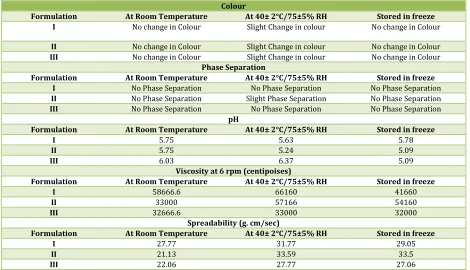
Table No. 5: Stability study of herbal gel formulation
Colour
Formulation At Room Temperature At 40± 2°C/75±5% RH Stored in freeze
I No change in Colour Slight Change in colour No change in Colour
II No change in Colour Slight Change in colour No change in Colour
III No change in Colour Slight Change in colour No change in Colour
Phase Separation
Formulation At Room Temperature At 40± 2°C/75±5% RH Stored in freeze
I No Phase Separation No Phase Separation No Phase Separation
II No Phase Separation Slight Phase Separation No Phase Separation
III No Phase Separation No Phase Separation No Phase Separation
pH
Formulation At Room Temperature At 40± 2°C/75±5% RH Stored in freeze
I 5.75 5.63 5.78
II 5.75 5.24 5.09
III 6.03 6.37 5.09
Viscosity at 6 rpm (centipoises)
Formulation At Room Temperature At 40± 2°C/75±5% RH Stored in freeze
I 58666.6 66160 41660
II 33000 57166 54160
III 32666.6 33000 32000
Spreadability (g. cm/sec)
Formulation At Room Temperature At 40± 2°C/75±5% RH Stored in freeze
I 27.77 31.77 29.05
II 21.13 33.59 33.5
III 22.06 27.77 27.06
RESULT AND DISCUSSION
A
ll physiochemical evaluation parameter of gel formulationare given in Table no. 2 from the result evident that all three gel formulation having good gelling property and homogenicity. The pH of all three formulations ranged between 5.75 to 6.05 which is acceptable for topical formulation. The extrudability of gel formulation from the
collapsible tube varied from 70-76 g/cm2 whereas the results of
spreadability varies from 22 to 27 g.cm/sec. A comparative study of viscosity and spreadability showed that the viscosity of the formulations increases, spreadability decreases and vice versa. From the results, it is clearly evident that all three optimized formulation showed good extrudability, homogenecity, viscocity and spreadability. The developed gel formulations were subjected to stability study as per ICH guidelines for the period of three months. By observing that effect of aging, viscosity, pH, spreadability, extrudability, it was confirmed that the developed gel posses good stability. It was observed that slight phase separation of F2 occurring at 40°C temperature. Other formulations showed good stability. The pH was constant throughout the study to about 6.5 and the gel did not produce any irritation upon application to the skin. The drug content uniformity of the gels were found in the range of 82-92%, F3 formulation contain more drug content as compared to other two gel formulations. F3 shows greater drug release 57.2% as compared with F2 drug release which is 56.2% in 5hrs.
CONCLUSION
T
his research work is carried out to develop a new topical herbal gel formulation for topical application. The prepared herbal gel was further evaluated for pH, Viscosity and extrudability, Spreadability, Drug content uniformity, In-vitro diffusion study, and stability Studies. The pH of all the formulations was in the range compatible with normal pH range of the skin. The drug content released was also above average. The rheological behaviors of the gel formulations were studied with Brookfield viscometer. The results indicated the viscosity of gel formulations was consistant neither too thick nor too thin. A comparative study of viscosity and Spreadability showed that with increase in viscosity of the formulation, the Spreadability decreased and vice versa. The gel formulation F3 was found to have all the desirable properties. Based on the above parameters, the formulation F3 isconcluded as most promising formulation and in vitro model can be use
for evaluation of its biological potency and it will useful for further clinical application.
REFERENCES:
1. Diandian shen. Development of anti-inflammatory agents from
the aromatic plants, Origanum spp. and Mentha spp., and analytical methods on the quality control of bioactive phenolic
compounds, dissertation work, October, 2008;2-3.
2. Abu Syed Md. Mosaddek, Md. Mamun Ur Rashid. Bangla J
Pharmacol 2008;3:44 - 47.
3. http://www.ayurvedaconsultants.com/herb
consult.aspx?commonName=NIRGUNDI accessed on Nov 2010.
4. Sultana A, Rahman KU, Padmaja AR. and Rahman S. Boswellia
serrata roxb. A traditional herb with versatile pharmacological
activity: a review. ijpsr 2013;4(6):2106-2117.
5. Garje KL, Salunkhe KS. Review on: anti-inflammatory herbal gel
of Boswellia serrata & Vitex negundo. IJPBS 2013;3(2):41-49.
6. Singh A, Duggal S, Kaur N, Singh J. Berberine: Alkaloid with wide
spectrum of pharmacological activities. J Nat Prod 2010
;3:64-75.
7. Gupta K, Sharma S, Khokra S, Sahu R, Jangde R. Evaluation of
wound healing activity of crude extract of Vitex negudo on rats,
Pharmacologyonline, 2012;2:1212-1216.
8. Khadabadi SS, Deore SL, Baviskar BA. Experimental
phytopharmacognosy, A Comprehensive Guide. Nirali
Prakashan, first edition, 2011;5.6-5.7.
9. Pudke Vrushali K. Development and evaluation of antifungal
herbal formulation for subcutaneous infection, dissertation submitted to Sant Gadge Baba Amravati university, Government
college of Pharmacy Amravati, 2014;75-82.
10. Gupta M, Verma PRP, Marwaha RK, Faruk A, Singh G.
Formulation and evalution of meloxicam gel. J Pharm Res 2008;7:27‐31.
11. Jadhav KR, Shetye SL, Kadam VJ. Design and Evaluation of
Microemulsion Based Drug DeliverySystem. Int J Adv in Pharm Sci 2010;1:156‐166.
12. Wood JH, Catacalos G, Liberman SV. Adaptation of commercial
viscometers for special applications in pharmaceutical rheology
13. Singh Manish. Formulation and Evaluation of Herbal Gel
containing Ethanolic Extract of Ipomoea Fistulosa. IJSR
2014;3(7):2319-7064.
14. ICH guidelines. Stability testing of new drug substances and
products, Current step 4 version dated 6 February 2003.
(http://www.ich.org/fileadmin/Public_Web_Site/ICH_Products /Guidelines/Quality/Q1A_R2/Step4/Q1A_R2__Guideline.pdf)
How to cite this article:
Vikram Choudhary et al. DEVELOPMENT AND EVALUATION OF ANTI- INFLAMMATORY HERBAL FORMULATION. J Sci Res Pharm
2018;7(2):13-17. DOI: https://doi.org/10.5281/zenodo.1182717
Conflict of interest: The authors have declared that no conflict of interest exists.