THE SCULPTURE
Plate VIA selection from the pieces of marble sculpture discovered during the campaign of 1931 will be presented here i-n a preliminary report. One piece, a marble herm, will be discussed in a subsequent paper by Professor George P. Oikonomos. The more fragmentary works will be reserved for the complete final publication of the results of the excavations. The marbles included in the present study fall into the three usual categories of Greek works, copies of Greek works made in the Roman period, and Roman works. Sculpture both in the rounid and in relief is represented.
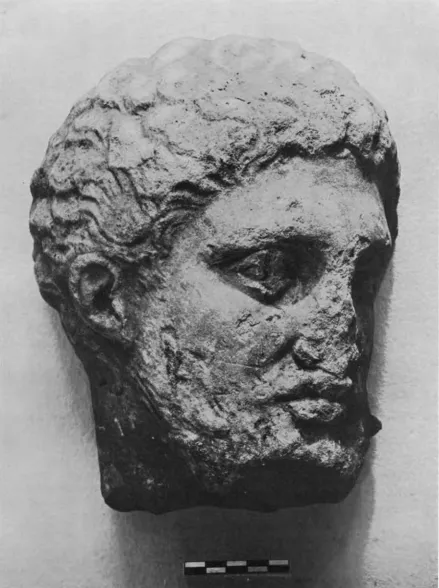
1. A marble head from a relief. Figure 1. Inv. No. 324-S 118. Found on July 27, 1931 in Section E 22/1S. Height: 0.27 m., width: 0.19 m. Pentelic marble.
The lhead represents a man of mature years, with mustache and beard and with the hair arranged in short curly locks. The lips are pressed together, there are pronounced lines on either side of the nostrils, and the eyes are deep-set at their inner ends. The style of the head illustrates the eclecticism of the fourth century. In its shape and in the treatment of the hair it is reminiscent of the work of Praxiteles, but the pathetic expression of the eyes, with their overhanging brows, is Skopasian in character.
The type illustrated by this head appears on Attic grave reliefs found in the Kerameikos and elsewhere in Athens and its neighborhood. The sepulchral monuments in the National Museum of Athens furnish excellent parallels. On one relief, Nat. Mus. No. 717 the manl is standing in a group of three persons of which a seated woman is evidently the deceased wife.' Waldstein (Sir Charles Walston) has pointed out the similarity of this standing bearded man to the magistrates on the east frieze of the Parthenon.2 For fir0ures of the same type reference may be made to Conze's catalogue,
Nos. 449, 450 (pl. CV), and 455. Heads which show but slight variations from the type appear on the following monuments listed by Conze: No. 239, pl. LIX; No. 304, pl. LXXII; No. 411, pl. XCVIII; No. 465, pl. CIX. This list could be almost indefinitely increased but sufficient examples have been cited to show that this is a typical head of the middle-aged man who is represented on the sepulchral monuments as mournfully gazing at a deceased wife or child.
I A. Conze, Die attischen Grabreliefs, 1, No. 322, pl. LXXX. P. Gardner, Sculptured Tombs of Hellas,
p. 168, pl. XXII.
2 Essays on the Art of Pheidias, p. 315.
American School of Classical Studies at Athens is collaborating with JSTOR to digitize, preserve, and extend access to
Hesperia
ko d . *e lS^ ; s
tw-se-< S-w<ilwo\- SS-e
ss > . ' .^:t > 4 J' 2;gs *at-;-t-t
L . E _ ';' 0''',si\u
D'''
W
1-S
'
6
e
; i pt w .-w.s u ':, . ' v l - *
'-, ^ C'.q;0r,'se,'1
i__
_r,_ _
_eN.F-
_F\@
,
S _|__a
|
..,
.|-
. -
.t*iSlli j
X ,
^ S FF .
>i
X sr 1. .s i. .v-
172 T. LESLIE SHEAR
As the head was found built into the side wall of a modern cess-pool no stratigraphic evidence is available for determining its date. Stylistically, however, it clearly belongs
in the series of sepulchral monuments of the fourth century B.C.
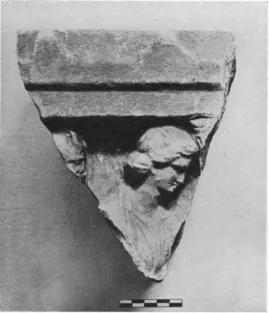
2. A fragment of a relief. Figure 2. Inv. No. 309-S 103. Found on July 13, 1931
in Section E, 10/I1T. Height: 0.165 M., width: 0.105 m., thickness: 0.095 m. Pentelic
Fig. 2. A Fragment of an Attic Grave Relief
marble which has been partly stained by fire. The back of the stone has been left in a roughly picked state, and its original edge is preserved only at the top.
The remains of two figures, a man and a woman, appear in relief beneath a plain
horizontal moulding,. Both of the filgfures face to the right. The head and bust of the
THE SCULPTURE 173
with the position of the head, and is set rather deeply under the brow. The girl wears a chiton which is arrang,ed in graceful folds, and she has a cloak draped about her shoulders. The expression of the youthful features is charming as the young woman gazes with serenity and intensity at some object in
front of her.
The types of the figures, their positions on the stone, and the manner of their treatment indicate that this fra(rment is broken from a sepulchral monument. The group as originally constructed was probably composed of three persons. On the left stood a man and a young woman, who were facing to the right and were looking down at a
seated woman, the man's deceased wife. The
arrangement may have been similar to that which occurs on a monument in the National Museum of Athens,' except that there the relative positions of the figures are reversed, since the seated figure is on the left of the group. In connection with that relief Conze designates the representation of both standing figures in profile as evidence of early date, but though that motive is present in the new fragment its stylistic character places it in the fourth century.
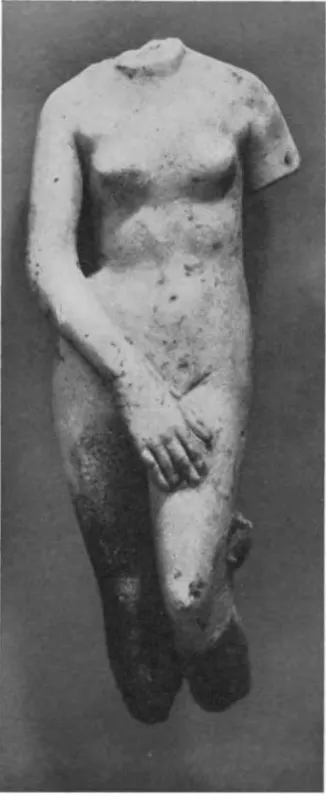
3. Marble statuette of a woman. Figure 3. Inv. No. 265-S 59. Found on June 13, 1931 in the large water-channel in Section E. Height: 0.20 m., width at the shoulders: 0.065 m. Parian marble.
The head, the left arm, and the feet are missing. The arm and the feet were made in separate pieces which were attached to the body by iron rods. The lower legs have been stained by the iron. The remains of a marble strut on the side, above the left knee, show that some object was attached to the figure.
The statuette is clearly made after the type of the Aphrodite of Knidos, and in its pose
Fig. 3. A Statuette of Aphrodite
and its general appearance it approximates the replica in the Vatican, except in the treatment of the right forearm which is carelessly made and of the hand, which is dis-
174 T. LESLIE SHEAR
proportionately large.' The position of the marble strut is much lower than is usual on the replicas.2 It could have served no useful purpose on this copy since the statuette is too small to require any support. The craftsman must have inserted it because he
. . .. .
Fig. 4. Statuette of Aphrodite. Back View
found it on the statue which he was copying. The context in which the statuette was found dates from the third and fourth centuries A.D. It was certainly made in the
1 Mliss G. M. A. Richter has conveniently grouped some of the replicas in her Sculpture anld Sculptors
of the Greeks, figs. 668 to 672.
2 A list of copies of the Aphrodite of Knidos is given by W. Klein, Praxiteles, pp. 251 ff. Cp. A. Fuirt-
THIE SCULPTURE 175
Roman period. The many reproductions of famous statues made by Greek artisans of that aoe could not have been made from the original works. In most cases they were undoubtedly copies inade from copies. The presence of the strut on the statuette, therefore, furnishes no evidence on which to base arguments for its presence or absence on the Praxitelean statue.'
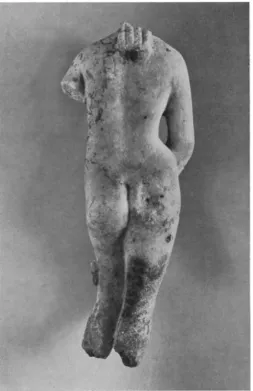
A curious feature of the new copy is the arrangement of the hair hehind (Fig. 4). Since the head is broken away only the lower part of the hair is preserved, but this hangs down in four straight stiff locks cut in a horizontal line at the bottom. It is a type of head-dress which is reminiscent of archaic style, and isi quite foreign to the character of the Praxitelean Aphrodite as it is revealed in the many replicas.2
4. Marble statue of a woman. Figure 5. Inv. No. 243-S 37. Found on June 6, 1931
in Section E, 5/B. Heig,ht: 1.40 m., greatest width across body and overhangin(g cloak:
0.615 m. Pelitelic marble.
The figure was fouind in four large pieces which had been built into a late wall. The head, the neck, and the front of the chest have been broken away, and the right arm and the left forearm are also missing. The left forearm had been made in a separate piece which had been fitted into the socket of the arm, where it was fastened with three pegs.
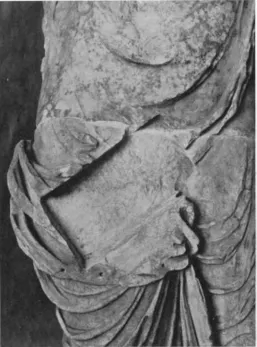
The statue stands with its weight on the right leg and with the left leg slightly bent at the knee. The woman is clad in a thin chiton and a himation. The latter is draped in such a manner as to pass diagonally across the back, with one end hanging, over the left arm, while the other end is clasped by the right hand in front of the body. From this bunch of drapery the garment then hangs down to the feet in deeplv cut folds. A series of eight small holes appears on one of the folds of the himation where it passes around the rig,ht hip and extends down in front. They may have served for the attachmenit ot some metal ornament.
At the poinit where the folds are thickly assembled in front of the body an ancient repair of the marble exists. An oblong cutting was made in the marble, measuring 0.22 m. in lencth, 0.12 m. in width, and 0.053 m. in depth, into which the additional piece was inserted (Fig,. 6). Since the marble and the workmanship of the insertion are similar to those of the statue the damage was probably done at the time the statue was made. Such injuries to statues must have often occurred in the coturse of manufacture, due to a defect in the marble or to some accident in the workshop.3 When the damaged piece was small the replacement was fastened in its bed with cement, as was done in the present case. The patch fits the socket perfectly, and the joints are partly concealed,
See W. Klein, Praxiteles, pp. 261 and 379 f.
2 For variations in the representation of the type compare Pottier and Reinachb La Necropole de
Myrina, p. 284.
fRll
4
44
zf
4A
kw!
fj
IV
THE SCULPTURE 177
when the piece is in place, by folds of the drapery which are made so as to overlap the edges and to overlie the adjoining folds which have been slightly shaved away.
The clothing is represented as of thin texture, and its folds, especially along the left thigh, are depicted with great charm and delicacy. This careful treatment of the
V117'
I
W~~~~~~~~~~~~~~~~~M
Fig. 6. Bed-cutting for an Ancient Repair
front of the figure contrasts strongly with the unfinished condition of the back where the tool marks on the surface have not been polished away (Fig. 7).
Various characteristics of the style of this figure bring, it into association with the works attributed to Timotheos. A Nereid from the akroterion of the temple of Asklepios at Epidauros clasps in similar manner a bunched mass of drapery in front of the body.' And for this motive Lippold compares the statue of a Maenad in the Vatican (Goethe-
178 T. LESLIE SHEAR
tanzerin).' Also the way in which the mass of drapery hangs down on the left side is matched by the statues in this group which are cited by Lippold, such as the figure in Copenhagen, the Leda in the Villa Albani,2 and a Nereid in the Archaeological Museum
Fig. 7. The Back of the Statue
in Venice. All these figures, moreover,
like the statue from the Agora, are charac- terized by the careless finish of the backs.
In view of the divergence of opinion among, scholars in interpreting ancient statues as Greek original works or as Roman copies it has become hazardous to make any definite affirmation on the
subject unless the circumstances of
discovery furnish conclusive evidence as
to date. But, although the context in
the present instance is not consistent in its chronology, it is significant that the wall in which the pieces of the statue were built yielded also four inscriptions of which three are dated by Professor Meritt in the early fourth century and one in the third.4 As the appreciation of a work of art rests largely on sub- jective grounds, there seems to me to be no compelling, reason why the statue should not be assigned to approximately the same period to which the inscriptions belong.
5. Statue of the Emperor Hadrian.
Plate VI. Fig,ures 8-10. Inv. No. 1165
-S 166. Found on July 25, 1931 in
the large water-channel at the north end
of Section E. Height: 1.52 m., width at
the shoulders: 0.82 m. Pentelic marble.
The head, the left arm, the right forearm, and both legs are missing. The head had
I Text to Brunn-Bruckmann, Denknialer griechischer und ri6mischer Skulptur', pls. 664-665.
2 Ibid. pl. 648.
3 Ibid. Text to pls. 664-665, figs. 1-2.
PLATE Vi
A,-A
~ ~
~
14~~~~
1!-wF' 48 T " Dt
5..}~.
a
~~~~~Fg 8.Th Scltue Deoaion of th Coslet
180 T. LESLIE SHEAR
been made in a separate piece which had been inset in the neck socket. The arms also had been made separately and had been attached by dowels.
The water-channel in Section E was in process of clearance from the interior when
Fig. 9. The Left Side of tlle Statue
the statue was discovered. Its position was ascertained to be beneath a house, adjoining the area on the north, which had not been expropriated. The statue was too large and heavy to be extricated through the channel, and it could not be excavated
from above. Consequently it was left
where it was found until the beginning of the season of 1932 when, after the removal of the house above it and the clearance of the terrain, it was eventually raised on
February 9, 1932. It is now standing,
temporarily on a stone foundation beside the channel.
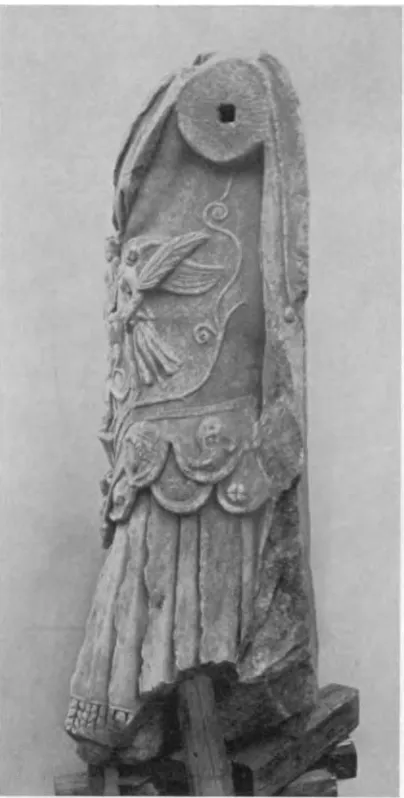
Although the head is missing this statue may with certainty be identified as Hadrian because of the similarity of its symbolical decoration to that on other statues of that Emperor. The closest replicas are a statue found in the exedra of Herodes Atticus at Olympia,' one at Kisamos in Crete,2 one from Gortyna, now in the Museum of Candia,3 and one in the Museum of Antiquities at Constantinople which was fouild at Hiera- pytna in Crete.4 The position of the arms of the new example was evidently similar to that of the statue at Olympia, the arms of which are preserved. The left arm was raised and supported a spear, and the right fore- arm was extended. The figure is clothed in an undergarment which appears below the leather skirt. Over this is the decorated
1 Olympia, III, Taf. LXV, 1; Text, p. 271.
2 Savignoni in Mon. Ant. XI, 1901, pp. 306ff., pl. XXV, 1. 3 Noted by Savignoni, loc. cit. p. 308, fig. 10.
4 A. Schede, Mleisterwerke der Tiirkischen Mutseen zu Konstantinopel, vol. I, Gqriech. u. runm. Skui1ptturen des
Antikenmnuseunziis, Berlin, 1928, p. 16, pl. XXXIII. Fragments of a similar statue execuited in fine style were found by Dr. 0. Bronieer in the Odeuim at Corinth. They have recently been published by htim in Corinth,
THE SCULPTURE 181
corselet with its pendent lappets and the kilt made of strips of leather with fringed ends. The great cloak, the paludamentuin, is caught on the right shoulder and thence passed, with rich heavy folds on the chest, over the left shoulder from which it falls down behind in a broad mass.
The corselet is decorated with figures in relief which are evidently imitative of richly ornamented bronze armor. The central group furnishes the keynote for the symbolical significance of the decorative theme. The goddess Athena, emblem of Athens, stands erect on the back of the wolf suckling the twins, the emblem of Rome, and the combination of these emblematic figures clearly characterizes Hadrian in his relation to the two cities, as benefactor of Athens and Emperor of Rome. Athena is represented in semiarchaistic style with the spear held in the upraised right hand and with the shield swungf on the left arm. She wears a triple-crested helmet and has her hair arranged in two long braids. The aegis has the shape of a jacket, with the gorgoneion on the front and with serpents along the edge. Beside Athena are her attributes, the
owl and(I the snake, which are supported by conventionalized tendrils extending from the
cluster of acanthus leaves on which rest the wolf and the twins. Side tendrils of the acanthus serve pictorially to support winged Victories which approach Athena from either side with the purpose of crowningf her with the wreaths held in their right hands. In the left hands they carry palm branches.
While the groups of figoures on the front of the corselets of these statues of Hadrian
are generally similar, minor variations show that they are not mere mechanical copies of a single prototype. On the statue at Olynmpia the positions of the owl and the serpent are reversed in their relation to Athena, and the folds of the: cloak on the breast are quite different. Equally apparent variations may be observed on the other members of the group, especially in the method of handling the folds of the cloak.
Below the corselet is a double series of decorated panels in imitation of the bronze lappets of veritable armor (Fig. 8). The decorations are arranged according to the following scheme: In the upper series on the right side are the head of Ammon, an eagle, a human head, an elephanit's head, and a rosette. On the left side there is one less lappet in this series than on the right because of the overhanging edge of the cloak (Fig. 9), and consequently the rosette is omitted. The lower lappets are decorated, on the right side, with a helmet, a lion's head, a rosette, and a pelta. On the left side the positions of the rosette and the pelta are reversed. The arrangement of these decorations, especially in the lower series, differs somewhat in the various related statues. The central decoration of the upper and larger set of panels is the head of Zeus Ammon. This is executed in the crude style and the coarse workmanship which are characteristic of the relief sculpture of most of the Imperial statues. A notable exceptioni to this rule is the figure at Corinth on which the relief decorations are carefully and admirably carved.' The panels on either side of the head of Ammon are filled with
I 0. Broneer, op. cit. pp. 125 ff., figs. 118-120.
182 T. LESLIE SHEAR
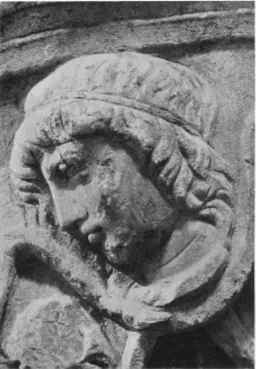
eag,les with spread wings in an attitude of flight away from the centre, but with the head in each case turned back. Next in order come two heads in high relief represented in full profile, on one side to the right and on the other to the left (Fig. 10). The heads which occur regularly in this position on these statues are usually interpreted as
Fig. 10. The Head on a Lappet of the Left Side
gorgoneia, but the feminine characteristics are so little apparent that they have also been interpreted as heads of Hermes.1 The head on the new statue has short hair which is bound by a fillet. The profile shows a type which is based on good Greek tradition, and there is nothing about the head itself which would warrant its inter-
1 Cp. Musee linp. Ottomnan, Cat. des Sculptures, 1893, p. 18. This statement is corrected by Schede,
THE SCULPTUJRE 183
pretation as a Medusa rather than an Apollo.' But there is a conventionalized necklace about the neck with a loop in front, which seems to be a survival of the looped serpents about the neck of Medusa. In marked contrast to the workmanship of the human heads are the crude heads of elephants carved on the succeeding lappets on each side. The head on the left, near which the cloak came, is most carelessly rendered, with both ear and trunk ruthlessly clipped so as to fit it into a shallow panel.
The kilt is represented as made of leather strips, with fringes on the edges and on the bottom. The cloak hangs down behind so as to cover the entire figure, and the large expanse of blank surface is relieved only by a series of conventionalized folds. The elaborate decoration of the front of the statue is in strong contrast to the simplicity of the back.
The Emperor Hadrian was honored by the erection of many statues of him. in Athens.2 In the theatre of Dionysos alone there were twelve such dedications, one made by eacli tribe, and there is record of one in the Olympieion and of one in the Parthenon, but no reason exists to doubt that the statue found in front of the Stoa of Zeus is the one reported as standing there by Pausanias.
Dr. Broneer has pointed oult that the corresponding head from the stattue at Corinth is similar to a head of Apollo fotund in the theatre there, op. cit. p. 126.
2 W. Judeich, op. cit. pp. 101 f.
3 I, 3, 2.