Tangling in Remix | 17 |
issue critical. Layout for this issue is the work of León de la Rosa-Carrillo (also Guest Editor): profound thanks to him for this undertak-ing. Thanks to University of Arizona Interim Director Martina Shenal for support of Managing Editor Chun-Chieh Chen’s position and to jCRAE’s parent organization, USSEA, and especially President Alice Wexler, Past President Steve Willis, and the USSEA Board for their support of the journal. A continuing thanks to readers for their inter-est in and support of cultural research in art education. We invite your contributions, and hope you will join or renew your membership with USSEA at ussea.net.
References
Amerika, M. (2011). Remixthebook (Kindle ed.). Minneapolis: University of
Minnesota Press.
Caplan, P. (2013, October 19). Everyday Remix - Remix [App-Book]. Retrieved
from http://www.theinternationale.com/everydayremix/#remix
Everything is a Remix with subtitles. (2011, November 22). Retrieved from http://www.amara.org/en/videos/1YEcplHRVXz2/en/9204/
Ferguson, K. (Director). (2010) Everything is a Remix [Video Series] USA. Avail-able: https://vimeo.com/14912890
Knobel, M., & Lankshear, C. (2008). The Art and Craft of Endless Hybridiza -tion. Journal of Adolescent & Adult Literacy, 52(1), 22-33. Retrieved from http:// www.jstor.org/stable/30139647
Lessig, L. (2008). Remix: Making art and commerce thrive in the hybrid economy
(PDF ed.). New York, NY: Penguin Press.
Miller, P. (2004). Rhythm Science. Cambridge, MA: The MIT Press.
Tangling in Remix
R. Darden Bradshaw PhD., University of Dayton Barbara Bergstrom PhD., Bowling Green State University1
AbSTRAcT
This project illustrates an alternative, or remixed, method of writing about a collaborative inquiry of two art educators. Their journey comprised searching, identifying, quarreling, and ultimately, proceeding forward on issues related to gaining relevant relationships with the culture of remix and the authors’ prac-tices as art educators. The layout used to illustrate the discourse between the authors presents a philosophically as well as emotionally labor-intensive de/ reconstruction of personal and professional issues related to using concepts of remix with students in art education classrooms. The journey itself enlight-ened the authors and energized a challenge to come to grips with topics they didn’t understand but wanted to understand in order to more fully connect with the media-rich lives of their students. This document shares lessons learned around a process of being transparent about differences, modeling rigorous discourse about the unknown, and sustaining a curiosity for meaningfully hon-oring the lives of our students.
The term remix has been flowing in and out of our awareness for years. A colleague in graduate school used the term to describe his research. Darden used the term with her mother when discussing a partially failed piecrust recipe. Her daughter, laughing with a friend in the backseat, used remix to describe a song that has been reinter-preted by a new contemporary artist. Despite such recollections, we, authors Darden and Barbara, discovered that our understanding of remix was vague and fleeting, and that we much preferred analog to digital remixes. Through research and discourse we investigated the relationship between remix and art education. At times, we struggled to communicate as we realized how we teach from places very dif-ferent from one another, as well as from where our students come. Compounded with our discomfort and anxiety about remix, our
real-1 Correspondence regarding this article may be sent to the authors at dbrad
Tangling in Remix | 19 |
ization called attention to the fact that we are both digital immigrants, dissimilar to our students who are digital natives (Prensky, 2001). The two of us were confronted with the knowledge that in order to reach our students and support them in becoming educators who can reach their students, we must change. We found ourselves resistant.
This article attempts to give tangible, visual form to our collaborative journey exploring remix as both practice and as culture. Within it we ask, how might our understanding of remix help our teaching? The two of us agreed that it was important to proceed knowing we would be transparent about our journey while modeling to our students the ways remix culture influenced us as pedagogues. In turn, we believed that our students might benefit from a similar expedition into the concepts of remix as a means of enriching their individual teaching practices and philosophies. Going forward, we honor each voice; we use the column format to indicate our various approaches to remix. These parallel threads are complementary but distinct. Darden’s more conversational narrative stands in contrast to Barbara’s matter-of-fact prose.
We begin this article by gathering contexts in which remix is used by artists, scholars, and musicians. We agreed that we would use the term remix as follows: a mixture, a combining together of all experiences, beliefs, theories, backgrounds, and values associated with who we are. In what follows we present our understanding in four sections.2 In the
section we call “Searching,” we move forward from our understand-ing of remix by examining our relationships with remix and teaching as well as remix and artmaking. Next, in “Identifying,” we investi-gate our individual relationships with technology and the networked culture in which we live. In the section we call “Quarreling,” we come together to share our different understandings. Finally, in the section we call “Proceeding,” we articulate the ways in which we imagine this journey could potentially inform the work undertaken by art
2 The educators and experiences to which we refer in the text repre-sent various relationships and occasions that made an impact on our journeys. Therefore, they are footnoted individually for the reader’s benefit.
educators in higher education and, ultimately, their pre-service art education students.
Searching
In our attempt to find ways in which remix, as we understand it, could be used in valuable ways within contemporary social, cultural, and educational practices, several thought-provoking questions chal-lenged our research process. The following exchange begins to reveal our unsettling individual differences and indicates the complexity that accompanied our journey. Here are excerpts from our collec-tion of writings and thoughts that informed our conversacollec-tions about remix. You will see that the column on the left indicates Darden’s process while the column on the right indicates Barbara’s.
I find myself recalling an incident three years ago. Driving down a Tucson highway with my then 15-year-old daughter and her best friend in the backseat, the radio is blaring and floating up toward me over the strains of the music are comments about “how awesome is this new song.” As they discuss the artist’s attrac-tiveness and his ability to lay musical tracks over one another, I chuckle.
They do not realize the song is a remix. The version I knew in the ‘80s has been remixed into this 2011 version. I listen and laugh, not at them but with them, as I realize I said almost the exact same thing at the age of 15. And
Tangling in Remix | 21 |
my mother politely told me the original song had been made in the ‘60s.
In the past, when I thought of the term remix, I interpreted it only from a technological perspective in which a musical work of art is altered and revised to include another. Yet as I consider Amer-ika’s discussion of “hybridized, post-studio arts practices” (2011, p. xiii) I wonder…is what I do as a teacher also remix?
Remix culture creates derivative works. And to avoid copyright issues, the work has to be so transformed as to no longer
reflect the original (Lessig, 2008). Yes, teaching is an act of derivation. We take the experiences we have had, the moments of learning that were most pivotal to us, and use them as the springboard. Certainly, my teaching practice is a
hybridization, derived from that I have experienced as a learner. Yet I question, am I altering those experiences enough that they no longer reflect the original or so that they are used in such a way that I make them uniquely my own? Is it possible in a remix culture for something to ever be uniquely one’s own?
Today, a sophomore undergradu-ate said to me, “Last week when I presented my lesson to the class, I heard phrases coming out of my mouth I had heard Mr. W. say during my observations of him.” I smiled encouragingly at him. Yes, I thought . . . we are remix, let alone its potential
relevance to art education. That said, the term was not foreign to me as I vaguely recalled that remix employed technology.
I understood remix to have started in the hands of artists, specifically musicians. I also understood the use of remix to be a creative act. But wait.
Remix can be made up of arti-facts from our personal archives (Knobel & Lankshear, 2008).
Amerika (2011) has claimed remix to be a “cross between an improvised keynote address delivered at a conference on disrupting narratives, a stand-up comedy routine, and the kind of live, pedagogical performance found in experimental seminars and lectures . . . in a lab focused on inventing future forms of avant-garde art and writing” (p. vii).
I remembered a lecture that I had recently attended by Drs. Wong and Wong, authors of The First Days of School: How to be an
Effec-tive Teacher (1998). One of the first slides in their presentation read “STEAL” in massive letters. Dr. Wong asserted that that is how to be a good teacher, steal from your colleagues. To me, this seemed to be a kind of remix.
I am also curious about Amerika’s “realm of autohallucination,” or what sounded to me like a sort of forgiveness we give ourselves before taking risks with hopes of new discovery.
Tangling in Remix | 23 |
all appropriating, or ripping off our teachers. When I took Dr. Beudert’s3 assignment to create
an autobiographical art educa-tion timeline and used it in my own classes, I was appropriating that from her. Perhaps she ap-propriated it from someone else. We are part of a culture in which we “consume and then critique, customize, create, and recreate” (Burwell, 2013) the pedagogical texts we use.
Everyone does this, right?
I have used Dr. Garber’s4
aes-thetic puzzle assignment to have students investigate the process of creating an open-ended ques-tion about aesthetics and art, Kyla Macario’s5 cultural literacy
exercise to confront the biases we carry into our teaching practice, Saphier and Gower’s Skillful Teacher (1997) graphic organiz-ers to help students gather and
3 Dr. Lynn Beudert, Professor Emeri-tus of Art, the University of Arizona. 4 Dr. Elizabeth Garber, Professor of Art, the University of Arizona. 5 Kyla Macario, Professor of Practice,
Teaching and Learning Center, the
University of Arizona.
synthesize lecture information, and Dr. Short’s6 studio/lecture
format to organize a class. If I listed or noted everything I use that I’ve ripped off/borrowed/ appropriated/remixed from my former teachers, books I’ve read, videos I’ve seen, I’d have a book. Yet, little of that is using technol-ogy but every bit of it is a type of networked remix (if I understand remix).
Thomas Moore, in Care of the Soul (1992), remixes Renaissance phi-losophy and theology as he situ-ates a set of suggestions for how one might begin to think and act in a way that allows us to care for our soul— ultimately to push back against the ways in which we become divided selves. Care comes from the Latin term cura. To curate is to “look after the items/objects in a collection”
6 Dr. Kathy Short, Professor of
Language, Reading and Culture, the
University of Arizona.
undergraduates as they began to assemble parts of their teaching portfolios. I thought, perhaps the concepts I could learn about building a “remixed” binder would enhance my students’ professional portfolios. It did not take one critical minute for me to gather the overarching purpose of this blogspot. As I saw it, the site merely offered some advice to new teachers: get organized! I thought, “duh!”
Later, I heard a report that focused on the popularity of smart tools and the unique ways in which they interacted with users. Feedback from smart tools was reported to be constructive, not punitive, and often happens through a series of progress-ing levels. A user’s purpose is then advanced, as if in a game. “Classroom pedagogy stands to learn much from remix practices and smart tools and how they en-able learning and achievement” (Lankshear et al., 2013, p. 30). In the nearest margin I wrote, “This quote scares the crap out of educators like me.” Smart tools have not been a part of my world—educationally or other-wise— until recently. When will I find the chance to fully immerse myself with technology in order to find comfort participating within it? I wish to model to stu-dents an authentic engagement with contemporary tools.
Tangling in Remix | 25 |
or to “select, organize and pres-ent . . . typically using profes-sional knowledge” (Retrieved from http://www.oxforddiction-aries.com/definition/english/ curate#curate-2.)
In delineating our teaching prac-tice, we are curating the class-room and learning experiences for our students. The artists, artwork, pedagogical structures and practices, teaching tools, and performative strategies I chose are, in fact, carefully selected to correspond with the knowledge gaps, purposes, and goals of the course, personalities of the learn-ers, and my past experiences teaching the course content. This is remix, is it not?
Do I have the cultural literacy to engage in remix? In our discus-sion, Barbara keeps addressing technology. I desperately want to ignore that piece. I am un-comfortable with that part of the discussion and keep trying to change the subject. I don’t really know what a meme is and every time the word is used, I feel my anxiety rising. How can I partici-pate in remix culture when I am deeply resistant to being open to learning about it? Why am I resistant?
I feel silly being resistant.
And maybe a valuable question The ongoing 20-year old
inter-national art show do it contin-ues to tour the works of artists including Adrian Piper, Félix Gonzales-Torres, and Ai Weiwei. The exhibition includes various sets of instructions written by approximately 250 artists and, according to Obrist, “every work is very much a collaboration between the artist who writes the instructions and the artist who actually executes it (as well as) the visitor who interacts with it” (Nathan, 2013).
Remix, right?
According to Deleuze and Guattari (Wolters, 2013, n.p.), “Rhizomes, taken from a kind of root system found in nature, are non-linear, and non-hierarchical” (n.p.).
Remix, right?
I recall one of my favorite part-time jobs, working as a librarian’s assistant at the School of the Art Institute of Chicago. There, my
passion for the Fluxus art move-ment exploded as I routinely experienced the works John Cage, Yoko Ono, Dick Higgins, and Charlotte Moorman. These artists and their work, like Yoko Ono’s Instruction paintings, are remix, right?
Cultural literacy required!
Tangling in Remix | 27 |
to ask myself is, am I willing to dismiss my understanding of remix because it does not in-clude technology to the greatest degree?
With each new reading, each time I sit down to investigate remix, my conception of it is modified. Just as I feel I have a handle on remix, there is a seismic swing and the paradigm has changed. Remix is a form of deconstruction (Amerika, 2011), a hybridization that combines parts from other wholes into a new work (Knobel & Lankshear, 2008). As I read and engage in this discourse, am I remixing the personal archives of Darden?
networks. I recognized a new desire to combine my visual art teaching practices with comput-ers. No longer dragging my feet, I was encouraged.
Indeed, for me, my personae has included that of an interloper.
I learned from Knobel and Lank-shear (2008) that remix could be taking cultural artifacts and com-bining and manipulating them into new kinds of creative blends. They claimed that remix “had expanded from remixing music and sound to [include] moving and static images, television, the Internet, personal archives” (p. 27). I like that. I saw the poten-tial of finding personal value in concepts of remixing as it could include my “personal archives.”
Finally, I had to quit looking for definitions after I came across Lessig’s (2005) comment that there is “no end to remix.” In-stead, there are fertile, “current remixes that reference previous remixes in a layer of significance indicat[ing] the fertility of an earlier remix” (p. 26).
Identifying
We came back together. In the process of sharing the results of our searching, there were several impassioned differences that separated our perspectives. We experienced frustration, “a-ha” moments, and (dis)connections as our individual artistic practices as well as teaching practices did not coalesce, yet seemed to naturally embrace concepts of remix. This phenomenon reminded Barbara of another research project she had done where similar circumstances emerged while par-ticipants were investigating sense of self and identity. In that study, participants did their best work in collaboration with one another. Barbara recalled, “it took a collaborative investigation to determine the intricacies of our individual selves” (Bergstrom, 2014, p. 212). Together, the two of us discovered a stronger sense of self while mak-ing room to acknowledge one another. In our “Searchmak-ing” section, we began our individual investigations of remix, yet here in “Identify-ing,” using concepts of mash-up, our identities, and specific theorists, we move from the internal dialogue to a collaborative discourse. We kept remixing.
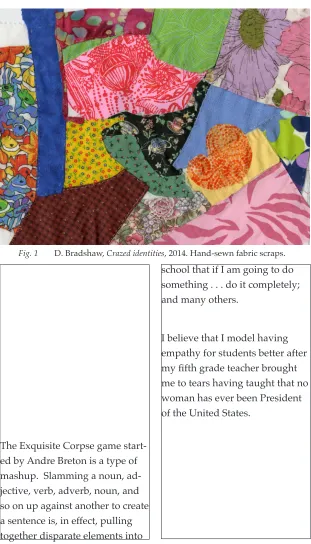
As an educator I am continu-ally becoming . . . my identity, knowledge, and experiences as artist, researcher, teacher, advo-cate, mother, and colleague are pieced together into a particular construction. I am engaged in a collage process on a daily, mo-mentary basis. By doing so, am I the producer of culture? Or am I still a consumer? (see figure 1)
I love to think of myself as a remix of several powerful ex-periences I have experienced in schools. My teaching philosophy stems from my unique combina-tion of Mrs. Mitchell’s8 “cheer”
to help us learn important dates in European literature; Robin Williams’ character in Dead Poets’ Society; Mom, who reminded me that as a student, sometimes you learn about what kind of teacher you don’t want to become; Dad, who told me while in elementary
8 Mrs. Ann Mitchell, Barbara’s
Tangling in Remix | 29 |
The Exquisite Corpse game start-ed by Andre Breton is a type of mashup. Slamming a noun, ad-jective, verb, adverb, noun, and so on up against another to create a sentence is, in effect, pulling together disparate elements into
Fig. 1 D. Bradshaw, Crazed identities, 2014. Hand-sewn fabric scraps.
a new whole with new mean-ings and derivations. Every class I teach, I use the Surrealist Exquisite Corpse drawing game7
as a way to encourage collabora-tion, play, and creative problem solving. As students engage in an analog form of mashup, they discover the relationship of semiotics, artmaking, and visual culture literacy.
Amerika addresses the oppor-tunity that arises from mashing up academic writing and popu-lar culture (2011, p. xii), yet I am conflicted. I am excited, on the one hand, by the idea that our work as scholars and educators can be shared in vari-ous forms (written narratives, digital narratives, or digital non-narratives) and through various outlets (journals, blogs,
7 Surrealist artists adapted the
Exquisite Corpse poetry game to one that involved a drawing created by a group of people. Each person would create a drawn image on a piece of
paper, fold down the paper, and pass
the image on to the next participant, and so on. The resulting collaborative drawing had an element of chance and unpredictability. The original intention of the game was to engage
the collective unconscious and see phenomena in new ways.
school that if I am going to do something . . . do it completely; and many others.
I believe that I model having empathy for students better after my fifth grade teacher brought me to tears having taught that no woman has ever been President of the United States.
Tangling in Remix | 31 |
books, videos, or other yet-to-be imagined means). That opens up a great space for me as an artist and teacher to find a hybrid research methodology. Yet on the other hand, as I am trying to figure out the protocol for achieving tenure at my insti-tution, the reality that research can be more practice-based and performative while resisting categorization makes me feel vulnerable. If I, as an artist and art educator, struggle to remix definitions of scholarship, how will my colleagues from other disciplines who must evaluate my work respond? I would be much more comfortable sharing my research in various for-mats and modes if I knew with certainty the University Tenure and Promotion committee un-derstood remix as I do.
“For myself, I find that my attitude towards, and understanding of my work is in a constant state of flux. I am continually learning more of what my work is about from other people and other sources” (Haring, 1984, p. 369).
While we are modeling remix practices, are we consciously and overtly articulating that it is remix? I hear myself channeling Ms. TerVeen, my high school art teacher: “Pay attention to where the light hits the object. Do you see the range of values? What is the relationship of one form to another?” As I turn to an-other student, I realize that Gayle Wimmer, my graduate fibers professor, has just appeared over my shoulder as I challenge the student to consider what they are trying to say.
Is the value-added approach to understanding the visual arts dependent on a viewer’s inter-pretation, or on remix? Isn’t this what I have read Barthes (1972) proposed, that a work of art is complete only after the viewer has drawn meaning from it?
Further, I learned, media and remix literacy fortifies users’ civic engagement by facilitating new forms of participation (Mihailikis 2012).
In my role as an art educator, I demonstrate my own remix of all the pedagogical influences I have experienced. Might I consider myself “en route to an identity,” as Amerika might propose?
Amerika (2011), claimed that in the “remixthebook project [he hoped to] indicate to emerging artists and scholars, particularly those engaged in advanced forms of digitally processed, practice-based research, an alternative model of multimedia writing . . . as part of a professional course of action” (p. vii).
Tangling in Remix | 33 |
I said to Barbara today as we departed our meeting at the cof-fee shop in Lima, Ohio, that as we research remix I feel like we are vultures, circling over road kill. Just as we swoop down and grab a piece of remix that meshes our ideas and/or furthers our understanding, a semi-truck comes along so we quickly fly away leaving with just tiny little morsels.
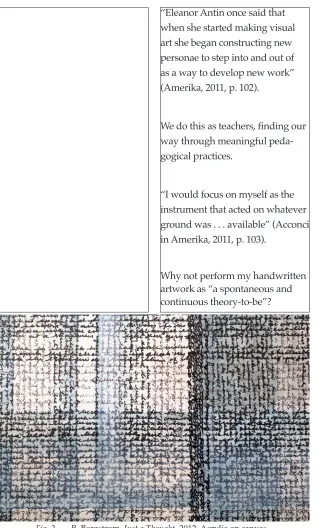
“Eleanor Antin once said that when she started making visual art she began constructing new personae to step into and out of as a way to develop new work” (Amerika, 2011, p. 102).
We do this as teachers, finding our way through meaningful peda-gogical practices.
“I would focus on myself as the instrument that acted on whatever ground was . . . available” (Acconci in Amerika, 2011, p. 103).
Why not perform my handwritten artwork as “a spontaneous and continuous theory-to-be”?
I read what Amerika crossed out on page xvi in remixthebook, “Do I contradict myself? Very well, then I contradict myself. I am large, I contain multitudes.”
Um . . . Yes, I believe that we all contradict ourselves at times. I began to wrestle with how this fact relates to being a classroom teacher and an inspiration to future artist-educators.
The phenomena of “becoming” intrigued me and was consistent-ly part of my art-making prac-tices. As addressed in my artist statement, in my art I consider the human performance of everyday and how one’s personal priorities coincide with time spent.
Okay. At this point, we have read about disrupting narratives, the phenomena of becoming, theo-ries-to-be, being en route, and always becoming. Are we any closer to knowing what remix means?
Tangling in Remix | 35 |
Quarreling
Coming together again after numerous sessions where we had spun our wheels, we were determined to find consensus and move for-ward. With hope and determination, we aimed to collate. However, as colleagues and friends, we were caught off guard by the messy nature of our collaborative process.
The following “Quarreling” section reveals evidence of the continued clash of our two divergent voices. Rather than being a transcribed dialogue, these thoughts and writings visually chronicle the impetus for conflict.
At least once a month I find myself handing my phone to my daughter and asking for her help solving another techno-logical problem. I resent being dependent and not being able to quickly or easily convey my ideas because I do not have tech-nological know-how.
I realized I share this frustration of feeling dependent with my students. Recently one of my preservice students wondered aloud how it was I had the abil-ity to walk into a classroom of Kindergarten students without fear, and step in or take over a lesson she had been teaching that had begun to fall apart. That ability and sense of confidence was gained through exposure, experience, and remixing the pedagogical practices of my own teachers. She will get there, if she keeps learning and if she stays open to finding her teacher voice, I assured her.
Will I get there with remix? I heard students discussing SnapChat again. My daughter is tethered to her iPhone in much the same way I am tethered to my pencil. I love the feel of hold-ing the pencil, the dark marks of graphite on the white paper, and seeing the words take shape. The disconnection and sterile process of sending a text message both-ers me. I’d rather meet and talk in person with someone, yet I see my daughter in a room with four of her friends, all completely Convinced that remix employs
technology in some way, I inves-tigated new ways to make art using a computer. Attending the Ohio Art Education Association conference, I was sure to visit sessions that would help me ap-preciate and adopt technology in my classroom. The sessions that I attended had titles such as “An introduction to internet-based art-making,” “Operation iPad,” and “Digital art lessons using free software.”
Tangling in Remix | 37 |
silent as they communicate digi-tally via text and Snap messages.
I questioned, what are the larger set of social practices in which learners are engaging now? How have these Apps and social media sites changed their relationships with learning? As I investigated SnapChat™ with my daughter one evening, I discovered that she and her friends place little value on the
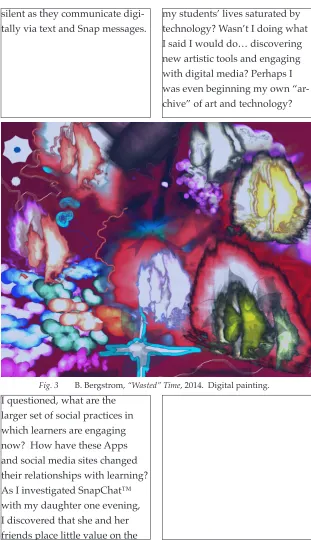
my students’ lives saturated by technology? Wasn’t I doing what I said I would do… discovering new artistic tools and engaging with digital media? Perhaps I was even beginning my own “ar-chive” of art and technology?
content of the “snap.” Rather, the value comes from the number of people following you. If one does not respond or snap back, people stop following you. I was stunned. What is being said is less important than the volume of people hearing you say noth-ing? If students are producing culture and the content of what is produced is irrelevant, what value is there in the production? My anger has ignited a fire. I must find a way to cross this technological and cultural divide. Is remix the answer?
Fig. 3 B. Bergstrom, “Wasted” Time, 2014. Digital painting.
Fig. 4 Darden
Tangling in Remix | 39 |
I must confront my relation-ship with technology, or more accurately, my anxiety with it that precludes me from mov-ing forward. I may never lose my “digital immigrant accent” (Prensky, 2001, n.p.) but I will at least be conversing in the same language with my students.
“Women have always col-lected things and saved and recycled them because leftovers yielded nourish-ment in new forms. The decorative functional objects women made often spoke in a secret language, bore a covert imagery. When we read these images in needlework, in paintings, in quilts, rugs and scrap-books, we sometimes find a cry for help, sometimes an allusion to a secret politi-cal alignment, sometimes a moving symbol about the relationships between men and women. We base our interpretations of layered meanings in these works on what we know of our own lives - a sort of archeological reconstruction and deci-phering” (Shapiro & Meyer, 1996, p. 153)
Recently, in order to achieve my vision for an arts-based research project in which I was involved, I reluctantly had to learn how to create a website. The investment of time and energy was tremendous; my learning curve was steep. I am proud of the work I achieved, yet exhausted at the thought of having to invest precious resources so I can learn nu-merous new technologies to continue moving forward and share in the language of my students.
I wonder, will I carry that experi-ence over into my classroom? My students must be competent to create a website, right? There is this voice in my head that says I am the professor, I am supposed to teach them but more often than not, they are teaching me. (Bradshaw, 2014).
Paik claimed new media artists can focus on “cybernated life,” that I translated as, lives that I considered to be technology-saturated.
How about the artist as me-dium?
I wondered, how about the teacher as medium?
Paik continued, “Cybernated art is very important, but art for cybernated life is more impor-tant, and the latter need not be cybernated” (Paik in Amerika, 2011, p. 104).
Tangling in Remix | 41 |
Our apparently different understandings of the ways in which technology has to be incorporated or used in remix seemed to be a tripping point in our discussion; we trespassed upon one another’s identity. We argued, pushed, and got our hackles up.
“I’m so lost. I don’t get what your frustration is.” Darden
“I don’t know what to do about [our discord]. I feel like this is getting icky.” Darden
“I don’t see how me saying that technology has to be part of remix is confusing.” Barbara
“Me too.” Barbara
We stepped on one another’s toes and then insisted that we each provide clarification as we articulated and processed the complex thoughts, viewpoints, and ideas that comprised our interactions. On the verge of exasperation, we had to step back. Finally seizing an opportunity to draw connections between the use of technology in remix and art education, we shifted focus onto our students. Hav-ing reached the peak of our dispute, we realized that the process of searching, identifying, and quarreling greatly heightened our indi-vidual awareness for the subtexts from which the two of us approach teaching and artmaking.
Remix allows us to move away from the mass-produced product of education, the branding, if you will, of students into our theories, beliefs, and ideas . . . it creates a culture through which we are encouraged to foster students to cultivate, create, critique, and ultimately re-create the text of the teacher they are becoming. Am I creating an environment where my students can write and rewrite the
text of their lives (Barthes, 1972) as Dr. Beudert encouraged me to do years ago?
Remix is not new (Knobel & Lankshear, 2008) and has been a part of cultural development be-fore digitization. Yet technology has become “increasingly inte-gral to how [young people] make meaning and express ideas” (p. 23).
If, as Iser (1980) notes, the act of reading is a process of becoming conscious, am I creating a space where students are reading their culture and becoming critical remixers?
According to Wilson (1997), the goal of art educational research is to provide knowledge about the ways art-learners use special ar-tistic insight to expand their con-ceptions of themselves, past and
It made sense to me that remix could be part of an aesthetic; however, it seemed that, by definition, it would not be part of a summative assessment of students’ work. Right?
Tangling in Remix | 43 |
present worlds, imagined and future worlds, and the norms by which individuals govern their lives through writing the texts of art into the texts of their lives within and beyond school. (p.3). As I ask my incoming art edu-cation majors why they want to teach, am I inviting them to research into their views of themselves, to investigate what education has been for them and ultimately to remix their own teaching philosophies?
In my resistance to technology, am I precluding my students from writing and remixing the text that allows them to find their own meaning as a teacher? I have become part of what Pren-sky (2001) notes is the single big-gest issue in education—teachers who speak an outdated language teaching students who speak an entirely different one.
Recently I found myself in an un-familiar situation as an educator. I took a moment and, Barbara’s and my remixed version of the popular phrase, “What Would Jesus Do,” asked, “What would Elizabeth do?” What pedagogi-cal practices are there in my past experience, my toolbox, my awareness that I can draw from, combine, and recreate to address this particular situation?
Have I been unfair to my stu-dents? How could I make partici-pation with personal electronic devices a valuable practice in art education?
I’m working on it.
How might an art educator be considered a “creative blend?”
How does a teacher (and peda-gogy) become a remix of images (moving or still), television, the Internet, and personal archives?
And then, what about making them meaningful to a group of art students?
What about technology?
Tangling in Remix | 45 |
Proceeding
Using these insights as the springboard to welcome our new under-standings of remix into our classrooms, studios, teaching, and artmak-ing practices, we finally began articulatartmak-ing our paths goartmak-ing forward— the ways we intend to bring remix into our pedagogies.
How might fan fiction be useful in creating a space in which my students become the actors in their own teaching? Fan fiction is a rewriting of a movie or tele-vision show in such a way that there is a new version, storyline, or character development (Berkowitz, 2012). Literacy scholars advocate bringing this practice into the K-12 classroom (Gee, 2004; Knobel & Lankshear, 2008; Manifold, 2009), but what if we focus in art education on fan non-fiction. I define fan non-fiction as remixing and rewrit-ing based on real events lived with real art educators that occurred in the course of one’s art education and through which the learner becomes a fan of the
educator or their practices. As a result of that fan experience, the participant rewrites and remix-es their art education philoso-phy, pedagogy, or practice as a byproduct of the original lived experience mashed up against the situation and educational experiences in which they find themselves and through which they remix themselves.
I often say to my daughter, “don’t knock it till you try it.” I am usually referring to a food item but those words can apply to me. I found myself encour-aged through this process to 1) not dismiss what I don’t know and am afraid of, and 2) not throw out my beliefs in the adop-tion of a new thing. Rather, I can find a way to remix my teaching practice to include and build on; to celebrate the technological, digital, and cultural references of my students while still celebrat-ing the way I learned and am comfortable teaching.
Teachers . . .
How might we collaborate to use remixing as a route to mean-ingful pedagogical practices in visual arts education?
How might we remix the pleth-ora of pedagogical ideas, experi-ences, and standards to make them meaningful for our future students?
Near the end of the time we delegated to writing this piece, I tried something new with my students in a Foundations in Art Education course. Wanting to explore as many technological opportunities in the art class-room as possible, I made a list of media-based tools that could potentially be used in teaching and asked several groups of four students to pick a tool at random. Then they were asked to use the tool to teach a studio art project to those in our class.
Tangling in Remix | 47 |
This past semester I invited students to bring their ideas and experiences to remixing our col-lective understanding of visual culture. Students were asked to consider the ways in which visual culture signs are mixed and remixed to layer meaning, to interpret the ways in which those signs have impacted their particular disciplinary focus, and then to find a way to share or disseminate their findings to us. The students created videos, blogs, twitter accounts, insta-gram accounts, and websites to articulate their developing and remixed understandings of visual culture. Opening up my prac-tice to invite their technological expertise enriched everyone’s learning.
Remix is another tool for social justice and democracy. It can be a method for breaking down barriers between those who have access to information and those who do not. Rather than we, as teachers, holding all the cards and knowledge, our students
come to us with access to and experience with finding and pro-ducing that knowledge. Perhaps the more pertinent of our tasks is to help them critique and ana-lyze what they are producing? Isn’t that what education should do—help students discern how to remix everything together as they find their voice?
After each group had done their lesson’s presentation, the most engaging discourse of our semester emerged. The 20-25 minute presentations were thought-provoking and triggered the students’ imaginations. They elaborated on ideas for how to use these technologies as ways to create new platforms for cri-tiques, build ongoing art history timelines, assign collaborative mind-maps as homework, and construct interactive portfolios for submissions to various cre-ative competitions.
Perhaps students enjoyed the fact that I was putting myself at risk when doing this assignment with our class. Walking into the unknown proved to be inspiring.
In Closing
Here we have articulated the difficult process we experienced in our attempts to come to terms with something we did not understand. We knew from the start that intense efforts would be required from the two of us. We had anticipated that this project would demand an openness that made vulnerable our personal values and beliefs. At the beginning of our journey, neither of us necessarily wanted to un-derstand remix. Yet we also knew that being able to empathize with our students of the 21st century would make us better art educators and, perhaps, better artists. With our heightened awareness of various concepts of remix, we agree with this claim made by Keith Haring,
I think the contemporary artist has a responsibility to humanity to continue celebrating humanity and opposing the dehumaniza-tion of our culture. This doesn’t mean that technology shouldn’t be utilized by the artist, only that it should be at the service of humanity and not vice versa. (1984, n.p.)
Tangling in Remix | 49 |
created with our students was a fundamental factor in our willingness to deeply and persistently engage with what was at first risky, foreign, and alienating. This commitment to one another as colleagues brings to light one of our initial intentions for this project: that of modeling the value found in doing collaborative research—or remixing—while remaining transparent and honest with one another as friends, track-ing our progress as professionals in the field, and keeptrack-ing our pre-service art education students at the heart of our pursuits.
The comfort we developed with one another and our individual dif-ferences demonstrated for us the value of intentionally creating envi-ronments that foster collaborative explorations. As an outcome of this experience, we better understand ways we may support our students to authentically participate in their own remix— searching, identify-ing, quarrelling and proceeding. We possess a renewed investment in opening fresh spaces for discourse throughout the milieu of visual arts education.
Maybe we have advanced the complex process that is remix. Or maybe we have merely cultivated the enigma. In the end, we are able to share the importance of seeking understanding even if—especially if—it means reaching well beyond our comfort levels to build mean-ingful, educative relationships. Remix, right?
References
Amerika, M. (2011). Remix the book (Kindle ed.). Minneapolis: University of
Minnesota Press.
Barthes, R. (1972). Mythologies: Roland Barthes. New York, NY: Hill & Wang.
Bergstrom, B. (2014). Engaging a sense of self: Participatory action research within a course for MFA graduate students in the visual arts (Doctoral dissertation). Ann Arbor, MI: ProQuest TX7-865-458.
Berkowitz, D.E. (2012). Framing the future of fanfiction: The New York Times’
portrayal of a youth media subculture influences beliefs about media literacy
education. Journal of Medial Literacy Education, 4(3), 198-212.
Bradshaw, R. D. (2014). Dialogue & reflective visual journaling: A means
to empower pre-service art educators. VOKE, 2. Retrieved from http://www. vokeart.org/?p=481&spoke=1
Burwell, C. (2013). The pedagogical potential of video remix: Critical con
-versations about culture, creativity, and copyright. Journal of Adolescent & Adult Literacy, 57(3), 205-213. DOI: 10.1002/JAAL.205.
Bryant, C. (2010). A 21st-century art room: The remix of creativity and tech
-nology. Art Education, 63(2), 43-48.
Curate 1. (n.d.). Retrieved from http://www.oxforddictionaries.com/defini
-tion/english/curate#curate-2
Gee, J.P. (2004). Situated language and learning: A critique of traditional schooling.
New York: Routledge.
Haring, K. (1984) Untitled Statement. In K. Stiles & P. Selz (Eds.), Theories and documents of contemporary art: A sourcebook of artists’ writings (pp. 369-371). Berke -ley: University of California Press.
Iser, W. (1980). The act of reading: A theory of aesthetic response. Baltimore, MD: Johns Hopkins University Press.
Knobel, M., & Lankshear, C. (2008). Remix: The art and craft of endless hy -bridization. Journal of Adolescent & Adult Literacy, 52(1), 22-33.
Lessig, L. (2005). Creative commons. Paper presented to the Annual ITU con
-ference, Creative dialogues. Oslo, Norway: Network for IT-Research and Compe
-tence in Education (ITU), University of Oslo.
Leesig, L. (2014). Remix making art and commerce thrive in the hybrid economy.
Las Vegas, NV: Epic Publishing.
Moore, T. (1992). Care of the Soul. New York: HarperCollins.
Nathan, E. (2013, July 2). You can ‘do it’. Retrieved from http://www.artnews. com/2013/07/02/you-can-do-it/
Prensky, M. (2001). Digital natives, Digital immigrants. On the Horizon, 9(5),
1-6.
Saphier, J. & Gower, R. (1997). The skillful teacher: Building your teaching skills.
(re)Mixing Girlhood | 51 |
Schapiro, M., & Meyer, M. (1977-78) Waste not want not: An inquiry into what women saved and assembled-Femmage. In K. Stiles and P. Selz (Eds.), Theo-ries and documents of contemporary art: A sourcebook of artists’ writings (pp. 151-154).
Berkeley: University of California Press.
Song, Y.I.K., (2009). Media art remix: A tool for social action. International Journal of Education Through Art, 5(2-3), 229-240.
Wilson, B. (1997). The second search: Metaphor, dimensions of meaning, and research topics in art education. In S. LaPierre and E. Zimmerman (Eds.). Research, methods, and methodologies for art education (pp. 1-32). Reston, VA: National Art
Education Association.
Wolters, E. (2013). Watch: Deleuze and Guattari’s “rhizome” explained. Re
-trieved from: http://www.critical-theory.com/rhizome/
Wong, H. K., & Wong, R. T. (1998). The first days of school. Sunnyvale, CA:
Harry K. Wong Publications.
(re)Mixing Girlhood
Olga Ivashkevich
University of South Carolina Courtnie Wolfgang1
Virginia Commonwealth University
AbSTRAcT
This article positions remix as an agentive site for girls and women in their consumption and production of popular media, one that disrupts domi-nant gender norms and representations and the pervasiveness of male gaze. Noting girlhood as connected to but also unique from womanhood (Kearney, 2009), the authors offer feminist interpretations of collage and video mash ups created by adolescent girls in a program of juvenile arbitration as a series of messy, non-linear readings of visual and textural fragments of girls’ work, interlaced with authors’ reactions to girls’ productions as female facilitators/ audience. The authors pose that this double-folded, dialogic, intergenerational
remix generates a flow of female gaze—as a continuous repetition and collab
-orative disruption of dominant gender codes—which is produced, reproduced,
and passed on to other girls and women to elicit reactions of difference.
Introduction
In this article, we employ a feminist framework to theorize girls’ acts of popular media remixing as spaces for productive disruption of the dominant images and discourses about girls and girlhood, and exam-ine our (re)Mixed Media project conducted with a group of adolescent girls in a juvenile arbitration program as a critical, collaborative, and agentive site of female gaze. Popular media such as advertisings, TV shows, films, and Internet are a pervasive cultural outlet through which girls derive pleasure, feel belonging, make meanings, and experiment with identities. As social languages and media converge unpredictably, they regulate and encourage questioning; they are at once controlling and permissive; they reproduce conformity yet also disrupt normative codes (Driver, 2007). Therefore, we posit that girls’
1 Authors’ name order does not follow the 1st/2nd author rule. Both authors equally contributed to planning and conducting the project and writing the manuscript. Olga Ivashkevich can be contacted at [email protected]; Courtnie Wolf