USING EDUCATIONAL MARBLE GAMES
IN GERMAN LANGUAGE TEACHING
H
ASANC
OûKUNGaziosmanpaüa University, Faculty of Education, Department of Curriculum and Instruction, Tokat Turkey
[email protected] & [email protected]
ABSTRACT
The aim of this article is to show how German students can be motivated by learning games. Apart from the development and didacticisation of the learning game “Marbles”, the attitude of Turkish families and language teaching educational establishments and the support of the DaF lessons by German mediating institutions in Turkey will be considered. The attitude of Turkish families to learning foreign languages is mostly positive. Turkish educational authorities and those responsible for education take various measures to expand foreign language teaching availability in the schools. German institutions which provide teachers (Goethe-Institut, ZfA, DAAD) promote the improvement of German teaching in Turkey. Nevertheless, the quality of German teaching is not satisfactory mostly because the available teachers are not adequately qualiÞ ed, teacher training is remote from practice, the quality of text books and teaching mate-rials, the traditions of learning, the excessively large classes, inadequate learning environment (language cabinets and equipment), the nature and method of central examinations (multiple choice) and their signiÞ cance in the Turkish educational system. In the long-term, this leads to frustration in both teachers and students. The Turkish educational authorities initially took measures to expand the availability of language teaching in the course of harmonisation of the Turkish educational system to that of the EU e.g. the introduction of a second foreign language. German mediating institutions ensure reasonable further training for teachers locally and in Germany and support the creation of teaching materials etc.
The Ministry of Education in Turkey, has started to take measures for students to learn other languages such as German, French, Russian, Spanish, Japanese, Italian, Arabic, ethnic lan-guages in Turkey, et cetera in the educational institutions in addition to English. For example, in the Anatolian high schools two foreign languages are taught. The Board for Higher Educa-tion in Turkey, has introduced second foreign language lessons in foreign language teacher programs, envisioned to be taken for three semesters, in order for the language teachers to gain experience in the Þ eld of two languages. Private education institutes are emphasizing that they are teaching more than one foreign language in order to draw more students. Families make an economic sacriÞ ce for their children in order for them to learn foreign languages. It is observed that in some districts of certain major cities, teaching of foreign languages has started to be given as early as at kindergarten level. In Turkey, German is preferred as the second foreign language in general. Nowadays, German is the second preferred language from primary to high school in Turkey. The quality of German language lessons should be increased for more students to select German as the second foreign language in the coming years. Despite all these efforts, teaching foreign language is not up to the desired level in Turkey (Bayraktaroùlu, 2014, pp. 9-14; Demircan, 2014, pp. 17-22). For that reason, it is important that motivating teaching methods and teaching materials be developed for German teaching.
Keywords: kitchen appliances, teaching German as a foreign language, educational
marble game, exercise types, implementation
Method
This study is an experimental research (Yõldõrõm & ûimüek, 2006). The resear-cher began to design educational games at the beginning of the 1990’s in order to draw the attention of students to lessons and to make sure that they retain what is taught. These games were developed in the Gazi University in Ankara and tested at the German School in Ankara, and some other Turkish schools and Universities. Expert opinions were taken both during the design of the educa-tional games and in the implementation stages. Photographs were taken during the implementation of the games, reports were prepared, and notes were taken during the observations. This research was conducted during the 2013/2014 academic year on 84 students who had selected German as a second foreign language at the Hacettepe University, Faculty of Education, Department of Fore-ign Language Education, Division of English Language Teaching. The subject of the lesson was kitchen appliances (cf. Annex). Because the kitchen is one of the topics most frequently discussed in foreign language lessons. According to the result of this study, the students were found successful in the courses in which the games are applied, in comparison with the courses with traditional methods (Coükun, 2013, pp. 151–169).
The current status of the German Teachers
and lesson in Turkey
Before proceeding to the studies to be made with the marble games, we will brieß y describe the current status of the German Teachers and lesson in Turkey. In doing so we will take advantage of the report dated, 2013 and the experiences of the Turkish-German Cultural Affairs Association (Ankara ofÞ ce).
The Education Cooperation Department of the German Cultural Center in Ankara, intends to support German lessons in Turkish schools and universities and to promote the German language. It is achieving these objectives through consultancy, projects aimed at those learning German and education programs prepared for teachers. It is supporting the learning of the German language in Turkish schools through the said programs.
The interest in German language has been numerically increasing since 2009. In keeping with the studies conducted on language in the European Union, mul-tilingualism has been integrated into the Turkish education system. Consequen-tly the German language is experiencing an increase in Turkey. The regular high schools in Turkey have been converted into Anatolian high schools which require a second foreign language. In the past years, there has been a signiÞ cant increase in learning the German language in the state schools. However, there is no reliable statistical data in this regard.
students rarely take the German language as a selective lesson for the time being. The German language has beneÞ tted the most from the application of a manda-tory second foreign language. 90% of the students select German language as their second foreign language.
One of the most important indicators in the interest shown in the German language is the appointment of new German teachers, unmatched almost any-where in the world. During the Þ rst semester of the 2011/2012 academic year 230 teachers were hired and additionally 435 more German teachers were hired. During the second semester 165 more German teachers were appointed. These were primarily new graduates of the Faculty of Education. In addition to this, German language teachers, who worked as primary school teachers reverted to their main branch, the German language.
Another group is mentioned in the report. This group is comprised of teachers who graduated as English teachers and who took German as a second language for three semesters for two hours a per week. It is statistically unknown how many of the teachers in this group taught German in addition to English. However, it is estimated that there is a large group. Because, there is an insufÞ cient number of German teachers in smaller settlements. English teachers are assigned there to teach English as a second foreign language.
The main target group of the Education Cooperation Department is the newly appointed German language teachers as in previous years. These newly appoin-ted teachers are more ambitious than those who have returned from Germany and are more open to learning. The language ß uency of the newly appointed teachers is comparatively lower. The reason for this is that they have learned the foreign language primarily in Turkey in the preparatory classes of a university. Because of this positive development, the Education Cooperation Department has arran-ged for a total of 4 basic training courses in order to develop language proÞ ciency during this report period, two courses focused on methodology and two group work activities in Germany.
The teachers trained by the German Cultural Center in Ankara were employed in the regional teaching efforts with the instructions of the Ministry of Education. The Education Cooperation Department organized a teacher training program to support the results of the two supportive and developmental seminars.
In the year 2013, the German Cultural Center in Istanbul hired a bus called the “German Language Bus” which travelled throughout Turkey for the expan-sion and promotion of the German language. This German language bus visited a school or an education centre every day to promote and adopt the German lan-guage to the students and showed them how to use the foreign lanlan-guage in games and competitions in a natural and free way. Robert Bosch Foundation was again a partner in the project held in the year 2012/2013. The project is supported by the Mercedes Benz Türk Inc. and “Bildungsoffensive Deutsch”.
Other activities aimed at the learners were as follows: European Languages within the framework of EUNIC organized at the Black Sea Region, Doppel-U (Christian Wirich) arranged at Ankara region, Fairy Tale World exhibition and activities (Story Teller) and (“Here comes the sun“) exhibition organized more by the program section.
“Schools: The Partners of the Future” executed under the framework of langu-age works by the German Cultural Center of Ankara is very important. Education Cooperation Department primarily focuses on numeral works and therefore, the contents of the projects executed by the PASCH increase the quality in the longer term. As can be seen the German agencies in Turkey are exerting great efforts to promote the German language in Turkey. They know that the teachers play an important role in teaching a language. Therefore, they are exerting special care to train the teachers who will be teaching the German language in many ways. They should be guided to use the education games and show them how they can be used in teaching efÞ ciently.
This report shoes that German mediating institutions are committed to the expansion and improvement of German language teaching in Turkey.
Preparation of the educational marbel game
As a learning material
After having brieß y outlined the situation of German teachers and the teaching of German, this section will deal with how the game „Marbles“ has been didacti-cised and made useful for German language teaching.
History of marble games
The author himself has experience from his childhood and youth. The idea of designing a game of marbles, used by the researcher in teaching language classes, came from an experience while living in an Anatolian village near Ankara. At that time, there were two common versions of a marble game in the researcher’s village. In the Þ rst version, the aim was to hit the marbles laid out in a row on the ground. In the second version, marbles are rolled into a hole from a certain distance. Marbles are usually played outdoors but with the modiÞ cations made, marbles can be played indoors on carpets or on a table at home, for recreational activities at schools and so on.
Base construction for the marble games, developed
For language classes
The marble game was developed and designed as a package by the author. This package is comprised of different parts (units). The game board consists of a square of 65 x 65 cm. The wooden plate that serves as a game Þ eld is Þ xed in the middle of a wooden frame. The marble game case serves two functions. When the case is opened, the game Þ eld appears. When the case is closed, it becomes the container of the game tools (stones, marbles, dice, and game manual). The two wings of the case are mounted on to each other with two joints. There are also two locks on the case, which hold the case wings securely together after the case is closed, and there is also a handle to carry the case.
On the game Þ eld there are 24 spots to put the stones on, which are numbered and arranged in a circle. There is a hole in front of every spot where the marbles are thrown in. There are also four storage areas at the corners of the game board and, in front of every storage area; there are holes for the marbles. The 4 storages areas are numbered from 1 to 4. Every storage area belongs to one player. For the game, twenty-four numbered stones, four standard sized marbles and a dice are needed. There is a Bosch emblem on one side of the stones and on the other side there is a picture depicting a Þ eld of various kitchen appliances. The kitchen appliances are inscribed in three languages.
Accessories of the marble games
The marble game consists of the following parts mentioned below: • One case holding the marble game.
• Four marbles.
• 24 stones, each 6 x 6 x 1 cm in size. • One dice.
• One game manual. • Teaching materials.
instructions for the use of the game can be modiÞ ed according to the levels and needs of the target groups.
Marble game rules
During the period that has elapsed, different training types and educational games compatible with the training types were developed. Every game has cer-tain rules. The rules of the game must be brief, simple and easy to understand. The user should make the necessary arrangements to the rules of the game in the manner stated above. Here, the general rules of the game are given.
01. This game of marbles is played with 4 players and one referee.
02. The order of the players is determined with a dice. The player who throws the highest number sits in front of the smallest number of the storage and starts. 03. Before the game starts, all stones are thrown on the game board. During this
process every player says the following by turns: a) Now I will take a stone.
b) On the stone there is a picture. c) The picture has the number ....
d) The picture means … in Turkish ..., in English ... and … in German e) It’s your turn.
f) Thank you very much.
g) Now I willtake a stone and so on.
04. The marble is thrown from the middle of the game board (marked with START) or from the outer circle of the game board into the holes which are in front of the stones. (The player isn’t allowed to move his hand).
The player says the following:
a) Now I will takemy marble and throw it into a hole.
b) My marble isn’t in a hole (in this case, it is the other player’s turn) or my marble is in a hole.
c) I will ß ip over the stone in front of this hole. d) On the stone there is a picture.
e) The picture has the number ....
f) The picture means ... in Turkish ... in English and ……. in German .... g) I will put this stone back in the storage spot.
(The surface of the picture is on top and the Bosch emblem is on the bottom) h) It’s your turn.
i) Thank you very much.
j) Now I will takea marble and throw it into the hole and so on.
05. Each player gets a marble and puts it into the hole in front of his/her storage area.
06. Each player gets a student sheet.
07. The referee tells the Þ rst player to start.
his/her student sheet into his storage area. As he/she does so, he/she says the following:
a) This is my stone.
b) Now I will takemy stone. c) On the stone there is a picture. d) The picture has the number ....
e) The picture means ... in Turkish, ... in English and ……….. in German. f) I will put this stone into my storage area.
g) It’s your turn.
h) Thank you very much. i) This is my stone and so on.
09. Teaching materials, supplementary games and practice forms will be introdu-ced according to the sequence of events.
10. The referee determines the most successful player according to the referee sheet in which he/she entered the names of each player for each ß ipped stone and he announces at the end of the game.
11. The game board (game table) is cleared by all participants (Coükun, 2013, pp. 157-158).
Game variations
The names of the kitchen appliances must be practiced by using different prac-tice forms and through supplementary games. The use of various games and sup-plementary material in lessons helps the students focus on the subject matter for an extended period of time. The following games can be added and modiÞ ed by the children:
1. Musical chairs. 2. Telephone game. 3. Card game.
4. Clothes line game.
The Þ rst three games have already been described in detail in the book “Lear-ning Languages Through Games” (Coükun, 2006, pp. 62-63, 89). The idea of the fourth game as a supplementary game came to my mind in 2007. This supplemen-tary game was successfully applied in various activities. The rules of the game must be brief, simple and easy to understand.
Targets of the activity
Students who take part in this activity,
1. Will have the necessary information on the educational marble game. 2. Will know the importance of the educational marble game in learning a
language.
3. Will know the names of the important kitchen appliances in Turkish, German and English.
Target group: Students ofHacettepe University in Ankara, Faculty of Educa-tion, Department of Foreign Language EducaEduca-tion, Division of English Language-Teaching, who take the German as a second foreign language.
Organizer (games master): Coükun, the author himself.
The flow chart of the activity game of marbles
The teaching and learning processes for the lesson where educational games are used should be planned in detail.
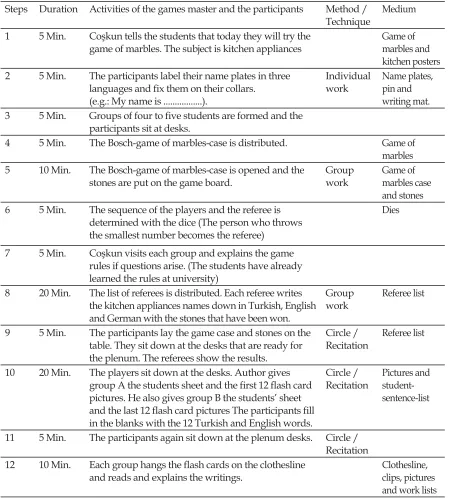
Table 1. The Flow Chart of the Activities.
Steps Duration Activities of the games master and the participants Method / Technique
Medium
1 5 Min. Coükun tells the students that today they will try the game of marbles. The subject is kitchen appliances
Game of marbles and kitchen posters 2 5 Min. The participants label their name plates in three
languages and Þ x them on their collars.
(e.g.: My name is ...).
Individual work
Name plates, pin and writing mat. 3 5 Min. Groups of four to Þ ve students are formed and the
participants sit at desks.
4 5 Min. The Bosch-game of marbles-case is distributed. Game of marbles 5 10 Min. The Bosch-game of marbles-case is opened and the
stones are put on the game board.
Group work
Game of marbles case and stones 6 5 Min. The sequence of the players and the referee is
determined with the dice (The person who throws the smallest number becomes the referee)
Dies
7 5 Min. Coükun visits each group and explains the game rules if questions arise. (The students have already learned the rules at university)
8 20 Min. The list of referees is distributed. Each referee writes the kitchen appliances names down in Turkish, English and German with the stones that have been won.
Group work
Referee list
9 5 Min. The participants lay the game case and stones on the table. They sit down at the desks that are ready for the plenum. The referees show the results.
Circle / Recitation
Referee list
10 20 Min. The players sit down at the desks. Author gives group A the students sheet and the Þ rst 12 ß ash card
pictures. He also gives group B the students’ sheet and the last 12 ß ash card pictures The participants Þ ll
in the blanks with the 12 Turkish and English words.
Circle / Recitation
Pictures and student-sentence-list
11 5 Min. The participants again sit down at the plenum desks. Circle / Recitation 12 10 Min. Each group hangs the ß ash cards on the clothesline
and reads and explains the writings.
13 10 Min. The participants again sit at their desks and solve the puzzle.
Individual work
Puzzle and writing material 14 5 Min. The participants again sit at their desks for the
plenum and talk about the problems of solving puzzles (the solutions are distributed if necessary).
Circle / Recitation
Work sheets for the group work/ individual work 15 5 Min.
Total of 120 Min.
The marble game is evaluated. The completion of the activity is announced. Coükun thanks them for their cooperation
Circle / Recitation
Source: Author.
Word lists
In order to facilitate communication in the foreign language teaching where edu-cational games were used, a table containing the proper names, personal pronouns, nouns, verbs, adjectives and expressions used in the games should be prepared. As I stated above, the target group is taking German as a second foreign language for two hours a week for three semesters. This period is very short to actively learn a foreign language. The explanations and lists should be given in three languages for the students to beneÞ t from the languages they know (have learned).
Table 2. The Important Vocabulary.
Türkçe Deutsch English
Özel isimler Eigennamen Proper names
Kerim Claudia Derin
Kerim Claudia Derin
Kerim Claudia Derin Source: Author.
As seen in this list, the proper names are the same in all languages and they are generally not translated. Sometimes the phonetic pronunciation of the names is adapted to the related alphabet. In foreign language lessons it is a relief for stu-dents, if they recognize proper names in dialogues, texts and so on.
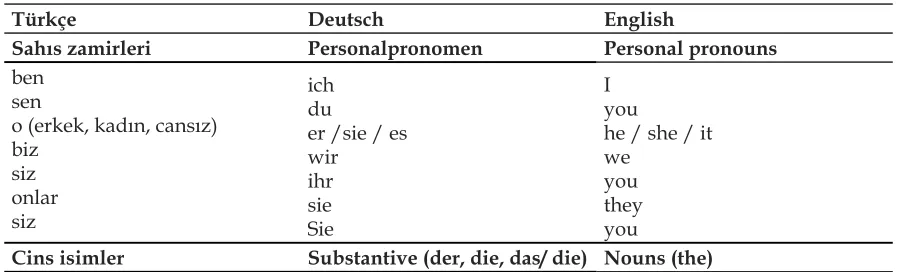
Table 3. Personal pronouns.
Türkçe Deutsch English
Sahõs zamirleri Personalpronomen Personal pronouns
ben sen
o (erkek, kadõn, cansõz)
biz siz onlar siz
ich du
er /sie / es wir
ihr sie Sie
I you
he / she / it we
you they you
çay karar hakem
hakem (kadõn)
oyuncu
oyuncu (kadõn)
oyun tahtasõ
rakip
rakip (kadõn)
resim üans zar oyun alanõ
bardak çanta oyun kuralõ
diyalog kahve tur masa üye grup alt grup numara harf oyuncak misket kenar der Tee die Entscheidung der Schiedsrichter die Schiedsrichterin der Spieler die Spielerin das Spielbrett der Gegner die Gegnerin das Bild die Möglichkeit der Würfel das Spielfeld das Glas der Koffer die Spielregel der Dialog der Kaffee die Runde der Tisch das Mitglied die Gruppe die Untergruppe die Nummer der Buchstabe das Spielzeug die Murmel der Rand Tea decision referee referee player player game board opponent opponent picture chance dice game Þ eld
glass case
rule of the game dialog coffee tour table member group subgroup number letter toy marble edge Source: Author.
It is believed that every educational game must include a word list that consists of personal pronouns, adjectives, verbs, nouns and simple and detailed speech tools. This list should be prepared by taking into consideration the target group. Below you will see a word list for the game of marbles.
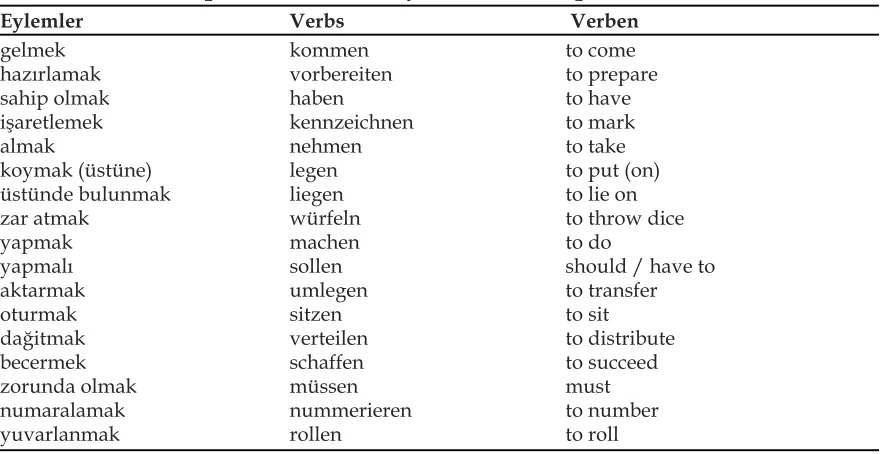
Table 4. The Important Verbs, Adjectives and Expressions.
Eylemler Verbs Verben
gelmek hazõrlamak
sahip olmak iüaretlemek almak koymak (üstüne) üstünde bulunmak zar atmak yapmak yapmalõ aktarmak oturmak daùitmak becermek zorunda olmak numaralamak yuvarlanmak kommen vorbereiten haben kennzeichnen nehmen legen liegen würfeln machen sollen umlegen sitzen verteilen schaffen müssen nummerieren rollen to come to prepare to have to mark to take to put (on) to lie on to throw dice to do
Sõfatlar Adjektive Adjectives
küçük
…dan küçük en küçük büyük ...dan büyük en büyük yavaü hõzlõ yuvarlak düz derin
klein kleiner als am kleinsten groß
größer als am größten langsam schnell rund ß ach tief
small smaller than smallest big
bigger than biggest slow quick round ß at deep
Konuüma Kalõplarõ Redemittel Expressions
Çay demlemek Sõra bende.
Nasõl devam ediyor?
Dur! Dur! Bu olmaz.
Hedefe ulaümõü olmak
Bir üeyi bir üeyin üstüne koymak
Bir üeyin bir üeyin üstünde olmasõ.
Gözünüz aydõn! (Tebrikler!)
Tee aufsetzen
Ich bin dran./ an der Reihe. Wie geht es weiter?
Halt! Halt! Das geht nicht. am Ziel sein
etwas auf etwas legen Etwas liegt auf etwas. Herzlichen Glückwunsch!
to brew tea It is my turn. How does it go on? Stop! Stop!
This does not work. to have reached the target
to put something on top of something
Something is on top of something. Congratulations!
Source: Coükun, 2013, pp. 163-164.
Table 5. Sözcük Listesi / Wortliste / Word List / Mutfak Aletleri / Küchen-gräte / Kitchen Appliances.
Nr. Resim / Bild / Picture Türkisch Deutsch English
1 Bardak das Glas Glass
2 Bõçak das Messer Knife
3 Bulaüõk makinesi die Spülmaschine Dishwasher
5 Çatal die Gabel Fork
6 Çaydanlõk die Teekanne Teapot
7 Fõrõn der Backofen Oven
8 Fincan die Tasse Cup
9 Kase die Schale Bowl
10 Kaüõk der Löffel Spoon
11 Kepçe die Kelle Ladle
12 Masa der Tisch Table
Source: Author.
Training materials for memorizing the vocabulary
It is possible to teach the names of kitchen appliances outside of game varia-tions with the use of different exercises. Zu diesem Zwecke habe ich einige Übung-smaterialien entwickelt. Als Beispiel Þ nden Sie im Anhang Übungsblätter „Word
Discussion and conclusion
In Turkish primary, middle and secondary schools, English is the foreign lan-guage of Þ rst choice. Secondary school students with good grades learn English as their Þ rst foreign language. Students with lower grades at that stage usually learn German or French. In teacher training, German or French is taken by stu-dent language teachers as their second foreign language. This gives rise to the question of how can the situation of the second foreign language be quantitatively and qualitatively improved in Turkey. Experience has shown that the situation of the second foreign language can be quantitatively and qualitatively improved in Turkey if the parents campaign for better teaching, necessary administrative measures are taken and lessons made more attractive with the support of foreign mediating institutions methodically and didactically. It is therefore of great signi-Þ cance that Turkish parents, Turkish educational institutions and foreign media-ting institutions together promote better foreign language teaching.
Most Students in Turkey choose English as a foreign language. However, today English is not a foreign language. English is a language everybody should know. Turkish families make an economic sacriÞ ce for their children in order for them to learn foreign languages. Therefore The Ministry of National Education has taken the initiative to start lessons in German, French, Russian, Spanish, Japa-nese and ethnic languages in Turkey in addition to English (Eurydice, 2010, p 177). For example, two languages are taught in Anatolian High Schools. The Higher Education Council has added second foreign language classes for three semesters to the foreign language teaching programs. Private educational institutions said that more than one foreign language is being taught in their schools (YÖK, 2007, pp. 215-219; Kavak, 2009, pp. 27-36; Takkaç, 2014, pp. 44-54). German representa-tive bodies try very hard to make German teaching more attracrepresenta-tive.
In spite of the measues mentioned above, the results in foreign language teaching are not satisfactory. There are, of course, various possibilities of making German language teaching attractive. One of these possibilities is the development and use of suitable teaching materials. In that connection, I have here attempted to relate my experience with the teaching game “Marbles”.
The experiences with the marble games showed it is possible to strengthen interest in and raise the level of knowledge of the German language through the use of educational games in Turkey. Because German is offered mostly as an elec-tive subject, German lessons should be made more attracelec-tive and interesting to the students, for which in-service training might be necessary.
I would like to make the following recommendations based on my experience acquired during the implementation of the marble game for the successful appli-cation of the eduappli-cational games in class.
Proposals for administrative measures and for German-Turkish cooperation: 1. The present 2 hours per week should be increased to 6.
2. The grade in German should be taken into account when teachers are being employed.
3. German-Turkish cooperation should be expanded.
4. New teaching materials and text books should be designed. Proposals in relation to teaching games:
1. Educational games should be developed to be used in language classes. 2. Educational games should be supported with additional games.
3. Educational materials (word lists, puzzles, dialogues, practices, etc.) should be developed.
4. The teachers should be provided with the necessary information during the in-service courses.
5. Parents and students should be informed that the educational games espe-cially support the development of speaking skills.
6. It should be explained that educational games are supported by the Common European Framework of Reference for Languages.
7. It should be highlighted that the educational games are helpful in practi-cing the functional phrases learned.
8. Facilities for the implementation of educational games should be created in educational institutions. (The facility, tables and chairs should be suita-ble for group studies.)
9. Coordination should be established between the teachers who work with educational games.
10. The educational games developed should be sent to those who show inte-rest in them.
References
Annual report of the Turkish-German Cultural Advisory Board Ankara for the period from 01.01.2013 to 31.12.2013.
Bayraktaroùlu, S. (2014). Neden Yabancõ Dil Eùitiminde Baüarõlõ Olamõyoruz? [Why can not we be
suc-cessful in foreign language teaching? ]. In: A. Sarõçoban, & H. Öz (Eds.), What should be trends
in foreign language education in Turkey. Ankara: Hacettepe Üniversitesi Yayõnlarõ.
Coükun, H. (2013). The importance of educational marble games in teaching German. Education Rese-arch – Eurasian Journal of Educational ReseRese-arch, 53, 151-174.
Coükun H. (2006). Oyunlarla dil öùretimi, Spiele im Sprachunterricht, Learning Languages Through Games, Türkçe – úngilizce – Almanca. Ankara: CTB Yayõnlarõ,.
Demircan, Ö. (2014).Yabancõ Dil Öùretimi: Deùiüen Bir ûey Yok! [Foreign Language Teaching: Nothing
has changed !]. Öùretmen Dünyasõ, Yõl: 35 / ûubat 2014, Sayõ: 410. Ankara.
Diem, W. (2004). Die schönsten Murmelspiele [The Nicest Games of Marble]. Classical Games. Kempen: Moses Verlag publication.
Models and Reconstruction Studies]. Türkiye’de Öùretmen Yetiütirmeye Genel Bakõü – Eùitimde
Yansõmalar: IX, Eùitim Araütõrma Geliütirme Vakfõ Yayõnlarõ No 11, Ankara:Educational founda-tion publicafounda-tion, 27-36.
Takkaç, M. (2014). Türkiye’de Öùretmen Yetiütirme Programlarõ ve Sorunlarõ [Teacher Training
Pro-grams in Turkey and Problems]. In: A. Sarõçoban, & H. Öz (Eds.), What should be trends in
forgeign language education in Turkey. Ankara: Hacettepe Üniversitesi Yayõnlarõ.
Yõldõrõm, A., & ûimüek, H. (2006). Sosyal bilimlerde nitel araütõrma yöntemleri [Qualitative research methods in social sciences]. Ankara: Seçkin Yayõncõlõk.
YÖK. (2007). Öùretmen yetiütirme ve eùitim fakülteleri (1982 – 2007) [Teacher training an faculties of edu-cation]. Ankara: Yükseköùretim Kurulu (Higher Education).
ANNEX
Sözcük salatasi / wortsalat / word salad
Mutfak aletleri / küchengeräte / kitchen appliances
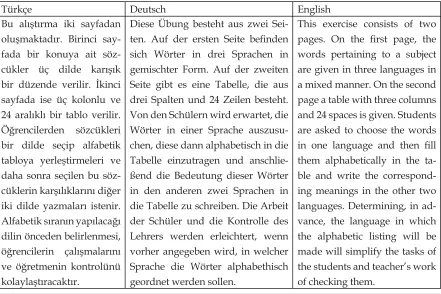
Table 6. Sözcük Salatasõ / Wortsalat / Word Salad. Mutfak Aletleri / Küchengräte / Kitchen Appliances.
Türkçe Deutsch English
Bu alõütõrma iki sayfadan
oluümaktadõr. Birinci
say-fada bir konuya ait söz-cükler üç dilde karõüõk
bir düzende verilir. úkinci sayfada ise üç kolonlu ve 24 aralõklõ bir tablo verilir.
Öùrencilerden sözcükleri bir dilde seçip alfabetik tabloya yerleütirmeleri ve daha sonra seçilen bu söz-cüklerin karüõlõklarõnõ diùer
iki dilde yazmalarõ istenir.
Alfabetik sõranõn yapõlacaùõ
dilin önceden belirlenmesi, öùrencilerin çalõümalarõnõ
ve öùretmenin kontrolünü kolaylaütõracaktõr.
Diese Übung besteht aus zwei Sei-ten. Auf der ersten Seite beÞ nden
sich Wörter in drei Sprachen in gemischter Form. Auf der zweiten Seite gibt es eine Tabelle, die aus drei Spalten und 24 Zeilen besteht. Von den Schülern wird erwartet, die Wörter in einer Sprache auszusu-chen, diese dann alphabetisch in die Tabelle einzutragen und anschlie-ßend die Bedeutung dieser Wörter in den anderen zwei Sprachen in die Tabelle zu schreiben. Die Arbeit der Schüler und die Kontrolle des Lehrers werden erleichtert, wenn vorher angegeben wird, in welcher Sprache die Wörter alphabethisch geordnet werden sollen.
This exercise consists of two pages. On the Þ rst page, the
words pertaining to a subject are given in three languages in a mixed manner. On the second page a table with three columns and 24 spaces is given. Students are asked to choose the words in one language and then Þ ll
them alphabetically in the ta-ble and write the correspond-ing meancorrespond-ings in the other two languages. Determining, in ad-vance, the language in which the alphabetic listing will be made will simplify the tasks of the students and teacher’s work of checking them.
Glass Çaydanlõk Knife Karaffe die Zuckerdose Ladle Termos die Spülmaschine Apron Strainer Salt shaker
Sandalye das Messer der Kühlschrank die Gabel Fork Çatal der Teekanne der Salzstreuer Teapot Fõrõn Sugar
bowl der Backofen Table Oven Fincan Sürahi Masa Bulaüõk makinesi die Kelle die Tasse die Schürze Cup
Tava die Schale Bowl Kaüõk der Löffel ûekerlik Tabak der Tisch Önlük Mikro dalga fõrõn Refrigerator Raf das
Regal Shelf Dishwasher Spoon der Stuhl der Teller Bõçak Thermos ß ask die Kase Decanter Süzgeç das Sieb
Kepçe die Bratpfanne die Mikrowelle Dish Frying-Pan Microwave das Glas Tencere der Kochtopf Chair Saucepan Buzdolabõ die Thermosß asche Bardak Tuzluk
Sözcük salatasi / wortsalat / word salad
Mutfak aletleri / küchengeräte / kitchen appliances
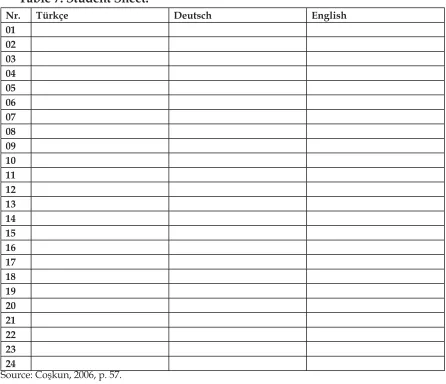
Önce sol sayfada yer alan kutudaki Türkçe sözcükleri seçiniz ve alfabetik sõraya göre aüaùõdaki tabloya yazõnõz. Daha sonra Almanca ve úngilizce anlamlarõnõ yazõnõz.
First choose the Turkish words in the lefthand column and write them in alpha-betical order into the tablen. Then write their meanings in German and English.
First, choose the Turkish words from the box on the left page and list them alphabetically in the table below. Then, write their meanings in German and English.
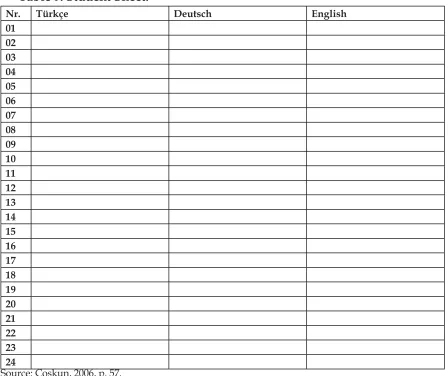
Table 7. Student Sheet.
Nr. Türkçe Deutsch English 01
02 03 04 05 06 07 08 09 10 11 12 13 14 15 16 17 18 19 20 21 22 23 24
Source: Coükun, 2006, p. 57.
Mutfak aletleri / küchengeräte / kitchen appliances Sözcük avi bulmaca / such - rätsel / search puzzle
Kare bulmacada 8 Türkçe, 8 Almanca ve 8 úngilizce sözcük gizlidir.
Bunlarõ bulabilir misiniz? Bu sözcükleri üç renkte iüaretleyiniz! Türkçe söz-cükleri kõrmõzõ, Almanca sözcükleri mavi ve úngilizce sözcükleri yeüil.
Kesiüme noktalarõndaki harß er iki renkli olabilir.
Können Sie diese Þ nden? Markieren Sie diese Wörter in drei Farben! Türkische Wörter in Rot, deutsche Wörter in Blau und englische Wörter in Grün.
Die Buchstaben an Überschneidungspunkten können zweifarbig sein. 8 Turkish, 8 German and 8 English words are hidden in the square puzzle. Can you Þ nd them?
Mark these words in three colors! Turkish words in red, German words in blue and English words in green.
The letters at the intersections may have two colors.
Tabele 8. Student Sheet.
00 01 02 03 04 05 06 07 08 09 10 11 12 13 14 15 16 17 18 19 20 01 C H A I R P O I U Y T R E W Q A S F G R 02 U H J K L û ú ø P O I U Y Y R U T A V A 03 P N K I T T E L M N B V C X Z V E K J F 04 J H A V F E I U Y T R E W D S A N V H J 05 K H R L K R J Y T R E W Q N B V C X K I 06 G L A S Ö M A S A M B V C û K H E J G F 07 J I F L J O I O E R T U I E O I R T R M 08 F B F U K S Q W E R T Y I K A S E I O I 09 O V E N B N V S I E B Z V E B N M Ö Ç C 10 R M B V C G R A I K J H F R D K L û û R 11 K J L û ú ø O L U T R E W L A D L E X O 12 V B N M Ö Ö Ö T Q W R Y U ú G I J K L W 13 Q W S E R T Y Z Y I O O P K Z S C V B A 14 M S P Ü L M A S C H I N E Ö Ç H û K J V 15 I U O T R E W T X V H J K B H Y N T G E 16 B V O N H Y T R B G R G T H Y U J M K O 17 I N N J K T E E K A N N E E D C V F R V 18 Ç Y H N M J U U I Ö Ö L O Ç I K Ö O L E 19 A O L Ç K I U E R T H B N H Y N J U M N 20 K Ü H L S C H R A N K J U K M N H T G B Source: Coükun, 2006, p. 57.
Kare içinde bulduùunuz Türkçe sözcükleri, alfabetik sõraya göre saù tara-ftaki tabloya yerleütiriniz. Daha sonra Türkçe sözcüklerin Almanca ve úngilizce anlamlarõnõ yazõnõz.
Tragen Sie zuerst die türkischen Wörter, die Sie im Quadrat gefunden haben, alphabetisch in die Liste auf der rechten Seite ein. Dann schreiben Sie bitte die deutschen und englischen Bedeutungen der türkischen Wörter auf.
Mutfak aletleri / küchengeräte / kitchen appliances Sözcük avi bulmaca / such - rätsel / search puzzle
Bu sözcük avõ bulmacada 24 sözcük (Mutfak Aletleri) gizlidir. Önce sol say-fadaki Türkçe, Almanca ve úngilizce sözcükleri bulunuz ve daha sonra Türkçe alfabetik sõraya göre aüaùõdaki tabloya yazõnõz.
In diesem Suchrätsel sind 24 Wörter (für Küchengeräte) versteckt. Suchen Sie zuerst die türkischen, deutschen und englischen Wörter auf der linken Seite heraus und tragen Sie diese alphabetisch geordnet (türkisch) in die unten vorhan-dene Liste ein.
In this search puzzle 24 words (kitchen appliances) are hidden. First, Þ nd out the Turkish, German and English words on the left and transfer them alphabeti-cally (in Turkish) into the existing list below.
Table 9. Student Sheet.
Nr. Türkçe Deutsch English 01
02 03 04 05 06 07 08 09 10 11 12 13 14 15 16 17 18 19 20 21 22 23 24