21
Abstract
The competitiveness of young people in the labour market is determined by the level of their education or a set of competencies satisfying modern requirements, and objective assessment methodology is needed for the identifi cation and monitoring of students’ ability to master the quality, growth dynamics and improvement of this set of competencies.
The improvement of organization management system that is aimed at excellent and effi cient management makes use of RADAR assessment methodology. The Article deals with the learning achievement assessment model in the chemistry-teaching course that has been synthesized on the RADAR assessment concept basis. The developed model is based on four priorities:
1. Assessment is transformative – it is carried out individually and collectively to stimulate students to develop the adequacy effect aimed at becoming aware of their learning abilities.
2. Assessment can be reviewed – the set of criteria provides information on improvement possibilities and harmonization that would promote formation of continuous improvement spiral.
3. Assessment can be deployed – the acquired information is applied, planned and used in experiments to promote changes in learning activities.
4. Assessment is successive – elements of assessment process promote successive assessment during learning process.
Key words: science competency, developing learning in chemistry, self-assessment, integral approach, set of criteria, personality development.
Introduction
In this dynamic period, with science based economy emerging and developing and education processes purposefully led by the society, the competitiveness of young people in the labour market is determined by the level of their education or a set of competencies satisfying modern requirements, comprising both professional knowledge and skills in specifi c speciality, as well as knowledge and skills that can easily be transformed and applicable in different sectors. Thus particular signifi cance acquire complex cross curricula competencies that are formed and developed on the basis of integral knowledge and skills of common several science subjects (Eurydice, 2002; Koke, 2003).
One of cross curricula competencies that are being used in international comparative longitu-dinal researches (IEA TIMSS; OECD PISA) for the characterization of the state’s education system quality is the science competency. This competency refl ects the ability of an individual to use the knowledge of science subjects; to make conclusions; to understand and take decisions about the world of nature and changes therein caused by the activities of people (Kangro, Geske, 2001; Geske, Grinfelds, 2006).
The TIMSS un OECD researches made during last ten years have discovered a correlation between the student’s achievements in science subjects and his/her ability to link the mastered
CONCEPT OF DEVELOPING LEARNING
IN THE MODEL OF LEARNING
ACHIEVEMENT ASSESSMENT
Renate Kalnina
22 knowledge with the surrounding world and everyday life experience; to apply them in problem solu-tion and decision taking. Unfortunately for students in many countries (including Latvia) this ability is insuffi ciently developed and trained (Guzejev, 2001; Namsone, 2003, Staudel, 2004; Gedrovics, Jerorena, Kuusela, Wareborn, 2006).
The interactive learning methods (De Jesus, 1995; Felder, 1996; Witteck, Leerhoff, Most, Eilks, 2004; Husan, Hill, Reid, 2004; Kalnina, Priksane, 2005) have proved their effi ciency in the develop-ment and formation of students’ research thinking skills and socio-communicative competencies in chemistry lessons.
In the application of interactive learning methods a ‘stumbling block’ according to the teachers is the absence of objective and pithy intellectual achievement assessment methods (Cohen, 1994; Kiraly, 1996; Gage, Berliner, 1998; Graf, 2000; Priksane, Klimenkovs, 2006).
The problem related to the assessment of students’ learning is topical all over the world. Al-ready in the mid 80ies of the 20th century W. Edwards Deming (30 years in quality management - the author of Deming’s Cycle and the Miracle of Japanese Economy), when analysing the reasons of breakdown of USA economy pointed out that in the USA the process development has been wrong for more than 50 years. For example: in the education - children are spoiled by the assessment and mark system, they should learn cooperate rather than compete (Deming, 1986).
At the turn of centuries the assessment issue in the scientifi c language got the name „Millen-nium problem” (Kunzel, 1999; MacBeath, Sugimine, 2003), because in post-modernism era, with the change of education paradigm, the concept of education changed globally. Thus new challenges are set forth to the education policy makers, scientists and teachers, namely to review the concept of assessing system and seek for new approaches to the assessment of intellectual achievements.
Methodology of Research
To be able to develop a modern approach to the assessment of students’ learning in chemistry a research was undertaken, the theoretical part of which clarifi ed the following issues:
1. What in modern pedagogy is understood under the notion ‘assessment’?
2. Whether the assessment system in schools, for instance in Latvia, promotes student’s learning, or on the contrary – hinders it?
What assessment approaches are being developed at present?
The research applied the following research methods: analyses of scientifi c literature, the con-tent analyses of regulating documents on Latvian education system and EFQM excellence model methodology. The analyses of the results gained in the theoretical part of the research and conclu-sions made determined the course of the practical part. Within its framework the students’ learning assessment system model in chemistry was synthesized based on RADAR assessment model.
Results of Research
Assessment component in the everyday learning process aspect
Scientifi c literature gives different explanations, for instance, assessment is a feed-back-function of teaching quality (Graf, 2000); it is an interaction with another person to gain and interpret infor-mation about the knowledge and understanding, skills and attitude of this person (Liepins, 1999); it is a process of intellectual activity having a motive, goal, instruments and result (Servuta, Spona, 1995); it is a process for collecting information, developing conclusions and getting assessment on student’s achievements and growth (Johnson, Johnson, 1996; Gage, Berliner, 1999). The diversity of term interpretations proves the assessing complexity because it comprises both the process analyses and the results.
Kvale (1993) when analysing the assessment process at school has put a question: “What is be-ing assessed – the student or knowledge?” The answer to this question can be given by the analyses of the regulating documents on education system.
23 Volume 2, 2007 standards assesses achievements. The teacher must assess the size of mastered knowledge,
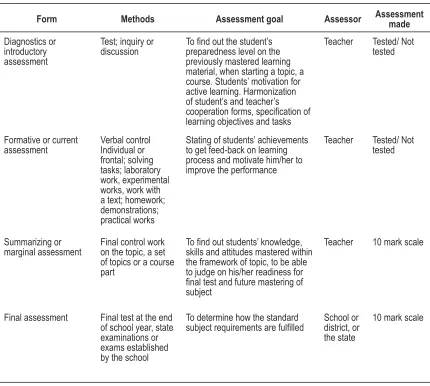
mas-tered skills, attitudes towards education, as well as the student’s development dynamics. In primary school until form 2 a descriptive system is being used, when no marks are given, which gradually till form 4 transforms into a mark-based assessing system within the 10-point scoring range. This assessment plays a very signifi cant role in the student’s further life because it not only shows his/ her level of progress, but also determines his/her ability to enter the next level education establish-ment and compete in the labour market. An eleestablish-ment of 10-point assessestablish-ment system is ‘tested/ not tested’, which is used when forming links with a student, making a simple statement, checking the memorization and application level, elementary knowledge and skills. The given assessment is not taken into account when determining the student’s semester or yearly mark, except cases when the teacher must choose between, for instance, either’5’ or ‘6’. The students’ learning assessment forms and methods at present in force in the country are given in the review table (Table 1).
Table 1. Learning achievement assessment forms and methods.
Form Methods Assessment goal Assessor Assessment made
Diagnostics or introductory assessment
Test; inquiry or
discussion To preparedness level on the fi nd out the student’s previously mastered learning material, when starting a topic, a course. Students’ motivation for active learning. Harmonization of student’s and teacher’s cooperation forms, specifi cation of learning objectives and tasks
Teacher Tested/ Not tested
Formative or current
assessment Verbal controlIndividual or frontal; solving tasks; laboratory work, experimental works, work with a text; homework; demonstrations; practical works
Stating of students’ achievements to get feed-back on learning process and motivate him/her to improve the performance
Teacher Tested/ Not tested
Summarizing or
marginal assessment Final control work on the topic, a set of topics or a course part
To fi nd out students’ knowledge, skills and attitudes mastered within the framework of topic, to be able to judge on his/her readiness for
fi nal test and future mastering of subject
Teacher 10 mark scale
Final assessment Final test at the end of school year, state examinations or exams established by the school
To determine how the standard
subject requirements are fulfi lled School or district, or the state
10 mark scale
(Ministry of Education and Science Republic of Latvia, http://www.izm.gov.lv/default. aspx?tablD=7(=1&cid=445; Center of Education Content and Assessment, http://isec.gov.lv/peda-gogiem/program/pamskol/prog.shtml?kimija8_9; ISEC, 2005).
24 education standard in the specifi c subject, and not to evaluate the student’s learning development dynamics and his/her attitude to education. Besides, although in the summary evaluation goal men-tions that attitude is also being assessed, yet the Regulation on 10-point scoring system does not provide for such a possibility. This system should be used when assessing the creative work where the student is given an opportunity to use knowledge and skills in situations unknown to him The evaluation goals in diagnostics and formative evaluation to a certain extent orientate the teachers to the application of alternative assessment approach, but at the same time it is not clear which are the cases when some other evaluator should be involved, because regulating documents state only that learning achievements on an everyday basis should be assessed only by the teacher.
Besides, the number of compulsory marks in semester set out in Latvia to a high extent is hindering teachers from systematic daily use of interactive teaching methods, because traditionally in such cases students’ learning achievements are evaluated only with ‘tested/not tested’. Thus, for example, in chemistry in comprehensive schools only laboratory works are regularly organized as a pair work, other interactive methods are being applied very seldom or practically are not used at all. (Kalnina, Priksane, 2006).
The analyses of the documents results in an unmistakable answer to the question, what is being evaluated at school? It is knowledge and not the student’s development.
Where the assessment goals and consequences are not thought over and are based only on the measurements of the existing practice, then evaluation can be simply transformed into a control instrument, which in the daily learning process can hinder and limit innovations.
Alternative evaluation approach in daily learning process aspect
In the 80ties of the 20th century with the activation of researches on innovation approaches to the learning and teaching methodologies and their role in the development of individual’s personality, particular attention was paid to the cooperative learning. Its successful procedure is ensured by the implementation of fi ve basic principles, one of which is assessment. This procedure involves group members who assess themselves the achievements attained as a result of this cooperation as well as the group work process. Thus a new approach to the assessment is emerging in daily learning process, where teacher’s assessment goes together with group members’ assessment. Assessment of coopera-tive learning is based on broadly considered judgements the presentation of which is the result of assessment. Self-assessment serves as an additional information source about the processes within the group. Particularly important is student’s – teacher’s conference where they discuss each student’s individual learning progress (Johnson, Johnson, 1996; Paulson, 1999; Bell-Loncella, 2001).
Other new assessment approaches are being developed too, for instance, authentic one, which is close to the way in which education achievements will be show themselves in real life situations (Col-lison, 1998; Gage, Berliner, 1999). Essentially this is a transition from summary – regulation-based approach to formative –criteria-based approach, besides the students’ learning self-assessment is a part of authentic assessment (Dunn, Parry, Morgan, 2002; Hume, Carson, Hodgen, Glaser, 2006).
Thus particular emphasis is put on the self-assessment of learning achievements as an alter-native assessment approach, to make an individual to understand better his/her learning and thus could manage and improve it purposefully. To integrate the students’ self-assessment as an integral component of the assessment system of chemistry learning process, the EFQM excellence model methodology was used.
Insight into EFQM Excellence Model with RADAR assessment methodology in the centre
25 Volume 2, 2007 thus it was transformed into EFQM excellence model with RADAR assessment methodology in the
centre. EFQM excellence model is a practically applicable methodology and is applicable in all type organizations, institutions and companies, and can be implemented in the most relevant manner:
• Model as a self-assessment instrument to understand the organization’s performance towards excellence, being aware of and assessing inadequacies;
• Concept as a basis for common vocabulary as a deliberate way of thinking in all organi-zation’s structures;
• Formation as a system for the introduction of existing and future ideas, preventing repeti-tion and being aware of imperfecrepeti-tions;
• Pattern as an organization management system structure.
The model comprises groups of criteria described in 9 modules that promote organization’s successful advancement. Each module is given a number, it is described and its importance is char-acterized. Criteria groups consist of thematic sections – activities summarizing criteria, which should be considered when evaluating model effi ciency. When evaluating each criteria group is given a defi nite number of scores which in the point of fact should be more ascribed to the signifi cance of defi nite group – module and therefore there is no strict requirement for its uniform consideration. Among groups-modules that can be interpreted professionally, fi ve of nine cover possibilities, and four – results. The possibility criteria are to be ascribed to the activities to be carried out in the or-ganization, but the result criteria refl ect the organization’s achievements.
The nature of RADAR assessment methodology put in the centre of excellence model roots in the logics of successive analyses and synthesis, covering 4 successive stages.
The RADAR methodology elements - approach, deployment, assessment and review are ap-plicable to each enabler criterion in EFQM excellence model, but the results element – to the Results criteria. In each of them:
• The scope of the results shows the organization’s achievements and performance, char-acterising successful achievements of organization and development effi ciency towards excellence. The scope of results is applied also for the improvement of respective crucial
fi elds. The results can be systematized, segmented, grouped in interesting cross-sections that promote identifi cation of improvement opportunities.
The approach is an aggregate of intended activities and planned actions of organization. Success-ful approach is rooted in present and future needs and requirements of organization to be achieved by means of harmonized and continuous improvement processes and procedures that are focused at satisfying all stakeholders’ needs. Integrated approach is substantiated by the organization’s strategy and policy.
• Deployment covers organization’s activities for the deployment and extension of ap-proaches and solutions. The organization is continuously realizing its ideas in crucial
fi elds of activity that are well planned to be able to implement the ideas in the most ap-propriate way.
• Assessment and review is the activity the organization carries out to review and improve its approach and deployment and the received results are used for the identifi cation and harmonization of most signifi cant fi elds, for improvement planning and implementation (Wunderer, 1997; Mayerer, 2004; Janauska, Mazais, Salenieks, 2005).
Students’ learning assessment system model in chemistry
In the student learning oriented pedagogic paradigm the basis of student’s learning progress as-sessment is formed by learning activity, which is being assessed both from the learning results point of view and learning process aspect. Therefore for the implementation of this assessment procedure through EFQM excellence model structural elements (sets of criteria – modules) for chemistry learn-ing and teachlearn-ing model the followlearn-ing was developed:
26 students in active cooperation-based practical and research work to enhance the learning process effi ciency, formation and improvement of competencies, development of student’s personality during chemistry mastering process.
• Chemistry learning and teaching activities: enable students to become aware of their intellectual resources, to perfect them during learning process in line with their learning peculiarities.
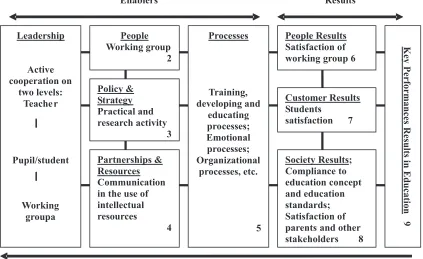
• Procedure of chemistry learning and teaching activities: in the chemistry teaching proc-ess to create an environment promoting active cooperation and communication between students and thus enhancing effi cient teaching information processing and mastering. It should be noted that in this case at the basis of chemistry teaching lays the didactic model of cooperation (CDM), which presents a group work system (both from the thematic and teaching organization aspect), which integrates cooperative learning elements. This systematic approach was worked out to promote the development and improvement of student’s research thinking and socio–communicative competencies, thus promoting formation of science comprehension in the chemistry mastering process (Kalnina, Priksane, 2005). Development of CDM model was based on the researches carried out in previous years, and thus it will not be considered in detail in this article. Since the learning environment was formed as an active practical or research activity of the student in small groups, the student simultaneously performs both learning and teaching activity, and so the next step is connected with the application of excellence model structure to this activity model, where the basis is CDM model organization structure. Figure 1 shows that CDM model structure elements are integrated in nine criteria sets of excellence model, of which fi ve fi rst criteria cover opportunities, while the latter four – the results.
Figure 1. CDM model integrated in Excellence model structure.
It should be noted here, that students constitute internal customers of this ‘formation’, in its turn students’ working groups constitute participants of ‘this formation’. Thus, for example, leader-ship (criterion 1) in this case is based on active two level cooperation (teacher – student – student’s working groups), and this criterion passes through the whole model.
27 Volume 2, 2007 close and direct – with criterion 7. For instance, cooperation between working group (criterion 2)
members participating in practical and research work determines the group work productivity. In its turn, the group’s satisfaction characterises the cooperation level quality. The results gained from criterion 7 give a feedback on the learning process course. Linking of cooperation (criterion 1) and communication when students are using the intellectual resources for obtaining, processing and mas-tering information, (criterion 4) is crucially important because they form CDM model approach. Thus learning results (criterion 9) give a feedback about the quality of criteria 1 and 4. Another signifi cant criterion are processes (criterion 5), which is closely linked with criteria 1 and 2, and similar to other cases, the feedback on its quality is given by fi nal learning result, which is to be connected with the satisfaction of working group members and each individual student, as well as with conformity to state education concept and modern requirements of society. Explanation of examples discloses the nature of model, since thanks to the opportunity quality, the chemistry teaching and learning concept, activities and processes or movement towards ‘excellence’ in learning can be implemented, and op-portunities are improved reciprocally according to the attained results.
To gain broader and more multiform information on students’ learning effi ciency and its im-provement possibilities, understanding of learning material, motivation and interest in its mastering, the following instruments were used:
• Self-assessment of working group; • Student’s self-assessment;
• Teacher’s assessment.
In its turn, for the student’s self-assessment to provide vast information that is signifi cant for the future work, there were developed two type sets of criteria, which are envisaged for a short-term and long-term learning period.
Assessment criteria for a short-term period (to get an immediate refl ection about the work in the class) are as follows:
• performance of learning and group work tasks; • understanding of mastered information; • signifi cance of mastered information; • emotional mood during work; • individual input into work;
• investment of creative potential (generating ideas);
• signifi cance of newly gained knowledge or newly mastered skills.
Students, both individually and collectively (group members jointly), periodically carry out assessment of work in the classroom according to 5-mark score system.
These criteria provide information on the quality of processes taking place internally from the student’s or working group’s point if view or a feedback, that clearly refl ects emotional mood of each individual or the working group, the productivity of learning activity, comprehension of learning material. The obtained information determines the course of further work process. It fulfi ls several functions, for instance, forms the students’ view on what has been mastered during the class, what new has been mastered and how signifi cant it is for him/her, whether he/she is satisfi ed with his/her, other person’s performance in the class, whether the learning material has been understood. This information is of crucial importance also for the teacher because it gives a feedback about the quality of the lesson, namely, whether the content of work task has ensured understanding of learning material and engaged students’ attention, what changes should be introduced. It should be stressed that this information initiates monitoring of students’ learning process, where he/she is being involved, and together with the teacher the foundation is laid for the fi rst ideas about an opportunity to improve one’s learning. Given information in point of fact is initial basis for the development of students’ learning achievement ‘portfolio’.
28 The set of criteria and included sub-criteria are characterised by:
• knowledge and skills in the subject (set out by the standard of chemistry subject); • practical skills (include both the use of terminology and proper measurement units,
laboratory appliances and vessels, presentation of work results and observance of work instructions);
• research thinking competencies (include competencies to think analytically, creatively and also applied thinking);
• communication and cooperation competencies (include socio – communicative and interaction skills);
• personal qualities and attitudes (a set of qualities characterising an individual as an open, sympathetic, fl exible, him/herself and others respecting, responsible personality). These criteria reveal information on concrete facts, which is being used for thorough analyses and planning of learning improvement opportunities. It is done by the student himself/herself and by the teacher. This approach develops the student’s understanding about his/her intellectual resources, as well as a possibility to advance in line with his/her abilities along a continuous learning improve-ment spiral.
A special matrix comprising the above criteria sets ensures review of assessment procedure. It helps to assess thoroughly defi nite basic elements of learning organization, for example, homework, laboratory work (theoretical and practical parts), group work presentation, small group projects, etc., giving them assessment in per cents. The arithmetical mean result of each criteria set is multiplied with a defi nite coeffi cient, thus giving the score the sum total of which or total value is within the range from 0-1000 scores. This scoring system, where necessary, can be easily linked to the 10-mark scoring system.
Thus the RADAR assessment methodology gave a possibility to synthesize on its basis a learning achievement system in chemistry, which is grounded in four priorities: assessment is transforma-tive – deployable – reviewable – successive.
Transformative because it is done both individually – by the student and teacher, and col-lectively – by the working group members. It stimulates formation of adequacy effect in students because through it his/her self-assessment corresponds more to the assessment done by other students and the teacher, thus promoting development of new assessment practice both in students and teachers.
Deployable because information obtained from assessment is used for the analyses and planning, it is experimented with seeking an opportunity to improve learning activity, thus promoting the growth of student’s intellectual resources.
Reviewable because the set of developed criteria provides information on processes going inside and outside achievements in concrete type of activity and on concrete topic of the subject. It is ensured by the assessment matrix and net diagram showing assessments by working groups, student and teacher, and thus formed accumulation can be used in the development of ‘portfolio’.
Subsequent because elements of assessment process are subordinated to each other and harmonized: sets of criteria for learning assessment; awareness of intellectual resource; identifi cation of improvement possibilities; reviewing of learning achievements aimed at advancement towards a new learning cycle, thus ensuring a successive assessment during learning process.
This approach is an essential innovation in the assessment strategy and a shift of focuses in the assessment of students’ learning.
Conclusions
sum-29 Volume 2, 2007 mary, standard based learning assessment approach fulfi ls the control function over knowledge and
skills amount compliance, rather than assesses the students’ education achievements. Giving marks, for example, in Latvia hinders systematic application of interactive learning methods in the learning process. At present the science and education policy makers focus their attention on the search for alternative approaches, which would help to make a more reasonable assessment procedure. One alternative approach is the students’ self-assessment, integration of which in chemistry learning process assessment system was carried out by the help of EFQM excellence model, with RADAR assessment methodology at the centre.
The practical part of the research confi rmed that all-embracing quality management method can help to develop a criteria-based assessment instrument, which would help to make an all-embracing assessment of student’s learning achievements and to manage his/her learning development. The RADAR assessment methodology gave a possibility to synthesize on its basis a learning achievement assessment system in chemistry with four priorities: assessment is transformative – deployable – reviewable – successive, thus introducing novelties in assessment strategy and shifting emphasis in the students’ learning achievement assessment. The assessment model structural elements can be easily incorporated in the learning process assessment system, which thus turns into a continuous and developing learning.
References
Bell-Loncella, E. T. (2001). A Few Words about Cooperative Learning in Chemistry, Retrieved March 9, 2005,
from http://www.pdt.edu/~etlell/cooplearn.htm
Center of Education Content and Assessment. Retrieved May 29, 2006, from http://www.isec.gov.lv/normdok/ mk00463.htm
Center of Education Content and Assessment. Retrieved November 17, 2006, from http://isec.gov.lv/pedago-giem/program/pamskol/prog.shtml?kimija8_9
Cohen, E. (1994). Designing Grouwork: Strategies for the Heterogeneous Classroom (2nd ed.). New York,
London: Teachers College Press.
Collison, D. (1998). Authentic Assessment. In School Library Media Research. Retrieved March 9, 2005, from
http://www.ala.org/ala/aasl/aaslpubsandjournals/slmrb/editorschiceb
Deming, W. E. (1986). Quit of the Crisis. Cambridge, MA: Center for Advanced Engineering Study, MIT
Press.
De Jesus, K. (1995). A Problem – Based Approach to Organic chemistry. Journal of Chemical Education, 3,
224-226.
Dunn, L., Parry, S., & Morgan, C. (2002). Seeking quality in criterion referenced assessment. Paper present in
the International Conference: The Learning Communities and Assessment Cultures. University of Northumbria,
August, 28-30. 2002. Retrieved March 9, 2005, from http://www.leeds.ac.uk/educol/documents/00002257. htm
Eurydice, (2002). Key competencies: A developing concept in general compulsory education. Retrieved March
5, 2004, from http://www.eurydice.org./ressources/eurydice/pdf/commonpressdos/PR032EN.pdf
Felder, R. M. (1996). Active – Inductive – Cooperative Learning: An Instructional Model for Chemistry.
Journal of Chemical Education, 9, 832-836.
Gedrovics, J., Jeronena, E., Kuusela, T. & Wereborn, I. (2006). Par vielu pārvērtību izpratni. Konferences
Ķīmijas izglītība skolā – 2006 rakstu krājums. Rīga: LU Akadēmiskais apgāds, 53-60.
Gage, N. L., & Berliner, D. C. (1999). Educational Psychology/Pedagoģiskā psiholoģija. Rīga: Zvaigzne
ABC.
Geske, A. & Grinfelds, A. (2006). Izglītības pētniecība. Rīga: LU Akadēmiskais apgāds.
Graf, E. (2000). Főrdern und Fordern durch leistungskontrollen und – rückmeldungen. Naturwissenschaften
im Unterricht Chemie, 56, 4–10.
Hume, D. L., Carson, K. M., Hodgen, B. & Gloser, R. E. (2006). Chemistry Is in the News: Assessment of
Student Attitudes toward/ Authetic News Media-Based Learning Activities. Journal of Chemical Education,
30 Hussan, A. K., Hill, R. A., & Reid, N. (2004). Ideas Underpinning Success Introductory Course of Organic
chemistry. Journal the Royal Society of Chemistry University Chemistry Education, 8, 40-51.
ISEC (Center of Education Content and Assessment), (2005). Pārbaudes darbi. Skolēnu mācību sasniegumu
vērtēšana pamatskolā. Rīga: Puse Plus.
Janauska, J., Mazais, J., & Salenieks, N. (2005). Eiropas izcilības modelis. Rīga: RKI.
Johnson, D.W., & Johnson, R.T. (Eds.). (1996). Cooperation and the use of technology. Handbook of research
for educational communications and technology. New York: 1017 – 1044.
Kalniņa, R., & Prikšāne, A. (2005). Kooperācijas didaktiskā modeļa pielietošanas iespējas ķīmijas apguvē
profesionālajā izglītībā. Scientific Proceedings of Riga Technical University the Humanities and Social
Sci-ence, 8, 24–31.
Kalniņa, R., & Prikšāne, A. (2006). Kompetences pilnveides iespējas skolēniem ķīmijas mācību procesā.
Konferences Ķīmijas izglītība skolā – 2006 rakstu krājums. Rīga: LU Akadēmiskais apgāds, 61-64.
Kangro, A., & Geske, A. (2001). Zināšanas un prasmes dzīvei. Rīga: SIA Mācību grāmata.
Kiraly, D. (1997). In Search of New Pathways for Translator Education. Transfer-Űbersetzen, Dolmetschen,
Interkulturalität. Universität zu Mainz: FASK, 135–52.
Koķe, T. (2003). Nepārtrauktā izglītība: galvenie uzdevumi un to īstenošana. Nepārtrauktās izglītībassociāli
pedagoģiskie aspekti. Rīga: SIA Izglītības soļi.
Künzel, K. (1999). Evaluation der Weiterbildung, eine Themeneinfürung. Universität zu Köln: CD ROM.
Kvale, S. (Eds.). (1993). Examinations Re-Exmined: Certification of Students or Certification of Knowledge.
Understanding Practice: Perspectives on Activity and Context. Cambridge: Cambridge University Press.
Liepiņš, E. (1999). Valsts pārbaudījumi. Skolotājs, 5, 18-19.
Macbeath, J., & Sugimine, H. (2003). Self-Evaluation in the Global Classroom. Routledger Falmer Taylor &
Francis Group London and New York.
Markic, S., Kienast, S., & Eilks, I., (2004). Von der kovalenten Bindung zur Struktur des Wassermolekuls: Ein
Beispiel für kooperatives Lernen in der Sekundarstufe I. Chemie konkret Forum für Unterricht und Didaktik,
2, 69-75.
Meyer, F.A. (2004). Radarise Your Business for Success. Brussels, EFQM.
Ministry of Education and Science Republic of Latvia. Retrieved May 29, 2006, from http://www.izm.gov.lv/ default.aspx?tablD=7(=1&cid=445)
Namsone, D. (2003). Ķīmijas mācīšana Latvijā – salīdzinošs aspekts. Starptautiskās konferences: Ķīmijas
mācīšanas metodika vakar, šodien un rīt rakstu krājums. Daugavpils: Saule, 18–26.
Paulson, D. (1999). Active Learning and Cooperative learning in the Organic Chemistry Lecture Class. Journal
of Chemical Education, 8, 1136–1140.
Prikšāne, A., & Kļimenkovs, I. (2006). Organiskās ķīmijas laboratorijas darbu organizācijas formas augstskolā.
Konferences Ķīmijas izglītība skolā – 2006 rakstu krājums. Rīga: LU Akadēmiskais apgāds, 106– 107.
Sevruta, Ā., & Špona, A. (1995). Studenta pašvērtējums. Rīga: Lepton media.
Stäudel, L. (2004). Aufgaben nach PISA? – Aufgaben vor PISA? Naturwissenschaften im Unterricht Chemie,
82/83, 91–94.
Wunderer, R. (1997). Vom EFQM Modell zum allgemeinen Managementmodell Beurteilingung des EFQM
Modelles und dieses Weiterentwicklung zu einem Business-Excellence Modell. Qualitätsmanagement, 12,
1371–1374.
Гузеев, В.В. (2001). О системе задач и задачном подходе к обучению. Химиявшколе, 8, 12– 18.
Калниня, Р., & Прикшане, А. (2005). Обучение органической химии используя элементы
кооперативно-го метода. Kn.: Gamtamokslinis ugdymas bendrojo lavinimo mokykloje, XI nacionalines mokslines praktine
konferencijas staipsniu rinkinys. Šiauliai: Lucilijus, 132-135.