
Vijay Kumar. R et al., J. Sci. Res. Phar. 2013, 2(1), 15-20
J
ournal of
S
cientific
R
esearch in
P
harmacy
Research Article
Available online thr oug h
ISSN: 2277-9469
www.jsrponline.com
Reverse Phase HPLC Method for Simultaneous Estimation of Atorvastatin and Telmisartan in Ta blet
Dosage form
Vijay Kumar. R1*, Vinay U Rao2, Suresh Kumar. P3, Madhukar. A4
*1JNTU, Kukatpally, Hyderabad-500 08, India., 2ISP India (P) Limited, Somajiguda, Hyderabad – 500 082, IN DIA, 3Dr Reddy’s laboratories, Hyderabad, India., 4Bright Labs, Kothapet, Dilshuk Nagar, Hyderabad, India.
Received on: 23-01-2013; Revised and Accepted on: 18-03-2013
ABSTRACT
This Reversed-phase high-performance liquid chromatographic method developed and validated for simultaneous estimation of Telmisartan and Atorvastatin calcium in bulk drug and in combined dosage forms. RP-HPLC separation was achieved on an Inertsil-Extend C18 (250 × 4.6 mm, packed with 5 µm) with acetonitrile and phosphate buffer (adjusted to pH 3.5 with ortho-phosphoric acid) at a ratio of 60:40 v/v and detection at 250 nm. The flow rate was kept at 1.5ml/min and injection volume 20ml. The separation was performed at ambient temperature. Retention time of Telmi sartan and Atorvastatin calcium was found to be 2.766 and 5.383min respectively. The linear ranges were found to be 10-100 μg/mL (r2=0.999) for Telmisartan and 5-50.0 μg/mL (r2=0.999) for both. Accuracy of the method was determined and was found to be 98.4 to 101.5% for Telmisartan and 98.4 -100.5% for Atorvastatin calcium respectively. The systemic suitability parameters such as theoretical plates and tailing factor were found to be within the limit. This method was validated according to ICH guidelines.
Key Words: RP-HPLC, Validation, Telmisartan and Atorvastatin calcium.
INTRODUCTION
Telmisartan is a non peptide molecule. It is chemically described as 4' – [(1, 4’-dimethyl-2' propyl [2, 6’bi-1H benzimidazole] – 1'-yl) methyl] – [1, 1’ biphenyl] 2- carboxylic acid. Telmisartan is a non peptide angiotensin II receptor antagonist which selectively and insurmountably inhibits angiotensin II AT1 receptor subtype without affecting other systems involved in cardiovascular regulation. Telmisartan blocks the vasoconstrictor and aldosterone secretion effect of angiotensin II by selectively blocking the binding of angiotensin II to the AT1 receptor in many tissues, such as vascular smooth muscle and the adrenal gland. Its action is therefore independent of the pathways for angiotensin II synthesis. AT2 receptor is found in many tissues. But AT2 is not known to be associated with cardio vascular homeostasis. Telmisartan has greater affinity (>3,000 fold) for AT1 receptor than for the AT2 receptor. Atorvastatin is a synthetic lipid – lowering agent. It is chemically designed as [R – (R*, R*)] – 2- (4- flurophenyl) β-dihydroxy – 5 - (1-methyl ethyl) – 3-phenyl-4-[(phenylamino) carbonyl] -1H-pyrole – 1-heptanoic acid, calcium salt (2:1) trihydrate. Atorvastatin is a synthetic lipid-lowering agent. It is an inhibitor of 3-hydroxy-3-methyl-glutaryl-coenzyme A (HMG-CoA) reductase enzyme. This enzyme catalyzes the conversion of HMG-CoA to mevalonate, an early and rate limiting step in the synthesis of cholesterol. The primary site of action of HMG-CoA reductase inhibitors is the liver. Inhibition of cholesterol synthesis in the liver leads to up regulation of receptors and an increase in LDL-catabolism. There is also some reduction of LDL-production as a result of inhibition of hepatic synthesis of very low density lipoprotein (VLDL), the precursor of LDL-cholesterol. For the present study the combination of Telmisartan and Atorvastatin calcium was selected. The extensive literature survey carried out revealed that there is no method reported for the simultaneous estimation of these drugs, some methods for
estimation of individual drugs by HPLC [1-11], HPTLC [14, 15],
Spectrophotometry [16-21] and LC-MS [23, 24] and LC-MS [23, 24] are available. Hence present study aim to developing a specific, precise, acoustic, linear, simple, rapid, validated and cost effective RP-HPLC method for the simultaneous estimation of these drugs in combined dosage forms.
*Corresponding author:
Vijay Kumar Rekulapally
JNTU, Kukatpally, Hyderabad-500 08, India.
*E-Mail: [email protected]
Fig. 1: Telmisartan
Fig. 2: Atorvastatin
For validation of analytical methods, the guidelines of the International Conference on the Harmonization of Technical
Requirements [25] for the Registration of Pharmaceuticals for Human Use
have recommended the accomplishment of accuracy tests, precisi on, specificity, linearity of the method.
MATERIALS AND METHODS
Materials:
Instrumentation:
A HPLC system consisting of a youngling dual wavelength, soft ware. The data was acquired using auto chrome 3000 software. The
column used was Inertsil-Extend C18 (250 × 4.6 mm, packed with 5 µm).
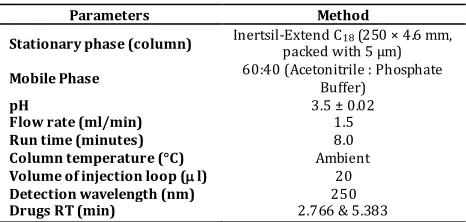
Table No. 1: Optimized Chromatographic conditions
Parameters Method
Stationary phase (column) Inertsil-Extend Cpacked with 5 µm) 18 (250 × 4.6 mm, Mobile Phase 60:40 (Acetonitrile : Phosphate Buffer)
pH 3.5 ± 0.02
Flow rate (ml/min) 1.5
Run time (minutes) 8.0
Column temperature (°C) Ambient
Volume of injection loop (l) 20
Detection wavelength (nm) 250
Drugs RT (min) 2.766 & 5.383
Preparation of standard stock solution:
The standard stock solutions were prepared by transferring 50 mg of TEL and 50 mg ATO working standards into 200 mL volumetric flasks. To that about 75 mL diluent was added, and the solution was sonicated to dissolve and the volume made up to mark with diluent. From That solution further pipette 5ml into 50 ml volumetric flask and made up to the mark with diluent. T to give the final concentration of 25 μg/mL of TEL and 50 μg/mL of ATO.
RESULTS AND DISCUSSION
In order to achieve simultaneous elution of the two components, initial trails were performed with the objective to select adequate and optimum chromatographic conditions. Parameters, such as ideal mobile phase and their proportions, detection wavelength, optimum pH, different columns and concentration of the standard solutions were carefully studied. Several solvents were tested by using different proportions, such as methanol-water (70:30 v/v), acetonitrile-water (80:20 v/v), methanol-0.05M phosphate buffer (80:20 v/v, pH 3.5-6.5 adjusted with ortho-phosphoric acid), methanol-acetonitrile-0.02M phosphate buffer (80:10:10 v/v/v, pH 3.5-6.5 adjusted with ortho-phosphoric acid) and acetonitrile-0.05M phosphate buffer (80:20 v/v, pH 3.5-6.5 adjusted with ortho-phosphoric acid). Finally, acetonitrile and 0.02M phosphate buffer in the ratio of (adjusted to pH 3.5 with ortho-phosphoric acid) at a ratio of 60:40 v/v was selected. After different flow variation trials 1.5ml/min yielded optimum separation and peak shape.
Method validation: System Suitability:
Tailing factor for the peaks due to Telmisartan& Atorvastatin calcium in Standard solution should not be more than 1.5.Theoretical plates for the Telmisartan& Atorvastatin calcium peaks in Standard solution .Should not be less than 2000.
Sample Solution Preparation:
Accurately weighed 20 tablets crushed and transferd equivalent to 50 mg of Telmisartan and 12.5 mg of Atorvastatin calcium sample into a 100 ml clean dry volumetric flask add about 50 ml of Diluent and sonicate to dissolve it completely and make volume up to the mark with the same solvent. (Stock solution).
Further pipette 5 ml of Telmisartan& Atorvastatin calcium of the above stock solution into a 50 ml volumetric flask and dilute up to the mark with diluents.
Procedure:
Inject 20 µl of the standard, sample into the chromatographic system and measure the areas for the Telmisartanand Atorvastatin calcium peaks to calculate the % Assay.
Precision:
Precision is the degree of repeatability of an analytical method under normal operational conditions. The system precision is a measure of method variability that can be expected for a given analyst performing the analysis and was determined by performing five replicate analysis of the same working solution [23]. The relative standard deviation (R.S.D.) obtained for telmisartan and atorvastatin calcium are 0.31 and 0.70% respectively (Table 3 & 4).
Preparation of Precision solution:
Accurately weighed 20 tablets crushed and transferred equivalent to 50 mg of Telmisartan and 25 mg of Atorvastatin calcium sample into a 100 ml clean dry volumetric flask add about 50 ml of Diluent and sonicate to dissolve it completely and make volume up to the mark with the same solvent (Stock solution).
Further pipette 5 ml of Telmisartan& Atorvastatin calcium of the above stock solution into a 50 ml volumetric flask and dilute up to the mark with diluents.
Accuracy:
Accuracy of the method was calculated by recovery studies at
three levels by standard addition method (Table 5). The mean
percentage of recoveries obtained for telmisartan and atorvastatin calcium was found to be 98.4 to 101.5% and 98.4-100.5% respectively.
Preparation of Accuracy solution:
Accurately weigh crushed by using mortar and pestle transferred the sample equivalent to 50%,100%and 150% of Telmisartan and Atorvastatin calcium working standard into a 100 ml clean dry volumetric flask add about 50 ml of Diluent and sonicate to dissolve it completely and make volume up to the mark with the same solvent (Stock solution).
Further pipette 5 ml of Telmisartan& Atorvastatin calcium of the above stock solution into a 50 ml volumetric flask and dilute up to the mark with diluent.
Linearity:
Linearity was determined for telmisartan in the range of telmisartan 10–100μg/ml and for atorvastatin 50– 50μg/ml. The correlation coeffi cient (‘r2’) values for both the drugs were >0.999.
Preparation of stock solution:
Accurately weigh and transferred 50 mg of Telmisartan and 25 mg of Atorvastatin calcium working standard into a two different 100 ml clean dry volumetric flask added about 50 ml of Diluent and sonicate in each to dissolve it completely and make volume up to the mark with the same solvent. (Stock solution).
Preparation of Level – I (10 ppm of Telmisartan & 5 ppm Atorvastatin calcium):
1 ml of TEL and 0.5 ml of ATO stock solution in 50ml volumetric flask dilute up to the mark with diluent.
Preparation of Level – II (25 ppm of Telmisartan &10.0ppm Atorvastatin calcium):
2.5 ml of TEL and 1 ml of ATO stock solution in 50ml volumetric flask dilute up to the mark with diluent.
Preparation of Level – III (50 ppm of Telmisartan &12.5 Atorvastatin calcium):
5 ml TEL and 1.25 ml of ATO stock solution in 50ml volumetric flask dilute up to the mark with diluent.
Preparation of Level – IV (75 ppm of Telmisartan & 25Atorvastatin calcium):
7.5 ml TEL and 2.5 ml of ATO stock solution in 50ml volumetric flask dilute up to the mark with diluent.
Preparation of Level – V (100 ppm of Telmisartan &50ppm Atorvastatin)
10 ml TEL and 0.5 ml of ATO stock solution in 5ml volumetric flask dilute up to the mark with diluent.
Limit of Quantitation (LOQ):
The limit of detection (LOD) is defined as the lowest concentration of an analyte that an analytical process can reliably differentiate from background levels [23]. The limit of quantification (LOQ) is defined as the lowest concentration of the standard curve that can be measured with acceptable accuracy, precision and variability. The LOD and LOQ were calculated as
LOD = 3.3 x Syx LOQ = 10.0 x Syx
b b
Robustness:
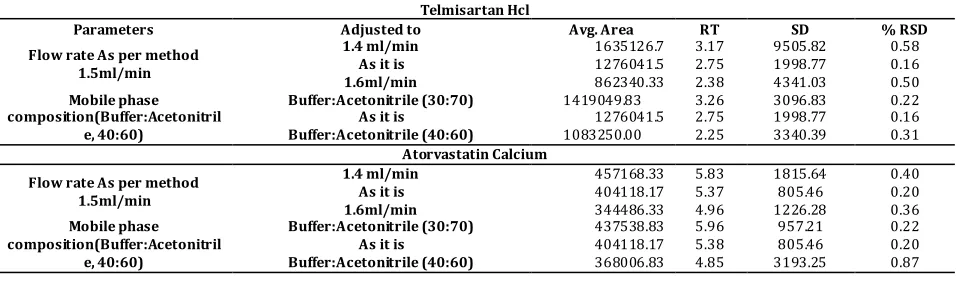
The robustness of an analytical procedure is measure of its ability to remain unaffected by small, but deliberate variations in method parameters. Robustness of the method was investigated by varying experimental conditions such as changes in wavelength, flow rate, pH
and composition of mobile phase [23]. The mixed standard solution is injected in five replicates every condition and % R.S.D. of assay was calculated for each condition. The degree of reproducibility of the results obtained implies method is robust for routine quality analysis (Table 8).
Table No. 2: System Suitability for Telmisartan HCl and Atorvastatin Calcium
Conc. of Telm &
Ator Injection Area of Ceti RT Area of Mont RT
50 & 25ppm
Inj-1 1273926 2.766 403926 5.383
Inj-2 1277798 2.742 402798 5.371
Inj-3 1271245 2.753 404245 5.382
Inj-4 1273846 2.757 403846 5.39
Inj-5 1274947 2.76 404947 5.376
Inj-6 1273542 2.756 403542 5.368
Statistical Analysis Mean SD 1274217 2138.56 2.755667 0.008017 715.5219 403884 5.378333 0.008214
% RSD 0.167833 0.290915 0.17716 0.15272
Tailing Factor 1.00 1.06
Plate Count 6387.6 3423.2
Table No.3: Summary of results of Method Precision parameter for Telmisartan HCl and Atorvastatin Calcium
inj-1 inj-2 Avg MEAN SD % RSD
TELMISARTAN HCl
MP-1 1268093 1268825 1268459
1273084.6 3976.1159 0.31232142
MP-2 1279459 1276947 1278203
MP-3 1272256 1268245 1270250.5
MP-4 1272199 1269542 1270870.5
MP-5 1272879 1273846 1273362.5
MP-6 1276798 1277926 1277362
ATORVASTATIN CALCIUM
MP-1 404059 409825 406942
405210.33 2874.1092 0.70928824
MP-2 403059 401947 402503
MP-3 402259 408245 405252
MP-4 404159 409542 406850.5
MP-5 404859 403846 404352.5
MP-6 402798 407926 405362
Table No.4: Summary of results of Injection Precision parameter for Telmisartan HCl and Atorvastatin Calcium
No. of Injections Telmisartan HCl Atorvastatin Calcium
I.P-1 1273926 403926
I.P-2 1267798 402798
I.P-3 1269245 404245
I.P-4 1273846 403846
I.P-5 1274947 401947
I.P-6 1273542 403542
Mean 1272217 403384
SD 2937.454 858.121
% RSD 0.230892 0.212731
No. Name RT[min] Area[mV*s] TP TF Resolution
1 Telmisartan Hcl 2.7667 1273021 6387.6 1.0000 0.0000
2 Atorvastatin Calcium 5.3833 402858 3423.2 1.0615 8.8219
Sum 1675879
Table No. 5: Summary of results of Accuracy parameter for Telmisartan HCl and Atorvastatin Calcium
TELMISARTAN HCl
Conc. inj-1 inj-2 inj-3 Mean % Recovery STD % RSD
25pm 50% 628462 627543 626643 627549.3 98.59214 909.5165 0.144931
50ppm 100% 1271937 1272670 1272803 1272470 99.95672 466.3572 0.03665
75pm 150% 1925734 1935573 1949463 1936923 101.4345 11921.99 0.615512
ATORVASTATIN CALCIUM
12.5ppm 50% 199462 197543 198643 198549.3 98.57038 962.9228 0.484979
25ppm 100% 402829 402783 402793 402801.7 99.98602 24.19366 0.006006
37.5ppm 150% 605734 605573 609463 606923.3 100.4363 2200.889 0.36263
Table No.6: Summary of results of Linearity parameter for Telmisartan Hcl and Atorvastatin Calcium
Telmisartan HCl Conc. (ppm) Average Atorvastatin Calcium Conc. (ppm) Average
10 372215 5 214365
25 936587 10 402858
50 1891175 12.5 535618
75 2801815 25 1081625
100 3732250 50 2153650
Fig.4: Linearity Curve of Telmisartan Hcl Fig. 5: Linearity Curve of Atorvastatin Calcium
Table No.7: Summary of results of LOQ for Telmisartan HCl and Atorvastatin Calcium
Injection Area of Telm. Area of Ator.
Inj-1 32593 10378
Inj-2 32497 10497
Inj-3 32371 10371
Inj-4 32498 10498
Inj-5 32383 10383
Inj-6 32387 10387
Mean 32454.83 10419
SD 88.90538 61.04097
% RSD 0.273936 0.585862
Fig. 7: Chromatogram of LOQ
Table No. 8: Summary of results of Robustness parameter for Telmisartan HCl and Atorvastatin Calcium
Telmisartan Hcl
Parameters Adjusted to Avg. Area RT SD % RSD
Flow rate As per method 1.5ml/min
1.4 ml/min 1635126.7 3.17 9505.82 0.58
As it is 1276041.5 2.75 1998.77 0.16
1.6ml/min 862340.33 2.38 4341.03 0.50
Mobile phase composition(Buffer:Acetonitril
e, 40:60)
Buffer:Acetonitrile (30:70) 1419049.83 3.26 3096.83 0.22
As it is 1276041.5 2.75 1998.77 0.16
Buffer:Acetonitrile (40:60) 1083250.00 2.25 3340.39 0.31
Atorvastatin Calcium Flow rate As per method
1.5ml/min
1.4 ml/min 457168.33 5.83 1815.64 0.40
As it is 404118.17 5.37 805.46 0.20
1.6ml/min 344486.33 4.96 1226.28 0.36
Mobile phase composition(Buffer:Acetonitril
e, 40:60)
Buffer:Acetonitrile (30:70) 437538.83 5.96 957.21 0.22
As it is 404118.17 5.38 805.46 0.20
Buffer:Acetonitrile (40:60) 368006.83 4.85 3193.25 0.87
CONCLUSION
The developed RP-HPLC method was accurate, precise, reproducible and robust. The developed method has been found to be better, because of its wide range of linearity, use of a readily available mobile phase. All these factors make the proposed method suitable for the quantification of TEL and ATO in bulk drugs and in table dosage form. The method can be successfully used for the routine analysis of TEL and ATO.
ACKNOWLEDGEMENT:
The authors are thankful to Bright Labs, Kothapet, Dilshuk Nagar, and Hyderabad for providing active pharmaceutical and support during work.
REFERENCES:
1. Damel M.C. et al, A validated HPLC method for analysis of
Atorvastatin calcium, Ramipril and Aspirin as the bulk drug and in combined capsule dosage form, Int. J. of Comprehend. Phar.,
2010; 1(1): 4.
2. R.Vijayamirtharaj, J. Ramesh, B. Jayalakshmi and Hanas Bin
Hashim. Development and validation of RP-HPLC method for the simultaneous estimation of Telmisartan and Atorvastatin calciumin tablet dosage form, Int. J. of Comprehend. Phar., 2010; 1(4): 1.
3. Patil K R, Rane V P,, Sangshetti J N and Shinde D B. A
Stability-Indicating LC Method for the Simultaneous Determination of
Telmisartan and Ramipril in Dosage Form, Chromatographia,
2008; 67(7-8): 575-582.
4. Shah D A, Bhatt K K, Mehta R S, Shankar M B, Baldania S L, Gandhi T R. Development and validation of a RP-HPLC method for determination of atorvastatin calcium and aspirin in a capsule dosage form, Indian journal of pharmaceutical sciences,
2007; 69(4): 546-549.
5. Shah D A, Bhatt K K, Mehta R S, Baldania S L, Gandhi T R. Stability indicating RP-HPLC estimation of atorvastatin cal cium
and amlodipine besylate in pharmaceutical formulations, Indian
journal of pharmaceutical scinces, 2008; 70(6): 754-760.
6. Palled M S, Rajesh P MN, Chatter M, Bhat A R. RP-HPLC
determination of Telmisartan in tablet dosage forms, Indian
journal of pharmaceutical sciences, 2005; 67(1): 108-110.
7. Raja K Rajeswari, Sankar G G, Rao A L, Seshagirirao JVLN. RP-HPLC method for the simultaneous determination of
Atorvastatin and Amlodipine in tablet dosage form, Indian
journal of pharmaceutical scinces, 2006; 68(2): 275-277.
8. Wankhede S B, Tajne M R, Gupta K R, Wadodkar S G. RP-HPLC
method for simultaneous estimation of telmisartan and hydrochlorothiazide in tablet dosage form, Indian journal of pharmaceutical scinces, 2007; 69(2): 298-300.
9. S.M.Patole, L.V.Potale, A.S.Khodke, M.C.Damle. A validated HPLC
method for analysis of atorvastatin calcium,ramipril and aspirin as the bulk drug and in combined dosage forms, Int. of Phar. Sci.
Review and Research, 2010; 4(3): 40-4.
10. Jain N, Raghuwanshi R, Jain D. Development and validation of RP-HPLC method for simultaneous estimation of atorvastatin
calcium and fenofibrate in tablet dosage forms, Indian journal of
pharmaceutical scinces, 2008; 70(2): 263-265.
11. Lucie N, Dalibor S, Petr S. HPLC methods for the determination
of simvastatin and atorvastatin, Trends in analytical chemistry,
2008; 27(4): 352-367.
12. Shah N J, Suhagia B N, Shah R R, Shah P B. Development and validation of a HPTLC method for the simultaneous estimation of telmisartan and hydrochlorothiazide in tablet dosage form,
Indian journal of pharmaceutical scinces, 2007; 69(2): 202-205.
13. Deshpande P B, Shridharan G, Anandi Libi, Jadhav D, Damle M C,
Gandhi S V. Validated Method Development for Esti mation of Atorvastatin Calcium and Fenofibrate in Fixed Dose
Combination by HPTLC, Kongposh publications The Pharma
Review. 2009.
14. Chaudhari B G, Patel N M, Shah P B, Modi K P. Development and
validation of a HPTLC method for the simultaneous estimation
of atorvastatin calcium and ezetimibe, Indian journal of
pharmaceutical sciences, 2006; 68(6): 793-796.
15. Palled M S, Chatter M, Rajesh PMN, Bhat A R. Difference
spectrophotometric determination of telmisartan in tablet dosage forms, Indian journal of pharmaceutical scinces, 2006; 68(5): 685-686.
16. Mishra P, Gupta A, Shah K. simultaneous estimation of
atorvastatin calcium and amlodipine besylate from tablets, Indian journal of pharmaceutical scinces, 2007; 69(6): 831-833.
17. Thamake S L, Jadhav S D, Pishawikar S A. Development and
by First Order Derivative Spectroscopy, Asian J. Research Chem.,
2009; 2(1): 52-53.
18. Sonawane S S, Shirkhedkar A A, Fursule R A, Surana S J.
Simultaneous spectrophotometric estimation of atorvastatin
calcium and ezetimibe in tablets. Indian journal of
pharmaceutical scinces, 2007; 69(5): 683-684.
19. Khan M R, Jain D. Simultaneous spectrophotometric
determination of atorvastatin calcium and amlodipine besylate in tablets, Indian journal of pharmaceutical scinces, 2006; 68(4): 546-548.
20. Sahu R, Patel V B. Simultaneous spectrophotometric
determination of amlodipine besylate and atorvastatin calcium in binary mixture, Indian journal of pharmaceutical scinces,
2007; 69(1): 110-111.
21. Ma L, Dong J, Chen X J and Wang G J. development and Validation
of Atorvastatin by LC–ESI–MS and Application in Bioequivalence
Research in Healthy Chinese Volunteers, Chromatographia,
2007; 65(11-12): 737-741.
22. Yan T, Li H, Deng L, Guo Y, Yu W, Fawcett J. P, Zhang D, Cui Y, and
Gu J. Liquid Chromatographic–Tandem Mass Spectrometric method for the Simultaneous Quantitation of Telmisartan and
Hydrochlorothiazide in human plasma, Journal of
Pharmaceutical and Biomedical Analysis, 2008; 48(4):
1225-1229.
23. ICH of Technical Requirements for the Registration of
Pharmaceutical for Human Use (ICH) Q2B. Validation of
Analytical Procedures, Methodology. (1996).



![Multicentered hydrogen bonding in 1 [(1 deoxy β D fructopyranos 1 yl)azaniumyl]cyclopentanecarboxylate (`D fructose cycloleucine')](data:image/gif;base64,R0lGODlhAQABAIAAAP///wAAACH5BAEAAAAALAAAAAABAAEAAAICRAEAOw==)