Tobinson et al. World Journal of Engineering Research and Technology
COMPUTER SIMULATION OF OPTIMIZATION MODELS FOR THE
OPERATIONAL PERFORMANCE OF LAWNMOWER DURING
CUTTING ACTION
Tobinson A. Briggs1* and Shadrack Mathew Uzoma2
Department of Mechanical Engineering, University of Port Harcourt, Port Harcourt, Nigeria.
Article Received on 12/04/2019 Article Revised on 02/05/2019 Article Accepted on 23/05/2019
ABSTRACT
A computer simulation employed in an attempt to enhance the
mathematical optimization models being developed to improved
Lawnmower blade geometry for the attainment of high cutting
efficiency during cutting action, the optimal blade thickness and blade
width. The computational analysis of the algorithmic development
confirmed blade angle of wrap of 3 to 40 should be the best design consideration. This
angular range resulted in the best optimal values in the design for optimal blade width and
thickness. The results obtained for theoretical power, optimal power, and electrical power to
drive the cutting blades were also challenging and tempting. The best cutting efficiency is
achievable when the number of blades are two, and the blade angle of wrap around the rotor
shaft is 40. The improvement in cutting efficiency decreases as the number of blades increase.
Geometrically, the cutting forces resulted in blade angle of cut of 450. The process avoids
shock loading of the blades during cutting action. Hence the cutting forces are gradually
taken up with less severe bending and twisting motion.
KEYWORDS: computer simulation, Blade angle of a wrap, Cutting force, blade optimization, Bending and twisting action, improved efficiency.
INTRODUCTION
The mathematical model was developed to provide an insight into the behavior of the cutting
blade geometrical configuration concerning the performance specifications.[1] The computer
World Journal of Engineering Research and Technology
WJERT
www.wjert.org
SJIF Impact Factor: 5.218*Corresponding Author Tobinson A. Briggs
through computer programming. The essence of the computer simulation is to forecast the
future behaviors of the blade geometry cutting characteristic of the lawn mower.
The use of computer simulation becomes necessary because of the availability of computing
power and improvements in programming languages. Also, there are inherent difficulties or
impossibilities to accurately describe the blade angle, cutting force, optimal blade width,
optimal blade thickness, and the wing. From the above reasons, computer simulation can
represent these complexities precisely is required.[3]
A Lawn Mower is a piece of equipment to keep a lawn or grassy terrain very tidy and clean.
The history, even the invention of lawn mower dated back to 1830.[4] Over the years different
design concepts of lawn mower had evolved: belt driven lawn mower, gear driven lawn
mower, lawn mower with air cushioning effect, robotic lawnmower, etc.[5,6] Frequently the
mower can use natural gas, gasoline or diesel as a source of power. There are other variations
of lawn mower, driven electrically.
Primarily they are designed to make grass cutting operation in a garden, sports arena or
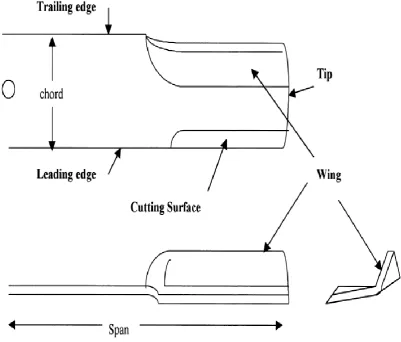
residential quarter much effortless to achieve. Figure 1 shows the archetypal pattern of a
lawnmower blade configuration. The lawnmower during operation, the blade strikes the
uncut grass with its side which is the leading edge. The tip of the blade on the leading edge is
the cutting surface focus; the high-speed impact with the grass cuts the grass down.[2]
Experimentally observation shows that approximately 70.4 meters per second are the blade
tip speeds. The wing, which is the up-turned portion of the trailing edge of the blade, and it, is
generally considered as the most critical design parameter that can be modified to obtain the
yearning performance.
Several scholars have worked on improving the efficiency and the performance of the lawn
mower. Tauro in his work, try to reduce the noise emanating from the use of commercial
lawn mower blades.[2] He further reviewed many works of literature on the effect of a single
blade on lawn mower to ascertain the efficiency of lawn mower, and reveal that the lawn
mower and other types of rotating blades such as aircraft, propellers and fan blade; all have
similar noise generation mechanisms. In trying to reduce the noise level, the application of
the following theories; rotational speed reduction, length reduction, and the reduction of the
width of the lawn mower blade; which are not a realistic solution for the performance of the
reduction, but the interaction between the deck and the blade plays a vital role in the
generation of noise while it is operational.
SIGNIFICANCE OF RESEARCH
The computational analysis of the mathematical models for optimization of Lawnmower
blade geometry for effective cutting action is a unique design concept in the determination of
the optimal number of blades, optimal blade width, and thickness. It is worthy to note that the
approach lends itself to computational analysis that applied itself to the comparative analysis
of the theoretical, optimal and electric power for more improved cutting effectiveness. The
blade area ratio gives an insight into the fact that if the cutting base is merely a disc, there
would not have been any cutting action order than rubbing action. Inadvertently, this effect
would lead to an increased power requirement from the cutting operations. Hence, it is
worthy to note that the computational analysis design considerations dictate two or four
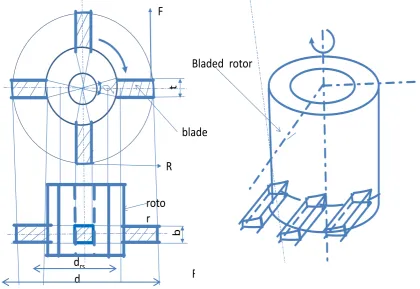
blades for improved cutting efficiency. The Lawn Mower is a bladed rotor; the geometric
representation of the blade and forces acting on it is as shown in Figure 2 below.
t
b
blade
roto r
Fig. 1 : Views of the bladed rotor F
R
Bladed rotor
drs d
Fig 2a: Views of the bladed rotor (Source: Uzoma and Briggs (2019)).
φ
β
F β
ϒ
Fig. 1b : Geometric representation of the blade cutting angle and thickness
Fig. 2a: Geometric representation of the blade cutting angle and thickness (Source: Uzoma and Briggs (2019)).
Recalling the mathematical model (from equation 1 to 16) of lawn mower blade geometry
used to attain improvement in the cutting efficiency of the lawn mower blade published
previously by Uzoma and Briggs (2019).[1] “The cutting resistance of the grass is g and the
tangential force on the blade as F and while the base area is A. The base diameter being d,
The cutting torque, T acting on the blade, represented as :
If ω is the angular rate of rotation of the blade per minute and Nb is the blade revolution per
second the,
Power required to drive the blade expressed as :
Equation 4, gives the equivalent power or horsepower to drive the electric motor.
Let the shearing resistance of the rotor shaft material be τrs and its area of cross section Ars,
then;
5 42
rs rs rs rs
rs g
d A
F A
F
Torque Trs on the rotor shaft expressed as:
If the speed reduction of the electric motor is N(rev/min) and the speed reduction from the
motor to the driven blade is ½, then:
Power to drive the cutting blade is expressed as:
The power required to drive the cutting blade should be dependent on the number of the
blade, n, and the area of the cutting blade occupied by the base. Hence, the concept of the
The power to drive the cutting blade expressed in terms of the blade area ratio Ar,
At optimal blade width, topt, for effective cutting action, dPAr/dt=0.
Optimal power to drive the system expressed as,
The blade angle of twist, β, is expressed as:
Optimal blade thickness, bopt, is given as:
The cutting efficiency, 𝞰, is the ratio of blade area ratio power requirement to the electric
The improved cutting efficiency,imp, is the ratio of the difference in the real power in terms of
the blade area ratio to optimal power over the electrical power requirement”.
Thus,
Computational Algorithmic Coding
The algorithms coding for the computational analysis are as outlined:
% COMPUTER SIMULATION OF THE OPTIMIZATION MODELS FOR THE
OPERATIONAL
% PERFORMANCE OF LAWN MOOWER DURING CUTTING ACTION
% INITIALIZATION (INPUT PARATERS)
% SPEED OF ELECTRIC MOTOR, n (Ren/min)
N=3000;
% ROTOR SHEARING RESISTANCE, RS(N/m2)
RS=75*10^6;
% cutting resistance of the grass,GS (N/m2)
% GS=15*10^6;
GS=150000;
% DIAMETER OF THE BASE AREA OF THE CUTTING BLADE, D (m)
disp('DIAMETER d OF THE CUTTING BLADE BASE')
d=0.65;
fprintf('%10.4f/',d)
% RADIUS OF THE BASE AREA OF THE CUTTING BLADE, r (m)
r=d/2;
pi=22/7;
% SPEED OF THE BLADE, Nb (rev/min)
Nb=N/2;
% ANGULAR RATE OF ROTATION OF THE BLADE, W (rad/s)
w=(2*pi*Nb)/60;
% TANGENTIAL VELOCITY AT THE TIP OF THE CUTTING BLADE, V (m/s)
V=r*w;
disp(' The value of n1 =? ')
fprintf('%10.4f/',n1)
for theta=1:1:5
disp('THETA')
fprintf('%10.4f/',theta)
Alp=(pi*theta)/180;
% ROTOR SHAFT DIAMETER, drs (m)
drs=((GS*d^2)/RS)^(1/3);
disp('drs')
fprintf('%10.4f/',drs)
% BLADE THICKNESS, T (m)
t=(drs*Alp)/2;
% OPTIMAL BLADE THICKNESS, topt(m)
topt=(pi^d*Alp)/(2*n1-1);
% OPTIMAL BLADE WIDTH (m)
bopt=topt*tan(Alp/2);
% BLADE AREA RATIO, ar (dimensionless)
disp('AREA RATIO')
% Ar=1-(2*n1*drs*Alp)/(pi*(d*t+((2*t)/theta)));
Ar=(1-(2*n1*drs*Alp)/(pi*(d+drs)));
fprintf('%10.4f/n',Ar)
% OPTIMAL AREA RATIO Aropt (dimensionless)%
% Aropt=(2*n1*topt)/(pi*(d*topt+((2*topt)/theta)));
Aropt=(1-(2*n1*topt)/(pi*(d+drs)));
% POWER REQUIRED TO DRIVE THE CUTTING BLADE IN TERMS OF THE BLADE
AREA RATIO, AR
P=((pi^2*drs^3*GS*Nb)/480)*Ar;
% CUTTING FORCE IMPARTED ON THE CUTTING BLADE
F=P/V;
R=F;
% THE BLADE CUTTING ANGLE, Beta
% Beta=tan^(-1)(R/F);
% disp('TUTTING ANGLE Beta=')
fprintf('%10.4f/n',F)
% OPTIMA POWER REQUIRED TO DRIVE THE CUTTING BLADE IN TERMS OF
THE BLADE AREA RATIO, AR
Popt=((pi^2*drs^3*GS*Nb)/480)*Aropt;
% POWER REQUIRED TO DRIVE THE ELECTRIC MOTOR
Pelec=((pi^2*drs^3*GS*Nb)/480);
disp('ALP')
fprintf('%10.4f/n',Alp)
disp('ttopt bopt')
fprintf('%10.6f/n',t,topt,bopt)
disp('P Popt Pelec')
fprintf('%10.4f/n',P,Popt,Pelec)
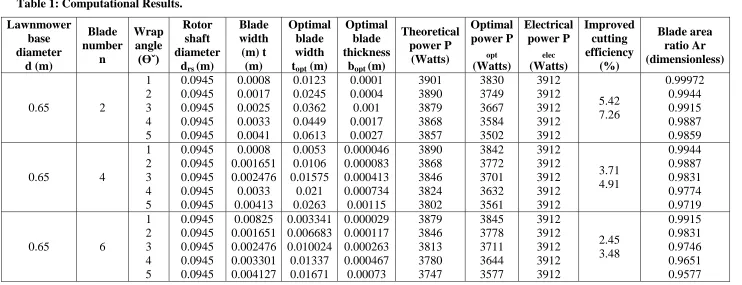
Analysis of Computational Results Table 1: Computational Results. Lawnmower base diameter d (m) Blade number n Wrap angle (Ɵˇ) Rotor shaft diameter
drs (m)
Blade width (m) t (m) Optimal blade width topt (m)
Optimal blade thickness
bopt (m)
Theoretical power P (Watts) Optimal power P opt (Watts) Electrical power P elec (Watts) Improved cutting efficiency (%) Blade area ratio Ar (dimensionless)
0.65 2
1 2 3 4 5 0.0945 0.0945 0.0945 0.0945 0.0945 0.0008 0.0017 0.0025 0.0033 0.0041 0.0123 0.0245 0.0362 0.0449 0.0613 0.0001 0.0004 0.001 0.0017 0.0027 3901 3890 3879 3868 3857 3830 3749 3667 3584 3502 3912 3912 3912 3912 3912 5.42 7.26 0.99972 0.9944 0.9915 0.9887 0.9859
0.65 4
1 2 3 4 5 0.0945 0.0945 0.0945 0.0945 0.0945 0.0008 0.001651 0.002476 0.0033 0.00413 0.0053 0.0106 0.01575 0.021 0.0263 0.000046 0.000083 0.000413 0.000734 0.00115 3890 3868 3846 3824 3802 3842 3772 3701 3632 3561 3912 3912 3912 3912 3912 3.71 4.91 0.9944 0.9887 0.9831 0.9774 0.9719
0.65 6
The computational results of some paramount parameters affecting the operational
performance of the Lawnmower during cutting action are in Table 1. The blade area ratio is a
pointer to the fact that if the cutting blade is to be merely a disc, the cutting action would
have been rubbing action. Thus, this requires tremendous power to effect cutting action. As
observed the ability to make cutting reduces as the number of blades increase but up to a
limit. The computational results show an indication that the cutting power decreased when
the number of cutting blades changed from 2 to 4. There is a need to increase cutting power
when the number of blades changed from 4 to 6. Based on the wrap angle of the blade around
the rotor shaft, the best optimal cutting efficiency obtained at a wrap angle of 3 to 40.
CONCLUSION
The essential focus of this paper is to develop computer simulations techniques evolved to
satisfy the analysis tool to predict and manage the geometrical characteristics of the
lawnmower blade. The application of the computational data faithfully would lead to
lowering overhead cost, reducing labor requirement, and streamlining operations of the lawn
mower. However, there is still more work to do to better understanding and quantity the
procedures of improving the quality of performance cutting efficiency of the lawn mower.
RECOMMENDATION
The results of the computational, algorithmic coding should be applied in the production of
new generational Lawnmower. More so, the blade angle of cut, β, was geometrically
determined as 450, even being the optimal value and practically relevant to avoiding shock
loading the blades during cutting action. The best possible range of this angle should be
obtained experimenting on a physical model.
NOMENCLATURE
F, R—tangential force at the blade tip (N)
A—base area of the cutting blade (m2)
Τg—cutting resistance of the grass (N/m2)
r—base area radius (m2)
ω—angular rate of rotation of the blade (m2)
N—motor revolution (rev/s)
P—power required to drive the blade (Watts)
PAr—theoretical power required to drive the blade in terms of blade area ratio (Watts)
Pele—electrical power required for cutting action (Watts)
T—cutting torque (Nm)
Nb—blade revolution (rev/s)
Τrs—rotor shaft shearing resistance (N/m2)
Ars—rotor shaft area of cross section (m2)
Ar—area ratio (dimensionless)
n—number of blades
t—blade width (m)
b—blade thickness (m)
topt—optimal blade width (m)
bopt—optimal blade thickness (m)
α—angle subtended by the cutting blade at the centre of the rotor shaft ( degree) β—cutting angle (degree)
REFERENCES
1. Shadrack Mathew Uzoma and Tobinson A. Briggs “Optimization Model Of Lawn Mower
Blade Geometry To Attain Improved Cutting Efficiency” European Journal of
Mechanical Engineering Research, April 2019; 6(1): 25-31.
2. Moore, Matthew D., "Measurement and analysis of lawn mower performance and noise"
Retrospective Theses and Dissertations.17368. https://lib.dr.iastate.edu/rtd/17368 (last
accessed 4th May 2019), 1997.
3. Roger Mchaney, Understanding Computer Simulation, Roger McHaney & Ventus
Publication Aps, 2009.
4. DHTRUST History of LawnMowers Part Three: 1870s-1890s, Available at
htt://www.hdtrust.co.uk/hist03htm [retrieved November 20,2016].), 2016.
5. Kinmander, O.: Rise of Lawn-Cutting Machines, Bloomberg Business week, Available at
http://www.oldlawnmowerclub.co.uk/aboutmowers/history.
6. Rodney A. B. A robust layered control system for a mobile robot, (EEE Journal of
Robotics and automation, 1999; 14.
7. The Hall & Duck Trust “ Lawn Mower History Part 2”, Available Hdtrust.co.uk
[Retrieved April 23, 2011], 2011.
9. Basil, O. Simple Design of Self-Powered Lawn Mower, Department of Mechanical
Engineering, Federal University of Technology Owerri, Imo State, Nigeria. International
Journal of Engineering and Technology, 2013; 3(10).
10.US RE 8560 Pass more, Everett G, “Improvement in Lawn Mowers,” published 23
February 1869, issued 23 January, 1879; 1(2).
11.Van den Berg, J. Socio-economic factors affecting adoption of improved agricultural
practices by small scale farmers in South African Journal of Agriculture, 2013; 8(35):
4490-4500.
12.Xiao O. and Wang M. study and implementation on batteries charging of lawnmower,
smart grid, and renewable energy, 2011; 2(4): 322-329.
13.Yong D. R. and Chow, S. H. Design and Construction of an Improved Domestic Lawn
Mower, Project : Beijing Institute of Technology, China, 1991.
14.Yong D. R. and Chow, S. H. Design and Construction of an Improved Domestic Lawn