WEJ
Effects of chloroform extract of
Artemisia maciverae
Linn on blood cholesterol levels and pathological
lesions in the heart of rats
2 1 1 3 4
ENE A.C , ATAWODI S.E , AMEH D.A , FATIHU M.Y & NNAMANI C.N
1. Department of Biochemistry, Ahmadu Bello University Zaria, Nigeria.
2. Nigerian Institute of Medical Research, Maiduguri Outstation, P.M. B 293, Maiduguri, Nigeria. 3. Department of Veterinary Pathology and Microbiology, Faculty of Veterinary Medicine, Ahmadu Bello
University, Zaria, Nigeria.
4. Department of Mathematics, Ahmadu Bello University, Zaria, Nigeria.
Corresponding author Email: [email protected]
ABSTRACT: The effect of chloroform extract of Artemisia maciverae Linn was studied in male Swiss albino rats. The rats were randomly distributed into four groups of 24 animals each. Group 1, the normal control was administered 0.3% Tween 80 solution. Groups 2 to 4 rats were administered chloroform extract of Artemisia maciverae at 50, 100 and 200 mg/kg body weight (b.wt) respectively for 60 days (for those that survived) and monitored until day 90 when they were sacrifice. The blood cholesterol levels of the rats were determined. The hearts were subjected to gross and histopathological examination. At the onset of treatment (week one), the mean (+ SD) serum cholesterol levels in the control, 50, 100 and 200 mg/kg treatment groups were 53.2+2.20, 78.5+6.40, 83.3+2.30 and 92.5+13.80 mg/kg respectively. A statistically significant difference (p<0.05) was observed in the cholesterol levels in the treated animals compared to the untreated controls at the onset of treatment. By day 90 (week 12), the cholesterol levels in the groups with the exception of 200mg/kg group were 42.2+3.20, 54.8+1.40 and 61.3+0.00 mg/kg in control, 50 and 100 mg/kg groups respectively. However, no gross and histopathological lesions were observed in the heart of rats in all groups. It is therefore concluded that the plant extract is associated with hypercholesterolemia in high doses.
Key words: Artemisia maciverae, Chloroform extract, Cardio-toxic effect, Swiss albino rats
INTRODUCTION
Medicinal plants play a very significant role in health care needs of rural populations in African and other
1
the treatment of various diseases in developing countries compensate for some perceived deficiencies in orthodox
2,3
continued therapeutic application of these remedies. The rationale for their utilization has rested largely on
long-3
2
Artemisia maciverae Linn belongs to the family Asteraceae. The whole plant of this medicinal herb is commonly used in the northern part of Nigeria in treating ailments like malaria and fever. It is commonly known in
4
flavonoids, triterpenes, phlobatannins, tannins, anthraquinones, steroids, saponins and alkaloid.
There is a high degree of concern regarding the safety use of plant extracts. The medicinal uses of some plants are well documented in the literature. However, there are few records in the literature of the toxicity profiles
5
6
third world countries especially in treatment of diseases . The use of herbal prescriptions and natural remedies for
pharmacotherapy . Unfortunately, there is limited scientific evidence regarding safety and efficacy to back up the
term clinical experience . But now, with the upsurge in the use of herbal medicines, a thorough scientific investigation of these plants will go a long way in validating their folkloric usage .
Hausa as Tazargade. This plant has been reported to have anti-malarial effect . It is rich in phytochemicals such as
Administration of chloroform extract of whole plant of Artemisia maciverae produced clinical signs of toxicity like dizziness, convulsion, loss of appetite and loss of agility in the treated groups. The signs of toxicity were found The heart is the primary organ that pumps blood throughout the body. Damage to the heart could arise due to the administration of plant extracts, but there is paucity of scientific information because the incidence of toxicity in local settings are hardly reported nor documented. A study of the toxicity of Artemisia maciverae is imperative because of its positive therapeutic effect. Moreover, a study of the effect of the drug extract on the heart is essential because of the cardinal role the organ plays in maintaining life. The determination of the histopathological effect on the heart and some biochemical parameters are relevant in the establishment of safety of this plant extract. Therefore, the present study aims at determining the levels of cholesterol and pathological effects of chloroform extract of Artemisia maciverae in Swiss albino rats.
MATERIALS AND METHODS
Plant material and extract preparation
The plant Artemisia maciverae was collected in Zaria and identified by a Taxonomist at the Herbarium Section of the Department of Biological Sciences, Ahmadu Bello University, Zaria.
The whole plants of Artemisia maciverae were air dried at room temperature for two weeks and grounded into powder using laboratory mortar. Extraction of this powdered form was carried out by defating with petroleum
o
Animals
Adult Swiss albino mice weighing between 20-35g were used for the assessment of the acute toxicity. Animals of both sexes were randomly assigned to 4 groups of 3 rats each. For the cardio-toxicity study, adult male Swiss albino rats weighing between 150g-280g were employed. Animals were randomly assigned to control and treated groups (24 animals per group).
ether followed by extraction with chloroform. The extract was stored at - 4 C until required.
Cardiotoxicity evaluation
7 8
male adult Swiss albino rats were randomized into four groups, each containing 24 rats. The rats were allowed to adjust to the laboratory environment for one week before the commencement of study. Group 1 which served as the normal control was administered 0.3% Tween 80 solution, while rats in groups 2, 3, and 4 were administered the chloroform extract of Artemisia maciverae at daily dose of 50 mg/kg, 100 mg/kg and 200 mg/kg b.wt respectively for sixty days. Administration of extract was stopped after 60 days of dosing the animals and the surviving animals were monitored till day 90 before sacrifice.
Food intake, water consumption and body weight of the animals were measured throughout the duration of the experiments. During the experimental period, all animals were observed daily for clinical signs and symptoms of toxicity. Animals were sacrificed at the end of weeks 1, 2, 4, 8, 10 and 12. At the end of the study, all surviving animals were sacrificed. Blood samples were collected for biochemical analysis. Heart of both the dead and sacrificed animals were removed and fixed in 10 % formal saline ready for histopatholgical analysis.
The method described by Chan et al and adopted by Adeyemi et al was used for this study. Ninety six
Histopathological Studies
9
Detailed microscopic examination was carried out in the heart of both control and test/treatment groups.
The heart were embebbed in paraffin wax, sectioned at 5µ and stained with haematoxylin and eosin .
Determination of serum cholesterol
Whole blood samples were collected and allowed to clot. The sera collected were analyzed for cholesterol
10
SX 60010383 0001).
, employing standard kit (Biosystems S. A; Costa Brava 30, Barcelona, Spain), Iso 13485-TUV Rheinland-Reg:
Statistical analysis
All the results generated were analyzed using students’ ‘t’ test and analysis of variance (ANOVA).
There was 100% mortality in the 200 mg/kg body weight (b. wt) treatment group within week one of treatment after convulsions as a sign of toxicity. No casualty was recorded in the control group. The LD50 of the extract was found to be 570 mg/kg. A drop in water and food consumption was observed in the animals as the dose of the extract administered to them increases.
Figure 1. Cholesterol levels in rats treated with chloroform extract of Artemisia maciverae for 90 days
Serum cholesterol profile showed an elevation in the levels of cholesterol in the treated groups at the onset of treatment compared to the normal control (Figure 1). This elevation in serum cholesterol is equally presented in table 3. By one week of treatment, the mean serum cholesterol levels in the control, 50, 100 and 200mg/kg treatment groups were 53.2+2.20, 78.5+6.40, 83.3+2.30 and 92.5+13.80mg/kg respectively (Table 1). There was a statistically significant difference (P< 0.05) observed when the levels of cholesterol in the treated groups were compared with the normal control. This increase in the cholesterol levels was more prominent in weeks one and two of treatment. The elevation in this biochemical parameter was highest in the animals treated with 200mg/kg body weight of the extract compared with the other treatment groups and the normal control group. The cholesterol levels remained elevated in all the treated groups when compared with the control throughout the duration of this study. At week 12, the cholesterol levels in the above treatment groups were found to be 42.2+3.20, 54.8+1.40 and 61.3+0.00mg/kg respectively (Figure 1).
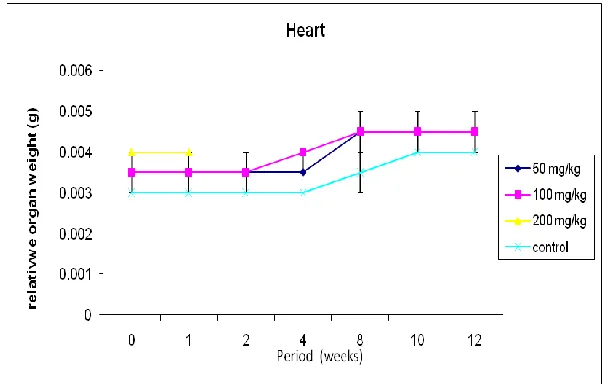
For cardio-toxicity studies, macro and microscopic observations indicated no lesions in the hearts of the animals treated with 50mg/kg, 100mg/kg and 200mg/kg of the extract. There were also no lesions observed in the heart of the normal control. Normal heart of rat is shown in plate 1. The relative weight of the heart of the treated animals were not significantly different (p>0.05) from that of the controls at the beginning and end of experiment (Figure 2). There was a significant difference (p<0.05) observed in the body weight of rats treated with 100 and 200 mg/kg b.wt of chloroform extract of A. maciverae when compared with the control and 50 mg/kg b.wt treatment groups.
Table 1. Cholesterol (mg/dL) levels of rats treated with chloroform extracts of Artemisia maciverae for 90 days
Groups Period
Week 0 Week 1 Week 2 Week 4 Week 8 Week 10 Week 12
Control 47.1±2.20c 53.2±2.20c 50.0±1.80c 51.7±2.40c 48.2±3.20c 49.9±2.80c 42.2±3.20c
50mg/kg 47.1±2.20c 78.5±6.40d 91.8±8.40f 61.6±2.30g 57.0±0.70g 54.8±0.00g 54.8±1.40g
100mg/kg 47.1±2.20c 83.3±2.30d 98.9±7.20f 64.6±1.20g 77.4±0.00d 66.1±0.70h 61.3±0.00h
200mg/kg 47.1±2.20c 92.5±13.80d - - - -
-All values were compared with each other at P = 0.05 Number of animals in a group (n) = 6
- = 100% mortality
Values with different superscript vertically and horizontally differ statistically (P<0.05)
Plate 1. Normal Heart of rat showing no lesion
DISCUSSION
The therapeutic importance of the chloroform extract of the whole plant of Artemisia maciverae in folk
4
effect of the plant extract in spite of its use in folk medicine practice. Current study showed that the chloroform extract of this plant could be potentially cardio-toxic when the dose is high and the duration of use extended.
Sub-chronic/cardio-toxicity studies are almost always invaluable in evaluating the safety profile of phytomedicines. This is because acute toxicity data are of limited clinical application since cumulative toxic effects do occur even at very low dose.
Cardio-toxicity/sub-chronic study revealed that the chloroform extract of Artemisia maciverae was toxic to the experimental animals during the onset of the experiment particularly weeks one and two. This toxic effect was observed with all the doses of the extract administered to the animals with the highest toxicity observed in the 200 mg/kg treatment group. This can be explained by the fact that all the animals in this group died in week one of treatment. The extract was associated with consistent dose and duration dependent increase in serum cholesterol with significant increase (p<0.05) observed in the 50, 100 and 200 mg/kg treatment groups compared to the untreated controls. The toxic effect of this plants extract was reversed towards the end of the experiment when the administration of the extract was stopped.
cholesterol levels at high dose of the extract and longer duration showed that the cardiovascular system could be adversely affected by the extract, but the adverse effect is prominent when high dose of the extract was given for a long period. Increased total cholesterol values are associated with a progressively escalating risk of atherosclerosis
10,12
13 14
with the ethanol extract of Euphorbia heliscopia in Swiss albino rats, there was a significant increase in the levels of serum cholesterol. They stated that there were no lesions observed in the heart of the treated animals during the toxicity study.
and coronary heart disease . The serum concentrations of cholesterol are also elevated due to skeletal or cardiac muscle disease among various other diseases arising from administration of various drugs .
Similar results were reported by Al-Sultan and Hussein . They reported that in a toxicity study carried out
CONCLUSIONS
Sub-chronic toxicity/cardio-toxicity test in rats dosed 50 mg/kg, 100 mg/kg and 200 mg/kg b.wt demonstrated that the extract is toxic at the onset of treatment. However, towards the end of this study which lasted for 90 days, the toxic effect of this plants extract was slightly reduced.
ACKNOWLEDGMENT
We express our gratitude to Mr. Apeh Y. E. O of the Biochemistry Department of Ahmadu Bello University, Zaria, Nigeria, for technical assistance.
REFERENCES
Arbonnier M. 2004. Trees, shrubs and Lianas of West African dry zones. Magral Publishers CIRAD GMBH, MNHN, pp 124-145.
st
Zhu M, Lew KT, Leung P. 2002. Protective effects of plant formula on ethanol-induced gastric lesions in rats, Phytotherapy Research, 16: 276-289.
Ene AC, Ameh DA, Kwanashie HO, Agomo PU, Atawodi SE. 2008. Preliminary in vivo anti-malarial screening of petroleum ether, chloroform and methanol extracts of fifteen plants grown in Nigeria, Journal of Pharmacology and Toxicolology, 3(4): 254-260.
Dalziel JM. 1997. Botany, uses of Alsonia boonei stem bark In: The useful plants of West Africa, Crown agents for Overseas government and administration, London, pp. 260-264.
Mcnamara BP. 1983. Concepts in health evaluation of commercial and industrial chemicals In: Mehlman M A, Sh apiro R E, Blumental H (Eds), New concepts in Safety D.C, 217-225.
Chan PK, O’ Hara GP, Hayes WA. 2009. Principles and methods for acute and subchronic toxicity. In: principles and methods of toxicology, Hayes W.A (ed) Raven Press, N .Y. 351-376.
Adeyemi OO, Elujoba AA,an Odesanmi WO. 1988. Evaluation of the toxicity potential of Cassia podocarpa with reference to official senna, In:
W. Africa J. Pharmacol. D. Res; 8(1): 41-47.
th
Allain C.C, Poon L.S, Chan C.S.G, Richmond W. and Fu P.C. (1974): Enzymatic determination of total serum cholesterol, Clin. Chem; 20: 470-475
nd
Searcy RL, Reardon JE, Foreman JA.1967. A new photometric method for serum urea nitrogen determination, Amer. J. Med. Technol; 33: 15-20.
Gella FJ, Olivella T, Cruz PM, Arenas J, Moreno R, Durban R, Gomez JA. 1985. A Simple procedure for routine determination of aspartate aminotransferase and alanine aminotransferase with pyridoxial phosphate, Clin. Chim. Acta; 153:241-247.
Al-Sultan SI, Hussein AY. 2006. Acute toxicity of Euphorbia heliscopia in rats, Pakistan Journal of Nutrition, 5(2): 135-140. Sofowora EA. 1967. Medicinal plants and traditional medicine in Africa, 1 edition, Spectrum Books Ltd, Ibadan-Nigeria, p. 289.
Drury RAB, Wallington EA, Roy C. 1997. Carleton’s histological technique, 4 Edition, Oxford University Press, London, pp.49-98.