Students’ Industrial Work Experience Scheme
(SIWES),Rufus Giwa Polytechnic Experience,
Prospescts, Challenges And Improvement.
Oladimeji A. O., Lawson O. S., Olajide O. G. and Akinfiresoye W. A.
Agricultural and Bio-Environmental Engineering Technology Department, Rufus Giwa Polytechnic, Owo, Ondo State, Nigeria.
Corresponding author Gmail: [email protected] Tel: +234-8066217713
Abstract—Training constitutes a basic concept in
human resource development. It is concerned with developing a particular skill to a desired standard by instruction and practice. SIWES programme is one of such training given to students in tertiary institutions to bridge the gap between theory and practice. Consequently, this paper evaluated the prospect of SIWES training, challenges and areas of improvement with Rufus Giwa Polytechnic, Owo in perspective. The paper looked into brief history of SIWES in Rufus Giwa polytechnic Owo, furthermore, the need for SIWES training was stretched and factors that tend to impede the smooth running of SIWES programme in the institution were identified and finally, solutions were proffered and useful and necessary recommendations made for future improvement.
Keywords—SIWES, Prospects, Challenges, Improvement, Rufus Giwa Polytechnic.
I. INTRODUCTION
The Students Industrial Work Experience Scheme (SIWES) is the acceptable skills training programme which forms part of the minimum academic standards in the various diploma and degree programmes for Nigerian Polytechnics and Universities. It is effort to bridge the existing gap between theory and practical science and technology and other professional educational programmes in the Nigerian tertiary institutions (Akerejola 2004 Allen and Craig 1987). The importance of SIWES cannot be over-emphasised. It provides students with an opportunity to apply their theoretical knowledge in real life situation. Also it exposes students to
more practical work methods and techniques. Furthermore, it strengthens links between the employers, the polytechnics, the Industrial Training Fund (ITF), and finally, it also prepares the students for the labour market after graduation. (ITF, 2009 and ITF, 2013). The Student Industrial Work Experience Scheme (SIWES) therefore is aimed at giving the students the opportunity to relate and translate their theoretical knowledge to the real world of work.
A. OBJECTIVE OF THE STUDY
The study generally is aimed at evaluating the students’ Industrial Work Experience Scheme in Rufus Giwa Polytechnic, Owo.
The specific objectives are:
i. To look into the necessity of (SIWES) programme in the Institution.
ii. To determine the area of challenges in the programme and proffer solutions to the observed challenges.
iii. To identify areas of improvement and make necessary recommendations. II. SIWES PROGRAMME IN RUFUS GIWA POLYTECHNIC, GENERAL OVERVIEW
www.jmess.org
JMESSP13420322 1637
in 1977 during the Military Administration of Group Captain David Ita Ikpeme. However the idea came to fruition during the era of the first civilian Governor, Chief (Dr) M.A Ajasin, when the state house of assembly in 1979 passes the bill establishing the Polytechnic. The institution came into being in January, 1980. An edict known as “Ondo State Polytechnic, Owo” edict was passes by the military Governor of Ondo state of Nigeria in 1990. This edict suspended the earlier bill establishing “The Polytechnic” deemed to have come into force on the 1st December, 1979. The name of the Institution metamorphosis to Rufus Giwa Polytechnic, in the year 2003. (StudentsInformation Handbook, 2010.
III.
SIWES COORDINATING UNIT
OF THE INSTITUTION
Until recently, very few institutions saw the need for establishing the Industrial (SIWES) coordinating unit and even where they have been established, their activities seemed to be narrowed down to only placing students on industrial attachment.
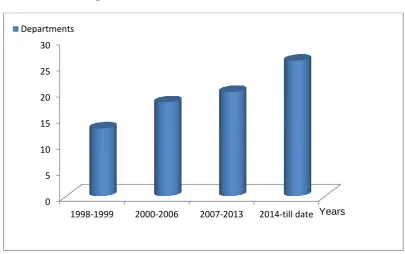
SIWES programme commenced at Rufus Giwa Polytechnic in the year 1998 with about thirteen (13) departments. These includes department of Electrical Electronic Engineering Technology (EEET), Mechanical Engineering Technology (MET), Quantity Surveying (QS), Architecture (Arch), Food Science Technology (FST), Hotel Management Technology (HMT), Surveying and Geo-Informatics (S&G), Agricultural Engineering Technology (AET) now Agricultural and Bio-environmental Engineering Technology (ABET) and Civil Engineering Technology (CET). However, today, the number of participating Department is twenty-six (26) with a complete building dedicated for SIWES operation. Competent staff and up to date office equipment were provided for the unit. (RUGIPO SIWES Information Handbook, 2012).
The unit is utilized in fostering closer link between the institutions of learning and the industries. The unit is developed to collect useful information on problems facing industries with a view to referring to relevant departments. Through the activities of this unit, real life case study could be readily available to lecturers and students as well. The unit by virtue of its position as well as Industrial liaison office is utilized for guiding students in career/job placement opportunities. Furthermore, it serves as college base students’ work experience programme which involve setting up pilot projects like prototype industries and production centres where students can acquire industrial experience during the early periods of their training.
IV. PROSPECTS OF SIWES
SIWES is a form of Industrial Training. Every organisation should provide training to all the employees irrespective of their qualification and skills. Training constitutes a basic concept in human resource development. It is concerned with developing a particular skill to a desired standard by instruction and practice. Training is a highly useful tool that can bring an employee into a position where they can do their job correctly, effectively and conscientiously. Training is the act of increasing the knowledge and skill of an employee for doing a particular job.
if properly planned and executed it has a lot of project either now or in the nearest future.
Industrial Training (SIWES) can make a significant contribution to the development of students. This is not only by increase in the economic wellbeing of a nation but also by the increase capacity of their own line. If the concept of development has been so defined to include the capacity of individual students to guide and determine the direction of their own lives, SIWES as a training programme is the yardstick for achieving this objective for the students of tertiary institutions.
The benefits acquiring to students who participated in Industrial Training are the skills and competences they acquire. These relevant production skills remain a part of the recipient of industrial training as lifelong assets which cannot be taken away from them. This is because the knowledge and skills acquired through training are internalized and become relevant when required to perform job. (Olusegun 2009).
Industrial training can contribute to the solution of a training problems no matter how defined at both national and individual levels by increasing awareness and understanding of the factors that contribute to industrial training charges and the consequences. In Nigeria, Industrial Training developed as a response to concern for rapid student trainee growth. It is
often assumed that the relevance is limited in countries where rapid industrial training is not a problem. Industrial Training is also relevant to countries wishing to increase their student trainee. Change their rate of growth in other directions to stabilize or to change their present pattern of Industrial Training programme exercise in the tertiary institutions. With a well organise SIWES programme in the higher institutions, the country will be able to produce and meet up with her industrial technological professional demand. Also the student will be self-reliant after graduation.
V. CHALLENGES FACED BY SIWES IN THE INSTITUTION
It is a clear fact that all the SIWES major stakeholders i.e the students, the institutions and the employers agreed that SIWES is relevant and useful for technical skills development in Nigeria. Unfortunately, however, the scheme has faced a number of problems and challenges since its commencement in the Rufus Giwa Polytechnic. These challenges include the following:
www.jmess.org
JMESSP13420322 1639
Fig. 1: SIWES enrolment between 2009 and 2016
Fig. 2: Number of participating departments in SIWES between the year 1998 till date From the above graphs, it could be seen
that the number of students mobilized for SIWES between 2014 and 2016 SIWES years undergo dramatic increase (fig 1). Similarly, the number of SIWES participating Department also increases, from 13 departments in the year 1998 to 20 departments in the year 2013 (fig 2). But today the number of department participating in SIWES programme in the institution has risen to 26. The above increase has resulted to placement challenges (fig 2).
B. Placement challenges:
Due to increase in the number of students and departments participating in SIWES programme in the institution as earlier observed above, it has become difficult to place all the students for the SIWES training. There are three major ways the SIWES Unit of the institution source for placement;
i. Institutional sourcing ii. Individual student sourcing iii. Employer request
0 500 1000 1500 2000 2500 3000 3500 4000
2009 2010 2012 2013 2014 2015 2016
0 5 10 15 20 25 30
1998-1999 2000-2006 2007-2013 2014-till date Years
The figure below shows the percentage of each method of sourcing for placement
Fig.3: Placement challenges in SIWES Program
Because pressure on sourcing for SIWES placement is majorly on the students, most of the student do their SIWES in places that are not relevant to their field of study and sometimes, sizable number are rejected from where they submitted their introduction letter and eventually do the SIWES within the Institution and by this they are less exposed.
Specifically, the following problems are associated with placement of student in the institution:
i. Increase in number of students in the institution for SIWES programme
ii. Inadequate industries willing to accept students for SIWES
iii. Economic problems, thus prevent students from going far away from their home for SIWES
iv. Students looking for places where they could be paid stipends
v. Limited number of viable and relevant places of attachment.
C. Inadequate Funding:
In most institutions running SIWES there is no financial autonomy for the SIWES Unit. Most of the monies for running SIWES are paid into an expended directly from the institutions common account, this places a lot of bottle-necks and delay in withdrawal of funds when needed.
Apart from the above, inadequate SIWES funding is another challenge faced by the SIWES unit of the institution. This dwindles from year to year. The results of the above challenges is that visitation of students on SIWES by the industrial base supervisor that supposed to be twice now reduced to once and furthermore the number of students to be visited by a supervisor is very high; i.e a supervisor to 50-100 students within a day is terrible and this result to lack of thorough supervision. This is a great challenge.
D. Orientation:
All eligible students for SIWES must be given an orientation on SIWES by their institutions during which ITF staff must be in
Key
Blue Colour: Student Sourcing
Green Colour: Institution Sourcing
www.jmess.org
JMESSP13420322 1641
attendance. The purpose of SIWES orientation is to create awareness and equip the students in respects of the situation they are likely to meet outside the campus at the place of their attachment. The will also be instructed about what to do and what they should not do when SIWES programme is on-going. However, from experience, the orientation programme has been characterised by the following:
i. Lack of student concentration ii. Poor attendance of students
iii. Lateness to orientation programme iv. Inadequate space
v. Poor public address system
The above points were captured by the picture below and to the success of the SIWES programme. The overall student of the above is that many of the students misbehave at the place of their attachment.
E. Delay in payment of SIWES allowance The above problem (i. e delay in payment of SIWES allowance to students) has constituted a big challenge to the institution and SIWES unit. For example, the SIWES stipend for the year 2012, 2013, 2014 and 2015 are yet to be paid. Recently, 2013 stipends were paid and 2012 left unpaid with the claim that the bulk allowance to the institution was paid to a wrong account. This has led to students’ agitation on daily basis and the SIWES unit has been subjected to much pressure from the students and it is quite demotivating. Late payment may be due to:
i. Late submission of master and placement list
ii. Delay in document processing by the ITF
iii. Delay in fund release by Federal Government.
F. Other challenges are:
Students on SIWES are expected to be visited twice by both the ITF official as well as the institution based supervisors. It is during SIWES visit that a student can be assessed on their level of participation, the problem they are facing as well as to encourage, advice and inform the employer on the purpose of SIWES programme. However, most of the time, supervision of students on SIWES are not thoroughly done. This may be due to one or more of the following reasons:
i. Inadequate funding
ii. Too many students to a supervisor iii. Wrong address given to the students iv. Lack of commitment on the part of the
supervisor.
Most of the supervisors that even go out on supervision usually lodge in hotels and start calling students to come along with their logbooks especially the female students; while some may find a place and call students to come for signing instead of going to the particular places of attachment of these students. On the part of the induction, some of them do monitor the students while others hardly have time for students
VI. POSSIBLE SOLUTIONS TO THE CHALLENGES FACED BY SIWES
The following as suggested by Oladimeji A. O et al (2016), are some of the solutions to the above stated challenges.
(i) Proper Coordination and Supervision of the Exercise:
ensure that what they are doing is in line with the objectives of the SIWES exercise. (ii) The various bodies involved in the
management of the SIWES programme should liaise with the various industries ahead of time so as to minimize or reduce to the bare rest minimum the high level of refusal to accept students for their industrial training.
(iii) Issuing of Log Books/IT Letters in time: The log books used by the student during the industrial training period and the IT letters should be issued to the students at the end of the first semester exam as against the second semester period so that students will use the little period of semester break to search for places that are relevant to their course of study.
(iv) Employment of Experts: The various institutions should endeavour to employ experts in the areas of career development to manage the student's industrial placement centres
(v) Timely payment of SIWES allowance to students
Government should endeavour to pay the backlog of SIWES allowances to the concerned students and issues like late submission of master and placement list, delay in document processing by the ITF and delay in fund release by Federal Government that usually resulted into late payment of SIWES allowances are thoroughly look into and make necessary improvement so that the subsequent SIWES allowances are not delayed again.
VII. CONCLUSION
In summary, this study adds to previous research that suggests that undergraduate work experience in general and SIWES programme in particular, has a positive impact on a student’s early career success. The study shows that those who serve in government
establishment, inclusive of organized private sector, are exposed to better opportunity for developing employability skills than those in private organizations.
REFERENCE
Akerejola, R. (2004): Information for Student’s Industrial Work Experience Scheme. Jos: ITF
Alice Mofesola (2012). An Appraisal of the Student Industrial Work Experience Scheme (SIWES) in Federal College of Agriculture Akure. Greener journal of Agricultural Sciences vol.2(4) pp. 162-166, August 2012
Allen, C. R. in Craig R. L. (1987). Training and Development Handbook. 3rd ed. McGrar-Hill, New York, Pp10
Eze N.M. (1998). Industrial Work Experience: A medium for actualizing vision 2010 through home economics education. Journal of Women in Colleges of Education. 2: 157-160
Industrial Training Fund (ITF) 2013. Information and Guidelines for Students, Industrial Work Experience Scheme Developing the Nations Human resources
Oladimeji A.O, Lawson O.S, Ayodele B. B, Akinfiresoye W. A. and Abdullahi H. K Investigation into Students Industrial Work Experience Scheme (SIWES). Agricultural and Bio-Environmental Engineering Technology Rufus Giwa Polytechnic, Owo, Ondo State, as a Case Study. The Journal of Engineering Innovations and Sustainable Technology (JEIST) Volume 1, Issue 1, March 2016 Olusegun A. T. Mafe (2009). Organization
www.jmess.org
JMESSP13420322 1643
Tertiary Institution. Panaf Publishing Inc. Abuja Nigeria
Mafe.O. A. T. (2009). Students Industrial Work Experience Scheme. Guide to Successful Participation in SIWES. Panaf Publishing Inc. Abuja Nigeria. Pp 6
Student Information Handbook, 2012. Directorate of Student Industrial Work Experience Scheme, Rufus Giwa Polytechnic, Owo.