Volume-7 Issue-2
International Journal of Intellectual Advancements
and Research in Engineering Computations
An experimental study on pervious concrete
M.Ranjithkumar
1, K.Jaganvicky
1, T.Mukilarasan
1, A.Nirmal kumar
1, K.Selvi
21
UG Students, Department of Civil Engineering, Nandha Engineering College,Erode
2
Associate Professor, Department of Civil Engineering, Nandha Engineering College,Erode
ABSTRACT
Pervious concrete is a type of concrete with high porosity. It is used for concrete flatworks application that allow the water to pass through it, thereby reducing the runoff from a site and allowing ground water recharge. The high porosity is attained by a highly interconnected voids content. Pervious concrete has water to cementicious material ratio of 0.34. The mixture is composed of cementicious materials, coarse aggregates and water with no fine aggregates. In this paper works pervious concrete with f ly ash as a blended material is tested for strength and permeability for assessing the adaptability of fly ash as a substitute material to cement. The percentage of fly ash is varied from 10% and 20%. Various tests like compressive strength, tensile streng th and water permeability are done on the specimens and results are discussed.
Keywords:
Fly ash, Compressive strength, Tensile strength, Permeability test.INTRODUCTION
Environmental change, global warming and manage of industrial wastages is the matter of concern of the hour. In civil engineering, environmental concern is becoming more and more vital due to the population explosion, massive constructions and extensive use of industry materials like cement. Thus studies are going on across the globe to find the substitute of cement. As fly ash is a industrial waste product and its disposal is a head ache towards the industries and government but it has cementitious property, so its use in civil engineering industry can solve both the problems. Titanium oxide is used in pervious concrete for cleaning the air pollutants and volatile organic compounds by oxidizing them. As a result, the dust particles clogged in the pores of concrete are easily washed down during rains by maintaining the infiltration rate in pervious
concrete. In this report, the effects of varying the components of pervious concrete on its compressive strength are investigated. The goal is to achieve a maximum compressive strength without inhibiting the permeability characteristics of the pervious concrete. This will be accomplished through extensive experiments on test cylinders and cubes [1].
MATERIALS AND ITS PROPERTIES
Cement
Table 1: Properties of Cement
Property Value
Specific gravity 3.10
Consistency (%) 31
Initial setting time (minutes) 32 Final setting time (minutes) 577 Fineness test (%) 7
Coarse Aggregate
The coarse aggregate are the blue granite stone of which particles passes through 20mm sieve and retained 16mm sieve they should be hard, strong, dense, durable and clean. It should be conical
shape. Flaky pieces should be avoided. It creates much better bond between cement paste and the Aggregates. The properties of Coarse aggregate are shown below in Table 2 [2].
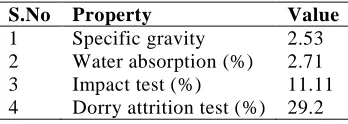
Table 2: Properties of Coarse Aggregate
S.No Property Value
1 Specific gravity 2.53 2 Water absorption (%) 2.71 3 Impact test (%) 11.11 4 Dorry attrition test (%) 29.2
Fly Ash
Fly ashconsists of fine, powdery particles that are predominantly spherical in shape, either solid or hollow and mostly glassy (amorphous) in
nature, having similar physical characteristic with silt. The properties of fly ash is shown below in Table 3 [3].
Table 3: Properties of Fly Ash
S.No Property Value
1 Specific gravity 2.42
2 Consistency (%) 33
3 Initial setting time (minutes) 37
OBJECTIVES
The objective of this study is to investigate the effects on the important engineering properties of pervious concrete with the use of fly ash. The physical properties examined included as compressive strength, split tensile strength and permeability [4].
MIX PROPORTIONS
While pervious concrete contains the same basic ingredients as the more common conventional concrete (ie. aggregate, Portland cement, water, and a variety of admixtures), the
proportioning of ingredients is quite different. One major difference is the requirement of increased void space within the pervious concrete. With low water to cement ratio, the need for void space within the mix design, and no fine aggregates, the conventional design of concrete needs to be adjusted accordingly. Ranges of materials commonly associated with pervious concrete are listed below. These ranges are based on previous researches [5-9].
Compositions
2. Cement + Coarse aggregates + water + fly Ash (10% substitution) + titanium dioxide (2%)
3. Cement + Coarse aggregates + water + fly ash (20% substitution) + titanium dioxide (2%)
Table 4: Mix Proportions
Material Proportion Range Selected Proportion
Fly ash 5-20% 10% and 20%
w/c ratio 0.27 to0.34 (without admixture) 0.34 Aggregate: cement ratio 4 to 4.5 : 1 4:1 Fine:coarse aggregate ratio 0 to 1.1 0
Table 5: Quantity of Material
S.No Description Value Kg/Lit
1 Total quantity of cement 36 Kg
2 Total quantity of coarse aggregate 180 Kg
3 Total quantity of Fly Ash 9 Kg
4 Total quantity of water 16.2 Lit
5 Total quantity of Titanium Dioxide 0.5 Kg
RESULTS AND DISCUSSION
Compressive Strength Test
Compression test is the most common test conducted on hardened concrete, partly because it is an easy test to perform and partly because most of the desirable properties of concrete are qualitatively related to its compressive strength. The strength of concrete is usually defined and determined by the crushing strength of 150mm x 150mmx150mm, at an age of 7 and 28 days. The mould and its base rigidly clamped together so as
to reduce leakages during casting. The sides of the mould and base plates were oiled before casting to prevent bonding between the mould and concrete. The cube was then stored for 24 hours undisturbed.
Compressive strength was calculated as
follows
Compressive strength = P/A Where,
P = Load (N) A = Area (mm2) Area(150mm x 150mm)
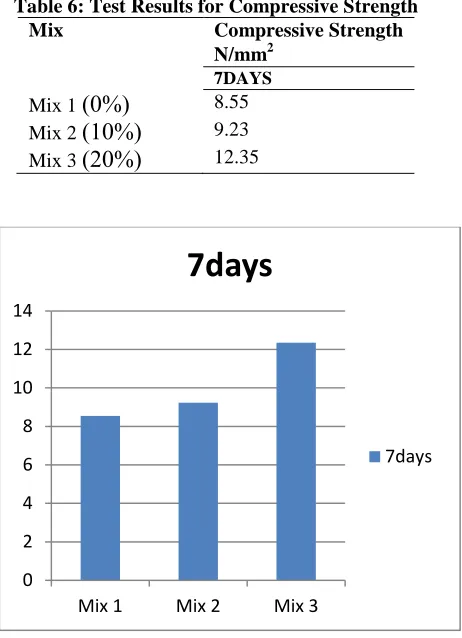
Table 6: Test Results for Compressive Strength Mix Compressive Strength
N/mm2 7DAYS Mix 1
(0%)
8.55 Mix 2(10%)
9.23 Mix 3(20%)
12.35
Graph 1 : Compressive Strength Test
Split Tensile Strength Test
For tensile strength test, cylindrical specimens of dimension 150 mm diameter and 300 mm length were cast. In this test three cylinders were tested and their average value was reported. The split tension test was conducted by using digital compression machine having 2000 kN capacity.
Split tensile strength was calculated as follows
Spilt Tensile strength (MPa) = 2P / π DL
Where,
P = Failure Load (kN)
D = Diameter of Specimen (150 mm) L = Length of Specimen (300 mm)
Three cylinder specimens were casted in each percentage, in order to find the average value of split tensile strength. These cylinder specimens were left for 7 and 28 days curing in a curing tank. After the course of curing, the specimens were ready for testing. All the cylinders were tested.
0 2 4 6 8 10 12 14
Mix 1 Mix 2 Mix 3
7days
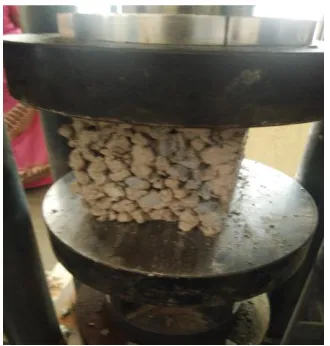
Fig.No 2: Split Tensile Strength Test on Cylinder
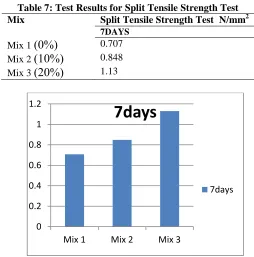
Table 7: Test Results for Split Tensile Strength Test Mix Split Tensile Strength Test N/mm2
7DAYS Mix 1
(0%)
0.707 Mix 2(10%)
0.848 Mix 3(20%)
1.13
Graph 2: Split Tensile Strength Test
Permeability Test
The constant head permeability test method has been Adopted. The time required for the flow of 1000 ml of water through the Cubical mould was noted. Graph below shows coefficient of permeability for the different specimens.
K = qL/AH
Where,
K = Coefficient of permeability cm/sec Q = Discharge cm3/sec
L = Length of specimen in cm A = Cross-sectional area in cm2 H = Constant head causing flow in cm
0 0.2 0.4 0.6 0.8 1 1.2
Mix 1 Mix 2 Mix 3
7days
Graph 3: Permeability test
CONCLUSIONS
In summary of the above investigations, the following conclusions are made from the experimental results indicated following:
The compressive strength and split tensile strength of concrete with 10% and 20% replacement results in increased strength
compared to the pervious concrete without fly ash.
By the use of cementicious material fly ash, the usage of cement can be reduced which will reduce the cost of concrete to certain extent. The permeability of concrete with 10% and
20% replacement results in decreased coefficient of permeability compared to the pervious concrete without fly ash.
REFERENCES
[1]. ACI, Pervious concrete ACI 522R-06, 2006.
[2]. M.S.Shetty “Concrete Technology” S.Chand &Co Ltd, 1997.
[3]. K.N.Usha, B.K.Smitha , “Suitability of Fly Ash in Replacement of Cement in Pervious Concrete”, International Journal of Engineering Research and Technology,ISSN:2278-0181, 5(8), 2016.
[4]. Satyaprakash Mishra, Aparajita Jena, “Effect of Fly Ash on Properties of Pervious Concrete”, International Journal of Engineering and Technoplogy,Management and Applied Sciences,ISSN:2349-4476, 6(5), 2018.
[5]. Sourabh Rahangdale, Shobhit Maran, Sumit Lakhmanil, Mayuresh Giddle, “Study on Pervious Concrete”, International Journal of Engineering and Technology, e-ISSN: 2395-0056, 4(6), 2017.
[6]. Ghafoori N. and Dutta S., “Building and Non pavement Applications of No-Fines Concrete,” Journal of Materials in Civil Engineering, 7(4), 1995, 286-289.
[7]. Dr.J.J.Magdum etl., “JaysingpurUse Of Pervious Concrete in Construction Of Pavement For Improving Their Performance”,IOSR Journal of Mechanical and Civil Civil Engineering,ISSN: 2278-1684, PP:54-56.
[8]. IS 516 -1959, “Methods of Tests for strength of concrete”, Bereau of Indian Standards, New Delhi. [9]. Darshan S.Shah, “Pervious Concrete: New Era for Rural Road Pavement”, International Journal of
Engineering Trends and Technology, 4(8), 2013.
0 0.05 0.1 0.15 0.2 0.25 0.3
Mix 1 Mix 2 Mix 3