Formalization of Web Security Patterns
ASHISHKUMARDWIVEDI1
SANTANUKUMARRATH2
Department of Computer Science and Engineering National Institute of Technology Rourkela
Odisha-769008, India 1[email protected]
Abstract. Security issues in software industries become more and more challenging due to malicious
attacks and as a result, it leads to exploration of various security holes in software system. In order to se-cure the information assets associated with any software system, organizations plan to design the system based on a number of security patterns, useful to build and test new security mechanisms. These patterns are nothing but certain design guidelines. But they have certain limitations in terms of consistency and usability. Hence, these security patterns may sometimes act as insecure. In this study, an attempt has been made to compose security patterns for the web-based application. Subsequently, a formal modeling approach for the composition of security patterns is presented. In order to maximize comprehensibility, Unified Modeling Language (UML) notations are used to represent structural and behavioral aspects of a web-based system. A formal modeling language i.e., Alloy has been taken into consideration for an-alyzing web-based security pattens. For the demonstration of this approach, a case study i.e., an online banking system is considered. A qualitative evaluation is performed for the identified security patterns against the critical security properties. In this study a model-driven framework is presented, which helps to automate the process of analyzing web security patterns.
Keywords:Alloy, Formal Modeling, Online Banking System, Security Patterns.
(Received March 3th, 2015 / Accepted May 4th, 2015)
1 Introduction
Developing a secure system is not an easy task as pro-viding a protected login screen. Hence, an extra effort is required to achieve security requirements. Various security goals can be achieved by applying security pat-terns during design phase. Software design patpat-terns are a set of techniques, applied during analysis and design phases for emphasizing certain design issues to recur-ring design problems. Each pattern emphasizes on a problem occurring in a recurring manner and provides a core solution to that problem, in such a way that one can use this solution a number of times for a particular domain [1].
In the past two decades, a number of software
num-ber of design patterns. Subsequently other authors have proposed different patterns, based on the template pro-posed by Gamma et al. [11].
Security patterns are a set of suitable techniques for analyzing, developing, and testing new security mech-anisms. Security patterns document solution to resolve the design level consequences for solving recurring se-curity problems in a particular context. Yoder and Barcalow presented seven security patterns, which are applied to various software development issues [24]. A number of other varieties of security patterns are also available in the literature [19] [20] [22].
In a pattern-oriented software development, a good number of patterns are specified using informal and semi-formal approaches, such as natural languages and other graphical notations. These notations very often lead to ambiguities and inconsistencies for the system analyst. Checking the consistency and completeness of composition of patterns using various formal meth-ods allow detecting problems in early stages of soft-ware development [23]. Formal methods are nothing but empirical techniques for the specification, develop-ment, and verification of software and hardware sys-tems. Formal models help to describe the software re-quirements precisely and unambiguously using certain tools and techniques which can capture the abstract fea-tures of a system. A number of formal specification languages are available in the literature. For analyzing security patterns a language known as Alloy has been taken into consideration, as it supports predicate logic and its syntax is helpful to express any complex con-straint [9] [15]. Alloy notation can be executed by an automated tool i.e., Alloy Analyzer that performs a se-mantic analysis [12]. This tool performs checking of consequences, consistency, and simulated execution of the Alloy specification.
In order to demonstrate the verification of security patterns, a case study on online banking system has been taken into consideration. Nowadays, customers need more advocacy, more personal security, and more control in their banking relationships. The major chal-lenge with different banks is that they intend to provide flexibility, shared services, easiness in use by align-ing themselves to technology. These challenges are so much mingled with security issues that their solutions can be only thought by application of right security patterns. This approach is not only limited to online banking system, but it can be helpful to other systems also that perform similar types of security-based online operation. In this study, an attempt has been made to perform a qualitative analysis of software security pat-terns, based on a non-functional requirement i.e.,
secu-rity. The requirement of security is based on parame-ters, such as availability, confidentiality, and integrity. At the end of this study, an evaluation has been per-formed for the security properties and associated pat-terns.
The basic overview of this study is that: in the next section, related research works are presented. Third section is further divided into five subsections. In its first subsection, formal modeling framework is pre-sented. In the second subsection, five security patterns such asSingle Sign On[14],Check Point[24], Authen-ticator[4],Policy[4] andSecure Proxy[20] have been identified and it has been exhibited as to how online banking application is influenced by these patterns. In the third subsection, the structural and behavioral as-pects of the composition of security patterns are pre-sented using UML class diagram and sequence diagram respectively. In the fourth subsection, formal analysis of security requirements based on those security pat-terns has been performed. Subsequently, an evaluation has been performed for the identified security patterns and security properties. In the fifth subsection, model driven development of the proposed framework is high-lighted. In the fifth section conclusion is presented.
2 Related Work
A good number of literatures are available for the for-malization of software design patterns [17] [6] [21]. But security patterns need to formalize their notations. Some of the related works are referred as below:
Konrad et al. [16] proposed an idea on templates for security patterns. Authors considered a template of Gamma et.al. [11] and added four other fields, such asbehavior, constraints, related security patterns, and supported principles. They have composed patterns of Yoder and Barcalow [24] for e-commerce application. They have proposed a technique for model checking of these set of patterns. Dong et al. [7] proposed an ap-proach to automate verification of the compositions of security patterns by model checking. They have for-mally described the behavioral aspect of security pat-terns by using CCS (Calculus of Communicating Sys-tems), and also proved the faithfulness of the transfor-mation from a sequence diagram to its CCS representa-tion.
design patterns. Dwivedi and Rath [10] proposed an approach to incorporate security features in service ori-ented architecture with the help of security patterns. They have presented an architectural model integrated with security goals and security patterns. Dwivedi and Rath [8] have further analyzed a complex architectural style i.e., C2 (component and connector) using object modeling language Alloy. They have performed con-sistency checking for the interaction of component and connector, interaction between connector and C2-connector, interaction between port and role etc.
Most of the above approaches are not based on lightweight formal modeling. Our approach is based on Alloy that is a lightweight formal modeling language. Few related works do not support graphical tool, as Alloy Analyzer generates graphical result to check the consistency of the composition of security patterns. Our approach can easily be reusable and extendable. From the above mentioned analysis, it may be observed that the application of security pattern is a research topic and need exhaustive thrust in order to make the design robust.
3 Proposed Work
3.1 Modeling Framework for Web Security Patterns
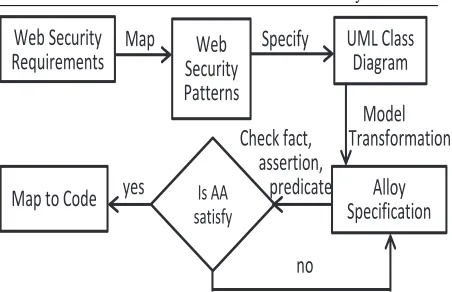
In this study, a modeling framework is presented for the analysis of web security patterns, which is shown in Figure 1. Model driven architecture supports an au-tomated transformation of one model into another. The transformation process can be specified by using a num-ber of axioms, which support mapping of source meta-model to target metameta-model. The UML diagrams are very often used to specify software patterns, which need to be formalized. A tool i.e., UML2Alloy can be con-sidered for the purpose, which helps in automatically transforming UML class digram to Alloy specification [5] [2]. In this study, a model driven framework has been proposed for modeling of web security patterns, which help to map web security problems to security patterns and then transform to a formal model i.e., Al-loy specification. This AlAl-loy model can be verified us-ing a tool i.e., Alloy Analyzer. If the proposed model satisfies all predefined assertions then it helps in map-ping the assertions to code.
3.2 Identification and Composition of Security
Pat-terns
A good number of security patterns have been pro-posed to preserve the security properties such as au-thentication, integrity, non-repudiation, confidentiality,
Map Specify
Model
Check fact, Transformation
assertion,
yes predicate
no
Web Security
Requirements
Is AA
satisfy
Web
Security
Patterns
UML Class
Diagram
Alloy
Specification
Map to Code
Figure 1:Model driven framework for the Web Security Patterns
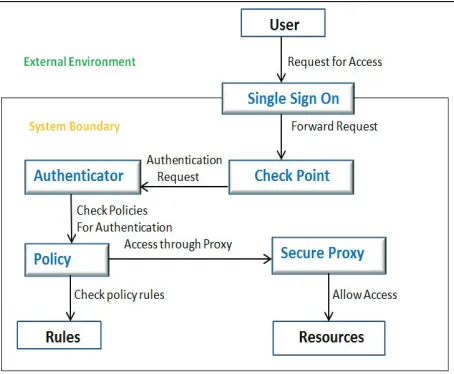
availability, and authorization. Related to these secu-rity properties, a number of secusecu-rity threats such as spoofing, tampering, repudiation, information disclo-sure, denial of service, elevation of privilege are avail-able which can affect the system. These security threats are dangerous for financial transactions, such as fund transfer in online banking system, online bill payment, loan application, and other online transactions. Hafiz et al. [13] described a pattern language for security aspects, havingninety sixpatterns. Although for any application, all patterns may not be applied; but based on security requirements for the case study on online banking system, five software security patterns such as Single Sign On,Check Point,Authenticator,Policy, and Secure Proxy have been considered. Composition of identified patterns is a difficult task in design patterns. Composition of identified security patterns along with external environment, rules, and resources is presented in Figure 2.
Figure 2:Composition of identified patterns
consults with the Authenticator to determine whether the access is permissible or not.Authenticator authenti-cates user by usingPolicythat takes decision to grant or deny access to resources based on the user’s attributes, rules, policies, and other security constraints. If policy rules are not violated, user can access resource by using Secure Proxy.
The design ofCheck Pointdepends on any system’s security policy. According to the policy of the system, the design might change as and when required. Hence, the algorithm forCheck Pointshould be very carefully designed.Authenticationcan be performed by adopting two policies, such as direct authentication and brokered authentication. Authentication policy is based on two elements such as identification and credential. Some-times, during the process of authenticating, the user can have a negative impact on performance due to authen-tication process. Authenticator pattern is also known asPluggable Authentication Modules.Policypattern is known as Access Decision Functionas well asPolicy Decision Point.Secure Proxypattern is based onPolicy and associated withRules. In terms of security context, Rulesare also called as guards.Secure Proxyis alterna-tively known asDefense In Depth,Delegation,Nested Protected Systemetc. It can be implemented with other patterns such as Facade.
These selected security patterns have both advan-tages and disadvanadvan-tages.Check Pointtransfers system-state to the safe-system-state when system fails. But, it diag-noses faults when it is executed. Its implementation may not be that much hard. The advantage of using Sin-gle Sign Onpattern is that it is easily implemented. But it is less secure. TheAuthenticatorpattern is used
al-most in all cases where security concept required. The reliability and security ofAuthenticatorare not much higher. Policyis based on security rules. If rules ful-fill all security requirements for an application, it will be robust against threats. The reliability and security of this pattern depend on security strategies and rules. But it is very hard to implement.Secure Proxyhas high speed of operation. If security policy is not satisfied, it cancels the resource request.
3.3 Structural and Behavioral aspects of patterns
In general, each pattern such as architectural pattern, security pattern, analysis pattern etc. has four essen-tial elements, such ascontext,problem,forces, and so-lution. In this approach, contextof identified patterns can be defined as; when a user wants to access a re-source from the Internet, it requires the user to present essential information. So that, he can be accepted as an authorized user for that resource. In this context, the problemis that, how does the system verifies the user’s information. A number of forces for the identi-fied patterns may be taken into consideration. First, the information presented by the user to the system may be based on shared secrets, i.e., password. Second, it may be possible that the access of the resource is so simple that it does not requireSingle Sign Onpattern. Third, the user and online services are supported to trust one another so as to manage security policy rules. One of the solutions of the problem is that, the user’s informa-tion should be verified on the basis of security rules. If the user fulfills all the security requirements for the particular resource, he may be allowed to access that re-source. Apart from these pattern’s elements, there are other elements which have the impact, such as moti-vation, applicability, participants, collaborations, con-sequences, implementation, related patterns etc. These elements are called as pattern templates. Each pattern is defined in terms of its requisite templates.
Figure 3:Class diagram of the composition of Security Patterns
is associated with CheckPoint, SecureProxy, andRule class. Good number of components of a system are re-quired to enforce thePolicy. The enforcement policy invokesenforcemethod when an access is attempted to a resource. Hence,Policyclass has a method known as enforce.
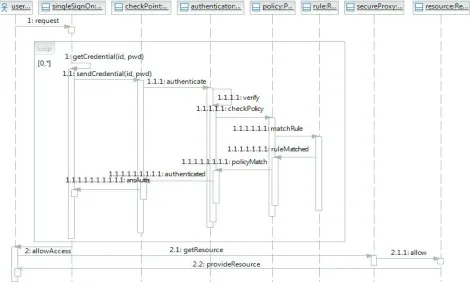
Figure 4 shows the behavioral aspect of composition of selected security patterns. It presents a typical sce-nario when a user successfully plans to login a system. Single Sign Oncould be the first step for the login pro-cedure. Single Sign Oninitializes the system by using Check Point. It checks for the authentication of user. Authenticator checks policies. Each Policyis defined by some rules. If user satisfies these rules, he will be allowed for access. Finally, user gets access to resource through aSecureProxy.
Single Sign On uses
Authenticator Check Point
interact with
access control enforce uses
Rules Policy uses enforce Secure Proxy access control
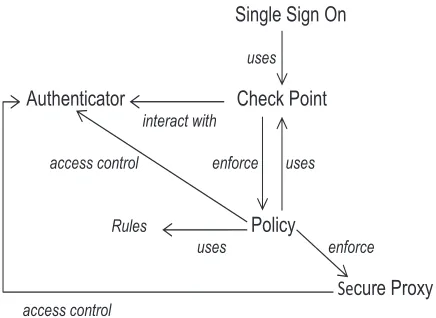
Figure 5:Pattern language for the selected Security Pattens
The pattern language proposed by Alexander was having 253 patterns[1]. In order to describe the flow of usage of the patterns selected for online banking sys-tem, a particular language is used as shown in Figure 5. The pattern language depicts a small portion of security patterns, which applies to a software system, that need to be considered with its functional domain. This pat-tern language describes, as to how all the patpat-terns can be fitted together. According to this language, selected patterns collaborate as an application security module. When a user wants to access a system, he has to enter through single entry point i.e., Single Sign ON (SSO). SSO uses Check Point, which interacts with Authenti-catorto validate the user’s information. After validat-ing user’s information,Check PointenforcesPolicyto check the policy rules for accessing particular resource. Policyuses rules to check the limitations of user access and enforces Secure Proxy to provide secure access.
Very often,Check Pointcan be used by other applica-tions, when they need to perform secure transaction that cannot be performed at startup. Security checks can also be accomplished by using access control. Policy andSecure ProxycallAuthenticatorto perform access control, if necessary.
3.4 Formal specification of patterns using Alloy
Analyzing system requirements using formal modeling language Alloy has a number of advantages. Firstly, it provides an executable notation, that ensures about the functionality of Alloy model, having an unambiguous and consistent semantics. Secondly, the Alloy Analyzer translates high-level, declarative, relational expressions of the Alloy notation into a SAT (Satisfiability) for-mula. These SAT expressions can be executed by us-ing a number of SAT solvers such as,SAT4J,Zchaff, MiniSAT etc. Thirdly, it can visualize an Alloy nota-tion of unbounded size and subsequently specifies it to a bounded size. In order to make the pattern notations more precise, Alloy is chosen as a correct methodology for analyzing essential requirements of security design patterns. Behavioral properties of these patterns can be represented in the form of predicate logic, which can be verified by using Alloy Analyzer tool.
module Security Patterns
openutil/ordering[SecurityPatterns]asSP enumAccessScheme{allow,deny}
enumRules{Valid,Invalid}
sig Account{}
abstract sig State{}
one sigWaitForAuth,Idle,Authenticated,Busy, Reset extendsState{}
abstract sig Operation{}
sig Fundtransfer,CheckService,BillPayment, Request,CheckAuth,Login,RESET
extends Operation{}
sig SecurityPatterns{state : oneState,op : Operation}
ap-predreqSSO[sp,sp0 : SecurityPatterns]{ sp.state = Idle &&sp0.op = Login&& sp0.state = WaitForAuth}
predcheckAuth[sp,sp0 : SecurityPatterns]{sp.state = WaitForAuth&& sp0.op = CheckAuth
&&sp0.state = Authenticated}
predreqResource[sp,sp0 : SecurityPatterns]{sp.state = Authenticated&&sp0.op = Request &&sp0.state = Idle}
preduseResource[sp,sp0 : SecurityPatterns]
{ sp.state = Idle&& sp0.op = (Fundtransfer+CheckService+BillPayment) &&sp0.state = Busy}
predreset[sp, sp0 : SecurityPatterns]{ sp.state = Idle&& sp0.state = Reset }
predinit[sp,sp0 : SecurityPatterns] {sp.state = Idle}
predtraces{ init[SP/first[] ] &&allsp : SecurityPatterns −SP/last[]|
letsp0 = SP/next[sp] | ((reqSSO[sp, sp0] && sp0.op = Login)or
(checkAuth[sp,sp0] && sp0.op = CheckAuth)or(reqResource[sp,sp0] &&sp0.op = Request)or (useResource[sp,sp0] &&sp0.op = (Fundtransfer+CheckService+BillPayment))
or(reset[sp,sp0] &&sp0.op = RESET))}
predperfTrans{traces&& (SP/last[] ).op = RESET
&& RESET!in (SecurityPatterns − SP/last[] ).op }
Analyzing behavioral aspects of Security Patterns
pear to be infeasible. Pruning techniques (analysis tech-nique) are used by Alloy Analyzer tool to overcome this type of problem. These techniques rule out whole sets of atoms at once. In this model, large number of signa-tures have been taken into consideration, such asState, Operation,SecurityPatterns,USER,SingleSignOn, Au-thenticator,CheckPoint,Policy, andSecureProxy. The StateandOperationsignatures are an abstract type. For theStatesignature, many other concrete states such as WaitForAuth,Idle,Authenticated,Busy, andResethave been considered. Similarly, other concrete operations such asFundtransfer,CheckService,BillPayment, Re-quest, CheckAuth, Login, and RESET have also been considered. The signature SecurityPatterns contains two fields, such asstateandop.
3.4.1 Analyzing behavioral aspects of Security
Pat-terns
In the process of model checking, analysis can expose defects that software architect may not have traced un-til much later. Alloy specification supports a logical constraint known as fact. In the process of rigorous analysis a fact should always hold. Alloy supportsfact, assertion,andpredicatefor consistency checking of a system requirement. If a designer/developer wants to check the Alloy model with other axioms, and also to analyze whether these axioms are related to some other axioms or not,predicateis used to achieve all these
re-quirements. A predicate is a logical formula with decla-ration parameters. It describes a set of states and transi-tions, by using constraints among the Alloy atoms and their fields. Without using a predicate, graphical results may not be generated for the operations, except from assertion’s counterexamples.
The predicatetraces indicates that the initial con-dition holds for the initial time step, and then for all subsequent times, system need to change in accordance with one of the five predicates such asreqSSO, check-Auth,reqResource,useResource, and reset. The oper-ations performed by the user is also presented here in order to help in annotation. Five operations performed by the user, which are: login to access a required re-source (Login), check for authenticity of user (Check-Auth), if user is authenticated then request for resource (Request), if resource is available, it is provided to user (Fundtransfer or CheckService or BillPayment), and af-ter using the system’s service, it makes a logout (RE-SET). Along with the traces of operations, post com-pletion error checking is also an essential task. The post completion error can be checked by using a sequence of operations, which represent a single interaction of the user with the system. Predicate perfTrans starts with initial state (waiting for login) and finishes with the sys-tem’s logout.
3.4.2 Modeling of individual Security Patterns
Each security pattern is specified in terms of signa-tures, facts, predicates, and assertions. The signature USERhas a fieldsso, which is an instance of Single-SignOn. For a SingleSignOn to be associated with a system, its user field must point to itself and it needs to have aCheckPoint. The signatureSingleSignOnhas two fields such as has and user. Another signature is CheckPoint which has also two fields such as ac-cessTypeandcheckk. The fieldcheckkrepresents Au-thenticatorwhich maps toPolicy. In this signature, for all authenticator and policy, user is authenticated by us-ing Authenticator, where rules are enforced by using Policy, and access type should allow the valid rules.
The signatureAuthenticatorhas three fields such as accessType,auth, andcp, which map toAccessScheme, USER, and CheckPoint respectively. Policy signature also has three fields such asaccessType,enforce, andcp which map toAccessScheme,Rules, andCheckPoint re-spectively. The last patternSecureProxyhas two fields such asaccessTypeandmake. The fieldmakemaps Ac-counttoOperation. All these security patterns extend signatureSecurityPatterns.
3.4.3 Formal verification of Security Patterns
For the process of formal verification, the chosen Al-loy model supports a good number of templates such asfact,predicate, andassertion. In order to check the consistency of security provision, the following codes indicate two predicates such as,supportedand
authPol-icy. The first predicatesupportedensures that on a par-ticular account user can perform operation. The second predicateauthPolicyspecifies that for an specified pol-icy, authentication should be checked.
predsupported[acct : Account,op : Operation]
{ acct−> opinSecureProxy.make }
predauthPolicy[p : Policy,a : Authenticator]
{ a−> pin CheckPoint.checkk }
In this formal model, predicateauthenticated spec-ifies that to perform an operation on a particular ac-count, the user should be authenticated through the pol-icy rules. Whereas, the predicateunauthenticated spec-ifies that, if policy rules are not satisfied, the user will not be authenticated.
predauthenticated[acct : Account,user : USER, op : Operation]
{ allp : Policy | alla : Authenticator |
p−> a inCheckPoint.checkk&& supported[acct,op] &&
user = Authenticator.auth&& authPolicy[p,a] }
predunauthenticated[acct : Account,user : USER,op : Operation]
{ allp : Policy | alla : Authenticator |
authPolicy[p,a] &&supported[acct,op] && user! = Authenticator.auth}
The predicateperformedindicates that, if predicates supportedandauthenticatedare satisfied, then user can perform operation. Whereas, predicatenoPerformed in-dicates that if prein-dicatessupportedandunauthenticated are satisfied then user can’t perform operation on a par-ticular account.
In this study, afactexpression is specified for vali-dating user’s authenticity. According to specified fact, if the user starts an operation on an account, they must be authorized to do so. This fact statement should be valid through the specification. If any constraint in the model is violated, the fact statement generates an error message.
sig USER{sso : SingleSignOn} {alls : SingleSignOn|sin ssoimplies
s.user = this&& s.has = CheckPoint &&s.user = USER }
sig SingleSignOnextendsSecurityPatterns{ has : oneCheckPoint,user : USER}
sig CheckPointextendsSecurityPatterns {accessType : AccessScheme, checkk : Authenticator−> Policy}
{ alla : Authenticator|allp : Policy|a.auth = USER&&p.enforce = Rules&& (a.cp.accessType = allowimpliesp.enforce = valid) }
sig AuthenticatorextendsSecurityPatterns{ accessType : AccessScheme, auth : setUser,cp : CheckPoint }
sig PolicyextendsSecurityPatterns{ accessType : AccessScheme,enforce : setRules, cp : CheckPoint }
sig SecureProxyextendsSecurityPatterns{ accessType : AccessScheme,make : Account−> Operation}
Modeling of individual Security Patterns
predperformed[acct : Account,user : USER, op : Operation]
{supported[acct,op] && authenticated[acct,user, op]}
prednoPerformed[acct : Account,user : USER, op : Operation]
{supported[acct,op] && unauthenticated[acct,user, op]}
fact{ allacct : Account |
allop : Operation | alluser : USER |
support[acct,op] &&authenticated[acct,user, op]
⇒performed[acct,user, op]}
3.4.4 Model checking using Alloy Analyzer
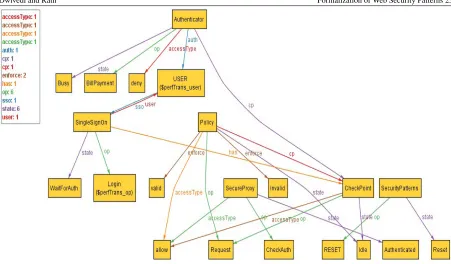
Alloy Analyzer is used for generating and visualizing instances and their relationship. In this formal model, operation perfTrans is executed for the scope value three. The graphical representation of this operation is shown in Figure 6, where it shows different instances, such as enumerations, signatures, and connections be-tween these signatures. The graphical result shows the different types of relationships, such as Authenticator has a state i.e.,busy, Secure Proxy has an accessType i.e., allow, check Point has an operation i.e.,Request, etc. As researcher says, if the number of instances are greater than seven, Alloy Analyzer can generate all pos-sible types of relations among given instances [15].
assertOperation Performed
{alla : Authenticator | allsso : SingleSignOn |
alluser : USER | allp : Policy |
allsp : SecureProxy |a.auth = =user&& p.enforce = valid &&sp.op =
(Fundtransfer+CheckService+BillPayment) && sso.has.accessType = allow&&
supported[acct,op] ⇒ performed[acct,user,op]}
3.4.5 Experimental results generated by Alloy
An-alyzer
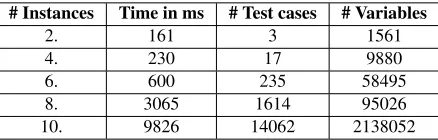
Alloy Analyzer also helps for the generation of test cases. It does not generate test cases directly. By us-ing Alloy Analyzer, user can find large number of re-lationships among the instances, which are helpful for checking the consistency of a particular method. In Ta-ble 1, first column represents the proTa-blem size (number of instances), second column indicates simulation time taken by Alloy Analyzer, third column is for the number of test cases, and fourth column represents the number of variables generated by Alloy Analyzer.
Table 1:Test cases generated by Alloy Analyzer
# Instances Time in ms # Test cases # Variables
2. 161 3 1561
4. 230 17 9880
6. 600 235 58495
8. 3065 1614 95026
Figure 6:Graphical result generated by Alloy Analyzer
Table 2:Evaluation of Security Patterns
S. No. Properties Threats Patterns
1. Confidentiality Information disclosure Check Point
2. Integrity Tampering Authenticator,Policy,Secure Proxy
3. Availability Denial of Service SSO
4. Authentication Spoofing Authenticator
5. Authorization Elevation of Privilege Authenticator
6. Non-repudiation Repudiation Secure Proxy
3.4.6 Evaluation of Security Patterns with security
properties
The evaluation of these security properties, such as con-fidentiality, integrity, availability, authentication, au-thorization, andnon-repudiationagainst the identified patterns, such as Single Sign On(SSO), Check Point, Authenticator,Policy,Secure Proxyare presented in Ta-ble 2.SSOprovides a single login screen to all external entities of the system, which helps the system to trace the unusual requests by maintaining theavailabilityof the system for other entities. Check Pointensures the confidentialityof system by authenticating the user and it also enforces certain security policies. Even it tries to penalize the user for violating security policies. Au-thenticator,Policy, andSecure Proxymaintain the
in-tegrity of a system.Authenticatoris helpful to preserve theAuthenticationandAuthorizationproperties. Non-repudiationcan be maintained with the help ofSecure Proxy.
3.5 Mapping Web Security Patterns into Formal
no-tation: An MDA based Approach
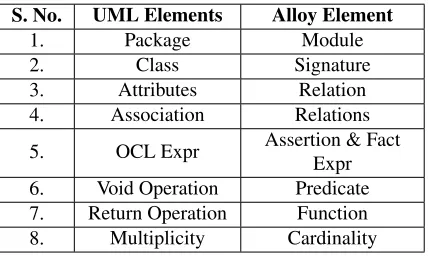
OCL is not a lightweight notation and it can not gen-erate graphical result. Hence, a UML class diagram incorporated with OCL expression needs to be trans-formed into Alloy expression. Table 3 represents the correspondence between UML elements and Alloy el-ements. The translation rules for the modeling frame-work are described as follows:
• Web security requirements into security patterns need to be represented.
• Security patterns using UML class diagram need composition.
• UML class diagram may be transformed into Al-loy notation by using UML2AlAl-loy.
• The axioms (fact, assertion, and predicate) using Alloy Analyzer may be checked.
• If predicate becomes inconsistent, Alloy specifica-tion need to be changed.
Table 3: Correspondence between Alloy elements and UML ele-ments
S. No. UML Elements Alloy Element
1. Package Module
2. Class Signature
3. Attributes Relation
4. Association Relations
5. OCL Expr Assertion & Fact Expr 6. Void Operation Predicate 7. Return Operation Function 8. Multiplicity Cardinality
In this study web security requirements are verified using assertion, fact, and predicates that provide a secu-rity verification framework for the other similar types of system. The behavioral aspect of security patterns are also analyzed that support run time verification of a system.
4 Conclusion
Security design patterns reuse effective software design experience on solving critical security related problems. Patterns, with good error detection and correction abil-ity, lower data redundancy, and easy implementation are useful for the system. In this study, an attempt has been made to systematically present a modeling approach to the formalization of security design patterns. This ap-proach captures both structural and behavioral aspects that specify variants using formal modeling language
Alloy. It consists of modeling of the composition of security patterns using UML notations. A formal ap-proach is considered for analyzing critical security re-quirements in order to analyze it. For the automated verification (model checking) process, Alloy Analyzer is considered. In the process of model checking, analy-sis is a form of constraint solving. Analyanaly-sis can disclose subtle flaws that software architect might not have dis-covered until much later. Alloy is considered for mod-eling security patterns, because it provides a compact model that allows the verification of structural and be-havioral properties of a system. Alloy makes it more logical for checking security problems in software de-sign and provides security assurance. In this study, a model driven approach is considered, that helps to map security patterns specified in UML notation into a for-mal notation. Some guidelines are presented to spec-ify the behavior of security patterns. These guidelines are useful to check the inconsistencies and ambigui-ties among these security patterns. The advantage of this study lies in its simple demonstration of security requirements, formal specification of these security re-quirements, and evaluation of security properties along with necessary security patterns. This methodology can further be extended by analyzing security patterns using ontology based modeling technique.
5 Bibliography References
References
[1] Alexander, C., Ishikawa, S., Silverstein, M., Ja-cobson, M., Fiksdahl-King, I., and Angel, S. A Pattern Language. Oxford University Press, New York, 1977.
[2] Anastasakis, K., Bordbar, B., Georg, G., and Ray, I. On challenges of model transformation from UML to Alloy. Software & Systems Modeling, 9(1):69–86, 2010.
[3] Bayley, I. and Zhu, H. Formal specification of the variants and behavioral features of de-sign patterns. Journal of Systems and Software, 83(2):209–221, 2010.
[4] Blakley, B. and Heath, C. Security design pat-terns. Technical Report G031, The Open Group, Apex Plaza, Forbury Road, Reading Berkshire, RG1 1AX, UK, 2004.
[6] Dong, J., Alencar, P. S., Cowan, D. D., and Yang, S. Composing pattern-based components and ver-ifying correctness. Journal of Systems and Soft-ware, 80(11):1755–1769, 2007.
[7] Dong, J., Peng, T., and Zhao, Y. Automated ver-ification of security pattern compositions. Infor-mation and Software Technology, 52(3):274–295, 2010.
[8] Dwivedi, A. K. and Rath, S. K. Analysis of a com-plex architectural style C2 using modeling lan-guage Alloy. Computer Science and Information Technology Journal, 2(3):152–164, 2014.
[9] Dwivedi, A. K. and Rath, S. K. Selecting and formalizing an architectural style: A comparative study. InContemporary Computing (IC3), 2014 Seventh International Conference on, pages 364– 369. IEEE, 2014.
[10] Dwivedi, A. K. and Rath, S. K. Incorporating security features in Service-Oriented Architecture using security patterns. ACM SIGSOFT Software Engineering Notes, 40(1):1–6, 2015.
[11] Gamma, E., Helm, R., Johnson, R., and Vlissides, J.Design patterns: Elements of Reusable Object-Oriented Software. Addison-Wesley, 1995.
[12] Group, S. D. Alloy analyzer 4. http:// alloy.mit.edu/alloy4/, 2010.
[13] Hafiz, M., Adamczyk, P., and Johnson, R. E. Growing a pattern language (for security). In Pro-ceedings of the ACM international symposium on New ideas, new paradigms, and reflections on pro-gramming and software, pages 139–158. ACM, 2012.
[14] Hogg, J., Smith, D., Chong, F., Taylor, D., Wall, L., and Slater, P. Web Service Security: Scenar-ios, Patterns, and Implementation Guidance for Web Services Enhancements (WSE) 3.0. Microsoft Press, Redmond, WA, USA, 2006.
[15] Jackson, D. Alloy: A lightweight object modeling notation. ACM Transactions on Software Engi-neering and Methodology, 11(2):256–290, April 2002.
[16] Konrad, S., H. C. Cheng, B., A. Campbell, L., and Wassermann, R. Using security patterns to model and analyze security. In In 2nd Interna-tional Workshop on Requirements Engineering for High Assurance Systems (RHAS’03), pages 13– 22. IEEE, 2003.
[17] Mikkonen, T. Formalizing design patterns. In Proceedings of the 20th international conference on Software engineering, pages 115–124. IEEE Computer Society, 1998.
[18] Niere, J., Schäfer, W., Wadsack, J. P., Wendehals, L., and Welsh, J. Towards pattern-based design recovery. InProceedings of the 24th international conference on Software engineering, pages 338– 348. ACM, 2002.
[19] Schumacher, M., Fernandez-Buglioni, E., Hybert-son, D., Buschmann, F., and Sommerlad, P. Se-curity Patterns: Integrating seSe-curity and systems engineering. John Wiley & Sons, West Sussex, England, 2005.
[20] Steel, C., Nagappan, R., and Lai, R.Core Security Patterns: Best Practices and Strategies for J2EE, Web Services, and Identity Management. Prentice Hall PTR, 2005.
[21] Taibi, T. and Ngo, D. C. L. Formal specification of design pattern combination using BPSL. Infor-mation and Software Technology, 45(3):157–170, 2003.
[22] Uzunov, A. V., Falkner, K., and Fernandez, E. B. A comprehensive pattern-oriented approach to en-gineering security methodologies. Information and Software Technology, 57:217–247, 2015.
[23] Woodcock, J., Larsen, P. G., Bicarregui, J., and Fitzgerald, J. Formal methods: Practice and experience. ACM Computing Surveys (CSUR), 41(4):19, 2009.
[24] Yoder, J. and Barcalow, J. Architectural patterns for enabling application security. InIn proceed-ing of the 4th Conference on Patterns Language of Programming (PLoP’97), 1997.
[25] Zanoni, M., Fontana, F. A., and Stella, F. On applying machine learning techniques for design pattern detection. Journal of Systems and Soft-ware, 103(1):102–117, 2015.