P R I M A R Y R E S E A R C H
Open Access
Comparative study and meta-analysis of
meta-analysis studies for the correlation of
genomic markers with early cancer detection
Zoi Lanara
1,2†, Efstathia Giannopoulou
3†, Marta Fullen
4, Evangelos Kostantinopoulos
2, Jean-Christophe Nebel
4,
Haralabos P Kalofonos
3, George P Patrinos
2and Cristiana Pavlidis
2*Abstract
A large number of common disorders, including cancer, have complex genetic traits, with multiple genetic and
environmental components contributing to susceptibility. A literature search revealed that even among several
meta-analyses, there were ambiguous results and conclusions. In the current study, we conducted a thorough
meta-analysis gathering the published meta-analysis studies previously reported to correlate any random effect or
predictive value of genome variations in certain genes for various types of cancer. The overall analysis was initially
aimed to result in associations (1) among genes which when mutated lead to different types of cancer (e.g.
common metabolic pathways) and (2) between groups of genes and types of cancer. We have meta-analysed 150
meta-analysis articles which included 4,474 studies, 2,452,510 cases and 3,091,626 controls (5,544,136 individuals in
total) including various racial groups and other population groups (native Americans, Latinos, Aborigines, etc.). Our
results were not only consistent with previously published literature but also depicted novel correlations of genes
with new cancer types. Our analysis revealed a total of 17 gene-disease pairs that are affected and generated gene/
disease clusters, many of which proved to be independent of the criteria used, which suggests that these clusters
are biologically meaningful.
Keywords:
Cancer, Meta-analysis, Gene, Association, Interaction, Single-nucleotide polymorphism, Alleles, Clustering
Introduction
Cancer is the result of a complicated process that involves
the accumulation of both genetic and epigenetic
alter-ations in various genes [1]. The somatic genetic alteralter-ations
in cancer include point mutations, small insertion/deletion
events, translocations, copy number changes and loss of
heterozygosity [2]. These changes either augment the
ac-tion and/or expression of an oncoprotein or silence
tumour suppressor genes. Single-nucleotide
polymorph-ism (SNP) is the most common form of genetic variation
in the human genome. Although common SNPs for
dis-ease prediction are not ready for widespread use [3],
re-cent genome-wide association studies (GWASs) using
high-throughput techniques have identified regions of the
genome that contain SNPs with alleles that are associated
with increased risk for cancer such as
FGFR2
in breast
cancer [4-7].
The knowledge on gene mutations that predispose
tumour initiation or tumour development and progress
will give an advantage in cancer patients' treatment.
Des-pite the complexity and variability of cancer genome,
numerous studies have examined the correlation of
gen-ome variation with cancer development and progression
[8]. However, ambiguous results have been generated
from the attempt to link genome variants with cancer
prediction or detection. A literature search revealed that
even among several meta-analyses, there were unclear
results and conclusions.
We have, therefore, conducted a thorough
meta-analysis of meta-meta-analysis studies previously reported to
correlate the random effect or predictive value of
gen-ome variations in certain genes for various types of
can-cer. The aim of the overall analysis was the detection of
* Correspondence:[email protected]†Equal contributors 2
School of Health Sciences, Department of Pharmacy, University of Patras, University Campus, Rio, Patras 26504, Greece
Full list of author information is available at the end of the article
correlations (1) among genes whose mutation might lead
to different types of cancer (e.g. common metabolic
pathways) and (2) between groups of genes and types of
cancer.
Methods
We performed a thorough field synopsis by studying
published meta-analysis studies involving the association
of various types of cancer with SNPs located in certain
genomic regions. For each published meta-analysis
in-cluded in our study, we also investigated the number of
patients (cases) and controls, date, type of study, study
group details (e.g. gender, race, age, etc.), measures
in-cluded, allele and genotype frequency and also the
out-come of each study, i.e. if there was an association or
not, the interactions noticed in each of these studies, etc.
We have meta-analysed 150 meta-analysis articles
(Additional file 1), which included 4,474 studies, 2,452,510
cases and 3,091,626 controls (5,544,136 individuals in
total). The meta-analyses that have been meta-analysed
in-cluded various racial groups, e.g. Caucasians, Far Eastern
populations (Asian, Chinese, Japanese, Korean, etc.),
African-American and other population groups (native
Americans, Latinos, Aborigines, etc.). Three types of
studies were included: (1) pooled analysis, (2) GWAS and
(2) other studies, e.g. search in published reports. Collected
data consisted of a list of genes, genomic variants and
diseases with a known genotype-phenotype association
(whether or not a given variation has an impact on
suscep-tibility to a given disease). The principle of our study was
to use data mining techniques to find groups (referred to
as clusters hereafter) of genes or diseases that behave
simi-larly according to related data. Such groupings will make it
possible to find different cancer types susceptible to similar
genotypes as well as different genes associated to similar
cancer types. Furthermore, our approach would facilitate
predicting whether susceptibility to one type of cancer may
be indicative of predisposition to another cancer type.
Moreover, the association between a group of genes and a
given phenotype may suggest that these genes interact or
belong to the same biochemical pathway. In order to allow
data mining analysis, genotype-phenotype associations had
to be classified within a fixed set of categories, i.e. yes/small
yes/may/no. Moreover, genes or diseases with fewer than
two entries were not considered in our analysis since their
clustering would not be meaningful.
Then, data were processed using a state-of-the-art
gen-eral purpose clustering tool, CLUTO [9]. Data analysis
consisted in finding the tightest and most reliable
group-ings. Since CLUTO offers a wide range of methods, and
many different scoring schemes can be used to estimate
similarity between genotypes or phenotypes, cluster
reli-ability was assessed by their robustness to clustering
cri-teria (details are provided in Additional file 1). As a
consequence, each putative association has been qualified
as either
‘highly consistent’
or
‘moderately consistent’. The
biological significance of those clusters was, first,
evalu-ated using the Search Tool for the Retrieval of Interacting
Genes/Proteins (STRING) [10,11], a biological database
and web resource of known and predicted protein-protein
interactions. The STRING database contains information
from numerous sources, including experimental data,
computational prediction methods and public text
collec-tions. It is widely accessible, and it is regularly updated.
Second, literature research was performed to complete
this initial evaluation.
Results and discussion
In this study, we performed a meta-analysis of published
meta-analysis studies to investigate possible correlations
among genes and SNPs and various types of cancer, as
well as among gene-gene and/or gene-environmental
in-teractions. Furthermore, an advanced literature research
was applied in order to evaluate our results obtained
from our meta-analysis. Our data were not only
consist-ent with previously published literature but we have also
depicted novel correlations of genes with new types of
cancer. Our analysis showed a total of ten cancer-related
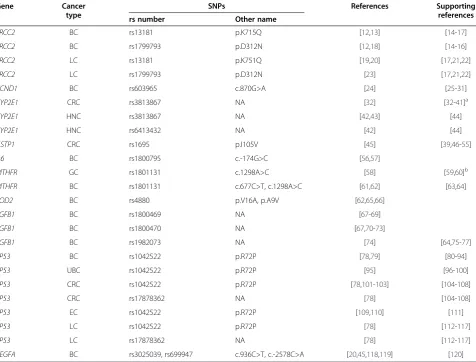
genes that are affected (Table 1).
Correlation of SNPs' genes with various types of cancer
The association highlighted by our meta-analysis between
the
CYP2E1
gene and colorectal cancer (CRC), head and
neck cancer (HNC) and liver cell carcinoma (LLC) is
sup-ported by published data [33-39,44,121]. An additional
lit-erature search to evaluate our initial results revealed novel
correlations of the gene combination
CYP2E1
and
GSTM1
with prostate cancer (PC) susceptibility, lung cancer (LC)
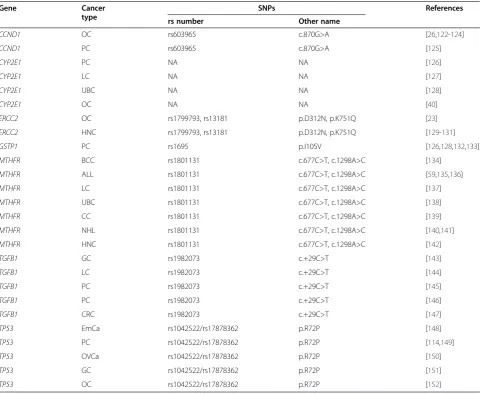
and bladder cancer (UBC) as shown in Table 2 [126-128].
A similar correlation was found in CRC using a
knock-down model [32,40,41]. Studies not only confirm the
pos-sibility of association between the
CCND1
gene and breast
cancer (BC) [25] but also suggest involvement with
squa-mous cell carcinoma (SCC), oesophageal cancer (EC), oral
cancer (OC) and malignant glioma (MG), as arisen from
the interaction between the
CCND1
and
CCND3
genes
[26,122-124]. This is further corroborated in mouse model
studies that show association of
CCND1
with BC
[25,27-31,153] and PC [125].
Moreover, as far as the
ERCC2
is concerned along with
the association of
ERCC1
gene with BC and LC which is
already confirmed [14-17,21,22], we have also identified
from our further literature search on humans the
exist-ence of an association with OC [26] and with HNC
[129-131]. There were no similar mouse studies that
could confirm or overrule our findings.
Our findings regarding the
GSTP1
gene are confirmed
have noticed an association with PC derived from the
combination of
GSTM1
and
CYP1A1
[126,128,132,133].
Likewise, previous experimental evidence supports the
association we found between the
MTHFR
gene and BC,
basal cell carcinoma (BCC) [63,134] and gastric cancer
(GC) [59,60]. An association was also found between
MTHFR
gene with other types of cancer, such as acute
lymphoblastic leukaemia (ALL) [135,136,154], LC [137],
UBC coming from interaction between
CTH
and
GSTM1
[138], CRC [139], non-Hodgkin's lymphoma
(NHL) [140,141], BC [64] and HNC [142]. Specifically,
in the case of NHL, the gene combination of
MTHFR
and
TYMS
might influence the susceptibility to
NHL
[140,141].
Concerning
TGFB1
, apart from the BC [64] that was
confirmed from the results of our further literature search
on humans and on mouse model [75,76], we have noticed
also the following associations with gastric dysplasia, LC,
pancreatic cancer (PanC) and BC [77,143-146]. Also, an
as-sociation of
TGFB1
with CRC was found using a mouse
model [147].
In addition for
TP53
gene, we have observed in the
re-sults of our meta-analysis that it is associated with BC,
UBC, CRC, EC and LC
[80-87,96-100,104-108,111-113,149]. We have observed also that
TP53
gene might be
associated with OC [88,148], too. Concerning the
litera-ture research on knockout mice, we have confirmed the
associations with BC [89-94] and LC [114-117], and we
have found also associations with ovarian cancer (OVCa)
[150], GC [151] and OC [152]. Moreover for the
VEGFA
gene, based on further literature
TGFB1
research, we have
confirmed the association with BC [120], but we had not
found any other evidence supporting the association with
other types of cancer.
Correlations between groups of genes and various types
of cancer
We have examined and confirmed the highly consistent
gene clustering results over further literature search via
STRING. Our search revealed additional types of cancer,
except from the types that we have studied in our
meta-analysis that seems to be related with pair of genes.
Table 1 Summary of genes and SNPs identified by meta-analysis to be positively correlated with various cancers
Gene Cancer
type
SNPs References Supporting
references rs number Other name
ERCC2 BC rs13181 p.K715Q [12,13] [14-17]
ERCC2 BC rs1799793 p.D312N [12,18] [14-16]
ERCC2 LC rs13181 p.K751Q [19,20] [17,21,22]
ERCC2 LC rs1799793 p.D312N [23] [17,21,22]
CCND1 BC rs603965 c.870G>A [24] [25-31]
CYP2E1 CRC rs3813867 NA [32] [32-41]a
CYP2E1 HNC rs3813867 NA [42,43] [44]
CYP2E1 HNC rs6413432 NA [42] [44]
GSTP1 CRC rs1695 p.I105V [45] [39,46-55]
IL6 BC rs1800795 c.-174G>C [56,57]
MTHFR GC rs1801131 c.1298A>C [58] [59,60]b
MTHFR BC rs1801131 c.677C>T, c.1298A>C [61,62] [63,64]
SOD2 BC rs4880 p.V16A, p.A9V [62,65,66]
TGFB1 BC rs1800469 NA [67-69]
TGFB1 BC rs1800470 NA [67,70-73]
TGFB1 BC rs1982073 NA [74] [64,75-77]
TP53 BC rs1042522 p.R72P [78,79] [80-94]
TP53 UBC rs1042522 p.R72P [95] [96-100]
TP53 CRC rs1042522 p.R72P [78,101-103] [104-108]
TP53 CRC rs17878362 NA [78] [104-108]
TP53 EC rs1042522 p.R72P [109,110] [111]
TP53 LC rs1042522 p.R72P [78] [112-117]
TP53 LC rs17878362 NA [78] [112-117]
VEGFA BC rs3025039, rs699947 c.936C>T, c.-2578C>A [20,45,118,119] [120]
These findings are supported by the published literature.a
For a different SNP (rs1329149);b
STRING database reports binding interaction between
GSTP1
and
GSTM1
genes, activating interaction
be-tween
MMP2
and
EGF
genes, between
VEGFA
and
IL1B
genes and between
MMP-9
and
IL8
genes (Table 3). The
application of our machine learning method has
high-lighted that those pair of genes have similar association
profiles and, therefore, might be involved in the same
pathways. The genes that do not appear in the
associa-tions do not probably correlate with the presence of a
certain type of cancer.
First, in our meta-analyses, we observed that the
inter-action between
IL6
and
TGFB1
genes was associated to
the following types of cancer: BC, CRC, GC, LC and PC
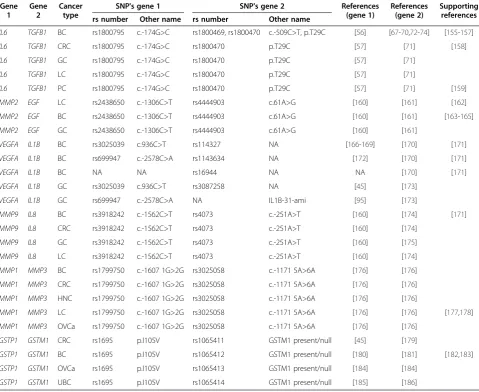
as shown in Table 4. Although further literature search
on humans could not validate our highly consistent
re-sults, we discovered that these interactions are
associ-ated to additional types of cancer, such as HNC [187],
CRC [158], renal cancer (RC), small cell lung cancer
Table 2 Summary of genes and SNPs identified by further literature search as positively correlated with various cancers
Gene Cancer
type
SNPs References
rs number Other name
CCND1 OC rs603965 c.870G>A [26,122-124]
CCND1 PC rs603965 c.870G>A [125]
CYP2E1 PC NA NA [126]
CYP2E1 LC NA NA [127]
CYP2E1 UBC NA NA [128]
CYP2E1 OC NA NA [40]
ERCC2 OC rs1799793, rs13181 p.D312N, p.K751Q [23]
ERCC2 HNC rs1799793, rs13181 p.D312N, p.K751Q [129-131]
GSTP1 PC rs1695 p.I105V [126,128,132,133]
MTHFR BCC rs1801131 c.677C>T, c.1298A>C [134]
MTHFR ALL rs1801131 c.677C>T, c.1298A>C [59,135,136]
MTHFR LC rs1801131 c.677C>T, c.1298A>C [137]
MTHFR UBC rs1801131 c.677C>T, c.1298A>C [138]
MTHFR CC rs1801131 c.677C>T, c.1298A>C [139]
MTHFR NHL rs1801131 c.677C>T, c.1298A>C [140,141]
MTHFR HNC rs1801131 c.677C>T, c.1298A>C [142]
TGFB1 GC rs1982073 c.+29C>T [143]
TGFB1 LC rs1982073 c.+29C>T [144]
TGFB1 PC rs1982073 c.+29C>T [145]
TGFB1 PC rs1982073 c.+29C>T [146]
TGFB1 CRC rs1982073 c.+29C>T [147]
TP53 EmCa rs1042522/rs17878362 p.R72P [148]
TP53 PC rs1042522/rs17878362 p.R72P [114,149]
TP53 OVCa rs1042522/rs17878362 p.R72P [150]
TP53 GC rs1042522/rs17878362 p.R72P [151]
TP53 OC rs1042522/rs17878362 p.R72P [152]
NAnot available.
Table 3 Putative gene-gene associations with various
cancer types
Gene associations
Considered phenotypes
Comments STRING confirmation
Literature confirmation
Gene 1
Gene 2
GSTP1 GSTM1 4 Binding
interaction
[Reference]: study type
TGFB1 IL6 5 4 of 5
based on ‘yes’
MMP2 EGF 3 Based on
‘yes’
Activating interaction
VEGFA IL1B 2 Activating
interaction
MMP9 IL8 4 Based on
‘may’
Activating interaction
KEGG: same process
[188], malignant melanoma (MM) [189-192] and OVCa
[193]. Additionally, regarding our further research on
the interaction between
IL6
and
TGFB1
genes on mouse
models, we have confirmed our initial results principally
for BC [155-157] and PC [159] and have noticed
associa-tions with epithelial cancer [194], skin tumour [195], LC
[196], OVCa and cervical cancer (CC) [197,198] and
HNSCC [199]. Second, we found that the interaction
between
MMP-2
and
EGF
was associated with LC, BC
and GC (Table 4). Subsequently with a further literature
search, we confirmed the association with BC osteolysis
[163,164] and also found new associations with EC
[200], LC, RC and PC [162]. Furthermore, in some cases,
we have observed the association of the aforementioned
genes with OSCC [201]. In this study,
EGF
induced
MMP-1
expression that is required for type I collagen
degradation. In addition,
MMP-1
is also associated with
human papillomavirus [202] and BC [165].
Another interesting interaction that was revealed from
our analysis was between the
VEGFA
and
IL1B
genes that
were associated with BC and GC (Table 4). After
proceed-ing with a further literature search, we have not found
simi-lar results - except from one report [171] - but we have
identified additional associations with HNC, ALL, laryngeal
carcinoma and MM [203-206]. For
MMP-9
and
IL8
inter-action, there was no study confirming our initial results for
BC, CRC and GC on neither humans nor mouse models.
We have observed though that there was evidence for an
association with nasopharyngeal carcinoma [171], LC
[177,178] and UBC [207]. Similarly, we could not find
any study that could support the interactions between
MMP-1
and
MMP-3
and
GSTP1
with
GSTM1
, although
two studies confirmed that
GSTP1
and
GSTM1
interac-tions could be associated with BC [182,183] (Table 4).
Indications from further literature search on human
models revealed associations for
MMP-1
and
MMP-3
with
Table 4 Summary of gene-gene interactions and the corresponding SNPs in these genes
Gene 1
Gene 2
Cancer type
SNP's gene 1 SNP's gene 2 References (gene 1)
References (gene 2)
Supporting references rs number Other name rs number Other name
IL6 TGFB1 BC rs1800795 c.-174G>C rs1800469, rs1800470 c.-509C>T, p.T29C [56] [67-70,72-74] [155-157]
IL6 TGFB1 CRC rs1800795 c.-174G>C rs1800470 p.T29C [57] [71] [158]
IL6 TGFB1 GC rs1800795 c.-174G>C rs1800470 p.T29C [57] [71]
IL6 TGFB1 LC rs1800795 c.-174G>C rs1800470 p.T29C [57] [71]
IL6 TGFB1 PC rs1800795 c.-174G>C rs1800470 p.T29C [57] [71] [159]
MMP2 EGF LC rs2438650 c.-1306C>T rs4444903 c.61A>G [160] [161] [162]
MMP2 EGF BC rs2438650 c.-1306C>T rs4444903 c.61A>G [160] [161] [163-165]
MMP2 EGF GC rs2438650 c.-1306C>T rs4444903 c.61A>G [160] [161]
VEGFA IL1B BC rs3025039 c.936C>T rs114327 NA [166-169] [170] [171]
VEGFA IL1B BC rs699947 c.-2578C>A rs1143634 NA [172] [170] [171]
VEGFA IL1B BC NA NA rs16944 NA NA [170] [171]
VEGFA IL1B GC rs3025039 c.936C>T rs3087258 NA [45] [173]
VEGFA IL1B GC rs699947 c.-2578C>A NA IL1B-31-ami [95] [173]
MMP9 IL8 BC rs3918242 c.-1562C>T rs4073 c.-251A>T [160] [174] [171]
MMP9 IL8 CRC rs3918242 c.-1562C>T rs4073 c.-251A>T [160] [174]
MMP9 IL8 GC rs3918242 c.-1562C>T rs4073 c.-251A>T [160] [175]
MMP9 IL8 LC rs3918242 c.-1562C>T rs4073 c.-251A>T [160] [174]
MMP1 MMP3 BC rs1799750 c.-1607 1G>2G rs3025058 c.-1171 5A>6A [176] [176]
MMP1 MMP3 CRC rs1799750 c.-1607 1G>2G rs3025058 c.-1171 5A>6A [176] [176]
MMP1 MMP3 HNC rs1799750 c.-1607 1G>2G rs3025058 c.-1171 5A>6A [176] [176]
MMP1 MMP3 LC rs1799750 c.-1607 1G>2G rs3025058 c.-1171 5A>6A [176] [176] [177,178]
MMP1 MMP3 OVCa rs1799750 c.-1607 1G>2G rs3025058 c.-1171 5A>6A [176] [176]
GSTP1 GSTM1 CRC rs1695 p.I105V rs1065411 GSTM1 present/null [45] [179]
GSTP1 GSTM1 BC rs1695 p.I105V rs1065412 GSTM1 present/null [180] [181] [182,183]
GSTP1 GSTM1 OVCa rs1695 p.I105V rs1065413 GSTM1 present/null [184] [184]
GSTP1 GSTM1 UBC rs1695 p.I105V rs1065414 GSTM1 present/null [185] [186]
types of cancer such as BCC, metatypical cancer of the
skin [208], colorectal adenoma and RC [209,210], and for
GSTP1
and
GSTM1
, endometrial cancer (EmCa) [211],
LC [212], multiple myeloma (observed no significant
asso-ciation to prostatic adenoma and adenocarcinoma) [213],
PC [133,214], ALL [215], chronic myeloid leukaemia [216]
and PanC [217].
We have then attempted to depict the various types of
cancers according to the number of SNPs and genes and/
or gene clusters found from our meta-analysis to be
mean-ingfully associated with certain cancer types. Our data
in-dicate that BC is correlated more often than the other
types of cancer both with the number of SNPs (Figure 1A)
as well as with the number of genes or gene clusters
(Figure 1B). This observation underlies the heterogeneity
of BC, indicating that it is, most likely, not a single disease
but a spectrum of related disease states.
Conclusions
In essence, our meta-analysis study generated clusters of
genes and diseases, many of which proved to be
independ-ent of the criteria used, which suggests that these clusters
are most likely biologically meaningful. Preliminary study
of some clusters and of our results shows that indeed
these genes interact. As regards the associations, with a
further literature analysis on human and mouse models,
we have also found meaningful gene associations related
to other cancer types not previously reported in the
litera-ture, an observation that warrants further investigation.
Additional file
Additional file 1:Genes and cancer types included in this meta-analysis.
Competing interests
The authors declare that they have no competing interests.
Authors' contributions
ZL carried out the data collection, result analysis and participated in the manuscript preparation. EG participated in the manuscript preparation and data analysis. MF participated in the result and statistical analysis and manuscript revision. EK participated in the data collection and manuscript revision. JCN carried out the result and statistical analysis and participated in the manuscript preparation. HPK participated in the manuscript preparation. GPP participated in the design of the study, data analysis and manuscript preparation. CP conceived of the study, participated in its design and coordination as well as manuscript preparation. All authors read and approved for the final manuscript.
Acknowledgements
This study was conducted to fulfil the requirements of an undergraduate thesis, jointly with the Universities of Trieste, Italy and Patras, Greece. This work was partly funded by the University of Patras research budget and a European Commission grant (GEN2PHEN; FP7-200754) to GPP.
Author details 1
Faculty of Mathematical, Physical and Natural Sciences, Department of Biological Sciences, University of Trieste, Trieste 34128, Italy.2School of Health Sciences, Department of Pharmacy, University of Patras, University Campus, Rio, Patras 26504, Greece.3Clinical Oncology Laboratory, Division of Oncology, Department of Medicine, University of Patras, Rio, Patras 26504, Greece.4School of Computing and Information Systems, Faculty of Science, Engineering and Computing, Kingston University, London SW15 3DW, UK.
Received: 25 March 2013 Accepted: 1 May 2013 Published: 5 June 2013
A
BC
LC
CRC
HNC
UBC
GC
EC
OC
PC
BCC
ALL
CC
NHL
EmCa
OVCa
B
BC
LC
CRC
HNC
UBC
GC
PC
OVCa
References
1. Lea IA, Jackson MA, Li X, Bailey S, Peddada SD, Dunnick JK:Genetic pathways and mutation profiles of human cancers: site- and exposure-specific patterns.Carcinogenesis2007,28(9):1851–1858.
2. Dutt A, Beroukhim R:Single nucleotide polymorphism array analysis of cancer.Curr Opin Oncol2007,19(1):43–49.
3. Chung CC, Chanock SJ:Current status of genome-wide association studies in cancer.Hum Genet2011,130(1):59–78.
4. Rae JM, Skaar TC, Hilsenbeck SG, Oesterreich S:The role of single nucleotide polymorphisms in breast cancer metastasis.Breast Cancer Res 2008,10(1):301.
5. Teraoka SN, Bernstein JL, Reiner AS, Haile RW, Bernstein L, Lynch CF, Malone KE, Stovall M, Capanu M, Liang X, Smith SA, Mychaleckyj J, Hou X, Mellemkjaer L, Boice JD Jr, Siniard A, Duggan D, Thomas DC, WECARE Study Collaborative Group, Concannon P:Single nucleotide polymorphisms associated with risk for contralateral breast cancer in the women's environment, cancer, and radiation epidemiology (WECARE) study.Breast Cancer Res2011,13(6):R114.
6. Inaki K, Liu ET:Structural mutations in cancer: mechanistic and functional insights.Trends Genet2012,28(11):550–559.
7. You JS, Jones PA:Cancer genetics and epigenetics: two sides of the same coin?Cancer Cell2012,22(1):9–20.
8. Lopez-Lazaro M:A new view of carcinogenesis and an alternative approach to cancer therapy.Mol Med2010,16(3–4):144–153. 9. Rasmussen MD, Deshpande MS, Karypis G, Johnson J, Crow JA, Retzel EF:
wCLUTO: a Web-enabled clustering toolkit.Plant Physiol2003,
133(2):510–516.
10. Szklarczyk D, Franceschini A, Kuhn M, Simonovic M, Roth A, Minguez P, Doerks T, Stark M, Muller J, Bork P, Jensen LJ, von Mering C:The STRING database in 2011: functional interaction networks of proteins, globally integrated and scored.Nucleic Acids Res2011,
39(Database issue):D561–D568.
11. Search Tool for the Retrieval of Interacting Genes/Proteins.www.string-db.org. 12. Jiang Z, Li C, Xu Y, Cai S, Wang X:Associations between XPD
polymorphisms and risk of breast cancer: a meta-analysis.Breast Cancer Res Treat2010,123(1):203–212.
13. Qiu LX, Yao L, Zhang J, Zhu XD, Zhao XM, Xue K, Mao C, Chen B, Zhan P, Yuan H, Hu X-C:XPD Lys751Gln polymorphism and breast cancer susceptibility: a meta-analysis involving 28,709 subjects.Breast Cancer Res Treat2010,124(1):229–235.
14. Wang HC, Liu CS, Wang CH, Tsai RY, Tsai CW, Wang RF, Chang CH, Chen YS, Chiu CF, Bau DT, Huang CY:Significant association of XPD Asp312Asn polymorphism with breast cancer in Taiwanese patients.Chin J Physiol 2010,53(2):130–135.
15. Han W, Kim KY, Yang SJ, Noh DY, Kang D, Kwack K:SNP-SNP interactions between DNA repair genes were associated with breast cancer risk in a Korean population.Cancer2012,118(3):594–602.
16. Hussien YM, Gharib AF, Awad HA, Karam RA, Elsawy WH:Impact of DNA repair genes polymorphism (XPD and XRCC1) on the risk of breast cancer in Egyptian female patients.Mol Biol Rep2012,39(2):1895–1901. 17. Yin J, Vogel U, Wang C, Liang D, Ma Y, Wang H, Yue L, Liu D, Ma J, Sun X:
Hapmap-based evaluation of ERCC2, PPP1R13L, and ERCC1 and lung cancer risk in a Chinese population.Environ Mol Mutagen2012,
53(3):239–245.
18. Yao L, Qiu LX, Yu L, Yang Z, Yu XJ, Zhong Y, Hu XC:The association between ERCC2 Asp312Asn polymorphism and breast cancer risk: a meta-analysis involving 22,766 subjects.Breast Cancer Res Treat2010,
123(1):227–231.
19. Zhang J, Gu SY, Zhang P, Jia Z, Chang JH:ERCC2 Lys751Gln polymorphism is associated with lung cancer among Caucasians.Eur J Cancer2010,
46(13):2479–2484.
20. Zhan P, Wang Q, Wei SZ, Wang J, Qian Q, Yu LK, Song Y:ERCC2/XPD Lys751Gln and Asp312Asn gene polymorphism and lung cancer risk: a meta-analysis involving 22 case–control studies.J Thorac Oncol2010,
5(9):1337–1345.
21. Yin J, Vogel U, Ma Y, Qi R, Wang H, Yue L, Liang D, Wang C, Li X, Song T:
HapMap-based study of a region encompassing ERCC1 and ERCC2 related to lung cancer susceptibility in a Chinese population.Mutat Res2011,
713(1–2):1–7.
22. Christiani DC:ERCC2/XPD polymorphisms and lung cancer risk.J Thorac
Oncol2011,6(1):233. author reply 233–235.
23. Zhang J, Qiu LX, Leaw SJ, Hu XC, Chang JH:The association between XPD Asp312Asn polymorphism and lung cancer risk: a meta-analysis including 16,949 subjects.Med Oncol2011,28(3):655–660.
24. Sergentanis TN, Economopoulos KP:Cyclin D1 G870A polymorphism and breast cancer risk: a meta-analysis comprising 9,911 cases and 11,171 controls.Mol Biol Rep2011,38(8):4955–4963.
25. Millar EK, Dean JL, McNeil CM, O'Toole SA, Henshall SM, Tran T, Lin J, Quong A, Comstock CE, Witkiewicz A, Musgrove EA, Rui H, Lemarchand L, Setiawan VW, Haiman CA, Knudsen KE, Sutherland RL, Knudsen ES:Cyclin D1b protein expression in breast cancer is independent of cyclin D1a and associated with poor disease outcome.Oncogene2009,28(15):1812–1820. 26. Miyashita H, Mori S, Tanda N, Nakayama K, Kanzaki A, Sato A, Morikawa H,
Motegi K, Takebayashi Y, Fukumoto M:Loss of heterozygosity of nucleotide excision repair factors in sporadic oral squamous cell carcinoma using microdissected tissue.Oncol Rep2001,8(5):1133–1138.
27. Ghosh-Choudhury N, Ghosh-Choudhury G, Celeste A, Ghosh PM, Moyer M, Abboud SL, Kreisberg J:Bone morphogenetic protein-2 induces cyclin kinase inhibitor p21 and hypophosphorylation of retinoblastoma protein in estradiol-treated MCF-7 human breast cancer cells.Biochim Biophys Acta2000,1497(2):186–196.
28. Musgrove EA, Hui R, Sweeney KJ, Watts CK, Sutherland RL:Cyclins and breast cancer.J Mammary Gland Biol Neoplasia1996,1(2):153–162. 29. Sutherland RL, Hamilton JA, Sweeney KJ, Watts CK, Musgrove EA:
Expression and regulation of cyclin genes in breast cancer.Acta Oncol 1995,34(5):651–656.
30. Taneja P, Frazier DP, Kendig RD, Maglic D, Sugiyama T, Kai F, Taneja NK, Inoue K:MMTV mouse models and the diagnostic values of MMTV-like sequences in human breast cancer.Expert Rev Mol Diagn2009,9(5):423–440.
31. Yang C, Ionescu-Tiba V, Burns K, Gadd M, Zukerberg L, Louis DN, Sgroi D, Schmidt EV:The role of the cyclin D1-dependent kinases in ErbB2-mediated breast cancer.Am J Pathol2004,164(3):1031–1038. 32. Zhou GW, Hu J, Li Q:CYP2E1 PstI/RsaI polymorphism and colorectal
cancer risk: a meta-analysis.World J Gastroenterol2010,16(23):2949–2953. 33. Silva TD, Felipe AV, Pimenta CA, Barao K, Forones NM:CYP2E1 RsaI and
96-bp insertion genetic polymorphisms associated with risk for colorectal cancer.Genet Mol Res2012,11(3):3138–3145.
34. Sameer AS, Nissar S, Qadri Q, Alam S, Baba SM, Siddiqi MA:Role of CYP2E1 genotypes in susceptibility to colorectal cancer in the Kashmiri population.Hum Genomics2011,5(6):530–537.
35. Yang H, Zhou Y, Zhou Z, Liu J, Yuan X, Matsuo K, Takezaki T, Tajima K, Cao J:
A novel polymorphism rs1329149 of CYP2E1 and a known polymorphism rs671 of ALDH2 of alcohol metabolizing enzymes are associated with colorectal cancer in a southwestern Chinese population.
Cancer Epidemiol Biomarkers Prev2009,18(9):2522–2527.
36. Kury S, Buecher B, Robiou-du-Pont S, Scoul C, Sebille V, Colman H, Le Houerou C, Le Neel T, Bourdon J, Faroux R, Ollivry J, Lafraise B, Chupin LD, Bézieau S:Combinations of cytochrome P450 gene polymorphisms enhancing the risk for sporadic colorectal cancer related to red meat consumption.Cancer Epidemiol Biomarkers Prev2007,16(7):1460–1467. 37. Chen K, Jin MJ, Fan CH, Song L, Jiang QT, Yu WP, Ma XY, Yao KY:
A case–control study on the association between genetic
polymorphisms of metabolic enzymes and the risk of colorectal cancer.
Zhonghua Liu Xing Bing Xue Za Zhi2005,26(9):659–664.
38. van der Logt EM, Bergevoet SM, Roelofs HM, Te Morsche RH, Dijk Y, Wobbes T, Nagengast FM, Peters WH:Role of epoxide hydrolase, NAD(P)H: quinone oxidoreductase, cytochrome P450 2E1 or alcohol
dehydrogenase genotypes in susceptibility to colorectal cancer.Mutat Res2006,593(1–2):39–49.
39. Landi S, Gemignani F, Moreno V, Gioia-Patricola L, Chabrier A, Guino E, Navarro M, de Oca J, Capella G, Canzian F:A comprehensive analysis of phase I and phase II metabolism gene polymorphisms and risk of colorectal cancer.Pharmacogenet Genomics2005,15(8):535–546. 40. Cotterchio M, Boucher BA, Manno M, Gallinger S, Okey AB, Harper PA:Red
meat intake, doneness, polymorphisms in genes that encode carcinogen-metabolizing enzymes, and colorectal cancer risk.Cancer Epidemiol Biomarkers Prev2008,17(11):3098–3107.
41. Chen J, Huang XF:The signal pathways in azoxymethane-induced colon cancer and preventive implications.Cancer Biol Ther2009,
42. Tang K, Li Y, Zhang Z, Gu Y, Xiong Y, Feng G, He L, Qin S:The PstI/RsaI and DraI polymorphisms of CYP2E1 and head and neck cancer risk: a meta-analysis based on 21 case–control studies.BMC Cancer2010,10:575. 43. Lu D, Yu X, Du Y:Meta-analyses of the effect of cytochrome P450 2E1
gene polymorphism on the risk of head and neck cancer.Mol Biol Rep 2011,38(4):2409–2416.
44. Garcia SM, Curioni OA, de Carvalho MB, Gattas GJ:Polymorphisms in alcohol metabolizing genes and the risk of head and neck cancer in a Brazilian population.Alcohol Alcohol2010,45(1):6–12.
45. Economopoulos KP, Sergentanis TN:GSTM1, GSTT1, GSTP1, GSTA1 and colorectal cancer risk: a comprehensive meta-analysis.Eur J Cancer2010,
46(9):1617–1631.
46. Ebrahimkhani S, Asgharian AM, Nourinaier B, Ebrahimkhani K, Vali N, Abbasi F, Zali MR:Association of GSTM1, GSTT1, GSTP1 and CYP2E1 single nucleotide polymorphisms with colorectal cancer in Iran.Pathol Oncol Res2012,18(3):651–656.
47. Sameer AS, Qadri Q, Siddiqi MA:GSTP1 I105V polymorphism and susceptibility to colorectal cancer in Kashmiri population.DNA Cell Biol 2012,31(1):74–79.
48. Wang J, Joshi AD, Corral R, Siegmund KD, Marchand LL, Martinez ME, Haile RW, Ahnen DJ, Sandler RS, Lance P, Stern MC:Carcinogen metabolism genes, red meat and poultry intake, and colorectal cancer risk.
Int J Cancer2012,130(8):1898–1907.
49. Sainz J, Rudolph A, Hein R, Hoffmeister M, Buch S, von Schonfels W, Hampe J, Schafmayer C, Volzke H, Frank B, Brenner H, Försti A, Hemminki K, Chang-Claude J:Association of genetic polymorphisms in ESR2, HSD17B1, ABCB1, and SHBG genes with colorectal cancer risk.Endocr Relat Cancer2011,18(2):265–276.
50. Jones BA, Christensen AR, Wise JP Sr, Yu H:Glutathione S-transferase polymorphisms and survival in African-American and white colorectal cancer patients.Cancer Epidemiol2009,33(3–4):249–256.
51. Skjelbred CF, Saebo M, Hjartaker A, Grotmol T, Hansteen IL, Tveit KM, Hoff G, Kure EH:Meat, vegetables and genetic polymorphisms and the risk of colorectal carcinomas and adenomas.BMC Cancer2007,7:228. 52. Talseth BA, Meldrum C, Suchy J, Kurzawski G, Lubinski J, Scott RJ:Genetic
polymorphisms in xenobiotic clearance genes and their influence on disease expression in hereditary nonpolyposis colorectal cancer patients.
Cancer Epidemiol Biomarkers Prev2006,15(11):2307–2310.
53. Romero RZ, Morales R, Garcia F, Huarriz M, Bandres E, De la Haba J, Gomez A, Aranda E, Garcia-Foncillas J:Potential application of GSTT1-null genotype in predicting toxicity associated to 5-fluouracil irinotecan and leucovorin regimen in advanced stage colorectal cancer patients.Oncol Rep2006,
16(3):497–503.
54. Probst-Hensch NM, Sun CL, Van Den Berg D, Ceschi M, Koh WP, Yu MC:The effect of the cyclin D1 (CCND1) A870G polymorphism on colorectal cancer risk is modified by glutathione-S-transferase polymorphisms and isothiocyanate intake in the Singapore Chinese health study.
Carcinogenesis2006,27(12):2475–2482.
55. Gaustadnes M, Orntoft TF, Jensen JL, Torring N:Validation of the use of DNA pools and primer extension in association studies of sporadic colorectal cancer for selection of candidate SNPs.Hum Mutat2006,
27(2):187–194.
56. Yu KD, Di GH, Fan L, Chen AX, Yang C, Shao ZM:Lack of an association between a functional polymorphism in the interleukin-6 gene promoter and breast cancer risk: a meta-analysis involving 25,703 subjects.Breast Cancer Res Treat2010,122(2):483–488.
57. Xu B, Niu XB, Wang ZD, Cheng W, Tong N, Mi YY, Min ZC, Tao J, Li PC, Zhang W, Wu HF, Zhang ZD, Wang ZJ, Hua LX, Feng NH, Wang XR:
IL-6–174G>C polymorphism and cancer risk: a meta-analysis involving 29,377 cases and 37,739 controls.Mol Biol Rep2011,38(4):2589–2596. 58. Dong X, Wu J, Liang P, Li J, Yuan L, Liu X:Methylenetetrahydrofolate
reductase C677T and A1298C polymorphisms and gastric cancer: a meta-analysis.Arch Med Res2010,41(2):125–133.
59. Wang Z, Chen JQ, Liu JL, Qin XG, Huang Y:Polymorphisms in ERCC1, GSTs, TS and MTHFR predict clinical outcomes of gastric cancer patients treated with platinum/5-Fu-based chemotherapy: a systematic review.BMC Gastroenterol2012,12:137.
60. Balassiano K, Lima S, Jenab M, Overvad K, Tjonneland A, Boutron-Ruault MC, Clavel-Chapelon F, Canzian F, Kaaks R, Boeing H, Meidtner K, Trichopoulou A, Laglou P, Vineis P, Panico S, Palli D, Grioni S, Tumino R, Lund E,
Bueno-de-Mesquita HB, Numans ME, Peeters PH, Ramon Quirós J, Sánchez MJ, Navarro C, Ardanaz E, Dorronsoro M, Hallmans G, Stenling R,et al:Aberrant DNA methylation of cancer-associated genes in gastric cancer in the European Prospective Investigation into Cancer and Nutrition (EPIC-EURGAST).
Cancer Lett2011,311(1):85–95.
61. Qi X, Ma X, Yang X, Fan L, Zhang Y, Zhang F, Chen L, Zhou Y, Jiang J:
Methylenetetrahydrofolate reductase polymorphisms and breast cancer risk: a meta-analysis from 41 studies with 16,480 cases and 22,388 controls.Breast Cancer Res Treat2010,123(2):499–506.
62. Qiu LX, Zhang J, Li WH, Zhang QL, Yu H, Wang BY, Wang LP, Wang JL, Wang HJ, Liu XJ, Luo ZG, Wu XH:Lack of association between methylenetetrahydrofolate reductase gene A1298C polymorphism and breast cancer susceptibility.Mol Biol Rep2011,38(4):2295–2299. 63. Perel'muter VM, Zav'ialova MV, Vtorushin SV, Slonimskaia EM, Kritskaia NG,
Garbukov E, Litviakov NV, Stakheeva MN, Babyshkina NN, Malinovskaia EA, Denisov EV, Grigor'eva ES, Nazarenko MS, Sennikov SV, Goreva EP, Kozlov VA, Voevoda MI, Maksimov VN, Beliavskaia VA, Cherdyntseva NV:Genetic and clinical and pathological characteristics of breast cancer in premenopausal and postmenopausal women.Adv Gerontol2008,
21(4):643–653.
64. Stevens VL, McCullough ML, Pavluck AL, Talbot JT, Feigelson HS, Thun MJ, Calle EE:Association of polymorphisms in one-carbon metabolism genes and postmenopausal breast cancer incidence.Cancer Epidemiol Biomarkers Prev2007,16(6):1140–1147.
65. Qiu LX, Mao C, Yao L, Yu KD, Zhan P, Chen B, Liu HG, Yuan H, Zhang J, Xue K, Hu XC:XRCC3 5′-UTR and IVS5-14 polymorphisms and breast cancer susceptibility: a meta-analysis.Breast Cancer Res Treat2010,
122(2):489–493.
66. Chen Y, Pei J:Possible risk modifications in the association between MnSOD Ala-9Val polymorphism and breast cancer risk: subgroup analysis and evidence-based sample size calculation for a future trial.Breast Cancer Res Treat2011,125(2):495–504.
67. Qi X, Zhang F, Yang X, Fan L, Zhang Y, Chen L, Zhou Y, Chen X, Zhong L, Jiang J:Transforming growth factor-beta1 polymorphisms and breast cancer risk: a meta-analysis based on 27 case–control studies.Breast Cancer Res Treat2010,122(1):273–279.
68. Huang Y, Hao Y, Li B, Xie J, Qian J, Chao C, Yu L:Lack of significant association between TGF-beta1-590C/T polymorphism and breast cancer risk: a meta-analysis.Med Oncol2011,28(2):424–428.
69. Woo SU, Park KH, Woo OH, Yang DS, Kim AR, Lee ES, Lee JB, Kim YH, Kim JS, Seo JH:Association of a TGF-beta1 gene−509 C/T polymorphism with breast cancer risk: a meta-analysis.Breast Cancer Res Treat2010,124(2):481–485. 70. Gu D, Zhuang L, Huang H, Cao P, Wang D, Tang J, Chen J:TGFB1 T29C
polymorphism and breast cancer risk: a meta-analysis based on 10,417 cases and 11,455 controls.Breast Cancer Res Treat2010,123(3):857–861. 71. Wei BB, Xi B, Wang R, Bai JM, Chang JK, Zhang YY, Yoneda R, Su JT, Hua LX:
TGFbeta1 T29C polymorphism and cancer risk: a meta-analysis based on 40 case–control studies.Cancer Genet Cytogenet2010,196(1):68–75. 72. Ma X, Chen C, Xiong H, Li Y:Transforming growth factorbeta1 L10P
variant plays an active role on the breast cancer susceptibility in Caucasian: evidence from 10,392 cases and 11,697 controls.Breast Cancer Res Treat2010,124(2):453–457.
73. Huang Y, Li B, Qian J, Xie J, Yu L:TGF-beta1 29T/C polymorphism and breast cancer risk: a meta-analysis involving 25,996 subjects.Breast Cancer Res Treat2010,123(3):863–868.
74. Qiu LX, Yao L, Mao C, Chen B, Zhan P, Xue K, Zhang J, Yuan H, Hu XC:
TGFB1 L10P polymorphism is associated with breast cancer
susceptibility: evidence from a meta-analysis involving 47,817 subjects.
Breast Cancer Res Treat2010,123(2):563–567.
75. Radisky DC, Hartmann LC:Mammary involution and breast cancer risk: transgenic models and clinical studies.J Mammary Gland Biol Neoplasia 2009,14(2):181–191.
76. Stuelten CH, Busch JI, Tang B, Flanders KC, Oshima A, Sutton E, Karpova TS, Roberts AB, Wakefield LM, Niederhuber JE:Transient tumor-fibroblast interactions increase tumor cell malignancy by a TGF-Beta mediated mechanism in a mouse xenograft model of breast cancer.PLoS One2010,
5(3):e9832.
78. Hu Z, Li X, Qu X, He Y, Ring BZ, Song E, Su L:Intron 3 16 bp duplication polymorphism of TP53 contributes to cancer susceptibility: a meta-analysis.
Carcinogenesis2010,31(4):643–647.
79. Ma Y, Yang J, Liu Z, Zhang P, Yang Z, Wang Y, Qin H:No significant association between the TP53 codon 72 polymorphism and breast cancer risk: a meta-analysis of 21 studies involving 24,063 subjects.
Breast Cancer Res Treat2011,125(1):201–205.
80. Chunder N, Mandal S, Roy A, Roychoudhury S, Panda CK:Differential association of BRCA1 and BRCA2 genes with some breast cancer-associated genes in early and late onset breast tumors.Ann Surg Oncol2004,
11(12):1045–1055.
81. Rebbeck TR:Inherited genetic predisposition in breast cancer. A population-based perspective.Cancer1999,86(11 Suppl):2493–2501. 82. Rossner P Jr, Gammon MD, Zhang YJ, Terry MB, Hibshoosh H, Memeo L,
Mansukhani M, Long CM, Garbowski G, Agrawal M, Agrawal M, Kalra TS, Gaudet MM, Teitelbaum SL, Neugut AI, Santella RM:Mutations in p53, p53 protein overexpression and breast cancer survival.J Cell Mol Med2009,
13(9B):3847–3857.
83. Nkhata KJ, Ray A, Schuster TF, Grossmann ME, Cleary MP:Effects of adiponectin and leptin co-treatment on human breast cancer cell growth.Oncol Rep2009,21(6):1611–1619.
84. Palanca Suela S, Esteban Cardenosa E, Barragan Gonzalez E, de Juan Jimenez I, Chirivella Gonzalez I, Segura Huerta A, Guillen Ponce C, Montalar Salcedo J, Martinez de Duenas E, Castel Sanchez V, Bolufer Gilabert P, Group for Assessment of Hereditary Cancer of Valencia Community:CASP8 D302H polymorphism delays the age of onset of breast cancer in BRCA1 and BRCA2 carriers.Breast Cancer Res Treat2010,119(1):87–93.
85. Fanale D, Amodeo V, Corsini LR, Rizzo S, Bazan V, Russo A:Breast cancer genome-wide association studies: there is strength in numbers.
Oncogene2012,31(17):2121–2128.
86. Cherdyntseva NV, Denisov EV, Litviakov NV, Maksimov VN, Malinovskaya EA, Babyshkina NN, Slonimskaya EM, Voevoda MI, Choinzonov EL:Crosstalk between the FGFR2 and TP53 genes in breast cancer: data from an association study and epistatic interaction analysis.DNA Cell Biol2012,
31(3):306–316.
87. Lo Nigro C, Vivenza D, Monteverde M, Lattanzio L, Gojis O, Garrone O, Comino A, Merlano M, Quinlan PR, Syed N, Purdie CA, Thompson A, Palmieri C, Crook T:High frequency of complex TP53 mutations in CNS metastases from breast cancer.Br J Cancer2012,106(2):397–404. 88. Mathoulin-Portier MP, Viens P, Cowen D, Bertucci F, Houvenaeghel G,
Geneix J, Puig B, Bardou VJ, Jacquemier J:Prognostic value of
simultaneous expression of p21 and mdm2 in breast carcinomas treated by adjuvant chemotherapy with antracyclin.Oncol Rep2000,7(3):675–680. 89. Blackburn AC, Jerry DJ:Knockout and transgenic mice of Trp53: what have
we learned about p53 in breast cancer?Breast Cancer Res2002,
4(3):101–111.
90. Bennett CN, Green JE:Genomic analyses as a guide to target
identification and preclinical testing of mouse models of breast cancer.
Toxicol Pathol2010,38(1):88–95.
91. Girardini JE, Napoli M, Piazza S, Rustighi A, Marotta C, Radaelli E, Capaci V, Jordan L, Quinlan P, Thompson A, Mano M, Rosato A, Crook T, Scanziani E, Means AR, Lozano G, Schneider C, Del Sal G:A Pin1/mutant p53 axis promotes aggressiveness in breast cancer.Cancer Cell2011,20(1):79–91. 92. Alsner J, Jensen V, Kyndi M, Offersen BV, Vu P, Borresen-Dale AL, Overgaard J:
A comparison between p53 accumulation determined by
immunohistochemistry and TP53 mutations as prognostic variables in tumours from breast cancer patients.Acta Oncol2008,47(4):600–607. 93. Bourdon JC, Khoury MP, Diot A, Baker L, Fernandes K, Aoubala M, Quinlan
P, Purdie CA, Jordan LB, Prats AC, Lane DP, Thompson AM:p53 mutant breast cancer patients expressing p53gamma have as good a prognosis as wild-type p53 breast cancer patients.Breast Cancer Res 2011,13(1):R7.
94. Besaratinia A, Pfeifer GP:Applications of the human p53 knock-in (Hupki) mouse model for human carcinogen testing.FASEB J2010,
24(8):2612–2619.
95. Jiang DK, Ren WH, Yao L, Wang WZ, Peng B, Yu L:Meta-analysis of association between TP53 Arg72Pro polymorphism and bladder cancer risk.Urology2010,76(3):765–767. e761.
96. Burger M, Burger SJ, Denzinger S, Wild PJ, Wieland WF, Blaszyk H, Obermann EC, Stoehr R, Hartmann A:Elevated microsatellite instability at
selected tetranucleotide repeats does not correlate with
clinicopathologic features of bladder cancer.Eur Urol2006,50(4):770–775. discussion 776.
97. Zuiverloon TC, Abas CS, van der Keur KA, Vermeij M, Tjin SS, van Tilborg AG, Busstra M, Zwarthoff EC:In-depth investigation of the molecular pathogenesis of bladder cancer in a unique 26-year old patient with extensive multifocal disease: a case report.BMC Urol2010,10:5. 98. Kompier LC, van Tilborg AA, Zwarthoff EC:Bladder cancer: novel molecular
characteristics, diagnostic, and therapeutic implications.Urol Oncol2010,
28(1):91–96.
99. Jarmalaite S, Andrekute R, Scesnaite A, Suziedelis K, Husgafvel-Pursiainen K, Jankevicius F:Promoter hypermethylation in tumour suppressor genes and response to interleukin-2 treatment in bladder cancer: a pilot study.
J Cancer Res Clin Oncol2010,136(6):847–854.
100. Lin HY, Huang CH, Yu TJ, Wu WJ, Yang MC, Lung FW:p53 codon 72 polymorphism as a progression index for bladder cancer.Oncol Rep2012,
27(4):1193–1199.
101. Dahabreh IJ, Linardou H, Bouzika P, Varvarigou V, Murray S:TP53 Arg72Pro polymorphism and colorectal cancer risk: a systematic review and meta-analysis.Cancer Epidemiol Biomarkers Prev2010,19(7):1840–1847. 102. Economopoulos KP, Sergentanis TN, Zagouri F, Zografos GC:Association
between p53 Arg72Pro polymorphism and colorectal cancer risk: a meta-analysis.Onkologie2010,33(12):666–674.
103. Wang JJ, Zheng Y, Sun L, Wang L, Yu PB, Dong JH, Zhang L, Xu J, Shi W, Ren YC:TP53 codon 72 polymorphism and colorectal cancer susceptibility: a meta-analysis.Mol Biol Rep2011,38(8):4847–4853. 104. Goodman JE, Mechanic LE, Luke BT, Ambs S, Chanock S, Harris CC:
Exploring SNP-SNP interactions and colon cancer risk using polymorphism interaction analysis.Int J Cancer2006,118(7):1790–1797. 105. Zhang Y, Liu L, Tang Y, Chen C, Wang Q, Xu J, Yang C, Miao X, Wei S,
Chen J, Nie S:Polymorphisms in TP53 and MDM2 contribute to higher risk of colorectal cancer in Chinese population: a hospital-based, case– control study.Mol Biol Rep2012,39(10):9661–9668.
106. Lopez I, PO L, Tucci P, Alvarez-Valin F, AC R, Marin M:Different mutation profiles associated to P53 accumulation in colorectal cancer.Gene2012,
499(1):81–87.
107. Kanaan Z, Rai SN, Eichenberger MR, Barnes C, Dworkin AM, Weller C, Cohen E, Roberts H, Keskey B, Petras RE, Crawford NP, Galandiuk S:Differential microRNA expression tracks neoplastic progression in inflammatory bowel disease-associated colorectal cancer.Hum Mutat2012,33(3):551–560. 108. Aizat AA, Shahpudin SN, Mustapha MA, Zakaria Z, Sidek AS, Abu Hassan MR,
Ankathil R:Association of Arg72Pro of P53 polymorphism with colorectal cancer susceptibility risk in Malaysian population.Asian Pac J Cancer Prev 2011,12(11):2909–2913.
109. Wang B, Wang D, Zhang D, Li A, Liu D, Liu H, Jin H:Pro variant of TP53 Arg72Pro contributes to esophageal squamous cell carcinoma risk: evidence from a meta-analysis.Eur J Cancer Prev2010,19(4):299–307.
110. Zhao Y, Wang F, Shan S, Qiu X, Li X, Jiao F, Wang J, Du Y:Genetic polymorphism of p53, but not GSTP1, is association with susceptibility to esophageal cancer risk - a meta-analysis.Int J Med Sci2010,
7(5):300–308.
111. Bashash M, Yavari P, Hislop TG, Shah A, Sadjadi A, Babaei M, Le N, Brooks-Wilson A, Malekzadeh R, Bajdik C:Comparison of two diverse populations, British Columbia, Canada, and Ardabil, Iran, indicates several variables associated with gastric and esophageal cancer survival.J Gastrointest Cancer2011,
42(1):40–45.
112. Duenas M, Santos M, Aranda JF, Bielza C, Martinez-Cruz AB, Lorz C, Taron M, Ciruelos EM, Rodriguez-Peralto JL, Martin M, Larrañaga P, Dahabreh J, Stathopoulos GP, Rosell R, Paramio JM, García-Escudero R:Mouse p53-deficient cancer models as platforms for obtaining genomic predictors of human cancer clinical outcomes.PLoS One2012,7(8):e42494. 113. Perez-Morales R, Mendez-Ramirez I, Castro-Hernandez C, Martinez-Ramirez
OC, Gonsebatt ME, Rubio J:Polymorphisms associated with the risk of lung cancer in a healthy Mexican Mestizo population: application of the additive model for cancer.Genet Mol Biol2011,34(4):546–552.
115. Campling BG, el-Deiry WS:Clinical implications of p53 mutations in lung cancer.Methods Mol Med2003,75:53–77.
116. Meylan E, Dooley AL, Feldser DM, Shen L, Turk E, Ouyang C, Jacks T:
Requirement for NF-kappaB signalling in a mouse model of lung adenocarcinoma.Nature2009,462(7269):104–107.
117. Fujiwara T, Cai DW, Georges RN, Mukhopadhyay T, Grimm EA, Roth JA:
Therapeutic effect of a retroviral wild-type p53 expression vector in an orthotopic lung cancer model.J Natl Cancer Inst1994,86(19):1458–1462. 118. Jiang DK, Yao L, Ren WH, Wang WZ, Peng B, Yu L:TP53 Arg72Pro
polymorphism and endometrial cancer risk: a meta-analysis.Med Oncol 2011,28(4):1129–1135.
119. Chen MB, Li C, Shen WX, Guo YJ, Shen W, Lu PH:Association of a LSP1 gene rs3817198T>C polymorphism with breast cancer risk: evidence from 33,920 cases and 35,671 controls.Mol Biol Rep2011,
38(7):4687–4695.
120. Bachelder RE, Crago A, Chung J, Wendt MA, Shaw LM, Robinson G, Mercurio AM:Vascular endothelial growth factor is an autocrine survival factor for neuropilin-expressing breast carcinoma cells.Cancer Res2001,
61(15):5736–5740.
121. Eriksson L, Ahluwalia M, Spiewak J, Lee G, Sarma DS, Roomi MJ, Farber E:
Distinctive biochemical pattern associated with resistance of hepatocytes in hepatocyte nodules during liver carcinogenesis.Environ Health Perspect1983,49:171–174.
122. Volm M, Koomagi R, Rittgen W:Clinical implications of cyclins, cyclin-dependent kinases, RB and E2F1 in squamous-cell lung carcinoma.
Int J Cancer1998,79(3):294–299.
123. Anayama T, Furihata M, Takeuchi T, Sonobe H, Sasaguri S, Matsumoto M, Ohtsuki Y:Insufficient effect of p27(KIP1) to inhibit cyclin D1 in human esophageal cancer in vitro.Int J Oncol2001,18(1):151–155.
124. Buschges R, Weber RG, Actor B, Lichter P, Collins VP, Reifenberger G:
Amplification and expression of cyclin D genes (CCND1, CCND2 and CCND3) in human malignant gliomas.Brain Pathol1999,9(3):435–442. discussion 432–433.
125. Comstock CE, Augello MA, Benito RP, Karch J, Tran TH, Utama FE, Tindall EA, Wang Y, Burd CJ, Groh EM, Hoang HN, Giles GG, Severi G, Hayes VM, Henderson BE, Le Marchand L, Kolonel LN, Haiman CA, Baffa R, Gomella LG, Knudsen ES, Rui H, Henshall SM, Sutherland RL, Knudsen KE:Cyclin D1 splice variants: polymorphism, risk, and isoform-specific regulation in prostate cancer.Clin Cancer Res2009,15(17):5338–5349.
126. Murata M, Watanabe M, Yamanaka M, Kubota Y, Ito H, Nagao M, Katoh T, Kamataki T, Kawamura J, Yatani R, Shiraishi T:Genetic polymorphisms in cytochrome P450 (CYP) 1A1, CYP1A2, CYP2E1, glutathione S-transferase (GST) M1 and GSTT1 and susceptibility to prostate cancer in the Japanese population.Cancer Lett2001,165(2):171–177.
127. Uematsu F:Genetic polymorphisms of drug-metabolizing enzymes and susceptibility to lung cancer-relevance to smoking.Nihon Rinsho1996,
54(2):513–517.
128. Murray GI, Taylor VE, McKay JA, Weaver RJ, Ewen SW, Melvin WT, Burke MD:
Expression of xenobiotic metabolizing enzymes in tumours of the urinary bladder.Int J Exp Pathol1995,76(4):271–276.
129. Hu YY, Yuan H, Jiang GB, Chen N, Wen L, Leng WD, Zeng XT, Niu YM:
Associations between XPD Asp312Asn polymorphism and risk of head and neck cancer: a meta-analysis based on 7,122 subjects.PLoS One 2012,7(4):e35220.
130. Yuan H, Niu YM, Wang RX, Li HZ, Chen N:Association between XPD Lys751Gln polymorphism and risk of head and neck cancer: a meta-analysis.Genet Mol Res2011,10(4):3356–3364.
131. Kumar A, Pant MC, Singh HS, Khandelwal S:Associated risk of XRCC1 and XPD cross talk and life style factors in progression of head and neck cancer in north Indian population.Mutat Res2012,729(1–2):24–34. 132. Clapper ML:Genetic polymorphism and cancer risk.Curr Oncol Rep2000,
2(3):251–256.
133. Likhin FA, Bartnovskii AE, Vdovichenko KK, Abramov AA, Belokhvostov AS:
Characteristics of methyl-specific PCR-test of glutathione-S-transferase P1 gene in plasm DNA and cellular urinary precipitate for differential diagnosis of prostatic adenoma and adenocarcinoma.Urologiia2005,
4:12–15.
134. Zhang Z, Liu W, Jia X, Gao Y, Hemminki K, Lindholm B:Use of
pyrosequencing to detect clinically relevant polymorphisms of genes in basal cell carcinoma.Clin Chim Acta2004,342(1–2):137–143.
135. Krajinovic M, Lemieux-Blanchard E, Chiasson S, Primeau M, Costea I, Moghrabi A:Role of polymorphisms in MTHFR and MTHFD1 genes in the outcome of childhood acute lymphoblastic leukemia.Pharmacogenomics J2004,4(1):66–72.
136. Petra BG, Janez J, Vita D:Gene-gene interactions in the folate metabolic pathway influence the risk for acute lymphoblastic leukemia in children.
Leuk Lymphoma2007,48(4):786–792.
137. Matakidou A, El Galta R, Rudd MF, Webb EL, Bridle H, Eisen T, Houlston RS:
Prognostic significance of folate metabolism polymorphisms for lung cancer.Br J Cancer2007,97(2):247–252.
138. Moore LE, Malats N, Rothman N, Real FX, Kogevinas M, Karami S, Garcia-Closas R, Silverman D, Chanock S, Welch R, Tardón A, Serra C, Carrato A, Dosemeci M, García-Closas M:Polymorphisms in one-carbon metabolism and trans-sulfuration pathway genes and susceptibility to bladder cancer.Int J Cancer2007,120(11):2452–2458.
139. Curtin K, Slattery ML, Ulrich CM, Bigler J, Levin TR, Wolff RK, Albertsen H, Potter JD, Samowitz WS:Genetic polymorphisms in one-carbon metabolism: associations with CpG island methylator phenotype (CIMP) in colon cancer and the modifying effects of diet.Carcinogenesis2007,
28(8):1672–1679.
140. Weiner AS, Beresina OV, Voronina EN, Voropaeva EN, Boyarskih UA, Pospelova TI, Filipenko ML:Polymorphisms in folate-metabolizing genes and risk of non-Hodgkin's lymphoma.Leuk Res2011,35(4):508–515. 141. Lee KM, Lan Q, Kricker A, Purdue MP, Grulich AE, Vajdic CM, Turner J, Whitby D, Kang D, Chanock S, Rothman N, Armstrong BK:One-carbon metabolism gene polymorphisms and risk of non-Hodgkin lymphoma in Australia.Hum Genet2007,122(5):525–533.
142. Suzuki T, Matsuo K, Hasegawa Y, Hiraki A, Wakai K, Hirose K, Saito T, Sato S, Ueda R, Tajima K:One-carbon metabolism-related gene polymorphisms and risk of head and neck squamous cell carcinoma: case–control study.
Cancer Sci2007,98(9):1439–1446.
143. Kim SH, Lee SH, Choi YL, Wang LH, Park CK, Shin YK:Extensive alteration in the expression profiles of TGFB pathway signaling components and TP53 is observed along the gastric dysplasia-carcinoma sequence.Histol Histopathol2008,23(12):1439–1452.
144. Gemma A, Uematsu K, Hagiwara K, Takenoshita S, Kudoh S:Mechanism of resistance to growth inhibition by transforming growth factor-beta 1 (TGF-beta 1) in primary lung cancer and new molecular targets in therapy.Gan To Kagaku Ryoho2000,27(8):1253–1259.
145. Jonson T, Albrechtsson E, Axelson J, Heidenblad M, Gorunova L, Johansson B, Hoglund M:Altered expression of TGFB receptors and mitogenic effects of TGFB in pancreatic carcinomas.Int J Oncol2001,19(1):71–81. 146. Franzen P, Ichijo H, Miyazono K:Different signals mediate transforming growth factor-beta 1-induced growth inhibition and extracellular matrix production in prostatic carcinoma cells.Exp Cell Res1993,207(1):1–7. 147. Maggio-Price L, Treuting P, Bielefeldt-Ohmann H, Seamons A, Drivdahl R,
Zeng W, Lai L, Huycke M, Phelps S, Brabb T, Iritani BM:Bacterial infection of Smad3/Rag2 double-null mice with transforming growth factor-beta dysregulation as a model for studying inflammation-associated colon cancer.Am J Pathol2009,174(1):317–329.
148. Hirshfield KM, Rebbeck TR, Levine AJ:Germline mutations and polymorphisms in the origins of cancers in women.J Oncol2010,
2010:297671.
149. Volate SR, Kawasaki BT, Hurt EM, Milner JA, Kim YS, White J, Farrar WL:
Gossypol induces apoptosis by activating p53 in prostate cancer cells and prostate tumor-initiating cells.Mol Cancer Ther2010,9(2):461–470. 150. Bernardini MQ, Baba T, Lee PS, Barnett JC, Sfakianos GP, Secord AA, Murphy
SK, Iversen E, Marks JR, Berchuck A:Expression signatures of TP53 mutations in serous ovarian cancers.BMC Cancer2010,10:237. 151. Shimada S, Mimata A, Sekine M, Mogushi K, Akiyama Y, Fukamachi H,
Jonkers J, Tanaka H, Eishi Y, Yuasa Y:Synergistic tumour suppressor activity of E-cadherin and p53 in a conditional mouse model for metastatic diffuse-type gastric cancer.Gut2012,61(3):344–353. 152. Sano D, Xie TX, Ow TJ, Zhao M, Pickering CR, Zhou G, Sandulache VC, Wheeler
DA, Gibbs RA, Caulin C, Myers JN:Disruptive TP53 mutation is associated with aggressive disease characteristics in an orthotopic murine model of oral tongue cancer.Clin Cancer Res2011,17(21):6658–6670.
154. de Jonge R, Hooijberg JH, van Zelst BD, Jansen G, van Zantwijk CH, Kaspers GJ, Peters GJ, Ravindranath Y, Pieters R, Lindemans J:Effect of
polymorphisms in folate-related genes on in vitro methotrexate sensitivity in pediatric acute lymphoblastic leukemia.Blood2005,
106(2):717–720.
155. Durfort T, Tkach M, Meschaninova MI, Rivas MA, Elizalde PV, Venyaminova AG, Schillaci R, Francois JC:Small interfering RNA targeted to IGF-IR delays tumor growth and induces proinflammatory cytokines in a mouse breast cancer model.PLoS One2012,7(1):e29213.
156. Calogero RA, Cordero F, Forni G, Cavallo F:Inflammation and breast cancer. Inflammatory component of mammary carcinogenesis in ErbB2 transgenic mice.Breast Cancer Res2007,9(4):211.
157. Schiff R, Osborne CK:Endocrinology and hormone therapy in breast cancer: new insight into estrogen receptor-alpha function and its implication for endocrine therapy resistance in breast cancer.Breast Cancer Res2005,7(5):205–211.
158. Lahm H, Petral-Malec D, Yilmaz-Ceyhan A, Fischer JR, Lorenzoni M, Givel JC, Odartchenko N:Growth stimulation of a human colorectal carcinoma cell line by interleukin-1 and−6 and antagonistic effects of transforming growth factor beta 1.Eur J Cancer1992,28A(11):1894–1899.
159. Yu C, Yao Z, Jiang Y, Keller ET:Prostate cancer stem cell biology.Minerva Urol Nefrol2012,64(1):19–33.
160. Peng B, Cao L, Ma X, Wang W, Wang D, Yu L:Meta-analysis of association between matrix metalloproteinases 2, 7 and 9 promoter polymorphisms and cancer risk.Mutagenesis2010,25(4):371–379.
161. Zhang YM, Cao C, Liang K:Genetic polymorphism of epidermal growth factor 61A>G and cancer risk: a meta-analysis.Cancer Epidemiol2010,
34(2):150–156.
162. Willmarth NE, Ethier SP:Amphiregulin as a novel target for breast cancer therapy.J Mammary Gland Biol Neoplasia2008,13(2):171–179.
163. Guise TA:Breaking down bone: new insight into site-specific
mechanisms of breast cancer osteolysis mediated by metalloproteinases.
Genes Dev2009,23(18):2117–2123.
164. Lacroix M, Body JJ:Regulation of c-fos and c-jun expression by calcitonin in human breast cancer cells.Calcif Tissue Int1997,60(6):513–519. 165. Chen MB, Wu XY, Shen W, Wei MX, Li C, Cai B, Tao GQ, Lu PH:Association
between polymorphisms of trinucleotide repeat containing 9 gene and breast cancer risk: evidence from 62,005 subjects.Breast Cancer Res Treat 2011,126(1):177–183.
166. Gu D, Wang M:VEGF 936C>T polymorphism and breast cancer risk: evidence from 5,729 cases and 5,868 controls.Breast Cancer Res Treat 2011,125(2):489–493.
167. Qiu LX, Wang K, Yang S, Mao C, Zhao L, Yao L, Zhang J, Zhang QL, Sun S, Xue K:Current evidences on vascular endothelial growth factor polymorphisms and breast cancer susceptibility.Mol Biol Rep2011,
38(7):4491–4494.
168. Yang DS, Park KH, Woo OH, Woo SU, Kim AR, Lee ES, Lee JB, Kim YH, Kim JS, Seo JH:Association of a vascular endothelial growth factor gene 936 C/T polymorphism with breast cancer risk: a meta-analysis.Breast Cancer Res Treat2011,125(3):849–853.
169. Xu B, Li JM, Tong N, Tao J, Li PC, Song NH, Zhang W, Wu HF, Feng NH, Hua LX:VEGFA +936C>T polymorphism and cancer risk: a meta-analysis.
Cancer Genet Cytogenet2010,198(1):7–14.
170. Liu X, Wang Z, Yu J, Lei G, Wang S:Three polymorphisms in interleukin-1beta gene and risk for breast cancer: a meta-analysis.Breast Cancer Res Treat2010,124(3):821–825.
171. Oh JS, Kucab JE, Bushel PR, Martin K, Bennett L, Collins J, DiAugustine RP, Barrett JC, Afshari CA, Dunn SE:Insulin-like growth factor-1 inscribes a gene expression profile for angiogenic factors and cancer progression in breast epithelial cells.Neoplasia2002,4(3):204–217.
172. Cao C, Ying T, Fang JJ, Sun SF, Lv D, Chen ZB, Ma HY, Yu YM, Ding QL, Shu LH, Deng Z-C:Polymorphism of vascular endothelial growth
factor−2578C/A with cancer risk: evidence from 11263 subjects.
Med Oncol2011,28(4):1169–1175.
173. Xue H, Lin B, Ni P, Xu H, Huang G:Interleukin-1B and interleukin-1 RN polymorphisms and gastric carcinoma risk: a meta-analysis.
J Gastroenterol Hepatol2010,25(10):1604–1617.
174. Gao LB, Pan XM, Jia J, Liang WB, Rao L, Xue H, Zhu Y, Li SL, Lv ML, Deng W, Chen TY, Wei YG, Zhang L:IL-8–251A/T polymorphism is associated with decreased cancer risk among population-based studies: evidence from a meta-analysis.Eur J Cancer2010,46(8):1333–1343.
175. Liu L, Zhuang W, Wang C, Chen Z, Wu XT, Zhou Y:Interleukin-8–251 A/T gene polymorphism and gastric cancer susceptibility: a meta-analysis of epidemiological studies.Cytokine2010,50(3):328–334.
176. Peng B, Cao L, Wang W, Xian L, Jiang D, Zhao J, Zhang Z, Wang X, Yu L:
Polymorphisms in the promoter regions of matrix metalloproteinases 1 and 3 and cancer risk: a meta-analysis of 50 case–control studies.
Mutagenesis2010,25(1):41–48.
177. Wysoczynski M, Ratajczak MZ:Lung cancer secreted microvesicles: underappreciated modulators of microenvironment in expanding tumors.Int J Cancer2009,125(7):1595–1603.
178. Xie Y, Zhang H, Sheng W, Xiang J, Ye Z, Yang J:Adenovirus-mediated ING4 expression suppresses lung carcinoma cell growth via induction of cell cycle alteration and apoptosis and inhibition of tumor invasion and angiogenesis.Cancer Lett2008,271(1):105–116.
179. Gao Y, Cao Y, Tan A, Liao C, Mo Z, Gao F:Glutathione S-transferase M1 polymorphism and sporadic colorectal cancer risk: an updating meta-analysis and HuGE review of 36 case–control studies.Ann Epidemiol2010,
20(2):108–121.
180. Lu S, Wang Z, Cui D, Liu H, Hao X:Glutathione S-transferase P1 Ile105Val polymorphism and breast cancer risk: a meta-analysis involving 34,658 subjects.Breast Cancer Res Treat2011,125(1):253–259.
181. Qiu LX, Yuan H, Yu KD, Mao C, Chen B, Zhan P, Xue K, Zhang J, Hu XC:
Glutathione S-transferase M1 polymorphism and breast cancer susceptibility: a meta-analysis involving 46,281 subjects.Breast Cancer Res Treat2010,121(3):703–708.
182. Singh V, Parmar D, Singh MP:Do single nucleotide polymorphisms in xenobiotic metabolizing genes determine breast cancer susceptibility and treatment outcomes?Cancer Invest2008,26(8):769–783. 183. Curran JE, Weinstein SR, Griffiths LR:Polymorphisms of glutathione
S-transferase genes (GSTM1, GSTP1 and GSTT1) and breast cancer susceptibility.Cancer Lett2000,153(1–2):113–120.
184. Economopoulos KP, Sergentanis TN, Vlahos NF:Glutathione S-transferase M1, T1, and P1 polymorphisms and ovarian cancer risk: a meta-analysis.
Int J Gynecol Cancer2010,20(5):732–737.
185. Zeng FF, Liu SY, Wei W, Yao SP, Zhu S, Li KS, Wan G, Zhang HT, Zhong M, Wang BY:Genetic polymorphisms of glutathione S-transferase T1 and bladder cancer risk: a meta-analysis.Clin Exp Med2010,10(1):59–68. 186. Moore LE, Baris DR, Figueroa JD, Garcia-Closas M, Karagas MR, Schwenn MR,
Johnson AT, Lubin JH, Hein DW, Dagnall CL, Colt JS, Kida M, Jones MA, Schned AR, Cherala SS, Chanock SJ, Cantor KP, Silverman DT, Rothman N:
GSTM1 null and NAT2 slow acetylation genotypes, smoking intensity and bladder cancer risk: results from the New England bladder cancer study and NAT2 meta-analysis.Carcinogenesis2011,32(2):182–189. 187. Tsukuda M, Nagahara T, Yago T, Matsuda H, Yanoma S:Production of
granulocyte colony-stimulating factor by head and neck carcinomas.
Biotherapy1993,6(3):183–187.
188. Lagadec PF, Saraya KA, Balkwill FR:Human small-cell lung-cancer cells are cytokine-resistant but NK/LAK-sensitive.Int J Cancer1991,48(2):311–317. 189. Enzmann V, Faude F, Kohen L, Wiedemann P:Secretion of cytokines by human choroidal melanoma cells and skin melanoma cell lines in vitro.
Ophthalmic Res1998,30(3):189–194.
190. Kimura F, Nakamura Y, Sato K, Wakimoto N, Kato T, Tahara T, Yamada M, Nagata N, Motoyoshi K:Cyclic change of cytokines in a patient with cyclic thrombocytopenia.Br J Haematol1996,94(1):171–174.
191. Reinhold D, Bank U, Buhling F, Lendeckel U, Ulmer AJ, Flad HD, Ansorge S:
Transforming growth factor-beta 1 (TGF-beta 1) inhibits DNA synthesis of PWM-stimulated PBMC via suppression of IL-2 and IL-6 production.Cytokine 1994,6(4):382–388.
192. Nikolova PN, Pawelec GP, Mihailova SM, Ivanova MI, Myhailova AP, Baltadjieva DN, Marinova DI, Ivanova SS, Naumova EJ:Association of cytokine gene polymorphisms with malignant melanoma in Caucasian population.Cancer Immunol Immunother2007,56(3):371–379.
193. Freedman RS, Deavers M, Liu J, Wang E:Peritoneal inflammation -a microenvironment for epitheli-al ov-ari-an c-ancer (EOC).J Transl Med 2004,2(1):23.
194. Jarnicki A, Putoczki T, Ernst M:Stat3: linking inflammation to epithelial cancer - more than a“gut”feeling?Cell division2010,5:14.
195. Rundhaug JE, Fischer SM:Molecular mechanisms of mouse skin tumor promotion.Cancers2010,2(2):436–482.
mouse models: valuable tools for evaluation of new therapeutic strategies for secondary liver cancers.J Biomed Biotechnol2009,
2009:437284.
197. Hiss D:Optimizing molecular-targeted therapies in ovarian cancer: the renewed surge of interest in ovarian cancer biomarkers and cell signaling pathways.Journal of Oncology2012,2012:737981. 198. Luo J, Solimini NL, Elledge SJ:Principles of cancer therapy: oncogene
and non-oncogene addiction.Cell2009,136(5):823–837.
199. Chen Z, Yan B, Van Waes C:The role of the NF-kappaB transcriptome and proteome as biomarkers in human head and neck squamous cell carcinomas.Biomark Med2008,2(4):409–426.
200. Shimada Y, Imamura M:Prognostic factors for esophageal cancer–from the viewpoint of molecular biology.Gan To Kagaku Ryoho1996,
23(8):972–981.
201. Ziober BL, Turner MA, Palefsky JM, Banda MJ, Kramer RH:Type I collagen degradation by invasive oral squamous cell carcinoma.Oral Oncol2000,
36(4):365–372.
202. Nuovo GJ:In situ detection of PCR-amplified metalloproteinase cDNAs, their inhibitors and human papillomavirus transcripts in cervical carcinoma cell lines.Int J Cancer1997,71(6):1056–1060.
203. Liss C, Fekete MJ, Hasina R, Lam CD, Lingen MW:Paracrine angiogenic loop between head-and-neck squamous-cell carcinomas and macrophages.Int J Cancer2001,93(6):781–785.
204. Stachel D, Albert M, Meilbeck R, Kreutzer B, Haas RJ, Schmid I:Bone marrow Th2 cytokine expression as predictor for relapse in childhood acute lymphoblastic leukemia (ALL).Eur J Med Res2006,11(3):102–113. 205. Melinceanu L, Sarafoleanu C, Lerescu L, Tucureanu C, Caras I, Salageanu A:
Impact of smoking on the immunological profile of patients with laryngeal carcinoma.J Med Life2009,2(2):211–218.
206. Lazar-Molnar E, Hegyesi H, Toth S, Falus A:Autocrine and paracrine regulation by cytokines and growth factors in melanoma.Cytokine2000,
12(6):547–554.
207. Inoue K, Wood CG, Slaton JW, Karashima T, Sweeney P, Dinney CP:
Adenoviral-mediated gene therapy of human bladder cancer with antisense interleukin-8.Oncol Rep2001,8(5):955–964.
208. Snarskaia ES, Molochkov VA, Frank GA, Zavalishina LA:Matrix metalloproteinases and their tissue inhibitors in basal cell and metatypical cancer of the skin.Arkhiv Patologii2005,67(3):14–16. 209. Lievre A, Milet J, Carayol J, Le Corre D, Milan C, Pariente A, Nalet B, Lafon J,
Faivre J, Bonithon-Kopp C, Olschwang S, Bonaiti-Pellié C, Laurent-Puig P, Members of the ANGH group:Genetic polymorphisms of MMP1, MMP3 and MMP7 gene promoter and risk of colorectal adenoma.BMC Cancer 2006,6:270.
210. Ricketts C, Zeegers MP, Lubinski J, Maher ER:Analysis of germline variants in CDH1, IGFBP3, MMP1, MMP3, STK15 and VEGF in familial and sporadic renal cell carcinoma.PLoS One2009,4(6):e6037.
211. Esteller M, Garcia A, Martinez-Palones JM, Xercavins J, Reventos J:
Susceptibility to endometrial cancer: influence of allelism at p53, glutathione S-transferase (GSTM1 and GSTT1) and cytochrome P-450 (CYP1A1) loci.Br J Cancer1997,75(9):1385–1388.
212. Kozhemiakin LA, Bulavin DV, Morozov VI, Osipov EV, Zolotarev DV:
Effectiveness of the glutathione s-transferase assay in diagnosing lung cancer.Vopr Onkol1995,41(1):33–38.
213. Schilthuizen C, Broyl A, van der Holt B, de Knegt Y, Lokhorst H, Sonneveld P:
Influence of genetic polymorphisms in CYP3A4, CYP3A5, GSTP1, GSTM1, GSTT1 and MDR1 genes on survival and therapy-related toxicity in multiple myeloma.Haematologica2007,92(2):277–278.
214. Lavender NA, Benford ML, VanCleave TT, Brock GN, Kittles RA, Moore JH, Hein DW, Kidd LC:Examination of polymorphic glutathione S-transferase (GST) genes, tobacco smoking and prostate cancer risk among men of African descent: a case–control study.BMC Cancer2009,9:397. 215. Saadat I, Saadat M:The glutathioneS-transferase mu polymorphism and
susceptibility to acute lymphocytic leukemia.Cancer Lett2000,
158(1):43–45.
216. Ovsepian VA, Vinogradova E, Sherstneva ES:Cytochrome P4501A1, glutathione S-transferase M1 and T1 gene polymorphisms in chronic myeloid leukemia.Genetika2010,46(10):1360–1362.
217. Vrana D, Pikhart H, Mohelnikova-Duchonova B, Holcatova I, Strnad R, Slamova A, Schejbalova M, Ryska M, Susova S, Soucek P:The association between glutathione S-transferase gene polymorphisms and pancreatic cancer in a central European Slavonic population.Mutat Res2009,
680(1–2):78–81.
doi:10.1186/1479-7364-7-14
Cite this article as:Lanaraet al.:Comparative study and meta-analysis of meta-analysis studies for the correlation of genomic markers with early cancer detection.Human Genomics20137:14.
Submit your next manuscript to BioMed Central
and take full advantage of:
• Convenient online submission
• Thorough peer review
• No space constraints or color figure charges