The Cryosphere, 5, 405–418, 2011 www.the-cryosphere.net/5/405/2011/ doi:10.5194/tc-5-405-2011
© Author(s) 2011. CC Attribution 3.0 License.
The Cryosphere
Point observations of liquid water content in wet snow –
investigating methodical, spatial and temporal aspects
F. Techel and C. Pielmeier
WSL Institute for Snow and Avalanche Research SLF, 7260 Davos, Switzerland
Received: 22 September 2010 – Published in The Cryosphere Discuss.: 12 October 2010 Revised: 30 March 2011 – Accepted: 13 May 2011 – Published: 18 May 2011
Abstract. Information about the volume and the spatial and temporal distribution of liquid water in snow is impor-tant for forecasting wet snow avalanches and for predicting melt-water run-off. The distribution of liquid water in snow is commonly estimated from point measurements using a “hand” squeeze test, or a dielectric device such as a “Snow Fork” or a “Denoth meter”. Here we compare estimates of water content in the Swiss Alps made using the hand test to those made with a Snow Fork and a Denoth meter. Measure-ments were conducted in the Swiss Alps, mostly above tree line; more than 12 000 measurements were made at 85 loca-tions over 30 days. Results show that the hand test generally over estimates the volumetric liquid water content. Estimates using the Snow Fork are generally 1 % higher than those de-rived from the Denoth meter. The measurements were also used to investigate temporal and small-scale spatial patterns of wetness. Results show that typically a single point mea-surement does not characterize the wetness of the surround-ing snow. Large diurnal changes in wetness are common in the near-surface snow, and associated changes at depth were also observed. A single vertical profile of measurements is not sufficient to determine whether these changes were a re-sult of a spatially homogeneous wetting front or caused by in-filtration through pipes. Based on our observations, we sug-gest that three measurements at horizontal distances greater than 50 cm are needed to adequately characterize the distri-bution of liquid water through a snowpack. Further, we sug-gest a simplified classification scheme that includes five wet-ness patterns that incorporate both the vertical and horizontal distribution of liquid water in a snowpack.
Correspondence to: F. Techel
1 Introduction
The distribution and amount of liquid water in snow af-fects surface albedo (Warren and Wiscombe, 1985; Gupta et al., 2005), snow stability (e.g. Armstrong, 1976; Kattel-mann, 1985; Conway and Raymond, 1993), and is important for forecasting the onset of melt-water run-off (Jones et al., 1983) and reservoir management (Kattelmann and Dozier, 1999).
In Switzerland, most snowpack information comes from snow profiles measured by researchers, avalanche profes-sionals, and observers from the Swiss snow observation net-work. Measurements are made at flat study plots as well as on potential avalanche slopes with different elevations and aspects. Typically about 1000 snow profiles (mostly in dry snow) are collected each year, and used by the avalanche warning service as input to the national avalanche hazard forecast (Schweizer and Wiesinger, 2001). Liquid water con-tent is typically estimated by conducting “hand” tests for each stratigraphic snow layer according to Swiss and inter-national observational guidelines (WSL, 2008; Fierz et al., 2009, Table 1). In this test, a sample is squeezed by hand, and the water content is estimated by observing its response (Ta-ble 1). A magnifying lens can also be used to detect the pres-ence/absence of liquid water. Measurements of snow tem-perature can also be used to determine the presence/absence of water; snow is expected to be dry at temperatures less than 0◦C. However, estimating liquid water content is difficult even for experienced observers (Martinec, 1991b; Fierz and F¨ohn, 1994), partly because water flow through snow varies both spatially and temporally (e.g. Colbeck, 1979; Marsh, 1988; Conway and Benedict, 1994).
Our objectives in this study are threefold: (i) investi-gate the reliability of point observations in relation to tem-poral and small-scale spatial variability; (ii) compare mea-surements using the hand test with other meamea-surements
406 F. Techel and C. Pielmeier: Point observations of liquid water content in wet snow
Table 1. Hand test for the qualitative estimation of liquid water content (mWC) and the approximate range of liquid water content (θ). The detailed description is taken from the International Classification of Seasonal Snow on the Ground (Fierz et al., 2009, p. 8). This classification
is also used in Swiss observational guidelines (WSL, 2008). Half index classes may also be used.ts– snow temperature.
Wetness Index Description θ
Content (mWC) [vol. %]
Dry 1 ts≤0.0◦C. Disaggregated snow grains have little tendency 0
to adhere to each other when pressed together.
Moist 2 ts=0.0◦C. The water is not visible, even at 10×magnification. 0–3
When lightly crushed, the snow has a tendency to stick together.
Wet 3 ts=0.0◦C. The water can be recognized at 10×magnification 3–8
by its meniscus between adjacent snow grains, but water cannot be pressed out by moderately squeezing the snow in the hands.
Very Wet 4 ts=0.0◦C. The water can be pressed out by moderately 8–15
squeezing the snow in the hands, but an
appreciable amount of air is confined within the pores.
Soaked 5 ts=0.0◦C. The snow is soaked with water and >15
contains a volume fraction of air from 20 to 40 %.
using dielectric methods; (iii) examine whether wetness ob-servations over larger areas would help improve wet snow avalanche forecasting.
2 Background
2.1 Liquid water in snow
Liquid water is introduced to snow by rain and/or melt. Melt-ing at the surface depends primarily on the incomMelt-ing flux of shortwave radiation, which varies with slope aspect and ele-vation. The advance of a wetting front into snow is seldom uniform; even under controlled laboratory conditions it is dif-ficult to achieve a homogeneous distribution (Brun, 1989). Infiltration usually starts through isolated small “flow fin-gers” (Marsh, 1988; Schneebeli, 1995; Waldner et al., 2004), which enlarge into channels with increased time and flow (Kattelmann and Dozier, 1999). The pattern and timing of infiltration depends on snow structure, temperature, slope an-gle and the amount of liquid water entering the snowpack (Conway and Benedict, 1994; Fierz and F¨ohn, 1994). Grav-itational forces usually dominate infiltration, although layer-parallel infiltration is often observed above impermeable ice layers, or capillary barriers that consist of fine grains layers of coarse grains (Wankiewicz, 1979; Jordan, 1994; Waldner et al., 2004). Introduction of liquid water into snow leads to rapid changes in grain shape (Brun, 1989; Col´eou and Lesaf-fre, 1998), grain coarsening (Raymond and Tusima, 1979; Brun, 1989; Marsh, 1987) and an increase in bulk density (Colbeck, 1997; Marshall et al., 1999; Jordan et al., 2008). Important feedback mechanisms exist between snow
meta-morphism, hydraulic conductivity and water flow (Jordan et al., 2008). The amount of liquid water influences the mechanical properties of snow. Relatively small amounts of liquid water can reduce the strength of snow; Techel et al. (2011) found that the strength of temperature-gradient snow (such as facets or depth hoar) decreased significantly at low water contents (θ <3 vol. %), while Colbeck (1982) described loss in strength of seasonal snow at approximately 8 vol. %.
2.2 Estimation and measurement of liquid water in snow
Liquid water content of snow has been measured by centrifu-gal separation, melting calorimetry, freezing calorimetry, al-cohol calorimetry and the dilution method. These methods, which are summarized by Stein et al. (1997), are difficult to perform and time-consuming, which makes them impracti-cal for operational forecasting. Liquid water content has also been estimated by measuring the real and imaginary parts of the permittivity of snow. This measurement is diagnostic of liquid water because the permittivity of water (0i≈86) is much higher than those of air (i0≈1), and ice (i0≈3.15) (Frolov and Macharet, 1999; Louge et al., 1998). In this study, we compare “hand” measurements with measurements made with a “Finnish Snow Fork” (SnF, Sihvola and Tiuri, 1986; Toikka, 2009) and also with a Denoth meter (Dn, De-noth, 1994).
F. Techel and C. Pielmeier: Point observations of liquid water content in wet snow 407
10 F. Techel and C. Pielmeier: Point observations of liquid water content in wet snow
Tables Figures
10 cm
Fig. 1.Denoth (left) and Snow Fork (right) measurement devices.
Fig. 2. Response of water flow in a slope. Shown are 50 cm wide frontal views of the pit-wall facing down-slope in experiments using dye-tracers. The left photo was taken immediately after cutting a pit-wall, the right picture approximately 30 s later. The size of the wet area at the pit-wall increased rapidly due to water flowing from lateral flow channels into the pit-wall.
Fig. 1. Denoth (left) and Snow Fork (right) measurement devices.
Insertion of the Snow Fork compresses the surrounding snow, which increases snow density by approximately 1– 2 %, which has a small effect on the estimate of the real part of the permittivity (Sihvola and Tiuri, 1986). The snow fork that we used provided an estimate of water content on sam-ples of area 7.5×2 cm2. The SnF has been used in a variety of studies including measuring the spatial wetness distribu-tion (Williams et al., 1999), snow characteristics in Antarc-tica (K¨ark¨as et al., 2005), and the wetness of snow in ski tracks (Moldestad, 2005).
The Denoth meter is a capacitance probe, which measures the permittivity of snow of area 13×13.5 cm2 (Fig. 1). A separate measurement of density is required to solve for the imaginary part of the permittivity (Denoth, 1994), which is necessary to estimate liquid water content. The Denoth me-ter has also been used in field studies to monitor changes in snowpack wetness during the melt period (Martinec, 1991a; Kattelmann and Dozier, 1999), and to validate snowpack models (Mitterer et al., 2010).
The accuracy of measurements made by dielectric meth-ods is±0.5 vol. % (Sihvola and Tiuri, 1986; Fierz and F¨ohn, 1994). Additional uncertainty can arise if sensors near the surface are affected by solar radiation (Lundberg et al., 2008). These methods are destructive to the snow sample and also require the excavation of a snow-pit, which can cause local disturbances to water flow (Fig. 2). More recently, non-destructive measurement methods like the Snow Pack Anal-yser (Mess-Systemtechnik, 2010) and ground-penetrating radar installed upward-looking at the snow-ground interface have been applied to measure snow wetness (Heilig et al., 2009). In addition, multispectral imaging from satellites has been used successfully to map regions of dry and wet snow surfaces (e.g. Gupta et al., 2005).
10 F. Techel and C. Pielmeier: Point observations of liquid water content in wet snow
Tables Figures
10 cm
Fig. 1.Denoth (left) and Snow Fork (right) measurement devices.
Fig. 2. Response of water flow in a slope. Shown are 50 cm wide frontal views of the pit-wall facing down-slope in experiments using dye-tracers. The left photo was taken immediately after cutting a pit-wall, the right picture approximately 30 s later. The size of the wet area at the pit-wall increased rapidly due to water flowing from lateral flow channels into the pit-wall.
Fig. 2. Response of water flow in a slope. Shown are 50 cm wide
frontal views of the pit-wall facing down-slope in experiments using dye-tracers. The left photo was taken immediately after cutting a pit-wall, the right picture approximately 30 s later. The size of the wet area at the pit-wall increased rapidly due to water flowing from lateral flow channels into the pit-wall.
3 Scope and aim
To address the three objectives of this study, we designed a series of measurements to investigate the following specific questions:
1. Does the “hand” test provide a realistic point estimate of water content in snow?
2. How do layer characteristics such as hardness, grain shape or size, influence the results from the “hand” test? 3. Can comparable measurements of snowpack wetness be achieved by either measuring before digging a snow pit or at the side-wall of a snow profile?
4. Is it necessary to consider small-scale spatial variability in water content when interpreting wetness profiles? Based on the answers to these questions we developed a ro-bust sampling strategy for field measurements. For practical purposes, we introduced a simplified snow wetness classifi-cation, which incorporates information on vertical and hori-zontal wetness distribution.
4 Methods and data
Most of the data analyzed was collected in winter and spring 2008/2009 and spring 2009/2010 in Alpine terrain in Switzerland in the Fribourg and Western Bernese Alps and Pre-Alps, the region of Davos and in the Lower Engadin (Fig. 3). The majority of these observations were carried out in potential avalanche terrain (slopes steeper than 30◦)
above tree-line. The data-set includes only one day when observations followed a rain-on-snow event (less than 5 mm precipitation fell as rain).
408 F. Techel and C. Pielmeier: Point observations of liquid water content in wet snow
Observation areas
0 50 km
Davos 2009 / 2010, 23 days
N
Fribourg and West. Bernese Prealps and Alps
2009, 6 days
Lower Engadin
2009, 1 day
Fig. 3. Map showing Switzerland (grey) and the regions (blue),
where measurements were conducted in 2009 and 2010. The num-ber of days is shown, when measurements were carried out. The majority of measurements were taken in the region surrounding Davos.
4.1 Field methods
All measurements were carried out in seasonal snow. Our plan was to sample data that were representative of diverse topographic, snowpack and wetness conditions. Slope se-lection was dictated by safety concerns, as many observa-tions were carried out during periods of wet snow avalanche activity.
In 2008/2009, we focused on measuring diurnal changes in wetness and comparing results from hand tests with di-electric measurements. Measurements were carried out in the morning and repeated in the afternoon in the same slope at a distance of approximately 3–5 m. Wetness contentθwas first measured horizontally (Fig. 4a), these were followed by the excavation of a snow-pit and measurements made on a shaded side-wall of the snow-pit (Fig. 4b). Lastly, a man-ual snow profile including measurements of layer thickness, hardness, wetness, grain shape and size was recorded ac-cording to observational guidelines (WSL, 2008; Fierz et al., 2009). Snow temperatures were measured using a calibrated, digital thermometer with an accuracy of±0.5◦C (Milwau-kee Stick Thermometer TH310). Snow stability during this period is discussed in detail by Techel and Pielmeier (2009). During the 2009/2010 winter we focused on measuring changes in snow wetness over several days and the distri-bution of water within the vicinity of a snow profile recorded according to Swiss observational guidelines. θ was usually measured by inserting the Snow Fork vertically into the snow in cross-sections of up to 5 m width. These measurements were followed by a manual snow profile and a snowpack sta-bility test. A qualitative estimation of liquid water content (mWC) was part of the standard observation procedure in all manual snow-profiles (WSL, 2008; Fierz et al., 2009,
Ta-Table 2. Spacing and extent of measurement lay-outs as shown
in Fig. 4 (concept according to Bl¨oschl, 1999). x-direction corre-sponds to horizontal distance, y-direction is distance between con-secutive measurements as in Fig. 4a, and z-direction is equivalent to snow depth measured vertically (in cm, Fig. 4b, c).
mode extent spacing
x y z
[cm] [cm] [cm] [cm]
profile 40 20 – 5
profile 300 10 – 5
horizontal 40 20 5 –
vertical 500 50 – 5
ble 1), the Finnish Snow Fork was used to obtain a more quantitative measure of liquid water content while the De-noth meter was used to allow a comparison between the two instruments.
4.1.1 Sampling design for liquid water content measurements in a natural snowpack with the Snow Fork
Liquid water content was measured in one of the following three ways:
– horizontal – These measurements preceded all slope profiles. Three contiguous measurements spaced 20 cm apart (across the slope) with horizontal measurement intervals of 5 cm into the snowpack were conducted (Fig. 4a, Table 2).
– profile – These measurements accompanied all slope profiles. Measurements were undertaken on the side-wall of a manual snow profile. Measurements were slope- and layer-parallel, and generally less than 50 cm from horizontal measurements. Vertical measurement intervals were 5 cm and the distance between the three measurement rows was 20 cm (Fig. 4b, Table 2). – vertical – These measurements were conducted to
de-termine the spatial variability of water content. The ver-tical distance between consecutive measurements was 5 cm, the horizontal distance (across the slope) 50 cm (Fig. 4c, Table 2).
F. Techel and C. Pielmeier: Point observations of liquid water content in wet snow 409
F. Techel and C. Pielmeier: Point observations of liquid water content in wet snow 13
5
5
5
A
B
C
profile
vertical
horizontal
5
50 50 50 50
50
before profile observations profile observationsbeside manual
example of a cross-section over 2.5 m distance
Fig. 4.Liquid water content measurements: sampling design for horizontal, profile and vertical measurements. A) horizontal measurements in 5 cm steps to a depth of 75 cm. B) observations adjacent to manual snow profile, vertical distance 5 cm, slope-parallel distance 20 cm. C) vertical measurements for spatial variability observations, measurement steps 5 cm, horizontal distance 50 cm. Refer also to Tab. 2 for extent and spacing of measurements.
Cross section 5 m
distance [cm]
depth [cm]
0 100 200 300 400 500
−80
−60
−40
−20
0
LWC [vol. %] 10 8 6 4 2 0
Fig. 5. Contour plot showing cross-section of snow wetness (θ) to a depth of 80 cm over 5 m wide areas across the slope. Measure-ments were conducted at horizontal intervals of 50 cm (lines) with a vertical spacing of 5 cm. 4 April 2009, S aspect, 2660 m, 30◦.
θ, measured with the Snow Fork, is corrected by -0.8 vol.% (this corresponds to the median offset in dry snow).
● ● ● ● ● ● ● ● ● ● ●●● ● ● ● ● ●●●● ● ● ● ● ● ● ●● ● ● ●● ●●●● ●● ● ●● ● ● ● ● ● ● ● ● ● ● ●●● ●●● ● ● ● ● ●● ●●●●● ●●● ● ●● ● ● ● ● ● ● ●● ● ● ● ● ● ● ● ● ● ● ● ● ● ● ● ●● ●●●● ● ● ●● ●●●● ● ●●● ● ● ● ● ●● ● ● ● ● ● ●●● ●●● a)
θDn [vol.%] θSn
F
[v
ol.%]
−2 0 2 4 6 0 2 4 6 8 ● ● ● ● ● ● ● ● ● ● ● ● ● ● ● ● ● ● ● ● ● ● ● ● ● ● ● ● ● ● ● ● ● ● ● ● ● ● ● ● ● ● ● ● ● ● ● ● ● ● ● ● ● ● ● ● ● ● ● ● ● ● ● ● ● ● ● ● ● ● ● ● ● ● ● ● ● ● ● ● ● ●● ● ● ●●●● ●● ● ● ● ● ● ● ● ● ●● ● b)
ρ [kg/m3]
θ
[v
ol.%]
100 200 300 −0.5 0 0.5 1 1.5 ● ●SnF Dn
Fig. 6.Comparison of measured liquid water content using the De-noth (θDn) and the Snow Fork (θSnF) instruments in a) all wetness conditions (n=134) and in b) in dry snow as a function of snow den-sity (ρ). Linear regression models are shown in both plots. The median off-set of theθSnF for the dry snow data is marked by the dark-blue dot (ρ=250 kg m3,θSnF=0.8 vol.%).
● ● ● ● ● ● ● ● ● ● ● ● ● ● ● ● ● ● ● a) mWC
θSn
F
[v
ol.%]
dry moist wet v. wet 0 2 4 6 8 10 12
Fierz et al. 2009
b)
mWC
correctly estimated mWC [%]
dry moist wet v. wet 0 25 50 75 100 Martinec, 1991b
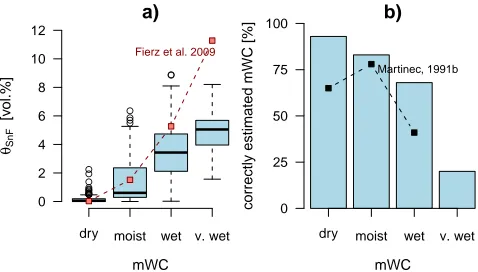
Fig. 7. a) Box-plot comparing estimated liquid water content (mWC) and water content measured with the Snow Fork (θSnF, n=318, 4 observers). As comparison the mean for each class is shown based on the conversion given in Fierz et al. (2009). b) shows the frequency that mWC was correctly estimated (light blue bars). For comparison, data by a previous study is shown (black dashed line, black squares Martinec, 1991b, n=518, 9 observers). θSnF is corrected by -0.8 vol.% (this corresponds to the median offset in dry snow).
Fig. 4. Liquid water content measurements: sampling design for horizontal, profile and vertical measurements. (A) horizontal measurements
in 5 cm steps to a depth of 75 cm. (B) observations adjacent to manual snow profile, vertical distance 5 cm, slope-parallel distance 20 cm.
(C) vertical measurements for spatial variability observations, measurement steps 5 cm, horizontal distance 50 cm. Refer also to Table 2 for
extent and spacing of measurements.
F. Techel and C. Pielmeier: Point observations of liquid water content in wet snow
13
5
5
5
A
B
C
profile
vertical
horizontal
5
50
50
50
50
50
before profile observations
beside manual
profile observations
example of a
cross-section over 2.5 m distance
Fig. 4.
Liquid water content measurements: sampling design for horizontal, profile and vertical measurements. A) horizontal measurements
in 5 cm steps to a depth of 75 cm. B) observations adjacent to manual snow profile, vertical distance 5 cm, slope-parallel distance 20 cm.
C) vertical measurements for spatial variability observations, measurement steps 5 cm, horizontal distance 50 cm. Refer also to Tab. 2 for
extent and spacing of measurements.
Cross section 5 m
distance [cm]
depth [cm]
0 100 200 300 400 500
−80
−60
−40
−20
0
LWC [vol. %] 10 8 6 4 2 0
Fig. 5.
Contour plot showing cross-section of snow wetness (
θ
) to
a depth of 80 cm over 5 m wide areas across the slope.
Measure-ments were conducted at horizontal intervals of 50 cm (lines) with
a vertical spacing of 5 cm. 4 April 2009, S aspect, 2660 m, 30
◦
.
θ
, measured with the Snow Fork, is corrected by -0.8 vol.% (this
corresponds to the median offset in dry snow).
● ● ● ● ● ● ● ● ● ● ●●● ● ● ● ● ●●●●● ● ● ● ● ● ●● ● ● ●● ●●●● ● ● ● ●● ● ● ● ● ● ● ● ● ● ●●●● ●●● ● ● ● ● ●● ●●●●● ●●● ● ●● ● ● ● ● ● ● ●● ● ● ● ● ● ● ● ● ● ● ● ● ● ● ● ●● ●●●● ● ● ●● ●●●● ● ●● ● ● ● ● ● ● ● ● ● ● ● ● ●●● ●● ●
a)
θ
Dn[vol.%]
θ
SnF
[v
ol.%]
−2
0
2
4
6
0
2
4
6
8
● ● ● ● ● ● ● ● ● ● ● ● ● ● ● ● ● ● ● ● ● ● ● ● ● ● ● ● ● ● ● ● ● ● ● ● ● ● ● ● ● ● ● ● ● ● ● ● ● ● ● ● ● ● ● ● ● ● ● ● ● ● ● ● ● ● ● ● ● ● ● ● ● ● ● ● ● ● ● ● ● ●● ● ● ●●●● ●● ● ● ● ● ● ● ● ● ●● ●b)
ρ
[kg/m3]
θ
[v
ol.%]
100
200
300
−0.5
0
0.5
1
1.5
●
●SnF
Dn
Fig. 6.
Comparison of measured liquid water content using the
De-noth (
θ
Dn
) and the Snow Fork (
θ
SnF
) instruments in a) all wetness
conditions (n=134) and in b) in dry snow as a function of snow
den-sity (
ρ
). Linear regression models are shown in both plots. The
median off-set of the
θ
SnF
for the dry snow data is marked by the
dark-blue dot (
ρ
=250 kg m
3
,
θ
SnF
=0.8 vol.%).
● ● ● ● ● ● ● ● ● ● ● ● ● ● ● ● ● ● ●
a)
mWC
θ
SnF
[v
ol.%]
dry
moist
wet
v. wet
0
2
4
6
8
10
12
Fierz et al. 2009
b)
mWC
correctly estimated mWC [%]
dry
moist
wet
v. wet
0
25
50
75
100
Martinec, 1991b
Fig. 7.
a) Box-plot comparing estimated liquid water content
(mWC) and water content measured with the Snow Fork (
θ
SnF
,
n=318, 4 observers). As comparison the mean for each class is
shown based on the conversion given in Fierz et al. (2009). b) shows
the frequency that mWC was correctly estimated (light blue bars).
For comparison, data by a previous study is shown (black dashed
line, black squares Martinec, 1991b, n=518, 9 observers).
θ
SnF
is
corrected by -0.8 vol.% (this corresponds to the median offset in dry
snow).
Fig. 5. Contour plot showing cross-section of snow wetness (θ) to a depth of 80 cm over 5 m wide areas across the slope. Measurements
were conducted at horizontal intervals of 50 cm (lines) with a vertical spacing of 5 cm. 4 April 2009, S aspect, 2660 m, 30◦. θ, measured
with the Snow Fork, is corrected by−0.8 vol. % (this corresponds to the median offset in dry snow).
potential problem. As shown in Fig. 5, there was usually a clear distinction between wet to dry layers indicating that water running ahead of the SnF was not a problem.
4.1.2 Comparison of Denoth wetness meter and Snow Fork device
Adjacent measurements from the Denoth meter (2–3 mea-surements) were compared with measurements from the Snow Fork (2–6 measurements). The measurements were always undertaken on a sidewall of snow pits and paral-lel to the layer stratigraphy. Horizontal and vertical dis-tances between measurements was 5 cm. Snow densities
were sampled directly above and below the Denoth meter measurements using a 100 cm3 density cutter and a digital scale.
4.2 Data
Snow wetness was measured using the Snow Fork in more than 80 different locations in a variety of measurement de-signs and wetness conditions in natural snow.
Measurements in 2008/2009 targeted small-scale variabil-ity (within 40 cm), diurnal changes in wetness within the same slope and compared hand and dielectric estimates of snow wetness. More than 7000 measurements were taken
410 F. Techel and C. Pielmeier: Point observations of liquid water content in wet snow
Table 3. Data overview: shown are the number of days (nday),
locations (nloc), measurement depths (ndepth) and single
measure-ments(n)for the various measurement modes (Fig. 4) using the
Snow Fork (SnF), and for the comparison between SnF and Denoth instrument (Dn).
mode nday ndepth n
(nloc)
horizontal 24 (60) >1300 >3500
profile 26 (63) >1200 >3500
vertical 10 (26) 330 >3500
Dn-SnF comparison 8 (11) 134 251–637
accompanying manual snow profiles using the horizontal (Fig. 4a) and profile measuring modes (Fig. 4b, Table 3). These were recorded in more than 2500 different measure-ment depths or layers.
In spring 2010, the focus was on investigating the wet-ness variability at spatial scales of up to 5 m. Vertical mea-surements (Fig. 4c) were carried out in 25 locations. The comparison of Snow Fork and Denoth instrument is based on measurements in 134 different snow layers made in pro-file mode (Table 3).
4.3 Data analysis
The water content measured with the Snow Fork (θSnF)
ranged from 0 to 23.6 vol. %. According to the Snow Fork manual (Toikka, 2008), measurements withθSnF>10 vol. %
may not be accurate. However, as these values often corre-sponded to areas of high snowpack wetness, they were not excluded from analysis but considered as 10 vol. %. The cal-culation of the water content using the Denoth instrument (θDn) requires a measurement of snow densityρ. We used the
mean of two measurements adjacent to the dielectric mea-surement.
The relationship between estimated water content (wet-ness index, mWC) and measured liquid water content (θSnF)
used the conversion shown in Table 1. IfθSnF was within
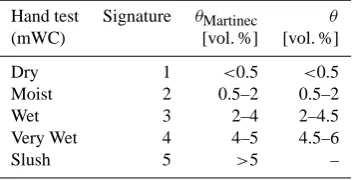
±0.5 vol. % of a class limit, this is considered as an interme-diate (half) index class and not considered as a false clas-sification or measurement. Snow wetness was often non-normally distributed. Therefore, the median and the in-terquartile range are considered as robust measures of cen-tral tendency and data distribution. If several measurements are available the medianθis used. Linear regression models were derived forθand the Pearson coefficient of determina-tionr2was calculated. For categorical variables (mWC), the Spearman correlationrswas used. Data was tested for
sig-nificant differences using non-parametric tests (Mann Whit-ney U-test, Kruskal-Wallis H-test, sign-test, Crawley, 2007), the level of significanceα≤0.05. Linear interpolation is
ap-F. Techel and C. Pielmeier: Point observations of liquid water content in wet snow 13
5
5
5
A
B
C
profile
vertical
horizontal
5
50 50 50 50
50
before profile observations profile observationsbeside manual
example of a cross-section over 2.5 m distance
Fig. 4.Liquid water content measurements: sampling design for horizontal, profile and vertical measurements. A) horizontal measurements in 5 cm steps to a depth of 75 cm. B) observations adjacent to manual snow profile, vertical distance 5 cm, slope-parallel distance 20 cm. C) vertical measurements for spatial variability observations, measurement steps 5 cm, horizontal distance 50 cm. Refer also to Tab. 2 for extent and spacing of measurements.
Cross section 5 m
distance [cm]
depth [cm]
0 100 200 300 400 500
−80
−60
−40
−20
0
LWC [vol. %] 10
8
6
4
2
0
Fig. 5. Contour plot showing cross-section of snow wetness (θ) to a depth of 80 cm over 5 m wide areas across the slope. Measure-ments were conducted at horizontal intervals of 50 cm (lines) with a vertical spacing of 5 cm. 4 April 2009, S aspect, 2660 m, 30◦. θ, measured with the Snow Fork, is corrected by -0.8 vol.% (this corresponds to the median offset in dry snow).
● ● ● ● ●
● ● ● ● ● ●●● ●
● ● ● ●●●● ● ●
● ● ● ● ●●
● ● ●● ●●●●
● ●
● ●●
● ● ● ●
● ● ● ● ● ●●●●
●●● ● ●
● ●
●● ●●●●● ●●● ● ●●
● ●
● ● ● ● ●● ●
● ●
● ● ●
● ● ●
● ● ●
● ● ● ●● ●●●● ● ● ●● ●●●●
● ●● ● ● ●
● ● ●● ● ●
● ● ●
●●● ●●
●
a)
θDn [vol.%] θSn
F
[v
ol.%]
−2 0 2 4 6
0 2 4 6 8
● ● ● ● ●
● ● ● ●
● ● ●
● ●
● ● ● ●
● ● ●
● ● ● ●
● ● ● ●
● ● ● ●
● ● ● ● ●●
● ● ●
● ●
● ● ●
●
● ●
● ● ● ●
● ●
● ● ●
● ● ● ● ● ● ● ● ● ● ●
● ● ●
● ● ● ● ●
● ● ● ●●
● ● ●●●●
●● ● ● ● ●
● ● ● ●●●
●
b)
ρ [kg/m3]
θ
[v
ol.%]
100 200 300
−0.5 0 0.5 1 1.5
● ●SnF
Dn
Fig. 6.Comparison of measured liquid water content using the De-noth (θDn) and the Snow Fork (θSnF) instruments in a) all wetness
conditions (n=134) and in b) in dry snow as a function of snow den-sity (ρ). Linear regression models are shown in both plots. The median off-set of theθSnFfor the dry snow data is marked by the
dark-blue dot (ρ=250 kg m3,θSnF=0.8 vol.%).
●
● ● ●
● ● ● ● ● ● ● ● ●
● ● ● ●
● ●
a)
mWC
θSn
F
[v
ol.%]
dry moist wet v. wet 0
2 4 6 8 10 12
Fierz et al. 2009
b)
mWC
correctly estimated mWC [%]
dry moist wet v. wet 0
25 50 75 100
Martinec, 1991b
Fig. 7. a) Box-plot comparing estimated liquid water content (mWC) and water content measured with the Snow Fork (θSnF,
n=318, 4 observers). As comparison the mean for each class is shown based on the conversion given in Fierz et al. (2009). b) shows the frequency that mWC was correctly estimated (light blue bars). For comparison, data by a previous study is shown (black dashed line, black squares Martinec, 1991b, n=518, 9 observers).θSnFis
corrected by -0.8 vol.% (this corresponds to the median offset in dry snow).
Fig. 6. Comparison of measured liquid water content using the
De-noth (θDn) and the Snow Fork (θSnF) instruments in (a) all wetness
conditions (n=134) and in (b) in dry snow as a function of snow
density (ρ). Linear regression models are shown in both plots. The
median off-set of theθSnFfor the dry snow data is marked by the
dark-blue dot (ρ= 250 kg m3,θSnF= 0.8 vol. %).
plied in the contour plots (as in Fig. 5) and is described in the R-package graphics (R, 2009).
5 Results
5.1 Liquid water content measurements using Snow Fork and Denoth wetness instrument
In a variety of snow wetness situations, the liquid water con-tent measured with the Snow Fork (θSnF, in vol. %) is
gener-ally higher than with the Denoth meter (θDn, Fig. 6a), but the
measurements were strongly correlated:
θSnF≈1.06×θDn+1.0 (r2=0.78,p≤0.001) (1)
Our results are similar to previous studies (Denoth, 1994; Williams et al., 1999; Frolov and Macharet, 1999). The vari-ability between adjacent measurements was similar regard-less which instrument was used.
In dry snow (hand test dry and snow temperature ≤ −0.5◦C), we investigated the effect of snow density (ρ) on
the measured water content. The Snow Fork recorded a medianθSnF=0.8 vol. % (standard deviationσ=0.2 vol. %,
nSnF=487). The Denoth wetness device showed lower
val-uesθDn=0.1 vol. % (σ=0.17 vol. %,nDn=281). Measured
water content in dry snow was generally 0.65 vol. % higher using the Snow Fork than with the Denoth meter (Fig. 6b). In dry snow poor positive correlations betweenθandρwere observed:
θSnF=0.0019ρ+0.32 (r2=0.28,p <0.001) (2)
F. Techel and C. Pielmeier: Point observations of liquid water content in wet snow 411 5.2 Influence of sampling design
Liquid water content measurements made before digging a snow-pit (horizontal mode, Fig. 4a) and following manual snow profile observations (profile mode, Fig. 4b) were com-pared in 86 locations.
No significant difference between either mode of measur-ing the water content was noted in locations with low water content (medianθSnF<1.3 vol %, dry or barely moist snow).
In moist and wet snow (θSnF≥1.3 vol %), horizontal
mea-surements were wetter than the meamea-surements at the side-wall following snow pit excavation (p=0.03). However, the median difference (θ=0.43 vol. %) is within the range of measurement uncertainty (±0.5 vol. %, Sihvola and Tiuri, 1986; Fierz and F¨ohn, 1994).
In our data-set, 2 % of the recorded values were higher than 10 vol. %. These high values were more frequently observed when we measured across layer boundaries in an undisturbed snowpack before digging the snow-pit than in layer-parallel measurements taken at the sidewall of a snow profile. In horizontal measurements, θ-values greater than 10 vol. % occur more frequently in layers relatively close to the snow surface and when neighboring measurements also showed high values.
5.3 Qualitative snow profile observations in wet snow
Manually estimated water content (mWC) and liquid wa-ter content (θSnF) were compared in 314 layers. mWC and
θSnF were strongly correlated (rs=0.73, p≤0.001).
Cor-rectly estimated water content mWC decreased with increas-ingθSnF (Fig. 7a, b). These results are similar to an earlier
study (Martinec, 1991b). Both, Martinec (1991b) and our results, show that dry layers are normally well described, while wetter layers are often incorrectly classified (30 % in our study for wet layers). It is of note, however, that few measurements were done in snow withθSnF>8 vol. %. Very
few layers were estimated as being very wet. In these layers, mWC was always overestimated.
The wetness in layers consisting of coarse melt-freeze-particles (MF, snow class MF, Fierz et al., 2009) is more frequently falsely estimated (33 % of cases) than in layers consisting of fine precipitation particles and snow which has undergone low-temperature gradient metamorphism (LTG, snow classes PP, DF, RG, 13 %) or coarse medium to high temperature gradient metamorphosed grains (TG, snow classes FC, DH, 13 %). No significant correlation was ob-served between snow hardness and the correct estimation of the water content. The wetness range in MF is much greater than in LTG or TG layers (MF: 0–10 vol. %; LTG/TG: 0– 5.5 vol. %). θSnF>3 vol. % is more frequently observed in
MF (>20 % of cases) and rarely in LTG/TG (<4 % cases). LTG layers estimated as being wet were almost always over-estimated. The error rate in snow estimated as being wet is smallest in TG snow (20 %).
F. Techel and C. Pielmeier: Point observations of liquid water content in wet snow 13
5
5
5
A
B
C
profile
vertical
horizontal
5
50 50 50 50
50
before profile observations
beside manual profile observations
example of a cross-section over 2.5 m distance
Fig. 4.Liquid water content measurements: sampling design for horizontal, profile and vertical measurements. A) horizontal measurements in 5 cm steps to a depth of 75 cm. B) observations adjacent to manual snow profile, vertical distance 5 cm, slope-parallel distance 20 cm. C) vertical measurements for spatial variability observations, measurement steps 5 cm, horizontal distance 50 cm. Refer also to Tab. 2 for extent and spacing of measurements.
Cross section 5 m
distance [cm]
depth [cm]
0 100 200 300 400 500
−80
−60
−40
−20
0
LWC [vol. %] 10
8
6
4
2
0
Fig. 5. Contour plot showing cross-section of snow wetness (θ) to a depth of 80 cm over 5 m wide areas across the slope. Measure-ments were conducted at horizontal intervals of 50 cm (lines) with a vertical spacing of 5 cm. 4 April 2009, S aspect, 2660 m, 30◦. θ, measured with the Snow Fork, is corrected by -0.8 vol.% (this corresponds to the median offset in dry snow).
● ● ● ● ●
● ● ● ● ● ●●● ●
● ● ● ●●●●● ●
● ● ● ● ●●
● ● ●● ●●●●
●●
● ●●
● ● ● ●
● ● ● ● ● ●●●●
●●● ● ●
●
●
●● ●●●●● ●●● ● ●●
● ●
● ● ● ● ●● ●
● ●
● ● ●
● ● ●
● ● ●
● ● ● ●● ●●●● ● ● ●● ●●●●●●●●●
● ● ● ●● ● ●
● ● ●
●●● ●●●
a)
θDn [vol.%] θSn
F
[v
ol.%]
−2 0 2 4 6
0 2 4 6 8
● ● ● ● ●
● ● ● ●
● ● ●
● ●
● ● ● ●
● ● ●
● ● ● ●
● ● ● ●
● ● ● ●
● ● ● ● ●●
● ● ●
● ●
● ● ●
●
● ●
● ● ● ●
● ● ● ● ●
● ● ● ● ● ● ● ● ● ● ●
● ● ●
● ● ● ● ●
● ● ● ●●
● ● ●●●●
●● ● ● ● ●
● ● ● ●●●
●
b)
ρ [kg/m3]
θ
[v
ol.%]
100 200 300
−0.5 0 0.5 1 1.5
● ●SnF
Dn
Fig. 6.Comparison of measured liquid water content using the De-noth (θDn) and the Snow Fork (θSnF) instruments in a) all wetness
conditions (n=134) and in b) in dry snow as a function of snow den-sity (ρ). Linear regression models are shown in both plots. The median off-set of theθSnF for the dry snow data is marked by the
dark-blue dot (ρ=250 kg m3,θSnF=0.8 vol.%).
●
● ● ●
● ● ● ● ● ● ● ● ●
● ● ● ●
● ●
a)
mWC
θSn
F
[v
ol.%]
dry moist wet v. wet 0
2 4 6 8 10 12
Fierz et al. 2009
b)
mWC
correctly estimated mWC [%]
dry moist wet v. wet 0
25 50 75 100
Martinec, 1991b
Fig. 7. a) Box-plot comparing estimated liquid water content (mWC) and water content measured with the Snow Fork (θSnF,
n=318, 4 observers). As comparison the mean for each class is shown based on the conversion given in Fierz et al. (2009). b) shows the frequency that mWC was correctly estimated (light blue bars). For comparison, data by a previous study is shown (black dashed line, black squares Martinec, 1991b, n=518, 9 observers).θSnF is
corrected by -0.8 vol.% (this corresponds to the median offset in dry snow).
Fig. 7. (a) Box-plot comparing estimated liquid water content
(mWC) and water content measured with the Snow Fork (θSnF,
n=318, 4 observers). As comparison the mean for each class
is shown based on the conversion given in Fierz et al. (2009).
(b) shows the frequency that mWC was correctly estimated (light
blue bars). For comparison, data by a previous study is shown
(black dashed line, black squares Martinec, 1991b,n=518, 9
ob-servers). θSnFis corrected by−0.8 vol. % (this corresponds to the
median offset in dry snow).
Hardness of snow is influenced by the liquid water con-tent. This can be observed by comparing the hardness (hand hardness test, Fierz et al., 2009) with estimated and mea-sured water content. A negative correlation exists in layers classified as MF (rs= −0.70 for mWC,rs= −0.43 forθSnF,
p≤0.001). Not surprisingly, the transition from dry (frozen) to wet infers a significant hardness decrease. While no clear trend was observed for TG snow, all layers estimated as be-ing wet (n=6), or measured as being wet (θSnF>3 vol. %,
n=9), had a hand hardness of 1. This was significantly softer than the dry hand hardness (p≤0.01) in TG snow. 5.4 Temporal changes in snow wetness: morning vs.
afternoon
Snowpack wetness was compared in 33 locations between morning and afternoon. Generally, snow wetness increased within the uppermost 10 cm of the snowpack (p <0.05, Fig. 8a). This is not surprising, as measurements were car-ried out when day-time warming was expected. Analyz-ing each location individually, the median snowpack wet-ness (excluding the uppermost 10 cm) changed significantly in only nine cases (p <0.05). Surprisingly, six of these nine wetness profiles showed decreasing values (Fig. 8b). These significant changes always involved a transition from dry or barely moist snow (medianθSnFm ≤1.3 vol. %, third quartile
θSnFq3 ≤1.9 vol. %) to moist or wet snow (θSnFm ≥1.2 vol. %,
θSnFq3 ≥1.9 vol. %) or vice versa (Fig. 8c), where both the changes in median and third quartile are significant (p≤ 0.001).
412 F. Techel and C. Pielmeier: Point observations of liquid water content in wet snow
14 F. Techel and C. Pielmeier: Point observations of liquid water content in wet snow
a)
∆θSnF [vol.%]
depth [cm]
−2 0 2 4 6
100 80 60 40 20 5 b)
θSnF [vol.%]
depth [cm]
0 2 4 6 8 10 100 80 60 40 20 5 c)
θSnF [vol.%]
depth [cm]
0 2 4 6 8 10 100 80 60 40 20 5
Fig. 8. a) Difference between morning and afternoon liquid water content (θSnF), measured in 33 locations. Positive values indicate
an increase inθSnF from morning to afternoon. Depth is given in
cm below snow surface. The median is the bold line, the shaded area represents the interquartile range. b) and c) example of profiles with significant changes inθSnFduring the day. The bold line represents
the morning measurements (median of 3), the shaded area and the arrows indicate the change during the day.
a)
lag(x) [cm]
c o rr e la ti o n c o e ff ic ie n t r
0 100 200 300 400 500 0.6 0.7 0.8 0.9 1 ● ● ● ● ● ● ● ● ● ● ● ● ● ● b)
lag(x) [cm]
∆θS n F [v ol.%]
0 100 200 300 400 500 0 0.5 1 1.5 2 x c)
Median θSnF [vol.%] ∆θS n F [v ol.%]
0 2 4 6 8 10
−3 0 3 ●● ● ●●●●●●●●●●●●●● ● ●●●● ●●●●●●● ● ●●●●● ● ● ● ● ● ●● ● ● ● ● ● ● ● ●●● ●●●●● ● ●● ●●●●● ● ●● ● ●●● ● ●● ● ● ●●●●● ● ●●●● ● ●●● ● ●● ●● ● ●● ● ●● ● ●● ● ● ● ●●● ● ● ● ●● ●●● ● ● ● ● ● ● ● ● ● ● ● ● ●●●●● ●●● ●● ● ● ● ● ● ● ● ● ●●● ●●●●● ● ● ● ● ● ● ● ● ● ● ● ●●● ● ● ● ● ● ● ● ● ● ●●● ● ● ● ●● ● ●● ● ● ● ●● ● ●● ● ● ● ● ● ● ● ●● ● ● ● ● ● ● ●●●● ● ● ● ● ● ● ● ● ● ● ● ● ● ● ● ● ● ● ● ● ● ● ● ● ● ● ● ● ● ● ● ● ● ● ● ● ● ● ●● ● ● ● ● ● ● ● ● ● ● ●● ● ● ● ● ● ● ● ● ● ● ● ● ● ● ● ● ●● ●● ● ● ● ● ● ● ● ● ● ● ●● ● ● ●● ● ● ● ●● ● ● ● ● ●● ● ● ● ● ● ● ● ● ● ● ●●●● ● ●●● ●● ●● ● ●● ● ●●● ● ●● ● ● ● ● ●●● ● ●● ● ● ●● ●● ● ● ● ●●● ● ● ● ● ●● ● ● ● ● ●● ●●● ● ●● ● ● ● ● ● ● ●● ● ●●●● ● ● ● ●● ●●● ● ● ● ● ● ●● ● ● ● ● ●● ●●●●●● ● ● ● ● ● ● ● ●● ● ●● ●●● ● ● ●● ● ● ●● ● ●● ●● ● ● ● ●●● ●● ● ● ● ● ●●●●● ●● ● ● ● ● ● ● ● ●● ● ● ● ● ● ● ● ● ● ● ● ● ● ● ● ● ● ● ● ● ● ● ● ● ● ● ● ● ● ● ●● ●● ● ● ● ●● ● ● ● ●● ● ●● ● ● ● ● ● ● ●● ● ● ●● ● ● ● ● ●●● ● ● ● ● ● ●● ● ● ● ● ● ● ● ● ● ●● ●● ● ● ● ● ● ● ● ● ● ● ● ● ● ●● ● ● ● ● ● ● ● ● ● ● ● ● ● ● ● ●● ● ● ● ● ● ● ● ● ● ● ● ● ● ● ● ● ● ● ● ● ●● ● ● ● ● ● ● ● ●● ● ●● ●● ● ● ● ● ● ●●
Fig. 9. Variability in measured water content as a function of lag-distance between measurements and water content. a) Pearson cor-relation coefficient r for all measurement pairs with the same lag distance lag(x). b) Difference in liquid water content (∆θSnF)
be-tween measurement pairs at lag distance (x). Compared are the me-dian (bold line) and the range between meme-dian and the third quartile for each lag distance (shaded area). The data-set is split into mea-surements where the medianθof the measurements taken over 5 m was less than 1.3 vol. % (lower values, red) and more than 1.3 vol. % (higher values, blue). c) Difference between median water content and the first and third quartile (always measured within 5 m distance,∆θSnF). The shaded area highlights the
interquartile-range averaged over 25 measurements.
0 2 4 6 8 10
θ [vol.%]
0 100 200 300 400 500
−70 −60 −50 −40 −30 −20 −10
0 a) 18 March − S, 32°, 2350 m
distance [cm] depth [cm] 0 2 4 6 8
θ [vol.%]
0 100 200 300 400 500
−70 −60 −50 −40 −30 −20 −10
0 b) 19 March − S, 32°, 2300 m
distance [cm] depth [cm] 0 2 4 6 8
θ [vol.%]
0 100 200 300 400 500
−70 −60 −50 −40 −30 −20 −10
0 c) 19 March − SW, 33°, 2350 m
distance [cm] depth [cm] 0 2 4 6 8 10
θ [vol.%]
0 100 200 300 400 500
−70 −60 −50 −40 −30 −20 −10
0 d) 20 March − SSE, 27°, 2290 m
distance [cm]
depth [cm]
Fig. 10. State of snow wetness, 18 - 20 March 2010 on southerly aspect slopes at similar altitudes in the beginning of the melt phase. Contour plots showing cross-sections of snow wetness (θ) to a depth of up to 70 cm over 5 m wide areas across the slope. All observa-tions were observed in shallow snowpack areas at similar elevaobserva-tions (2000 - 2300 m) in southerly aspect slopes (SE, S, SW).θ, measured with the Snow Fork, is corrected by -0.8 vol.% (this corresponds to the median offset in dry snow).θ-values greater than 10 vol.% are shown as 10 vol.%.
Fig. 8. (a) Difference between morning and afternoon liquid water
content (θSnF), measured in 33 locations. Positive values indicate
an increase inθSnFfrom morning to afternoon. Depth is given in cm
below snow surface. The median is the bold line, the shaded area represents the interquartile range. (b) and (c) example of profiles
with significant changes inθSnFduring the day. The bold line
rep-resents the morning measurements (median of 3), the shaded area and the arrows indicate the change during the day.
We have only one explanation for the profiles where over-all water content decreased during the day: the snowpack was in the initial part of the melt-phase with spatially and temporally highly variable water infiltration patterns where both dry and wet regions exist within the snowpack. In such situations it is unclear if morning or afternoon measurements were a better representation of snowpack wetness at the time. Considering just the six observations, where snowpack wet-ness decreased during the day, almost 20 % of the measure-ments may be a poor representation of snowpack wetness. 5.5 Spatial variability in water content distribution
The variability of liquid water contentθSnFwas investigated
at horizontal distances of 10–500 cm. The difference be-tweenθSnF at measurement spacings of 10 and 20 cm was
significantly less than at 40 cm or greater (p <0.001). In 50 % of the cases variability was similar to, or less than the measurement accuracy (θ±0.5 vol. %). However, even at relatively small horizontal spacings of 20 cm, 20 % of the measurements differed by more than 1 vol. % and 10 % of the measurements differed by more than 1.8 vol. %. Gener-ally the correlation between measurements at various mea-surement distances was moderate to strong (Fig. 9a). Sig-nificant differences between the medianθSnF in each
verti-cal column existed in five of the twenty-five 500 cm-wide grids (p≤0.05). Variability in θSnF increased marginally
with greater measurement spacings (Fig. 9b). The variabil-ity (expressed as the interquartile range) as a function to the median water content within 5 m distance (θ5 m) is much
smaller atθ5 m<1.3 vol. % than atθ5 m≥1.3 vol. % (±0.16
and±0.52 vol. %, respectively,p <10−16, Fig. 9b, c). Randomly selecting one single measurement showed strong correlations to the θ5 m (r2>0.83) with the large
14 F. Techel and C. Pielmeier: Point observations of liquid water content in wet snow
a)
∆θSnF [vol.%]
depth [cm]
−2 0 2 4 6
100 80 60 40 20 5 b)
θSnF [vol.%]
depth [cm]
0 2 4 6 8 10 100 80 60 40 20 5 c)
θSnF [vol.%]
depth [cm]
0 2 4 6 8 10 100 80 60 40 20 5
Fig. 8. a) Difference between morning and afternoon liquid water content (θSnF), measured in 33 locations. Positive values indicate
an increase inθSnF from morning to afternoon. Depth is given in
cm below snow surface. The median is the bold line, the shaded area represents the interquartile range. b) and c) example of profiles with significant changes inθSnFduring the day. The bold line represents
the morning measurements (median of 3), the shaded area and the arrows indicate the change during the day.
a)
lag(x) [cm]
c o rr e la ti o n c o e ff ic ie n t r
0 100 200 300 400 500 0.6 0.7 0.8 0.9 1 ● ● ● ● ● ● ● ● ● ● ● ● ● ● b)
lag(x) [cm]
∆θS n F [v ol.%]
0 100 200 300 400 500 0 0.5 1 1.5 2 x c)
Median θSnF [vol.%] ∆θS n F [v ol.%]
0 2 4 6 8 10
−3 0 3 ●● ● ●●●●● ●●● ● ● ● ● ●● ● ●●●● ●● ●●●●● ● ●●●●● ● ● ● ● ● ●● ● ● ● ● ● ● ● ●●● ●●●●● ● ●● ● ●●●● ● ●● ● ●●● ● ●● ● ● ● ● ●●● ● ●●● ● ● ●● ● ● ●● ● ● ● ●● ● ●● ● ●● ● ● ● ●●● ● ● ● ●● ●●● ● ● ● ● ● ● ● ● ● ● ● ● ●●●●● ● ●● ●● ●● ● ● ● ● ●● ●●● ●●●●● ● ● ● ● ● ● ● ● ● ● ● ● ●● ● ● ● ● ● ● ● ● ● ● ●● ● ● ● ●● ● ●●●● ● ●● ●●● ● ● ● ● ● ● ● ● ● ● ● ● ● ● ● ●● ●● ● ● ● ● ● ● ● ● ● ● ● ● ● ● ● ● ● ● ● ● ● ● ●● ● ● ● ● ● ● ● ● ● ● ● ● ● ● ●● ● ● ● ● ● ● ● ● ● ● ● ● ● ● ● ● ● ● ● ● ● ● ● ● ● ● ● ● ● ● ●● ● ● ● ● ● ● ● ● ● ● ●●●●●● ● ● ● ●● ● ● ● ● ●● ● ● ● ● ● ● ● ● ● ● ●●●● ● ●●● ●● ●● ● ●● ● ●●● ● ●● ● ● ● ● ●●● ● ●● ● ● ●● ●● ● ● ● ●● ● ● ● ● ● ●● ● ● ● ● ●● ●●● ● ●● ● ● ● ● ● ● ●● ● ●●●● ● ● ● ●● ●●● ● ● ● ● ● ●● ● ● ● ● ●● ●●●●●● ● ● ● ● ● ● ● ●● ● ● ● ●●● ● ● ●● ● ● ●● ● ●● ●● ● ● ● ●●● ●● ● ● ● ● ●●●●● ●● ● ● ● ● ● ●● ●● ● ● ● ● ● ● ● ● ● ● ● ● ● ● ● ● ● ● ● ● ● ● ● ● ● ● ● ● ● ● ●● ●● ● ● ● ●● ● ● ● ●● ● ●● ● ● ● ● ● ● ●● ● ● ●● ● ● ● ● ● ● ● ● ● ● ● ● ●● ● ● ● ● ● ● ● ● ● ●● ●● ● ● ● ● ● ● ● ● ● ● ● ● ● ●● ● ● ● ● ● ● ● ● ● ● ● ● ● ● ● ●● ● ● ● ● ● ● ● ● ● ● ● ● ● ● ● ● ● ● ● ● ●● ● ● ● ● ● ● ● ●● ● ● ● ●● ● ● ● ● ● ●●
Fig. 9. Variability in measured water content as a function of lag-distance between measurements and water content. a) Pearson cor-relation coefficient r for all measurement pairs with the same lag distance lag(x). b) Difference in liquid water content (∆θSnF)
be-tween measurement pairs at lag distance (x). Compared are the me-dian (bold line) and the range between meme-dian and the third quartile for each lag distance (shaded area). The data-set is split into mea-surements where the medianθ of the measurements taken over 5 m was less than 1.3 vol. % (lower values, red) and more than 1.3 vol. % (higher values, blue). c) Difference between median water content and the first and third quartile (always measured within 5 m distance,∆θSnF). The shaded area highlights the
interquartile-range averaged over 25 measurements.
0 2 4 6 8 10 θ [vol.%]
0 100 200 300 400 500
−70 −60 −50 −40 −30 −20 −10
0 a) 18 March − S, 32°, 2350 m
distance [cm] depth [cm] 0 2 4 6 8 θ [vol.%]
0 100 200 300 400 500
−70 −60 −50 −40 −30 −20 −10
0 b) 19 March − S, 32°, 2300 m
distance [cm] depth [cm] 0 2 4 6 8 θ [vol.%]
0 100 200 300 400 500
−70 −60 −50 −40 −30 −20 −10
0 c) 19 March − SW, 33°, 2350 m
distance [cm] depth [cm] 0 2 4 6 8 10 θ [vol.%]
0 100 200 300 400 500
−70 −60 −50 −40 −30 −20 −10
0 d) 20 March − SSE, 27°, 2290 m
distance [cm]
depth [cm]
Fig. 10. State of snow wetness, 18 - 20 March 2010 on southerly aspect slopes at similar altitudes in the beginning of the melt phase. Contour plots showing cross-sections of snow wetness (θ) to a depth of up to 70 cm over 5 m wide areas across the slope. All observa-tions were observed in shallow snowpack areas at similar elevaobserva-tions (2000 - 2300 m) in southerly aspect slopes (SE, S, SW).θ, measured with the Snow Fork, is corrected by -0.8 vol.% (this corresponds to the median offset in dry snow). θ-values greater than 10 vol.% are shown as 10 vol.%.
Fig. 9. Variability in measured water content as a function of
lag-distance between measurements and water content. (a) Pearson
cor-relation coefficientr for all measurement pairs with the same lag
distance lag(x). (b) Difference in liquid water content (1θSnF)
be-tween measurement pairs at lag distance(x). Compared are the
me-dian (bold line) and the range between meme-dian and the third quartile for each lag distance (shaded area). The data-set is split into
mea-surements where the medianθof the measurements taken over 5 m
was less than 1.3 vol. % (lower values, red) and more than 1.3 vol. % (higher values, blue). (c) Difference between median water content and the first and third quartile (always measured within 5 m
dis-tance,1θSnF). The shaded area highlights the interquartile-range
averaged over 25 measurements.
majority of measurements being within 0.5 vol. % (Table 4, Fig. 10a, b). In more than 90 % of the cases the measure-ment was within the same wetness class (as defined in Ta-ble 1) (Fig. 10c). The median water content observed in three measurements θm3 at regular intervals of 50 cm, 100 cm or
200 cm was very strongly correlated toθ5 m(r2>0.93).θm3
was in more than 70 % of the cases within 0.5 vol. % ofθ5 m
and in more than 98 % within±0.5 mWC-classes. The in-terquartile range within 5 m sections is generally very well represented by the minima and maxima of three values (95 % within±0.5 mWC-class, Fig. 10d–f shows the results for the measurements at 100 cm distance). With an increase in mea-surement spacing, the devation between θ5 m andθm3 was
smaller and the minima and maxima of the three measure-ments tend to fall outside the interquartile range of 5 m cross-sections. The recorded snow wetness differed less fromθ5 m
F. Techel and C. Pielmeier: Point observations of liquid water content in wet snow 413
F. Techel and C. Pielmeier: Point observations of liquid water content in wet snow 15
0 2 4 6 8 10 θ [vol.%]
0 100 200 300 400
−70 −60 −50 −40 −30 −20 −10
0 a) 20 March − S, 28°, 2190 m
distance [cm] depth [cm] ground ground 0 2 4 6 8 10 θ [vol.%]
0 100 200 300 400 500
−70 −60 −50 −40 −30 −20 −10
0 b) 24 March − SSE, 28°, 2330 m
distance [cm] depth [cm] 0 1 2 3 4 5 6 7 θ [vol.%]
0 100 200 300 400 500
−70 −60 −50 −40 −30 −20 −10
0 c) 03 April − S, 20°, 2050 m
distance [cm] depth [cm] 0 2 4 6 8 10 θ [vol.%]
0 100 200 300 400 500
−60 −50 −40 −30 −20 −10
0 d) 17 April − S, 30°, 2210 m
distance [cm]
depth [cm]
ground
ground
Fig. 11.Evolution of snow wetness during melting from 20 March till 17 April 2010 on southerly aspect slopes at similar altitudes. Contour plots showing cross-sections of snow wetness (θ) to a depth of up to 70 cm over 5 m wide areas across the slope. All observa-tions were observed in shallow snowpack areas at similar elevaobserva-tions (2000 - 2300 m) in southerly aspect slopes (SE, S, SW).θ, measured with the Snow Fork, is corrected by -0.8 vol.% (this corresponds to the median offset in dry snow). θ-values greater than 10 vol.% are shown as 10 vol.%.
●
a) one measurement
θ5m [vol.%] θSn
F
[v
ol.%]
0 2 4 6 8 10
0 2 4 6 8 10 ● ● ● ● ● ● ● ● ● ● ● ● ● ●●●●●● ● ●●● ● ● ● ● ● ● ● ● ● ● ● ●● ● ● ● ●●● ● ●● ● ●● ● ● ● ● ● ● ●● ● ●●●● ● ● ● ● ● ● ● ● ● ●●●●● ● ● ● ● ● ● ● ● ● ● ● ● ● ● ●●● ●● ● ● ● ● ● ● ● ● ● ● ● ● ●●●● ● ● ● ● ● ● ● ● ● ●●●●●● ● ● ● ● ● ● ● ● ● ● ● ● ● ● ● ● ●●● ● ●● ● ● ● ● ● ● ● ● ● ● ● ● ● ● ● ● ● ● ● ●● ● ● ● ● ● ●● ● ● ●●● ●● ● ●●●● ●● ●● ● ● ● ● ● ● ● ● ● ● ●● ●●●●●● ● ● ●● ● ● ● ● ● ● ● ● ● ● ● ●●●● ● ● ● ● ● ● ● ● ● ● ● ● ● ● ● ● ● ● ● ● ● ● ● ● ●● ● ●● ● ● ● ● ● ● ● ●●●●●●● ● ● ● ● ● ● ● ● ● ● ● ● ● ● ● ● ● ● ● ● ● ● ● ● ● ● ● ● ● ● ● ● b)
∆θSnF [vol.%]
Frequency
−4 −2 0 2 4
0 100
200 c)
∆ mWC class
Frequency
−2 −1 0 1 2
0 100 200
●
d) three mesaurements
θ5m [vol.%] θm3
[v
ol.%]
0 2 4 6 8 10
0 2 4 6 8 10 ● ● ● ● ● ● ● ● ● ● ● ● ● ● ● ● ● ● ● ● ● ● ● ● ● ● ● ● ●● ●●● ● ●● ● ● ● ● ● ● ● ● ● ● ●● ● ●● ● ● ●●● ● ● ● ● ● ● ● ●● ● ● ● ● ● ● ● ● ● ● ● ●● ● ● ● ● ● ● ● ● ● ● ● ●●● ● ● ● ● ●● ● ● ● ● ● ● ● ● ● ● ● ● ●●●● ● ● ● ● ● ● ● ● ● ● ● ● ● ● ● ●● ● ● ● ● ● ● ● ● ● ● ● ● ● ● ● ● ● ●● ● ● ● ● ●●● ●● ● ● ● ● ● ● ● ● ● ● ● ● ● ● ● ● ● ● ● ●● ● ● ● ● ● ● ● ● ●●● ● ● ● ● ● ● ●● ● ●● ● ● ● ● ● ● ● ●●●● ● ● ● ● ●● ● ● ● ● ● ● ● ● ● ● ● ● ● ● ● ● ● ● ● ● ● ● ● ● ● ● ●● ● ● ● ● ● ● ● ● ● ● ●●● ● ● ●●●●●● ● ● ● ● ● ● ● ● ● ● ● ●● ●● ● ●● ● ● ● ● ● ● ● ● ● ● e)
∆θSnF [vol.%]
Frequency
−4 −2 0 2 4
0 100 200
f)
∆ mWC class
Frequency
−2 −1 0 1 2
0 100 200
Fig. 12. Comparison between measurement samples and the me-dian of a 5 m cross-section at a certain depthθ5m. Upper row plots
(a-c) show the comparison for one randomly selected measurement toθ5m, lower row plots (d-f) compare the median of three
measure-ments (θm3) observed at 1 m horizontal distance toθ5m.
Scatter-plots show the absolute values (a, d), the histograms the difference betweenθ-values (∆θ, plots b and e) and the difference in wetness classes (∆mWC) using the international classification (Fierz et al., 2009, plots c, f).
dry mixed wet dry mixed wet dry mixed wet dry mixed wet dry mixed wet
1-dry
2-upper part wet 3-transitional
4-fully wet
5-lower part wet
Fig. 13.Wetness classification incorporating vertical and horizontal water content distribution. The x-direction shows the percentage of the snow which has been wetted, where dry/wet is fully dry or fully wet and mixed consists of both dry and wet regions. The y-direction shows the vertical distribution of snow wetness. Diurnal changes occur mostly within the upper-most 10 - 15 cm of the snowpack and are not considered in this classification.
Fig. 10. Comparison between measurement samples and the
me-dian of a 5 m cross-section at a certain depthθ5 m. Upper row plots
(a–c) show the comparison for one randomly selected measurement
toθ5 m, lower row plots (d–f) compare the median of three
measure-ments (θm3) observed at 1 m horizontal distance toθ5 m.
Scatter-plots show the absolute values (a, d), the histograms the difference
betweenθ-values (1θ, plots (b) and (e)) and the difference in
wet-ness classes (1mWC) using the international classification (Fierz
et al., 2009, plots (c, f)).
Table 4. Deviation between median measured water content in 5 m
cross-sectionsθ5 m: if one measurement is doneθ1and to median
water content if three measurements are doneθm3at regular
hori-zontal spacings of 50–200 cm.
deviation fromθ5 m θ1 θm3–50 cm θm3–200 cm
>0.5 vol. % 33 % 25 % 15 %
>1 vol. % 18 % 10 % 5 %
>2 vol. % 8 % 2 % 2 %
5.6 Temporal evolution of snowpack wetness
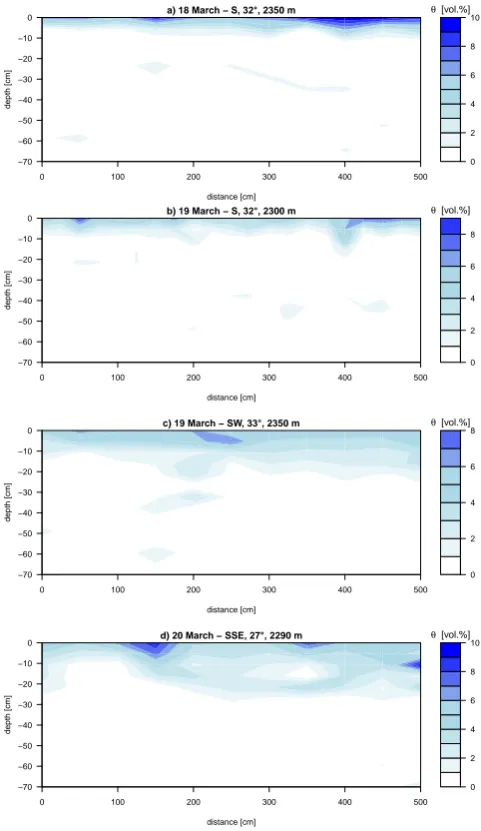
The evolution of snowpack wetness during spring 2010 for southerly aspect slopes above tree-line is shown in Fig. 11 and Fig. 12. The snowpack was shallow with snow depth often less than 1 m and dominated by soft, coarse-grained faceted layers due to the relatively dry winter with sustained cold periods. The snowpack was predominantly dry and cold with snow temperatures mostly below−1◦C on 18 March
(Fig. 11a). Water infiltration was slow the following day too (Fig. 11b, c). On 20 March two grids were measured: the first at higher elevation showed a relatively dry snow-pack with first weak flow channels (Fig. 11d), while the sec-ond, measured later in the afternoon and at lower elevation, was already moist to the ground (Fig. 12a). Four days later, on 24 March the snowpack was moist or wet throughout (Fig. 12b). This first wetting of the snowpack coincided with
14 F. Techel and C. Pielmeier: Point observations of liquid water content in wet snow
a)
∆θSnF [vol.%]
depth [cm]
−2 0 2 4 6
100 80 60 40 20 5 b)
θSnF [vol.%]
depth [cm]
0 2 4 6 8 10 100 80 60 40 20 5 c)
θSnF [vol.%]
depth [cm]
0 2 4 6 8 10 100 80 60 40 20 5
Fig. 8. a) Difference between morning and afternoon liquid water content (θSnF), measured in 33 locations. Positive values indicate an increase inθSnF from morning to afternoon. Depth is given in cm below snow surface. The median is the bold line, the shaded area represents the interquartile range. b) and c) example of profiles with significant changes inθSnF during the day. The bold line represents the morning measurements (median of 3), the shaded area and the arrows indicate the change during the day.
a)
lag(x) [cm]
c o rr e la ti o n c o e ff ic ie n t r
0 100 200 300 400 500 0.6 0.7 0.8 0.9 1 ● ● ● ● ● ● ● ● ● ● ● ● ● ● b)
lag(x) [cm]
∆θS n F [v ol.%]
0 100 200 300 400 500 0 0.5 1 1.5 2 x c)
Median θSnF [vol.%] ∆θS n F [v ol.%]
0 2 4 6 8 10
−3 0 3 ●● ● ●●●●● ●●● ●● ● ●●● ● ●●●● ●●●●●●● ● ●●●●● ● ● ● ● ● ●●● ● ● ● ● ● ● ●●● ●●●●● ● ●●●●●●●● ●● ● ●●● ● ● ● ● ● ●●●●●● ●●●● ● ●● ● ● ●● ●● ● ●● ● ●● ● ●● ● ● ● ●●● ● ● ● ●● ●●● ● ● ● ● ● ● ● ● ● ● ● ● ●●●●● ●●● ●● ●● ● ● ● ● ●● ●●● ●●●●● ● ● ● ● ● ● ● ● ● ● ● ● ●● ● ● ● ● ● ● ● ● ● ● ●● ● ● ● ●● ● ●●●● ● ●● ● ●● ● ● ● ● ● ● ● ● ● ● ● ● ● ● ● ●●●● ● ● ● ● ● ● ● ● ● ● ● ● ● ● ● ● ● ● ● ● ● ● ●● ● ● ● ● ● ● ● ● ● ● ● ● ● ● ●● ● ● ● ● ● ● ● ● ● ● ● ● ● ● ● ● ● ● ● ● ● ● ● ● ● ● ● ● ●● ●● ● ● ● ● ● ● ● ● ● ● ●●●●●● ● ● ● ●● ● ● ● ● ●● ● ● ● ● ● ● ● ● ● ● ●●●● ● ●●● ●● ●● ● ●● ● ●●● ● ●● ● ● ● ● ●●● ● ●● ● ● ●● ●● ● ● ● ●● ● ● ● ● ● ●● ● ● ● ● ● ● ●●● ● ●● ● ● ● ● ● ● ●● ● ●●●● ● ● ● ●● ●●● ● ● ● ● ● ●●● ● ● ● ●● ●●●● ●● ● ● ● ● ● ● ● ●● ● ●● ●●●● ● ●● ● ● ●●● ●● ●● ● ● ● ●●● ●● ● ● ● ● ●●●●● ●● ● ● ● ● ● ● ● ● ● ● ● ●● ● ● ● ● ● ● ● ● ● ● ● ● ● ● ● ● ● ● ● ● ● ● ● ● ● ● ●● ●● ● ● ● ●● ● ● ● ●● ● ●● ● ● ● ● ● ● ●● ● ● ● ● ● ● ● ● ● ● ● ● ● ● ● ● ●● ● ● ● ● ● ● ● ● ● ●● ●● ● ● ● ● ● ● ● ● ● ● ● ● ● ●● ● ● ● ● ● ● ● ● ● ● ● ● ● ● ● ●● ● ● ● ● ● ● ● ● ● ● ● ● ● ● ● ● ● ● ● ● ●● ● ● ● ● ● ● ● ●● ● ● ● ●● ● ● ● ● ● ●●
Fig. 9. Variability in measured water content as a function of lag-distance between measurements and water content. a) Pearson cor-relation coefficient r for all measurement pairs with the same lag distance lag(x). b) Difference in liquid water content (∆θSnF) be-tween measurement pairs at lag distance (x). Compared are the me-dian (bold line) and the range between meme-dian and the third quartile for each lag distance (shaded area). The data-set is split into mea-surements where the medianθof the measurements taken over 5 m was less than 1.3 vol. % (lower values, red) and more than 1.3 vol. % (higher values, blue). c) Difference between median water content and the first and third quartile (always measured within 5 m distance,∆θSnF). The shaded area highlights the interquartile-range averaged over 25 measurements.
0 2 4 6 8 10 θ [vol.%]
0 100 200 300 400 500
−70 −60 −50 −40 −30 −20 −10
0 a) 18 March − S, 32°, 2350 m
distance [cm] depth [cm] 0 2 4 6 8 θ [vol.%]
0 100 200 300 400 500
−70 −60 −50 −40 −30 −20 −10
0 b) 19 March − S, 32°, 2300 m
distance [cm] depth [cm] 0 2 4 6 8 θ [vol.%]
0 100 200 300 400 500
−70 −60 −50 −40 −30 −20 −10
0 c) 19 March − SW, 33°, 2350 m
distance [cm] depth [cm] 0 2 4 6 8 10 θ [vol.%]
0 100 200 300 400 500
−70 −60 −50 −40 −30 −20 −10
0 d) 20 March − SSE, 27°, 2290 m
distance [cm]
depth [cm]
Fig. 10. State of snow wetness, 18 - 20 March 2010 on southerly aspect slopes at similar altitudes in the beginning of the melt phase. Contour plots showing cross-sections of snow wetness (θ) to a depth of up to 70 cm over 5 m wide areas across the slope. All observa-tions were observed in shallow snowpack areas at similar elevaobserva-tions (2000 - 2300 m) in southerly aspect slopes (SE, S, SW).θ, measured with the Snow Fork, is corrected by -0.8 vol.% (this corresponds to the median offset in dry snow). θ-values greater than 10 vol.% are shown as 10 vol.%.
Fig. 11. State of snow wetness, 18–20 March 2010 in the beginning
of the melt phase. Contour plots showing cross-sections of snow
wetness (θ) to a depth of up to 70 cm over 5 m wide areas across the
slope. All observations were observed in shallow snowpack areas at similar elevations (2000–2300 m) in southerly aspect slopes (SE, S,
SW).θ, measured with the Snow Fork, is corrected by−0.8 vol. %
(this corresponds to the median offset in dry snow).θ-valu