R E S E A R C H
Open Access
Sorting signed permutations by short
operations
Gustavo Rodrigues Galvão
*, Orlando Lee and Zanoni Dias
Abstract
Background: During evolution, global mutations may alter the order and the orientation of the genes in a genome. Such mutations are referred to as rearrangement events, or simply operations. In unichromosomal genomes, the most common operations are reversals, which are responsible for reversing the order and orientation of a sequence of genes, and transpositions, which are responsible for switching the location of two contiguous portions of a genome. The problem of computing the minimum sequence of operations that transforms one genome into another – which is equivalent to the problem of sorting a permutation into the identity permutation – is a well-studied problem that finds application in comparative genomics. There are a number of works concerning this problem in the literature, but they generally do not take into account the length of the operations (i.e.the number of genes affected by the
operations). Since it has been observed that short operations are prevalent in the evolution of some species, algorithms that efficiently solve this problem in the special case of short operations are of interest.
Results: In this paper, we investigate the problem of sorting a signed permutation by short operations. More precisely, we study four flavors of this problem: (i) the problem of sorting a signed permutation by reversals of length at most 2; (ii) the problem of sorting a signed permutation by reversals of length at most 3; (iii) the problem of sorting a signed permutation by reversals and transpositions of length at most 2; and (iv) the problem of sorting a signed permutation by reversals and transpositions of length at most 3. We present polynomial-time solutions for problems (i) and (iii), a 5-approximation for problem (ii), and a 3-approximation for problem (iv). Moreover, we show that the expected approximation ratio of the 5-approximation algorithm is not greater than 3 for random signed permutations with more than 12 elements. Finally, we present experimental results that show that the approximation ratios of the approximation algorithms cannot be smaller than 3. In particular, this means that the approximation ratio of the 3-approximation algorithm is tight.
Keywords: Genome rearrangement, Short reversals, Short transpositions
Background
One of the challenges of modern science is to under-stand how species evolve. As evolution can be viewed as a branching process, whereby new species arise from changes occurring in living organisms, the study of the evolutionary history of a group of species is commonly made by analyzing trees whose nodes represent species and edges represent evolutionary relationships. Since these relationships are referred to as phylogeny, such trees are called phylogenetic trees.
*Correspondence: [email protected]
Institute of Computing, University of Campinas, Av. Albert Einstein, 1251, 13083-852 Campinas, Brazil
Phylogenies can be inferred from different kinds of data, from geographic and ecological, through behavioral, morphological, and metabolic, to molecular data, such as DNA. Molecular data have the advantage of being exact and reproducible, at least within experimental error, not to mention fairly easy to obtain ([1], Chapter 12). Among the existing methods for phylogenetic reconstruc-tion from molecular data, we focus on those referred to as distance-based methods. These methods build the phylogenetic tree corresponding to a group of species as follows. First, the evolutionary distance between each pair of species is estimated in order to generate a dis-tance matrix M such that each entry Mi,j contains the evolutionary distance between speciesiandj. Then, the phylogenetic tree is constructed from this matrix using
a specific algorithm, such asNeighbor-Joining[2]. There-fore, a key point of distance-based methods is how to estimate the evolutionary distance between two species.
A well-accepted approach for estimating the evolu-tionary distance is the genome rearrangement approach [3]. It proposes to estimate the evolutionary distance between two species using the rearrangement distance between their genomes, which is the length of the shortest sequence of genome-wide mutations, called rearrange-ment events, that transforms one genome into the other. Assuming genomes consist of a single linear chromosome, share the same set of genes, and contain no duplicated genes, we can represent them as permutations of integers where each integer corresponds to a gene. Besides, each integer may have a sign,+or−, indicating the gene orien-tation. Permutations whose elements have signs are called signed permutations and permutations whose elements do not have signs are called unsigned permutations.
By representing genomes as permutations, the prob-lem of finding the shortest sequence of rearrangement events that transforms one genome into another can be reduced to the combinatorial problem of calculating the minimum number of operations necessary to transform one permutation into another. By algebraic properties of permutations, this problem can be equivalently stated as the problem of calculating the minimum number of operations necessary to transform one permutation into the identity permutation (+1 + 2. . . + n). This prob-lem is commonly referred to as the permutation sorting problem.
Depending on the operations allowed to sort a permuta-tion, we have a different variant of the permutation sorting problem. Reversals and transpositions are the most often considered operations for phylogenetic reconstruction. A reversal is responsible for reversing the order and flipping the signs of a sequence of elements within a permuta-tion, while a transposition is responsible for switching the location of two contiguous portions of a permuta-tion. The problem of sorting an unsigned permutation by reversals is an NP-hard problem [4]. It was intro-duced by Wattersonet al.[5] and the best known result is due to Berman, Hannenhalli and Karpinski [6], who presented a 1.375-approximation algorithm. The prob-lem of sorting a signed permutation by reversals was introduced by Bafna and Pevzner [7], who presented a 1.5-approximation algorithm. Hannenhalli and Pevzner [8] presented the first polynomial algorithm for this prob-lem, which was further improved by Tannier, Bergeron and Sagot [9] to run in subquadratic time. Barder, Moret and Yan [10] showed how to determine the minimum number of reversals that sorts a signed permutation (without actually sorting) in linear time. The problem of sorting an unsigned permutation by transpositions is an NP-hard problem [11]. It was introduced by Bafna
and Pevzner [12], who presented a 1.5-approximation algorithm. Later, Elias and Hartman [13] improved the approximation bound to 1.375. Variants of the permu-tation sorting problem which allow both reversals and transpositions are also regarded in the literature [14-16].
Simultaneously with the study of the aforementioned variants of the permutation sorting problem, some researchers have investigated variants in which bounds are imposed on the lengths of the operations. Jerrum [17] proved that the problem of sorting an unsigned permuta-tion by reversals (or transposipermuta-tions) of length 2 is solvable in polynomial time. Later, Heath and Vergara [18] consid-ered the problem of sorting an unsigned permutation by reversals of length at most 3 and presented the best known result for it, a 2-approximation algorithm. Heath and Vergara [19,20] also considered the problem of sorting an unsigned permutation by transpositions of length at most 3 and presented a 43-approximation algorithm. Jianget al. [21] presented a (1+)-approximation for unsigned per-mutations with many inversions and, more recently, Jiang et al.[22] also devised an 54-approximation algorithm for sorting general unsigned permutations by transpositions of length at most 3. Finally, Vergara [23] showed that the
4
3-approximation algorithm for the problem of sorting by transpositions of length at most 3 is a 2-approximation algorithm for the problem of sorting by reversals and transpositions of length at most 3.
The biological relevance of these bounded variants is grounded on the assumption that rearrangement events affecting large portions of a genome are less likely to occur. In the past, corroborating evidence has emerged, that is, separate sets of observations have shown the prevalence and significance of short reversals (i.e. reversals involv-ing one or a few genes) in the evolution of bacterial genomes [24,25] and lower eukaryotes genomes [26,27]. This fact, together with the realization that signed per-mutations constitute a more biologically relevant model for genomes, motivated us to investigate the problem of sorting a signed permutation by short operations.
for problems (i) and (iii), a 5-approximation for problem (ii), and a 3-approximation for problem (iv). Moreover, we show that the expected approximation factor of the 5-approximation algorithm is not greater than 3 for ran-dom signed permutations with more than 12 elements. Finally, we present experimental results that show that the approximation factors of the approximation algorithms cannot be smaller than 3. In particular, this means that the approximation factor of the 3-approximation algorithm is tight.
Preliminaries
In this section, we present basic definitions that are used throughout this paper, generally following [28]. Letnbe a positive integer.
A signed permutation π is a bijection of {−n,. . .,−2,−1, 1, 2,. . .,n} onto itself that satisfies π(−i) = −π(i) for all i ∈ {1, 2,. . .,n}. The two-row notation for a signed permutation is
π =
−n . . . −2 −1 1 2 . . . n −πn . . . −π2 −π1 π1 π2 . . . πn
,
πi ∈ {1, 2,. . .,n} for 1 ≤ i ≤ n. The notation used in genome rearrangement literature, which is the one we will adopt, is the one-row notation π = (π1π2. . . πn). Note that we drop the mapping of the negative elements sinceπ(−i) = −π(i)for alli ∈ {1, 2,. . .,n}. By abuse of notation, we say thatπ has sizen. The set of all signed permutations of sizenisSn±.
A signed reversal ρ(i,j), 1 ≤ i ≤ j ≤ n, is an operation that transforms a signed permuta-tionπ = (π1π2. . . πi−1πiπi+1. . . πj−1πjπj+1. . . πn)into the signed permutation π · ρ(i,j) = (π1π2. . . πi−1 −πj−πj−1. . .−πi+1−πiπj+1. . . πn). A signed reversal ρ(i,j)is called asigned k-reversalifk=j−i+1. A signed k-reversal is calledshortifk≤3. It is calledsuper shortif k≤2.
The problem of sorting by signed short reversals con-sists in finding the minimum number of signed short reversals that transform a permutationπ ∈ Sn±into the identity permutationιn = (+1+2. . .+n). This num-ber is referred to as thesigned short reversal distanceof permutationπand it is denoted bydssr(π). Similarly, the problem of sorting by signed super short reversals con-sists in finding the minimum number of signed super short reversals that transform a permutationπ ∈S±n into ιn. This number is referred to as thesigned super short reversal distanceof permutation π and it is denoted by dsssr(π).
A transposition ρ(i,j,k), 1 ≤ i < j < k ≤ n+ 1, is an operation that transforms a signed permuta-tion π = (π1. . . πi−1πi. . . πj−1πj. . . πk−1πk. . . πn) into the signed permutation π · ρ(i,j,k) =
(π1. . . πi−1πj. . . πk−1πi. . . πj−1πk. . . πn). A transpo-sition ρ(i,j,k) is called an (x,y)-transposition, where x = j−iandy= k−j. An(x,y)-transposition is called shortifx+y≤3. It is calledsuper shortifx+y=2.
The problem of sorting by signed short operations con-sists in finding the minimum number of signed short reversals and short transpositions that transform a per-mutationπ ∈Sn±intoιn. This number is referred to as the signed short operation distanceof permutationπand it is denoted bydsso(π). Similarly, the problem of sorting by signed super short operations consists in finding the min-imum number of signed super short reversals and super short transpositions that transform a permutationπ∈S±n intoιn. This number is referred to as thesigned super short operation distanceof a permutationπand it is denoted by dssso(π).
We say that a pair of elements(πi,πj)of a signed permu-tationπis aninversionifi<jand|πi|>|πj|. The number of inversions in a signed permutation π is denoted by Inv(π).
Lemma 1.Letπbe a signed permutation. If Inv(π) >0, then there exists an inversion(πi,πj)such that j=i+1.
Proof.Letπ1,π2,. . .,πibe a maximal subsequence such that|π1|< |π2| <· · · < |πi|. Since Inv(π) >0, we have thati<n. So|πi+1|<|πi|and the result follows.
Let Inv(π,ρ) denote the change in the number of inversions in a signed permutationπ due to the applica-tion of an operaapplica-tion ρ, that is, Inv(π,ρ) = Inv(π)− Inv(π·ρ). The following lemma provides bounds on the value ofInv(π,ρ)considering thatρis a short operation.
Lemma 2.Letπbe a signed permutation. Then, we have that
i) −1≤Inv(π,ρ)≤1 ifρis a super short operation, ii) −2≤Inv(π,ρ)≤2 ifρis a short transposition,
and
iii) −3≤Inv(π,ρ)≤3 ifρis a signed short reversal.
Proof.Suppose first thatρis a super short operation. If ρis a 1-reversal, thenInv(π,ρ)=0. Moreover, ifρis a signed 2-reversalρ(i,i+1)or a (1, 1)-transpositionρ(i,i+ 1,i+2), thenInv(π,ρ) =1 if(πi,πi+1)is an inversion andInv(π,ρ)= −1 otherwise.
Finally, suppose thatρis a signed 3-reversalρ(i,i+2). We have that if|πi|> |πi+1|> |πi+2, thenInv(π,ρ) = 3. On the other hand, if |πi| < |πi+1| < |πi+2, then Inv(π,ρ) = −3. Since in the other subcases we have that−1≤Inv(π,ρ)≤1, the lemma follows.
Sorting by bounded signed reversals
In this section, we present a polynomial-time solution for the problem of sorting by super short signed reversals and a 5-approximation algorithm for the problem of sort-ing by signed short reversals. Before we present the main results, we first introduce a useful tool for tackling these problems, thevector diagram. This tool was also used by Heath and Vergara [18,23] for the problem of sorting by (unsigned) short reversals.
The vector diagram
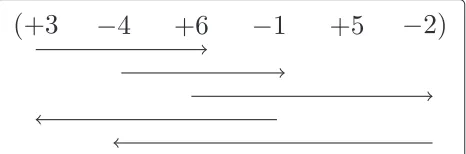
For each elementπiof a signed permutationπ, we define avectorv(πi)whose length is given by|v(πi)| = ||πi|−i|. If |v(πi)|>0, the vectorv(πi)has a direction indicated by the sign of|πi|−i. The vectorv(πi)is aright vectorif|πi|−i> 0 while it is aleft vector if|πi| −i < 0. If the length of v(πi)is zero, thenv(πi)is said to be apositive zero vector ifπi = iand anegative zero vectorifπi = −i. A vector diagramVπofπis the set of vectors of the elements ofπ. The sum of the lengths of all the vectors inVπ is denoted by Vec(π). See Figure 1 for an example.
Two elementsπiandπj,i < j, of a signed permutation π are said to bevector-oppositeif the vectors v(πi) and v(πj)differ in direction,|v(πi)| ≥j−i, and|v(πj)| ≥j−i. Besides, they are said to bem-vector-oppositeif j−i = m. Note that m specifies the distance between vector-opposite elements. For instance, in Figure 1 the elements π2= −4 andπ4= −1 are 2-vector-opposite elements.
Lemma 3.Letπbe a signed permutation. If Inv(π) >0, thenπcontains at least a pair of vector-opposite elements.
Proof. We say that an elementπeinπ is out-of-place if |πe| =e. Note that there must exist out-of-place elements inπ if Inv(π) > 0. Among all out-of-place elements in π, letπi be the one with the greatest absolute value. We first show by contradiction thatv(πi)is a right vector. Sup-posev(πi)is a left vector, that is,|πi| −i < 0. Then the
Figure 1Vector diagram.Vector diagram of the signed permutation π=(+3−4+6−1+5−2). Note that Vec(π)=14.
elementπk such that|πk| =iis an out-of-place element with absolute value greater than|πi|, a contradiction.
Now since there is at least one right vector inVπ, there exists a rightmost right vector inVπ, that is, a right vec-torv(πi)such that i is as large as possible. The elementπk such thatk= |πi|is out-of-place since|πk| =k. The vec-torv(πk)is therefore a left vector as it occurs to the right ofv(πi), the rightmost right vector. Consider the elements πi+1,πi+2,. . .,πk. At least one of these elements corre-sponds to a left vector. Select the leftmost left vector from these elements, that is, select the vector v(πj) such that i+1≤j≤kandjis as small as possible.
We claim thatπi andπj are vector-opposite elements. Since |v(πi)| = k ≥ j, all that remains to be shown is that |v(πj)| ≤ i. In other words, we need to show that the correct position of elementπjdoes not occur to the right of position i. For a contradiction, suppose this is the case. Then the element πt such thatt = |πj| is out-of-place and thereforev(πt)is either a right or left vector. It is not a right vector since it occurs on the right ofv(πi), the rightmost right vector. It is not a left vector since it occurs on the left ofv(πj), the leftmost left vector from a set that includesv(πt). Then we have a contradiction since we have found an out-of-place element that corresponds to a zero vector. The lemma follows.
Lemma 4. Letπ ∈ S±n be a signed permutation such that Inv(π) > 0 and letπi andπj be m-vector-opposite elements. Moreover, letπ ∈ Sn±be a signed permutation such that|πi| = |πj|,|πj| = |πi|, and|πk| = |πk|for all k∈ {/ i,j}. Then Vec(π)−Vec(π)=2m.
Proof. We have that
Vec(π)−Vecπ = kn=1|v(πk)| −v
π
k = |v(πi)| −v
π
i+v
πj −vπj
= m+m
= 2m,
and therefore the lemma follows.
Let Vec(π,ρ) denote the change in the sum of the lengths of all the vectors inVπdue to the application of a signed reversalρ, that is,Vec(π,ρ)=Vec(π)−Vec(π· ρ). The following lemma provides bounds on the value of Vec(π,ρ)considering thatρis a signed short reversal.
Lemma 5.Letπbe a signed permutation. Then, we have that
i) Vec(π,ρ)=0ifρis a signed 1-reversal,
Proof.Suppose first thatρis a signed 1-reversalρ(i,i). In this case,ρdoes not affect the length of the vectorv(πi), thereforeVec(π,ρ)=0.
Now, suppose thatρ is a signed 2-reversalρ(i,i+ 1). If the elements πi and πi+1 are 1-vector-opposite, then Vec(π,ρ) = 2. On the other hand, if v(πi) is a zero or a left vector and v(πi+1) is a zero or a right vector, thenVec(π,ρ) = −2. Note thatVec(π,ρ)cannot be greater than 2 and cannot be less than -2 becauseρ(i,i+1) can increase or decrease the length ofv(πi)andv(πi+1)by just one unit.
Finally, suppose that ρ is a signed 3-reversal ρ(i,i+ 2). Note thatρ does not affect the length of the vector v(πi+1). Now, if the elements πi andπi+2 are 2-vector-opposite, thenVec(π,ρ)=4. On the other hand, ifv(πi) is a zero or a left vector andv(πi+2)is a zero or a right vector, thenVec(π,ρ)= −4. Note thatVec(π,ρ) can-not be greater than 4 and cancan-not be less than−4 because ρ(i,i+2)can increase or decrease the length ofv(πi)and v(πi+2)by just two units.
Sorting by signed super short reversals
From the proof of Lemma 2, we have that a signed 1-reversal does not change the number of inversions in a signed permutation and a signed 2-reversal can elimi-nate at most one inversion. This means that, for sorting a signed permutationπ, we have to apply Inv(π)signed 2-reversals plus a given number of signed 1-reversals in order to flip the signs of the remaining negative elements. The question is: how many signed 1-reversals do we have to apply?
Intuitively, if an elementπiis in t distinct pairs of inver-sions in a signed permutation π, then its sign will be flipped t times, one time per signed 2-reversal applied. Therefore, if πi is negative and t is even, then πi will remain negative after we apply the t signed 2-reversals. The same is true whenπiis positive and t is odd. We can make use of the vector diagram in order to capture this intuition formally.
Let Vπeven− be a subset of Vπ such that Vπeven− = {v(πi) : πi < 0 and |v(πi)|is even} and let Vodd
+
π be a subset of Vπ such that Vπodd+ = {v(πi) : πi > 0 and |v(πi)| is odd}. The elements of a signed permuta-tionπ whose vectors belong to either Vπeven− or Vπodd+ are precisely the elements which will be negative after we apply the Inv(π)signed 2-reversals (Lemma 6). Using this fact, we can obtain an exact formula for the signed super short reversal distance of a signed permutationπ (Theorem 1).
Lemma 6.Letπ be a signed permutation and letπ = π ·ρ(i,i+1). Then, we have that|Vπeven −| + |Vπodd +| = |Vπeven−| + |Vπodd+|.
Proof.The signed 2-reversalρ(i,i+1)changes the signs of πi and πi+1 along with the parities of |v(πi)| and |v(πi+1)|. For this reason, ifπi(orπi+1)belongs to either Vπeven− or Vπodd+, then πi+1 = −πi (or πi = −πi+1) belongs to eitherVπeven − orVodd
+
π . On the other hand, if
πi(orπi+1)does not belong to neitherVeven
−
π norVπodd+, thenπi+1 = −πi (orπi = −πi+1) does not belong to eitherVπeven −orVodd
+
π . Therefore the lemma follows.
Lemma 7.Letπbe a signed permutation. Then, we have that dsssr(π)≤Inv(π)+ |Veven
−
π | + |Vπodd+|.
Proof.It suffices to prove that it is always possible to apply signed super short reversals onπ=ιnin such a way that the resulting permutationπsatisfies
Inv(π) + |Vπeven −| + |Vπodd +| ≤Inv(π)+ |Vπeven−|
+ |Vπodd+| −1. (1)
If Inv(π) = 0, then|v(πi)|= 0 for everyπi ofπ. This means that|Vπodd+| =0, and therefore we can sortπwith |Vπeven−|signed 1-reversals and (1) holds.
If Inv(π) > 0, then there exists a signed 2-reversal ρ(i,i+ 1) that removes an inversion in π (Lemma 1). So, apply such signed 2-reversal onπ and letπ denote the resulting permutation. We have that Inv(π) = Inv(π)−1. Moreover, we have that |Vπeven −|+|Vπodd +|= |Veven−
π |+|Vπodd+| (Lemma 6). Summing both equalities we obtain (1), therefore the lemma follows.
Lemma 8.Letπbe a signed permutation. Then, we have that dsssr(π)≥Inv(π)+ |Vπeven−|+|Vπodd+|.
Proof.It suffices to prove that if we apply an arbi-trary signed super short reversal onπ, then the resulting permutationπsatisfies
Inv(π) + |Vπeven −| + |Vodd +
π | ≥Inv(π)+ |Veven −
π |
+ |Vπodd+| −1. (2)
Suppose first that we apply a signed 1-reversalρ(i,i)on π and letπdenote the resulting permutation. We have that Inv(π) = Inv(π). Moreover, since the sign ofπi is flipped without changing the parity of|v(πi)|, we have that |Vπeven −|+|Vπodd +| ≥ |Vπeven−| + |Vπodd+| −1. Summing the
previous equality with this inequality we obtain (2). Now, suppose that we apply a signed 2-reversalρ(i,i+1) onπand letπdenote the resulting permutation. We have that |Vπeven −|+|Vodd
+
π |= |Veven −
Theorem 1.Letπ be a signed permutation. Then, we have that dsssr(π)=Inv(π)+ |Veven
−
π |+|Vπodd+|.
Proof. Immediate from Lemmas 7 and 8.
From the proof of Lemma 7, we can derive the follow-ing optimal algorithm for sortfollow-ing a signed permutation by signed super short reversals. First, perform signed 2-reversals on the inversions until the permutation has no inversions. Then, perform signed 1-reversals on the negative elements until the permutation has no nega-tive elements. Since a signed permutation π ∈ S±n can have at most n2inversions and at most n negative ele-ments, we have that this algorithm runs in O(n2) time. We remark that the value of dsssr(π) can be computed inO(nlogn)time because computing|Vπeven−|+|Vπodd+| takesO(n)time and computing Inv(π)takesO(nlogn) time [29].
Sorting by signed short reversals
A trivial algorithm for the problem of sorting by signed short reversals is the optimal algorithm for the problem of sorting by signed super short reversals. From the lower bound of Lemma 9, it follows that this trivial algorithm is a 6-approximation algorithm. Moreover, we have that this approximation bound is tight. For instance, we need 6 signed super short reversals for sorting the signed permu-tation(−3−2−1), but one signed 3-reversal is sufficient for sorting it.
Lemma 9.Letπbe a signed permutation. Then, we have that dssr(π)≥ Inv(π)+|V
−
π|+|Vπ+|
6 .
Proof. It suffices to prove that if we apply an arbitrary signed short reversal onπ, then the resulting permutation πsatisfies
Inv(π) + |Vπeven −| + |Vodd +
π | ≥Inv(π)+ |Veven −
π |
+ |Vπodd+| −6. (3)
From the proof of Lemma 8, we have that (3) holds when we apply a signed super short reversal on π. So, suppose that we apply the signed 3-reversal ρ(i,i+ 2) on π and let π denote the resulting permutation. We have that Inv(π) ≥ Inv(π)−3. Moreover, we have that |Vπeven −|+|Vπodd +| ≥ |Vπeven−|+|Vπodd+|−3. Summing both
inequalities we obtain (3), and the lemma follows.
LetVπoddbe a subset ofVπ such thatVπodd = {v(πi) : |v(πi)| is odd} and let Vπ0− be a subset of Vπ such that Vπ0− = {v(πi) : v(πi) is a negative zero vector}. By using these two subsets ofVπ, we can obtain better bounds on the signed short reversal distance of a signed permutation
π (Lemmas 11 and 12). These bounds lead to a 5-approximation for the problem of sorting by signed short reversals (Theorem 2). We note that the upper bound given in Lemma 11 relies on the fact that it is always pos-sible to switch the positions of a pair ofm-vector-opposite elements (without affecting the elements between them) applyingmsigned short reversals (Lemma 10).
Lemma 10.Let π ∈ S±n be a signed permutation such that Inv(π) > 0 and letπi andπj be m-vector-opposite elements. It is possible to transformπ intoπ ∈ S±n such that|πi| = |πj|,|πj| = |πi, and|πk| = |πk|for all k∈ {/ i,j} applying d signed short reversals, where
d=
m−1 if m is even,
m if m is odd.
Proof. We have two cases to consider:
a) mis even. In this case, we can transformπinto a signed permutationπ∈S±n such that|πi| = |πj|, |π
j| = |πi|,πj−1= −πj−1, andπk =πkfor all k∈ {/ i,j−1,j}applying the sequence of signed short reversalsρ(i,i+2),ρ(i+2,i+4),. . .,ρ(j−4,j− 2)),ρ(j−2,j)),ρ(j−4,j−2),. . .,ρ(i,i+2). Therefore, to transformπintoπ, we can apply m-1 signed 3-reversals.
b) m is odd. In this case, we can transformπinto a signed permutationπ∈S±n such that|πi| = |πj|, |π
j| = |πi|, andπk =πkfor allk∈ {/ i,j}applying the
sequence of signed short reversalsρ(i,i+2), ρ(i+2,i+4),. . .,ρ(j−3,j−1),ρ(j−1,j),ρ(j−3, j−1),. . .,ρ(i,i+2). Therefore, to transformπinto
π, we can apply m-1 signed 3-reversals and one
signed 2-reversal, totalizing m signed short reversals.
Since in both cases we can transformπintoπapplying 2m2 −1, the lemma follows.
Lemma 11.Let π be a signed permutation. Then, we have that dssr(π)≤Vec(π)+ |Vπodd| + |Vπ0−|.
Proof. It suffices to prove that it is always possible to apply a sequence oft>0 signed short reversals onπ=ιn in such a way that the resulting permutationπsatisfies
Vec(π) + |Vπodd | + |V0 −
π | ≤Vec(π)+ |Vπodd|
+ |Vπ0−| −t. (4)
If Vec(π) = 0, then|v(πi)| = 0 for everyπiinπ. This means that |Vπodd| = 0. Therefore we can sort π with |Vπ0−|signed 1-reversals and (4) holds.
apply the d signed reversals described in Lemma 10 on π and letπ denote the resulting permutation. We will show that the application of this sequence of signed short reversals results in an average decrease in
(π,π)=Vec(π)+|Vodd
π |+|Vπ0−|−
Vec(π)+|Vπodd |+|V0 − π| =2m+
|Vodd
π |−|Vπodd | +
|V0−
π |−|V0 − π |
of at least 1 unit per signed short reversal. In other words, we need to show that(πd,π) ≥1.
In order the evaluate the value of(π,π), we divide our analysis in two cases:
a) mis even. In this case, we have that the parities of the lengths of the vectors do not change, therefore |Vodd
π | − |Vπodd | =0. In order to evaluate the value of |Vπ0−| − |Vπ0− |, we further divide our analysis into three subcases:
i) |v(πi)|and|v(πj)|are even. In this subcase,
we have that the vectorsv(πi),v(πj−1), and v(πj)may become negative zero vectors,
therefore|Vπ0−| − |Vπ0−| ≥ −3. This means that(π,π)≥2m−3.
ii) |v(πi)|and|v(πj)|have distinct parities. In
this subcase, we have that the vectorv(πj−1)
and one of the vectorsv(πi)andv(πj)
(precisely the one whose length is even) may become negative zero vectors, therefore |Vπ0−| − |Vπ0− | ≥ −2. This means that
(π,π)≥2m−2.
iii) |v(πi)|and|v(πj)|are odd. In this subcase, we
have that none of the vectorsv(πi)andv(πj)
can become a negative zero vector, but the vectorv(πj−1)can. Therefore
|Vπ0−| − |Vπ0− | ≥ −1. This means that
(π,π)≥2m−1.
b) mis odd. In this case, we further divide our analysis into three subcases:
i) |v(πi)|and|v(πj)|are even. In this subcase,
we have that none of the vectorsv(πi)and v(πj)can become a negative zero vector,
therefore|V0−
π | − |Vπ0−| =0. Moreover, |v(πi)|and|v(πj)|become odd, therefore |Vπodd− |Vπodd | = −2. This means that
(π,π)=2m−2.
ii) |v(πi)|and|v(πj)|have distinct parities. In
this subcase, we have that the parities of the lengths of the vectorsv(πi)andv(πj)are
switched, therefore|Vπodd| − |Vπodd | =0. Moreover, one of the vectorsv(πi)andv(πj)
(precisely the one whose length is odd) may become a negative zero vector, therefore
|Vπ0−| − |Vπ0− | ≥ −1. This means that
(π,π)≥2m−1.
iii) |v(πi)|and|v(πj)|are odd. In this subcase, we
have that|v(πi)|and|v(πj)|become even,
therefore|Vπodd| − |Vπodd | =2. On the other hand, we have that the vectorsv(πi)andv(πj)
may become negative zero vectors, therefore |Vπ0−| − |Vπ0− | ≥ −2. This means that
(π,π)≥2m.
Note that the only subcase in which we have(πd,π) <1 is subcase (b.i), precisely whenm = 1. So, assume that we have no choice other than selecting a pair of 1-vector-opposite elementsπiandπjsuch that|v(πi)|and|v(πj)| are even. We will show that it is still possible to apply a sequence of signed short reversals onπin such a way that (4) holds.
Letv(πi) be the rightmost right vector ofπ, that is, i is the largest integer for whichv(πi)is a right vector. As shown in the proof of Lemma 3, there exists an element πj,j>i, such thatπiandπjform a pair of vector-opposite elements. Combining this fact with our initial assumption, we can conclude thatj=i+1.
Now, suppose that we apply the signed short reversal ρ(i,i+1) onπ and letπ denote the resulting permu-tation. From our previous case-by-case analysis, we have that(π,π) = 0. Moreover, we have thatv(πi+1)is the rightmost right vector ofπ. Therefore, there exists an ele-mentπk,k > i+1, such that πi+1andπk form a pair of m-vector-opposite elements, as shown in the proof of Lemma 3. This means that we can apply the d short signed reversals described in Lemma 10 onπ, obtaining permu-tation π. Given that|v(πi+1)| is odd, we can conclude from our previous case-by-case analysis that(π,π)≥ 2m−1 ifmis odd and(π,π) ≥2m−2 ifmis even. Hence, the average decrease in(π,π)is of at least2mm+−11 units per signed short reversal if m is odd and of at least
2m−2
m units per signed short reversal if m is even.
Note that 2mm+−11 < 1 whenm = 1, but in this case we show that the average decrease in(π,π)is of at least 1 unit per signed short reversal. We have two cases to consider:
1) |v(πk)|is odd. In this case, we have that
(π,π)≥2, therefore the average decrease in (π,π)is of at least 1 unit per signed short reversal. 2) |v(πk)|is even. We show that this case cannot
happen. For the sake of contradiction, assume that |v(πk)|is even. Then, we have that|v(πk)| ≥2. Besides, sincem=1, we have thatk=i+2. These two facts imply thatπiandπi+2are
Since it always possible to apply a sequence oftsigned short reversals on π in such a way that the resulting permutationπsatisfies (4), the lemma follows.
Lemma 12.Let π be a signed permutation. Then, we
have that dssr(π)≥ Vec(π)+|V
odd
π |+|Vπ0−|
5 .
Proof. It suffices to prove that if we apply an arbitrary signed short reversal onπ, then the resulting permutation πsatisfies
Vec(π) + Vπodd +Vπ0− ≥Vec(π)+Vπodd
+ Vπ0−−5. (5)
Suppose first that we apply a signed 1-reversalρ(i,i)on π and let π denote the resulting permutation. We have that Vec(π) = Vec(π)and|Vπodd | = |Vπodd|. Moreover, since the sign ofπiis flipped without changing the parity of|v(πi)|, we have that|V0
−
π | ≥ |Vπ0−| −1 ≥ |Vπ0−| −5.
Summing the previous equalities with this inequality we obtain (5).
Suppose now that we apply a signed 2-reversalρ(i,i+1) on π and let π denote the resulting permutation. We have that Vec(π)≥ Vec(π)−2. Moreover, we have that |Vπodd | ≥ |Vπodd| −2 and|V0
−
π | ≥ |Vπ0−| −2, but since Vodd
π ∩Vπ0− = ∅, we conclude that |Vπodd | + |V0 −
π | ≥ |Vπodd| + |Vπ0−| −2 ≥ |Vπodd| + |Vπ0−| −3. Summing the previous inequalities we obtain (5).
Finally, suppose that we apply a signed 3-reversalρ(i,i+ 2)onπand letπdenote the resulting permutation. We have that the parities of the lengths of the vectors do not change and hence |Vπodd | = |Vπodd|. Moreover, we have that Vec(π) ≥ Vec(π)−4 and |Vπ0−| ≥ |Vπ0−| −3. It
should be noted, however, that ifv(πi)(orv(πi+2)) belongs toV0−
π , then Vec(π)≥Vec(π)−2 because the length of
v(πi)(orv(πi+2))increases by 2 units. On the other hand, if neitherv(πi)norv(πi+2)belongs toV0
−
π , then|Vπ0− | ≥ |Vπ0−| −1. Therefore Vec(π)+ |Vπ0− | ≥Vec(π)+ |V0
−
π | − 5. Summing the previous equality with this inequality we obtain (5) and the lemma follows.
Theorem 2.The problem of sorting by short signed reversals is 5-approximable.
Proof. Immediate from Lemmas 11 and 12.
Heath and Vergara [18] have described an algorithm for finding vector-opposite elements which runs in lin-ear time onn, the size of the input permutation. Basically, what their algorithm does is to find vector-opposite ele-ments πi and πj such that v(πi) is the rightmost right vector ofπ. Algorithm 1 is an adaptation of that algorithm. The difference between the two algorithms is that, given a
signed permutationπ =ιn, Algorithm 1 guarantees that, if it returns a pair (πi,πi+1), thenπi andπi+2are not 2-vector-opposite. Note that Algorithm 1 also runs in linear time onn.
Algorithm 1: Returns a pair of vector-opposite elements
Data: A permutationπ ∈Sn±.
Result: A pair of vector-opposite elements.
1 i←n
2 while|πi| ≤ido
3 i←i−1
4 end while
5 j←i+1
6 while|πj| =jdo
7 j←j+1
8 end while
9 ifj<nandj−i=1then
10 if|πi+2|<i+2and|v(πi)| ≥2and |v(πi+2)| ≥2then
11 j←i+2
12 end if
13 end if
14 return(πi,πj)
Algorithm 2 sorts a signed permutation in two steps. While the signed permutation has vector-opposite ele-ments, the algorithm finds a pair of them using Algorithm 1 and then switches their positions applying the signed short reversals described in Lemma 10. When the signed permutation has no vector-opposite elements, the algorithm applies signed 1-reversals until the signed permutation has no negative elements.
Algorithm 2: Algorithm for sorting by signed short reversals
Data: A permutationπ ∈Sn±.
Result: Number of signed short reversals applied for sortingπ.
1 d←0
2 whileVec(π) >0do
3 Letπiandπjbem-vector opposite elements returned by Algorithm 1
4 Apply signed short reversals onπsuch as described in Lemma 10
5 d←d+2m2 −1
6 end while
It follows from Theorem 2 that Algorithm 2 is a 5-approximation algorithm for the problem of sorting by short signed reversals. Regarding its time complexity, it suffices to compute the total cost of calls to lines 3, 4, and 7. The total cost of calls in line 3 equals the total cost for all calls to Algorithm 1. Although it runs inO(n)time and there areO(n2)vector-opposite elements in a signed per-mutation, we can provide the Algorithm 1 with enough information so that the costs of calls to this algorithm can be significantly reduced. Note that Algorithm 1 performs two scans in the signed permutation, one for each vector of the vector-opposite elements returned. By observing that a rightmost right vector remains a rightmost vector until it becomes a zero vector, it need not be searched again if the vector has not been zeroed. Thus, the scan for the rightmost vector needs to be performed onlyO(n) times. In addition, the total cost of scans for the left vec-tor for the same right vecvec-tor is bounded by the length of the right vector, alsoO(n). The total cost for all calls to Algorithm 1 with this refinement is thusO(n2). Each call to line 4 takesO(m) time, wherem = j−i, and causes a strict decrease in Vec(π) of 2munits. Thus, the cost in this case is bounded by Vec(π)rather than the number of iterations performed in the while loop. As each vector has length at mostn, we have that Vec(π) ≤ n2, meaning a cost ofO(n2)time for the calls to line 4. Finally, we have that line 3 runs inO(n)time, therefore Algorithm 2 runs inO(n2)time.
We finish by noting that there exists a large class of signed permutations for which the approximation ratio of Algorithm 2 is much lower than its worst-case approxima-tion ratio (Lemma 13). Moreover, based on the fact that the expected value of Vec(π)of a random signed permu-tationπ ∈S±n is n23−1(Lemma 15), we can conclude that the expected approximation ratio of Algorithm 2 for sort-ing a random signed permutation is also lower than the worst-case approximation ratio (Theorem 3). Just to make things clear, we define a random signed permutation as a random ordering of the elements{1, 2,. . .,n}, with the added characteristic that the sign,+or−, of each element is also randomly chosen.
Lemma 13.Let A2(π) be the number of signed short reversals applied by Algorithm 2 for sorting a signed per-mutationπ∈S±n. We have thatdA2(π)
ssr(π) ≤3when Vec(π)=
0or Vec(π)≥4n.
Proof.We have two cases to consider:
a) Vec(π)=0. In this case, we have that Algorithm 2 sortsπwith|Vπ0−|signed 1-reversals. On the other
hand, we have thatdssr(π)≥ |V 0−
π |
3 because a signed
short reversal cannot affect more than 3 elements at once. Therefore A2(π)
dssr(π)≤3.
b) Vec(π)≥4n. In this case, we have seen that Algorithm 2 sortsπin two steps. First it applies signed 2-reversals and signed 3-reversals onπuntil Vec(π)=0and then it applies signed 1-reversals on
πuntilVπ0−=0. Note that, in the first step, each signed short reversal applied by Algorithm 2 results in an average decrease in Vec(π)of at least 2 units. Hence Algorithm 2 applies at most Vec(π)2 signed short reversals in the first step. Moreover,
Algorithm 2 applies at most n signed 1-reversals in the second step because|Vπ0−| ≤n. On the other hand, we have thatdssr(π)≥Vec(π)4 (Lemma 5). This
analysis lead us to conclude thatdA2(π) ssr(π)≤2+
4n
Vec(π).
Therefore dA2(π) ssr(π) ≤3.
SincedA2(π)
ssr(π)≤3 in both cases, the lemma follows.
In what follows, let Pr(|v(πi)| =j)denote the probabil-ity that|v(πi)|is equal tojandE(X)denote the expected value of a random variableX.
Lemma 14.Letπ ∈ S±n be a random signed permuta-tion. Then ni=1Pr(|v(πi)| = j) = 2(nn−j) for1 ≤ j ≤ n−1.
Proof.We have that|S±n| =n! 2nand for each 1≤k≤n, there are(n−1)! 2nsigned permutations for which|πi| = k. Then
Pr(|v(πi)|=j)=
⎧ ⎪ ⎪ ⎪ ⎨ ⎪ ⎪ ⎪ ⎩
1
n if j=0,
2
n if i+j≤n and i−j≥1,
1
n if i+j>n or i−j<1 but not both, 0 otherwise,
for 0≤j≤n−1. In order to evaluateni=1Pr(|v(πi)| =j) for a givenj, we consider two cases:
a) 1≤j< n2. In this case, we have that
Pr(|v(πi)| =j)= ⎧ ⎪ ⎨ ⎪ ⎩ 1
n if 1≤i≤j, 1
n if n −j+1≤i≤n, 2
n otherwise.
Therefore, we have thatni=1Pr(|v(πi)| =j)= nj+nj +2(n−2j)
n =
2(n−j)
n .
b) n2 ≤j≤n. In this case, we have that
Pr(|v(πi)| =j)= ⎧ ⎪ ⎨ ⎪ ⎩ 1
n if 1≤i≤n−j, 1
n if j+1≤i≤n, 0 otherwise.
Therefore, we have thatni=1Pr(|v(πi)| =j)= n−nj+ n−j
n = 2(n−j)
n .
Lemma 15. Letπ ∈ S±n be a random signed permuta-tion. ThenE(Vec(π))= n23−1.
Proof. Given thatE(|v(πi)|) = jn=−01jPr(|v(πi)| = j), we have that
E(Vec(π)) = Eni=1|v(πi)|
= n
i=1E(|v(πi)|)
= n
i=1 n−1
j=0 jPr(|v(πi)| =j) = n−1
j=1 j n
i=1Pr(|v(πi)| =j) = n−1
j=1 j 2(n−j)
n
= 2nj=−11j− 2nnj=−11j2 = 2n22−n − 2n(n−1)n6(2n−1) = n2−n−2n2−3n+1
3 = n2−1
3 , and the lemma follows.
Theorem 3.The expected approximation ratio of Algorithm 2 for sorting a random signed permutationπ ∈ S±n is no greater than 3 for n≥13.
Proof. According to Lemma 13, we have that the approx-imation ratio of Algorithm 2 for sorting a given signed permutationσ ∈Sn±is no greater than 3 when Vec(σ)≥ 4n. Since we know that the expected value of Vec(π)of a random signed permutationπ ∈S±n isn23−1(Lemma 15), we conclude that the expected approximation ratio of Algorithm 2 for sortingπis no greater than 3 ifn23−1≥4n. This inequality holds when n ≥ 13, and the theorem follows.
Sorting by bounded operations
In this section, we present a polynomial-time solution for the problem of sorting by super short operations and a 3-approximation algorithm for the problem of sorting by short operations. Before we present the main results, we first introduce a useful tool for tackling these problems, thepermutation graph. This tool was also used by Heath and Vergara [20] for dealing with the problem of sorting by short transpositions.
The permutation graph
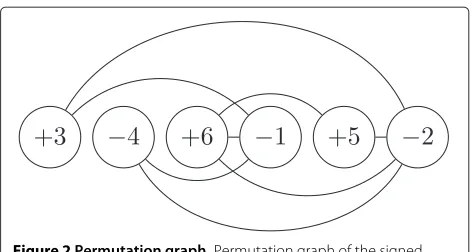
The permutation graph of a permutation π ∈ Sn± is the undirected graph Gπ = (V,E), where V = {π1,π2,. . .,πn}andE = {(πi,πj) : i< jand|πi| >|πj|}. In other words, Gπ is an undirected graph whose ver-tex set is formed by the elements of π and edge set is formed by the inversions inπ. Figure 2 illustratesGπfor π =(+3−4+6−1+5−2).
Given a signed permutationπ, we denote the number of connected components (or simply components) ofGπ by c(π). Moreover, we say that a component ofGπ isoddif
Figure 2Permutation graph.Permutation graph of the signed permutation(+3−4+6−1+5−2).
it contains an odd number of negative elements (vertices) and we say it isevenotherwise. The number of odd com-ponents ofGπ is denoted bycodd(π). Lastly, we say that an edge of Gπ is acut-edge if its deletion increases the number of components ofGπ.
Sorting by signed super short operations
From the proof of Lemma 2, we have that a super short operation can eliminate at most one inversion of a signed permutation. This means that, for sorting a signed permu-tationπ, we have to apply Inv(π) super short operations (i.e. 2-reversals and (1, 1)-transpositions) plus a given number of signed 1-reversals in order to flip the signs of the remaining negative elements. As before, the question is: how many signed 1-reversals do we have to apply? As Lemmas 16 and 17 show, the answer iscodd(π).
Lemma 16.Letπ ∈S±n be a signed permutation. Then, we have that dssso(π)≤Inv(π)+codd(π).
Proof. It suffices to prove that it is always possible to apply a signed super short operation onπ =ιnin such a way that the resulting permutationπsatisfies
Inv(π)+codd(π)≤Inv(π)+codd(π)−1. (6)
If Inv(π) = 0, then each component ofGπ is a single vertex. Therefore, we can sort π withcodd(π)signed 1-reversals and (6) holds.
If Inv(π) >0, then there exists an edgee=(πi,πi+1)in Gπ (Lemma 1). Suppose first that e is not a cut-edge and that we apply the (1, 1)-transpositionρ(i,i+1,i+2)on π, obtaining the permutationπ. We have that Inv(π) = Inv(π)−1. Moreover, since e is not a cut-edge, we have that the vertex sets of the components ofGπare the same as of the components ofGπ. This means thatcodd(π) = codd(π). Summing both equalities we obtain (6).
a) C1andC2are both even. Note thatCis even. Apply
the (1, 1)-transpositionρ(i,i+1,i+2)onπand letπ denote the resulting permutation. Then, we have that Inv(π)=Inv(π)−1and thatcodd(π)=codd(π). Summing both equalities we obtain (6).
b) C1andC2have distinct parities. Note thatCis odd.
Apply the (1, 1)-transpositionρ(i,i+1,i+2)onπ and letπdenote the resulting permutation. Then, we have that Inv(π)=Inv(π)−1and that
codd(π)=codd(π). Summing both equalities we
obtain (6).
c) C1andC2are both odd. Note thatCis even. Apply
the signed 2-reversalρ(i,i+1)onπand letπ denote the resulting permutation. Then, we have that Inv(π)=Inv(π)−1. Moreover, we have that
codd(π)=codd(π)becauseC1andC2become even
after the signed reversal is applied onπ. Summing both equalities we obtain (6).
Since it is always possible to apply a signed super short operation onπin such a way that the resulting permuta-tionπsatisfies (6), the lemma follows.
Lemma 17.Letπ ∈S±n be a signed permutation. Then dssso(π)≥Inv(π)+codd(π).
Proof.It suffices to prove that if we apply an arbitrary super short operation onπ, then the resulting permuta-tionπsatisfies
Inv(π)+codd(π)≥Inv(π)+codd(π)−1. (7)
Suppose first that we apply a signed 1-reversalρ(i,i) and let π denote the resulting permutation. Then, we have that Inv(π) = Inv(π). Moreover, since the com-ponent containing πi may become even, we have that codd(π) ≥ codd(π)−1. Summing the previous equality with this inequality we obtain (7).
Now, suppose that we apply the (1, 1)-transposition ρ(i,i + 1,i + 2) on π and let π denote the resulting permutation. We have two cases to consider:
a) (πi,πi+1)is not an inversion. In this case, we have
that Inv(π)=Inv(π)+1. On the other hand, by adding a new edge, we may eliminate two odd components, thereforecodd(π)≥codd(π)−2.
Summing the previous equality with this inequality we obtain (7).
b) (πi,πi+1)is an inversion. In this case, we have that
Inv(π)=Inv(π)−1. Moreover, lete=(πi,πi+1)be
an edge ofGπand letCbe the component ofGπ
containingeand. We further divide our analysis into two subcases:
i) eis not a cut-edge. In this case, we have that
codd(π)=codd(π)because the parity of the
componentC−eis the same as ofC, therefore (7) holds.
ii) eis a cut-edge. In this case, letC1andC2
denote the components ofC−e. IfCis odd, then eitherC1orC2is odd. IfCis even, then
eitherC1andC2are both odd orC1andC2
are both even. In any case, we have that
codd(π)≥codd(π), therefore (7) holds.
Finally, suppose that we apply the signed 2-reversal ρ(i,i+1)onπand letπdenote the resulting permuta-tion. By making use of an argument analogous to the one in the previous paragraph, we conclude thatπsatisfies (7) and the lemma follows.
Theorem 4.Letπ ∈Sn±be a signed permutation. Then, dssso(π)=Inv(π)+codd(π).
Proof.Immediate from Lemmas 16 and 17.
Let π be a signed permutation. From the proof of Lemma 17, we can conclude that a super short operation cannot decrease the value ofcodd(π)if it is applied on an inversion inπ. Moreover, from the proof of Lemma 16, we can conclude that if a (1, 1)-transposition increases the value of codd(π) when applied on an inversion in π, then it is possible to apply a signed 2-reversal on this inversion in such a way thatcodd(π)remains unal-tered. These observations lead us to the following optimal algorithm for sorting by signed super short operations (Algorithm 3).
Algorithm 3: Optimal algorithm for sorting by super short operations
Data: A permutationπ∈S±n.
Result: Number of super short operations applied for sortingπ.
1 d←0
2 codd←codd(π)
3 whileInv(π) >0do
4 Let (πi,πi+1) be an inversion inπ 5 π←π·ρ(i,i+1,i+2)
6 ifcodd(π) >coddthen
7 π ←π·ρ(i,i+1,i+2) undo the previous (1, 1)-transposition 8 π ←π·ρ(i,i+1)
9 end if
10 d←d+1
11 end while
The time complexity of Algorithm 3 depends on the time complexity of the algorithm used to compute the value of codd(π). A straightforward algorithm is to tra-verseGπ with a depth-first search and count the number of odd components. Such an algorithm runs in O(n2) time. It is possible, however, to count the number of odd components inGπinO(n)time.
Koh and Ree [30] have studied the permutation graph of unsigned permutations and have demonstrated some useful properties about them. Since the permutation graph of the signed permutation π ∈ S±n is isomorphic to the permutation graph of the unsigned permutation (|π1||π2|. . .|πn|), we are able to translate those proper-ties to the permutation graph of signed permutations. In particular, Lemma 18 represents the translation of one of those properties.
Lemma 18.Let π ∈ S±n be a signed permu-tation. The vertex sets of the components of Gπ are of the form C1 = {π1,π2,. . .,πk},C2 = {πk+1,πk+2,. . .,πl},. . .,Ct = {πm+1,πm+2,. . .,πn}. Moreover, we have that {|π1|,|π2|,. . .,|πk|} = {1, 2,. . .,k},{|πk+1|,|πk+2|,. . .,|πl|} = {k + 1,k + 2,. . .,l},. . .,{|πm+1|,|πm+2|,. . .,|πn|} = {m + 1,m + 2,. . .,n}.
We say that a contiguous sequence of elements πiπi+1. . . πj,i ≤ j, of a signed permutation π is a com-plete substring if{|πi|,|πi+1|,. . .,|πj|} = {i,i+1,. . .,j}. From Lemma 18, we have that the vertex set of a com-ponent ofGπ forms a complete substring. Furthermore, assume that{πi,πi+1,. . .,πj}is the vertex set of a compo-nent ofGπ. We claim that πiπi+1. . . πj is the minimum complete substring that starts with πi. For the sake of contradiction, suppose that there exists a complete sub-string πiπi+1. . . πk such thatk < j. We have thatπl > πm for every i ≤ l ≤ k and k + 1 ≤ m ≤ j. Therefore there does not exist any edge in Gπ connect-ing the elements in {πi,πi+1,. . .,πk} with the elements in{πk+1,πk+2,. . .,πj}. But this contradicts our hypothe-sis that{πi,πi+1,. . .,πj}is the vertex set of a component ofGπ.
From the discussion of the last paragraph, we can design the following algorithm for finding the vertex sets of the components of the permutation graph of a signed per-mutationπ ∈Sn±. Find the minimum complete substring π1π2. . . πk starting withπ1and letC1 = {π1,π2,. . .,πk} be a component ofGπ. Ifk < n, then find the minimum complete substringπk+1πk+2. . . πlstarting withπk+1and let C2 = {πk+1,πk+2,. . .,πl} be another component of Gπ. Continue with this process until all elements have been assigned to a component. It remains to show how to find the minimum complete substringπiπi+1. . . πj start-ing withπi. Note that i is the least element and j is the
largest element of the setS= {|πi|,|πi+1|,. . .,|πj|}. Since all integers in the interval [i,j] are in S, we have that |S| = j−i+1. This fact give us the necessary and suf-ficient condition for knowing when we have found the last element of the minimum complete substring start-ing with πi. The complete algorithm is detailed below (Algorithm 4).
Algorithm 4:Find the vertex sets of the components of a permutation graph
Data: A permutationπ∈S±n.
Result: The vertex sets of the components ofGπ.
1 C← ∅
2 S← ∅
3 i←1
4 whilei≤ndo
5 C←C∪ {πi}
6 min←i
7 max← |πi|
8 while(max−min+1) >|C|do
9 i←i+1
10 C←C∪ {πi}
11 if|πi|>maxthen
12 max← |πi|
13 end if
14 end while
15 S←S∪C
16 C← ∅
17 i←i+1
18 end while
19 returnS
Algorithm 4 performs a linear scan on the positions of the permutationπ ∈S±n, and so it runs inO(n). With the vertex sets of the components ofGπ, it is easy to count the number of odd components inGπinO(n)time. Returning to Algorithm 3, we can see that lines 4-9 run inO(n)time. Since the while loop iterates a total ofO(n2)times and line 12 runs inO(n)time, we can conclude that Algorithm 3 runs inO(n3)time. We remark that the value ofdssso(π) can be computed in O(nlogn) time because comput-ingcodd(π)takesO(n)time and computing Inv(π)takes O(nlogn)time [29].
Sorting by signed short operations