Protected Replica Placement Scheme to Improve
Data Availability in Cloud Data Center
VS.Selva Siva Santhiya
PG Scholar
Department of Computer Science and Engineering National Engineering College
K.R. Nagar Kovilpatti, India
Mr. D. Vijayakumar
Assistant Professor (SG)
Department of Computer Science and Engineering National Engineering College
K.R. Nagar Kovilpatti, India
Abstract—Cloud computing is a computing which enabling
ubiquitous, convenient, on-demand access to a shared pool of configurable computing resources. Cloud computing is an internet based computing that provides shared pool of resources which may be accessed anyplace, anywhere and anytime everywhere the globe and offered on-demand to a user who doesn’t need to bother with implementation details or maintenance. It involves delivering hosted services over the internet. These services are mostly categorized into Infrastructure-as-a– Service, Platform-as-a-Service and Software-as-a-Service. Data management is the major issue in cloud computing. An efficient data management provides high data availability in cloud data centers. The proposed method includes Replica Manager that handles the entire system. In second part, replica selection process is done (selection of best replica). Third part includes the placing of replica into datacenters. The replica selection will be performed using Rule based Fuzzy based replica selection. The data availability can increase by this replication method.
Keywords— Data Center Configuration; replica selection replica placement, fuzzy logic.
I. INTRODUCTION
Cloud computing is an internet based computing that provides shared computer processing of resources which may be accessed anywhere and anytime all over the world and offered on-demand to a user. Cloud computing is a computing for enabling ubiquitous, convenient, on-demand access to a shared pool of configurable computing resources. Cloud computing and storage solutions maintain users and enterprises with various capabilities to store and process their data in third-party data centers. It relies on sharing of resources to bring about coherence and economies of scale, similar to a utility (like the electricity grid) over a network. At the foundation of cloud computing is the broader approach of converged infrastructure and shared services.
Cloud computing is a computing for enabling ubiquitous, convenient, on-demand access to a shared pool of configurable computing resources that can be rapidly procure and released with minimal management effort or service provider interaction.
The main ideas of cloud computing:
Shared Resources
Instance of Resources
Virtualization
II. RELATED WORK
Kaur et al, (2016) [8] proposed an approach for Dynamic Cost-Aware re-replication and Re-balancing Strategy (DCR2S) for heterogeneous cloud data centers was proposed. The system has designed with a heterogeneous cloud system to understand the relation between data availability, system availability and the cost of replication. This DCR2S algorithm has implemented as three phases and is suitable for replicating one or more data files. In the first phase, the popular data file is selected based on its access intensity and a decision is made regarding when to invoke the replication operation for it. In the second phase, the number of new replicas to be created for a selected data file is determined in order to meet the availability requirements. In the third phase, the placement decision is made in order to provide higher SBER, better response time and to keep the cost of replication within the budget. If the cost of the replication exceeds the user budget, then the replication knapsack algorithm is invoked to optimize the cost of Replication.
Bo Mao et al (2016) [2] proposed a hybrid redundant data distribution approach, called HyRD, by exploiting the workload characteristics and the diversity of cloud storage providers to improve the storage availability in Cloud-of-Clouds. In HyRD, large files are distributed in multiple cost-oriented cloud storage providers with the erasure-coded data redundancy while small files and file system metadata are replicated on multiple performance-oriented cloud storage providers.
Wenhao Li et al (2016) [11] proposed a cost-effective reliability management mechanism (PRCR) based on a generalized data reliability model. It applies an innovative proactive replica checking approach to ensure the data reliability while the data can be maintained with the minimum number of replicas (serving as a cost effectiveness benchmark
for evaluation), which is no more than two. Evaluation of PRCR has demonstrated that this mechanism is able to manage large amounts of data in the Cloud, significantly reduce the Cloud storage space consumption at a negligible overhead.
SonglingFu et al (2016) [10] proposed a Cloud-assisted data replication and storage service, called Cadros, for Decentralized Online Social Network (DOSN), aiming to improve the data availability of DOSN. This paper first conducts the quantitative analysis about the storage capacity as the result of combining the Cloud with DOSN. Further, this models and predicts the level of Data Availability (DA) that Cadros is able to achieve. In Cadros, the published data are partitioned in terms of the replication technique, which is either full replication or erasure coding. The optimal data partition is achieved in this paper in the sense that the overhead incurred by erasure coding is minimized under the condition of satisfying the desired level of DA. This paper also proposes the data placement strategies to realize the desired DA and improve the performance in terms of other metrics.
III. PROPOSED WORK
Data replication is the process of copying data from one location to another. Replication is used to hold same data in multiple storage devices to improve availability of data.
Due to frequent usage of resources or high load it increases the possibility of hardware failure. Hardware failure may happen due to natural disasters also. While in case of hardware failure, the system cannot access any of the resources from cloud repository. To decrease the rate of data corruption or data loss, we go for replication concept. In that, the replicated resources are copied in more than one Datacenters, which makes high data availability and low possibility of data loss. If replication copies increased, the power consumption and storage space also increased. The main aim of this project is to increase the data availability.
The main objective of this project is to increase data availability of the system by holding multiple copies of same data (replication) in different data centers. The replica selection and replica placement can achieve by fuzzy based replication algorithm. Also another thing will be focused on protecting the replicated data by using erasure coding techniques.
In the proposed model, the data availability is going to increase by, selecting suitable number of replicas and placed it in different Cloud data centers. Replica Manager has full control over Replica Management System. According to the demands of the user replica manager creates and manages the replica. When each time the data stores a new replica it sends a request to replica catalog, then the Replica Catalog manages the information. When a primary Datacenter crashed due to any reason, then user request redirected into next of offered zones. The replica placement algorithm considers number of replicas and number of data centers in the availability zone. And the replica selection and replica
placement will be decided based on the fuzzy based replica placement algorithm. By using erasure coding techniques the replicated data is protected.
IV. SYSTEM ARCHITECTURE
The proposed architecture is composed of five modules. The system architecture is as follows,
Fig. 1, Architectural diagram of proposed system The modules are:
1. Replica Manager (ReMa) 2. Replica Catalog(RCat)
3. Data Center Configuration (DCC) 4. Replica Selection (RSel)
5. Replica Placement (RPla)
Various modules and its methodologies are discussed below. A. Replica Manager
Replica manager handle entire operations of replication part which has,
1. Replica Catalog
2. Data Center Configuration 3. Replica selection
4. Replica placement.
Replica manager includes all the data regarding the replicas like location, size and the number of replicas. Replica manager redirects the user request to different available Datacenter / zone.
B. Replica Catalog
Each newly created file is registered in the replica catalog table. This catalog is also responsible for locating requested data and maintains the number of user bases,
datacenter, replicas in region, number of request at certain time period and availability. When each time, the site stores a new replica it send a file register request to replica catalog. C. Data Center Configuration
In data center configuration module, the essential details like data center id, File Name, File Type, File Size, File Location are designed by the cloud owner / authorized user. The file is uploaded and automatically the file details are approved it chooses the most appropriate location.
D. Replica Selection
Replica selection is based on the user demand. It is used to find the location of replication to create number of copies and select optimally. Selecting the reasonable number of replicas can improve the response time.
E. Replica Placement
In replica placement section, the newly created replicas are placed within the appropriate Datacenter. This will increases the data availability due to place the constant resource (replica of original resource) in more than one data center. When multiple locations are discovered it chooses the most appropriate node. Then the Erasure coding technique is a technique used to protect that placed replica in different location.
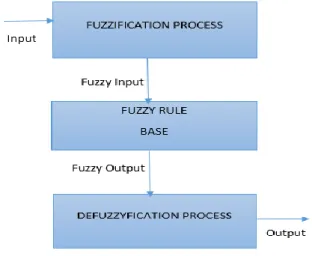
A rule based fuzzy inference system include if then rules. These if then rules are used to map the conditional statements that compose the complete knowledge base. If then rule consider the form „if x is A then y is B‟ and if the part of the rule „x is A‟ is called the antecedent the then part of the rule „y is B‟ is called the consequent.
Fig .2, Architecture of a Fuzzy Inference System
Every element in fuzzy system has a degree of membership, and that membership is represented by a value 0 and 1
Algorithm:
1. It defines the range of good, moderate and poor for cost, performance, availability via membership functions
2. Then it defines the range of good, moderate and weak for the Output via membership functions.
3. The rules are defined in the Fuzzy Inference Engine. 4. According to the rule there 3 criteria, each criteria
has three membership functions, and therefore there are a total of = 27 rules.
5. Now the following 27 rules are,
IF NoofAccess IS high AND Bandwidth IS high AND AccessLatency IS high AND LastAccessTime IS high THEN Replica Value is high
IF NoofAccess IS high AND Bandwidth IS low AND AccessLatency is low AND LastAccessTime IS high THEN Replica Value is high
IF NoofAccess IS high AND Bandwidth IS high AND AccessLatency IS high AND LastAccessTime is low THEN Replica Value is high
6. Similarly all other rules are defined by the condition. Each input variable is fuzzified and defined in FUZZIFY block. Each block it define one or more terms is composed by a name and a membership function.
Output variables are defuzzified to get a „real‟ output number, this is defined in DEFUZZIFY block.
Here „min‟ is used for „and‟ operation and „max‟ for „or‟ to fulfill DeMorgan‟s Law, „min‟ is used for activation method and „max‟ is used as accumulation method.
V. IMPLEMENTATION RESULTS
The replication strategy was implemented and deployed using java programming language. The proposed replication algorithm is using number of user request and number of data centers.
Fig. 3, Screen Shot for Data Center Configuration-Cloud Sim Tool Cloud Sim Tool Kit: CloudSim is a framework for modeling and simulation of cloud computing infrastructure and services. It is an Automation based on a Java command line tool using Netbeans 8.0 and Cloud Sim Tool Package 4.0 is used.
Fig. 4, Screen shot for main frame
Fig 4 shows the main frame which includes Replica Catalog. By clicking “Replica Catalog” button, it moves to configuration screen.
Fig. 5, Screen shot for Replicate
Fig 5 shows three modules like datacenter configuration, replica selection and replica placement. By clicking “data center configuration” button, it moves to configuration screen.
Fig .6, Screen shot for File Chooser
Fig 6 shows that the file is chosen by clicking the “Choose File” button. Then any type of file is selected and uploaded.
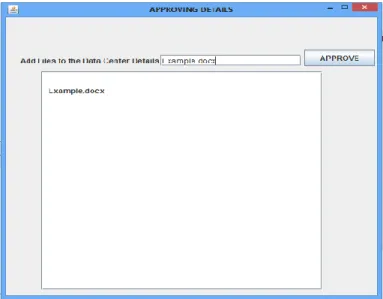
Fig .7, Screen Shot for Approving Details
Fig 7, shows that the file is uploaded and the selected file is entered in the Data Center Details then by clicking the “Approve” button, the file name, type, and size is automatically upgraded to the Data Center Configuration.
Fig. 8, Screen shot for Data Center Details Fig 8, shows that the file containing last modified date and time, network bandwidth is noted and then it gets inserted.
Fig. 9, Screen shot for Files in Primary Data Center
Fig 9, shows that the files present in the primary data center has been displayed. Then while clicking the ADD button the copies for the file is created.
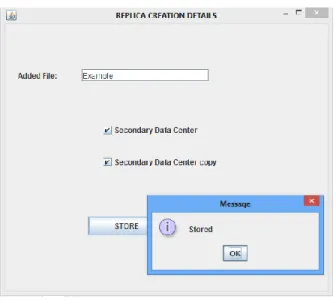
Fig .10, Screen Shot for Replica Creation Details
Fig 10, shows that the two other replica is created for a file, and gets stored in the Secondary Data Center, and Secondary Data Center Copy.
VI PERFORMANCE ANALYSIS
According to the Fuzzy Rule the Access Latency, Bandwidth, Last Access Time, No of Access, Replica Value, is generated and it produce the defuzzification Center of
Gravity value is obtained.
Fig .11, Screen Shot for Last Access Time
Fig 11, shows that the Last Access Time for the Criteria high, medium, low is measured. The values ranges from 0 to 9.
Fig .12, Screen Shot for Access Latency
Fig 12, shows that the Access Latency for the Criteria high, low is measured. The values ranges from 0 to 9.
Fig .13, Screen Shot for Bandwidth
Fig 13, shows that the Bandwidth for the Criteria high, medium, low is measured. The values ranges from 0 to 9.
Fig .14, Screen Shot for No of Access
Fig 14, shows that the No of Access for the Criteria high, medium, low is measured. The values ranges from 0 to 9.
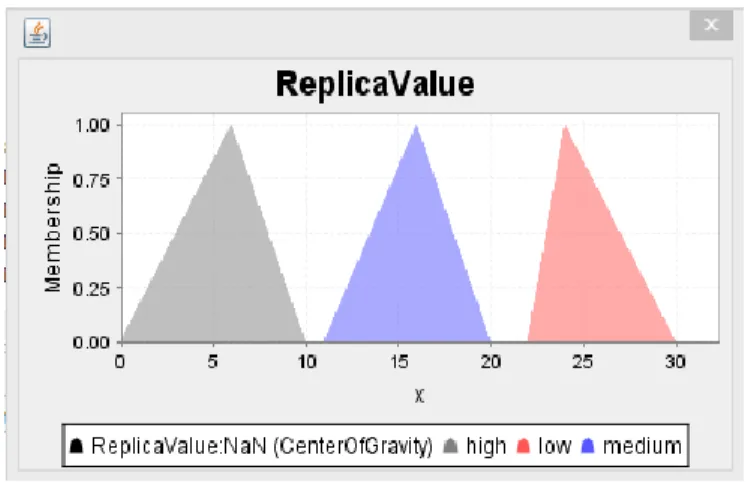
Fig .15, Screen Shot for Replica Value
Fig 15, shows that the Replica Value for the Criteria high, medium, low is measured. The values ranges from 0 to 30.
Fig .16, Screen Shot for Replica Value
Fig 16, shows that the Center of Gravity, is obtained for a Replica Value: 5.16. The value ranges from 0 to 30.
TABLE 1: CENTER OF GRAVITY CALCULATION-REPLICA VALUE
S.No Replica Value Center Of Gravity Difference
1 0 to 30 0.58 to 17.33 5.77
2 0 to 40 0.58 to 23.10 5.78
3 0 to 50 0.58 to 28.88 5.77
4 0 to 60 0.58 to 34.65 5.78
5 0 to 70 0.58 to 40.43 5.77
Table 1, shows the Replica Value ranges from 0 to 30, 0 to 40, 0 to 50, 0 to 60, and 0 to 70. Then the Center of Gravity is noted for each range and their value is obtained.
TABLE 2: BANDWIDTH CALCULATION
S.No Bandwidth Center Of Gravity
1 Below 6 0
2 Above 6 Remains Same
Table 2, shows if the Bandwidth range has Below 6 then the Center of Gravity obtained is 0. If it is Above 6 then the Center of Gravity Remains the Same
TABLE 3: LAST ACCESS TIME CALCULATION
S.No Last Access Time Center Of Gravity
1 Below 7 0
2 Above 7 Remains Same
Table 3, shows if the Last Access Time range has Below 7 then the Center of Gravity obtained is 0. If it is Above 7 then the Center of Gravity Remains the Same
VI. CONCLUSION
An efficient replica strategy was proposed to improve the data availability in cloud data centers. The licensed user or cloud service supplier configures the data center in order to supply appropriate environment to Client. The Replica Manager is created, which controls the whole information system. Each newly created file is registered in the replica catalog table. This catalog is also responsible for locating requested data and maintains the number of user bases, datacenter. By using Fuzzy Logic the fuzzification and defuzzification process is done.
VII. FUTURE WORK
By using the Erasure coding Techniques the data gets protected in the Cloud Data Center by using encoding and decoding process. Erasure coding Technique can save storage space.
REFERENCES
[1] BakhtaMeroufel, GhalemBelalem“Managing Data Replication and Placement Based on Availability” AASRI Procedia 5, pp.147 – 155,(2013)
[2] Bo Mao, Member, IEEE, Suzhen Wu, Member, IEEE, and Hong Jiang, Fellow, IEEE “Exploiting Workload Characteristics and ServiceDiversity to Improve the Availability of Cloud Storage Systems” IEEE Transactions on parallel and distributed systems, vol. 27, no. 7, july 2016
[3] Gang Chen, H.V. Jagadish, Dawei Jiang, David Maier, Beng Chin Ooi “Federation in Cloud Data Management: Challenges and Opportunities” IEEETransactions on knowledge and data engineering, vol. 26, no. 7,(2014.)
[4] Israel Casas , JavidTaheri , Rajiv Ranjan , Lizhe Wang, Albert Y. Zomaya “A balanced scheduler with data reuse and replication for scientific workflows in cloud computing systems” Future Generation Computer Systems 2015
[5] JunaidShuja, Kashif Bilal, Sajjad A. Madani, PavanBalaji, and Samee U. Khan “Survey of Techniques and Architectures for Designing Energy-Efficient Data Centers” IEEE Journal,(2015).
[6] Lingfangzeng, BharadwajVeeravalli, Albert Y.Zomaya “An integrated task computation and data management scheduling strategy for workflow applications in cloud environemt” Journal of Network and Computer Applications” December 2014
[7] Mr. Sanjay Bansal , Prof. Sanjeev Sharma and IshitaTrivedi “A Dynamic Replica Placement Algorithm to Enhance Multiple Failures Capability in Distributed System” International Journal of Distributed and Parallel Systems (IJDPS) Vol.2, No.6, November 2011. [8] NavneetKaur Gill and Sarbjeet Singh “ A dynamic, cost-aware
optimized data replication strategy for heterogeneous cloud data centers” Future Generation Computer Systems 10-32(2016)
[9] Rashedur M. Rahman, RedaAlhajj, Ken Barker "Replica selection strategies in data grid" J. Parallel Distrib. Comput. No.68, pp. 1561-1574,(2008).
[10] SonglingFu, LigangHe, XiangkeLiao, ChenlinHuang“Developing the Cloud-integrated data replication framework indecentralized online social networks” Journal of Computer and System Sciences 82 113– 129,(2016).
[11] Wenhao Li, Yun Yang, Senior Member, IEEE, and Dong Yuan, Member, IEEE “Ensuring Cloud Data Reliability with Minimum Replication by Proactive Replica Checking” IEEE Transactions on computers, vol. 65, no. 5, May 2016
[12] YoungJinChoi, SangHakLee, JinHwanKim, YongJuKim, HyeonGyuPak, GyuYoungMoond, JongHeiRa, Yong-GyuJung “The method to secure scalability and high density in cloud data -center” Information Systems48, pp.274– 278,(2015).