USING SOCIAL MEDIA
Beata Jungselius
Department of Applied Information Technology University of Gothenburg
ISBN: 978-91-7833-549-7 (pdf)
Doctoral Thesis in Applied Information Technology University of Gothenburg
URL: http://hdl.handle.net/2077/61756 Please cite as follows (APA):
Jungselius, B. (2019). Using social media.
Doctoral dissertation. Department of Applied IT. University of Gothenburg.
Cover illustration: Lovisa Sköld
Cover photo: Henrik Jansson/Expressen Print: BrandFactory AB, Kållered, 2019
Author: Beata Jungselius
Language: English with a Swedish summary ISBN: 978-91-7833-548-0 (print) ISBN: 978-91-7833-549-7 (pdf)
Keywords: social media, social photography, platforms, affordances, Instagram, likes, like
The rise of social media platforms has changed how people interact. Mobile technologies with built-in, high-quality cameras offer new possibilities for people to document and share their everyday activities. Many consider these interaction-mediating devices to be important tools for facilitating people’s social life through use of social media. The aim of this thesis is to describe what constitutes social media use in a world of smartphones with cameras, why and how social media use is meaningful as a category of activity, and to contribute with new insights on how social media skills and perceptions change as practices and platforms develop. Drawing upon data collected in 2012 and 2017, this thesis provides empirical findings from four papers. By returning to the same informants, conducting stimulated recall interviews five years apart, the data provides insights on how social media use has developed over time. In this thesis, social media use is understood as the social practices that people engage in when they plan, produce, post, and take part in social media activities. As levels of engagement in social media vary from active involvement, such as producing and interacting with content, to more passive ways of planning and monitoring social media, a revised conceptualization of
use of the social photo sharing application Instagram. When engaging in social photography activities, users rely upon modal, technical and social affordances and develop particular idioms of practices. Each social media platform engenders its own expressions and idioms, and its own platform vernacular, which users learn in order to interact on it fluently. Users develop new skills through social participation within their community of practice on one or more platforms. As they learn how to engage in social practices, developing skills for particular idioms of practice and platform vernaculars, they become competent members of these social media communities. Based on data collected five years apart, this thesis highlights that despite many relatively stable aspects to the ways that users approach social media, four prominent categories of factors have had an impact on changes to social media use over time: changes in life and time management, changes in technical capabilities, changes in privacy preferences, and changes in modes of engagement.
Författare: Beata Jungselius
Språk: Engelska med svensk sammanfattning ISBN: 978-91-7833-548-0 (print)
ISBN: 978-91-7833-549-7 (pdf)
Sökord: social media, social photography, platforms, affordances, Instagram, likes, like
Sociala medier har förändrat hur människor interagerar. Smarta mobiltelefoner med inbyggda högkvalitativa kameror har erbjudit nya möjligheter för människor att dokumentera och dela med sig av sina vardagliga aktiviteter. För många är dessa enheter viktiga verktyg vad gäller att ta del av nyheter, bli underhållna och själva underhålla sina sociala liv. Syftet med denna avhandling är att beskriva vad användning av sociala medier innefattar, varför det är meningsfullt att studera och att bidra med nya insikter om hur färdigheter och perceptioner utvecklats i takt med att sociala medieplattformar vuxit. Med utgångspunkt i data som samlats in 2012 och 2017 presenteras i denna avhandling empiriska resultat från fyra artiklar. Genom att återvända till samma informanter fem år efter första datainsamlingstillfället har data som bidrar till förståelse för hur användningen av sociala medier förändras över tid kunnat samlas in och analyseras. I den här avhandlingen beskrivs de sociala praktiker som människor engagerar sig i när de planerar, postar, producerar och interagerar med innehåll i sociala medier. Människors engagemang i sociala medier varierar. Användning av sociala medier kan innefatta ett aktivt engagemang, som att producera eller interagera med innehåll, såväl
för en reviderad konceptualisering av sociala medier-användningsbegreppet. Fokus i denna avhandling ligger på en specifik och central del av interaktionen i sociala medier: social fotografering, dvs. hur människor producerar, delar och interagerar kring bilder i sociala medier. När människor lär sig att interagera i sociala medier, utvecklar de olika färdigheter. När användare deltar i sociala fotograferingsaktiviteter förhåller de sig till, och använder sig av, olika modala, tekniska och sociala affordancer och utvecklar genom interaktion med varandra s.k. praktikidiom. På varje plattform utvecklas ett eget, särskilt plattformsspråk som användare lär sig att behärska. Trots att flera aspekter av användning av sociala medier varit stabila över tid, har andra förändrats. Baserat på analysen av den på djupintervjudata som samlats in med fem års mellanrum presenteras i den här avhandlingen de mest framträdande faktorerna som har haft inverkan på användningen av sociala medier över tid: livsstilsförändringar, teknologins förändring, förändrade integritetspreferenser och förändringar i engagemangsformer.
in museums, Hillman, T., Weilenmann, A. & Jungselius, B., (2012). Proceedings of The Transformative Museum, May 23-25, 2012, Roskilde University, Denmark.
Instagram at the Museum: Communicating the Museum Experience through Social Photo Sharing. Weilenmann, A., Hillman, T., & Jungselius, B. (2013). In Proceedings of the SIGCHI Conference on Human Factors in Computing Systems (CHI '13). ACM, New York, NY, USA, 1843-1852. DOI: https://doi.org/10.1145/2470654.2466243
“In Just Three Hours I Got Like 22 Likes on a Pancake Picture”: Dealing with Temporality in Social Media Use and Research. Hillman, T., Weilenmann, A. & Jungselius, B. (2013). Worskshop paper at the SIGCHI Conference on Human Factors in Computing Systems (CHI '13). ACM, New York, NY, USA.
Fishing for followers: Using hashtags as like bait in social media, Jungselius, B., Hillman, T. & Weilenmann, A. (2014). AoIR Selected Papers of Internet Research, IR ’15. Association of Internet Researchers.
Traces of engagement: Narrative-making practices with smartphones on a museum field trip. Hillman, T., Weilenmann, A., Jungselius, B & Leino Lindell, T. Learning, Media and Technology 41, 2: 351–370.
Workshop paper for the workshop “Mobile Wellbeing”.
“She liked the picture so I think she liked it: Unpacking the social practice of liking,
Jungselius, B. (2018). Proceedings of International Conference Social Networks, Digital Traces and Electronic Communication, Le Havre, France, 2018.
“Conceptualizing 'Use' in Social Media Studies”, Jungselius, B., Weilenmann, A. (2018). Proceedings of the 9th International Conference on Social Media and Society (SMSociety '18) Copenhagen, Denmark: ACM Press.
Same Same But Different. Changes in Social Media Practices Over Time. Jungselius, B., Weilenmann, A. (2019). Proceedings of 10th International Conference on Social Media and Society (SMSociety '18) Toronto, Canada: ACM Press.
“She liked the picture so I think she liked it”. Unpacking the social practice of liking,
Jungselius, B. (2019) Netcom [En ligne], 33-1/2 | 2019, mis en ligne le 09 septembre 2019, consulté le 09 septembre 2019. URL : http://journals.openedition.org/netcom/3849
List of included papers
Paper 1. Talking About Social Media UseJungselius, B., Weilenmann, A. Manuscript. Extended version of Jungselius, B. and Weilenmann, A. (2018) “Conceptualizing ‘Use’ in Social Media Studies”, In Proceedings of the 9th International Conference on Social Media and Society – SMSociety ’18. Copenhagen, Denmark. ACM Press.
Paper 2. Instagram at the museum: Communicating the Museum Experience through Social Photo Sharing
Weilenmann, A., Hillman, T., & Jungselius, B. (2013). In Proceedings of the SIGCHI Conference on Human Factors in Computing Systems (CHI '13). ACM, New York, NY, USA, 1843-1852.
Paper 3. “She liked the picture so I think she liked it”: Unpacking the social practice of liking
Jungselius, B. (2019) Netcom [En ligne], 33-1/2 | 2019, mis en ligne le 09 septembre 2019, consulté le 09 septembre 2019. URL : http://journals.openedition.org/netcom/3849
Paper 4. Same Same but Different: Changes in Social Media Practices Over Time
Jungselius, B. and Weilenmann, A. (2019). In Proceedings of the 10th International Conference on Social Media and Society – SMSociety ’19. Toronto, Canada. ACM Press.
Acknowledgements
Trying to resist the urge to change every a to @ and write acknowledgments in internet language because lame, I want to take this opportunity to express my gratitude to all the great people I have had the pleasure of meeting and working with during my PhD.
I would like to begin by expressing my greatest gratitude to my brilliant and patient supervisors. Thanks to Alexandra Weilenmann for being smart, funny and persistent. Thank you for everything. I would also like to thank my co-supervisors Thomas Hillman and Dick Stenmark for patience and encouragement. Thanks to all three of you for the many intellectually stimulating conversations and for helping me in putting this thesis together. I am forever grateful.
My research would not have been possible without financing from The Linnaeus Centre for Research on Learning, Interaction and Mediated Communication in Contemporary Society (LinCS). Thank you for giving me with this opportunity. Through the Department of Applied IT and the division of Learning, Communication and IT I have met a lot of interesting and nice people over the years. Thanks to Johan Lundin for being The Best Boss™ and for widening my perspectives on what a researcher could be. Thanks also to Jonas Landgren and Marie Eneman for always being supportive, approachable and friendly. Thanks to every great colleague at LKIT; Charlotte Arkenback-Sundström, Wolmet Barendregt, Fredrik Bergstrand, Leona Bunting, Lu Cao, Katerina Cerna, Karin Ekman, Elin Ericsson, Mattias von Feilitzen, Anita Grigic Magnusson, Ylva Hård af Segerstad, Tomas Lindroth, Berner Lindström,
in our PhD corner. Thanks to Pär Meiling for always cheering us PhD students on. Also, thanks to Peter Larsson for enthusiastically helping me communicate my work.
Thanks to everyone I have had the pleasure of meeting through LinCS and LETStudio; Åsa Mäkitalo, Mona Lundin, Annika Lantz-Andersson, Roger Säljö, Emma Edstrand, Elin Nordenström, Geraldine Fauville to mention a few. Thanks to my friends at JMG; to Ulrika Hedman for important and not so important DM conversations on Twitter; to Marie Grusell for a fun and out-of-my-comfort-zone collaboration; to Oscar Westlund for suggesting that should look into that position at Applied IT in 2011. Also, thanks to Ingela Wadbring for encouraging me in doing something different back in the days.
I would also like to say special thanks to Annika Lantz-Andersson, Tomas Lindroth and Mikael Wiberg for their valuable comments on my manuscripts at the planning, mid and final seminars. I must neither forget to express my gratitude to the informants who participated in my studies. Let’s talk in 2022 again, okay?
I have, as many PhD students before me, gotten by with a little help from my friends. I am incredibly grateful for your support throughout this looooong journey. Thanks for letting me go on and on about some paper I read and for allowing me to describe interesting methods over dinner. Thanks to Albert, Hugo, Adam and Felix. To Dad and Jeanette. Thanks
also to Eva and Tore Linder. Thanks to Trissgruppa. May we continue to strive in the running towards becoming millionaires. Thanks to Alf. Thanks to Paulina. Thanks to Lovisa Sköld for managing to translate my crappy vision of a thesis cover into something understandable and cool. You are a true artist. To Anna, for being the best friend a girl could have and for liking every selfie I have ever posted. And thanks to Viktor. For love, support and carbonara. Don´t tell anyone, but I like you the most. Beata Jungselius
Part 1 – Using social media
1.INTRODUCING SOCIAL MEDIA USE ... 25
2.RESEARCH QUESTIONS AND AIM ... 33
3. RELATED WORK ... 35
3.1 The messiness of bridging contexts ... 36
3.2 Social media interaction ... 38
3.3 Social media use and users ... 41
3.4 Social media practices ... 44
3.5 Social media skills ... 47
3.6 Social photography ... 51
3.6.1 Social photography in a museum setting ... 53
3.7 Summary of related work ... 55
4.THEORETICAL PERSPECTIVES ... 57
4.1 Affordances ... 58
4.2 Idioms of practices ... 62
4.3 Social media platform vernacular ... 64
4.4 Communities of practice ... 68
4.5 Affinity spaces ... 69
5.METHOD ... 73
5.1 Studying mobile phone use ... 76
5.4.2 Phase 2: Revisiting social media use ... 92
6.SUMMARY OF FINDINGS AND CONTRIBUTION OF THESIS ... 97
7.DISCUSSION ... 105
7.1 What social media use is ... 107
7.2 Social media skills ... 115
7.3 How social media practices develop and change ... 120
7.4 Limitations of this study and ideas for future work ... 126
8.REFERENCES ... 129
9.SVENSK SAMMANFATTNING ... 143
Part 2 – The papers
PAPER 1.TALKING ABOUT SOCIAL MEDIA USE ... 161PAPER 2.INSTAGRAM AT THE MUSEUM:COMMUNICATING THE MUSEUM EXPERIENCE THROUGH SOCIAL PHOTO SHARING ... 179
PAPER 3. “SHE LIKED THE PICTURE SO I THINK SHE LIKED IT”: UNPACKING THE SOCIAL PRACTICE OF LIKING ... 191
PAPER 4. SAME SAME BUT DIFFERENT: CHANGES IN SOCIAL MEDIA PRACTICES OVER TIME ... 209
Figures and tables
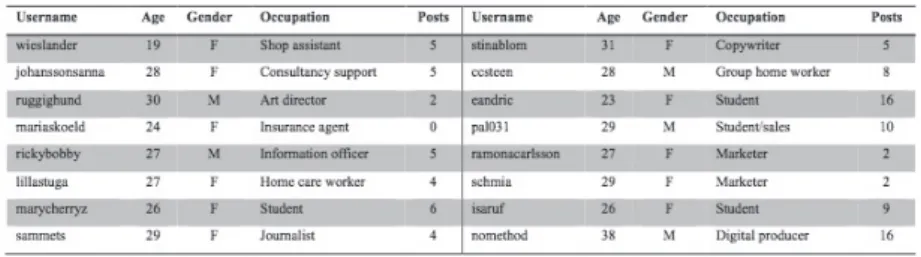
Table 1: Overview of participants in interviews, 2012 ... 89
Table 2: Overview of participants in interviews, 2017 ... 93
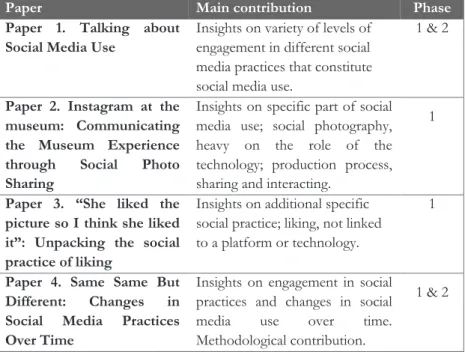
Table 3. Summary of paper contributions ... 104
Figure 1. Using social media ... 109
Tabell 4. Avhandlingens artiklar och bidrag ... 153
Part 1
1. Introducing social
media use
During the last decade, social media has become an integrated part of many people’s everyday life. The period between 2012 and today has been an explosive one in terms of growth in social media use. An increasingly large number of users are spending more and more time on a variety of social media platforms (Davidsson, Palm, & Melin Mandre, 2018; A. Smith, Anderson, & Caiazza, 2018). During the years of writing this thesis, the number of social media users worldwide increased from 1.4 billion (EMarketer, 2018) to almost 3.2 billion (Kemp, 2018) and the array of social media platforms, as well as the definition of what social media use is, has changed drastically. Interaction in social media today is massive. Every single minute, one million people are accessing their Facebook account, 347,222 people are scrolling Instagram and 87,000 people are tweeting (Walker-Ford, 2019). New platforms have emerged and
additional mobile social applications are continually put on the market, offering new ways for users to document and share their daily activities. Against this shifting backdrop, the aim of this thesis is to describe what constitutes social media use, why and how this is meaningful as a category of activity, and to contribute with new insights on how social media skills and perceptions change as practices and platforms develop.
Today, the most common way to access social media is through a smartphone (Davidsson et al., 2018) and many recent social media platforms, such as Instagram and Snapchat, have been specifically developed as mobile applications. The increased ownership and use of smartphones with built-in, high-quality cameras has been a contributing reason for the everydayzation of social photography. Much of the visual aspect of social media now consists of the activities of taking, sharing and interacting around photographs, activities made possible by the widespread adoption of smartphones with cameras. As use of social media, including social photography, has become more integrated in everyday life, online and offline interaction has become increasingly intertwined and more difficult to separate with the scope of interactions widening beyond physical spaces (Baym, Zhang, & Lin, 2004; Vorderer, Krömer, & Schneider, 2016). The increasing presence of social media has had consequences on how people communicate. As society digitalizes, so do many aspects of our lives. We use social media in different ways for different purposes such as staying in touch with friends and family, keeping up with events, or sharing and reading news. The development of social media has changed us as media consumers, relationship facilitators, students, and citizens as we access and share information in new and different ways. We use social media to consume news and to be
entertained, we create and facilitate relationships and we share snapshots from our everyday lives. In order to keep up with these developments, an understanding of emerging communication technologies is needed. Social media users develop both general technical as well as platform specific skills and learn to understand the underlying social norms on which their interactions rely. Apart from technical skills such as downloading a specific application, creating a profile, or pressing the correct button, there are also a number of social skills that users must master in order to be able to make use of social media. Developing these skills and learning which social codes to comply with sometimes leads to confusion, as exemplified in the e-mail that prefaces this chapter. As we become more competent and used to different forms of mediated interaction, we develop repertoires where we express what we have learned, the logics we understand on which our platform use builds, and our recognition of nuanced shifts and deviances from established norms.
Although use of social media is becoming increasingly widespread, no longer being just a leisure activity, but also having implications for other domains, such as work (Thomas & Akdere, 2013) and education (Greenhow & Lewin, 2016), the multifaceted notion of social media use is yet to be further conceptualized. To date, a large number of studies have been conducted, contributing to the growing body of work on social media use. Previous studies of social media use have examined interaction on specific platforms, for instance Facebook (Buehler, 2017), Instagram (Gibbs, Meese, Arnold, & Nansen, 2015), and Twitter (Brownlie & Shaw, 2018; Greenhow & Gleason, 2012). Studies have also investigated specific social media practices such as liking (Hayes, Carr, & Wohn, 2016b; Scissors, Burke, & Wengrovitz, 2016), retweeting and favoriting
(Paßmann, Boeschoten, & Schäfer, 2014), taking selfies (Svelander & Wiberg, 2015), and even how social media users handle Facebook breakups (Gershon, 2010). Although many new insights have been gained, there are several common limitations with previous work. A common approach has been to study the final products of social media such as tweets and instagrams, i.e. the content posted and shared, rather than to follow the process leading up to this. It has also been common to study practices of a homogenous group, often students and mainly undergraduates. In addition, the meaning of central terms and concepts, such as “social media use” and “Like” is often generalized without being unpacked. Also, little research has taken a longitudinal approach where the same individuals are followed over time leading to a lack of knowledge about how social media practices develop over time.
Due to the development in terms of increased ownership and use of smartphones with built-in advanced cameras, visual aspects have become an even more central part of social media during recent years. This shift has included additional modes for interaction, such as the possibility to communicate through photography and video in a simpler, more accessible way, and has contributed to changes in how social media interaction is understood. Much earlier work on online mediated social interaction has focused on interaction through text, as this was the most common mode through which people interacted online. However, when social media interaction was substantially text-based, social media interaction was, in fact, substantially different than it is today. Shifts in social media technologies and practices often happen gradually and can be difficult to grasp, not just for users themselves but also for researchers interested in understanding social media (Hogan & Quan-Haase, 2010).
For instance, when social media use is mentioned in the literature, researchers tend to neglect the fact that what social media is, is not static; it is an evolving process, where platform capabilities are continually updated and changed in ways that also affect user practices. In addition to adjustments on existing platforms, new platforms appear, changing the social media landscape. Extending the existing literature, this thesis seeks to address several limitations of previous work and provide new insights by presenting findings on social processes implicated in multimodal social media activities, through work conducted on social media users varying in age and occupation, and with data collected following the same users over time. As part of this work, concepts and terms that are often taken for granted in the social media literature are unpacked and scrutinized. Specifically, I unpack the multidimensional phenomenon of social media use through four papers on how people plan, produce, post and take part in social media interaction. Focusing on the level of granularity of these activities, this thesis presents detailed descriptions of social media activities. A combination of different methods for collecting data, such as observations, online scraping and in-depth stimulated recall interviews has made it possible to identify different components of social media use. By collecting the data for this thesis during the most explosive phase of social media adaption, letting social media users reflect upon their social media use in both 2012 and 2017, this thesis presents findings on the evolution of social media use over time.
In Paper 1, social media use is introduced and the notion of what constitutes social media use is conceptualized. Commonly, when studying traditional media, including television and the Internet, time spent has been the prominent way to measure use (see for instance (Bondad-Brown,
Rice, & Pearce, 2012; Davidsson & Thoresson, 2017)). When applying this way of measuring use to studying social media, however, new concerns arise in terms of which activities would be included. Social media is different from traditional media, especially in terms of the interplay between consuming and producing of content. Does social media use only refer to time spent on actively writing and sharing a tweet, instagramming a photo or posting a status update on Facebook? Or should the concept of social media use also include the time spent on planning and composing the tweet, taking and editing the picture and formulating the status update? Does social media use only refer to producing and posting one’s own content or would sharing content produced by others be included as well? Are scrolling, liking and commenting all counted as use of social media? Should the concept of social media use include all the times a user has an Internet connection and is available for comments and mentions through notifications despite not actively looking at the screen and engaging with a social media application? By providing examples of how people talk about and conceptualize their own social media use, this paper contributes to the discussion about what constitutes social media use. This paper provides examples of activities on different levels of involvement in social media practices, ranging from more passive use, such as monitoring and planning, to more active kinds of use that together form the scope for a revised definition of social media.
Paper 2 examines the compositional resources and concerns shaping the creation of the multi-layered presentations of images and texts referred to as “instagrams”. The analysis in this paper focuses on the process of creating and sharing instagrams, including photographic choices of various kinds, the formulation of captions and hashtags, and the role of
the audience. Combining different sets of data, collected through several complimentary methods, this paper contributes with a holistic view on how content is produced and shared in social media. It also shows how interaction around produced content steers further production and how interaction initiated on one platform often evolves and continues on others.
In Paper 3, the social practice of liking on Instagram is examined and the difference between liking a photograph and “liking” on Instagram is unpacked. Likes were originally introduced in social media with the intent to make social media easier and more rewarding to use (Pearlman, 2009). However, descriptions from social media users show that the meaning ascribed to these seemingly simple expressions cannot always be simply interpreted. In addition to the meaning intended by the developers of social media platforms, users add their own meanings to technical expressions. As social media users interact, they develop a great sensitivity for the different meanings of available expressions and for the norms that regulate the social practices that include them. Looking closer at the social practice of liking, this paper offers insight on a specific social media practice.
Paper 4 examines changes in the use of social media and explores differences and similarities in social media use over time. It includes analysis of data collected with the same social media users in 2012 and 2017. By allowing informants to comment on their five-year-old statements on their own social media use, the participants’ own analysis and reflections upon their own developments as social media users was fostered. The analysis shows a change in how users spend their time in
social media, where some users admit to higher frequency but less engagement in terms of how they interact with peers and produce and share content. A distinguishable shift from engaging in public interaction towards keeping conversations more private is also observed. The factors that influence evolvements in social media practices are discussed and it is concluded that although having undergone life changes and sometimes switched platforms and changed some behaviors, users’ approaches towards social media have to a great extent remained stable.
Despite the fact that social media platforms and use have grown massively over the last decade, we are still far from understanding the possible consequences of this phenomenon. Although affecting almost all of us, we still know little about the impact and meaning of social media. For my thesis, I aspire to contribute to the growing body of work on social media interaction by unpacking and describing practices that are known to many, but not observable and understood by all. Or to use the language of ethnography more deliberately; by making the invisible visible.
2. Research questions and
aim
In earlier iterations, interaction in social media relied heavily on text. However, increased ownership and use of smartphones with built-in advanced cameras has contributed to change in what we understand social media interaction to be. With an increased emphasis on producing, sharing and interacting around photographs, the visual aspects of social media have become more central, not only for specific social photo sharing platforms such as Instagram, but for social media in general. As often used today in research literature, the term “social media” is insufficiently detailed to be meaningful and there is a need to further unpack social media practices as platform and context specific activities. Social photography is a central part of social media today and users engaged in this practice rely on a multitude of modes and affordances as they develop both textual and visual social media skills. Focusing on the
adoption of social photography and taking a critical stand on common conceptualizations of social media use in the literature, the aim of this thesis is to describe what constitutes social media use, why and how this is meaningful as a category of activity and to contribute with new insights on how social media skills and perceptions change as practices and platforms develop. In order to provide these insights, the research questions for this thesis are:
RQ1) What is social media use and how is it meaningful as a category of activity?
RQ2) What kind of skills are necessary to engage in social media activity and how do these change as practices and platforms develop?
RQ3) How do perceptions of social media as a type of activity change as practices and platforms develop?
3. Related work
The aim of this thesis is to describe what constitutes social media use, why and how this is meaningful as a category of activity and to contribute with new insights on how social media skills and perceptions change as practices and platforms develop. The research questions seek to unpack social media use and contribute with an understanding of the social practices that people engage in when producing, sharing and interacting in social media. In this chapter on related work, I will first address the key idea for this thesis that explores the complex multi-dimensioned ecology in which social media interaction takes part, that users are “permanently online, permanently connected” (Vorderer, Hefner, Reinecke, & Klimmt, 2017). I will next turn to established perspectives on social media use and discuss different ways of looking at social media use and users. In particular, much of the earlier work taking the kind of micro-sociological interactional approach to understanding social media use taken in this thesis, has adopted Goffman’s dramaturgical perspective (Goffman,
1959). In this section, I describe Goffman’s conceptualization of social interaction and provide examples of how this concept has been used to describe social media interaction in previous work. In order to be able to understand the social practices that people engage in when using social media, I will introduce a definition of social media practices and discuss earlier work taking a similar perspective. Further, asking: “what skills are necessary to be able to engage in social practices?”, I will introduce the concepts of media convergence, modal affordances and social affordances and describe how they can be used to understand the ways that social media use is shaped. The data for this thesis has been collected with one main social practice in focus, social photography, where social interaction around photographs on Instagram has been of particular interest. The first phase of the study was situated within a museum context, both in terms of the physical space (as in within the walls of the Natural History Museum in Gothenburg) as well as in online spaces (such as on Instagram, Twitter and Spots.io). At the end of this chapter, I will present related work on social photography in general as well as work on social photography in museum settings to provide the reader with an understanding of both social photography in general as well as within the specific setting in which the first phase of the study took place.
3.1 The messiness of bridging contexts
During the last decade, social media has become an integrated part of many aspects of people’s everyday lives (Davidsson et al., 2018; Kemp, 2017; A. Smith et al., 2018). Although people use social media for different purposes, the focus of this thesis is mainly on the micro-interactions that people engage in when using social media. When talking about social media, I rely upon the well-established, early definition of boyd and
Ellison (2007), who defined social networking sites (SNS) as “web-based services that allow individuals to (1) construct a public or semi-public profile within a bounded system, (2) articulate a list of other users with whom they share a connection, and (3) view and traverse their list of connections and those made by others within the system ”(boyd and Ellison, 2007). When talking about social media, both users and researchers often use the term vaguely, referring to the largest social networking platforms such as Facebook, Instagram, Twitter, and Snapchat. Interaction on social media platforms is usually part of a larger interactional pattern and use of a particular social media application is often situated within broader social media use (C. Smith, 2011). Interactions in social media may also shift among different platforms, where conversations initiated on one platform continue on another one (Weilenmann, Hillman, & Jungselius, 2013b). As detailed by McMillan, McGregor and Brown, social media use is also situated within an offline, face-to-face context where smartphone use may take place alongside involvements with co-present activities and other people (McMillan, McGregor, & Brown, 2015). Similar to the shifts occurring with social media, scholars have described the adoption of earlier technologies such as mobile phones themselves, as major social transformations that while in progress are as yet too massive to be fully described as they find their way into our everyday lives, affecting how we socialize and communicate in ways greater than we are able to scope in the moment (Ling, 2012). Engendering such scale and complexity, the online practices involved in social media use are always situated within an offline context as well, with the co-presence of other activities and other people influencing the scene. Thus, a consequence of the increased use of smartphones to access and interact in social media is that people are often involved and engaged in
different social contexts in parallel, where they are no longer really “logging off” social media. To describe this always-online way of using social media, I use Vorderer et al.’s concept of a permanently online, permanently connected (POPC) world which refers to “a) the close and intense relationship with the smartphone and its communication ecology to which it grants permanent access and b) the communication-related expectations that are brought forth with one´s own and other’s permanent connectedness” (Vorderer et al., 2017, p. 3). In this thesis, a key idea is that social media interaction takes part in a complex multi-dimensioned ecology where users are “permanently online, permanently connected”.
3.2 Social media interaction
A common approach in early work on social media use was to describe people’s social interaction as “performances” where users were considered to be actors performing on a stage in front of their audience of followers. The performance metaphor is a central component of the dramaturgical perspective on social interaction originally developed by sociology and anthropology professor Erving Goffman (1959). Although Goffman accentuated face-to-face interaction and immediate physical presence, the concepts he developed remain useful and are often applied in studies of technology-mediated social interaction in non-physical spaces (Hogan, 2010; Robards & Lincoln, 2016; Sveningsson Elm, 2007). In “The Presentation of Self in Everyday Life” (1959) social interaction is described as a performance similar to those acted out by professional actors on a stage (Goffman, 1959). Goffman uses theatre and dramaturgy to explain how people present themselves in the drama of everyday life. In Goffman’s view, what happens when we meet and interact with others, is that we choose to enhance information we believe to be beneficial, while
concurrently toning down information that might affect the impression we try to make in a negative way. In order to live up to the ideal norms prevailing during the performance, the individual must refrain from, or try to conceal, any actions incompatible with these norms. Thus, an individual must not only possess the right attributes but must also keep up with current norms and demonstrate that they are in control of the rules governing behavior within a particular social group. Goffman defines performance as “all the activity of an individual which occurs during a period marked by his continuous presence before a particular set of observers and which has some influence on the observers” (Goffman, 1959, p. 22). When an individual performs in front of others, they will have a number of motives to try and control the impression that they make in the situation. When a performance is formed and transformed to fit into the society in which it is performed, the process is understood to be the “socialization of a performance”. Generally, interaction is described as “the reciprocal influence of individuals upon one another’s actions when in one another’s immediate physical presence” (Goffman, 1959, p. 15). While an interaction is defined as “all the interaction which occurs throughout any one occasion when a given set of individuals are in one another’s continuous presence” (Goffman, 1959, p. 15), the term “encounter” could also be used in a corresponding manner. When performing for an audience, people sometimes make mistakes. Unmeant gestures, inopportune intrusions, and missteps are examples of what Goffman describes as “performance disruptions” or “incidents” that may be in conflict with the impression people are trying to make.
During the last two decades, Goffman’s dramaturgical metaphor has been used as a framework in a number of studies on social media interaction.
How people present themselves as well as how they interact with others have garnered particular interest in social media interaction studies. As people engage in social media interaction, they are not only interacting with the immediate other part, but also with what Goffman termed the “performance team” surrounding them, such as mutual followers or friends of friends. Using Goffman’s concept of audience for example, Bernstein et al. state that that audience estimates are central to media behavior, “as perceptions of our audience deeply impact what we say and how we say it” (Bernstein, Bakshy, Burke, Karrer, & Park, 2013, p. 21). Studying emotional attachment to mobile phones, Vincent (2003) uses Goffman’s concepts to reason on the turn from mobile phones being a novelty into becoming a more integrated item in everyday life, mentioning how this shift requires “a new set of normative behaviors common to all users” (Vincent, 2003, p. 96). In a more recent study, Wei links Goffman’s work to today’s use of mobile social media noting that, “What Goffman (1963) imagined sociologically a half century ago, that “co-presence renders persons uniquely accessible, available and subject to one another” (p. 22) has come true thanks to advanced mobile media” (Wei, 2013, p. 52). Exemplifying this, Goffman’s argument concerning how individuals play different roles in different contexts was applied in a study on young people’s presentations of relationships in a Swedish Internet community (Sveningsson Elm, 2007). Goffman’s ideas on presentation of self, in particular, have been reinterpreted in the context of romantic relationships on Facebook (Robards & Lincoln, 2016) and developed further by extending the concept of presentation of self into an exhibition metaphor, describing social media as a place of displaying and curating content (Hogan, 2010).
Within the dramaturgical perspective, aspects of self-presentation and impression management are fundamental. How imagined online audiences affect the use of social media has been central in previous work on social media interaction. Marwick & boyd (2010), Weilenmann et al. (2013) and Cramer et al. (2011), among others, describe how both actual and imagined online audiences are central concerns for social media users and affect the ways they engage. In relation to social photography and sharing photographs with others, a range of studies have shown that when taking photos, photographers orient to the fact that their photos might be viewed by others and social photographers often relate to a perceived audience when producing and sharing photos online (Marwick & Boyd, 2010; Miller & Edwards, 2007; Weilenmann, Hillman, & Jungselius, 2013). The imagined audience may consist of friends and family in the tradition of snapshot amateur photography (Chalfen, 1987) as well as the broader online community in general (Miller & Edwards, 2007). When trying to understand use of social media, the presence and possible impact of online audiences are central and needs to be taken in consideration. People are aware of their online audiences and their social media practices are affected by this awareness. The very essence of social media is people being social, producing, sharing and interacting around text, tweets, instagrams and a multitude of other media that has been produced and shared with others.
3.3 Social media use and users
In more recent work, some researchers have suggested that not all social media use is social interaction. For instance, in an attempt to define mediated social interaction, Hall asks “When is social media use social interaction?” (Hall, 2018). Through his work, Hall shows that “only a
minority of time spent on social media can be characterized as social interaction, and that a minority of daily social interactions take place on social media” (Hall, 2018, p. 167). Interestingly, Hall notes that no matter the definition (either provided by researchers or by allowing users to provide their own definition), social media users believed that a majority of their social interactions occurred in some other way than through social media (Hall, 2018, p. 175). So not all social media use constitutes social interaction, but what constitutes social media use? Leading the reader towards a definition of mediated social interaction, Hall presents different views on social media interaction. While mentioning Goffman’s use of “focused social interaction” (Hall, 2018, p. 164), of particular interest for this thesis is Hall’s discussion of the distinction between browsing and broadcasting of social media. Aiming to conceptualize mediated social interaction, Hall suggests that interaction requires “(1) mutual acknowledgment by both partners of a shared relationship, (2) conversational exchange” (Hall, 2018, p. 165). Therefore, neither browsing nor broadcasting can be classified as social interaction as neither of these requirements are met.
Talking about social media users, it is important to recognize that they may not primarily see themselves as users. Aiming to conceptualize technology users as social actors, Lamb and Kling highlight the fact that users tend to see themselves in a different way than the researchers who study them. They note that, “In fact, users don't think of themselves as having anything to do with the computer at all. They see themselves as professionals, working with others, and using computers in support of those interactions”(Lamb & Kling, 2003, p. 200). Within my work, this has been noticed as being a potential problem when interviewing users,
encouraging them to talk about and describe their own use by asking “how much do you use social media?” and having them sometimes respond, “what do you mean by use?” (Jungselius & Weilenmann, 2018). Despite the complexity of defining social media users, some scholars have attempted to categorize different types. For instance, Brandtzaeg identified five user types: Sporadics, Lurkers, Socializers, Debaters, and Advanced (Brandtzæg, 2012). Including the dimension of tension among motives for use, Ploderer et al. introduce the notion of the “Ambivalent Socializer”, “a person who is simultaneously keen but also reluctant to engage with others via social media” (Ploderer, Smith, & Howard, 2012, p. 1511). Thus, capturing sometimes contradictory feelings about one’s own social media use. Touching upon these ambivalent feelings towards social media use, Tiidenberg et al studied how young people make sense of their social media experiences and talk about their use. They suggest that when encouraged to reflect upon their experiences with social media, users’ “rhetoric about social media use and its implications becomes more nuanced yet remains inherently contradictory” (Tiidenberg et al., 2017, p. 1). They describe how users’ struggle as they negotiate the paradoxes among established “grand narratives” of social media use, such as juggling feelings about social media being either bad, because it is addictive, or good, because it is their lifeworld (Tiidenberg et al., 2017). In Paper 4 of this thesis, I build upon earlier categorizations of user types with my co-author and identify an additional type, “Consuming Socializer”, “the social media user who checks, monitors and consumes publicly displayed content, not as passively as the “Lurker”, but yet not as interactive as the Socializer” (Jungselius & Weilenmann, 2019).
3.4 Social media practices
For this thesis, I use the term “social media practices” when describing how social media users engage with social media. The term was introduced by Hogan and Quan-Haase in 2010 in the Bulletin of Science, Technology and Society through a number of papers in a special issue on Persistence and Change in Social Media. The aim of this special issue was to “identify elements of social media practice that are persistent across platforms, users, and cultures” (Hogan & Quan-Haase, 2010, p. 309). The concept allows for an emphasis on the on-going social processes that people engage in when using social media. In recent years, a number of studies have been conducted to explore platform-specific social media practices. Seeking to understand the practice of retweeting on Twitter, Paßmann and colleagues conclude that a lot of effort is put in to this practice and that users make a number of pragmatic choices when retweeting and favoriting tweets, such as aiming to return a favor or seeking to write tweets that receive a maximum of retweets, favorites and followers in order to increase their status (Paßmann, Boeschoten & Schäfer, 2014). Another example of a study aiming to describe a specific social media activity is to be found in work by Svelander and Wiberg who argue for the need to understand selfies as a social practice. In a way similar to Paßmann and colleagues, Svelander and Wiberg show how selfies are the result of a long and thoughtful process (Svelander & Wiberg, 2015).
Managing their social media interaction, users often rely upon a structured set of social norms. They negotiate between different needs, suggesting a tension between what is possible to do and what is done. For instance, a recent study showed that when using Facebook, users negotiate between seeking emotional support and not violating the social norms that regulate
the use of the platform noting that, “Users must balance competing needs for emotional comfort with needs to behave appropriately within the Facebook context” (Buehler, 2017, p. 9). Another example of social rules regulating use is that during the peak of its popularity adding someone unknown on Foursquare was not considered to be okay, while following a similarly unknown somebody on Twitter was (Cramer et al., 2011). Another example of a social media practice where users negotiate between what is technically possible and what is socially acceptable is using hashtags, or hashtagging. Hashtags (#) are used on Facebook, Twitter, Instagram, Flickr, del.icio.us and similar platforms to annotate different kinds of content such as micro blog posts, status updates, videos, images and photographs. When adding a hashtag to a photograph in social media, like Instagram, the audience for a photographer is extended beyond their immediate followers. By searching for photographs with a specific hashtag, people who usually don’t follow a photo stream from a certain user are able to see those photographs without needing to follow the rest of that user’s photo stream. By using many different hashtags, the possibilities for reaching audiences larger than one’s own followers are increased. In this way, hashtags are used to provide information about a photograph and to help others find one’s photographs (Ames & Naaman, 2007; Miller & Edwards, 2007). Apart from serving as a bookmark for content and as a symbol of community membership (Yang, 2012), hashtags also allow users to track ongoing conversations and to communicate non-verbal cues like irony (Lin, Margolin, & Keegan, 2013). In a published paper, not included in this thesis, my co-authors and I presented findings from users’ descriptions of using hashtags to provide information about such features as where a photo had been taken, the
camera used, and any photographic filters added. Interestingly however, in addition to using hashtags to provide basic information about the content and composition of photographs, users also described how hashtags were sometimes used strategically as tools to attract more views in order to gain more likes and followers (Jungselius, Hillman, & Weilenmann, 2014). A conclusion that could be made from this finding is that apart from the hashtag uses intended by platform developers, users create their own meanings, practices and ways of use through participation and interaction with other users. In relation to differences in how developers of a social media platform intend a feature to be used and how people go about using it, there are also differences in the ways people use common concepts and terms in everyday talk versus how they use them when referring to social media. Words such as “friend” and “like” are frequently used in online interaction, but they are not always used in the same ways they are used away from social media contexts. For instance, Turkle (2011) noticed that users make an important distinction between a friend and a Facebook friend, and others go as far as to claim that a virtual friend is not the same as a real friend (Smith, 2011). Ouwerkerk and Johnson (2016) suggest a number of alternative motives for friending someone, showing that befriending someone online is not necessarily equivalent to becoming, or even wanting to become, friends in a more traditional sense. In a similar way, there is a significant difference between liking a photograph and liking an Instagram (Jungselius, 2018) and there are a number of reasons for a user to like another user’s picture apart from actual appreciation of the photograph. Given this complexity, in the following section, I will describe the social and technical skills that users of social media develop in order to be able to use social media fluently.
3.5 Social media skills
A central concept when unpacking the skills needed for engaging in social media interaction is convergence. Henry Jenkins defines convergence as “the flow of content across multiple media platforms, the cooperation between multiple media industries, and the migratory behavior of media audiences who will go almost anywhere in search of the kinds of entertainment experiences they want” (Jenkins, 2006, p. 2). Jenkins argues against the idea that convergence is to be “understood primarily as a technological process bringing together multiple media functions within the same device” (Jenkins, 2006, p. 3). Instead, he claims that “convergence represents a cultural shift as consumers are encouraged to seek out new information and make connections among dispersed media content” (Jenkins, 2006, p. 3). Epitomizing Jenkins’ ideas, social media use may be described as differing from previous media as the lines between different kinds of interaction are blurred with audiences required to acquire skills for engaging in social media beyond those associated with the consumption of traditional media.
Taking the view that emerging technologies change how we communicate and that people use language differently as a result, a broadened conceptualization of the skills required for fluency with social media is needed that includes not only language in text, but also a number of other modes. However, offering such a broadened conceptualization in a discussion of the multimodality of texts, Kress and van Leeuwen (1996) claim that the notion of language as not only being text is not something new. Language, they say, whether spoken or written, has always existed as
“just one mode in the ensemble of modes involved in the production of texts, spoken or written” (Kress & van Leeuwen, 1996, p. 41). They note
that a verbal text is never just verbal, but instead combines a number of visual expressions such as gestures, posture and facial expressions. Similarly, a written text involves a lot more than language, as it is both written on something and with something. Drawing on this, Kress and van Leeuwen claim that the multimodality of texts is being revealed in today’s age of multimedia (Kress & van Leeuwen, 1996). Building on the work of Kress and van Leeuwen, Jewitt explains the concept of “modal affordances” as “what is possible to express and represent, […] how a mode has been used, what it has been repeatedly used to mean and do, and the social conventions that inform its use in context shape its affordance” (Jewitt, 2008, p. 247). When learning to use social media, it is not only about learning how to use a new kind of technology, but rather about learning both the social mechanisms that social media interaction relies upon as well as learning how to make use of the different communication modes that social media use offers. When engaging in social photography for instance, the user has a number of modes available. They express themselves both through the choice of photo subject as well as the ways they choose to manipulate and present their photographs. They also formulate captions to go with a photograph to add another level of meaning and after sharing their photos. They learn how to interact around them, using letters, emojis, GIFs and Likes.
Apart from acquiring modal and technical skills, a user of social media also acquires social skills. Wellman et al. (2006) suggest that a set of societal changes such as increased communicational bandwidth, people staying more or less always connected, the development of computer mediated communications towards personalization, wireless portability, and globalized connectivity has created possibilities or “social
affordances” that have influenced the social use of the internet in everyday life (Wellman et al., 2003). Also using the term “social affordances”, but in a slightly different way, Hogan and Quan-Haase describe them as allowing “individuals to perceive aspects of their social environment, such as who else is in a chat room, who was co-sent a message, or who are the friends of my friends on a social network site” (Hogan & Quan-Haase, 2010). In this way, the social affordances of social media may be viewed as enablers of social practices.
A specific social media practice where social affordances are key and that has been of particular interest for me during my work is the practice of liking, i.e. interaction through the use of Likes. In Paper 3, I argue for the interactional richness of these seemingly simple expressions. Although the Like button, when launched on Facebook in 2009, was introduced as a way for users to “be able to say that they ‘Like’ something” (Kincaid, 2009), it has been shown that Likes may have various meanings and can embody large amounts of information (Hayes, Carr, & Wohn, 2016a; Jungselius, 2018). The possibility to like a status update, comment, photo, or organization is central when using social media today. On Instagram alone, users perform over 4.2 billion Likes per day (Aslam, 2017). Although beginning to acknowledge liking as an increasingly popular social function (Jin, Wang, Luo, Yu, & Han, 2011) some studies refer to Likes as “non-text feedback” (Burke, Marlow, & Lento, 2009) and “lightweight interaction” (Backstrom, Kleinberg, Lee, Danescu-Niculescu-Mizil, & Max, 2013; Burke, Kraut, & Marlow, 2011). Jang and colleagues refer to Likes, Favorites (on Twitter) and Re-pinning (on Pinterest) as “micro expressions” (Jang, Han, Shih, & Lee, 2015) and Meixner and Marlow describe Likes as “endorsement of content”
(Meixner & Marlow, 2017). Taking a slightly different approach and exploring the social value of Likes, some studies have concluded that Likes can serve as tokens of emotional gratification and support. Simply put, users report feeling happy when receiving Likes and sad when they do not (Hayes et al., 2016a). Focusing on Facebook, Gerlitz and Helmond (2013) explored the technical infrastructure of Likes and similar “social buttons” as part of a so-called “Like economy”. Drawing on Thrift (2008), they suggest that “a Like is always more than a number on the Like counter” (Gerlitz & Helmond, 2013, p. 1359). More specifically seeking to understand the social value of Likes on Facebook, Scissors et al. (2016) found that users tend to care more about who likes their post rather than the number of Likes they receive (Scissors et al., 2016). Likes are used in a number of ways and are interpreted differently depending on the social context. Technically, the act of clicking a Like button might be considered to be lightweight, low-cost or as a micro endorsement of content, but socially, this non-text feedback to social media content encompasses a range of complex social practices (Jungselius, 2018).
In this section, I have presented related work on social media interaction, use and practices and the skills needed for being able to interact properly in social media. For the next section, I will go into more detail on what has become a central part of social media use during the past decade, social photography. I will present relevant related work on how people engage in this practice generally and in the specific setting for the fieldwork undertaken for this thesis, museums.
3.6 Social photography
Social media use is no longer just a leisure activity that only has impact on everyday, peer-to-peer social interaction. Instead, social media has also rearranged the way we look at other domains, such as the workplace (Thomas & Akdere, 2013) and education (Greenhow & Lewin, 2016). As built-in cameras in mobile phones have become more advanced, social photography has become an increasingly popular activity embedded in many practices. Early work highlighted the fact that camera phones make it possible for people to take and share pictures of the places, people, pets and objects that they get in touch with in their everyday lives in new ways (Okabe, 2004). It was also noticed early on in their adoption that there are differences between how people use camera phones and how they use classical cameras to document and share their experiences (Okabe, 2004). For a conceptualization of social photography, I turn to the work of Richard Chalfen and his studies of how people take, organize and share photographs (Chalfen, 1987). For decades, anthropology scholar Chalfen studied how people use cameras and video cameras to capture and present particular versions of life to others. Within his work, the focus was on understanding the knowledge that one must have in order to be able to take “good” photographs and how this knowledge is used in everyday life. For instance, he discusses the “normality of taking pictures” (Chalfen, 1987, p. 9), i.e. what is considered to be “normal” pictures, how these pictures are taken and what enables photographers to take these pictures. Studying how people act both behind and in front of the camera, he presented the idea of “Kodak culture” (Chalfen, 1987). Within Kodak culture, the knowledge that users develop in order to engage, is key. This knowledge consists of “whatever it is that one has to learn, know, or do in order to participate appropriately” (Chalfen, 1987, p. 10). Over the
years, Chalfen’s work has been cited by a number of researchers studying social photography (Belk, 1988; Frohlich, Kuchinsky, Pering, Don, & Ariss, 2002; Grinter, 2005; Hillman & Weilenmann, 2015; Miller & Edwards, 2007). In early work on personal photographic practices mediated by mobile phones, some researchers concluded that Chalfen’s work had become dated due to changes in technology, claiming that “camera phones change the definition of what’s photo-worthy from what’s special and enduring to what’s often transitory and ordinary” (House et al., 2005). In recent years, however, as mobile phones with high-quality cameras have become accessible to a larger population, scholars have returned to Chalfen's work to inform studies of different aspects of smartphone mediated social photography. For instance, Weilenmann and Hillman build upon Chalfen’s work to describe the act of taking selfies as a situated practice (Weilenmann & Hillman, 2019) and MacDowall and de Souza refer to Kodak culture in a study of the relationship between street art, graffiti, and mobile digital technologies, discussing the role Instagram plays in reshaping production and consuming practices (MacDowall & de Souza, 2018). Of particular interest for this thesis is Chalfen´s discussion of what is possible to do with the technology at hand in relation to what people actually do with it. Technology in itself has different features that shape use in one way, as in what can be done, while norms and social codes shape what is actually done. Chalfen makes a distinction between “a culturally structured set of norms that helps us separate and differentiate what can be done – in a technical sense – from what can be done – in a social sense” (Chalfen, 1987, p. 44). Social photography is shaped by both technical features and social norms. In the next section, social photography within a specific domain will be further described.
3.6.1 Social photography in a museum setting
The presence of smartphones has impacted a number of everyday life activities such as shopping, how we talk to friends and family, how we consume media and how we experience and share cultural activities such as going to a concert or visiting a museum. Institutions such as museums are impacted as people experience and interact with exhibitions is new ways. Social media being the media channel, smartphones with built-in cameras are often the technology that people use when documenting and sharing their museum visits. Previous work on the use of mobile technologies within cultural institutions has examined how museum visitors use technology while visiting a museum and how they interact with technology that is already there or provided by the museum for the visitors to use with their own devices (Grinter et al., 2002; Pierroux, Krange, & Sem, 2010; Woods & Scanlon, 2012). Within the project that provided the opportunity for the fieldwork undertaken in this thesis, however, the interest was on both documentation practices that take place during museum visits (i.e. the process of taking photos and recording videos), as well as sharing practices (i.e. how photos and videos are shared during and after visits), and how people engage in these practices with the mobile devices and applications that they have brought with them to the museum themselves. In relation to this interest, a number of studies have been conducted that deepen understanding of the relationship between mobile technology, social media and learning in cultural institutions (Pierroux et al., 2010; Russo, Watkins, Kelly, & Chan, 2006). Russo et al. for instance, studied the potential role for social media when it comes to learning in informal environments such as museums, libraries and galleries. In their work, museums emerging use of social media as a way to engage online participants with new interactive experiences is discussed. Although some
put great faith in museums use of social media and believe that social media have potential to gain a central role as a learning tool in museums and science centers, other studies have shown that young people rarely initiate museum visits (Pierroux et al., 2010), that they often find museums to be boring and unapproachable and that they often believe that museums hold nothing of interest to them (Jansson & Thyrsson, 2012; Stuedahl & Smørdal, 2011). Despite this, there has been a prevalent belief that social media can be a way for museums and science centers to communicate and attract younger visitors and engage them in the co-design of exhibits. For example, Pierroux, Krange & Sem studied upper secondary students in an art museum field trip interpreting contemporary art within and across school and museum settings using social and mobile technologies, specifically blogs and mobile phones. The aim of their study was to examine the ways in which mobile phones and social media may contribute in facilitating meaning making in both formal and informal learning environments. Through interaction analysis, they examined ways that the students interacted on a specifically designed platform called Gidder, by studying how students discussed and created content related to the art museum field trip (Pierroux et al., 2010). More recently, however, it is often visitors themselves, even in younger age groups that bring mobile technologies into museums. Before the development of these devices, museums and science center exhibitions often focused on providing different technologies for visitors to interact with, but during recent years, it has become increasingly common for museums and science centers to avoid providing their own devices in favor of using visitors’ own and social media in order to introduce new types of interaction with museum exhibits. However, beyond more pragmatic concerns such as the cost of providing devices, some claim that the reason
that social media has been adopted by an increasing number of museums and science centers is the potential to help visitors to co-create and interact socially with museum exhibits (Stuedahl & Smørdal, 2011). This aligns with the call for museums to be responsive, democratic, and reflective and to subsequently take the “museum conversation” beyond the museum (Black, 2010 in Stuedahl & Smørdal, 2011, p. 216). Choosing to focus my work on social media activities within cultural institutions was a way to approach the activity of documenting and sharing of everyday life online in a delimited physical space. A museum visit is a focused, demarcated activity that plays out in a public, and thereby accessible, place. Although being a public place, delimiting to a physical setting within four walls, made the practice of documenting and sharing through mobile social media more accessible to study.
3.7 Summary of related work
The aim of this thesis is to describe what constitutes social media use, why and how this is meaningful as a category of activity and to contribute with new insights on how social media skills and perceptions change as practices and platforms develop. By focusing on a specific and central part of social media use (social photography) in a specific domain (museums), combining studies of this delimited physical space with the accompanying delimited non-physical space, was a way to locate and bound a relevant study object in the complex landscape of social media use. Working from this study object, my ambition in this thesis is to conceptualize the findings from my studies in these spaces and show how they may be transferred to other settings as well. The conclusions in this thesis draw upon fieldwork in these settings, but build upon the related work presented here on social media use more generally, contributing to our understanding of social