“© 2016 IEEE. Personal use of this material is permitted. Permission from IEEE must be obtained for all other uses, in any current or future media, including
reprinting/republishing this material for advertising or promotional purposes, creating new collective works, for resale or redistribution to servers or lists, or reuse of any copyrighted component of this work in other works.”
Conditional Graphical Lasso for Multi-label Image Classification
Qiang Li
1,2, Maoying Qiao
1, Wei Bian
1, Dacheng Tao
11
QCIS and FEIT, University of Technology Sydney
2Department of Computing, The Hong Kong Polytechnic University
{leetsiang.cloud, qiao.maoying}@gmail.com, {wei.bian, dacheng.tao}@uts.edu.au
Abstract
Multi-label image classification aims to predict multiple labels for a single image which contains diverse content. By utilizing label correlations, various techniques have been developed to improve classification performance. However, current existing methods either neglect image features when exploiting label correlations or lack the ability to learn image-dependent conditional label structures. In this paper, we develop conditional graphical Lasso (CGL) to handle these challenges. CGL provides a unified Bayesian frame-work for structure and parameter learning conditioned on image features. We formulate the multi-label prediction as CGL inference problem, which is solved by a mean field variational approach. Meanwhile, CGL learning is efficien-t due efficien-to a efficien-tailored proximal gradienefficien-t procedure by apply-ing the maximum a posterior (MAP) methodology. CGL performs competitively for multi-label image classification on benchmark datasets MULAN scene, PASCAL VOC 2007 and PASCAL VOC 2012, compared with the state-of-the-art multi-label classification algorithms.
1. Introduction
Multi-label image classification targets the specific prob-lem of predicting the presence or absence of multiple object categories in an image. Like other high-level vision tasks such as object recognition [2], image annotation [15] and scene classification [5], multi-label image classification is very challenging due to large intra-class variation caused by viewpoint, scale, occlusion, illumination, etc. To meet these challenges, many image representation and feature learning schemes have been developed to gain variation-invariance, such as GIST [29], dense SIFT [4], VLAD [18], object bank [25], and deep CNN [22, 8]. Meanwhile, label correlations, which are typically encoded in a graph structure, have been exploited to further improve classification performance.
In literature, the task of finding a meaningful label struc-ture is commonly handled with probabilistic graphical mod-els [20]. A classical approach is the ChowLiu Tree [11]
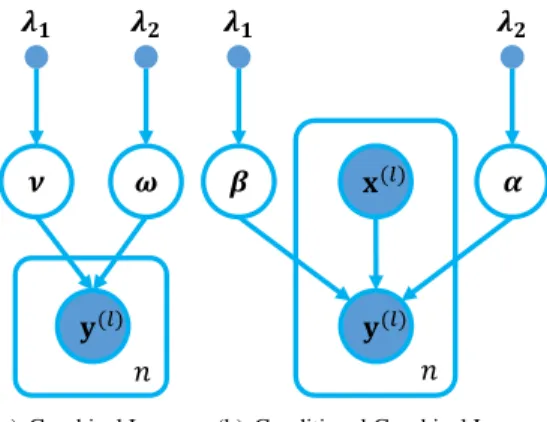
�(�) � � �� � ��
(a) Graphical Lasso
�(�) �(�) � � �� � ��
(b) Conditional Graphical Lasso
Figure 1. Comparison of graphical models between uncondition-al and conditionuncondition-al graphicuncondition-al Lasso. The templates denotes replica of ntraining images and labels. x(l) represents thel-th image
andy(l)denotes its label vector. The parameters{ν,ω},{α,β}
are shared across training data, and are themselves parameterized by hyperparametersλ1andλ2. In graphical Lasso,νandω pa-rameterize unary and pairwise potentials, respectively. In contrast, the parameterization is achieved by considering linear functions of
x(l), i.e.,βTx(l)andαTx(l), in conditional graphical Lasso.
which utilizes mutual information between labels to obtain a maximum spanning tree structure and is proved to be e-quivalent to the maximum likelihood estimation. Recent-ly, probabilistic label enhancement model (PLEM) [26] ex-ploits label co-occurrence pairs based on a maximum span-ning tree construction and applies the tree structure to solve multi-label classification problem. In these methods, the structure learned on labels is naively used to model the label structure conditioned on features, which is inappropriate be-cause this kind of structure describes the label distribution rather than the conditional distribution of labels.
To target the problem, several methods have been pro-posed to incorporate input features during label structure learning [6, 43, 35]. An extension to the ChowLiu Tree is designed in [6] which investigates two kinds of condition-al mutucondition-al information to learn a conditioncondition-al tree structure. Meanwhile, a conditional directed acyclic graph (DAG) is
also designed to reformulate multi-label classification into a series of single-label classification problems [43]. More recently, clique generating machine (CGM) [35] learns the conditional label structure in a structured support vector machine framework. These methods assume a shared la-bel graph across all input images, which provides a better approximation to the true structure than the uncondition-al label graph. However, such a shared conditionuncondition-al graph is not flexible enough to characterize the label structure of each unique image.
In this paper, we propose a conditional label structure learning method which can produce image-dependent con-ditional label structures. Our method extends the classi-cal graphiclassi-cal Lasso (GL) framework which estimates graph structure associated with Markov random field (MRF) by employing sparse constraints [28, 31, 24]. 1 We term the proposed method as conditional graphical Lasso (CGL). See Figure 1 for the comparison between graphical mod-els of GL and CGL. CGL offers a principled approach to model conditional label structures within a unified Bayesian framework. Besides, CGL provides a simple but effective way to learn image-dependent label structures by consider-ing conditional label correlations as linear weight functions of features. Such favourable properties are achieved via an efficient mean field approximate inference procedure and a tailored proximal gradient based learning algorithm.
2. Related Works
Apart from the structure learning approach, we briefly review three other main categories of multi-label classifica-tion methods which follows the taxonomy of recent surveys [36, 45, 16]. The three categories include problem transfor-mation, algorithm adaptation and dimension reduction.
Problem transformation methods reformulate multi-label classification into single-label classification. For example, the binary relevance (BR) method trains binary classifiers for each label independently. By considering label depen-dency, classifier chain (CC) [33], as well as its ensemble and probabilistic variants [10], constructs a chain of bina-ry classifiers, in which each classifier additionally use the previous labels as its input features. Another group of al-gorithms are built upon label powerset or hierarchy infor-mation, which includes random k-label sets (RAKEL) [37], pruned problem transformation (PPT) [32], hierarchical bi-nary relevance (HBR) [7] and hierarchy of multi-label clas-sifiers (HOMER) [36].
Algorithm adaptation methods extend typical classifiers to multi-label situation. For example, multi-label K near-est neighbour (MLkNN) [44] adapts kNN to handle multi-label classification, which exploits the prior multi-label distribu-1In literature, the term “graphical Lasso” is traditionally restricted to
refer structure learning for (continuous) Gaussian MRF only. In this paper, we use this concept to cover continuous, discrete and mixed random fields.
tion within the neighbourhood of an image instance and ap-plies the maximum a posterior (MAP) prediction. Instance based logistic regression (IBLR) [9] adapts LR by utilizing label information from the neighbourhood of an image in-stance as features.
Dimension reduction methods target to handle high-dimensional features and labels. The reduction of feature space aims to reduce feature dimension either by feature s-election or by feature extraction. For example, multi-label informed latent semantic indexing (MLSI) [41], multi-label least square (MLLS) [19], multi-label F-statistics (MLF) and multi-label ReliefF (MLRF) [21]. Label specific fea-tures (LIFT) [42] method represents an image instance as its distances to label-specific clustering centers of positive and negative training image instances, and use the features to train binary classifiers and make predictions. On the oth-er hand, the reduction of label space utilizes a variety of strategies, such as compressed sensing [17], random projec-tion [47], principal label space transformaprojec-tion (PLST) [34] and maximum margin output coding (MMOC) [46].
3. Model Representation
In this section, we first review the basic GL framework from a Bayesian perspective. Then we present the exten-sion by considering conditional variables and exploiting a group sparse prior. To simplify discussion, we will consider a fully-connected and pairwise label graph, though the same methodology can be easily applied to a higher-order case.
3.1. Graphical Lasso
An GL framework considers the problem of estimat-ing the graph structure associated with an MRF. Consid-er the ℓ1-regularized Ising MRF [31] over a label vector
y∈ {−1,1}m, GL employs anℓ
1regularization over
pair-wise parameters and achieves conditional independence by increasing sparsity. An ℓ1 regularization is equivalent to
imposing a Laplacian prior. Thus, we can formulate theℓ1
-regularized Ising model into the Bayesian framework which is given by p(y,ν,ω) =p(y|ν,ω)p(ν)p(ω), (1) p(y|ν,ω)∝exp m X i=1 νiyi+X i<j ωijyiyj , (2) p(ν)∝λd/1 2exp(−λ1kνk22), (3) p(ω)∝λd/2 2exp(−λ2kωk1), (4)
whereνandωparameterize the unary and pairwise poten-tials over y. λ1 andλ2 are hyperparameters which
con-trol the strength of regularization overνandω, respective-ly. Though the label graph learned by GL can be applied to multi-label classification, bothνandωhave no explicit
connection to the image features. In the next subsection, we will make a conditional extension to GL by incorporating image features to the learning process of label graph which leads to our CGL framework.
3.2. Conditional Graphical Lasso
As an extension to the GL framework, we consider a more deliberate structure learning approach when condi-tional variables emerge. In particular, CGL framework aims to search adaptive structures among response variables (la-bels) conditioned on input variables (image features).
For the particular multi-label classification task, we s-tudy the problem of learning a joint predictiony=fΘ(x) : X 7→ Y, where the prediction functionf is parameterized byΘ, the image feature spaceX ={x:kxk ≤1,x∈Rd}
and the label spaceY ={−1,1}m. By considering
appro-priate priors onΘ, we arrive at the joint probability distri-bution overyandΘconditioned onx,
p(y,Θ|x) =p(y|x,Θ)p(Θ). (5)
Note that the joint conditional distribution can be specified according to certain considerations, such as dealing with overfitting problems and inducing sparsity over label cor-relations.
Consider a label graphG = (V,E),V ={1,2,· · ·, m}
denotes the set of nodes corresponding to labels andE =
{(i, j) : i < j;i, j ∈ V}represents the set of edges
en-coding pairwise label correlations. We can model the con-ditional distributionp(y|x,Θ)with a set of unary and pair-wise potentials over the label graphG,
p(y|x,Θ)∝exp m X i=1 νi(x)yi+ X i<j ωij(x)yiyj . (6)
The above unary and pairwise weights{νi(x)},{ωij(x)}
can be linear or nonlinear functions of x. For simplicity, we restrict the weights to be linear functions ofxwhich are defined as
νi(x) =βTi x, fori∈ V;
ωij(x) =αTijx, for(i, j)∈ E.
(7) To this end, the model parameter Θ = {β,α} contains
β = [β1, ..., βm]andα = [α12, ..., α(m−1)m]. Note that,
conditioned onx, (6) is exactly an Ising model fory. It can also be treated as a special instantiation of CRF [23], by defining featuresφi(x,y) =yixandψij(x,y) =yiyjx.
As for the model prior p(Θ), we employ multivariate
d-dimensional Gaussian priors over each group of the n-ode regression coefficients, which is equivalent to place an
ℓ2-norm regularizer on the nodewise parametersβ.
Mean-while, we use multivariate d-dimensional Multi-Laplacian
priors [30] over each group of the edge regression coeffi-cients, which can be regarded as imposing an ℓ2,1-norm,
i.e., group-Lasso regularizer on the edgewise parametersα. More specifically, p(Θ) =p(β)p(α) = m Y i=1 p(βi)Y i<j p(αij), (8)
p(βi)∝λd/1 2exp(−λ1kβik22), (9)
p(αij)∝λd/2 2exp(−λ2kαijk2), (10)
where hyperparametersλ1 andλ2 control the strength of
regularization overβandα, respectively. It is worth men-tioning that one can also choose other kinds of priors over the model parameters provided the priors can induce certain sparsity over pairwise correlations.
4. Algorithms
In this section, we derive both inference and learn-ing algorithms for CGL. Generally, the label space Y =
{−1,1}m in (6) maintains an exponentially large number
of possible configurations. To normalize the conditional distribution in (6), one requires the log-partition function. For CGL with linear weight functions ofxin (7), the log-partition function is defined as
A(Θ,x) = log X y∈Y exp (Xm i=1 yiβTix+ X i<j yiyjαTijx ) , (11)
which involves a summation over all the configurations. Hence, it is computationally intractable to exactly calcu-late the log-partition function. To make CGL inference and learning tractable, we resort to approximate inference and learning algorithms via the variational methodology.
4.1. Approximate Inference
Inference of CGL involves two main tasks: marginal in-ference and the most probable explanation (MPE) predic-tion. However, conducting inference from the exact distri-bution p(y|x)is intractable due to the log-partition func-tion A(Θ,x). Considering tractable approximation tech-niques, we choose the variational approach instead of sam-pling methods for its simplicity and efficiency. In particular, by applying the mean field assumption, the optimal varia-tional approximation ofp(y|x)is obtained by
b q(y) = arg min q(y)= Q iq(yi) KL[q(y)kp(y|x,Θ)]. (12)
According to [3], the marginal q(yi)that minimizes (12)
is achieved by analytically minimizing a Lagrangian which consists of the Kullback-Leibler divergence and Lagrangian multipliers constraining the marginal q(yi) to be a valid
Algorithm 1CGL Inference
Input:Imagexand model parametersΘ = (β,α).
Output:Variational distributionqb(y) =Qibq(yi).
Initializeq(0)(y
i)← 1+exp{−12
yiβTix}
for eachi.
whilenot convergeddo fori= 1,· · ·, mdo
Prepare expected statistics,
ξq(y\i) = Eq(t+1)(y j)[yj] : 1≤j < i; Eq(t)(y j)[yj] :i < j ≤m.
Update the variational distributionq(t+1)(y
i)with
ξq(y\i)by using (16).
Update thei-th expected statisticEq(t+1)(yi)[yi].
end for
t=t+ 1
end while
probability distribution. For brevity of presentation, we simply give the update formula for eachq(yi),
q(yi)← 1
ZiexpEq(y\i)[lnp(y|x,Θ)], (13)
whereEp[g]calculates the expectation of function gw.r.t.
distributionp,Ziis the normalization term for distribution
q(yi), and we definedq(y\i) =Qj6=iq(yj).
To solve (12) for updatingq(yi), we expand and refor-mulate the expectation w.r.t. q(y\i). By dissecting out all
the terms that containyi, we obtain
Eq(y\i)[lnp(y|x,Θ)] =yiβiTx+yiEq(y\i) X j6=i yj αTijx+const (14) =yiβiTx+yi X j6=i Eq(yj)[yj]α T ijx+const, (15)
where we have applied the marginalization property of the joint distributionq(y\i)to obtain (15).
With a further consideration for the normalization con-straint of a valid probability distribution, we arrive at a lo-gistic regression for eachq(yi)given by
q(yi) =σ 2yi βiTx+ X j6=i Eq(yj)[yj]α T ijx , (16) whereσ(t) = 1
1+exp(−t) is the sigmoid function. This
for-mula requires the expectation of other variables connected to variableyi. Thus, a cycling and iterative updating for
each q(yi)is performed until convergence to a stationary
point. Algorithm 1 presents the pseudo code for this pro-cedure. It is worth mentioning that, we employed the most
Algorithm 2CGL Learning
Input:Training images and labels{X,Y}, hyperparam-eters{λ1, λ2}, and learning rateη, where1/ηis set larger
than the Lipschitz constant of∇Js(Θ)(25).
Output:Model parametersΘ = (b βb,αb). Initializeβ(0) =0,α(0)=0.
whilenot convergeddo
Update the variational distributions{qb(y(l))}n
l=1with
Θ(k)= (β(k),α(k))by using Algorithm 1.
Calculate the gradient ofJs(Θ)atΘ(k)= (β(k)
,α(k)) according to (24). UpdateΘ(k+1)= (β(k+1) ,α(k+1))by using (27); k=k+ 1 end while
recent expected statisticsξq(y\i)instead of the terms from previous round when updating one particular factor distri-butionq(yi). This strategy can avoid undesired abrupt
os-cillations of the iterative procedure to some extend. So far, it seems that our derivation only considers opti-mizing a factorized variational distributionq(y)which ap-proximates p(y|x). However, the same methodology can be straightforwardly applied to other inference and learning tasks. Take MPE for example, suppose we are given a new imagex, MPE aims to perform a joint prediction of its label vectorywith some learned model parameterΘb. Instead of conducting the max-product algorithm overp(y|x,Θ)b , we can achieve the predictionbydirectly fromq(y).
4.2. Structure and Parameter Learning
Given a set of i.i.d. training imagesX={x(l)}n
l=1and
their label vectorsY={y(l)}n
l=1, structure and parameter
learning of CGL aims to find the optimal model parame-terΘb which achieves the maximum a posterior (MAP) un-der certain values of hyperparameters{λ1, λ2}. It is worth
emphasizing that the graphical structure is implicitly repre-sented by the ℓ2-norm of αij. In other words, a nonzero
vectorαij almost probably indicates an edge in the graph between nodei andj, while a zero vectorαij implies no such edge. To utilize the MAP methodology for CGL learn-ing, the Bayesian rule is applied to obtain
b Θ = arg max Θ p(Θ|Y,X) (17) = arg max Θ p(Y,Θ|X) R Θp(Y,Θ|X) (18) = arg max Θ p(Y,Θ|X) (19) = arg max Θ n Y l=1 p(y(l)|x(l),Θ)p(Θ). (20)
Note that we have exploited the fact that the evidence
R
And the final optimization problem (20) is achieved by con-sidering (5) and the i.i.d. assumption.
By taking negative logarithm of the posterior and substi-tuting (6), (9) and (10) into (20), the original maximization problem can be reformulated into an equivalent minimiza-tion problem as below,
b Θ = arg min Θ − m X i=1 βiTφi¯ − X i<j αTijψij¯ + 1 n n X l=1 A(Θ,x(l)) +λ1 n m X i=1 kβik22+ λ2 n X i<j kαijk2, (21) whereφi¯ = 1 n Pn l=1y (l) i x(l),ψij¯ = 1n Pn l=1y (l) i y (l) j x(l).
Note that we have included A(Θ,x) into (6) before the derivation, and thrown away all other terms that are inde-pendent ofΘ.
Denoting by L(Θ) the objective function on the right-hand-side of (21). To learn the parameters Θ, a direc-t gradiendirec-t-based opdirec-timizer is inapplicable due direc-to direc-the non-smooth ℓ2,1-norm regularizer. In addition, the intractable
log-partition functionA(Θ,x)makes the optimization even more complicated. As an alternative, we optimize L(Θ) by first dividing the objective into smooth and nonsmooth parts, and then apply the soft thresholding technique. Mean-while, the mean field approximation is employed to approx-imate the gradient ofA(Θ,x).
More specifically, we first separate out the smooth part ofL(Θ)and denote it byJs(Θ), i.e.,
Js(Θ) =− m X i=1 βiTφi¯ − X i<j αijTψij¯ + 1 n n X l=1 A(Θ,x(l)) +λ1 n m X i=1 kβik2 2. (22)
Further, according to the mean field approximation de-scribed in Section 4.1, the gradient ofA(Θ,x)is estimated by replacing the true conditional distribution p(y|x)with the variational distributionbq(y). Hence, we have
∇Aβi(Θ,x) =Ep(y|x)[yix]≈Eqb(y)[yix]
∇Aαij(Θ,x) =Ep(y|x)[yiyjx]≈Eqb(y)[yiyjx]. (23)
This results in a simple approximation of the gradient∇Js
at thek-th iterationΘ(k)={β(k) ,α(k)}as below ∇Jsβi(Θ (k))≈ −φ¯ i+n1 n P l=1b q(y(il))x (l)+2λ1 n β (k) i ∇Jsαij(Θ (k))≈ −ψ¯ij+1 n n P l=1b q(y(il))qb(y (l) j )x( l). (24)
Then, a surrogateJ(Θ)of the objective functionL(Θ)can
be obtained by using∇Js(Θ(k)), i.e.,
J(Θ; Θ(k)) =Js(Θ(k)) + m X i=1 h∇Jsβi(Θ (k)), βi−β(k) i i+ 1 2ηkβi−β (k) i k 2 2 +X i<j h∇Jsαij(Θ (k)), αij−α(k) ij i + 1 2ηkαij−α (k) ij k22+ λ2 nkαijk2. (25)
The parameterηin (25) serves as a similar role to the vari-able updating step size in gradient descent methods. It can be shown that J(Θ) ≥ L(Θ) and J(Θ(k)) = L(Θ(k))
if1/ηis larger than the Lipschitz constant of∇Js(Θ(k)).
Hence,Θcan be updated by minimizing (25), i.e., Θ(k+1)= arg min Θ J(Θ; Θ (k)), (26) which is solved by ( βi(k+1)=βi(k)−η∇Jsβi(Θ (k)) αij(k+1)=S(αij(k)−η∇Jsαij(Θ (k));λ2 n), (27) where the soft thresholding function is
S(u;ρ) =
(1−kuρk2)u, ifkuk2> ρ;
0, otherwise. (28)
Iteratively applying (27) until convergence provides a first-order method for solving (21). The pseudo code for this procedure is summarized in Algorithm 2. Note that the gra-dient descent steps in Algorithm 2 can be speeded up with modern optimization procedures, such as the fast iterative shrinkage thresholding [1].
As a final remark, the conditional graph structure learned by CGL is largely related to the value of hyperparame-ter λ2. In general, a larger λ2, which represents a more
peaked Multi-Laplacian prior over α, can lead to a spars-er conditional structure. As a consequence, it is impor-tant to find an appropriate level of sparsity, which can be achieved by resorting to domain knowledge or data-driven cross-validation techniques.
5. Experiments
In this section, we evaluate the performance of CGL on the task of multi-label image classification. In particular, all experiments are conducted on three benchmark multi-label image datasets, including MULAN scene (MULANscene)2, PASCAL VOC 2007 (PASCAL07) [12] and PASCAL VOC 2012 (PASCAL12) [13]. MULAN scene dataset contains 2047 images with 6 labels, and each image is represented
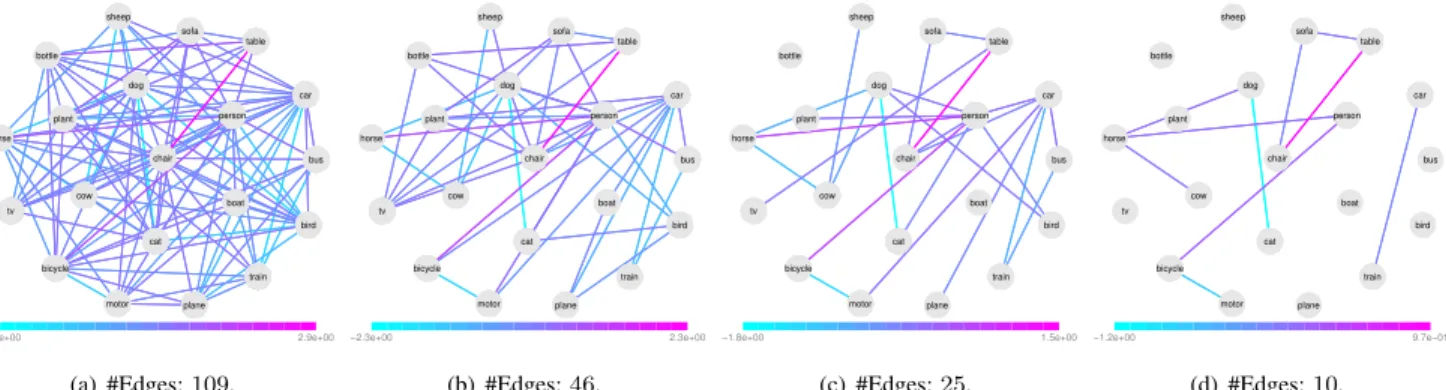
−3.2e+00 2.9e+00 plane bicycle bird boat bottle bus car cat chair cow table dog horse motor person plant sheep sofa train tv (a) #Edges:109. −2.3e+00 2.3e+00 plane bicycle bird boat bottle bus car cat chair cow table dog horse motor person plant sheep sofa train tv (b) #Edges:46. −1.8e+00 1.5e+00 plane bicycle bird boat bottle bus car cat chair cow table dog horse motor person plant sheep sofa train tv (c) #Edges:25. −1.2e+00 9.7e−01 plane bicycle bird boat bottle bus car cat chair cow table dog horse motor person plant sheep sofa train tv (d) #Edges:10.
Figure 2. Illustration of the CGL label graphs learned from PASCAL07-CNN.
Table 1. Datasets summary. #images stands for the number of all images, #features stands for the dimension of the features, and #labels stands for the number of labels.
Dataset #images #features #labels
MULANscene 2047 294 6
PASCAL07-PHOW 9963 3600 20
PASCAL07-CNN 9963 4096 20
PASCAL12-PHOW 11540 3600 20
PASCAL12-CNN 11540 4096 20
by a 294-dimensional feature. PASCAL VOC 2007 dataset consists of 9963 images with 20 labels. For PASCAL VOC 2012, we use public available train and validation subsets which contains 11540 images with 20 labels. As for image features of the latter two datasets, two kinds of feature ex-tractors are employed, i.e., the PHOW (a variant of dense SIFT descriptors extracted at multiple scales) features [4] and the deep CNN (convolutional neural network) features [22, 8]. We extract PHOW features of 3600 dimensions by using the VLFeat implementation [38]. For deep CNN features, we use MatConvNet matlab toolbox [39] and the ’imagenet-vgg-f’ model pretrained on ImageNet database [8] to represent each image as a 4096-dimensional feature. The basic information of the datasets is summarized in Ta-ble 1.
5.1. Label Graph Structure of CGL
To build up an intuition on structure learning of CGL, we employ PASCAL07 with CNN features to visualize the label correlations under different levels of sparsity regular-ization. In particular, we fix hyperparameterλ1= 0.01and
letλ2 varies in the range 0.001 ∼ 0.1 to check the label
graph evolvement. Since CGL models pairwise label corre-lations via a parametric linear function, i.e.,ωij(x) =αT
ijx,
the label graph is actually dependent on features thus unique for each image. To simplify the visualization of so many la-bel graphs, we use the average feature of training images, i.e.,x¯= 1
n
P
lx(l), and consider the average label graph.
Figure 2 presents the graph structure variations asλ2
in-creases. From the four label graphs, the number of edges
shrinks asλ2 increases. In addition, the maintained edges
are consistent with both semantic co-occurrence (e.g., chair and table) and repulsion (e.g., cat and dog) edges. For co-occurrence, ”chair” and ”table” often co-appear in the dataset and have large positive correlations, thus the edge weight in the label graph is a large positive value. In con-trast, ”cat” and ”dog” share certain visual similarity, though they seldom co-appear in the dataset. These two terms can be easily treated as conditionally independent by consider-ing label only. However, CGL can successfully capture the repulsion between these two terms, which is represented as a large negative edge weight in the label graph. It is not astonishing since CGL takes both feature and label into ac-count when modeling label correlations.
5.2. Comparison Methods and Measures
We compare CGL with the binary relevance (BR) method and six state-of-the-art multi-label classification methods. In this paper, we use logistic regression to imple-ment BR method which is also named as the independent logistic regressions (ILRs) method. Moreover, six state-of-the-art multi-label classification methods - instance-based learning by logistic regression (IBLR) [9], multi-label k-nearest neighbor (MLkNN) [44], classifier chains (CC) [33], maximum margin output coding (MMOC) [46], prob-abilistic label enhancement model (PLEM) [26] and clique generating machine (CGM) [35] were also employed for comparison study. Note that ILRs can be regarded as the basic baseline and other methods represent state-of-the-arts. In our experiments, LIBlinear [14] ℓ2-regularized logistic
regression is employed to build binary classifiers for ILRs. Based on ILRs, we implement PLEM by ourselves. As for other methods, we use publicly available codes in MEKA3 and the authors’ homepages4 5.
We use six widely accepted performance criteria to
e-3http://meka.sourceforge.net/
4http://www.cs.cmu.edu/˜yizhang1/
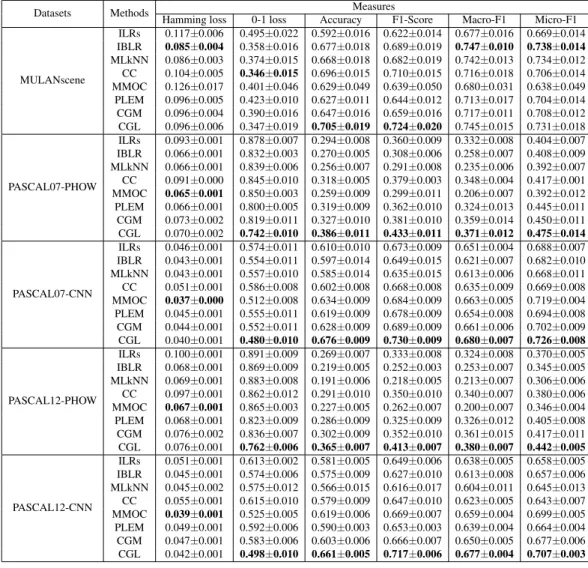
Table 2. Multi-label image classification performance comparison via 5-fold cross validation
Datasets Methods Measures
Hamming loss 0-1 loss Accuracy F1-Score Macro-F1 Micro-F1
MULANscene ILRs 0.117±0.006 0.495±0.022 0.592±0.016 0.622±0.014 0.677±0.016 0.669±0.014 IBLR 0.085±0.004 0.358±0.016 0.677±0.018 0.689±0.019 0.747±0.010 0.738±0.014 MLkNN 0.086±0.003 0.374±0.015 0.668±0.018 0.682±0.019 0.742±0.013 0.734±0.012 CC 0.104±0.005 0.346±0.015 0.696±0.015 0.710±0.015 0.716±0.018 0.706±0.014 MMOC 0.126±0.017 0.401±0.046 0.629±0.049 0.639±0.050 0.680±0.031 0.638±0.049 PLEM 0.096±0.005 0.423±0.010 0.627±0.011 0.644±0.012 0.713±0.017 0.704±0.014 CGM 0.096±0.004 0.390±0.016 0.647±0.016 0.659±0.016 0.717±0.011 0.708±0.012 CGL 0.096±0.006 0.347±0.019 0.705±0.019 0.724±0.020 0.745±0.015 0.731±0.018 PASCAL07-PHOW ILRs 0.093±0.001 0.878±0.007 0.294±0.008 0.360±0.009 0.332±0.008 0.404±0.007 IBLR 0.066±0.001 0.832±0.003 0.270±0.005 0.308±0.006 0.258±0.007 0.408±0.009 MLkNN 0.066±0.001 0.839±0.006 0.256±0.007 0.291±0.008 0.235±0.006 0.392±0.007 CC 0.091±0.000 0.845±0.010 0.318±0.005 0.379±0.003 0.348±0.004 0.417±0.001 MMOC 0.065±0.001 0.850±0.003 0.259±0.009 0.299±0.011 0.206±0.007 0.392±0.012 PLEM 0.066±0.001 0.800±0.005 0.319±0.009 0.362±0.010 0.324±0.013 0.445±0.011 CGM 0.073±0.002 0.819±0.011 0.327±0.010 0.381±0.010 0.359±0.014 0.450±0.011 CGL 0.070±0.002 0.742±0.010 0.386±0.011 0.433±0.011 0.371±0.012 0.475±0.014 PASCAL07-CNN ILRs 0.046±0.001 0.574±0.011 0.610±0.010 0.673±0.009 0.651±0.004 0.688±0.007 IBLR 0.043±0.001 0.554±0.011 0.597±0.014 0.649±0.015 0.621±0.007 0.682±0.010 MLkNN 0.043±0.001 0.557±0.010 0.585±0.014 0.635±0.015 0.613±0.006 0.668±0.011 CC 0.051±0.001 0.586±0.008 0.602±0.008 0.668±0.008 0.635±0.009 0.669±0.008 MMOC 0.037±0.000 0.512±0.008 0.634±0.009 0.684±0.009 0.663±0.005 0.719±0.004 PLEM 0.045±0.001 0.555±0.011 0.619±0.009 0.678±0.009 0.654±0.008 0.694±0.008 CGM 0.044±0.001 0.552±0.011 0.628±0.009 0.689±0.009 0.661±0.006 0.702±0.009 CGL 0.040±0.001 0.480±0.010 0.676±0.009 0.730±0.009 0.680±0.007 0.726±0.008 PASCAL12-PHOW ILRs 0.100±0.001 0.891±0.009 0.269±0.007 0.333±0.008 0.324±0.008 0.370±0.005 IBLR 0.068±0.001 0.869±0.009 0.219±0.005 0.252±0.003 0.253±0.007 0.345±0.005 MLkNN 0.069±0.001 0.883±0.008 0.191±0.006 0.218±0.005 0.213±0.007 0.306±0.006 CC 0.097±0.001 0.862±0.012 0.291±0.010 0.350±0.010 0.340±0.007 0.380±0.006 MMOC 0.067±0.001 0.865±0.003 0.227±0.005 0.262±0.007 0.200±0.007 0.346±0.004 PLEM 0.068±0.001 0.823±0.009 0.286±0.009 0.325±0.009 0.326±0.012 0.405±0.008 CGM 0.076±0.002 0.836±0.007 0.302±0.009 0.352±0.010 0.361±0.015 0.417±0.011 CGL 0.076±0.001 0.762±0.006 0.365±0.007 0.413±0.007 0.380±0.007 0.442±0.005 PASCAL12-CNN ILRs 0.051±0.001 0.613±0.002 0.581±0.005 0.649±0.006 0.638±0.005 0.658±0.005 IBLR 0.045±0.001 0.574±0.006 0.575±0.009 0.627±0.010 0.613±0.008 0.657±0.006 MLkNN 0.045±0.002 0.575±0.012 0.566±0.015 0.616±0.017 0.604±0.011 0.645±0.013 CC 0.055±0.001 0.615±0.010 0.579±0.009 0.647±0.010 0.623±0.005 0.643±0.007 MMOC 0.039±0.001 0.525±0.005 0.619±0.006 0.669±0.007 0.659±0.004 0.699±0.005 PLEM 0.049±0.001 0.592±0.006 0.590±0.003 0.653±0.003 0.639±0.004 0.664±0.004 CGM 0.047±0.001 0.583±0.006 0.603±0.006 0.666±0.007 0.650±0.005 0.677±0.006 CGL 0.042±0.001 0.498±0.010 0.661±0.005 0.717±0.006 0.677±0.004 0.707±0.003
valuate all the methods, including four example based mea-sures (Hamming loss, zero-one loss, accuracy and F1-score) and two label based measures (Macro-F1 and Micro-F1). In general, example based measures encourage the impor-tance of performing well on each example, the Macro-F1 score is more influenced by the performance on rare cate-gories, and the Micro-F1 score tend to be dominated by the performance on common categories. More details of these evaluation measures can be found in [40, 27]. It is worth mentioning that, PLEM, CGM and our method solve MPE inference problem for label prediction (each predicted label is either 0 or 1 thus containing no ranking information). As a result, ranking based measures like mean average preci-sion (mAP) are not suitable for these methods. In addition, all the methods are compared by 5-fold cross validation on each dataset. And the mean and standard deviation are re-ported for each criterion. For CGL hyperparameters, we fix
λ1 = 0.01, and setλ2 as 0.0149 for MULANscene and
0.003for PASCAL07 and PASCAL12.
5.3. Results and Discussion
Table 2 summarizes the experimental results on MU-LANscene, PASCAL07 and PASCAL12 of all eight algo-rithms evaluated by the six measures. Except for Ham-ming loss, CGL achieves better or comparable results on all datasets with different types of feature. This is because Hamming loss treats the prediction of each label individu-ally. However, CGL performs significantly better than oth-er methods on PASCAL07 and PASCAL12 in toth-erms of the other five measures. Especially in terms of accuracy and F1-score, CGL performs the best on all datasets. It is inter-esting that these two measures encourage good performance on each example. CGL’s outstanding performance on ac-curacy and F1-score confirms our motivation of exploiting conditional label correlations, which enables example based label graph. In the following, we present a more detailed comparison between CGL and the four different categories of multi-label classification methods.
10−3 10−2 10−1 0 2 4 6 8 10 12 14 16 λ 2 #Edges (a) #Edges 10−3 10−2 10−1 0.05 0.1 0.15 0.2 0.25 0.3 0.35 0.4 λ 2 Performance Hamming loss (b) Hamming loss 10−3 10−2 10−1 0.35 0.4 0.45 0.5 0.55 0.6 0.65 0.7 λ 2 Performance 0−1 loss (c) 0-1 loss 10−3 10−2 10−1 0.35 0.4 0.45 0.5 0.55 0.6 0.65 0.7 0.75 0.8 λ 2 Performance Accuracy F1−Score Macro−F1 Micro−F1 (d) Other measures
Figure 3. Performance variation of CGL versus the hyperparameterλ2on MULANscene.
10−3 10−2 10−1 0 20 40 60 80 100 120 140 160 180 λ 2 #Edges (a) #Edges 10-3 10-2 10-1 λ 2 0.036 0.038 0.04 0.042 0.044 0.046 0.048 0.05 Performance Hamming loss (b) Hamming loss 10-3 10-2 10-1 λ2 0.46 0.47 0.48 0.49 0.5 0.51 0.52 0.53 0.54 Performance 0-1 loss (c) 0-1 loss 10-3 10-2 10-1 λ 2 0.62 0.64 0.66 0.68 0.7 0.72 0.74 0.76 Performance Accuracy F1-Score Macro-F1 Micro-F1 (d) Other measures
Figure 4. Performance variation of CGL versus the hyperparameterλ2on PASCAL07-CNN.
methods (ILRs and CC). We observe that both CGL and C-C outperforms ILRs which validates the improvements ob-tained by exploiting label correlations for multi-label clas-sification. However, CC has to incrementally conduct train-ing and prediction thus is not scalable to large label space.
Secondly, CGL shows better performance than algorith-m adaptation algorith-methods (IBLR and MLkNN). Both IBLR and MLkNN adopt a local approach to adjust label prediction performance for each image instance. However, such lazy learners can be very inefficient when making predictions e-specially when the training database is large.
Thirdly, CGL outperforms the label space dimension re-duction algorithm MMOC. Though MMOC obtained good performance on PASCAL07-CNN and PASCAL12-CNN, the training of output codes is time-consuming. In addition, MMOC is sensitive to the features at hand since its per-formance degrades more than other methods when PHOW feature is utilized instead of CNN.
Finally, we compare three structure learning based meth-ods (PLEM, CGM and CGL). One can observe that both CGL and CGM performs better than PLEM on all datasets. This is because PLEM learns the label graph based on la-bel statistics without using the features. On the other hand, CGM learns a shared label graph across all images which lacks flexibility. In contrast, CGL exploits conditional label correlations that are adaptive to different images.
To investigate how CGL exploits label correlations, we present the performance variation of CGL versus the hyper-paramterλ2 on MULANscene and PASCAL07-CNN. We
use the same setting in Section 5.1 by lettingλ1= 0.01and
λ2range from0.001to0.1. The results are shown in
Fig-ures 3 and 4. To make the performance variation easier to understand, we also provide the curve of #Edges versusλ2
in Figures 3(a) and 4(a). According to the two curves, larg-erλ2encourages graph sparsity which leads to fewer edges.
As for the performance curves, we can draw several conclu-sions. First, the performance almost keeps stable when λ
is larger than some value since few label correlations have been utilized. Second, utilizing more relevant label corre-lations can improve the performance. However, adding too many label correlations (especially irrelevant ones) may im-pair the performance due to overfitting issues.
6. Conclusion
A conditional structure learning approach has been de-veloped for multi-label image classification. Our proposed conditional graphical Lasso framework offers a principled way to model label correlations by jointly considering im-age features and labels. In addition, our proposed frame-work is provided with a graceful Bayesian interpretation. The multi-label prediction task is formulated into an infer-ence problem which is handled via an efficient mean field approximate procedure. And the learning problem is ef-ficiently solved by a tailored proximal gradient algorith-m. Empirical evaluations confirmed the effectiveness of our method and showed its superiority over other state-of-the-art multi-label classification algorithms.
AcknowledgementsThis research is supported by Aus-tralian Research Council Projects DP-140102164, FT-130101457, and LE140100061.
References
[1] A. Beck and M. Teboulle. A fast iterative shrinkage-thresholding algorithm for linear inverse problems. SIAM J. Img. Sci., 2(1):183–202, 2009.
[2] S. Belongie, J. Malik, and J. Puzicha. Shape matching and object recognition using shape contexts.IEEE Trans. Pattern Anal. Mach. Intell., 24(4):509–522, 2002.
[3] C. M. Bishop. Pattern recognition and machine learning. Springer, 2006.
[4] A. Bosch, A. Zisserman, and X. Munoz. Image classification using random forests and ferns. InProc. IEEE Int. Conf. Comput. Vis., pages 1–8. IEEE, 2007.
[5] M. R. Boutell, J. Luo, X. Shen, and C. M. Brown. Learn-ing multi-label scene classification. Pattern Recognit., 37(9):1757–1771, 2004.
[6] J. K. Bradley and C. Guestrin. Learning tree conditional ran-dom fields. InProc. Int. Conf. Mach. Learn., pages 127–134, 2010.
[7] N. Cesa-Bianchi, C. Gentile, and L. Zaniboni. Incremental algorithms for hierarchical classification. J. Mach. Learn. Res., 7:31–54, 2006.
[8] K. Chatfield, K. Simonyan, A. Vedaldi, and A. Zisserman. Return of the devil in the details: Delving deep into convo-lutional nets. InBritish Machine Vision Conference, 2014. [9] W. Cheng and E. H¨ullermeier. Combining instance-based
learning and logistic regression for multilabel classification.
Mach. Learn., 76(2-3):211–225, 2009.
[10] W. Cheng, E. H¨ullermeier, and K. J. Dembczynski. Bayes optimal multilabel classification via probabilistic classifier chains. InProc. Int. Conf. Mach. Learn., pages 279–286, 2010.
[11] C. Chow and C. Liu. Approximating discrete probability dis-tributions with dependence trees. IEEE Trans. Inform. The-ory, 14(3):462–467, 1968.
[12] M. Everingham, L. Van Gool, C. K. Williams, J. Winn, and A. Zisserman. The pascal visual object classes (voc) chal-lenge.Int. J. Comput. Vis., 88(2):303–338, 2010.
[13] M. Everingham, L. Van Gool, C. K. Williams, J. Winn, and A. Zisserman. The pascal visual object classes challenge 2012 (voc2012) results, 2012.
[14] R.-E. Fan, K.-W. Chang, C.-J. Hsieh, X.-R. Wang, and C.-J. Lin. Liblinear: A library for large linear classification. J. Mach. Learn. Res., 9:1871–1874, 2008.
[15] S. Feng, R. Manmatha, and V. Lavrenko. Multiple bernoulli relevance models for image and video annotation. InProc. IEEE Conf. Comput. Vis. Pattern Recognit., volume 2, pages II–1002. IEEE, 2004.
[16] E. Gibaja and S. Ventura. A tutorial on multilabel learning.
ACM Comput. Surv., 47(3):52, 2015.
[17] D. Hsu, S. Kakade, J. Langford, and T. Zhang. Multi-label prediction via compressed sensing. InProc. Adv. Neural Inf. Process. Syst., volume 22, pages 772–780, 2009.
[18] H. J´egou, M. Douze, C. Schmid, and P. P´erez. Aggregat-ing local descriptors into a compact image representation. InProc. IEEE Conf. Comput. Vis. Pattern Recognit., pages 3304–3311. IEEE, 2010.
[19] S. Ji, L. Tang, S. Yu, and J. Ye. A shared-subspace learning framework for multi-label classification.ACM Trans. Knowl. Discov. Data, 4(2):8, 2010.
[20] D. Koller and N. Friedman.Probabilistic graphical models: principles and techniques. MIT press, 2009.
[21] D. Kong, C. Ding, H. Huang, and H. Zhao. Multi-label re-lieff and f-statistic feature selections for image annotation. InProc. IEEE Conf. Comput. Vis. Pattern Recognit., pages 2352–2359. IEEE, 2012.
[22] A. Krizhevsky, I. Sutskever, and G. E. Hinton. Imagenet clas-sification with deep convolutional neural networks. InProc. Adv. Neural Inf. Process. Syst., pages 1097–1105, 2012. [23] J. D. Lafferty, A. McCallum, and F. C. N. Pereira.
Con-ditional random fields: Probabilistic models for segmenting and labeling sequence data. InProc. Int. Conf. Mach. Learn., pages 282–289. ACM, 2001.
[24] J. Lee and T. Hastie. Structure learning of mixed graphical models. InProc. Int. Conf. Artif. Intell. Stat., pages 388–396, 2013.
[25] L.-J. Li, H. Su, L. Fei-Fei, and E. P. Xing. Object bank: A high-level image representation for scene classification & semantic feature sparsification. InProc. Adv. Neural Inf. Pro-cess. Syst., pages 1378–1386, 2010.
[26] X. Li, F. Zhao, and Y. Guo. Multi-label image classification with a probabilistic label enhancement model. Proc. Conf. Uncertain. Artif. Intell., 2014.
[27] G. Madjarov, D. Kocev, D. Gjorgjevikj, and S. Dˇzeroski. An extensive experimental comparison of methods for multi-label learning.Pattern Recognit., 45(9):3084–3104, 2012. [28] N. Meinshausen and P. B¨uhlmann. High-dimensional graphs
and variable selection with the lasso. Annals of Statistics, pages 1436–1462, 2006.
[29] A. Oliva and A. Torralba. Modeling the shape of the scene: A holistic representation of the spatial envelope.Int. J. Comput. Vis., 42(3):145–175, 2001.
[30] S. Raman, T. J. Fuchs, P. J. Wild, E. Dahl, and V. Roth. The bayesian group-lasso for analyzing contingency tables. In
Proc. Int. Conf. Mach. Learn., pages 881–888. ACM, 2009. [31] P. Ravikumar, M. J. Wainwright, J. D. Lafferty, et al.
High-dimensional ising model selection using l1-regularized logis-tic regression.Annals of Statistics, 38(3):1287–1319, 2010. [32] J. Read. A Pruned Problem Transformation Method for
Multi-label classification. InProc. New Zealand Computer Science Research Student Conference, pages 143–150, 2008. [33] J. Read, B. Pfahringer, G. Holmes, and E. Frank. Clas-sifier chains for multi-label classification. Mach. Learn., 85(3):333–359, 2011.
[34] F. Tai and H.-T. Lin. Multilabel classification with prin-cipal label space transformation. Neural Computation, 24(9):2508–2542, 2012.
[35] M. Tan, Q. Shi, A. van den Hengel, C. Shen, J. Gao, F. Hu, and Z. Zhang. Learning graph structure for multi-label im-age classification via clique generation. InProc. IEEE Conf. Comput. Vis. Pattern Recognit., pages 4100–4109, 2015. [36] G. Tsoumakas, I. Katakis, and I. Vlahavas. Mining
multi-label data. InData Mining and Knowledge Discovery Hand-book, pages 667–685. Springer, 2010.
[37] G. Tsoumakas and I. Vlahavas. Random k-labelsets: An en-semble method for multilabel classification. InProc. Eur. Conf. Mach. Learn., pages 406–417. Springer, 2007. [38] A. Vedaldi and B. Fulkerson. VLFeat: An open and portable
library of computer vision algorithms. http://www. vlfeat.org/, 2008.
[39] A. Vedaldi and K. Lenc. Matconvnet – convolutional neural networks for matlab. InProc. ACM Int. Conf. Multimedia. [40] Y. Yang and X. Liu. A re-examination of text
categoriza-tion methods. InProc. ACM SIGIR Conf. Res. Develop. Inf. Retrieval, pages 42–49. ACM, 1999.
[41] K. Yu, S. Yu, and V. Tresp. Multi-label informed latent se-mantic indexing. InProc. ACM SIGIR Conf. Res. Develop. Inf. Retrieval, pages 258–265. ACM, 2005.
[42] M.-L. Zhang and L. Wu. Lift: Multi-label learning with label-specific features. IEEE Trans. Pattern Anal. Mach. In-tell., 37(1):107–120, 2015.
[43] M.-L. Zhang and K. Zhang. Multi-label learning by exploit-ing label dependency. InProc. ACM SIGKDD Conf. Knowl. Discov. Data Min., pages 999–1008. ACM, 2010.
[44] M.-L. Zhang and Z.-H. Zhou. Ml-knn: A lazy learn-ing approach to multi-label learnlearn-ing. Pattern Recognit., 40(7):2038–2048, 2007.
[45] M.-L. Zhang and Z.-H. Zhou. A review on multi-label learn-ing algorithms.IEEE Trans. Knowl. Data Eng., 26(8):1819– 1837, 2014.
[46] Y. Zhang and J. G. Schneider. Maximum margin output cod-ing. InProc. Int. Conf. Mach. Learn., pages 1575–1582. ACM, 2012.
[47] T. Zhou, D. Tao, and X. Wu. Compressed labeling on dis-tilled labelsets for multi-label learning. Mach. Learn., 88(1-2):69–126, 2012.