BANK of ZAMBIA
CURRENCY REBASING
TECHNICAL GUIDELINES
1
Document information
AUTHOR
Bank of ZambiaVERSION
2.00PROJECT
Currency RebasingSTATUS
Work in progress In Review ApprovedSUPPORT DOCUMENTS USED
1. Bank of Zambia Currency Rebasing Project Charter 2. International Standardization Organization – ISO 4217 3. Bank of Zambia Act of 1996
4. Currency Redenomination – Ghana 5. Currency Redenomination – Turkey 6. Currency Redenomination – Mozambique 7. Currency Redenomination – Venezuela
SOURCE OF AUTHORITY
1. Government of the Republic of Zambia 2. Bank of Zambia Board
2
Table of Contents
Document information ... 1
1. INTRODUCTION ... 5
2. BACKGROUND ... 5
2.1 Definition of Currency Rebasing ... 5
2.2 Rationale for Currency Rebasing ... 5
3. OBJECTIVES ... 6
4. SCOPE ... 6
5. BENEFITS OF CURRENCY REBASING ... 6
6. EFFECTS OF CURRENCY REBASING ... 6
7. IMPLEMENTATION GUIDELINES ... 7
7.1 Changeover Date ... 7
7.2 The ISO Code of the Kwacha ... 7
7.3 Currency Symbol ... 7
7.4 New family of Zambian Banknotes and Coins ... 7
7.5 Distribution of Banknotes and Coins ... 8
7.6 Exchange of Banknotes and Coins ... 8
7.6.1 Over the Counter Limits ... 8
7.6.2 Transition Phase ... 8
7.6.3 Post Transition Phase ... 9
7.7 Transaction Processing... 9
7.7.1 Staff Training ... 9
7.7.2 Simultaneous Display of Prices ... 9
7.7.3 Contracts and Payment Obligations ... 9
7.7.4 Invoices and Invoicing... 10
7.7.5 Cash Payments and Change ... 10
7.7.6 Rounding-off Rules ... 10
7.7.7 Quotation of Exchange Rates ... 10
7.7.8 Cash Payments ... 11
7.7.9 Banking Transactions ... 11
7.7.10 Cheque Transactions ... 12
7.7.11 Cheque Clearing ... 12
3
7.8.1 Treatment of Financial Records at 31st December 2012... 12
7.8.2 Accounting & Other Transaction Processing Packages ... 13
7.8.3 Accounting for Rounding-off Differences ... 13
7.8.4 Record of Expenses Associated with Currency Rebasing Adaptations ... 13
7.9 Tax Aspects ... 14
7.9.1 Tax Obligations ... 14
7.9.2 Income Tax Returns for Year Ended 31st December 2012 ... 14
7.9.3 PAYE Annual Returns ... 14
7.9.4 Monthly Tax Remittances ... 14
7.9.5 Excise Returns ... 14
7.9.6 VAT Returns ... 14
7.9.7 Accountable Documents ... 14
7.10 Wages and Salaries, Pensions, Retirement Funds, and Other Social Benefits ... 15
7. 11 Financial Instruments ... 15
7.12 Technological Adaptation... 15
7.12.1 Timeframe for the Technological Adaptation ... 15
7.12.2 Recommendations to Tackle Technological Adaptations ... 15
7.12.3 Systems/Mechanisms to be affected by the Currency Rebasing ... 15
7.12.4 Electronic Funds Transfer... 16
7.12.5 Real Time Gross Settlement System ... 16
7.13 Historical Data ... 16
8.0 INFORMATION DISSEMINATION ... 16
4 GLOSSARY OF TERMS
ATM Automated Teller Machine
BOZ Bank of Zambia
DDACC Direct Debit and Credit Clearing
GRZ Government of the Republic of Zambia
ISO International Standardization Organization
IVL Item Value Limit
K Kwacha (Currency Symbol)
KR Kwacha Rebased (Currency Symbol)
NatSave National Savings and Credit Bank
POS Point of Sale
RTGS Real Time Gross Settlement system
VAT Value Added Tax
URL Uniform Resource Locator
ZAMPOST Zambia Postal Services
ZECHL Zambia Electronic Clearing House Limited
ZMK Zambian Kwacha Currency Code
5
1. INTRODUCTION
The Bank of Zambia Act No. 43 of 1996 Section 4 (2) (c) empowers the Bank to issue notes and coins to be legal tender in the Republic and regulate all matters relating to the currency of the Republic. Accordingly, on 23rd January 2012, the Government of the Republic of Zambia approved the recommendation of the Bank of Zambia (BOZ) Board to rebase the national currency. Consequently, the BOZ has set 1st January 2013 as the changeover date when the rebased currency will become legal tender.
The currency rebasing exercise covers the replacement of all Zambian banknotes and coins currently in circulation with the rebased currency.
In order to ensure preparedness, the Bank and all stakeholders have identified areas that will be impacted by the impending currency rebasing exercise.
The Bank of Zambia has issued these technical guidelines on currency rebasing to provide guidance to all stakeholders on the wider implications of the currency rebasing exercise, as well as, ensure the preparedness of accounting, banking and related software, and infrastructure before the 1st January, 2013. The guidelines are further intended to inform all stakeholders on the different aspects of the currency rebasing exercise, so that the rebased currency can be recognized and used with ease and confidence. The guidelines will also serve as a reference document for all stakeholders especially those that have to carry out the necessary adaptations of processes and systems.
2. BACKGROUND
2.1 Definition of Currency Rebasing
Currency rebasing involves dividing of a currency unit by a defined denominator and adapting that rebased currency to every amount expressed in both notes and coins. The Zambian currency rebasing exercise, therefore, entails dividing the currency by one thousand (1,000).
With the currency rebasing there will be no change in the name of the national currency, which will remain the Kwacha and Ngwee.
2.2 Rationale for Currency Rebasing
A national currency is rebased because of the need to address costs associated with an accumulated loss in value of the currency that undermines its basic function as a store of value, medium of exchange and measure of value. This loss of value is typically as a result of high inflation rates over a prolonged period of time.
The high denominations that characterize the existing currency is a consequence of high inflation rates experienced over a long period of time. Zambia experienced high levels of inflation during the 1990s and early 2000s which peaked at 188% in 1993. Such high levels of inflation resulted in:
i. Inconveniences and risks inherent in carrying large sums of money for transactions;
ii. Increasing difficulties in maintaining book-keeping and statistical records and ensuring compatibility with data processing software;
iii. Higher costs on the payments system, particularly the delivery of banking services through a greater use of technology.
Normally rebasing is done by countries during periods of low and stable inflation. In Zambia’s case, inflation has generally been in single digit in the last five years such that in December 2011 it closed at 7.2%. This low level of inflation, coupled with favourable macroeconomic conditions and positive economic outlook, provides an opportune time to rebase the Zambian currency.
6
3. OBJECTIVES
The key objectives of these technical guidelines are to:
i. Promote common understanding among stakeholders about currency rebasing and how it will be conducted in Zambia; and
ii. Outline the key roles and responsibilities of various stakeholders to ensure smooth currency rebasing implementation.
4. SCOPE
These guidelines apply to all entities and individuals that conduct financial transactions in the Zambian Kwacha.
5. BENEFITS OF CURRENCY REBASING
Rebasing the currency will result in a number of benefits including:
i. Facilitating easier business transactions because it leads to the use of smaller units of money. It simplifies accounting and the ease of expressing monetary values, thereby minimizing errors associated with the inputting of financial data and time spent to review such data. It achieves a more efficient use of calculation and accounting record systems. Thus, rebasing simplify book-keeping and reduces the drudgery in transactions, record keeping and banking transactions.
ii. Creating greater confidence in the currency. When there are many zeros or digits, people may lose confidence in the local currency.
iii. Reduction in the cost often incurred when customizing standard packages that are purchased by entities. This is because most of the current accounting packages are developed in jurisdictions where values, at a maximum, tend to be in millions. The present situation in Zambia, where organizations record values in billions and trillions of Kwacha, requires further customization of such packages in order to widen data fields. Thus, currency rebasing will limit the extent of customization of standard application packages.
iv. Efficient payments systems and encouraging the use of mechanisms such as pay phones, vending machines, car parking meters and other related technologies.
v. Re-introduction of a culture of using coins which are more durable.
6. EFFECTS OF CURRENCY REBASING Currency rebasing will not affect the following:
i. The value of the rebased currency and its purchasing power (there is neither a revaluation nor devaluation of the currency);
ii. The value of savings and other investment instruments; and
7
7. IMPLEMENTATION GUIDELINES
7.1 Changeover Date
The changeover date has been set for 1st January 2013. The new currency becomes legal tender and will be issued from this date and shall accordingly be acceptable as a medium of exchange in the Republic of Zambia.
7.2 The ISO Code of the Kwacha
The International Standardization Organization (ISO) provides international standard codes (ISO 4217) to identify every currency in the international market. The ISO Currency code prescribes a three letter structure. The current currency code for Zambia is ‘ZMK’, where the letters ‘ZM’ stand for the country code for Zambia and ‘K’ stands for, ‘Kwacha’.
Any modification to a currency requires a permanent change to its ISO code. Therefore, effective 1st January 2013, the new alphabetic ISO Code for the Zambian currency will be ZMW, where the letter ‘W’ represents the
rebased Kwacha. The letter ‘W’ being the second character in the Zambian currency name ‘KWACHA’.
This code has a numerical equivalent – also three digits – used for the registration of specific operations such as credit cards. The current numeric code for Zambia is 894. The new numeric code will be 967 and also becomes effective on 1st January 2013.
Table 1: ISO Code 4217 for Zambia
Current Code New Code
Alphabetic ZMK ZMW
Numeric 894 967
The alphabetic and numeric currency codes, ZMK and 894 respectively will no longer be in use effective 1st January 2013.
The currency code is used primarily to record financial settlements in international and domestic payment systems. Therefore with effect from 1st January 2013, all transactions in Zambian Kwacha in these systems will be expressed as the rebased currency ZMW.
7.3 Currency Symbol
The symbol for the Zambian currency shall remain ‘K’ as this will not change after rebasing.
7.4 New family of Zambian Banknotes and Coins
The Bank has restructured the family of banknotes and introduced the K100 and K2 denominations to the rebased family of banknotes. The K100 and K2 will be the highest and lowest value banknotes respectively. Most of the old family banknotes will have an equivalent in the rebased currency except the K20.
It should also be noted that in the old family of banknotes, the K100 will be equivalent to the 10 Ngwee coin in the new family after rebasing. The old K100 should not therefore be confused with the new K100 to be introduced.
8
Table 2: Family of Old and New Banknotes and Coins
Banknotes Coins
No. Old banknotes New banknotes No. Old coins New coins
1 - K100 2 K50,000 K50 3 K20,000 K20 4 K10,000 K10 5 K5,000 K5 6 - K2 7 K1,000 - 1 K1 8 K500 - 2 50 Ngwee 9 K100 - 3 10 Ngwee 10 K50 - 4 5 Ngwee 11 K20 - 5 - - 6 K10 - 7 K5 - 8 K1 - 9 50 Ngwee - 10 25 Ngwee -
7.5 Distribution of Banknotes and Coins
The BOZ will primarily be responsible for the distribution of the new family of banknotes and coins throughout the country. In this regard, BOZ will utilize its normal distribution channels to carry out this exercise.
During the distribution and exchange exercise of the two currencies in those parts of the country that do not have a bank network, the BOZ will engage other agencies such as Zambia Postal Services (ZAMPOST) and National Savings and Credit Bank (NatSave), etc. to assist in the exchange process. More information will be availed to the public in due course.
7.6 Exchange of Banknotes and Coins
All stakeholders will be able to exchange cash holdings of the old banknotes and coins for the rebased currency over the counter at commercial banks and other designated institutions from 1st January 2013.
The exchange of old notes and coins for the rebased currency will be FREE of CHARGE for all stakeholders.
7.6.1 Over the Counter Limits
The exchange of old notes and coins over the counter will be limited to an amount of K25million (K25,000 rebased currency) per individual transaction. The commercial banks will still be required to observe Anti-Money Laundering Directives.
7.6.2 Transition Phase
The period from 1st January to 30th June 2013 has been designated as the transition phase during which both the old and rebased currencies will circulate simultaneously. During the transition phase, goods and services may be paid for using both currencies, as long as the equivalences are observed.
Effective 1st July 2013, simultaneous circulation of currencies will cease and the old currency shall not be accepted for the purchase of goods and services.
9 7.6.3 Post Transition Phase
Commercial banks shall continue to exchange old banknotes and coins for the rebased currency for their clients and non-clients. In so doing, commercial banks will still be expected to comply with Anti-Money Laundering Directives.
The exchange of the old currency for the rebased currency in designated exchange centers will continue for 12 months (until 30th June 2014). Thereafter, exchange will only take place at the BOZ as below:
a) Exchange at Bank of Zambia and Commercial Banks
Effective 1st July 2013 to 30th June 2014, stakeholders shall exchange old currency for the rebased currency at BOZ, commercial banks and designated agents.
b) Exchange at Bank of Zambia
Effective 1st July 2014 to 31st December 2015, stakeholders shall exchange the old currency for the rebased currency exclusively at BOZ.
The old currency, consisting of banknotes and coins, shall cease to be legal tender after 30th June 2013, but shall be accepted for exchange purposes only.
7.7 Transaction Processing
In order to facilitate smooth implementation of currency rebasing, the following procedures shall be followed:
7.7.1 Staff Training
It is a requirement that all business entities train their employees in the managing of the various aspects of currency rebasing. Such training should include how to make the conversions from old currency (K) to rebased currency (KR), and to provide information about prices and details of the operations to other stakeholders, especially during the transition phase.
7.7.2 Simultaneous Display of Prices
During this transition period, i.e. 1st January to 30th June 2013, an interim currency symbol (KR) will be introduced for purposes of displaying prices. The symbol (KR) will be used temporarily during the 6 months transition phase. Thereafter, the symbol KR will cease to be used in reference to rebased currency. Only the symbol ‘K’ will be in use.
Effective 1st to 31st December 2012, entities will have the option to display prices in both the old currency (K) and the rebased currency (KR). Entities and the public may use this time period to acquaint themselves with the dual display of prices.
Effective 1st January 2013 to 30th June 2013 i.e. the dual display of prices by all entities will be mandatory.
7.7.3 Contracts and Payment Obligations
All contracts entered into prior to 1st January 2013 with expiry date falling after that date, will still be valid. Outstanding obligations at 31st December 2012 but only settled after that date shall be divided by 1,000 and paid in the rebased currency. However, as from this 1st January 2013 onwards, every payment obligation or commitment entered into shall be understood to be in the rebased currency.
10
7.7.4 Invoices and Invoicing
Effective 1st January 2013, all invoices issued shall be expressed in the rebased currency. Invoices issued prior to this date shall be converted to the rebased currency if settlement is after the changeover date.
In addition, stakeholders shall ensure that the purchase invoice or deposit slips corresponding to the respective transactions are expressed in the rebased currency.
7.7.5 Cash Payments and Change
During the six months transition phase (1st January to 30th June 2013), cashiers shall give change for all transactions in rebased currency. In instances where there is insufficient rebased currency, cashiers shall give first preference to the rebased currency followed by the old currency. In cases where this is not possible, cashiers will give change in the old currency. The change received could be in any of the three possible options:
i. With notes and coins of the old currency;
ii. With notes and coins of the rebased currency
iii. With notes and coins in a combination of both currencies, as long as the equivalences are observed.
7.7.6 Rounding-off Rules
All amounts converted from the old currency to the rebased currency shall be rounded off to two decimal places unless stated otherwise. The general rounding off rule is the following:
i. When a third decimal of an amount converted to the rebased currency is equal to or higher than 5, the second decimal is raised by one unit;
ii. When the third decimal of an amount converted to the rebased currency is lower than 5, the second decimal stays the same.
Examples:
· K38,255 converted and rounded off, becomes K38.26.
· K38,351 converted and rounded off, becomes K38.35.
7.7.7 Quotation of Exchange Rates
All exchange rate quotations shall continue to be made in accordance with international best practice. Exchange rate quotations shall be rounded off to four decimal places.
Table 3: Example of Quotations of Exchange Rates
Foreign Currency
Exchange Rate
Before Rebasing
(K)
Rebased Exchange Rate (Before Rounding Off) (KR)
Rebased Exchange Rate After Rounding Off (KR)
1USD 5,231.4423 5.2314423 5.2314
1GBP 7,985.2423 7.9852423 7.9852
1EURO 6,358.5912 6.3585912 6.3586
11
7.7.8 Cash Payments
During the transition phase, payments in cash could be made using notes and coins of both old and rebased currencies without distinction.
7.7.9 Banking Transactions
In order to accelerate withdrawal of the old currency, commercial banks will make payments in the rebased currency only. This will ensure that all old currency received as deposits by commercial banks from the public is in turn deposited at the Bank of Zambia. In this regard, banks are guided as follows:
i. Cash Depositsand Withdrawals
All commercial banks shall receive cash deposits in both the old and rebased currencies while payments shall only be made in the rebased currency. Banks shall continue to guard against counterfeiting.
ii. Receipts from ATMS and POS
All amounts shown on receipts from ATMs and POS, shall be expressed in the rebased currency with the new Currency Code (ZMW).
iii. Returns and Reports
Effective from 1st January 2013, all accounting, returns and other reports to the Bank of Zambia, Zambia Revenue Authority and others shall be stated in the rebased currency.
iv. Deposit Vouchers
When depositing either cash or cheques at a bank, separate vouchers shall be used for old and rebased currencies where applicable.
v. Cash Statements
The cash statement of banks at each month end during the transition period shall be maintained in two separate statements i.e. old and rebased currencies. This statement may be prepared outside the processing systems.
vi. Bank Statements
On the 1st of January 2013, all commercial banks shall be required to provide two separate bank statements to their customers reflecting closing balances in the old kwacha and the opening balances in the rebased currency.
vii. Bid and Ask Rates
Effective 1st October 2012 and during the transition phase (1st January to 30th June 2013), the bid and ask rates for convertible currencies and cash substitutes shall be displayed by all financial institutions in both the old and the rebased currencies.
viii. Automated Teller Machines (ATMs)
To accelerate the withdrawal of the old currency from circulation, commercial banks shall be required to dispense from ATMs the rebased currency effective 1st January 2013.
12
7.7.10 Cheque Transactions
During the transition period of the currency rebasing exercise (1st January to 30th June 2013), the current Cheques would be used and the reference point would be the date of issue on the Cheque. In addition, special care shall have to be taken when issuing cheques to ensure that the amounts are expressed in the rebased currency. This will also help prevent cheque processing errors. The following issues should be taken into account when issuing and processing cheques:
i. All cheques issued before 1st January 2013 will be in the old currency. All cheques issued before this date but only presented for payment after 1st January 2013 will be paid with the amount divided by 1,000.
ii. Cheques dated 1st January 2013 and after, shall be assumed to have been issued in rebased currency and would be paid on face value.
iii. Issuance of postdated Cheques prior to the changeover date (1st January 2013) is discouraged.
iv. The Cheque Item Value Limit (IVL) would be restated to K100,000 from K100million and any Cheque whose value exceeds IVL would be returned with the notation “Exceeds Item Value Limit”.
v. Banks in conjunction with BAZ and other financial institutions shall be obliged to inform their clients, through the most convenient and suitable means, regarding the rules applicable to the payment of cheques during the transition phase.
7.7.11 Cheque Clearing
During the transition phase, commercial banks will be required to prepare consolidated files for clearing purposes. Cheques denominated in the old currency will be divided by 1,000 and added to those of the rebased currency and thereafter sent to ZECHL.
Any rounding off differences will be for the collecting banks’ accounts. 7.8 Accounting
The currency rebasing exercise does not modify any accounting principle. Consequently, financial statements should continue to be prepared in accordance with the generally accepted accounting principles.
7.8.1 Treatment of Financial Records at 31st December 2012
Entities shall convert the balances of accounts as at 31st December 2012 to rebased currency on 1st January 2013, by dividing such balances by one thousand (1,000). Therefore, effective 1st January 2013, transactions shall be reflected on the balance sheet in rebased currency.
Financial statements for the period ending 31st December 2012 shall be prepared in old currency. To this end, balances brought forward from 31st December 2012 shall be converted to rebased currency. At close of business on 31st December 2012, there shall be need to either:
i. Close all ZMK accounts and open new accounts in the rebased currency ZMW for systems with multicurrency functionality or
13
ii. Take on the rebased balances in ZMW in the same old accounts for systems without multicurrency functionality.
7.8.2 Accounting & Other Transaction Processing Packages
Business entities should prepare adequately to ensure that by 1st January 2013, accounting packages and related software have been tested and ready for the introduction of the rebased currency.
In this regard, a deadline date for preparedness has been set at one month before the changeover date (30th November 2012), to ensure that all entities are ready for the process and avoid any risk of failure. Therefore, business entities must address the following:
i. Effective 1st January 2013, all data maintained on accounting and other processing packages shall be expressed in the rebased currency with the new currency code ZMW.
ii. Assets and liabilities in the books of accounts up to 31st December 2012 shall be recorded in old currency and the closing balances at 31st December 2012 shall be converted to rebased currency on 1st January 2013.
iii. All outstanding items on Kwacha reconciliation statements shall be in the old currency prior to 1st January 2013. However, from changeover date amounts in the reconciliation statements shall be converted into rebased currency.
iv. Starting 1st January 2013, all accounting, financial and supporting documents shall be prepared in rebased currency. Likewise, the books and sub ledgers used by business entities as well as data on Information Technology applications shall be prepared in the rebased currency.
v. The amounts shown on debit instruments, such as cheques and promissory notes held by beneficiaries based on agreements concluded between the parties prior to 1st January 2013 for settlement after this date shall be converted to rebased currency.
7.8.3 Accounting for Rounding-off Differences
Any difference caused by the rounding off of amounts, shall be incorporated into the results of the financial year to which such a procedure is applied.
The difference arising from the conversion shall be subject to adjustment as follows:
i. The difference arising from conversion of assets and liabilities shall be recognized under account item “other adjustments account”.
ii. At balance sheet date following currency rebasing implementation, the balance on the account items ‘other adjustments account’ shall be recognized as either expense or income, under ‘other operating expenses’ or ‘other operating income’ as appropriate.
7.8.4 Record of Expenses Associated with Currency Rebasing Adaptations
The expenses that entities, both public and private, will incur due to the adaptation of their accounting, administration, computer or any other system, shall be recognized as expenses of the financial year in which they take place.
14
7.9 Tax Aspects
The currency rebasing exercise will not alter any taxation rules and obligations. A notable difference is that the books, invoices, declarations, payments and accounting records in general shall be expressed in rebased currency as from 1st January 2013.
7.9.1 Tax Obligations
The tax obligations outstanding at 31st December 2012 will be paid in the old currency if these fall due before 1st January 2013. However if tax obligations outstanding at 31st December 2012 fall due for payment after 1st January 2013, these will be payable in the rebased currency.
7.9.2 Income Tax Returns for Year Ended 31st December 2012
For the tax year ending December 2012 the returns due on 30th June 2013 shall be expressed in the rebased currency.
7.9.3 PAYE Annual Returns
The PAYE Annual Return (P18) for the year ended 31st December 2012 due before 1st March 2013 shall be expressed in the rebased currency.
7.9.4 Monthly Tax Remittances
All returns and remittance cards due by 14th January 2013 (e.g. Turnover Tax, PAYE) shall be expressed in the rebased currency.
7.9.5 Excise Returns
Excise Returns due by 20th January 2013 shall be expressed in rebased currency.
7.9.6 VAT Returns
VAT Returns due by 21st January 2013 shall be expressed in rebased currency.
7.9.7 Accountable Documents
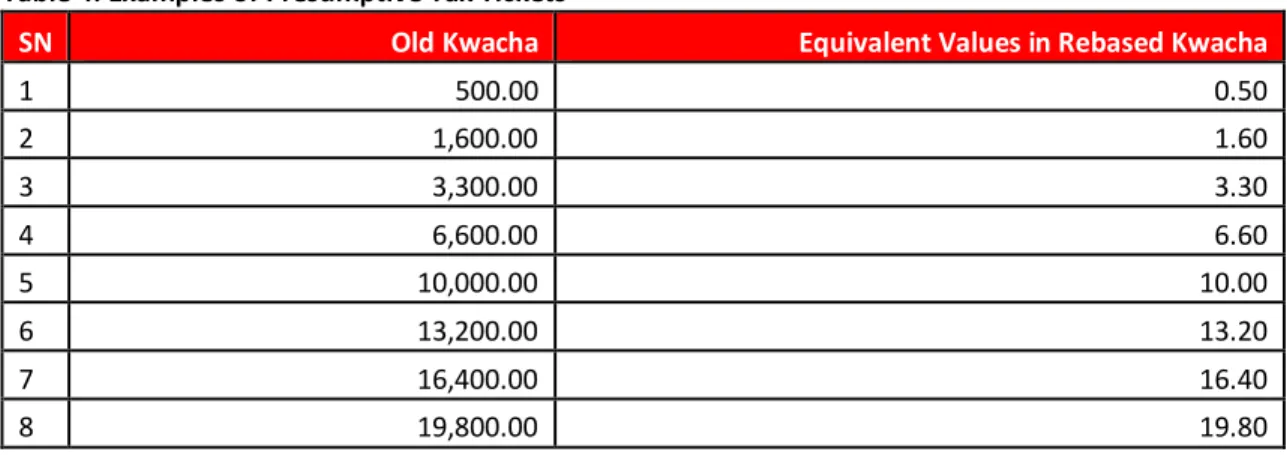
Stamped paper and revenue stamps as well as any other items valued in the old currency shall be used until these are exhausted although as from 1st January 2013 their value shall be recognised by their equivalent in the rebased Kwacha. See example Table 4 below:
Table 4: Examples of Presumptive Tax Tickets
SN Old Kwacha Equivalent Values in Rebased Kwacha
1 500.00 0.50 2 1,600.00 1.60 3 3,300.00 3.30 4 6,600.00 6.60 5 10,000.00 10.00 6 13,200.00 13.20 7 16,400.00 16.40 8 19,800.00 19.80
15
7.10 Wages and Salaries, Pensions, Retirement Funds, and Other Social Benefits
Wages and salaries, pensions, retirement funds and other social benefits of workers paid after 1st January 2013, shall all be rounded upwards as this is an accrued right.
7. 11 Financial Instruments
All securities issued prior to, but with maturity beyond 1st January, 2013, shall be converted to the rebased currency and customers advised of the new values.
Statements showing the value on 31st December, 2012 and revised value in rebased currency on 1st January, 2013 shall be availed to all customers.
7.12 Technological Adaptation
The technological adaptation is a process of adapting different technological components so as to express all amounts and / or prices expressed in the rebased currency.
All entities shall be required to adjust their systems and infrastructure so that all transactions made and referring to the rebased currency are expressed in ZMW effective 1st January 2013.
One of the capabilities required of all affected systems is the multi-currency functionality.
7.12.1 Timeframe for the Technological Adaptation
All entities must ensure that their systems and infrastructure are adapted to the required technological amendments by 30th November 2012. The deadline set to adapt all systems and infrastructure for the rebased currency is to ensure adequate preparedness.
7.12.2 Recommendations to Tackle Technological Adaptations
Technological adaptation based on the currency rebasing exercise should be undertaken as a project by business entities to consider changes in processes, hardware, information systems and data. In order to carry out this project, the following stages may be covered:
i. Definition of requirements
ii. Inventory of technological components to be adapted
iii. Design of alternate solutions
iv. Build or buy
v. Testing
vi. Moving on to live environment
vii. Business continuity plans
7.12.3 Systems/Mechanisms to be affected by the Currency Rebasing
All systems handling, registering or operating in the Zambian currency will be affected by the currency rebasing exercise. In this regard all technological solutions rendering services to customers should have capability of processing transactions in both the old and rebased currencies at the time of adaptation. All stakeholders shall carry out inventory of systems and/or mechanisms used in offering services and adapt them to accept the rebased currency. Some examples of systems and/or mechanisms are given below:
16
Table 5: Examples of Systems and/or Mechanisms Systems
and/or mechanisms
Item Systems and/or mechanisms
i. Information systems ii. E-Business
iii. Data structures
iv. Automatic Teller Machines v. Scales
vi. Cash registers vii. Payphones
viii. Systems to generate labels and price tags ix. Fuel Pump Machines
7.12.4 Electronic Funds Transfer
Payments made through Electronic Funds Transfer systems such as Mobile payments, POS, DDACC, etc. shall from 1st January 2013 be expressed in the rebased currency. All business entities utilizing such systems shall ensure such changes are adapted and tested by 30th November 2012.
7.12.5 Real Time Gross Settlement System
The BOZ shall ensure that the Real Time Gross Settlement (RTGS) system, the large value interbank payment system, is accordingly tested and ready for adaptation to the rebased currency by 30th November 2012.
7.13 Historical Data
It is recommended that stakeholders maintain all data prior to 1st January 2013, in the old currency. 8.0 INFORMATION DISSEMINATION
The BOZ will make available, in September 2012, a web page exclusively dedicated to currency rebasing. A uniform resource locator (URL) will be provided where the public will find information on general and specific aspects of the currency rebasing exercise in Zambia.
The public will also be able to send email messages to the address of the BOZ’s public relations via the e-mail address [email protected]. In addition, the currency rebasing exercise has dedicated a team of staff and other officers who will facilitate the whole exercise.
BOZ and other institutions employees dedicated to the information activity will be properly trained on the different aspects of currency rebasing exercise, and use informative material made and/or authorized by the BOZ. This joint work with other organizations will allow the Bank to inform more citizens.
9.0 REVIEW OF THE GUIDELINES
These guidelines will be reviewed as and when deemed necessary by the Bank of Zambia in consultation with key stakeholders during the implementation process.