Directorate-General for Development and Cooperation – EuropeAid Directorate-General for Development and Cooperation – EuropeAid
GUIDELINES
BUDGET SUPPORT
Se
pt
em
be
r 2
01
2
Programming, Design and Management
- A modern approach to Budget Support
September 2012
ls a
nd M
et
ho
ds S
er
ie
s
Bu
dg
et S
up
po
rt G
ui
de
lin
es
Working document
Programming, Design and Management
A modern approach to Budget support
EuropeAid Development and Cooperation Directorate-General
European Commission
More information on the European Union is available on the Internet (http://europa.eu).
© European Union, 2012
Reproduction is authorised provided the source is acknowledged. Printed in Belgium
PRINTED ON ELEMENTAL CHLORINE-FREE BLEACHED PAPER (ECF)
to your questions about the European Union.
Freephone number*: 00 800 6 7 8 9 10 11
*Certain mobile telephone contractors do not allow access to 00 800 numbers or these calls may be billed.
These Guidelines have been prepared by unit DEVCO “Budget Support, Public Finance and Macroeconomic Analysis”
of the EuropeAid in close collaboration with all DEVCO Directorates and the EEAS and has benefited from many dis
-cussions and contributions received from staff in Headquarters and EU Delegations.
In light of the experience in using these Guidelines, it is planned to make modifications and adaptations as and when necessary. To help in this work, comments, questions and suggestions are welcomed and should be sent to unit
DEVCO/A4 at [email protected] starting from the 01/01/2013.
Structure of the Guidelines
The Guidelines are structured in three parts as follows: Part I: Executive Guide
Part II: Programming, Design and Management of Budget Support
Part III: Annexes – Thematic topics and procedural requirements
The Executive Guide is designed to provide an overview for the decision makers of how the new policy will be imple-mented. Each section of the Executive Guide corresponds to a companion chapter of the second part “Programming, Design and Management of Budget Support” of the guidelines, where further policy and technical guidance can be
found for a wider audience: EU staff, EU Member States, partner countries, other donors, parliaments, civil society organizations. A number of Annexes provide guidance on thematic topics and procedural requirements, including annotated templates for programme preparation and implementation, for the EU staff dealing directly with budg -et support operations.
ACKNOWLEDGEMENTS . . . 1
STRUCTURE OF THE GUIDELINES . . . 1
CHAPTER 1: PURPOSE, RATIONALE AND SCOPE . . . 5
1.1. Structure of the guidelines . . . 7
CHAPTER 2: RATIONALE FOR BUDGET SUPPORT AND POLICY CONTEXT . . . 9
2.1. What is Budget Support? . . . 11
Platform for Dialogue . . . 11
Financial Support to Public Policies Using Country Systems . . . 11
Performance & Results Assessment . . . 11
Capacity Development . . . 11
2.2. Policy Context . . . 12
EU Coordinated Approach . . . 13
2.3. Objectives of EU Budget Support . . . 13
Good Governance and Development Contracts (GGDCs) . . . 13
Sector Reform Contracts (SRCs) . . . 13
State Building Contracts (SBCs) . . . 14
2.3.1. The Choice of Contract . . . 14
2.3.2. Budget Support and Decentralisation . . . 14
2.3.3. Budget support: an intervention logic . . . 15
CHAPTER 3: NEW GOVERNANCE FOR EU BUDGET SUPPORT . . . 19
3.1. Introduction . . . 21
3.2. Headquarters . . . 21
Budget Support Steering Committee . . . 21
3.3. EU Delegations in the Region . . . 22
Regional Budget Support Teams . . . 22
3.4. Key Tasks of the new governance structures . . . 23
3.4.1. Assessment of the pre-conditions for Good Governance and Development Contracts . . . 23
3.4.2. Risk Management Framework . . . 23
3.4.3. Ensure quality and policy coherence of budget support . . . 23
3.4.4. Conduct the necessary Budget Support dialogue . . . 24
CHAPTER 4: FUNDAMENTAL VALUES AND BUDGET SUPPORT . . . 25
Principles . . . 27
Scope . . . 27
Promotion and protection of fundamental values via Budget Support . . . 27
Structures and Mechanisms . . . 28
EU coordination on fundamental values and GGDC (General budget support) . . . 29
Gradualism and proportionality of the responses to be considered by the EU . . . 29
CHAPTER 5: DESIGN AND IMPLEMENTATION OF BUDGET SUPPORT . . . 31
5.1. Eligibility Criteria for Approval & Disbursement . . . 33
5.1.1. Public Policies [National/sector development strategy] . . . 34
5.1.2. Stable Macroeconomic Framework . . . 35
5.1.3. Public Financial Management . . . 37
5.1.4. Transparency and Oversight of the Budget . . . 39
5.2. Budget Support Dialogue . . . 42
5.3.1. Introduction . . . 42
5.3.2. Risk Assessment . . . 43
5.3.3. Risk Responses and Mitigation . . . 45
5.3.4. Risk monitoring and reporting . . . 46
5.4. Performance, Variable Tranche Design, Ownership & Predictability . . . 46
5.4.1. Introduction . . . 46
5.4.2. Size and phasing of variable tranches. . . . 47
5.4.3. Variable tranche indicator selection . . . 47
5.4.4. Determining variable tranche payments . . . 48
5.5. Domestic Revenue Mobilisation . . . 48
5.6. Accountability . . . 49
5.7. Fraud and corruption . . . 50
5.8. Capacity development . . . 50
CHAPTER 6: THE PROGRAMME CYCLE . . . 51
6.1. Introduction . . . 53
6.2. Identification . . . 53
6.2.1. Whether to Provide Budget Support . . . 53
6.2.2. How Much Budget Support . . . 54
6.2.3. Identification . . . 55
6.3. Formulation . . . 55
6.4. Commitments . . . 56
6.5. Implementation and Disbursements . . . 56
6.6. Evaluation and Audit . . . 57
6.7. Visibility . . . 57
BUDGET SUPPORT CONTRACTS: SUMMARY TABLE . . . 58
ANNEXES . . . 61
DETAILED TABLE OF CONTENTS OF THE ANNEXES . . . 63
ANNEX 1: GLOSSARY OF TERMS . . . 67
ANNEX 2: OBJECTIVES AND INTERVENTION LOGICS OF BUDGET SUPPORT . . . 72
ANNEX 3: ASSESSING PUBLIC POLICY ELIGIBILITY . . . 78
ANNEX 4: ASSESSING MACROECONOMIC ELIGIBILITY . . . 83
ANNEX 5: ASSESSING PUBLIC FINANCIAL MANAGEMENT ELIGIBILITY . . . 95
ANNEX 5: ASSESSING PMF ELIGIBILITY – PART II: ANNUAL MONITORING REPORT . . . 105
ANNEX 6: ASSESSING ELIGIBILITY ON TRANSPARENCY AND OVERSIGHT OF THE BUDGET . . . 116
ANNEX 7: RISK MANAGEMENT FRAMEWORK . . . 126
ANNEX 8: PERFORMANCE ASSESSMENT AND VARIABLE TRANCHE DESIGN . . . 135
ANNEX 9: STATE BUILDING CONTRACTS FOR FRAGILE SITUATIONS . . . 141
ANNEX 10: BUDGET SUPPORT IN SMALL ISLAND DEVELOPING STATES (SIDS) AND OVERSEAS COUNTRIES AND TERRITORIES (OCTS) . . . 151
ANNEX 11: DOMESTIC REVENUE MOBILISATION (DRM) . . . 156
Chapter 1
PURPOSE, RATIONALE
1. PURPOSE, RATIONALE AND SCOPE
The purpose of these Guidelines is, firstly, to contribute to improving the quality of European Commission budg -et support programmes by providing guidance to those who programme, design and implement them. They aim to
promote consistency and clarity of approach, while allowing for the necessary operational flexibility required in the
face of dynamic and diverse situations. Secondly, the Guidelines are intended to provide a basis for a more coordi-nated EU approach to the provision of budget support.
The rationale for this particular revision is to ensure that new budget support programmes comply with the new policy direction set out in the budget support Communication and corresponding Council Conclusions.
The scope of the Guidelines covers all budget support programmes provided by the European Commission to “third countries” (that is countries other than the Member States, Acceding countries, candidate countries, and
poten-tial candidate countries of the European Union). The Guidelines do not cover the requirements for the provision of
Macro-Financial Assistance (MFA), which is managed by DG ECFIN on the basis of its own operational procedures(1).
1.1. Structure of the guidelines
The main body of these guidelines is designed to provide a comprehensive overview of how the new Communication will be operationalised, summarising why and how the EU will provide budget support.
The Guidelines are structured as follows. Chapter 2 summarises the basic definitions, policy context and objectives
of budget support. Chapter 3 describes new budget support governance arrangements, while Chapter 4 sets out how the fundamental values are to be used and assessed as preconditions for budget support, and during imple-mentation. Chapter 5 outlines key themes that need to be considered throughout the programme cycle, focusing on eligibility criteria, policy dialogue, risk assessment and management, performance assessment, domestic reve-nue mobilisation, accountability, fraud and corruption, and capacity development. Chapter 6 summarises the pro-gramme cycle and outlines what analysis and documentation needs to be prepared at each stage. A number of
Annexes provide further guidance on thematic topics and procedural requirements, including annotated templates
used during programme preparation and implementation.
(1) Macro Financial Assistance is managed by ECFIN and provides balance of payments support to beneficiary countries on a short-term and exceptional nature,
man-aged under the so-called “Genval Criteria” and requiring an explicit decision by the Commission in accordance with Article 308 of the Treaty. However strong coordina-tion is foreseen with DG ECFIN in countries where the Commission provides both Macro-Financial Assistance and Budget Support in order to ensure coherence and synergies between the two programmes.
This chapter summarises basic definitions, policy context,
and objectives of budget support.
Chapter 2
RATIONALE
FOR BUDGET SUPPORT
AND POLICY CONTEXT
2. RATIONALE FOR BUDGET SUPPORT AND POLICY CONTEXT
2.1. What is Budget Support?
Budget support is an aid modality. It should not be seen as an end in itself, but as a means of delivering better aid and
achieving sustainable development results. It involves dialogue, financial transfers to the national treasury account of
the partner country, performance assessment and capacity development, based on partnership and mutual account-ability. Therefore, it is important to distinguish between the budget support aid modality, which incorporates all four elements of this package, and budget support funds, which relates only to the financial resources transferred to the partner country. Budget Support is not a blank cheque, nor is it provided to every country. Eligibility criteria have to be met before and during the programme and conditions need to be fulfilled before payments are made. Budget support is fully aligned with the principles and commitments made in the Paris Declaration on Aid Effectiveness (2005), the Accra Agenda for Action (2008) and the Busan Partnership for Effective Development Co-operation (2011).
Platform for Dialogue
Budget support offers a platform for dialogue with the partner country (Government, national control bodies and civil society) on policies and their financing, objectives and results, consistent with the principles of ownership, transpar -ency and accountability. A major step to reinforce dialogue and manage risk is the governance structure of budg-et support (chapter 3).
Financial Support to Public Policies Using Country Systems
EU budget support involves the transfer of financial resources to the National Treasury of a partner country, follow-ing the respect by the latter of agreed conditions for payment. Transfers are made in EURO to a Government account held at the Central Bank and then converted into local currency to the National Treasury Account(2). The Delegation must ensure that the beneficiary government provide the documentary evidence that the relevant Treasury Account has been credited by the amount equivalent to the foreign exchange transfer at the appropriate day’s exchange rate
as outlined in the Financing Agreement. Budget support funds must be accounted as government revenues and
in-cluded in the State budget of the beneficiary country, if predictable enough, in the executive budget proposal and the enacted budget, otherwise in the year-end report of the budget, according to the principles of the IMF’s Government
Finance Statistics. Any transfer is always made after the agreed conditions for payment have been respected. Once
this transfer has taken place, budget support funds are used in accordance with the partner country’s own public financial management (PFM) systems, and responsibility for the management of these transferred resources rests with the partner government. The Commission’s responsibilities when accounting for and auditing its resources are
therefore limited to ensuring that the conditions have been met and that resources are transferred to the national treasury in accordance with the agreement. However, EU Delegations and HQ services should be aware of and seek to avoid any reputational risk for the EU caused by a major dysfunction of the country systems or by corruption and fraud. The risk management framework (section 5.3) is an important tool to manage such risk.
Performance & Results Assessment
Budget support is focused on development results. This implies good country systems to collect information and
provide statistics, monitor progress, evaluate impact, ensure sound results-focused public financial management,
transparent reporting and public accessibility of information. The system should be developed under the ownership of the government with the support from donors if need be. Clarity in choices of indicators and targets as well as on
resources requirements and institutional set up are important elements for the reliability of the system. The system should contribute to strengthening the voice and legitimacy of national stakeholders in the partner country’s budg -etary process, to structuring the policy dialogue between the government and donors and to ensuring that factual
and verifiable information on development results is placed in the public domain.
Capacity Development
Capacity development needs should be assessed systematically to promote effective institutions and to enhance government’s capacity to design and implement policies and deliver services to final beneficiaries; to promote the
active engagement of all domestic stakeholders and to strengthen the national statistical system. The Commission
(2) The Consolidated Fund, National Revenue Account, “le compte du Trésor” or equivalent – normally held by the government in the Central Bank. Transfers that are
made to accounts held by parties other than the government, held in commercial banks (even if held by government agencies or agents), or held outside the National Treasury system cannot be considered to be budget support funds.
provides support to capacity development based on demand, linked to clear outputs, and through harmonised and aligned initiatives. These guidelines provide an enhanced treatment of institutional analysis and capacity
develop-ment, emphasising the need for a contextual and country specific analysis of institutions and capacity, focusing on underlying incentives and performance, and avoiding the superficial “add-on” approach which has often led to sup -ply-driven prescriptions of technical assistance.
2.2. Policy Context
The policy context has changed significantly since the previous 2007 Guidelines. Questions about the quality, value
for money and impact of budget support were increasingly being raised by a range of stakeholders, and led to the publication of a Green Paper on the future of EU Budget Support in October 2010(3). These consultations and other developments – notably reports from the European Court of Auditors concerning the Commission’s management of
budget support(4) – informed the subsequent preparation of the new Communication on Budget Support, adopted on
13 October 2011. The Communication was adopted together with a new Development Policy framework (the “Agenda for Change”(5)) outlining the EU Development policy and laying down the priorities and guiding principles that will
un-derpin all future programming exercise. Council Conclusions on both Communications were approved in May 2012. The Communication sets out a modern approach to budget support that aims at strengthening the contractual partner-ship on EU budget support between the EU and partner countries in order to build and consolidate democracies, pursue
sustainable economic growth and eradicate poverty. This approach must be based on mutual accountability and shared
commitment to fundamental values of human rights, democracy and the rule of law. It should enable greater differen
-tiation of budget support operations, allowing the EU to respond better to the political, economic and social context of the partner country. Budget support is provided as a “vector of change” to address five key development challenges: ― Promoting human rights and democratic values;
― Improving financial management, macroeconomic stability, inclusive growth and the fight against corruption and fraud;
― Promoting sector reforms and improving sector service delivery;
― State building in fragile states, and addressing the specific development challenges of small island development states (SIDS) and overseas countries and territories (OCTs);
― Improving domestic revenue mobilisation and reducing dependency on aid.
In order to respond to those challenges, the European Commission provides three forms of budget support pro-grammes(6):
― Good Governance and Development Contracts to provide budget support to a national development or reform policy and strategy.
― Sector Reform Contracts to provide budget support in order to address sector reforms and improve service delivery.
― State Building Contracts to provide budget support in fragile and transition situations(7).
There are no targets for EU budget support at either national or global level. Rather, the appropriate mix between
different aid modalities should be decided as part of a portfolio approach that comprises several financing modali
-ties in response to a partner country’s specifici-ties and agreed development objectives(8).
(3) COM(2010) 586; 19 October 2010
(4) “The Commission’s Management of General Budget Support in ACP, Latin American and Asian Countries”, ECA Special Report No.11, 2010.
(5) COM(2011) 637; 13 October 2011
(6) MDG-Contracts, provided to 8 good performing countries in the 10th EDF as a longer-term, more predictable form of general budget support, will not be continued as
a separate form of budget support. However, their principle features may be applied to both GGDCs and SRCs.
(7) For the purposes of DAC coding, GGDCs and SBCs can be considered as general budget support, whereas SRCs are sector budget support.
(8) Distinctions can also be drawn between untargeted and targeted budget support (depending on whether funds are linked to a defined set of eligible expenditures or budget
lines). In the majority of cases, Commission support will and should be provided as untargeted budget support. In some cases, for example State Building Contracts or in the presence of serious Treasury/Budgetary process constraints, support may be targeted in order to better safeguard Commission assistance. Budget support may also be used for arrears clearance or to assist countries affected by exogenous shocks (eg V.Flex in 2009 and 2010), but will remain subject to the provisions in these Guidelines.
EU Coordinated Approach
The Council Conclusions renew the EU commitment to use budget support effectively to support poverty reduction and the use of country systems, make aid more predictable and strengthen partner countries’ ownership of de -velopment policies and reforms. They endorse the policy and the objectives set out in the Communication and ac-knowledge the need to apply a dynamic approach to eligibility, focusing on progress in the implementation of cred-ible and relevant reforms, to maximise the impact on the ground. They highlight the importance of strengthening the contractual and reciprocal nature of partnership between the EU and partner countries and point out that the commitment and record of partner countries to democracy, human rights and the rule of law is one of the key de-terminants of EU development cooperation, including general and sector budget support, and should be assessed to determine if using budget support is appropriate.
The Council Conclusions also highlight the need for a more EU coordinated approach to increase the effectiveness
of this modality for development results and reforms, and to provide coordinated and consistent EU responses. This more coordinated approach shall be conducted within existing procedures and decision-making processes, in
coun-try and headquarters, and shall be based upon the principles of sovereign decision making by Member States.
2.3. Objectives of EU Budget Support
The general objective common to the three forms of budget support, which are coherent with the “Agenda for Change”, is to contribute to:
― Poverty eradication
― Sustainable and inclusive economic growth
― Consolidation of democracies
The specific objectives of individual budget support programmes should be defined in line with two important prin -ciples:
― Alignment with partner countries own development policies, priorities and objectives (and thus harmonised and coordinated with other aligned donors)
― Consistency with EU development policy, particularly the “Agenda for Change”.
These specific objectives should also reflect the five development challenges, the relative importance of which will
vary according to country context and the form of budget support (see annex 2).
Good Governance and Development Contracts (GGDCs)
GGDCs are to be used whenever the specific objectives are focused on fostering domestic accountability and strength -ening national control mechanisms (an important basis for improving governance and adherence to fundamental
values); or on strengthening core government systems and supporting broader reforms, such as macroeconomic management, public financial management (including procurement and the fight against corruption), domestic rev -enue mobilisation and public sector reform, and addressing constraints to sustained and inclusive growth. Improved government systems should lead to improved MDG indicators and cross-cutting service delivery aspects, which may
therefore also be reflected in the specific objectives of GGDCs.
Sector Reform Contracts (SRCs)
SRCs should be used when the specific objectives are more narrowly focused on supporting sector policies and re
-forms, improving governance and service delivery in a specific sector or set of interlinked sectors. When providing SRC, emphasis should be on the equitable access to and quality of public service delivery, particularly to the poor, on the promotion of gender equality and children’s rights, and the capacity to absorb and use sector research re -sults, as well as creating conditions at sector level for inclusive and sustainable growth. Financial additionality may be a key feature of many SRC programmes – as it is of other forms of external support – but SRC programmes may
also have objectives that do not necessarily imply significant increases in sector expenditure. The value added of a SRC is often in supporting an acceleration of reforms, in improving efficiency and effectiveness of sector expendi -tures, in knowledge sharing or capacity development. When SRC objectives imply an increase in sector expenditure,
EU Delegations should start early to prepare for a structured dialogue with the national authorities and other
part-ners, particularly the IMF, on budgetary allocations and sector expenditure path, focusing on realistic and fiscal sus -tainability expenditure projections that should underpin the sector programme (see annex 2).
In providing budget support under SRC to Small Island Developing States (SIDS) and Overseas Countries and Territories
(OCTs) the EU should pay particular attention to address in an efficient way the complex and cross-cutting develop -ment challenges, including structural vulnerability and climate change (Annex 10).
State Building Contracts (SBCs)
SBCs should be used when situations of fragility or transition require action to support transition processes to -wards development and democratic governance, including sustainable changes in transition societies, to help part-ner countries to ensure vital state functions and to deliver basic services to the populations. Assessments of eligi-bility for SBCs will focus more on forward looking political commitment and institutional reforms than backward
looking track record, but will require stronger political and policy dialogue and, if necessary, closer monitoring and
possible targeting of EU funds.
2.3.1. The Choice of Contract
The appropriate form of budget support contract should be determined by the specific objectives and expected re -sults of the programme. The use of conditions, dialogue and performance indicators should be tailored to address
those specific objectives and expected results. While the provision of a GGDC may be considered as signalling en
-dorsement of a country’s commitment and path towards to the fundamental values, SRCs will in many contexts re -main the more appropriate option and should not be seen as a second class form of budget support.
It makes sense to be pragmatic and take into account the country specific context when identifying “interlinked sec -tors” to be supported by a “multi-sector” SRC. Such linkages should be underpinned by a coherent policy and institu-tional coordinating framework covering the interlinked sectors or areas, and the existence of complementarities and synergies in the implementation of the activities under a “multi-sector” programme. It is also important to consider whether the “multi-sector” SRC reaches a critical mass at country level in terms of support to the “interlinked
sec-tors” or human resources (including capacity in EU Delegations for policy dialogue) in order to generate significant results. The effectiveness of the programme will suffer if the same instrument is used to support different specific
objectives that are not connected as explained.
GGDCs and SRCs may both be provided in parallel to the same country as they can mutually reinforcing each
oth-er. GGDC provides a unique platform to support broader policy reforms and objectives of the partner country and should not be overloaded with a multiplicity of objectives at sector level. When provided in parallel, SRC can benefit
from a concomitant GGDC, mainly by deferring to the GGDC the assessment and dialogue of macroeconomic policies and PFM reforms, as well as the support to the partner country national development policy and, therefore,
provid-ing a sound basis for implementprovid-ing sector policies. In contrast, a SRC can reinforce a GGDC by providprovid-ing a unique platform to support specific sector priorities embedded into the country national development policy and for which a SRC can drill down into the specifics of the sector, including a comprehensive range of indicators (input, process, output, outcome and impact) reflecting different dimensions of the sector.
SBCs would not generally be combined with other forms of budget support. It should prepare the ground for GGDC or SRCs by supporting the formulation of national/sector development policies, consolidating the macroeconomic and PFM framework or ensuring a better phasing and smoothing transition from short to medium/long term
part-ner country’s objectives and commitments.
2.3.2. Budget Support and Decentralisation(9)
Many budget support operations, particularly Sector Reform Contract, tend to support significant service delivery
mechanisms or reforms, which need to be decentralised geographically in order to reach the target population or insti-tutions, for example in health, education, water, sanitation, agriculture, roads or the process of decentralisation itself.
EU Delegations can come across different situations in providing budget support in a decentralised context, as the
decentralisation normally originates from a rich variety of public administration, cultures, traditions and history
spe-cific to each country. As regards to budget support, the approach should be based on the EU guidance on decen -tralisation process (see reference document in footnote 11), which is to focus on the three functional dimensions of decentralisation, i.e. i) Political which involves a range of political powers, including the formulation and adoption
of public policies; ii) Administrative which involves resources and responsibilities for the delivery of a select num-ber of public services or “functions”, and iii) Fiscal which involves a high degree of autonomy and discretion for the decision and management of an important share of revenues and/or expenditures by sub-national governments. Therefore, EU Delegations should follow a pragmatic approach for budget support in a decentralised context, taking into account the following elements:
● Budget Support for the decentralisation of public services:In situations where normally the sub-national gov-ernment has extensive administrative powers but very limited political and fiscal autonomy, SRC can be provided
to support the geographic decentralisation of services, for example, in sectors such as health, education, water
& sanitation, justice and security, generally related to a sector policy or reform framed and financed at national
level. The design and implementation of the SRC, including the eligibility criteria and budget support dialogue, has to take into account both central and sub-national government levels.
● Budget support to a decentralisation process(10):In situations where the decentralisation process from central
to sub-national levels is itself the specific objective of the programme, SRC can be provided to support the decen -tralisation policy. The programme should focus on the reforms and institutional aspects of the decen-tralisation process and, according to the country own policy, could cover the three functional dimensions above political,
administrative and fiscal. Similar to the previous case, the design and implementation of the SRC, including the
eligibility criteria and budget support dialogue, has to take into account both central and sub-national govern-ment levels.
● Budget support to a sub-national government: In situations where a sub-national government enjoys extensive political, administrative and fiscal powers (e.g. Federal system), a fully-fledged SRC can be provided to support a sector policy or reform. Although the central government can still play a role (national authorising officer, some
central aspects of the eligibility criteria), the design and implementation of the SRC, including the eligibility cri-teria and budget support dialogue, should focus on the sub-national level. However, GGDC is not advisable even in those cases, as main features of the GGDC, such as the pre-condition on fundamental values, are by nature an essential function of the central government.
2.3.3. Budget support: an intervention logic
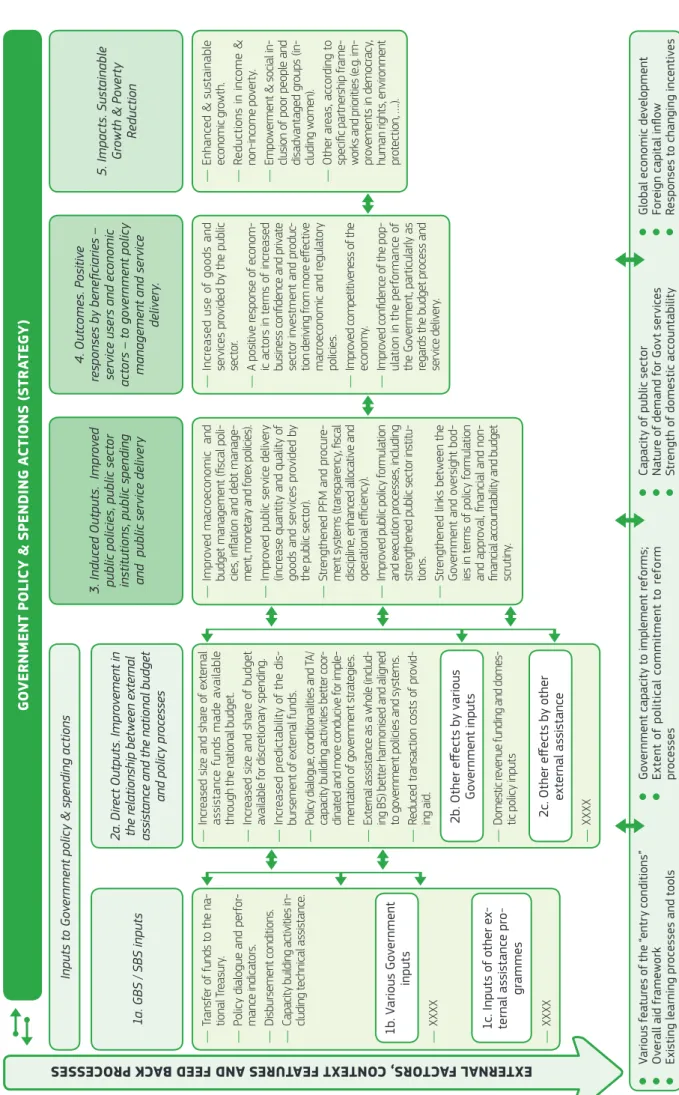
The intervention logic can be considered in two parts(11). The first part covers the effects of the budget support op
-eration (including associated policy dialogue and capacity development) on public policy, institutions, spending and
service delivery (the first three levels of the framework: budget support inputs (level 1); direct outputs (level 2) and
induced outputs (level 3)), recognising that these “induced outputs” will be determined by government actors and policies beyond the budget support package. The second part considers changes in outcomes (level 4) and impacts (level 5) expected from Government policies, strategies and spending, but also influenced by a range of other fac -tors (including other government policies, private sector and civil society initiatives, other aid programmes and ex-ternal factors) which need to be assessed during evaluation.
It is these elements, particularly those at levels 2 and 3 where the effects of budget support are more direct, that represent the expected benefits of budget support as an aid modality. These are likely to be particularly significant
in heavily aid dependent countries where budget support will contribute to capacity development to enable the use of country systems and support the development of coherent policies by partner governments.
The general objectives outlined above (eradicate poverty, sustainable economic growth, consolidate democracies)
are reflected in level 5 of the framework (impacts). The specific objectives and expected results will vary more wide -ly between individual budget support programmes, but will general-ly be focused on level 3 (induced outputs) and 4 (outcomes). Thus while acknowledging that budget support aims at making a contribution to the achievement of
(10) This would be consistent with the sectors identified in the Communication “Agenda for Change” under “Democracy, human rights and the rule of law” or “Public Sector
Management”.
(11) Figure 1 sets out the comprehensive evaluation framework recently piloted in the budget support evaluations for Tunisia, Mali and Zambia, and accepted with some
revisions as the basis for future evaluation work. This framework effectively provides the intervention logic for budget support, through which budget support trans-fers, coupled with policy dialogue, technical assistance and capacity development, contribute to improved outputs, outcomes and ultimately impacts. Evaluations of BS operations are joint donor exercises and therefore cover all BS operations within a specified period. The details of the Comprehensive Evaluation Framework therefore relate to the entire package of BS operations in a country and, thus, needs to be adapted if applied to specific BS operations.
Fi gu re 1 – C om pr eh en si ve E va lu at io n F ra m ew or k f or b ud ge t s up po rt e va lu at io ns G OV Er NME N T pOL iC Y & S pEN di N G A CT iO N S ( ST r AT EG Y ) In pu ts t o G ov er nm en t p ol ic y & s pe nd in g a ct io ns 3. I nd uc ed O ut pu ts . I m pr ov ed pu bl ic p ol ic ie s, p ub lic se ct or in sti tu tio ns , p ub lic s pen din g an d p ub lic se rv ic e d el iv er y ― Imp ro ved m ac ro ec on om ic a nd bud ge t ma na ge m ent (fi sc al p ol i -cie s, in flat io n and d ebt ma na ge -m en t, m on et ar y a nd f or ex p ol ici es ). ― Im pr ove d p ub lic s er vic e d el ive ry (in cr ea se qu an tit y a nd q ua lit y o f go od s a nd s er vi ce s p ro vi de d b y th e p ub lic s ec to r). ― St re ng the ned P FM a nd p ro cu re -m ent s ys tems (t ra ns pa ren cy , fi sc al di sc ipli ne , e nh an ce d a llo ca tiv e a nd op er at io nal effi cien cy ). ― Imp ro ved p ub lic p ol icy fo rm ula tion an d e xe cu tio n p ro ce ss es , in clu din g st ren gt hen ed p ub lic se cto r i ns tit u-tion s. ― St ren gt hen ed li nk s b et w een t he G over nm en t a nd over si gh t b od -ie s i n t er m s o f p ol ic y f or m ul at io n and a pp ro val , fi na nc ial a nd non -fina nc ial a cco un ta bi lit y and b ud ge t scr ut iny . 4. O utc om es . P os iti ve re sp on se s b y b en efi ci ar ie s – se rv ic e u se rs a nd e co no m ic ac to rs – t o g ov er nm en t p ol ic y m an ag em en t a nd se rv ic e de liv er y. ― In cr ea se d u se o f g oo ds a nd se rv ice s p ro vi de d b y t he p ub lic se cto r. ― A p os iti ve re sp on se o f e conom -ic a ct or s i n t er m s o f i nc re as ed bu sin ess c on fid enc e and p riv at e se ct or i nv es tm en t a nd p ro du c-tion de riv ing fr om m or e eff ec tive m ac ro ec on omi c a nd re gul at or y pol icie s. ― Imp ro ved comp eti tiv ene ss o f t he ec onom y. ― Imp ro ved con fid enc e of the p op -ul at io n i n t he p er fo rm an ce o f th e G over nm en t, p ar tic ul ar ly a s re ga rd s t he b ud ge t p ro ce ss a nd ser vic e d el iver y. 5. I m pa ct s. S us ta in ab G ro w th & P ov er ty Re duc tio n ― En ha nc ed & s us tai na ec onom ic g ro w th . ― Re du cti on s i n i nc ome non -inc ome p ov er ty . ― Em po w er m en t & s oc clu sio n o f p oo r p eo pl di sa dv an ta ge d g ro up clu din g w om en ). ― O th er a re as , a cc or di spec ifi c p ar tn er sh ip fr w or ks an d p rio rit ie s ( e. pr ov em en ts in d em ocr hu ma n r ig ht s, e nv iro nm pr ot ec tion , … .). ● Va rio us f ea tu re s o f t he “ en tr y c on di tio ns ” ● O ve ra ll a id f ra m ew or k ● Ex is tin g l ea rn in g p ro ce ss es a nd t oo ls ● G ov er nm en t c ap ac ity t o i m pl em en t r efo rm s; ● Ex te nt o f p ol it ic al c om m it m en t t o r efo rm pr oc es se s ● Ca pa ci ty o f p ub lic s ec to r ● N at ur e o f d em an d fo r G ov t s er vi ce s ● St re ng th o f d om es tic a cc ou nt ab ili ty ● G lo ba l e co no m ic d ev elo pm en ● Fo re ig n c ap ita l i nfl ow ● Re sp ons es t o c ha ng in g in ce nt ― Tr an sf er o f f un ds t o t he n a-tio na l T re asur y. ― Po lic y d ia lo gu e a nd p er fo r-m an ce in di ca tor s. ― Di sb ur sem en t c on di tio ns . ― Ca pac ity b ui ldi ng ac tiv iti es in -clu din g t ec hni ca l a ss ist an ce . ― XXXX ― XXXX 1a . G BS / S BS i np ut s 1c . I np ut s o f o th er e x-te rn al a ss is ta nc e p ro -gr am m es 1b. V ar io us G ov er nme nt in pu ts ― Dome sti c r ev en ue fu nd ing a nd dome s-tic p ol ic y i np ut s ― XXXX 2a . D ire ct O ut pu ts . I m pr ov em en t i n th e r el at io nsh ip b et w ee n e xt er na l as sis ta nc e a nd t he n at io na l b ud ge t an d p ol ic y p ro ce sse s ― In cr ea se d s ize a nd s ha re o f e xt er na l as si st an ce f un ds m ad e a va ila bl e th ro ug h t he na tio nal b ud ge t. ― In cr ea se d s iz e a nd s ha re o f b ud ge t av ai la bl e f or di sc re tio na ry s pe ndin g. ― In cr ea se d p re di ct ab ili ty o f t he d is -bu rs em ent o f e xt er nal fu nds . ― Po lic y d ia lo gu e, c on di tio na lit ie s a nd T A/ ca pac ity b ui ldin g ac tiv iti es b et te r c oor -din at ed a nd m or e c on du civ e for im pl e-m en ta tio n o f g over nm en t s tra te gie s. ― Ex te rn al a ss ist an ce a s a w ho le ( in clu d-in g B S) b et te r h ar m on ise d a nd a lig ne d to g ove rn m en t p ol icie s a nd s ys te m s. ― Re du ce d t ra ns ac tio n c os ts o f p ro vi d-in g a id . 2c . O th er e ff ec ts b y o th er ex te rn al a ss ist anc e 2b . O th er e ff ec ts b y v ar io us G ove rn m en t i np ut s EX TErNAL FAC TO rS, C ON TEX T FEA Tur ES A Nd FEEd BAC K pr OCES SES
the general objective reflected on the impact indicators such as sustainable growth and poverty reduction, the fo -cus should be on what budget support (and its complementary activi ties) can contribute to more directly, i.e. the
specific objectives and results.
Some example “intervention logics” that set out overall and specific objectives, as well as expected results and main
activities, for a GGDC, SRC and SBC can be found in Annex 2 to illustrate this more clearly. Expected results (linked
to the specific objectives and to be achieved by the end of the programme) should be as specific as possible in or -der to better assess and report on progress during implementation, support completion of an end of programme re-view, and facilitate ex-post evaluation.
Chapter 3
NEW GOVERNANCE
3. NEW GOVERNANCE FOR EU BUDGET SUPPORT
3.1. Introduction
The Communication on “The Future Approach to EU Budget Support to Third Countries” approved by the Commission on 13 October, with the full support of the EEAS, foresees the reinforcement of the capacity of the Commission to manage budget support. It states that:
“In order to engage in a genuine high-level political and policy dialogue with countries eligible for budget support in general, and for Good Governance and Development Contracts in particular, staff resources at EU Delegations will have to be reviewed nationally and regionally, both in terms of level and expertise.
To this end, the Commission will set up senior regional teams, at Headquarters and in EU Delegations, with the participa-tion of relevant Commission services and the EEAS. These teams will also consult with Member States as appropriate”.
This mechanism will be complemented by appropriate management tools, in particular a risk management frame-work. In this regard, the Communication states that:
“Commission services and where appropriate the EEAS will develop an improved risk management framework adapted
to the specific risk profile of budget support… This framework will be an important complementary tool in program
-ming, designing and implementing programmes and to inform policy dialogue… Risk response and mitigating meas
-ures will be proposed according to the balance between risks and benefits”.
Therefore, it has been agreed to set up the new governance structure foreseen by the Communication, at Headquarters
and EU Delegations, in charge of monitoring and implementing Budget Support. The objectives of these proposals are to:
1) Strengthen continuous policy steering at Senior Management and Commissioner level.
2) Enhance and ensure coherence of the EU budget support dialogue with partner countries, as agreed in the Communication.
3) Ensure policy coherence across countries and regions.
4) Reinforce the risk management and risk mitigation mechanisms
5) Support EU Delegations and HQ in programming, design and implementation of budget support programmes. The new governance structure will include new/strengthened structures both at Headquarters and in EU Delegations.
3.2. Headquarters
The Geographical Directors in DEVCO are, and will remain, directly responsible, in their role of Sub-Delegated
Authorising Officer, for the management of all budget support programmes in their region.
There will be no change in the current financial circuits, neither in HQs nor in EU Delegations. Relevant DEVCO services, including thematic experts, will continue to provide technical advice and support to the Geographical
Directorates through the quality support group or upon request.
Budget Support Steering Committee
In order to further involve the Director General in the decision making-process early enough to provide necessary strategic guidance, as well as to consult the Commissioners for Development, Neighbourhood, and the HR/VP as appropriate, a “Budget Support Steering Committee” will be created, chaired by the Director General of DEVCO. The Steering Committee will include:
― The responsible Geographical Director
― Relevant Thematic/Horizontal Directors
― Representatives of the Geographical services
― Representatives of the thematic services (for the sectors concerned)
― One representative from DG ECFIN (for macroeconomic/financial aspects) ― One representative of unit DEVCO A2 (secretariat)
The “Budget Support Steering Committee” (BSSC) will meet as regularly as is necessary. Its frequency will be determined by the timing of commitments and disbursements with every effort made to avoid delays in the deci -sion making process.
The Steering Committee will discuss Budget Support programmes to be presented to the relevant Management Committee of EU Member States, as well as disbursements of ongoing programmes, where there are substantial or high political and policy implications that need to be brought to the attention of, and formally engage, the sen-ior management and, as appropriate, the Commissioners (Development, Neighbourhood) and the HR/VP.
It is the responsibility of the Geographical Directors to include in the agenda of the BSSC such budget support
programmes and disbursement decisions. Directors A, C or D and the EEAS may also request referral of a BS oper -ation to the Steering Committee.
A decision in principle to engage in Budget support, particularly in high risk environments, as well as the decision to suspend budget support operations will be taken by the Director General (as chair of the Steering Committee) after
agreement, as appropriate, of the Commissioners (Development, Neighbourhood) and the HR/VP. Disagreements on is-sues of political governance, including fundamental values, will lead to consultation at Commissioner and/or HR/VP level.
3.3. EU Delegations in the Region
The Heads of Delegation and Delegation staff are, and will remain, directly responsible, in their respective Sub-Delegated roles, for the management of all budget support programmes in their Delegation.
Regional Budget Support Teams
The regional teams will have an advisory and support role to Geographical Directorates, HoD and EU Delegations in the region, in close cooperation with the relevant thematic experts. The Senior Regional Advisor will work under the instructions of the Geographic Director (SDAO) and in full cooperation with the Heads of EU Delegations in the region. The regional teams location will be decided by the Director General, after a proposal from the Geographic Director
and in agreement with the EEAS taking into account the administrative and budgetary capacity of EU Delegations to host the regional teams.
The regional teams structure and specific mandate will be decided by the Director General, after a proposal from
the Geographic Director and consultation with the EEAS.
The role of the Regional Teams will be to enhance the capacity of EU Delegations and Geographical Directorates to
prepare, oversee and implement high quality budget support programmes by:
1) Providing advice and support toEU Delegations in Budget support operations;
2) Providing advice to the respective Geographical Directorate on issues related to Budget support in the region;
3) Being fully associated with the Heads of Delegation in the budget support dialogue with the partner country, following instructions from the DEVCO Geographical Director,andwith participation of relevant Commission services and the EEAS.
The regional budget support teams will be chaired by a senior official designated by DEVCO (to be called Senior
Regional Advisor) and will comprise a number of officials, contract and local agents. They will also benefit from the support of DEVCO staff in the Delegation where they are based, if deemed necessary.
The Chair and staff of the regional teams will work as a team in close cooperation with thematic experts, HODs and with all other relevant staff in EU Delegations and HQ and the EEAS under the supervision of the Geographical Director.
As a rule, the Regional teams will be involved in Good Governance and Development Contracts and State Building Contracts dialogues, unless the Geographic Director or the BS Steering Committee decides otherwise. They will also be involved in Sector Reform Contracts dialogues in cases considered by the Geographic Director or the BS Steering Committee as presenting substantial or high risks.
3.4. Key Tasks of the new governance structures
3.4.1. Assessment of the pre-conditions for Good Governance and Development Contracts
With a view to ensure full respect of the preconditions and other criteria and before starting the identification phase,
the Director General of DEVCO, following discussions in the Budget Support Steering Committee and taking into ac-count the MIPs and the assessment made of the preconditions for budget support by the HoD, will identify which
countries fulfil all the conditions and eligibility criteria for Good Governance and Development Contracts, and will
seek the agreement as appropriate of the Commissioners for Development, Neighbourhood, and the HR/VP. The Geographical Director will provide the necessary information, the opinions of the Head of Delegation, the EEAS as well as the advice of the Regional teams to inform this decision.
Once this decision has been taken, the identification and formulation of GGDC programmes will start in line with the
currently existing decision-making procedures,
3.4.2. Risk Management Framework
The Director General of DEVCO is responsible for the risk management strategy and its effectiveness. The Geographical
Directors are responsible for the implementation and monitoring of the risk management in their region.
The Geographical Directorates, with support from EU Delegations and Regional Teams, shall provide country specific
information and propose alternative options for decision-making, including in response to deteriorating situations.
The EEAS leads on the political risks involved in budget support and instructs, as required, the Head of Delegation,
on the line to take in relation to political dialogue. The HOD will ensure consistency at the country level between the budget support dialogue and the political dialogue.
Regional Teams will support the EU Delegations and the Geographical Directorates in implementing the risk
manage-ment strategy and framework in a consistent and effective way across countries by providing inputs that will help: a) to inform decisions on the risk level; and balancing risks and benefits of providing budget support (or not); b) to formulate mitigating measures and risk responses as part of a risk strategy and to reflect these in the dia
-logue on budget support;
The implementation of the Risk Management Framework will inform the Geographical Directorates on where
addi-tional policy and dialogue efforts should be deployed.
3.4.3. Ensure quality and policy coherence of budget support
Quality and policy coherence of budget support programmes across countries and regions will be ensured at two levels:
● Geographical, Thematic and Policy Directorates: will ensure quality and policy coherence between countries in
the same region, with the support of the Regional BS teams and thematic hubs.
3.4.4. Conduct the necessary Budget Support dialogue
Under instructions given by the Geographical Directors (sometimes after discussions in the BSSC), the HoDs chair the policy dialogues, as first interlocutors with local authorities. The Senior Regional advisor and the Regional Teams
will be fully associated to these dialogues. When the Geographical Director decides to visit the partner country, s/he chairs the dialogues, in full association with the HoD and the regional teams.
There will be close coordination with the EEAS, in charge of the overall political dialogue, as well as with EU Delegations
and geographic services, in charge of the continuous policy dialogue with the beneficiary country.
The dialogue will be intensified and more strategic in countries receiving Good Governance and Development Contracts
This chapter describes how issues relating to fundamental
val-ues are to be considered in the framework of Good Governance
and Development Contracts (General Budget support)
pro-grammes in third countries. It reviews the principles to be
fol-lowed, the scope of the assessment, how fundamental values
link to different contexts of Good Governance and Development
Contracts (General Budget support), the process to assess and
monitor the fundamental values and finally discuss the wider
process of EU coordination in this area.
FUNDAMENTAL VALUES
AND BUDGET SUPPORT
4. FUNDAMENTAL VALUES AND BUDGET SUPPORT
Principles
Article 21 of the Treaty on European Union defines democracy, rule of law and the universality and indivisibility of human rights and fundamental freedoms as guiding principles of the EU’s action on the international scene. A pos
-itive and pro-active approach is required to implement these guiding principles, which requires coherence between
the EU development policy and the EU CFSP.
As stated in art. 208 TEU, development cooperation shall be conducted in the framework of the principles and ob-jectives of the Union´s external action and its primary objective is poverty reduction and eradication.
In addition to the primary objective of poverty reduction, there is the general EU commitment and adherence to the fundamental values of human rights, democracy and rule of law, which are essential elements of all the
EU’s partnerships and cooperation agreements with third countries.
In this context, Good Governance and Development Contracts (General Budget support) could be provided where
there is trust and confidence that state budget funds will be spent pursuant to the fundamental values that the EU
and the partner country share, and for the respect of which partner countries commit to move forward.
Scope
Article 21 of the Treaty defines as guiding principles of the EU external action:
“democracy, the rule of law, the universality and indivisibility of human rights and fundamental freedoms, respect for human dignity, the principles of equality and solidarity, and respect for the principles of the United Nations Charter and international law.”
The scope of assessment shall refer inter alia to international instruments, ratification, transposition into domes
-tic laws, the relevant institutional framework and effective implementation. It shall build on the relevant EU Human
Rights Country Strategies and the analyses they contain on country situations.
It may include corruption in so far as there may be fundamental breaches in the rule of law, but concerns around
the strength of public financial management systems and the fiduciary implications of corruption should be consid
-ered as part of the public financial management eligibility criterion.
The assessment will determine the extent to which the government of a third country concerned is committed to the
effective protection and promotion of these fundamental values, as well as changes and trends over time, in a dynam
-ic process, based on minimal standards, e.g. in terms of ratif-ication of the core international instruments that express
the shared commitments to fundamental values. This exercise should build on, and fully take into account, existing mechanisms, documents, instruments and dialogues, including output of UN and regional human rights mechanisms.
Promotion and protection of fundamental values via Budget Support
With Good Governance and Development Contracts (GGDCs), the EU aims at fostering domestic accountability and strengthening national systems and control mechanisms, as a basis for promoting broad reforms leading to poverty reduction and improving governance, including adherence to fundamental values.
Delivering assistance through GGDC is to be seen as an implicit recognition that the partner country’s overall poli -cy stance and democratic governance is on track, or moving in the right direction. Therefore, GGDC (General budget
support) could be provided where there is trust and confidence that state budget funds will be spent while the part -ner country continues to be committed to make fundamental values move forward.
The GGDC is an instrument to support broad reforms that lead to poverty reduction, improved governance, while signalling a mutual and shared commitment to universal fundamental values. Therefore, the
commit-ment to fundacommit-mental values needs to be assessed as a pre-condition for any GGDCs, and subsequently monitored
during implementation (to identify slippage, policy reversals and deterioration).
When Sector Reform Contracts are selected as the most appropriate support modality, adherence to fundamen-tal values should be taken into account. In general, Sectoral budget support is geared at promoting sectoral policy reforms and delivering basic services to the people.
Sector Budget support remains a useful tool even where the conditions do not exist to permit the use of GGDC,
be-cause it often remains the best delivery mechanism, and can be used as a vector to improve governance. Assessing
EU sector budget support in the light of political govenance will need to be carefully balanced against the need to serve and protect the population. However, where political governance has severely deteriorated, the EU should re-assess its overall development cooperation with the partner country, including sector budget support.
Particular care should be taken when supporting sectors which have a direct link with fundamental values, such as justice and security.
In case of State Building Contracts, the assessment of the government’s commitment to fundamental values as
well as the political response to adress them in a comprehensive way are aspects to be considered, inter alia, when
deciding to engage with these countries. In the context of a fragile or conflict affected situation, the EU should adopt
a forward looking approach accompanied by reinforced political and Budget support dialogues. The risk of inaction should be balanced with the development and basic needs implications of not engaging in fragile states.
Structures and Mechanisms
There are already a number of relevant mechanisms in place which enable the EU to monitor trends in the situation as regards human rights and other fundamental values:
● Regular, political reporting from the Heads of the EU Delegation (and/or of EU Heads of Mission when
appro-priate), provide continuous information and assessments of political developments, also in terms of fundamental values, and recommendations are formulated as appropriate.
● The ongoing political dialogue between the EU and the partner country is a key forum to address concerns
and challenges relating to fundamental values, including human rights issues.
● The EU Human Rights country strategies are very useful tools, and represent comprehensive assessments cov-ering the principles defined in Article 21 and also identify the activities envisaged to attain the objectives. They
take into account, and link, to the Universal Periodic Reviews undertaken in the United Nations context. They do not need to be replicated for this purpose.
They should be fed in the discussions of the Budget Support Steering Committee and in the Budget Support dia-logue, which addresses all issues related to Budget support operations (with the participation of the EEAS and the Head of the EU Delegation).
When proposing the MIP including the EU response strategy during the programming phase, the Head of Delegation could propose as a priority sector “Good Governance and Development”. In such cases, the HoD will provide his assessment on:
● whether the preconditions in terms of fundamental values, are met for providing GGDC (General budget
sup-port), and – if appropriate – what conditions would need to be met, or which development would need to take
place, for the EU to be able to initiate or resume support through GGDC (General budget support);
● which areas of fundamental values, and other aspects, are likely to be raised in the political and Budget Support dialogues with the partner country in the short and medium term.
● A brief identification of the political risks, to be considered for the “risk management framework” for the country.
The Budget Support Steering Committee will take into account existing information and documentation on fun-damental values, including HRs country strategies, as provided by the EEAS, as well as the opinion of the Head of Delegation and the advice of Regional teams and the Geographic services.
The Director General of DEVCO, following discussions in the Budget Support Steering Committee, will identify which countries fulfil the pre-conditions for Good Governance and Development Contracts, and will seek the agree-ment of the competent Commissioners (Developagree-ment or Neighbourhood) and the High Representative/Vice-President, as appropriate.
Four types of situations can emerge, insofar as fundamental values are concerned
1 Mostly stable or positively progressing situation. The situation with regard to fundamental values allows the EU to continue to deploy activities planned with GGDC (General budget support), including its disbursements.
Minor modifications or adaptations can be made to the GGDC (General budget support) operations to better
provide for promoting fundamental values, but overall the situation is deemed as being on track in this respect. 2 Some concerns arising, but an overall respect of fundamental values is nevertheless still observed. The
Commission (Geographic Director), following the advice of the EU Head of Delegation, EEAS and the Regional Budget Support teams may propose mitigation measures, changes to activities and approach to follow in rela-tion to disbursements, to the Budget Support Steering Committee. DEVCO and the EU Delegarela-tion then undertake
the necessary financial or contractual adjustments or measures, as appropriate.
3 Significant deterioration of fundamental values. The EEAS and the EU Delegation, with support from the Budget Support regional teams, will provide a report, including an analysis of the political impact on the budget support operations, and their recommendations for action to the Geographic Director, who then refers this BS programme, with his recommendation, to the Budget Support Steering Committee for decision. The Budget Support Steering Committee will then decide on the re-orientation of the planned budget support aid towards other delivery modalities, and/or the adoption, of precautionary measures. The Development or Neighbourhood Commissioners, and the HR/VP will be consulted, as appropriate.
4 In the extreme cases where overall cooperation needs to be suspended(ex art 96 of Cotonou agreement, and similar procedures normally based on art 1 of Agreements in the DCI and Neighbourhood regions), appropriate meas-ures are decided by the EU Institutions, which can include a reallocation of funds to non-governmental channels.
EU coordination on fundamental values and GGDC (General budget support)
The EU is aiming at a close coordination in the assessment and monitoring of fundamental values, both at local and capitals levels, including by means of the EU Human Rights country strategies and the political follow-up of the country provided by the EU Delegations. EU coordination in the appreciation of the situation of the
fundamen-tal values is desirable to face the consequences of decisions to be taken, which can include a decision by some EU
Member States or by the Commission to suspend budget support.
Gradualism and proportionality of the responses to be considered by the EU
Any EU response to a significant/serious deterioration in the situation of fundamental values should be progressive and proportionate, except in the very serious cases where immediate suspension may be necessary. There are a number of contingency measures which can be considered to promote fundamental values and allow for a balanced response from the EU so as to achieve the best outcome in terms of defending and promoting fundamental values: 1. Enhanced dialogue should be the first response either to allay the concern and/or to agree on a roadmap for
restoring confidence.
2. When dialogue fails, the Budget Support Steering Committee may consider different options, including delaying disbursements (to provide time to clarify the situation and agree on appropriate action), reallocating (General budget support) funds to other aid delivery modalities or a reduction of General budget support
3. Suspension of GGDC (General budget support), as a measure of last resort,
Short term conditions agreed to by the partner country, including for example a roadmap for alleviating concerns, can be put in place setting, new terms for resuming GGDC (General budget support), reallocating temporarily funds to other delivery modalities or providing, if necessary, funds for enabling correction of problem areas that were
iden-tified as critical
Use can be made of the Article 23 of the Financing Agreements, which are jointly signed by the Commission and the beneficiary country, and that provides for formal ways for suspending budget support. This can be: a) Gradual, by means of a reduction of the value of planned disbursements in order to provide a clear signal that changes are needed, as the situation is deteriorating., b) Temporary suspension as part of precautionary measures, c) Complete, full and formal suspension of budget support to make it clear that the situation in terms of fundamental values is no longer compatible with providing General budget support to the country.
Where conditions allow it and subject to the eligibility criteria, a reallocation to a Sector reform contract or sector programme can be made. Alternatively, a reallocation can be made to project aid. The choice between alternative aid delivery modalities in case of deterioration should be carefully assessed, so as to balance the need to
con-tinue responding to development and people’s needs and the respect and promotion of fundamental values, using
This chapter sets out the key issues that need to be considered
throughout the programme cycle. The chapter begins by
con-sidering eligibility, and also summarises the approaches to
pol-icy dialogue, risk assessment and management, performance
assessment and domestic revenue mobilisation, accountability,
fraud and corruption, and capacity development. Further
de-tails are in Annexes 3-8.
DESIGN
AND IMPLEMENTATION
OF BUDGET SUPPORT
5. DESIGN AND IMPLEMENTATION OF BUDGET SUPPORT
5.1. Eligibility Criteria for Approval & Disbursement
Budget support programmes are subject to the following four eligibility criteria covering:
● National/sector policies and reforms (“public policies”) ● Stable macro-economic framework
● Public financial management
● Transparency and oversight of the budget
These criteria need to be met both when a programme is approved, and at the time of each budget support dis-bursement. The assessment of the eligibility criteria generally involves:
1) Assessment, during identification and formulation, of the relevance and credibility of the partner country policy and strategy related to each eligibility criterion:
● Relevance: refers to extent to which key constraints and weaknesses are being addressed by the government’s
strategy to reach the objectives of the policy.
● Credibility: refers to the quality of the reform process regarding its realism, institutional arrangements, track
record and political commitment to the reforms.
2) Assessment, during implementation, of progress made in implementing the policy and strategy and achieving the objectives:
● Satisfactory progress: it should be based on a dynamic approach, looking at past and recent policy performance benchmarked against reform commitments, but allowing for shocks and corrective measures and refining the
objectives and targets if necessary. For some criteria (notably PFM), progress against initial reform milestones
is particularly important; for others (macroeconomic, for example), maintaining stability-oriented policies is suf
-ficient to confirm eligibility. The setting of targets and assessment of progress should take into account the initial
starting point. In countries with already strong performance and systems the assessment should focus on
main-taining the quality of the systems. The continued relevance and credibility of any strategy should be confirmed.
Eligibility criteria during formulation and implementation
For approval (end of formulation):
A country may be considered eligible when:
● Public policy: There is a credible and relevant national/sector development strategy that supports the objectives of poverty reduction, sustainable and inclusive growth, and democratic governance. ● Macroeconomic: There is a credible and relevant programme to restore and/or maintain macroeconomic
stability.
● PFM: There is a credible and relevant programme to improve public financial management.
● Budget transparency: the government has published either the Executive’s Proposal or the Enacted Budget
within the previous or current budget cycle.
During implementation (suggested wording for General Conditions):
● Public policy: satisfactory progress in the implementation of [cite appropriate public policy/strategy
docu-ment] and continued credibility and relevance of that or any successor strategy.
● Macroeconomic: maintenance of a credible and relevant stability-oriented macroeconomic policy or
pro-gress made towards restoring key balances.
● PFM: satisfactory progress in the implementation of its programme to improve public financial management. ● Budget Transparency: satisfactory progress with regard to the public availability of accessible, timely,
Assessments should be reasonably short (avoiding lengthy descriptions of the policy) and analytical, providing a clearly argued and justified recommendation regarding eligibility. A reform programme may not always be encap-sulated into a single, comprehensive and coherent policy or strategy document. In such cases, the analysis will be based on the different me