A Model-based Approach to Resilience
Dissertation
zur Erlangung des akademischen Grades Doktoringenieur (Dr.-Ing.)
vorgelegt an der
Technischen Universität Dresden Fakultät Informatik
eingereicht von
Dipl.-Inf. Georg Püschel
geboren am 15. Mai 1985 in Dippoldiswalde
Erster Gutachter: Prof. Dr.-Ing. Thomas Schlegel
Zweiter Gutachter: Univ.-Prof. Dr.-Ing. habil. Matthias Riebisch Tag der Verteidigung: 05. Juni 2018
from third parties. No other than the resources and references indicated in this thesis have been used. I have marked both literal and accordingly adopted quotations as such. There were no additional persons involved in the intellectual preparation of the present thesis. I am aware that violations of this declaration may lead to subsequent withdrawal of the degree.
Dresden, June 28, 2018
tems. Self-driving cars, mail-delivering drones, automated guided vehicles in production sites, and housekeeping robots need to decide autonomously during most of their operation time. As soon as human intervention becomes necessary, the cost of ownership increases, and this must be avoided. Although the algorithms controlling autonomous systems become more and more intelligent, their hardest opponent is their inexibility. The more environmental situations such a system is confronted with, the more complexity the control of the autonomous system will have to master. To cope with this challenge, engineers have approached a system design, which adopts feedback loops from nature. The resulting architectural principle, which they call self-adaptive systems, follows the idea of iteratively gathering sensor data, analyzing it, planning new adaptations of the system, and nally executing the plan. Often, adaptation means to alter the system setup, re-wire components, or even exchange control algorithms to keep meeting goals and requirements in the newly appeared situation.
Although adaptivity helps engineers to organize the vast amount of information in a self-deciding system, it remains hard to deal with the variety of contexts, which involve both environ-mental inuences and knowledge about the system's internals. This challenge not only holds for the construction phase but also for verication and validation, including software test. To assure sucient quality of a system, it must be tested under an enormous and, thus, unmanageable, number of dierent contextual situations and manual test-cases.
This thesis proposes a novel set of methods and model types, which help test engineers to specify precisely what they expect from a self-adaptive system under test. The formal nature of the introduced artifacts allows for automatically generating test-suites or running simulations in the loop so that a qualitative verdict on the system's correctness can be gained. Additional to these conceptional contributions, the thesis describes a model-based adaptivity test environment, which test engineers can use for testing actual self-adaptive systems. The implementation in-cludes comprehensive tooling for creating the introduced types of models, generating test-cases, simulating them in the loop, automating tests, and reporting. Composing all enabling com-ponents for these tasks constitutes a reference architecture of integrated test environments for self-adaptive systems. We demonstrate the completeness and accuracy of the technical approach together with the underlying concepts by evaluating them in an experimental case study where an autonomous robot interacts with human co-workers.
In summary, this thesis proposes concepts for automatically and, thus, eciently testing self-adaptive systems. The quality, which is fostered by this novel approach, is resilience: the ability of a system to maintain its promises while facing changing environments.
• Georg Püschel, Ronny Seiger, Thomas Schlegel (2012). Test Modeling for Context-Aware Ubiquitous Applications with Feature Petri Nets. In Modiquitous Workshop, pp. 1-4, 2012. • Georg Püschel, Testmodellierung für mobile Anwendungen. In Proceedings of
Innovations-forum Open4Innovation, pp. 65-69, 2012.
• Georg Püschel, Christian Piechnick, Sebastian Götz, Christoph Seidl, Sebastian Richly, Uwe Aÿmann, A Black Box Validation Strategy for Self-Adaptive Systems. In Proceedings of ADAPTIVE 2014, The Sixth International Conference on Adaptive and Self-Adaptive Systems and Applications, pp. 111-116, 2014.
• Georg Püschel, Sebastian Götz, Claas Wilke, Christian Piechnick, Uwe Aÿmann. Testing Self-Adaptive Software: Requirement Analysis and Solution Scheme. International Journal on Advances in Software, ISSN 1942-2628, 7(1&2), pp. 88-100, 2014.
• Georg Püschel, Christian Piechnick, Sebastian Götz, Christoph Seidl, Sebastian Richly, Thomas Schlegel, Uwe Aÿmann, A Combined Simulation and Test Case Generation Strat-egy for Self-Adaptive Systems. International Journal On Advances in Software, 7(3&4), pp. 686-696, 2014.
Further publications related to the thesis:
• Georg Püschel, Test Modeling of Dynamic Variable Systems Using Feature Petri Nets. Technische Universität Dresden, Fakultät Informatik. ISSN 1430-211X, TUD-Fl13-01-Sept. 2013. Technical Report, 2013.
• Georg Püschel, Christian Piechnick, Uwe Aÿmann, Generative und simulative Softwaretests für selbstadaptive, cyber-physikalische Systeme. In Proceedings of the Multiconference Soft-ware Engineering and Management 2015, Koellen-Verlag, 2015.
1 Introduction 1
1.1 Problem Description . . . 1
1.2 Overview of Adopted Methods . . . 3
1.3 Hypothesis and Main Contributions . . . 4
1.4 Organization of This Thesis . . . 5
I Foundations 7 2 Background 9 2.1 Self-adaptive Software and Autonomic Computing . . . 9
2.1.1 Common Principles and Components of SAS . . . 10
2.1.2 Concrete Implementations and Applications of SAS . . . 12
2.2 Model-based Testing . . . 13
2.2.1 Testing for Dependability . . . 14
2.2.2 The Basics of Testing . . . 15
2.2.3 Automated Test Design . . . 18
2.3 Dynamic Variability Management . . . 22
2.3.1 Software Product Lines . . . 23
2.3.2 Dynamic Software Product Lines . . . 25
3 Related Work: Existing Research on Testing Self-Adaptive Systems 29 3.1 Testing Context-Aware Applications . . . 30
3.2 The SimSOTA Project . . . 31
3.3 Dynamic Variability in Complex Adaptive Systems (DiVA) . . . 33
3.4 Other Early-Stage Research . . . 34
3.5 Taxonomy of Requirements of Model-based SAS Testing . . . 36
II Methods 39 4 Model-driven SAS Testing 41 4.1 Problem/Solution Fit . . . 41
4.2 Example: Surveillance Drone . . . 43
4.3 Concepts and Models for Testing Self-Adaptive Systems . . . 44
4.3.1 Test Case Generation vs. Simulation in the Loop . . . 44
4.3.3 Basic Representation Format: Petri Nets . . . 46
4.3.4 Context Variation . . . 50
4.3.5 Modeling Adaptive Behavior . . . 53
4.3.6 Dynamic Context Change . . . 57
4.3.7 Interfacing Context from Behavioral Representation . . . 62
4.3.8 Adaptation Mode Variation . . . 64
4.3.9 Context-Dependent Reconguration . . . 67
4.4 Adequacy Criteria for SAS Test Models . . . 71
4.5 Discussion on the Viability of the Employed Models . . . 71
4.6 Comparison to Related Work . . . 73
4.7 Summary and Discussion . . . 74
5 Model-based Adaptivity Test Environment 75 5.1 Technological Foundation . . . 76
5.2 MATE Base Components . . . 77
5.3 Metamodel Implementation . . . 78
5.3.1 Feature-based Variability Model . . . 79
5.3.2 Abstract and Concrete Syntax for Textual Notations . . . 80
5.3.3 Adaptive Petri Nets . . . 86
5.3.4 Stimulus and Reconguration Automata . . . 87
5.3.5 Test Suite and Report Model . . . 87
5.4 Test Generation Framework . . . 87
5.5 Test Automation Framework . . . 91
5.6 MATE Tooling and the SAS Test Process . . . 93
5.6.1 Test Modeling . . . 94
5.6.2 Test Case Generation . . . 95
5.6.3 Test Case Execution and Test Reporting . . . 96
5.6.4 Interactive Simulation Frontend . . . 96
5.7 Summary and Discussion . . . 97
III Evaluation 99 6 Experimental Study: Self-Adaptive Co-Working Robots 101 6.1 Robot Teaching and Co-Working with WEIR . . . 103
6.1.1 WEIR Hardware Components . . . 104
6.1.2 WEIR Software Infrastructure . . . 105
6.1.3 KUKA LBR iiwa as WEIR Manipulator . . . 106
6.1.4 Self-Adaptation Capabilities of WEIR . . . 107
6.2 Cinderella as Testable Co-Working Application . . . 109
6.2.1 Cinderella Setup and Basic Functionality . . . 109
6.2.2 Co-Working with Cinderella . . . 110
6.3 Testing Cinderella with MATE . . . 112
6.3.1 Automating Test Execution . . . 112
6.3.2 Modeling Cinderella in MATE . . . 113
6.3.3 Testing Cinderella in the Loop . . . 121
6.4 Evaluation Verdict and Summary . . . 123
7 Summary and Discussion 125 7.1 Summary of Contributions . . . 126
7.2 Open Research Questions . . . 127
Appendix Cinderella Denitions 139 1 Cinderella Adaptation Bounds . . . 139 2 Cinderella Self-adaptive Workow . . . 140
1.1 The state space of an SAS . . . 2
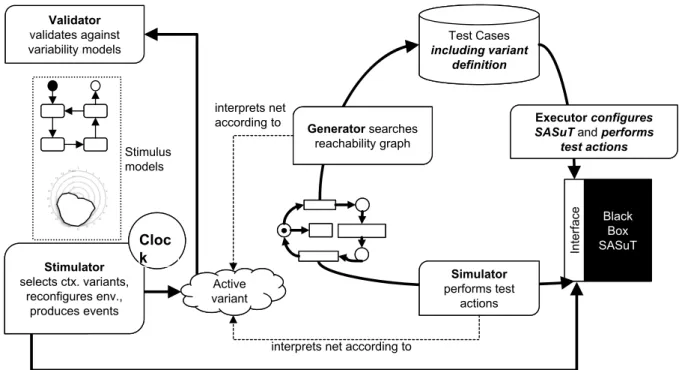
1.2 Thesis outline . . . 5
2.1 The control loop structure of SAS [IBM06] . . . 11
2.2 The causality chain of faults, errors, and failures (redrawn from [ALRL04]) . . . . 14
2.3 The V-Modell (redrawn from [Gre10]) . . . 16
2.4 Dynamic test process (redrawn from [IEE13a]) . . . 16
2.5 The MBT Process [UL07] . . . 19
2.6 Sample nite state machine for a simple webshop . . . 22
2.7 Example of the original feature tree notation (taken from [KCH+90]) . . . 24
3.1 Taxonomy of requirements of model-based SAS testing. . . 36
4.1 Problem/Solution t . . . 42
4.2 The conceptional process of SAS testing . . . 45
4.3 Petri net for the drone example . . . 47
4.4 Petri net reachability graph . . . 48
4.5 Usage of the Petri net in simulation and test-case generation . . . 49
4.6 Context variability model . . . 52
4.7 Adaptive Petri net modeling adaptive behavior . . . 54
4.8 Usage of the variability model in simulation and test-case generation . . . 56
4.9 Dierent types of change models. . . 58
4.10 Variant manipulation and its eect on the denition of expected behavior . . . . 59
4.11 Virtually timed change models . . . 60
4.12 Integration of stimulus models in simulation and generation . . . 62
4.13 Adaptive Petri net with timer transitions . . . 63
4.14 Generation and simulation infrastructure with timer-transition-based synchroniza-tion . . . 65
4.15 Explicit representation of adaptation modes . . . 66
4.16 Stimulus models with event production . . . 69
4.17 Causal chain of stimulus and reconguration . . . 69
4.18 Generation and simulation infrastructure including reconguration and explicit adaptation modes . . . 70
4.19 Comparison of the proposed approach to related work . . . 73
5.1 Layers and components of MATE . . . 77
5.2 Packages of the MATE metamodel with dependencies . . . 79
5.4 Classes and relations of the abstract syntax for variability constraints (package
constraints) . . . 81
5.5 Abstract syntax of functions language (package functions) . . . 82
5.6 The abstract syntax of the term language (package terms) . . . 84
5.7 The abstract syntax of the test action language (package actions) . . . 85
5.8 Metamodel for adaptive Petri nets (package petri) . . . 86
5.9 Common metamodel for automaton-based stimulus models reconguration au-tomata (package reconfiguration) . . . 88
5.10 Metamodel for test-suites (package test) . . . 88
5.11 Classes and relations of the generator framework (package generator) . . . 89
5.12 Metamodel for test-automation (package automation) . . . 92
5.13 The process of SAS testing with MATE . . . 94
5.14 A running simulation in MATEs . . . 96
6.1 Functional modes of the DLR co-worker, redrawn from [HSF+11] . . . 102
6.2 WEIR hardware . . . 104
6.3 WEIR software components . . . 105
6.4 WEIR-controlled KUKA LBR iiwa . . . 107
6.5 Adaptation bounds, movables, and state machine for collision detection . . . 108
6.6 Example WEIR adaptive workow . . . 109
6.7 Cinderella setup . . . 111
6.8 Cinderella co-working behavior . . . 111
6.9 Variability model for Cinderella . . . 113
6.10 Event ow through the Cinderella test model . . . 114
6.11 Spatial context stimulus model for Cinderella . . . 115
6.12 Model of movement of body parts for Cinderella . . . 116
6.13 Reconguration automaton for one Cinderella picking box . . . 118
6.14 Cobotics reconguration automaton for Cinderella . . . 119
6.15 Adaptive Petri net for Cinderella . . . 120
6.16 Running Cinderella test . . . 122
6.17 Representation of proposed concepts in Cinderella . . . 123
Imagine robots that build our houses, organize our household, and manage our everyday prob-lems. Others transport us to our job or holiday location, or wherever we need to go. Such systems, however, are not anymore bound to a single, controlled location, such as industry work-stations or a living room's carpet. Consequently, they have to cope with the dynamics of real environments, just like humans do. Such intelligence requires a new kind of software to take control and to determine at run-time how the whole system should adapt to newly explored surroundings. Software engineering characterizes such kind of system as self-adaptive.
Self-adaptive software orto a greater extenta self-adaptive system (SAS) observes proper-ties of itself and its environmentor more precisely its contextand automatically adapts itself at run-time to a set of goals [Lad97]. The loop-wise execution of this process allows SAS for autonomously adhering to the goals, that is without manual intervention. Vice versa, auton-omy in physical, mostly uncontrollable environments demands such a self-adaptive mechanism. Recent and future cyber-physical systems, self-steering cars, unmanned air vehicles, and many other applications of autonomy will benet from recent ndings of SAS research.
From the perspective of quality assurance, failures in self-adaptive applications can be highly critical. Self-adaptivity unavoidably leads to systems that interact autonomously with other sys-tems or people and their property with the risk of severely damaging them. Thus, the functional correctness and the quality of SAS has to be veried and validated extensively before delivery.
Software engineering processes employ validation and verication (V&V) on dierent abstrac-tion layers and at dierent points in time during the product lifecycle. Testing, as the most widely adopted method of V&V, is based on code, components, interfaces, and requirement specications, each with increasing level of abstraction. This thesis focuses on testing the func-tional correctness of SAS, performed on the abstract level of interfaces and requirements, which we call black-box testing because it neglects internal structures of the system under test (SUT).
1.1. Problem Description
Despite the severe need to test SAS, their complexity does not comply well with traditional test approaches. Changes in the environment, in the adaptation of behavior, and the adaptation of the SUT's structural appearance, as well as the causality in between, are not considered in standard testing. Jean-Claude Laprie summarizes the quality of SAS to be dependent on external inuences as resilience:
Denition 1 (Resilience) The persistence of service delivery that can justiably be
1. Introduction
(a) Context states (C) combine with system states (S). The resulting state must adhere to modelsM (re-drawn from [CdLG+09]).
(b) The behavior additionally depends on history. Hence, a third time dimension tis considered.
Figure 1.1.: The state space of an SAS.
Testing SAS is challenging and unique because the bandwidth of conditions in context and adaptation generates structural and behavioral variability that by far exceeds those of traditional systems. This variability can be described as a highly complex state space, as already recognized by Cheng et al. [CdLG+09]. According to them, each state is a compound of context and system
conditions. When one of the two changes, a completely new situation constitutes. This relation is illustrated in Figure 1.1a. The illustration shows the conguration spaces of the context C
and the systemS, 1which are combined in sense of the propositions that hold at a certain point
in time. Having 100 context states and 100 system states gives 100∗100 = 10000 possible
congurations. Additionally, the system adapts itself or, in other words, it changes its operation mode j. Thus, adaptation further inates the state space. Of course, the specication does not
allow all of those combinations; the state space is segregated in a valid and an invalid subset. V&V is in charge to assure that the risk of trespassing this line of segregation remains low during the productive operation phase.
The specication of permitted behavior denes propertiesPt
ji, which can be tested for certain
transitions and othersPj that are expected to hold for a complete adaptation mode. All these
expectations must be reected by models for statesMji and models for transitionsmji.
In black-box testingas investigated in this thesis, another eect is the incomplete knowl-edge of the inner processes of the SUT. Testers can never be sure about eventually changed states so that only a strict history of sequences actions guarantees the reproduction of a targeted state. This eect is illustrated in Figure 1.1b. Not only context, system, and adaptation mode inuence the assumed state but also the history of performed test actions, which here is represented by the time dimensiont.
To consider all these eects, validation methods usually implement three dierent mechanisms for checking given expectations: (1) a mechanism to enforce a particular state, (2) an oracle that anticipates the expected properties, and (3) a mechanism for comparing those expected properties with measured ones. Standard test-cases incorporate all threethey enforce a state based on action sequences and test data, query for results and compare them to given values dened in a test data repository. However, in traditional testing, the tester manually provides all these ingredients, which is inecient in the face of an SAS' highly variable behavior. The combinatorial eects cause case explosion, which is the multiplication of the number of test-cases caused by each additional variable to be considered. Similarly, the notion of state space explosion describes the combinatorial eects on the operational and parameter space, which must be covered by those test-cases. Whereas test-case and state space explosion are already hard to manage when testing traditional systems, testers are lost in SAS testing.
Another misconception is the assumption that all states of an SAS under test (SASuT) are explicitly known to designers and testers. The autonomy fostered by SAS also requires an algorithmic design in which reconguration is automatically decided based on rules, heuristic methods, or even articial intelligence, including machine learning approaches. Similarly, the physical environment of autonomous applications cannot be controlled with the same precision as for virtual environments. Instead, the eects of physical manipulation can often only be measured and the system's reaction be veried based on this measurement. Here, so-called stigmergy (i.e., information transfer by physical manipulation [KFH15]) and external environment dynamics aect the real context state. Consequently, manual testing faces the problem that the test designer is not able to explicitly pre-dene all states that will be reached during processing. Thus, much more information is implicit and must be investigated and checked with the means of software testing.
Some past research proposed to built-in mechanisms of self-testing into SAS [KACC11]. In this approach, components of SAS are equipped with test-cases or templates that are executed at adaptation time. Such mechanisms even allow for testing unanticipated change where com-ponents are integrated at run-time without that a designer could have anticipated the reached conguration. This thesis neglects such methods as they fall short in classical software quality assurance. In contrast, products have to be provided in an acceptable quality at the moment when they are shipped to the customer.
In consequence, the manufacturer must perform tests in advance and systematically so that engineers can subordinate SAS testing to the standard processes of V&V. However, due to the lack of sucient SAS test methods, no eective tooling yet exists. Such tooling should incorporate support for all test process steps: test design, automation, execution, and reporting. To cope with the special requirements of SAS, each of these steps must be enriched with new technical concepts.
In summary, the concrete vision of this thesis is an ecient set of models and methods for systematic a-priori testing SAS together with a ready-to-use realization. Consequently, the following major problems arise:
(P1) Vast expansion of the state space of SAS: SAS monitor changing properties of their context and react at run-time by changing their conguration in the form of structural composition, parameterization, and service behavior. To assure the system's quality ade-quately, a wide variety of contextual situations have to be enforced and the reaction veried. Furthermore, not only the current situation may play a role but the past situations as well. All these factors introduce multiply variation points, which produce a much larger state space than in traditional computing. In consequence, overlooking this state space and testing paths through it for verication is highly demanding for test experts.
(P2) Missing tooling for testing SAS: Test engineers lack an integrated environment, which allows for performing tests on SAS. This lack includes tools for test design, automation, execution, and reporting. Respective solutions should incorporate support for all these process steps and leverage standards of test tooling to SAS-specic requirements.
1.2. Overview of Adopted Methods
The problems enumerated in Section 1.1 shall be tackled by dierent concepts, which combine to an overall conceptional and technical solution. The foundations of this solution are outlined in the following.
Model-based Testing The necessity of abstraction of context and system behavior by a valida-tion model was already recognized by Cheng et al. in [CdLG+09]. Against this background and
1. Introduction
models in place of test-cases; more precisely, the rst generates the latter [UL07]. Thus, a test engineer no longer writes test-cases as sequences of actions and assertions but instead denes a formal model from which test-cases are produced automatically. A test model denes structural and behavioral expectations to the SASuT and is searched for sequences that enforce certain system states. Also, the model species properties for each state, which are then veried against measurements from the real SASuT. Thus, testing of systems with a lot of variations gets much more ecient because testers are freed from the need to specify a high number of test-cases by hand.
Dynamic Variability Modeling State-of-the-art MBT applies to standard, non-adaptive sys-tems. To leverage MBT methodology for SAS, it must be extended for the problems that are specic to self-adaptation. As introduced in Problem (P1), new dimensions of variability arise from run-time adaptation to dynamic environments. Dynamic change in properties of the moni-tored environment and the SASuT itself are causally connected, which has to be tackled by novel MBT methods. Furthermore, both context and the resulting adaptation depends on the history of the system. To tackle these challenges, this thesis integrates MBT with dynamic variability modeling. The latter provides means to abstract and organize commonalities and dierences of congurations of both context and SAS. For representing the dynamics and the causality be-tween context and system variability, re-conguration at run-time shall be described by dynamic variability models.
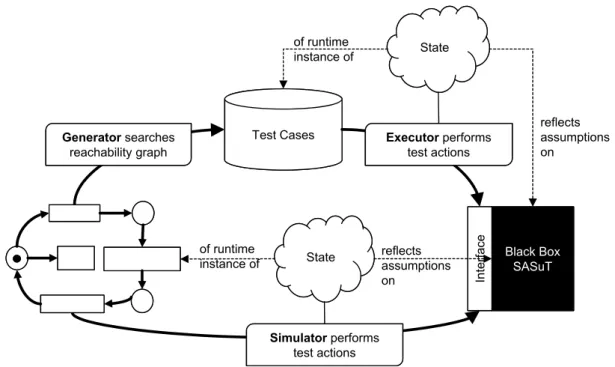
Duality of Test Generation and Simulation Almost all concepts that are proposed in this thesis can be used within a classic MBT process and simulative validation. Classic MBT means to generate a xed set of cases from the model and later execute the generated sequential test-cases. In contrast, simulative validation executes the model directly while applying the modeled actions on a real parallel-running SASuT, which is further observed and its state and outputs veried against the model. Such an approach is often referred to as in the loop" (ITL) simulation and is benecial in situations where certain situations cannot be modeled with sucient precision. As the decision logic, which is resolved during test generation, is still accessible in simulation, observed environment data can be embedded in the model. Such an update mechanism was already claimed to be benecial by Cheng et al.:
On one side the model must be eciently updated to reect the system changes, on the other it should still reect an accurate representation of reality
[CdLG+09, p. 19]
Only based on the updated information from ITL observations, test oracle's can generate correct expectations. Both test generation and simulation shall be performed on almost the same models and tools to gain more reuse.
1.3. Hypothesis and Main Contributions
This thesis employs a model-based approach to cope with conceptional problems arising from a complex state space and implicit information within the tested black-box. The approach claims to improve SAS' testability and that the used models provide appropriate expressiveness to enforce and verify parts of the state space, which could only be tested before with enormous eort. Thus, the following hypothesis can be stated:
The proposed conceptual and formal models, together with the process that puts those models in use, solve the automation of testing the dynamics of self-adaptive systems to a novel extent of the contextual and behavioral state space.
This hypothesis promises certain contributions that reach from conceptional approaches to implementations:
(C1) Model-driven methods for testing before non-covered regions of an SAS' state space based on generated test-cases or simulation in the loop
(C2) A comprehensive formalization in the form of metamodels that implement all as-pects of the SAS test methods
(C3) A reference architecture for an integrated test environment (MATE) that realizes the proposed models and allows for employing them along a standard dynamic test process
Besides these main contributions, several minor ones are elaborated during the chapters ahead. We list them in the thesis' summary where they can be understood in detail.
Based on MATE, a later evaluation shall demonstrate the correctness of the hypothesis as well as the adequacy of the above-listed contributions. Hence, an experimental study has been performed and documented in the evaluation part of this thesis.
1.4. Organization of This Thesis
The thesis' parts are outlined in Figure 1.2. Part I introduces several research domains, which created the foundations this thesis' contributions shall rely on. First, the background is discussed and, second, related work is presented. In Part II, the modeling concepts are described, including examples and formalization. Subsequently, MATE is presented as an implementation of the introduced models and the dynamic test process for SAS. In Part III, an experimental study is elaborated, which validates the proposed concepts in a robotic scenario. Finally, a summarization of this thesis, including open research questions, follows.
As argued in this thesis, Model-based testing (MBT) of SAS relies on a tremendous body of knowledge in numerous research directions. Not only that SAS has been identied in separate communities as the next generation of software system., Even more, the bandwidth of solutions that claim to solve SAS-inherent challenges is quite heterogeneous.
Similarly, in test research, several model-based techniques have been found. Some approaches generate from design artifacts; others introduce entirely new formalisms and notations for testing. The level of expressiveness of an MBT concept determines the level the automation of test design, which this thesis aims to improve with the particular focus on SAS.
As briey discussed in Section 1.2, variability modeling is an appropriate match to connect both SAS and MBT. Research on software variability evolved primarily in the eld of software product line engineering (SPLE), which is a necessary preliminary for understanding the moti-vation behind variability management. For at-run-time adaptive systems, the SPLE community developed the concept of dynamic variability modeling, which shall be adopted in this thesis.
Because of this bandwidth of background topics, this chapter follows coarse-granular segmen-tation of the introduced body of knowledge. The theoretical foundations of self-adaptivity are presented in Section 2.1, model-based testing in Section 2.2, and dynamic variability manage-ment in Section 2.3. Commonly accepted denitions are recited as well as related work that establishes a basis for comprehending the contributions of this thesis.
2.1. Self-adaptive Software and Autonomic Computing
The history of SAS research is brief in comparison to the time span researchers spend with software engineering. As the term self-adaptivity suggests, there are two crucial factors that make out an SAS: rstly, it provides mechanisms to adapt itself and, secondly, it decides automatically to adapt at run-time. Software is a formal artifact and, thus, adaptation decisions rely on objective criteriafor instance on an observed quality, which is guaranteed by the system and drops below a given threshold. To navigate itself out of this situation, a system should be self-aware, which is a necessary precondition for the decision making in SAS.
Before the background of above intuitive understandings of SAS, software researchers have outlined the notion of SAS more precisely. One of the rst denitions by DARPA engineer Robert Laddaga circumscribed SAS as follows:
Self Adaptive Software evaluates its behavior and change behavior when the evaluation indicates that it is not accomplishing what the software is intended to do, or when better functionality or performance is possible." [Lad97]
2. Background
Furthermore, Laddaga explicitly distinguishes SAS from systems explicitly relying on neural networks or genetic programming, which he sees as potential reasoning techniques. Instead, he aims to build systems that explicitly know about their structure, functionality, and performance and automatically reason on this knowledge with the goal to act more intelligently.
Later, in 1999, Oreizy et al. recognized the strong relationship between SAS and autonomic computing [OGT+99]. The authors derived the demand for SAS from the necessity to reuse
ar-chitectural components in dierent applications. As a solution to this requirement, they proposed automated reasoning and adaptation. From their perspective, the main challenges of SAS engi-neering are planning, coordination, monitoring, evaluation, and the implementation of seamless adaptation by means of software architecture.
Autonomic computing as distinct research domain gained interest in software engineering since IBM claimed several challenges and proposed respective architectural components after the mil-lennium [Hor01][KC03][IBM06]. The IBM engineers' initial desire was to shift responsibilities in managing complex heterogeneous systems from humans to automated solutions. According to them, creators of business applications face a complexity crisis. They have to integrate various heterogeneous, often networked components that fulll a common task. Test concerning con-guration, deployment, and maintenance can no longer be understood and managed by humans eectively and eciently. Additionally, modern business applications evolve constantly while they are productively used. These factors cause the total cost of ownership (TCO) to increase, which has to be counteracted.
To remedy these problems, management tasks should be delegated to automated decision mechanisms. Thus, the human administrators can better focus on problems with a higher value to the actual business. Low-value tasks are performed by intelligent computing systems so that the TCO is decreased.
The task delegation is performed during run-time by administrators. In this process, the task has to be formulated as a policy, which is assembled from goals that dene what the automated system is expected to achieve and constraints that restrict the means the system is permitted to use. After conguring the system with goals and constraints, the autonomic computing system has to compute necessary actions on its own (i.e., autonomic). The process runs periodically in a control loop, which reasons on input and decides adaptations.
Both bodies of knowledge developed in SAS research and autonomic computing intersect strongly, whereas the application domains are quite dierent. At DARPA, typically military applications were considered, including automated target recognition, signal and image process-ing, and robotics. Besides such military domains, SAS plays a vital role in civil applications like autonomous cars, drones, and home robotics. In contrast, autonomous computing focused on improving processes in business applications and automating periodically recurring tasks of such software.
2.1.1. Common Principles and Components of SAS
IBM engineers Jerey O. Kephart and David M. Chess encouraged their vision [KC03] of self-adaptive and autonomic computing and published ideas about concepts and principles to be standardized in the form of an architectural blueprint [IBM06]. In this section, starting with IBM's notion, the commonly accepted principles and components of SAS and autonomic com-puting are presented. Thus, a common understanding of self-adaptivity shall be reached that is the premise of the generality of the proposed test approach.
Concerns of Adaptation: Self-* Properties
SAS and autonomic computing employ control loops that collect environment observations. Based on the gathered data, quality measures are investigated and reasoned about to derive
Monitor Knowledge Execute Analyze Plan Change Request Change Plan Symptom
Figure 2.1.: The control loop structure of SAS [IBM06]. Sensor and otherwise input is monitored and fused to symptoms, which later are analyzed for the need of change. Potential change requests are computed in the plan phase resulting in a change plan, which is nally executed. Required information to reason about is stored to and taken from knowledge sources.
adaptation actions. Several qualities can be considered during the adaptation process. In [KC03], four dierent categories of control loops are distinguished:
• Self-conguring: Adapt dynamically at run-time to changes of the environment using policies that are provided by IT professionals. Thus, a continuous operation should be ensured.
• Self-healing: The system uses correction policies to react to detected malfunctions. Thus, the system's resilience is improved.
• Self-optimizing: Tune the system's resources in response to dynamically changing work-loads. The quality of service is steered towards the requested requirements of the users. • Self-protecting: Find behaviors that threaten the system's security and privacy and react
by corrective actions. Thus, the security and privacy policies are enforced even during attacks.
All categories of control loops have a common structure originating from business processes for the control of incident, problem, and change management. As each role of such a process has power on a specic scope, in an autonomic system an autonomic manager controls a particular scope as well. Therefore, the system must be able to automatically congure, heal, optimize, and protect itself using a set of knowledge sources.
Later, the four types of control loops were adopted as self-* properties. In [ST09], Salehie and Tavildari classify these properties as major levels of adaptation and hierarchically arrange them below the general level of self-adaptiveness. Furthermore, self-awareness and context-awareness constitute a most primitive layer in this hierarchy.
Process of Adaptation: Components and Feedback Loops
The named blueprint [IBM06] also proposes a standard architecture for autonomic computing. On the lowest level, several hardware (e.g., CPU, storage) and software (e.g., databases, services) resources are situated. The resource management is performed using standard interfaces called touchpoints, managers, and orchestration of these independent agent-like constituents.
Adaptation mangers of dierent scope use the concept of control loops, which are structured as depicted in Fig. 2.1. The rst function is Monitor by which details on the managed resources are collected. The gathered information is aggregated, correlated, or ltered. The result is a set of symptoms, which are handed over to the Analyze function. The latter function is in charge to perform a data analysis (e.g., prediction) and determine whether a change is required.
2. Background
For instance, policies are used for this purpose and matched with the observed situation. The analysis may result in a change request. The Plan component derives change plans, which comprise actions that dene the reorganization tasks for fullling the new policy. There may be only a single action or even a complex workow necessary to alter the system. These actions are scheduled and performed by the Execute function.
The complete control loop is supported by a knowledge base. Knowledge can be provided by knowledge sources of dierent types. Firstly, the policy is passed directly to an autonomic manager and is stored as another element of the knowledge base. Secondly, external sources can support the decision making. For instance, symptom descriptions or historical data can be stored to analyze later and compare them with recently monitored events. The third type of knowledge sources encompasses information that is created by the autonomic manager itself. Thus, monitored sensor data, created plans, and execution results can be stored. For this purpose, each function may also have the ability to alter stored knowledge.
Loop-wise computation of observed data and derivation of adaptation decisions is the most referred concept of SAS and incorporates much variability, which was investigated by Andersson et al. in [ADLMW09]. The authors enumerate a multitude of dimensions of dierent categories. These dimensions include properties and qualities of goals to achieve, the change that causes adaptation, and mechanisms to adapt and eects adaptation. Along the process, a control loop runs, which instantiates all these parameters.
2.1.2. Concrete Implementations and Applications of SAS
For all adaptation concerns, a multitude of SAS frameworks has been implemented. A good overview is given by Salehie and Tahvildari in [ST09]. Whereas researchers mostly aimed at developing generic approaches for SAS, such as architectural frameworks, engineers implement solutions to concrete domain problems. For both directions, several works are discussed in the following.
From an architectural perspective, dierent topological variants have been proposed. For in-stance, IBM's blueprint describes a strongly layered architecture for SAS [IBM06]. On the lowest layer, resources, such as servers, storage, and network, are managed. On the next level, each resource is instrumented by a so-called touchpoint, which is a uniform resource management interface. Furthermore, touchpoints are controlled by autonomic managers, which run a local control loop. Globally, touchpoint managers are orchestrated by more generic autonomic man-agers. On the highest level, manual intervention is possible for tasks that were not automated yet. IBM's blueprint can be understood as a reference architecture for SAS, and many later proposals refer to it as such.
Alternatively, Garlan et al. constructed their Rainbow system, which performs an architecture-based self-adaptation approach [GCH+04][GSC09]. In Rainbow, a model of the system's
archi-tecture is maintained at run-time on an archiarchi-tecture layer, whereas resources, eectors, and probes for measurement are bundled on a separate system layer. Both layers are connected via a translation infrastructure, which mediates information exchange. Based on the architectural model, reasoning is performed to determine when and how to adapt.
For the evaluation of the Rainbow framework, the authors introduced the self-adaptive web framework ZNN.com, which provides news and adapts to load spikes [ASP13b]. The goal quality is response time, which may become unacceptable due to high request frequency. In reaction, the system adapts by enlisting new servers or switching to text-only content delivery. Also, adaptation strategy considers user-dened goals, such as costs to be minimized or prioritization of the user experience of multimedia content before response time.
In contrast to these layered architectures, Raibulet et al. propose in [RAM+06] to separate a
networked system into views for resource structures, the topology of connections, and resource location. Based on these views, the system reects itself and knowing the quality of service (QoS) that can be delivered in a specic setting. For each query to the service, the required QoS
is evaluated so that necessary adaptations can be derived. The concrete adaptation strategy strongly depends on the application domain so that only an abstract framework for strategy denition is provided.
Furthermore, a relevant project is Managing Distributed Adaptation of Mobile Applications (MADAM [AHPE07]), where adaptation decisions are based on utility functions on provided and required QoS properties, which are annotated to components. MADAM runs a control loop that monitors environment properties and manages adaptation autonomously.
The Autonomia framework by Al-Nashif et al. provides another elaborate approach for con-structing SAS [ANKH+08]. The proposed architecture comprises two components: (1) the
component run-time managers (CRM), which actively executes the control loop, and (2) the component management interface (CMI), which allows for dening adaptation policies and other to necessary specications. Further, the CMI connects to sensors and actuators as well as rules that dene adaptation actions. Autonomia also implements the orchestration aspect as discussed by the above mentioned IBM blueprint in the form of compound components and CRMs. The authors present a multitude of applications in the domains of consumer, military, nancial, and scientic computing. Especially grid computing and network security (e.g., intrusion detection) have been tackled in their work.
Alternatively, peer-to-peer topologies are constituted of widely independent entities. Adap-tation in such decentralized systems can be enabled for instance by the architecture proposed by Baresi et al. in [BGT08]. Here, supervised elements (SE, i.e., sensor and actuators) and supervisors are distinguished. Supervisors run a subscription/notication protocol that they can be connected to the supervised elements of interest. Furthermore, the supervisors monitor their subscriptions and run adaptation of dierent granularity (in a federation of supervisors or clusters of SEs). One remarkable specialty of this approach is that supervisors are connected to SE via aspect-oriented programming (AOP) because adaptation is considered a cross-cutting concern.
Engineers apply SAS principles in situations where autonomy is needed to decrease manual workload and, thus, the TCO, or to cope with many inuence factors at run-time. For the aeronautics domain, Mahadevan et al. built an SAS that monitors the health state of the air data inertial reference unit (ADIRU) and adapts by performing mitigation actions [MDK11]. The authors call their approach software health management and classify it as advanced fault tolerance technique.
Self-organization is frequently desired in robotic cooperative scenarios. An instance of such a system was constructed by Zhong et al. in [ZD11]. The authors employ a model of goals, capabilities, and roles. Without using explicit reorganization rules, the system can assign robots with appropriate capabilities to roles that are necessary to reach a certain goal. Another self-organizing robotic scenario is shown in [NG15] by Niemczyk and Gheis. Here, not the actual task of a robot entity but information sharing is focused. The approach is rather generic and allows developers for creating robot teams with cooperative information processing, which is adapted to optimize qualities like transfer time.
In summary, most implementations of SAS principles are, on the one hand, academic but, on the other hand, quite heterogeneous in the appearance, nomenclature, and employed techniques. However, each of them employs a control loop as the central mechanism, which is, therefore, the unifying element in SAS engineering and, consequently, must be taken into account in this thesis' eorts to tackle the SAS test challenge.
2.2. Model-based Testing
Dependable software requires a proper application of quality assurance methods during planning, development, and use. Testers are in charge to ensure that customers experience a awless product after deployment. Otherwise, post-delivery failures are not only very costly and eect
2. Background fault error failure fault … … activation propagation causation
Figure 2.2.: The causality chain of faults, errors, and failures (redrawn from [ALRL04]). the image of the software manufacturer, but also potentially cause severe damage to people or property. Thus, software and, more general, systems have to be tested exhaustively before delivery according to a hopefully correct requirements specication.
2.2.1. Testing for Dependability
Testing is the most-adopted method of fault avoidance. On a more general level, fault avoidance is a category of means for dependability besides fault tolerance, fault removal, and fault forecasting. In [ALRL04], Aviºienis et al. give a broad overview of failure-related glossary and denitions in the eld of dependent information systems. These notions shall be discussed in the following.
Information systems consist of a set of interacting entities, of which some may be designed, and others are established at run-time. For instance, a search engine comprises components, such as crawlers, a web interface, a database, and an indexing mechanism, but all data is gained later, after development. During actions for fault avoidance, only the search engine itself, but not all the searched data, can be considered. However, the system is expected to cope with potentially harmful inuences from such external sources, which cannot be xed by quality assurance. The frontier between the environment and the system is dened as system boundary, which has to be adequately designed by engineers.
Each system has a certain function, which is dened by a functional specication comprising denitions of the system's functionality and performance. To implement this specication, a system has a certain behavior. Behavior can be described by a sequence of states. Whereas single components may span isolated state spaces, the total state of the system comprises the complete set of states of computation, communication, stored information, interconnections, and physical conditions.
Furthermore, information systems only make sense when they interact with a human being or a technical counterpart. The interaction is provided as a service, which is the behavior that is perceived by a user. The user may not only be a human but also another system that receives the service from its provider.
The service is delivered at a service interface. Due to potential information hiding at this interface, the counterpart of the service only perceives a limited behavior viewed as external states, whereas internal states cannot be observed directly. Finding or avoiding malfunctions during the service delivery is the crucial interest of quality assurance. Such a malfunction can be dened as an event of deviation from the correct service.
A service failure, abbreviated failure, is caused by aws during development, interaction, or due to physical conditions. The user perceives the failure as a deviation of the observed external state from the expectations that are dened in the system's specication. The failure-underlying state is called error and its cause fault. In summary, faults, errors, and failures span a causal chain. As depicted in Figure 2.2, a fault can activate an error, which further can propagate a failure. The transition from failure to another system part's fault is called causation. It must be mentioned, that the error activation, in particular, is optional. A fault may also be dormant so that no errors are produced because the functionality is not used or the fault is covered by a compensating part of the system.
As means for fault avoidance, testing checks information systems for the existence of failures. While debugging, an engineer investigates the error at the moment of failure occurrence and tries to identify the fault. However, due to the step-wise construction of software systems from requirements along design to implementation, the search for failures must be performed on dif-ferent levels of abstraction. To improve the understanding of these dierent perspectives, the next section covers aspects of the test process and test methodology.
2.2.2. The Basics of Testing
Testing can be performed for an integrated software system or just some of its parts. The particular approach depends on the point in the software life cycle, the availability of interfaces and completed components, and the level of abstraction to be considered. A canonical impression on the relation between abstraction, construction step, and test methodology is delivered by the German V-Modell, which is discussed in the following section.
V-Modell: Levels of Testing
Depending on the knowledge, interfaces, and budget a tester is equipped with, testing can be per-formed on dierent levels of abstraction. The more detailed single components are investigated, the more precisely their preliminaries have to be specied. As software engineering processes target on rening initial knowledge over time, potential verication methods do as well. For instance, the specication of the German V-Modell [Gre10, p. 375] includes a visualization of relations between testing and design, as depicted in Figure 2.3. The process starts from the left upper corner of the V with an exploratory collection of information on the system to be developed. After a certain time, organizational plans and requirements can be specied. In the following phases, the system is constructed according to these requirements with an increasing level of detail. The process starts with a rather abstract product design, which is followed by a more detailed design and later implementation of code. After the nal implementation step is concluded, each level has to be veried or validated based on the artifacts that were created during the design phase on the respective level of abstraction. In contrast to the denition of verication and validation in the context of dependable systems (cf., Section 2.2.1), verication is understood as building the system conforming to the specications of the previous phase and validation as building the system appropriate to its indicated purpose. Thus, verication takes place on the lower levels, where formal or informal design specications are available; validation on the upper levels, where the system can be checked against a user's needs.
The most implementation-near test level is unit testing where single modules of the system's code are directly stressed with input data and checked against pre-dened output data. After-wards, the modules and components are increasingly integrated and tested for correct interaction and performance (integration test). The complete integrated system can be analyzed in the sys-tem test phase. An examination whether the constructed product matches its desired design is done during the acceptance test phase. The conformance of the system is checked above the baseline of requirements and can be nished by concept validation.
Whereas the V-Modell includes a description of test activities, a more focused model was launched by ISO, IEC, and IEEE and standardized under the reference 29119. It describes the test process as an isolated engineering discipline.
A Standard Process of Software Testing: ISO/IEC/IEEE 29119
It is generally accepted that it is not possible to create perfect software. [IEE13a]
Besides its role in the V-Modell, testing is essential to all accepted software development life cycles. To unify the understanding of test concepts, software testing has been standardized in
2. Background Validation Test Exploratory conceptional Plans & Requirements Requirements Baseline Product Design Detailed Design Code UnitTest Integration & System Test Acceptance Test Installation OT & E Usage & Support Validation Verification Product Design Verification Program Design Verification Requ.
Validation ValidationDesign Concept Validation
Figure 2.3.: The V-Modell (redrawn from [Gre10]).
Test Design &
Implementation ExecutionTest
Test Environment Set-up & Maintenance Test Incident Reporting Test Environment Requirements Test Specification Test Environment Readiness Report Test Results Incident Report [Issue Noticed OR Retest Result] [No Issues Noticed]
Figure 2.4.: Dynamic test process (redrawn from [IEE13a]).
ISO/IEC/IEEE 29119. The standard is organized along three aspects of testing, which have been published yet: (1) concepts and denitions [IEE13a], (2) test processes [IEE13b], and (3) test documentation [IEE13c]. The most signicant statements of ISO/IEC/IEEE 29119 are discussed in this section for later reference.
The standard proposes to separate the process of testing in three sub-processes.
1. Organizational Test Process: The highest level of organizational test management includes test specications, such as an Organizational Test Policy and Organizational Test Strategy.
2. Test Management Process: Test management including project management (planning, monitoring, and controlling) and type test management.
3. Dynamic Test Process: Lowest-level test activities like designing and implementing tests, executing them, and reporting the outcomes.
All three sub-processes interact by the interchange of certain artifacts, such as policies and specications. Depending on the type of testing, artifacts from requirement engineering
ceptance testing), architectural design (system and integration testing), and from the detailed design (unit testing) are processed.
As this thesis discusses a specic test practicemodel-based testingfor a specic category of test objectsSAS, the dynamic test process is of particular importance. Activities and communicated artifacts of the dynamic test process are depicted in Figure 2.4. The rst activity test design & implementation aims at the creation of test specication consisting of test-cases and test procedures. During this sub-process, it is also necessary to specify test coverage measures and test completion criteria. Furthermore, it may be the case that the specication activity has to be re-entered due to re-plan or to identify additional test conditions.
Besides the test specication, in test design, requirements of the test environment are derived. These requirements constitute a set of conditions that the test environment must conform to. The subsequent activity test environment setup & maintenance involves building the environment according to the conditions and maintaining it. Here, software and hardware are assembled appropriately so that test-cases can be run and test data can be applied as dened in the test specication. The test environment readiness report contains all information on how this environment can be used and congured.
During test execution, test-cases are assembled in the test specication and run in the test environment. Running means applying the actions of the test-cases, while the SUT is deployed in the environment, and comparing the outcome of the application with expected test results. This procedure includes comparing results between dierent re-tests (e.g., after regressions). Test execution is recorded in a log along with all information to trace back failures to a certain point of execution. The test results contain passed and failed test instances and those, whose execution involved something unusual or unexpected.
Tests that were not passed can result in an issue which must be handled in the test incident reporting activity, which involves analyzing the test results and creating or updating an incident report.
Test Methods, Practices, and Techniques
The extent of testing depends on whether the system artifacts are analyzed with or without execution. The latter case is, called static testing and involves manual approaches (e.g., reviews) as well as tool-based approaches (e.g., static program analysis). In contrast, dynamic testing executes the SUT with a set of test-cases. Whereas static testing is a method of verication, dynamic test approaches additionally perform validation.
In dynamic testing, software and system engineers perform dierent practices depending on the types of requirements and level of insight into the SUT. The latter distinction separates testing in three classes: In white-box testing, the internal structures of the SUT are exposed and investigated. Test inputs are selected to cover specic paths through the space of inner states of the tested execution logic. In contrast, black-box testing relies on a specication, from which testers construct test-cases, and an API for applying the actions in those test-cases against the SUT. Afterwards, they compare outputs with given expectations to gain a verdict about the SUT's correctness. Between those extremes, grey-box testing is performed against black-boxes, whereas grey-box test design uses information on system internals.
Especially in black-box testing, expected data must be specied to determine a test execution's correctness. For this purpose, test oracles provide a function that maps input data to expected outputs. An oracle may provide dierent characteristics, which, for instance, includes complete-ness and accuracy [Hof98]. However, no matter how powerful an oracle is, most real systems are so complex, that only a very restricted, carefully chosen subset of input and output data pairs can be tested. It is subject to an adequacy criterion, when a tester is allowed for qualifying an SUT as correct under the given conditions. In test projects, a usual way to systematically select representatives of data to be tested is to divide the domains of relevant input values into equivalence classes and perform a boundary value analysis. In this approach, predominantly
val-2. Background
ues on the edge of the found equivalence classes are selected for the test set because, especially, problematic cases are covered in this way.
Furthermore, the specic quality or type of tested requirement plays an important role. Besides functional correctness (i.e., if the system does what it is made for), non-functional requirements target on manifold qualities. Both types have been documented in ISO/IEC 25010:2011 [ISO16]. According to this widely-adopted standard, non-functional characteristics are reliability, usabil-ity, eciency, maintainabilusabil-ity, and portability. Each of them is further structured in sub-qualities, which all can be tested by dierent techniques. For instance, eciency is investigated by software performance testing, whereas conformance testing targets on maintainability and portability.
Crosscutting to the mentioned types and approaches of testing, certain actions of this discipline can be automated. Test automation traditionally focuses on how to execute test input and compare test output without human intervention. Whereas manual testing requires long lists of test-cases with human-readable actions, test data, and a lot of repetitive work, automated tests benet from homogeneous, completely reproducible outcomes. In this manner, many more test-cases can be executed in shorter time spans, because actions are scripted in executable formats, and comparisons of test results are delegated to an algorithm as well. Due to the capability of automatically interacting with an SUT, not only functional testing of large systems but also performance testing benets from automation.
Additionally, automating test execution supports quickly repeating tests for new versions of the SUT. Such repetitions become necessary due to regression, which means that the quality of the SUT potentially decreases with the new versions. This common approach is consequently called regression testing and enables test engineers to keep quality over long-term development cycles [Mye79].
However, test execution is only one end of test-automation. Another elaborate step is the creation of test-cases from a specication. The necessary eort can further be lowered by au-tomating the test design, which is discussed in the following section.
2.2.3. Automated Test Design
Managing test data, test-cases, and test congurations can become cumbersome for complex systems. In design and implementation, engineers found methods that help to automate parts of recurring renement tasks using model-driven software development (MDSD). The recent research adopts MDSD and proposes so-called model-based testing (MBT) as a generative ap-proach that is appropriate for decreasing test design eorts. According to Utting and Legegard, MBT can be dened as follows:
Model-based testing is the automation of the design of black-box tests.
[UL07, p. 8]
The authors explicitly distinguish MBT from test approaches that only automate test-case execution. Thus, MBT can be understood as an approach to improve the test process eciency by design automation. In consequence, MBT is especially benecial if a service accepts a large variety of inputs and calls. This relation is, in turn, a perfect match with the requirements of context-dependence and self-adaptive software service.
MBT can be employed at all levels of testing (cf., Section 2.2.2), whereas it is not compatible with all test techniques, such as white box testing. The latter derives test-cases from design and implementation artifacts (e.g., symbolic execution [Kin76]), whereas MBT only checks the external state of the exposed service. For this purpose, the expected behavior of the system is specied in the form of models, which are later used for automatically generating test-cases. The overall process of MBT is described in the next section.
Model
Require-ments CasesTest CasesTest
Ad ap tor
SUT
Test Results Requirements Traceability Matrix Model Coverage Test Plan1. Model 2. Generate 3. Concretize 4. Execute
5. Analyze Test Case
Generator Test Script Generator
Test
Executi
on
Tool
Figure 2.5.: The MBT Process [UL07]. The MBT Process
Automating test design involves certain activities, for which a tool chain must be provided. Fig-ure 2.5 depicts the overall process including necessary tools and artifacts. The process comprises the following steps:
1. Model: In the rst step, an engineer creates a model. Because MBT is a black-box method, the model has to reect the requirements of the SUT. Furthermore, the model is more abstract than the real system. For instance, in comparison to MDSD, we can qualify the model as platform-independent if it omits details on technical execution. Additionally, it should be precisely annotated, which model elements refer to which requirements to integrate trace information. The eort and level of granularity that is modeled can be controlled by a formal or informal test plan.
2. Generate: From the model, a test case generator automatically derives test-cases on the same abstraction level as the input model. Each test-case consists of a sequence of operations that can be applied with the SUT. As the majority of systems can run without termination (i.e., that interaction can be executed innitely), the number of test-cases is innite, as well. Therefore, the test engineer has to provide a test selection or test adequacy criterion that allows for terminating the generation at a specic point.
Besides test-cases, the generator may produce a requirements traceability matrix and model coverage report. These artifacts relate test-cases to requirements. After test execution, this mapping can be used to determine violated requirements.
3. Concretize: Abstract operations of each test-case have to be mapped to concrete, ex-ecutable ones. Typically, this step is performed using templates or any other form of transformation mechanism. Alternatively, an adapter can map abstract operations to the SUT's technical interface operations at run-time. Both transformation and adaptation may be realized for dierent SUT implementations so that the abstract test-cases can be reused. 4. Execute: In this step, the generated concrete tests are executed in the SUT. A test execution tool schedules and executes all test-cases sequentially. During execution, failures are recorded as well as passed test-cases. The test results report this outcome.
5. Analyze: Finally, test results can now be interpreted by an analyst. Her/his task is to investigate, which faults caused the failures, and to report them to the developers, who x them.
2. Background
The central dierence between traditional test processes to MBT is modeling and the gen-eration of test-cases from the models. Without MBT, test-cases are basically derived from an informal or even mental model. With MBT, test engineers benet from explicit formal denitions that unify the understanding of a system as well as the method how test-cases are created. Potential Types of Test Models, Metamodels, and Notations
There is a variety of metamodels that are used for generating test-cases. First of all, Utting and Legeard distinguish between four basic approaches [UL07, p. 7]:
1. Generation of test input from a domain model: Dene value domains of necessary input variables and combine them to generate appropriate test input. As the combination of all input domains may be very large, algorithms, such as pairwise testing [CDPP96] can be employed to restrict the considered number of combinations.
2. Generation of test-cases from an environment model: Dene sequences of environ-ment changes, which are input to the SUT. The generation of sequences can be controlled by a dedicated model, e.g., a statistical one. The advantage is that potentially all states of the SUT can be reached. Still, there are no means for evaluating whether the reaction (i.e., the output) of the system was correct. The only observable reaction is a system crash. 3. Generation of test-cases with oracles from a behavior model: In this approach, the
model has to include information on the expected reaction or output of the system. Thus, the model is taken as an oracle implementation.
4. Generation of test scripts from abstract tests: Map implementation-independent test-cases to actual API calls of SUT functionality. This task is identical with step 3 of the MBT process described above.
As it turns out, approach (3) is the most challenging because it demands the largest amount of information; both environment behavior and the SUT's reaction have to be integrated into an appropriate model. However, this approach allows for automating tests to the greatest extent.
Another question is, from which development artifacts the test model is built from [UL07, p. 31f]. The rst approach would be to reuse design models from system developers. For testers, this would be benecial because these models involve a lot of denitions, which are relevant for test design. However, there are several disadvantages. First of all, design models such as structural class diagrams are mostly not detailed enough to describe the exact behavior of the system.
Furthermore, the details that describe the system behavior in more ne-granular design models are too implementation-specic so that this approach can be compared to white-box testing. When the code has been generated from the same design models that should be reused in testing, faults manifest in the resulting test-cases, as well. In consequence, taking design artifacts as the only resource in testing is often questionable and, thus, not a satisfactory approach.
Notably, though, a completely new test model would create the maximum independence from design knowledge. The fundamental resource in this approach is a requirements document. Furthermore, it is possible to enrich (e.g., annotate) high-level design artifacts with test-specic information. This approach would create a compromise between complete reuse of design models and the denition of test models from scratch.
A bandwidth of metamodels and notations can be used to represent the input to a test-case generator. Utting and Legeard classify those model types as follows [UL07, p. 62.]:
Pre/post (or) state-based notations Each operation is dened together with a precondition and a postcondition. For instance, the object constraint language1 (OCL) together with
1Object Management Group: Object Constraint Language 2.4, http://www.omg.org/spec/OCL/2.4
the unied modeling language2 (UML) can be used for this purpose. From preconditions,
the generator can determine test inputs that are applicable in a certain run-time state and postconditions that are used to decide whether to produce data or if a reached state is correct.
Transition-based notations Test operations are dened as transitions between system states. For instance, nite state machines (FSM) and UML statecharts are graph-based models. Each transition can be labeled with concrete actions (e.g., retrieving input or verifying an assertion) that are applied in the presumed state.
History-based notations For instance, in message-sequence charts (MSCs) or UML sequence charts permitted traces of a system's behavior or time can be dened.
Functional notations Describe a system by a set of algebraic formulas and generate test-cases from these specications. An example can be found in [Mar95].
Operational notations Dene a system as collection of parallel executed processes. Example notations are Communicating Sequential Processes (CSPs, [Hoa78]), the Calculus of com-municating systems (CCS, [Mil80]), and Petri nets [Pet62].
Statistical notations If distributions of possible events and input data values have to be dened, statistical models like Markov chains are appropriate. Those model types can be used together with deterministic ones that describe the reaction of the system.
Data-ow notations Instead of control ow, the ow of data through the system is modeled. An example is Lustre [MA00].
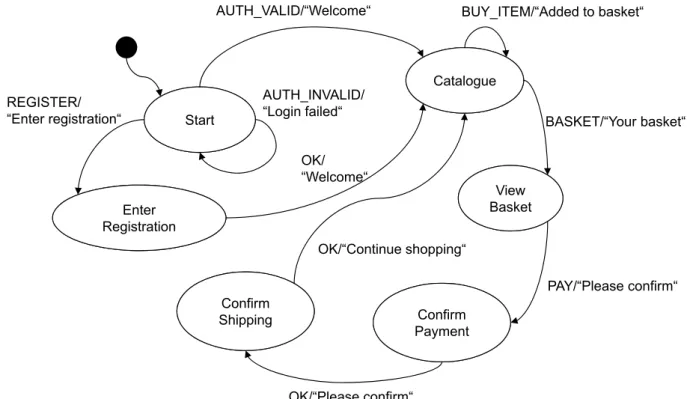
To improve the understanding of how test-cases can be generated from a model, in the following an example is provided. Figure 2.6 depicts a nite state machine (FSM), which species the expected behavior of a simple web shop. More precisely, the FSM is a Mealy machine, which translates sequences of input symbols to sequences of output symbols. State Start is the initial state, which is denoted by the incoming edge from the black pseudo element. Input symbols AUTH_VALID and AUTH_INVALID abstract from correct or incorrect login data submitted by the user. All other input items symbolize buttons, which have to be pressed to advance to the next shop window. We also abstract from the fact that certain data has to be entered (e.g., while registration), and that it is necessary to select a specic item to be bought because only the SUT's workow is tested.
To generate test-cases from this automaton, valid sequences of input and output pairs are derived. Because in this specic example, no terminal state was dened, all lengths of test-cases are acceptable. A sample instance is the following:
Example:
AUTH_INVALID/Login failed" →REGISTER/Enter registration"
→OK/Welcome" →BUY_ITEM/Added to basket"
→PAY/Please conrm" →OK/Please conrm"
→OK/Continue shopping"
Although the FSM is deterministic, innitely many of such sequences can be generated. A tester is in charge to decide which of them are more important and which can be ignored. To formalize this decision and steer an automatic generator algorithm, modelers specify selection criteria.
![Figure 2.5.: The MBT Process [UL07].](https://thumb-us.123doks.com/thumbv2/123dok_us/638311.2576907/35.892.90.764.83.355/figure-the-mbt-process-ul.webp)