Deutsches Institut für Wirtschaftsforschung
www.diw.de
Andreas Peichl
annn
The Benefits and Problems
of Linking Micro and Macro Models
-Evidence from a Flat Tax Analysis
1
82
SOEPpapers
on Multidisciplinary Panel Data Research
SOEPpapers on Multidisciplinary Panel Data Research
at DIW Berlin
This series presents research findings based either directly on data from the German Socio-Economic Panel Study (SOEP) or using SOEP data as part of an internationally comparable data set (e.g. CNEF, ECHP, LIS, LWS, CHER/PACO). SOEP is a truly multidisciplinary household panel study covering a wide range of social and behavioral sciences: economics, sociology, psychology, survey methodology, econometrics and applied statistics, educational science, political science, public health, behavioral genetics, demography, geography, and sport science.
The decision to publish a submission in SOEPpapers is made by a board of editors chosen by the DIW Berlin to represent the wide range of disciplines covered by SOEP. There is no external referee process and papers are either accepted or rejected without revision. Papers appear in this series as works in progress and may also appear elsewhere. They often represent preliminary studies and are circulated to encourage discussion. Citation of such a paper should account for its provisional character. A revised version may be requested from the author directly.
Any opinions expressed in this series are those of the author(s) and not those of DIW Berlin. Research disseminated by DIW Berlin may include views on public policy issues, but the institute itself takes no institutional policy positions.
The SOEPpapers are available at http://www.diw.de/soeppapers Editors:
Georg Meran (Dean DIW Graduate Center) Gert G. Wagner (Social Sciences)
Joachim R. Frick (Empirical Economics) Jürgen Schupp (Sociology)
Conchita D’Ambrosio (Public Economics)
Christoph Breuer (Sport Science, DIW Research Professor) Anita I. Drever (Geography)
Elke Holst (Gender Studies)
Frieder R. Lang (Psychology, DIW Research Professor) Jörg-Peter Schräpler (Survey Methodology)
C. Katharina Spieß (Educational Science)
Martin Spieß (Survey Methodology, DIW Research Professor) Alan S. Zuckerman (Political Science, DIW Research Professor)
ISSN: 1864-6689 (online)
German Socio-Economic Panel Study (SOEP) DIW Berlin
Mohrenstrasse 58 10117 Berlin, Germany
The Benefits and Problems of Linking Micro and Macro Models
-Evidence from a Flat Tax Analysis
Andreas Peichl∗
IZA Bonn, ISER and University of Cologne Submitted: December 2008
Abstract
Mircrosimulation (MS) and Computable General Equilibrium models (CGE) have both been widely used in policy analysis. Their combination allows the utilisation of the advantages of both types. The aim of this paper is to describe the state-of-the-art in simulation analysis and to illustrate the benefits and problems of linking micro and macro models by analysing flat tax reform proposals for Germany. Taking feedback effects into account has important implications for the evaluation of tax reforms. The analysis shows that a personal income flat tax can indeed overcome the fundamental equity efficiency trade-off while simultaneously increasing the tax revenue. However, this result does not hold for a flat tax combining a personal income flat tax with a corporate cash flow flat tax, even when allowing for an ex-post loss in revenue as the top of the distribution still gains the most.
JEL Codes: D58, H2, J22
Keywords: Microsimulation, CGE, linked micro macro models, flat tax
∗IZA - Institute for the Study of Labor, P.O. Box 7240, 53072 Bonn, Germany, [email protected]. I would
like to thank Christian Bergs, Stefan Boeters, Markus Clauss, Michael Feil, Clemens Fuest, Nicolas H´erault, Erling Holmøy, Thilo Schaefer, Sebastian Siegloch, Jorge Streb, an anonymous referee and seminar participants in Bonn, Cologne, Leuven and N¨urnberg as well as participants of the EcoMod conference in Berlin for their helpful contributions. The usual disclaimer applies.
I
Introduction
The recent success of the flat rate income tax in Eastern Europe suggests that this concept could also be a model for countries of Western Europe. The introduction of a flat tax system is widely seen as a reform which may boost efficiency, employment and growth through simplification and higher incentives. However, inequality is expected to increase as a consequence of a flat tax reform. In the discussion of the flat tax “a notable and troubling feature [...] is that it has been marked more by rhetoric and assertion than by analysis and evidence“ (Keen et al. (2008), p. 713). Given that flat taxes have not yet been implemented in Western European countries, the effects of flat tax reforms in these countries can only be studied on the basis of simulation models. The method of simulation analysis aims at analysing and quantifying the economic effects of different policies based on the given institutional background to compare and evaluate different reform proposals with respect to equity and efficiency effects.
For the analysis of fiscal reforms, microsimulation (MS) and computable general equilibrium (CGE) models have been widely used in the literature. CGE models consider various interde-pendencies and facilitate simulating behavioural responses and adjustments on several markets. In contrast, MS models consider only the household side of the economy, which allows for more heterogeneity and a much more detailed mapping of the complex tax benefit system. Combin-ing these two model types enables the utilisation of the complementary advantages. The aim of this paper is twofold. First, possibilities of linking microsimulation and CGE models are shown. Second, the benefits and problems of the linking approach are illustrated using a flat tax example for Germany.
The most popular flat rate tax proposal is the ”Flat Tax“ of Hall and Rabushka (1985) (HR), which combines cash flow taxation on corporate incomes with the same single marginal tax rate on labour income. This proposal, however, has not been implemented in its pure form in any country yet. Previous reforms considered a flat rate personal income tax as an indirect progressive tax schedule with a basic allowance and a uniform marginal tax rate. In the lit-erature, there are several simulation studies on efficiency and equity aspects of such (revenue neutral) flat income tax reforms. One focus of these studies is the impact on employment and growth using CGE models (see, e.g., Heer and Trede (2003) for Germany or Jacobs et al. (2007) for the Netherlands), whereas a second group of studies focuses on the distributional effects using MS models (see, e.g., Aaberge et al. (2000) for Italy, Norway and Sweden, Fuest et al. (2008) for Germany and Paulus and Peichl (2008) for a cross country study of 10 EU countries). In summary, all previous studies support the existence of a trade-off between eq-uity and efficiency, i.e. it is not possible to decrease inequality while increasing employment. However, a HR-type flat tax may lead to further efficiency gains due to more investment and labour demand as it is also likely to reduce tax distortions in the corporate sector. So far, the
introduction of a HR-type flat tax has been analysed using only CGE models. Stokey and Re-belo (1995) conclude that a flat tax reform would have little effect on the growth rate. Dunbar and Pogue (1998) show that high income households gain whereas low and especially middle income households are burdened. These finding are supported by Ventura (1999) and Altig et al. (2001). Cassou and Lansing (2004) find that a flat tax reduces growth in the short run if revenue-neutrality is maintained, but increases capital accumulation and growth in the long run. Nielsen et al. (1999) find significant efficiency gains but negative distributional effects for a flat tax in Denmark. So far, none of these studies has used a linked MS-CGE model to take feedback effects into account.
This paper contributes to the literature by analysing a HR-type flat tax reform proposal of the German tax system using a linked MS-CGE simulation model for the German tax and transfer system. With its socio-economic and demographic structure, Germany can be seen as a typical Western European democracy. Therefore, the qualitative results of our analysis should be of interest to a wider range of countries.1 Applying the linked model to a not revenue
neutral flat tax proposal shows that taking the general equilibrium effects into account indeed increases the expected efficiency gains in the long-run. The overall employment effects are larger than the labour supply reactions because of reduced costs of labour and capital resulting in increasing labour and investment demand. As a consequence, a personal flat income tax can indeed improve the fundamental equity-efficiency trade-off. However, combining this flat tax with a cash flow flat tax on business income still increases inequality due to the large gains at the top of the distribution. Therefore, we conclude that due their problematic short-term distributional impact, flat tax reforms are unlikely to spill over to the grown-up democracies of Western Europe.
We proceed as follows. Section II describes methods to link MS and CGE models. Section III describes the linked model used for the application. In section IV, the flat tax reform proposal for Germany is analysed. Section V concludes.
II
Linking micro and macro simulation models
Before discussing possibilities to link micro and macro models, it is important to introduce the main features of the stand-alone models. In general, simulation models are tools which are designed to answer “what if” questions about different policy reform options. In the run-up of the implementation of a specific reform proposal, it is crucial to predict the expected consequences on individuals (gains and losses, income distribution), the government budget
1
It has to be taken into account, though, that the structures of the tax benefit systems do vary considerably among the countries of Western Europe.
and key economic indicators (e.g. employment, prices, consumption) to provide policymakers with well-founded decision guidance. The complexity of existing welfare states requires the usage of simplified models for the evaluation of reform proposals. Theoretical models allow to point out a single argument in a simplified framework and to construct hypotheses which can be tested empirically. Empirical models allow for an econometric evaluation of a given reform and are especially useful whenever the magnitude, and thus not only the sign, of the effects are to be estimated. If the reform already has been implemented (and data is available), an ex-post analysis is possible using standard econometric procedures. On the other hand, if the reform has not been implemented, only simulation models can provide information for an ex-ante analysis of different reform proposals. Other than in the natural sciences, it is seldom possible in economics to construct natural experiments for the analysis of a given treatment (policy). Policy simulations can be interpreted as quasi-experiments which allow the economist to ex-ante analyse a reform proposal before its implementation in real life controlling for behavioural responses of different agents in the economy.
A
Computable general equilibrium (CGE) models
General equilibrium theory has provided important insights about mechanisms that determine the allocation of resources on mutually interdependent markets. CGE2 models compute
numer-ically the values of endogenous variables (e.g., prices, quantities) with the aim of quantifying the impact of exogenous variables and policy measures (e.g., elasticities, tax rates) on economic equilibria. Although CGE models are based on the microeconomic general equilibrium theory, they usually use aggregated macro data for the analysis. The analysis focuses particularly on the long-run3 allocation of factors and goods, whereas short-term distributional effects cannot
be analysed in a sophisticated way using this type of models.
In a CGE framework, the interactions of individual households and firms on interdependent markets are modelled. In a typical CGE model there are only a few representative agent groups, while the number of firms (production sectors) is generally larger. A CGE model consists of a set of equations describing the variables and a database consistent with these equations. For all agents (households, firms, government) an optimising behaviour (e.g. utility and profit maxi-mization) is assumed to determine their behaviour on different markets. In general, standard models assume product and factor markets to be competitive and relative prices to be flexible
2
This class of numerical economic models is also called Applied General Equilibrium (AGE) models. A Introduction to CGE models can be found, e.g., in Kehoe and Prescott (1995).
3
It should be noted, though, that the term ”long-run” in the context of simulation analysis does not necessarily imply a dynamic model. Even within the context of a comparative static model, two equilibrium states of the economy are compared without taking into account the adaption path between them. Therefore, the changes between the two equilibria have to be interpreted as ”long-run” effects.
enough to simultaneously clear all markets. However, it is possible to allow for non-market clearing (e.g. unemployment or inventories), imperfect competition (e.g. monopolistic com-petition), heterogeneous agents, and taxes or externalities (e.g. pollution). CGE models are aimed at quantifying the impact of specific policies on the equilibrium allocation of resources and relative prices of goods and factors. For the numerical computation of equilibria, it is essential to specify functional forms of production and utility functions as well as the values of the exogenous parameters of the model. The specification of these functions and parameters is of key importance for the model results. Usually some parameters are estimated (or estimates are taken from the literature) and other parameters are calibrated to replicate the benchmark equilibrium given in the data.
Comparative-static models are by far the most common class of CGE models. The econ-omy is modelled at two given points in time only: the status quo benchmark and the future counterfactual equilibrium. These models compare the differences (usually reported in per-cent changes) between the benchmark equilibrium and the future equilibrium to which the economy converges after a given exogenous shock. The transition path towards this new equi-librium is not explicitly modelled. This, however, allows for a more detailed specification of the single-period economy in terms of numbers of agents, sectors and commodities. Dynamic CGE models, by contrast, explicitly model the transition path. These models are far more challenging to design, maintain and solve but allow a more realistic representation of the ad-justment process of a policy change. However, the increasing complexity of dynamic models often reduces the heterogeneity of the agents. Dynamic models assume rational expectations of agents, i.e. they use all available information for the best guess of the future. This makes it necessary to simultaneously solve for all periods.
B
Microsimulation (MS) models
Microsimulation models are microanalytic partial equilibrium models focusing on one side (usu-ally the household side) of markets.4 MS models are based on micro data which offer great
flexibility regarding the modelling of structural characteristics of micro units and a detailed mapping of the complex tax benefit system including non-convex budget sets. Therefore, MS models reflect the considerable heterogeneity within the population by taking into account the characteristics and circumstances of each individual.
Static MS models use cross-sectional data at a given point in time to mimic the tax law by applying a set of (current or alternative) tax benefit rules to individual units. These models are essential arithmetic tax benefit calculators that compute the budget set for every point of
4
the income distribution. This allows the user to simulate the instantaneous first-round effects (in terms of fiscal and distributional effects, i.e. gains and losses in different variables at the individual or aggregated level) of policy changes. They allow for a comparative-static analysis of the pre- and post-reform state of the economy without looking at the adjustment process. Dynamic MS models endogenously explain this process of adaptation through the incorporation of dynamic ageing of individual records over time based on the probabilities of the happening of different real life events (e.g. marriage, divorce, birth of a child). The relevant life processes are simulated and the individual characteristics are recalculated at each period in time which allows moving the micro units forward through time. On the one hand, dynamic MS models allow the modelling of demographic changes over time, but on the other hand, dynamic models have a higher demand regarding the modelling, the data requirements and the computational resources than static models. Therefore, often static models which are easier to build and maintain are used in combination with a behavioural model.
Non-behavioural models5 do not allow the individuals to change their behaviour as a
con-sequence of a given policy reform. These models are used to estimate the immediate fiscal and distributional effects for ”the day after” the reform. This is done by generating income profiles for various groups of individuals to highlight discontinuities in the tax benefit rules which in turn can be modified by policy-makers. Behavioural models simulate some kind of behavioural response to a policy change. These responses can include the supply and demand of factors and goods. The most common applications are models of labour supply. Microeconometric labour supply models allow the modelling of both the extensive (participation) and the intensive (hours worked) labour supply decision.
C
Linking micro and macro models
CGE models excel through their theoretical foundation and the estimation of various interde-pendent behavioural responses and adjustments on several markets. In contrast, MS models are partial equilibrium models that do not consider the broader economic environment in which the micro units are acting. Nevertheless, these models account for much greater heterogene-ity than CGE models could ever do. In consequence, CGE models give no insight into how aggregate changes in the economy affect different individuals as the distribution within repre-sentative agent groups is assumed to be exogenous. During the last years, a tendency of linking micro and macro models has emerged in computational economics to utilise the complementary advantages of MS and CGE models. A linked model can provide a more powerful tool for
pol-5
Note that behavioural responses can be simulated with both static and dynamic models. Sometimes behavioural models are labelled dynamic. Although dynamic models often include behavioural responses, they do not necessarily have to include them.
icy analysis than using results from two stand-alone MS and CGE models (Anderson (1990)). Outputs from the macro model can be used to align the predictions of the micro model and to enable general equilibrium feedbacks and interactions among variables in the micro model. Outputs from the micro model can be used to calibrate the macro model and provide a mi-croeconomic basis for aggregate behaviour. Hence, the key advantage of a linked micro macro model is the feedback which is used to resolve the model corresponding to a revised set of parameters. This in turn will then enable to analyse the complex interdependence of various policy measures with respect to fiscal, distributional, employment and growth effects within the same econometric framework. However, achieving these feedback effects through linking MS and CGE models is not a trivial task.
The idea of linking micro- and macroeconomic simulation models is almost as old as the stand-alone models themselves. Orcutt (1967) suggests to link models operating at different levels of aggregation through intermediate variables. However, the number of researchers de-veloping linked micro macro models is still very small worldwide (see Davies (2004)). Nonethe-less, recent progress in information technology and advances in computational and econometric methods are leading to a growing interest in combining these modelling techniques.
There are two general possibilities for linking the models. On the one hand, one can com-pletely integrate both models into a joint model or on the other hand, one can combine two separated models via interfaces (layered approach). The first approach requires the complete micro model to be included in the CGE model which demands high standards for the database and the construction of the integrated model.
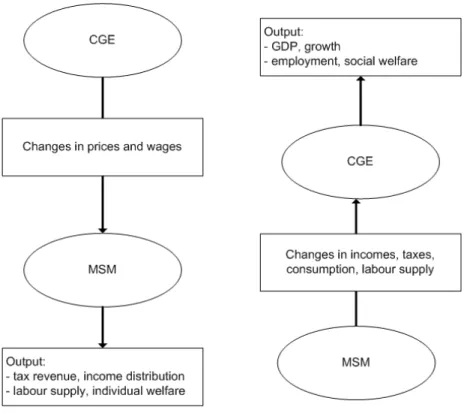
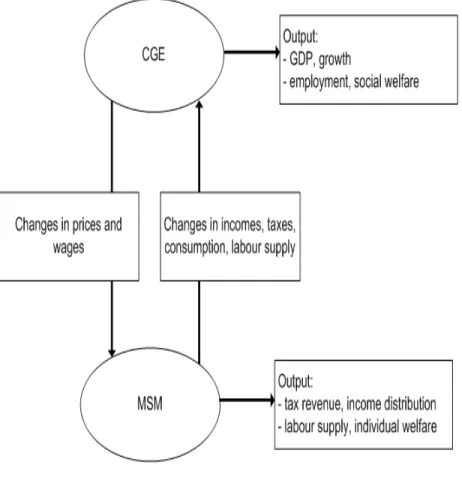
The layered approach can be differentiated into “top-down“ (see Figure 1, left-hand side), “bottom-up“ (see Figure 1, right-hand side) or “top-down bottom-up“ (see Figure 2) ap-proaches.6 The top-down approach computes the macroeconomic variables (price level, growth
rates) in a CGE model as input for the micro model which is adjusted to match an exogenous macro aggregate. The bottom-up approach works the other way around and information from the micro model (elasticities, tax rates) is used in the macro model (e.g. to calibrate the repre-sentative agents). Both approaches suffer from the drawback that not all feedback is used. The top-down bottom-up approach combines both methods to a recursive approach. In an iterative process one model is solved, information is sent to the other model, which is solved and gives feedback to the first model. This iterative process continues until the two models converge.
Choosing the appropriate approach for the analysis of a given policy reform depends on the specific research question. If one is interested in both micro and macro level variables and the shock induces a complex feedback effect which is quantitatively relevant, then a top-down bottom-up model is the right choice. If not, it depends on the level of the initial shock. If
6
Figure 1: Top-down and bottom-up
the shock occurs on a different level than the variables one is interested in, either a top-down or a bottom-up approach is suitable. If you are only interested in variables of the level where the shock occurs, a stand-alone model - maybe with simple extensions (e.g. labour demand constraints in a MS model or micro consistent aggregated elasticities in a CGE model) - can do the job. Further on, in practical considerations, the availability of micro consistent data (especially in developing countries) as well as time requirements and human resources have to be taken into account. Fortunately, information technology is no longer the bottle-neck for these kind of models.
To be able to successfully link MS and CGE models, common variables through which the two models interact are needed. On the one hand, information from the MS model is aggregated to calibrate the representative agent(s) of the CGE model. Typical variables and parameters used in this bottom-up linkage include labour supply elasticities, income components, average and marginal tax rates, consumption patterns, income levels and tax revenues. On the other hand, information from the CGE model is given to the MS model. For the top-down linkage changes of the wage or price level are used to adjust the (real) disposable incomes and con-sumption levels for the labour supply estimations. When linking the two levels, it has to be
Figure 2: Top-down bottom-up
assured that the individual functions from the micro model can be aggregated to macro level functions and the macro level information disaggregated to the micro level in a consistent way. For example, a (nested) multinominal logit specification of the individual direct utility function (which is usually used in discrete choice labour supply models) can be aggregated to a global CES utility function (which is usually used in CGE models, see, e.g., Verboven (1996)). If the top-down bottom-up approach is used, convergence criteria for the end of the iteration pro-cess have to be defined. Convergence is typically achieved when the changes in the exchange variables are (close to) zero. However, there is no (theoretical) guarantee that both models converge.
The application of linked micro macro models to analyse tax reforms is rather limited.7
Boeters et al. (2005) use the bottom-up approach to calibrate the three representative house-holds of a CGE model to analyse different hypothetical reform proposals of the social assistance benefit system in Germany. A similar approach is chosen by Fuest et al. (2007) to evaluate a tax reform proposal for Germany with respect to fiscal, employment and growth effects. Arntz et al. (2008) use the recursive top-down bottom-up approach to analyse reform proposals designed to
7
encourage labour supply at the lower end of the wage distribution in Germany. Aaberge et al. (2007) use an integrated micro macro model of Norway to analyse the impact of population ageing on fiscal sustainability with endogenous labour supply. Labour supply responses are computed using the MS model and are then used in the CGE model to estimate changes in wage rates. Rutherford et al. (2005) link a CGE model to the Russian Household Budget Sur-vey (representing 55,000 households) in order to analyse the distributional effects of Russia’s WTO accession. They use the information of the micro model to calibrate the representative agent of the CGE model and iterate both models until they converge in terms of price changes and aggregate demand equalling aggregate supply.
D
Potential problems of simulation analyses
When conducting a simulation analysis or interpreting its results one should be aware of po-tential errors or biases (see Betson (1990)). Sampling errors can always occur when subsamples from the whole population are used in an empirical analysis which can increase or decrease the variation in the data. Thus, estimates from the simulation model might differ from estimation based on the whole population. If the sample was not drawn randomly, the assumptions of statistical procedures might be violated and special corrections have to be used in the analysis. Furthermore, there might be also “sampling errors“ in the dataset, resulting e.g. from non-response and reporting or data processing mistakes. The weighting of the individual records with population weights to estimate aggregated values for the whole population can reduce these errors, as the weighting factors are chosen to ensure that the sample estimates conform to macroeconomic indicators of the whole population. However, when these population factors are modified, e.g. using static ageing techniques of reweighting, this can give rise to ageing errors if the modification itself is biased. Imputation errors arise when data from different sources are used for the imputation of missing values or variables. As a consequence, distribu-tional assumptions might be violated leading to biased estimations. But not only the data is error-prone but also the modelling of the benchmark or the counterfactual scenario itself gives rise to potential mistakes. Individual response errors can arise from simplifying assumptions regarding the individual behaviour in the model. Simplifying assumptions are always subject to errors, but have to be used to overcome data limitations or to make the model operational. Behavioural assumptions are necessary for the estimation of behavioural responses. To do so, functional forms and co-variables of the econometric model have to be specified based on be-liefs of the underlying behaviour of the individuals. Incomplete or imperfect bebe-liefs can lead to misspecifications and biased results. Environmental errors can e.g. arise from the negligence of the broader economic environment or individual reactions to policy changes.
assumptions about optimising behaviour, competitive markets and flexible prices. CGE models rely on the calibration method, which is to some extent rather arbitrary as it is not based on a solid econometric foundation. However, the usefulness of a CGE model depends on the aims and purposes it was designed for and what the alternatives are. If a model cannot be solved analytically, a numerical solution can help to identify general equilibrium effects of policy changes and the role of (exogenous) parameters for the results can be explained using extensive sensitivity analyses. Furthermore, even if the precise magnitude of the effects remains uncertain, it still might be possible to identify if the effects are small or large or at least to compare and rank different scenarios.
When conducting a micro-macro linkage, several specific potential problems arise. The main problem is the lack of theoretical and empirical consistency between the micro and the macro parts which can give rise to (dis)aggregation errors. To be able to successfully link MS and CGE models there have to be some common variables through which the two models can exchange information. Usually, it is necessary to aggregate or disaggregate these variables to be comparable with the variables in the other model. Of course, the less variables have to be (dis)aggregated the more of the underlying heterogeneity in the data will be retained. Furthermore, it has to be checked if the same variable in both models represents the same population (e.g. household consumption in the micro model vs. aggregated total consumption including government in the macro model). Functional forms (e.g. the preference functions in the labour supply model and the aggregated utility in the CGE model) have to be specified in a consistent way. In addition, it has to be checked if one run of each model represents the same time horizon. However, despite the best efforts, there is no guarantee of coherence between the two models which can be complex and technically challenging to achieve.
When building and using a simulation model, a researcher has to be aware of these potential errors and should try to avoid them if possible or at least to document the possible biases in the analysis. Extensive sensitivity analyses should be conducted when building a model or simu-lating a new scenario. When interpreting the results of a simulation study, one should consider these potential errors and take a closer look at the underlying data, methods and assumptions. Furthermore, estimations from simulation models should not be used as an exact forecast of a single number but to compare and rank different scenarios according to various dimensions. Despite all these potential errors, simulation models nevertheless provide a powerful tool for the ex-ante evaluation of fiscal policy reform proposals.
III
Database and model
A
General layout of the simulation model FiFoSiM
Our analysis is based on a behavioural simulation model for the German tax and transfer system (FiFoSiM) using income tax and household survey microdata. The approach of FiFoSiM is innovative insofar as it creates a dual database using two micro data sets for Germany: FAST01 and GSOEP.8 FAST01 is a micro dataset from the German federal income tax statistics 2001 containing income tax data of nearly 3 million households in Germany. Our second data source, the German Socio-Economic Panel (GSOEP), is a representative panel study of private households in Germany. The simultaneous use of both databases allows for the imputation of missing values or variables in the other dataset using techniques of statistical matching.
The layout of the tax benefit module follows several steps: First, the database is updated using the static ageing technique which allows controlling for changes in global structural vari-ables (through reweighting of the sample) and a differentiated adjustment for different income components of the households (through uprating of various income components). Second, we simulate the tax and benefit system in 2008 using the uprated data. This allows us to compute the disposable incomes for each person and household taking into account the detailed rules of the complex tax benefit system. The basic steps for the calculation of the personal income tax under German tax law are as follows. The income of a taxpayer from different sources is allocated to the seven forms of income defined in the German income tax law. For each type of income, the tax law allows for certain specific income related expenses. Then, general deductions like contributions to pension plans or charitable donations are taken into account and subtracted from the sum of incomes, which gives taxable income as a result. Finally, the income tax is calculated by applying the tax rate schedule to taxable income. To derive the disposable incomeY from gross incomeG,received benefits (like unemployment benefit, social assistance, child benefits, etc.) are added and taxesT and social insurance contributions S are subtracted:
Y =G+B−T −S. (1)
Third, the individual results are multiplied by individual sample weights to extrapolate the fiscal effects of the reform with respect to the whole population.
8
This section is based on the English documentation of FiFoSiM (see Peichl and Schaefer (2008)). In the last years several tax benefit microsimulation models for Germany have been developed. Most of these models use either GSOEP or FAST data. FiFoSiM is so far the first model to combine these two databases.
B
Labour supply module
Based on the disposable incomes, we estimate the labour supply effects of tax reform scenarios. For the econometric estimation of labour supply elasticities, we apply a structural discrete choice household labour supply model. Discrete choice labour supply models allow to analyse both the extensive (participation) and the intensive (hours worked) labour supply decision within the same modelling framework (Blundell and MaCurdy (1999)).
Following Van Soest (1995), we assume that the household’s head and his partner jointly maximise a household utility function in the arguments leisure of both partners and net income. Household i (i = 1, ..., N) can choose between a finite number (j = 1, ..., J) of combinations (yij, lmij, lfij), whereyij is the net income, lmij the leisure of the husband and lfij the leisure
of the wife of household i in combination j. Based on our data, we choose five working time categories for men and women (unemployed, employed, overtime and two part time categories).
We model a quadratic household utility function Vij(xij) =x
′
ijAxij +β
′
xij (2)
with the arguments yij, lmij, and lfij, which enter the utility function in linear (coefficients
β = (β1, β2, β3)
′
) and in quadratic and gross terms (coefficients A(3×3) = (aij)). We control for
observed heterogeneity in household preferences by adding interactions with control variables into the specification. Following McFadden (1973) and his concept of random utility max-imisation, we add a stochastic error term εij for unobserved factors to the household utility
function:
Uij(xij) = Vij(xij) +εij. (3)
Assuming joint maximisation of the households utility function implies that household i chooses category k if the utility index of category k exceeds the utility index of any other category l ∈ {1, ..., J}\{k}, if Uik > Uil. This discrete choice modelling of the labour supply
decision uses the probability of i to choose k relative to any other alternative l: P (Uik > Uil) =P [(x ′ ikAxik +β ′ xik)−(x ′ ilAxil+β ′ xil)> εil−εik]. (4)
Assuming that εij are independently and identically distributed across all categories j to
a Gumbel (extreme value) distribution, the difference of the utility index between any two categories follows a logistic distribution. This distributional assumption implies that the prob-ability of choosing alternative k ∈ {1, ..., J} for household i can be described by a conditional
logit model which can be estimated using maximum likelihood: P (Uik > Uil) = exp (Vik) PJ l=1exp (Vil) . (5)
C
CGE module
The tax benefit and labour supply modules of FiFoSiM only account for the household side of the economy. The CGE module allows us to simulate the overall economic effects of policy changes including the production side. Therefore effects on labour demand, employment and GDP as well as wage and price levels can be assessed. The static CGE module of FiFoSiM models a small open economy with 12 sectors and one representative household.9
The representative household maximises a nested CES utility function. At the top nest the household chooses between aggregated consumption (including leisure) today Q or in the futureS. The result of this optimisation is the savings supply. On the second level, the present consumption leisure (or labour leisure) decision takes place. The household maximises a CES utility functionU (C, F) choosing between consumption C and leisure F:
U (C, F) =h(1−β)σC,F1 CρC,F +β 1
σC,FFρC,F
iρC,F1
. (6)
whereβis the value share, andσC,F = ρC,F−1
ρC,F the elasticity of substitution between consumption
and leisure. The budget constraint is: pCC =w 1−tl
(E−F) +r 1−tk
K+TLS, (7)
where pC is the commodity price, w the gross wage, tl the tax rate on labour income, E the time endowment, r the interest rate, tk tax rate on capital income and K the capital endowment. Consumption pCC is financed by labour incomew 1−tl
(E−F), capital income r 1−tk
K and the lump sum transfer TLS, that ensures revenue neutrality. Optimising (6)
subject to (7) yields the demand functions for goods and leisure. From the latter we calculate the labour supply of the household. A representative firm produces a homogenous output in each production sector according to a nested CES production function. At the top level nest, aggregate value added (V A) is combined in fixed proportions (Leontief production function) with a material composite (M). M consists of intermediate inputs with fixed coefficients, whereas V A consists of labour (L) and capital (K).10 The optimisation problem at the top
9
The expressiveness of this simple CGE module as a stand-alone model is rather limited. In combination with the state-of-the-art microsimulation module it becomes a powerful tool, though. Nevertheless, the improvement of the CGE module is work in progress.
10
level in each sector i can be written as: Yi = min 1 a0i fi(Li, Ki); M1i a1i ;...;M12i a12i . (8) In the bottom nest, the following CES function is used:
fi(Li, Ki) = [αiLiρi+ (1−αi)Kiρi]
1
ρi (9)
where σi = 1−1ρi is the constant elasticity of substitution between labour and capital.
To account for imperfections of the German labour market, a minimum wage wmin
i is
mod-elled as a lower bound for the flexible wages in each sector.11 The labour supply is therefore
rationed:
LSi (1−µ)≥LDi . (10)
The minimum wage is calibrated such that the benchmark represents the current unemployment level of Germany. The government provides public goods (G), which are financed by input taxes on labour and capitaltl andtk.A lump sum transferT to the households completes the budget
equation:
G+T =tlwL+tkrK. (11)
Domestically produced goods are transformed through a CET-function into specific goods for the domestic and the export market, respectively. By the small-open-economy assumption, export and import prices in foreign currency are not affected by the behaviour of the domestic economy. Analogously to the export side, we adopt the common Armington assumption of product heterogeneity for the import side. A CES function characterises the choice between imported and domestically produced varieties of the same good. The Armington good enters intermediate and final demand.
The model is based on a social accounting matrix (SAM) for Germany which is created using the 2004 Input-Output-Table and the static ageing technique to transform the data to 2008. Further on, it is assured that this SAM is micro consistent by reconciling the data with the household budget survey and calibrating the representative agent groups based on this information. The elasticities for the utility and production functions are calibrated based on empirical estimations. The sectoral Armington elasticities are based on Welsch (2001), the elasticity of substitution between labour and capital is assumed to be 0.39 according to Chirinko depending on the context of the simulated reform.
11
It is possible to model different minimum wages for each activity. Assuming involuntary unemployment induced by a minimum wage is a rather strong assumption and might be to simple for the German labour market and a model with wage bargaining (see e.g. B¨ohringer et al. (2005)) might be more realistic. Therefore, the predictions of the magnitude of the employment effects should be interpreted carefully. However, for the purpose of explaining possibilities of linking micro and macro models, this assumption should be sufficient.
et al. (2004). The elasticity of intertemporal substitution is assumed to be 0.8 (Schmidt and Straubhaar (1996)), whereas the elasticity of substitution between consumption and leisure is based on aggregated labour supply elasticity estimates taken from the MS module.
D
MS-CGE-Linkage
In FiFoSiM, the MS and CGE modules are linked in several ways. In the bottom-up linkage the representative household (income, labour supply, tax payments) in the CGE module is calibrated based on the simulation results of the microsimulation modules. For the top-down linkage changes of the wage or price level are computed in the CGE model and used in the microsimulation modules for the calculation of real disposable incomes and the labour supply estimation. The top-down bottom-up approach used for this analysis is executed manually until the changes in labour supply and wages close to zero, i.e. smaller than someǫ. The MS module is written in Stata and the CGE module in GAMS. The interfacing and the information exchange has to be executed manually. We are currently implementing a routine to automatically execute the GAMS program from Stata, read in the modified CGE parameters, resolve the MS model, write the modified MS output in GAMS format, execute the CGE model and so on until convergence is achieved. However, it appears to be useful to manually check the results to be able to quickly identify possible problems.
IV
A Flat Tax for Germany
A
Cash flow flat tax proposal
The proposal of Mitschke (2004) in its original version combines an almost flat rate tax (two brackets with different marginal rates) on earned income with a S-base cash flow tax, i.e. income which is invested in firms is tax exempt.12 Real investments are granted an immediate
write-off, whereas financial investments are tax exempted. Therefore, the neutrality of the savings and investment decision is achieved through this S-base cash flow tax. In effect, this reform proposal is a switch from an income based tax system to consumption taxation (concept of deferred taxation). In principle, this proposal is close to the ”Flat Tax“ idea of Hall and Rabushka (1985) which combines a R-base cash flow taxation on corporate income with the same single marginal tax rate on labour income. The tax base is sales minus purchases with capital goods being excluded (R-base).13 Essentially, the HR flat tax is a consumption-type,
origin-based value added tax (VAT) with a tax credit for labour income (see Keen et al. (2008)).
12
See Fuest et al. (2007) for a detailed description and analysis of the Mitschke proposal.
13
Further on, this origin-based VAT is a tax on domestic production that taxes exports but not imports (in contrast to the destination-based form of VAT).
The Mitschke proposal includes several elements to broaden the tax base compared to the current German tax law. Pensions as well as all payments from insurance contracts are now subject to income tax. Several non labour income related deductions are abolished or limited to lump-sum amounts. Further on, an imputed rent on owner-occupied housing is also taxed. In contrast to Mitschke (2004), who chooses a progressive tax schedule with two brackets, we model a single marginal tax rate of 25% for all types of income with a basic allowance of 7,500 Euro in this paper. The marginal rate of 25% is computed from micro data as an average tax rate of taxpayers under the Mitschke proposal. The basic allowance is chosen such that the Mitschke flat tax yields the same revenue as the Mitschke two bracket schedule - allowing for a loss in revenue compared to the existing system which is in line with the HR flat tax idea. Further on, the rather low marginal rate of 25% is in line with existing flat tax rates (see, e.g., Keen et al. (2008)). The Mitschke proposal further distinguishes between an introductory phase (personal income tax reform, Scenario 1) and a final phase (personal income tax and cash flow corporate tax, Scenario 2). In the first phase, only the personal income tax system is changed to a system with a single marginal rate on all sources of income (including capital and business income). In the final phase, the modified personal income tax is combined with a cash flow corporate income tax with the same marginal rate. In contrast to HR, the VAT is not changed in the Mitschke proposal. Furthermore, the imputed rent on owner occupied housing is also part of the tax base in this phase.
B
Analysis
For a better illustration of results, the analysis is conducted in 4 steps. In the first step, the fiscal effects are analysed using the static tax benefit MS module without taking into account the behavioural reactions of the economic agents (first round effects). In the second step, we allow for behavioural reactions by estimating the labour supply responses without any feedback to/from the CGE module (i.e. assuming exogenous labour demand). In the third step, the labour demand and wage changes are computed in the CGE module (without any feedback to/from the MS module, i.e. exogenous labour supply). In the fourth step, the linked model is used for the computation of the overall employment and GDP effects (general equilibrium) and their feedback on the income distribution after all adjustments are taken into account. We link the tax benefit module to the CGE model by using the MS results to calibrate the representative household in terms of income, labour supply and tax payments. Information on changes in wages and prices are fed back from the CGE model to the MS model. This procedure is iterated until the two models converge, i.e. the changes in labour supply and wages/prices
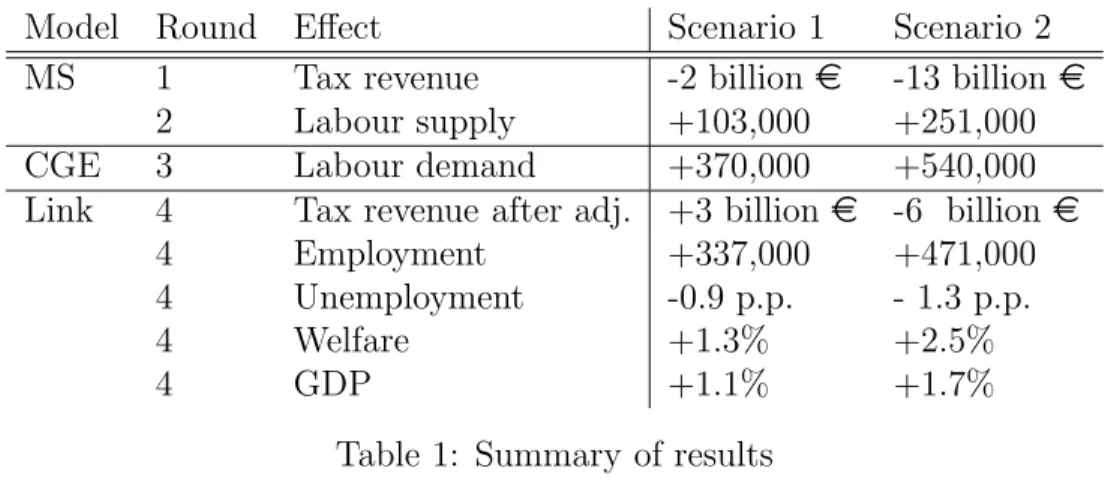
are close to zero. The main results are summarised in Table 1.
When interpreting the results it has to be stressed that we are using static MS and CGE models, i.e., the economy is modelled at two given points in time only: the status quo benchmark and the future counterfactual equilibrium without modelling the adjustment process between the two equilibria. The fact that we are using static models does not imply that we necessarily compute short-run effects. In contrary, the behavioural results present the (level) changes be-tween two equilibria in the long-run without taking into account the transition path (which can only be analysed in a dynamic model). Therefore, the behavioural adjustments are expectations for the long-run (partial or general) equilibrium, i.e., after the economy has fully equilibrated, whereas the first round effects represent the immediate short-run effects the “day after” the reform (without any adjustment).14
Model Round Effect Scenario 1 Scenario 2
MS 1 Tax revenue -2 billion e -13 billion e
2 Labour supply +103,000 +251,000
CGE 3 Labour demand +370,000 +540,000
Link 4 Tax revenue after adj. +3 billion e -6 billion e
4 Employment +337,000 +471,000
4 Unemployment -0.9 p.p. - 1.3 p.p.
4 Welfare +1.3% +2.5%
4 GDP +1.1% +1.7%
Table 1: Summary of results Source: own calculations based on FiFoSiM
The Mitschke proposal includes measures to broaden the tax base and a uniform marginal tax rate instead of a graduated rate schedule. Therefore, it is a priori not clear cut if the tax revenue will be higher or lower than in the status quo.15 The shift from the current German
tax regime to the Mitschke proposal would result in revenue losses amounting to e 2 billion
in the introductory phase (i.e. flat personal income tax) respectively e 13 billion in the final
phase (i.e. flat personal income tax and cash flow flat corporate income tax) without taking the behavioural responses into account (first round effects). These short-run effects indicate that the (not revenue neutral) flat tax reform scenario reduces the average tax burden on labour.
14
Note that if a simulation model computes short or long-run effects depends on the closure rules. For instance, if in a CGE model the capital stock/supply is assumed to be exogenous, the model will be able to analyse short-term effects. The results from a labour supply model are usually estimations for the long-run as they do not account for frictions of the labour market, e.g. due to searching and matching or fixed costs of working. In the following, we use ”short-term” for the analysis without any feedback and ”long-term” for the new equilibrium after all feedback has been taken into account.
15
It would have been possible to construct the scenarios revenue neutral. However, the HR flat tax idea as well as the Mitschke proposal are not designed to be revenue neutral. Furthermore, allowing for a first round loss in revenue might trigger stronger efficiency effects than a revenue neutral scenario. Therefore, the analysis in this section allows for a loss (or increase) in tax revenue.
As a consequence of this lower tax wedge, the net wage is likely to increase and the gross wage is likely to decrease. These effects imply increasing labour supply as well as increasing labour demand due to reduced user costs of labour. These effects will be simulated in the next steps. In the second step, the labour supply effects are simulated in the behavioural MS module assuming exogenous labour demand and wages. Labour supply increases by 103,000 [251,000] fulltime equivalents in Scenario 1 [2]. By including those second round effects, revenue increases and revenue losses are lowered. The distribution of the labour supply reactions with respect to different groups is presented in the upper panel of Table 2. First of all it should be noted that all groups increase their labour supply in both scenarios. Nevertheless, the differences between both scenarios for the different groups are noteworthy. Women react stronger than men which is in line with the recent empirical literature on female labour supply elasticities. One reason for this effect in the German context is the (implicit) abolition of joint taxation when introducing a flat tax. The existing German system of joint taxation makes it unattractive for secondary earners to work as both spouses face the same effective marginal tax rate. Therefore, in many households only the husband is employed (often even working overtime) whereas the wife does not work (or more precisely: specialises in household production). Lowering the statutory (and effective) marginal tax rates decreases the incentives for this type of employment distribution within a given household. As a consequence, women increase their labour force participation whereas men decrease it. The fact that even married men in total increase their labour supply can be explained by the tax relief through the lower tax rates. If the scenario had been constructed to be revenue neutral ex-ante, the labour supply effects of married men would have been close to zero (or even negative, see Fuest et al. (2008)). These effects are robust to parameter specifications in the sense that revenue neutral scenarios with higher tax parameter values always yield lower labour supply effects, whereas scenarios with higher tax reliefs yield higher labour supply reactions. Therefore, the labour supply effects in Scenario 2, which leads to higher fiscal losses, are larger than those of Scenario 1.
Couple male Couple female Single male Single female Total
A: LS Scenario 1 27,208 39,607 1,950 34,706 103,471
Scenario 2 46,681 73,649 55,957 74,921 251,208
B: Emp. Scenario 1 79,754 118,753 30,238 108,900 337,645
Scenario 2 96,094 148,075 82,558 144,689 471,416
Table 2: Labour supply (A) and employment (B) effects (fulltime equivalents) Source: own calculations based on FiFoSiM
So far, these results are only based on the MS model. In the third step, the CGE model is used to derive the effects on labour demand, which increases by 370,000 [540,000] Scenario 1 [2] due to reduced costs of capital and labour. As labour supply is assumed to be exogenous in
this step, the wages increase as a consequence.
In the fourth step, the linked model is used to integrate the micro (labour supply) and macro (labour demand) analysis. The information from the MS model (step 1 and 2) is used to calibrate the representative household of the CGE model and the feedback effects on wages and prices (step 3) are used again in the MS model. Both models are resolved several times until they converge. This leads to the following results: employment increases by 337,000 full-time jobs, unemployment is reduced by 0.9 p.p., and GDP increases by 1.1% in the first scenario. The distribution of these employment effects across different groups is presented in the lower panel of Table 2 and is rather similar to the distribution of labour supply effects explained above. The overall employment effects are larger than the labour supply reactions because of reduced costs of labour and capital resulting in increasing labour and investment demand.16
However, the employment effects are smaller than the pure labour demand effect derived from the stand-alone CGE model. These two result imply that the incidence of the tax reform is split between employees (labour supply) and employers (labour demand). This result is confirmed by the average increase in the wages which is smaller than the reduction in the tax wedge. This effect indicates the importance of taking feedback effects into account as the labour supply model alone would underestimate the employment effects whereas the labour demand model would overestimate them. For the second scenario, we calculate a total of 471,000 new full-time jobs (unemployment is reduced by 1.3 p.p.) and a 1.7% increase in GDP. These results show that a cash flow flat tax leads to further efficiency gains due to more investment and labour demand as a consequence of reduced tax distortions in the corporate sector.
What are the effects on income distribution? We compute different distributional measures based on equivalised disposable incomes17 to analyse the distributional effects before any (short
run) and after the complete (long run) adjustment process (see Table 3). Without taking any behavioural responses into account (first round effects) the highest decile, which generates the largest part of the overall tax payments, gains the most in both flat tax scenarios. One should note, though, that average gains of a decile do not, of course, exclude heterogeneity within deciles. Households in the lowest deciles seldom pay taxes in the status quo and therefore the relative changes are rather small. Overall, both scenarios lead to redistribution from middle income households to the ’rich’, e.g., the middle income deciles finance the relief of the 10%
16
These results are in line with results from Aaberge et al. (2007) who find that the general equilibrium effects of a flat income tax for Norway are larger than the pure labour supply reactions.
17
We use the new OECD equivalence scale which weights the household head with a factor of 1, household members over the age of 14 with 0.5, and under 14 with 0.3. The households net income is divided by the sum of the individual weights of each member (=equivalence factor) to compute the equivalence weighted household income. The results without equivalising household incomes do not differ qualitatively. Further on, we do not report the results of other summary measures of inequality, poverty or richness as they do not contribute any new insights to the analysis.
richest taxpayers. This result is reflected in an increase of the Gini coefficient of disposable incomes.18 The main reason is the relief for the top of the distribution. The small gains at
the lower end cannot compensate the higher burden in the middle income range and hence inequality increases.
∆ Income without adj. ∆ Income with adj. Equivalent variation Decile Scenario 1 Scenario 2 Scenario 1 Scenario 2 Scenario 1 Scenario 2
1 0.69 0.88 79.48 79.73 65 45 2 0.01 -0.33 12.42 12.05 -28 -163 3 -0.22 -1.82 6.20 4.35 -67 -454 4 -0.64 -2.53 3.16 1.41 90 -387 5 -1.33 -2.63 0.61 -0.59 282 -126 6 -1.92 -2.35 -0.55 -0.63 291 770 7 -2.30 -1.49 -2.13 -0.89 -516 596 8 -2.42 0.03 -3.19 -0.23 -251 3,323 9 -1.83 1.45 -2.63 1.88 -557 4,802 10 2.70 6.54 2.38 7.24 6,906 15,559 Gini / Sum 1.51 4.90 -2.38 1.73 6,215 23,965
Table 3: Change in disposable income (in percent) and equivalent variation (in million e)
Source: own calculations based on FiFoSiM
These effects change, however, after the economy has fully equilibrated. Especially the lowest deciles (using the same classification as before any adjustments) gain above average in relative terms in both scenarios. These high relative changes can be explained by low absolute values for disposable incomes in these deciles, which consist mostly of transfers. If some of these persons start working, they often earn a multiple of their previous income. This explains the large changes in relative terms. Still, the highest decile gains most in absolute terms and again middle income deciles are burdened the most. The introduction of the personal income flat tax reduces inequality because of the strong behavioural responses at the bottom of the distribution. When combining the personal income flat tax with the corporate cash-flow tax, however, inequality still increases but less than without behavioural adjustment. This is due to the fact that especially the high income households have corporate or business income.
Analysing welfare measures is another important aspect for the evaluation of tax reforms. In addition to looking at the changes in disposable income, we also report the effects on utility (after the adjustment process). We compute the changes in the equivalent variation as a money metric welfare measure based on the microeconometrically estimated utility function of
18
The Gini coefficient of the distribution of tax payments (not shown in the table) is decreasing in both scenarios indicating less redistribution through the income tax system. This prediction is confirmed when looking at more comprehensive measures of tax progressivity and redistribution which decrease for both scenarios.
the labour supply model. The equivalent variation EVi for each individual iis defined as:
EVi =Ei(p0, Ui0)−Ei(p0, Ui1) =Ei(p1, Ui1)−Ei(p0, Ui1) (12)
where Ei is the expenditure function, p the price (wage) vector, and Ui the utility level
be-fore (superscript 0) and after (1) the reform. The effects on utility differ from the effects on disposable income as they take into account the consumption-leisure decision which implies an income and a substitution effect. Therefore, increasing (decreasing) disposable income (i.e. labour supply incentives) does not necessarily trigger higher (lower) labour supply. The dis-tribution of utility gains and losses again indicate a redisdis-tribution from the poor and middle income households to the rich. In total, when looking at the sum of these efficiency gains (im-plicitly assuming an Utilitarian social welfare function with equal weights), the utility gains are larger than the tax revenue losses. Therefore, it would be possible to compensate the people who face lower utility as a consequence of the reform to increase the support for such a policy. This gain in overall welfare is achieved because the reform reduces the labour leisure distortions caused by the existing tax system.
To sum up, can a flat tax reform improve the fundamental equity efficiency trade-off? Both scenarios increase the efficiency of the tax system: labour supply, employment, GDP and welfare increase both in the short and in the long run. However, equality decreases for both scenarios in the short run and for scenario 2 in the long-run. The only case where efficiency and equity both increase is the first scenario after taking all feedback effects into account. Therefore, a flat tax can improve the fundamental equity efficiency trade-off but this can be argued to be the outcome of a specific flat tax design rather than a universal feature of flat taxes in general. Note that the results of our analysis depend on the chosen flat tax parameters (marginal tax rate, basic allowance, tax base broadening, revenue). For instance, it would be possible to construct revenue neutral scenarios. This would imply c.p. a higher (lower) marginal tax rate (basic allowance). Further on, it would also be possible to keep the inequality level in terms of, e.g., the Gini coefficient unchanged. This would imply an even higher marginal tax rate.19 For
example, Fuest et al. (2008) simulate two scenarios that are revenue neutral for Germany. The flat tax with a low rate and the existing basic allowance (26.9% without tax base broadening) increases the Gini coefficient by 2% and labour supply by about 90,000 full time equivalents. The flat tax with a high basic allowance and tax rate (10,700e and 31.9%) keeps the Gini
coefficient constant. However, in this scenario the labour supply effects are not significantly
19
Due to lack of space, we do not present the results for such a scenario in detail but only discuss the main implications. Further on, proponents of a HR-type flat tax usually advocate a rather low marginal rate and taking into account a loss in tax revenue. Therefore, the results presented in more detail are of special interest as they differ from previous findings in the literature and, hence, add additional insights.
different from zero. The welfare effects (equivalent variation) are positive but roughly four times smaller than in our Scenario 1. When analysing the scenarios from Fuest et al. (2008) in the linked MS-CGE model, the employment effects are estimated to be close to zero. This is a consequence of the higher marginal tax rate and the almost constant labour supply. Positive employment effects can only be achieved in combination with a cash flow tax on business income. However, it is not possible to design a revenue and inequality neutral flat tax reform with the same marginal rate on corporate income without exceeding the previous user costs of capital. This would then results in reduced labour demand and therefore in combination with unchanged labour supply even in negative employment effects.
V
Concluding discussion
In this paper, we analysed the introduction of a comprehensive cash flow flat tax in the tradition of Hall and Rabushka (1985) using a linked MS-CGE model of the German economy, which provides a powerful tool for the ex-ante evaluation of hypothetical tax benefit reform proposals. Using the linked model enables us to extent the MS analysis beyond labour supply reactions by accounting for the effects on (un)employment and GDP. The CGE model can be supplemented with a detailed distributive analysis. We find that taking these feedback effects into account has important implications for the evaluation of (flat) tax reforms.
Our analysis shows that the overall employment effects are larger than the labour supply reactions - because of reduced costs of labour and capital resulting in increasing labour and investment demand - but smaller than the the pure CGE labour demand effects because of labour supply and wage adjustments. Therefore, it is essential to take these feedback effects into account. In doing so, the analysis shows that a personal income flat tax can improve the familiar equity efficiency trade-off, but only in the long-run. The adverse immediate distributional effects still dominate in the short-run. Moreover, combining this flat tax with a cash flow flat tax on business income with the same marginal rate still increases inequality - even when accounting for feedback effects - due to the large gains at the top of the distribution at the expense of the middle class. This is important from a political economy perspective. A strong and politically powerful middle class is a typical characteristic of most Western European countries. This suggests that it will be hard for flat tax reforms to spill over to these grown-up democracies. Since our analysis focuses on Germany, the question arises whether the main findings are likely to apply to other countries as well. Therefore, more (and especially comparative) country studies are required to complete the picture. However, a multi-country linked MS-CGE model has not been developed yet.
analysis to static models. Therefore, the effects from our analysis only account for the new long-run equilibrium neglecting the transition path.20 However, regarding the political feasibility of a
flat tax reform, the short-term effects are most likely to be decisive.21 An aspect neglected in our
analysis is the impact of tax reforms on training and human capital accumulation. The results in Jacobs et al. (2007) suggest that flat tax reforms may increase investment in skill formation and thus change the composition of the labour force in the long term. But the question arises whether the income tax is the best instrument to achieve this. Furthermore, our analysis abstracts from effects of the flat tax reform on compliance. Flat rate tax systems are widely expected to improve taxpayer compliance. The 2001 tax reform in Russia is widely thought to be an example for this effect. Indeed, tax compliance and revenue apparently improved by about one third after the 2001 tax reform (Ivanova et al. (2005)). However, it is not clear whether this can be attributed solely to the flat tax or to improved law enforcement and tax administration which was also part of the 2001 reform (see also Gorodnichenko et al. (2007)). Moreover, the case of Eastern Europe differs from Germany insofar as the latter has a long tradition of income taxation in a market economy and a well established tax administration to ensure tax compliance. In addition, since we do not change social insurance contributions, the marginal tax rate on labour still remains high. This suggests that positive effects of a flat tax reform on compliance are probably less important in Germany than in the transition countries of Eastern Europe. Keen et al. (2008) survey the existing evidence of previous flat tax reforms in Eastern Europe. For the Russian case, they support the view that the increased compliance cannot be attributed directly to the flat tax reform. Besides Russia, only the 2004 reform in Slovakia has been analysed and the results suggest that income tax revenues slightly declined after the reform. For both cases, no evidence for increased labour supply could be found. This evidence supports our findings that strong efficiency gains can only be achieved when allowing for a loss in revenue (and an ex-ante increase in inequality).
Furthermore, the question arises whether the scope of increasing GDP and employment through personal income tax reforms is sufficiently large. Including the corporate income tax in the analysis does indeed lead to larger efficiency effects, but at the expense of increasing inequality. Therefore, the main problem of implementing a flat tax would be to convince a majority of the population that an immediate redistribution in favour of the highest income
20
Flat taxes are also supposed to have positive dynamic efficiency and growth effects (see e.g. Stokey and Rebelo (1995) or Cassou and Lansing (2004)).
21
People tend to judge future gains and losses asymmetrically (see e.g. the “prospect theory“ by Kahneman and Tversky (1979)). Starting from a reference point (status quo) and given the same variation in absolute values, there is a bigger impact of losses than of gains (loss aversion). Furthermore, people prefer the status quo over uncertain outcomes in the future (“status-quo-bias“, see Kahneman et al. (1991)). Therefore, short-term losses in comparison to the status quo can have a much stronger impact than (possible) future gains. Hence, the short term effects presented here could be decisive.
deciles is acceptable to achieve (uncertain) future efficiency gains. Moreover, it is uncertain whether a tax system that abolishes a large number of exemptions and tax reliefs is politi-cally sustainable. The temptation for politicians to serve special interest groups with special deductions cannot be ignored. Furthermore, from a political economy perspective, a broad tax base allows the government to increase revenue with small increases in tax rates (Brennan and Buchanan (1980)). Therefore, narrow tax bases might protect the taxpayers from excess taxation by the government.
References
Aaberge, Rolf, Ugo Colombino, Erling Holmøy, Birger Strøm, and Tom Wennemo (2007), “Population Ageing and Fiscal Sustainability: Integrating Detailed Labour Supply Models with CGE Models.” InModelling Our Future: Social Security and Taxation (A. Harding and A. Gupta, eds.), volume I, 259–290, Elsevier, Amsterdam.
Aaberge, Rolf, Ugo Colombino, and Steinar Strøm (2000), “Labor Supply Responses and Wel-fare Effects from Replacing Current Tax Rules by a Flat Tax: Empirical Evidence from Italy, Norway and Sweden.” Journal of Population Economics, 13, 595–621.
Altig, David, Alan Auerbach, Laurence Kotlikoff, Kent Smetters, and Jan Walliser (2001), “Simulating fundamental tax reform in the U. S.”American Economic Review, 91, 574–595. Anderson, Joseph M. (1990), “Micro-Macro Linkages in Economic Models.” InMicrosimulation
Techniques for Tax and Transfer Analysis (G. H. Lewis and R. C. Michel, eds.), Urban
Institute Press.
Arntz, Melanie, Stefan Boeters, Nicole G¨urtzgen, and Stefanie Schubert (2008), “Analysing Welfare Reform in a Microsimulation-AGE Model: The Value of Disaggregation.”Economic
Modelling, 25, 422–439.
Ballard, Charles, Don Fullerton, John Shoven, and John Whalley (1985),A General Equilibrium
Model for Tax Policy Evaluation. University of Chicago Press, Chicago.
Betson, David (1990), “How Reliable are Conclusions Derived from Microsimulation Models?”
InSimulation Models in Tax and Transfer Policy: Proceedings of an International Symposium
(Johann Brunner and Hans-Georg Petersen, eds.), 423–446, Campus Verlag, Frankfurt am Main.
Blundell, Richard and Thomas MaCurdy (1999), “Labor Supply: A Review of Alternative Approaches.” InHandbook of Labor Economics, Vol. 3A(Orley Ashenfelter and David Card, eds.), 1559–1695, Elsevier, Amsterdam.
Boeters, Stefan, Michael Feil, and Nicole G¨urtzgen (2005), “Discrete Working Time Choice in an Applied General Equilibrium Model.” Computational Economics, 26, 183–211.
B¨ohringer, Christoph, Stefan Boeters, and Michael Feil (2005), “Taxation and Unemployment: An Applied General Equilibrium Approach.” Economic Modelling, 22, 81–108.
B¨ohringer, Christoph and Thomas F. Rutherford (2006), “Combining Top-Down and Bottom-up in Energy Policy Analysis: A Decomposition Approach.” ZEW Discussion Paper No. 06-007.
Bourguignon, Francois and Amedeo Spadaro (2006), “Microsimulation as a tool for evaluating redistribution policies.” Journal of Economic Inequality, 4, 77–106.
Brennan, Geoffrey and James M. Buchanan (1980),The Power to Tax: Analytical Foundations
of a Fiscal Constitution. Cambridge University Press, New York.
Cassou, Steven P. and Kevin J. Lansing (2004), “Growth Effects of Shifting from a Graduated-rate Tax System to a Flat Tax.” Economic Inquiry, 42(2), 194–213.
Chirinko, Robert S., Steven M. Fazzari, and Andrew P. Meyer (2004), “That Elusive Elasticity: A Long-Panel Approach to Estimating the Capital-Labor Substitution Elasticity.” CESifo-Working Paper No. 1240.
Davies, James (2004), “Microsimulation, CGE and Macro Modelling for Transition and Devel-oping Economies.” Mimeo, University of Western Ontario.
Dunbar, Amy and Thomas Pogue (1998), “Estimating Flat Tax Incidence and Yield: A Sensi-tivity Analysis.” National Tax Journal, 51, 303–324.
Fuest, Clemens, Andreas Peichl, and Thilo Schaefer (2007),Aufkommens-, Besch¨aftigungs- und
Wachstumswirkungen einer Steuerreform nach dem Vorschlag von Mitschke. Nomos,
Baden-Baden.
Fuest, Clemens, Andreas Peichl, and Thilo Schaefer (2008), “Is a flat tax reform feasible in a grown-up democracy of Western Europe? A simulation study for Germany.” International