An Actor Network Theory Lens for Mobile Commerce:
A Mobile Payment Case Study
Hsiao-Chi Wu
Dept. of Information Management National Taiwan University
Taipei, Taiwan [email protected]
Cheng-Chieh Huang
Dept. of Information Management National Taiwan University
Taipei, Taiwan [email protected]
Ching-Cha Hsieh
Dept. of Information Management National Taiwan University
Taipei, Taiwan [email protected]
Abstract—Mobile device technology and mobile commerce are deeply embedded in many people’s everyday lives. In this paper, we adopt Actor Network Theory to understand how consumers, merchants, service providers, mobile devices, applications, and services interact in aligned networks. Using a mobile payment system adoption case, we identify social-technical problems encountered by users. We examine how they redefine “convenience” while performing different activities under space-time limitations. The results imply that m-commerce technology and service designers should consider strategies that emphasize oriented design, activity-based response, social-technical fit, and that lock users in a virtual closed network.
Keywords-mobile payment system; actor network theory; system perspective.
I. INTRODUCTION
Devices and applications based on mobile technology are now commonplace in everyday life. In recent years these devices have moved beyond wireless phones, wireless-enabled handheld computers, and personal digital assistants (PDAs) to include global positioning systems (GPS), location-based services, and electronic payment systems. People expect these devices and applications to make their lives more convenient, while merchants aspire to earn money through mobile commerce transactions.
Traditionally, mobile devices and applications emphasize an “anywhere, anytime” development scheme, but m-commerce services are now at a crossroads [1]. Experts are increasingly discussing the reasons behind mobile technology adaptation and user intentions [2-6]. Despite these efforts, relatively little is known about how users, merchants, mobile technologies, applications and services interact in everyday activities or social life.
In this paper, we examine social actors and technologies in m-commerce environments from a system perspective. Actor Network Theory (ANT) is used to understand how technical (i.e. mobility applications, technologies) and different social actors (i.e. consumers, merchants) align and interact in a social-technical system, called an actor network. In testing this theory, we selected a complex social and technical mobile payment case study, a public Taiwanese university.
We address three questions. First, how do focal actors, such as merchants or issuers, enroll users to join the actor network? Secondly, how do these technical and social elements interact, and what are the consequences? Thirdly, under what conditions do users accept or reject the m-commerce actor networks these focal actors construct into their social life? Using the ANT lens to interpret our case study, we argue that m-commerce technology and service strategies should focus on activities-oriented designs rather than location-based or context-aware concepts.
The remainder of this paper is organized as follows. Section II illustrates Actor Network Theory. Section III outlines our research approach, while section IV describes our Taiwanese university mobile payment application case. Here we identify main actors, social environments, and relevant technical elements. We then analyze and discuss how the focal actors enroll users, and how the mobile payment system enables or constrains users (section V). Finally, we examine why the technical system is accepted or rejected by users (section VI). The concluding section (section VII) lists our contributions and the limitations of our research.
II. ACTOR NETWORK THEORY
Actor Network Theory (ANT) was developed within the sociology of science and technology [7]. A key feature of ANT is that it treats networks as involving both human and nonhuman actors (such as a technology) [7][8]. The theory examines the motivations and actions of human actors who align their interests around the requirements of non-human actors.
Within ANT, inscription and translation are pivotal concepts. Engineers who design, develop and diffuse a technical artifact inscribe into this artifact their instructions for use, their intentions, and their vision of the society and world in which the artifact best fits. In this sense, they become sociologists, or in Callon’s word, engineer-sociologists. The technical aspects of the engineer’s work are profoundly social. Therefore, it is difficult to distinguish between the technical and the social during the process of innovation. When we accept that the technical is social, the artifacts on which engineers inscribe their own social preferences become entities; in ANT terminology, an actor
with the same nature and characteristics is regarded as a human actor. The distinctiveness of ANT is that it does not distinguish between human and nonhuman actors.
ANT helps describe how actors form alliances, enroll other actors, and use nonhuman actors (artifacts) to strengthen such alliances and to secure their interests. This process, called translation, is defined as “the methods by which an actor enrolls others” [8]. When an actor–network is created, translation consists of four stages [8].
• Problematization: The focal actors define interests that others may share, and establish themselves as indispensable resources in the solution of the problems they have defined. They define the problems and solutions and also establish roles and identities for other actors in the network. As a consequence, focal actors establish an “obligatory passage point” for problem solutions that all the actors in an actor-network must pass.
• Interessement: The focal actors convince other actors that the interests defined by the focal actors are in fact well in-line with their own interests. Through interessement the developing network creates sufficient incitement to both lock actors into networks.
• Enrollment: Enrollment involves a definition of the roles of each of the actors in the newly created actor-network. It also involves a set of strategies through which focal actors seek to convince other actors to embrace the underlying ideas of the growing actor-network and to be an active part of the whole project.
• Mobilization: The focal actors use a set of methods to ensure that the other actors act according to their agreement and remain loyal. With allies mobilized, an actor network achieves stability.
That is, the ANT lens is suitable for analyzing how social actors and technical elements negotiate and interact during the design and adoption phases of mobile technology.
III. RESEARCH APPROACH A. Data Collection Strategies
Informed by this interaction process as a guiding framework, our subsequent research strategy sought in-depth case study data that would give further insight into the complex interaction processes in m-commerce environments. For this we contacted T University, a university in Taiwan that has struggled to introduce their mobile payment system on campus. This system involves many participating groups, including university mobile payment project teams, the mobile payment cards service provider, merchants and users, students, staff, and the teachers of T University.
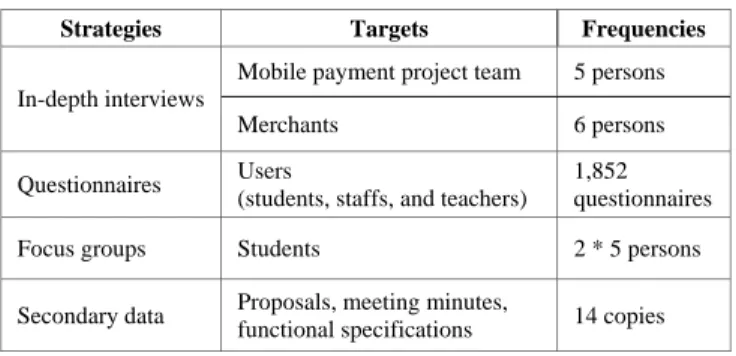
We adopted multiple data collection strategies (see Table 1). First, we conducted in-depth interviews with the mobile payment project teams at T University and the mobile payment cards service provider, so as to understand their design intentions and issues. We also interviewed merchants about their experiences using mobile payment systems.
Secondly, we distributed questionnaires to students, staff, and teachers to understand their use and interaction experiences. Third, we held two student focus groups to understand why they used or rejected the mobile payment system. Moreover, we gathered secondary data such as the mobile payment system’s proposal, function specifications, and meeting minutes. This secondary data helps supplement our survey and interview sources [9].
TABLE I. DATA COLLECTION STRATEGIES
Strategies Targets Frequencies
Mobile payment project team 5 persons In-depth interviews
Merchants 6 persons
Questionnaires Users (students, staffs, and teachers) 1,852 questionnaires
Focus groups Students 2 * 5 persons
Secondary data Proposals, meeting minutes,
functional specifications 14 copies
B. Analysis Framework
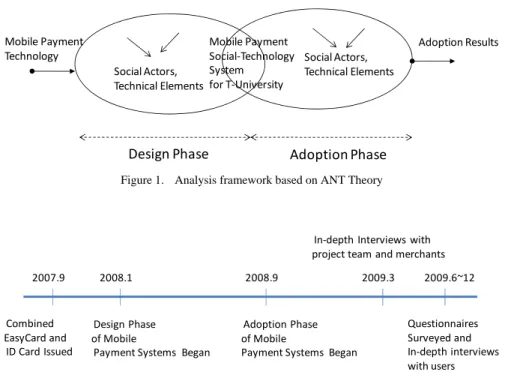
Our analytical approach was to understand the different participating groups’ perspectives, use and interaction experiences relating to the T University mobile payment environment. Following our approach and ANT, we constructed our analytical framework (Figure 1).
Using this framework, we can understand how the mobile project team inscribed their interests on the mobile payment system during the design phase and how the users, merchants and mobile payment system interacted during the technology’s adoption.
IV. MOBILE PAYMENT SYSTEMS AND ACTORS IN T UNIVERSITY
A. Mobile Payment Systems
Mobile payments are defined as the use of a mobile device to conduct a payment transaction in which money or funds are transferred from a payer to a receiver via an intermediary, or directly without an intermediary. Mobile devices include mobile phones or any wireless enabled device (e.g. PDA, laptop, card, watch).
Payment technology can be classified as card-based and phone-based systems [10]. Several successful mobile payment systems have already been launched in order to enhance the convenience of micro-payments for daily local expenditures. These solutions have been principally adopted by various fast service-oriented industries such as public transport (e.g. Octopus), toll booths (e.g. EZPay, FasTrak), gas stations (e.g. ExxonMobils Speedpass), fast food restaurants (e.g. McDonalds), retail vending machines (e.g. Sonera Mobilepay) and ski resort ticketing (e.g. Skidata) [11]. A payment market can be examined in terms of payment service providers, technology, and users. Payment service providers are typically financial institutions, network operators or independent issuers [12]. Users are divided into
two different and demanding groups of adopters: consumers and merchants. In general, the mobile payment adoption environment is complex, and involves many social and technical elements.
B. Social Actors and Technical Elements in the Case of T University
Mobile payments systems in T University were introduced in August, 2008. T University administrators considered that “mobile payments systems, combined with EasyCard and students’ or staffs’ identity cards will be convenient for payment needs on campus,” according to their meeting minutes on December, 2007. The intention of combining the university card with the public transportation EasyCard (issued by E Company) would increase its overall utility and provide simpler access to the largest public transportation system in northern Taiwan. That is, the new student/staff identity cards would conveniently pay for public transportation, parking, and other purchases on campus. Merchants M‐payment Service provider (E Company) Users refund clearing Issuers (T University) issue payment refund machines payment machines
Figure 2. The mobile payment system business model in T University
The business model for this system is illustrated in Figure 2. Users, such as students, staff, and teachers of T University refill the payment cards (their identity cards) using refill machines, and pay merchants through payment machines, called EDC (electronic data collector). Merchants will send this transactions information to E company for every transaction. Merchants pay a 0.5 % transaction fee to E company, which is cheaper than credit card transaction fees.
In summary, the mobile payment system in T University is a card-based system. The service provider is E company, and the issuer is T University. The technical elements include mobile payment cards, payment machines, and refill machines. The social actors are T University authorities, E Company, and participating merchants, students, staff, and teachers.
V. AMOBILE PAYMENT CASE IN TUNIVERSITY
Based on our analytical framework, the following are the interactions of social actors and technical elements in the design and adoption phases in the T University case.
A. Design Phase
The design phase began in January, 2008 after the T University combined EasyCard with student/staff identity cards in September, 2007 (see Figure 3). The T University project manager then invited the E company to design the mobile payment system on campus.
This was not the first time E company had introduced their EasyCard as a mobile payment system for institutions. The most successful case was D Hospital, which introduced EasyCard for patients to pay for their registration fees and medicine. Other education institutions have also incorporated these cards. Prior to implementation, T University surveyed more than forty merchants on campus, who initially welcomed the mobile payment system.
However, it was not easy to persuade these merchants to join the payment system. One E company representative said, “When talking about transactions fees, only ten merchants wanted to join!” The representative continued, “This case is very different from D Hospital or other education institutions. T University administrators did not sufficiently help persuade merchants.”
The T University project manager responded, “We are different from D Hospital or other private Universities!” He said, “It is state-run university, and our culture is free and respectful to everyone. We will not and cannot force every merchant and student or teacher to use the mobile payment system.”
A complication included differences between merchant points of sales (POS) systems. The card system required considerable integration costs. One of mechants said “Why we promote more while costs/benefits are not equal?” Nineteen merchants finally joined card payment services after T University agreed to pay the machine rental for two years.
B. Adoption and Consequences
To encourage user adoption, the T University project team conducted a promotional activity, where using a mobile payment card during the first month of the adoption phase earned the user a prize. They also made posters for participating merchants to attract user adoption. The project team and T University administrators viewed the cards as a valuable convenience.
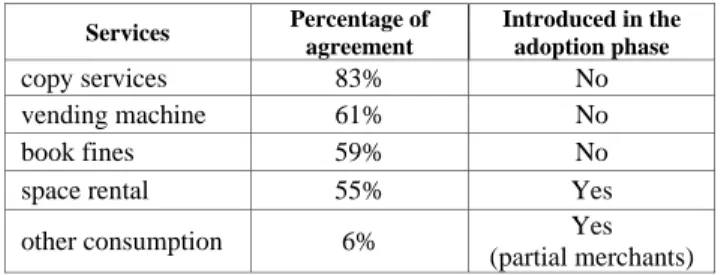
TABLE II. PRIORITY OF MOBILE PAYMENT USAGE SERVICES
Services Percentage of agreement Introduced in the adoption phase copy services 83% No vending machine 61% No book fines 59% No
space rental 55% Yes
other consumption 6% Yes
(partial merchants) Despite this perception however, adoption has been surprisingly weak. According to our survey questionnaires, weekly average payment amounts per user are roughly 100 NT dollars, which is less than one-day average spending on
campus. Although about 70% users agreed that the mobile payment card is more convenient than paying by cash, the cards are primarily used to pay for school administration activities, such as copy services, space rental, book fines, and vending machines (see Table II).
When asked, the first reason respondents did not use the payment card frequently was the risk of card loss. An interviewee said, “I think that the payment card is small and easier to lose than cash. If I lose my payment card I lose my student ID card!” Another interviewee described, “I added only a small amount of money into the payment card to reduce risk.” A user explained his experiences, “One day, I used my mobile payment card to pay for dinner at a coffee shop. I found the amount is not enough. But I really do not want to leave because my seat will probably be taken while I go to refill my payment card. It left me embarrassed!” As a result, users will not make large purchases with their mobile payment cards. Students also complained that only a few merchants accept mobile payment cards; they still need to bring cash in their pocket to campus. Moreover, payment speed is not faster than paying by cash. “Most of time, I still use my mobile payment card to pay for public transportation. I paid by mobile payment cards only because I was running out my coins!” an interviewee explained.
Merchants also encounter problems with the mobile payment system. A merchant said, “Sometimes users want to reorder, but the mobile payment system cannot withdraw.” A restaurant salesclerk also said, “We have three salesclerks so that, for cash payers, they could choose any line for transaction during peak hours. However, for card users, they have no choice, but need to stand in the only line for the card payment machine, which sometimes takes longer time.”
In summary, it seems convenient for users and merchants to use the mobile payment system, but in different social-technical interaction situations, they encounter different problems, and the system is not as convenient as focal actors expected. The payment cards are mostly used with the public transportation system beyond the T University campus.
VI. ANALYSIS AND DISCUSSIONS
Based on our analytical framework, the following are the interactions of social actors and technical elements during the design and adoption phases in the T University case.
A. Inscription and Translations
As described within the design phase, the T University holds a “respect towards every merchant” policy, and did not push any merchants to join the mobile payment system (see Table III). Even after T University decided to pay for a two-year payment machines rental, only nineteen merchants joined. For E company, integration costs were too high, with little expected benefit. T University also did not want to invest much in installing refill machines. Finally, inscription of the mobile payment system on T University campus is like a “proof of concept” in a laboratory.
During the adoption phase, users encountered different social or technical problems in different situations, but the focal actors could not solve these problems. Merchants did
not actively promote the mobile payment system. E company did not want to invest additional effort in resolving technical problems. Finally, users did not frequently use the card on campus. While the mobile payment card seemed convenient for students, these social-technical problems hampered overall convenience. Designers or merchants should thus consider such issues when solving these scenario problems, and not only technical functions or consumers’ intentions.
TABLE III. TRANSLATION STRATEGIES IN THE TUNIVERSITY CASE
Phase Focal Actors Translation
Design phase
T University, E company
1.problematization: T University defines “convenience for students”
2.interessement & enrollment: T University did promote system among merchants. E company also considered costs too high to form the network. 3.mobilization: merchants will
remain loyal if T University pays for two years of payment machine rental. Adoptio n phase T University, E company, merchants 1.problematization: “convenient for students,” but users encountered different problems in different situations.
2.interessement & enrollment: except for first month prize activity, little promotion. Merchants did not actively promote mobile payment system to users.
3.mobilization: did not have any agreement between users and merchants.
B. From Physical Location to Actor Network
Merchants
Figure 4. Location context of T University
Like other universities in Taiwan, T University is surrounded by many merchants beyond campus (see Figure 4). Moreover, the campus is near a famous trade circle, with
many restaurants, coffee shops, and clothing stores. After school, most students will thus not stay on campus and instead explore the nearby shopping area.
Such an environment, where actors can easily enter or leave to conduct transactions, is called an open network. Compared with the closed MRT network environment, it is not easy to lock users into consuming on campus. Physical location still limits users’ mobile commerce behaviors. Thus, when introducing mobile payment or mobile commerce services, it is worthy to consider the relationship between location context and users.
But from the ANT theory viewpoint, the focal actors can take strategies to form a ‘virtual’ closed actor network space to escape the physical location limitation. For example, actors may provide more discounts or other marketing activities for participating merchants on campus. Other strategies include persuading more merchants to join the actor network, installing more payment machines on campus or enrolling other non-school members to consume on campus by mobile payment cards.
Some students compared the mobile payment system on T University with a famous convenience store chain, with three stores located on campus. “I do not know why, but when I enter the convenience store, I will always find myself paying by mobile payment card!” “The payment speed of the mobile payment card is also slow, but I would like to pay by the card when purchasing at the convenience store.” The convenience store installed refill machines, and introduced different promotion activities every two months. That is, the convenience store chain arranged suitable social and technological elements, and then constructed a virtual closed actor network while customers entered their many-location stores.
C. Activity-Oriented Mobility
Sometimes the location is not the only factor to consider; activities in specific space-time also matter. For example, students consider that they will use their cards most frequently for copy services, book fines, space rental, and vending machines (see Table II). Often they will remain a long time in a specific space, such as the library, while doing these activities. Users defined “convenience” as doing different activities within their space-time limitations. That is, the focal actors should consider different strategies according to different space and time-limited activities (see Figure 5). Recently, more and more mobile commerce literature focuses on location-based or context-aware services and their applications [3]. Balasubramanian et al. [13] suggest that mobile technologies change the flexibility of activities along the spatial and temporal dimensions, and also impact people’s activity pattern. Therefore, a designer needs to take additional consideration in activity-oriented thinking when designing mobile devices, applications or services.
Although we expect mobile technology to achieve ubiquitous world dreams, most of time, mobile commerce is embedded within our living world, and activities within a specific space and time. Designers of mobile commerce applications or services should consider how to arrange the social-technical elements of different specific activities.
Space Limitation high low Time Limitation low high reading copying exercising online shopping lunch dinner shopping museum urban transportation
Different Social‐technical Arrangements and Design Strategies
Figure 5. Activity-oriented mobility design D. Implications for Technology and Service Strategies
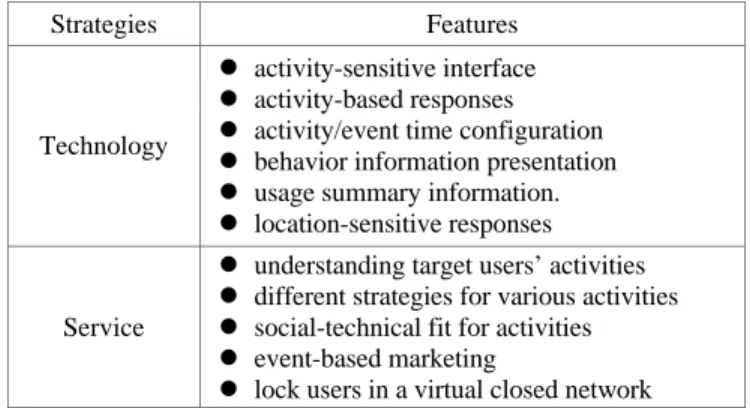
As discussed above, both location and space-time matter for mobile commerce design. Based on the above analysis and discussion, we can indicate future directions for mobile commerce system technology and service design strategies (see Table IV).
Table IV indicates possible directions for design solutions, such as an sensitive interface, activity-based responses, etc. Mobile systems can record activity, usage information and responses for different activities. Using T University as an example, mobile payment cards or service providers can record user-purchasing information, and merchants can respond with different promotion activities according to this purchasing data. Although some devices, such as the payment cards in our case, cannot store as much information as a smart phone, designers can still consider ways to use these cards for information storage, as social activities and other technical devices support these features. This is referred to as a social-technical fit for different activities (see Table IV).
Moreover, although ubiquitous computing is a dream for technology, focal actors should consider strategies for locking their users in a specific space-time environment: an actor network. This involves mobilizing more users to stay in an actor network and strengthening the stability of such a network.
TABLE IV. IMPLICATIONS FROM TECHNOLOGY AND SERVICE
STRATEGIES
Strategies Features
Technology
z activity-sensitive interface
z activity-based responses
z activity/event time configuration
z behavior information presentation
z usage summary information.
z location-sensitive responses
Service
z understanding target users’ activities
z different strategies for various activities
z social-technical fit for activities
z event-based marketing
VII. CONCLUSIONS [3] I. A. Junglas, and R. T. Watson, “Location-Based Services,” Communications of the ACM, vol 51, 2008, pp. 65-69.
In this paper, we take ANT theory as an analytic lens to understand the social-technical interactions of a mobile payment application case. We argue that mobile commerce is not only location-sensitive but also represents a social-technical arrangement of specific time-space activities. For designers, it is not sufficient to simply create a ubiquitous payment system, but an arrangement of applications, services, devices and activities that are embedded within the user’s living world. These findings imply the following principles for designers:
[4] P. A. Pavlou, and M. Fygenson, “Understanding and Predicting Electronic Commerce Adoption: An Extension of the Theory of Planned Behavior,” MIS Quarterly, vol 30, 2006, pp. 115-143. [5] Y. Aoyama, “Sociospatial Dimensions of Technology Adoption:
Recent M-commerce and E-commerce Developments,” Environment and Planning, vol 35, 2003, pp. 1201-1221.
[6] E. W. T. Negi, ,and A. Gunasekaran, “A Review for Mobile Commerce Research and Applications,” Decision Support Systems, vol 43, 2007, pp. 3-15.
[7] M. Callon, and B. Latour, “Unscrewing the big Leviathan,” in Advances in Social Theory and Methodology, K. Knorr-Cetina and A.V. Cicourel, Eds, London: Routledge & Kegan, 1981, pp. 277-303. • follow and understand user’s everyday activity
• activity-based sensitivity and responses [8] M. Callon, ”Some Elements of a Sociology of Translation: Domestication of the Scallops and the Fishermen of St. Brieuc Bay,” in Power, Action and Belief, J. Law, Ed, London: Routledge and Kegan, 1986, pp. 197-233.
• social-technical fits for different activities
• location-sensitive responses
• design a virtual closed actor network and strategies to
lock users [9] R. K. Yin, Case Study Research, Design and Methods, CA: Sage Publications, 1994.
In this study, we adopt multiple data collection strategies, and analyze both quantitative and qualitative data. Our primary limitation however is our single mobile payment case study. In future work, we will compare other institutions and different mobile commerce applications cases to understand the complex social-technical interactions within mobile commerce environments.
[10] J. Ondrus, and Y. Pigneur, “A multi-stakeholder multi-criteria assessment framework of mobile payments: An illustration with the swiss public transportation industry,” in Proceedings of the 39th Annual Hawaii International Conference on System Science, Hauai, HI, USA, 2006, pp. 42a.
[11] J. Ondrus, and Y. Pigneur, “A Disruption Analysis in the Mobile Payment Market,” in Proceedings of the 38th Annual Hawaii International Conference on System Sciences, Big Island, Hawaii, 2005, pp. 84c
REFERENCES [12] Y. Au, and R. Kauffman, “The economics of mobile payments: Understanding stakeholder issues for an emerging financial technology application,” Electronic Commerce Research and Applications, vol. 7, no. 2, pp. 141-164, 2008.
[1] S. L. Jarvenpaa, K. R. Lang,, Y. Takeda, and V. K. Tununainen,: “Mobile Commerce At Crossroads,” Communications of the ACM, vol 46, 2003, pp. 41-44.
[13] S. Balasubramanian, R. Peterson, and S. Jarvenpaa, “Exploring the implications of m-commerce for markets and marketing,” Journal of the academy of Marketing Science, vol. 30, no. 4, pp. 348-361, 2002. [2] S. Sarker, and J. D. Wells, “Understanding Mobile Handheld Device
Use and Adoption,” Communications of the ACM, vol 46, 2003, pp. 36-40.
Design Phase Adoption Phase
Mobile Payment Technology Mobile Payment Social‐Technology System for T‐University Adoption Results Social Actors, Technical Elements Social Actors, Technical Elements
Figure 1. Analysis framework based on ANT Theory
Combined EasyCard and ID Card Issued 2007.9 2008.1 Design Phase of Mobile
Payment Systems Began
2008.9
Adoption Phase
of Mobile
Payment Systems Began
2009.3 2009.6~12
In‐depth Interviews with project team and merchants
Questionnaires Surveyed and In‐depth interviews with users