15 Page 15-19 © MAT Journals 2019. All Rights Reserved
Opportunistic routing using Wireless Sensor Networks
Prankur Gupta1, Amar R.1*, Dr. H.C. Srinivasaiah2Student1, Assistant Professor2
Department of Telecommunication Engineering, Dayananda Sagar College of Engineering, Bangalore, Karnataka, India
Email: [email protected] DOI: http://doi.org/10.5281/zenodo.3073550
Abstract
Wireless Sensor Networks (WSN) are used in our daily life for monitoring and controlling application because of it’s unique features such as low power consumption, reduced cost, and implementation with ease. To improve the lifetime of wireless sensor networks energy efficient routing protocol is very necessary to choose in the network layer of WSN. A comparative analysis based on performance and energy consumption referring to opportunistic routing algorithm is done. It is being evaluated in terms of energy consumed, packets lost, flow rate and throughput. We see that Opportunistic routing algorithm performs way better than the entire traditional routing algorithm. The results provided show that Opportunistic routing give significant improvement in power consumption.
Keywords: Opportunistic routing, Energy efficient, Power consumption
INTRODUCTION
Wireless sensor netorks are one of the most important part of the wirelesss communication network. These sensors are the combined network of sensors placed in various lacation. These sensors can be static or dynamic in nature depending upon the usage and application. There are two types of WSN’s Unstructured WSN and structured WSN
The main characteristics of WSN are that it should be self organsing, concurrency processing, it needs to have low cost as there needs to be 100’s of WSN in a network. The most important characteristic of WSN is restricted energy resources which is needed as it can be in remote location and changing of battries and recharging them is very difficult so we hato use energy efficient algorithm instead to traditional routing algorithm.
The following section shows the
importance of energy efficient algorithm i.e. Opportunistic routing algorithm over Traditional routing algorithm.
DIFFERENCE BETWEEN
TRADIONAL AND OPPORTUNISTIC ROUTING
Traditional routing protocol
Traditional routing protocols are mainly focused on finding the minimum number of hops for faster transmission and minimum path by using least number of nodes possible. This minimum path may include some defective links which can lead to path breaks and data loss and henceforth leading to decreased throughput and unreliability of the network.
There are several types of traditional routing protocol which are based on certain constraints such as minimum path, best route, least number of hops etc., some of these routing protocols used in WSN are:
Heirarchial routing protocol
These type of protocols are used in the network to achieve the benefits like reduction in the size of the routing table, to provide better scalability in the network. The transmission of data is reduced by
16 Page 15-19 © MAT Journals 2019. All Rights Reserved forming a cluster and sending all the data
at once.
Geographic routing: It is geographic based routing in which the transmission of data is done in directional manner. This is based on the feature that the sender knows the location of the destination instead of the network address. The main disadvantage of the geographic based routing is that the location of the destination should always be known to the source which sends the message which is very hard as the nodes are moving in WSN.
Data-Based Routing: In this type of routing the data is broadcasted to all the nodes which leads to high number of retransmission of the data. The routin in this protocol is data centered i.e. it is more focussed on the data rather than path or route. The receiver sends the requests to the source for receiving the data. Due to the fact that the data is being broadcasted it induces high redundancy in the network
which hece increases the energy
consumption of the system and increased latency on the data transcieving. These problems can be solved using energy efficient protocol known as opportunistic routing protocol.
Opportunistic Routing Protocol
Opportunistic routing is the new
mechanism for the major improvement
over traditional routing protocol.
Traditional routing protocol selects the next neighbour irrespective of the fact that the neighbouring node might not have the energy to transmit the data due to its limited energy resources and battery constraints.
Opportunistic routing protocol takes use of the broadcasting. The packet is surprised by each node and everyone can send the received packets. The technique of opportunistic routing is base upon encoding of the network: the packets are broadcasted by the source and a random linear combination of packets is created by the route. Finally, the acknowledgement is sent by the destination in case of receiving all the data packets. The transmission in this type of routing takes place by the
coordination of the nodes. The
coordination is decided by certain
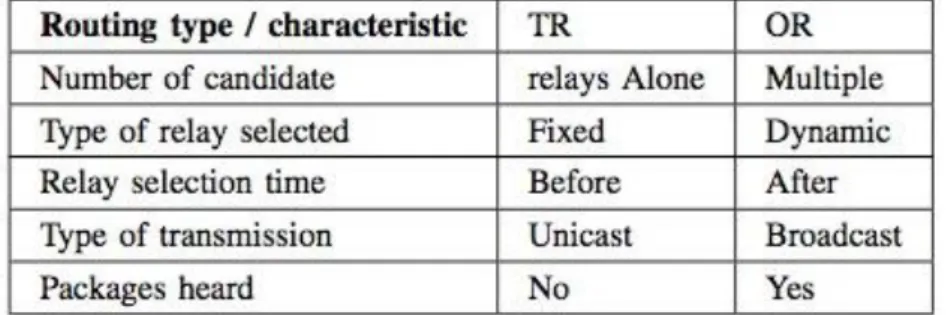
measures such as closest path and low energy consumption. Table 1 shows the difference between the traditional and opportunistic routing.
Table 1: Comparative Study between Traditional and Opportunistic Routing.
SYSTEM REQUIREMENT SPECIFICATIONS
Software specific requirements: It is the foundation of the software development process. It defines the basic requirements of the design and work of a project. It is basically a blueprint for choosing design
plans, architectural design and software requirements.
Specific requirements: The system designed for working needs to have some functionality and constraints which can provide functionality of these types.
17 Page 15-19 © MAT Journals 2019. All Rights Reserved
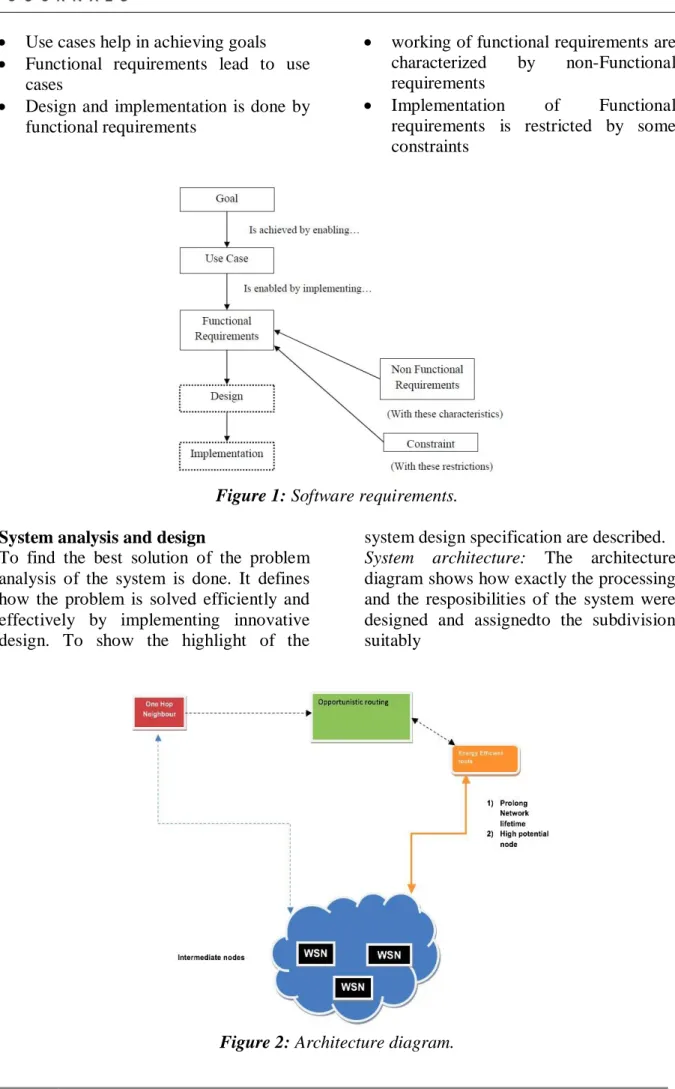
Use cases help in achieving goals
Functional requirements lead to use cases
Design and implementation is done by functional requirements
working of functional requirements are
characterized by non-Functional
requirements
Implementation of Functional
requirements is restricted by some constraints
Figure 1: Software requirements.
System analysis and design
To find the best solution of the problem analysis of the system is done. It defines how the problem is solved efficiently and effectively by implementing innovative design. To show the highlight of the
system design specification are described. System architecture: The architecture diagram shows how exactly the processing and the resposibilities of the system were designed and assignedto the subdivision suitably
18 Page 15-19 © MAT Journals 2019. All Rights Reserved EXPEXTED RESULTS AND
SIMULATION
This shows different network
parameters of the system as well as the simulation attributes. We are comparing
two different routing protocols based on various different parameters on the basis
of performance. These different
parameters are compared in the
following table:
The above figure shows the expected
theoretical result which shows the
comparison of energy consumption
between traditional routing and
opportunistic routing. In this graph we can clearly see that the energy consumed by the opportunistic routing protocol is way
less than compared to the traditional routing protocol.
Another theoretical graph of the expected result given below shows that the throughput in the opportunistic routing increases drastically as compared to
traditional routing protocol.
CONCLUSION
Energy consumed in opportunistic routing as compared to traditional routing is way lesser. It has less duplicated packets and
low retransmission of packets is required. Opportunistic routing protocol is highly energy efficient routing algorithm which is very useful in wireless sensor networks.
19 Page 15-19 © MAT Journals 2019. All Rights Reserved REFERENCES
1. Soo-Hoon Moon, Seung-Jae
Han,’Lifetime Optimization for Large- Scale Sink-Centric Wireless Sensor Networks’, WiOpt, 2015.
2. M. Abdullah and A. Ehsan, ’Routing
Protocols for Wireless Sensor
Networks: Classifications and
Challenges.’Quest Journals Journal of
Electronics and Communication
Engineering Research Vol. 2, Issue 2 (2014).
3. S. Chachulski, M. Jennings, S. Katti, and D. Katabi. Trading structure for randomness in wireless opportunistic routing. In ACM SIGCOMM, 2007. 4. Yamuna Devi C R, S H Manjula, K R
Venugopal, L M Patnaik, Multihop Route Discovery Using Opportunistic Routing for Wireless Sensor Networks, International Journal of Innovative
Technology and Exploring
Engineering (IJITEE)ISSN:
2278-3075, Volume-3, Issue- May 2014.
5. Awatef Benfradj Guiloufi, Nejeh
Nasri, Abdennaceur Kachouri, Energy- Efficient Clustering Algorithms for Fixed and Mobile Wireless Sensor
Networks, in The International
Wireless Communications and Mobile Computing Conference, IWCMC’14 Cyprus, 2014.
6. Arjun R V, Naveen H M, ’Data-centric routing in a wireless sensor network’, IJETTCS, April 2013.
7. Payal Jadhav, Prof. Rachna Satao, A Survey on Opportunistic Routing
Protocols for Wireless Sensor
Networks, by Elsevier, 2016.
8. Gary K. W. Wong, Xiaohua Jia,” A Novel Socially-Aware Opportunistic Routing Algorithm in Mobile Social Networks” International Conference on
Computing, Networking and
Communications, Wireless Ad Hoc and Sensor Networks Symposium 2013.