Towards Efficient Authenticated Subgraph Query
Service in Outsourced Graph Databases
Zhe Fan, Yun Peng, Byron Choi, Jianliang Xu, Sourav S Bhowmick
Abstract—Graphs have been a powerful tool that is suitable for a large variety of applications including chemical databases and the
Semantic Web, among others. A fundamental query of graph databases is subgraph query: given a query graphq, it retrieves the data graphs from a database that containq. Due to the cost of managing massive data coupled with the computational hardness of subgraph query processing, outsourcing the processing to a third-party service provider is an appealing alternative. However, security properties such as data integrity and the response time are critical Quality of Service (QoS) issues in query services. Unfortunately, to our knowledge, authenticated subgraph query services have not been addressed before. To support the service, we propose Merkle
IFTree(MIFTree) where Merkle hash trees are applied into our Intersection-aware Feature-subgraph Tree (IFTree).IFTreeaims to
minimize I/O in a well-received subgraph query paradigm namely the filtering-and-verification framework. The structures required to be introduced to verification objects (VOs) and authentication time are minimized. Subsequently, the overall response time is minimized. For optimizations, we propose an enhanced authentication method onMIFTree. Our detailed experiments on both real and synthetic datasets demonstrate thatMIFTreeis clearly more efficient than a baseline method.
Index Terms—13.0.I Security Concerns of Service-Oriented Solutions, 13.II.I Service-Oriented Security Enablement at Software Level,
Subgraph Query Service, Query Answer Authentication, Outsourced Graph Databases
✦
1
I
NTRODUCTIONT
Here have been a wide range of emerging applicationsof graph databases, including bio-informatics, chemi-informatics, and web topology [6], [23], [24], whose data are modeled as graphs. To retrieve graphs from large graph databases, many structural queries have been proposed. Among others, subgraph isomorphism query (or simply
sub-graph query) (e.g., [3], [9], [12], [28]–[30], [32], [36], [37])
has been a fundamental and popular query. Specifically, given
a query graphqand a graph databaseG, retrieve all graphs in Gthat containqas a subgraph1. For example, in biology, there are more than 1,500 online molecular biology databases [6]. In chemistry, PubChem [23] provides public access to numerous chemical compounds. Users can query compounds containing their structures via its web interface.
Due to the cost of hosting the explosive volume of data and performing large-scale computations, the owners of graph databases may not always have the necessary IT infra-structure and expertise to provide the best usage of their data. An ap-pealing solution to address this issue of managing voluminous data is to outsource the owners’ data to a third-party service
provider (e.g., Amazon EC2 and Google Cloud Service).
Then, the service provider provides query services on the data
• Zhe Fan, Yun Peng, Byron Choi and Jianliang Xu are with the Department of Computer Science, Hong Kong Baptist University, China.
E-mail: zfan, ypeng, bchoi, [email protected]
• Sourav S. Bhowmick is with School of Computer Engineering, Nanyang Technological University, Singapore.
E-mail: [email protected]
1.There are two streams of research work on subgraph queries [8]. One stream handles a very large graph. The other stream concerns a large number of small graphs, which is the focus of this study.
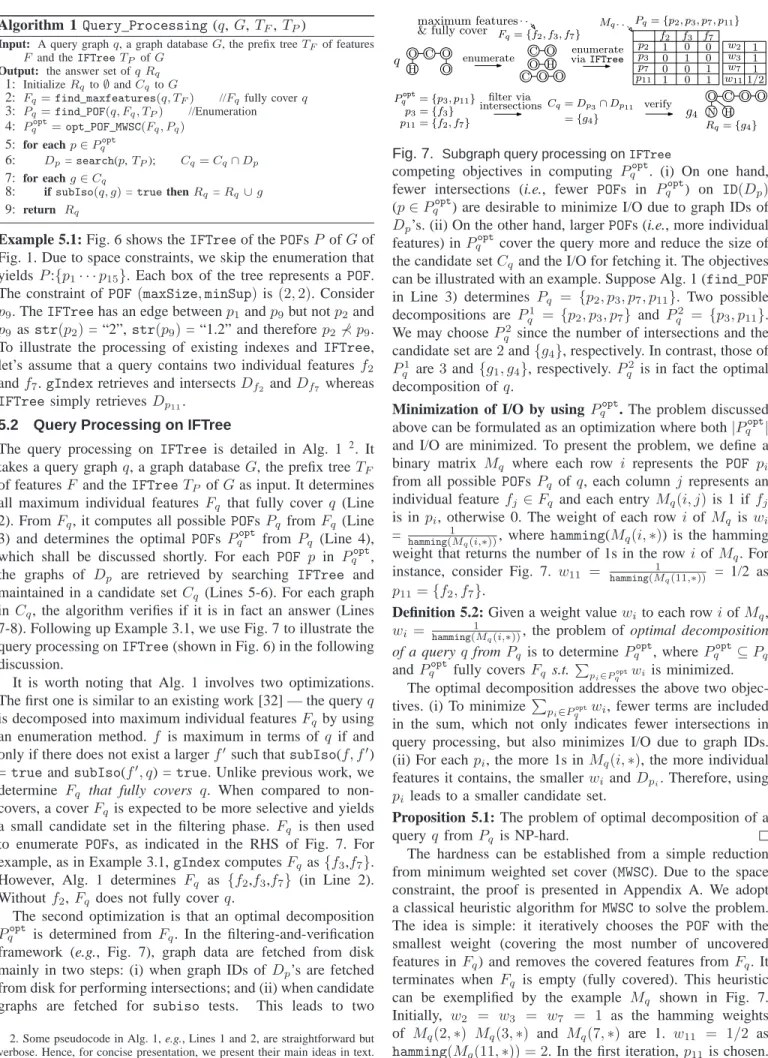
C O O H O N C C O C O N O C C C O C O O H N g1 g2 g3 g4 O C O O H Data Owner G Outsource DB MIFTree Service Provider
public key Client
Queryq
Answer set & Verification G={g1, g2, g3, g4} Outsourced G q Objects Filtering-and Verification
Fig. 1. System model of graph database outsourcing
owners’ behalf. For instance, according to [23], PubChem has managed 19 million unique compound structures. PubChem allows laboratories to submit their data [22]; and PubChem manages the data on the laboratories’ behalf. In addition to PubChem, in drug engineering, many commercial service providers (e.g., [1], [2], [11]) support outsourcing of pharma databases owned by laboratories. Laboratories then focus on the curation of their data.
Security properties such as data integrity are listed as
Quality of Service (QoS) issues [20] in (query) services. A
reason is that the service provider may be untrusted and/or compromised to attacks and clients may receive tampered results. For instance, Fig. 1 shows an example of a graph
databaseGand a query graphq. Suppose the service provider
storesGand its index and the client retrieves graphs that
con-tain q. Supposeg4 is the answer graph. However, the service
provider might return incorrect results, e.g., g1, simply abort
the computation or return partial answers as some queries may in fact take long to evaluate. In this scenario, the owner/client may never be sure whether the data was outsourced correctly. In practice, the query can be some sensitive chemical com-pound such as benzopyrene, a carcinogenic substance recently found in some ramen. A compromised service provider might collaborate with some ramen companies and conveniently skip their ingredients that contain benzopyrene. Another important
attribute of QoS is the response time of a service. In this paper, it consists of the times for query processing, data transmission and authentication of query results. These two attributes of QoS significantly influence the practicality of out-sourcing graph databases. Hence, there is a need for efficient
query authentication framework to support the subgraph query
services.
Majority of existing querying or indexing algorithms for subgraph queries adopt a filtering-and-verification frame-work [3], [12], [28], [29], [32], [36] consisting of two key steps. (1) In the filtering phase, the query is decomposed into a set of individual features and an index is searched with those features. The search of each individual feature yields a set of graphs (represented by graph IDs) containing this searched feature. The sets of graphs are intersected to form a candidate set (a superset of answers). (2) In the verification phase, each graph in the candidate set is checked by an exact subgraph isomorphic algorithm to compute the final result set. However, to the best of our knowledge, none of the existing subgraph querying works addresses authentication of such a framework.
In this paper, we take the first step towards this goal.
In a typical query authentication system [7], a data owner publishes his database and signature; A service provider processes queries from a client and transmits to the client
both the answer and a verification object (VO) which stores
the processing traces such as index traversals and; By using
the answer and VO, the client synthesizes the digest of the
database/index and compares it with the data owner’s signature to verify the authenticity of the answer.
As the filtering-and-verification framework is not specially designed for authentication, we note at least three problems
that may cause large VO to be transmitted to clients and
inefficient authentication at clients. Firstly, query features must be authenticated to ensure the correct graph IDs are fetched and intersected. The more the query features, the larger the
VO. Unfortunately, none of the previous work minimizes the
number of query features used in query processing. Secondly, all graph IDs involved in the intersections must be represented
in the VO so that the client can efficiently and correctly
verify the intersections. Thirdly, the answer graphs do not generally form a range. In the worst case, each answer graph is authenticated separately. This makes direct applications of
classical techniques (e.g.,MHT[21] or signature chaining [25])
inefficient. Observe that both the query features and their graph IDs (described in the first two problems) dominate the I/O of the filtering phase and therefore, the problem of minimizing
VOs is directly related to minimizing I/O of the
filtering-and-verification framework.
In this paper, we propose a novel
authentication-friendly index called Intersection-aware Feature-subgraph
Tree (IFTree) to address the aforementioned technical
chal-lenges. We then apply MHTs toIFTreecalled MerkleIFTree
for efficient authentication. Specifically, for the first problem, in order to minimize the number of features used in the filtering phase, we propose a novel higher-order feature called
Partially Overlapping Features (POF) which are themselves features composed by individual features. We propose to
decompose a query into an optimal POFset such that fewest
POFs (i.e., fewest intersections) are used in querying time and
meanwhile, more individual features are implicitly used in the filtering phase. As a result, fewer graph IDs are fetched while the candidate set is minimized. As we shall see later, the
number of fetched graph IDs in query processing onIFTree
is 5 times smaller than that of a baseline. Moreover, the size of
candidate set usingIFTreeis around 25% smaller than that of
a baseline. Consequently, theVOsize and authentication time
are reduced by a factor of 3.6 and 3.3, respectively. For the second problem, we propose a compact matrix representation
of intersection of graph IDs onMIFTreeto form an enhanced
authentication. Our experiments show that the compact
repre-sentation improves the VO size and the authentication time
by a factor around 2.5 and 3.4 (respectively). For the last problem, we determine the optimal ordering of graphs that are “intersect-able”. Our empirical study demonstrates that graphs needed to be authenticated form the fewest number of ranges
and the corresponding VO size is reduced by around 40%.
We observe that the overall improvement of the response time over the baseline is often more than an order of magnitude. We show that the energy saving on smartphone by using our proposed techniques is about 27% over the baseline.
In summary, the contributions are listed as follows.
• We propose a novel higher-order feature, called
par-tially overlapping feature for indexing graphs. We
lever-age these features to propose a novel index, namely
Intersection-aware Feature-subgraph Tree (IFTree). For
basic authentication, we applyMHTs to various structures
of IFTreecalledMIFTree.
• We propose a novel matrix representation of intersection
of graph IDs for enhanced authentication.
• We cluster the graphs that are “intersect-able” by
adopt-ing approximation algorithms.
• We conduct extensive experiments with real and synthetic
datasets to demonstrate the effectiveness and superiority of our proposed methods.
The rest of the paper is organized as follows. Sec. 2 discusses related works. We present the preliminaries and overview in Sec. 3. We present partially overlapping feature in
Sec. 4. We proposeIFTreeand its query processing in Sec. 5.
We propose MerkleIFTreeand a basic authentication in Sec.
6. Sec. 7 proposes an enhanced authentication and the optimal ordering of graphs. Sec. 8 presents a detailed experiment. Sec. 9 concludes this paper. We present all the detailed proofs in Appendix A.
2
R
ELATEDW
ORKAlthough there are several efforts in the literature on query authentication for relational and range queries [17], [25], stream queries [27], [34], spatial queries [33], XML queries [5], text search [26], and multi-dimensional queries [4], very few work focus on authentication of graph query processing. Yiu et al. [35] propose authentication of shortest path queries on road networks. However, the ordering of objects in road networks can be determined offline, e.g., by network-based distance. Such ordering is absent in graph databases in general and it is not clear how to adopt this work to subgraph queries. Kundu et al. [13]–[16] propose a series of methods for a
closely related problem. They verify the authenticity of a given
portion of data (subtree/subgraph that users’ have the right
to access to) without any leakage of extraneous information of the data (tree/graph/forest). They optimize the signature needed and recently propose a scheme that uses one signature [13], [14]. However, in our problem setting, the portion of the data retrieved is the answer of a client’s query, which is yet to be processed by an untrusted service provider. Therefore, the client is required to authenticate both the soundness and completeness (see SubSec. 3.3) of the portion of retrieved data. Search DAGs (Directed Acyclic Graph) [19] is a generalized model for authenticating a large class of data structures, e.g., binary trees, multi-dimensional range trees and tries. However, subgraph query processing can hardly be efficiently cast into a DAG search.
A large number of indexing techniques have been pro-posed for evaluating subgraph queries. These efforts can be roughly classified into two approaches, namely
feature-based approaches (e.g., [3], [12], [28], [29], [32], [36]) and non-feature-based approaches (e.g., [9], [37]). Examples of
features are frequent subgraphs, using tools such as gSpan [31] and CAM code [10]. Recently, iGraph [8] implemented these techniques on a common platform and reported that former approaches outperform latter approaches in most cases. Hence, we adopt the feature-based approach in our study.
3
B
ACKGROUND ANDO
VERVIEWIn this section, we first discuss the background to subgraph query processing and query authentication. We then formulate the problem studied. A baseline approach and an overview of our solution are discussed.
3.1 Background for Subgraph Query
This paper assumes undirected labeled connected graphs. For simplicity, we may use the term graphs to refer to them. A
graph is denoted as g = (V, E,Σ, l), where V(g), E(g), Σ
andlare the set of vertices, the set of edges, the set of labels
of vertices and edges and the function that maps a vertex or
edge to a label, respectively. We use |g| to denote the size
of graph g, where|g|=|E(g)|. Following the literature of a
popular stream of graph databases [3], [9], [12], [28], [29], [32], [36], [37], we consider graphs of modest sizes.
Definition 3.1: Given two graphs g = (V, E,Σ, l)and g′ =
(V′, E′,Σ′, l′), a subgraph isomorphism from g to g′ is an
injective function ϕ:V(g)→V(g′)such that
• ∀u∈V(g), ϕ(u)∈V(g′), l(u) =l′(ϕ(u)); and
• ∀(u, v) ∈ E(g), (ϕ(u), ϕ(v)) ∈ E(g′), l(u, v)=
l′(ϕ(u),ϕ(v)).
Subgraph query can be formally defined in Def. 3.1. We
say a graphgis a subgraph of another graphg′ if there exists
a subgraph isomorphism from g to g′, denoted as g ⊆g′ or
subIso(g, g′) = true. It is known that deciding whether g
is the subgraph of g′ is NP-hard. Subgraph query processing
can be described as follows.
Definition 3.2: Given a graph database G= {g1, g2, ..., gn}
and a query graphq, we want to determine the query answers
Rq ={gi|subIso(q, gi), gi ∈G}.
Subgraph query paradigms. Two query paradigms for
sub-graph queries have been proposed: feature-based (e.g., [3],
C C C O O H O N O O C C O C O O O O N f1 f2 f3 f4 f5 f6 f7 f8 [1,2,3,4] [1,4] [1,2,4] maxL= 2 dr= 0.1 O C O O H q C O O O H Fq={f3, f7} ={g1, g4} Rq={g4} O C O O H N g4 intersections verify enumerate Cq=Df3∩Df7 candidate
set answerset
filter via
The graph ID’s ofDf7
fr
SISF(1) = 1,SISF(2) = 2
Fig. 2. Illustration ofgIndexand its query processing
[12], [28], [29], [32], [36]) and non-feature-based (e.g., [9], [37]) indexes. From Sec. 2 above, iGraph [8] concludes that the former often outperforms the latter. This work contributes to the feature-based approaches.
Feature-based approaches index graphs by their individual features. The term individual feature is used to refer to those proposed previously, as the one we put forward comprise individual features that form “higher-order” features. An index of this approach uses these features as the search keys for the graphs that contain them.
A well-received query paradigm for feature-based ap-proaches is the filtering-and-verification framework [3], [12], [28], [29], [32], [36]. Early work on subgraph query processing such as Shasha et al. [29] proposes filtering graphs via paths
and then verifying the remaining graphs through subIso.
Some later works [3], [12], [28], [29], [32], [36] proposed innovative solutions that follow such a framework. To illustrate the filtering-and-verification framework, we present a seminal
index called gIndex [32] which is shown efficient in many
cases [8]. gIndex proposes discriminative frequent features
as individual features, denoted asF, for indexing. A
discrim-inative frequent featuref,f ∈F, is
• a subgraph whose size is smaller than or equal tomaxL,
where maxLis a user-defined maximum feature size;
• a frequent feature that |Df| ≥SISF(|f|), where Df =
{f| f ⊆g, g ∈G},|Df|is called the support of f and
SISF is a user-defined Size-Increasing-Support-Function
of eachf; and
• discriminative, s.t., |∩f′ ∈F∧f′ ⊆fDf′|
|Df| ≥dr, wheredris a
user-defined discriminative ratio.
The functionSISFreturns a support that increases with the
input feature size.gIndexsetsSISF(1) = 1by default.SISF
gives the flexibility to allow indexing with infrequent features. The individual features are represented by a canonical string
called minimum DFS code [31] and gIndex is a prefix tree
of the minimum DFS codes. gIndex processes queries in
two phases. (1) Filtering: enumerate the maximum individual
feature set Fq from q, where Fq = {f|f ⊆ q, f ∈ F, ∄f′,
s.t., f ⊆ f′, f′ ⊆ q}, and filter out the graphs that do not
contain a feature in Fq to obtain the candidate set Cq by
performing the following intersections:
Cq =
\
f∈Fq,Fq⊆F
Df (1)
(2) Verification: determine the query answers Rq from the
candidate set by invokingsubIso, whereRq ={g|q⊆g, g ∈
Cq}.
It is worth noting that the intersections in the filtering
phase are performed on graph IDs whereas subIso in the
previous indexes (see [3], [12], [28], [29], [32], [36]) propose innovative ideas to filter more non-answer graphs that aim to
minimize the candidate set Cq.
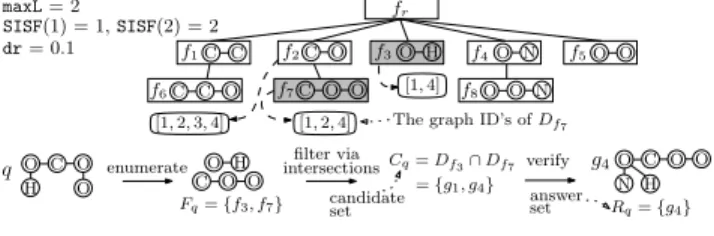
Example 3.1: We illustrate the filtering-and-verification
framework with an example in Fig. 2. The upper half of
Fig. 2 shows the gIndexconstructed from a set of individual
features mined fromGin Fig. 1,F={f1, f2,· · ·, f8}, where
SISF(1) = 1,SISF(2) = 2,maxLanddrare set to2and0.1,
respectively. fr is an artificial root node. The lower half of
Fig. 2 shows its query processing: Given a query graphq, the
filtering phase first enumerates all the maximum individual
features Fq = {f3, f7} of q and performs intersections of
the graphs(via IDs)containing the individual feature(s)(Df3
and Df7) to compute the candidate set Cq =Df3
T Df7 =
{g1, g4}. The verification phase invokessubIsoon each graph
inCq, and computes the answersRq ={g4}.
3.2 Background for Query Authentication
Cryptographic primitives. Similar to other works on
authen-tication, we assume a one-way collision-resistant hash function
(e.g.,SHAandMD5) is denoted ash(x), wherexis a data value
to be hashed and the hash value h(x) is often referred to as
the digest ofx. It is infeasible to determine the preimage of a
digest. We assume a public-key digital signature scheme, such
asRSA, that guarantees the authenticity of a message or value.
The signer has a private key (SK) and can produce a signed
message y =sign(x,SK). Any public user has a public key
(PK) and can verify the message by decryption.
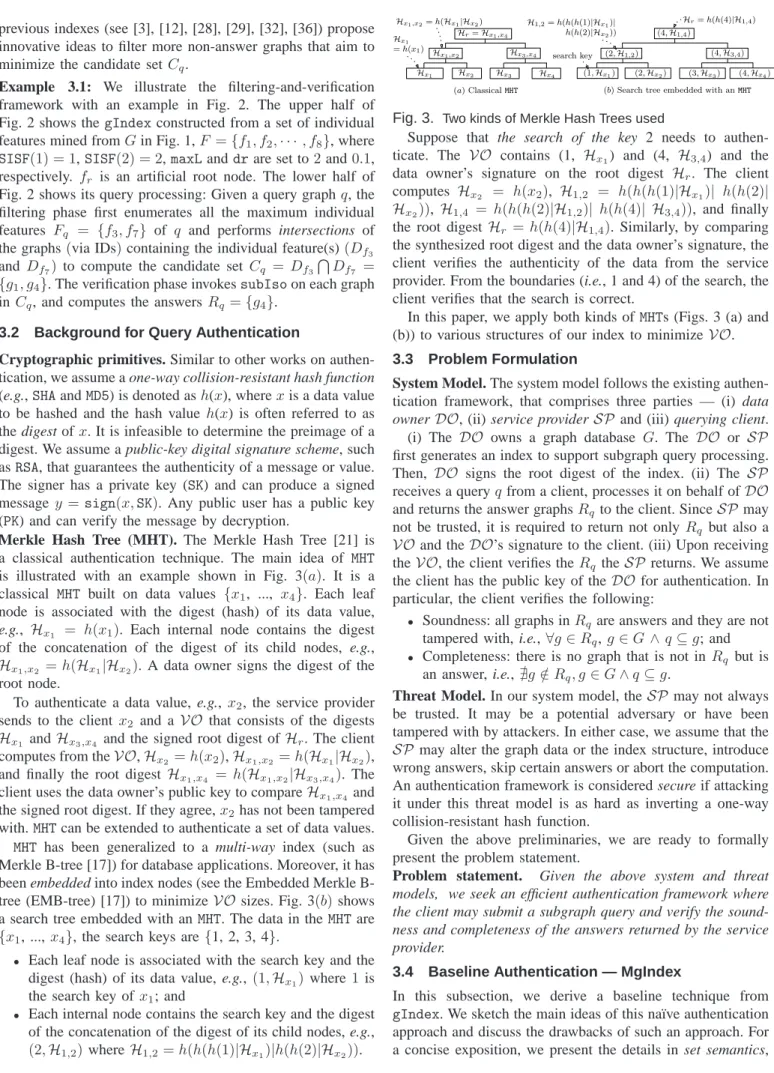
Merkle Hash Tree (MHT). The Merkle Hash Tree [21] is
a classical authentication technique. The main idea of MHT
is illustrated with an example shown in Fig. 3(a). It is a
classical MHT built on data values {x1, ..., x4}. Each leaf
node is associated with the digest (hash) of its data value,
e.g., Hx1 = h(x1). Each internal node contains the digest of the concatenation of the digest of its child nodes, e.g.,
Hx1,x2 =h(Hx1|Hx2). A data owner signs the digest of the
root node.
To authenticate a data value, e.g., x2, the service provider
sends to the client x2 and a VO that consists of the digests
Hx1 andHx3,x4 and the signed root digest ofHr. The client
computes from theVO,Hx2=h(x2),Hx1,x2 =h(Hx1|Hx2),
and finally the root digest Hx1,x4 =h(Hx1,x2|Hx3,x4). The
client uses the data owner’s public key to compareHx1,x4and
the signed root digest. If they agree,x2has not been tampered
with.MHTcan be extended to authenticate a set of data values.
MHT has been generalized to a multi-way index (such as
Merkle B-tree [17]) for database applications. Moreover, it has been embedded into index nodes (see the Embedded Merkle
B-tree (EMB-B-tree) [17]) to minimizeVO sizes. Fig. 3(b)shows
a search tree embedded with an MHT. The data in theMHTare
{x1, ...,x4}, the search keys are {1, 2, 3, 4}.
• Each leaf node is associated with the search key and the
digest (hash) of its data value, e.g., (1,Hx1)where 1 is
the search key ofx1; and
• Each internal node contains the search key and the digest
of the concatenation of the digest of its child nodes, e.g.,
(2,H1,2)where H1,2=h(h(h(1)|Hx1)|h(h(2)|Hx2)).
Hx1 Hx1,x2
(a) ClassicalMHT (b) Search tree embedded with anMHT
(1,Hx1) (2,Hx2) (3,Hx3) (4,Hx4) (4,H1,4) (4,H3,4) H1,2=h(h(h(1)|Hx1)| Hr=h(h(4)|H1,4) Hx2 Hx3 Hx4 (2,H1,2) Hx3,x4 Hr=Hx1,x4 search key Hx1 Hx1,x2=h(Hx1|Hx2) h(h(2)|Hx2)) =h(x1)
Fig. 3. Two kinds of Merkle Hash Trees used
Suppose that the search of the key 2 needs to
authen-ticate. The VO contains (1, Hx1) and (4, H3,4) and the
data owner’s signature on the root digest Hr. The client
computes Hx2 = h(x2), H1,2 = h(h(h(1)|Hx1)| h(h(2)|
Hx2)), H1,4 = h(h(h(2)|H1,2)| h(h(4)| H3,4)), and finally
the root digest Hr =h(h(4)|H1,4). Similarly, by comparing
the synthesized root digest and the data owner’s signature, the client verifies the authenticity of the data from the service provider. From the boundaries (i.e., 1 and 4) of the search, the client verifies that the search is correct.
In this paper, we apply both kinds ofMHTs (Figs. 3 (a) and
(b)) to various structures of our index to minimizeVO.
3.3 Problem Formulation
System Model. The system model follows the existing
authen-tication framework, that comprises three parties — (i) data
ownerDO, (ii) service providerSP and (iii) querying client.
(i) The DO owns a graph database G. The DO or SP
first generates an index to support subgraph query processing.
Then, DO signs the root digest of the index. (ii) The SP
receives a queryqfrom a client, processes it on behalf ofDO
and returns the answer graphsRq to the client. SinceSPmay
not be trusted, it is required to return not only Rq but also a
VOand theDO’s signature to the client. (iii) Upon receiving
theVO, the client verifies theRq theSPreturns. We assume
the client has the public key of theDOfor authentication. In
particular, the client verifies the following:
• Soundness: all graphs inRq are answers and they are not
tampered with, i.e.,∀g∈Rq,g∈G∧ q⊆g; and
• Completeness: there is no graph that is not inRq but is
an answer, i.e.,∄g /∈Rq, g∈G∧q⊆g.
Threat Model. In our system model, theSPmay not always be trusted. It may be a potential adversary or have been tampered with by attackers. In either case, we assume that the
SP may alter the graph data or the index structure, introduce
wrong answers, skip certain answers or abort the computation. An authentication framework is considered secure if attacking it under this threat model is as hard as inverting a one-way collision-resistant hash function.
Given the above preliminaries, we are ready to formally present the problem statement.
Problem statement. Given the above system and threat
models, we seek an efficient authentication framework where the client may submit a subgraph query and verify the sound-ness and completesound-ness of the answers returned by the service provider.
3.4 Baseline Authentication — MgIndex
In this subsection, we derive a baseline technique from
gIndex. We sketch the main ideas of this na¨ıve authentication approach and discuss the drawbacks of such an approach. For a concise exposition, we present the details in set semantics,
unless otherwise specified. For detailed algorithm, please refer to Appendix B.
With reference to Formula 1 in Sec. 3.1, in order to
authen-ticate the answer of the query q, the client must authenticate
the correctness of (i) the query featuresFq and (ii) their graph
IDsDf (for allf ∈Fq) in order to verify the authenticity of
the candidate setCq. Therefore, the client can examineCq to
obtain the answer Rq.
The baseline approach calledMgIndex simply appliesMHT
to (i) the children of each index node of gIndex; and (ii) the
graphs (with IDs) of Df of each feature f, respectively. The
query processing ofMgIndexis similar to that ofgIndexbut
incorporates withVOconstruction. More specifically, theVO
of MgIndexconsists of three main parts:
VO=VOindex∪ VOCq ∪ψF
1) VOindex contains the digests that record the search of
each individual featuref ∈Fq during query processing
and all the graph IDs (and the graphs’ hash values if the
graphs are not present inRq) ofDf for allf ∈Fq;
2) VOCq contains the non-answer graphs in the candidate
set, i.e.,VOCq=Cq−Rq, denoted asC
¯ Rq
q ; and
3) ψF is simply the signature of the data owner.
Example 3.2: We use Example 3.1 to illustrate theVO.
1) VOindex contains the digests that record the search of
Fq ={f3, f7}. Suppose the search locatesf7 first. The
VOindexincludes the digests of the nodesf1,f3,f4and
f5. The digest of node f2 is computed by the client.
When the search locatesf3, the digest off3 inVOindex
is replaced by the actual content of the nodef3. Thus,
the client can verifyf3. The graph IDs for each graph
in Df7 and Df3 (i.e., {1,2,4} and {1,4} respectively),
and the hash value ofg2 are added toVOindex; and
2) VOCq contains the non-answer graphs in the candidate
set, i.e.,VOCq =Cq−Rq ={g1}, whereCq ={g1, g4}
andRq ={g4}.
Regarding the authentication at the client side, firstly, the
client rebuilds the root digest of MgIndex using VOindex
and VOCq to verify that Fq and Cq are not tampered with.
Secondly, it enumerates the query again to verify that Fq
is exactly f3 and f7 by using VOindex. Thirdly, the client
performs intersections on {1,4} and {1,2,4} to verify the
correctness ofCq. Finally, the client performs thesubIsotests
to verify g4 is the answer but not g1.
The sketch of the baseline approach reveals the performance bottlenecks of subgraph query authentication. The more
fea-tures (i.e., more intersections) are used to determine Cq
(For-mula 1), the more VOindex is needed to authenticate Fq and
the more graph IDs ofDf are introduced. This not only leads
to large VO, but also requires high time costs to authenticate
them. Similar to query processing, query authentication also
requires to minimize Cq as the non-answer graphs (not the
IDs) are included inVOCq.
3.5 Overview of our Approach
In response to the drawbacks of the baseline approach, we pro-pose more efficient authentication techniques. The frequently used symbols of our discussions are listed in Appendix E.
Service Provider MIFTree VOindex Pqopt={p1, . . . , pn} Dp1 . . . ∩ ∩ Mpmin . . . VOCq= (IM∪C ¯ Rq q ) Rq CRq¯ q Cq authen-Dpn matrix rep. ofID(Dp) non-answer answer set = + Cq= Client Query Rq q VO search candidate set set Intersection Rq Pqopt tication Rq subgraph isomorphism filter verify minimizeVOindex P Basic Method Enhanced Method 1 2 3 4 5 Optimal decompo-sition Mpn ψ 6
Fig. 4. Overview of efficient authentication method
To minimizeVOindex while keepingCq small, we propose
essentially to precompute some intersections offline, such that fewer intersections are involved at query time and hence need to be authenticated by clients. In particular, we propose
higher-order features (Partially Overlapping Features POFs). In a
nutshell, a POF consists of a set of overlapping individual
features. If a data graph contains a POF, this implies it also
contains those individual features in thePOF. Hence,POFs are
more selective than individual feature, and result in smaller candidate sets.
We propose the Intersection-aware Feature-subgraph
Tree (IFTree) to index a graph database by POFs P.
Merkle IFTree(MIFTree) is proposed by adoptingMHTs on
IFTreefor basic authentication.
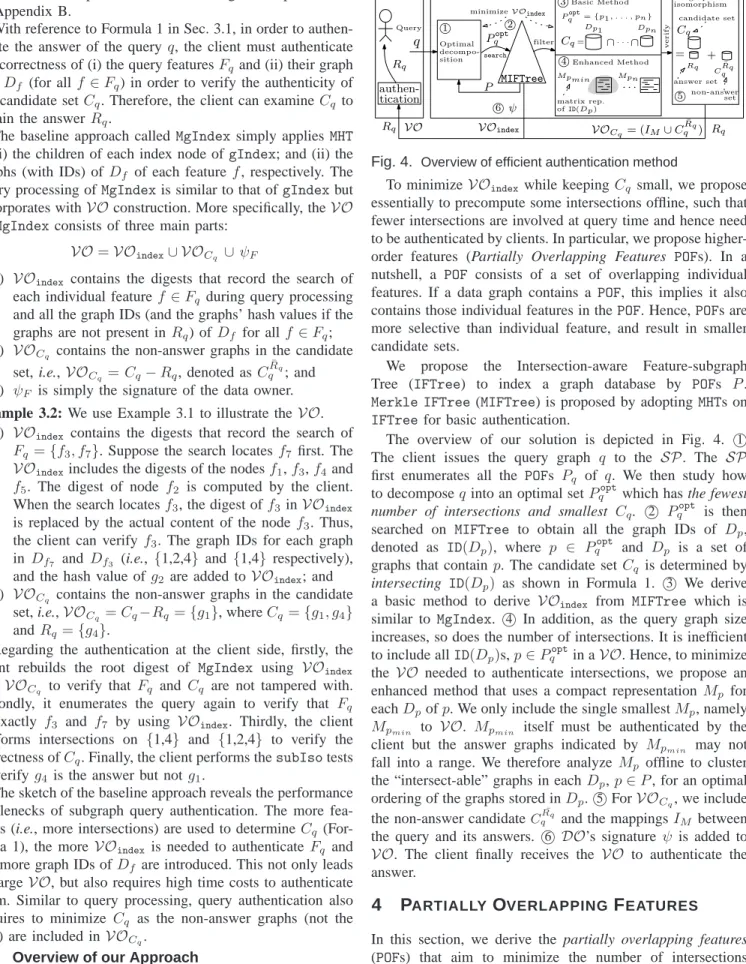
The overview of our solution is depicted in Fig. 4. 1
The client issues the query graph q to the SP. The SP
first enumerates all the POFs Pq of q. We then study how
to decomposeqinto an optimal setPopt
q which has the fewest
number of intersections and smallest Cq. 2 Pqopt is then
searched on MIFTree to obtain all the graph IDs of Dp,
denoted as ID(Dp), where p ∈ Pqopt and Dp is a set of
graphs that containp. The candidate setCq is determined by
intersecting ID(Dp) as shown in Formula 1. 3 We derive
a basic method to derive VOindex from MIFTree which is
similar to MgIndex. 4 In addition, as the query graph size
increases, so does the number of intersections. It is inefficient
to include allID(Dp)s,p∈Pqoptin aVO. Hence, to minimize
the VO needed to authenticate intersections, we propose an
enhanced method that uses a compact representation Mp for
eachDpofp. We only include the single smallestMp, namely
Mpmin to VO. Mpmin itself must be authenticated by the
client but the answer graphs indicated by Mpmin may not
fall into a range. We therefore analyze Mp offline to cluster
the “intersect-able” graphs in eachDp,p∈P, for an optimal
ordering of the graphs stored inDp.5 ForVOCq, we include
the non-answer candidateCR¯q
q and the mappingsIM between
the query and its answers. DO6 ’s signatureψ is added to
VO. The client finally receives the VO to authenticate the
answer.
4
P
ARTIALLYO
VERLAPPINGF
EATURESIn this section, we derive the partially overlapping features
(POFs) that aim to minimize the number of intersections
involved in query time. The benefits are threefold. Fewer intersections are computed in query time; fewer graph IDs are fetched; and more individual features are implicitly involved and often lead to small candidate sets.
C O O H O N co-existing feature f7 f2 overlapping feature C O O H O N f7 f3
partially overlapping feature C O O H O N g1 f7 f4 completely g1 g1 (a) (b) (c)
Fig. 5. Illustration of higher-order features
4.1 Types of Overlapping Features
Features can be composed in various ways. We derive POFs
and call them higher-order features as they themselves are
features and composed by individual features.
To describe POFs, we first present a few notations needed:
Individual featuresF can be features proposed by any existing works. We adopt discriminative frequent feature [32] as the
individual feature in this paper. We useg andFg to denote a
graph and its individual features. We call the subgraph of g
that is isomorphic tof as an instance off, i.e.,g∈Df. With
these notations, we derive POFs. We start with the feature of
multiple individual features.
Definition 4.1: A feature{f1,· · ·, fn}is a co-existing feature
of g if g contains an instance of fi for all i ∈ {1,· · ·, n},
where {f1,· · · , fn} ⊆Fg.
The definition above can be trivially extended to a database
G. Let{f1,· · ·, fn}be a co-existing feature ofG, a graphg
inGcontains it iffg∈Df1∩ · · · ∩Dfn.
The next feature, namely overlapping feature, concerns not only the existence of features but also the overlapping of features.
Definition 4.2:{f1,· · ·,fn}is an overlapping feature ofgif it
is a co-existing feature ofgand there is a setS:{s1,· · ·,sn}in
g, where si∈S is an instance offi, and S forms a connected
graph.
We remark that singleton sets {f1} (i.e.,n = 1) are
con-sidered as “overlapping” features since each of their instance definitely forms a connected graph.
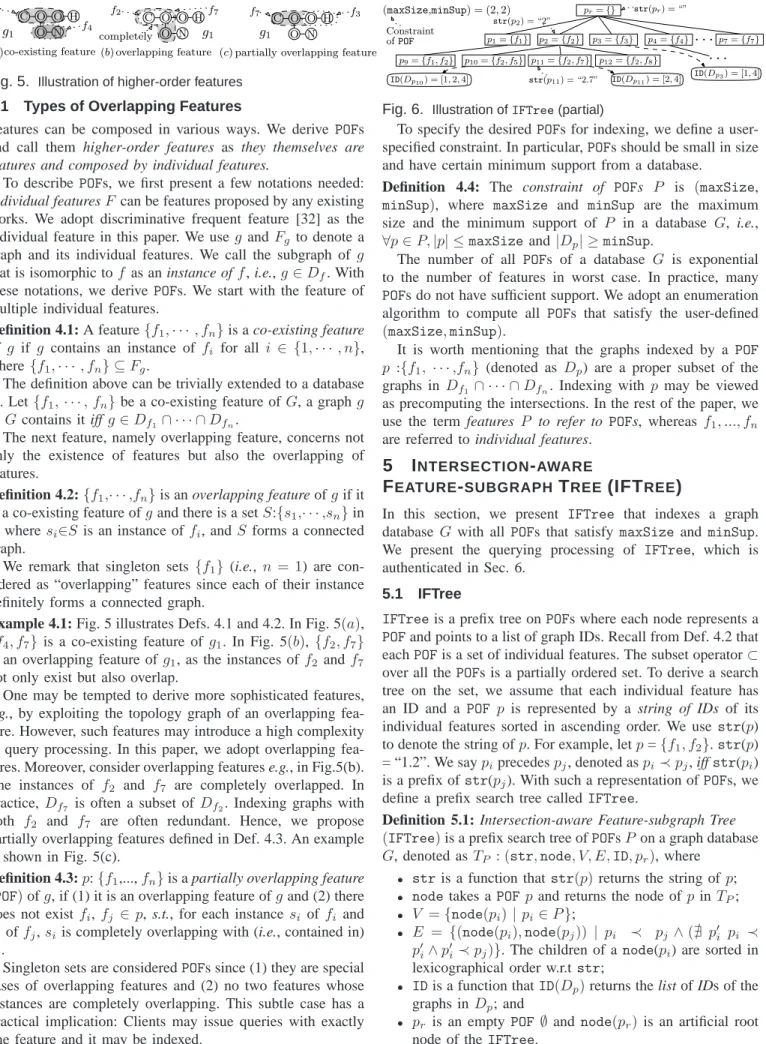
Example 4.1: Fig. 5 illustrates Defs. 4.1 and 4.2. In Fig. 5(a),
{f4, f7} is a co-existing feature ofg1. In Fig. 5(b),{f2, f7}
is an overlapping feature ofg1, as the instances off2 andf7
not only exist but also overlap.
One may be tempted to derive more sophisticated features,
e.g., by exploiting the topology graph of an overlapping
fea-ture. However, such features may introduce a high complexity in query processing. In this paper, we adopt overlapping fea-tures. Moreover, consider overlapping features e.g., in Fig.5(b).
The instances of f2 and f7 are completely overlapped. In
practice, Df7 is often a subset of Df2. Indexing graphs with
both f2 and f7 are often redundant. Hence, we propose
partially overlapping features defined in Def. 4.3. An example is shown in Fig. 5(c).
Definition 4.3:p:{f1,...,fn}is a partially overlapping feature
(POF)ofg, if (1) it is an overlapping feature ofgand (2) there
does not exist fi,fj ∈ p, s.t., for each instance si of fi and
sj offj,si is completely overlapping with (i.e., contained in)
sj.
Singleton sets are consideredPOFs since (1) they are special
cases of overlapping features and (2) no two features whose instances are completely overlapping. This subtle case has a practical implication: Clients may issue queries with exactly one feature and it may be indexed.
p2={f2} p3={f3} p4={f4} p1={f1} pr={} p9={f1, f2} p10={f2, f5} p11={f2, f7} p12={f2, f8}
· · ·
(maxSize,minSup) = (2,2)· · ·
Constraint ofPOF ID(Dp11) = [2,4] ID(Dp3) = [1,4] str(p2) = “2” str(pr) = “” str(p11) = “2.7” ID(Dp10) = [1,2,4] p7={f7}· · ·
· · ·
Fig. 6. Illustration ofIFTree(partial)
To specify the desiredPOFs for indexing, we define a
user-specified constraint. In particular,POFs should be small in size
and have certain minimum support from a database.
Definition 4.4: The constraint of POFs P is (maxSize,
minSup), where maxSize and minSup are the maximum
size and the minimum support of P in a database G, i.e.,
∀p∈P,|p| ≤maxSize and|Dp| ≥minSup.
The number of all POFs of a database G is exponential
to the number of features in worst case. In practice, many
POFs do not have sufficient support. We adopt an enumeration
algorithm to compute all POFs that satisfy the user-defined
(maxSize,minSup).
It is worth mentioning that the graphs indexed by a POF
p :{f1, · · ·,fn} (denoted as Dp) are a proper subset of the
graphs in Df1∩ · · · ∩Dfn. Indexing with p may be viewed
as precomputing the intersections. In the rest of the paper, we
use the term features P to refer to POFs, whereas f1, ..., fn
are referred to individual features.
5
I
NTERSECTION-
AWAREF
EATURE-
SUBGRAPHT
REE(IFT
REE)
In this section, we present IFTree that indexes a graph
database G with all POFs that satisfy maxSize and minSup.
We present the querying processing of IFTree, which is
authenticated in Sec. 6.
5.1 IFTree
IFTreeis a prefix tree onPOFs where each node represents a
POFand points to a list of graph IDs. Recall from Def. 4.2 that
eachPOFis a set of individual features. The subset operator⊂
over all thePOFs is a partially ordered set. To derive a search
tree on the set, we assume that each individual feature has
an ID and a POF p is represented by a string of IDs of its
individual features sorted in ascending order. We use str(p)
to denote the string ofp. For example, letp={f1, f2}.str(p)
= “1.2”. We saypiprecedespj, denoted aspi≺pj, iffstr(pi)
is a prefix ofstr(pj). With such a representation ofPOFs, we
define a prefix search tree called IFTree.
Definition 5.1: Intersection-aware Feature-subgraph Tree (IFTree)is a prefix search tree ofPOFsPon a graph database
G, denoted asTP : (str,node, V, E,ID, pr), where
• stris a function thatstr(p)returns the string of p;
• node takes aPOFpand returns the node ofpinTP;
• V ={node(pi)| pi∈P};
• E = {(node(pi),node(pj)) | pi ≺ pj∧(∄ p′i pi ≺
p′
i∧p′i≺pj)}. The children of anode(pi) are sorted in
lexicographical order w.r.tstr;
• IDis a function thatID(Dp)returns the list of IDs of the
graphs inDp; and
• pr is an empty POF∅ andnode(pr)is an artificial root
Algorithm 1 Query Processing (q,G,TF,TP)
Input: A query graphq, a graph databaseG, the prefix treeTF of features
F and theIFTreeTP ofG Output: the answer set ofq Rq
1: InitializeRqto∅andCqtoG
2: Fq=find maxfeatures(q, TF) //Fqfully coverq
3: Pq=find POF(q, Fq, TP) //Enumeration
4: Pqopt=opt POF MWSC(Fq, Pq)
5: for eachp∈Pqopt
6: Dp=search(p,TP); Cq=Cq∩Dp
7: for eachg∈Cq
8: ifsubIso(q, g)=truethenRq=Rq ∪g
9: return Rq
Example 5.1: Fig. 6 shows theIFTreeof thePOFsP ofGof Fig. 1. Due to space constraints, we skip the enumeration that
yields P:{p1· · ·p15}. Each box of the tree represents a POF.
The constraint of POF(maxSize,minSup)is (2,2). Consider
p9. TheIFTreehas an edge betweenp1andp9but notp2and
p9 asstr(p2)= “2”,str(p9)= “1.2” and thereforep26≺p9.
To illustrate the processing of existing indexes and IFTree,
let’s assume that a query contains two individual features f2
andf7.gIndexretrieves and intersectsDf2 andDf7 whereas
IFTree simply retrievesDp11.
5.2 Query Processing on IFTree
The query processing on IFTree is detailed in Alg. 1 2. It
takes a query graphq, a graph database G, the prefix treeTF
of featuresF and theIFTreeTP ofGas input. It determines
all maximum individual features Fq that fully cover q (Line
2). FromFq, it computes all possible POFsPq fromFq (Line
3) and determines the optimal POFs Popt
q from Pq (Line 4),
which shall be discussed shortly. For each POF p in Pqopt,
the graphs of Dp are retrieved by searching IFTree and
maintained in a candidate set Cq (Lines 5-6). For each graph
in Cq, the algorithm verifies if it is in fact an answer (Lines
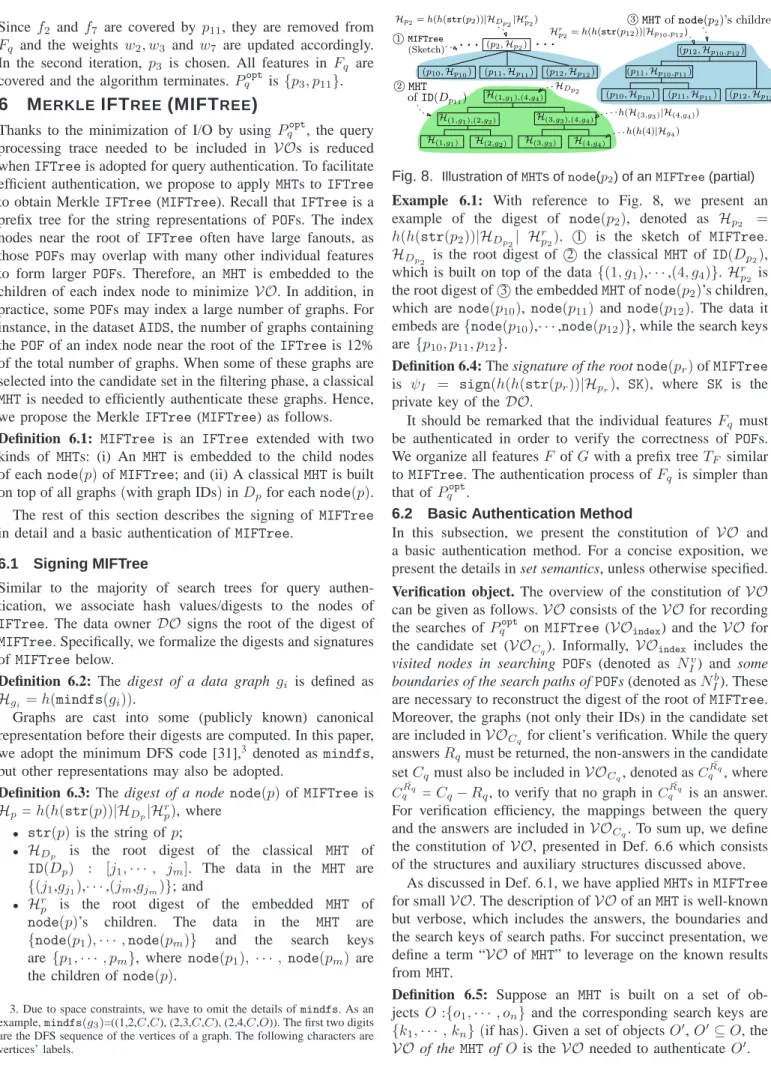
7-8). Following up Example 3.1, we use Fig. 7 to illustrate the
query processing onIFTree(shown in Fig. 6) in the following
discussion.
It is worth noting that Alg. 1 involves two optimizations.
The first one is similar to an existing work [32] — the queryq
is decomposed into maximum individual featuresFq by using
an enumeration method. f is maximum in terms of q if and
only if there does not exist a largerf′ such thatsubIso(f, f′)
= trueandsubIso(f′, q) =true. Unlike previous work, we
determine Fq that fully covers q. When compared to
non-covers, a coverFq is expected to be more selective and yields
a small candidate set in the filtering phase. Fq is then used
to enumerate POFs, as indicated in the RHS of Fig. 7. For
example, as in Example 3.1,gIndexcomputesFq as{f3,f7}.
However, Alg. 1 determines Fq as {f2,f3,f7} (in Line 2).
Without f2,Fq does not fully cover q.
The second optimization is that an optimal decomposition
Pqopt is determined from Fq. In the filtering-and-verification
framework (e.g., Fig. 7), graph data are fetched from disk
mainly in two steps: (i) when graph IDs of Dp’s are fetched
from disk for performing intersections; and (ii) when candidate
graphs are fetched for subiso tests. This leads to two
2. Some pseudocode in Alg. 1, e.g., Lines 1 and 2, are straightforward but verbose. Hence, for concise presentation, we present their main ideas in text.
O C O O H q ={g4} Rq={g4} O C O O H N g4 filter via verify Popt q ={p3, p11} p3={f3} p11={f2, f7} p2 p3 p7 p11 f2 f3 f7 1 1 1 1 0 0 0 0 1 0 0 0 Mq Cq=Dp3∩Dp11 C O O O H Fq={f2, f3, f7} C O
& fully cover
maximum features Pq={p2, p3, p7, p11} viaIFTree enumerate enumerate intersections w2 w3 w7 w11 1 1 1 1/2
Fig. 7. Subgraph query processing onIFTree
competing objectives in computing Pqopt. (i) On one hand,
fewer intersections (i.e., fewer POFs in Pqopt) on ID(Dp)
(p∈Pqopt) are desirable to minimize I/O due to graph IDs of
Dp’s. (ii) On the other hand, largerPOFs (i.e., more individual
features) inPqoptcover the query more and reduce the size of
the candidate setCq and the I/O for fetching it. The objectives
can be illustrated with an example. Suppose Alg. 1 (find POF
in Line 3) determines Pq = {p2, p3, p7, p11}. Two possible
decompositions are P1
q = {p2, p3, p7} and Pq2 = {p3, p11}.
We may chooseP2
q since the number of intersections and the
candidate set are2and{g4}, respectively. In contrast, those of
P1
q are3 and{g1, g4}, respectively.Pq2 is in fact the optimal
decomposition ofq.
Minimization of I/O by using Pqopt. The problem discussed
above can be formulated as an optimization where both|Pqopt|
and I/O are minimized. To present the problem, we define a
binary matrix Mq where each row i represents the POF pi
from all possible POFsPq of q, each column j represents an
individual feature fj ∈Fq and each entryMq(i, j)is 1 if fj
is in pi, otherwise 0. The weight of each row i of Mq is wi
= hamming(1M
q(i,∗)), where hamming(Mq(i,∗)) is the hamming
weight that returns the number of 1s in the rowiof Mq. For
instance, consider Fig. 7. w11 = hamming(M1q(11,∗)) = 1/2 as
p11={f2, f7}.
Definition 5.2: Given a weight valuewi to each rowiofMq,
wi = hamming(1Mq(i,∗)), the problem of optimal decomposition
of a query qfromPq is to determinePqopt, wherePqopt⊆Pq
andPqopt fully coversFq s.t.Ppi∈Pqoptwi is minimized.
The optimal decomposition addresses the above two
objec-tives. (i) To minimizePpi∈Popt
q wi, fewer terms are included
in the sum, which not only indicates fewer intersections in query processing, but also minimizes I/O due to graph IDs.
(ii) For eachpi, the more 1s inMq(i,∗), the more individual
features it contains, the smallerwi andDpi. Therefore, using
pi leads to a smaller candidate set.
Proposition 5.1: The problem of optimal decomposition of a
queryq fromPq is NP-hard.
The hardness can be established from a simple reduction
from minimum weighted set cover (MWSC). Due to the space
constraint, the proof is presented in Appendix A. We adopt
a classical heuristic algorithm forMWSCto solve the problem.
The idea is simple: it iteratively chooses the POF with the
smallest weight (covering the most number of uncovered
features in Fq) and removes the covered features fromFq. It
terminates when Fq is empty (fully covered). This heuristic
can be exemplified by the example Mq shown in Fig. 7.
Initially, w2 = w3 = w7 = 1 as the hamming weights
of Mq(2,∗) Mq(3,∗) and Mq(7,∗) are 1. w11 = 1/2 as
Since f2 andf7 are covered by p11, they are removed from
Fq and the weights w2, w3 and w7 are updated accordingly.
In the second iteration, p3 is chosen. All features in Fq are
covered and the algorithm terminates.Pqopt is{p3, p11}.
6
M
ERKLEIFT
REE(MIFT
REE)
Thanks to the minimization of I/O by using Pqopt, the query
processing trace needed to be included in VOs is reduced
whenIFTreeis adopted for query authentication. To facilitate
efficient authentication, we propose to applyMHTs toIFTree
to obtain MerkleIFTree(MIFTree). Recall thatIFTreeis a
prefix tree for the string representations of POFs. The index
nodes near the root of IFTree often have large fanouts, as
those POFs may overlap with many other individual features
to form larger POFs. Therefore, an MHT is embedded to the
children of each index node to minimizeVO. In addition, in
practice, some POFs may index a large number of graphs. For
instance, in the datasetAIDS, the number of graphs containing
the POFof an index node near the root of theIFTreeis 12%
of the total number of graphs. When some of these graphs are selected into the candidate set in the filtering phase, a classical
MHTis needed to efficiently authenticate these graphs. Hence,
we propose the Merkle IFTree(MIFTree) as follows.
Definition 6.1: MIFTree is an IFTree extended with two
kinds of MHTs: (i) An MHT is embedded to the child nodes
of eachnode(p)ofMIFTree; and (ii) A classicalMHTis built
on top of all graphs(with graph IDs)inDpfor eachnode(p).
The rest of this section describes the signing of MIFTree
in detail and a basic authentication of MIFTree.
6.1 Signing MIFTree
Similar to the majority of search trees for query authen-tication, we associate hash values/digests to the nodes of
IFTree. The data owner DO signs the root of the digest of
MIFTree. Specifically, we formalize the digests and signatures of MIFTreebelow.
Definition 6.2: The digest of a data graph gi is defined as Hgi =h(mindfs(gi)).
Graphs are cast into some (publicly known) canonical representation before their digests are computed. In this paper,
we adopt the minimum DFS code [31],3 denoted asmindfs,
but other representations may also be adopted.
Definition 6.3: The digest of a node node(p) of MIFTreeis Hp = h(h(str(p))|HDp|H
r
p), where
• str(p)is the string of p;
• HDp is the root digest of the classical MHT of
ID(Dp) : [j1,· · · , jm]. The data in the MHT are {(j1,gj1),· · ·,(jm,gjm)}; and
• Hrp is the root digest of the embedded MHT of
node(p)’s children. The data in the MHT are
{node(p1),· · ·,node(pm)} and the search keys
are {p1,· · · , pm}, where node(p1), · · · , node(pm) are
the children of node(p).
3. Due to space constraints, we have to omit the details ofmindfs. As an example,mindfs(g3)=((1,2,C,C), (2,3,C,C), (2,4,C,O)). The first two digits are the DFS sequence of the vertices of a graph. The following characters are vertices’ labels. (p10,Hp10)
· · ·
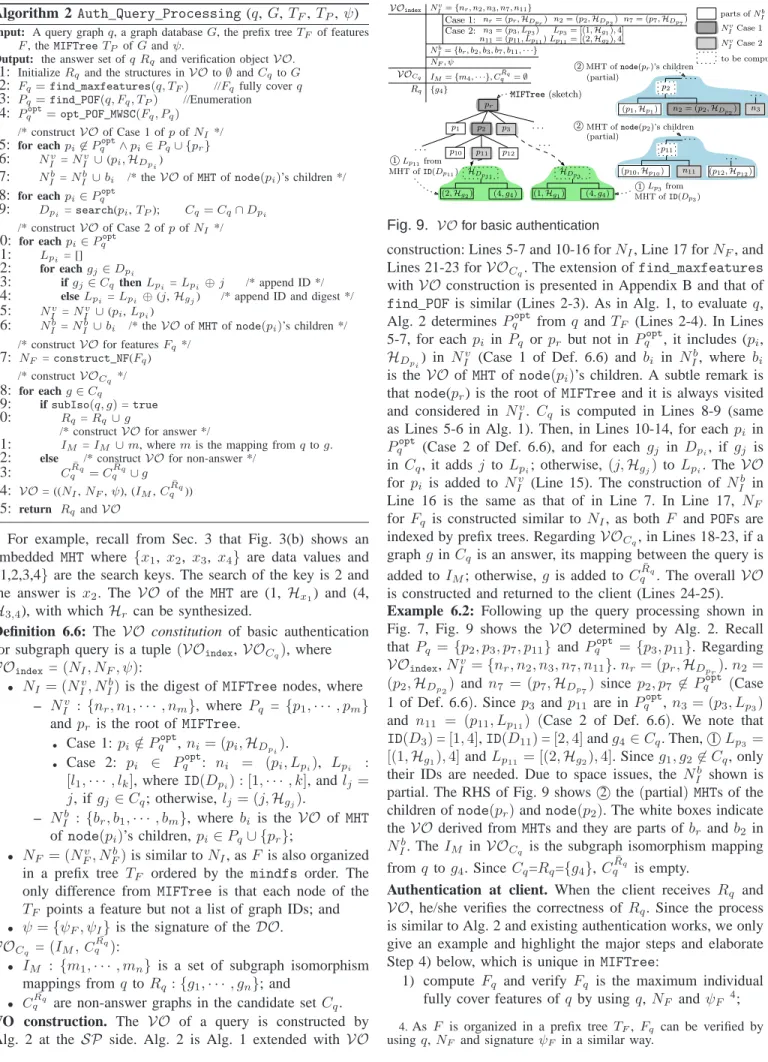
Hp2=h(h(str(p2))|HDp2|H r p2) (p11,Hp11) (p12,Hp12) (p12,Hp10,p12) HDp2· · ·
H r p2=h(h(str(p12))|Hp10,p12) h(h(4)|Hg4) H(1,g1) H(1,g1),(2,g2) (p11,Hp10,p11) H(2,g2) H(3,g3) H(4,g4) H(3,g3),(4,g4) H(1,g1),(4,g4) MHT MHTofnode(p2)’s children MIFTree 3 2 1 (Sketch) ofID(Dp11) h(H(3,g3)|H(4,g4)) (p10,Hp10) (p11,Hp11) (p12,Hp12) (p2,Hp2)Fig. 8. Illustration ofMHTs ofnode(p2) of anMIFTree(partial)
Example 6.1: With reference to Fig. 8, we present an
example of the digest of node(p2), denoted as Hp2 =
h(h(str(p2))|HDp2| H r
p2). 1 is the sketch of MIFTree.
HDp2 is the root digest of 2 the classical MHTof ID(Dp2),
which is built on top of the data{(1, g1),· · ·,(4, g4)}.Hrp2 is
the root digest of3 the embeddedMHTofnode(p2)’s children,
which arenode(p10),node(p11)and node(p12). The data it
embeds are{node(p10),· · ·,node(p12)}, while the search keys
are{p10, p11, p12}.
Definition 6.4: The signature of the rootnode(pr)ofMIFTree
is ψI = sign(h(h(str(pr))|Hpr), SK), where SK is the
private key of the DO.
It should be remarked that the individual featuresFq must
be authenticated in order to verify the correctness of POFs.
We organize all featuresF of Gwith a prefix treeTF similar
toMIFTree. The authentication process ofFq is simpler than
that ofPqopt.
6.2 Basic Authentication Method
In this subsection, we present the constitution of VO and
a basic authentication method. For a concise exposition, we present the details in set semantics, unless otherwise specified.
Verification object. The overview of the constitution of VO
can be given as follows.VOconsists of theVOfor recording
the searches of Popt
q on MIFTree(VOindex) and theVO for
the candidate set (VOCq). Informally, VOindex includes the
visited nodes in searching POFs (denoted as Nv
I) and some
boundaries of the search paths ofPOFs (denoted asNb
I). These
are necessary to reconstruct the digest of the root ofMIFTree.
Moreover, the graphs (not only their IDs) in the candidate set
are included inVOCqfor client’s verification. While the query
answersRqmust be returned, the non-answers in the candidate
setCq must also be included inVOCq, denoted asC
¯
Rq
q , where
CR¯q
q =Cq−Rq, to verify that no graph inC
¯
Rq
q is an answer.
For verification efficiency, the mappings between the query
and the answers are included inVOCq. To sum up, we define
the constitution ofVO, presented in Def. 6.6 which consists
of the structures and auxiliary structures discussed above.
As discussed in Def. 6.1, we have appliedMHTs inMIFTree
for smallVO. The description ofVOof anMHTis well-known
but verbose, which includes the answers, the boundaries and the search keys of search paths. For succinct presentation, we
define a term “VO of MHT” to leverage on the known results
fromMHT.
Definition 6.5: Suppose an MHT is built on a set of
ob-jects O :{o1,· · ·, on} and the corresponding search keys are
{k1,· · ·, kn}(if has). Given a set of objectsO′,O′⊆O, the VO of theMHTofO is the VO needed to authenticateO′.
Algorithm 2 Auth Query Processing(q,G,TF,TP,ψ) Input: A query graphq, a graph databaseG, the prefix treeTF of features
F, theMIFTreeTP ofGandψ.
Output: the answer set ofq Rq and verification objectVO.
1: InitializeRqand the structures inVOto∅andCqtoG
2: Fq=find maxfeatures(q, TF) //Fqfully coverq
3: Pq=find POF(q, Fq, TP) //Enumeration
4: Pqopt=opt POF MWSC(Fq, Pq)
/* constructVOof Case 1 ofpofNI */
5: for eachpi6∈Pqopt∧pi∈Pq∪ {pr}
6: Nv
I =NIv∪(pi,HDpi)
7: Nb
I =NIb∪bi /* theVOofMHTofnode(pi)’s children */
8: for eachpi∈Pqopt
9: Dpi =search(pi,TP); Cq=Cq∩Dpi
/* constructVOof Case 2 ofpofNI */
10: for eachpi∈Pqopt
11: Lpi = []
12: for eachgj∈Dpi
13: ifgj∈CqthenLpi =Lpi ⊕j /* append ID */ 14: elseLpi =Lpi ⊕(j,Hgj) /* append ID and digest */
15: Nv
I =NIv∪(pi,Lpi)
16: Nb
I =N
b
I ∪bi /* theVOofMHTofnode(pi)’s children */
/* constructVOfor featuresFq*/
17: NF =construct NF(Fq)
/* constructVOCq*/ 18: for eachg∈Cq
19: ifsubIso(q, g)=true
20: Rq =Rq ∪g
/* constructVOfor answer */
21: IM =IM ∪m, wheremis the mapping fromqtog.
22: else /* constructVOfor non-answer */
23: C ¯ Rq q =C ¯ Rq q ∪g 24: VO= ((NI,NF,ψ), (IM,C ¯ Rq q )) 25: return RqandVO
For example, recall from Sec. 3 that Fig. 3(b) shows an
embedded MHT where {x1, x2, x3, x4} are data values and
{1,2,3,4} are the search keys. The search of the key is 2 and
the answer is x2. The VO of the MHT are (1, Hx1) and (4,
H3,4), with which Hr can be synthesized.
Definition 6.6: The VO constitution of basic authentication
for subgraph query is a tuple (VOindex,VOCq), where
VOindex = (NI, NF, ψ):
• NI = (NIv, NIb)is the digest ofMIFTree nodes, where
– Nv
I : {nr, n1,· · ·, nm}, where Pq = {p1,· · ·, pm}
andpr is the root of MIFTree.
• Case 1:pi∈/Pqopt,ni = (pi,HDpi). • Case 2: pi ∈ Pqopt: ni = (pi, Lpi), Lpi : [l1,· · ·, lk], whereID(Dpi) : [1,· · ·, k], andlj= j, ifgj∈Cq; otherwise,lj= (j,Hgj). – Nb I : {br, b1,· · ·, bm}, where bi is the VO of MHT of node(pi)’s children,pi∈Pq∪ {pr};
• NF = (NFv, NFb)is similar toNI, asF is also organized
in a prefix tree TF ordered by the mindfs order. The
only difference from MIFTree is that each node of the
TF points a feature but not a list of graph IDs; and
• ψ={ψF, ψI} is the signature of theDO.
VOCq =(IM,C
¯
Rq q ):
• IM : {m1,· · ·, mn} is a set of subgraph isomorphism
mappings from q toRq:{g1,· · ·, gn}; and
• C
¯
Rq
q are non-answer graphs in the candidate set Cq.
VO construction. The VO of a query is constructed by
Alg. 2 at the SP side. Alg. 2 is Alg. 1 extended with VO
p3 pr p11 p12 HDp11 (2,Hg2) · · · · · · V Oindex Rq NF, ψ Nv I={nr, n2, n3, n7, n11} n2= (p2,HDp2) n3= (p3, Lp3) Lp3= [(1,Hg1),4] n7= (p7,HDp7) n11= (p11, Lp11)Lp11= [(2,Hg2),4] Case 1: Case 2: V OCq IM={m4,· · ·}, C ¯ Rq q =∅ Nb I={br, b2, b3, b7, b11,· · ·} MHT ofID(Dp11) (p1,Hp1) n2= (p2,HDp2) n3 (p10,Hp10) n11 (p12,Hp12) p2 · · · · · · · · · p1 p2 p10 · · · · · · · MHT ofnode(pr)’s children MHT ofnode(p2)’s children MIFTree(sketch) {g4} parts ofNb I Nv I Case 1 Nv I Case 2 (partial) (partial) to be computed (4, g4) MHT ofID(Dp3) Lp11from Lp3from HDp3 (1,Hg1) (4, g4) nr= (pr,HDpr) p11 1 2 2 1
Fig. 9. V Ofor basic authentication
construction: Lines 5-7 and 10-16 forNI, Line 17 forNF, and
Lines 21-23 forVOCq. The extension offind maxfeatures
withVO construction is presented in Appendix B and that of
find POF is similar (Lines 2-3). As in Alg. 1, to evaluateq,
Alg. 2 determinesPqopt fromq andTF (Lines 2-4). In Lines
5-7, for eachpi inPq or pr but not inPqopt, it includes (pi,
HDpi) in NIv (Case 1 of Def. 6.6) and bi in NIb, where bi
is theVO of MHTof node(pi)’s children. A subtle remark is
that node(pr) is the root ofMIFTreeand it is always visited
and considered in Nv
I. Cq is computed in Lines 8-9 (same
as Lines 5-6 in Alg. 1). Then, in Lines 10-14, for eachpi in
Popt
q (Case 2 of Def. 6.6), and for each gj in Dpi, if gj is
inCq, it addsj to Lpi; otherwise, (j,Hgj) toLpi. The VO
for pi is added to NIv (Line 15). The construction ofNIb in
Line 16 is the same as that of in Line 7. In Line 17, NF
for Fq is constructed similar to NI, as both F andPOFs are
indexed by prefix trees. RegardingVOCq, in Lines 18-23, if a
graphginCq is an answer, its mapping between the query is
added toIM; otherwise, g is added to C
¯ Rq
q . The overall VO
is constructed and returned to the client (Lines 24-25).
Example 6.2: Following up the query processing shown in
Fig. 7, Fig. 9 shows the VO determined by Alg. 2. Recall
that Pq ={p2, p3, p7, p11} and Pqopt ={p3, p11}. Regarding
VOindex,NIv={nr, n2, n3, n7, n11}.nr= (pr,HDpr).n2=
(p2,HDp2) andn7 = (p7,HDp7) sincep2, p7 6∈ P
opt q (Case
1 of Def. 6.6). Sincep3 andp11 are in Pqopt,n3= (p3, Lp3)
and n11 = (p11, Lp11) (Case 2 of Def. 6.6). We note that
ID(D3)=[1,4],ID(D11)=[2,4]andg4∈Cq. Then,1 Lp3 =
[(1,Hg1),4]andLp11 = [(2,Hg2),4]. Sinceg1, g26∈Cq, only
their IDs are needed. Due to space issues, the Nb
I shown is
partial. The RHS of Fig. 9 shows2 the(partial)MHTs of the
children ofnode(pr)andnode(p2). The white boxes indicate
theVO derived from MHTs and they are parts of br andb2 in
Nb
I. TheIM inVOCq is the subgraph isomorphism mapping
fromq tog4. Since Cq=Rq={g4},C
¯ Rq
q is empty.
Authentication at client. When the client receives Rq and
VO, he/she verifies the correctness ofRq. Since the process
is similar to Alg. 2 and existing authentication works, we only give an example and highlight the major steps and elaborate
Step 4) below, which is unique inMIFTree:
1) compute Fq and verify Fq is the maximum individual
fully cover features of qby usingq,NF andψF 4;
4.As F is organized in a prefix tree TF, Fq can be verified by usingq, NF and signature ψF in a similar way.
2) compute Pq and verifyPq is consistent to those inNI by usingq,Fq andNI; 3) determine Popt q by usingFq andPq; 4) synthesizeHpr by usingP opt q and theVO;
5) verify theHpr with the signatureψI and the public key;
6) determine Cq by intersecting theLps from NIv, where
p∈Pqopt; and
7) verifyRqby usingIM; and ifIM is not correct, invokes
subIso; and verifyCR¯q
q by invoking subIso.
In Step 4), the root digest Hpr is synthesized bottom-up:
We start the synthesis from the p in Pq that do not have a
p′ ∈Pq s.t. p≺p′. At each synthesis step,pi can only be in
one of the two cases: Case 1pi is in Pq but not inPqopt.ni
of pi is (pi,HDpi). Case 2pi is inPqopt.ni of pi is (pi,Lpi).
HDpi is determined fromLpi, C
¯
Rq
q and Rq, which contains
the IDs, digests and the graphs ofDpi. The remaining part
to-be-determined isHr
pi. In both cases,H
r
pi is determined from
the VO of MHTof node(pi)’s children, inNIb. The synthesis
must have computed the digest of node(pi)’s children (if it
is not already in VO), as the synthesis is defined bottom-up.
With pi,HDpi and Hrpi (Def. 6.3), the client can recompute
Hpi. Then,pi is removed fromPq. In the recursive step, the
synthesis proceeds to anotherpinPqwith nop′∈Pq∧p≺p′.
With the Hp for allp∈ Pq, Hpr is synthesized. We present
the formal proofs of the soundness and completeness of the basic authentication in Appendix A.
Example 6.3: To illustrate Step 4), we present the major steps
of the synthesis of Hpr of Fig. 9. To compute Hpr
bottom-up, we may start the synthesis from p11 since p11 ∈ Pqopt
and ∄p′ ∈P
q s.t. p11 ≺p′. We may start at p3 for a similar
reason. Let’s start at p11. n11 = (p11, Lp11). HDp11 can be
computed from Lp11 and Rq. The root digest H
r
p11 of the
MHT of node(p11)’s children can be computed since the MHT
is empty. Hp11 can then be determined from p11,HDp11 and
Hr
p11.p11is removed fromPq. After that, we may proceed to
p2, sincep2∈Pq∧p2∈/Pqopt.n2= (p2,HDp2). We determine
Hr
p2 from the computed (p11,Hp11) and the VO of MHT of
node(p2)’s children such asb2. In this case, Hp2 is obtained
andp2is removed from thePq. We then proceed top3.Hp3 is
obtained, similar to the synthesis ofHp11.Hp7 is synthesized
similar to Hp2. With the same logic, nr = (pr,HDpr). With
Hp2, Hp3, Hp7 and the VO of MHTof node(pr)’s children,
Hpr is synthesized.
7
E
NHANCEDA
UTHENTICATIONWhile the basic method presented in Sec. 6 is natural to au-thenticate the filtering-and-verification framework of subgraph
query, VO sometimes contains excessive graph IDs. In this
section, we propose two enhancements on the basic method.
Firstly, all graph IDs of each featurep∈Pqoptare returned
and in Step 6) of authentication, intersected at the client side
to ensure the correctness of Cq. To optimize this, we propose
a compact representation of graph IDs. Secondly, graph IDs
are needed to synthesize the digests of MIFTrees nodes, as
elaborated in Step 4) of authentication. As motivated in Sec. 1,
graph IDs ofCq do not fall into a range in general which may
lead to large VOs when classical authentication techniques
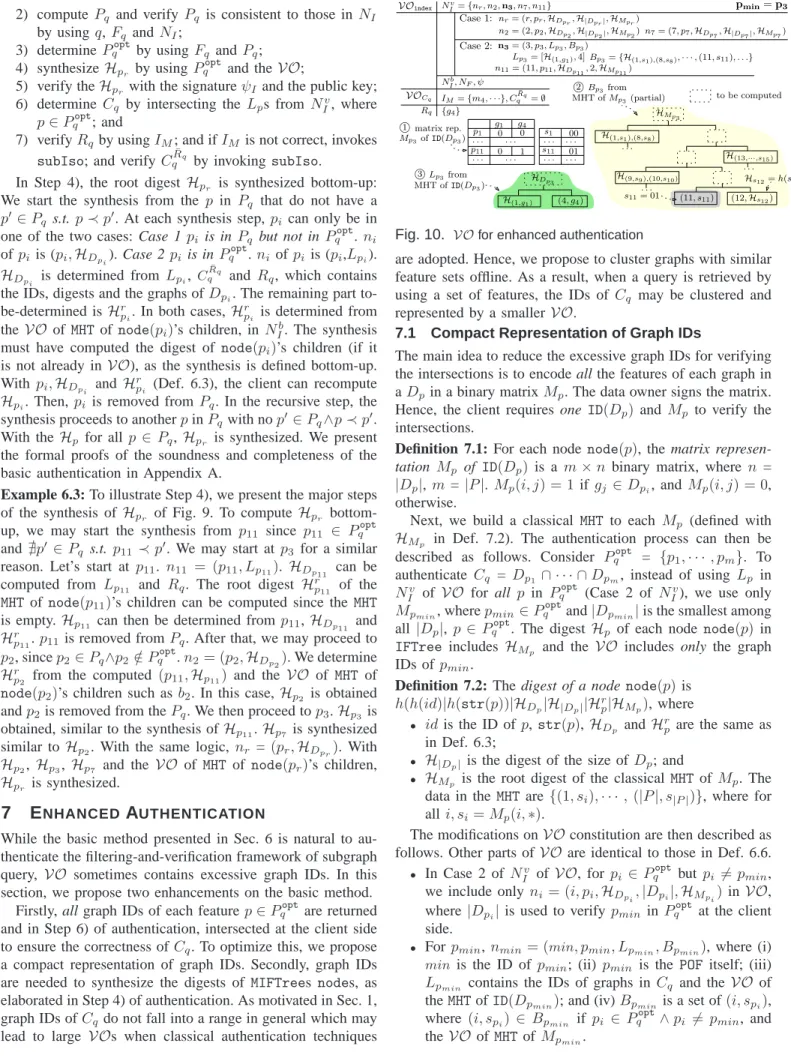
Lp3= [H(1,g1),4]Bp3={H(1,s1),(8,s8),· · ·,(11, s11), . . .} p1 · · · p11 g1 g4 0 0 1 0 s1 s11 00 01 · · · · · · · · · · · · · · · · · · · · · H(1,s1),(8,s8) HMp3 s11= 01 pmin=p3 V Oindex Rq Nb I, NF, ψ n2= (2, p2,HDp2,H|Dp2|,HMp2) n3= (3, p3, Lp3, Bp3) Case 1: Case 2: V OCq IM={m4,· · ·}, C ¯ Rq q =∅ Nv I={nr, n2,n3, n7, n11} n7= (7, p7,HDp7,H|Dp7|,HMp7) n11= (11, p11,HDp11,2,HMp11) MHT ofMp3(partial) MHT ofID(Dp3) (11, s11) matrix rep. Mp3ofID(Dp3) {g4} Lp3from Bp3from H(9,s9),(10,s10) H(13,···,s15) (12,Hs12) HDp3 H(1,g1) (4, g4) . . . . . . . . . nr= (r, pr,HDpr,H|Dpr|,HMpr) to be computed Hs12=h(s12) 1 2 3
Fig. 10. V Ofor enhanced authentication
are adopted. Hence, we propose to cluster graphs with similar feature sets offline. As a result, when a query is retrieved by
using a set of features, the IDs of Cq may be clustered and
represented by a smallerVO.
7.1 Compact Representation of Graph IDs
The main idea to reduce the excessive graph IDs for verifying the intersections is to encode all the features of each graph in
aDp in a binary matrixMp. The data owner signs the matrix.
Hence, the client requires one ID(Dp) andMp to verify the
intersections.
Definition 7.1: For each node node(p), the matrix
represen-tation Mp of ID(Dp) is a m×n binary matrix, where n = |Dp|,m= |P|. Mp(i, j) = 1 ifgj ∈Dpi, andMp(i, j) = 0, otherwise.
Next, we build a classical MHT to each Mp (defined with
HMp in Def. 7.2). The authentication process can then be
described as follows. Consider Pqopt = {p1,· · ·, pm}. To
authenticate Cq = Dp1 ∩ · · · ∩Dpm, instead of using Lp in
Nv
I of VO for all p in P
opt
q (Case 2 of NIv), we use only
Mpmin, wherepmin∈P
opt
q and|Dpmin|is the smallest among
all |Dp|, p∈ Pqopt. The digestHp of each nodenode(p) in
IFTree includes HMp and the VO includes only the graph
IDs ofpmin.
Definition 7.2: The digest of a node node(p)is
h(h(id)|h(str(p))|HDp|H|Dp||H r
p|HMp), where
• idis the ID of p,str(p),HDp andH
r
p are the same as
in Def. 6.3;
• H|Dp| is the digest of the size ofDp; and
• HMp is the root digest of the classicalMHTof Mp. The
data in theMHTare {(1, si),· · ·, (|P|, s|P|)}, where for
alli, si=Mp(i,∗).
The modifications onVOconstitution are then described as
follows. Other parts ofVO are identical to those in Def. 6.6.
• In Case 2 of Nv
I of VO, for pi ∈Pqopt but pi 6=pmin,
we include onlyni = (i, pi,HDpi,|Dpi|,HMpi)inVO,
where |Dpi| is used to verifypmin inP
opt
q at the client
side.
• Forpmin,nmin = (min, pmin, Lpmin, Bpmin), where (i)
min is the ID of pmin; (ii)pmin is the POF itself; (iii)
Lpmin contains the IDs of graphs in Cq and the VO of
theMHTofID(Dpmin); and (iv)Bpmin is a set of(i, spi),
where (i, spi) ∈ Bpmin if pi ∈ P
opt
q ∧pi 6= pmin, and
We remark that Bpmin records the bit strings of si of
Mpmin where i 6= min. smin is not needed as smin can be
derived from Lpmin. Finally, determining Dp1∩ · · · ∩Dpm is
equivalent to computings1∧· · ·∧smwhich very often requires
smaller VO. We provide the formal proofs of soundness and
completeness of the enhanced method in Appendix A.
Example 7.1: Following up Example 6.2, Fig. 10 shows the
major parts of the VO determined by the enhanced method.
The differences ofVO from the Example 6.2 are localized in
Nv
I. Foremost, Pq ={p2, p3, p7, p11} andPqopt={p3, p11}.
Since|Dp3|=|Dp11|= 2, we just choosep3as thepmin. We
show 1 the (partial) matrix Mp3 in the LHS of the figure.
The bit strings are shown next to the matrix. On the RHS
of Mp3 is its 2 (partial) MHT. Regarding the VO, we first
discussp11. Sincep11is inPqoptbutp116=pmin. Thus,n11=
(11, p11,HDp11,2,HMp11). Next, forpmin(i.e.,p3),n3ofN
v I
is (3, p3, Lp3, Bp3). From previous examples, we have Dp3
= {g1, g4} and Cq = {g4}. Lp3 = [H(1,g1),4], where 4 is
the graph ID in Cq andH(1,g1) is3 the VO of theMHT of
ID(Dp3). RegardingBp3, onlyp11is inP
opt
q butp116=pmin.
Thus,(11, s11)is included inBp3. Finally, theVO ofMHTof
Mp3 is included in Bp3. We remark that the ID of g1 is not
needed inLp3, sinces11[1] = 0ands11will be authenticated
inBp3. Thus,g1 is certainly not inCq.
7.2 Clustering Intersect-able Graphs
The matrix Mp (defined in Def. 7.1) not only minimizes the
number of graph IDs by using Mpmin, but also indicates how
much VO is needed for authenticating the candidate set. In
particular, let intv(Mp, i) denote the number of intervals
in the row of pi, where all entries in each interval are 1s.
The 1s in Mp(i,∗) correspond to the graphs in Dp ∩Dpi
and intv(Mp, i) is the number of ranges needed to be
authenticated. To authenticate a range, the upper and lower
bounds of the range are needed in VO. This argument can be
generalized to the intersections of multiple sets.
In this subsection, we define the problem of optimal
permu-tation (of columns) ofMp. The ordering of graphs inID(Dp)
is optimal when intersecting the graphs of other POFs, the
number of the intervals is minimized. We remark that the ordering is optimal in the absence of queries.
Definition 7.3: Given am×nbinary matrixMpfornode(p),
the optimal permutation forMp(OPM)is to transformMpinto
M′
pby column permutation s.t.cost(Mp′)=
Pm
i=1intv(Mp, i)
is minimized, where|P|= mand|Dp|= n.
Finding the optimal ordering of graphs of ID(Dp) is to
determine the optimal column permutation ofMp. Its hardness
is established by a reduction from Shortest Hamiltonian Path
(SHP). Details are shown in Appendix A.
Proposition 7.1: The problem of OPMis NP-hard.
The OPMproblem can be solved by heuristics of SHP. We
cast an instance of OPM into that of SHP. Specifically, given
an instance of OPM Mp, we generate a complete graph in
terms of Mp. Each column (graph ID in ID(Dp)) of Mp is
a vertex and the weight of the edge between two vertices is the total number of different 1s between the two respective
columns. The difference of the row ofpistates that one graph
has pi but the other does not. That is, one graph appears in
Dp∩Dpi and the other does not. A final trick is to add an
artificial node s0 as the source and sink of the graph being
constructed. We extend Mp with a column of zeros for s0.
The SHPof such a complete graph encodes a permutation of
columns of Mp. We have proved that the total sum of the
weight of the optimalSHPis twice of the number of intervals
inMp after the optimal permutation. One of the most efficient
approximation algorithms forSHP LKH-2[18] is adopted. The
algorithm is K-opt and the approximation ratio is preserved
under the above conversion.
Example 7.2: To illustrate the effect of the permutation, we
create a small artificial example. Suppose thatPqoptis{pi,pj},
ID(Dpi) = [1,3,5,7,9] and ID(Dpj) = [2,3,8,9]. Assume
further pi and pj are the only POFs of the database. Then,
Cq ={g3,g9}.pmin ispj as|Dpj|= 4 and|Dpi|= 5. Before
permutation, the Lpmin in VO is [H(2,g2),3,H(8,g8),9]. In
contrast, after the permutation, ID(Dpmin) = [2,8,3,9]. The
Lpmin contains[H(2,g2),(8,g8),3,9].
8
E
XPERIMENTALE
VALUATIONIn this section, we present a detailed experimental evaluation that verifies the performance of our proposed techniques and the effectiveness of our optimizations.
8.1 Experimental Setup
Running Platform. We conducted all our experiments on a
machine with an Intel Core 2 Quad 2.4GHz CPU and 4 GB memory running Windows 7 OS. All our techniques were implemented using C++. We implemented our algorithms on
top of iGraph [8].SHAandRSAwere used as our cryptographic
signing schemes.
Dataset. Following previous experiments of iGraph, we used
the same real-world and synthetic datasets in our experimental evaluation. The real-world dataset consists of 10,000 graphs,
all of which are drawn from a real AIDS Antiviral dataset
(hereafter denoted asAIDS) [24].AIDShas been used in many
studies of subgraph queries [3], [9], [12], [28], [29], [32], [36],
[37]. On average, AIDS has 25.42 vertices and 27.40 edges.
The number of distinct vertex labels and distinct edge labels are 51 and 4.
For the synthetic dataset, we used SYN.10K.E30.D3.L50
(denoted as SYN). It contains 10,000 graphs of which the
average size (the number of edges) is 30; the average density is 0.3; and the number of distinct vertex/edge labels is 50.
We used gSpan [31] with the default settings [32] on the above two datasets to obtain a set of discriminative frequent
features, which are served as individual features for our
experiment.
Query sets. For bothAIDSandSYN, the query sets (denoted as
Qn) used have been benchmarked in previous works [3], [9],
[12], [28], [32], [36]. Each Qncontains 1000 graphs with size
(the number of edges) of n, e.g., Q4 represents 1000 graphs
sized 4.
I/O cost and query time comparison. We used two
rep-resentative indexes, namely gIndex [32] and FGIndex [3],
to compare the I/O cost (number of graph IDs and graph
data fetched) and query time of IFTree. We used the same
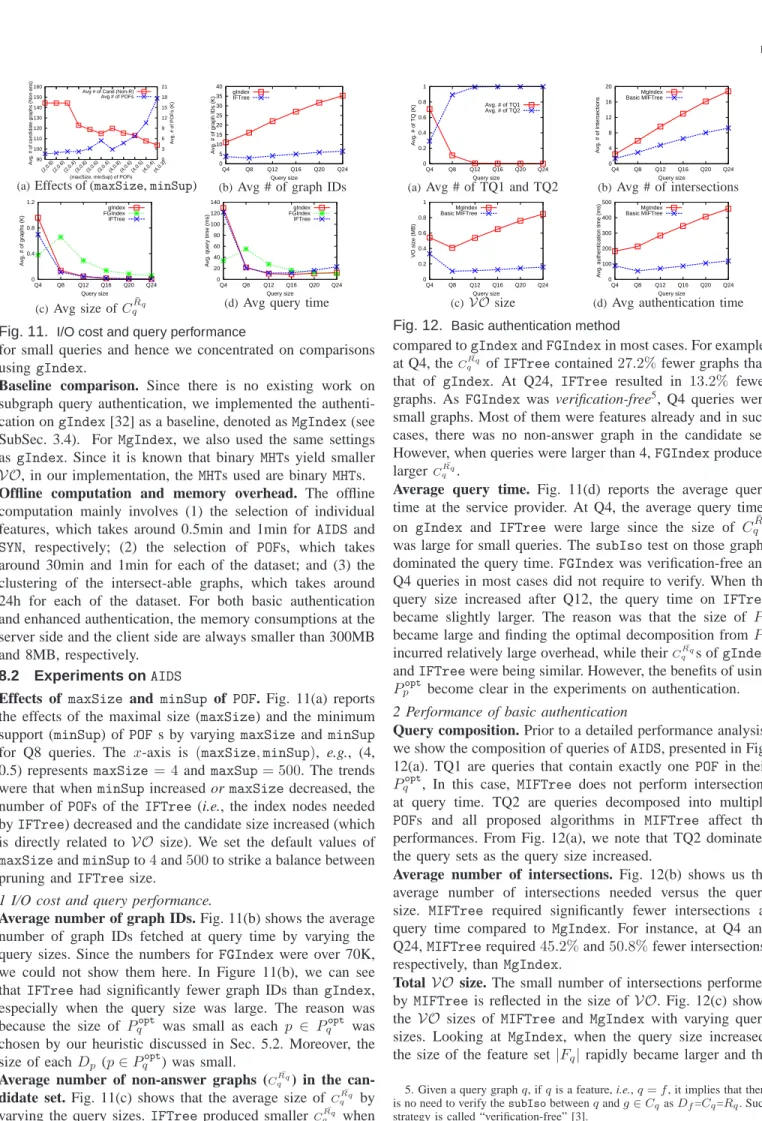
settings for gIndex and FGIndexas in previous experiment