STRUCTURE, CONDUCT, AND PERFORMANCE IN THE LOCAL PUBLIC SECTOR
by Randall W. Eberts and Timothy J. Gronberg
Randall W. Eberts is assistant vice president and economist at the Federal Reserve Bank of Cleveland, and Timothy J. Gronberg is an associate professor of economics at Texas A&M University in College Station, Texas. Helpful comments and suggestions by Brian Cromwell and computer assistance by Ralph Day and John Swinton are greatly appreciated.
Working papers of the Federal Reserve Bank of Cleveland are preliminary materials circulated to stimulate discussion and critical comment. The views stated herein are those of the authors and not necessarily those of the Federal Reserve Bank of Cleveland or of the Board of Governors of the Federal Reserve System.
I. Introduction
The theoretical implications of the effect of public-sector structure on
public-sector performance have been explored in numerous studies since the
appearance of the classic treatise on fiscal federalism by Oates (1972).
However, the empirical relationship between structure and performance in the
delivery of public services has received far less attention. Renewed interest
in the study of this relationship has been stirred by the Leviathan model of
government behavior. The Leviathan government seeks to exploit its monopoly
powers by maximizing the size of its budget. Brennan and Buchanan (1980)
argue that fragmentation of the public sector into independent decision-making
units can serve to attenuate the monopoly power of government agents. The
line of argument follows the traditional industrial organization paradigm of
structure, conduct, and performance. In the public-sector case, the argument
runs from an increase in the number of independent public jurisdictions
(suppliers), to an increase in the degree of competition, to a decrease in the
relative size of the public sector (the particular performance measure
utilized in the Leviathan context).
The basis for the constraining effect of decentralization is founded upon
the interjurisdictional competition for mobile resources, both human and
nonhuman, within a Tiebout setting. The potential for migration across
jurisdictions serves as a disciplining device within local public goods
markets. The actual effectiveness of decentralization as a mechanism for
Initial attempts at estimating the relationship between measures of
structure and performance provide little support for the Leviathan hypothesis.
For example, Oates (1985) finds no significant relationship between increases
in the total number of government units within a state and the share of state
personal income that is spent on state and local services. Nelson (1987)
offers several improvements and refinements on Oates' initial methodology, but
the coefficient on what we consider to be his most preferred specification--
the general-purpose government variable in equation (3)--has a t-value of only
0.91.
It is not surprising that analyses such as Oates and Nelson, which were
based on state-level data, do not yield significant results. If migration
acts to discipline local governments, as the theory suggests, then the cost
for households to move between government jurisdictions must be relatively
low. This can occur if households choose among jurisdictions within a local
labor market, making it possible for them to change municipalities or school
districts without necessarily changing jobs or leaving familiar surroundings.
Indeed, Oates (1985, p. 750) argues that the discipline afforded by fiscal
competition should increase as the geographical size of the unit of analysis
decreases. The standard metropolitan statistical area (SMSA) offers a
convenient unit of analysis, since it typically corresponds with a local labor
market. Eberts and Gronberg (1988), following Nelson's specification,
estimate the relationship between local government share and number of
jurisdictions at various levels of aggregation and find it to be negative and
level. Zax (1989), using county-level data, also finds a negative and
statistically significant correlation between number of jurisdictions and
local government expenditures per personal income.
Although these results are consistent with the Leviathan model, the basic
specification used throughout these empirical studies requires further
refinement in order to distinguish between the Leviathan hypothesis and
competing ones. Nelson (1987) suggests that his results, which he interprets
to be consistent with the Leviathan model of local government competition,
could be compatible with other theories, such as the possibility that larger
cities may provide a greater range of services due to economies of scale and
indivisibilities of various services.
In order to provide a more precise estimation of the Leviathan hypothesis,
we incorporate four modifications to the basic model used by Oates, Nelson,
and Zax. First, we offer more precise measures of government structure. As
noted by Fischel (1981), both the size distribution and the total number of
local government units are important in assessing the competitiveness of local
government structure. We incorporate separate measures of fragmentation and
concentration into the estimating model.
Second, we consider the possibility that different types of local
governments (e.g., suburban, central-city, county, etc.) may respond
differently to the disciplining effects of market structure within a
metropolitan area. Sjoquist (1982) finds that the total number of local
municipalities has a negative and statistically significant effect on the
the opposite relationship for counties. The number of counties within an SMSA has a positive and statistically significant effect on county government's share of personal income. Zax (1989), on the other hand, finds that when all governments within the county are aggregated to the county level, the number of jurisdictions within the county is negatively correlated with local
government revenues per personal income. Considering three types of local governments: municipalities (other than central cities), central cities, and all others (typically including counties, independent school districts, and special districts), may help to reconcile the contradictory results of Zax (1989) and Forbes and Zampelli (1989).
Third, we explore more thoroughly the source of the negative correlation between the number of jurisdictions and local government size. Without actual measures of local government services, it is difficult to determine whether the negative correlation between the number of jurisdictions and the size of the local government sector results from more efficient provision of the same services, a reduction in services, or a redistribution of service
responsibilities among the various local government units. We attempt to control for these possibilities in two ways. First, we account for the
correlation among the three types of jurisdictions by estimating the behavior of each within a system of equations using Zellner's seemingly unrelated estimation technique. Second, in order to determine whether the differences in the aggregate size of the local jurisdictions are due to differences in the
mix of services provided by each type of jurisdiction, the effect of
government structure on various functional expenditure categories is estimated separately.
Fourth, we explicitly enter household mobility measures into the analysis. Although household mobility is considered the disciplining device for local government performance, no one has explicitly entered mobility measures into their analysis. Zax purports to account for mobility, but includes only indirect measures of mobility such as percentage of population in the county in 1975. We use gross migration flows within and between the suburbs and central cities within each SMSA, which we view as a more direct measure of household mobility.
For our sample of 227 SMSAs, solid statistical support for the fragmentation/decentralization hypothesis is found for both suburbs and central cities. An increase in the number of competing general-purpose suburban government units in an SMSA is associated with a statistically significant decrease in the relative income share of local public
expenditures. An increase in the concentration index for the suburban local public sector is found to be positively related to the relative public share measure. Furthermore, the behavioral response to market structure varies significantly between suburbs and central cities. Finally, increased mobility serves to reduce the size of the local public sector. These findings
establish an empirical connection between the structure of the local public service market and its performance.
11. Measuring Local Public Performance and Market Structure
In order to estimate the structure-performance relationship in local public service markets, we must make several decisions regarding definitions. First, we must choose a unit of observation for the public market. Within a Tiebout framework, competition among jurisdictional suppliers of local public goods is fostered by the mobility of consumer-voters. Close competitors are defined in spatial terms. For this study we choose the SMSA as the relevant spatial market within which alternative municipal suppliers compete. This choice is motivated largely from a belief that the increased dispersion of employment opportunities within SMSAs has increased the viability of non-Urban Area SMSA sites. This obviates Fischel's (1981) objection to the use of an SMSA market definition rather than an Urban Area definition.
Second, we must choose a measure of local government performance. Oates (1985) suggests that the relative size of the public sector, as measured by the ratio of expenditures (or revenues) to personal income, might serve as a useful performance indicator. The Leviathan view of government, exemplified by Brennan and Buchanan (1980), suggests that monopolistic public suppliers appropriate an inefficiently large share of resources for public-sector use. Therefore, structural changes that result in decreases in the relative size of the public sector can be interpreted as enhancing or improving efficiency within this framework. Following Oates, we use as our performance measure the ratio of general expenditures to personal income for the three classes of local governments within an SMSA. General expenditures include six budget categories: schools, fire, police, welfare, sanitation, and parks. In order
to explore the effects of government structure on the individual budget
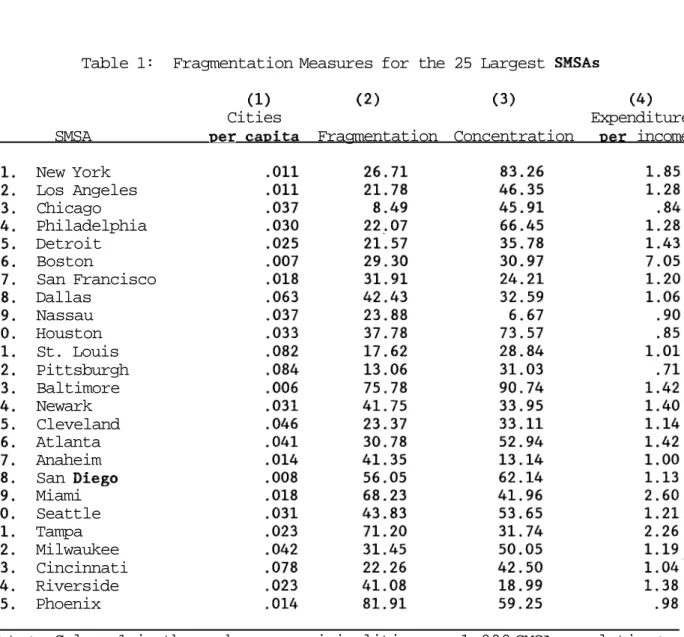
categories, we also run separate regressions for each category. The variation in the income share of municipal expenditures for the 25 largest SMSAs for the 1976-1977 fiscal year is shown in table 1.
Third, we measure the structure of the market for municipally-provided services in two dimensions: fragmentation and concentration. We define
fragmentation as the number of government units within an SMSA per capita. We include two measures of fragmentation: one for municipalities (both
suburbs and central cities) and one for other jurisdictions (independent school districts, counties, and special districts). The considerable variation in the degree of fragmentation across the 25 largest SMSAs is illustrated in table 1.
Fischel (1981) argues that the number of cities alone may not accurately represent the degree of competition in the public goods market. Borrowing from the industrial organization literature, Fischel promotes the use of a four-firm (city) concentration index to capture the relative competitiveness of suburban local government structure. Fischel constructs such an index for the 25 largest urban areas in 1970 based upon concentration with respect to land area. This corresponds to what Zax (1989) refers to as centralism: the share of the top tier of government.
For our analysis we constructed a four-city concentration index for 227 SMSAs in 1977 based upon concentration with respect to population.2 More precisely, the concentration index is calculated as the ratio of the
suburban population (i.e., total SMSA population minus central-city
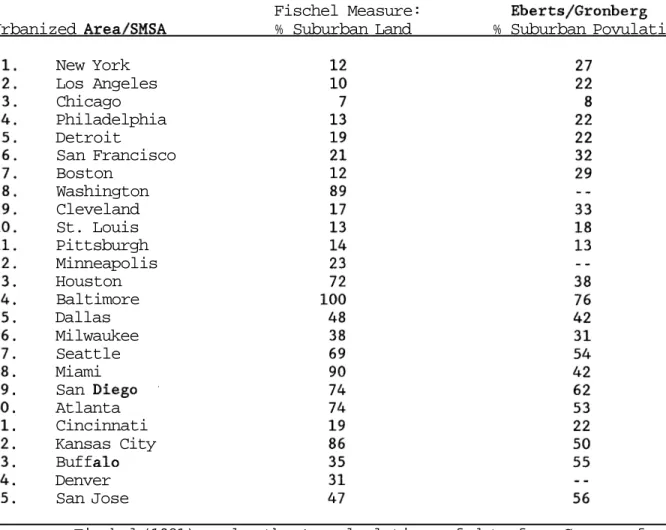
population). The switch to a population-based concentration measure seems most appropriate when addressing the impact of structure on the delivery of local public services. The combined impact of a) using the SMSA rather than the urbanized area as the unit of observation, b) updating the sample to 1976, and c) basing the concentration measure on population instead of land area can be seen in table 2.
In addition to measuring the competitive structure within the suburban submarket, we also wish to measure the relative monopoly power of the central city vis-a-vis the suburban sector. Proceeding in a similar fashion, we measure the central-city concentration index as the fraction of total SMSA population residing in the central city. Concentration values for central cities of the 25 largest SMSAs are displayed in table 1.
According to the Leviathan hypothesis, increased fragmentation should result in decreases in the relative size of both the central city and the suburban public sectors. Increases in the four-suburb concentration ratio, indicating a less competitively structured suburban sector, are expected to be positively related to the income share of the suburban municipal sector.
Similarly, an increase in the central city's share of SMSA population is expected to increase the size of the central city's government sector. The expected effects across submarkets of the concentration measures are not obvious, particularly for the "other" government category.
Finally, since competition is assumed to be achieved through household mobility, explicit measures of mobility should be included in the estimation.
Household mobility among government jurisdictions is measured by gross migration flows between 1975 and 1980. Two measures are included:
1) migration from central cities to the remainder of the SMSA and migration among suburbs, and 2) migration from the remainder of the SMSA to the central
city.4 The two gross migration flow measures are expressed as percentages of the SMSA population. Including these two measures separately allows us to estimate the relative disciplining effects of population inflows and outflows on local government performance. In addition, net migration flows are
included to measure the overall effect of population increases or declines on local governments.
It is not clear a priori whether inflows or outflows of households would have a more significant effect on government performance. Local governments experiencing large outflows of households may have an incentive to cut costs and consequently provide services more efficiently, thus claiming a smaller portion of personal income. On the other hand, local governments experiencing a large inflow of households may be attractive because of their more efficient provision of local government services. It is difficult to make a precise interpretation of these results since we only consider cross-sectional analysis and we do not have measures of the quantity and quality of local public services.
Migration results can also be interpreted in terms of the marginal cost of providing services to inmigrants and outmigrants, as described by Buchanan and Goetz (1972), and Pauly (1970). If the marginal cost of providing services to inmigrants is less relative to the personal income they bring to the
jurisdiction, then the effect on local government size would be negative. The
opposite would, of course, hold for a positive correlation between inmigration
and size. This interpretation depends on the services demanded by the
inmigrants and the outmigrants relative to those households already in the
community.
111, Empirical Analysis
Our data set consists of observations on local public-sector
characteristics of 227 SMSAs for fiscal year 1977. Our empirical model
consists of three equations corresponding to aggregate measures of the three
SMSA submarkets described earlier. The dependent variable is the ratio of
local government expenditures to personal income for the various groups of
governments within an SMSA. For suburbs, we totalled municipal expenditures
for all suburbs within an SMSA and divided that number by total personal
income of the suburbs. For central cities, we simply divided a central city's
expenditures by its personal income. For other governments, we divided
expenditures of all other local governments by total personal income for the
SMSA. We used total SMSA personal income for this group of governments
because in many cases they overlap suburbs and municipalities.
The key explanatory variables are the measures of local government
fragmentation and concentration, and household mobility. The anticipated
effects of these variables have already been discussed.
The other explanatory variables include state mandates, per capita
and population. As noted by Nelson, state mandates may impose binding
minimum constraints on certain local government activities. The presence of
such strictures would, therefore, be positively associated with the relative
size of the local public sector. The relationship between per capita income
and relative public sector size has been subjected to considerable empirical
scrutiny. Investigation of Wagner's Law of a positive correlation between
increases in income and increases in government's relative claims upon the
income has sparked much research and kindled considerable controversy.
Contrary to the national focus of most studies, our results provide some
evidence of the workings of Wagner's Law at the local level. The means and
standard deviations of the variables are shown in table 3.
Asare~ate Estimates
The suburban, central-city, and other government equations are estimated
using Zellner's seemingly unrelated regression technique. The estimates are
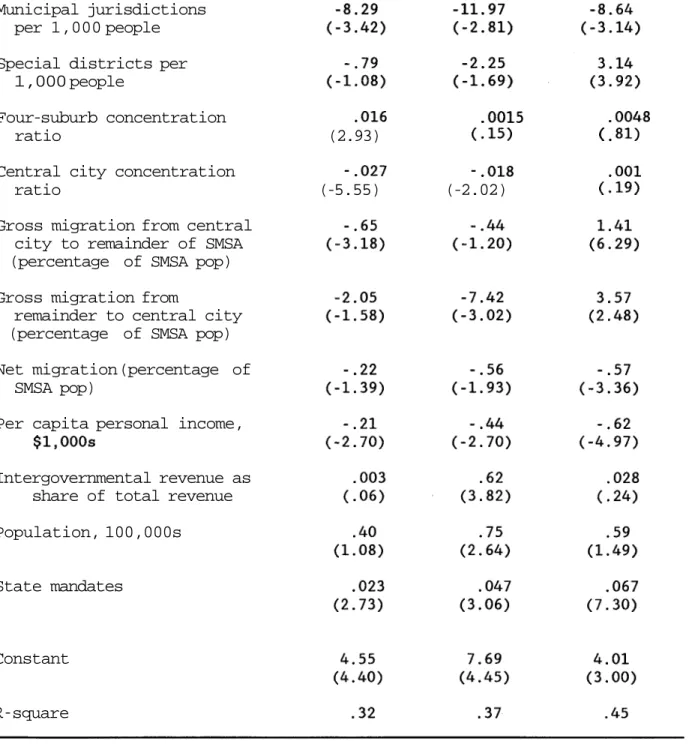
shown in table 4. The results provide strong support for the fragmentation/
competition hypothesis. As expected, the number of municipalities per capita
has a negative and statistically significant effect on all three types of
local governments. Interestingly, there is no statistically significant
difference in the magnitude of these coefficients among the three equations.
The number of nonmunicipal governments per capita has a negative effect on the
size of suburbs and central cities, but neither coefficient is statistically
However, the fragmentation hypothesis is not supported for "other" governments. The number of nonmunicipal governments per capita positively affects the size of "other" governments and is statistically significant at the 1 percent level. Interpretation of the positive effect of this
fragmentation variable on the "other" government expenditures is somewhat difficult since this category contains several different types of governments. However, the results are consistent with Nelson (1987) and Forbes and Zampelli (1989). The former finds that a proliferation of special districts, which
usually provide specialized services to the SMSA, increases the size of the local government sector. The latter find that an increase in the number of counties in the SMSA is also associated with an increase in the ratio of county expenditures to personal income.
The concentration hypothesis is also supported by our results, but only for suburbs. Estimates show that a higher concentration of population within the four most populated suburbs increases the size of suburban governments, which is consistent with the notion of monopoly power and corroborates the centralism findings of Zax (1989). The concentration of suburbs does not have a statistically significant effect on either central cities or other local governments.
Moreover, the results for central-city concentration run counter to the concentration argument. Estimates indicate that as the central city becomes more dominant in the SMSA (i.e., its share of SMSA population increases), the size of central-city government decreases. The negative relationship between central-city concentration and central-city size is difficult to understand.
We will reserve comment until we discuss the estimates of individual expenditure categories in the next section.
Estimates of the two gross migration variables suggest that household mobility plays an important role in disciplining local governments.
Furthermore, the constraining effect comes primarily from households moving into a particular government jurisdiction rather than from households leaving a jurisdiction. Gross migration from central cities to suburbs has a negative and statistically significant effect on the size of suburban governments. However, the loss of households from central cities does not have a
statistically significant effect on the size of central-city governments, although the coefficient is negative.
The size*of central-city governments is affected similarly by
inmigration. Gross migration from suburbs to central cities has a negative and statistically significant effect on the size of central-city governments. The effect of outmigration is also negative but is not statistically
significant at any respectable confidence level.
Opposite results are found for county governments. Both gross inmigration and gross outmigration increase the size of the "other" category of
governments. It is not obvious why county governments, school districts, and special districts should increase their size as mobility increases. In the case of counties and special districts, households are simply moving within their jurisdictions. In the case of schools, they should have an incentive structure similar to municipalities. One possible explanation is that
effect of net inmigration has a diminutive effect on other governments, as
well as central-city and suburban governments. As mentioned earlier, a clear
interpretation of this effect is difficult without measures of the quantity
and quality of local public services, which are unavailable.
The signs of the coefficients of the other variables, which were included
to control for various demographic characteristics and financial incentives,
are consistent with our expectations. The size of local governments increases
with an increase in intergovernmental revenue, with more state-imposed
mandates for providing various local government services, and with larger
populations. The size of local governments, on the other hand, decreases with
higher per capita income. These results are consistent with results found by
Ram (1987) for a cross-section analysis of 115 countries. Zax (1989) also
finds a negative relationship between revenues per income and income per
capita.
Individual Functional Cateaorv Estimates
The various structure and mobility variables are not expected to
influence all functions of local governments in the same direction or with the
same level of statistical significance. Moreover, variation in the scope of
the services offered by local governments could account for the correlation
between local government size and structure and household mobility. As a
first attempt to control for this variation, we estimated expenditures per
personal income for six budget categories for suburbs and central cities. OLS
suburbs and central cities in all SMSAs. These categories included the
provision by central cities of fire protection, the provision of police
protection by suburbs and central cities, and the provision of parks by
central cities. The remaining categories were not supplied by suburbs and
central cities in some SMSAs. Because of the censored nature of these data,
the Tobit estimation technique was used. The results for selected variables
are shown in table 5.
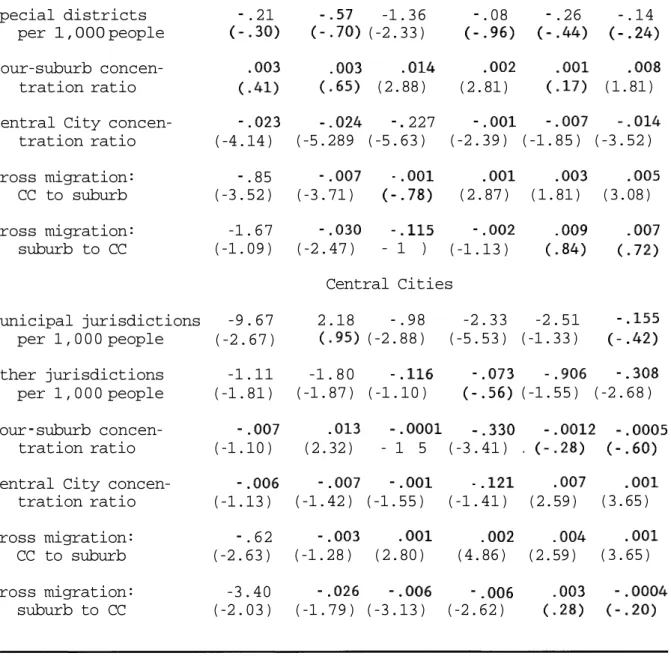
The results are consistent with the findings in the previous section. The
number of municipal jurisdictions per capita has a negative effect on
expenditures per personal income for all categories. All but four
coefficients, primarily for central cities, are statistically significant at
the 5 percent level. The effect of the number of other jurisdictions per
capita is also negative, but only a third of the coefficients are
statistically significant at the 5 percent level.
The central-city concentration measure has the most widespread effect on
the suburban expenditure categories, while the four-suburb concentration ratio
primarily affects suburban police and fire expenditures.
The apparent anomaly concerning the relationship between central-city
concentration and local government size that surfaced for the aggregate
estimates seems to disappear for the individual expenditure estimates.
Somewhat surprisingly, the negative correlations between central-city
concentration and central-city expenditures are not statistically significant
at any respectable confidence level. However, for the categories of
their share of personal income. This increase in expenditures for central
cities is offset by a decrease in suburban expenditures on sanitation and
parks expenditure, providing further evidence of a tradeoff between suburban
and central-city expenditures.
The diminutive effect of mobility on the size of local government is felt
primarily in school, welfare, fire, and police expenditures. According to the
estimates, mobility increases the income share of expenditures for parks and
sanitation. This general pattern of results holds for both suburban and
central-city governments.
Examining the effect of household mobility on individual budget categories
offers some insight into the relative effects of various types of households
on the net fiscal surplus of local governments. The relative contribution of
various household groups will depend upon their preferences of local services
and their income level. For example, according to the estimates, central-city
households moving to the suburbs cause suburban police expenditures to rise
more than suburban personal income. On the other hand, these same
central-city migrants reduce welfare expenditures of suburban municipalities
relative to their contribution to personal income. One could also interpret
these results as saying that central-city residents prefer to locate in
municipalities with a high level of police protection and a minimal welfare
program.
When central-city residents leave central cities for the suburbs, they
impose a marginal cost on the remaining residents in terms of higher
welfare. On the other hand, suburban residents moving to the central city reduce the expenditures relative to personal income on all central-city expenditures while imposing very little cost on the suburban residents they left behind.
IV. Conclusion
The decentralized U.S. government structure has been both praised for promoting efficiency and blamed for stimulating excessive local government spending. This paper examines the relationship between the number of local governments within local labor markets and their expenditures. Particular attention is given to four aspects of the structure/performance relationship. First, local government structure is captured by two measures: fragmentation and concentration. Second, since different types of local governments may respond differently to the disciplining effects of local government structure, the analysis looks at suburbs, central cities, and all other local governments separately. Third, six individual expenditure categories are analyzed
separately in order to examine the effects of government structure on
individual government functions. Fourth, household migration is included in the analysis to take into account its disciplining effect on local
governments.
For a sample of 227 U.S. metropolitan areas, solid empirical support for the fragmentation/decentralization hypothesis is found for both suburbs and central cities. An increase in the number of competing suburban government units in an SMSA is associated with a decrease in the relative income share of
local public expenditures. An increase in the concentration index for the
suburban local public sector is found to be positively related to the relative
public share measure. The behavioral response to market structure varies
among suburbs and central cities, and across the various local government
functions. Finally, increased mobility serves to reduce the size of the local
References
Advisory Commission on Intergovernmental Relations, State Mandating of Local Expenditures, Washington, D.C.: U.S. Government Printing Office, 1978. Brennan, Geoffrey and Buchanan, James F., The Power to Tax: Analytical
Foundation of a Fiscal Constitution, Cambridge, New York: Cambridge University Press, 1980.
Buchanan, James M. and Goetz, Charles J., "Efficiency Limits of Fiscal Mobility: An Assessment of the Tiebout Model," Journal of Public Economics, April 1972, 1, 25-43.
Eberts, Randall W. and Gronberg, Timothy J., "Can Competition Among Local Governments Constrain Government Spending?" Economic Review (Federal Reserve Bank of Cleveland), No. 1 , 1988, 24, 2-9.
Fischel, William A., "Is Local Government Structure in Large Urbanized Areas Monopolistic or Competitive?" National Tax Journal, March 1981, 34, 95-104.
Forbes, Kevin F. and Zampelli, Ernest M., "Is Leviathan a Mystical Beast?" American Economic Review, June 1989, 79(3), 568-577.
Nelson, Michael A., "Searching for Leviathan: Comment and Extension," American Economic Review, March 1987, 77, 198-204.
Oates, Wallace E., Fiscal Federalism, New York: Harcourt Brace Jovanovich, Inc., 1972.
Oates, Wallace E., "Searching for Leviathan: An Empirical Study," American Economic Review, September 1985, 75, 748-57.
Pauly, Mark V., "Optimality, 'Public' Goods, and Local Government: A General Theoretical Analysis, Journal of Political Economy, 1970, 78, 572-585.
Ram, Rati, "Wagner's Hypothesis in Time-Series and Cross-Section Perspectives: Evidence from 'Real' Data for 115 Countries," Review of Economics and Statistics, May 1987, 69, 194-204.
Sjoquist, David L., "The Effect of the Number of Local Governments on Central City Expenditures," National Tax Journal, March 1982, 35, 79-87.
Zax, Jeffrey S., "Is There a Leviathan in Your Neighborhood?" American Economic Review, June 1989, 79(3), 560-567.
Footnotes
1. The number of single-purpose governments is the sum of the number of townships, school districts, and special districts, except in Pennsylvania, New Jersey, and the New England states, where townships are not included. The reason for these exceptions is that the functional responsibilities closely resemble municipalities in these states.
2. A few SMSAs were not included in the sample due to a variety of problems,
including differences in definitions of government units and missing observations.
3. Local government expenditures (or revenue) have also been suggested as a
basis for the concentration ratios. However, we feel that population is more in keeping with the Tiebout mechanism since it is the potential to migrate that is conjectured to discipline local governments.
4 . Migration data were obtained from Bureau of the Census, Geographical
Mobility for Metropolitan Areas, November 1984, tables 2 and 8.
5. The Advisory Commission on Intergovernmental Relations surveyed local
governments about 77 functional subcomponents in five broad areas: state
personnel other than police, fire, and education (15 components); public
safety (31); environmental protection (8); social services and miscellaneous
Table 1: Fragmentation Measures for the 25 Largest SMSAs
(1) (2 (3 (4)
Cities Expenditures
SMS A per ca~ita Fragmentation Concentration ~ e r income New York Los Angeles Chicago Philadelphia Detroit Boston San Francisco Dallas Nassau Houston St. Louis Pittsburgh Baltimore Newark Cleveland Atlanta Anaheim San Diego Miami Seattle Tampa Milwaukee Cincinnati Riverside Phoenix
Note: Column 1 is the number or municipalities per 1,000 SMSA population; column 2 is the four-suburban concentration ratio; column 3 is the central cities to total SMSA population ratio; column 4 is average suburban
expenditures (on the six categories) per $1,000 personal income.
Source: Government finance and structure variables are created from U.S. Bureau of the Census, Governments Division, Census of Governments, 1977. Personal income and population data for each municipality and SMSA are obtained from the Bureau of Economic Analysis, 1977.
Table 2: Suburban Concentration Ratios: A Comparison with Fischel's Estimates
Fischel Measure: Eberts/Gronberg Urbanized Area/SMSA % Suburban Land % Suburban Povulation
New York Los Angeles Chicago Philadelphia Detroit San Francisco Boston Washington Cleveland St. Louis Pittsburgh Minneapolis Houston Baltimore Dallas Milwaukee Seattle Miami San Diego ' Atlanta Cincinnati Kansas City Buff a10 Denver San Jose
Source: Fischel (1981) and author's calculations of data from Census of Governments.
Table 3: Sample Statistics of Government Structure and Performance Variables Standard
Variable Mean Deviation
Municipal jurisdictions .061 .045
per 1,000 people Special districts per
1,000 people
Four-suburb concentration ratio (percentage)
Central city concentration ratio (percentage)
Gross migration (percentage of SMSA population)
a) central city to remainder b) remainder to central city Net migration (percentage of
SMSA population)
Per capita personal income, $ 1 , 0 0 0 ~
a) municipalities 6913.7 1152.7
b) central cities 6781.9 961.40
c) other 6718.7 950.06
Intergovernmental revenue as share of total revenue
a) municipalities 1.06 1.48 b) central cities 1.02 .83 c) other 1.50 .91 Population, 100,000s a) municipalities b) central cities c) other State mandates 38.93 11.47
Expenditures per $1,000 income
a) municipalities 1.60 1.54
b) central cities 3.19 2.89
C) other 5.61 1.87
Table 4: Concentration and Competitive Effects on Public Sector Size, all SMSAs, 1976-77
Coefficients
Ex~lanatorv Variables Suburbs Central Cities Other Municipal jurisdictions
per 1,000 people Special districts per
1,000 people
Four-suburb concentration .016 .0015 .0048
ratio (2.93) (.I51 ( 81)
Central city concentration
-
.027-
.018 .001ratio (-5.55) (-2.02) (.I91
Gross migration from central city to remainder of SMSA (percentage of SMSA pop) Gross migration from
remainder to central city (percentage of SMSA pop) Net migration (percentage of
SMSA pop)
Per capita personal income, $1,000~
Intergovernmental revenue as share of total revenue Population, 100,000s
State mandates
Constant
Note: Equations estimated simultaneously using Zellnerts seemingly unrelated regression technique. Asymptotic T-ratios in parentheses. Number of
observations equals 227. The dependent variable included expenditures for the following functions: schools, welfare, fire, police, sanitation, and parks. Source: Municipal finances were obtained from Census of Governments, 1977. Personal income and population came from Bureau of Economic Analysis. State mandates are from Advisory Commission on Intergovernmental Relations,
Table 5: Concentration and Fragmentation Effects on Public Sector Size, all SMSAs, selected categories, 1976-77
Variables Suburbs
Independent/Dependent Schools Welfare Fire Police Sanit Parks Municipal jurisdictions -8.59 -3.82 -7.00 -1.15 -4.28 -6.23 per 1,000 people (-2.29) (-1.70) (-3.52) (-3.93) (-2.17) (-3.15) Special districts
-
.21 -.57 -1.36-
.08-
.26 - .14 per 1,000 people (-.30) (-.70) (-2.33) (-.96) (-.44) (-.24) Four-suburb concen- .003 .003 .014 .002 .001 .008 tration ratio (.41) (.65) (2.88) (2.81) (.17) (1.81) Central City concen--
.023 -.024-.
227-
.001-
.007 -.014tration ratio (-4.14) (-5.289 (-5.63) (-2.39) (-1.85) (-3.52) Gross migration:
-
.85-
.007-
.001 .001 .003 .005CC to suburb (-3.52) (-3.71) (-.78) (2.87) (1.81) (3.08) Gross migration: -1.67
-
.030 - .I15-
.002 .009 .007suburb to CC (-1.09) (-2.47) - 1 ) (-1.13) (.84) (.72) Central Cities
Municipal jurisdictions -9.67 2.18 - .98 -2.33 -2.51
-
.I55 per 1,000 people (-2.67) (-95) (-2.88) (-5.53) (-1.33) ( - .42) Other jurisdictions -1.11 -1.80 - .I16-
.073 - .906-
-308per 1,000 people (-1.81) (-1.87) (-1.10) (-.56) (-1.55) (-2.68) Four
-
suburb concen--
.007 .013 -.0001 -.330 -.0012 -.0005tration ratio (-1.10) (2.32) - 1 5 (-3.41) . (-.28) (-.60) Central City concen-
-
.006-
.007-
.001-
.I21 .007 .001tration ratio (-1.13) (-1.42) (-1.55) (-1.41) (2.59) (3.65) Gross migration:
-
.62-
.003 .001 .002 .004 .001CC to suburb (-2.63) (-1.28) (2.80) (4.86) (2.59) (3.65) Gross migration: -3.40
-
.026-
.006-
.006 .003-
.0004Note: Equations are estimated using Tobit technique except for those functions that are supplied by all governments, in which case OLS is used. These functions include central city fire, suburban and central police, and
central city parks. The regression equations included the same set of
explanatory variables as used in table 4, but are not shown to save space.
Asymptotic T-ratios for Tobit and T-ratios for OLS are in parentheses.