Rheinische Friedrich-Wilhelms-Universität Bonn
B 25
1999
Zentrum für Europäische Integrationsforschung Center for European Integration Studies
Rheinische Friedrich-Wilhelms-Universität Bonn
Walter-Flex-Straße 3 D-53113 Bonn Germany Tel.: Fax: http: +49-228-73-9218 +49-228-73-1809 //www.zei.de ISSN 1436-6053
MICRO AND MACRO
DETERMINANTS OF
PUBLIC SUPPORT FOR
MARKET REFORMS IN
EASTERN EUROPE
* Special thanks to Jan Fidrmuc, Michael Funke, Bernd Lucke, Robert MacCulloch, Birgit Uhlenbrock, Jürgen von Hagen, Christian Weller, and participants of Research Seminars at the Universities of Bonn and Hamburg for helpful comments. The usual disclaimer applies.
Market Reforms in Eastern Europe
Bernd Hayo
* ZEI University of Bonn Walter-Flex-Str. 3 D-53113 Bonn Germany Email: [email protected] Tel.: +49-228-73-1878 Fax: +49-228-73-1809Market Reforms in Eastern Europe
Abstract
This paper looks at public support for the creation of a market economy in Eastern Europe. As a data base, the Central and Eastern Eurobarometers surveys are employed, covering up to 21 countries over a time period of 1990-96 and totalling more than 100000 observations on individuals. The development of support for market reforms is analysed over time and countries. Moreover, in a number of panel regressions, individual and macroeconomic determinants of support for reforms are studied. Apart from the influence of individual characteristics (age, gender, education, income), the only significant and robust aggregate effect is that those countries that are able to keep inflation low get more support for market reforms. Small government budget deficits may also help to strengthen support. Differences in employment, GDP per capita, openness, private sector share and microeconomic transition progress do not show robust effects on people’s attitudes towards the creation of a market economy.
Keywords: Economic Reforms, Eastern Europe, Public Support, Transformation
1. Introduction
Many observers agree that public support for the creation of a market economy is a key ingredient in a successful transformation programme. In an interesting book, Williamson (1994) brings together a number of experts with the aim to generate hypotheses about the determinants of successful economic reform. In the comparison of different case studies of practical policy reforms none of those hypotheses survived the test without at least some rejections. However, one of the three more robust influences is that of strong political support
for the reformer.1 In other words, public support, though not a sufficient condition for success,
is helpful in raising the chances that the reforms will be feasible and successful.
There is a growing body of work on economic policy reform, which is surveyed by Rodrik (1996), where public support for reforms is often mentioned in the discussion. A recent collection of formal models on economic reforms is the book by Sturzenegger and Tommasi (1998). Again, in many of these papers, public support of reforms plays, either directly or indirectly, a crucial role in the models. But selective evidence on Poland, Mexico and Peru indicates that the relation between economic outcomes and public support for the government is not a straightforward one (see the summary by Stokes (1996)).
However, the motivation of these and other papers with respect to the importance of support for economic reforms is solely based on case studies, primarily from South America. This is not surprising, though, as no econometric multi-country studies investigating determinants of public support for market reforms exist. The empirical analysis presented in this paper is an attempt to contribute to our knowledge on what factors influence people’s support by going beyond case studies. Instead, survey data collected in up to twenty-one Eastern European countries over a time period of up to seven years is employed.
Clearly, Eastern Europe is in a rather specific situation of economic reform in its struggle to transform its centrally-planned economies into Western-styled market economies and a general theory of transition is still missing. A well-known partial equilibrium model of economic transformation is presented by Blanchard (1997), who starts from the stylised fact of a u-shaped development of output in most Eastern European economies. He considers a model of a transition economy with perfect foresight which captures such an output and employment development, and where support for economic reforms is also u-shaped. However, if one were to endogenise the political process, the chosen reform path may turn out
1
The other two conditions for successful reforms are a “visionary leadership” and a “coherent economic team” (Williamson (1994, p. 589)).
to be non-achievable (see Blanchard (1996, p. 29)). Blanchard (1997, p. 15f.) reports some survey evidence for Poland to analyse the determinants of the perception of current and expected economic situation. He finds that unemployment and output affect people’s attitudes.
A somewhat broader empirical study is the one by Fidrmuc (1999), who approaches the issues of support for reforms in Eastern Europe indirectly. He uses actual election results from four countries to investigate the question of political support by explaining voting shares for reform and non-reform parties employing a diverse mix of regressors such as unemployment, entrepreneural activity or demographic factors. The advantage of that study is that actual votes are revealed preferences instead of intentions voiced by respondents, as collected in surveys. However, voting for a party can not be easily attributed to just one policy issue, and therefore it is not clear whether voters prefer a party because of its stance on economic reform or, for instance, its position on maintaining order, improving democracy, national defence, etc.
There exist a number of studies which directly look at public opinion on different aspects of transformation in Eastern Europe. Early attempts to compare Eastern European attitudes with those of Western countries are interesting (see Shiller et al. (1991) or Shiller et al. (1992)) but limited in scope. Concentrating on the labour market and taking into account a time dimension, Blanchflower and Freeman (1997) compare the labour market attitudes of respondents in Eastern and Western Europe using the much larger ISSP data base. In contrast
to Shiller et al., they find evidence in favour of an ‘attitudinal’ legacy of communist times.2
Shleifer (1997) compares the development in Poland and Russia. One aspect of his analysis takes into account possible differences in trust and participation in civic activities, which he computes using the World Values Survey. In his view, the differences that emerge in “social capital” do not support the view that this is the key component in understanding the differences in economic performance.
A specifically designed set of regular surveys have been put into existence with the New Democracies Barometers (NDB). This data covers a number of Central and Eastern countries, and includes many useful questions on political, social and economic issues (see Rose and
Haerpfer (1993, 1994) for a descriptions of the structure of the surveys).3
2
See Frentzel-Zagorska and Zagorski (1993) for survey evidence on Poland. 3
The NDB data base has just been made available to a selected group of researchers within the framework of the “Citizens in Transition Network” (CITNET).
The largest data base in terms of number of countries and covered time periods, however, has been collected on behalf of the European Commission under the name of Central and Eastern Eurobarometers (CEEB). With respect to the number of included questions it is more limited than the NDB, but it still contains useful information. While the EU presents some results of these surveys in print, the primary data are only available with a considerable time lag to outside researchers. A variety of studies use this data base, but most of them concentrate on sociological or political science issues, like democratisation, political participation, values, etc. (see, for instance, Juchler (1994) or Pickel and Pickel (1996)). An emphasis on attitudes towards economic issues is provided by Hayo (1997a, 1997b, 1999), where, for example, mass opinion towards privatisation and economic transformation is analysed.
The present study focuses on one specific question in the CEEB that has been asked in all of the surveys and which is of utmost importance for analysing support for economic reforms in the transformation countries, namely people’s opinion towards the creation of a market economy. Using answers collected from more than 100000 people over a time span of seven years and twenty-one countries, support for market reforms is analysed applying both simple descriptive as well as advanced ordered logit models. In Section 2, the data base and econometric methodology are explained. A descriptive analysis of the data is presented in Section 3 and an aggregate analysis of support for the creation of a market economy in Section 4. Section 5 considers an ordered logit model with both individual-level and aggregate-level variables. Finally, a conclusion discussing the policy implication of the analysis is put forward.
2. Data Base and Econometric Methodology
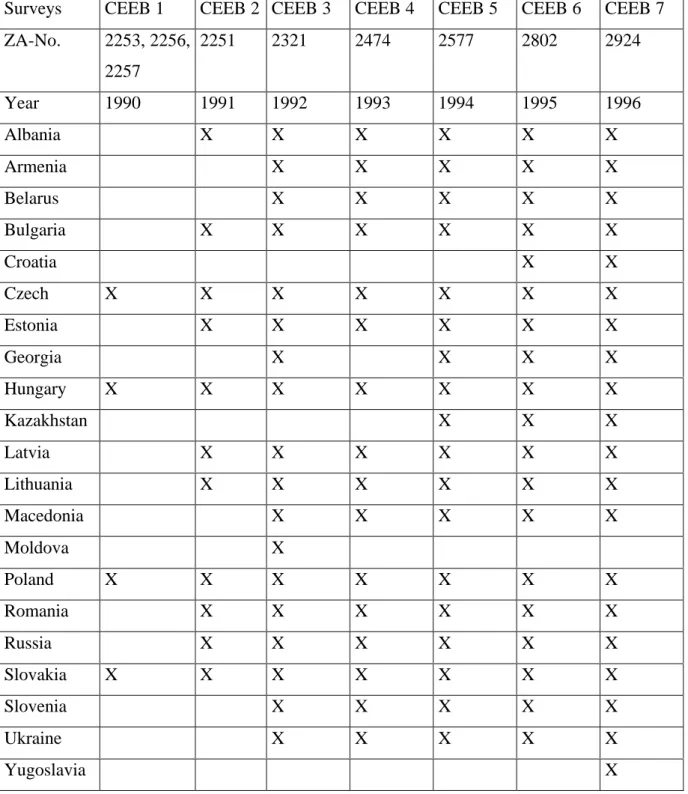
The CEEB is a series of comparable and representative surveys undertaken on behalf of the European Union in the period 1990 to 1996, covering up to 21 Eastern European countries. In general, about 1000 people in a country were randomly selected for a personal interview in Autumn of the respective year. Table A in the Appendix summarises the time and country dimension of the surveys. The first surveys in 1990 were only undertaken in the CSFR, Hungary and Poland, while the last currently available survey from 1996 provides data on 20 countries. Unfortunately, the CEEB have some drawbacks regarding the consistent and regular covering of important questions over time. There are just a few demographic variables being collected over time and countries, and many interesting substantial question have been
discarded after only a few years time (for example with respect to privatisation, see Hayo (1997a)). The data base employed in this study combines the available CEEB surveys and contains more than 100000 respondents.
There are other, more fundamental, problems related to comparative survey analysis (see Przeworski and Teune (1970), Almond and Powell (1978)), to concepts (see Converse (1970), Zaller (1992)) as well as problems connected to practical issues (see Schuman and Presser (1981)). These are being addressed in Hayo (1997a, 1997b, 1999) and need not concern us here. In general, the data appear to provide a useful tool for analysing the question at hand. As indicated above, in this study I concentrate on one substantial question, namely people’s opinion toward the creation of a market economy. This variable is called SUPPORT, and the actual wording and coding of the question are as follows:
SUPPORT:
“Do you personally feel that the creation of a free market economy, that is one largely free
from state control, is right or wrong for (our country’s) future?
Coding: Right 1
Don’t know 0
Wrong -1
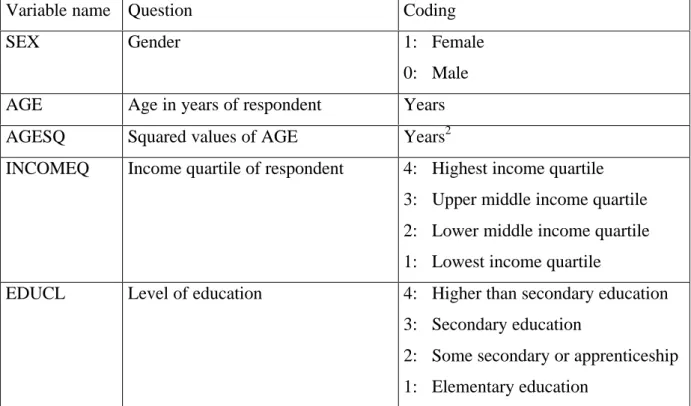
To control for individual effects, socio-demographic variables are used in the later part of the analysis. Those that were collected consistently over most surveys are given in Table 1.
Tab. 1: Socio-Demographic Variables and Coding
Variable name Question Coding
SEX Gender 1: Female
0: Male
AGE Age in years of respondent Years
AGESQ Squared values of AGE Years2
INCOMEQ Income quartile of respondent 4: Highest income quartile
3: Upper middle income quartile 2: Lower middle income quartile 1: Lowest income quartile
EDUCL Level of education 4: Higher than secondary education
3: Secondary education
2: Some secondary or apprenticeship 1: Elementary education
Even though the number of variables is not large, they are at least relatively comparable over time and countries.
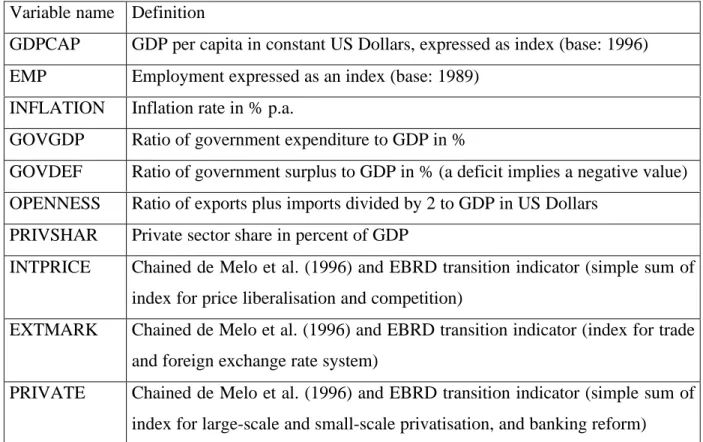
Table 2 lists those variables that will be used to investigate the influence of macroeconomic developments and progress in microeconomic reforms. The choice of aggregate variables has been guided by a proposition of Lipton and Sachs (1990), who claim that fundamental economic reforms involve three core elements, namely macroeconomic stabilisation, economic liberalisation and privatisation of state enterprises. A similar, though more detailed, list is given in Williamson (1994), who calls his selection the “Washington Consensus”. The aspect of stabilisation will be covered by appropriately chosen macroeconomic variables, while the latter two aspects are proxied by private share in GDP and the transition indicators. Regarding stabilisation, the use of both the average income variable and the employment variable can be rationalised by the importance of these variables in many models (see, for instance, Blanchard (1997), Fidrmuc (1999a) or Rodrik (1995). Employment rather than unemployment has been chosen to capture the situation on the labour markets, as the measurement of unemployment is extremely unreliable (see UN (1997, p. 114f.)). There are also a number of problems related to the real GDP per capita numbers, therefore an index is used instead of absolute values.
Tab. 2: Aggregate Level Variables and Coding
Variable name Definition
GDPCAP GDP per capita in constant US Dollars, expressed as index (base: 1996)
EMP Employment expressed as an index (base: 1989)
INFLATION Inflation rate in % p.a.
GOVGDP Ratio of government expenditure to GDP in %
GOVDEF Ratio of government surplus to GDP in % (a deficit implies a negative value)
OPENNESS Ratio of exports plus imports divided by 2 to GDP in US Dollars
PRIVSHAR Private sector share in percent of GDP
INTPRICE Chained de Melo et al. (1996) and EBRD transition indicator (simple sum of
index for price liberalisation and competition)
EXTMARK Chained de Melo et al. (1996) and EBRD transition indicator (index for trade
and foreign exchange rate system)
PRIVATE Chained de Melo et al. (1996) and EBRD transition indicator (simple sum of
index for large-scale and small-scale privatisation, and banking reform) Source: de Melo et al. (1996), EBRD Transition Report (1994, 1995, 1996, 1997, 1998), UN Economic Survey of Europe (1997, 1998), Berg et al. (1999), own calculations.
The IMF typically proposes a stabilisation programme that contains a strong focus on eliminating high inflation. At the same time, the evidence on the negative economic effects of moderate inflation is neither theoretically nor empirically very compelling (see, for instance, Fischer (1986), Driffil et al. (1990) or Bruno and Easterly (1998)). But it turns out that in survey data people often express serious concern about inflation (see, for instance, Di Tella et al. (1999), Fischer and Huizinga (1982), Hayo (1998), Rose (1998)).
More generally, Fischer et al. (1996, 1996a) look at the IMF-approach to transformation, and, based on empirical evidence, they argue that the focus on eliminating high inflation rates appears to be a requirement for economic growth to pick up again. Other observers, for example Yavlinski and Braguinsky (1994), think that alternative policy areas, such as de-monopolisation, need to be addressed before monetary policy ought to be tightened. Finally, in a paper by Mondino et al. (1996) a model is presented that is able to generate an inflation cycle. After the adoption of a stabilisation programme, inflation goes down rapidly but starts to pick up again as the reform is abandoned. Here it is the inflation rate itself which drives support for reforms, and as soon as the inflation rate is brought down, the programme collapses.
Another important issue is the question of how fiscal policy should be conducted. While the IMF emphasises the avoidance of a large share of government expenditures in GDP and large budget deficits, there exist good economic arguments why, in principle, it may be worthwhile for Eastern European countries to run up some debt in the transition period. For instance, the present generation has to suffer severe hardship as a large share of its material and immaterial capital is being wiped out by the change-over to a market economy, which can be considered as a special historical event that opens up a great potential for the future. One can argue that this extraordinary burden should be partially shifted to other generations who will benefit from the creation of a market economy.
With budgets being dominated by social spending, a large share of government expenditures helps to smooth the distributional consequences of transformation. For instance, Fernandez
and Rodrik (1991) develop a model which shows that the existence of ex ante uncertainty
about winners and losers of reforms may prevent the implementation of efficiency-enhancing
reforms, even though people would have supported the reform ex post. Hence if people know
that they will benefit from the reforms - even if they turn out to be losers according to the primary income distribution - then the likelihood of public support for the reform will be higher.
Further, social spending may also avoid the delay in reforms caused by a “war of attrition” as described by Alesina and Drazen (1991). In this model, different groups in society try to shift the burden of adjustment to other groups which results in a stalemate. Only if one group gives in and accepts a relatively large share of the adjustment costs will the stabilisation programme be undertaken. With the help of fiscal transfers, directed at the avoidance of economic hardship, support for reforms may be kept up as the losers do not have to bear the whole burden.
There is an argument that the external trade openness of an economy may influence people’s attitudes towards reforms. As summarised in Krueger (1993), certain trade policies can have asymmetric effects on different groups within an economy, which then affect the balance of political power. Further, some groups within the population may get the perception that economic problems can be traced back to foreign capital or trade links (see, for example, La Ferrara (1996)). OPENNESS measures the trade linkages with other countries and serves as an indicator of foreign economic influence.
The aspects of economic privatisation and liberalisation can be captured by employing the share of private sector in GDP (see Berg et al. 1999), and the indicators calculated by the EBRD to report progress on microeconomic reforms. Unfortunately, the EBRD transition indicators are only available from 1994 onwards. However, de Melo et al. (1996) have developed a comparable index. One can use the one year of overlap between the EBRD data
and the de Melo et al. index to construct a new series covering the period 1991-1996.4
Regarding econometric methodology, we start the analysis by using a simple OLS approach employing average national values for SUPPORT. Although this gives a first impression of the patterns in the data, the general problem with such an approach is that we lose the individual level information. As the countries in our sample may differ with respect to individual characteristics and as there could be interaction between individual level and aggregate level variables, it would be interesting to analyse the influence of those effects as well.
There exists, however, a serious difficulty in combining variables measured at an individual level and variables measured at a country level, as the standard errors of the latter tend to be downward biased (see Moulton (1990)). One way to deal with this problem is to apply a two-step method (see, for example, Dickens and Katz (1986) or Di Tella et al. (1999)). In the first step, an OLS-regression is run consisting only of individual variables and dummies
4
It should be noted that employing the original EBRD data from 1994 onwards affects the results obtained for the significance of transition indices (see Hayo (1999a)) but does not change the general conclusions.
representing the aggregate level, for example nationality. Then, in the second step, the estimates on the coefficients of the country dummies are used to form a series employed as a dependent variable in a regression with aggregate-level variables as regressors. This approach has two main drawbacks in our context: First, applying OLS in the first stage does not square well with a dependent variable of ordinal scale. Second, possible interactions between individual and aggregate variables can not be captured.
In view of these disadvantages, this paper takes a different route. It estimates ordered logit equations in one step, with both individual and country level variables as regressors. This is only a valid procedure, if one takes the clustering of data with respect to countries into account (see Binder (1983), Skinner (1989)). The disadvantage of that approach is that one can not use traditional maximum likelihood estimation anymore, which implies a much longer computing time and perhaps a reduction in the interpretability of the results compared to the
two-step method.5
3. Descriptive Analysis
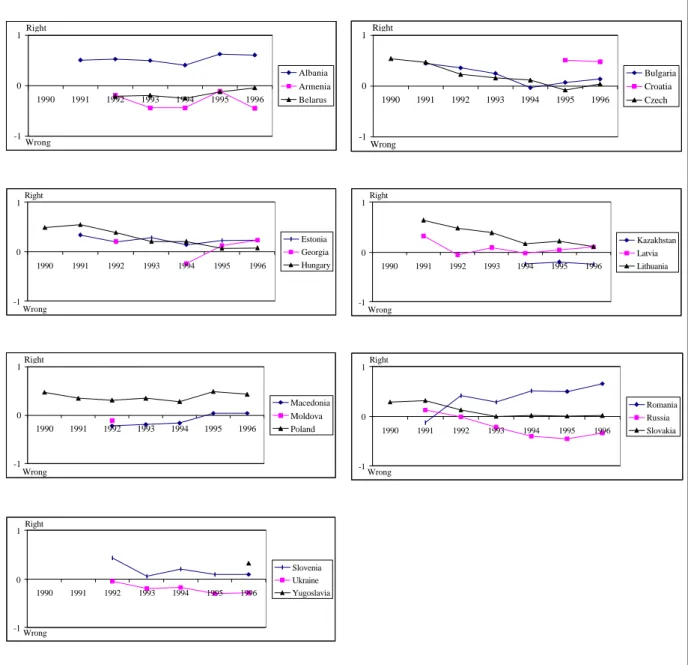
In this section, I briefly discuss the development of a country’s mean responses over time, and in comparison to the other countries. In Figure 1, the development of the national averages is shown in an alphabetical order. These values can be interpreted as the share of net supporters (supporters minus opponents in relation to all respondents) of the creation of a market economy.
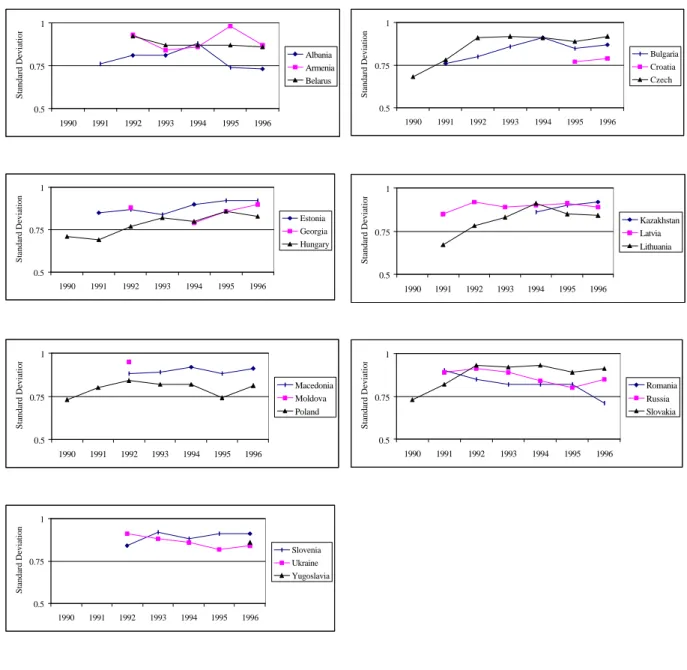
However, analysing average values does not say anything about the degree of consensus of opinion within one society. Thus to complement the analysis of average values, the standard deviation as a measure of dispersion is taken into account, and the corresponding graphs are shown in the Appendix (Fig. A). A small standard deviation is interpreted as reflecting a strong public consensus regarding the assessment of a market economy in the respective country.
Public support for the creation of a market economy is very high in Albania, though there are some signs that these results may be upward biased (see Hayo (1999)). Except for 1994, there is a strong consensus on this position. People in Armenia are much more critical about the introduction of a market economy, a clear majority does not consider it as the right decision.
5
But considering the arguments presented before, the gain in terms of interpretation when applying the two-step method can be rather spurious.
As a whole, the Armenian society appears to be relatively divided on this issue, especially in 1995 when the number of supporters increased considerably. People in Belarus are also rather against market reforms, but there seems to be a trend towards more support, which is strengthened by a slightly falling dispersion of opinion.
Fig. 1: Mean Values of SUPPORT over Time
-1 0 1 1990 1991 1992 1993 1994 1995 1996 Albania Armenia Belarus Right Wrong -1 0 1 1990 1991 1992 1993 1994 1995 1996 Bulgaria Croatia Czech Right Wrong -1 0 1 1990 1991 1992 1993 1994 1995 1996 Estonia Georgia Hungary Right Wrong -1 0 1 1990 1991 1992 1993 1994 1995 1996 Kazakhstan Latvia Lithuania Right Wrong -1 0 1 1990 1991 1992 1993 1994 1995 1996 Macedonia Moldova Poland Right Wrong -1 0 1 1990 1991 1992 1993 1994 1995 1996 Romania Russia Slovakia Right Wrong -1 0 1 1990 1991 1992 1993 1994 1995 1996 Slovenia Ukraine Yugoslavia Right Wrong
In the case of Bulgaria we can see a steady decline from 1991 to 1994, from a strong majority in favour of creating a market economy to a stalemate situation, accompanied by a rising standard deviation. Since then, however, support for reform has increased again. For Croatia, there are only two values, but they indicate a clear majority in favour of pro-market reform. Many more observations are available for the Czech people. Similar to Bulgaria, a negative
trend can be detected. The corresponding standard deviation shows a strong rise in 1990 and 1991, and it remains on a high level since. Thus only a small majority exists in favour of market reforms in 1996, and the society appears to be relatively polarised on this question. For Estonia, the situation is different in the sense that no major trends have occurred in spite of some variations in the strength of the majority in favour of creating a market economy. But even though the average value has not changed much between 1991 and 1996, the dispersion of the society has steadily increased. Surveys for Georgia started in 1992, were interrupted in 1993, and the average values continued in 1994 from a much lower level. Since then, people have become more supportive with respect to the free market, even though the consensus on that opinion has decreased. The development in Hungary is very similar to the one in the Czech Republic, that means a continuous loss in support and a corresponding drop in the national consensus.
Given that only few observations for Kazakhstan are in the data set, there is little movement in the negative position towards creating a market economy. In Latvia there is a drop in support for market reforms in 1992, and the majority of people remained just about in favour of the free market. A negative trend can be seen in Lithuania, where the 1996-value is now equal to the one for Latvia. The dispersion of opinion within the Lithuanian society rose heavily, reached a maximum in 1994, and started to decline since then.
In Macedonia, people were rather anti-market oriented until 1995, with a slight increase in dispersion on this issue. Only one data point is available for Moldova, and it indicates a small majority against market reforms. For Poland, there appears to be a strong and relatively constant pro-market majority, backed by a comparatively high consensus in the society. A positive trend exists in Romania over that time period. Starting from a majority of anti-market supporters in 1991 people became much more pro-reform over time, and this development is accompanied by a smaller dispersion in opinion. For Russia, an opposite situation is found. People favoured market reforms in 1991, but from 1993 onwards the majority is clearly on the side of the anti-market opinion. Slovakia started off with a majority of respondents in favour of market reforms, but since 1993 a stalemate situation exists and society is relatively divided on that question.
In Slovenia a majority supports market reforms, though the enthusiasm displayed in 1992 got lost. The anti-reform forces held a majority in the Ukraine over the whole sample period and the corresponding standard deviation is relatively small. Finally, Yugoslavia shows support for market reforms in 1996, the only available observation.
To summarise, in only one half of the countries do we find a majority supporting the creation of a market economy. Except for Romania, in none of the countries can we observe a strong increase in support over time, though there appears to be a recovery starting in 1995. Coming back to the model presented in Blanchard (1997), his hypothesis that support for market reforms will be u-shaped over time is neither generally supported nor rejected by the data. For some countries, e.g. Russia, there is a u-shaped development over the given time period, while for other countries, e.g. Romania, this does not seem to be the case.
4. Aggregate Level: Determinants of Support for Market Reforms
In a first step, net support for market reforms is explained on an aggregate level by constructing a panel data set. Table 3 contains the OLS estimation results and some diagnostic information. To avoid problems caused by missing data, the sample starts in 1991, and we exclude the observations for Moldova and Yugoslavia. In the analysis, we generally allow for country fixed effects.
Model 1 gives the results for using a real GDP per capita index, employment, inflation and openness in the regression. The first column lists the variables included in the regressions, column two shows the coefficient estimates, and column three the corresponding standard errors (SEs). This layout is then extended to cover other models in this and the following tables. The adjusted coefficient of determination is high, but the bulk of explained variance is due to the country dummies, and only about 10% of the variance is explained by the macroeconomic variables. With regard to diagnostics, we can not reject homoscedasticity applying the White (1980)-test, nor do we find evidence for misspecification using a RESET-test.6
The first important result is related to the inflation variable: it is significantly negative at a 1% level. The higher the inflation rate, the lower is support for market reforms. This result throws new light on the conflict between the IMF and others about the best way to run stabilisation programmes. In general, critics of the IMF have argued that a focus on curbing inflation will stiffen opposition to market reforms. For Eastern Europe, we rather get the opposite result: an appropriate monetary policy delivering low inflation rates will increase support for market reforms. To assess the relative importance of the inflation effect, a standardised regression
6
Employing White’s (1980) robust standard errors would raise the significance of parameters without changing the general conclusions.
coefficient (beta value) can be computed for all variables. The beta value for INFLATION -in absolute terms - is much higher (-0.19) than the correspond-ing ones for GDPCAP (-0.01), EMP (0.05) or OPENNESS (0.09). The absolute effect of small inflation rates are negligible, however. An inflation rate of 100 percent p.a. will increase the share of net support for the market economy by 0.3 percent. This is equivalent to saying that three respondents out of 1000, who were undecided before, now support the creation of a market economy.
Tab. 3: Aggregate Level Models for Average of SUPPORT (1991-96, 91 observations, OLS)
Variables Coefficients SEs Coefficients SEs Coefficients SEs
Model 1 2 3 INFLATION -0.00003** 0.00001 -0.00003* 0.00001 -0.00003* 0.00001 GDPCAP -0.00004 0.00048 -0.0003 0.0004 -0.0001 0.0004 EMP 0.002 0.003 -0.002 0.004 -0.001 0.006 OPENNESS 0.163 0.203 GOVGDP 0.0001 0.05 GOVDEF 0.0006 0.005 PRIVSHARE 0.01 0.02 INTPRICE -0.16 0.21 EXTMARK 0.29 0.18 PRIVATE -0.57(*) 0.34 R2 0.75 0.75 0.76 F-test F(22,68) = 13.4** F(23,67) = 12.5** F(25,65) = 12.2** White-Test F(26,41) = 0.95 F(28,38) = 1.15 F(32,32) = 0.97 RESET-Test F(1,67) = 0.24 F(1,66) = 0.13 F(1,64) = 0.03
Notes: Country dummies and constant always included. Moldova and Yugoslavia are excluded. (*), *, ** indicate significance at a level of 10%, 5%, and 1%, respectively.
As noted above, the theoretical and empirical evidence that moderate inflation has a negative effect on welfare is not entirely conclusive. But there is convincing evidence that high inflation rates hurt the real economy, as, for instance, presented in Bruno and Easterly (1998). We have observed excessive inflation rates of more than 1000 percent p.a. in some of the Eastern European countries (for example, Armenia, Belarus, Kazakhstan), and one may think that we should find that there is a non-linear relationship between inflation and support for reforms. However, including inflation in logs or adding squared values indicates that this is
not the case (results omitted). We conclude that people react to inflation in an approximately linear way.
What about the variables that receive considerable attention in the political economy models of economic reforms and transformation, namely real GDP per capita and employment? It is clear from Model 1 in Table 3 that none of those variables is significant. This finding is also true for alternative variables, such as GDP growth, GDP per capita expressed in constant US Dollar values, unemployment and change of employment (results omitted). As a second important conclusion, we can state that according to these results, neither per capita GDP nor employment matter for explaining support for market reforms. A similar conclusion emerges for the degree of openness of the economy as well.
Model 2 adds fiscal policy indicators to the core explanatory variables inflation, GDP per capita and employment. None of these is significant within this model set-up. Finally, Model 3 introduces the private sector share and the transition indicators. Only PRIVATE (privatisation and banking reform index) emerges as a negative influence at a significance level of 10%. It is likely that this result reflects two developments: First, privatisation in most Eastern European countries has not been a major success (see Stiglitz (1999) for such an opinion). Arguably, the problems encountered in the privatisation process, which can be considered an important part of market reforms, have lowered support for market reforms in general. Second, it has long been recognised that there exists an endemic risk in the financial sector (see Diamond and Dybvig (1983)). Further, there are good arguments that the banking system may be particularly vulnerable after economic transition (see Minsky (1986)). The Bank for International Settlements (1997) writes: “Financial institutions in recently liberalised financial systems often lack the experience to manage these risks, and, in the face of stronger competition, institutions will tend to be pushed towards riskier investments.” (p. 13). There have been a number of banking crises in Eastern Europe over the sample period, but none has led to a severe impact on the real economy (see EBRD (1998a, p. 91f.)). This may have created some fears, though, that one day there will be a sizeable spill-over from a crisis in the banking sector to other parts of the economy.
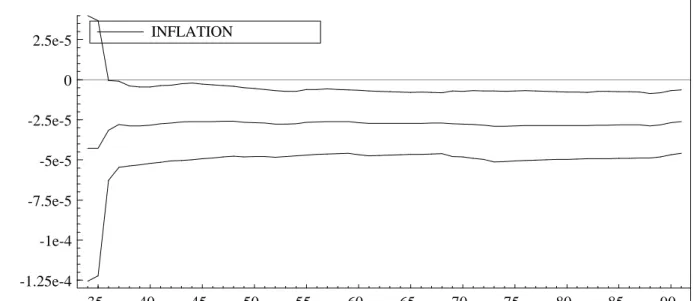
To summarise, the strongest result to emerge out of Table 3 is the small but significantly negative influence of the inflation rate on public support for reforms. Does this result depend only on the situation in a few countries and is the coefficient fluctuating wildly over the sample? As a robustness test, I have computed parameter estimates recursively over the panel data set and added 95% confidence intervals (see Figure 2):
Fig. 2: Recursive Estimation of Parameter on INFLATION with 95% confidence bands 35 40 45 50 55 60 65 70 75 80 85 90 -1.25e-4 -1e-4 -7.5e-5 -5e-5 -2.5e-5 0 2.5e-5 INFLATION
Notes: Using country dummies, constant, GDPCAP, EMP and INFLATION in model.
After an initial phase of uncertainty due to the small number of observations, the coefficient on inflation is significant over the whole sample. Moreover, its recursive estimates are basically constant, which underlines that the impact of inflation is robust over years and countries (after controlling for fixed effects). For the GDP per capita index and employment, the estimates are less stable and never significant.
5. Individual Level: Determinants of Support for Market Reforms
In an attempt to combine micro and macro information, this section presents an ordered logit analysis of individual and aggregate determinants of people’s opinion towards creating a market economy. To explain SUPPORT, I employ the variables listed in Table 1 and then add the variables from Table 2.
I have applied a significance level of 1% (**) to the variables measured at an individual level, as the large sample size makes the test very sensitive to a violation of the null hypothesis (see Leamer (1978)). Moreover, as outlined above, a standard error correction must be applied, as we include variables that are clustered with respect to countries, and for those aggregate level
variables, the conventional 5% (*) significance level is employed. To economise on space,
estimates on country dummies and cut-off parameters are not reported.7
Tab. 4: Real versus Transition Time Proxys (1991-1996, ordered logit, 73191 cases)
Variables Coefficients SEs Coefficients SEs Coefficients SEs
Model 4 5 6 INFLATION -0.00005** 0.00001 -0.00009** 0.00002 -0.00007** 0.00001 GDPCAP -0.001 0.000 0.0003 0.0006 -0.0006 0.0004 EMP -0.009 0.008 -0.017 0.012 -0.007 0.009 SEX -0.17** 0.021 -0.17** 0.021 -0.17** 0.021 AGE -0.04** 0.005 -0.04** 0.004 -0.04** 0.005 AGESQ 0.0004** 0.00005 0.0004** 0.00005 0.0004** 0.00005 EDUCL 0.21** 0.029 0.21** 0.028 0.21** 0.028 INCOMQ 0.18** 0.014 0.18** 0.015 0.18** 0.015 D92 -0.644** 0.106 D93 -0.649** 0.088 D94 -0.971** 0.078 D95 -0.863** 0.088 D96 -0.867** 0.084 DTranTime1 0.24 0.194 DTranTime 2 0.17 0.108 DTranTime 3 -0.12 0.117 DTranTime 4 -0.19 0.163 DTranTime 5 -0.33* 0.143 DTranTime 6 -0.36(*) 0.176 DTranTime 7 -0.44 0.268 TransitTime -0.09* 0.034 F-test F(12,7) = 223** F(14,5) = 311** F(12,7) = 174** Test Time Variables F(5,18) = 33** F(7,18) = 3.9* t-value = -2.6* Pseudo-R2 0.072 0.071 0.070
Notes: Country fixed effects are included and are jointly significant at a 1% level. Moldova and Yugoslavia are excluded. (*), *, ** indicate significance at a level of 10%, 5%, and 1%, respectively.
7
The F-test signals that the variables are highly significant as a group, but as noted above, this is not surprising in view of the large sample size. The fit of the equations, measured by a
pseudo-R2 based on log-likelihoods, is not high, but also not unusually low for this type of
data.8
There is a problem regarding the appropriate use of time in the model. The straightforward approach would be to include dummies for the respective years, as implemented in Model 4. However, an argument can be made that it is more meaningful to include a proxy for transformation or stabilisation time, as not all Eastern European countries started economic reforms at the same time (see, for instance, Fischer et al. (1998) for an overview of stabilisation programmes). Therefore, transformation time dummies were constructed that take on the value of unity if a country has begun with serious stabilisation programmes in the respective year or earlier. Finally, to get an impression of the cumulative impact, a variable was computed that basically counts years since economic stabilisation started.
With respect to the normal time dummies in Model 4, a general u-shape can be detected, as predicted by Blanchard’s (1997) model. The time pattern is the following: relatively strong support in 1991, continuous decline until reaching a minimum in 1994, and then a slow recovery again, but without reaching the starting level in 1996. This pattern is neither supported using the transition time dummies in Model 5, which show a continuous decline in support, nor the cumulative variable employed in Model 6. In any case, comparing parameter estimates of the micro and macro regressors across models, little differences can be seen. In the rest of the analysis, we employ only the normal time dummies as they are more significant than either of the two transition time indicator approaches.
Regarding the socio-demographic variables listed in Table 4, the first result is that women are less in favour of creating a market economy than men (SEX). If one interprets this outcome as scepticism with respect to economic reforms then it is quite consistent with other results on Eastern Europe (see Hayo (1999)) but also for Western Europe (see Gabriel (1992) or Hayo (1999b)). A possible economic reason for this scepticism is the creation of labour market barriers for woman, for instance as a result of reduced spending on child care opportunities and equal employment regulations. Further, one can argue that women are less involved in the political and economic decision making process and may therefore feel that they can not actively shape the changes in their countries. We also know from a number of experimental studies (see Basow (1986) or Sorrentino et al. (1992)) that women tend to be more risk averse
8
The pseudo-R2s are based on conventional ordered logit regression, and are therefore only suggestive in this
than men, and thus might be more reluctant to support major political or economic reforms the outcome of which is to some extent uncertain.
The age of a person is an important variable in the literature on modernisation, and the negative sign is fully in accordance with theory, indicating that older persons are less in favour of reforms (see, for instance, Huntington (1968)). The squared value of AGE has a positive sign (AGESQ), which implies a u-shaped effect of age. This finding reflects the difficulties of the age group around 50 years to adjust to the changes, especially in the labour market. As shown by Brainerd (1998) for the case of Russia in 1994, men in the 45-55 age group, who tend to be the high-earners in Western countries, did not earn much more than new entrants to the labour market. A large proportion of their human capital has been wiped out and they are too old to acquire new skills easily. Fidrmuc (1999) does not find straightforward evidence of a high share of pensioners having a negative effect on voting for reform parties. His result could be explained by emphasising that it is the age group around 50 that seems to show the least enthusiasm for creating a free market.
The level of education (EDUCL) has a positive influence on people’s attitude towards a market system. People expect and experience higher returns to education than under the centrally-planned economic system. At the same time, a good education is a useful insurance in turbulent times. There is ample empirical evidence, see Brainerd (1998) for Russia, Vecernik (1995) for the Czech Republic, Orazem and Vodopivec (1995) for Sovenia, and Rutkowski (1996) for Poland, that persons with a higher education fare relatively better under
the new system.9 It is also likely that more educated respondents understand the notion of a
market economy better. This insight may prevent people from forming unrealistic expectations and avoid the resulting disappointment with the actual developments.
Respondents with a relatively higher income (INCOMQ) are more supportive with respect to market reforms. They have exploited the new economic opportunities without too many problems. Further, the relatively rich people are, by definition, not exposed to the economic hardship resulting from the greater income dispersion which evolved in the transition years (see Cornelius and Weder (1996) or Milanovic (1998)).
As aggregate variables - in Model 4 of Table 4 - inflation, GDP per capita, and employment are included. Again we find that the negative coefficient on inflation is highly significant, and no obvious non-linear effects can be found. Employment remains insignificant, which is in
9
Moreover, Ham et al. (1998) attribute the superior labour market performance of the Czech Republic in comparison with Slovakia to its ability to absorb low-skilled workers, which again indicates that education is a good insurance against unemployment.
line with a study by Rose (1998) using the NDB, who finds that respondents from Eastern Europe are more concerned about inflation than unemployment.
In Table 5, we add openness as a regressor to the model. While the openness variable itself is not significant in Model 7, the parameter on GDP per capita is now significantly negative.
Tab. 5: Testing Income, Employment, Inflation and Openness (1991-1996, ordered logit)
Variables Coefficients SEs Coefficients SEs Coefficients SEs
Model 7 8 9
All income classes Cases: 73191
Lower income quartile Cases: 17835
Higher income quartile Cases: 18014 INFLATION -0.00004** 0.00001 -0.00001 0.00001 -0.00005** 0.00001 GDPCAP -0.002* 0.001 -0.003(*) 0.001 -0.001 0.001 EMP -0.010 0.007 -0.003 0.008 -0.017 0.011 OPENNESS -0.737 0.468 -1.033(*) 0.565 -0.692 0.604 F-test F(13,6) = 190** F(12,7) = 117** F(12,7) = 174** Pseudo-R2 0.072 0.054 0.063
Notes: Time and country fixed effects, socio-demographic variables, and cut-off variables are always included. Moldova and Yugoslavia are excluded. (*), *, ** indicate significance at a level of 10%, 5%, and 1%, respectively.
This implies that in those countries where GDP per capita has remained relatively low -compared to the reference year - support for market reforms is higher. A possible interpretation is that if countries do not make much progress in per capita income the population pushes more strongly for market reforms. Hence, while the year dummies support the u-shaped development discussed by Blanchard (1997), this result is not due to the development of output per capita or general employment conditions, which are the driving force in the theoretical argument. Together with the finding that the u-shaped response does not hold up using transition-time indicators, we get little support for this model.
In the discussion above, it was noted that the question of winners and losers of economic reforms plays an important role in the theoretical literature. It will be interesting to see whether results differ if separate regressions are run for the highest and lowest income quartile. Model 8 keeps the same set of variables but concentrates the analysis on the respondents from the lowest income quartile. The most interesting finding is that inflation is no longer significant. Thus, for the relatively poor income quartile, inflation does not matter in forming support for market reforms, which can be rationalised by noting that this group of
people owns little financial wealth, and subsistence economy and barter play on important role (see Rose and McAllister (1996)). The openness of the economy becomes significant at a 10% level, indicating that more foreign trade leads to less support. This could be interpreted as a sign that this income group makes foreign influences responsible for economic problems in their respective home countries, and this association lowers support for the creation of a market economy.
For the high income group, as shown in Model 9, the only significant variable is the inflation rate. Thus relatively rich people react much more sensitively with respect rising prices than poor people. At the same time, neither GDP per capita nor openness play a role for them. In a next step, we add fiscal policy variables to the equation as presented in Table 6.
Tab. 6: Adding Fiscal Policy Variables to Explain SUPPORT (1991-1996, ordered logit)
Variables Coefficients SEs Coefficients SEs Coefficients SEs
Model 10 11 12
All income classes Cases: 73191
Lowest income quartile Cases: 17835
Highest income quartile Cases: 18014 INFLATION -0.0001** 0.00001 -0.0001** 0.00002 -0.0001** 0.00002 GDPCAP -0.0014** 0.0004 -0.0016(*) 0.0008 -0.0010* 0.0004 EMP -0.0180* 0.0083 -0.0161 0.0093 -0.0200 0.0119 PRIVSHAR 0.0035 0.0050 -0.0032 0.0058 0.0094(*) 0.0052 GOVGDP 0.0167 0.0126 0.0213 0.0126 0.0196 0.0179 GOVDEF 0.0324* 0.0113 0.0385** 0.0130 0.0302 0.0198 F-test F(15,4) = 1127** F(14,5) = 181** F(14,5) = 1249** Pseudo-R2 0.073 0.054 0.064
Notes: Time and country fixed effects, socio-demographic variables, and cut-off variables are always included. Moldova and Yugoslavia are excluded. (*), *, ** indicate significance at a level of 10%, 5%, and 1%, respectively.
Model 10 consists of inflation, GDP per capita and employment, and additionally of openness of the economy, government expenditure as percentage of GDP, and government surplus as percentage of GDP. To comment only on the new variables, government deficit to GDP shows a significantly positive sign, implying that higher budget deficits reduce public support. This association complements IMF prescriptions to eliminate public deficits quite well, and indicates that large deficits may rather undermine support for market reforms instead of increasing it.
Model 11 concentrates on the lower income respondents and finds that large government deficits lower support especially from this group. This can be interpreted as a sign that funds raised by debt finance are not targeted to this group. For respondents from the high income quartile, a high share of the private sector in GDP raises support for the market reforms (see Model 12).
Now we can add the microeconomic transition indicators to the model, as shown in Table 7. Model 13 gives the results for all income groups. Inflation remains the key variable, while none of the other variables is significant.
Tab. 7: Adding Transition Indicators to Explain SUPPORT (1991-1996, ordered logit)
Variables Coefficients SEs Coefficients SEs Coefficients SEs
Model 13 14 15
All income classes Cases: 73191
Lowest income quartile Cases: 17835
Highest income quartile Cases: 18014 INFLATION -0.0001** 0.00001 -0.00003* 0.00001 -0.0001** 0.00002 GDPCAP -0.0006 0.0004 -0.0007 0.0009 -0.0003 0.0006 EMP -0.0145 0.0087 -0.0116 0.0095 -0.0212 0.0124 INTPRICE 0.5859 0.4477 0.5351 0.4754 1.0134(*) 0.5214 EXTMARK -0.2122 0.4296 0.0385 0.5007 -0.7924 0.5572 PRIVATE -0.3572 0.8279 -1.0484 1.0792 0.2957 0.9493 F-test F(15,4) = 294** F(14,5) = 172** F(14,5) = 64** Pseudo-R2 0.072 0.054 0.064
Notes: Time and country fixed effects, socio-demographic variables, and cut-off variables are always included. Moldova and Yugoslavia are excluded. (*), *, ** indicate significance at a level of 10%, 5%, and 1%, respectively.
The same variables are included in model 14 but it contains only the lowest income quartile as observations, and this time inflation is important for this group as well. Additionally, for the high income quartile in Model 15, a significantly positive coefficient, at a level of 10%, can be found for the progress that has been made in the field of price liberalisation and competition. Arguably, this result, although weak, reflects a positive association between the successful implementation of reforms and public support. It is noteworthy that the significance of PRIVATE, obtained in the aggregate level model above, does not show up in this specification.
6. Conclusion
As argued in the introduction, the question of whether macroeconomic variables affect people’s opinion towards the creation of a market economy should be of great concern for policy makers. For example, Blanchard (1997) develops a model where he predicts that a perfect foresight path of support for reforms will follow a u-shape. He argues that if one endogenises political decisions, reforms may be severely delayed.
More generally, if the result of a “cold turkey” approach was to allow the economy to experience high inflation, falling per capita income and bigger unemployment, with the expectation of a medium-run recovery based on a fully re-structured economy, support for those market oriented reforms may have been washed away before the process reached the turning point (see also Bresser Pereira et al. (1993) and Dewatripont and Roland (1992, 1992a)). If it were the case, though, that people did not attach much weight to macro indicators when they decide on supporting market reforms, then a fast transition would have a lot to recommend.
I have utilised survey data collected from more than 100000 Eastern Europeans to analyse determinants of support for market reforms. To summarise the core results, support for the creation of a market economy depends on personal circumstances (gender, age, education, relative income position) and on the success of governments in keeping inflation rates down. After stressing the policy relevance of the research question, what policy conclusions emerge from this study? It is important to emphasise that most of the policy conclusions listed below are derived within a partial equilibrium framework. Further, it is difficult to make policy recommendations based on the individual characteristics of people. However, regarding the macroeconomic variables, the following conclusions can be drawn:
First, the IMF focus on keeping inflation down seems to be consistent with the objective of keeping support for market reforms high. This is true for all but the lowest income quartiles. Thus countries should not let inflation soar upward, for instance, by creating appropriately designed monetary institutions. The absolute effect of inflation is quite small, though.
Second, unemployment may have some explanatory power at an individual level (see Rose (1998)) but it does not help to explain support for market reforms on an aggregate level. Arguably, people are willing to put up with aggregate unemployment over the transition period.
Third, the effects of fiscal policy are not entirely clear. Since higher budget deficits seem to reduce support for reforms, it may be a prudent policy not to engage in too much deficit spending, as advocated by the “Washington consensus” for different reasons.
Fourth, the actual progress in market reforms does not affect opinion much. In a simple aggregate OLS regression we find that financial liberalisation and privatisation affect support negatively, but this effect does not survive in the ordered logit model. Instead, there is some evidence that for high income respondents progress in price liberalisation and competition regulation as well as a larger share of the private sector improve support for reforms.
These results make it seem likely that only a package of policies will be highly effective in helping to maintain support for the creation of a market economy. However, a feasible starting point for governments would be to keep inflation rates down and to avoid excessive budget deficits. Therefore, regarding public support for reforms, the IMF programmes are probably not as bad as some observers have suggested.
Appendix
Tab. A: Overview of Surveys Used in this Study
Surveys CEEB 1 CEEB 2 CEEB 3 CEEB 4 CEEB 5 CEEB 6 CEEB 7
ZA-No. 2253, 2256, 2257 2251 2321 2474 2577 2802 2924 Year 1990 1991 1992 1993 1994 1995 1996 Albania X X X X X X Armenia X X X X X Belarus X X X X X Bulgaria X X X X X X Croatia X X Czech X X X X X X X Estonia X X X X X X Georgia X X X X Hungary X X X X X X X Kazakhstan X X X Latvia X X X X X X Lithuania X X X X X X Macedonia X X X X X Moldova X Poland X X X X X X X Romania X X X X X X Russia X X X X X X Slovakia X X X X X X X Slovenia X X X X X Ukraine X X X X X Yugoslavia X
Notes: The data for Czechs and Slovaks over the period 1990-92 are based on filtering the respondents in Czechoslovakia according to the region where they live. Yugoslavia stands for Serbia and Montenegro. The primary data are available, for example, from the “Zentralarchiv für Empirische Sozialforschung” (ZA) in Cologne, and as additional information ZA-classification codes are listed in the second line.
Fig. A: Standard Deviations of SUPPORT over Time 0.5 0.75 1 1990 1991 1992 1993 1994 1995 1996 Standard Deviation Albania Armenia Belarus 0.5 0.75 1 1990 1991 1992 1993 1994 1995 1996 Standard Deviation Bulgaria Croatia Czech 0.5 0.75 1 1990 1991 1992 1993 1994 1995 1996 Standard Deviation Estonia Georgia Hungary 0.5 0.75 1 1990 1991 1992 1993 1994 1995 1996 Standard Deviation Kazakhstan Latvia Lithuania 0.5 0.75 1 1990 1991 1992 1993 1994 1995 1996 Standard Deviation Macedonia Moldova Poland 0.5 0.75 1 1990 1991 1992 1993 1994 1995 1996 Standard Deviation Romania Russia Slovakia 0.5 0.75 1 1990 1991 1992 1993 1994 1995 1996 Standard Deviation Slovenia Ukraine Yugoslavia
References
Almond, G.A. and G.B. Powell (1978), Comparative Politics, 2nd ed., Boston: Little, Brown.
Apter, D.E. (1965), The Politics of Modernization, New Jersey: Prentice Hall.
Alesina, A. and A. Drazen (1991), Why are Stabilizations Delayed?, American Economic
Review 81, p. 1170-1188.
Bank for International Settlements (1997), Financial Stability in Emerging Market
Economies, Report of the Working Party on Financial Stability in Emerging Markets, Basle: BIS.
Basow, S.A. (1986), Gender Stereotypes: Traditions and Alternatives, Monterey:
Brooks/Cole.
Berg, A., E. Borensztein, R. Sahay, J. Zettelmeyer (1999), The Evolution of Output in
Transition Countries, IMF Working Paper No. 99-73.
Binder, D.A. (1983), On the Variances of Asymptotically Normal Estimators from Complex
Surveys, International Statistical Review 51, p. 279-292.
Blanchard, O. (1996), Lecture 3: Putting Things Together, Clarendon Lectures, mimeo.
Blanchard, O. (1997), Clarendon Lectures: The Economics of Transition in Eastern Europe,
Oxford: Oxford University Press.
Brainerd, E. (1998), Winner’s and Losers in Russia’s Economic Transition, American
Economic Review 88, p. 1094-1116.
Bresser Pereira, L.C., J.M. Maravall, A. Przeworski (1993), Economic Reforms in New
Democracies: A Social-Democratic Approach, Cambridge: Cambridge University Press.
Bruno, M. and W. Easterly (1998), Inflation Crises and Long-run Growth, Journal of
Monetary Economics 41, p. 3-26.
Converse, P.E. (1970), Attitudes and Non-Attitudes: Continuation of a Dialogue, in: E.R.
Tufte (ed.), The Quantitative Analysis of Social Problems,Reading (Mass.):
Addison-Wesley, p. 168-190.
Cornelius, P.K. and B.S. Weder (1996), Economic Transformation and Income Distribution
-Some Evidence from the Baltic Countries, IMF Staff Papers 43, p. 587-604.
De Melo, M., C. Denizer, and A. Gelb (1996), From Plan to Market: Patterns of Transition,
World Bank Working Paper 1564, January.
Dewatripont, M. and G. Roland (1992), The Virtues of Gradualism and Legitimacy in the
Dewatripont, M. and G. Roland (1992a), Economic Reform and Dynamic Political
Constraints, Review of Economic Studies 59, p. 703-730.
Diamond, D.W. and P.H. Dybvig (1983), Bank Runs, Deposit Insurance, and Liquidity,
Journal of Political Economy 91, p. 401-419.
Dickens, D.W.T. and L.F. Katz (1986), Interindustry Wage Differences and Industry
Characteristics, NBER Working Paper 2014, September.
Di Tella, R., R. MacCulloch, and A. Oswald (1999), The Macroeconomics of Happiness, ZEI
Working Paper B99-03, University of Bonn.
Driffil, J., G.E. Mizon and A. Ulph (1990), Costs of Inflation, in: B. Friedman and F. Hahn
(eds.), Handbook of Monetary Economics, Amsterdam: North-Holland, p. 1013-1066.
European Bank for Reconstruction and Development (1994), Transition Report 1994,
London: EBRD.
European Bank for Reconstruction and Development (1995), Transition Report 1995,
London: EBRD.
European Bank for Reconstruction and Development (1996), Transition Report 1996,
London: EBRD.
European Bank for Reconstruction and Development (1997), Transition Report 1997,
London: EBRD.
European Bank for Reconstruction and Development (1998), Transition Report Update,
London: EBRD.
European Bank for Reconstruction and Development (1998a), Transition Report 1998,
London: EBRD.
Fernandez, R. and D. Rodrik (1991), Resistance to Reform: Status Quo Bias in the Presence
of Individual-Specific Uncertainty, American Economic Review 81, p. 1146-1155.
Fidrmuc, J. (1999), Political Support for Reforms: Economics of Voting in Transition
Countries, European Economic Review, forthcoming.
Fidrmuc, J. (1999a), Unemployment and the Dynamics of Political Support for Economic
Reforms, Journal of Policy Reform 3, forthcoming.
Fischer, S. (1986), Indexing, Inflation and Economic Policy, Cambridge (MA): MIT Press.
Fischer, S. and J. Huizinga (1982), Inflation, Unemployment and Public Opinion Polls,
Journal of Money, Credit and Banking 14, p. 39-51.
Fischer, S., R. Sahay, and C.A. Végh (1996), Economies in Transition: The Beginnings of
Fischer, S., R. Sahay, and C.A. Végh (1996a), Stabilization and Growth in Transition
Economies: The Early Experience, Journal of Economic Perspectives 10, p. 45-66.
Fischer, S., R. Sahay, and C.A. Végh (1998), From Transition to Market: Evidence and
Growth Prospects, IMF Working Paper 98/52, April.
Fourastié, J. (1954), Die große Hoffnung des 20. Jahrhunderts, Köln: Bund-Verlag.
Frentzel-Zagorska, J. and K. Zagorski (1993), Polish Public Opinion on Privatisation and
State Intervention, Europe-Asia Studies 45, p. 705-728.
Gabriel, O.W. (1992), Die EG-Staaten im Vergleich, (Ed.), Opladen: Westdeutscher Verlag. Ham, J.C., J. Svejnar, and K. Terrell (1998), Unemployment and the Social Safety Net During
Transitions to a Market Economy: Evidence from the Czech and Slovak Republics,
American Economic Review 88, p. 1117-1142.
Hayo, B. (1997a), Eastern European Public Opinion on Economic Issues: Privatization and
Transformation, American Journal of Economics and Sociology 56, p. 85-102.
Hayo, B. (1997b), How Do People in Eastern Europe Perceive their Economic Situation?, in:
J. Backhaus and G. Krause (eds.), Issues in Transformation Theory, Marburg:
Metropolis, p. 61-90.
Hayo, B. (1998), Inflation Culture, Central Bank Independence and Price Stability, European
Journal of Political Economy 14, p. 241-263.
Hayo, B. (1999), Public Opinion on Transformation in Eastern Europe, in: F. Columbus (ed.),
Central and Eastern Europe in Transition, Vol. 3, New York: Nova Science, p. 129-157.
Hayo, B. (1999a), Public Support for Market Reforms in Eastern Europe, Studies in Public
Policy 321, Centre for the Study of Public Policy, Glasgow.
Hayo, B. (1999b), Knowledge and Attitude Towards European Monetary Union, Journal of
Policy Modeling, forthcoming.
Huntington, S.P. (1968), Political Order in Changing Societies, New Haven: Yale University
Press.
Juchler, J. (1994), Osteuropa im Umbruch: Politische, wirtschaftliche und gesellschaftliche
Entwicklungen 1989-1993, Zürich: Seismo.
Krueger, A. (1993), Virtuous and Vicious Circles in Economic Development, American
Economic Review 83, p. 351-355.
La Ferrara, E. (1996), A Political Equilibrium Approach to Trade Liberalization in
Developing Countries, Journal of International Trade and Economic Development 5,
Leamer, E.E. (1978), Specification Searches, New York: John Wiley.
Lipton, D. and J. Sachs (1990), Creating a Market Economy in Eastern Europe: The Case of
Poland, Brookings Papers on Economic Activity 1, p. 75-133.
Milanovic, B. (1998), Explaining the Increase in Inequality During the Transition, Policy
Research Working Paper 1935, Washington: World Bank.
Minsky, H.P. (1986), Stabilizing an Unstable Economy, New Haven: Yale University Press.
Mondino, G., F. Sturzenegger, and M. Tommasi (1996), Recurrent High Inflation and
Stabilization: A Dynamic Game, International Economic Review 37, p. 1-16.
Moulton, B.R. (1990), An Illustration of a Pitfall in Estimating the Effects of Aggregate
Variables on Micro Units, Review of Economics and Statistics 72, p. 334-338.
Orazem, P. and M. Vodopivec (1995), Winners and Losers in Transition: Returns to
Education, Experience and Gender in Slovenia, World Bank Economic Review 9, p.
201-230.
Pickel, G. and S. Pickel (1996) Unterschiede in der Demokratiezufriedenheit und im Wahlverhalten zwischen ost- und westeuropäischen Staaten, in O.W. Gabriel and F.
Brettschneider (eds.), Wahlen und politische Einstellungen in westlichen Demokratien,
Frankfurt: Peter Lang, p. 177-203.
Przeworski, A. and H. Teune (1970), Logic of Comparative Social Enquiry, New York: John
Wiley.
Rodrik, D. (1995), The Dynamics of Political Support for Reforms in Economies in
Transition, Journal of the Japanese and International Economies 9, p. 403-425.
Rodrik, D. (1996), Understanding Economic Policy Reform, Journal of Economic Literature
34, p. 9-41.
Rose, R. (1998), What is the Demand for Price Stability in Post-Communist Countries?,
Problems of Post-Communism 45, p. 43-50.
Rose, R. and C. Haerpfer (1993), Adapting to Transformation in Eastern Europe: New
Democracies Barometers II, Studies in Public Policy 212, Glasgow: University of
Strathclyde.
Rose, R. and C. Haerpfer (1994), Mass Response to Transformation in Post-communist
Societies, Europe-Asia Studies 46, p. 3-28.
Rose, R. W. and I. McAllister (1996), Is Money the Measure for Welfare in Russia?, Review
of Income and Wealth 42, p. 76-90.
Rutkowski, J. (1996), High Skills Pay Off: The Changing Wage Structure During Economic
Schuman, H. and S. Presser (1981), Questions and Answers in Attitude Surveys, New York: Academic Press.
Shiller, R.J., M. Boycko, and V. Korobov (1991), Popular Attitudes Toward Free Markets:
The Soviet Union and the United States Compared, American Economic Review 81, p.
385-400.
Shiller, R.J., M. Boycko, and V. Korobov (1991), Hunting for Homo Sovieticus: Situational
versus Attitudinal Factors in Economic Behavior, Brookings Papers on Economic
Activity 1, p. 127-181.
Shleifer, A. (1997), Government in Transition, European Economic Review 41, p. 385-410.
Skinner, C.J. (1989), Introduction to Part A, in C.J. Skinner, D. Holt, and T.M.F. Smith (eds.),
Analysis of Complex Surveys, New York: John Wiley, p. 23-58.
Sorrentino, R.M., E.C. Hewitt, and P.A. Raso-Knott (1992), Risk-taking in Games of Chance
and Skill, Journal of Personality and Social Psychology 62, p. 522-533.
Stiglitz, J.E. (1999), Whither Reform?, Paper prepared for the Annual Bank Conference on
Development Economics, mimeo, Washington: World Bank.
Stokes, S.C. (1996), Public Opinion and Market Reforms: The Limits of Economic Voting,
Comparative Political Studies 29, p. 499-519.
Sturzenegger, F. and M. Tommasi (1998), The Political Economy of Reform, (eds.),
Cambridge (MA): MIT Press.
United Nations (1997), Economic Survey of Europe in 1996-1997, Economic Commission for
Europe, New York: UN.
United Nations (1998), Economic Survey of Europe 2, Economic Commission for Europe,
New York: UN.
Vecernik, J. (1995), Changing Earnings Distribution in the Czech Republic: Survey Evidence
from 1988-1994, Economics of Transition 3, p. 333-353.
White, H. (1980), A Heteroscedasticity-consistent Covariance Matrix Estimator and a Direct
Test for Heteroscedasticity, Econometrica 48, p. 817-838.
Williamson, J. (1994), The Political Economy of Policy Reform, (ed.), Washington: Institute
for International Economics.
Yavlinsky, G. and S. Braguinsky (1994), The Inefficiency of Laissez-Faire in Russia:
Hysteresis Effects and the Need for Policy-Led Transformation, Journal of
Comparative Economics 19, p. 88-116.
Zaller, J. (1992), The Nature and Origin of Mass Opinion, Cambridge: Cambridge University
ZEI Papers
ZEI Policy Paper B97-01 A Stability Pact for Europe (a Forum organized by
ZEI)
ZEI Policy Paper B97-02 Employment and EMU (Deutsch-Französisches
Wirtschaftspolitisches Forum/ Forum Economique Franco-Allemand)
ZEI Policy Paper B97-03 Liberalising European Markets for Energy and
Telecommunications: Some Lessons from the US Electric Utility Industry (Tom Lyon and John Mayo)
ZEI Policy Paper B97-04 Macroeconomic Stabilization with a Common
Currency: Does European Monetary Unification Create a Need for Fiscal Insurance or Federalism? (Kenneth Kletzer)
ZEI Policy Paper B98-01 Budgeting Institutions for Aggregate Fiscal
Discipline (Jürgen von Hagen)
ZEI Policy Paper B98-02 Trade with Low-Wage Countries and Wage
Inequality (Jaleel Ahmad)
ZEI Policy Paper B98-03 Central Bank Policy in a More Perfect Financial
System (Jürgen von Hagen and Ingo Fender)
ZEI Policy Paper B98-04 The EMU`s Exchange Rate Policy
(Deutsch-Französisches Wirtschaftspolitisches Forum/ Forum Economique Franco-Allemand)
ZEI Policy Paper B98-05 Estimating a European Demand for Money (Bernd
Hayo)
ZEI Policy Paper B98-06 Monetary Union, Asymmetric Productivity Shocks
and Fiscal Insurance: an Analytical Discussion of Welfare Issues (Kenneth M. Kletzer)
ZEI Policy Paper B98-07 Designing Voluntary Environmental Agreements in
Europe: Some Lessons from the U.S. EPA`s 33/50 Program (John W. Maxwell)
ZEI Working Paper B98-08 Money-Output Granger Causality Revisited: An
ZEI Working Paper B98-09 US Monetary Policy AND Monetary Policy and the ESCB (Robert L. Hetzel)
ZEI Policy Paper B98-10 Der Wettbewerb der Rechts- und politischen
Systeme in der Europäischen Union (Martin Seidel)
ZEI Working Paper B98-11 Exchange Rate Regimes in the Transition
Economies: Case Study of the Czech Republic: 1990-1997 (Julius Horvath)
ZEI Policy Paper B98-11A Die Bewertung der „ dauerhaft tragbaren
öffentlichen Finanzlage“ der EU Mitgliedstaaten beim Übergang zur dritten Stufe der EWWU (Rolf Strauch)
ZEI Working Paper B98-12 Price Stability and Monetary Policy Effectiveness
when Nominal Interest Rates are Bounded at Zero (Athanasios Orphanides and Volker Wieland)
ZEI Working Paper B98-13 Fiscal Policy and Intranational Risk-Sharing (Jürgen
von Hagen)
ZEI Working Paper B98-14 Free Trade and Arms Races: Some Thoughts
Regarding EU-Russian Trade (Rafael Reuveny and John Maxwell)
ZEI Working Paper B98-15 Can Taxing Foreign Competition Harm the
Domestic Industry? (Stefan Lutz)
ZEI Policy Paper B98-16 Labour Market & Tax Policy in the EMU
(Deutsch-Französisches Wirtschaftspolitisches Forum/ Forum Economique Franco-Allemand)
ZEI Working Paper B99-01 The Excess Volatility of Foreign Exchange Rates:
Statistical Puzzle or Theoretical Artifact? (Robert B.H. Hauswald)
ZEI Working Paper B99-02 The Consequences of Labour Market Flexibility:
Panel Evidence Based on Survey Data (Rafael Di Tella and Robert MacCulloch)
ZEI Working Paper B99-03 The Macroeconomics of Happiness (Rafael Di
ZEI Working Paper B99-04 The Finance-Investment Link in a Transition Economy: Evidence for Poland from Panel Data (Christian Weller)
ZEI Working Paper B99-05 Tumbling Giant: Germany`s Experience with the
Maastricht Fiscal Criteria (Jürgen von Hagen and Rolf Strauch)
ZEI Working Paper B99-06 Productivity Convergence and Economic Growth: A
Frontier Production Function Approach (Christopher M. Cornwell and Jens-Uwe Wächter)
ZEI Working Paper B99-07 Comovement and Catch-up in Productivity Across
Sectors: Evidence from the OECD (Christopher M. Cornwell and Jens-Uwe Wächter)
ZEI Working Paper B99-08 The Connection Between More Multinational Banks
and Less Real Credit in Transition Economies (Christian Weller)
ZEI Working Paper B99-09 Monetary Policy, Parameter Uncertainty and
Optimal Learning (Volker Wieland)
ZEI Working Paper B99-10 Financial Liberalization, Multinational Banks and
Credit Supply: the Case of Poland (Christian Weller)
ZEI Policy Paper B99-11 Financial Supervision and Policy Coordination in
the EMU (Deutsch-Französisches
Wirtschaftspolitisches Forum/ Forum Economique Franco-Allemand)
ZEI Working Paper B99-12 Size Distortions of Tests of the Null Hypothesis of
Stationarity: Evidence and Implications for Applied Work (Mehmet Caner and Lutz Kilian)
ZEI Working Paper B99-13 Financial Fragility or What Went Right and What
Could Go Wrong in Central European Banking? (Christian E. Weller and Jürgen von Hagen)
ZEI Working Paper B99-14 Industry Effects of Monetary Policy in Germany
ZEI Working Paper B99-15 Financial Crises after Financial Liberalization: Exceptional Circumstances or Structural Weakness? (Christian E. Weller)
ZEI Working Paper B99-16 Multinational Banks and Development Finance
(Christian E. Weller and Mark J. Scher)
ZEI Working Paper B99-17 Stability of Monetary Unions: Lessons from the
Break-up of Czechoslovakia (Jan Fidrmuc, Julius Horvath and Jarko Fidrmuc)
ZEI Working Paper B99-18 Why are Eastern Europe`s Banks not failing when
everybody else`s are? (Christian E. Weller and Bernard Morzuch)
ZEI Working Paper B99-19 The Evolution of Monetary Policy in Transition
Economies (Ali M. Kutan and Josef C. Brada)
ZEI Working Paper B99-20 Subnational Government Bailouts in Germany
(Helmut Seitz)
ZEI Working Paper B99-21 The End of Moderate Inflation in Three Transition
Economies? (Josef C. Brada and Ali M. Kutan)
ZEI Working Paper B99-22 Partisan Social Happiness (Rafael Di Tella and
Robert MacCulloch)
ZEI Working Paper B99-23 Informal Family Insurance and the Design of the
Welfare State (Rafael Di Tella and Robert MacCulloch)