Alternatives within corporate ‘ownership’ and
beyond
Donald Nordberg (Bournemouth University, [email protected]); Dionysia Katelouzou (King’s College London, [email protected])
Abstract: Institutional investors play a central role in corporate finance and ownership. But their direct role in corporate governance has received only limited attention, focused mainly on shareholder activism, with its focus on strategic change and rapid improvement in corporate performance. Following the financial crisis, however, policy has sought ways to counteract the perceived short-termism in equity markets. It has cast a spotlight on the role of investors, not least in the UK, with its Stewardship Code (introduced in 2010 and revised in 2012) and in related moves in a number of European countries and by the European Union. In the US too, policy has paid special attention to questions of proxy access and enhancing shareholder rights to voice. They share a concern to evoke the spirit of the “universal owner”, interested in both the long term and in the broad development of the economy as a whole. This paper examines developments in the policy against the backdrop of changing practices and structures, raising doubts about the premises of the policy direction and discussing alternatives within other forms of ownership and in reconfiguring the bundle of rights to bring in actors other than owners to the governance process.
Keywords: Investor engagement, ownership, stewardship, corporate governance, alternatives
Introduction
Institutional investors have long played a central role in corporate governance but no more so than since the financial crisis of 2007-09. To encourage investors to engage with the companies in which they invest, the UK Stewardship Code (FRC, 2010) came first and developed a sense of “ownership”, while the Kay Review (2012) made similar recommendations to counteract short-termism. France (Commission Europe, 2010; ORSE, 2011) and Germany (discussed in Roth, 2012), among other countries took similar actions, while the European Union (European Commission, 2011, 2013) included investor engagement in its review of corporate governance. In the US the Dodd-Frank Act (Library of Congress, 2010) gave shareholders new voting powers and made it easier to raise shareholder resolutions. Later the European Union sought to amend its Shareholder Rights Directive to empower investors (European Commission, 2014). Some institutional investors that favour this approach now call themselves “shareowners” rather than “shareholders”
(e.g. Butler & Wong, 2011). The thrust of each of these policy moves assumes that shareholders are able to prevent corporate excess and with certain incentives would want to. But the policy initiatives face obstacles arising from the changing structure and power balances in institutional investment, in particular the growth of foreign ownership, funds-of-funds, sovereign wealth, and even from a revival of shareholder activism, promulgated by activist hedge funds.
This paper takes its cue from a parallel debate about changes in structure and power in corporations. In his paper “After the corporation”, Davis (2013) provocatively argues that both scholarship on organizations and industrial policy are based on an outdated conceptualization of the corporation. He describes how companies including Apple, Google, Facebook and Amazon are now giants in the eyes and portfolios of institutional investors. They are giants by market capitalization, but pigmies by employment. The disaggregation of production functions across industries makes the corporation of yore a relic of a previous industrial age. In the US at least, the old giants made up a large part of the social structure and services that has held society together. What happens to the structure of society “after the corporation”, he asks?
This paper turns that spotlight on investors. The policy push towards stewardship evokes a bygone era of family-owned enterprises and corporations controlled by grand financiers. But the patient capital of Warren Buffett is a model few follow, or could (Bushee, 2004). New money from end-investors increasing flows instead into funds-of-funds, detaching the end beneficiary even further from control. 1 Setting public policy to make
finance serve the whole economy as envisaged in the “universal owner” (Hawley & Williams, 2007; Urwin, 2011) - modelled on the large pension fund – seems a laudable goal. The economic interests of such investors, this theory argues, lie more in long-term advances of society as a whole than in short-term profits from share-trading.
But in view of the changes in investment, there is a danger such policy prescriptions are anachronistic and may even privilege a dying class of investor against other more vibrant ones. Moreover, they may legitimate shareholder primacy at a time when scholars and the rest of the policy framework question it (Armour, Deakin, & Konzelmann, 2003; Bainbridge,
1 Statistics on this development are not consistently reported, but the Investment Company Institute
in the US says that investments in funds of funds reached nearly $1.7 trillion in 2014, nearly three times the 2007 (pre-financial crisis) level, and more than eight times the level a decade ago (source:
http://www.ici.org/pdf/2015_factbook.pdf). Funds of funds provide even broader diversification for retail investors within a single transaction than mutual funds, which in modern portfolio theory makes them low-risk investments. But it means the beneficiary is at least one step further from investing directly in and engaging with the end-investment object.
2010; Stout, 2013). We – scholars, policymakers and practitioners alike – need to consider alternatives. Within the system of wealth creation and like the corporation, the traditional investor – including the universal owner – remains an important economic force. But what alternatives within the system will work as these investors decline as a social force? What alternatives arise “after the owner”?
This paper questions both the efficacy and legitimacy of policy prescriptions that rely upon institutional investors acting as universal owners. We start by depicted the tension between ownership in theory and practice. We sketch of the extensive theoretical and policy-oriented debate over question of shareholder primacy and the assumption that underpins it of shareholder value maximization as the driving force of corporate decision-making. We set this conceptualization of corporate “ownership” against the backdrop of the investment landscape as it has developed over the past three decades.
Next, we consider several examples of the policy attempts, including in detail the UK Stewardship Code, showing the gap between policy expectations and potential outcomes in practice. We then examine the recent emergence of hedge fund activism to consider whether this style of engagement met the assumptions of policy and how the outcomes aligned with what policy envisaged.
We then discuss alternative approaches to achieve the policy aims. To do so, we look first at ones arising from different concepts of ownership, and then for ones addressing the same issues but drawing on mechanisms outside the structures of share ownership. We conclude by outlining an agenda for empirical research that would test the feasibility of some of these alternatives to “ownership”.
‘Ownership’ in theory and practice
In the pre-industrial era, business ownership was simple. Unlimited liability and direct communication between capital, labour, suppliers and customers meant that markets exerted a strong and personal governing influence on business management even without the price mechanism. Reputation was an attribute of people, not brands. But the technical innovations that led to industrialization required the aggregation of capital, which led to the limitation of owner liability in the joint stock company. As the process continued, it created what Berle and Means (1932/1991) famously called the “modern corporation” where investors held small stakes in large enterprises, and knowledgeable managers enjoyed positions of power over distant and fragmented owners. Ownership had become
separated from control. Berle and Means described a US phenomenon, but it was one copied in many ways in Britain after the Second World War (Franks, Mayer, & Rossi, 2005) and emulated with variations as capital markets grew more international in the 1980s and 1990s.
The agency problem (Fama, 1980) came to dominate the emerging literature on corporate governance. Agency theory sees excess and avoidable costs arising from management shirking their responsibilities to owners or expropriating company assets for their personal use. The prescriptions of agency theory involve using equity-based incentives to align the interests of managers with shareholders and freeing up a market for corporate control as a disciplinary tool. In addition, agency theory has been cited as justification for policy requiring broader and deeper disclosure to reduce information asymmetries and stronger shareholder rights to enable monitoring, even though these may offer at best only partial solutions (e.g. Hermalin & Weisbach, 2012).
Such monitoring involves costs that some investors were unwilling to incur. But in the normative literature, and in particular among legal scholars of corporate governance, a theme developed suggesting that a category of investors had incentives to engage in monitoring, termed the “universal owner”. The term itself came into wide use from the textbook written by Robert Monks and Nell Minow (1995), themselves activist investors with a long-term orientation. They argued that some investors, and in particular pension funds, invest across the whole economy and thus have interests to see the economy as a whole improve, not just particular stocks or sectors.
Moreover, in view of the long-term nature of their liabilities, proponents of this view argue that such investors have a fiduciary duty to take a long-term view of their assets (Hawley & Williams, 2000, 2007). In this view, such investors are likely to have duties and interests aligned with a public policy direction encouraging private investment in businesses with sustainable operations and profitability. Universal owners have little to gain from short-term trading profits, especially if trading encourages managers to take a short-term view of business opportunities. This sense of ownership is a particular one, however. It involves a long investment horizon, a wide breadth of actual investments (rather than just breadth of opportunities to invest), and a sense of commitment. As we examine next, another concept of ownership is in wide use in company law and practice.
‘Ownership’ in law and beyond
Legal scholars and practitioners alike consider ownership as a concept arising in property rights. Ownership involves a certain bundle of rights. Glackin (2014) traces this usage to John Lewis in 1888 in his Treatise on the Law of Eminent Domain in the United States, an idea developed further in the writings of Wesley Hohfeld (1920). This liberal and individualist view sees property ownership involving the freedom to dispose of property as the owner wishes, subject only to certain overriding constraints (e.g. eminent domain). Outright ownership of a business, in which the owner has unlimited personal liability, involves considerable rights.
The invention of limited liability and the creation of a legal personality for the company involved a change in the bundle. Owners of shares in the company have only limited rights. These vary by jurisdiction, but broadly they concern the right to elect directors, the right to vote on changes to the articles of association, and the right to approve certain material changes in the nature of the business, often to do with takeover bids and mergers (Siems, 2008). They often have a right to approve measures to raise new equity capital and in some countries, notably in Europe, a prior right to supply fresh capital to the business (the so-called pre-emption rights). Shareholders have the right to receive a dividend, but the board of directors is under no obligation to pay one. Crucially, shareholders have no rights over the assets of the company and no right to withdraw their capital.
This sense of ownership is not only limited in terms of rights, it also represents a narrow view of what ownership means in common parlance. People feel a sense of ownership when they identify with something, when it becomes part of their personality. They do not possess the “target” of ownership we see in the bundle of rights approach; they care about it, become one with it. This is a psychic – cognitive and emotional – investment, not just a material or financial one. In the literature of organization studies, such ownership appears in the case of employees (Pierce, Kostova, & Dirks, 2001) and is sometimes used by stakeholder theorists to justify that employees as well as shareholders have a residual risk in a company (Brink, 2010). As we will consider below, this sense of care, identification and commitment seems in part to underpin some aspects of the policy attempts to promote stewardship.
Policy attempts to promote ‘ownership’
In various papers and policy interventions, Monks uses a market-based rationale in advocating engaged share ownership. But his writings raise the spectre of a systemic failure
(e.g. "Capitalism without owners will fail," Monks & Sykes, 2002), a view that, in the wake of the financial crisis of 2007-09, other polemicists saw as prophetic ("Capitalism without owners has failed," Resta & Davies, 2011). In cases of market failure, the alternative, in the traditional dichotomy in political economy, is state intervention. Policy moves in Europe since the crisis have relied more on “nudge” tactics2 and voluntary codes, rather than the
brute force of law and regulation.
One such policy approach involves the concept of stewardship on the part of investors, that is, to encourage institutional investors to act in ways that promote better understanding of the forces affect long-term corporate performance, and with a sense of duty to the broader, long-term interests of their beneficiaries, that is, their end-investors. The concept of stewardship was promulgated in the United Kingdom, where the failures of corporate governance at UK banks identified in the Walker Review (2009) led to development of the UK Stewardship Code (FRC, 2010, 2012). In its revised version, it calls for institutional investors to engage with corporate management and boards in a constructive way across a range of issues:
For investors, stewardship is more than just voting. Activities may include monitoring and engaging with companies on matters such as strategy, performance, risk, capital structure, and corporate governance, including culture and remuneration. Engagement is purposeful dialogue with companies on these matters as well as on issues that are the immediate subject of votes at general meetings (FRC, 2012, p. 1).
In this language, “monitoring” is separate from “engaging”. The former includes carrying out meetings with the board chairman or other board members, attending the general meetings (Principle 3), or escalating their activities “as a method of protecting and enhancing shareholder value” (Principle 4). The latter involves dialogue – listening as well as speaking – and specifically listening to explanations of why a company chooses not to follow the prescriptions of the UK Corporate Governance Code. This is, therefore, a recommendation seeking a relationship, not just an expression of rights.
The UK Stewardship Code draws a distinction between “asset managers” and “asset owners”, with the latter identified broadly as “pension funds, insurance companies, investment trusts and other collective investment vehicles” who “set the tone” for stewardship (FRC, 2012, p. 1). Asset managers, by contrast, have day-to-day responsibility
2 The concept of policy “nudges” became popular in policy circles around the world through the
writings of behavioural economists Thaler and Sunstein (2009) and Sunstein’s subsequent work with the Obama administration in Washington. In outline, it draws on prospect theory (Kahneman & Tversky, 1979) to urge policy paths that influence choice by setting default options in policy-friendly directions, rather than imposing those directions.
for managing investments; they generally work as agents for asset owners, their principals. Although the shareholder is in law the entity recorded on the share register, and therefore in the FRC’s terminology the asset manager, the emphasis of this code is that the principal’s interests are paramount, even if that is not what the law itself states. That is, it seeks to emphasize the agent’s duty to the principal as the basis for stewardship.
Through promulgating a discourse valourizing “asset owners”, the Stewardship Code seeks to effect “behavioural changes that lead to better stewardship” from asset managers and, by extension, investee companies (FRC, 2015, p. 1). As assets owners pledge support for the code, pressure should build on asset managers, with their more immediate, “day-to-day responsibility”(FRC, 2012, p. 1) to engage with companies. Similarly the code envisages that companies will therefore listen more to asset owners’ concerns. According to an assessment published in early 2015, the UK Stewardship Code has attracted about 300 signatories, providing “potential for a critical mass of oversight and engagement”, yet “despite these improvements, too many signatories fail to follow-through” (FRC, 2015, p. 1).
The UK Stewardship Code spawned similar initiatives around the world, including ones in Germany (discussed in Roth, 2012) and France (Commission Europe, 2010; ORSE, 2011). Similar moves followed in countries including Italy, the Netherlands and Switzerland. Like the UK Stewardship Code, these efforts encourage investor engagement without direct state intervention. That is, these are voluntary arrangements, encouraged by regulators but not required. Investors are not required to publish their voting records, let alone detail the timing and substance of their interventions with corporate management and boards.
The European Commission’s Green Paper on corporate governance (2011) also raised questions about the role of institutional investors promoting corporate decision-making focused on the long-term. Its follow-up Green Paper on long-term finance (European Commission, 2013) linked it to industrial policy initiatives with respect in particular to infrastructure and energy development, and the need to fund innovation for tasks including climate change. Green papers focus on idea generation more than policymaking, but these one served to reinforce a discourse of investor stewardship in policy discussions. The current debate over amending the EU Shareholder Rights Directive (European Commission, 2014) involves a variety of mechanisms to encourage engagement by institutional investors.
Both voluntary and regulative directions have detractors, supported by theoretical arguments and empirical information. But as we shall examine next, basing policy on the
assumption that investors have the interests (economic) and interest (affective) in engaging is open to question. And developments in equity capital markets in the past 25 years suggest that those that might are a diminishing force. We illustrate this point with what is perhaps an extreme example – the UK – but an important one because of its centrality in the policy debate.
Practical impediments to ‘ownership’
A variety of obstacles stand in the way of institutional investors acting as “owners”, many well described in the literature. While policy efforts to harmonize voting arrangements in Europe have had some effect, shareholders still face difficulties exercising the basic right to vote at annual meetings when it involves crossing national boundaries (European Commission, 2006). Well justified regulatory restrictions on shareholders acting in concert and thus disadvantaging other shareholders also paradoxically constrain shareholders’ voice and reduce their ability to discipline corporate management (Santella, Baffi, Drago, & Lattuca, 2012, pp. 279-281).
Moreover, aspects of the investment industry itself get in the way of stewardship. One is that mutual funds and other collective investments face particular performance pressures from the quarterly performance metrics that drive decisions of their own investors. Asset managers working on behalf of pension funds have similar issues on an annual basis. Popular opinion has highlighted the problem active fund managers – those that select individual investments – face in achieving good fund performance, that is, in beating the index. As a result, low-cost index-tracking funds now absorb the majority of funds under management in most places, and their low-cost business model leaves little room to pay for engagement.
And cost is not just an issue for index-trackers. Engagement with companies involves a present cost with a rather uncertain future benefit. Across a widely diversified portfolio, even low-key engagement, using less costly, non-decision-making staff, can cost millions of dollars/pounds/euros. Engaging in the “purposeful dialogue” on matters of “strategy, performance, risk, capital structure, and corporate governance, including culture and remuneration” or giving “careful” consideration of explanations of non-compliance with the corporate governance code envisaged in the UK Stewardship Code (FRC, 2012, pp. 6, 7) involves substantial resource commitment. Is it any wonder, then, that engagement tends to be restricted to cases of controversy, where the decisions at stake have substantial impact, or that routine engagement is often outsourced to agencies?
Moreover, benefits relating to the costs incurred by engaged investors in successful stewardship accrue to all investors, engaged or otherwise. Gilson and Gordon (2013) see investors as “rationally reticent”, unwilling to initiate interaction with companies while willing to respond to the interventions of others. They see this as a justification for the role of activist investors, such as some hedge funds, seeking specific changes where they see a tangible and likely benefit. Their campaigns then attract other investors. As we discuss in the next section, this form of engagement -can clash with the policy direction towards “purposeful dialogue” on strategy and other matters, or even the “careful consideration” of explanations companies might give to not complying with codes of corporate governance. Edmans and Manso (2011) see a solution to this so-called “free-rider” problem in using exit – selling shares – rather than engagement through voice to express concern about corporate direction, another potential device to prod companies towards shorter-term considerations and against the policy flow.
These factors impede the participation of willing and economically interested would-be stewards in the investment industry. But the investment landscape in general shows a number of developments that suggest even larger hurdles to the policy push.
Investment practices have undergone dramatic changes in the quarter of a century since the Cadbury Code (1992) defined corporate governance in the UK and many other parts of the world. In the early 1960s, individuals still owned more than half the value of shares on the London Stock Exchange. By the early 1990s, their holdings represented barely more than fifth, and what we now call traditional institutional investors held the bulk of UK equities, with pension funds being the largest category, with almost a third (see Figure 1), as pension investors sought to diversify their holdings away from government bonds in search of better performance. The growth of pension funds’ assets in equities began before the wave of privatizations that followed Margaret Thatcher election victory in 1979, but it accelerated thereafter.
--- Insert Figure 1 about here ---
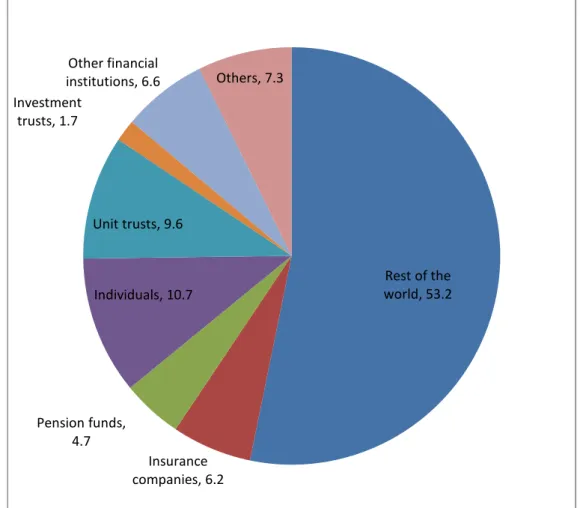
The era of pension funds as universal owners was not particularly long lived, however. Data from the UK Office of National Statistics show that pension funds gave up this leading position in part to insurance funds but in particular to overseas investors. By 2012, these “rest-of-the-world” investors owned more than 50% of UK equities (see Figure 2). Also growing were “other financial institutions”, from 0.4% in 1992 to 6.6% in 2012 (ONS, 2010,
2013). This category benefited by the expansion of UK-based hedge funds during the past decade and a half. They reached a peak of more than 12% in the data for 2010, before falling as foreign hedge funds replaced UK ones as buyers on the UK market. Meanwhile, pension funds – the archetype of “universal owners”– in the UK now own less than 5% of shares in the UK equities market.
--- Insert Figure 2 about here ---
Indeed, the shifts in these ownership patterns were rather steady during the history of UK corporate governance codification. The four categories of “traditional” institutions (pensions, insurance, unit trusts – or mutual funds – and investment trusts) peaked in their role at just over 60% of UK equities in 1992, just as the Cadbury Code was being drafted. Collectively they now own less than a quarter of the market (see Table 1).
--- Insert Table 1 about here ---
That the majority of UK equities are now held by foreign investors has a number of explanations. Sovereign wealth funds grew rapidly during this period, in particular in China and among oil-producing states, modelled on the successes of the Norwegian state oil fund and the investment funds of Kuwait and Abu Dhabi. US institutional investors also expanded overseas during this period, seeking asset diversification. Moreover, the character of UK equities markets changed radically as well. Big names in UK equities left the stock market either by being acquired (e.g. Cadbury Schweppes) or by collapse (Marconi). They were replaced in part by large foreign companies, including many from developing economies in Asia, Latin America and the former Soviet Union. They listed their shares on the London Stock Exchange in search of outside investors wanting the assurance that came with the British legal and regulatory system and with UK corporate governance standards. Meanwhile, private equity supplied capital to a growing number of growth companies, leading to a sharp decline in the number of companies listed.
Is it any wonder, then, that policy pronouncements for “stewardship” by institutional investors fell on semi-deaf ears? Neither the investors nor the equities they were investing in bear particularly close relationship to the scope of interests represented in the UK Stewardship Code (Cf. Cheffins, 2010). Arguably sovereign wealth and some US-based pension funds share some characteristics of the universal owner, with their interests aimed
at broad-based economic improvement over a long time. They should, therefore, favour a long-term approach to their investments. But their beneficiaries are not particularly interested in the long-term health of the UK economy but rather in the long-term appreciation of capital in the funds, irrespective of national boundaries. They accept that their assets must, therefore, fail to match their liabilities. In accepting that principle, their stewardship duties will not correspond to the wishes of policymakers for a long-term orientation to UK companies and the UK economy, but rather to the trading profits possible in a market for corporate control (Manne, 1965, 1984) and in identifying the opportunities for gains in other economies and markets.
These changes in investment practice suggest that the policy initiative is largely based on expectations of behaviour dating from an earlier point in history, at the start of the corporate movement when equity markets had a national character, rather than considering the current constellation of interests and motivations. Is it any wonder, then, that, Sir Winfried Bischoff, chairman of the Financial Reporting Council, should find that among the 300 funds that signed up to its Stewardship Code, “too many signatories fail to follow-through on their commitment” (FRC, 2015, p. 1)? Is it any wonder that the version of “ownership” involving psychological commitment or even interest in “purposeful dialogue” is difficult to initiate let alone to achieve?
Hedge fund activism and ownership
It is against this background that a new breed of activist shareholders, known with the moniker “activist hedge funds”, has moved to the centre of the corporate governance scene. Activist hedge funds appeared in the early 2000s when a number of hedge fund managers used their fund’s influence as minority shareholders to effect changes in the companies in which they invest. Hedge fund activism has emerged and flourished in the United States, and spread to other countries in Europe and Asia (for empirical evidence, see Katelouzou, 2015).
Previous literature shows that hedge funds are more suited to engage in shareholder activism than other institutional shareholders, such as mutual funds and pension funds, mainly because they face fewer conflicts of interest and they use unique organisation features, including their ability to lock-up investor capital (Kahan & Rock, 2007). It is also important to note that activist hedge funds are not a homogenous group. Hedge funds are, as expected, the main practitioners of this style of activism, but unlike “conventional”
hedge funds, activist hedge funds do not use automated systems for rapid arbitrage. There are also growing numbers of investors other than hedge funds that have emerged prepared to engage in hedge-fund-style activism, although many fund management firms may resist the categorization as activist hedge funds. For instance, Bill Ackman of the hedge fund Pershing Square Capital Management was originally a passive value investor who moved into the activist world to generate better returns for the funds’ investors. Some private equity funds are also converting themselves into activist hedge funds. For example, in 2006, Sebastian Holdings, a private equity firm owning 4% of Vivendi, opposed Vivendi’s plan to acquire PagesJaunes arguing that “[a] project aimed at forming a conglomerate of assets would be to the detriment of the interest of the entirety of the shareholders” (Ruitenberg, 2006). On the basis of the above, we use the term activist hedge funds in a relatively broad sense as involving not only hedge funds in the strict sense, but also the extremely active asset managers and funds that carry out proprietary research on individual companies and use shareholder activist to agitate for changes in the target companies’ practices.
The style of shareholder activism hedge funds engage presupposes an equity stake as departure point, which is accumulated offensively, that is activist hedge funds either do not have a pre-existing stake in the target company or they have a small one which they quickly increase when they decide to adopt a proactive stance (Katelouzou, 2013). Activist hedge funds, therefore, differ from both vulture funds, which use debt rather than equity as their starting point for investment, and from previous forms of shareholder activism by institutional investors, which rely on pre-existing stakes to lobby for changes out of dissatisfaction with the incumbents.
A further key element of hedge fund activism is that it aims to make changes in the target companies’ corporate governance, corporate strategy or financial structure to enhance returns to shareholders. Hedge fund activism can be conceptualized within the shareholder primacy model, according to which the ultimate goal of the corporation is to create shareholder value (Hansmann & Kraakman, 2001). Activist hedge funds draw on the logic of shareholder primacy and assert shareholder value maximization as the ultimate goal of their activist campaigns, putting in place an array of strategies (from behind the scenes negotiations and informal meetings to shareholder proposals and shareholder-driven litigation) which are not designed to achieve control of the target company (Katelouzou, 2013). Activist hedge funds, therefore, are neither like the 1980s-style raiders making bids that seek to dismantle and liquidate the company or the “greenmail” artists that promise to stop nagging companies only if management directs the corporation to buy
their shares at a premium, nor like private equity firms who specialise in buyouts seeking for control. Activist hedge funds do not aim to acquire sufficient voting rights in the target company to give it control of that company, they rarely launch takeovers and they use board control seeking campaigns (proxy fights in the American jargon) only occasionally at egregious times as an adjunct to their previous strategies (Katelouzou, 2013). Instead, activist hedge funds engage in oversight activities to influence their target companies and promote value-enhancing changes with the ultimate goal to provide absolute returns for their investors.
But can activist hedge funds qualify as the new “stewards”? Stewardship is couched as “a method of protecting and enhancing shareholder value” (FRC, 2012, Principle 4). Hedge fund activism can arguably perform this role. Anecdotal evidence suggests that activist hedge funds usually advocate, especially at the beginning of their campaign, that they intend to work with the board, the management and the rest of the shareholders in order to maximise value for all shareholders, while sometimes they even advocate value maximisation for all stakeholders. For example, Osmium Special Situations, an activist hedge fund, has been seeking for board representation in ATS Corp. since February 2010 advocating that the “ATSC’s present market capitalization does not accurately reflect the underlying value of the company’s U.S. federal service business, industry-leading margins and prospective contract opportunities”. In addition, the fund says that “they intend to work with the board, management, shareholders and others to maximize value for all stakeholders” (Hedge Fund Solutions, 2010, 2011). Put in the words of John Buchanan, Dominic Chai and Simon Deakin (2012, pp. 6, 295) activist hedge funds “were seen, and saw themselves, as the shock troops of shareholder primacy’’ which can benefit all shareholders and assist the efficient operation of the market economy as a whole, ‘‘since attention to shareholder value is recognized widely as a public good”.
Many empirical studies further report that activist hedge fund campaigns generate abnormal stock returns, particularly around the announcement of the activist event, but the evidence is more mixed where longer term operating performance of the company is evaluated post hedge fund activism (for a literature review, see Coffee & Palia, 2014). There is also some recent empirical evidence suggesting that hedge fund activism, at least as of 2007, is able to achieve not only its investment objective of profiting from shareholder activism, but also provides a form of discipline, especially against the agency problems associated with free cash flow, and creates improved long–term performance (Bebchuk, Brav, & Jiang, 2015).
But even if activist hedge funds can qualify as “stewards” as far as they enhance shareholder value, it is their allegedly short-term investment horizon that may undermine their role as “owners”. A number of high-profile corporate actions where activist hedge funds were involved have invigorated a public debate about the perceived negative effects of hedge fund activism. Opponents of hedge fund activism have argued that they are often identified with a trading rather than an ownership mentality, and with vulture capitalism rather than the patient capital of the universal owner. For instance, activist hedge funds have allegedly sought to squeeze as much value as possible from the target company, forcing for dividend payouts, share buybacks, liquidation, buyout or assets selling. Empirical evidence, however, suggests that activist hedge funds are in fact more long-term investors than the conventional wisdom might suggest, as the vast majority of activist hedge funds studied remained in the target for a period of more than one year, and with 39% of the total investments with an investment horizon of more than three years (Katelouzou, 2013). However, what is a long-term investment is a nebulous concept, and while an investment of more than three years may be considered as long-term for an activist hedge fund, pension savers might have a different view.
What is more, although the holding period of securities by activist hedge funds is suggestive, it is not in itself evidence of a long-term behaviour directed to the welfare of the targeted company and its shareholders, because it says little about the time perspective behind the valuation of a company. Previous empirical studies, however, refute the myopia theory and suggest that the activist hedge funds’ effect on their targets’ financial well-being is positive, although there are differing opinions as to whether the positive market reaction to hedge fund activism is simply due to a redistribution of wealth from creditors to shareholders (e.g. Klein & Zur, 2009).
What are the alternatives?
Policy may wish to promote dialogue and understanding alongside monitoring and control, but practice suggests that other conditions may prevail. Shifts in ownership patterns and the emergence of hedge fund activism raise questions about seeing the universal owner as a viable model for engaged investors. Shareholder empowerment seems to have stimulated confrontation more than dialogue. These disjunctions of policy and practice suggest a need to consider alternatives. How can policy help to break the cycle of performance and short-termism affecting both companies and their investors? Let us accept
that the days of loyal, private shareholders investing carefully their life savings in tiny proportions of the shares of most companies are a thing of the past, assuming they existed at all.
In this section we consider, first, alternative forms of ownership, other than the public listed company with a dispersed range of institutional investors. We then turn attention to what alternatives might be created by state intervention to unbundle ownership rights and reconfigure them. Each approach consider has some advantages over the current arrangements, but each has significant drawbacks.
Other forms of ownership
As the policy direction envisages a relational approach to ownership, let us consider, first, alternative forms of ownership, ones in which relationships play at least as strong a role as rights. The implication is that policy might be reset in ways to favour ownership forms that encourage long-term orientation of enterprises. In this section we consider, as examples, the implications for a selection of these.
Favouring founders and families. Some current practices, especially in the UK, constrain the influence of founders and families in public companies, where differential voting rights are discouraged (a point we return to in the next section). In other countries, including the US, major institutional investors, including those that have long-term investment horizon and might qualify as universal owners see this as a policy objective. Yet family firms, including the family-led, Mittelstand companies in Germany and family controlled businesses elsewhere are often seen as paragons of a long-term orientation in decision making. As a result, we could consider policy alternatives that favour such companies, including preferential bidding rights for government business or tax incentives.
Empirical evidence is mixed, however. On the one hand, empirical evidence finding that family owned firms outperform their peers might support an alternative view of families as “stewards”(e.g. Anderson & Reeb, 2003). On the other hand, however, in a study of US listed companies with family control, Miller, Le Breton-Miller and Lester (2013) found that such control created little differentiation (a source of strategic advantage) and provided little protection from isomorphic pressures. A recent analysis (Cannella, Jones, & Withers, 2015) also provides reasons for policymakers not to conflate founder-led and family-controlled firms. It found indications of longer decision horizon in the form of the tenure of directors for family firms.
Favouring the state as owner. The financial crisis led to rescues and (for a time) partial or full nationalization of some financial institutions in a wide range of the most liberal economies (e.g. UBS in Switzerland, RBS in the UK, AIG in the US), and even of some industrial companies (General Motors). In addition, the rapid growth and commercial successes of Chinese state-controlled enterprises or ones with implicit state backing has led to fresh questions about the role of the state as owner. Moreover, the growth of sovereign wealth funds from resource-rich economies, often with small populations, has offered another model of state-led equity investment (Lyons, 2007; Ungureanu, 2014). What unites these three disparate types of state ownership is the perception that the state’s interests lies in serving the long-term, strategic (economic and security) interests of the population as a whole. The dual role of the state as a shareholder and regulator, however, remains understudied (Cf. Pargendler, 2012).
The state is in some ways the archetype of the universal investor, but experience of state control in electoral democracies has not been so favourable. Politicians driven by election cycles seem to lack a long-term perspective in much the same ways identified as the problem of short-term oriented capital markets. In addition state ownership limits personal incentives for entrepreneurship and creativity and often involves a high degree of bureaucracy that manifests in stated-owned enterprises. This is where recent Chinese experience is of interest, with the state providing an ownership platform even as it stands back from management while conveying competitive advantage, at least in domestic markets against foreign rivals.
Favouring collective ownership. Mutual or collective ownership is often seen as the means to diminish the effects of short-termism in capital markets. Colin Mayer (2013) argues the case for a return to an older form of management with concern for social welfare and more communitarian forms of ownership. In particular the success of the John Lewis Partnership, a UK-based retailer, has demonstrated that it is possible to combine a creative and strategic approach focused on long-term when ownership resides with the workforce and without hyper-aggressive incentives for top managers. Similarly traditional mutual organizations, owned by customers, have been held up as potential models for a return to a more communitarian approach, in particular for the financial sector. The John Lewis Partnership is an interesting model, but we wonder why it has seen so few imitators of its ownership structure. Perhaps it is because few companies have a founder uninterested in cashing out during his lifetime and who also had no desire to favour his heirs over this employees in inheritance.
Collectives have downsides, too. While the building societies of Britain have (with a few notable exceptions) disappeared under competitive pressure from banks, we see a certain nostalgia for them seen in press discussion after the financial crisis and in the advertising campaign of the most prominent remaining one (The Nationwide). Indeed, the Co-operative Bank, a mutual with a commercial focus broader than building societies, was seen as part of the solution to the crisis as the government encouraged its desire to purchase branches of Lloyds Banking Group during the restructuring that followed Lloyds’ partial nationalization. But its mutual status and collective governance did not prevent managerial excess that took a long time to discover (Myners, 2014). It had disastrous effects on the bank, leading it too to require a rescue, not this time by the state but instead through a capital injection from hedge funds, the supposed arch-enemy of long-term, patient capital.
Reconfiguring ownership rights
If we accept that relational ownership is in practice elusive other than in exceptional cases, then let us consider alternatives arising from reimagining the bundle of rights. This section considers a few of these rights and how the state might reconfigure them through law to achieve “good enough” rights to promote capital formation while limiting what policymakers seem to see as the tyranny of shareholders’ short-term orientation. Some of these reforms involve enhancing shareholder rights, others involve diminishing them.
Voting rights. A mechanism often discussed and in some places enacted is to limit the voting rights of short-term traders or to enhance the rights of long-term holders. Differential voting rights have been used for many years in many countries to protect companies from stake-building that would unsettle founders or their families (e.g. with Google),3 or protect a business purpose from subversion by investors hostile to it [e.g. Dow
Jones & Co., Reuters (Nordberg, 2007)]. In some places this notion has been extended to all shareholders who maintain their position for some time. A recent case in point is France.
In 2014, France amended its laws on shareholder rights in the wake of the financial crisis. As part of its effort to encourage long-term investment, French law had for many years allowed companies to give long-term investors – those that held shares for more than two years – double voting rights. This was controversial for many mainstream investors,
3 Google faced a proxy challenge in 2014 seeking equal voting rights. The company’s defence was
couched in these terms: “Since its inception, Google has been managed with a focus on the long term”(for details, see
http://www.sec.gov/Archives/edgar/data/1288776/000130817914000114/lgoogle2014_def14a.htm #x1_lgooa062).
which see as anathema its challenge to the principle of one-share, one-vote. Differential voting rights are seen as helping to entrench incumbent managers by impeding such as governance mechanisms as challenges to director elections or other moves by dissident shareholders (see results of a debate among governance actors in ECGI, 2007).
France took a further step in 2014, enacting the so-called Loi Florange. Its most widely discussed provision requires companies with more than 1,000 employees to seek buyers for any operations in France threatened with closure. But it also altered governance rules on voting rights for listed companies. French law had previously permitted companies to give long-term investors double voting rights. In keeping with the “nudge” principle of setting a policy-friendly default position, the Loi Florange reversed the starting point: Companies now had to give double voting rights to shareholders of two years’ standing unless shareholders specifically vote against it. It was a move that provoked strong reactions from activist investors in French equity capital markets (for an example, see PhiTrust, 2015).
The Loi Florange gives companies and their shareholders the right to opt out of a mechanism aimed at promoting a longer-term approach, so its effects are less than binding. But the mechanism has flaws identified in theory and empirical studies over the years that have challenged the use of differential voting rights. Giving supposedly long-term investors greater voice can have perverse effects. For example, if the investors vote but are disengaged, their greater voting power may entrench management, exacerbate the agency problems corporate governance reforms have long sought to mitigate or impede timely structural reform. It may also make more complex the operations of index-tracking funds, which need continually to rebalance their portfolios at the margin to reflect the shifting weight on market capitalization in their funds.
Proxy access. A question that often arises is: Who is allowed to propose changes to the company’s articles of association or nominate directors? Soliciting shareholder votes is a costly exercise that can be made more costly if the board refuses to circulate supporting materials with regular communications with shareholders.
Following the dot-com collapse and the failures of Enron, WorldCom and others in the early 2000s, the US Securities and Exchange Commission sought to open the proxy process. One of its regulatory proposals under the Sarbanes-Oxley Act (Library of Congress, 2002) was to give investors of long standing the right to make proposals, including director nominations, to the annual shareholders meeting and have the costs of doing so paid by the company. To prevent frivolous proxy challenges, the SEC recommended thresholds for both the length of time shares had been held and the level of shareholding. Arguments
about these thresholds and their fairness arose, and eventually the courts overturned the regulation. The corporate lobby argued that it might lead to dissident directors and harm board cohesion. Some investors argued that it would entrench management and impede the market for corporate control. The issue arose again follow the financial crisis and the resulting Dodd-Frank Act (Library of Congress, 2010), again rejected in the courts.
Such measures aim to enhance the voice of long-term investors at the expense of those that trade frequently. But they also can prevent all but the largest shareholders from having this stronger voice, while privileging those best able to afford the costs of mounting a proxy challenge independently. When combined with pressure on institutional investors to disclose their voting records (as the SEC also did in 2003 for registered investment managers), they can lead to more conservative voting by disengaged investors (e.g. index-trackers) seeking a low-cost method of compliance.
Investors on committees. Who should sit on the committees that under corporate governance reforms since Cadbury guide the most sensitive work of boards? The Swedish model for nomination committees has found considerable resonance outside the country. In it, investors of a certain standing have a formal seat and vote in private, internal discussion about succession planning and recruitment of new directors. It is in some ways an alternative to the proxy-access approach, avoiding contested elections at shareholder meetings (one of the issues in the US with the SEC plan) while giving committed and engaged shareholder enhanced voice. As the UK debated its response to the financial crisis, this model won endorsement from the think tank Tomorrow’s Company (2010).
This idea prompts others: While the nomination committee is clearly important, why not extend the principle to the audit and remuneration committees? Following corporate governance reforms in recent years in many countries, audit committees are now often made up exclusively of independent non-executive directors so as to prevent senior executives from dominating their discussions, recommendations and decisions. Shareholders already have the right4 to appoint external auditors, why not then also the
internal auditors and then discussion of what the audits produce?
Remuneration is perhaps the most publicly contested area of corporate policy between shareholders and boards. There may be advantages in having shareholder representatives involves in setting remuneration policy, informed from the outset, confidentially and in detail, about the rationale for the decision.
Such measures beg other questions, however. The Swedish system for nominations is based in part on the presence of very large blockholders who also have enhanced voting rights. These holders are long-term in their orientation, and unable to exit their positions without disrupting market valuations. As a result, enhancing voice can be justified. But setting the conditions and thresholds raises complex issues of legitimacy, as happened with the SEC’s proxy access rules. Moreover, shareholders with this status have privileged access to material information, making them insiders and therefore subject to insider trading restrictions. Some large shareholders would baulk over accepting the role, especially as it would constrain their abilities to lend securities for the sake of improving portfolio cash flow or to rebalance portfolios in response to changes in weighting as market capitalizations fluctuate.
Moreover, opening committees to shareholders and thus enhancing rights leads to the question of whether committees might be opened in ways that reduce rights. A variation of the theme of worker rights and co-determination on German and Austrian boards is the question of stakeholder representation on board committees. If appointment as a director is no longer a pre-condition for committee membership, there may be less concern for having the workforce involved in making recommendations concerning pay policy, audit or who next joins the board. Enacting such provisions would face considerable opposition from shareholders of all descriptions and from corporations. But it might also serve to offset enhancements of other aspects of the bundle of rights.
A more radical idea would be extract the work of committees entirely from the boards. Consider audit: While audit committees may officially be the exclusive domain of independent non-executives, anecdotal evidence suggests that in practice on many boards, all directors attend audit committee meetings and the finance director often leads it. In a unitary board it may be uncomfortable for the committee to meet in camera, though they could do so when delicate issues arise. But given that the outcome of a committee is only ever advisory, and that the board in its entirety decides, why not consider having a shareholder- or a shareholder-stakeholder committee recommend actions, leaving the decisions and accountability for them with the directors?
Non-shareholder voice. The question of opening committees to shareholders and perhaps other stakeholders raises another alternative mechanism to reconfigure shareholder rights – reconfiguring the rights of others to such processes. Take, for example, the changes in practice in the UK in the wake of the financial crisis. Following the collapse and state rescue of Royal Bank of Scotland and Lloyds, the Financial Services Authority
(and its successor, the Financial Conduct Authority) claimed the right to vet any individual nominated to take a position of significant influence in any financial services firm working in the UK.
The sweeping reform was justified by the implicit risk the state bears with respect to financial stability in its role as guarantor of the lender of last resort. But it also pre-empted shareholder rights to elect directors, as all individuals would require approval for each post. Previously individuals might be barred from serving as directors, but such bans applied to directing any company, that is of being a director at all. The new powers go beyond that in being specific to individual and the company that person might serve.
Board-less corporations. Another radical idea is that of doing away with boards of directors entirely. This view – voiced privately by some advocates of shareholder activism – starts from the premise that the recurrent nature of the crises in corporate governance suggests boards are the weak link. With boards in many countries now dominated by independent non-executive directors, this argument suggests that they lack the knowledge and time needed to understand the business and reach informed decisions. An element of this concern came in the Walker Review (2009) in the UK in its suggestion that expertise might be more valuable than independence. In heavily regulated industries, like financial services, electricity supply and water, where the state, taxpayers and householders bear the residual risk, is there a case that board is redundant, and that management might deal directly with the regulator on the one hand and capital providers (debt and equity) on the other?
Auditor selection. As discussed above, one example of shareholder rights is that of selecting the external auditors, which is justified because, fundamentally, they verify calculations of shareholder equity. The Cadbury Committee in the UK was empanelled in 1991 to investigate the “financial aspects” of corporate governance after audit failures at a variety of UK companies. The Enron and WorldCom failures led to overhauls in the audit system in the US and indeed other countries as well. The acknowledged danger in audit is exemplified in these cases: that the auditors became too cosy with the directors owing in part to the commoditization of audit services, and thus low margins, and the importance of non-audit advisory work on taxes, information technology, human resource and strategy.
Many attempts have been made to “fix” the broken audit system in the aftermath of Enron, WorldCom and the resulting collapse of the accounting and audit firm Arthur Andersen in 2001-02. Limits to non-audit work led to accounting firms hiving off their management consulting arms only to build them back up again a few years later. Auditor
rotation has been tried, as have incentives to let smaller audit firms grow into realistic competitors to the four remaining large ones. To no avail.
One idea that was not tried was taking responsibility for audit away from shareholders. A version of this contends that shareholders do not really select auditors, they merely ratify the recommendation of the board and audit committee. An alternative to the alternative of removing the audit committee from the board might be to have auditor appointed by the party most immediately at risk – not the shareholders, but the providers of directors’ and officers’ insurance. Studies suggest a link between D&O insurance premiums and audit fees (Chung & Wynn, 2014; O'Sullivan, 2009).
An alternative to that is to have debt and equity providers share responsibility for both auditor appointments, approval of credit rating agencies and selection of D&O insurance. While some question the ability of D&O insures to make appropriate judgements of even the risks they bear (Heimer, 2013), this notion may have the advantage of widening the accountability of auditors beyond equity and credit ratings beyond debt.
Pre-emption rights. A common feature in many European countries is the right of shareholders to approve capital raising exercises, and in particular large issues of new shares. A study commissioned by the UK government in the early 2000s concluded that the right of pre-emption was a valuable one, but in effect one that also impeded value creation. The report by Paul Myners (2005) sought a more flexible system to allow faster decisions that would allow managers and boards to raise capital for investment in long-term projects without the impediment of having to securing shareholder approval in advance. In essence this argument rests on the experience in the US, where pre-emption rights are virtually unknown for publicly traded companies and where investment in research and development are much higher than in European countries and the UK in particular.
A research and policy agenda
This discussion points towards a need in scholarship and policy for a better understanding of the concept of ownership and the details of the workings of interactions between investors and corporations. With the UK as its central focus, our analysis is both illuminating and limited. The rise of international investment and the advent of hedge fund activism have changed the landscape of investment and put into doubt whether policy that rests even implicitly on the idea of the universal owners can achieve the desired aims.
The alternative forms of ownership outlined above have benefits but also drawbacks. Collective ownership like the “John Lewis” model has its advocates (Mayer, 2013), but collective ownership has also been known to result in poor monitoring and loss of control (Myners, 2014). Revisiting corporate law to make companies less like private property and more like a commons, i.e. “a shared resource whose sustainability depends on the participation of multiple constituencies in its governance (not just shareholders, but employees, core suppliers and customers)” (Deakin, 2012, p. 339), is worth exploring as an alternative to an investor-centric approach.
Viewing ownership as a bundle of rights leads to questions about what might happen if the legal environment changed and those rights were then unbundled. The alternatives outlined above warrant examination, perhaps by looking at practices in place is jurisdictions other than the ones we have considered here, and in experiments that happen on the fringes of capital markets in the major economies. For example, pre-emption rights are common in Europe but almost unknown for listed companies in the US. Yet there is anecdotal evidence that private equity firms and venture capital funds in America often install such rights to their own benefit at companies in which they invest, and then lift them as the companies head towards initial public offerings. What can we learn from such activity to guide both our understanding of the functioning of capital-corporate interactions and the policy options that might arise?
As the policy direction envisages a relational approach to ownership, future research needs to consider alternative forms of ownership, one in which relationships play at least as strong a role as rights. We have considered above some alternative forms of ownership which policy might be reset in ways to encourage long-term orientation of enterprises, including family ownership, state ownership (especially through SWFs) and collective ownership. As with investor ownership, however, these alternative forms of ownership have their downsides. The answer to the long-term saga, therefore, might turn out to be found within investor ownership. Although emerging forms of shareholder activism, especially the ones associated with hedge funds, mainly promote shareholder primacy rather than equally serving the interests of all the firm’s constituencies (e.g. employees), reconciling investor ownership with sustainability and long-termism is not a utopia. For instance, making institutional investors corporate insiders by mandating board representation for minority shareholders as a counterbalance to a dominant owner (following the example of Italy) might strengthen a relational approach to ownership.
Because our focus has been on the interaction between investors and companies, we have not considered in detail the growth in recent years of algorithmic trading, high-frequency trading. Such “shareholders” now constitute in many cases the vast majority of shares changing hands in the shares of major corporations. The impact of such trading on price formation needs to be understood by policymakers and practitioners. With much of corporate remuneration and target-setting done based on share prices, such trading may well influence incentives in a perverse way, perverse, that is, from the point of view of other, longer-term investors. But does it, or is such trading neutralized by its very velocity?
Conclusions
Legal scholars have engaged in a sometimes heated debate over the value of enhancing shareholder rights (e.g. Bainbridge, 2013; Bebchuk, 2013). What we have examined here is something different, the possibilities arising from alternative ownership forms and a reconfiguration of owners’ rights.
This paper shows that the current policy direction of encouraging corporate-investor dialogue – engagement, commitment and stewardship – faced formidable obstacles, given the current state of capital markets and configurations of share ownership. It also suggests that both the scholarly literature and current practice in a variety of countries has engaged in a search for alternative approaches. While some see value in encouraging alternative forms of incorporation and patterns of shareholding, others focus on reconfiguring the bundle of rights that make up the legal definition of ownership.
What this paper does not do is advocate any of these, let alone all of them. Instead, it is our intention to suggest both fresh research into these alternatives and to encourage some experimentation that will provide the ground for further research. Doing so will help us overcome the lack of evidence for policy and prepare us for the consequences when policy fails to keep pace with markets.
References
Anderson, R. C., & Reeb, D. M. (2003). Founding-Family Ownership and Firm Performance: Evidence from the S&P 500. The Journal of Finance, 58(3), 1301-1327. doi: 10.1111/1540-6261.00567
Armour, J., Deakin, S., & Konzelmann, S. J. (2003). Shareholder Primacy and the Trajectory of UK Corporate Governance. British Journal of Industrial Relations, 41(3), 531-555.
Bainbridge, S. M. (2010). Director Primacy. UCLA School of Law, Law-Econ Research Paper No. 10-06. Retrieved June 8, 2010, from http://ssrn.com/paper=1615838
Bainbridge, S. M. (2013, August). Preserving Director Primacy by Managing Shareholder Interventions. UCLA School of Law, Law-Econ. Research Paper No. 13-09. Retrieved May 9, 2014, from http://ssrn.com/abstract=2298415
Bebchuk, L. A. (2013). The myth that insulating boards serves long-term value. Columbia Law Review, 113(10), 1637-1694.
Bebchuk, L. A., Brav, A., & Jiang, W. (2015, April). The long-term effects of hedge fund activism. Harvard - John M. Olin Center Discussion Paper 802, prepared for Columbia Law Review. Retrieved May 30, 2015, from http://dx.doi.org/10.2139/ssrn.2291577 Berle, A. A., & Means, G. C. (1932/1991). The Modern Corporation and Private Property
(Revised ed.). New Brunswick, NJ: Transaction Publishers.
Brink, A. (2010). Enlightened Corporate Governance: Specific Investments by Employees as Legitimation for Residual Claims. Journal of Business Ethics, 93(4), 641-651.
Buchanan, J., Chai, D. H., & Deakin, S. (2012). Hedge Fund Activism in Japan: The Limits of Shareholder Primacy. Cambridge: Cambridge University Press.
Bushee, B. (2004). Identifying and Attracting the "Right" Investors: Evidence on the Behavior of Institutional Investors. Journal of Applied Corporate Finance, 16(4), 28-35. Butler, P., & Wong, S. (2011). Recent trends in institutional investor responsibilities and
stewardship. Pensions: An International Journal, 16(2), 80-85.
Cadbury, A. (1992). The Financial Aspects of Corporate Governance. Retrieved April 9, 2007, from http://www.ecgi.org/codes/documents/cadbury.pdf
Cannella, A. A., Jones, C. D., & Withers, M. C. (2015). Family- versus
Lone-Founder-Controlled Public Corporations: Social Identity Theory and Boards of Directors. Academy of Management Journal, 58(2), 436-459. doi: 10.5465/amj.2012.0045
Cheffins, B. R. (2010). The Stewardship Code's Achilles' Heel. Modern Law Review, 73(6), 1004-1025. doi: 10.1111/j.1468-2230.2010.00828.x
Chung, H. H., & Wynn, J. P. (2014). Corporate governance, directors' and officers' insurance premiums and audit fees. Managerial Auditing Journal, 29(2), 173-195. doi: 10.1108/MAJ-04-2013-0856
Coffee, J. C., Jr., & Palia, D. (2014, September). The Impact of Hedge Fund Activism:
Evidence and Implications. European Corporate Governance Institute Law Working Paper No. 266/2014. Retrieved May 30, 2015, from http://dx.doi.org/10.2139/ssrn.2496518
Commission Europe. (2010, April). Recommandations et bonnes pratiques à l’attention des émetteurs et des investisseurs institutionnels. Le Club des Juristes policy report. Retrieved December 20, 2014, from
http://leclubdesjuristes.com/wp- content/uploads/2014/03/Commission-Europe-Recommandations-et-bonnes- pratiques-a%CC%80-lattention-des-e%CC%81metteurs-et-des-investisseurs-institutionnels-FR.pdf
Davis, G. F. (2013). After the Corporation. Politics & Society, 41(2), 283-308. doi: 10.1177/0032329213483110
Deakin, S. (2012). The Corporation as Commons: Rethinking Property Rights, Governance and Sustainability in the Business Enterprise. Queen's Law Journal, 37(2), 339-381. ECGI. (2007). General Assembly, Annual Lecture and Debate: This House believes that
long-term shareholders should have double voting rights. European Corporate Governance Institute. Retrieved June 28, 2007, from
http://www.ecgi.org/conferences/agm2007/video/index.php
Edmans, A., & Manso, G. (2011). Governance Through Trading and Intervention: A Theory of Multiple Blockholders. The Review of Financial Studies, 24(7), 2395. doi:
10.2307/20869310
European Commission. (2006). Impact assessment, annex to the proposal for a Directive 2004/109/EC on shareholder voting rights. European Commission staff working document. Retrieved May 30, 2015, from