ERP in Manufacturing Network
Sindre Bolseth and Odd Jøran Sagegg Department of Production and Quality Engineering The Norwegian University of Science and Technology (NTNU)N- 7491 Trondheim, Norway
E-mail: [email protected] [email protected] Keywords:
ERP-systems, Manufacturing Network, BPR, Supply Chain, ICT
ABSTRACT
This paper outlines the different types of manufacturing networks and their characteristics, in addition to a description of the ERP-system (Enterprise Resource Planning system) from a logistics point of view. Further, it discusses the possibilities and shortcomings of using ERP-systems in manufacturing networks. And the result from two empirical surveys is presented through case studies done upon Norwegian manufacturing companies.
INTRODUCTION
The use of manufacturing networks has become an essential weapon in many multinational companies’ strategies. A manufacturing network enables a company to develop capabilities to respond to diversity in national or regional demand, while at the same time integrate and co-ordinate their activities globally to reduce costs and improve productivity (De Meyer et al., 1996). Parameters like speed, flexibility, productivity and cost are improved, but the need for integration and co-ordination of processes and information are increased drastically.
Many companies have implemented an Enterprise Resource Planning (ERP) -system in order to support their internal processes. New requirements for collaboration across company borders have led to increased demand for different functionality in the enterprise software. But the traditional ERP-system is still the backbone of many companies information and communication systems.
This paper will discuss how the ERP-systems can integrate and support a manufacturing network. The focus will be on the manufacturing network requirements for integration and co-ordination and to which extent the ERP-systems (with supporting systems) can meet these demands. The paper will also present results from ongoing case studies, where two Norwegian owned international manufacturing networks have designed/redesigned they’re manufacturing networks and implemented a new ICT strategy.
MANUFACTURING NETWORKS
Manufacturing companies are subject to tremendous pressures because of ever changing market environments and the fact that manufacturing takes place in a global context where local markets are subject to global standards (Jagdev and Thoben, 2001). Consequently we see that many multinational companies develop capabilities to respond to diverse a national demands, while at the same time they integrate and co-ordinate their activities to reduce costs and improve
productivity (De Meyer et al., 1996). These changes force companies to rethink their global strategy in general, and to rethink their manufacturing strategy more specifically. An important element in this new manufacturing strategy is how to establish an efficient, flexible and integrated manufacturing network.
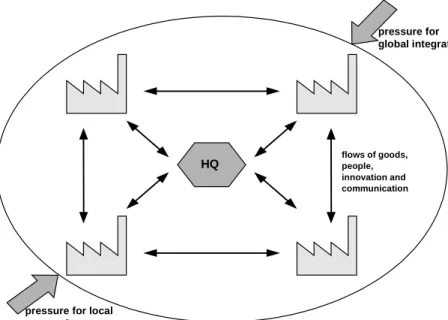
A manufacturing network consists of manufacturing plants that co-operate and share resources with each other. They are not only linked together by a supply chain, but they are also linked at the same level of value adding. The network can consist of plants within the same company or a network of one focal company and some sub-contractors, see figure 1.
Figure 1. A manufacturing network (Vereecke and Van Dierdonck, 1999)
Almost every large manufacturing company consists of a manufacturing network. The network can be a result of merges, take-overs, and according to a well-prepared strategy or just pure coincidences. According to Du Bois and Oliff (1992) there are four types of manufacturing network configurations:
• Home country configuration without any plants abroad
• Regional configuration with a division of the international market into a small number of sub-regions, whereby each region is self-contained in its management. Simplicity in management and closeness to local markets triggers this choice
• Global co-ordination where each factory has to play a global role and serve markets; exploitation of local or regional advantages becomes possible in this configuration
• A combination of regional with global co-ordination
As mentioned earlier, a manufacturing network consists of plants that co-operate and share resources with each other not only linked together by a supply chain but also liked at the same level of value adding. By focusing on requirements, materials and payments between the plants in the network, it is possible to further divide manufacturing networks into two types:
• Sequential networks
• Parallel networks
HQ flows of goods,people, innovation and communication
pressure for global integration
pressure for local responsiveness
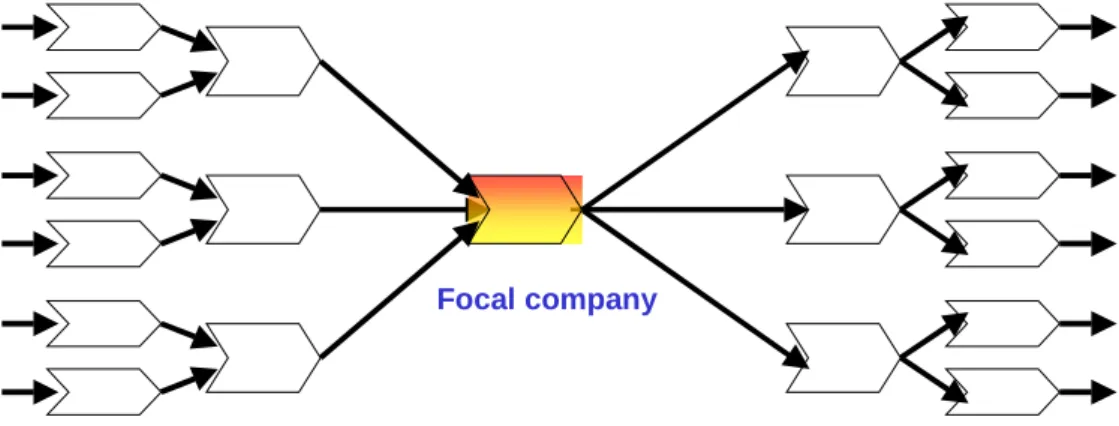
Sequential networks can be considered as a network of supply chains, see figure 2. Supply chains constitute a sequential network, where plants receive (buy) unfinished goods from upstream suppliers and transform the products into higher value and passes (sell) them to the next plant downstream the chain. Competitiveness can be achieved through chain integration and process redesign that enables reductions of stock and quick response to focal customers/market segments.
Figure 2: Sequential network
Parallel networks are a group of plants at the same level of value adding that share resources, see figure 3. Parallel networks are most common between plants in the same company. Companies allocate jobs (capacity) between plants in order to optimise their resources and fulfil customers’ volatile demand patterns. Manufacturing plants collaborate in parallel networks to increase their flexibility. The ability of manufacturing plants to fulfil customers orders with respect to due dates, are often constrained by the limitation of capacity. Thus, manufacturing plants improve their flexibility by sharing production capacity with other plants that are able to provide the same product or service. However, to exploit the full potential of such networks requires extensive communication and monitoring of the order and resources situation in the network.
Figure 3. Parallel manufacturing network
A manufacturing network can consequently consist of global, regional or local networks of plants arranged in parallel and/or sequential. In order to use the manufacturing network as a competitive advantage in the increasing global competition, each company has to repeatedly rethink their manufacturing strategy and look for better ways to do things. In particular, there
Focal company Requirement Payments Materials Requirement Payments Materials
are two crucial and mutual depended questions that should be raised: “How to design a manufacturing network”, and “How to manage the network?” It is important to understand how close these two questions are linked. It is hard to manage a badly design network, and an ideal designed network does not exceed business excellence if the management works against it.
Design of a manufacturing network
As mentioned earlier there are many questions that should be raised in order to be able to design a manufacturing network according to the current manufacturing strategy for a company. To give some insight in this process, we will address two of these questions here, namely each plant strategic role and the portfolio of products to the different plants.
In a manufacturing network, consisting of dispersed manufacturing plants, each plant will have a particular role. According to Ferdows (1989) there are six different strategic roles in a manufacturing network:
• The off-shore plant – utilise local cheap production input factors
• The source plant – as the off-shore plant, but has a more substantial strategic role and can be responsible for particular products or processes
• The server plant – serving a national or regional market
• The contributor plant – as the server plant, but it also develops know-how for the company
• The outpost plant – collects useful information from hi-tech regions or area, e.g. from universities or research centers or technologically advanced competitors, suppliers or customers
• The lead plant – acts as a partner of the HQ in developing manufacturing capabilities within the company
The basis for this model is the level of contribution of the plant to the competitive strategy of the company (strategy role) and the primary location driver. By using this model the company can design a network with the desired profile, e.g. that the company is customer oriented enough or can gain competitiveness through local inputs factors.
The next question is how to allocate the whole portfolio of products to the different plants. The plants were located in a certain region mainly for reasons of cost, market or technology (De Meyer and Vereecke, 1994), but which product should be produced where?
According to Hayes and Schmenner (1978) and later Schmenner (1982) a company can choose between three principles for focusing their plants:
• Product focus – to which extent the plant is producing a limited portion of the company’s products range
• Market focus – to which extent the plant is producing for a limited portion of the geographical market supplied by the company
• Process focus – to which extent the plant is concentrate on a distinct stage of the production chain
The choice between these principles has strong implications for the range of tasks of the corporate manufacturing staff and the plant management. In the next section we will discuss some aspects of managing a manufacturing network.
Management of a manufacturing network
Managing a manufacturing network has many similarities to supply chain management. Supply chain management can be defined as: “The management of upstream and downstream relationships with suppliers and customers to deliver superior customer value at less cost to the chain as a whole“ (Christopher, 1998). In addition to the supply chain perspective there are also the challenges associated with how to manage and co-ordinate an integrated parallel network. A major contribution from the supply chain perspective is that each company in a chain is dependent on each other and yet paradoxically by tradition does not closely co-operate with each other. Competitiveness can be achieved through chain integration and process re-design that enables reductions of stock and quick response to focal customers/market segments.
By comparing the management of one large manufacturing plant to many plants that constitute a network, we will see that the management are facing different problems. If the manufacturing plant becomes too large, “diseconomies of scale” will probably occur. As the production output grows, the plant usually has to distribute its products over a larger geographic area. This will affect the distribution costs. There may also be a tendency to increase the level of co-ordination and control more than proportionally, by creating a more bureaucratic organization (De Meyer and Vereecke, 1994). One large plant also has the tendency to become unfocused, there are too many processes and products and it is hard to achieve business excellence. As opposed to this, each plant in a manufacturing network is focused on its core competencies. The challenges are how to integrate and co-ordinate the network in order to achieve an efficient and competitive flow of goods, know-how/technology and information.
At the operational level, the manufacturing network supports three types of flows that require careful control and extensive communication:
• Material flows, which represent physical product flows from the suppliers to the customers
• Requirement flows, which represent order transmission
• Financial flows, which represent credit terms and payments
The focus of the plants has major logistical implications for the company, as it determines to a large extent the flow of goods in the network. In process-focused plant, goods have to be transported in a sequential network. Product and/or market oriented plants operate more as a parallel network and have other needs. In such a network one of the logistical challenges will be to co-ordinate deliveries, e.g. cross-docking.
In order to achieve logistical excellence the manufacturing network is dependent on a thorough and powerful ICT strategy, with ICT systems (e.g. ERP-systems) that support the management, integration and co-ordination of the network.
A manufacturing network is characterised by intensive communication not only between suppliers and customers, but also between the participating companies. The goal is to get everyone in the manufacturing network onto a common platform of logistics transactions and information systems for greater inter-organisational “seamless ness”. This integration can result in significantly faster system response times to volatile changes in marketplace events and patterns of demand. By creating and managing a highly organised network of complementary companies across the supply chain, a manufacturing network can also rapidly build strategic effectiveness and wealth (Boyson et al., 1999).
ENTERPRISE RESOURCE PLANNING SYSTEMS
Traditionally, the enterprise has many different computer systems and databases to support its various departments. For example, the financial department have systems for accounting and general ledger, the sales and marketing have systems for order management and pricing, while the production department can make use of a Manufacturing Resource Planning (MRPII) system. An ERP-system is a standard application program, which support execution of business processes throughout the whole company. The ERP-system has functionality that makes the company able to replace many of their applications with a single seamless system with one common database.
The term ERP was first introduced by Gartner Group in the beginning of the nineties (see www.garter.com). But this type of software goes further back. Already in the seventy, some of the larger integrated software programs did appear (SAP, Oracle, JD.Edwards, Baan etc.). The development of the functionality of the ERP-systems began even earlier, with the Bill Of Material Processor (BOMP). The BOMP calculates total quantities or each ingredient or component by multiplying the quantity of the end product in each batch by the number of ingredients or components in the bill or recipe for that product.
In the late 50's, Dr. Joe Orlicky published the first book published on Material Requirements Planning (MRP). MRP is a computerised approach for the planning of material acquisition and production and is an extension of the BOMP. MRP calculates a net requirement, that is the total requirement net of stocks and already planned production or scheduled goods receipts. This net requirement is valid for the total make or purchase needs across a number of products, and the calculations consider not just what is needed but when it would be needed (Intentia, 2000). The schedules made by the MRP- calculation had one major shortcoming; they did not consider the capacity available in the factory. This meant that the plans produced in the MRP-run could not always be executed because of capacity restrains. To reduce this problem capacity adding steps where included in the bill of materials, and capacity numbers where allocated to them. A capacity plan for the key resources could then be produced, and be compered with the capacity available. It could then be observed if the material plan allocated too much capacity. And if it did, the material plan must be rescheduled and a new MRP-calculation had to be done. This planning loop done on key resources was termed Rough Cut Capacity Planning (RCCP). This loop and other extensions of the original MRP principles like Production Activity Control (PAC), Capacity Requirement Planning (CRP) and purchasing was named Closed Loop MRP (Browne 1996).
By the late 1970s the industry had gained considerable MRP experience. Costing information, raw material costs, standard times and overhead allocations could be combined into the MRP algorithm to calculate total manufacturing costs. This and the extension of the feedback principal to the provision of tools to improve forecasts and to create a usable business plans did result in the development of MRPII (Intentia, 2000). The American Production and Inventory Control Society (APICS) began to standardise the components of which MRP II is made up, and developed it into a clearly recognisable shape, albeit with variations.
The MRPII functionality combined into a common database with other modules that adds up an ERP-system. The ERP-systems provide three types of functionality (Akkermans, Bogerd and Yucesan, 1999):
• A transaction-processing engine, allowing for the integrated management of data throughout the enterprise.
• Workflow management functions for controlling the numerous process flows that exist in the enterprise, such as the order-to-cash process or the purchasing process.
• Decision support functions, assisting in the creation of plans (e g. by doing an MRP run) or in deciding on the acceptance of a specific customer order (e.g. by performing an Available-to-Promise (ATP) check).
It can be argued that the foundation of the ERP-system is order handling. The transactions are generated by events in the order fulfilling processes, and the workflow management is in fact managing these transactions. Further, the decision support functionality is totally depending on issued-, open- and planned orders.
An ERP-system in a production environment has typically four types of orders. The first three are mainly for internal use in the production unit or for connections with the environment. The last one is used between production units in the same ERP-system for sharing goods.
• Customer orders – Orders triggered by the sales department for fulfilling customer needs.
• Production orders – Used by the production department for preparing the goods.
• Purchase orders – Used for acquire needed raw materials and various services.
• Distribution orders – Internal orders for transferring goods between internal warehouse and plants.
Different orders can be triggered in different manners. The customer orders are usually entered manually by the sales department, which gets the customers demand by telephone or fax, or they can be automatically entered in the system via an EDI connection or an Internet site. The other orders is created by the ERP-system, (or they can of course be manually issued) typically by first generating an order proposal via an MRP-run, which can be released by the user into a genuine order. These order-proposals are created by four principles. First, we have one-to-one order generation. The order proposal is created because other order is generated downstream the delivery chain. This is usual in a make to order environment were a customer order is directly connected to a production order. Second, we have orders generated from future demands and/or forecasts. This method is typically used in plants that makes to stock from forecasts but can also be used to “summarise” customer demand downstream the chain. Third, we got order proposals that are generated from a stock level, typically with point of sale approach. Finally, may the order be generated in a timely fashion without considering any demands or other factors. It is important to notice that these are the main principles for order creation, and they can be configured into many variants for different purposes.
The ERP-system can use different principles of generating order proposals on the same installation and even on the same item. But to be able to generate these order proposals the system must do an MRP run, which usually is done in a batch job during a night run. This means that the ERP-system is, from a logistics point of view, mainly an order-processing machine, that stepwise is being updated during night jobs.
CHALLENGES WITH THE USE OF ERP-SYSTEMS IN A MANUFACTURING
NETWORK
When addressing challenges of using ERP-systems in manufacturing networks, it is important to understand that we are not addressing the use of these systems within a manufacturing plant, but rather challenges with co-ordinating and integrating a network. The use of an ERP-system in a plant within a network can be considered similar to the use of such a system in an independent plant. We will focus on how the ERP-systems can support and contribute to an integrated and co-ordinated network. Typical challenges will be:
• Integration with customers and suppliers, order reception and allocation of orders to the plants
• Capacity allocation between the plants in the network
• Planning and decision support for logistics
Through EDI- or Internet-connections orders, delivery plans and other information can be transferred automatically between the different ERP-systems in the network. In addition to the ERP-functionality there must be implemented some kind of manual control routine for verifying the transactions in case of errors. Investments to get these solutions on-line are relatively expensive and therefore may a change of vendor or customer become quite costly. This results in closer connections, but also increased dependency between the different actors in the network.
Even by using manual orders between units may also integrate and generate dependency between the actors. Considerable amounts of information must be added in the ERP-system for making it able to generate these transactions. This information may be; addresses, cost information, the vendor/suppler item numbers, agreements and so on. In addition the ordering documents are often tailored for the different connections. All this information must be altered for making the network able to change, which again will do the network more integrated but less flexible.
Distribution Resource Planning (DRP) can support the material logistics planning between actors in the network if the units are using the same ERP-system and database. This demands that all bill of materials are correct and up to date, and that the data quality is generally high. If separate ERP-systems are used, the delivery dates are set when the orders are issued, by calculating the operation time using backward scheduling. If the delivery dates are being changed causing re-planning or other unforeseen events, a manual process between the delivering unit and the receiving unit must take place for harmonising the systems.
The functionality provided by the ERP-systems for coping with the need of capacity allocation support for manufacturing networks is almost non-existing. The ERP-system can provide some kind of visualisation of the capacity situation in separate plants by using the rough-cut capacity-planning module or by making use of a data-mining tool. But the decisions mainly must be done in a manual process. There is software on the marked that can do a capable to promise calculation based on the information in the ERP-system. But the data quality required for making such decisions is inappropriate high.
Co-ordination of order reception and allocations is also insufficient supported by the ERP-systems. If different units are using the same system they can use DRP to update the due-dates in the different plants, but the order reception functions more or less like two separate systems.
Between ERP-systems the only help provided by the applications for material planning is the decision support functionality. This is limited to an available-to-promise (ATP) check, which can be used in the customer order receiving process. The ATP indicates how many of the items in the stock can be promised to a customer without risking shortages in other future deliveries. This check assumes that the items are produced to stock, and that the data quality is high considering both time and accuracy. Because of this, the ATP-check is impossible to implement successfully in many companies.
The ERP-system is, form a manufacturing network view, a network with serial coupled orders, which interacts internal and external in the production network. This network can help building a framework for co-ordination and collaboration across company borders. But the users must know the limitations of the system, and process owners must verify data transfers and make decisions based on less automated methods.
CASE STUDIES
In this section we will present result from two case studies we have conducted on Norwegian owned international manufacturing network. In both cases we will try to illustrate how close the design of the network and use of the ERP-system is connected. The fist case is from a value re-engineering project, where both the manufacturing networks and the ICT system were redesigned and highly improved. The second case follow the process of establish a new manufacturing network and implementing an ICT strategy, and thereby an ERP-system, into this new organisation.
Company A
Company A is a Norwegian industry group developing, manufacturing and distributing electrical equipment worldwide. It is an international company with production capacities in 5 countries across Europe, Asia and North America, a turnover of approximately 1.3 billion NOK and 1,250 employees. The group is divided in two separate sales divisions.
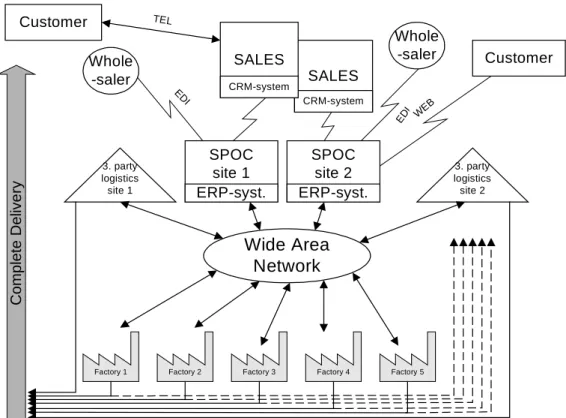
In 1998 a strategy process was launched. This process led among other things, into a “Value Chain Reengineering” (VCR) project, which aimed to totally rearrange the value chain, and thereby the manufacturing network, in order to achieve a simple, efficient and comprehensive value chain. The VCR project goal was to implement digital work processes throughout the company. In order to make all communication between customers, sales personnel, logistic centers, manufacturing plants and suppliers digital as illustrated in figure 4. The VCR project was mainly an ICT-project with 7 sub-projects, whereby implementing Baan (ERP-system) and making the business e-business ready were two of them.
Figure 4: The digital work processes of case study A
Earlier the company had 25 different ICT systems installed within the company. During the project these were replaced by one ERP-system (with three special programs in addition) with one common database for all the plants. Thereby all employees are using the same system and the knowledge, integration and co-ordination between the different plants are increased. The vision of “the mobile salesman” has been the cornerstone of the restructuring and simplification of the value chain. This was made possible with a self-developed customer relationship management (CRM) system. The salesman connects to the network and the main system either via mobile or fixed communication, and is able to transfer information electronically to the BaaN ERP-system and to get on-line information. The second element is the idea of “Single Point Of Contact” (SPOC). From all points of the network employees have access to all kind of information and are able to carry out all types of transactions. This has made it possible to centralize logistics information to two main logistics centers. The sales representatives work now directly towards their “Single Point Of Contact” at one of the logistic centers. The SPOC is the sales representative’s permanent contact person and takes the responsibility from order entry through the delivery chain until the order is delivered and invoice sent. The third element is the concept of “Modular Products”. All new “high end” products developed in Glamox lately, demanding a considerable extent of flexibility, are now constructed on modular basis production. This means that with a few basic common components various complete products can be assembled in a short time, and only the basic modules are stored (“mass customization”). The last element is the idea of “Complete deliveries to customers direct from factories and 3. party stock via cross docking”. The modular product design philosophy makes it possible to deliver directly from factories, or should an order consists of products manufactured by several factories and stocks, it is possible to make all products to meet somewhere on the road to the
SPOC site 2 ERP-syst.
SALES
CRM-system
Factory 1 Factory 2 Factory 3 Factory 4 Factory 5
Wide Area Network SPOC
site 1 logistics3. party site 2 3. party logistics site 1 SALES Whole -saler Whole -saler Customer Customer TEL ED I ED I WEB Complet e Deli ve ry CRM-system ERP-syst.
customer, through the cross docking system. In this way the customer receives a complete delivery and one invoice.
Company A can be described as a parallel manufacturing network with product focus. Each manufacturing plant is responsible for a product group within the portfolio, but they serve the same markets.
The challenges of the ERP-system in this type network lies in spitting customer orders into several production orders for the different plants. This can be set by relatively simple rules, but few systems have functionality that supports this. Promising delivery dates to customers is a complicated task. In this operation the product group with the longest production time and the time for “cross-docking” should be considered. But which product group that have the longest production time and the time for “cross-docking” may vary, and all of these calculations are based on standard times. Therefore the delivery date presented by the ERP-system should be considered as an indication, and a manual evaluation of the computed time is required. The fact that the times calculated by the system are subjects of uncertainty, lead to that the concept of “cross-docking” is a challenging task to perform. All products should be finished at the required time to avoid delays and unnecessary inventory. If the calculated times and the actual times do not mach, the planning of this is difficult and even sometimes impossible perform satisfactory. In this case the ERP-system supports the production network to some degree, but have some limitations when it comes to planning and co-ordination of it. This is partly an issue of functionality, but even more important is the question of data discipline and quality of basic data. Since the numbers the ERP-makes it computation on is a subject of uncertainty, the human evaluation is a key issue in this type of networks.
Company B
Company B is one out of five divisions of one of Norway’s largest industrial group. It is an international group with manufacturing capacities in both Europe (6 different countries) and soon also in North America, a turnover of approximately 2,4 billion NOK and 2,300 employees. As part of a comprehensive restructuring process of the whole group, they decided to concentrate its business on a few selected business areas where particular advantages can or have been already developed. As a result a part of company B was sold out and they decided to focus on developing, producing and supplying lightweight components to the OEM industry. During 1999 and 2000 the company establish contracts, with a value of approximately 750 million NOK, for delivery of lightweight components to one of the worlds largest OME company. As a consequence of these contacts the company has to build up production capacity and to design a manufacturing network. So far they have invested 200 million NOK in a manufacturing plant in Norway, which is now in the start-up phase. They have also decided to invest USD 40 million in an equivalent factory in North America, due to be ready for production in the course of 2003.
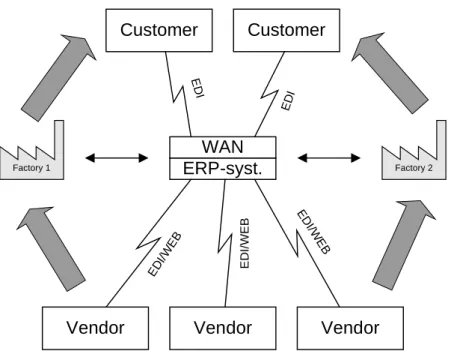
As a part of the process of building up a brand new manufacturing network, the company has formulated a new ICT strategy. Important elements in this strategy are the use of the ERP-system (oracle 11i), the wide area network and a data-mining tool, and not at least how to use these systems together, see figure 5.
Figure 5. The digital work processes of company B
Company B can be described as a parallel network with a marked focus. Each plant is producing the almost same products, but to two different markets (geographically). This means that there is now flow of goods between the plants within the network. There is only a flow of information, know-how and technology between the plants. But if new contracts with others OEM are signed, new plants will be considered and flows of goods between the plants can occur. The ICT structure has to take this under consideration.
The ERP-system works as two separate units, except for general ledger and some other economical functions. Therefore, from a planning and co-ordination point of view the system is like as two independent systems with limited support for network management. On the other hand, the ERP-system eases the uptake of new units in the network. Because, this unit can adapt many of the tested solutions form the other factories and share common economical functionality.
Lessons learned from the case studies
The case studies have shown us that different manufacturing networks have different requirements in how the ERP-systems can support the network. Most demanding is the parallel network as shown in case A. The ERP-systems lacks functionality that must be completed with system design and user involvement and knowledge. By coping with this, Company A have designed an advanced solution and established the SPOC-centres where planners can take the decisions the ERP-systems are not able to do.
Modularity is the most important feature provided by the ERP-system in a serial network. The ERP-systems in this type of networks functions more or less independently, and no other special functionality is needed compered to an independent installation. But, the ERP-system can be used as a drive force for implementing well-tested work processes in the new units in the manufacturing network.
ERP-syst.
Factory 1 Factory 2Customer
Vendor
Customer
Vendor
Vendor
ED I/W EBWAN
E D I ED I ED I/W EB E D I/W E BCONCLUSION
By a thorough presentation of manufacturing networks we have tried to highlight some of the challenges associated with use of ERP-systems in such networks, and how these system can function as the backbone in the information and communication structure for the networks. The manufacturing- and ICT-strategy should be linked together and not be treated as two separated processes. Through our two cases we have showed that both the manufacturing and ICT strategy were developed as a part of a value chain project. This insured that a flexible and competitive manufacturing network with an efficient, integrated and powerful ICT solution. We have showed that ERP-system is well suited to handle many of the support operations (such as finance, order transactions and demand management) in a network, but also fail to give desired decision support in others (e.g. questions regarding distribution and logistics).
REFERENCES
Akkermans, H. A. Bogerd, P. Yucesan, E., 1999, The impact of ERP on Supply Chain Management, Production and Operations Management, INSEAD R&D working paper; 99/72/TM
Boyson, S., Corsi, T.M., Dresner, M.E. and Harrington, L.H, 1999, Logistics and the Extended Enterprise Benchmarks and Best Practices for the Manufacturing Professional, John Wiley & Sons, inc., New York
Browne, J., Harhen, J. and Shivnan, J., 1996, Production Management Systems: an integrated perspective, Addison-Wesley Publishing Ltd, Harlow, England
Christopher, M., 1998, Logistics and Supply Chain Management: Strategies for reducing cost and improving service, Pitman Publishing, London
De Meyer, A. and Vereecke, A., 1994, Strategies for international manufacturing, INSEAD R&D working paper; 94/25/SM/TM
De Meyer, A., Van Dierdonck, R. and Vereecke, A., 1996, Global Plant Networks in European Multinationals, INSEAD R&D working papers; 96/22/TM
Du Bois, F.C. and Oliff, M.D., 1992, International Manufacturing Configuration and Competitive Priorities in Voss, C.A., Manufacturing Strategy: Process and Content, Chapman and Hall
Ferdows, K., 1989, Mapping International Factory Networks, in Ferdows, K., Managing International Manufacturing, Elsevier Science Publishers, Amsterdam
Jagdev, H. S. and Thoben, K. D., 2001, Anatomy of Enterprise Collaboration, in Production Planning and Control, vol. 12, no. 5, p 437-451
Hayes, R.H. and Schmenner, R.W., 1978, How should you Organise Manufacturing?, Harvard Business Review, Jan-Feb, 105-118
Intentia, Various authors. Movex Concept Series 7, MRPII and Movex, 2000.
Lutz, S. and Wiendahl, H.P., 2000, Concept for Production-Management in Networks, in Strandhagen, J.O. et al (ed) Information and Communication Technology in Logistics and Production Managenent, Tapir, Trondheim
Schmenner, R.W., 1982, Making Business Location Decisions, Prentice Hall, New Jersey Upton, D. M. and McAfee, A. P., 2000, A path-based approach to information technology in manufacturing. Int. J. Manufacturing Technology and Management, Vol. 1, No. 1
Vereecke, A. and van Dierdonck, R., 1999, Design and management of international plant networks: research report, Academia Press, Gent
Vollmann T.E., Berry W.L. and Whybark D.C., 1997, Manufacturing Planning and Control Systems, Fourth Edition. Irwin McGraw-Hill
Wortmann, J.C., 1998, Evolution for ERP-systems, Strategic Management of the Manufacturing Value Chain. Proceedings of the International Conference of the Manufacturing Value Chain, Aug ’98 Troon, Scotland, U.K.