International Journal of Distributed Sensor Networks 2018, Vol. 14(4) ÓThe Author(s) 2018 DOI: 10.1177/1550147718768991 journals.sagepub.com/home/dsn
Random traveling wave pulse-coupled
oscillator algorithm of energy-efficient
wireless sensor networks
Zeyad Ghaleb Al-Mekhlafi
1, Zurina Mohd Hanapi
1, Mohamed Othman
1,
Zuriati Ahmad Zukarnain
1and Ahmed M Shamsan Saleh
2Abstract
Energy-efficient pulse-coupled oscillators have recently gained significant research attention in wireless sensor networks, where the wireless sensor network applications mimic the firefly synchronization for attracting mating partners. As a result, it is more suitable and harder to identify demands in all applications. The pulse-coupled oscillator mechanism causing delay and uncharitable applications needs to reduce energy consumption to the smallest level. To avert this prob-lem, this study proposes a new mechanism called random traveling wave pulse-coupled oscillator algorithm, which is a self-organizing technique for energy-efficient wireless sensor networks using the phase-locking traveling wave pulse-coupled oscillator and random method on anti-phase of the pulse-pulse-coupled oscillator model. This technique proposed in order to minimize the high power utilization in the network to get better data gathering of the sensor nodes during data transmission. The simulation results shown that the proposed random traveling wave pulse-coupled oscillator mechan-ism achieved up to 48% and 55% reduction in energy usage when increase the number of sensor nodes as well as the packet size of the transmitted data compared to traveling wave pulse-coupled oscillator and pulse-coupled oscillator methods. In addition, the mechanism improves the data gathering ratio by up to 70% and 68%, respectively. This is due to the developed technique helps to reduce the high consumed energy in the sensor network and increases the data col-lection throughout the transmission states in wireless sensor networks.
Keywords
Wireless sensor network, pulse-coupled oscillators, self-organizing, energy-efficient, synchronization
Date received: 28 September 2017; accepted: 10 March 2018
Handling Editor: Seokcheon Lee
Introduction
The wireless sensor network (WSN) positions itself within the revolutionary network technologies as a credible member.1–3This is due to the enormous benefit of WSNs in diverse fields that affects human life. WSN applications can be classified into two categories, that is, tracking and monitoring.4The main task of tracking applications is to track objects, animals, humans, and vehicles. However, monitoring applications focus on monitoring the environment, health, power, inventory, and process automation. According to Zulkifli et al.,5 the data obtained from the observed ecological
1
Department of Communication Technology and Network, Universiti Putra Malaysia, Serdang, Malaysia
2
Department of Computer Science, University of Tabuk, Tabuk, Saudi Arabia
Corresponding authors:
Zeyad Ghaleb Al-Mekhlafi, Department of Communication Technology and Network, Universiti Putra Malaysia, 43400 Serdang, Malaysia. Email: [email protected]
Zurina Mohd Hanapi, Department of Communication Technology and Network, Universiti Putra Malaysia, 43400 Serdang, Malaysia. Email: [email protected]
Creative Commons CC BY: This article is distributed under the terms of the Creative Commons Attribution 4.0 License (http://www.creativecommons.org/licenses/by/4.0/) which permits any use, reproduction and distribution of the work without further permission provided the original work is attributed as specified on the SAGE and Open Access pages (http://www.uk.sagepub.com/aboutus/ openaccess.htm).
phenomenon are only required to be occasionally sampled and transported to the base station. Therefore, it is imperative to create a smart mechanism that could further advance the performance of sensor nodes in reducing energy consumption, particularly among the process of transmission.2,6,7
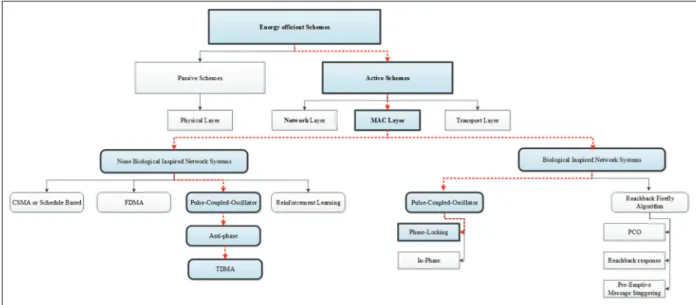
In this study, energy efficiency mechanism was pro-posed with the expectation of its benefits through the expanded number of sensor nodes and data packet size, specifically from the aspect of energy consumption and data gathering ratio. Moreover, the recommended ran-dom traveling wave pulse-coupled oscillator (RTWPCO) mechanism is able to spread the traffic load frequently and gradually over the sensor nodes during the process of transmission, which consequently enables the production of an improved network life-span and allows the sensors to fail. On top of that, low energy consumption is possible through the use of mul-tihop communication of each node with the sink that could be done by the proposed mechanism. Based on the above discussion, Figure 1 illustrates the energy-efficient taxonomy that encompasses two main mechanisms, which are biological-inspired network sys-tem and non-biological-inspired network syssys-tem.
The RTWPCO algorithms focused on improving energy consumption ratio and data gathering ratio to some sort of applications. Using this self-organizing strategy, the WSN develops energy consumption and data gathering, thus resulting into a prolonged network lifespan.
For the purpose of this study, a self-organized for-mula was established from the traveling wave pulse-coupled oscillator (TWPCO) mechanism developed by Al-Mekhlafi et al.8 through randomization-based mechanism. The main difference between RTWPCO
and TWPCO is obvious because TWPCO ignored the high energy usage consumed during the synchronized transmission scheduling between sensor nodes in WSN. The proposed mechanism is not complicated and easy to operate compared to the other mechanism. Therefore, the aim of the proposed method is to reduce energy consumption and increase data gathering according to WSN conditions. This method will avoid packet collisions during data traffic between sender and receiver, resulting better data gathering, as well as minimized energy usage of sensors in transmission phase.
The flow of this article is described as follows: In section ‘‘Related works,’’ the previous works related to this study are thoroughly discussed. Section ‘‘Proposed algorithm’’ illustrates the suggested mechanism in detail. In section ‘‘RTWPCO mechanism design,’’ the purpose and major processes of the proposed method are described and discussed with details. Moving on, the performance assessment of the proposed method is presented in section ‘‘Performance evaluation of RTWPCO.’’ Finally, an overall summary of this study is provided in section ‘‘Conclusion.’’
Related works
In this section, an extensive analysis of the previous works related to this study is presented together with the status of the recommended approach. In terms of energy efficiency, a self-organizing method is usually chosen in transmission scheduling in order to synchro-nize the time. Energy-efficient transmission scheduling is ensured in WSNs by explicit embedding energy mini-mization protocols into the underlying sensing model of the sensors, for example, minimizing the per packet
energy consumption9–11 or avoiding preventing high energy usage of any single node within the network. Another vital specification of WSNs revolves around a self-organizing capability which allows the sensor nodes to relocate their new neighbors (as a result of battery exhaustion or an immediate breakdown of some nodes in the network) in the case of dynamic network topol-ogy changes. Energy efficiency is the major focus of constructing any sensor nodes due to the inadequate and non-rechargeable power resource.12
According to the literature,13–15the traditional data collection mechanism suggests that a tree topology rooted at the sink is secured due to the many-to-one advantages of the monitoring environmental applica-tions. Moreover, sleep timings and data packet trans-mission are separated to avoid high energy consumption and low data gathering. In these mechan-isms, sensor nodes are expected to transport the control packets to secure the sensor network topology, to cooperate with the surrounding sensor nodes, or to pre-vent high energy consumption and low data gathering among the surrounding sensor nodes. In the case of self-organizing, sensor nodes must transport the sup-plemental control packets to re-establish the topology which could be energy- and time-consuming.
Various researchers in wireless communication have established different types of energy-efficient pulse-coupled oscillator (PCO)-based models. The PCO model is possible to be adopted in establishing WSNs.7,8,12,16–21 Similar to sensor nodes, the energy efficiency of PCO models demonstrates decentraliza-tion performance as well as inadequate individual pro-cessing potentials. In fact, communication is greatly confined.
According to Taniguchi et al.,12 a self-organizing mechanism that depends on phase-locking in PCO was first created. The purpose of this particular mechanism was to circulate the data of the sender node to the sink node inside WSN in order to prevent deafness problem. Following it, a simple randomization-based mechanism and a desynchronization-based mechanism were devel-oped by focusing on the anti-phase provided in the PCO model. The purpose of creating both mechanisms was to solve the issue of an unnecessary contact among sensors and at the same time sustain the same hop count attained by means of the energy efficiency ratio and the data gathering ratio. However, the desynchronization-based mechanism is appropriate to be applied to WSN, as it requires a high level of data collection and efficiency and clarity of mechanism instead of the data gathering ratio.
In Phung et al.,22 a multichannel protocol for high-bandwidth WSNs was introduced by incorporating the time-division multiple access (TDMA) to the frequency-division multiple access (FDMA). In this case, the aim was to solve the issues of deafness and
packet collision. In other words, it aimed to meet the demand of scheduling of transmissions. Therefore, it was augmented by choosing learning for collaborated scheduling and routing in each node, which is in agree-ment with the service quality (i.e. packet delivery ratio, end-to-end latency, and energy waste factor). As expected, this study managed to accomplish the pre-dicted conditions without any complications, which include a minimal latency and a packet loss. Furthermore, it was reported that the developed proto-col could enhance the operations related to an end-to-end delivery rate and an end-to-end-to-end-to-end latency, including making the energy efficiency possible compared to other protocols.
Leidenfrost and Elmenreich23 proposed a self-organizing scheme based on the biological features of firefly. Moreover, this method utilizes the PCO model to synchronously emit light flashes to attract mating partners, as a result the timing of light flashes will dis-tribute in a given time window without affecting the quality of the synchronization. In their study, no dedi-cated synchronization node was required and thus there was no single point of failure. Moreover, the additional rate calibration mechanism allows a longer resynchronization interval, and the use of cheap oscilla-tors with high drift rates is usually featured in low-cost nodes. It is also possible to achieve a synchronization precision which is lower than 1 ms.
Nu´n˜ez et al.24 proposed the implementation of pulse-coupled synchronization in an acoustic event detection system that aimed to locate the source of acoustic events by means of an acoustic capable WSN. The distributed localization with pulse-coupled syn-chronization over a pure-broadcasting infrastructure-free ad hoc network seems to be the ideal configuration to solve the acoustic source localization problem.
Al-Mekhlafi et al.8presented a TWPCO using a self-organizing mechanism for energy-efficient WSNs. This proposed method neglected packet collisions as a result of synchronized transmission scheduling between sen-sor nodes and recorded high energy consumption ratio and fewer data gathering ratio.
Kamimura and Tomita25 suggested a novel self-organizing network coordination framework (SoNCF) for WSNs for information-gathering applications in large-scale ad hoc wireless networks. The framework supports numerous nodes’ P2P communication with a decentralized time-division technique for transmissions using a simplified PCO model. The proposed frame-work demonstrated the feasibility of SoNCF using soft-ware simulations by comparing the SoNCF and the traditional carrier-sense multiple access with collision avoidance (CSMA/CA) method. A simulation of the extended method successfully transferred data from 59 nodes in a mesh network to a base node with no packet loss.
Based on the above review, the previous works assisted this study to achieve a better understanding as well as to enable communication phases, acquisition, and network synchronization to be differentiated. However, the proposed mechanisms that have been reviewed above are not appropriate to be applied to WSNs due to the fact that it must adhere to the topology.
Proposed algorithm
Radio communications of sensor nodes contribute to the rising energy costs on the sensor node, especially in the active mode (receive and transmit). As a matter of fact, the energy consumed in transmitting and receiving modes are larger compared to sleep and idle modes that they are assumed to be negligible in this proposed framework. A number of different sensor network applications will result in various demands and specifi-cations, which cause it to be more complicated in hav-ing identical requirements for all applications. For instance, the adoption of the TWPCO in the energy effi-ciency process is very energy-consuming, thus making it inapplicable for other applications.8 Alternatively, the RTWPCO is preferred because it does not absorb a lot of energy, thus making it possible to maximize the life-span of the whole network. According to the litera-ture,13–15 referring to the traditional mechanism of collecting data, a tree topology that is rooted at the sink is not changed as a result of many-to-one features of the monitoring applications. Moreover, the data packet transmission and the sleep timings are being separated for the purpose of avoiding radio interference and high power. In this case, sensor nodes are required to assign control packets to sustain the network topology and integrate themselves with the surrounding sensor nodes, or avoid any interference and high power among the surrounding sensor nodes. In the case of a network topology change, sensor nodes have to transport extra control packets for the purpose of strengthening the topology because it requires more energy and time.
The prime mechanism behind the self-organizing algorithm is to utilize the parameter information from the application requirements to construct a conclusion about the suitable value of the offset ti. The provided
information that points to the kindliness of the applica-tion to the energy-efficient delay as an instance can be used to tune some variables, for example, the value of offset ti among the sensor nodes. Adjusting the offset
ti value according to the application requirements in
energy efficiency has a significant impact on the data gathering ratio and power consumption ratio at each sensor node. To evaluate the proposed RTWPCO mechanism, we have integrated the self-organizing TWPCO algorithm with randomization-based algo-rithm, which will be discussed in the next subsection.
TWPCO algorithm
The PCO technique introduced in the litera-ture8,18,20,26,27requires the performance of oscillators to be coordinated with the fact that an oscillator only fires when its timer reaches 1. According to the conventional method of PCO, there are several synchronous firefly behaviors, namely, in-phase, anti-phase, and phase-locking.21 For in-phase behavior, the oscillators are totally integrated, while for the anti-phase behavior, the oscillators must be integrated with an equal inter-val. The phase-locking behavior can only be integrated based on PCO synchronization, for example, in travel-ing waves, the synchronization is only possible with the presence of a constant offset. Overall, it can be con-cluded that up to this moment, this is the only study that has chosen to apply both biologically inspired net-work systems based on phase-locking of PCO model and non-biologically inspired network systems based on the anti-phase of PCO model. Biologically inspired network systems neglects high power utilization in the network as a result of synchronized transmission sche-duling between sensor nodes, therefore high energy consumption ratio and fewer data gathering ratio was recorded. Hence, non-biologically inspired network sys-tems are used in order to counteract high power utiliza-tion in the network to get better data gathering, as well as to minimize the energy needed for the sensor nodes during transmission.8
The details of the process are described as follows: Given a set ofNoscillatorfi; where1iN and each oscillator fi is associated with a phase fi (such that
fi2 ½0,T). However, the passing of time has caused thefi to shift towardT(which is the maximum). AtT, the oscillator fi fires before fi gets back to zero. Similarly, the oscillator fj which is doubled with the firing oscillatorfi is prompted, thus causing the corre-sponding phase fj to be moved by an infinitesimal amountD(fj), wherefj=D(fj) +fj.
The totalD(fj) is given by
fj=D(fj) +fj ð1Þ whereD(fj) expresses the phase response curve (PRC) that is commonly applied by researchers in evaluating the performance of a system without the knowledge of the mechanisms responsible for the behavior.27,28 The PCO firing is performed by utilizing the traveling wave equation based on phase-locking of the PCO model. In particular, the proof of equation (1) is developed (D(fj)) in accordance with several other models such as the quadratic integrate and fire (QIF) model,27 the radial isochron clock (RIC) model,27 and the PRC function and satisfies:16
DQIF(f) =PRCa(1cos (2pf)) ð2Þ
wherePRCa=0:5,1:0, 0:5. In this model, an
oscilla-tor disregards all stimuli at the time of firing. In addi-tion, it identifies multiple stimuli received simultaneously as one stimulus. For a given value of PRCa, the PRC can both delay and advance the firing.
As PRCa approaches the value of one, the PRC
becomes singular. It should be noted that this occurs regardless of the value of at which the PRC vanishes: t= 0, T. For the smallest values ofPRCa, the QIF of
PRC has a particularly simple form. RIC model
DRIC(f) = PRCasin (2pf) ð3Þ
wherePRCa=0:5,1:0, 0:5. In this model, an
oscilla-tor disregards all stimuli at the time of firing, and it also identifies multiple stimuli received simultaneously as one stimulus.
The PRC function
To create a desired TWPCO, regardless of the initial phase, an oscillator must advance its phase toward 12t when it is catalyzed throughout (0f\1t). In contrast, its phase must move away from 12t
when it is catalyzed throughout (1t\f\1). Therefore, we have the following conditions on the PRC to create a TWPCO 0\D(f)1tf (0f\1t) D(f) =0 (f=1t) 1tfD(f)\0 (1t\f\1) 8 < : ð4Þ
From equations (3) and (4), we can generate the fol-lowing new equation
Ds(f) = PRCasin
p
1tf+PRCb(1tf) ð5Þ Moreover, from equations (2) and (4), equation (6) is formed as Ds(f) =PRCacos p 2(1t)f+PRCb(1tf) ð6Þ wherePRCa((PRCb(1t))=(p)\PRCa((1PRCb)
(1t))=(p)) and 0\PRCb1 are the factors that
determine the characteristics of PRC.
Figure 2 presents the evaluation of PRC (Ds(f)) that
satisfies the RIC model and the QIF model where PRCa=0:1andPRCb=0:5must be located in the two
lines whent=0:2.
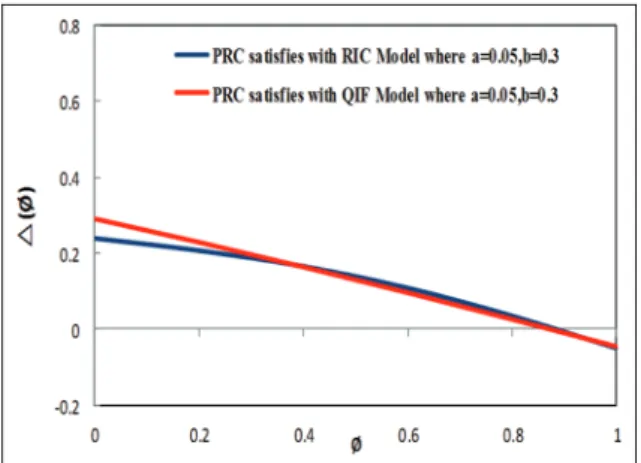
Figure 3 presents the assessment of PRC (Ds(f)),
which also satisfies the RIC model and the QIF model wherePRCa=0:5and PRCb=0:3 need to be located
in the two lines whent=0:2.
By comparing the above evaluations as shown in Figures 2 and 3, the PRC that satisfies the QIF model in equation (6) obtained superior results than the PRC model that satisfies the RIC model in equation (5). Our new generated equation (6) indicates that the PRC satisfies the QIF model as assisted in the firefly and pacemaker. The pacemaker may be related to the TWPCO mechanism broadcast to oscillator number of sensor nodes N forward the pacemaker information together with a constant offset phase-variation1t.
As a result, the TWPCO equation proved from equa-tion (6) and applied in equaequa-tion (1) catalyzes the sensor node and modifies its phase as follows
fj=fj+PRCacos
p
2Tfj+PRCb(Tfj) ð7Þ Figure 2. Evaluation of PRC(Ds(f))with RIC model and QIF
model.
Figure 3. Evaluation of PRC(Ds(f))with RIC model and QIF
On the whole, the traveling wave phenomenon is possible to be arranged in data gathering and diffusion according to the biologically inspired network systems of phase-locking in the PCO model.2,8,9,11,20 In the TWPCO model, the collected data are being broad-casted by individual sensor in the range of its timer. Therefore, this allows the network to amend the phase of its own timer whenever a transmission from another node is spotted. It is important for a sensor node to cooperate with its surroundings to allow itself to get into the phase-locking state in which the sensor data are discharged. In this scenario, the timing of a message being discharged is considered as a traveling wave phe-nomenon, in which the center takes place at the sensor node and attempts to either gather or disperse informa-tion from or to all sensor nodes.
In this case, the phase timerfiand levelliincluding
offset t are present in each sensor node ni (where
1iN). According to the formula, the level field is able to signify the sensors hop count from the base sta-tion. At the beginning of the process, every level of the sensor is appointed to a high value. The offsettrefers to the interval between the nodes of level l and l2 1 which takes place amid the communication of data. Therefore, a transmission which comprises adminis-tered information and sensor data is delivered by the sensor nodeni when the phasefireachesT. The phase
will come back to 0 following the previous step. Therefore, when the message by nodenjfromniat level
li\ljis collected, the nodelj will be altered to its level
aslj=li+1.
TWPCO mechanism suggests that the phase will be activated and adjusted by the node as presented in equation (7), where considering that PRCa and PRCb
are the determinants that influence the pace of assem-blage. Without considering the introductory phase of nodes, the traveling wave phenomenon which is in accordance with phase-locking in the PCO is executed amid the regular transmission among sensor nodes by applying equation (7) in the PRC function.
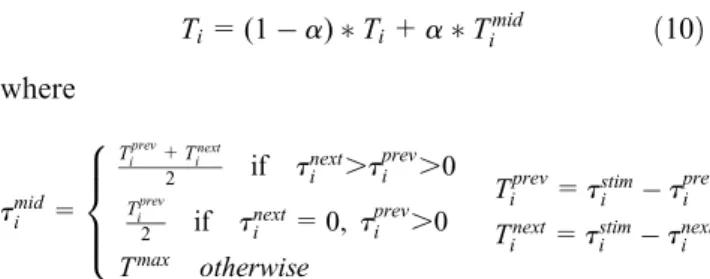
Randomization-based algorithm. In the randomization-based formula, offset tiis inconstantly picked between
zero andtmax as presented below
tprevi =teTi,maxt \ttransi t ð8Þ tnexti =teTi,tmin\ttransi t ð9Þ whereTirefers to the set of time estimated for
transmis-sion of messages inei. However, they will be considered
as zero iftPrev
i ortnexti is not achieved. Following it, the
relation is adopted as a guide for the nodenito alter the
offsetti Ti= (1a)Ti+aTimid ð10Þ where tmidi = Tiprev+Tnext i 2 if t next i .t prev i .0 Tiprev 2 if t next i =0, t prev i .0 Tmax otherwise Tiprev=tstimi t prev i Tnext i =tstimi tnexti 8 > > < > > :
It is important to understand that in the randomization-based formula, the sensor node ni
nei-ther stores message communication nor comprises any information of message transmission timing Fi in the
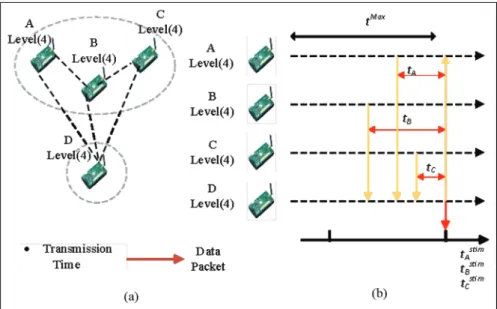
messages. However, this formula is not really helpful in solving the hidden node issue despite it is considered as uncomplicated, and what it only needs is a minimum control overhead compared to other mechanisms. From Figure 4, it can be seen that both the message transmission timing and offsetti with sensor nodes are
stable when the randomization-based formula is applied in the process. Referring to the same figure, it can be observed that sensor nodes A, B, and C share the similar hop counts from the sink. In this case, the communication broadcast timings are circulated along with the offset t. It was observed that both sensor nodes A and C acted as two-hop neighbor sensor nodes, but no prompt transmission occurred between them. Regarding the RTWPCO mechanism, informa-tion must be achieved from a single-hop upstream neighbor sensor node, specifically sensor node D as shown in Figure 4. This aims to prevent massive utiliza-tion between the two-hop neighbor sensor nodes. The organized information of sensor node ni has a timerti
and keeps phasefi(such thatfi2 ½0,T), levelli, offset
ti(0\titmax), communication broadcast timing table
ei, and sensor data Di. T refers to data gathering
period, while levelli signifies the number of hops from
the sink that was initially set to a high value by keeping in mind that a sink always contain the level of 0. Offset
tisets the communication broadcast period among
sen-sor node ni and a sensor node, thus triggering sensor
nodenithat was originally fixed totmax. It is important
to acknowledge that sensor node density highly influ-ences the process of setting the greatest offset tmax,
communication broadcast timing table ei, and sensor
dataDi. Moreover,eiis utilized to keep information on
communication broadcast timing of sensor node nj
within two hops from sensor nodeni.
Figure 5 depicts the pseudocode of the randomization-based algorithm and offset ti with
sta-ble sensor nodes when applying the randomization-based algorithm, thus providing the value of tas illu-strated in Figure 4.
Additionally, even if the receipt of the message satis-fies lj=li1, node ni develops its communication
broadcast timing tableei as follows. Initially, it utilizes
the received communication broadcast timing informa-tion Fj to compute the estimated communication
broadcast timettrans
(j;k) =tfj;k of nodenkwhich refers to
a single or two-hop neighbor nodes achieved by ni.
Without any access to node nk in its communication
broadcast timing table ei, node ni will still insert a
recent access ei;k= (k,li,ttrans(j;k)) to the table. Moreover,
assuming that an access for node nk is present in
its communication broadcast timing table ei and
ttrans
(i;k).ttrans(j;k) is satisfied, node ni writes the access as
ei;k= (k,li,ttrans)(j;k) .
RTWPCO mechanism design
In this article, RTWPCO model was classified into two parts. First part involves the use of phase-locking
TWPCO that is related to sensor nodes, which was dis-covered in the flashing synchronization behavior of fireflies, which requires the sensor node to transmit the data packet to the base station or sink during transmis-sion. The second part is using random method on anti-phase of the PCO model that uses the TDMA protocol in order to minimize the high power utilization in the network to get better the data gathering of the sensor nodes during transmitting.
Multiple factors were classified into several varied categories that are the sensor node, the method, the energy model, the CSMA/CA model, and the equation. The sensor node factors are the packet phase size, the packet header size, the data packet size, and the maxi-mum number of nodes. The methods used in the devel-oped simulator are built using Java programming language running on Microsoft Windows 7 Home Premium 64-bit edition. The energy model factors for MICAz29are the initial energy, the transmit power, the receive power, the idle power, the sleep power, and the transmit data rate. The CSMA/CA factors30 are sented in Table 2. Finally, the notations factors are pre-sented in Table 1.
A fundamental sensor node for the base station or the root node and surrounding sensor nodes of the rec-ommended methods in the sender were generated and deployed. These nodes were deployed with the inten-tion to the width (Y) and the height (X) of deployment area based on uniform random distribution between 0.0 and 3.0, which is offered by the Java programming language. The generated sensor nodes were then repre-sented byX, Yvalues (i.e. two-dimensional (2D) loca-tion within the deployment area), the transmission range value, and the initial energy value. For
Figure 4. Message broadcast timing and offset in the randomization-based algorithm: (a) level and (b) time.
estimation, the proposed mechanism utilizes a WSN. After generating the nodes, it was crucial to figure out the location of the radio range by utilizing the follow-ing equation function of distance7,21
d=
ffiffiffiffiffiffiffiffiffiffiffiffiffiffiffiffiffiffiffiffiffiffiffiffiffiffiffiffiffiffiffiffiffiffiffiffiffiffiffiffiffiffiffiffiffiffiffiffi
(X2X1)2+ (Y2Y1)2 q
ð11Þ It is important to validate that all sensor node pack-ets in the same radio range with the value of 50 in order to allow for the sensor nodes packet to be recorded. All vital parameters for the sensor node packet must be programmed, particularly the parameters of CSMA/ CA model parameters of ZigBee 802.15.4 as presented in Table 2.29
Figure 6 semantically illustrates that the sensors are deployed randomly with the restriction of height, X= 100 m and width Y= 100 m of the deployment field while the base station is placed at the center X= 50 m*Y= 50 m. In addition, sensor nodes are deployed randomly with no prior assumptions regard-ing the connectivity and the position.
This article mainly focuses on the aspect of naming the mechanism of energy consumption operation, trans-mitting operation, and receiving operation:7,21
1. Energy consumption operation.
Energy consumption event in WSN9,10,31 has sleep, idle, transmit, and receive modes, which are mainly
attributed to the radio system in active mode. The energy consumed in transmit and receive modes are large compared to sleep and idle modes.
(a) Sleep mode
ConsumEnergy=Esleepadvphase ð12Þ
where Esleep is the sleep power that measures
1mA310633V=0:000003(W) by MICAz energy
model, andadvphaseis calculated by equation (7). (b) Idle mode
ConsumEnergy=Eidleadvphase ð13Þ
where Eidle is the idle power that measures (W) in
MICAz energy model, and advphase is calculated by equation (7). (c) Transmit mode ConsumEnergy=ETX Packetsize Datarate ð14Þ where ETX transmits power that measures (W) in
MICAz energy model, Packetsize is data packet size
that measures (bit), andDataratetransmits data packet
rate that measures (bps) in MICAz which is equal 250,000bps the WSN communication bandwidth.
Table 1. Specification of notations.
Notations Specification
PRCaandPRCb PRCaandPRCbare parameters that determine the speed of convergence.
D(fi) D(fi)is called phase response curve (PRC) which commonly used by researchers to evaluating the performance of a system without knowing fundamental scheme of behavior.
i iis the number of oscillator where 1iN
CSMA/CA The CSMA/CA technique is used for the process of message transmission.
l The level indicates the number of hops from the base station, and is initialized with a large value.
n The number of sensor nodes.
t The offset defines the interval of message transmission between a sensor node of levelland one ofl21.
T Tis a time which is the maximum.
fi fiis associated with a phasefi(such thatfi2 ½0,T)
CSMA/CA: carrier-sense multiple access with collision avoidance.
Table 2. Parameters of CSMA/CA.
Parameters CSMA parameters
Value Specification
CCA_DURATION 0.000128 Clear Channel Assessment ccaDetectionTime (s) (0.000128 = 128ms) BACKOFF_UNIT 0.001000 Base unit for all backoff calculations// (802.15.4 default: 320ms) macMinBE 1 Minimum backoff exponent (802.15.4 default: 3 (0–3))
aMaxBE 3 Maximum backoff exponent (802.15.4 default: 5) macMaxCSMABackoff 4 Maximum number of backoffs (802.15.4 default: 4 (0–5))
(d) Receive mode:
The receive power can be classified into listening and receiving.
Listening
ConsumEnergy=ERXEidleCCADuration ð15Þ
where ERX is the receive power that measures (W) in
MICAz energy model,Eidleis the idle power that
mea-sures (W) in MICAz energy model, and CCADuration is
the clear channel assessment CCADetection Time (s)
(0.000128 = 128ms) in carrier-sense multiple access (CSMA) model.
Receiving
Consum Energy=ERX Eidle
Packetsize Datarate
ð16Þ whereERX is the received power that measures (W) in
MICAz energy model, Eidle is the idle power that
measures (W) in MICAz energy model,Packetsizeis the
data packet size that measures (bit), and Datarate is
transmitted packet data rate that measures (bps) in MICAz, which is equal to 250,000 bps, the WSN com-munication bandwidth.
2. Transmitting operation.
Sensor node behavior refers to the performance of the sent message after a series of cycle and when the nodes become stable. Previously, we paragraph men-tioned that the performance of a sensor node ni is
dependent on its current phasefi, in which the sensor node obtains control messages from the surrounding nodes:
(a) Wake-up.
The sensor nodeniis considered to be in the wakeup
state when the phase fi=T tmax. In this phase, the
message transmission timing tableei, and sensor data Figure 6. Generate and deploy the sensor node and base station.
Diare discharged by the node while waiting for the
mes-sages to be sent by the neighbors.
(b) Message reception from downstream nodes. When the message is obtained from its downstream node nj at timet, wherelj=li+1, it is then included
to the overall dataDi. Similarly, the nodenjexpresses a
new item being registered e(i,j)= (j,l,t) into its data
transmission timing tableei.
(c) Message reception from same hop nodes. When a message is obtained from another nodenjat
timet wherelj=li, the new item will be registered by
the nodee(i,j)= (j,l,t) into its data transmission timing
tableei.
(d) Message transmission.
Following the phasefi=T, a broadcast packet will be transported by the nodenito the surrounding nodes
in the wakeup state including those within the transmis-sion range. The phase fi returns to zero and time t is recorded as the transmission time ttrans
i when T is
achieved. The CSMA/CA technique is utilized amid the process of message transmission.
(e) Message reception from upstream nodes. The nodenistays in the wakeup state forTmaxin the
process of returning to zero. In the process of obtaining the message from its upstream node ni at time twhere
lj\li, the node ni will adapt to its level as li=lj+1,
thus causing its phase to change along with equation (7).
3. Receiving operation.
While waiting for the message to arrive and in fulfill-ing the condition ofli=lj+1, the transmission timing
tableeiof nodeniis revised. The first step involves the
process of applying the transmission timing informa-tion of the received messageFjin determining the
mes-sage transmission time ttrans
(j,k)=tf(j,k) of node nk,
whereby nk expresses a one- or two-hop neighbor of
node ni. When the new registry of nodenk is absent in
the message transmission timing tableei, it will be
auto-matically created by node ni e(i,k)= (k,li,ttrans(j,k)) in the
table. Contrastingly, when a new item is present for nodenk in its message transmission timing tableeiand
when the conditionttrans
(i,k).ttrans(j,k) is fulfilled, nodeni
over-writes the entry as e(i,k)= (k,li,ttrans(j,k)). When phase fi
reaches Tmax and node ni is accelerated, the node will
revise its offset Ti. If it is not conducted in the right
manner, then the node has to wait for a stimulation, which can only be achieved after a message from an upstream node is obtained. Nodeniis associated with a
tPrevi andtnexti as follows
tprevi =teTi,maxt \ttransi t ð17Þ tnexti =teTi,tmin\ttransi t ð18Þ where Ti expresses the set of time estimated for
trans-mission of messages in ei. Assuming that tPrevi or tnexti
are not achieved, it is considered to be zero. The offset
tiis then amended by the nodenibased on the relation.
Alternatively, use equation (19)
Ti= (1a)Ti+aTimid ð19Þ where tmid i = Tiprev+Tinext 2 iftnexti .t prev i .0 Tiprev 2 ift next i =0,t prev i .0 Tmaxotherwise, Tiprev=tstim i t prev i Tnext i =tstimi tnexti 8 > > < > > :
Performance evaluation of RTWPCO
In this study, an observation and an evaluation of the simulation experimental results were conducted for the purpose of assessing the performance under numerous WSN environments. According to the experimental results obtained, our proposed mechanism plays a cru-cial role in improving energy efficiency as well as data gathering. These particular improvements achieved by the RTWPCO mechanism are resulted from the process of adapting to the quality evaluation of the functions, thus further assisting the process of improving the accuracy of the firefly based on the formula of the PCO.21 In verifying the RTWPCO mechanism, the results of the experiments were compared to those obtained through the TWPCO mechanism8 and PCO mechanism. In the following part, the experimental setup and the evaluation of the accuracy and results of the RTWPCO mechanism are further clarified.Simulation environment
The suggested RTWPCO mechanism was replicated by setting up various sensor nodes. The reproduction of the experiments was carried out with a laptop (Intel CoreTM i52410M, CPU at 2:30 GHz and 2:30 GHz, 4GB RAM, Windows 7) by utilizing a simulator imple-mented in Java. In this manner, whenever a node receives transmission messages from two different nodes at the same time, the recipient node would not be able to receive both messages. The data gathering ratio cycle,Twas set to 1 s, while the highest substitute,tmax,
was set to 0.1 s. According to equations (7) and (10), PRCa,PRCb, andawere set to0:01,0:5, and0:5,
respec-tively. The introductory phase readings were unsystemati-cally arranged. The sizes of the message header and the individual sensor data were set to 2B, while message trans-mission control information was fixed to 1B. The CSMA/ CA parameters included a backoff time slot of 1 ms with a backoff of 4 ms. Following it, the results of the RTWPCO mechanism were compared to those of TWPCO8and PCO. Moreover, in order to maintain the objectivity, the TWPCO and PCO were re-implemented. This involved using the Java programming language so that both methods could operate or run using similar simulators together with constant software and hardware platforms. As presented in Table 3, a concise analysis of other para-meters used in the simulation is further explained.
Evaluation of the performance metrics
This section is concerned with the calculation and benchmarking of the performance metrics of the pro-posed mechanism using the similar metrics for other mechanisms. Similar to the other mechanisms of energy efficient, the performance of our RTWPCO mechanism was measured in relation to two significant effects: the effect of the number of sensor nodes and the effect of data packet size. Our mechanism mainly aims at updat-ing the system performance through the reduction of the consumed energy and extension of the network life-span. The metrics of the performance discussed are the data gathering ratio and the energy efficiency ratio. Data gathering ratio. The data gathering ratio is described as the ratio of the overall sensor node data collected at the sink per cycle. This ratio is calculated as follows Data Gathering= Pn i=1 Topcksink SNC ð20Þ
wherenis described as the number of sensor nodes in the network, whileTopcksink refers to the total number
of packets which are sent to the sink node for each sen-sor nodei. It is important to note thatSNCis the sen-sor nodes for each cycle.
Energy efficiency ratio. The energy efficiency ratio refers to the ratio of the overall consumption of energy to the number of packets, which are accepted by the core node. This particular ratio is measured in the following manner Energy Efficiency= Pn i=1 ToEnc(i) Topcksink ð21Þ where n expresses the number of sensor nodes in the network,ToEnc(i) is the total energy consumption for each sensor node i, and Topcksink is described as the
total number of packets sent to the sink node.
Discussion of experimental results
The main preliminary outcomes of this study obtained by comparing the efficiency of the proposed RTWPCO mechanism to the TWPCO and PCO mechanisms are reviewed.8 The outcomes are centered on two main facets: increasing the number of nodes from 10 to 100 sensor nodes and increasing the data packet size from 8 to 800 bits in the transmission state due to the packet transmission based application requirements as shown in Figures 7–10. In this case, the proposed formula pre-sents better behaviors in terms of data collection and energy conservation compared to the TWPCO and PCO formulas. With the results shown, the application of mathematical and biological models of the RTWPCO mechanism to WSN provided evidence of the suitability and strength of this mechanism.
In Figure 7, the TWPCO model at nodes 90 and 100 consumed 4.13808 and 5.27089 (m Joule) of energy,
Table 3. Parameters setup.
Parameters Values
Scenario I Scenario II
Channel frequency (GHz) 2.4 2.4
Number of nodes 10, 20, 30, 40, 50, 60, 70, 80, 90, 100 30
MIN_TIME_STEP 0.00001 0.00001
Packet data size (bits) 16 8, 16, 40, 80, 160, 400, 800
Energy model MICAz MICAz
Data rate (kbps) 250 250 Transmit power (mW) 52.2 52.2 Receive power (mW) 59.1 59.1 Idle power (mW) 60 60 Sleep power (mW) 3 3 INITIAL_ENERGY (Joules) 100 100
respectively, whereas the recommended RTWPCO mechanism only dominated about 1.78087 and 2.30856 (m Joule). Hence, it is demonstrated that the suggested model reduced the energy efficiency up to 48% com-pared to the TWPCO and PCO models for every node. As a result, the ratio of consumed energy achieved through the RTWPCO mechanism is approximately less than the TWPCO and PCO mechanisms. This par-ticular outcome acts as one of the inputs to the pro-posed mechanism reported in this study. Meanwhile, the improvement is the result of various categories of the levels of nodes.
Similarly, Figure 8 shows that the collection of data reduced or declined, while the amount of sensor nodes became greater in both mechanisms. In the process of increasing the number of sensor nodes from 10 to 100 nodes, the ratio of data collection of the RTWPCO mechanism tended to reduce when the number of sen-sor nodes reached above 40, which is believed to be the effect of the simulation results. When the RTWPCO, TWPCO, and PCO mechanisms are evaluated, the ratio of data collection of the RTWPCO mechanism is 70% greater due to the beneficial methods provided by the proposed mechanism. Furthermore, the ratio of data collection of the RTWPCO mechanism is approxi-mately 100% when the number of sensor nodes was below 40, which is considered as one of the
contributions of the proposed mechanism resulted by the classifications of the levels of nodes. By contrast, the packet data size of the RTWPCO mechanism seemed to be greater compared to the TWPCO and PCO mechanisms due to the presence of broadcast tim-ing information of the packet data.
The data collection ratio and energy efficiency ratio based on the number of sensor nodes in the transmis-sion state in the RTWPCO mechanism obtained super-ior results to counteract high energy and lost data based on the application requirements of WSN. This implies that our proposed mechanism tolerates the increasing number of received nodes.
As presented in Figure 9, the results of the suggested RTWPCO mechanism are compared to the TWPCO and PCO mechanisms, particularly on the total energy usage of the nodes according to the data packet size when the number of sensor node is equal to 30. It is clear that the data packet size of sensor 100B seemed to consume a huge amount of energy compared to the rest such as 50B during the transmission, thus causing faster energy drain. Meanwhile, the suggested RTWPCO mechanism spread the large data packet size to the high energy level (EL) nodes instead of the critical nodes. It makes the amount of energy used decreased by the data packet size in sensors 50B and 100B up to 15% and 55%, respectively. Therefore, it can be concluded that the consumed energy ratio of the RTWPCO mechan-ism is approximately less than the TWPCO and PCO for all data packet sizes due to the presence of greater amount of received packets in the TWPCO and PCO mechanisms that makes it more effective.
As presented in Figure 10, the outcomes of the sug-gested RTWPCO mechanism are compared to the TWPCO and PCO mechanisms in terms of the overall data collection of the nodes based on the data packet size, particularly when the number of sensor node is equal to 30. Apart from that, it was also observed that the data gathering reduced in both mechanisms when the data packet size was bigger. With the increase in the data packet size of sensor nodes from 8 to 800 bits,
Figure 7. Energy efficiency ratio based on number of nodes in the transmission state of RTWPCO mechanism.
Figure 8. Data gathering ratio based on number of nodes in the transmission state of RTWPCO mechanism.
Figure 9. Energy efficiency ratio based on data packet size in the transmission state of RTWPCO mechanism.
the scale of data gathering of the RTWPCO mechan-ism was found to be decreasing when the data packet size was greater than 2B. When the RTWPCO, TWPCO, and PCO mechanisms were evaluated, the data gathering ratio of the RTWPCO mechanism counted for 68% more than the TWPCO and PCO mechanisms. Moreover, the data gathering ratio of the RTWPCO mechanism reached approximately 100% when the data packet size was below 2B. Based on the results, the RTWPCO mechanism in data gathering ratio was as equal as TWPCO mechanism when exceeded 100B. This equal ratio of data gathering achieved by the two mechanisms is attributed to the limited memory of sensor nodes.
Conclusion
This article presented an RTWPCO mechanism, which is a self-organizing technique for energy-efficient sensor networks adapted from firefly synchronization. The designed RTWPCO classified into two stages. First stage involved the use of phase-locking traveling wave pulse-coupled, which requires the sensor node to trans-mit the data packet to the base station during transmis-sion state. The second stage is using random method on anti-phase of the PCO model that uses the TDMA protocol in order to minimize the high power utiliza-tion in the network to get better the data gathering of the sensor nodes during data transmitting. From the simulation results, the proposed RTWPCO showed a better performance than the TWPCO and PCO, which reduced the consumption of power inside the network resulting to expand the lifetime of the whole WSN. Moreover, this mechanism decreasing the number of the dropped data led to increasing the data gathering ratio, thus enabling the proposed model to show higher reliability and energy efficiency in WSN.
Declaration of conflicting interests
The author(s) declared no potential conflicts of interest with respect to the research, authorship, and/or publication of this article.
Funding
The author(s) disclosed receipt of the following financial sup-port for the research, authorship, and/or publication of this article: This work was supported by Fundamental Research Grant mechanism (FRGS) UPM-FRGS-08-02-13-1364FR.
References
1. Youn S. A comparison of clock synchronization in wire-less sensor networks. Int J Distrib Sens N 2013; 9: 532986.
2. Al-Mekhlafi ZG, Hanapi ZM, Othman M, et al. Energy efficient on aspect of clock synchronization in a wireless sensor network.J Appl Sci2014; 14(11): 1101–1113. 3. Enayatifar R, Yousefi M, Abdullah A, et al. A novel
sen-sor deployment approach using multi-objective imperial-ist competitive algorithm in wireless sensor networks.
Arab J Sci Eng2014; 39(6): 4637–4650.
4. Keswani K and Bhaskar A. Wireless sensor networks: a survey. In:Proceedings of the futuristic trends in engineer-ing, science, humanities, and technology FTESHT-16, Gwalior, India, 23–24 January 2016. IPS College of Technology & Management.
5. Zulkifli C, Mohd Noor N, Mohamad Ali A, et al. Utiliz-ing active RFID on wireless sensor network platform for production monitoring.J Teknol2016; 78(2): 63–72. 6. Abusaimeh H, Shkoukani M and Alshrouf F. Balancing
the network clusters for the lifetime enhancement in dense wireless sensor networks. Arab J Sci Eng 2014; 39(5): 3771–3779.
7. Al-Mekhlafi ZG, Hanapi ZM, Othman M, et al. Self-organizing method for energy-efficient pulse coupled oscillator (EEPCO) in wireless networks.Wulfenia2016; 23(12): 240–265.
8. Al-Mekhlafi ZG, Hanapi ZM, Othman M, et al. Travel-ling wave pulse coupled oscillator (TWPCO) using a self-organizing scheme for energy-efficient wireless sensor networks.PLoS ONE2017; 12(1): e.0167423.
9. Nokhanji N, Hanapi Z, Subramaniam S, et al. An energy aware distributed clustering algorithm using fuzzy logic for wireless sensor networks with non-uniform node dis-tribution.Wireless Pers Commun2015; 84(1): 395–419. 10. Kawale SSR and Makandar A. Enhancing energy
effi-ciency in WSN. Int Res J Eng Technol 2015; 02(07): 872–876.
11. Srivastava R and Koksal C. Energy optimal transmission scheduling in wireless sensor networks. IEEE T Wirel Commun2010; 9(5): 1650–1660.
12. Taniguchi Y, Hasegawa G and Nakano H. 2013; Self-organizing transmission scheduling considering collision avoidance for data gathering in wireless sensor networks.
J Commun2013; 8(6): 389–397.
13. Wang F and Liu J. Networked wireless sensor data col-lection: issues, challenges, and approaches. IEEE Com-mun Surv Tut2011; 13(4): 673–687.
14. Incel OD, Ghosh A and Krishnamachari B. Scheduling algorithms for tree-based data collection in wireless sen-sor networks. In: Nikoletseas S and Rolim JDP (eds)
Theoretical aspects of distributed computing in sensor net-works. New York: Springer, 2011, pp.407–445.
Figure 10. Data gathering ratio based on data packet size in the transmission state of RTWPCO mechanism.
15. Lu G, Krishnamachari B and Raghavendra C. An adap-tive energy-efficient and low-latency MAC for tree-based data gathering in sensor networks.Wirel Commun Mob Com2007; 7(7): 863–875.
16. Nu´n˜ez F, Wang Y and Doyle F. Bio-inspired hybrid con-trol of pulse-coupled oscillators and application to syn-chronization of a wireless network, 2012, pp.2818–2823, https://www.scopus.com/inward/record.uri?eid=2-s2.0-8 4869462240&partnerID=40&md5=293ed868fd7bf3d28f cde23c31ff4091
17. Wang Y, Nez F and Doyle F III. Energy-efficient pulse-coupled synchronization strategy design for wireless sen-sor networks through reduced idle listening.IEEE T Sig-nal Proces2012; 60(10): 5293–5306.
18. Nishimura J. Frequency adjustment and synchrony in networks of delayed pulse-coupled oscillators.Phys Rev E2015; 91(1): 025201.
19. Pagliari R and Scaglione A. Scalable network synchroni-zation with pulse-coupled oscillators. IEEE T Mobile Comput2011; 10(3): 392–405.
20. Al-Mekhlafi ZG, Hanapi ZM, Othman M, et al. Com-parative study on energy efficient in traveling wave pulse coupled oscillator for wireless sensor networks. Am J Appl Sci2016; 13(11): 1235–1244.
21. Al-Mekhlafi ZG, Hanapi ZM and Othman M. Zukar-nain Z. A firefly-inspired mechanism for energy-efficient transmission scheduling using a self-organizing method in a wireless sensor networks.J Comp Sci2016; 12(10): 482–494.
22. Phung KH, Lemmens B, Mihaylov M, et al. Adaptive learning based scheduling in multichannel protocol for energy-efficient data-gathering wireless sensor networks.
Int J Distrib Sens N2013; 9: 345821.
23. Leidenfrost R and Elmenreich W. Firefly clock synchro-nization in an 802.15.4 wireless network. EURASIP J Embed Syst2009; 17: 186406.
24. Nu´n˜ez F, Wang Y, Grasing D, et al. Pulse-coupled time synchronization for distributed acoustic event detection using wireless sensor networks.Control Eng Pract2017; 60: 106–117.
25. Kamimura A and Tomita K. A self-organizing network coordination framework enabling collision-free and congestion-less wireless sensor networks.J Netw Comput Appl2017; 93: 228–244.
26. Mirollo RE and Strogatz SH. 1990; Synchronization of pulse-coupled biological oscillators. SIAM J Appl Math
50(6): 1645–1662.
27. Goel P and Ermentrout B. Synchrony, stability, and fir-ing patterns in pulse-coupled oscillators.Physica D2002; 163(3–4): 191–216.
28. Taniguchi Y 2014; Desynchronization-based weighted scheduling adaptive to traffic load for wireless networks, 2014, pp.130–134, https://www.scopus.com/inward/record .uri?eid=2-s2.0-84879981221&doi=10.12720%2fjcm.8.6.38 9-397&partnerID=40&md5=869a116e55f414b39cce4c205 21d84a6
29. Molisch AF, Balakrishnan K, Cassioli D, et al. IEEE 802.15.4a channel model-final report.IEEE P802 2004; 15(04): 0662.
30. Fruth M. Probabilistic model checking of contention res-olution in the IEEE 802.15.4 low-rate wireless personal area network protocol, 2007, pp.290–297, https:// www.scopus.com/inward/record.uri?eid=2-s2.0-7795644 6572&doi=10.1109%2fISoLA.2006.34&partnerID=40& md5=3f9cf3ee80c23380c5eaa75164c5011f
31. Ishmanov F, Malik AS and Kim SW. Energy consump-tion balancing (ECB) issues and mechanisms in wireless sensor networks (WSNs): a comprehensive overview.Eur T Telecommun2011; 22(4): 151–167.