Jute based all-cellulose composite laminates
Bapan Adak & Samrat MukhopadhyayaDepartment of Textile Technology, Indian Institute of Technology Delhi, New Delhi, 110 016, India Received 20 January 2014; revised received and accepted 21 May 2015
In this work, jute fabric reinforced all-cellulose composite laminates have been developed using a conventional hand lay-up method and compression moulding. Five layers of alkali-treated jute fabrics are impregnated with ionic liquid [1-butyl-3-methylimidazolium chloride (BmimCl)]. The impregnated layers are stacked symmetrically maintaining warp and weft directions of fabric, and then heated under pressure in a compression moulding machine for surface-selective dissolution in ionic liquid with the aim to prepare a compact single composite laminate. A matrix phase is formed in-situ by regeneration of dissolved fraction of fibre via solvent exchange. FTIR and X-ray diffraction (XRD) are used to investigate solid-state chemistry and to measure crystallinity of jute in fabric and composite forms. The surface morphology and cross-section of all-cellulose composite laminates is observed by optical microscopy and SEM. It is found that the binding of matrix and reinforcement, final morphology and mechanical properties of prepared ACCs are strongly dependant on pressure, temperature and dissolution time during the preparation of ACCs.
Keywords:Alkali treatment, All-cellulose composite, Ionic liquid, Jute fabric, Regeneration analysis 1 Introduction
Use of natural ligno-cellulosic fibres like jute, flax, hemp, kenaf, banana, bagasse, etc. as replacement to man-made fibres in fibre reinforced composites have increased due to advantages like good strength, low density, widespread availability, low cost and biodegradability1, 2. But the natural fibres have poor compatibility 1 with the hydrophobic polymer matrix due to their hygroscopic nature. Therefore, different physical and chemical modification techniques have been developed in order to modify the surface of natural fibres and to improve fibre-matrix adhesion3.
Recently developed, fully cellulose based all-cellulose composites (ACCs) have a potential to overcome the critical problem of fibre-matrix adhesion in traditional biocomposites by virtue of chemically identical cellulosic materials for both matrix and reinforcement. Moreover, all-cellulose composites possess an interesting combination of high strength and biodegradability4. ACCs may be produced in different forms (films/sheets/laminates) and have many promising properties. It is expected that these classes of composites may be applicable in diverse applications ranging from structural to biomedical. However, further research is required in
this field to understand the fundamentals of ACCs and to address their suitable industrial applications. All-cellulose composites are synthesized from (i) completely dissolved cellulose combined with undissolved cellulose or (ii) partially dissolved cellulose5. In the synthesis of ACCs, cellulosic materials are initially subjected to dissolve partially/ completely in a solvent and subsequently left to coagulate in a non-solvent. Upon coagulation, the dissolved cellulose fraction forms the matrix and the non-dissolved fraction serves as reinforcement6.
In the present work, jute fabric was used as raw material with combination of ionic liquid (1-butyl-3-methylimidazolium chloride) as cellulose solvent for preparing of all-cellulose composites. Ionic liquids are salts with melting temperature lower than 100°C, having high cellulose dissolution capacity, low vapour pressure, ease of recycling, non-flammability and thermal stability7. Jute is a multicellular bast fibre containing three main categories of chemical compounds, namely cellulose (59-71.5%), hemicellulose (13.6-20.4%) and lignin (11.8~13%) as well as some other small quantities of constituents like pectins (0.2-0.4%), waxes (0.5%), etc3. Presence of the outer layer of non-cellulosic materials was a big obstruction to dissolution of cellulose in ionic liquid. So initially the fabric was treated with alkali (NaOH) to partially remove the outer layer of non-cellulosic
—————— a
Corresponding author. E-mail: [email protected]
materials while retaining good tensile properties. The alkali-treated fabric was used to synthesize all-cellulose composites by treating with ionic liquid.
The majority of past studies on ACCs in the literature have focussed solely on producing ACCs in the form of thin films, limiting their potential applications7. Inspite of low cost of jute based material, it was not used earlier by any researchers to produce all-cellulose composite. So, an attempt has been made to produce thicker-type all-cellulose composite laminates with thicknesses of several millimeters from 2D woven jute textiles.
2 Materials and Methods
2.1 Materials
Jute fabric (Herringbone twill weave, G.S.M 230, E.P.I. 23, P.P.I. 16, thickness approximately 1.25 mm) was purchased from Al Champadany Industries Ltd., New Delhi. NaOH and glacial acetic acid (99-100%) were purchased from Merck Specialities Private Limited, Mumbai. Ionic liquid (IL), 1-butyl-3-methylimidazolium chloride (BmimCl), supplied by Sigma-Aldrich, was dried in a vacuum oven at 105°C for 24h prior to use to remove residual moisture.
2.2 Material Preparation Method
Jute fabric was pre-treated with 5% NaOH (material: liquor ratio 1:20) for 4h at 70°C for partial removal of non-cellulosic components (lignin, hemicellulose and pectin). Actually, before deciding the final recipe for alkali treatments, some trials were taken by varying conditions (time and temperature) in order to achieve higher weight loss while retaining good tensile properties of jute fabrics. Different conditions for alkali treatment with 5%NaOH would be detailed later (Table 1). The alkali-treated fabric was washed properly followed by neutralizing with 2% acetic acid solution for 15 min and then washed again. After that the jute fabric was dried properly at
room temperature for 24h. The dried fabric was cut to a particular size (16mm in length and 12mm in width) and finally the cut-pieces weredried at 90°C for 2h to make moisture free before being used for composite preparation.
2.3 Processing of ACC Laminates
ACCs were synthesised using the partial dissolution technique by treating alkali-treated jute fabric in ionic liquid. The dried jute fabric was impregnated in pre-heated ionic liquid and such five fabric layers were stacked symmetrically between two aluminium foil. Then the foils were folded in such a way that it wrapped the laminas from three sides. After that it was placed between two plates of a compression moulding machine setting at 110°C temperature and pressed with a pressure of 500kPa for varying duration of 2h, 4h, 6h and 8h. One side of the aluminium foil was kept open just to collect the excess ionic liquid when the laminas were pressed. The hot-pressed consolidated laminas were then placed in distilled water to regenerate the dissolved cellulose. Water was changed four times in 24h for complete removal the IL from the prepared laminate. Subsequently, the regenerated laminas were dried in compressing moulding (30min, 125 kPa pressure and 105°C) followed by hot-press drying in a dryer for 2h at 80°C. The ACC prepared with 2h timing in compression moulding, has been termed as J-ACC-2h. The other samples were coded on a similar principle.
2.4 Assessment and Characterization
For measuring percentage weight loss, the weights of jute fabrics were taken before and after alkali treatment and these were specified as W1 and W2,
respectively. The percentage weight loss (%W) was measured using following formula:
%W= 1 2
2 ×
100 ... (1)
Table 1—Tensile properties and % weight loss before and after alkali treatment of jute fabric
Alkali treatment Sample code Tensile strength, MPa Young's modulus, MPa % Strain to break % Weight loss
Untreated J-F-UN 32.97±1.29 966.89±54.62 10.41±0.33 - 2h, RT J-F-2h-RT 23.45±2.09 294.74±95.25 17.65±1.35 8.69 4h, RT J-F-4h-RT 23.50±0.64 270.34±65.21 18.59±1.83 9.29 6h, RT J-F-6h-RT 20.51±0.72 255.07±97.33 17.38±1.15 9.33 8h, RT J-F-8h-RT 18.44±0.77 201.31±46.43 16.43±1.43 10.12 1h, 70°C J-F-1h-70 19.08±1.72 257.47±81.74 17.39±1.95 11.38 2h, 70°C J-F-2h-70 20.11±1.22 332.67±106.5 16.89±1.17 14.62 3h, 70°C J-F-3h-70 22.38±0.96 392.19±85.13 21.93±2.11 15.05 4h, 70°C J-F-4h-70a 23.25±1.07 440.59±95.08 20.09±1.75 15.21 6h, 70°C J-F-6h-70 21.24±1.22 234.74±3.89 20.28±1.66 15.53 a
Tensile properties were measured using Instron 4301 tensile tester and CRE principal. All samples were conditioned for 24h at 20°C and 65% RH before testing. Tensile testing of jute fabric and jute-ACCs was done by ASTM D3039 method using gauge length of 40mm, cross head speed of 2mm/min and load cell of 500kg. Five fabric samples were cut in size of 150 mm (length) 12 mm (width) 1.25mm (thickness). In case of composites, sample dimension was 150 mm (length) 6 mm (width) 2.5-2.8 mm (thickness). Fourier transmission infrared (FTIR) spectra of untreated jute fabric, alkali-treated jute fabric and jute-ACC were recorded with KBr pellets of powdered samples in a Spectrum BX FTIR system (Perkin Elmer). The specimens were measured directly with a scan range from 400 cm-1 to 4000 cm-1. Optical microscope was used to observe the surface morphology of the jute fabric and jute ACCs. A Nikon SMZ1500, Japan polarised optical microscope, was connected with a computer interface and digital camera. The samples were observed using 20 times magnification. Scanning electron microscopy (SEM) was utilized to observe the cross-section of the jute-ACCs. The samples were prepared by drying in a vacuum oven at 80°C for 24 h, placed on carbon tabs and then performed gold sputter coating with 25 mA current. SEM was performed with Zeiss Evo 50 using an accelerating voltage of 20 kV.
The change in crystallinity in jute fibres before and after NaOH treatment and also after making all-cellulose composites was determined by Wide angle X-ray diffraction (WAXD) of powdered samples with a PAN alytical PW 3040 – 60 X’pert Pro (Netherlands) X-ray diffractometer. The X-ray patterns represented peaks at 101, 10ī, and 002 planes.
Percentage crystallinity (% Xc) was measured using following formula:
% Xc= ( )× 100 ... (2)
where T is the total area under the graph; and A, the amorphous area under the graph.
3 Results and Discussion
3.1 Tensile Properties and Weight Loss
The tensile properties of jute fabrics before and after alkali treatment and also % weight loss of alkali-treated jute fabric are presented in Table 1. It is observed that during alkali treatment with 5% NaOH at room temperature (~30°C) even up to 8h, weight
loss is only about 10.12% which is mainly due to the removal of hemicellulose. As lignin is soluble in hot alkali, further trials are made at 70°C to remove some lignin with hemicellulose. About 14.62% weight loss is observed within 2h alkali treatment due to the removal of mainly hemicellulose and also some amount of lignin. After 2h, increase in weight loss is found marginal (Table 1). This is similar to the findings of Ray and Sarkar8.
Compared to untreated jute fabric, the tensile strength of the alkali-treated fabric reduces slightly, but a huge fall in Young’s modulus is observed due to the removal of non-cellulosic components, thus providing stiffness to the fibre. For the same reason, breaking strain is also found to increase after alkali treatment. The 4h alkali-treated fabric is used as raw material for producing all-cellulose composite as it shows best retention of tensile properties with a good reduction in weight.
3.2 FTIR Analysis
The FTIR spectra of untreated jute fabric (J-F-UN), alkali-treated jute fabric (J-F-4h-70) and jute-ACC produced form alkali-treated jute fabric with 6h compression moulding (J-ACC-6h) have been analysed to investigate the changes in chemical composition of jute, before and after different processing steps. In all spectrums, the broad peak in the region 3100-3800 cm–1 is due to OH stretching vibrations. The peak at 2921.92 cm–1 is due to the C-H stretching vibration in cellulose and hemicellulose. It is shifted to a lower frequency (2905.8 cm–1) in case of alkali-treated jute fabric and jute-ACC. A sharp peak at 1737.85 cm–1 is due to the C=O stretching vibration of carboxylic acid and ester groups of hemicellulose. This peak is absent after alkali treatment, indicating removal of hemicellulose8.
The band at 1640.60 cm–1 could be due to water in the amorphous region of cellulosic fibres. The peaks in the region 1440-1530 cm–1 are due to various lignin components. The peak at 1248.21 cm–1 is assigned to C-O stretching of acetyl linkage in lignin in untreated jute fabric8. This peak is shifted to 1232.87 cm–1 for alkali-treated sample and jute-ACC with reduction in sharpness of the peak, indicating slight removal of lignin after alkali treatment. The bands at 1375, 1335 and 1055 cm–1 are attributed to C-H stretching, O-H bending, and C–O stretching vibration in cellulose, respectively. The peak at 895.34cm–1 is due to
There is almost no difference between the FTIR spectrum of alkali-treated jute fabric and jute-ACC, justifying that it is a non-derivatizing process.
3.3 Surface Morphology of ACCs
Figure 1 shows the optical microscopy images for surface morphology of alkali-treated jute fabric (J-F-4h-70) and jute all-cellulose composite (J-ACC-6h). The surface of jute-ACCs becomes relatively smoother and the fibres are flattened due to their surface dissolution and application of pressure. The pores in case of jute fabric are observed to reduce in jute-ACC is causing improved binding.
3.4 Cross-sectional Binding of ACCs
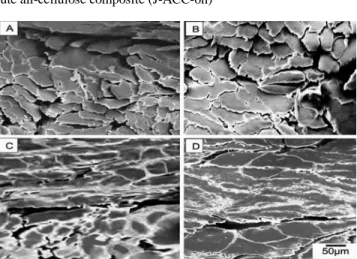
The SEM micrographs of the cross-section of jute, all-cellulose composites are shown in Fig. 2. With increasing processing time more cellulose is dissolved to form a better matrix. Therefore, for 6h and 8h compression moulding the intra and inter-laminar binding between matrix and reinforcement is quite better [Figs 2(C)&(D)] compared to 2h and 4h timing [Figs 2(A)&(B)]. From the micrographs
it is clear that the binding between matrix and reinforcement is still not very good. This could be due to the formation of unsufficient matrix as the non-cellulosic components are dissolved poorly in ionic liquid in used conditions, as previously reported by Huber et al.7. Even due to the presence of a higher non-cellulosic content, dissolution of cellulose in ionic liquid is found slow, resulting in more time for the dissolution of cellulose.
3.5 Change in Crystallinity
From the X-ray diffractograms of powdered samples of jute fabrics (before and after alkali treatment) and jute-ACCs, crystallinity values are measured (Fig. 3). Prior to alkali-treatment, crystallinity of jute fibre is found about 62.1%. After 4h alkali treatment at 70°C it is increased about 10% due to improved packing of the cellulose chains and molecular reorientation after removal of amorphous non-cellulosic components8. This high crystallinity of jute fibres is also a reason of slow dissolution process. However, crystallinity of the all-cellulose composites are observed to decrease due to dissolution of cellulose in ionic liquid. It is because during dissolution and re-solidification of cellulose the crystalline phase is converted into non-crystalline or amorphous phase, resulting in decrease in crystallinity10. It is observed that with increasing gcompression moulding time the reduction in crystallinity is found higher due to higher dissolution of cellulose.
3.6 Tensile Properties of ACCs
The tensile properties of the all-cellulose composites are shown in Fig. 4. It is observed that with increasing dissolution time, tensile strength of all-cellulose composites is reduced. This reduction in tensile strength might be due to reduction in basic strength of jute fibres by more dissolution of cellulose and also reduction in crystallinity of jute fibres in ACCs. Tensile modulus of jute-ACCs is increased with Fig. 1—Optical micrographs (×20 magnification) for surface
morphology of (A) alkali-treated jute fabric (J-F-4h-70), and (B) jute all-cellulose composite (J-ACC-6h)
Fig. 2—SEM micrographs of cross-sectional binding of different jute based all-cellulose composites J-ACC-2h (A), J-ACC-4h (B),
increasing dissolution time from 2h to 6h, due to the formation of an adequate matrix, leading to good interfacial bonding and better stress transfer between matrix and reinforcement. With further increase in dissolution time up to 8h slight reduction in modulus is observed.
Though the resultant tensile strength and Young’s modulus of the prepared all-cellulose composites are slightly inferior to other ACCs and most of the other bio-composites, still these materials have comparable properties with bio-composite like jute-PP composite prepared by Gunti et al1. The percentage strain to break is decreased with increasing dissolution time due to improved matrix-reinforcement bonding and increase in stiffness of ACCs.
4 Conclusion
With increasing dissolution time, the fraction of dissolved cellulose is increased, and results in better intra and inter-laminar adhesion. The crystallinity of jute fabric initially increases after alkali treatment due to removal of non-cellulosic amorphous constituents (lignin and hemicellulose). However, in case of jute-ACCs, crystallinity decreases gradually with increasing dissolution time, due to increased dissolution of cellulose and formation of less crystalline matrix phase. The alkali-treated jute fabric having a high crystallinity (68.3%) and presence of a higher amount of non-cellulosic content, took longer time for the dissolution of cellulose. It is observed that though jute fabric has a good tensile properties, it is not very good in ACCs. It may be due to the removal of non-cellulosic contents and reduction of the basic strength of fibre after dissolution of cellulose. The 2h processed ACCs (J-ACC-2h) shows best tensile strength, but intra and inter laminar binding is not very high. However, the jute-ACC prepared with 6h dissolution time (J-ACC-6h), shows best result in term of their stiffness and cross-sectional binding. This can be ascribed to decrease in internal voids and improvement in intra and inter-laminar adhesion for longer dissolution time.
References
1 Gunti G & Atluri V R P, Int J Adv Mater Manuf Charact, 3 (2) (2013) 528.
2 Schuermann J, Huber T & Staiger M P, Proceedings, The 19th International Conference on Composite Materials (ICCM-19, Canada), 2013,5626.
3 Dittenber D B & Ganga Rao H V S, Composites: Part A, 43 (8) (2012) 1419.
4 Kalka S, Huber T, Steinber J, Baronian K, Mussig J & Staiger M P, Composites: Part A, 59 (2014) 37.
5 Huber T, Bickerton S, Mussig J, Pang S & Staiger M P, Carbohydr Polym, 90 (2012) 730.
6 Altmutter W G, Keckes J, Plackner J, Liebner F, Englund K & Laborie M P, Compos Sci Technol, 72 (11) (2012) 1304.
7 Huber T, Pang S & Staiger M P, Composites: Part A, 43 (10) (2012) 1738.
8 Ray D & Sarkar B K, J App Polym Sci, 80 (2001) 1013. 9 Pang J H, Liu X, Wu M, Wu Y Y, Zhang X M & Sun R C,
J Spectrosc, 2014 (2014) 1.
10 Soykeabkaew N, Arimoto N, Nishino T & Peijs T, Compos Sci Technol, 68 (10-11)(2008) 2201.
Fig. 4—Tensile strength, Young’s modulus and breaking strain of jute-ACCs prepared with different dissolution times