5 Autoregressive-Moving-Average Modeling
5.1 Purpose.
Autoregressive-moving-average (ARMA) models are mathematical models of the persistence, or autocorrelation, in a time series. ARMA models are widely used in hydrology,
dendrochronology, econometrics, and other fields. There are several possible reasons for fitting ARMA models to data. Modeling can contribute to understanding the physical system by revealing something about the physical process that builds persistence into the series. For example, a simple physical water-balance model with precipitation as input and including terms for evaporation, infiltration, and groundwater storage can be shown to yield a streamflow series as output that follows a particular form of ARMA model. ARMA models can also be used to predict behavior of a time series from past values alone. Such a prediction can be used as a baseline to evaluate the possible importance of other variables to the system. ARMA models are widely used for prediction of economic and industrial time series. Another use of ARMA models is simulation, in which synthetic series with the same persistence structure as an observed series can be generated. Simulations can be especially useful for established confidence intervals for statistics and estimated time series quantities. ARMA models can also be used to remove
persistence. In dendrochronology, for example, ARMA modeling is applied routinely to generate residual chronologies – time series of ring-width index with no dependence on past values. This operation, called prewhitening, is meant to remove biologically-related persistence from the series so that the residual may be more suitable for studying the influence of climate and other outside environmental factors on tree growth.
5.2 Mathematical Model
ARMA models can be described by a series of equations. The equations are somewhat simpler if the time series is first reduced to zero-mean by subtracting the sample mean. Therefore, we will work with the mean-adjusted series
, 1,
t t
y Y Y t N (1)
whereYtis the original time series, Y is its sample mean, and ytis the mean-adjusted series. One subset of ARMA models are the so-called autoregressive, or AR models. An AR model
expresses a time series as a linear function of its past values. The order of the AR model tells how many lagged past values are included. The simplest AR model is the first-order
autoregressive, or AR(1), model
1 1
t t t
y a y e (2)
whereytis the mean-adjusted series in year t, yt1is the series in the previous year, atis the lag-1 autoregressive coefficient1, and etis the noise. The noise also goes by various other names: the error, the random-shock, and the residual. The residuals et are assumed to be random in time (not autocorrelated), and normally distributed. Be rewriting the equation for the AR(1) model as
1 1
t t t
y a y e (3)
1
Some authors (e.g., Chatfield, 2004) write the equation for an AR(1) process in the form
1 1
t t t
y a y e , which implies a positive coefficient a1 for positive first-order autocorrelation. But as written in (2), positive autocorrelation goes with a negative coefficient a1. There is no confusion as long as the equation being used for describing the process is presented along with values of parameters. The convention used in this chapter follows Ljung (1995) and Matlab’s System Identification Toolbox.
we see that the AR(1) model has the form of a regression model in which ytis regressed on its previous value. In this form, a1 is analogous to the negative of the regression coefficient, and
t
e to the regression residuals. The name autoregressive refers to the regression on self (auto).
Higher-order autoregressive models include more lagged ytterms as predictors. For example, the second-order autoregressive model, AR(2), is given by
1 1 2 2
t t t t
y a y a y e (4)
where a1,a2are the autoregressive coefficients on lags 1 and 2. The
t h
p order autoregressive
model, AR(p) includes lagged terms on years t1 to t p.
The moving average (MA) model is a form of ARMA model in which the time series is regarded as a moving average (unevenly weighted) of a random shock serieset. The first-order moving average, or MA(1), model is given by
1 1
t t t
y e c e (5)
where et,et1are the residuals at times t and t-1, and c1is the first-order moving average
coefficient. MA models of higher order than one include more lagged terms. For example, the second order moving average model, MA(2), is
1 1 2 2
t t t t
y e c e c e (6)
The letter q is used for the order of the moving average model. The second-order moving average model is MA(q) with q 2.
We have seen that the autoregressive model includes lagged terms on the time series itself, and that the moving average model includes lagged terms on the noise or residuals. By including both types of lagged terms, we arrive at what are called autoregressive-moving-average, or ARMA, models. The order of the ARMA model is included in parentheses as ARMA(p,q), where p is the autoregressive order and q the moving-average order. The simplest ARMA model
is first-order autoregressive and first-order moving average, or ARMA(1,1):
1 1 1 1
t t t t
y a y e c e (7)
5.3 Steps in modeling
ARMA modeling proceeds by a series of well-defined steps. The first step is to identify the model. Identification consists of specifying the appropriate structure (AR, MA or ARMA) and order of model. Identification is sometimes done by looking at plots of the acf and partial autocorrelation function (pacf). Sometimes identification is done by an automated iterative procedure -- fitting many different possible model structures and orders and using a goodness-of-fit statistic to select the best model.
The second step is to estimate the coefficients of the model. Coefficients of AR models can be estimated by least-squares regression. Estimation of parameters of MA and ARMA models usually requires a more complicated iteration procedure (Chatfield 2004). In practice, estimation is fairly transparent to the user, as it accomplished automatically by a computer program with little or no user interaction.
The third step is to check the model. This step is also called diagnostic checking, or verification (Anderson 1976). Two important elements of checking are to ensure that the residuals of the model are random, and to ensure that the estimated parameters are statistically significant. Usually the fitting process is guided by the principal of parsimony, by which the best model is the simplest possible model – the model with the fewest parameters -- that adequately describes the data.
Identification by visual inspection of acf and pacf. The classical method of model identification as described by Box and Jenkins (1970) is judge the appropriate model structure and order from the appearance of the plotted acf and pacf. We have already discussed the acf, and know that the acf at lag k measures the correlation of the series with itself lagged k years. The partial autocorrelation function (pacf) at lag k is the autocorrelation at lag k after first removing autocorrelation with a A Rk 1 model. If the A Rk1model effectively whitens
the time series, the pacf at lag k will be zero. The identification of ARMA models from the acf and pacf plots is difficult and requires much experience for all but the simplest models. Let’s look at the diagnostic patterns for the two simplest models: AR(1) and MA(1).
The acf of an AR(1) model declines geometrically as function of lag. For example, the acf of series that follows an AR(1) model with coefficient a1 0 .5is
2 3 4
{0 .5 , 0 .5 , 0 .5 , 0 .5 } at lags 1-4.
The pacf of the AR(1) process at lags k 1is zero, because if the model is AR(1), all
autocorrelation is removed by the AR(1) model. In summary, the diagnostic patterns of acf and pacf for an AR(1) model are:
Acf: declines in geometric progression from its highest value at lag 1 Pacf: cuts off abruptly after lag 1
The opposite types of patterns apply to an MA(1) process: Acf: cuts off abruptly after lag 1
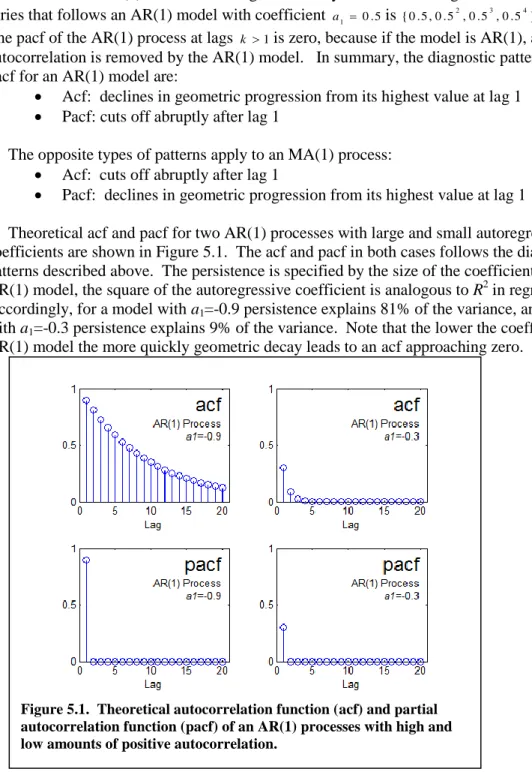
Pacf: declines in geometric progression from its highest value at lag 1 Theoretical acf and pacf for two AR(1) processes with large and small autoregressive coefficients are shown in Figure 5.1. The acf and pacf in both cases follows the diagnostic patterns described above. The persistence is specified by the size of the coefficient. For an AR(1) model, the square of the autoregressive coefficient is analogous to R2 in regression. Accordingly, for a model with a1=-0.9 persistence explains 81% of the variance, and for a model
with a1=-0.3 persistence explains 9% of the variance. Note that the lower the coefficient for the
AR(1) model the more quickly geometric decay leads to an acf approaching zero.
Figure 5.1. Theoretical autocorrelation function (acf) and partial autocorrelation function (pacf) of an AR(1) processes with high and low amounts of positive autocorrelation.
The theroretical patterns of decay of the acf and pacf can be visually compared with the estimated acf and pacf of a time series to decide whether the series was likely generated by an AR(1) process. The theoretical decay patterns can be difficult to discern for actual time series, especially if the series is short. Higher-order AR, MA, and ARMA processes also have characteristic theoretical patterns of decay of the acf and pacf. The decay patterns are more complicated that those illustrated for the AR(1) model. Generally, however, the pacf cuts off after lag p for an AR(p) process, and the acf cuts of abruptly after lag q for an MA(q) process.
Short memory and long memory processes. Though the acf may die off very slowly for an
AR(1) process with a high AR coefficient (Figure 5.1), the AR(1) process, and indeed all
stationary AR, MA and ARMA processes are termed “short memory” processes. Such processes satisfy a condition of eventual dying off of the acf. The condition is given by k
k C
, where k
is the theoretical autocorrelation at lag k, and C and are constants with0 1(Chatfield 2004, p. 261). For such processes,
0 | k | k
converges. On the other hand, there is another classof processes, called “long-memory” processes, for which
0 | k | k
does not converge. See Chatfield (2004, p. 260) for discussion of long-memory processes.Automated identification by the FPE criterion. A different way of identifying ARMA
models is by trial and error and use of a goodness-of-fit statistic. In this approach, a suite of candidate models are fit, and goodness-of-fit statistics are computed that penalize appropriately for excessive complexity. (Think of adjusted R2 in regression.) Akaike’s Final Prediction Error (FPE) and Information Theoretic Criterion (AIC) are two closely related alternative statistical measures of goodness-of-fit of an ARMA(p,q) model. Goodness of fit might be expected to be measured by some function of the variance of the model residuals: the fit improves as the residuals become smaller. Both the FPE and AIC are functions of the variance of residuals. Another factor that must be considered, however, is the number of estimated parameters
n p q. This is so because by including enough parameters we can force a model to perfectly
fit any data set. Measures of goodness of fit must therefore compensate for the artificial
improvement in fit that comes from increasing complexity of model structure. The FPE is given by 1 * 1 / n N F P E V n N (8)
where V is the variance of model residuals, N is the length of the time series, and n p qis the
number of estimated parameters in the ARMA model. The FPE is computed for various candidate models, and the model with the lowest FPE is selected as the best-fit model.
The AIC (Akaike Information Criterion) is another widely used goodness-of-fit measure, and is given by 2 lo g 1 n A I C V N (9)
As with the FPE, the best-fit model has minimum value of AIC.2 Neither the FPE nor the AIC directly addresses the question of the model residuals being without autocorrelation, as they ideally should be if the model has removed the persistence. A strategy for model identification by the FPE is to 1) iteratively fit several different models and find the model that gives
approximately minimum FPE and 2) apply diagnostic checking (see below) to assure that the model does a good job of producing random residuals.
Checking the model – are the residuals random? A key question in ARMA modeling is
does the model effectively describe the persistence? If so, the model residuals should be random –or uncorrelated in time – and the autocorrelation function (acf) of residuals should be zero at all lags except lag zero. Of course, for sample series, the acf will not be exactly zero, but should fluctuate close to zero.
The acf of the residuals can be examined in two ways. First, the acf can be scanned to see if any individual coefficients fall outside some specified confidence interval around zero.
Approximate confidence intervals can be computed. The correlogram of the true residuals (which are unknown) is such that rkis normally distributed with mean
( k) 0 E r (10) and variance 1 v a r (rk) N (11)
where rk is the autocorrelation coefficient of the ARMA residuals at lag k. The appropriate confidence interval for rk can be found by referring to a normal distribution cdf. For example, the 0.975 probability point of the standard normal distribution is 1.963. The 95% confidence interval for rk is therefore 1 .9 6 / N . For the 99% confidence interval, the 0.995 probability point of the normal cdf is 2.57. The 99% CI is therefore 2 .5 7 / N . An rk outside this CI is evidence
that the model residuals are not random.
A subtle point that should be mentioned is that the correlogram of the estimated residuals of a fitted ARMA model has somewhat different properties than the correlogram of the true residuals – which are unknown because the true model is unknown. As a result, the above approximation (11) overestimates the width of the CI at low lags when applied to the acf of the residuals of a fitted model (Chatfield, 2004, p. 68). There is consequently some bias toward concluding that the model has effectively removed persistence. At large lags, however, the approximation is close.
A different approach to evaluating the randomness of the ARMA residuals is to look at the acf “as a whole” rather than at the individual rk 'sseparately (Chatfield, 2004). The test is called the
portmanteau lack-of-fit test, and the test statistic is
2 1 K k k Q N r
(12)This statistic is referred to as the portmanteau statistic, or “Q” statistic. The Q statistic, computed from the lowest K autocorrelations, say at lags k 1, 2 , 2 0 , follows a 2distribution
with K p qdegrees of freedom, where p and q are the AR and MA orders of the model and N is the length of the time series. If the computed Q exceeds the value from the 2
table for
2 The System Identification Toolbox in MATLAB© has functions for the FPE and the AIC.
(Computational note: MATLAB© computes the variance V used in the above equations with N-1 rather than N in the denominator of the sum-of-squares term.)
3 The MATLAB© disttool function is a handy interactive graphics tool for getting probability points of the cdf for various distributions
some specified significance level, the null hypothesis that the series of autocorrelations represents a random series is rejected at that level.
The p-value gives the probability of exceeding the computed Q by chance alone, given a random series of residuals. Thus non-random residuals give high Q and small p-value. The significance level is related to the p-value by
s ig n ific a n c e le v e l (% ) = 1 0 0 (1 - )p (13)
A significance level greater than 99%, for example, corresponds to a p-value smaller than 0.01.
Checking the model – are the estimated coefficients significantly different from zero?
Besides the randomness of the residuals, we are concerned with the statistical significance of the model coefficients. The estimated coefficients should be significantly different than zero. If not, the model should probably be simplified, say, by reducing the model order. For example, an AR(2) model for which the second-order coefficient is not significantly different from zero might be discarded in favor of an AR(1) model. Significance of the ARMA coefficients can be
evaluated by comparing estimated parameters with the standard deviations. For an AR(1) model, the estimated first-order autoregressive coefficient,aˆ1, is normally distributed with variance
2
1 1 ˆ 1 ˆ v a r ( ) a a N (14)where N is the length of the time series. The approximate 95% confidence interval for aˆ1is
therefore two standard deviations around aˆ1:
1 1
ˆ 2 v a r (ˆ )
a a (15)
For example, if the time series has length 300 years, and the estimated AR(1) coefficient is
1
ˆ 0 .6 0
a , the 95% confidence interval is
1 1 1 2 1 2 ˆ ˆ 9 5 % C I = 2 v a r ( ) ˆ 0 .6 0 2 v a r ( ) ˆ 1 0 .6 0 2 1 0 .6 0 0 .6 4 0 .6 0 2 0 .6 0 2 3 0 0 3 0 0 0 .6 0 2 .0 0 2 1 3 0 .6 0 0 .0 9 2 a a a a N (16)The estimated parameter aˆ1 0 .6 0is therefore significant as the confidence band does not
include zero and in fact is highly significant as the confidence band is far from zero. Equations are also available for the confidence bands around estimated parameters of an MA(1) model and higher-order AR, MA, and ARMA models (e.g., Anderson 1975, p. 70). The estimated
parameters should be compared with their standard deviations to check that the parameters are “significantly” different from zero.4
4 The present function in the MATLAB© System Identification Toolbox is convenient for getting the standard deviations of estimated ARMA parameters
5.4 Practical vs statistical significance of persistence
Note from equation (14) that the variance of the estimated autoregressive coefficient for an AR(1) model is inversely proportional to the sample length. For long time series (e.g., many hundreds of observations), ARMA modeling may yield a model whose estimated parameters are significantly different from zero but very small. The persistence described by such a model might actually account for a tiny percentage of the variance of the original time series.
A measure of the practical significance of the autocorrelation, or persistence, in a time series is the percentage of the series variance that is reduced by fitting the series to an ARMA model. If the variance of the model residuals is much smaller than the variance of the original series, the ARMA model accounts for a large fraction of the variance, and a large part of the variance of the series is “due to persistence.” In contrast, if the variance of the residuals is almost as large as the original variance, then little variance has been removed by ARMA modeling, and the variance due to persistence is small. A simple measure of fractional variance due to persistence:
2 v a r ( ) 1 v a r ( ) t p t e R y (17)
wherev a r (yt)is the variance of the original series, and v a r (et)is the variance of the residuals of the ARMA model.5 Whether any given value of 2
p
R is practically significant is a matter of subjective judgment and depends on the problem. For example, in a time series of tree-ring index, 2
0 .5 0 p
R would likely be considered practically significant, as half the variance of the original time series is explained by the modeled persistence. On the other hand,
2
0 .0 1 p
R might well be dismissed as practically insignificant.
Example. To illustrate the steps in ARMA modeling consider the fitting of a model to a time
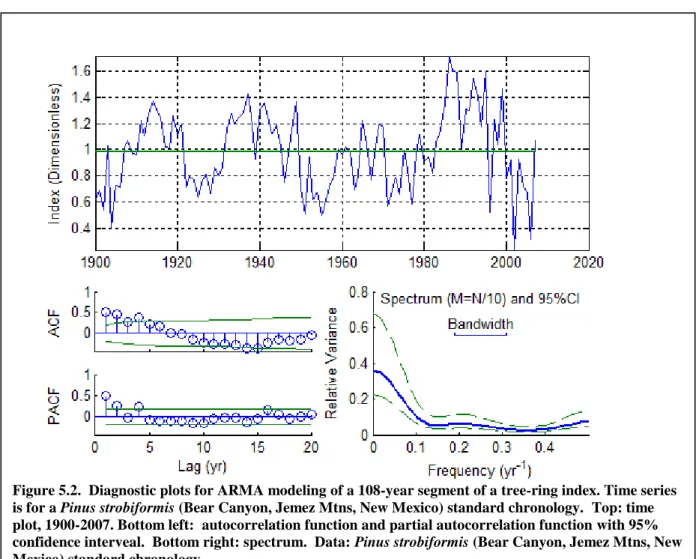
series of tree-ring index (Figure 5.2). The tree-ring index covers several hundred years, but for illustrative purposes, only a portion of the record has been used in the modeling. The time series plot strongly suggests positive autocorrelation, as successive observations tend to persist above or below the sample mean. The series has a low-frequency spectrum, with much of the variance at wavelengths longer than 10 years. This shape of spectrum is broadly consistent with a positively autocorrelated series. The acf indicates significant positive autocorrelation out to a lag of 4 years, and the pacf “cuts off” after lag 4. These acf and pacf patterns alone are enough to suggest an AR(4) model.
Fitting an AR(4) model to the data results in the equation
1 2 3 4
0 .3 7 5 4 0 .2 1 9 2 0 .1 1 9 9 0 .2 5 4 7
t t t t t t
y y y y y e (18)
which is in the form of equation (4) extended to autoregressive order p=4. Whether the coefficients are significantly different from zero can be evaluated by comparing the estimated coefficients with their standard deviations:
a1: -0.3754 (±0.0956) a2: -0.2192 (±0.1036) a3: 0.1199 (±0.1035) a4: -0.2547 (±0.0968)
Since twice the standard deviation is an approximate 95% confidence interval for the estimated coefficients, all except a3 are significantly different from zero. The AR(4) cannot therefore be ruled out because of insignificant coefficients, especially since the highest-order coefficient, a4, is significant.
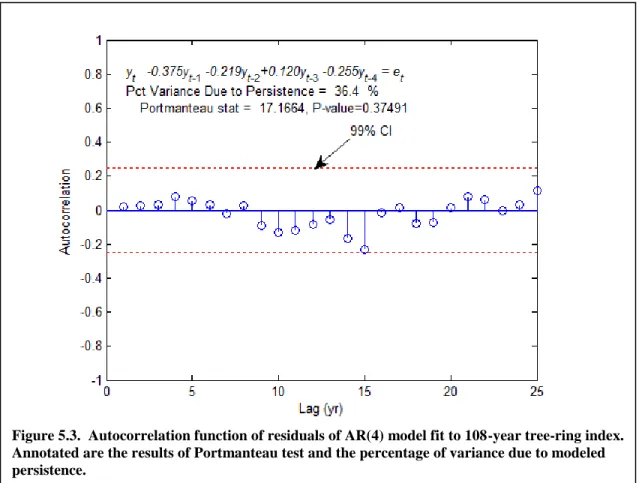
Of key importance is the “whiteness” of the residuals – are they non-autocorrelated? A acf plot for the tree-ring example reveals that none of the autocorrelations of the AR(4) model residuals are outside the 99% confidence interval around zero (Figure 5.3). This is a desired result, as effective ARMA modeling should explain the persistence and yield random residuals. Whiteness of residuals can alternatively be checked with the Portmanteau test (see equation (12)). The null hypothesis for the test is all the autocorrelations of residuals for lags 1 to K are zero, where choice of K is up to the user. As annotated on Figure 5.3, for K=25 we cannot reject the null hypothesis. The p-value for the test is greater than 0.05 (p=0.37491), meaning the test is not significant at the 0.05 α-level. In summary, review of the individual autocorrelations of residuals, the Portmanteau test on those residuals, and the error bars for the estimated AR parameters favor accepting the AR(4) model as an effective model for the persistence in the tree-ring series.
Figure 5.2. Diagnostic plots for ARMA modeling of a 108-year segment of a tree-ring index. Time series is for a Pinus strobiformis (Bear Canyon, Jemez Mtns, New Mexico) standard chronology. Top: time plot, 1900-2007. Bottom left: autocorrelation function and partial autocorrelation function with 95% confidence interveal. Bottom right: spectrum. Data: Pinus strobiformis (Bear Canyon, Jemez Mtns, New Mexico) standard chronology.
5.5 Prewhitening
Prewhitening refers to the removal of autocorrelation from a time series prior to using the time series in some application. In dendroclimatology standard indices of individual cores are
prewhitened as a step in generating “residual” chronologies (Cook 1985). Prewhitening can also be applied at the level of the site chronology to remove the persistence (Monserud 1986). In the context of ARMA modeling, the prewhitened series is equivalent to the ARMA residuals6. As prewhitening aims at removal of persistence, there is an expected effect on the spectrum. Specifically, for a persistent (positively autocorrelated) series, the spectrum of the prewhitened series should be flattened relative to the spectrum of the original series. A positively
autocorrelated series has a low-frequency spectrum, while white noise – the objective of ARMA modeling – has a flat spectrum.
The effect of prewhitening on the spectrum is clear for our tree-ring example (Figure 5.4). The original series has a low-frequency spectrum and the prewhitened series has a nearly flat
spectrum. Note also that the spectrum of the prewhitened spectrum is lower overall than that of the original series. The area under the spectrum is proportional to variance, and the removal of variance due to persistence will result in a spectrum with a smaller area. For the tree-ring series, a substantial fraction of the variance (more than 1/3) is due to persistence.
The flattening of the spectrum, a frequency-domain effect, is reflected by changes in the time domain. For a series with positive autocorrelation, prewhitening acts to damp those time series features that are characteristic of persistence. Thus we expect that broad swings above and below
6 In practice, the original mean of the tree-ring index is usually restored, so the prewhitened chronology has the same mean as the standard chronology, rather than a mean of zero
Figure 5.3. Autocorrelation function of residuals of AR(4) model fit to 108-year tree-ring index. Annotated are the results of Portmanteau test and the percentage of variance due to modeled persistence.
the mean (broad peaks and troughs) will be reduced in amplitude, or damped. The damping is evident in a zoomed portion of the time series for the tree-ring example (Figure 5.5). For
example, the swing above the mean for the period 1983-1995 has been lessened in amplitude, and positive departures in 1989 and 1994 have been converted to negative departures. Specific differences in an original and prewhitened series can be readily explained by referring to the equation of the fitted ARMA model used to prewhiten. For the tree-ring example, the fitted AR(4) model is equation (18). Differences in the original and prewhitened index (Figure 5.5) derive directly from this equation. Recall first of all that yt in the equation is a departure from the
mean (red line in Figure 5.5). The residual is computed by summing over the departures of the original series from the mean for the previous 4 years, after multiplying those residuals by the estimated ARMA coefficients. The prewhitened index for 1988 is therefore drawn closer to the mean because negative coefficients are applied to fairly large positive anomalies 1987, 1986, and 1984.
5.6 Simulation and Prediction
In addition to helping to objectively describe persistence and providing an objective way to remove it, ARMA modeling can also be used in simulation and prediction. A brief introduction to these topics is given here. More extensive treatment can be found elsewhere (e.g., Chatfield 2004,Wilks 1995).
Simulation is the generation of synthetic time series with the same persistence properties as the observed series. Prediction is the extension of the observed series into the future based on past and present values. The AR(1) model
1 1
t t t
y a y e (19)
Whereytis the departure of a time series from its mean,a1is the autoregressive coefficient, and
t
e is the noise term, can be rearranged as
1 1
t t t
y a y e . (20)
A simulation ofytcan be generated from equation (20) by the following steps: 1) estimate the autoregressive parameter by modeling the time series as an AR(1) process, 2) generate a time
Figure 5.5. Zoomed time series segments of original and prewhitened tree-ring index. The full original series isplotted in Figure 5.2 (top).
Figure 5.4 Spectra of original and prewhitened tree-ring index. Time series is a 108-yr tree-ring from New Mexico (see previous example). Dashed line is 95% confidence interval.
series of random noise,et, by sampling from an appropriate distribution, 3) assume some starting value foryt1, and 4) recursively generate a time series ofyt. The appropriate distribution for the noise is typically a normal distribution with mean 0 and variance equal to the variance of the residuals from fitting the AR(1) model to the data.
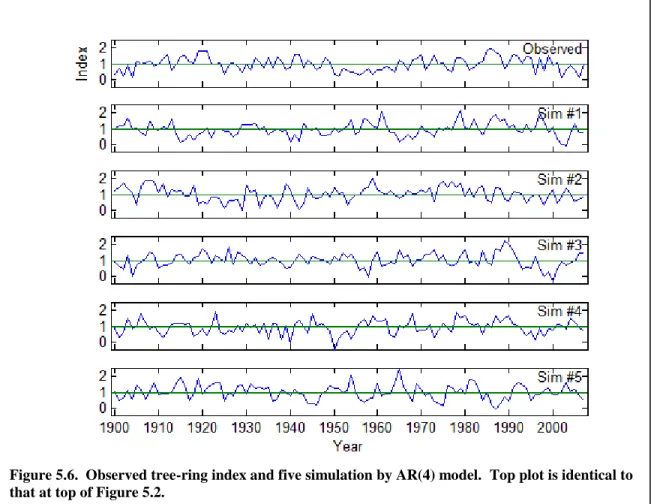
For example, five simulations of the tree-ring index are plotted along with original time series in Figure 5.6. The simulations appear to effectively mimic the low-frequency behavior of the observed series. Any synchrony in timing of variations in the various series is due to chance alone, as the simulations have been randomly generated. A possible application of such series is to generate empirical (as opposed to theoretical) confidence intervals of the relationship between the observed time series and a climate variable. For such an application, many (e.g., 10,000) simulated tree-ring series of length 108 years can be generated, correlation coefficients computed between each simulation and the climate series, and 95% confidence interval for significant correlation established as the 0.025 and 0.975 probability points of the 10,000 sample
correlations. If the correlation between the observed time series and the climate series is outside the confidence interval, a significant statistical relationship is inferred.
Prediction differs from simulation in that the objective of prediction is to estimate the future value of the time series as accurately as possible from the current and past values. Unlike simulations, predictions utilize past values of the observed time series. A prediction form of the AR(1) model is
1 1
ˆt ˆ t
y a y (21)
Figure 5.6. Observed tree-ring index and five simulation by AR(4) model. Top plot is identical to that at top of Figure 5.2.
where the “^” indicates an estimate. The equation can be applied “one step ahead” to get estimate yˆt from observed yt1. A “k-step-ahead” AR(1) prediction can be made by recursive
application of equation (21). In recursive application, the observed y at time 1 is used to generate the estimatedyˆ at time 2. That estimate is then substituted as yt1to get the estimatedyˆ at time
3, and so on. The k-step-ahead predictions eventually converge to zero as the prediction horizon, k, increases7.
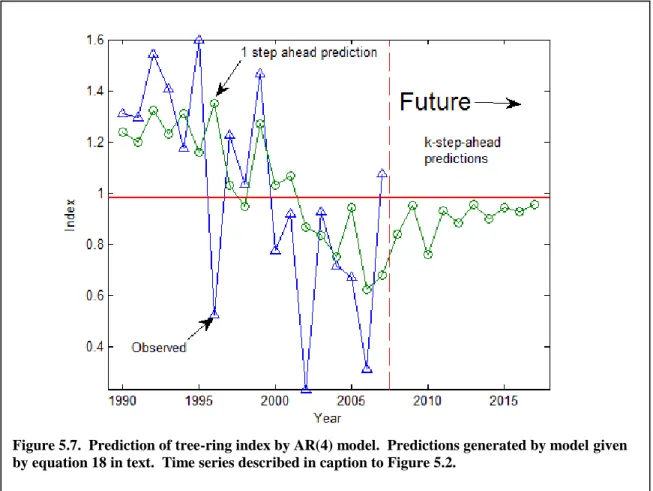
Prediction is illustrated in Figure 5.7 for the tree-ring example. Recall that the index for the 108-year period 1900-2007 was fit with an AR(4) model, which explained about 1/3 the variance of the series. The segments of observed and predicted index beginning with 1990 are plotted in Figure 5.7. The observed index ends in 2007, and for the years 1990-2007 the
predicted values plotted are one-step-ahead predictions. For the AR(4) model, this means that the prediction for year t is made from observed index in the preceding four years. One-step-ahead predictions in general make use of observed data for timest (t1) to make the prediction for year t. The predictions plotted in Figure 5.7 for years beginning with 2009 are k-step-ahead predictions. These predictions use observed index for timest (tk)and predicted index for later times in making a prediction for time t. The predicted index for 2008 is a one-step-ahead prediction, for 2009 a 2-step-ahead prediction, for 2010 a 3-step-ahead prediction and so forth. The persistence in the data combined with the low-growth period starting about 2000 leads to predictions of below normal tree-ring index for the 10 years of prediction horizon beyond the end of the observed data. The predictions converge toward the mean as the horizon lengthens, however, because the influence of the past gradually fades.
7 Because the modeling assumes y
t is a departure from the mean, this convergence in terms of the original time series is convergence toward the mean
5.7 Extension to nonstationary time series
ARMA modeling assumes the time series is weakly stationary. With the appropriate
modification, nonstationary series can also be studied with ARMA modeling. Trend defined as a deterministic function of time can be removed by curve-fitting prior to ARMA modeling. That is the approach in dendrochronology, where a smooth curve describing the “growth trend” is removed in converting ring widths to ring indices. Periodic time series are a special case in which the trend is cyclical. An example of a periodic series is a monthly time series of air
temperature with its annual cycle. The mean is clearly nonstationarity in that it varies in a regular pattern depending on month. One way of handling such a series with ARMA modeling is to remove the annual cycle by expressing the monthly data as departures from their long-term monthly means. Another way is by applying periodic ARMA models, in which separate
parameters are simultaneously estimated for each month of the year. Periodic ARMA models are discussed by Salas et al. (1980).
A trend itself might be a stochastic feature of a time series. For example, a random walk time series wanders with a time varying population mean. The series does not tend to return to any specific preferred level. Such series can be detrended by first-differencing before ARMA modeling – a modeling approach called autoregressive-integrated-moving-average (ARIMA) modeling. Further discussion of ARIMA modeling can be found elsewhere (Anderson 1976; Box and Jenkins 1976; Salas et al. 1980)
Figure 5.7. Prediction of tree-ring index by AR(4) model. Predictions generated by model given by equation 18 in text. Time series described in caption to Figure 5.2.
5.8 References
Anderson, O., 1976, Time series analysis and forecasting: the Box-Jenkins approach: London, Butterworths, p. 182 pp.
Box, G.E.P., and Jenkins, G.M., 1976, Time series analysis: forecasting and control: San Francisco, Holden Day, p. 575 pp.
Chatfield, C., 2004, The analysis of time series, an introduction, sixth edition: New York, Chapman & Hall/CRC.
Cook, E.R., 1985, A time series approach to tree-ring standardization, Ph. D. Diss., Tucson, University of Arizona.
---, Shiyatov, S., and Mazepa, V., 1990, Estimation of the mean chronology, in Cook, E.R., and Kairiukstis, L.A., eds., Methods of dendrochronology, applications in the environmental sciences: In:,: Kluwer Academic Publishers, p. 123-132.
Ljung, L., 1995, System Identification Toolbox, for Use with MATLAB, User's Guide, The MathWorks, Inc., 24 Prime Park Way, Natick, Mass. 01760.
Monserud, R., 1986, Time series analyses of tree-ring chronologies, Forest Science 32, 349-372.
Salas, J.D., Delleur, J.W., Yevjevich, V.M., and Lane, W.L., 1980, Applied modeling of hydrologic time series: Littleton, Colorado, Water Resources Publications, p. 484 pp.
Wilks, D.S., 1995, Statistical methods in the atmospheric sciences: Academic Press, 467 p.