Total Privatization of Banks – Is it the Right or the Wrong Choice?
Alqi Naqellari
Prof.Inordinar, Doktor Pedagog U.Mesdhetar i Shqiperise Doi:10.5901/mjss.2013.v4n9p343Abstract
In this material we will address an important problem, being the answer of the question; "Was the total privatization of the Commercial Banks in Albania the right thing to do? In this material we have explain why “The total privatization of the Commercial Banks in Albania”, was not the right choice! Furthermore, we will analyze and explore the system’s current status, more than 10 years after it was first applied. Detailed facts and figures have reflected the inefficient impact of the total privatization of commercial banks in the domestic economy? The areas in which we have extended our analysis are: - In the distribution of loans between sectors of production (i.e. industry, agriculture, service sectors, tourism etc..). The privatization of commercial banks has had a negative effect in some of the most important economic sectors such as agriculture, quarrying and processing industry, tourism, etc. - In the distribution of deposits and loans in Albanian Lek and foreign currency. The level of deposits and the economic growth are getting higher, however the deposits are growing at a higher rate than the economic growth. Their structure has changed in favor of foreign currency due to the lack of confidence in the Albanian lek, which has been caused by its continuous loss of value against foreign currency. This has caused the same structure in the application of loans. Foreign currency loans have a more positive effect in the rate increase of the domestic economy then the Albanian Lek loans. - In the differences between deposits and loans by type of currency. Only 50% of the deposits in Albanian Lek, with or without a maximum term, are given to economic entities in “Loan” form. The rest is used in the purchase of government debt instruments, treasury bills, while 100% of foreign currency deposits are given as loans. - In the distribution of loans by economic entities. The Loan Structure in respect of the different economic entities and different currencies is almost the same. Businesses use currency for the purchase of machinery and equipment, mostly for imports while individuals generally use the currency to make payments within the country for apartments, cars, etc. - In the distribution of loans by regions, etc… The distribution of loans shows that in general, the Albanian economy has not been supported by the right level of loans from commercial banks, therefore creating disproportionate development between different regions. Is this also one of the reasons for the declining of the population in the countryside due to it being mainly supported economically by emigrants rather than through government subsidies. The general conclusion drawn from the above data analysis is that, the total privatization of commercial banks in the Republic of Albania has had a negative consequence inthis country’s economic performance.The Albanian government should open state owned Commercial Banks.
Keywords. Bank, monetary policy, total privatization, inflation, exchange rate, etc 1. Introduction
Problems of privatization in an economy like the Albanian one take a special significance not only in regard to the change of ownership, property transfer its rights from state hands to private entities, but also in regard to the heavily selected model for this economy’s perspective. Therefore we focused our attention precisely in a relevant field, just as it is the privatization of the financial system, the commercial banks.
In this analysis, without claiming to have exhausted the problem, we have focused our attention in the analysis of a number of important indicators that reflect the performance of a financial institution, such as commercial bank. Through surveys and charts built we have presented the trends, regarding the consequences of the privatization of these institutions. The conclusion derived from the following data, is that, in addition to a number of positive consequences for the Albanian economy, there is also an even higher number of negative consequences, therefore it is important to consider in the future the possibility of opening a “State Owned” Commercial Bank.
2. Content of the material
1. Why the privatization of “The State Savings Bank” should not have happened?
3. In which areas do the inefficiency effects of the total privatization expressthemselves in relation to the domestic economy?
3. Why State Savings Bank (Raiffeizen Bank) should not have been privatized
- It was the largest bank in Albania. It had 36 branches and 112 branch offices. It was extended to the entire country. It collected 80% of Albanians’ savings deposits. In support of making Central Bank monetary policy of the Albanian
- You will be easily create Albanian businesspersons who import export trade activities with neighboring countries, especially in Albanian territories.
The majority of business people circulate their money directly in cash. Not only foreign currency but also Albanian lek. Having an Albanian Bank in Turkey, Greece, Kosovo, Macedonia, Italy, etc., makes it possible for our business people to make their transactions through a bank, avoiding thereby the need to carry cash. I will be judged for their commercial activity and then for obligations arising in the state. Spend millions of dollars across the borders for imports.
It is estimated that about 10% (AN) of business transactions take place through banks. Others have led Albanian traders bags sacks. Therefore the state must open Savings Bank branches in all other countries with which we have commercial relationships.
- Creates credit facilities for the whole Albanian economy. It should be noted that private foreign banks have not come to Albania for the development of the Albanian economy. They are here for their own interests. In short,to make money. Only the government can protect our banks and safeguard our economic interests, through an efficient monetary and financial policy. We as a country are based on an agricultural economy, and we are perhaps one of the few countries in the world that do not have an Agricultural Bank. Then who should invest in this sector? Our agriculture has remained in the hands of some small loans which do not guarantee any financial leverage. Only 1.4% of these loans are given by commercial banks; the other part belongs to the spontaneity of the weak governmental efforts.
- Increases the possibility of foreign banks attracting Albanian Lek through increasing savings deposits. It should be recognized that today there are over 1 million of Albanians working outside the country having billions in foreign currency deposited in their respective Greek, Italian, UK and German banks. If we had a branch of our Savings Bank in Greece, we would ensure that all the foreign currency saved by Albanians would go in the direction of our economy. Also today in Italy there are more than 350 thousand Albanians. Why not have a commercial bank there? This would not only be to attract the savings of our emigrants, but also to perform money transfers and other various transactions.
- Creates new relations of exchange in favor of the Albanian Lek. Right now our Lek is not known by anycountry, not even our neighbors, Macedonia, Greece or Italy. Albanian Lek can be used only in Kosovo, and in the vicinities of Albanian-Macedonian borders. If we could have branches of our commercial banks in the countries neighboring Albania, our Lek woul dretain a greater leverage as a currency. It would gain space and the monetary power throughout the whole region inhabited by Albanians. Willingly or not, our neighbors would exchange it, not only in the black market, but also in their own banks.
The appearance Albanian Leka broad should be called an historical event, not the privatization of our public banks. Commercial banks can be easily opened - and competing in the banking market can easily be achieved - without jeopardizing the country’s financial leverage by buying its assets.
- Creates opportunities to use the marketsof securities and capital accounts in neighboring countries: treasury bonds, stock, etc… A careful observation of the activities of National Bank of Greece branch in Tirana since its opening 10 years ago, shows that it has not once made a currency loan to the Albanian economy. It has simply purchased Treasury Bonds from the Albanian Government, and through this investment it has ensured its survival. Foreign banks have exploited the state of our economy and based on it they have designed their currency policies. Why shouldn’t we Albanians use the same approach in their countries of origin?
- Creates opportunities for the use of foreign currency. Having branches of our Bank in other countries, creates the possibility for our nationals - and other foreign citizens living in those countries - to deposit money in our bank, just as we deposit our money in the branches of foreign banks located in our country.
There are thousands of Albanians who have accountsin the foreign banks operating in Albania. The same phenomenon will occur even if we opened our banks in these countries. Thus we would have the opportunity
to use, not only the money our people living abroad but the money of other foreign citizens as well, in the interest of our economy.
4. What happened 10 years after the total privatization of Albania’s commercial banks?
Most of the settargets or projections were achieved, so the services, lending and deposits infrastructure improved. Almost all banks have a European appeal, and offer with European products. But achievements left aside, a number of apparent failures to the detriment of the Albanian economy are easily noticed.
Specifically:
- If there initially was an intention to remove the monopoly of the State Bankover the banking system, and to create the conditions for fair competition, it is easily ascertained that this monopoly passed from the hands of the Albanian Governmentto those of Raiffeizen Bank. Thus, no monopoly was removed.
- If the government, through the treasury bonds it sells estimated in the billions (Lek) per year, would enter in debt with the then- State owned Savings Bank (because of the fact it was the government’s biggest buyer), nowadaysit constantly finds itself in debt with private banks. On November 29th 2008, on "Ora News" and on December 12th, 2008 on Top-Channel, a statement was made public that the government’s debt to commercial banks (in Treasury Bonds liability) was $340 million. Is it normal to make 145 million Euros from the privatization of the state- held Savings Bank, and then find oneself 6 years late $340 million in debt? Today this number is multiplied. Who bears responsibility for the outrageous consequences of the privatization?
- Monetary policy with a state commercial bank would have been more effective. Today the euro and the dollar have so much leverage on the domestic currency market, that we could unarguably conclude that the CBA(Central Bank of Albania) and its Lek are sent to retirement.
- If it was said that the advantages of privatization will influence the growth of the Albanian economy, we today regrettably notice that the loans granted by them are directed to certain risk-free sectors which are profitable for the banks alone.
Foreign banks have opened branches in Albania, not with the scope of developing the Albanian economy, but to make profit and to maximize the value of their shares
Foreign banks have been installed in Albania, not with a view to the development of the Albanian economy, but to win, to increase their profits, to maximize the value of their shares.
They do not contribute in the development of vital sectors such as agriculture, or in pivotal pillars of our domestic economy such as tourism, but funnel Albanians’money in construction, transportation, or service related projects, where the risk is lower. Is this one of the reasons why agriculture’s GDP share has dropped to 19% and an apparent decrease its growth rate is being noticed.
Cutting to the chase, it should be emphasized that the privatization of the Savings Bank was an intolerable mistake- of the Albanian government, the consequences of which are significantly felt in the low rate of economic growth and the role of CBA in the economy.
5. Which areas express the inefficient totalprivatization impact of the commercial banks in the domestic economy?
5.1 First, the area of loans distribution among production, industry, agriculture, service, and tourism sectors. Statement No. 1. Distribution of loans by sectors in million lekë1
Years Total loans Agriculture % Fishing % Mining % Manufactu % Electricity % Construc %
to business hunting and ring gas and tion
and forestry quarrying water S
2009 291,214 3,060 1.1 569 0.2 6,728 2.3 42,215 14 22,392 7.7 59,332 20.4
2012 398,225 5,527 1.4 946 0.2 7,626 1.9 60,306 15 42,903 11 67,898 17.1
Trade, repair of % Hoels % Transport, % Financial % Education % Other com. % Other %
motor storage and
motor vehicles and storage Interme health soc.pers
and goods p-h restaurants t.com.n.c diation health activity
98,050 34 13,800 4.7 7,391 2.5 9,055 3.1 6,532 2.2 13,575 4.7 8,515 2.92
135,074 34 17,570 4.4 11,602 2.9 12,660 3.2 10,543 2.6 15,024 3.8 10,546 2.65
Source: Bank of Albania. Monthly Statistical Report 2012 Fig. 1. Graph of the distribution of loans by branches (2009)
Fig. 2. Graph of the distribution of loans by branches (2012)
From the figures and the above graphs we can draw a number of conclusions:
From 2009 to 2012 total loans have increased by 36%. Loans by branches do not reflect adistribution according to standing these branches occupy in the GDP. They are destined to wards sectors which the banks consider to have a greater return likely hood, as well as in the shortest time period possible. Thus GDP from agriculture in 2010, accounting for about 20% (Table No.2) while credit to agriculture accounts for only 1.4%.
Real lending increased by 81% from 2009 to 2012 for agriculture, but the figure is very low with only 3 billion Lek. While its production is estimated more than 226 billion loan to account for only 0.88% of that amount.
It appears that agriculture sector is one of the most important sectors of economy in the field of loans is completely left out of hand. Of this sector depend on a number of related sectors such as the processing industry of agricultural products or export. Curbing it also inhibits the development of these sectors.
Statement No. 2. Production according to the main branches (in%)
Years Nr Naming 2008 2009 2010 1 Agriculture,hunting,forestry 18.5 19.9 19.7 2 Industry 10 10 11.2 3 Construction 13.9 15.9 11.5 4 Services 57.6 58.4 57.5
Source: Statistical Report. Bank of Albania. 02/2012. Tirana
Agriculture is likely because there are unused resources development. Not only has land spread over the entire country without putting under culture but also has the lowest degree of mechanization of agriculture in Europe.
In 2009 in agriculture, though they operated on 353,486 farms had only about 7883 tractors with tires, seeding machines 3064 and 3893 farmers2. So instead of being a part of these investments went to agriculture that will directly affect economic growth and the level of employment, loans have gone to other sectors without risk as trade, services, car repair, furniture, etc. where concentrating more than 34% of them.
Reasons why not credited agriculture from commercial banks are that:
• has a higher risk than other sectors because it depends very much on the weather conditions,
• are perishable products,
• poor transport
• has a slow return of investment,
• there are few opportunities of control,
• is lying on the broad area of land and is not focused,
• has not stabilized prices,
• there is a high degree of mechanization,
• low degree of organization and management,
• low educational level,
• there is a lack in the young workforce, etc.
If we had a commercial bank wholly owned state it will apply other policies to this sector giving at times corresponding priority.
Conclusion. The conclusion to draw is that the privatization of commercial banks has negatively affected the credit of the most important sectors of the economy such as agriculture, quarrying and processing industry, tourism, etc., and is generally limited to the sectors of trade and repairs.
Industry sector occupies 11.2% of GDP and has absorbed only 16.8% of the loans. Percentage figure is satisfactory but in absolute figure represents a symbolic only 66 billion leke. It is primarily focused on the mining of chrome or its processing, at a time when there are dozens of mines scattered throughout the territory of Albania. 5.2 Second, the distribution of deposits and loans in domestic and foreign currency deposits,
Statement No.3 Million deposit structure ALL (National currency = lek) Years deposits Total Deposits in ALL % of total
Deposit in foreign currency
% of
total deposits Time
Time deposits on ALL % oftotal Time deposits in foregn currency % of total Total sight deposits 2008 619,886 359,187 57.9 260,699 42.1 467,728 2 72,142 58.1 1 95,586 41.9 152,158 2009 662,425 369,137 55.7 293,288 44.3 511,540 293,675 57,4 217,865 42,6 150,885 2010 785,224 409,458 52.1 375,766 47.9 617,384 329,090 53,3 288,294 46,7 167,840 2011 875,226 452,080 51.6 423,146 48.4 706,498 370,105 52,3 336,393 47,7 168,728 2012 884,621 459,991 52 424,630 48 721,981 380,963 52,7 341,018 47,3 162,640
Source: Statistical Report. Bank of Albania. 02/2012. Tirana
Fig.3. Structure of deposits (48% foreign currency and 52% ALL)
Deposits have a normal size, they have been steadily increasing, that more foreign currency deposits because they ALL have been declining. This trend is characteristic of the time deposits as currency and in foreign currency. Time deposits occupy the major part of total deposits.
Deposit growth rates are higher than the growth rates of GDP. From 2010 to 2012 they were increased by 12.07%, 11.4% and 10.2% at a time when GDP growth for these years has not exceeded 4%.Thus the effect of deposit growth is not at the same rate. Dynamics of deposits was caused by several factors, the first of the interest rate, the second of client confidence to banks and third against the currencies customers confidence. All deposits have been declining for the account of the continuous depreciation of the Albanian lek and the strengthening of the euro. Rate shock caused the attention shift to other currencies. Bank of Albania failed to stem its decline in order to create a better balance in the structure of deposits and loans.
If we had a state commercial bank that will support the Central Bank policies with clear strategic goals, regardless of the rate of profit that could fulfill.
Conclusion. Deposits are growing but at higher rates compared to the level of economic growth. Their structure has changed in favor of foreign currency due to the lack of confidence in the Albanian Lek, as a result of its continuous depreciation. This has led to the result that even the loans show the same patterns.
Statement No.4. Million credit structure
Years Total credit(Loans) Credit in national currency % of total Credit in foregn currency % of total
2008 396,264 114,051 28.8 282,212 71.2
2009 440,397 140,479 31.9 299,918 68.1
2010 483,129 157,197 32.5 325,932 67.5
2011 541,899 188,779 34.8 353,120 65.2
2012 550,029 192,145 34.9 357,884 65.1
Source: Statistical Report. Bank of Albania. 02/2012. Tirana
Total loans has been increasing from 2008 to 2012 has increased by 38.8%. GDP is low by not occupy less than 50% of its.
In these years has changed the internal structure, so is the increase in domestic credit by 28.8% to 34.9%, and dropped it in foreign currency from 71.2% to 65.1%. However, if we refer to the absolute figures it is clear that foreign currency loans is 86% higher than in all. So credit to grant commercial banks predominates foreign currency loans and not at ALL. This is a good thing, a positive for the European economy face the same coin, but there is a very great evil because its base rate does not depend on the base rate set by the Central Bank of Albania. Typically it is used in the field of investment loans and not for broader consumer goods. It is for this reason that foreign currency credit affects more than one in ALL Albanian economy growth rates .
Conclusion.On account of the weight it occupies in the total loan and its destination currency credit affects more than one in ALL Albanian economy growth rates.
Fig. 4 .Structure of Credit (26% ALL and 74% foreign currency)
5.3 Third, the differences between deposits and loans by type of currency Statement No. 5. Some synthetic indicators of credit deposits connection
Total depositin
mill/ALL Total loanin mill/ALL Difference, in mill/ALL Loans/deposits in % Time deposits Loans/dep.(time) in %
2008 619,886 396,264 223,622 63.9 467,728 84.7
2009 662,425 440,397 222,028 66.5 511,540 86.1
2010 785,224 483,129 302,095 61.5 617,384 78.3
2011 875,226 541,899 333,327 61.9 706498 76.7
2012 884621 550,029 334,592 62.2 721,981 76.2
Source: Statistical Report. Bank of Albania. 02/2012. Tirana Fig. 5. Graph structure deposits loans in total
Fig. N0 5/1. Loans/Dep % and Time loans/dep in %
Statements and the corresponding graph is clear that we have a big difference between the level of deposits and commercial loans. Loans to deposits has been steadily declining since 2008. This is an indicator that shows the deterioration of using deposits. The question is where it goes the rest of the currency that is not put into circulation through loans? Let's answer that question by continuing our analys.
Statement No.6 Deposits and loans in ALL. Emërtimi Deposits in ALL deposits in Time
ALL
Loans in
ALL Difference Loans/Depositsin % Loans/Deposits(time) in %
2008 359,187 272,142 114,051 245,136 31.8 41.9
2009 369,137 293,675 140,479 228,658 38.1 47.8
2010 409,458 329,090 157,197 252,261 38.4 47.8
2011 452,080 370,105 188,779 263,301 41.8 51.0
2012 459,991 380,963 192,145 267,846 41.8 50.4
Source: Statistical Report. Bank of Albania. 02/2012. Tirana
Statements have brought relations between loans and total deposits and time to see the level of use. From year to year the level of loan-to-deposit ratio has increased, while the total has not passed 42% of them time is only 50.4%. This figure is too negative and requires coverage answer the rest of the profit rate deposits. Where are the currency that is not activated in the form of lending business or individuals? The answer is simple if you deepen the analysis by inserting between the cabinet. These ALL are absorbed by the government through Treasury Bills. It is for this reason that their interest rate has gone up to 9%.
Conclusion. ALL deposits with or without maximum term only 50% of them are in the form of credit economic entities, the rest is used to purchase government debt instruments, treasury bills, while 100 are given credit currency deposit.
Statement No.7. Deposits and loan in foreign currency
Emërtimi Depozitanëvalutë afatnëvalutë Kredinëvalutë Dep.me Kredi/dep.gjithsej % Kredi/dep.me afat %
2008 260,699 195,586 282,212 108.3 144.3
2009 293,288 217,865 299,918 102.3 137.7
2010 375,766 288,294 325,932 86.7 113.1
2011 423,146 336,393 353,120 83.5 105.0
2012 424,630 341,018 357,884 84.3 104.9
Source: Statistical Report. Bank of Albania. 02/2012. Tirana Fig 7. Deposits and loan in foreign currency.
The statement and the chart shows that we have a much higher percentage of the use of foreign currency deposits than the proportion of deposits. This proves once again the conclusion that we draw higher than in Albania gives direct impact on economic growth in the area of investment currency use more than the Albanian Lek. Albanian Lek comes out bank through the purchase of Treasury Bills contributing to the growth of aggregate demand. Its growth contributes indirectly to increase domestic production.
5.4 Fourth, the power that the Central Bank of the Republic of Albania to affect inflation through monetary policy that it formulates and implements. This point we have treated other material we have published.
5.5 Fifth, the distribution of loans by economic entities, manufacturing entities, businesses and individuals. Statement No.8. Distribution of total loans by economic entities (in million ALL, lek)
Years Business Individuals
2009 291,214 139,779
2012 396,705 142,004
Source: Statistical Report. Bank of Albania. 02/2012. Tirana
Statement No.9. Credit distribution in ALL
Business 121,958 Individuals 61,743 Source: Statistical Report. Bank of Albania. 02/2012. Tirana
Figure No. 9 Distribution of loans in domestic currency(in ALL=lek)
Statement No.10. Loans distribution in euro
Biznes 237,650 Individ 77,703 Source: Statistical Report. Bank of Albania. 02/2012. Tirana
Figure No. 10 Distribution of loans in euro
The data and statements accompanying graph clearly shows that the average separation between business and individual loans is in the ratio of 75 to 25%. This is a very important indicator because it shows the level of business engagement in this moment of transition, but in the future this indicator should change in favor of individuals.
Statement No.11.Structure for business credit, currency, euro and dollar million
Years Loans for Business
lekë % dollar % euro % Total
2009 76,734 26.3 26,832 9.2 186,942 64.2 291,214
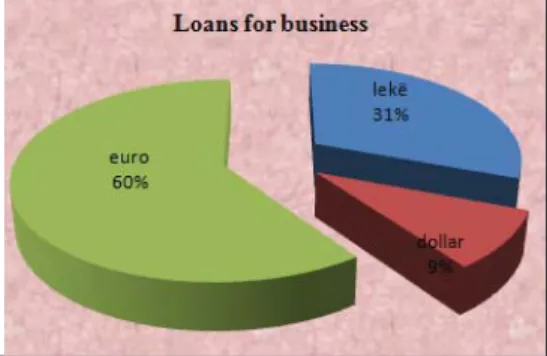
2012 121,958 30.7 36,888 9.3 237,650 59.9 396,705
Figure no. 11. The distribution of loans to businesses
The structure of loans by euro currency takes first place with 60%, the lek by 31% and only 9% of the dollar. It is this structure because the business uses to ensure currency of the main tools for machinery and equipment and for the purchase of raw materials from import. In this way, the demand for the currency of business is justified. Those with these transactions affect the growth of production opportunities and achieving the highest domestic factors
Table 12. Loans to individuals
Years Individuals Total
lekë % dollar % euro %
2009 56,239 40.2 2,230 1.6 80,748 57.8 139,779
2012 61,743 43.5 2,074 1.5 77,703 54.7 142,004
Source: Statistical Report. Bank of Albania. 02/2012. Tirana Figure No. 12. Graf the distribution of loans by currency
Credit facility drawn from individuals is almost the same as using credit structure of the business, but did not have 9% dollar loan but only 2%, while currency loans is 40% euro and 58%. Increased demand for foreign currency is another factor influencing business alongside the growth of total demand for foreign currency which affects the Albanian currency depreciation.
Albanian Lek is not only impaired by the decline of remittances by reducing supply but also the demand side. Are precisely the reasons that we have presented in this paper.
Why isroughly distribution structure to that business, what are the factors why the currency used by the citizens? According to ouran alysis and judgment she used:
- For house purchase from the construction sector. The construction sector sells apartments in euro per square meter and not at ALL. A piece of furniture made in euro and not at ALL.
- Paya portion of the employees of banks and foreign companies are given in euros and not in Albanian Lek - Holidays abroad are made in euro and not in Albanian lek
- Part of the payments to universities, as well as a part of training courses will be made in euro.
In this way, the Albanian citizens are forced to turn to banks or informal market for currency for these transactions. If we had energeticaction of the Ministry of Finance,Taxationand Tax Branch will have as econd-tier state bank then all these companies would be forced to all sales you make through this bank which would enable the opening ALL loan smild interest. This will reveal the Albanian lek and circulation would facilitate it.
Conclusion. Structure of loans by companies andcurrenciesisalmostthe same. Business uses currency for the purchase of machinery and equipment, mostly for imports while individuals generally use to make payments within the country for apartments, cars or other services
5.6 Sixth, the distributionof loans byterritory, etc. Statement 13. Distribution of the loans by districts
Totali Tirana % Durrës/ % Elbasan/ % Shkodër/ %
538,710 383,738 71.2 40,810 7.6 15,279 2.8 13,051 2.4
Korçë/ % Vlorë/ % Fier/ % Lezhë/ % Tëtjera %
8,680 1.6 16,607 3.1 15,424 2.9 10,323 1.9 34,802 6.5
Figure No.13 The distribution of loansby districts
Statements and supporting chart concluded that nearly 80% of the credit is give ninthe Tirana-Durres, while only 20% is distributed to other districts of Albania. This structure reveals an asymmetrical distribution ofloans and their concentration as close to the centerand generally to trade and repairs, construction, hotels, transportation, etc..
6. Conclusions
Distribution of credit shows that in general the Albanian economy is not based on proper rate loans of commercial banks by creating disproportioned development between different regions. This is also one of the reasons for rural areas abandonmentas it is funded mostly only from immigrants coming from these areas, and less through government subsidies, particularly in agriculture.
Were we to have a state- owned commercial bank, then loan structure would have been different; the loans would have been headed towards agriculture, the development of tourist areas, the use of resources in all regions of the country from the low lands to the most remote mountainous ones.
References
Statistical Report. Bank of Albania. 10/2012. Tirana
Statistical Yearbook. Ministry of Agriculture 2009 Monthly Statistical Report. Bank of Albania 09/2012 Annual Report. Bank of Albania 2012
Raporti i Politikës Monetare për Tremujorin e tretë të Vitit 2012
Sjellja e kreditimit në Shqipëri: Një shenjë konvergjence apo devijim nga tendenca e vet afatgjatë? Publikuar nga Irini Kalluci në 26.11.2012
Raporti i Politikës Monetare për Tremujorin e dytë të Vitit 2012
“Recesioni global dhe ndikimi i tij në ekonominë shqiptare”. Monografi. Alqi Naqellari, Robert Maliqi & Almarin Naqellari Tiranë 2012. The Priority of the Development of Standartization of the Deposit Activities of the Russian Banks in the Context of the Post-Crisis
Economic Recovery. Gerasimova, Irina &Sokolova, Evgenia. International Conference of ASECU”. “Recent Economic Crisis and Future Development Tendencies”.
International Conference of I. Alba-Shkenca in Skopje 29-31 august 2012. “ Albanian economic model face pressure of global recession” A.Naqellari, T.Mehilli & JetonShaqiri.
Shqipëria në Shifra. 2010. INSTAT