Hyrax: Cloud Computing on Mobile Devices
using MapReduce
Eugene E. Marinelli
CMU-CS-09-164September 2009
School of Computer Science Carnegie Mellon University
Pittsburgh, PA 15213 Thesis Committee: Priya Narasimhan, Chair
Srinivasan Seshan
Submitted in partial fulfillment of the requirements for the degree of Master of Science.
Copyright c2009 Eugene E. Marinelli
This work has been partially supported by the National Science Foundation CAREER grant CCR-0238381 and CNS-0326453, and the Army Research Ofce grant number DAAD19-02-1-0389 (Perpetually Available and Secure Information Systems) to the Center for Computer and Communications Security at Carnegie Mellon University.
The views and conclusions contained in this document are those of the author and should not be interpreted as representing the official policies, either expressed or implied, of the U.S. Government.
Report Documentation Page
OMB No. 0704-0188Form ApprovedPublic reporting burden for the collection of information is estimated to average 1 hour per response, including the time for reviewing instructions, searching existing data sources, gathering and maintaining the data needed, and completing and reviewing the collection of information. Send comments regarding this burden estimate or any other aspect of this collection of information, including suggestions for reducing this burden, to Washington Headquarters Services, Directorate for Information Operations and Reports, 1215 Jefferson Davis Highway, Suite 1204, Arlington VA 22202-4302. Respondents should be aware that notwithstanding any other provision of law, no person shall be subject to a penalty for failing to comply with a collection of information if it does not display a currently valid OMB control number.
1. REPORT DATE
SEP 2009 2. REPORT TYPE
3. DATES COVERED
00-00-2009 to 00-00-2009 4. TITLE AND SUBTITLE
Hyrax: Cloud Computing on Mobile Devices using MapReduce
5a. CONTRACT NUMBER
5b. GRANT NUMBER
5c. PROGRAM ELEMENT NUMBER
6. AUTHOR(S) 5d. PROJECT NUMBER
5e. TASK NUMBER
5f. WORK UNIT NUMBER
7. PERFORMING ORGANIZATION NAME(S) AND ADDRESS(ES) Carnegie Mellon University ,School of Computer Science,Pittsburgh,PA,15213
8. PERFORMING ORGANIZATION REPORT NUMBER
9. SPONSORING/MONITORING AGENCY NAME(S) AND ADDRESS(ES) 10. SPONSOR/MONITOR’S ACRONYM(S)
11. SPONSOR/MONITOR’S REPORT NUMBER(S)
12. DISTRIBUTION/AVAILABILITY STATEMENT
Approved for public release; distribution unlimited 13. SUPPLEMENTARY NOTES
14. ABSTRACT
15. SUBJECT TERMS
16. SECURITY CLASSIFICATION OF: 17. LIMITATION OF ABSTRACT Same as Report (SAR) 18. NUMBER OF PAGES 123 19a. NAME OF RESPONSIBLE PERSON a. REPORT unclassified b. ABSTRACT unclassified c. THIS PAGE unclassified
Standard Form 298 (Rev. 8-98) Prescribed by ANSI Std Z39-18
Keywords: mobile, cloud, grid, distributed, computing, Hadoop, Android, Hyrax, MapReduce, smartphones, middleware, filesystem, peer-to-peer
Abstract
Today’s smartphones operate independently of each other, using only lo-cal computing, sensing, networking, and storage capabilities and functions provided by remote Internet services. It is generally difficult or expensive for one smartphone to share data and computing resources with another. Data is shared through centralized services, requiring expensive uploads and down-loads that strain wireless data networks. Collaborative computing is only achieved using ad hoc approaches.
Coordinating smartphone data and computing would allow mobile appli-cations to utilize the capabilities of an entire smartphone cloud while avoiding global network bottlenecks. In many cases, processing mobile data in-place and transferring it directly between smartphones would be more efficient and less susceptible to network limitations than offloading data and processing to remote servers.
We have developed Hyrax, a platform derived from Hadoop that supports cloud computing on Android smartphones. Hyrax allows client applications to conveniently utilize data and execute computing jobs on networks of smart-phones and heterogeneous networks of smart-phones and servers. By scaling with the number of devices and tolerating node departure, Hyrax allows applica-tions to use distributed resources abstractly, oblivious to the physical nature of the cloud.
The design and implementation of Hyrax is described, including experi-ences in porting Hadoop to the Android platform and the design of mobile-specific customizations. The scalability of Hyrax is evaluated experimentally and compared to that of Hadoop. Although the performance of Hyrax is poor for CPU-bound tasks, it is shown to tolerate node-departure and offer reason-able performance in data sharing. A distributed multimedia search and sharing application is implemented to qualitatively evaluate Hyrax from an application development perspective.
Acknowledgments
I would like to acknowledge the many people who supported me in completing this work. First, I would like to acknowledge Professor Priya Narasimhan, my advisor, for her guidance, inspiration, and funding over the past two years. I would also like to thank Professor Srinivasan Seshan for serving on my thesis committee.
I would like to thank Jiaqi Tan for his constant willingness to contribute and discuss ideas for my project. The Hadoop log analysis system that he developed has been instru-mental in debugging and evaluating Hyrax. I would also like to thank Dr. Rajeev Gandhi and Ernie Brown for taking the time to help me with testing at Mellon Arena. I would also like to acknowledge the rest of the people with whom I collaborated in research and class projects this year, including Mike Kasick, Keith Bare, Soila Kavulya, Austin McDonald, Dmitriy Ryaboy, Nathan Mickulicz, and Shahriyar Amini.
I would like to thank Jennifer Engleson for all her help in acquiring hardware for this project, answering various questions, and, most importantly, notifying me when free food was available. I would also like to thank Deborah Cavlovich for her help in the Fifth Year Master’s program, and Samantha Stevick and Joan Digney for their help with technical reports and posters. I would like to thank Karen Lindenfelser for all she has done to create a great work environment at the CIC, which was practically my home this year.
I would like to thank my office-mates Adam Goldhammer, Michael Chuang, Heer Gandhi, Wesley Jin, and James Kong for helping me formulate and refine my ideas through-out the project. Adam’s and Heer’s hardware knowledge was particularly helpful. I would also like to thank my apartment-mates Rich Lane and Jeffrey Ohlstein for giving me feed-back on my ideas and providing technical advice. I would like to thank Jessica Liao for helping to revise my thesis and prepare for my defense, and for supporting me in general throughout the year.
I would like to thank Seth Goldstein for recommending me for the Fifth Year Master’s program and for his guidance and advice during my time as a student at Carnegie Mellon.
I would also like to thank Frank Pfenning for hiring me as a teaching assistant and advising me on research and academics.
Finally, I would like to thank my father, Gene Marinelli, my mother, Barbara Marinelli, my sister, Amy Marinelli, and the rest of my family and friends for their support this year and throughout my education.
Contents
1 Introduction 1 1.1 Our contributions . . . 3 2 Background 5 2.1 Smartphone technology . . . 5 2.2 Cloud computing . . . 62.3 MapReduce and Hadoop . . . 6
2.4 Android . . . 8
3 Problem Statement and Motivation 11 3.1 Problem statement . . . 11
3.2 Goals and non-goals . . . 12
3.3 Motivation . . . 13
3.3.1 Advantages of cloud computing on mobile devices . . . 13
3.3.2 Applications . . . 14
3.3.3 Feasibility . . . 16
4 Approach 17 4.1 Assumptions . . . 17
4.2 Requirements . . . 18
4.3 Using Hadoop for mobile-cloud computing . . . 21
4.3.2 Disadvantages . . . 22
4.4 Hadoop’s assumptions in relation to mobile computing . . . 24
4.5 Using Android for Hadoop . . . 25
4.6 Evolution of our approach . . . 26
5 Implementation 27 5.1 Porting Hadoop . . . 27
5.1.1 Android obstacles . . . 28
5.1.2 Hadoop obstacles . . . 29
5.2 Hadoop on a mobile cluster . . . 30
5.3 Mobile-specific components . . . 30
5.4 Adjusting Hadoop’s configuration parameters . . . 31
5.5 Replication strategy . . . 33
5.6 File organization . . . 33
5.7 Heterogeneous networks . . . 34
5.7.1 Server-augmented Block Replication and Serving . . . 34
6 Evaluation 37 6.1 Experimental infrastructure . . . 37
6.1.1 Testbed . . . 37
6.1.2 Benchmarks . . . 39
6.1.3 Analysis tools . . . 40
6.2 Baseline performance of mobile devices vs. traditional servers . . . 42
6.3 Network link properties . . . 45
6.3.1 Question . . . 46
6.3.2 Approach . . . 46
6.3.3 Hypothesis . . . 46
6.3.4 Results . . . 46
6.4 Performance of Hadoop on mobile devices and traditional servers . . . . 48
6.4.1 Question . . . 49
6.4.2 Hypothesis . . . 50
6.4.3 Results . . . 52
6.4.4 Conclusions . . . 56
6.5 Handling network changes . . . 65
6.5.1 Question . . . 65 6.5.2 Approach . . . 65 6.5.3 Hypothesis . . . 65 6.5.4 Results . . . 66 6.5.5 Conclusions . . . 68 6.6 File sharing . . . 68 6.6.1 Question . . . 68 6.6.2 Approach . . . 68 6.6.3 Hypothesis . . . 69 6.6.4 Results . . . 71 6.6.5 Conclusions . . . 74 6.7 Battery consumption . . . 75 6.7.1 Question . . . 75 6.7.2 Approach . . . 75 6.7.3 Hypothesis . . . 76 6.7.4 Results . . . 77 6.7.5 Conclusions . . . 80
7 Case Study: Distributed Video Search and Sharing 83 7.1 Requirements . . . 83
7.2 Design . . . 84
7.3 Implementation . . . 85
7.4.1 Background and Motivation . . . 85
7.4.2 Experiences at Mellon Arena . . . 86
8 Related Work 87 8.1 Mobile Grid Computing . . . 87
8.2 Sensor In-network Processing . . . 89
8.3 Mobile Data Sharing Systems . . . 91
9 Conclusions 93 9.1 Future work . . . 94
9.1.1 NAT and firewall traversal . . . 94
9.1.2 Battery consumption analysis and improvement . . . 94
9.1.3 Handling network changes . . . 95
9.1.4 Cluster selection . . . 95 9.1.5 Mobile rack-awareness . . . 95 9.1.6 Sensor databases . . . 96 9.1.7 Adaptive replication . . . 96 9.1.8 Security . . . 96 9.1.9 Storage fault-tolerance . . . 97
9.1.10 Optimization or re-implementation of MapReduce . . . 97
9.1.11 Large-scale testing . . . 97
9.1.12 Offloaded vs. local computation . . . 97
List of Figures
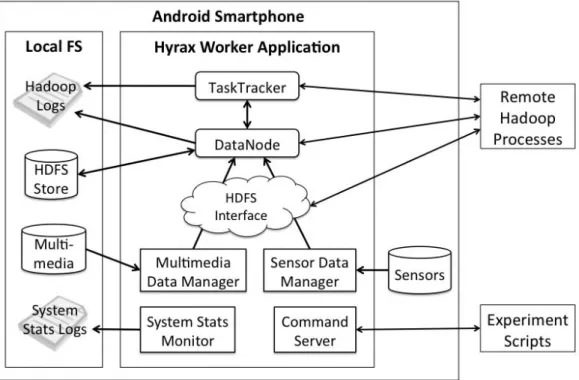
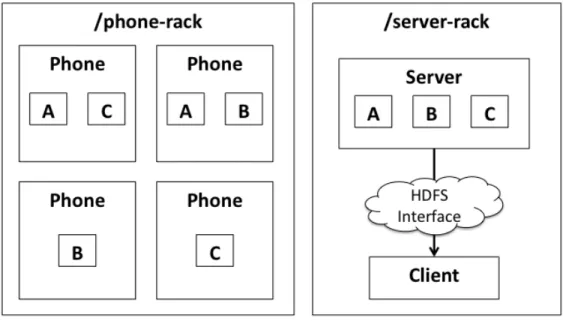
2.1 Typical Hadoop cluster configuration. . . 8 5.1 Hyrax hardware and software layers. . . 30 5.2 Hyrax worker application component interaction diagram. . . 31 5.3 Example of block replica distribution in Hyrax with replication factor 3
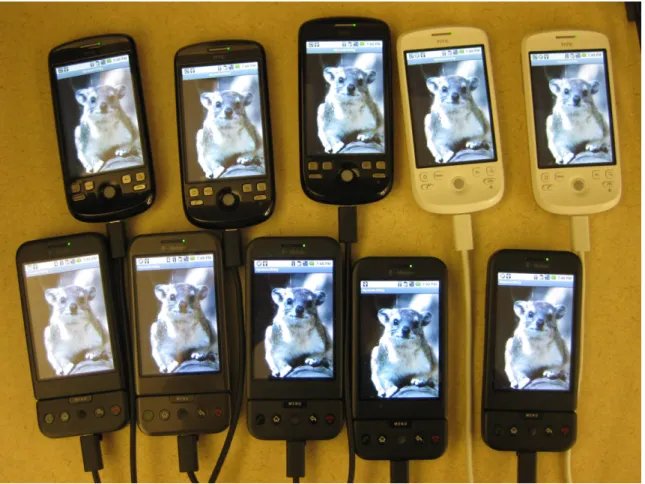
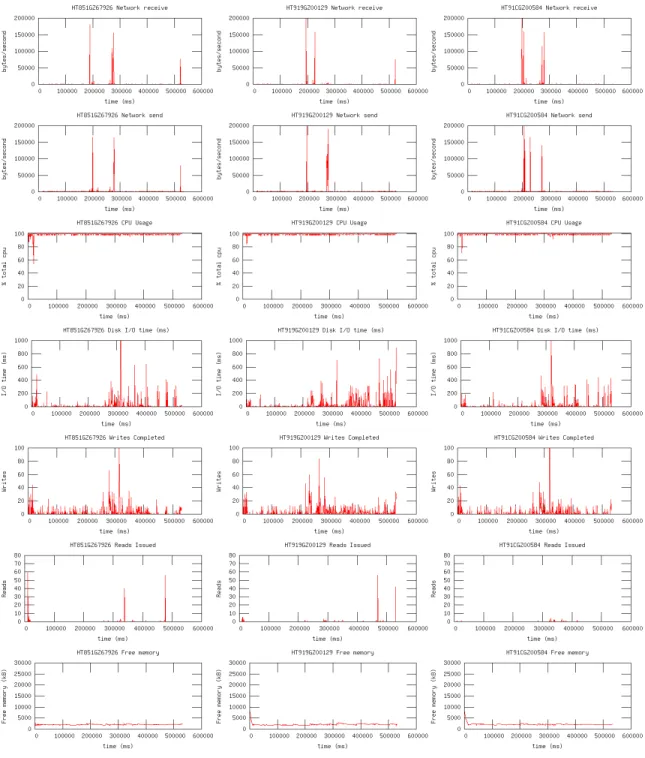
for each file using/phone-rackand/server-rack. . . 35 6.1 Hyrax workers running on our Android smartphone cluster. . . 38 6.2 Example of system resource usage data. Network, CPU, disk, and memory
usage metrics for Sort benchmark on 3 of 10 phones. . . 41 6.3 Swimlanes visualization for Sort benchmark on 5 phones and on 5 servers
sorted by task start time. . . 43 6.4 Total phase time bar graphs for 5 smartphones and for 5 servers running
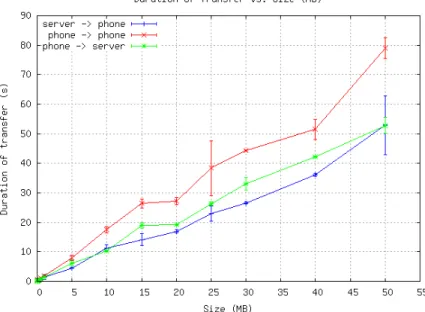
Pi Estimator. . . 44 6.5 Network transfer time vs. size for each network path in testbed for large
transfers. . . 47 6.6 Network transfer time vs. size for each network path in testbed for small
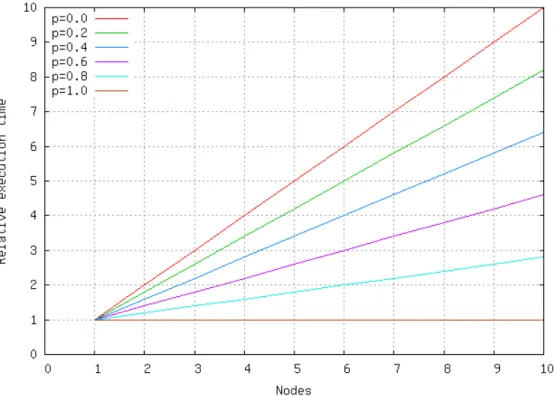
transfers. . . 47 6.7 Simulated relative benchmark execution time vs. number of nodes for
varying levels of parallelization. . . 51 6.8 Execution time vs. number of nodes (top) and input size (bottom) for
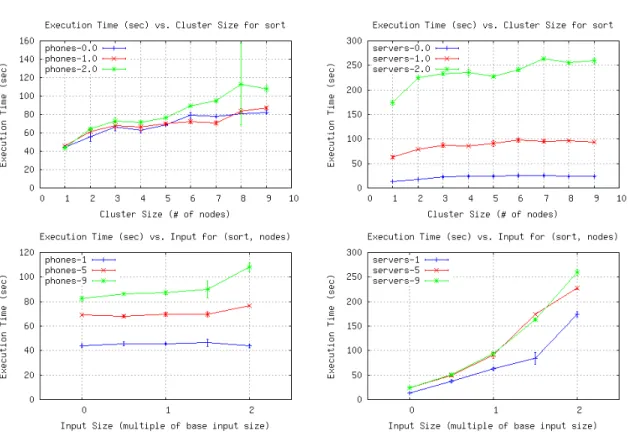
phones (left) and servers (right), Sort benchmark . . . 53 6.9 Execution time vs. number of nodes (top) and input size (bottom) for
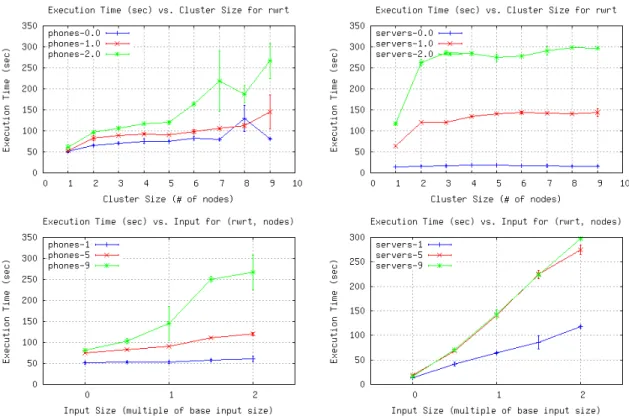
6.10 Execution time vs. number of nodes (top) and input size (bottom) for
phones (left) and servers (right), Word Count benchmark . . . 55
6.11 Normalized task time breakdown for servers and phones vs. number of nodes (top, 1.0x input size) and input size (bottom, 5 nodes) for Sort benchmark. . . 57
6.12 Absolute task time breakdown for servers (top) and phones (bottom) vs. number of nodes for Sort benchmark, 1.5x base input size. . . 58
6.13 Absolute task time breakdown for servers (top) and phones (bottom) vs. input size for Sort, 5 nodes. . . 59
6.14 Normalized task time breakdown for servers and phones vs. number of nodes (1.0x input size) for Word Count. . . 60
6.15 Total bytes received (top) and sent (bottom) vs. number of nodes for servers and phones, Sort benchmark. The server plot for input size 0 is nearly zero for all numbers of nodes. . . 61
6.16 Average CPU usage vs. number of nodes for servers and phones, Sort (top) and Pi Estimtor (bottom) benchmarks. . . 62
6.17 Word Count benchmark disk reads (top), disk writes (middle), and disk I/O time (bottom) vs. number of nodes for phones (left) and servers (right). 63 6.18 File sharing experiment diagram for the HDFS case. . . 69
6.19 Publishing time vs. input size for 5 nodes. . . 71
6.20 Retrieval time distribution vs. number of nodes for a 10 MB file. Points in box-and-whisker plot correspond to (from bottom to top) minimum, lower quartile, median, upper quartile, and maximum. Box-and-whisker plots are shifted slightly on the x-axis for visual clarity, but correspond to the nearestnto the left. . . 72
6.21 Mean retrieval time vs. number of nodes for a 10 MB file. . . 73
6.22 Total upload and mean download time vs. number of nodes for 10 MB file. 74 6.23 Total bytes sent or received vs. number of nodes for 20 MB file. . . 75
6.24 Battery life by task. . . 78
6.25 Battery consumption fit for video streaming battery level data. . . 79
6.26 Battery consumption fit for Hyrax-active battery level data. . . 79
6.28 Normalized battery consumption and total time by task type for Hyrax Sort with 7 nodes. . . 81
List of Tables
6.1 Benchmark input types and sizes per node. . . 39 6.2 Benchmark initialization and execution phases. . . 40 6.3 Android G1 and server performance results. . . 45 6.4 Node departure success rates for Random Writer benchmark. Each cell
contains the success rates for r = 1, r = 2, and r = 3 in that order. Success rates wherek≥rshow shown in red. . . 66 6.5 Node departure success rates for Grep benchmark. Each cell contains the
success rates for r = 1, r = 2, and r = 3 in that order. Success rates wherek ≥rshow shown in red. . . 67 6.6 Node departure success rates for Word Count benchmark. Each cell
con-tains the success rates forr = 1, r = 2, andr = 3in that order. Success rates wherek ≥rshow shown in red. . . 67 6.7 Node departure success rates for Sort benchmark. Each cell contains the
success rates for r = 1, r = 2, and r = 3 in that order. Success rates wherek ≥rshow shown in red. . . 67 6.8 Battery experiment results. . . 77 6.9 Mean resource usage for each battery workload. Computed over entire
duration of each workload and averaged over all phones. . . 78 6.10 Battery consumption by task type in Hyrax Sort (7 nodes). . . 80
Chapter 1
Introduction
Most of today’s smartphone applications are geared towards an individual user and only use the resources of a single phone. There is an opportunity to harness the collective sens-ing, storage, and computational capabilities of multiple networked phones to create a dis-tributed infrastructure that can support a wealth of new applications. These computational resources and data are largely underutilized in today’s mobile applications. Using these resources, applications could conveniently use the combined data and computational abil-ities of an entire network of smartphones to generate useful results for clients both outside and within the mobile network. This interface and the underlying hardware would create a
mobile-cloudupon which compute jobs could be performed. We definemobile-cloud com-putingto be an extension of cloud computing in which the foundational hardware consists at least partially of mobile devices.
Some mobile applications already extract and aggregate information from multiple phones. Tweetie Atebits for the iPhone uses locations from other phones running the application to allow users to see recent Twitter posts by nearby users. Video and photo publishing applications such as YouTube and Flickr allow users to upload multimedia data to share online. The Ocarina application Smule for the iPhone allows users to listen to songs played by other users of the application, displaying the location of each user on a globe. Such smartphone applications are “push”-based and centralized, meaning that users push their information to a remote server where it is processed and shared.
It is possible to use a networked collection of smartphones in a more opportunistic way. Each smartphone has some amount of storage, some amount of compute power, some sensing abilities, some multimedia data, and some amount of energy. Each of these capabilities is currently only available to and utilized by the smartphone’s owner. What if these capabilities were somehow offered to other users and applications? What if we
could harness a collection of smartphones to support large-scale distributed applications, using smartphones as the basis for a cloud computing infrastructure? Each smartphone would be equipped to perform individual, local computations on its local data in support of a larger, system-wide objective, and the outcomes of each smartphone’s local actions would be aggregated to meet the needs of the overall application. Applications could use these resources abstractly, oblivious to the underlying implementation on a smartphone network.
Similar concepts have been studied in sensor networks and mobile grid computing, Sorniotti et al. [2007], Akyildiz et al. [2006], Litke et al. [2004]. However, in contrast to data-center “pay-as-you-use” cloud computing and sensor networks, in the proposed mobile-cloud concept (1) each node is owned by a different user, (2) each node is likely to be mobile, (3) the network topology is more dynamic, and (4) each mobile node is battery-powered. In contrast to mobile grid computing, mobile-cloud computing focuses on abstracting away from the implementation of resource sharing to provide a useful tool for applications.
Using mobile hardware for cloud computing offers advantages over using traditional hardware, such as computational access to multimedia and sensor data without large net-work transfers, more efficient access to data stored on other mobile devices, and distributed ownership and maintenance of hardware. Such a concept inevitably gives rise to many concerns, including access-control, incentivisation of users, privacy, and mobile resource conservation. At the same time, this concept may create many opportunities for interesting new applications and for more resource-efficient versions of existing applications.
One application that illustrates the usefulness of a mobile-cloud computing platform is distributed mobile multimedia sharing. Today, it is easy to upload mobile photos and videos directly to remote services such as Flickr and YouTube, at least when a stable, high-bandwidth network connection is available. However, sharing a file in this way is expensive and sometimes wasteful. The file needs to be compressed, annotated, and then sent over the network, draining the battery in the process. This upload is also a burden for wireless network service providers who must handle these large uploads and for other mo-bile users who experience the network performance degradation that results. Furthermore, many videos and pictures uploaded to these websites are only accessed a few times if at all.
Handling file uploads is a particularly big problem when a large number of people are using mobile phones in one location. For example, many wireless data services failed in Washington D.C. during the 2009 U.S. Presidential Inaugration Park [2009], an event which millions of people attended. In fact, CTIA-The Wireless Association issued a press release Joe Farren before the event imploring mobile users to “wait until leaving the
In-augural events to send [photos and videos] to friends and family”. In such cases, mobile users are unable to publish and consume multimedia at the time when it is most interesting and relevant. Furthermore, wireless service providers cannot prepare for all events that in-duce high network traffic in advance. For instance, the terrorist attacks of September 11th, 2001, induced similar network congestion in New York Beard [2005], making it difficult to place wireless phone calls. If a similar incident happened today, it would be difficult to share extremely important multimedia data collected on smartphones.
A more scalable way to support multimedia sharing from mobile devices is to host files on phones and distribute queries and summarization tasks across many nodes, eliminating the need for each user to upload large files to and retrieve files from remote services. In-stead, large transfers could be performed directly within local networks. Search queries could include times and locations of interest and incorporate local sensor readings such as heading and movement to estimate video quality and relevance. Irrelevant and low-quality videos would never need to leave the phone on which they were collected, saving battery energy for both these users and users who would have downloaded these videos, and re-ducing the load on the network as a whole. Data “hot-spots”, i.e. smartphones uniquely hosting very popular data, could be avoided by replicating popular data to other smart-phones, and in some cases servers on the local network. Using this system, smartphone users could publish and retrieve photos and video from many vantage points without wait-ing until after the event, and other entities such as broadcasters could find relevant videos to share with the general public. This application would be useful at any event where a large crowd is gathered, such as sporting events, concerts, plays, and movies.
1.1
Our contributions
The goal of our research is to develop amobile-cloud infrastructure that will enable smart-phone applications that are distributed both in terms of data and computation. In this paper, we present our implementation and evaluation of a mobile-cloud computing infras-tructure based on MapReduce.
We needed a starting point for our investigation of mobile-cloud computing. One pos-sibility was to build a new infrastructure from scratch designed to run on mobile devices. Instead, we decided to start with an existing cloud computing infrastructure and examine its suitability by modifying it to run on mobile devices. We sought to understand and ar-ticulate the obstacles, challenges, and solutions in supporting a mobile-cloud computing platform.
and Ghemawat [2008]. MapReduce is a programming framework and implementation in-troduced by Google for data-intensive cloud computing on commodity clusters. Hadoop is used by companies such as Yahoo!, Facebook, and IBM Apache to process large amounts of data distributed across a network of servers. It is commonly used on Amazon’s Elastic Compute Cloud (EC2), a utility computing service.
Hadoop includes a large amount of the functionality required for a mobile-cloud com-puting system. We target the Android platform since it incorporates the Dalvik Java VM, which is capable of executing much of Hadoop’s Java codebase without modification. We provide an overview of cloud computing, Hadoop, and Android in§2.
In this paper, we establish the motivation for this mobile-cloud computing platform, which we call Hyrax 1, discuss how the challenges of mobile computing apply to this
platform, enumerate the requirements of the platform, and describe the choices we made and the challenges we faced in porting Hadoop to run on Android. We develop and present the results of several experiments that evaluate the scalability, flexibility, performance, and battery usage of Hyrax. We also implement a distributed multimedia search and sharing application to gain insight into the advantages of using Hyrax as an infrastructure for applications that use mobile data.
Our experiments show that Hyrax easily scales to the 12 Android smartphones in our testbed in terms of execution times and resource usage. Unfortunately, it also exerts a huge base cost on Android, requiring a lot of time to process relatively small amounts of data. Hyrax handles node-departure during MapReduce jobs when the number of nodes in the cluster and the replication factor are sufficiently high. Hyrax also allows for data sharing among smartphones in a WiFi network with similar but potentially more consistent latencies compared to uploading files to and hosting files from a remote server. Hyrax has not been optimized to be battery-efficient, but it uses significantly less power than video recording and downloading even in the worst case.
This document is organized as follows: §2 provides the necessary background on cur-rent smartphone technology, cloud computing, Hadoop, and Android. §3 gives the prob-lem statement and establishes the motivation for a mobile-cloud computing platform. In
§4, we list our assumptions, develop requirements, and justify using Hadoop for mobile-cloud computing. §5 describes the implementation of Hyrax, including our assumptions, requirements, and choices in configuring and customizing Hadoop for mobile devices. §6 describes our experimental evaluation of Hyrax. §7 describes our distributed multimedia search and sharing case study. §8 discusses the related work.
1The hyrax is a small herbivorous animal that lives in Africa and the Middle East. It is described as being the closest living relative to the elephant.
Chapter 2
Background
2.1
Smartphone technology
Advances in mobile hardware and software have allowed users to perform tasks that were once only possible on personal computers and specialized devices like digital cameras and GPS personal navigation systems. Using smartphones like the Apple iPhone, Android phones, and the BlackBerry, mobile users can now make full use of the Internet, capture and manage photos and videos, play music and movies, and play complex games. They have nearly ubiquitous access to the Internet via 3G services, WiFi, and peer-to-peer net-working and can switch between networks automatically.
Sensors enable many interesting applications on smartphones. They provide informa-tion about the locainforma-tion, movement, and orientainforma-tion of the phone and the environment’s temperature and lighting. For example, the Google Android G1 contains an accelerome-ter, a GPS device, and a digital compass. Applications use local sensor data to customize and enhance the user’s experience in a context-aware manner. For example, map applica-tions display the user’s current location on a map, rotate the map according to the user’s heading, and provide customized directions. Games use motion data as input to create an immersive experience. Music applications such as Ocarina use microphone signals to simulate the effect of blowing into a musical instrument.
In addition to sensor data, smartphones are used to store, generate, and share multi-media data. Using built-in cameras and microphones, these devices can record photos, videos, and sound clips. Smartphones are also used to play movies and music downloaded to the device by the user. Several gigabytes of multimedia data can be stored locally on smartphones thanks to cost and size improvements in flash memory Matt.
Smartphones are becoming extremely widespread. According to International Telecom-munication Union [2009], there are currently over 4 billion mobile subscriptions in the world. Among the devices used by these subscribers, smartphones are becoming increas-ingly common, accounting for a larger percentage of the mobile phone market and replac-ing less capable mobile phones. Accordreplac-ing to Hamblen, smartphones accounted for more than 14% of all mobile device shipped in 2008 and will account for 17% of all mobile de-vices in 2009. 116 million smartphones were shipped in 2007, 171 million were shipped in 2008, and a projected 203 million will be shipped in 2009. As powerful smartphones become more popular, it is increasingly feasible to run more complex software and more computationally-expensive tasks on them.
2.2
Cloud computing
Cloud computing is a style of computing in which dynamically scalable resources are provided as a virtualized service Knorr and Gruman. It allows service providers and other users to adjust their computing capacity depending on how much is needed at a given time or for a given task.
According to Myerson, cloud computing requires three components: thin clients, grid computing, and utility computing. Thin clients are applications that make use of the vir-tualized computing interface. Users are commonly exposed to cloud computing systems through web interfaces to use services such as web-based email, search engines, and on-line stores. Grid computing harnesses the resources of a network of machines so that they can be used as one infrastructure. Utility computing provides computing resources on de-mand, where users “pay as they use”. This is exemplified by Amazon EC2, which allows users to allocate virtual servers on demand, paying an hourly fee for each allocated server. In mobile-cloud computing, the same type of virtualized interface is provided to users, but the system is ultimately supported by mobile devices or a combination of mobile and static devices. The possibility of heterogeneous clusters of servers and mobile devices in which the capabilities of each are used in conjunction is not excluded. The motivation for mobile-cloud computing is developed in§3.3.
2.3
MapReduce and Hadoop
MapReduce Dean and Ghemawat [2008] is a programming model and implementation de-veloped by Google that is used to process very large datasets distributed across a cluster of
servers. It is highly scalable, fault-tolerant, and useful for many large-scale data processing tasks. It is typically used in conjunction with the Google File System Howard et al. [2004], a distributed filesystem designed for “large distributed data-intensive applications.”
To use MapReduce, users specify a “map” function that takes an input key/value pair and outputs intermediate key/value pairs. For every key in the set of intermediate pairs, a set of values is collected. The user specifies a “reduce” function that processes each intermediate key/value set pair and generates an output. Input data is loaded from the distributed filesystem and output data is written back to the filesystem.
The MapReduce runtime system handles splitting the input data, scheduling map and reduce tasks, and transferring input and output data to the machines running the tasks. Jobs are managed by a master that assigns tasks to slave machines and provides the locations of intermediate values to reduce tasks. Computation on the machine where the input data is already stored is preferred in order to minimize network transfers. Large data transfers are performed directly between the machine where the data is stored and the machine that needs the data. Data transfers between machines on the same rack are preferred to transfers between machines that are more “distant” from each other in the network.
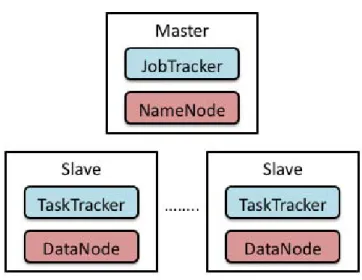
Hadoop Apache is an open source implementation of MapReduce used by many or-ganizations for large-scale data processing. Hadoop is written in Java and operates on data stored in a distributed filesystem, usually the Hadoop Distributed Filesystem (HDFS), which is based on the Google File System. Hadoop instances consist of four types of pro-cesses Borthakur [2007]: NameNode, JobTracker, DataNode, and TaskTracker. There is one NameNode and one JobTracker in a Hadoop cluster. The NameNode maintains a directory of data blocks that make up the files in HDFS. The JobTracker manages jobs and coordinates sub-tasks among the TaskTrackers. Both a DataNode instance and a Task-Tracker instance run on each worker machine. The DataNode stores and provides access to data blocks, and the TaskTracker executes tasks assigned to it by the JobTracker. Clients access files by first requesting block locations from the NameNode and then requesting blocks directly from these locations. The layout of these processes in a typical Hadoop cluster is summarized in Figure 2.1.
Hadoop is capable of tolerating faults by re-executing failed tasks (and tasks whose results are no longer available because of later failures) and by maintaining block replicas among several DataNodes. When speculative execution is enabled, the same task may be executed on multiple nodes to increase the probability of successful and fast results. Hadoop’s fault tolerance, along with its peer-to-peer bulk data transfers and largely inde-pendent tasks, allow it to scale to thousands of machines.
Figure 2.1: Typical Hadoop cluster configuration.
an arbitrarily scaled computing cluster. Hadoop programmers only need to be concerned with defining a high-level workflow for the system. The Hadoop runtime determines how to divide jobs submitted by the user into sub-tasks, where to physically store data, how to move computations and data, how to handle machine failures, and all of the other details that are required for a distributed computing system to work.
2.4
Android
Android Open Handset Alliance is an open source mobile operating system developed by Google and the Open Handset Alliance. It is built on top of the Linux kernel and provides an SDK for application development in Java.
Android uses the Dalvik Virtual Machine to execute applications. Dalvik is optimized to run on devices with constrained CPU, memory, and power resources. It implements a subset of Java 2 Platform Standard Edition (J2SE) using libraries from the Apache Har-mony Apache Java implementation, giving it an advantage over other mobile platforms that only support Java 2 Platform Micro Edition (J2ME), which is limited by comparison. Java class files must be compiled to Dalvik bytecode (.dex format) and packaged in a .apkfile in order to be used on Android.
Android provides an interface to system devices and services through a set of Java packages, includingandroid.os,android.hardware,android.location, and
android.media. This makes it easy to access and operate on multimedia data, sensor values, system resource usage data, and location information. Unlike some mobile oper-ating systems, Android applications can use the filesystem directly, making it possible to manage files as on a traditional Unix system. Android also provides a shell interface, but it lacks many of the abilities of a typical Linux shell. Some of the missing utilities can be added by installing BusyBox Denys Vlasenko.
Chapter 3
Problem Statement and Motivation
3.1
Problem statement
We study the problem of how to create a mobile-cloud computing infrastructure that al-lows applications to utilize the collective data and computational resources of networked smartphones, particularly by modifying an existing non-mobile platform. The following questions are addressed:
1. In what ways does an existing cloud computing platform succeed and fail to meet the needs of a mobile deployment? Can it be modified to be adapted to be suitable, and how? The effectiveness of Hadoop on the Android platform is evaluated, and customizations of Hadoop for mobile hardware are implemented.
2. To what extent do mobile hardware and software reduce the effectiveness of an existing cloud computing platform? The performance of Hadoop on the Android platform is evaluated.
3. Does sharing processing and data among mobile phones in local networks reduce strain on globally-limited networks and decrease distribution latency by avoiding this bottleneck? The latency of resource usage is compared between sharing data through a central service and sharing it through a distributed filesystem.
4. What are the challenges in porting an existing cloud computing platform to run on smartphones? The obstacles that were faced in porting Hadoop to run on Android are reported.
5. How can a cloud interface to mobile resources be used effectively in practice? A distributed multimedia search and sharing application is implemented, and the ad-vantages of using Hyrax instead of an ad hoc approach are reported.
With respect to this problem, we make the following claim:
Thesis statement.It is feasible with today’s mobile hardware and network infrastruc-ture to provide mobile cloud computing using local data and computational resources to support larger system-wide goals.
The thesis statement is validated through the design and implementation of a mobile-cloud computing system based on MapReduce, various performance experiments, and the development of a case-study application.
3.2
Goals and non-goals
In order to address the problem statement, our goals are the following:
• Motivate mobile-cloud computing by discussing the advantages of using mobile de-vices for cloud computing, proposing example applications, and showing that it is feasible using today’s mobile technology.
• Implement Hyrax, a mobile-cloud computing platform, by porting Hadoop to run on Android smartphones.
• Evaluate what effect the mobile hardware platform has on the performance of Hadoop by developing a testbed and running a set of experiments on it.
• Determine whether Hyrax offers advantages in sharing data and processing com-pared to current approaches.
• Implement an application on top of Hyrax and evaluate it. We do not aim to do the following:
• Implement a mobile-cloud computing platform that is fully optimized and ready for real-world deployment.
• Create a platform that is useful for generic distributed computation. We do not ex-pect to compete with traditional server clusters for generic large-scale distributed data processing, only to support applications that make use of mobile-specific capa-bilities and data that is already on mobile phones.
3.3
Motivation
Mobile-cloud computing is motivated by the unique advantages of mobile devices, the wide range of applications that a mobile-cloud computing platform would facilitate, and the feasibility of such a platform using today’s mobile technology.
3.3.1
Advantages of cloud computing on mobile devices
As defined in§1, mobile-cloud computing is cloud computing in which the foundational hardware consists at least partially of mobile devices. Traditional cloud computing sys-tems are built on clusters of servers. Massive amounts of data are placed on these clusters through layers of virtualization, and then high-level jobs are executed to process this data and return useful results. In mobile-cloud computing, data originates and is processed on mobile devices.
Despite the obstacles that mobile computing systems inevitably face relative to station-ary computing systems, including resource limitations, risk of loss and damage, variability in connectivity, and finite energy Satyanarayanan [1996b], there are numerous advantages of cloud computing on mobile hardware. These provide the core motivation for Hyrax:
• Mobile data such as sensor logs and multimedia data are immediately available and can be processed in-place or another node that is nearby in the network. Processing data in this way eliminates the need to expensively transfer data to remote, central-ized services.
• Data can often be shared more quickly and/or less expensively among mobile de-vices through local-area or peer-to-peer networks. Data sharing is inherently useful in some applications, and it is needed for collaborative computing jobs. Distribut-ing data usDistribut-ing the local network avoids file uploads to and downloads from remote Internet services, which induce and are susceptible to global network contention.
• Services such as websites that use mobile data can be created with little extra com-puting infrastructure. Instead of hosting data and services on an expensive server farm or utility computing service, work can be distributed among mobile devices. With Hyrax, services would only need to act as a frontend to the mobile cloud.
• As stated in§2.1, billions of mobile devices are in use, and the proportion of these devices with smartphone capabilities is increasing. A mobile-cloud computing in-frastructure could potentially be scaled to many more machines than a traditional
cloud computing infrastructure simply because of the number of these devices that are in use.
• Ownership of the cluster hardware is distributed. By using mobile hardware owned by many different people, risks that arise when proprietary cloud services are used, such as data lock-out and dependence on external entities for data privacy, are avoided. Furthermore, maintenance of mobile devices in the cluster is also dis-tributed since owners of smartphones almost always need them to be turned on and working properly. Note that distributed ownership also creates security and privacy challenges.
3.3.2
Applications
We are interested in applications that use data distributed among multiple phones such as multimedia files and sensor logs. Hyrax would support requests from these applications, either for direct access to the data or the results of running some job using the data. A highly appropriate application for Hyrax which incorporates both multimedia and sensor data is described in §1. In this section, more applications that Hyrax would facilitate are described.
Sensor data applications
Sensor data is composed of series of readings generated by a smartphone’s sensors, such as the GPS device, accelerometer, light sensor, microphone, thermometer, clock, and com-pass. Each reading is timestamped, allowing it to be linked with readings from other sen-sors and multimedia files. Applications would use this sensor data by executing queries on the data as in a sensor database system Bonnet et al. [2001]. The data would be accessible via an interface similar to that of a relational database and large data transfers would be avoided by doing computations in-place (where the data is located) whenever possible. For example, a query might ask “what was the average temperature of nodes within five miles of my home at noon?” or “what is the distribution of velocities of all nodes within half a mile the next highway on my current route?”.
The following applications would use sensor data in this way:
• Traffic reporting.This application would use location and movement data collected on mobile phones to infer traffic flow. The movement signal for a given time range would be processed (smoothed, interpolated) on the phone on which it resides, and
a smaller result would be returned to the client. As with any traffic monitoring sys-tem, this application would be useful to drivers who need to navigate through traffic and officials in charge of controlling traffic. However, using mobile devices would allow for more precise monitoring than current systems provide. Traffic monitor-ing systems usmonitor-ing sensor networks were implemented in Hull et al. [2006] usmonitor-ing application-specific sensors and in Lo et al. [2008] using mobile device sensors.
• Sensor maps. This application would plot sensor levels such as temperature or sound levels on a map. The number of phones sampled would depend on the zoom level of the map. This could be used, for instance, to estimate levels of danger in a crisis situation in terms of temperatures, light, and noise levels and how they have been changing over time, or to visualize mobile usage distributions in a city as in Reades et al. [2007].
• Network availability monitoring.This application would collect network connec-tivity information on each phone by time and location. This could be used to de-termine where local-area and wide-area wireless network connectivity is available and how strong the signal of each is in a given location. This information would be useful for both wireless users and wireless providers. For example, Hull et al. [2006] analyzes WiFi availability using sensors attached to cars.
Multimedia applications
Multimedia data consists of files recorded on mobile devices, including videos, photos, and sound clips. It also encompasses files stored on mobile devices for entertainment, such as music and movies. Examples of applications that would use multimedia data are:
• Similar multimedia search. This application would find photos, videos, or music files whose contents are similar to that of an input sample. Each phone would reduce the dimensionality of its resident multimedia files locally using some given feature extraction algorithm, for instance using methods surveyed in Faloutsos [1996], and forward the result. Shazam Shazam Entertainment Ltd is a popular mobile applica-tion that does something similar, searching for songs similar to an uploaded music clip in a central database.
• Event summarization. This application would splice video clips from multiple devices into a single video which captures the entire event. The final video can be uploaded to the Internet or shared among mobile peers. For instance, this system would have been useful the protests that resulted from Iran’s June 2009 presidential
election, where video clips were scattered in time and difficult to share as a result of the government’s efforts to crack down on protests and the spread of information.
• Social networking. Sharing pictures has become a cornerstone of social network-ing websites such as Facebook Facebook. A mobile cloud could be integrated into the infrastructure of a social network to provide automatic sharing and peer-to-peer multimedia access while reducing the need for huge numbers of servers to store, back-up, and serve all of this data.
3.3.3
Feasibility
Mobile-cloud computing is enabled by recent advances in mobile hardware and software. CPU speed and RAM capacity have been approaching those of the desktop machines of less than a decade ago. For instance, the HTC Magic, a recently released Android phone, features a 528 MHz processor and 288 MB of RAM HTC [b]. Networking capabilities are also advancing. Many mobile devices can now connect to WiFi networks, which are widely available in homes and public areas. 3G networks provide widespread access to the Internet with speeds approaching that of WiFi. WiFi and 3G technologies are compared in depth in Lehr and McKnight [2003]. In addition to WiFi and 3G, Bluetooth allows low-power data transfer between devices with bandwidth that will soon approach those of WiFi networks, allowing fast, power-efficient bulk transfers between devices Bluetooth SIG [2009]. Smartphones will soon be able to create peer-to-peer networks using ad hoc WiFi and Bluetooth connections.
Thanks to increasingly powerful mobile hardware, mobile devices are now capable of running full-fledged operating systems such as Linux and Mac OS X. Mobile versions of these operating systems provide SDKs for writing complex applications using extensive libraries. The iPhone SDK supports development in Objective-C and C, allowing appli-cations to make use of almost any existing code in these languages. Similarly, Android’s Dalvik VM implements many J2SE classes, allowing existing Java libraries to be used in mobile applications with slight modifications. As a result, it is increasingly feasible to port desktop and server applications directly to mobile devices.
Unfortunately, energy density in batteries has not improved at nearly the same rate as computational capabilities in mobile devices Lehr and McKnight [2003]. This presents a serious obstacle for running services like a distributed computing platform on smart-phones. As a result, power constraints are an extremely important consideration in design-ing a realistic mobile distributed computdesign-ing platform.
Chapter 4
Approach
In this section, we explicitly state our assumptions, enumerate the requirements for a mobile-cloud computing platform, and explain why we chose to use Hadoop as a basis for Hyrax.
4.1
Assumptions
Our work depends on the following assumptions about the targeted hardware and how the system will be used. We briefly explain why we made each assumption. Future work may allow these assumptions to be relaxed.
• The system will be used primarily for computations that involve data on mobile devices, not for generic distributed computation. We do not expect to replace or effectively collaborate with traditional servers for generic large-scale computation. This is a reasonable assumption given that the fixed cost of computing resources is now very low using systems like Amazon EC2, which provide access to machines that are far more capable than smartphones.
• The smartphones under consideration have sufficient space to store multimedia data and sensor logs, on the order of several gigabytes. This is not an unreasonable assumption given the availability of cheap flash memory Matt. In our testbed, for instance, an 8 GB microSD card costing about $15 is installed in each phone.
• A central machine that can connect to each phone exists. This is required to use Hadoop without extensive modification since Hadoop’s NameNode and JobTracker
processes must each run on some machine. This assumption is not unrealistic given how widespread Internet connections on smartphones are. Note that these do not have to be high-bandwidth connections since the NameNode and JobTracker are only used for coordinating data and jobs.
• Files shared on the mobile network will not be modified often if at all. Our system is targeted at multimedia and sensor data, which can be considered historical records that do not need to be changed.
• Each smartphone is reachable from each other device in the network via IP. This is an unrealistic assumption given the complexities imposed by firewalls and network address translation (NAT). For instance, when a mobile device is behind a wireless router, it is only possible for other devices to connect to it (using plain TCP or UDP sockets) if the correct ports on the router are forwarded to the device. However, sev-eral peer-to-peer NAT- and firewall-traversing protocols exist, including the Session Initiation Protocol (SIP) Rosenberg et al. [2001], JXTA Sun Microsystems [a], and SmartSockets Palmer et al. [2009]. These protocols use mutually-accessible proxies to coordinate transfers on nodes behind firewall and NAT layers. This problem is not addressed in our implementation, but it would not be difficult to incorporate an ex-isting peer-to-peer protocol into Hadoop, especially one such as JXTA that provides a Java SocketFactory implementation.
Note that the following are not assumed:
• Static network topology. It is not assumed that devices in the network, other than the central server, will be present throughout a job.
• Homogeneous hardware. Heterogeneous clusters of devices, including both mobile devices and traditional servers, are allowed.
4.2
Requirements
A mobile-cloud computing platform must satisfy the needs of the applications written for it while using resources efficiently. The essential functionality of a mobile-cloud computing system is:
• Global data access. Applications should be able to access any data that the user of the application has permission to access regardless of the physical nature of the data, for instance where it is stored and how it is replicated.
• Distributed data processing. Given a program that takes data on the filesystem as an input, the platform should be able to compute the result of executing this function on the appropriate data and make the results available to the requester.
In order for the system to usefully provide global data access and distributed data pro-cessing in a real-world mobile distributed system, it must also have the following features:
• Fault-tolerance. It is important for the system to tolerate mobile devices leaving and entering the network. Individual devices are susceptible to network signal loss, running out of battery power, being too far away from other phones for peer-to-peer networking, and hardware failure.
• Scalability. The system must scale with an increasing number of devices and an increasing amount of data. The latency of an operation invoked on the system should increase at most linearly with respect to the amount of the data being processed or accessed. Increasing the number of phones should have a positive to neutral effect on job latencies.
• Privacy. File owners should be able to control other users’ access to their data. For instance, users should be able to specify which other users have access to individual pictures taken on their phones.
• Hardware interoperability. Machines that the software components of the system runs on should be able to interoperate with other machines regardless of hardware specifics. Different types of mobile devices and servers should be able to work together as long as they run compatible versions of the software.
The implementation of this system should use mobile resources wisely, including:
• Battery life. Energy is a finite resource on any mobile device. A service that runs for a long period of time on a mobile device must be especially conscious of energy usage. Energy density in batteries has been increasing much more slowly than the capacities of other mobile computing resources, so preserving energy will likely be the chief priority for mobile software systems for a long time Estrin et al. [2002].
• Network bandwidth. Wireless network connections on mobile phones are rela-tively slow and intermittent, and they account for a significant percentage of power consumption. In fact, network transmission is orders of magnitude more energy-costly than CPU cycles Palmer et al. [2009]. Therefore it is often more efficient to process data on the phone where it resides and return a smaller result.
Furthermore, on mobile data networks, bandwidth is a globally limited resource. The more data that devices send, the slower and less available the service becomes for everyone. As stated in §1, this can make it difficult to transmit data when an extremely large number of mobile devices are being used in the same location.
• CPU cycles and memory. Using the processor on a mobile device requires en-ergy from the battery and may interfere with the performance of other applications. Along the same lines as processor usage, excessive memory usage may interfere with the performance of other applications. Memory allocation tends to be more tightly constrained on mobile operating systems than it is on traditional operating system configurations. For instance, Android limits the heap size of each applica-tion to 16 MB.
In the case of Java-based mobile application frameworks such as the Android SDK, it is especially important to avoid CPU-intensive operations. The virtual machine (the Dalvik VM in the case of Android) adds an extra layer of abstraction which greatly impedes the performance of a program that is CPU- and/or memory-bound compared to the equivalent program running directly on the hardware.
• Time. Time-efficiency is always important to users. The platform should be able to compute results in a reasonable amount of time. This is particularly important in mobile applications because many mobile operating systems only allow the user to focus on one application at a time.
• Storage. The size and cost of flash storage is improving, but the amount of per-manent storage available on mobile devices is still limited compared to the amount of storage on traditional machines. Furthermore, “erase” and “write” operations on flash memory cause memory wear Corsair, reducing data integrity over time. There-fore permanent storage should be used conservatively.
Above basic resource considerations, there are several constraints inherent in mobile computing that need to be considered, especially when transforming a distributed system to one that is both distributed and mobile, as we do with Hadoop. These challenges, originally outlined in Satyanarayanan [1996b], are:
1. Mobile elements are resource-poor relative to static elements. The additional weight, power, and size restrictions compared to static counterparts will always have a neg-ative effect on performance and capacity.
2. Mobility is inherently hazardous. Mobile devices are more susceptible to loss and damage.
3. Mobile connectivity is highly variable in performance and reliability. Wireless works vary in speed and reliability, and mobile users constantly move between net-works. There is often no network available.
4. Mobile elements rely on a finite energy source. Battery power consumption must be considered at all levels for conservation to be effective.
We must demonstrate how Hyrax satisfies or fails to satisfy (in its current state) each of these requirements.
4.3
Using Hadoop for mobile-cloud computing
In order to satisfy the requirements that have been outlined, a new infrastructure had to be built from scratch, or an existing one had to be modified. Recognizing that Hadoop implements the core required functionality, we decided to use it as a starting point. Hadoop has several advantages and disadvantages with respect to the requirements of mobile-cloud computing.
4.3.1
Advantages
Hadoop implements much of the core required functionality outlined in §4.2, including global data access, distributed data processing, scalability, fault-tolerance, and data-local computation (and thus efficient use of network resources).
HDFS, as a distributed filesystem, provides global data access to all devices in the network. Furthermore, data blocks are transferred point-to-point, not through an interme-diary. As a result, the speed of data transfer is limited primarily by the network bandwidth between the two devices involved.
Distributed data processing is provided via Hadoop’s MapReduce implementation, which divides jobs submitted by the user into independent “tasks” and distributes these tasks to slave nodes, taking the physical location of input data into consideration. These slave nodes execute map tasks on data stored on HDFS. As the outputs of map tasks be-come available, reduce tasks process this intermediate data and write results back to HDFS. When possible, data that is physically located on a given node is processed on that node, avoiding data transfers.
Hadoop was designed to scale to thousands of machines, and has been shown to do so by Yahoo! Yahoo!. It is also designed to tolerate faults; any sufficiently large system
faces hardware failures with some expected frequency. HDFS implements file permis-sions, which can be used to protect user data from unauthorized access. Therefore Hadoop covers our requirements for scalability, fault-tolerance, and, to some extent, privacy. Fur-thermore, the hardware fault-tolerance of Hadoop covers the mobile challenge, “mobility is inherently hazardous”.
Since Hadoop uses abstract IPC interfaces for communication between processes and between physical nodes, it is trivial for different types of machines running Hadoop pro-cesses to work together. Therefore Hadoop also satisfies the “hardware interoperability” requirement.
Although Hadoop does not currently take energy efficiency into account, there are signs that this will change. Many companies are interested in data center efficiency Google, Intel for reducing costs and the environmental impact of their operations. There-fore energy usage improvements in Hadoop may be implemented in the future. In fact, researchers have begun to investigate and suggest improvements for energy efficiency in Hadoop. Chen et al. [2009] offers some suggestions for increasing the energy efficiency of Hadoop, such as increasing the replication factor, avoiding excessive fan out and fan in, and making sure that the intermediate pairs processed by reduce workers fit in memory. Given Hadoop’s popularity among major companies which are constantly optimizing their processes and the research that is being done to improve Hadoop’s power efficiency, it is likely that Hadoop will become more power-aware and power-efficient in the future. Fur-thermore, investigating the battery consumption of Hadoop on mobile devices may yield insights useful to improving the energy efficiency of Hadoop in a traditional setting.
4.3.2
Disadvantages
Despite numerous advantages, Hadoop is less than ideal for some of the mobile aspects of mobile-cloud computing. It implements much of the functionality that our platform requires, but it does not cover all of the requirements. This is mostly because Hadoop was designed and implemented with commodity server hardware in mind rather than resource-constrained hardware.
One problem is that Hadoop is not conservative in CPU and memory usage. Hadoop was designed for I/O bound jobs, i.e. those in which reading, writing, and transferring data are the most time-consuming operations. Hadoop’s liberal use of CPU and memory is ex-emplified by several aspects of its codebase. For example, Hadoop makes heavy use of interfaces and inheritance, which impose computational overhead because of the lookups that are required to determine which function to execute. Android provides several
guide-lines for writing efficient code, such as avoiding object instantiation, avoiding internal get-ters and setget-ters, and preferring “virtual” over “interface” Android [a]. Of course, Hadoop was not written with these guidelines in mind since it was developed for normal JVMs running on traditional hardware. By default, Hadoop assumes that memory buffers on the order of 100MB can be allocated, such as in map output buffering. This is clearly not the case on mobile devices.
In the interest of avoiding “reinventing the wheel”, Hadoop also uses technologies that are not well-suited for mobile devices. For instance, it uses XML extensively, which is notoriously expensive to parse. It also uses servlets to serve intermediate results, even though a light-weight custom HTTP server would require less overhead. JSPs, which require dynamic compilation, are used to provide a monitoring interface to DataNodes and TaskTrackers. This inefficiency is magnified on a mobile device.
Hadoop is also lacking in its ability to cope with varying and slow network conditions. Hadoop is typically run on servers Apache connected via 1 Gbit/s to 10 Gbit/s Ethernet networks, which are about 8 and 80 times faster than 802.11g WiFi respectively IEEE [2003] and much more stable. A network-bound MapReduce job may take approximately this many times longer to complete using WiFi connections and perform even worse when signal is poor for some of the nodes. This network bottleneck would occur during the shuffle phase of MapReduce, where intermediate key-value pairs are distributed among the nodes. As a result, for a typical MapReduce job, with all other things equal, a wire-less mobile cluster would be expected to perform much worse than a traditional cluster. MapReduce jobs that run on mobile device networks would have to be tailored to low-bandwidth conditions, e.g. by making sure that intermediate keys and values are small.
The design of HDFS precludes disconnected operation, a major feature in other mo-bile distributed filesystems Kistler and Satyanarayanan [1992]. DataNodes store blocks without any knowledge of the file paths that they correspond to. Therefore it is impossible for mobile devices to access data on HDFS, even if it is stored locally, if no connection to the NameNode exists. Mobile applications would have to use a separate filesystem, most likely the local native filesystem, as a backup when the NameNode is not reachable. Sim-ilarly, mobile applications cannot execute compute jobs through the MapReduce interface when disconnected from the JobTracker. A side-effect of this limitation is that Hyrax does not face consistency problems such as how to resolve changes made to the same file during disconnected operation.
4.4
Hadoop’s assumptions in relation to mobile
comput-ing
It is important to consider the assumptions of the Hadoop and HDFS architecture Borthakur [2007] in relation to mobile devices and the requirements of our platform. These assump-tions should be reasonably compatible with the particulars of smartphones. They are:
• Hardware failure is common. In a mobile device network, failure is equivalent to a device being disconnected from the network for an extended period of time, which is a common occurrence. For instance, mobile devices sometimes disconnect from WiFi when they are in an idle state in order to save power Android [b]. Mobile devices also become disconnected when they enter places with poor wireless signal coverage, such as basements, rural areas, and airplanes.
• Applications use large datasets. By default, HDFS uses 64 MB blocks to store files. This is much larger than most multimedia files collected on phones with the exception of large video files. For example, a photo taken using the Android G1 phone uses about 1 MB, and a typical MP3 music file uses about 3 MB. Since at least one block must be allocated per file, storing individual photos and songs as files on HDFS may waste a lot of space and lead to excessive block lookup requests to the NameNode. This overhead can be reduced by combining multiple multimedia files into larger files to be stored on HDFS.
• Applications do not require low-latency access to results. HDFS is designed to support batch-processing rather than interactive use. This assumption might seem difficult to reconcile with the demands of mobile applications, where applications might execute custom queries and expect a result within a short time. However, there are many cases where mobile applications could, instead of executing Hadoop jobs directly, send queries to an intermediary which periodically runs a small set of common queries and caches the results.
• Files are not modified after they are created. This fits well with multimedia files and sensor logs, which are generally not modified once they have been captured. They are essentially historical records.
• Moving computation is easier than moving data. This assumption fits extremely well in a mobile environment. As noted in§4.2, bandwidth is a precious resource on mobile devices, and code generally takes up less space than the data that it is used to process. Therefore it often makes sense to distribute instructions for each phone
to execute on the data that it already contains instead of having each phone offload all of its data to remote machines.
In summary, the assumptions of hardware failure, file non-modification, and relative ef-ficiency of moving code instead of data fit very well with a mobile environment. Hadoop’s job latency assumptions require applications to be developed such that MapReduce jobs are executed periodically instead of on-demand, which should be acceptible in most cases. Hadoop’s dataset size assumptions do not fit very well and thus need to be accounted for.
4.5
Using Android for Hadoop
Google’s Android operating system was the most natural choice of a mobile platform to run Hadoop on. Android’s Dalvik VM implements a subset of the Apache Harmony Java implementation, which includes most of the Java classes used by Hadoop. Hadoop, an Apache project itself, depends on several Apache libraries, such as Apache log4j, Apache XML, and Apache Commons. Because of this compatibility, it was possible to port Hadoop without rewriting a huge amount of code.
Note that most mobile devices that run Java only implement J2ME, which is not suffi-cient for running an application like Hadoop without extensive modification. J2ME does not include many of the high-level networking, process management, and file I/O fea-tures that Hadoop depends on. Using Android made it possible to port Hadoop without completely overhauling its source code.
Another appealing aspect of Android is its open nature relative to other mobile plat-forms such as the iPhone, which is the most popular mobile application platform. Android allows arbitrary applications to be installed on any number devices without any external permission. In contrast, the iPhone SDK requires an expensive developer account in or-der to install an application on an actual iPhone. Android’s debugging tool, ADB, can be used to execute shell commands, install applications, display phone logs, and push and pull files. Because it is a shell utility, it can be used in scripts. The iPhone provides ap-plication installation and log viewing within the XCode IDE, and it does not support the execution of arbitary shell commands or the creation of files. Overall, Android’s relative open-ness makes it an acceptible platform for distributed mobile applications, whereas closed platforms such as the iPhone make the development of such systems more difficult.
4.6
Evolution of our approach
In the early stages of this project, we attempted to port Hadoop to SunSPOTs Sun Mi-crosystems [b], which implements a J2ME API. We found this platform to be too limiting for a direct port of Hadoop; it is missing many of the basic J2SE-style Java classes that Hadoop depends on. For instance, the SunSPOT API does not even include theList in-terface. It would probably be easier to write a simple MapReduce platform specifically for J2ME devices from scratch than to port Hadoop. We chose not to implement a MapReduce system from scratch because we wanted to study a full-featured, real-world MapReduce implementation.
We found it much easier to make progress in porting Hadoop when we tried to do so using the Android SDK and Android devices. We were not certain that it would be possible to port every detail of Hadoop. In fact, we failed to port dynamic class loading and JSP serving. However, we were able to get the core functionality of Hadoop to work through a lot of painstaking debugging.
Chapter 5
Implementation
In this section, we discuss how Hadoop was ported and configured for Android smart-phones and describe the obstacles that were faced. In general, we found that the challenges induced by Android resulted from a lack of openness and deviation from a the typical Unix interface whereas those induced by Hadoop resulted from assumptions about system per-formance. We found that there were many mobile-specific customizations that were made trivial by features of Hadoop.
5.1
Porting Hadoop
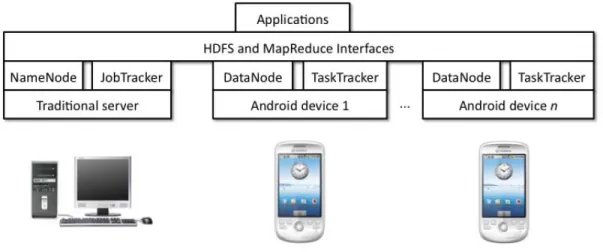
The first step towards porting Hadoop to run on Android was to compile Hadoop’s source code into an Android application. We wanted to create an Android application that would act as a slave in a Hadoop network, running DataNode and TaskTracker instances. Instan-tiating the DataNode and TaskTracker was just a matter of including Hadoop’s source in the Java build path in an Android project. We started with Hadoop 0.19.0. Of course, the system did not simply work immediately. Fixing the incompatibilities between Hadoop and Android was a very difficult debugging task because of several obstacles imposed by both Android and by Hadoop. These obstacles are described in§5.1.2 and§5.1.1. Having fixed most of these incompatibilities, the source was later patched from Hadoop version 0.19.0 to version 0.19.1. This did not break any of our modifications.
Note that the NameNode and JobTracker processes were not ported to run on Android. In Hyrax, these must be run on a traditional machine. However, it would not be any more difficult to port these than it was to port the DataNode and TaskTracker.
5.1.1
Android obstacles
Porting Hadoop to run on Android was a very difficult debugging challenge. Android imposes several additional constraints on its applications that are not present in a typi-cal Linux system. Furthermore, since it uses a custom Java implementation that is not fully compatible with Sun’s JVM implementation, legitimate error-free Java class files are sometimes rejected at runtime. As a result, Hadoop’s source and that of many of its li-braries needed to be changed, either by removing or rewriting offending code, for it to run as an Android application.
At runtime, Dalvik performs an additional consistency check that causes it to reject some opcode sequences even though they were accepted by the Dalvik bytecode compiler. This caused many classes packaged in libraries that Hadoop depends on to be rejected. To get around this, the source code for the incompatible libraries had to be downlo