This content has been downloaded from IOPscience. Please scroll down to see the full text.
Download details:
IP Address: 103.53.34.15
This content was downloaded on 27/09/2016 at 01:52
Please note that terms and conditions apply.
You may also be interested in:
Temperature dependent estimator for load cells using an adaptive neuro-fuzzy inference system Kuang-Chyi Lee
Design of a biped locomotion controller based on adaptive neuro-fuzzy inference systems M-Y Shieh, K-H Chang and Y-S Lia
Artificial Intelligent Control for a Novel Advanced Microwave Biodiesel Reactor W A Wali, K H Hassan, J D Cullen et al.
Nonlinear system identification of smart structures under high impact loads Kemal Sarp Arsava, Yeesock Kim, Tahar El-Korchi et al.
Integration of ANFIS, NN and GA to determine core porosity and permeability from conventional well log data
Ahmad Ja’fari and Rasoul Hamidzadeh Moghadam
Evaluation of arterial propagation velocity based on the automated analysis of the Pulse Wave Shape F M Clara, A G Scandurra, G J Meschino et al.
System identification of smart structures using a wavelet neuro-fuzzy model Ryan Mitchell, Yeesock Kim and Tahar El-Korchi
Adaptive neuro-fuzzy inference system (ANFIS) to predict CI engine parameters fueled with
nano-particles additive to diesel fuel
View the table of contents for this issue, or go to the journal homepage for more 2015 IOP Conf. Ser.: Mater. Sci. Eng. 100 012070
(http://iopscience.iop.org/1757-899X/100/1/012070)
Adaptive neuro-fuzzy inference system (ANFIS) to predict CI
engine parameters fueled with nano-particles additive to
diesel fuel
M Ghanbari1, G Najafi1, B Ghobadian1, R Mamat2, M M Noor2,3 and A
Moosavian1
1Mechanics of Biosystem Eng. Department, Tarbiat Modares University, Tehran, Iran 2Faculty of Mechanical Engineering, University Malaysia Pahang, Malaysia
3Department of Mechanical Engineering, University of Southern Queensland,
Australia\
E-mail:[email protected]
Abstract. This paper studies the use of adaptive neuro-fuzzy inference system (ANFIS) to predict the performance parameters and exhaust emissions of a diesel engine operating on nanodiesel blended fuels. In order to predict the engine parameters, the whole experimental data were randomly divided into training and testing data. For ANFIS modelling, Gaussian curve membership function (gaussmf) and 200 training epochs (iteration) were found to be optimum choices for training process. The results demonstrate that ANFIS is capable of predicting the diesel engine performance and emissions. In the experimental step, Carbon nano tubes (CNT) (40, 80 and 120 ppm) and nano silver particles (40, 80 and 120 ppm) with nano-structure were prepared and added as additive to the diesel fuel. Six cylinders, four-stroke diesel engine was fuelled with these new blended fuels and operated at different engine speeds. Experimental test results indicated the fact that adding nano particles to diesel fuel, increased diesel engine power and torque output. For nano-diesel it was found that the brake specific fuel consumption (bsfc) was decreased compared to the net diesel fuel. The results proved that with increase of nano particles concentrations (from 40 ppm to 120 ppm) in diesel fuel, CO2
emission increased. CO emission in diesel fuel with nano-particles was lower significantly compared to pure diesel fuel. UHC emission with silver nano-diesel blended fuel decreased while with fuels that contains CNT nano particles increased. The trend of NOx emission was
inverse compared to the UHC emission. With adding nano particles to the blended fuels, NOx
increased compared to the net diesel fuel. The tests revealed that silver & CNT nano particles can be used as additive in diesel fuel to improve combustion of the fuel and reduce the exhaust emissions significantly.
1. Introduction
Effects of cerium oxide nano-particles addition in diesel and diesel-biodiesel-ethanol blends on performance and emission characteristics of a CI engine has been studied and results showed that the cerium oxide acts as an oxygen donating catalyst and provides oxygen for the oxidation of CO or absorbs oxygen for the reduction of NOx. The tests revealed that cerium oxide nano-particles can be
used as additive in diesel and diesel-biodiesel-ethanol blend to improve complete combustion of the fuel and reduce the exhaust emissions significantly [1]. The investigation on the performance
3rd International Conference of Mechanical Engineering Research (ICMER 2015) IOP Publishing IOP Conf. Series: Materials Science and Engineering100(2015) 012070 doi:10.1088/1757-899X/100/1/012070
comparison of learning methods in prediction of engine parameters is limited. Hosoz, Ertunc [2] investigated the applicability of adaptive neuro-fuzzy inference system (ANFIS) for predicting several parameters of a diesel engine fueled with diesel and biodiesel blends. Yücesu, Topgül [3] proposed a model based on sparse Bayesian extreme learning machine (SBELM) for engine performance prediction. A comparison was made between SBELM, extreme learning machine (ELM), Bayesian ELM and back-propagated neural network (BPNN) methods. The predicted engine parameters were fuel consumption, Lambda value, HC, CO and CO2 emissions. In another research, Wong, Wong [4]
presented a biodiesel engine modelling by kernel-based extreme learning machine (K-ELM). The used fuel was gasoline, and three parameters of specific fuel consumption, engine power and exhaust temperature were predicted. Because ANNs follow empirical risk minimization (ERM) principle, they have some drawbacks like poor generalization, greater computational burden and proneness to over fitting [5]. The disadvantages cause a performance reduction in modelling. In the literature, there are a few works that have used other machine learning methods which have some advantages over ANNs. In addition, the investigation on the performance comparison of learning methods in prediction of engine parameters is limited. The K-ELM model was compared with least-square support vector machine (LS-SVM) model [4, 6-15]. Previous researches using nano diesel have been mentioned that blending the nano particles with diesel fuel improves the combustion parameters of CI engine [16-33]. In this study, Adaptive Neuro-Fuzzy Inference System (ANFIS) has been employed to determine the engine power, torque, brake specific fuel consumption (bsfc), and emission components based on various diesel–biodiesel and nano particles blends and speeds. The main objective of this research is to investigate the ability of ANFIS for predicting engine performance parameters and exhaust emissions, and also compare their performances in modelling. In this research, the optimum values for the parameters of ANFIS are found, and then the performances of this method are thoroughly evaluated.
2. Experimental Setup 2.1.Methodology
ThereIn this study, the experiments were performed on a CI engine, 6 Cylinder. A 190 kW
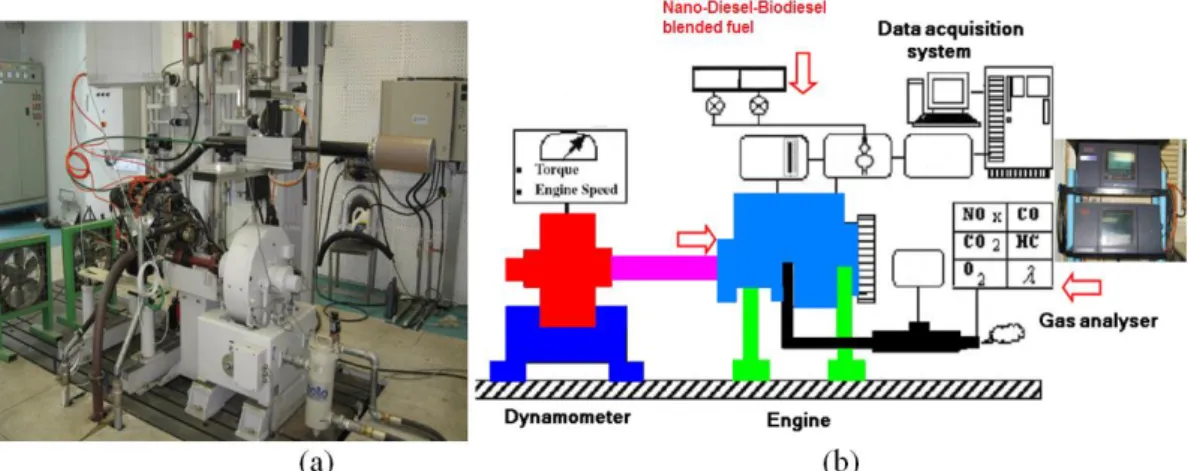
SCHENCK-WT190 eddy– current dynamometer was used in the experiments. Fuel consumption rate was measured in the range of 0.4– 45 kg/h by using laminar type flow meter, Pierburg model. The emission parameters (CO, CO2, HC and NOx) from an online and accurately calibrated exhaust gas
analyser AVL DIGAS 4000 were recorded (figure 1). Considering the accomplished researches about nano fuels and diesel fuel nano additives, two silver nano-particles (Ag) and carbon nano tubes (CNT) were applied as nano additives to these fuels. Furthermore based on researches conducted about the effect of concentrations of used nano-particles in reduction of exhaust emissions, in this study three concentrations (40, 80 and 120 ppm) were applied. Stability of nano fuel was tested at standard conditions. In order to ensure the validity of nano-particles utilized in this research, SEM and TEM pictures were taken (Figure 2). Also the use of carbon nano tubes (CNT) and silver nano particles in neat diesel blend has the tendency to settle down at the fuel tank. An ultrasonic processor (UP400S, Hielscher, USA) was used to perform the reaction and even mixing nano-particles with diesel fuel before the engine tests. The processor operated at 400W and 24 kHz frequency (figure 2). Main characteristics of the test engine has been described in table 1. Engine speeds varied in the range of 700-1000 rpm.
3rd International Conference of Mechanical Engineering Research (ICMER 2015) IOP Publishing IOP Conf. Series: Materials Science and Engineering100(2015) 012070 doi:10.1088/1757-899X/100/1/012070
Figure 1. Engine test set-up and test instruments (a) real and (b) schematic.
Table 1. Main characteristics of the test engine. Engine Type CI engine, 6 Cylinder Combustion Order 1-5-3-6-2-4 Bore ×Stroke(mm) 98.6 * 127 Displacement Volume (Lit) 5.8
Max. Torque (N.m/rpm) 376 / 1300 Max. Power(kW/rpm) 82 / 2300
Figure 2. The Set up for ultrasonic-assisted nano-diesel production process (a)reaction, (b) ultrasonic set-up and (c) nano-diesel blend.
SEM and
TEM
pictures
3rd International Conference of Mechanical Engineering Research (ICMER 2015) IOP Publishing IOP Conf. Series: Materials Science and Engineering100(2015) 012070 doi:10.1088/1757-899X/100/1/012070
In this paper, the quantity BX represents a blend consisting of X% biodiesel by volume, e.g., B20
indicates a blend consisting of 20% biodiesel in 80% diesel. Laboratory tests were then carried out using ASTM test standards to determine the fuel properties.
2.2.ANFIS.
ANFIS model introduced by Jangis a model consisting of fuzzy logic and ANNs. ANFIS which is based on the Sugeno fuzzy inference model (SFIM),constructs an input–output mapping according to
both the fuzzy if–then rules and the stipulated input–output data pairs. The if-then rules of fuzzy system are usually employed to obtain the inference of imprecise model, which can process information in system as well as the human experience. Using stipulated input–output training data
pairs by good membership functions, the if-then rules are built. ANFIS can adjust the membership function using back propagation gradient descent. ANFIS simulates Takagi-Sugeno-Kang (TSK) fuzzy rule of type-3 where the consequent part of the rule is a linear combination of the inputs and a constant. The final output of the system is weighted by average of each rule's output. The form of the
type-3 rule simulated in the system is as follows:
If x1 is A1 and x2 is A2 and … and xp is Ap then y=c0+c1x1+c2x2+...+cpxp
where [x1,x2,…,xp] are the input variables, [A1,A2,…,Ap] are fuzzy sets which are determined during
the training process, [c0,c1,…,cp]are the consequent parameters and y is the output variable. In order to
evaluate the performance of a method in prediction, several criterions are calculated. The criterions used in this research are correlation coefficient (R), root mean square error (RMSE), mean relative
error (MRE) and accuracy. The correlation coefficient (R) which evaluates the strength of the relationship between the experimental and predicted results is defined as:
cov( , )
( , )
cov( , ) cov( , )
a p
R a p
a a
p p
where cov(a,p) is covariance between a and p sets. a and p denotes the actual output and predicted output sets. RMSE is determined by:
2 1 1 n i i i RMSE a p n
where n is the number of the points in the data set. MRE which indicates the mean ratio between the error and the experimental values, is obtained by:
1 1 (%) 100 n i i i i a p MRE n a
Accuracy which is a simple representation of prediction performance is calculated as:
1 i i 100 i a p Accuracy a 3. Flow dynamic of LLHC
The performance of ANFIS is highly depend on the type and number of membership function. In this research after testing several membership functions, it was found that ANFIS based on Gaussian curve membership function (gaussmf) had better performance. Figure 3 illustrates the performance of ANFIS in the brake power prediction under various numbers of the two parameters. It is seen that ANFIS performance with two numbers of membership function is higher. Moreover, the performance (1)
(2)
(3)
(4)
3rd International Conference of Mechanical Engineering Research (ICMER 2015) IOP Publishing IOP Conf. Series: Materials Science and Engineering100(2015) 012070 doi:10.1088/1757-899X/100/1/012070
of ANFIS improved by increasing the training epoch number up to 200, but the performance did not change with further increase. Hence, the number of 200 is selected as an optimum number for the training epoch. After determining the optimum numbers, the ability of ANFIS in prediction of the engine parameters was evaluated by calculating the criterions of correlation coefficient (R), RMSE, MRE and accuracy.
100 200300 400 500 600 2 4 6 8 0 0.5 1 Epoch (a) No.mf R 100 200 300 400500 600 2 4 6 8 0 20 40 Epoch (b) No.mf RMS E (k W) 100 200300 400500 600 2 4 6 8 0 50 100 Epoch (c) No.mf MRE (%) 100 200 300 400 500 600 2 4 6 8 0 50 100 Epoch (d) No.mf Accuracy (%) 0.2 0.4 0.6 0.8 5 10 15 20 25 30 20 40 60 80 20 40 60 80
Figure 3. The values of the performance criterions of ANFIS for the brake power under different numbers of membership function and training epoch: (a) R, (b) RMSE, (c) MRE and (d) Accuracy.
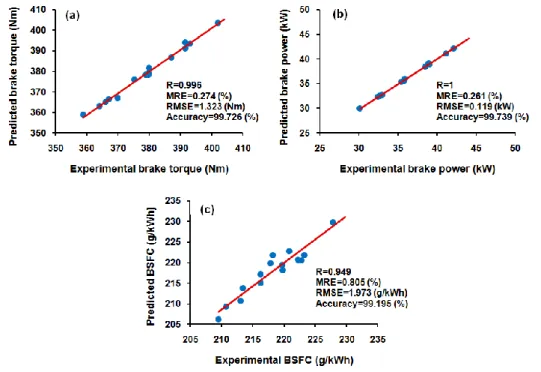
Figure 4(b) shows the predicted versus experimental values for the brake power. ANFIS predictions for the brake power yielded a correlation coefficient (R) of 1, RMSE of 0.119 kW, MRE of 0.261% and accuracy of 99.739%. ANFIS predictions for the engine torque yielded a correlation coefficient (R) of 0.996, RMSE of 1.323 Nm, MRE of 0.274% and accuracy of 99.726% (Figure 4a). In predicting the bsfc, ANFIS resulted in a correlation coefficient of 0.949, RMSE of 1.973 g/kWh, MRE of 0.805% and accuracy of 99.195% (Figure 4(c)).
3rd International Conference of Mechanical Engineering Research (ICMER 2015) IOP Publishing IOP Conf. Series: Materials Science and Engineering100(2015) 012070 doi:10.1088/1757-899X/100/1/012070
Figure 4. ANFIS predictions for the (a) brake torque, (b) brake power and (c) BSFC versus experimental values.
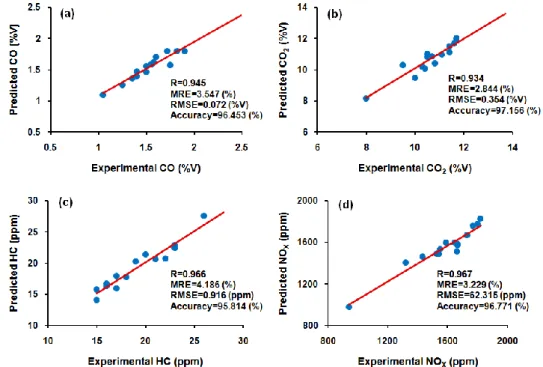
Figure 5 shows the predicted versus experimental values for the exhaust emission parameters. ANFIS predictions for the CO, CO2, HC and NOX yielded a correlation coefficient (R) of 0.945, 0.934,
0.966 and 0.967, respectively. It was found that the RMSE values were 0.072 %V, 0.354 %V, 0.916 ppm and 62.315 ppm for the CO, CO2, HC and NOX, respectively. ANFIS predictions for the CO
yielded a MRE of 3.547% (Fig. 5(a)). MRE value for the CO2 was 2.844% (Fig. 5(b)). Fig. 5c shows
the predicted versus experimental values for the HC with MRE of 4.186%. According to Fig. 5(d), MRE of the NOX was 3.229%. ANFIS accuracy for prediction of the CO, CO2, HC and NOX was
96.453%, 97.156%, 95.814% and 96.771%, respectively. The above results demonstrate that ANFIS can predict the exhaust emission parameters well.
3rd International Conference of Mechanical Engineering Research (ICMER 2015) IOP Publishing IOP Conf. Series: Materials Science and Engineering100(2015) 012070 doi:10.1088/1757-899X/100/1/012070
Figure 5. ANFIS predictions for the (a) CO, (b) CO2, (c) HC, (d) NOX versus experimental values.
4. Conclusions
According to experiments and results obtained by the proposed methods, findings can be summarized as follows: The results of this research study demonstrated that nanodiesel could be efficiently utilized as blended fuel in diesel engine. The produced nanodiesel was blended with biodiesel and diesel fuels in different concentrations and the CI engine emission parameters were evaluated with these new blended fuels. Adding nano particles in diesel fuel can improve engine performance and reduce CO and HC emissions. But it can cause an increase in CO2 and NOX emissions. SVM can be employed to
predict the engine performance and exhaust emissions.
ANFIS can be employed to predict the engine performance and exhaust emissions. But there is a need for finding the optimum values of its parameters. The ANFIS results were very good, R values in this model are very close to one, while root mean square error (RMSE) was found to be very low. The results showed that ANFIS predicted the engine performance and exhaust emissions with correlation coefficient (R) and accuracy in the range of 0.6–1 and 60–99.9%. The results demonstrate that ANFIS is capable of predicting the CI engine performance and emissions. Analysis of the experimental data by the ANFIS method revealed that there is a good correlation between the ANFIS predicted results and the experimental data. Therefore ANFIS proved to be a useful tool for correlation and simulation of engine parameters.
Acknowledgments
The authors wish to thank the Iranian Fuel Conservation Organization (IFCO) of NIOC for the research grant provided (Grant no.:1393-2) and UMP (Grant No.:RDU130313) to complete this project and Mega Motor Company for providing of laboratory facilities..
References
[1] Selvan V A M, Anand R, Udayakumar M 2009 J Eng Appl Sci 4 1819-6608
[2] Hosoz M, Ertunc H M, Karabektas M, Ergen G 2013 Applied Thermal Engineering 60 24-32 [3] Yücesu H S, Topgül T, Cinar C, Okur M 2006 Applied Thermal Engineering 26 2272-8 [4] Wong P K, Wong K I, Vong C M, Cheung C S 2015 Renewable Energy 74 640-7
3rd International Conference of Mechanical Engineering Research (ICMER 2015) IOP Publishing IOP Conf. Series: Materials Science and Engineering100(2015) 012070 doi:10.1088/1757-899X/100/1/012070
[5] Tu J V 1996 Journal of clinical epidemiology 49 1225-31 [6] Vapnik V N 2000 Springer-Verlag, New York
[7] Widodo A, Yang B-S 2007 Mechanical Systems and Signal Processing 21 2560-74 [8] Gunn S R 1998 ISIS technical report 14
[9] Jang J-S R 1993 Systems, Man and Cybernetics, IEEE Transactions on 23 665-85 [10] Reddy M J, Mohanta D K 2007 Electric Power Components and Systems 35 1385-407 [11] Sugeno M, Kang G 1988 Fuzzy sets and systems 28 15-33
[12] Şişman-Yılmaz N A, Alpaslan F N, Jain L 2004 Neurocomputing 61 139-68
[13] Sayin C, Ertunc H M, Hosoz M, Kilicaslan I, Canakci M 2007 Applied thermal engineering 27
46-54
[14] Widodo A, Yang B-S 2011 Expert Systems with Applications 38 8430-7 [15] Ma F, Hanna M A 1999 Bioresource technology 70 1-15
[16] Schumacher L, Peterson C, Grepen J, Fuelling direct diesel engines with 2% biodiesel blend. Written for presentation at the 2001 annual international meeting sponsored by ASAE; 2001. [17] Ghobadian B, Rahimi H, Biofuels-past, present and future perspective. International Iran and
Russian Congress of Agricultural and Natural Science Shahre-Kord University, Shahre Kord, Iran; 2004.
[18] Fukuda H, Kondo A, Noda H 2001 Journal of bioscience and bioengineering 92 405-16 [19] Lee S W, Herage T, Young B 2004 Fuel 83 1607-13
[20] Najafi G, Ghobadian B, Tavakoli T, Buttsworth D, Yusaf T, Faizollahnejad M 2009 Applied Energy 86 630-9
[21] De Caro P S, Mouloungui Z, Vaitilingom G, Berge J C 2001 Fuel 80 565-74 [22] Xing-cai L, Jian-Guang Y, Wu-Gao Z, Zhen H 2004 Fuel 83 2013-20
[23] Ghobadian B, Rahimi H, Khatamifar M, Evaluation of engine performance using net diesel Fuel and biofuel blends. The First Combustion Conference of Iran (CCT1) Tarbiat Modares University February; 2006.
[24] Elawad M, Yusaf T 2004 Journal of Energy & Environment 3 61-8
[25] Li D-g, Zhen H, Xingcai L, Wu-gao Z, Jian-Guang Y 2005 Renewable energy 30 967-76 [26] Ajav E, Singh B, Bhattacharya T 1998 Biomass and Bioenergy 15 493-502
[27] Abu-Qudais M, Haddad O, Qudaisat M 2000 Energy Conversion and Management 41 389-99 [28] Noguchi N, Terao H, Sakata C 1996 Bioresource Technology 56 35-9
[29] Gerdes K, Suppes G 2001 Industrial & engineering chemistry research 40 949-56 [30] He B-Q, Shuai S-J, Wang J-X, He H 2003 Atmospheric Environment 37 4965-71 [31] Hansen A C, Zhang Q, Lyne P W 2005 Bioresource technology 96 277-85 [32] Can Ö, Celikten I, Usta N 2004 Energy Conversion and Management 45 2429-40 [33] Ajav E, Singh B, Bhattacharya T 2000 Energy conversion and management 41 1533-41
3rd International Conference of Mechanical Engineering Research (ICMER 2015) IOP Publishing IOP Conf. Series: Materials Science and Engineering100(2015) 012070 doi:10.1088/1757-899X/100/1/012070