POUR L'OBTENTION DU GRADE DE DOCTEUR ÈS SCIENCES
acceptée sur proposition du jury: Prof. V. Kunčak, président du jury Prof. P. Ienne, directeur de thèse Dr A. Mishchenko, rapporteur
Prof. I. Markov, rapporteur Prof. G. De Micheli, rapporteur
Exploiting Satisfiability Solvers
for Efficient Logic Synthesis
THÈSE N
O7866 (2017)
ÉCOLE POLYTECHNIQUE FÉDÉRALE DE LAUSANNE
PRÉSENTÉE LE 25 SEPTEMBRE 2017À LA FACULTÉ INFORMATIQUE ET COMMUNICATIONS LABORATOIRE D'ARCHITECTURE DES PROCESSEURS PROGRAMME DOCTORAL EN INFORMATIQUE ET COMMUNICATIONS
PAR
Дом е таму каде што боли.
Дом е таму каде што ви се вестите.
Таму каде што ве сакаат и таму каде што ве мразат.
— Горан Стефановски
Интервjу, проект Дванаесет
Home is where it hurts. Home is where your news are. Where they love you and where they hate you. — Goran Stefanovski Interview, project TwelveAbstract
Logic synthesis is an important part of electronic design automation (EDA)flows, which enable the implementation of digital systems. As the design size and complexity increase, the data structures and algorithms for logic synthesis must adapt and improve in order to keep pace and to maintain acceptable runtime and high-quality results. Large circuits were often represented usingbinary decision diagrams (BDDs)that were rapidly adopted by logic synthesis tools beginning in the 1980s. Nowadays, BDD-based algorithms are still enhanced, but the possibilities for improvement are somewhat saturated after some 35 years of research. Alternatively, the first EDA applications that exploitBoolean satisfiability (SAT)were developed in the 1990s. Despite the worst-case exponential runtime of SAT solvers, rapid progress in their performance enabled the creation of efficient SAT-based algorithms. Yet, logic synthesis started using SAT solvers more diffusely only in the last decade. Therefore, thorough research is still required both for exploiting SAT solvers and for encoding logic synthesis problems into SAT. Our main goal in this thesis is to facilitate and promote the further integration of SAT solvers into EDA by proposing and evaluating novel SAT-based algorithms that can be used as building blocks in logic synthesis tools.
First, we propose a rapid algorithm for LEXSAT, which generates satisfying assignments in lexicographic order. We show that LEXSAT can bring canonicity, which guarantees the gen-eration of unique results, when using SAT solvers in EDA applications. Next, we present a new SAT-based algorithm that progressively generates irredundantsums of products (SOPs), which still play a crucial role in many logic synthesis tools. Using LEXSAT, for the first time, we can generate canonical SAT-based SOPs that, much like BDD-based SOPs, are unique for a given function and variable order but could relax canonicity in order to improve speed and scalability. Unlike BDDs, due to its progressive nature, our algorithm can generate partial SOPs for applications that can work with incomplete circuit functionality. It is noteworthy that both LEXSAT and the SAT-based SOPs are applicable beyond logic synthesis and EDA. Finally, we focus onresubstitution, which reimplements a given Boolean function as a new function that depends on a set of existing functions called divisors. We propose the carv-ing interpolationalgorithm that, unlike the traditional Craig interpolation, forces the use of a specific divisor as an input of the new function. This is particularly useful for global circuit restructuring and for some synthesis-basedengineering change order (ECO)algorithms. Furthermore, we compare two existing SAT-based methodologies for resubstitution, which are used for post-mapping logic optimisation. The first methodology combines SAT-based functional dependency checking and Craig interpolation that are also used for our carving
interpolation; the second methodology is based on cube enumeration and is similar to the SAT-based SOP generation.
The initial implementations of our novel SAT-based algorithms offer either better performance or new features, or both, compared to their state-of-the-art versions. As the results indicate, a further thorough development of SAT-based algorithms for logic synthesis, like the one performed for BDDs in the past, can help overcome existing limitations and keep up with growing designs and design complexity.
Résumé
La synthèse logique est une partie importante des flots deconception assistée par ordinateur pour l’électronique(CAO électronique;electronic design automation, EDA) permettant l’im-plémentation des systèmes digitaux. L’augmentation en taille et en complexité des designs nécessite l’adaptation des structures de données et des algorithmes utilisés dans la synthèse logique afin de rester compétitif et de maintenir un temps d’exécution acceptable et des résultats de haute-qualité. Les grands circuits étaient souvent représentés par desdiagrammes de décision binaire(binary decision diagrams, BDDs) qui ont été rapidement adoptés par les outils de synthèse logique au début des années 1980. De nos jours les algorithmes basés sur les diagrammes de décision binaire sont toujours en développement, cependant les possibilités d’amélioration se sont quelque peu saturées après environ 35 ans de recherche.
De manière alternative, les premières applications de CAO électronique exploitant la satis-faisabilité booléenne(Boolean satisfiability, SAT) ont été développées dans les années 1990. Malgré le temps d’exécution exponentiel dans le pire cas des solveurs SAT, la progression rapide de leur performance a permis de créer des algorithmes efficaces qui sont basés sur SAT. Cependant, la synthèse logique a commencé à utiliser les solveurs SAT plus couramment seulement dans la dernière décennie. C’est pourquoi il est nécessaire d’approfondir encore la recherche pour trouver des meilleures façons d’exploiter des solveurs SAT ainsi que d’encoder des problèmes de synthèse logique en SAT. Notre but principal dans cette thèse est de faciliter et de promouvoir l’intégration en cours des solveurs SAT dans la CAO électronique en propo-sant et en évaluant des algorithmes novateurs basés sur SAT qui peuvent être utilisés en tant que blocs de construction dans les outils de synthèse logique.
En premier, nous proposons un algorithme rapide pour LEXSAT qui génère des affectations satisfaisantes en ordre lexicographique. Nous montrons que LEXSAT peut apporter de la cano-nicité, garantie de génération de résultats uniques, lorsqu’on utilise des solveurs SAT dans les applications de CAO électronique. Ensuite, nous présentons un nouvel algorithme basé sur SAT générant de façon progressive dessommes de produits(sums of products, SOP) non redon-dants qui jouent toujours un rôle crucial dans nombres d’algorithmes de synthèse logique. Avec LEXSAT, nous pouvons pour la première fois générer des SOPs canoniques basées sur SAT qui, tout comme les SOPs basées sur des diagrammes de décision binaire, sont uniques pour une fonction et un ordonnancement des variables, mais peuvent assouplir la canonicité afin d’améliorer la vitesse et la scalabilité. Contrairement aux diagrammes de décision binaire, notre algorithme peut, de par sa nature progressive, aussi générer les SOPs partiels pour des applications qui peuvent travailler avec la fonctionnalité incomplète d’un circuit. Il est
remarquable que LEXAT et les SOPs basées sur SAT sont applicables au-delà de la synthèse logique et de la CAO électronique. Finalement, nous nous concentrons sur laresubstitution, qui ré-implémente une fonction booléenne donnée comme une nouvelle fonction dépendant sur un ensemble de fonctions existantes, appelées diviseurs. Nous proposons l’algorithme d’interpolation à ciselage(carving interpolation) qui, contrairement à l’interpolation tradition-nelle de Craig, impose l’utilisation d’un diviseur spécifique en tant qu’entrée de la nouvelle fonction. Ceci est particulièrement utile pour la restructuration globale de circuit ainsi que pour quelques algorithmes d’engineering change order (ECO)basés sur la synthèse logique. De plus, nous comparons deux méthodologies existantes pour la resubstitution basés sur SAT, utilisées pour l’optimisation logique après letechnology mapping. La première méthodologie combine la vérification de dépendances fonctionnelles basées sur SAT et l’interpolation de Craig, également utilisées dans notre interpolation à ciselage; la deuxième méthodologie est basée sur l’énumération de cubes et est similaire à la génération de SOPs basée sur SAT. Les implémentations initiales de nos algorithmes novateurs basés sur SAT offrent soit de meilleures performances soit de nouvelles fonctionnalités, ou toutes les deux, en compa-raison à leurs versions de pointe. Comme les résultats l’indiquent, un développement plus approfondi des algorithmes basés sur SAT pour la synthèse logique, comme celui effectué pour les diagrammes de décision binaire dans le passé, peut aider à surmonter les limitations existantes et à rester en phase avec la croissance et la complexité des designs.
Mots clefs :conception assisté par ordinateur pour l’électronique, synthèse logique, satisfaisa-bilité booléenne, solveurs SAT.
Резиме
Логичката синтеза (
logic synthesis
) е значаен дел од системите за
автоматизаци-jа на електронски дизаjн (
electronic design automation, EDA
), кои овозможуваат
изработка на дигитални системи. Како што големината и комплексностa на
ди-заjните расте, структурите на податоци и алгоритмите за логичка синтеза мора
да се прилагодуваат и усовршуваат за да останат конкурентни и за да одржат
прифатливо време на извршување и резултати со висок квалитет. Големите
ди-гитални кола беа често прикажувани со бинарни диjаграми за одлука (
binary
decision diagrams, BDDs
) кои беа брзо прифатени од алатките за логичка
синте-за почнуваj´
ки од 1980-тите години. Денес,
BDD
-базираните алгоритми с`e уште
се унапредуваат, но можностите за подобрување се донекаде заситени после
околу 35 години истражување.
Алтернативно, првите
EDA
апликации кои користат Булова задоволителност
(
Boolean satisfiability, SAT
) беа развиени во 1990-тите години. И покраj
експо-ненциjалното наjлошо време на извршување на
SAT
решавачите (
SAT solvers
),
брзиот напредок во нивните перформанси овозможи создавање на ефикасни
SAT
-базирани алгоритми. Сепак, SAT решавачите почнале да се користат
порас-пространето во логичката синтеза дури во последната децениjа. Поради тоа, с`e
уште има потреба од темелно истражување за искористување на
SAT
решава-чите, како и за претставување на проблемите од логичка синтеза како
SAT
про-блеми. Нашата главна цел во оваа дисертациjа е да jа олесниме и промовираме
понатамошната интеграциjа на
SAT
решавачите во
EDA
, со тоа што
предлага-ме и евалуирапредлага-ме нови
SAT
-базирани алгоритми кои може да се користат како
основни елементи во алатките за логичка синтеза.
Прво, ние предложуваме брз алгоритам за
LEXSAT
, коj генерира
задоволувач-ки вредности (
satisfying assignments
) по лексикографски редослед. Покажуваме
дека
LEXSAT
може да овозможи каноничност (
canonicity
), коja гарантира
созда-вање на уникатни резултати, при користење на
SAT
решавачи во
EDA
аплика-ции. Следно, претставуваме нов
SAT
-базиран алгоритам коj постепено
генери-ра сума од производи (
sum of products, SOP
) без редундантност, кои с`e уште
има-ат клучна улога во многу алима-атки за логичка синтеза. Со користење на
LEXSAT
, за
прв пат, можеме да генерираме канонски
SAT
-базирани
SOP
-а кои, слично на
BDD
-базираните
SOP
-а, се единствени за дадена функциjа и редослед на
про-менливите, но со можност да се релаксира каноничноста за да се подобри
бр-зината и приспособливостa. За разлика од
BDD
-ата, поради постепената
приро-да, нашиот алгоритам може да генерира парциjални
SOP
-а за апликации кои
можат да работат со нецелосна функционалност на колата. Значаjно е што и
LEXSAT
и
SAT
-базираните
SOP
-а се применливи пошироко од логичката
синте-за и
EDA
. На краj, се фокусираме на ресупституциjа (
resubstitution
), коjа
реим-плементира даденa Булова функциjа како нова функциjа коjа зависи од
мно-жество од постоечки функции наречен делители. Ние го предложуваме
алго-ритамот за интерполациjа со отсекување (
carving interpolation
) коjа за разлика
од традиционалната Крегова интерполациjа (
Craig interpolation
) jа принудува
употребата на одреден делител како влез на новата функциjа. Ова е особено
корисно за глобалнo реструктуирање на кола и за некои алгоритми базирани
на
engineering change order (ECO)
алгоритми. Покраj тоа, споредуваме две
по-стоечки
SAT
-базирани методологии за ресупституциjа кои се користат при
ло-гичка оптимизациjа после технолошко мапирање (
technology mapping
). Првaта
методологиjа соединува
SAT
-базирана проверка за функционална зависност и
Крегова интерполациjа кои исто така се употребуваат за нашата интерполациjа
со отсекување; втората методологиjа се базира на наброjување на коцки (
cube
enumeration
) и е слична со создавањето на SAT-базирани
SOP
-а.
Првобитните имплементации на нашите нови
SAT
-базирани алгоритми нудат
или подобри перформанси или нови функции или и двете, во споредба со
нив-ните современи верзии. Како што резултатите укажуваат, понатамошен
теме-лен развоj на
SAT
-базиранте алгоритми за логичка синтеза, како оноj коj беше
извршен за
BDD
-ата во минатото, може да помогне да се надминат
постоечки-те ограничувања и да се остане во чекор со растот на дизаjнипостоечки-те и нивната
ком-плексност.
Клучни зборови:
автоматизациjа на електронски дизаjн, логичка синтеза,
Бу-лова задоволителност,
SAT
решавачи.
Acknowledgements
Obtaining this thesis was made possible and enjoyable by many people that have left their footprints in my life.
I am deeply grateful to my advisor, Paolo Ienne, first, for encouraging me to start the PhD stud-ies and, second, for guiding me through the process. He gave me freedom and vast support in pursuing projects for which I was passionate. His advices and constructive criticism empow-ered me to overcome many obstacles. I have learned a lot from him on both professional and personal level as he had a role of both a mentor and a friend.
Although the logic synthesis community is quite small compared to others, I had the privilege of working closely with and learning from some of the top people in the field.
First and foremost, I am extremely grateful to Alan Mishchenko for sharing with us many research opportunities and being always available for discussions both over the Internet and in person. He provided me with tremendous support, inspiring advices, and profound belief in my abilities throughout the course of my PhD studies. I would also like to extend my gratitude to Mathias Soeken who has kindly answered many questions and helped me to verify many ideas I had in the last years. I am also thankful to him for his help, valuable comments and discussions while I was writing this thesis. I would like to thank David Novo for his unwavering guidance and support in the first part of my PhD studies. I also wish to thank Ajay K. Verma for introducing me to logic synthesis during my internship at EPFL in 2009. I have learned a lot from all of them, and they all had a major impact on my life as collaborators, colleagues, (un)official mentors, and friends.
I would also like to express my gratitude to Robert K. Brayton, Luca Amarù, Pierre-Emmanuel Gaillardon, and Giovanni De Micheli with whom I had the pleasure to collaborate on various publications, some of which are used in this thesis. I also had great pleasure of working on challenging logic synthesis projects with some brilliant students, including Grégoire Hirt, Mertcan Temel, Polina Zablotskaia, and Sun Chenfan.
I would like to especially thank the members of my thesis committee Alan Mishchenko, Igor Markov, Giovanni De Micheli, and Viktor Kunˇcak for the time that they dedicated to this task, as well as for their constructive feedback and for the insightful discussions we had.
I would also like to thank Sahand Kashani-Akhavan and Chantal Schneeberger for providing and reviewing the French version of the abstract. Likewise, I would like to thank Andrew Becker and Biljana Vörös for proofreading parts of this thesis.
The time spent at Processor Architecture Laboratory (LAP) has been so valuable because of the people comprising it. I was fortunate to interact and spend amazing time with some former and present members of LAP, including Ajay, Ali, Andrew, Chantal, David, Grace, Hadi, Lana, Madhura, Mikhail, Mirjana, Nithin, Paolo, René, Sahand, Thomas, and Xavier. I would like to express my deep gratitude to Chantal Schneeberger, Grace Zgheib, and Nithin George for their friendship and constant support from the beginning of my PhD; but especially to Grace Zgheib with whom I was lucky to share the office and work with, and who became a close friend on whom I could always rely.
The Macedonian crew—including Ana, Biljana, Darko, Dino, Emil, Filip, Gorica, Igor, Jovanche, Marjan, Paulina, Slavica, Stefan, and many others—made the stay in Switzerland fun and less homesick. I am especially grateful to Gorica for being always there for me. Since the beginning of my PhD studies, I have shared with her joyful and hard moments, both from my personal and professional life.
Finally, my deepest gratitude goes to my family. The unconditional love and selfless support of my parents, Vesna Stefanovska and Borcho Stefanovski, made me the person I am today and enabled me to achieve many goals in life, including finishing these PhD studies. Their passion for learning, teaching, and new technologies, which they have been transferring to me since the day I was born, have lead me where I am now. I would like to thank them for everything they have done for me. I am thankful to my sister, Eva Stefanovska, for her love and support, and for being there for me whenever I need her. Last but not least, I will be eternally thankful to my husband, Vase Petkovski, who agreed to undertake this journey with me. His love, devotion, and support bring warmth and vividness every day of my life; whereas his patience, care and encouragement give me strength and make it easier for me to go through hard periods and overcome many challenges while actualising my aspirations.
Contents
Abstract (English) i
Abstract (Français) iii
Abstract (
Македонски
) vAcknowledgements vii
Table of contents xi
List of abbreviations xiii
List of figures xv
List of tables xvii
1 Satisfiability Solvers for Electronic Design Automation 1
1.1 From Truth Tables to SAT Solvers: The Evolution of Logic Synthesis Algorithms 3
1.2 SAT Solving in EDA Applications . . . 7
1.3 Challenges of Exploiting SAT Solvers . . . 9
1.4 Thesis Contribution and Organisation . . . 11
2 Background Information 15 2.1 Boolean Function . . . 15
2.2 Representation of Boolean Functions . . . 16
2.2.1 Truth Tables . . . 17
2.2.2 Sums of Products . . . 18
2.2.3 Binary Decision Diagrams . . . 19
2.2.4 And-Inverter Graphs . . . 20
2.3 Boolean Satisfiability . . . 21
2.4 Functional Dependency . . . 23
2.5 Craig Interpolation . . . 25
3 Fast Generation of Lexicographic Satisfying Assignments 29
3.1 Lexicographic Boolean Satisfiability . . . 31
3.2 LEXSAT for EDA Applications . . . 32
3.3 LEXSAT for SAT Algorithms . . . 35
3.4 Generating Lexicographic Satisfying Assignments . . . 38
3.4.1 Simple Version . . . 38
3.4.2 Binary Search-Based Version . . . 40
3.4.3 Runtime Improvement for Consecutive LEXSAT Assignments . . . 40
3.5 Experimental Results . . . 43
3.5.1 Runtime Comparison . . . 44
3.5.2 Influence of the Variable Order on the Runtime . . . 46
3.5.3 Evaluation of the Methods for Runtime Improvement . . . 49
3.6 On Integrating the LEXSAT Algorithms in a SAT Solver . . . 50
3.7 Conclusion . . . 52
4 Progressive Generation of Canonical Irredundant Sums of Products 55 4.1 SAT-Based SOP Generation . . . 58
4.1.1 Generation of Minterms . . . 59
4.1.2 Expansion of Minterms into Cubes . . . 61
4.1.3 Removing Redundant Cubes . . . 64
4.1.4 Improving the Runtime . . . 65
4.2 Experimental Results . . . 66
4.2.1 Experimental Setup . . . 66
4.2.2 SAT-Based vs. BDD-Based SOP Generation . . . 67
4.2.3 Case-Study: SAT-Based SOPs for Multi-level Implementation of Circuits 72 4.3 Conclusion . . . 73
5 Constrained Interpolation for Guided Logic Synthesis 75 5.1 Motivating Example . . . 77
5.2 The Standard Interpolation Method . . . 78
5.3 The Carving Interpolation Method . . . 79
5.3.1 Deficiency of the Standard Interpolation Method . . . 79
5.3.2 Carving Out a Base Function . . . 80
5.3.3 Carving Out a Set of Base Functions . . . 81
5.4 Experimental Results . . . 83
5.4.1 Experimental Setup . . . 83
5.4.2 Imposing a Single Base Function . . . 84
5.4.3 Imposing a Set of Base Functions . . . 86
Contents
6 Comparison of SAT-Based Algorithms for Resubstitution 93
6.1 Technology Mapping as Motivation . . . 95
6.2 SAT-Based Algorithms for Resubstitution . . . 97
6.2.1 Resubstitution Using a Resubstitution Miter and Interpolation . . . 97
6.2.2 Resubstitution Based on Cube Enumeration . . . 101
6.3 Experimental Results . . . 105
6.3.1 Experimental Setup . . . 105
6.3.2 Minimisation and Feasibility Check of a Set of Divisors . . . 107
6.3.3 Generation of Resubstitution Function . . . 109
6.4 Conclusion . . . 111
7 Conclusions 113 7.1 Towards Faster SAT-Based Applications . . . 115
7.2 Final Remarks . . . 116
Bibliography 128
List of abbreviations
#SAT counting satisfiability
AIG and-inverter graph
AllSAT all solutions satisfiability
ASIC application specific integrated circuit
BBDD biconditional binary decision diagram
BDD binary decision diagram
CNF conjunctive normal form
DAG directed acyclic graph
DLN dependency logic network
DNF disjunctive normal form
ECO engineering change order
EDA electronic design automation
FPGA field-programmable gate array
ISOP irredundant sum of products
LEX-UNSAT lexicographic unsatisfiability
LEXSAT lexicographic satisfiability
LUT look-up table
MAX-SAT maximum satisfiability
MIG majority-inverter graph
NPN negation-permutation-negation
PI primary input
PLA programmable logic array
PO primary output
QBF quantified Boolean formula
SAT Boolean satisfiability
SMT satisfiability modulo theories
SOP sum of products
SPFD sets of pairs of functions to be distinguished
TBDD transformation binary decision diagram
TFI transitive fanin
TFO transitive fanout
UNSAT unsatisfiable
VLIW very long instruction word
List of Figures
1.1 Evolution of the best SAT solvers from 2002 to 2011 . . . 2
1.2 Design flows for ASICs and FPGAs . . . 4
1.3 The logic synthesis process for a 2-bit adder . . . 5
1.4 Comparison of SAT and BDDs for functional verification . . . 8
1.5 Connection of the main contributions of the thesis . . . 11
2.1 Representation of the Boolean functions of a full adder . . . 17
2.2 Representation of a target function with a set of base functions . . . 24
2.3 A miter for checking if a target function depends on a set of base functions . . . 25
2.4 Computing an interpolant from a refutation proof by using the McMillan’s algo-rithm . . . 26
3.1 Profiling the success of the first SAT calls . . . 43
3.2 Performance of the LEXSAT algorithms when generating 1000 consecutive as-signments . . . 45
3.3 Performance of the LEXSAT algorithms when generating 1000 consecutive as-signments . . . 46
3.4 Influence of the variable order on the runtime of the LEXSAT algorithms when generating a single assignment . . . 47
3.5 Influence of the variable order on the runtime of the LEXSAT algorithms when generating 1000 consecutive assignments . . . 48
3.6 Runtime variation for the benchmark frisc from the MCNC set for different variable orders . . . 49
3.7 Effect of the methods for runtime improvement on small benchmarks . . . 50
3.8 Effect of the methods for runtime improvement on large benchmarks . . . 51
4.1 Flowchart of the algorithm for minterm generation . . . 60
4.2 Flowchart of the algorithm for expansion of minterms into cubes . . . 62
4.3 An example for minimum SOP . . . 63
4.4 Difference in the size of the smallest SOP generated by each method . . . 68
4.5 The number of generated cubes in the partial SOPs when the time limit is set between 1 and 10 seconds . . . 72
4.6 Comparison of the best circuit implementations, in terms of area-delay product, derived by each method . . . 73
5.1 The process for computing a single-output dependency function using the
stan-dard interpolation method . . . 78
5.2 The process for imposing the first base functiong1from a set of base functions G={g1,g2,g3} . . . 81
5.3 Difference between carving multiple base functions one by one and simultane-ously . . . 82
5.4 The setup for imposing the base functiong1using the carving method . . . 85
5.5 The relative execution time to generate a dependency function for a base func-tion set composed of a single base funcfunc-tion and essential identity funcfunc-tions . . 86
5.6 Non-overlapping 3-input cuts and the formed layers for the most significant bit of a 4-bit adder . . . 87
5.7 Area and delay of the MSB of a 14-bit adder, reconstructed using 10 layers . . . 88
5.8 The percentage of disconnected base functions among all layers for the three methods . . . 90
5.9 Comparison of the execution time of the interpolation methods when generating a dependency function for a set of base functions . . . 91
6.1 Typical flow of a resubstitution algorithm . . . 94
6.2 Overview of the framework for SAT-based logic optimisation . . . 96
6.3 The resubstitution miter . . . 98
6.4 A miter for representing the care set of a target node . . . 102
6.5 Flow of the algorithm for feasibility check based on cube enumeration . . . 103
6.6 Number of removed divisors by the resubstitution algorithms for minimisation 106 6.7 Reduction in runtime achieved by pushing and popping of assumptions . . . . 107
6.8 Reduction in runtime for the algorithms based on a resubstitution miter com-pared to the algorithm based on cube enumeration . . . 108
6.9 Comparison of the average runtime per node of the resubstitution algorithms for sets of divisors with different size . . . 109
6.10 Runtime of the interpolation algorithms for generation of the resubstitution miter relative to the runtime of the algorithm based on cube enumeration . . . 110
List of Tables
4.1 Number of benchmarks for which activating or deactivating an option for
SATCLP
results in the smallest SOP in terms of number of cubes or the best area-delay product . . . 68 4.2 Comparison of the number of combinational outputs in the used benchmarks
and the number of isomorphic classes . . . 69 4.3 Runtime results for the combinational industrial benchmarks when SOPs are
generated with
BDDCLP
andSATCLP
. . . 705.1 Failure rates of the interpolation methods for a single base function . . . 85 5.2 Failure rates of the interpolation methods for a set of base functions . . . 89
1
Satisfiability Solvers for
Electronic Design Automation
The design complexity is growing, EDA should keep up the pace
Electronic design automation (EDA)tools ease the implementation of digital systems by providing an automated process for translating a high-level description of a design into its final chip implementation. Research and development in EDA began in the 1960s, soon after the development of the integrated circuit [Wang et al., 2009]. Later, an extensive academic research was initiated and accelerated the advance-ment. As a consequence, the EDA tools have followed the continuous growth in design size and can implement digital systems with more than a billion transistors. This growth in design size and complexity is mainly attributable to advancements in hardware. The revised Moore’s law predicts that transistor density doubles approximately every two years [Moore, 1975]. Despite the fear that this rate of growth might be impossible to maintain any further, the prediction has remained largely accurate. Many experts, including Moore himself [Courtland, 2015], are convinced that this can be continued at least through the following decade. Moreover, more complex technologies such as field-programmable gate arrays (FPGAs)and 3D integrated circuits are in-creasingly prevalent in the market. Today, we have a commercially available single-chip processor with about 7.2 billion transistors [Al-corn, 2016] and an FPGA with about 30 billion transistors implementing 5.5 million logic elements [Altera, 2016; Rubenstein, 2016]. In order to use them efficiently, EDA tools have to be upgraded with scalable tech-niques to keep up with the size and complexity of modern designs, while maintaining the tools’ performance and ideally achieving an improved quality of the final design implementations. This would enable the EDA tools to further accomplish their goal of producing high-quality complex
0 200 400 600 800 1 000 1 200 0 20 40 60 80 1 00 1 20 1 40 1 60 1 80 C PU T im e (in s ec on ds )
Number of problems solved
Results of the SAT competition/race winners on the SAT 2009 application benchmarks, 20mn timeout
Limmat (2002) Zchaff (2002) Berkmin (2002) Forklift (2003) Siege (2003) Zchaff (2004) SatELite (2005) Minisat 2 (2006) Picosat (2007) Rsat (2007) Minisat 2.1 (2008) Precosat (2009) Glucose (2009) Clasp (2009) Cryptominisat (201 0) Lingeling (201 0) Minisat 2.2 (201 0) Glucose 2 (201 1 ) Glueminisat (201 1 ) Contrasat (201 1 )
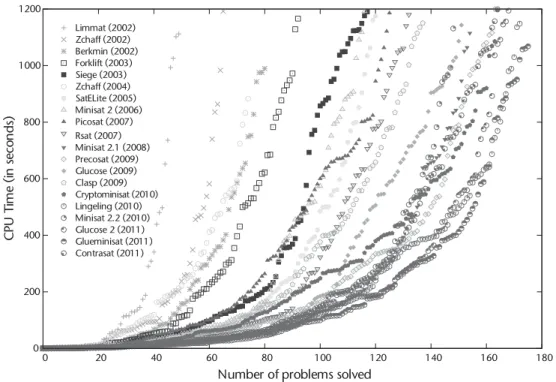
Figure 1.1 –Evolution of the best SAT solvers from 2002 to 2011. The performance of the given solvers is compared using benchmarks from the SAT 2009 competition. For each solver, the cumulative number of solved problems (x-axis) within a specific amount of time (y-axis) is given [Järvisalo et al., 2012].
circuits without design defects in relatively short design time, which al-lows meeting time-to-market and cost requirements [De Micheli, 1994].
The performance of SAT solvers is continuously improving
On a different note, the Boolean satisfiability (SAT)problem, which determines if there exist a variable assignment for which a given propo-sitional formula evaluates to true, received great attention from both a theoretical and a practical point of view. Theoretically, it is unlikely to find an algorithm for solving the SAT problem with a polynomial worst-case time complexity as it is an NP-complete problem [Cook, 1971]. Although the NP-completeness currently leaves us with only determin-istic algorithms with worst-case exponential runtime, in practice many modern SAT algorithms, which are implemented inSAT solvers, can solve complex instances of real world problems in a reasonable time. We have witnessed a tremendous improvement of the performance of state-of-the-art SAT solvers in the last two decades—SAT problems that could not have been solved in more than an hour are now solvable in
1.1. From Truth Tables to SAT Solvers: The Evolution of Logic Synthesis Algorithms
less than a second [Marques-Silva, 2007]. For example, Figure 1.1 shows the evolution of the best solvers from 2002 to 2011 [Järvisalo et al., 2012]. This continuous advancement of SAT solvers can be tracked through the SAT competitions that have started in 1992 and have been organ-ised annually since 2002 [Balyo et al., 2017; Järvisalo et al., 2012]. Their main goal is to stimulate the innovation and development of techniques for SAT solving. Considering the success of and interest in these com-petitions, it is expected that this trend of improving SAT solvers will continue in the coming years. Another reason for improving SAT solvers is that SAT has already a wide variety of practical applications across a number of domains [Gu et al., 1996; Marques-Silva, 2008], such as artifi-cial intelligence, bioinformatics, software verification, and automated theorem proving, as well as EDA [Claessen et al., 2009; Marques-Silva and Sakallah, 2000].
In the following sections of this chapter, we first present a short his-tory on the evolution of the algorithms for logic synthesis, which is the research subject of this thesis. Next, we provide algorithms from logic synthesis and other EDA stages as examples that already use SAT solvers as the core machinery. Then, we discuss the main challenges of exploiting SAT solvers in logic synthesis. Finally, we summarise our contributions and present the thesis organisation.
1.1 From Truth Tables to SAT Solvers: The
Evolution of Logic Synthesis Algorithms
The vital role of logic synthesis as part of EDA flows
EDA flows differ depending on the target technology for implementing the given design. For example, Figure 1.2 shows side-by-side the typ-ical stages of the EDA flows forapplication specific integrated circuits (ASICs)[Smith, 1997] and FPGAs [Betz et al., 1999]. Regardless of the target technology, logic synthesis is part of any EDA flow and has a vital role because its operation has a major impact on the performance of the final implementation. It receives as input agate-level netlistthat is composed of basic Boolean logic gates, such as AND, OR, and XOR gates, and inverters. Its main goal is to convert the received netlist into a high-quality mapped netlist of technology blocks without modifying the functionality. This is achieved with the two main steps of logic synthesis. First, it performs technology-independentlogic optimisation
GDSII/OASIS file High-Level Description
Placement & Routing Floorplanning Logic Synthesis High-Level Synthesis
(a)ASIC design flow.
Programming file High-Level Description
Placement & Routing Packing Logic Synthesis High-Level Synthesis
(b)FPGA design flow.
Figure 1.2 –Design flows for ASICs and FPGAs. Although some of the stages are different, logic synthesis is always required. It receives a gate-level netlist from the high-level synthesis stage and outputs a netlist of technology blocks for the floorplanning or packing stage for ASICs and FPGAs, respectively.
et al., 1990]. For a gate-level netlist, itsarearepresents the size of the netlist in terms of number of logic gates used to implement it, and its
delayrepresents the number of logic levels on the critical path. Once an implementation with a good gate-level area and delay is produced,
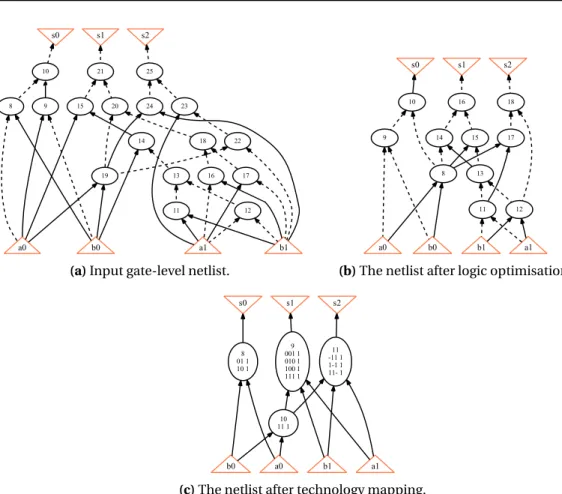
technology mapping algorithms transform the gate-level netlist into a netlist of larger logic blocks whose structure depends on the target technology [De Micheli, 1991]. For example, for ASICs, the logic gates are mapped into a netlist of ASIC blocks that usually represent stan-dard cells, which are predesigned logic components that implement a Boolean logic function or a memory element. Whereas, for FPGAs, it creates a netlist oflook-up tables (LUTs)[Cong and Ding, 1994] or LUT structures [Ray et al., 2012]. As with logic optimisation, the objective is to generate a circuit implementation with a minimal area or a minimal delay by considering the area and delay of the used technology blocks. Figure 1.3 shows the netlist of a 2-bit adder before and after logic op-timisation, and after technology mapping. But, this small circuit is an easy target for logic synthesis, and it can even be easily processed by hand. Modern logic synthesis methods work with large circuits whose size varies from a few thousand to several million gates.
The evolution of logic synthesis is triggered mainly by the growth in the design size. The main role in this evolution belongs to the data struc-tures for representing digital circuits along with the tools and algorithms
1.1. From Truth Tables to SAT Solvers: The Evolution of Logic Synthesis Algorithms 10 21 25 8 9 15 20 24 23 14 18 19 22 13 16 17 11 12 a0 b0 a1 b1 s0 s1 s2
(a)Input gate-level netlist.
10 16 18 9 8 14 15 17 12 13 11 s0 s1 s2 a0 b0 b1 a1
(b)The netlist after logic optimisation.
s0 s1 s2 8 01 1 10 1 9 001 1 010 1 100 1 111 1 11 -11 1 1-1 1 11- 1 a0 b0 10 11 1 a1 b1
(c)The netlist after technology mapping.
Figure 1.3 –The logic synthesis process for a 2-bit adder. The initial gate-level netlist, which is com-prised of 18 AND gates and has 5 levels, is shown on Figure 1.3a. Each internal (oval) node represents an AND gate and gives its ID number. Figure 1.3b shows the netlist after an algorithm for logic optimisation is run. Both area and delay are optimised, so the new netlist has only 11 AND gates and 4 levels. Finally, Figure 1.3c presents the network after technology mapping into 3-input LUTs. Each internal node represents a LUT and gives its ID number and SOP representation.
for their processing. The data structures that are used in this thesis are described in more detail in Section 2.2.
Once upon a time, minterm-based representations and algorithms were introduced
In order to produce an optimal two-level circuit implementation, logic synthesis started by proposing optimisation algorithms that use rep-resentations such astruth tables[Karnaugh, 1953; McCluskey, 1956; Quine, 1952; Veitch, 1952] andsums of products (SOPs)[Brayton et al., 1984]. Some algorithms operating with these representations are still used as building blocks of more complicated logic synthesis ap-plications. For example, in technology mapping, the state-of-the-art
algorithms fornegation-permutation-negation (NPN)classification use truth tables for classifying and matching functions [Huang et al., 2013; Petkovska et al., 2016a]. But in general, truth tables are impractical for functions with more than 16 inputs, whereas SOPs are inefficient for some practical circuits that are rich with XOR logic and for which the size of the minimal two-level representation is exponential in the number of primary inputs.
Transition to the more scalable DAG-based representations and algorithms
Due to these limitations, the attention was redirected to algorithms for multi-level logic optimisation [Brayton et al., 1987; Gregory et al., 1986] in which the circuits are represented as adirected acyclic graph (DAG)of logic gates. For example, ABC [ABC], which is a widely-used academic open-source software system for logic synthesis and formal verification, heavily relies onand-inverter graphs (AIGs)[Hellerman, 1963; Kuehlmann et al., 2002], but a rising interest exists also for the more recentmajority-inverter graphs (MIGs)[Amarù et al., 2014a]. At the same time when the first multi-level logic optimisation algorithms appeared, algorithms that usebinary decision diagrams (BDDs)started to emerge [Bryant, 1986; Coudert et al., 1993a]. The use of BDDs spread fast because their canonicity enables an efficient processing of two Boolean expressions once the BDDs are constructed. However, for some practical functions, such as multipliers, the BDD construction suffers from theBDD memory explosion problem—the BDD size has an exponential lower bound in the number of input variables—hence, using BDDs is often impractical [Bryant, 1991].
SAT solvers as a promising way to overcome the current limits of logic synthesis
In contrast, SAT solvers can be initialised in linear time to the circuit size and can immediately start solving the given problem. By not using a canonical representation, algorithms using SAT can avoid the exponen-tial space blow-up of BDDs. Hence, the SAT-based algorithms are more scalable and offer better runtime and memory consumption in many cases. In the following section, we discuss the introduction and role of SAT solvers in logic synthesis in more detail. We also demonstrate that SAT solving has already been shown to be (1) a good option for im-plementing traditional logic synthesis algorithms, and (2) appropriate as an alternative or a replacement for BDDs. Moreover, by using the existing SAT-based algorithms, new applications can be easily built.
Example 1.1.1. Soeken et al. [2016] proposed a SAT-based algorithm
for computing a dependency matrix that combines SAT-based algo-rithms from combinational equivalence checking [Mishchenko et al.,
1.2. SAT Solving in EDA Applications
2006b] and automatic test pattern generation [Larrabee, 1990], with some SAT-solver features such as incremental solving. Their algorithm also outperformed the BDD-based algorithm from ABC [ABC] for 13 out of 14 benchmarks—the BDD-based implementation did not solve 4 benchmarks due to a time limit and 5 benchmarks due to a memory limit, for 4 it has a higher runtime, and it is faster for only one bench-mark that has a simple structure.
Exploring and analysing further which algorithms and features of SAT solvers are suitable specifically for logic synthesis and other EDA stages, as well as proposing new ways to implement and use SAT solvers, would ease the development of SAT-based logic synthesis applications and would enable problems, which were intractable before, to be solved.
Logic synthesis for combinational and sequential circuits
The algorithms for logic synthesis also differ depending on whether they optimise the combinational logic of the circuit or the sequential one. In this thesis, the proposed algorithms work only with combi-national logic, whereas sequential circuits are handled by assuming all inputs and outputs of the sequential logic as primary outputs and inputs, respectively.
1.2 SAT Solving in EDA Applications
EDA algorithms based on SAT solvers are proposed for every part of the tool flow
SAT solvers have been deployed in almost all stages of EDA flows. Shift-ing towards SAT solvShift-ing is encouragShift-ing because the improvement of the performance of state-of-the-art SAT solvers brings immediate bene-fit to the applications that use them. Furthermore, beside the regular improvement in SAT solvers, SAT algorithms have been proposed specif-ically for solving EDA problems and have been tuned to target distinct properties and structures of the digital circuits [Aloul et al., 2006; Gold-berg and Novikov, 2002; Marques-Silva and Sakallah, 1999; Oh et al., 2004]. The interest in applying SAT to EDA began in the 1990s when SAT solvers were introduced in algorithms for routing in FPGAs [Nam et al., 1999; Wood and Rutenbar, 1998], placement [Devadas, 1989], timing analysis [Silva et al., 1998], fault diagnosis and logic debugging [Chen and Gupta, 1996; Smith et al., 2005], but also for logic synthesis and verification, as described next. The success of these initial algorithms showed the potential of SAT solvers in these stages of EDA, and the
0 10 20 30 40 50 60 70 80 90 100 100 101 102 103 104 105
100 Buggy VLIW Designs
T im e, se c. BDDs: 16 runs Chaff: 1 run
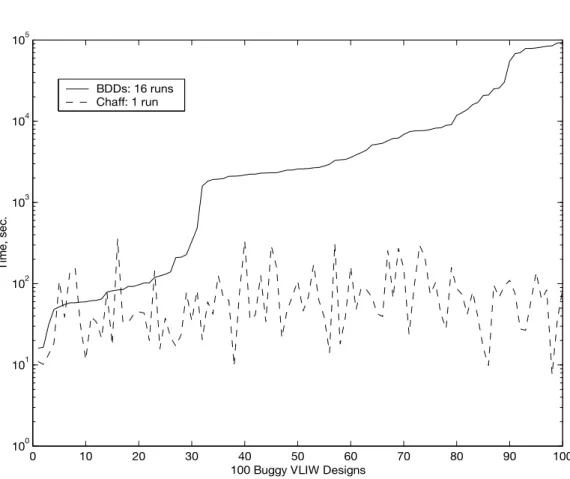
Figure 1.4 –Comparison of SAT and BDDs for functional verification. The benchmarks are Boolean for-mulas for verifying 100 buggy versions of a VLIW microprocessor. The used SAT solver Chaff [Moskewicz et al., 2001] evaluates only one correctness criterion. BDDs evaluate 16 easier criteria in parallel, and as soon as one of them finishes, the rest are terminated and the verification time of the one that finished is reported. The benchmarks are sorted in ascending order of their times for the BDD-based experiment [Velev and Bryant, 2003].
research in these areas is still active [Fraisse et al., 2016; Fujita and Mishchenko, 2014; Nadel and Ryvchin, 2016].
SAT as an alternative to BDDs: the success story from verification
The biggest motivation for developing SAT-based logic synthesis algo-rithms came from their success in formal verification [Velev and Bryant, 2003], especially in automatic test pattern generation [Fujita et al., 2015; Larrabee, 1990; Stephan et al., 1996], equivalence checking [Goldberg et al., 2001; Mishchenko et al., 2006b], and model checking [Biere et al., 1999; McMillan, 2003]. All these algorithms work also with Boolean logic, and are thus similar to logic synthesis. These applications proved that SAT-based methods can easily outperform existing BDD-based
1.3. Challenges of Exploiting SAT Solvers
methods, hence SAT solvers and algorithms using them became crucial components of most verification tools [Claessen et al., 2009].
Example 1.2.1. Velev et al. [2003] compared the runtime of procedures
based on SAT solvers and BDDs by evaluating benchmarks that rep-resent Boolean formulas for formal verification of correct and buggy versions of avery long instruction word (VLIW)microprocessor. In this case, first, they proved that the SAT solver Chaff [Moskewicz et al., 2001] has the best performance among other SAT solvers at that time. Next, they compared Chaff to a fast BDD-based method [Velev, 2000]. As Figure 1.4 shows, the difference between BDDs and Chaff is up to four orders of magnitude when verifying the buggy designs. When verifying correct designs, Chaff required 1.6 seconds, whereas the BDD-based method required 31.5 hours (about five orders of magnitude).
The wide and active use of SAT solvers in logic synthesis
This success in formal verification triggered a similar trend in logic syn-thesis. For example, more scalable SAT-based versions were proposed for the BDD-based algorithms for functional dependency [Jiang et al., 2010; Lee et al., 2007], functional decomposition [Lee et al., 2008; Lin et al., 2008], logic don’t-care-based optimisation [Mishchenko and Bray-ton, 2005], and dependency matrix computation [Soeken et al., 2016c]. The algorithms based on SAT solvers are more scalable because they can process problems for which the size of BDDs is exponential, and they are faster when solving large and hard problems. However, the in-tegration of SAT is not limited to replacing BDDs. SAT is shown efficient also for many other logic synthesis applications, including Boolean matching [Safarpour et al., 2006; Soeken et al., 2016a], technology map-ping [Ling et al., 2005], and combinational delay optimisation [Soeken et al., 2017]. Due to the wide use of SAT in logic synthesis, but also in other stages of the EDA flow, SAT solvers became a standard part of the EDA tools, similarly to how BDD packages were integrated in the past. This facilitates the development and inclusion of new SAT-based algorithms in the flow.
1.3 Challenges of Exploiting SAT Solvers
Despite the wide use of SAT solvers in EDA and other applications, there are still many challenges that have to be addressed in order to facilitate and enable efficient implementation of some specific applications. In
this chapter, we present challenges that are among the most important for logic synthesis, and we therefore tackle most of them in this thesis.
Excessive runtime for hard problems, and unpredictable runtime in general
Although modern SAT solvers can often solve hard structured problems with over a million variables and several million constraints [Gomes et al., 2008], there are still some hard problems that cannot be solved within several hours of computing time. The required time for SAT solving depends mostly on the size and complexity of the problem, but other factors can also affect the ability to find a solution for a given problem. First, there are differentencodingtechniques that determine the translation into a propositional representation given as input to the SAT solver. Choosing an appropriate encoding is important as the quality of encoding often determines whether the problem is solvable or not [Björk, 2009]. Second, the SAT competitions have different competi-tion tracks in order to accommodate different types of SAT solvers [Balyo et al., 2017]. Thus, although some SAT solvers might be unsuitable for solving some particular problems, others can demonstrate an excep-tional runtime. An addiexcep-tional challenge is that it is impossible to predict the runtime and final result of a single call of the SAT-solving procedure. In this aspect SAT solvers are similar to BDDs, for which the termination time and the quality of results are unknown until the complete BDD is build. However, in this thesis, we show that in some cases SAT-based algorithms can be more scalable than their BDD-based versions. This scalability is achieved by structuring the algorithms to solve the problem gradually by issuing multiple easier calls of the SAT-solving procedure. The gradual problem solving also enables estimating the progress of the solving and the total required runtime.
Non-existent control over the returned satisfying assignment and proofs of unsatisfiability
For a given problem, SAT solvers return a canonical answer in terms of whether the problem issatisfiableorunsatisfiable (UNSAT). However, the previously mentioned factors also affect the choice and quality of the received proof for the final evaluation, which is either asatisfying as-signmentor aproof of unsatisfiability, respectively. For example, when the problem is satisfiable, the choice of the satisfying assignment re-turned by the SAT solver depends on the encoding of the problem, the implementation of the SAT solver, and the underlying operating system. Moreover, in logic synthesis, the runtime and results are affected by the initial implementation of the circuit from which the SAT problem is derived. Thus, SAT solvers are often considered as non-canonical. This makes them unsuitable for applications requiring canonicity; hence,
1.4. Thesis Contribution and Organisation SAT solvers LEXSAT (Chapter 3) Carving Interpolation (Chapter 5) Methods for resubstitution (Chapter 6) SAT-based SOPs (Chapter 4)
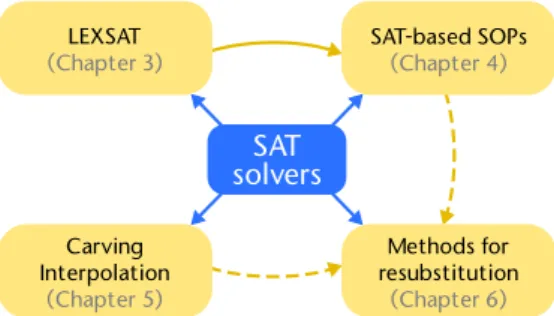
Figure 1.5 –Connection of the main contributions of the thesis. All algorithms are based on SAT solving. The LEXSAT algorithm is used for the SAT-based SOP generation to generate canonical SOPs. The methods used for resubstitution include, as first option, a method that is based on cube enumeration, similar to the one for SAT-based SOPs generation, and as second option, methods that are used as part of the carving interpolation algorithm. The last line of each box gives the chapter number that covers the corresponding topic.
such applications usually rely on canonical BDDs that also face scalabil-ity issues for some particular problems despite being the most scalable canonical representation. Similarly, even when canonicity is not re-quired, different satisfying assignments and proofs of unsatisfiability can lead to results with different qualities in the applications that use them. In this thesis, we demonstrate that it is possible to achieve canon-icity in SAT-based applications that utilise the returned satisfying as-signments. We also propose a fast algorithm for this purpose. Moreover, despite having no control over the returned proofs of unsatisfiability, we obtain results with the wanted properties by calling the SAT-solving procedure multiple times with specific values for some inputs.
1.4 Thesis Contribution and Organisation
Facilitate the development of SAT-based logic synthesis applications
With this thesis, we facilitate the development of logic synthesis applica-tions that use SAT solvers as a main engine of computation. We extend the set of available SAT-based methods with three novel approaches. Eachmethodis an algorithm that functions as a key building block in different logic synthesis applications. Some proposed methods are not even restricted to logic synthesis and can be used as building blocks for other applications. Finally, we compare two SAT-based methodologies that are used for the resubstitution of a given function. Figure 1.5 illus-trates the connection between the proposed methods and the
compari-son. Next, we give the outline of the thesis, as well as a short description of the chapters containing the main contributions.
First,Chapter 2comprises the background information to support the following chapters.
Fast generation of satisfying assignments in lexicographic order
Chapter 3introduces a new fast algorithm [Petkovska et al., 2016b] for
the lexicographic Boolean satisfiability problem, called LEXSAT, when the satisfying assignments are generated in a lexicographic order. Given a variable order, LEXSAT finds a satisfying assignment whose integer value under the given variable order is minimum (or maximum) among all satisfying assignments. If the formula has no satisfying assignments, LEXSAT proves it unsatisfiable, as does traditional SAT. We also pro-pose methods that use the lexicographic properties of the assignments to further improve the runtime when generating consecutive satisfy-ing assignments in lexicographic order. Finally, we promote the use of LEXSAT in a wide range of EDA applications, especially because it enables canonicity in SAT-based algorithms.
Progressive generation of canonical irredundant SOPs
Next,Chapter 4proposes an algorithm [Petkovska et al., 2017] that pro-gressively generates canonical irredundant SOPs for completely and incompletely specified Boolean functions by using a SAT solver. For the first time, we can generate canonical SOPs using a SAT solver, which is enabled by the LEXSAT algorithm described in Chapter 3. Canonic-ity is a key component in applications, such as constraint solving and random assignment generation, which traditionally rely on methods based on BDDs. However, in contrast with BDDs, our algorithm can relax canonicity when it is not required in order to improve speed and scalability. Moreover, unlike the BDD-based methods for SOP gener-ation, our progressive generation enables real time monitoring and early termination, as well as generation of partial SOPs for incremental applications.
Forcing the use of base functions during interpolation
Chapter 5provides a new method [Petkovska et al., 2014] that can be
particularly useful when rewriting circuits in some synthesis-based algorithms for which a dependency functionhshould be generated. The functionhreimplements a given target functionf asf =h(G), whereG
represents a given set of base functions. The problem with the existing Craig interpolation, which can also provide the dependency function, is that it selects random base functions and, in particularly, omits some base functions potentially required for an optimal implementation of
1.4. Thesis Contribution and Organisation
the target function. Therefore, we propose a method, calledcarving interpolation, that forces a specific base function as a primary input of the dependency function by building the dependency function as a Shannon expansion of two constrained Craig interpolants. We also introduce an efficient method that iteratively imposes a predefined set of base functions.
Comparison of methods for resubstitution
Chapter 6compares side-by-side two SAT-based methodologies for
re-substitution, which replaces a function of a giventarget nodeusing a
resubstitution functionthat has other nodes as inputs, calleddivisors. Both methodologies were proposed as a substantial part of different algorithms for post-mapping optimisation and resynthesis, but they have never been compared to each other. Each methodology includes algorithms that can minimise the set of divisors while ensuring that the target node can be reimplemented with the minimised set, and can generate the resubstitution function. The first methodology combines methods that are also part of the carving interpolation presented in Chapter 5. First, it creates a minimal set of divisors by using a circuit structure similar to the one for obtaining an interpolant; it then gener-ates a resubstitution function by using Craig interpolation. The second methodology is based on cube enumeration and is similar to the SAT-based SOP generation from Chapter 4. Its strength is that it directly provides the resubstitution function at the end of the minimisation. Lastly, we conclude that a hybrid approach that combines algorithms from the two methodologies represents an optimal solution for some applications.
Finally,Chapter 7concludes the thesis and provides ideas for future research that can build upon and extend the presented work.
2
Background Information
In this chapter, we provide background information on the basic terms and concepts that are used in the thesis. First, we introduce Boolean functions and their most commonly used representations. Then, we de-fine satisfiability solving and describe the features available in modern SAT solvers that play a crucial role in the algorithms proposed in this thesis. Finally, we define the terminology associated with functional dependency, Craig interpolation and Shannon expansion, which are required for Chapter 5 and Chapter 6.
2.1 Boolean Function
Boolean function
For a variablev, apositive literalrepresents the variablev, whereas thenegative literalrepresents its negation ¯v. Acube, or a product,c, is a Boolean product (AND,·) of literals,c=l1· · · · ·lk. If a variable is
not represented by a negative or a positive literal in a cube, then it is represented by adon’t-care (−), meaning that it can take both values 0 and 1. A cube withidon’t-cares, covers 2iminterms. Amintermis the
smallest cube in which every variable is represented by either a negative or a positive literal.
Example 2.1.1. Consider the set of variables X =(x1,x2,x3). A cube
−x2x¯3, which can be simply written asx2x¯3, covers the two minterms
¯
x1x2x¯3andx1x2x¯3 because the variablex1is represented by a
don’t-care.
Assignment
Each minterm is associated with a given input assignment. An assign-mentto a finite set of Boolean variables,X =(x1,...,xk), is the mapping
X→{0,1}k. In the minterm, a variable is represented with the positive or negative literal if it assumes a value of 1 or 0, respectively.
Example 2.1.2. Consider the set of variablesX =(x1,x2,x3). An
as-signment 010 denotes thatx1=0,x2=1, andx3=0. The minterm
associated with this assignment is ¯x1x2x¯3.
Incompletely specified Boolean function and support sets
Letf(X) :Bn→{0,1,−},B∈{0,1}, be anincompletely specified Boolean functionofnvariablesX={x1,...,xn}. Thesupport setoff is the subset
of variables that determine the output value of the function f. The
on-setof f is defined by the set of minterms for whichf evaluates to 1. Similarly, theoff-set and thedon’t-care-set of f are defined by the minterms for whichf evaluates to 0 and don’t-care, respectively. In a multi-output functionF={f1,...fm}, each outputfi, 1≤i≤m, has its
own support set, on-set, off-set and don’t-care-set associated with it.
Completely specified Boolean function
Similarly, f(X) :Bn→{0,1},B∈{0,1} is acompletely specified Boolean
functionofnvariablesX={x1,...,xn}. For completely specified
func-tions, the minterms belong either to theon-setor to theoff-setoff.
Example 2.1.3. Consider the functionf(x1,x2,x3)=(x1+x2) ¯x3. For the
assignment 010, the function f(x1,x2,x3) evaluates to 1. Thus, its
corre-sponding minterm ¯x1x2x¯3belongs to the on-set of f. On the contrary,
the minterm ¯x1x¯2x3belongs to the off-set off, because the function
evaluates to 0 for the corresponding assignment 001.
Primary inputs and outputs
In a multi-output Boolean functionF ={f1,...fm} defined over a set
of input variablesX ={x1,...,xn}, the input variablesxi, 1≤i≤n, are
calledprimary inputs (PIs), and the variables of the outputsfj, 1≤j≤
m, represent theprimary outputs (POs). The PIs and POs represent the external connections of the network.
2.2 Representation of Boolean Functions
In this section, we define four possibilities for representing Boolean functions that are used in the following chapters of this thesis. First, we introduce the minterm-based representations truth tables and sums of products. Then, we introduce two representations based on di-rected acyclic graphs (DAGs): binary decision diagrams and and-inverter graphs. Figure 2.1 illustrates the different representations through the sum and carry function of a full adder.
2.2. Representation of Boolean Functions ci a b co s 0 0 0 0 0 0 0 1 0 1 0 1 0 0 1 0 1 1 1 0 1 0 0 0 1 1 0 1 1 0 1 1 0 1 0 1 1 1 1 1
(a)A truth table.
co s -11 001 1-1 010 11- 100 111 (b)An SOP. 1 0
c
os
a
a
b
b
b
b
c
ic
i (c)A BDD.a
b
c
ic
os
6 7 8 9 10 11 12 (d)An AIG.Figure 2.1 –Representation of the Boolean functions of a full adder. The carry output is represented with the functionco=ab+ci(a⊕b), and the sum output is represented with the functions=a⊕b⊕ci.
Canonicity
Some representations of Boolean functions are canonical. Acanonical representationis a unique representation for a function under certain conditions. For example, the BDD structure of a Boolean function depends only on the input variable order and is independent of the original representation of the function. Canonicity is an important feature for some applications, such as functional equivalence checking.
2.2.1 Truth Tables
Truth tables
A single-output Boolean functionf withninputs can be represented with itstruth table, which is a string composed of 2nbits. Thei-th bit of
are assigned to the minterm defined with the binary digits of then-bit binary numberi. For example, the bit in position 0 gives the value of the function when all PIs are assigned to 0. The bitstring representing the truth table can be observed as the binary expansion of a non-negative numbertf ∈[0,2n). For example, the truth table of any 5-input function
can be encoded with a 32-bit integer. As shown on Figure 2.1a, 8 bits are required to represent the truth table of each full-adder output that has 3 inputs.
Example 2.2.1. The truth table of the two-input functionf(x1,x2)=x1·
x2is 0001 andtf =7. The three-input functiong(x1,x2,x3)=x1·x2+x¯3
has the truth table 10101011 andtg=171.
Pros and cons of truth tables
The truth table of a given function is always canonical. They provide a simple way to represent and manipulate Boolean functions. However, they are not practical for functions that have more than 16 inputs, due to their exponential growth in size in terms of the number of inputs.
2.2.2 Sums of Products
Sums of products Another more compact minterm-based representation is the two-level sum of products (SOP), which is a Boolean sum (OR,+) of cubes,S= c1+ · · · +ck. Assume that a Boolean functionf is represented as an SOP
Sf. The SOP can be also represented as the set of cubes that comprise
the sum of cubes by representing the positive, negative and don’t-care variables of the cubes with 1, 0 and−, respectively.
Example 2.2.2. Consider the functionsf andgfrom Example 2.2.1. The
on-set SOP of the two-input function f,Sf =x1x2, can be also written
asSf ={11}. The on-set SOPSg=x1x2+x1x¯3+x¯1x¯3of the three-input
functiong the can be also written asSg={11−,1−0,0−0}.
Prime cubes and irredundant SOPs
A cube isprime, if no literal can be removed from the cube without changing the value that the cube implies forf. A cube that is not prime, can beexpandedby substituting at least one literal with a don’t-care. The SOP isirredundantif each cube is prime and no cube can be deleted without changing the function.
Pros and cons of SOPs
Typically, a canonical SOP refers to the canonical disjunctive normal form that represents a sum of minterms and is canonical for a given
2.2. Representation of Boolean Functions
function, but these SOPs are redundant. However, for a given function, some algorithms [Minato, 1992] can generate canonical irredundant SOPs that depend only on the input variable order. The disadvantage of SOPs is that their two-level representation leads to an ineffective ma-nipulation of large logic nodes. Moreover, they are inefficient for some arithmetic, error correcting, and telecommunication circuits that are rich with XOR logic. For example, Figure 2.1b shows that the SOP of the sum output, which implements a 3-input XOR gate, is composed of four complete cubes (i.e., minterms), and the carry output is represented with 3 cubes, each composed of only 2 literals.
2.2.3 Binary Decision Diagrams
Binary decision diagrams
One of the fundamental representations of Boolean functions are the BDDs that were first introduced by Lee et al. [1959] and Akers [1978]. Abinary decision diagram (BDD)is a DAG with decision nodes repre-senting the input variables of the Boolean function and terminal nodes representing either a constant 1 or 0. One of the decision nodes is the root node of the DAG. Each decision node has two output edges labelled with 0 and 1, and it actually represents a 2-to-1 multiplexer. Any path from the root node to any terminal 1 or 0 node defines a cube for which the represented Boolean function evaluates to 1 or 0, respectively. For example, Figure 2.1c shows the BDD of the full adder in which some decision nodes are shared among the two outputs.
Refinements of BDDs
Several refinements of the BDDs have been proposed in the litera-ture [Wegener, 2000], such as transformation binary decision diagrams (TBDDs) [Goldberg et al., 1997], biconditional binary decision diagrams (BBDDs) [Amarù et al., 2013], and zero-suppressed decision diagrams (ZDDs) [Mishchenko, 2014]. In general, the term BDD refers to the most commonly used form, calledreduced ordered binary decision diagram (ROBDD)[Bryant, 1986], that is canonical for a particular function and variable order.
Variable order in BDDs
A BDD is ordered [Bryant, 1986] if the input variables appear in the same order on all paths from the root to the terminal nodes. The size of the BDD for a given function highly depends on the chosen variable order. As finding the best variable order is NP-hard problem [Bollig and Wegener, 1996], many efficient heuristics were developed [Rice and Kulhari, 2008].
Pros and cons of BDDs
BDDs are typically canonical for a given variable order. However, due to their canonicity, the size of the ordered BDDs is exponential, re-gardless of the variable order for some practical functions where the same inputs serve as both control and data [Br