Locking Made Easy
Jelena Anti´c
∗, Georgios Chatzopoulos, Rachid Guerraoui, Vasileios Trigonakis
† École Polytechnique Fédérale de Lausanne, Switzerland[email protected], {first}.{last}@epfl.ch
ABSTRACT
A priori, locking seems easy: To protect shared data from concur-rent accesses, it is sufficient to lock before accessing the data and unlock after. Nevertheless, making locking efficient requires fine-tuning (a) the granularity of locks and (b) the locking strategy for each lock and possibly each workload. As a result, locking can become very complicated to design and debug.
We presentGLS, a middleware that makes lock-based program-ming simple and effective. GLSoffers the classic lock-unlock in-terface of locks. However, in contrast to classic lock libraries,GLS
does not require any effort from the programmer for allocating and initializing locks, nor for selecting the appropriate locking strat-egy. WithGLS, all these intricacies of locking are hidden from the programmer. GLSis based onGLK, a generic lock algorithm that dynamically adapts to the contention level on the lock object.GLK
is able to deliver the best performance among simple spinlocks, scalable queue-based locks, and blocking locks. Furthermore,GLS
offers several debugging options for easily detecting various lock-related issues, such as deadlocks.
We evaluateGLSandGLKon two modern hardware platforms, using several software systems (i.e., HamsterDB, Kyoto Cabinet, Memcached, MySQL, SQLite) and show howGLKimproves their performance by 23% on average, compared to their default locking strategies. We illustrate the simplicity of usingGLSand its de-bugging facilities by rewriting the synchronization code for Mem-cached and detecting two potential correctness issues.
CCS Concepts
•Computing methodologies→Shared memory algorithms; Con-current algorithms;•Computer systems organization→ Mul-ticore architectures;
Keywords
Locking; Adaptive Locking; Locking Middleware; Locking Run-time; Synchronization; Multi-cores; Performance
∗Work done while the author was at EPFL. Currently at Google. †Author names appear in alphabetical order.
Permission to make digital or hard copies of all or part of this work for personal or classroom use is granted without fee provided that copies are not made or distributed for profit or commercial advantage and that copies bear this notice and the full citation on the first page. Copyrights for components of this work owned by others than the author(s) must be honored. Abstracting with credit is permitted. To copy otherwise, or republish, to post on servers or to redistribute to lists, requires prior specific permission and/or a fee. Request permissions from [email protected].
Middleware’16, December 12 - 16, 2016, Trento, Italy
c
2016 Copyright held by the owner/author(s). Publication rights licensed to ACM. ISBN 978-1-4503-4300-8/16/12. . . $15.00 DOI:http://dx.doi.org/10.1145/2988336.2988357 0 1 2 3 4 5 6 1 10 20 30 40 50 60
Throughput (Mops/s) # Threads
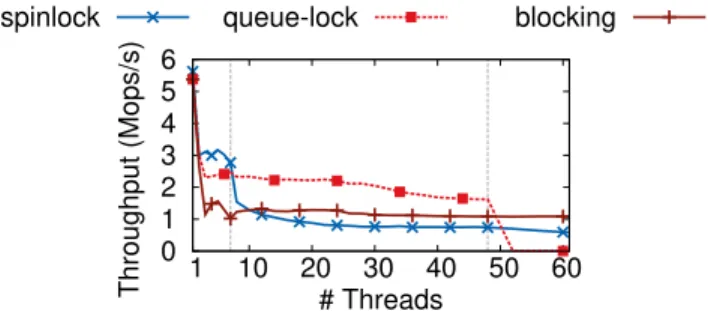
spinlock queue-lock blocking
Figure 1: Different lock strategies under varying contention.
1.
INTRODUCTION
Lockingis arguably the most widely-used synchronization
tech-nique in concurrent programming. Essentially, every modern sys-tem makes use of locks. Most operating syssys-tems (e.g., the Linux kernel), DBMSs (e.g., MySQL), and key-value stores (e.g., Mem-cached) heavily rely on locks. The wide adoption of locking can be mainly attributed to the need for a simple and fast technique for synchronization. Indeed, locking seems simple at a first glance. However, in practice, there is more to using locks efficiently in sys-tems than meets the eye.
Typically, the programmer must (i) map data to locks, (ii) declare locks, (iii) allocate and initialize locks, (iv) use the locks (i.e.,lock
andunlock), and (v) destroy and deallocate the locks. Of course,
she has to also select which lock algorithm(s) to use.
These steps are inflexible and error-prone. Every lock object must be explicitly declared, hence, changing the mapping of data to locks can be cumbersome. For example, moving away from the global lock in the Linux kernel required significant effort [14, 43]. Common mistakes during lock-based programming include [19]: (i) accessing uninitialized locks, (ii) trying to acquire the same lock twice, (iii) releasing an already free lock, (iv) releasing a lock that belongs to another thread, and, of course, (v) deadlocks. Theses issues can be difficult to debug.
To make things even more complicated, in order to achieve good performance, one has to fine-tune the locking strategies in use. In-deed, there is no one-size-fits-all lock algorithm [21, 33]. Consider Figure 1 that depicts the performance of different locking strate-gies under increasing contention. Simple spinlocks are very fast on low contention but do not scale well. Queue-based locks scale well, but are slower than spinlocks on low contention and suffer on multiprogrammed environments (i.e., when the number of threads is larger than the number of hardware contexts). Blocking locks (e.g.,pthreadmutexes) are suitable on that latter case, but are very slow on non-multiprogrammed environments.
Consequently, selecting the “wrong” algorithm can have detri-mental performance results. For example, recent work [21, 30, 32, 33, 46] has shown significant performance improvements in mid-dleware software, such as Memcached and LevelDB, by modify-ing lockmodify-ing. Accordmodify-ingly, the designer must select the appropriate locking techniquefor eachlock object in order to optimize her sys-tem as much as possible. However, the “correct” lock algorithm strongly depends on the lock contention levels which, in turn, de-pend on the workload. Additionally, workloads tend to change over time, thus the correct lock algorithm is a function of time. Ideally, we would like a single lock algorithm that can dynamically adapt to the workload, delivering the best performance among spinlocks, queue-based locks, and blocking locks, at any point in time.
In this paper, we question whether we can have the cake and eat it too. We presentGLS, ageneric locking servicedesigned to solve all the aforementioned intricacies related to lock-based programming.
GLSis a middleware that provides the traditional lock interface, with two main functions to acquire and release a lock. However, in contrast to traditional lock libraries, the locks are fully controlled byGLS, thus the developer does not need to select a lock algorithm, nor to declare, allocate, or initialize any locks. In fact, any arbitrary memory address can be used as a parameter togls_lock().GLS
takes care of mapping the input address to a lock object.
Under the hood,GLSuses a fast concurrent hash table for map-ping addresses to objects. As most locks are repeatedly used, this hash table converges to a read-mostly hash table, thus incurring low overhead. Having a central data structure, where all locks are kept, allows us to develop very useful debugging extensions on top of
GLS. GLScan detect accesses to uninitialized locks, double lock-ing, etc. Additionally, in §4.2, we show how to build low-overhead deadlock detection on top ofGLS, as well as lock profiling tools.
More importantly, the programmer does not need to select the lock algorithm for each individual lock;GLSautomatically adapts the lock algorithm to the workload. GLScomes with an adaptive lock called GLK, standing for generic lock. GLKkeeps track of the contention levels in order to dynamically adapt the algorithm to the needs of the workload. On low contention,GLKbehaves as a simple spinlock (i.e., ticket lock [47]). On high contention,GLK
turns into a scalable queue-based lock (i.e.,MCSlock [47]). On high system load (multiprogramming),GLKtransforms to a block-ing lock (i.e., mutex lock). The adaptiveness ofGLK is per lock, thus a system might contain various locks that operate on different modes depending on their contention levels (e.g., MySQL in §5.2). Naturally, in a system with locking already in place,GLKcan be used with or withoutGLSto minimize the overhead.
Additionally, GLSoffers explicit interfaces for many state-of-the-art lock algorithms: test-and-set, test-and-test-and-set, ticket,
MCS, CLH [20], and mutex, and allows for easy deployment of more algorithms. These interfaces can be used to manually spec-ify the lock algorithm to be employed for a specific lock object. In §5.1, we show how we use this interface to re-implement locking in Memcached from scratch. The resulting implementation contains 26% less lock-related code than the initial design and delivers 14% higher throughput on our benchmarks.
We evaluateGLSandGLKon various microbenchmarks and soft-ware systems. Based on microbenchmark results, we show thatGLS
adds low overheads compared to directly using locks. Addition-ally, we show thatGLKis always able to capture the needs of the underlying workload, thus adapting to the best algorithm for each workload phase. We plugGLK in various systems: HamsterDB, Kyoto Cabinet, Memcached, MySQL, and SQLite, by overloading
thepthreadmutex library. We improve the performance of these
systems by 23% on average, with essentially zero effort. Finally,
using the debugging facilities ofGLS, we detect two potential cor-rectness issues in Memcached.
The main contributions of this paper are as follows:
•GLS, a middleware locking service that simplifies lock-based programming;
•GLK, a practical lock algorithm that dynamically adapts to the contention of the underlying workload;
•Efficient implementations of GLSand GLK in our locking li-braries – available at https://lpd.epfl.ch/site/gls;
•A novel approach for dynamically detecting correctness issues in lock-based systems.
Of course, neitherGLS, norGLKare silver bullets.GLSadds both latency and memory overheads compared to plain locking. Ad-ditionally, the adaptiveness ofGLKadds a low performance over-head compared to directly using the corresponding lock algorithm. Therefore, a fully-customized system, for a fixed workload config-uration, with every lock object set to the correct lock algorithm, will inevitably be slightly faster than withGLK. Finally, one can devise scenarios where GLKwill be frequently switching modes. However, we never observe such behavior in practice.
The rest of the paper is organized as follows. In §2, we recall background notions regarding lock-based programming. We intro-duceGLKin §3 and use it inGLSin §4. We useGLSandGLKto simplify and optimize modern software systems in §5. We discuss related work in §6, and we conclude the paper in §7.
2.
LOCK-BASED PROGRAMMING
Locksare objects with two states: busyorfree. A lock can be
either free, or have a singleowner, namely the thread that holds the lock. Locks ensuremutual exclusion: Only the owner can proceed with its execution, while any concurrent threads are waiting behind the lock. Locks offer two operations:lockandunlock. The former is used toacquirethe lock (i.e., make the current thread the owner of that lock). Unlockreleasesthe lock so that it can be subsequently acquired by another thread.
There are numerous lock algorithms. These algorithms mostly differ in the way they handle contention, namely the situation where threads are waiting for a busy lock to become free. Typical designs employ eitherbusy waiting, or blockingfor waiting. With busy waiting, waiting threads remain active, polling the lock until they manage to acquire it. With blocking, waiting threads release their hardware context to the OS. The OS is responsible for unblocking these “sleeping” threads when the owner releases that lock.
There exist various busy-waiting algorithms. Simple spinlocks, such astest-and-set(TAS),test-and-test-and-set(TTAS), andticket lock[47] (TICKET), use a single memory location on which threads are busy waiting. Spinlocks are fast under low contention due to their simplicity. However, simple spinlocks might generate a lot of coherence traffic on the single memory location (i.e., cache line) of the lock [10]. Queue-based locks (e.g., MCS[47], CLH[20]) generate a queue of waiting nodes so that each thread is spinning on a unique location when busy waiting. Queue-based locks thus remove the single-memory-location bottleneck of simple spinlocks. The most well-known blocking lock is themutex-lock (MUTEX), part of thepthreadlibrary. Because the overheads of the OS for blocking and unblocking a thread are high, blocking locks typically employ a busy-waiting period before putting threads to sleep.
At a first glance, programming with locks looks simple. Lock-ing is appealLock-ing precisely because of this simplicity. Nevertheless, using locks efficiently (i.e., achieving correct and fast designs) can become cumbersome, mainly because of various correctness and performance problems that are often associated with locks.
Programming with Locks.
In short, programming with locks involves the following steps: 1. Recognizing the various critical sections and the data they
pro-tect (i.e., thegranularityof each lock).
2. Selecting and using concrete lock implementations.
3. Declaring the lock objects. Non-statically allocated locks must not only be declared, but allocated as well.
4. Initializing the locks.
5. Using the locks through their interface (i.e.,lock,trylock, un-lock) in order to protect the critical sections.
6. Destroying and possibly deallocating the locks.
If the developer implements any of these steps improperly, cor-rectness and performance issues can emerge.
System Correctness with Locks.
The most well-known bugs associated with locks aredeadlocks. In a deadlock, a thread has acquired a lockl0and is waiting for an
already acquired lockl1, the owner of which is waiting for a
differ-ent acquired lockl2and so forth. Finally, there is a thread that has
acquiredlnand is waiting forl0, in which case none of the threads
can make progress. Deadlocks are often a result of acquiring locks in the wrong order and are notoriously hard to debug.
Another hard-to-detect issue with locks is using uninitialized locks (i.e., trying to (un)lock a non-initialized lock object). This issue results in executions where the system may or may not work properly, depending on the initial value of the lock object’s mem-ory. Other common mistakes with locks are trying to lock the same object twice, unlocking a lock that is already free, or releasing a lock that has been acquired by another thread.1 As with uninitial-ized locks, the latter issues can break the system.
These issues are common in practice [19]. In §4.2, we present an easy-to-use debugging extension ofGLSfor detecting all of these issues. In fact, we useGLSto detect and solve two of these issues in Memcached (§5.1).
System Performance with Locks.
In addition to correctness problems, locks might become a per-formance bottleneck, mainly due to two different reasons.
First, highly-contended locks can easily become a bottleneck (e.g., the global lock in Memcached v1.4.13 [30] or in the Linux kernel [14, 43]). Removing these bottlenecks might require signif-icant effort. The designer must redesign the critical sections and change the granularity of the locks. This process is of course prone to the correctness issues discussed earlier.
The second and more important reason is that different lock algo-rithms are suitable for different workloads [21, 33]. As we show in Figure 1, simple spinlocks shine under very-low contention, queue-based locks are by far the best under medium to high contention, and blocking locks are necessary under multiprogrammed work-loads. Choosing the “wrong” algorithm under multiprogramming can lead tolivelocks, situations where although the threads execute, the system throughput is close to zero (see MySQL in §5.2).
Naturally, while designing and implementing a general-purpose system, the designer cannot predict every single deployment or potential runtime fluctuation of the behavior of the workload. Therefore, she must choose the common-denominator lock algo-rithm (i.e., the one that works even on multiprogramming), namely mutex. Unfortunately, studies have shown that mutex is slow com-pared to other algorithms in the absence of multiprogramming [21].
1Releasing a lock owned by another thread, or acquiring a lock
twice, can be also used as a feature.
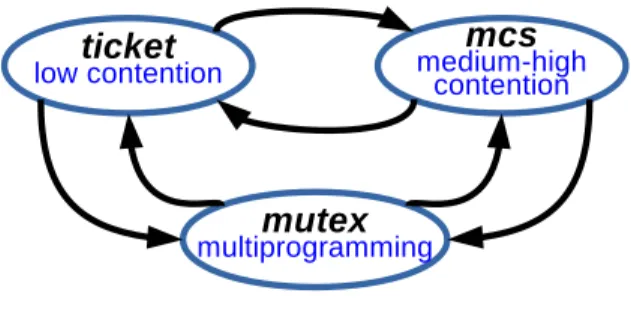
Figure 2: The three modes ofGLK.
Locking on Modern Multi-cores.
In order to properly substantiate our claims regardingGLSand
GLK, we perform our experiments on two modern multi-cores from Intel. We detail the characteristics of these platforms below:
Name Model #Cores Freq L1 L2 LLC
Haswell E5-2680 v3 12 2.5GHz 32KB 256KB 30MB
Ivy E5-2680 v2 10 2.8GHz 32KB 256KB 25MB
Haswell and Ivy are both 2-socket Intel Xeon machines, with
128GB of main memory attached to each socket. Both platforms run Ubuntu 14.04.3 with Linux kernel 3.13.0-63 andglibc2.19, with dynamic voltage and frequency scaling (DVFS) disabled.
3.
GLK: A GENERIC LOCK ALGORITHM
As we explain in §1 and §2, different lock algorithms are suitable for different workloads. Simple spinlocks (e.g, ticket locks) are the fastest locks under low contention. Queue-based spinlocks are more suitable under high contention. For instance,MCSlocks were recently introduced in the Linux kernel to improve scalability of highly-contended locks [17]. Nevertheless, spinlocks cannot prop-erly handle multiprogrammed environments. Due to busy waiting, threads waiting behind a spinlock might occupy a hardware context instead of a thread that could perform some useful work. This phe-nomenon is exacerbated in fair locks,2where the thread that is next in acquiring the lock might not be scheduled.
Accordingly, we design thegeneric lockalgorithm (GLK), based on the premise that there is no one-size-fits-all lock algorithm.GLK
adapts to the workload in order to select the most suitable way of waiting behind a busy lock. In brief,GLKcollects contention in-formation and, based on this inin-formation, periodically adapts the mode it operates in, betweenticket,mcsandmutex(Figure 2). We useTICKETinstead of other simple spinlocks, asTICKETis fair and more scalable thanTASandTTAS[21]. In what follows, we first de-scribe the design ofGLKand then perform a sensitivity analysis for the configuration parameters ofGLKon our target platforms.
The GLK Structure.
Figure 3 includes the code for theGLK structure. The struc-ture contains alock_typeflag that indicates the current mode of the lock, the three lock objects for ticket, mcs, and mutex, and two counters for gathering statistics (num_acquiredand
queue_total). The former counter measures the number of
completed critical sections, while the latter contains the amount of queuing behind the lock.
2
Fair locks, such as ticket locks, offer FIFO ordering of lock ac-quisitions. Queue-based locks are FIFO by design because they are implemented as queues.
typedef struct g l k { g l k _ t y p e _ t l o c k _ t y p e ; g l k _ t i c k e t _ l o c k _ t t i c k e t _ l o c k ; g l k _ m c s _ l o c k _ t m c s _ l o c k ; g l k _ m u t e x _ l o c k _ t m u t e x _ l o c k ; uint32_t n u m _ a c q u i r e d ; uint32_t q u e u e _ t o t a l ; } g l k _ t ;
Figure 3: TheGLKstructure.
Measuring Contention.
GLKcontains a configuration parameter on how often to collect contention statistics. On spinlock-mode (i.e., ticketormcs), we measure contention as the amount of queuing behind the lock.
Ticket locks provide this queuing information by design [47]. A ticket lock comprises two counters:ticketandowner. To ac-quire the lock, the thread grabs a tickettby atomically increment-ing (and fetchincrement-ing) theticketfield. It then spins untiltbecomes equal tolock->owner. To release the lock, the owner simply increments theownerfield. Consequently,lock->ticket−
lock->ownershows how many threads are waiting behind the
lock (plus one for the current owner).
MCScreates a queue of waiting nodes. To measure the amount of queuing, we count the number of nodes while traversing the queue. It is important that this traversal is infrequent, because it breaks the “each node is accessed by a single thread” design goal ofMCS.
Finally, the aforementioned queuing information is not sufficient for detecting multiprogramming. Multiprogramming does not re-late to the contention of a single lock, but rather to the overall pro-cessor load. In other words, multiprogramming might be caused by other applications executing on the machine. Accordingly, to detect multiprogramming,GLKcompares the number of running tasks to the number of available hardware contexts. On the firstGLK invo-cation, a background thread is spawned. This background thread is shared across allGLKobjects in a system and checks whether there is oversubscription of threads to hardware contexts at the system level, and whetherGLKlocks must switch tomutexmode.
Selecting the GLK Mode.
We perform a sensitivity analysis on whenTICKETis faster than
MCS(see §3.1). TICKETis consistently faster thanMCSwhen up to three concurrent threads are accessing the lock. We thus config-ure the transition fromtickettomcsto happen when the amount of average queuing on a lock is more than three. To avoid frequent, unnecessary transitions, we configure the opposite transition, from
mcstoticket, to happen when queuing drops below two.
Addition-ally, we keep the exponential moving average of the statistics in order to hide possible short-term workload fluctuations.
The periodic background thread that detects multiprogramming wakes up approximately every 100 us. If the thread detects multi-programming, it sets a library-wide flag to inform locks that they must switch tomutexwhen they next try to adapt. However, locks switching tomutexmode might cause a system-load decrease, as threads block onmutex. Thus, the locks might continuously fluc-tuate betweenmutexand the other modes. To avoid this effect, we detect and avoid consecutive transitions frommutexto spinlocks, by exponentially increasing the number of consecutive rounds with no oversubscription required to switch away frommutex.
Additionally, locks that face close-to-zero contention do not cause a problem on multiprogramming. In fact, these locks should be simple spinlocks in order to complete these critical sections as fast as possible. Therefore,GLKobjects that operate with minimal queuing do not switch tomutex, but remain inticketmode.
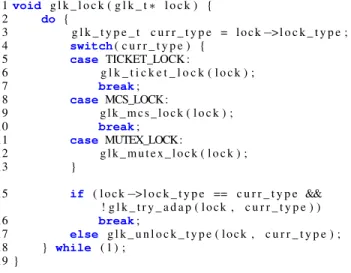
1void g l k _ l o c k ( g l k _ t∗ l o c k ) { 2 do { 3 g l k _ t y p e _ t c u r r _ t y p e = l o c k−> l o c k _ t y p e ; 4 switch( c u r r _ t y p e ) { 5 case TICKET_LOCK : 6 g l k _ t i c k e t _ l o c k ( l o c k ) ; 7 break; 8 case MCS_LOCK : 9 g l k _ m c s _ l o c k ( l o c k ) ; 10 break; 11 case MUTEX_LOCK : 12 g l k _ m u t e x _ l o c k ( l o c k ) ; 13 } 15 if ( l o c k−> l o c k _ t y p e == c u r r _ t y p e && ! g l k _ t r y _ a d a p ( l o c k , c u r r _ t y p e ) ) 16 break; 17 else g l k _ u n l o c k _ t y p e ( l o c k , c u r r _ t y p e ) ; 18 } while ( 1 ) ; 19 }
Figure 4: TheGLKlock function.
We implement a version ofMUTEXforGLKthat incorporates the collection of statistics required for adaptation. We also modify the lock to support deadlock detection. OurMUTEXimplementation is more lightweight than the one in thepthreadlibrary, as it does not include the various sanity checks of the latter. These sanity checks (and more) are provided byGLSin debug mode (see §4.2).
Adapting the GLK Mode.
GLKcontains a configuration parameter on how often adaptation must be attempted. When adaptation is triggered, the thread cur-rently holding the lock checks the lock statistics and decides which
GLKmode to use.
To acquire the lock, a thread (i) accesses thelock_typeflag of the lock, (ii) acquires the corresponding “low-level” lock object, (iii) checks thatlock_typehas not been modified (if it has been modified, the thread releases the low-level lock object and restarts), and (iv) performs the adaptation (if needed). This approach has the benefit that the lock and unlock functions of TICKET, MCS, and
MUTEXcan be used almost unmodified. The only modifications in their lock functions are in order to update the queuing and the number of completed critical sections statistics.
The GLK lock function is included in Figure 4. The
glk_try_adap function first checks whether it should try to
adapt theGLK’s mode and then checks the statistics to decide on which mode the lock will execute on. If a mode-transition hap-pens, glk_try_adapreturns true, hence the lock operation is restarted (line 15).
Correctness.
The correctness ofGLKis not obvious at a first glance. To un-derstandGLK, we need to consider all possible interleavings of ex-ecutions. First, we can differentiate between executions with and without concurrent adaptation(s). In the latter case, without any
GLKadaptation, GLKis trivially correct because it acts exactly as the low-level lock indicated bylock->lock_type.
Then, we will show that only a single threadt can succeed the if statement in line 15 of Figure 4 at a time. If tsucceeds
lock->lock_type == curr_type, then no other thread
can succeed this statement beforeteither adapts the lock, or re-leases the low-level lock. Any other concurrent thread that uses the same lock type astwill block at the low-level lock. All other con-current threads will fail the statement. Accordingly, justt(i.e., one thread at a time) has the chance to trigger adaptation and enter the
2 3 4 5 6 0 2000 4000 6000 8000 10000
Crosspoint (# Threads) Critical Section Size (Cycles)
Ivy Haswell
Figure 5: Performance crosspoint: The number of threads that should be concurrently accessing a lock object so thatMCS out-performsTICKET.
critical section. If no adaptation happens,glk_try_adapreturns false andtenters the critical section. Otherwise,glk_try_adap
returns true, thustreleases the low-level lock and re-runs the while loop. In that case, any thread can take the position oftin succeed-ing the first clause of line 15, without breaksucceed-ing the correctness of our algorithm.
Including Additional Lock Algorithms.
InGLK, we chose to use a minimum number of algorithms to cover the needs of most workloads. As such, we included aTICKET
spinlock algorithm for low contention cases, anMCSqueue lock al-gorithm for contended locks and aMUTEXlock algorithm in order to cope with oversubscription of threads to hardware contexts. In our experience, and as we show in our evaluation ofGLK, these locks are sufficient for a wide range of workloads. However, addi-tional lock algorithms can be included inGLK: By modifying the lock selection algorithm previously described and by introducing new selection criteria, users can add more specialized lock algo-rithms to address cases where such algoalgo-rithms could yield better performance (e.g., cohort locks [24]).
3.1
GLK Sensitivity Analysis
We perform a sensitivity analysis of the three most important parameters ofGLK: (i) the contention thresholds that control the switch from/toticketmode, (ii) adaptation period, and (iii) queue sampling period. Based on our analysis, we set the defaultGLK
settings, which we believe are suitable for most workloads and x86 hardware platforms (in our evaluation we did not need to change any of the settings). However, our scripts for this sensitivity anal-ysis can be used to fine-tuneGLKfor specific hardware platforms and workloads, if necessary.
ticket vs. mcs Mode.
Figure 5 shows how many threads must contend for a single lock in order for anMCSlock to outperform aTICKETlock. On both of our platforms,TICKETis typically faster thanMCSon up to three threads. Accordingly, we configureGLKin our experiments so that it switches fromtickettomcsmode when the average queuing be-hind the lock is more than three.
Adaptation and Queue Sampling Periods.
Figure 6 contains the relative throughput ofGLK compared to
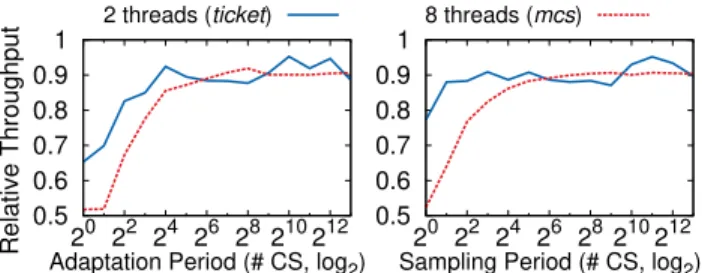
GLKwith adaptation disabled, under the extreme scenario of empty critical sections. For the 2-thread execution we fix the non-adaptive
GLKtoticketmode, while for the 8-thread execution tomcsmode.
For both experiments the results show that – as expected – short adaptation periods incur a high performance overhead. In both cases, the results stabilize as we increase the adaptation period.
0.5 0.6 0.7 0.8 0.9 1 20 22 24 26 28210212 Relative Throughput
Adaptation Period (# CS, log2)
0.5 0.6 0.7 0.8 0.9 1 20 22 24 26 28210212
Sampling Period (# CS, log2) 2 threads (ticket) 8 threads (mcs)
Figure 6: Relative throughput ofGLKinticketandmcsmodes compared toGLKwith adaptation disabled, depending on the adaptation period (left) and the queue sampling period (right).
cordingly, in our experiments, we set the adaptation period to 4096 critical sections and the sampling period to 128 critical sections. With these settings, we obtain a sufficient number (4096/128 = 32) of queuing samples per adaptation.
3.2
GLK Evaluation
We start by evaluating the overhead ofGLKdue to its adaptive-ness. We then compare the performance ofGLKwithTICKET,MCS, andMUTEXon a set of microbenchmarks. In §5, we plug in and compare the performance of these algorithms in software systems. Before we proceed with the evaluation, we describe the experimen-tal settings in our microbenchmarks.
Experimental Methodology.
Threads execute in a loop, performing lock and unlock opera-tions on lock object(s). On every run, we configure (i) the number of threads, (ii) the number of lock objects, and (iii) the duration of the critical section (in CPU cycles). Furthermore, after every loop iteration, threads wait for a short duration to avoid long runs [48]. On every loop iteration, each thread selects a lock object at ran-dom. Our results use the median value of 11 repetitions of 10 sec-onds each. We do not pin threads to cores, but let the OS do the scheduling. Additionally, for fairness and for avoiding false cache-line sharing, we pad all locks to 64 bytes (one cache cache-line). Due to space limitations, we only show the results on ourHaswellmachine (see §2). We get very similar results on ourIvymachine.
Overhead.
We evaluate the overhead of GLK due to its adaptiveness. Compared to the vanilla TICKET, MCS, andMUTEX algorithms,
GLKadditionally executes the following steps: (i) it accesses the
lock_typeflag, (ii) it increments thenum_acquiredcounter
on almost every critical section,3(iii) it updates the queuing
statis-tics of the lock every 128 critical sections, (iv) it tries to adapt the lock type every 4096 critical sections, and (v) it checks the
lock_typeflag for a second time. Additionally, the conditional
statement on whether adaptation should be attempted is executed on every lock acquisition.
Figure 7 shows the throughput ofGLKon three distinct configu-rations, each suitable forTICKET,MCS, andMUTEX, respectively. On the single-thread execution, all acquires and releases are local and uncontested (we use empty critical sections).GLKoperates on
ticketmode but is 22% slower thanTICKET, mainly because of the
switch statement on thelock_typewhen locking and unlocking. Even if we turn adaptation off (i.e., overhead steps (ii)-(iv)),GLKis still 19% slower thanTICKET. This comparison reveals an inherent
3In
TICKETmode, we take advantage of thecurrentcounter of the lock to avoid incrementing thenum_acquiredcounter.
0. 78 0. 93 0. 99 0 0.2 0.4 0.6 0.8 1
1 thread 10 threads multiprog.
Re
la
tiv
e
Th
ro
ug
hp
ut
TICKET MCS MUTEX GLKFigure 7: Relative throughput ofGLK compared to the best per-configuration lock on various configurations.
overhead ofGLK: An adaptive lock must access a flag to find the lock type to use. Still,GLKdelivers 24% and 30% more throughput thanMCSandMUTEX, respectively.
The second workload includes 10 threads and empty critical sec-tions, a configuration suitable forMCSlocks. In this case,GLKis 7% slower thanMCS. Again, even if we remove adaptation from
GLK,GLKis still 6% slower thanMCS. The overhead inmcsmode is lower than inticket, because there is actual contention behind the lock, thus the overhead is partly hidden by waiting. Again, regard-less of the overhead ofGLK,GLKis still significantly faster than
TICKETandMUTEX, respectively.
Finally, the third configuration of Figure 7 involves 10 threads and multiprogramming (we initialize 48 additional threads that just spin locally). In this configuration,GLK is only 1% slower than
MUTEX, but much faster than TICKET and MCS. As we have pointed out, fair locks suffer on multiprogrammed workloads.4
Single Lock Behavior.
We evaluate the behavior of a single lock as the number of con-current threads increases. Critical section are 1024 cycles long. Figure 8 includes the results of this experiment. As expected, on a low thread count (i.e., up to 3 threads),TICKETis the fastest lock. On these executions,GLKoperates inticketmode and follows the performance ofTICKETclosely. As we increase the contention fur-ther,GLKswitches tomcsmode, thus behaving similarly toMCS. Finally, when using more than 48 threads, where there is oversub-scription of threads to hardware contexts,GLKexecutes inmutex
mode, in order to handle multiprogramming.
Multiple Locks Behavior.
We experiment with eight locks as the number of concurrent threads increases, using critical sections of 1024 cycles. On ev-ery iteration, each thread selects one of the locks at random, using a zifpian skewed distribution with alpha set to 0.9. In other words, some locks are more frequently utilized than the rest. The two most
4
There do exist techniques, such as time-published queue-based locks [34], for alleviating this problem.
0 1 2 3
1 10 20 30 40 50 60
Throughput (Mops/s) # Threads
TICKET MCS MUTEX GLK
Figure 8: A single lock on varying contention.
0 1 2 3 4 5 1 10 20 30 40 50 60
Throughput (Mops/s) # Threads
TICKET MCS MUTEX GLK
Figure 9: Eight locks on varying contention.
busy locks serve 34% and 18% of the requests, respectively. Intu-itively, in a software system, some locks might be more contended than others: This is one of the cases that we aim at capturing with
GLK. The developer must not have the difficult duty of identifying contended locks and customizing their algorithm accordingly.
Figure 9 includes the results of this test. For up to three threads, all eight locks face low contention. Thus, TICKETand GLK (in
ticketmode) are the fastest. For more threads, the contention on one
to two locks increases, thusMCSis the most suitable choice.GLKis able to adapt tomcsmode only these highly-contended locks, while keeping the rest inticketmode. This behavior results inGLKbeing approximately 20% faster thanMCSon the non-multiprogrammed configurations. Under multiprogramming, GLKusesmutexmode for the two contended threads, while the rest remain inticketmode.
Varying Workload.
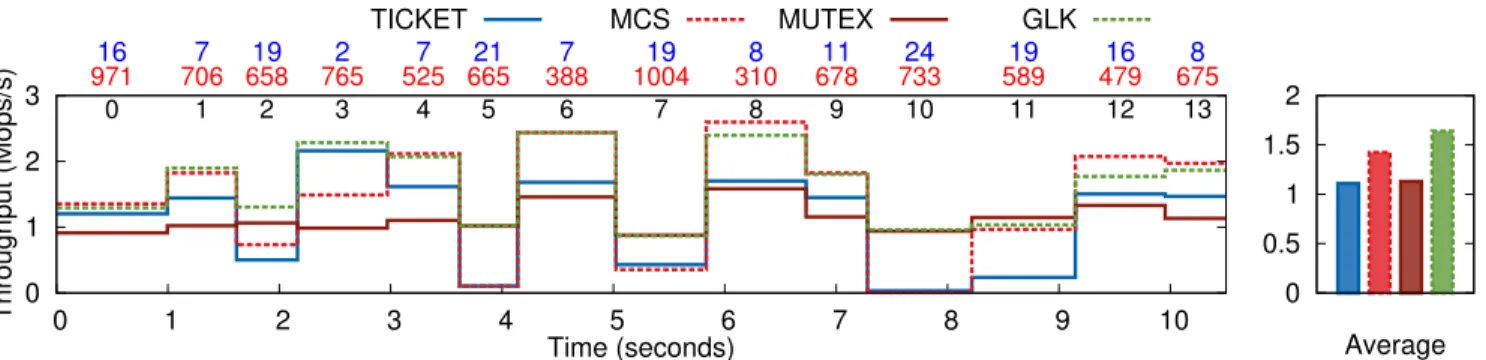
We evaluate the behavior of a single lock when the contention varies over time. More precisely, the execution is broken into phases of 0.5-1s.5 In each phase, the number of threads that exe-cute is selected at random from 1-24. Additionally, 30 background threads run on the processor. These background threads represent other applications that could be executing on the same machine.
Figure 10 shows the throughput of different lock algorithms as a parameter of time and per-phase configuration. On average,
GLKdelivers 15% higher throughput than the second fastest lock, namelyMCS. GLKachieves this by dynamically adapting its con-figuration during every phase, depending on the needs of the work-load. For instance, in phase 3, where contention is very low,GLK
switches toticketmode, thus delivering the same performance as
TICKET. In contrast, in phases 0-1, where contention is very high,
GLKswitches tomcsto better scale with the number of contend-ing threads. Finally, in multiprogrammed phases, such as 2 and 10,GLKswitches tomutexin order to avoid potential performance degradation caused by busy waiting.
Conclusions.
GLKcan successfully adapt to the needs of the underlying work-load at runtime, in order to deliver performance that is close to the best lock algorithm at any point in time. Of course, due to the adap-tation overhead, GLKis usually slightly slower than the best per-configuration lock algorithm for fixed workloads. Based on these results, we claim thatGLK delivers close-to-optimal performance for any workload and configuration combination. Additionally, as we show in §5, in systems with many locks and complex interac-tions,GLKcan outperform any lock algorithm precisely because of its adaptiveness.
5
Note thatGLKis able to adapt with much more fine-grain granu-larity. Assuming 1M acquires/s, adaptation happens approximately every 4 ms, hence the phase length can be as low as roughly 10 ms.
0 1 2 3 0 1 2 3 4 5 6 7 8 9 10 Throughput (Mops/s) Time (seconds) 0 1 2 3 4 5 6 7 8 9 10 11 12 13 16 7 19 2 7 21 7 19 8 11 24 19 16 8 971 706 658 765 525 665 388 1004 310 678 733 589 479 675 0 0.5 1 1.5 2 Average TICKET MCS MUTEX GLK
Figure 10: One lock under varying contention levels over time. The numbers on top of the graph represent the number of threads on each phase (blue, top), the critical section duration in cycles (red, middle), and the phase id (black, bottom).
4.
GLS: A GENERIC LOCKING SERVICE
GLSis ageneric locking servicethat simplifies lock-based
pro-gramming by handling many of the complexities that developers must typically cope with when using locks. GLS provides the classic lock interface (e.g., functions for locking and unlocking). However, unlike traditional lock libraries, GLSaccepts any arbi-trary memory address (or even value) as an input parameter to
gls_lock. WithGLS,gls_lock(17)is a valid lock
invoca-tion.GLSmaps the input address to a lock object behind the scenes. Accordingly, the user ofGLSdoes not need to worry about declar-ing and initializdeclar-ing locks.
Additionally, GLS offers two very useful extensions: (i) a de-bugging extension that can detect the most common bugs in lock-based programming, and (ii) a profiler that reports the amount of contention on each lock. We first describe the default design and implementation ofGLSand then we detail the debugging and pro-filer extensions ofGLS.
4.1
Programming with GLS
Interface.
Table 1 presents the interface of GLS. Apart from the initializa-tion funcinitializa-tions,GLSincludes various calls for locking and unlocking using different algorithms. These functions accept any arbitrary value as an input, except forNULL. The default interface ofGLS
(gls_lock) utilizes theGLKalgorithm. In addition,GLSoffers
an explicit interface to six other algorithms.
Implementation.
GLSis essentially a cache for locating the lock object that cor-responds to an address. We implementGLSon top of a modified version of the lock-basedCLHThash table [22]. CLHThas sev-eral properties that are necessary inGLS: (i) it uses
cache-line-Function Description
gls_init() InitializeGLS
gls_destroy() StopGLSand cleanup
gls_lock(void* m) gls_trylock(void* m) gls_unlock(void* m)
Lock, trylock, or unlockmusing
GLKalgorithm
gls_A_lock(void* m) gls_A_trylock(void* m) gls_A_unlock(void* m)
Lock, trylock, or unlockmusing
algorithmA.Acan betas,ttas,
ticket,mcs,clh, ormutex
gls_free(void* m) RemovemfromGLS
Table 1:GLSinterface.
sized buckets, hence operations typically complete with at most one cache-line transfer, (ii) searching for a key is a read-only, wait-free operation, (iii) failing to insert a key is also read-only and wait-free, and (iv) it is resizable. Consequently, when the lock objects used in a system are stable (i.e., there are not many allocations and deallocations of locks), theCLHThash table inGLSbecomes a read-mostly hash table, thus incurring low overhead. The workflow of
gls_lockis as follows:
1int g l s _ l o c k (void∗ a d d r ) {
2 g l k _ t∗ l o c k = ( g l k _ t∗) g l s _ c l h t _ p u t ( a d d r ) ;
3 return g l k _ l o c k ( l o c k ) ; 4 }
In line 2, GLSis searching in the hash table for the lock object that corresponds to the given address. We modify clht_put
to create and initialize a new lock object for addr if addr is not found. If addr already exists in the hash table, then the corresponding lock object is returned. Thegls_unlock func-tion uses gls_clht_getto fetch the lock which maps to the given address. (As we show in §4.2, if gls_clht_get re-turnsNULL,GLSdetects that an uninitialized lock is used in un-lock.) Thegls_A_lockfunctions perform the same workflow as
gls_lock, but initialize and use the lock function of the
corre-sponding algorithmA.
Lock-cache Optimization.
In locking, the most common pattern involves acquiring and later releasing the same lock, without accessing any other locks in the meantime (the opposite case is calledlock nesting). Additionally, there is temporal locality of accesses: A lock that is used by a thread will be reused in the near future by the same thread with high prob-ability. To optimize for these patterns, we introduce a single object cache inGLS. This cache keeps track of the address and the lock object of the latest lock that has been accessed. If a lock/unlock operation finds the target address in the cache, there is no need to access theGLShash table. On a cache miss during locking, the cache is updated with the target address-lock object pair.
Memory Overhead.
GLSadds memory overhead over traditional locking, mainly due to the hash table.CLHTkeeps up to three key-value pairs per cache line (64 bytes), hence the minimum overhead introduced byGLSis one-third of a cache line per lock. In our experience, theCLHTused inGLStypically achieves 60-70% occupancy, thus we estimate the overhead per lock to be approximately 32 bytes, or 50% of a cache-line-sized lock object.
0 20 40 60 1 lock 512 locks 4096 locks
Ov
er
he
ad
(c
yc
le
s)
Lock Latency TICKET MCS 0 1 2 3 4 1lock locks512 4096 locks Unlock Latency
MUTEX GLK
Figure 11: Latency overhead ofGLSover directly using locks on a single thread.
Performance Overhead.
We evaluate the performance overhead ofGLScompared to using locks directly.
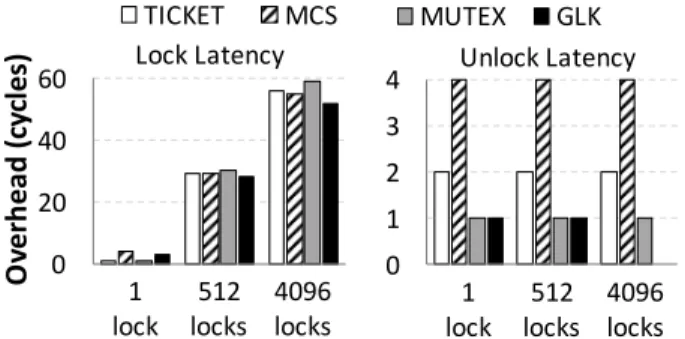
Single Thread. Figure 11 depicts the latency overhead ofGLSon
a single thread, depending on how many locks are accessed. On each iteration, the thread picks a lock at random. Evidently, with a single lock, the overhead ofGLSis just a few cycles due to the lock cache that is always able to locate the lock without accessing theGLShash table. The same applies for the unlock latencies in this experiment, regardless of the number of locks: Unlock opera-tions always hit on the lock cache (no lock nesting). Without the cache, the unlock latency overhead is close to theGLSoverhead in lock functions. With 512 locks,GLSadds approximately 30 cycles overhead, which corresponds to roughly 100% increase in lock la-tency. As we increase the number of locks, the size of the hash table does not fit in the L1 cache, thus the overhead ofGLSincreases.
Multiple Threads. Figure 12 compares the throughput of different
lock algorithms when used inGLSto direcly using the lock algo-rithm, with 10 threads competing for 1, 512, or 1024 locks (high, medium and low contention respectively). Each thread randomly chooses among the locks and spends 1024 cycles in the critical sec-tion. When locks are not contested (4096 locks to choose from), the overhead ofGLSis proportional to the duration of the critical sec-tion. In the presence of contention, however, the overhead ofGLS
can be masked by waiting.
4.2
Debugging with GLS
GLScan be configured to detect several lock-related issues. In order to detect potential bugs, including deadlocks,GLSin debug mode keeps track of the owner of each lock object. In what follows, we describe the issues thatGLScan detect. Note that some of these issues could be seen as features depending on the semantics of the specific lock algorithm in use.
Uninitialized Locks.
GLShandles the mapping of addresses to lock objects. Accord-ingly,GLScan detect when a thread is trying to access an uninitial-ized lock. Upon releasing a lock, uninitialuninitial-ized locks are detected when the target address does not exist in the hash table, which means that the lock was not acquired before. In order to detect uninitialized locks while trying to acquire a lock, GLSadds spe-cial values in the overloaded MUTEX locks for static initialization (instead of the default ones used by thepthreadmutex). When trying to acquire a lock, if the call togls_clht_putdoes not find an address-lock mapping, there are two possible cases: either the lock has been statically initialized, or the lock has not been ini-tialized at all. To discern between the two,GLSchecks whether the
MUTEXobject contains the special values used for static
initializa-0 0.2 0.4 0.6 0.81
1 lock 512 locks 4096 locks
Re la tiv e Th ro ug hp ut TICKET MCS MUTEX GLK Figure 12: Relative throughput ofGLSover directly using locks on 10 threads.
tion. If that is the case, the lock was statically initialized, otherwise an error is detected. Due to the static declaration of these locks, it is certain that if not initialized, they will contain a zero value [1].
Double Locking.
GLScan check whether the current owner of a lock tries to ac-quire that same lock again. GLSimplements this functionality by comparing the id of the thread that is performing the operation with the id of the lock owner. Of course, double locking is a subset of deadlock detection.
Releasing a Free Lock.
Releasing an already free lock can either break some lock algo-rithms (e.g.,TICKET), or result in race conditions where a thread is trying to acquire the lock while another is falsely releasing it at the same time. GLSchecks whether an unlock function call operates on a lock that is already free.
Releasing a Lock with Wrong Owner.
GLSchecks that the owner id of the lock to be released is the same as the id of the thread performing the unlock operation.
Deadlocks.
Deadlocks can be very hard to detect and debug [28].GLS imple-ments a technique for detecting and reporting deadlocks at runtime.
GLSimplements deadlock detection in the following steps: 1.GLSaugments the hash table with awaitingarray that indicates
which lock each thread is waiting on (if any).
2. Before calling the lock/trylock function in the
gls_clht_put invocation, GLS records that the
corre-sponding thread is waiting on the target address.
3. When the lock is acquired (or the trylock function completes),
GLSupdates the waiting structure to indicate that this thread is not waiting behind that lock anymore.
4. Additionally, the owner of that lock is set to the thread id. For trylock, the owner id is set iff the lock was successfully ac-quired.
5. On lock release, the owner id for that lock is cleared.
Based on the aforementioned steps, if the thread is waiting be-hind a lock for a long time (i.e., more than a second),GLStriggers the following deadlock-detection procedure:
// the invoking thread is waiting on wait_lock
w a i t _ o n = w a i t _ l o c k ;
do {
/* find the owner of the lock that the previous thread is waiting on */ o w n e r _ i d = g l s _ d e b u g _ g e t _ o n w e r ( w a i t _ o n ) ; // if the invoking thread re-appears
if ( o w n e r _ i d == g l s _ g e t _ i d ( ) )
g l s _ d e b u g _ d e a d l o c k _ p r i n t ( ) ;
// find the lock that owner_id is wating on w a i t _ o n = g l s _ d e b u g _ g e t _ w a i t _ o n ( o w n e r _ i d ) ; } while ( w a i t _ o n _ l o c k ! = NULL) ;
In short, the invoking thread owner0 tries to find a cycle with
owner0→waiting0→owner1→waiting1→... →owner0
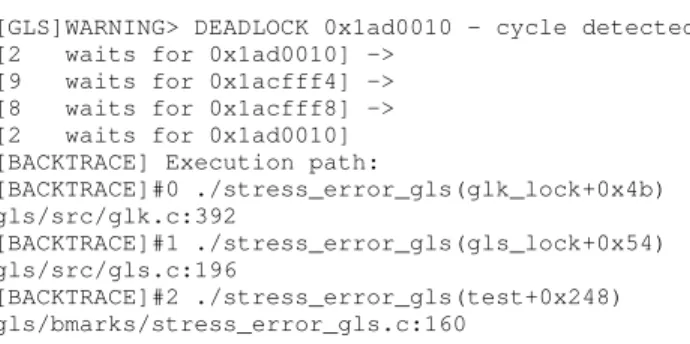
rela-tionships. If such a cycle exists (a series of relationships that starts and ends with the same id) a deadlock is detected. In that case,GLS
prints the details of the cycle as well as the backtrace of the call that caused the deadlock:
[GLS]WARNING> DEADLOCK 0x1ad0010 - cycle detected
[2 waits for 0x1ad0010] ->
[9 waits for 0x1acfff4] ->
[8 waits for 0x1acfff8] ->
[2 waits for 0x1ad0010]
[BACKTRACE] Execution path:
[BACKTRACE]#0 ./stress_error_gls(glk_lock+0x4b) gls/src/glk.c:392 [BACKTRACE]#1 ./stress_error_gls(gls_lock+0x54) gls/src/gls.c:196 [BACKTRACE]#2 ./stress_error_gls(test+0x248) gls/bmarks/stress_error_gls.c:160
Note that this output is a simplified version of the actual output.
GLScan provide more details for debugging the deadlock easier (e.g., automatically setting GDB breakpoints and printing the
ac-tualpthreadids of threads).
Removing GLS Deadlock-detection Overhead.
The overhead ofGLS’s detection technique is high, because every lock and unlock operation has to update some metadata in theGLS
hash table. In our microbenchmarks,GLSin debugging mode per-forms up to 4 times slower than without debugging. However, this metadata (regarding waiting-for relations and lock ownership) is only checked when the deadlock-detection procedure is triggered. Accordingly, we can avoid updating this metadata in normal opera-tion and only have the threads update it when they are stuck behind a lock for a significant amount of time. With this approach, dead-lock detection happens after a couple of invocations to the detection procedure, but we almost completely remove the overheads while threads operate normally.
4.3
Profiling with GLS
GLS can be configured to operate in a low-overhead profiler mode. In this mode,GLSreports per-lock statistics regarding the average queuing behind the lock, the lock acquisition latency, and the critical-section duration. For instance, in SQLite the output is similar to the following:6
[GLS] queue: 0.03 | l-lat: 96 | cs-lat: 194
@ (0x7fe6318eb660:sqlite3.c:pthreadMutexEnter) [GLS] queue: 4.50 | l-lat: 13963 | cs-lat: 2848 @ (0x7fe6318eb4e0:sqlite3.c:pthreadMutexEnter)
We use this profiler mode to easily detect highly-contended locks that are likely to become a scalability bottleneck as we scale a sys-tem. For example, in §5, we use the profiler to better redesign locking in Memcached and to better understand the performance results on various systems.
Additionally, GLK can be configured to print the mode transi-tions that it performs, as well as the reason behind each transition. This output can be used to better understand potential variations in the workload behavior. It can also be used to decide on a pre-determined lock algorithm that is the most suitable for a given lock object in a system (in case the designer selects to use a per-lock custom algorithm).
6SQLite wraps mutex calls in a function. We could get the actual
location of this invocation by printing the backtrace of the call.
5.
GLS / GLK IN LOCK-BASED SYSTEMS
We modify locking in various concurrent systems in order to evaluate the effectiveness ofGLSandGLK. In most systems, mod-ifying locks is as simple as overloading thepthreadmutex func-tions with our own lock implementafunc-tions. We first show how we can easily employGLSin debugging and optimizing Memcached. We then plugGLKin various modern software systems in order to improve their performance.
5.1
Re-engineering Memcached with GLS
Debugging Memcached.
We notice that when we overloadpthreadmutexes with cer-tain lock algorithms (i.e.,TICKET,MCSandGLK), Memcached (v. 1.4.20) hangs. We identify this behavior as the perfect opportunity to show the debugging capabilities ofGLSin action. Indeed,GLS
reports the following output:
[GLS]WARNING> LOCK 0x6344e0 - Uninitialized lock [BACKTRACE] #0 memcached/thread.c:662
[BACKTRACE] #1 memcached/assoc.c:72 [GLS]WARNING> UNLOCK 0x62a494 - Already free
[BACKTRACE] #0 memcached/slabs.c:836 [BACKTRACE] #1 memcached/assoc.c:249
The first warning is about locking the uninitialized
stats_lock in assoc.c. The second one involves
un-locking the slabs_rebalance_lock before it is ever acquired. Based on the output of GLS, we easily fix these two issues. Notice that these issues do not manifest with MUTEX, because (i) the stats_lockis always initialized to zero due to its static declaration [1], and (ii) unlocking a free lock with
MUTEXleaves the lock in the same state. However, the first issue (locking the uninitializedstats_lock) is indeed a programming error, as the behavior of MUTEXin such cases is undefined [9]. The second issue (unlocking the slabs_rebalance_lock
without acquiring it) can either be an error, or not, depending on the configuration ofpthreadmutex.
Optimizing Memcached.
The main goal ofGLSis to make programming with locks easier. To showcase usingGLSin practice, we re-implement synchroniza-tion in the Memcached key-value store from scratch, using theGLS
API directly. We remove the code for lock declaration and initial-ization and replace the calls topthreadlocks with calls toGLS. We use thegls_lockandgls_unlockfunctions and letGLK
choose the most suitable locking technique for our workloads. We remove 26% of the synchronization code of the application and modify 186 lines of code in total. This implementation is the way we expect that mostGLSusers will be using the service, allowing for fast and easy development of lock-based applications.
1. 01 1.07 1. 35 1. 14 1. 00 1.04 1.18 1.07 1. 00 1.09 1. 32 1. 14 0 0.5 1 1.5 2
GET SET/GET SET Avg
Thr oug hput (N or m al iz ed ) MUTEX GLK GLS GLS SPECIALIZED
Figure 13: Normalized (to MUTEX) throughput of our Mem-cached implementations onIvy.
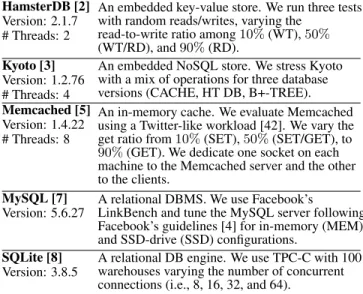
HamsterDB [2] An embedded key-value store. We run three tests with random reads/writes, varying the
read-to-write ratio among10%(WT),50%
(WT/RD), and90%(RD). Version: 2.1.7
# Threads: 2
Kyoto [3] An embedded NoSQL store. We stress Kyoto with a mix of operations for three database versions (CACHE, HT DB, B+-TREE). Version: 1.2.76
# Threads: 4
Memcached [5] An in-memory cache. We evaluate Memcached using a Twitter-like workload [42]. We vary the get ratio from10%(SET),50%(SET/GET), to
90%(GET). We dedicate one socket on each machine to the Memcached server and the other to the clients.
Version: 1.4.22 # Threads: 8
MySQL [7] A relational DBMS. We use Facebook’s
LinkBench and tune the MySQL server following Facebook’s guidelines [4] for in-memory (MEM) and SSD-drive (SSD) configurations.
Version: 5.6.27
SQLite [8] A relational DB engine. We use TPC-C with 100 warehouses varying the number of concurrent connections (i.e., 8, 16, 32, and 64).
Version: 3.8.5
Table 2: Software systems and configurations.
Figure 13 compares the performance of Memcached when using
MUTEX,GLK, as well asGLSusingGLKon ourIvyplatform. The
GLSversion is 7% slower than directly usingGLK. This is due to the overheads ofGLS. Still, theGLSversion is 7% faster than the default Memcached implementation withMUTEX.
We then set out to better understand the performance of locking in Memcached. We first observe the output ofGLKand notice that most locks operate inTICKETmode, which hints at these locks facing little contention. We then use theGLSprofiler mode (see §4.3) to understand the different requirements and behavior of each lock. What we discover is that all the locks used in Memcached exhibit low contention, with the exception of specific global locks (e.g. thestats_lock).
Accordingly, we devise a second version of Memcached, again usingGLS. This time we use the explicit interface ofGLS(see Ta-ble 1), choosing the lock algorithm that best suits each lock. We useMCSlocks for the contended global locks andTICKETlocks for the internal hash table and all other locks.GLSallows us to use any lock algorithm by simply modifying the lock and unlock func-tion calls. This enables us to avoid the adaptafunc-tion overheads and tailor our synchronization code to the optimal strategy. Figure 13 shows that the performance gains from this implementation are significant. Specifically,GLS SPECIALIZEDachieves 14% higher throughput than the defaultMUTEXversion, the same asGLK. Pro-grammers with experience in lock-based programming can use this interface to achieve higher performance while still benefiting from the simplicity ofGLS.
5.2
Optimizing Systems with GLK
We modify locking in five software systems. We select the set of systems so that they employ locking in diverse ways, including concepts such as global locking, fine-grained locking, reader-writer locks, and conditional variables. Table 2 includes a short descrip-tion of the systems that we use, as well as the workloads that we use to evaluate them. All of our experiments use a dataset size of 10 GB, except for the MySQL SSD configuration. For this experi-ment, we use a dataset of 100 GB. We tune each system to achieve maximum throughput and configure the number of threads used based on the maximum-throughput configuration with their default
MUTEXlocks. Figures 14 and 15 show the throughput of the target systems when employing different lock algorithms on ourIvyand
Haswellplatforms respectively.
Overall.
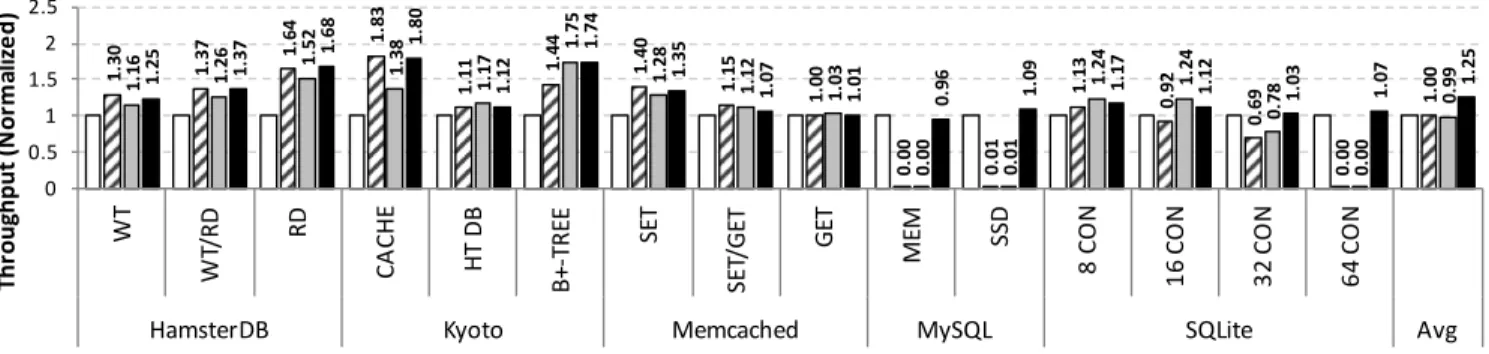
For both platforms, we see that in 14 out of 15 configurations forIvy(and 12 out of 15 forHaswell),GLKimproves the perfor-mance over the default MUTEXlock on the target systems. The performance gains range from 1% to 80% on ourIvymachine, and from 3% to 53% on ourHaswellmachine. On average,GLK deliv-ers 25% higher throughput thanMUTEX onIvy and 21% higher
on Haswell by selecting the most appropriate locking technique
per lock, per phase, and per configuration. Naturally, there do ex-ist configurations where spinlocks are sufficient. In these cases, the performance of both TICKETand MCS is similar. Addition-ally, there are few configurations whereMUTEXdelivers the high-est throughput. In these configurations, whereGLKdoes not de-liver the highest throughput, GLK is slower only up to 8% than the best performing lock. In contrast, in the configurations where
GLKdelivers the best performance, we see the power of adaptive-ness, as no static algorithm can capture the characteristics of the workload. The overall trends in the results are intuitive. In low-contention configurations,TICKET(i.e., simple spinlocks) delivers the best performance due to its simplicity. On higher contention levels,MCSis the fastest. Finally, in multiprogrammed configura-tions, blocking locks, such asMUTEX, are necessary.
HamsterDB.
The HamsterDB embedded key-value store [2] relies on a global lock. Of course, the contention on that lock is very high. We mea-sure with theGLSprofiler that withNworker threads, the average queuing behind the lock is always close toN−1. Consequently, we use just two threads as the application cannot scale further.TICKET
delivers the best performance. GLKoperates inticketmode, de-livering throughput very close toTICKET. MUTEXlags behind in performance because it employs, unnecessary for this workload, block and unblock invocations.
Kyoto Cabinet.
The Kyoto Cabinet NoSQL store [3] comes in two flavors: a hash table, and a B+-tree-based implementation. The hash-table version has two extensions, a store (HT DB) and a cache (CACHE). All three versions protect the main data structure with a highly-contended global reader-writer lock.7
Additionally, the hash-table versions use 16 mutexes, each pro-tecting a group of buckets. These locks typically face very low contention: We use GLS in profiler mode to measure the con-tention and discover that the average queuing behind locks is less than 0.1 and 0.05 for CACHE and HT DB, respectively. However, the throughput of CACHE is approximately 10-times higher than that of HT DB, which means that there is significantly higher traf-fic on the locks of the former. Additionally, CACHE utilizes up to 10 levels of lock nesting. Nesting with MCSlocks is expen-sive because, for each lock, threads must find and use a separate queue node. These behaviors are reflected in the results of CACHE, whereTICKETis significantly faster thanMCS. For CACHE,GLK
operates inticketmode and thus delivers throughput very close to
TICKET. On HT DB, locks are accessed less frequently, hence the performance gains obtained by changing the locks used are smaller than those on CACHE.
The tree-version uses reader-writer locks for the nodes of the tree and mutexes for a custom cache of the tree nodes. These mutexes are highly contended: BothMCSandGLKsignificantly outperform
TICKETandMUTEX.
7For
TICKET,MCS, andGLK, we overload thepthread reader-writer locks with our customTTAS-based implementation.
1. 30 1.37 1.64 1. 83 1. 11 1.44 1.40 1. 15 1. 00 0. 00 0. 01 1. 13 0. 92 0. 69 0. 00 1. 00 1. 16 1.26 1. 52 1. 38 1. 17 1. 75 1. 28 1. 12 1. 03 0. 00 0. 01 1. 24 1. 24 0. 78 0. 00 0. 99 1. 25 1.37 1. 68 1.80 1. 12 1. 74 1. 35 1. 07 1. 01 0. 96 1.09 1.17 1.12 1.03 1.07 1. 25 0 0.5 1 1.5 2 2.5 WT WT /R D RD CA CH E HT D B B+ -TR EE SET SE T/ G ET GET ME M SSD 8 CO N 16 CO N 32 CO N 64 CO N
HamsterDB Kyoto Memcached MySQL SQLite Avg
Th ro ug hp ut (N or m al iz ed ) MUTEX TICKET MCS GLK
Figure 14: Normalized (toMUTEX) throughput of various systems with different locks on our Ivy machine.
1. 41 1. 39 1. 38 1.56 1. 22 1.46 1. 60 1. 29 1. 08 0. 00 0. 00 1. 06 0. 94 0. 78 0. 00 1. 01 1. 40 1. 33 1. 31 1.54 1. 24 1.40 1.43 1. 25 1. 13 0. 00 0. 00 1. 20 1. 18 0. 86 0. 00 1. 02 1. 42 1. 35 1. 27 1.53 1. 14 1.48 1. 53 1. 25 1. 06 0. 99 1.03 1.15 1.11 0. 92 0. 94 1.21 0 0.5 1 1.5 2 2.5 WT WT /R D RD CA CH E HT D B B+ -TR EE SET SE T/ G ET GET ME M SSD 8 CO N 16 CO N 32 CO N 64 CO N
HamsterDB Kyoto Memcached MySQL SQLite Avg
Th ro ug hp ut (N or m al iz ed ) MUTEX TICKET MCS GLK
Figure 15: Normalized (toMUTEX) throughput of various systems with different locks on our Haswell machine.
Memcached.
As we describe earlier in this paper (Section 5.1), the locks in our Memcached experiments typically face low contention. Thus,
TICKETdelivers the highest performance for Memcached. Con-sequently, withGLK, most locks operate inticketmode, achieving performance that is very close to that ofTICKETfor both platforms.
MySQL.
MySQL is a complex system that handles most low-level syn-chronization with custom locks (semaphores). Clearly, neither sim-ple, nor queue-based spinlocks are sufficient for MySQL: In both workloads, MySQL oversubscribes threads to hardware contexts. The result is a livelock for bothMCSandTICKETthat deliver less than 100 operations per second. Notice that the fairness of these two locks exacerbates the problem. In comparison, aTTASlock – not shown in the graph – gives 90% and 50% lower throughput than
MUTEXon the MEM and SSD workloads, respectively.
On MySQL, we see an inherent limitation, but also the true power of adaptiveness. On the in-memory workload,GLK is 4% slower thanMUTEXonIvyand 1% slower onHaswell. This dif-ference in throughput is due to the adaptiveness overhead. Directly using the mutex implementation ofGLKresults in the exact same throughput asMUTEX. However, on the SSD workload we see the power of adaptiveness: Many locks in MySQL are lightly con-tended, thus usingticketmode instead ofmutexresults in 9% higher throughput onIvyand 3% higher throughput onHaswell. In com-plex systems, such as MySQL, it is nearly impossible to manually customize every single lock with the “correct” algorithm.
SQLite.
SQLite is based on a B-tree data structure. SQLite implements concurrency with both coarse and fine-grained locks. SQLite uses aMUTEXfor each database (e.g., each new connection), another for memory allocation, and a last one for protecting the database cache. However, the nodes of the B-tree are protected by custom reader-writer locks. The mutexes of SQLite become contended as we increase the number of connections.
With 8 and 16 connections, MCS gives the best performance, with GLK following closely. However, on 32 connections, the workload has some phases with multiprogramming, thus the per-formance ofMCSandTICKETdrops. As expected, on 64 connec-tions, using fair spinlocks results in livelocks. In comparison,TTAS
– not shown in the graph – delivers 30% lower throughput than
MUTEX. On both 32 and 64 connections,GLK achieves slightly better throughput thanMUTEXonIvyand follows closelyMUTEX
onHaswell, with lightly contended locks remaining inticketmode.
Conclusions.
GLKis able to adapt and capture the needs of all the 15 work-loads on the five systems that we evaluate. Doing so,GLKimproves the performance of these systems by 25% and 21% on average on our two platforms, with practically zero effort on the developer’s side. Even on the configurations thatGLKdoes not deliver the best performance, due to the overheads of adaptation,GLKis only up to 8% slower than the best performing lock. Consequently, our experimental results validate our claim thatGLKcan deliver close-to-optimal performance regardless of the configuration.
6.
RELATED WORK
Lock Algorithms.
Apart from the traditional spinlock algorithms (e.g., test-and-set, ticket locks [47]), there are several efforts towards designing more scalable locks. Mellor-Crummey et al. [47] and Anderson [10] in-troduce several alternatives, such as queue-based locks. Luchangco et al. [45] design a hierarchical CLH lock [20] for NUMA architec-tures. Dice et al. [24] generalize the design of NUMA-aware hier-archical locks by introducing a technique for converting any lock algorithm to be hierarchical. Chabbi et al. [18] and Zhang et al. [60] design locks for NUMA systems, delivering performance in various contention scenarios. David et al. [21] analyze various lock algo-rithms on different platforms and point out that “every lock has its fifteen minutes of fame.” OurGLSmiddleware andGLKalgorithm directly build on top of the observations and the results of such prior work. Concurrently with our work, Guiroux et al. [33] study the performance of lock algorithms in applications and confirm the previous findings. Their LiTL library uses a similar approach to
GLS, but with the aim of easily switching between lock algorithms.
Adaptiveness in Locks.
Karlin et al. [39] analyze the cost of busy waiting and block-ing and show that adaptive techniques (i.e., adaptblock-ing the amount of spinning before threads block) deliver the best performance. Simi-larly, Falsafi et al. [29] design a mutex algorithm that dynamically adapts the amount of spinning when locking/unlocking, to achieve higher energy efficiency. Many modern lock designs, such as the classic mutex lock, both on Linux [6] and on Solaris [56], include this type of adaptiveness. Similarly, the Hotspot 7 JVM modifies its semaphore algorithm at runtime to save memory, based on the idea of thin locks [12]. If there are no threads waiting behind the lock, the JVM represents the lock with just a few bits, otherwise it con-verts the lock to keep track of the queue of waiting threads. Lock elision [31, 52, 53] aims at reducing the overhead of locking when critical sections do not actually conflict. A thread can optimistically execute its critical section without acquiring a lock. If a data con-flict appears, then the thread rolls back and executes the critical sec-tion normally. Diniz and Rinard [25] introduce dynamic feedback, where the compiler generates various synchronization policies that can then be selected at runtime based on sampling.
Lim and Agarwal [41] propose reactive locks, an adaptive syn-chronization scheme that switches between different protocols and waiting strategies. In this sense,GLKcan be viewed as an instance of reactive locks. However,GLKis a fully practical adaptive lock algorithm, tailored to modern multicores.GLKincludes three con-crete lock algorithms which cover the needs of modern software systems, tuned approaches for collecting contention statistics for the locks, as well as a low-overhead method for detecting multi-programming and switching to a blocking lock when necessary.
Johnson et al. [38] present a locking technique (LC) that decou-ples waiting from thread scheduling. A global monitor controls how many threads must block, while the remaining threads use time-published MCS locks [34]. The background thread ofGLK
is similar to this global monitor. However, inGLK, every lock ob-ject is a “normal” lock with just a hint on whether it should employ
themutexmode.
Debugging Locks.
Debugging locks is notoriously hard. The main techniques avail-able today can be categorized intostaticanddynamic. Static tech-niques identify deadlocks by analyzing the lock and flow graphs of an application and by employing heuristics for identifying the prerequisites for a deadlock [28, 50, 58]. Dynamic deadlock-detection techniques employ ways of monitoring the acquired locks
for each thread and discovering cycles in the locks that are being locked [40, 51, 54, 57]. More specifically, Koskinen et al. [40] im-plement a deadlock detection algorithm that allows lock operations to expire. Pyla et al. [51] implement a runtime for deadlock de-tection for applications that usepthreads. Samak et al. [54] use dynamic analysis and execution traces to identify possible dead-locks. GLSincludes a low-overhead, dynamic debugging mode, which can identify issues in lock-based applications.
Alternatives to Traditional Locks.
Transactional memory, in software (STM) [27, 49, 55] or in hardware (HTM) [23, 36], replaces locks with transactions as a concurrency-control mechanism. On the one hand, STMs are typi-cally slower than locks, due to their instrumentation overhead. On the other hand, HTMs are not mature enough and cannot yet fully replace locking [59]. Flat combining [35] is a technique for op-timizing coarse-grained locks (e.g., the global lock of a queue). With flat combining, a critical section translates to a message to a dedicated server thread that executes the request on behalf of the invoking thread. Similarly to flat combining, RCL [44] overloads the lock function for highly-contended locks with remote proce-dure calls on a dedicated server thread. Unlike flat combining and RCL,GLKoptimizes both lightly- and highly-contended locks.
Locks in Systems.
There are various efforts in operating systems to minimize shar-ing [15], to remove lock-related bottlenecks [16, 17], or to com-pletely avoid locks [11, 13] in order to resolve scalability bottle-necks. Similarly, in data stores and DBMSs, recent projects [26, 30, 32, 37, 44, 46] show significant performance improvements in systems such as Memcached and RocksDB, mainly by removing contended locks. GLSis designed to make development of such systems easier, while achieving high performance.
7.
CONCLUSIONS
We introducedGLS, ageneric locking serviceand the accom-panying GLK lock algorithm. GLSis a middleware that makes lock-based system development significantly easier (i) by removing the need for manually handling lock declaration and initialization, (ii) by detecting several common lock-related correctness issues, and (iii) by profiling and reporting per-lock statistics, such as the contention behind a lock and its acquisition latency. GLK simpli-fies things further, by monitoring the contention levels of a lock in order to dynamically adapt the locking algorithm to the needs of the underlying workload, delivering the best performance among spinlocks, queue-based locks, and blocking locks.
We showed that GLS can simplify concurrent programming, adding low overheads compared to directly using a locking algo-rithm. We also showed thatGLKis always able to capture the needs of the workload, adapting to the best-performing algorithm for each workload phase. We usedGLSto re-implement synchronization in Memcached, resulting in 26% less lock-related code and achieving 14% higher throughput. We also used the debugging facilities of
GLSto detect two locking issues in the initial Memcached imple-mentation. Finally, we usedGLKin five software systems: Hams-terDB, Kyoto Cabinet, Memcached, MySQL, and SQLite, compar-ing against their default lockcompar-ing algorithm, as well as the different modes thatGLKcan operate in. We improved the performance of these five systems by 23% on average, on two different platforms, usingGLK, with essentially zero effort.
Acknowledgements
We wish to thank the anonymous reviewers for their helpful com-ments on improving the paper. Part of this work was supported by the European Research Council (ERC) Grant 339539 (AOC).
References
[1] C99 Standard. http://www.open-std.org/jtc1/sc22/wg14/ www/docs/n1256.pdf.
[2] HamsterDB. http://hamsterdb.com.
[3] Kyoto Cabinet. http://fallabs.com/kyotocabinet.
[4] Facebook LinkBench Benchmark. https://github.com/ facebook/linkbench.
[5] Memcached. http://memcached.org.
[6] Pthread Mutex Lock. https://sourceware.org/git/?p=glibc.git; a=blob_plain;f=nptl/pthread_mutex_lock.c;hb=HEAD. Ac-cessed: 2016-09-07.
[7] MySQL. http://www.mysql.com. [8] SQLite. http://sqlite.org.
[9] Information technology Portable Operating System Interface (POSIX) Base Specifications, Issue 7. IEEE/ISO/IEC 9945, 2009.
[10] T. E. Anderson. The Performance of Spin Lock Alternatives for Shared-Memory Multiprocessors.TPDS ’90.
[11] C. Arad, J. Dowling, and S. Ha